Juan J. Montero-Rodr´ıguez
1,2, Edgar Eduardo Salazar-Fl´orez
1, Paola Vega-Castillo
1,2,
Jakob M. Tomasik
∗, Wjatscheslaw Galjan
∗, Kristian M. Hafkemeyer
∗and Wolfgang Krautschneider
11Institute of Nano and Medical Electronics, Hamburg University of Technology, Hamburg, Germany 2Escuela de Ingenier´ıa Electr´onica, Instituto Tecnol´ogico de Costa Rica, Cartago, Costa Rica
Keywords: ASIC, Cell Concentration, Impedance Spectroscopy, Porcine Chondrocytes, Yeast.
Abstract: This paper describes the design and testing of an ASIC for impedance spectroscopy of biological samples at frequencies up to 40 kHz. The circuit is designed in the 350 nm AMS H35B4 technology and enables the measurement of impedances in the range of 10 kΩup to 28 MΩ. The design features a digital oscillator and a current-to-voltage converter. The ASIC is used to monitor the growth of yeast cell cultures and porcine chondrocytes, in real-time, using a standard 384-well plate and copper electrodes.
1
INTRODUCTION
Impedance Spectroscopy is a technique that can be used to monitor different biomedical parameters, such as glucose concentration (Hossain and Dhar, 2013), blood lactate concentration (Alvarenga and Souza, 2007), and cell growth (Giaever and Keese, 1984).
Electrical measurements of the cell growth avoid the use of toxic markers that may degrade the samples (Giaever and Keese, 1986). If the applied voltages are small, there is no cell stress and the cells do not lose vitality. Also, the measurements can be easily automatized, enabling real-time measurement of the cell growth without damaging the cells.
This paper describes the implementation of an Application Specific Integrated Circuit (ASIC) for impedance spectroscopy of biological samples at frequencies up to 40 kHz, for samples in the range from 10 kΩup to 28 MΩ. The chip was designed in the AMS H35B4 technology of 350 nm.
This integrated circuit is used to measure the impedance of samples by the Auto-balancing Bridge Method (ABBM) described in the Impedance Measurement Handbook (Keysight, 2015). The chip allows the use of short wiring between the circuit and the measurement chambers by placing the chip directly on the back of commercial well plates.
∗He was with the Institute of Nano and Medical
Electronics of Hamburg University of Technology at the time the design of the ASIC was performed.
The top view of the ASIC is shown in Figure 1.
ADC
ADC
LPF
LPF
I2V
OSC
SR32Miller-C2
OTA
CAP_array
Figure 1: Top layout of the ASIC.
In this paper the circuit is used to monitor the growth of yeast cell cultures and porcine chondrocytes in different experimental conditions, such as the inclusion of sugar in the culture medium.
The structure of this paper is as follows. The chip architecture and a detailed explanation of the design is described in section 2. The impedance computation with LabVIEW is described in section 3. The measurement setup is shown in section 4. The experimental results from yeast cell measurements are presented in section 5, and experiments with porcine chondrocytes are described in section 6.
222
Montero-Rodríguez, J., Salazar-Flórez, E., Vega-Castillo, P., Tomasik, J., Galjan, W., Hafkemeyer, K. and Krautschneider, W. An Impedance Spectroscopy ASIC for Low-Frequency Characterization of Biological Samples.
2
CHIP ARCHITECTURE
The architecture of the ASIC is shown in Figure 2. The circuit applies a known input voltage to the device-under-test (DUT), and produces an output voltage proportional to the current. The impedance of the DUT can be determined by sampling these input and output voltages, as described in section 3.
Osc
Figure 2: Block diagram of the chip.
The input voltage is provided either by an internal oscillator or an external source. This input signal is low-pass filtered and applied to the DUT. The current is converted to a voltage by the operational amplifier, and the output signal is applied to another low-pass filter. The input and output voltages are sampled by on-chip 10-bit ADCs, or by a National Instruments PCI-6289 acquisition board.
The power is supplied from 3.3 V and 1.65 V sources, and the chip draws approximately 5 mW of power when operating from an external oscillator, with the low-pass filters enabled, and the ADCs deactivated.
2.1
Configuration Register
The circuit operation can be adjusted by programming an on-board 32-bit register. A detailed description of the configuration bits is shown in Table 1.
The default power-on configuration enables the internal oscillator, enables the low-pass filters with
unity gain and sets a feedback resistance at 1 MΩ.
Table 1: Description of the configuration register. Signal Name Description Reg<0> PD 0: Chip Enabled
1: Chip Disabled Reg<1:7> ClkFreq 0010001: 39 kHz
1010110: 15 kHz 0011000: 3 kHz Reg<8:14> ClkLvl 0000001: 1 V
0010100: 500 mV 0010100: 100 mV 1000000: 25 mV Reg<15> OscSel 0: Internal
1: External Reg<16> ByPsLPF1 0: LPF1 Enabled
1: LPF1 Disabled Reg<17> ByPsLPF2 0: LPF2 Enabled
1: LPF2 Disabled Reg<18:20> LPF1set Gain Adjustment 1
000: Av = 1 110: Av = 2 111: Av = 6 101: Av = 10 Reg<21:23> LPF2set Gain Adjustment 2
000: Av = 1 110: Av = 2 111: Av = 6 101: Av = 10 Reg<24:27> I2Vset Feedback Selection
1010: 10 kΩ 0110: 100 kΩ 0000: 1 MΩ 0011: 10 MΩ
2.2
Internal Oscillator
The ASIC includes an on-board oscillator for generating the sinusoidal waveforms applied to the device-under-test. This oscillator is based on a digital resonator circuit, using oversampling and delta-sigma modulation techniques (Lu and Roberts, 1994).
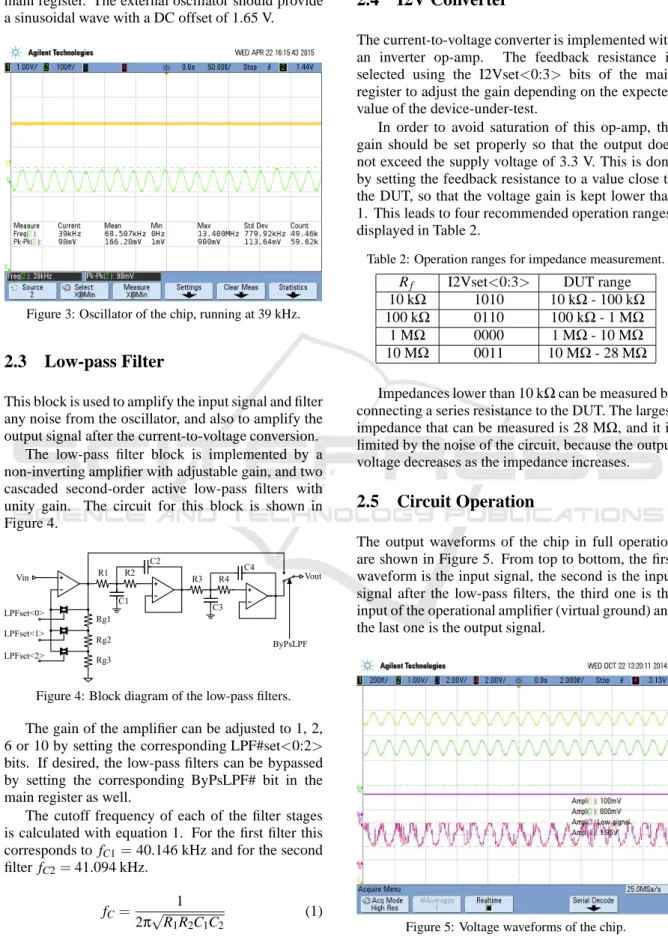
The internal oscillator requires an external square clock source of 12.8 MHz, which can be divided externally by a factor ranging from 1 to 8 to obtain lower oscillation frequencies. The output frequency and amplitude can be programmed by the ClkFreq and ClkLvl configuration bits on the main register.
The output voltage of the internal oscillator is observed in Figure 3 running at 39 kHz with an output amplitude of 98 mV peak-to-peak.
main register. The external oscillator should provide a sinusoidal wave with a DC offset of 1.65 V.
Figure 3: Oscillator of the chip, running at 39 kHz.
2.3
Low-pass Filter
This block is used to amplify the input signal and filter any noise from the oscillator, and also to amplify the output signal after the current-to-voltage conversion.
The low-pass filter block is implemented by a non-inverting amplifier with adjustable gain, and two cascaded second-order active low-pass filters with unity gain. The circuit for this block is shown in Figure 4.
Vin Vout
LPFset<0>
LPFset<1>
LPFset<2>
R1 R2
C1 C2
R3 R4
C3 C4
Rg1
Rg2
Rg3
ByPsLPF
Figure 4: Block diagram of the low-pass filters.
The gain of the amplifier can be adjusted to 1, 2, 6 or 10 by setting the corresponding LPF#set<0:2>
bits. If desired, the low-pass filters can be bypassed by setting the corresponding ByPsLPF# bit in the main register as well.
The cutoff frequency of each of the filter stages is calculated with equation 1. For the first filter this corresponds to fC1=40.146 kHz and for the second
filter fC2=41.094 kHz.
fC= 1
2π√R1R2C1C2
(1)
2.4
I2V Converter
The current-to-voltage converter is implemented with an inverter op-amp. The feedback resistance is selected using the I2Vset<0:3> bits of the main register to adjust the gain depending on the expected value of the device-under-test.
In order to avoid saturation of this op-amp, the gain should be set properly so that the output does not exceed the supply voltage of 3.3 V. This is done by setting the feedback resistance to a value close to the DUT, so that the voltage gain is kept lower than 1. This leads to four recommended operation ranges, displayed in Table 2.
Table 2: Operation ranges for impedance measurement.
Rf I2Vset<0:3> DUT range
10 kΩ 1010 10 kΩ- 100 kΩ 100 kΩ 0110 100 kΩ- 1 MΩ 1 MΩ 0000 1 MΩ- 10 MΩ 10 MΩ 0011 10 MΩ- 28 MΩ
Impedances lower than 10 kΩcan be measured by connecting a series resistance to the DUT. The largest impedance that can be measured is 28 MΩ, and it is limited by the noise of the circuit, because the output voltage decreases as the impedance increases.
2.5
Circuit Operation
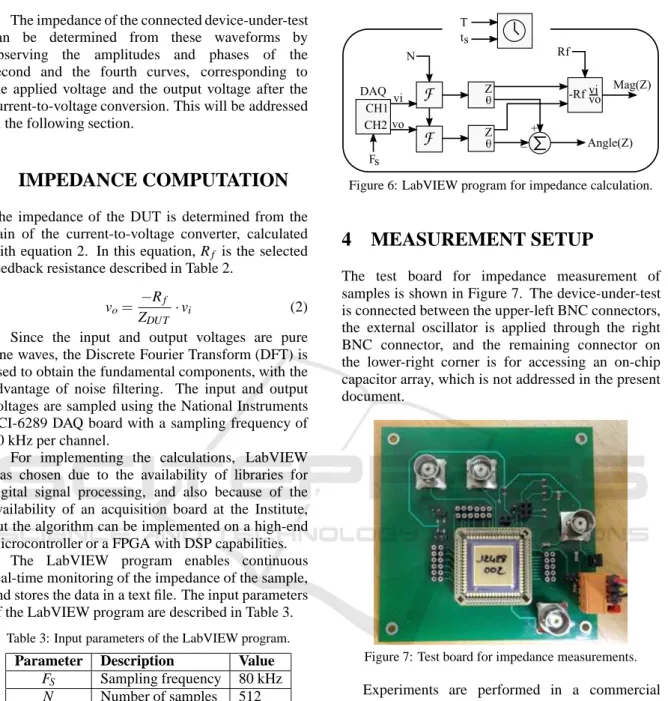
The output waveforms of the chip in full operation are shown in Figure 5. From top to bottom, the first waveform is the input signal, the second is the input signal after the low-pass filters, the third one is the input of the operational amplifier (virtual ground) and the last one is the output signal.
The impedance of the connected device-under-test can be determined from these waveforms by observing the amplitudes and phases of the second and the fourth curves, corresponding to the applied voltage and the output voltage after the current-to-voltage conversion. This will be addressed in the following section.
3
IMPEDANCE COMPUTATION
The impedance of the DUT is determined from the gain of the current-to-voltage converter, calculated with equation 2. In this equation, Rf is the selected
feedback resistance described in Table 2.
vo= − Rf
ZDUT ·vi (2)
Since the input and output voltages are pure sine waves, the Discrete Fourier Transform (DFT) is used to obtain the fundamental components, with the advantage of noise filtering. The input and output voltages are sampled using the National Instruments PCI-6289 DAQ board with a sampling frequency of 80 kHz per channel.
For implementing the calculations, LabVIEW was chosen due to the availability of libraries for digital signal processing, and also because of the availability of an acquisition board at the Institute, but the algorithm can be implemented on a high-end microcontroller or a FPGA with DSP capabilities.
The LabVIEW program enables continuous real-time monitoring of the impedance of the sample, and stores the data in a text file. The input parameters of the LabVIEW program are described in Table 3.
Table 3: Input parameters of the LabVIEW program.
Parameter Description Value
FS Sampling frequency 80 kHz N Number of samples 512
Rf Feedback resistance 10 kΩ T Measurement time 30 min
tS Sampling delay 1 s
The sampling frequency FSis used to acquire the
data and calculate the DFT, using a block size N. The program keeps running for T minutes and averages the measurements, producing one impedance point every tSseconds.
The LabVIEW block diagram used to perform the calculations is presented in Figure 6.
DAQ
F
Figure 6: LabVIEW program for impedance calculation.
4
MEASUREMENT SETUP
The test board for impedance measurement of samples is shown in Figure 7. The device-under-test is connected between the upper-left BNC connectors, the external oscillator is applied through the right BNC connector, and the remaining connector on the lower-right corner is for accessing an on-chip capacitor array, which is not addressed in the present document.
Figure 7: Test board for impedance measurements.
Experiments are performed in a commercial 384-well plate from Corning Inc., using two pins as microelectrodes. The electrodes are of copper and they are changed for every measurement, as they tend to get oxidized and damaged by electrolysis.
The electrodes are shown in Figure 8.
Figure 8: Test chamber with electrodes.
5
YEAST EXPERIMENTS
The growing process of yeast cells can be either synchronous or asynchronous (Asami et al., 1999). In the first case, every cell of the culture is in the same growth stage and therefore the cellular cycles can be seen in the impedance curve. In the asynchronous process, cells are not necessarily in the same growth stage and therefore cycles are not as visible as in the synchronous case.
In the present experiment, the cells are placed in well plates at room temperature, without any controlled environmental condition, and the growth follows an asynchronous process. Therefore it is not possible to observe the reproduction cycles.
5.1
Agilent 4284a LCR Meter
The impedance of a yeast cell culture was measured with an Agilent 4284a LCR Meter to observe the growth pattern of the impedance of the cells with standard commercial equipment.
The test chamber is filled with yeast cells until half of its height (approximately 6 mg), and the rest of the well is filled either with tap water or with sugar water. The sugar concentration was not measured, but is different for the two experimental curves shown in Figure 9. The blue curves describe the growth of yeast cells in tap water, and the red curves describe the impedances of cell cultures in sugar water.
As expected, the growth is accelerated by the inclusion of sugar in the samples. The difference between the two red curves arises from the different glucose concentrations.
Time [s]
0 500 1000 1500
Impedance [k
Ω
]
0 1 2 3 4 5 6
Figure 9: Impedance of yeast cell cultures in tap water (blue) and in sugar water (red), measured with an Agilent 4284a LCR meter for 30 minutes.
5.2
Yeast Experiments with the ASIC
In this section, the ASIC is used to perform the impedance recording of eight yeast samples.
The ASIC is configured to operate with an external oscillator, unity gain at the amplifiers, the low-pass filters activated, and a resistance of 20 kΩ in series with the DUT, to operate the chip in the proper range according to Table 2. This resistance is necessary because the chip is not suitable to measure impedances under 10 kΩ.
The external oscillator provides a sine wave with a frequency of 2 kHz, an amplitude of 100 mV peak-to-peak and a DC offset voltage of 1.65 V. The DC offset can be adjusted during the experiment to operate the chip in the linear region.
The experimental measurements of yeast cell growth are shown in Figure 10. The measurements were carried out for thirty minutes. This plot shows the impedance patterns for eight samples in tap water (blue), five samples in sugar water (red) and a reference line showing the impedance of water without cells (black).
These measurements are similar to Figure 9, and in both scenarios, the impedance of the samples is increasing as the cells grow. The cells in presence of glucose grow faster than the cells immersed only in tap water.
Time [s]
0 500 1000 1500
Impedance [k
Figure 10: Impedance of yeast cell cultures in tap water (blue) and in sugar water (red), plotted together with the impedance of tap water without cells (black) as reference. The 20 kΩ series resistance can be subtracted only if the phase information is available.
6
PORCINE CHONDROCYTES
A second type of cells, the porcine chondrocytes, were used in the experiments with the ASIC. The concentration of cells in the sample is around 1.45×10⁶ cells/ml when immersed in Dulbecco’s Modified Eagle Medium (DMEM). The cells were placed in a standard 384-well plate with a well size of 80 µL. The impedance of one sample was recorded for one hour using the same measurement setup and applied voltages as for the yeast cell experiments. The result is shown in Figure 11.
The impedance remains constant for the first 3000 seconds, and after this time, it starts to decrease.
One reason for this behavior is the cell death due to copper contamination. The test electrodes used for this paper were made of copper, and it is possible that copper ions are being released into the medium. Copper is a toxic material for the cells.
Another possibility is the deposition of cells over time at the bottom of the container. The impedance decreases because the concentration at the top part of the container is reduced.
7
CONCLUSIONS
Impedance measurements of biological samples have been performed with the ASIC. The operation of the chip was confirmed by measuring the impedance of yeast cell samples and of porcine chondrocytes.
Time [s]
0 1000 2000 3000 4000
Impedance [k
Figure 11: Impedance of porcine chondrocytes in series with a 20 kΩresistance. The phase information is necessary to subtract this resistance from the complex impedance of the sample.
The ASIC was able to detect the difference between a yeast cell culture in tap water and another cell culture with sugar water, where the cell growth rate is faster. This was verified in Figure 10.
Also, the chip was able to measure the impedance of porcine chondrocytes and detected a decrease of the impedance after 3000 seconds, which could be related with cell death or cell deposition at the bottom of the container.
For future experiments, it is recommended to use electrodes of platinum or Ag/AgCl, since the copper pins used on this study can get oxidized and affected by electrolysis, changing the composition of the DUT and even damaging the cells.
With these preliminary studies, we conclude that the ASIC can be used to monitor the impedance of biological samples over time.
ACKNOWLEDGEMENTS
The authors would like to thank Dr. Christiane Goepfert from the Institute of Bioprocess and Biosystems Engineering, for providing the materials and support for the porcine chondrocyte experiments.
REFERENCES
Engineering in Medicine and Biology Society, volume 2007, pages 3052–3055. IEEE.
Asami, K., Gheorghiu, E., and Yonezawa, T. (1999). Real-Time Monitoring of Yeast Cell Division by Dielectric Spectroscopy. Biophysical Journal, 76(6):3345–3348.
Giaever, I. and Keese, C. R. (1984). Monitoring fibroblast behavior in tissue culture with an applied electric field. Proceedings of the National Academy of Sciences, 81(12):3761–3764.
Giaever, I. and Keese, C. R. (1986). Use of Electric Fields to Monitor the Dynamical Aspect of Cell Behavior in Tissue Culture. IEEE Transactions on Biomedical Engineering, BME-33(2):242–247.
Hossain, Q. D. and Dhar, S. K. (2013). Characterization of Physiological Glucose Concentration Using Electrical Impedance Spectroscopy. International Journal of Computer Science, 10(1):105–111.
Keysight (2015). Impedance Measurement Handbook. Keysight Technologies, https://www.keysight.com/, 4th edition.