POULTRY PRODUCTION IN SPAIN: NEW ADVANCES IN FEEDING AND NUTRITION PRACTICE
G.G. Mateos, P. Guzmán, B. Saldaña, and R. Lázaro
Department of Animal Science, U.P. Madrid, 28040 Madrid, Spain
E-mail address: [email protected]
1.- Introduction
Spain produces approximately 600 M broiler chickens per year and has a current
laying hen census of 35 M birds. Production of other poultry species, such as turkeys
and ducks, is quite limited. The number of birds slaughtered has remained quite flat for
the last 10 years although final body weight (BW) has increased in this period by almost
200 g per bird. The number of laying hens has decreased markedly (e.g. circa 50 M in
2010) and the proportion of brown-egg layers has increased from less than 10% in 1990
to more than 90% in 2013. In addition to egg color, brown eggs are preferred by the
consumers because of bigger size and better shell quality.
Broiler production corresponds primarily (70:30) to heavy birds slaughtered with
more than 2.7-2.8 kg BW and medium size birds slaughtered at 2.4-2.5 kg BW. The
interest in one or other type of bird depends primarily on geographical location. A small
percentage of birds are destined to the grill market and slaughtered at lower weight
(below 2.0 kg). Details on the characteristics of the diets and expected productive
performance of commercial broilers are showed in Table 1. Most of the carcasses
produced in Spain (> 70%) correspond to white broilers with no corn used in the
finisher phase diets and less than 10-15% in the starter diets. Consequently, commercial
sunflower meal, rapeseed meal, and animal and vegetable fats. High amounts of barley
(e.g., 40-50%), sunflower meal (e.g., 10-15%), and vegetable oil soapstocks (> 2-4%)
are frequently included in the laying hen diets.
Table 1.- Broiler production in Spain
Heavy birds Medium size birds
Nutrient content
AMEn, Mcal/kg 2.95 up to 3.17 3.00 up to 3.16
CP, % 23.0 down to 17.4 23.0-18.5
Dig. Lys, % 1.28 down to 0.93 1.28 down to 0.96
Productive performance
Slaughter BW, kg 2.78-2.85 2.45-2.50
BW gain, g/d 64-66 60-62
FCR 1.75-1.85 1.72-1.75
Days to slaughter 42-45 40-42
Mortality, % 4.5-5.0 4.0-4.5
2.- Main factors impacting poultry production
As in most European Union (EU-27) countries, food safety, animal welfare, and
sustainability issues, are key driver of animal production with high impact in nutritional
decisions. For example, most diets will use phytases and monocalcium phosphate
(rather than dicalcium or tricalcium phosphate) many times irrespective of cost. Also,
the crude protein (CP) content of the diets is decreasing and the utilization of crystalline
amino acids (including Lys, TSAA, Thr, and even Val) increasing. Moreover, numerous
additives such as organic acids, probiotics, and prebiotics are used in substitution of
growth promoters of antibiotic origin. The control of the incidence of footpad
dermatitis, bone fractures, and feather pecking are taking into account in the nutritional
programs, not only because of economic considerations, but also to meet legislation and
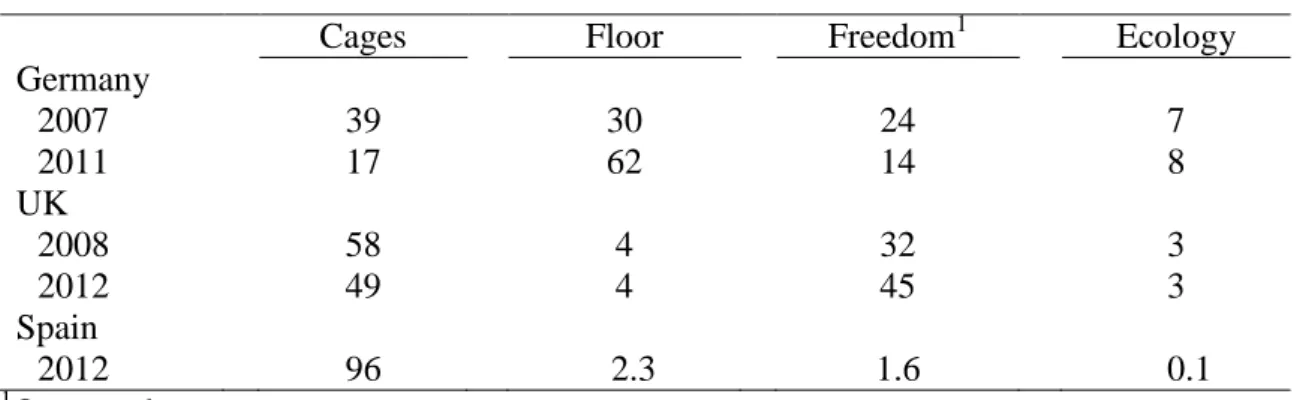
consumer demands. In Table 2, we present data on production systems in key countries
of the EU-27 related to hen welfare. Cages are still prevalent in South Europe while
alternative systems, such as floor production and “freedom park” systems are gaining
Table 2.- Hen production systems in key European Union-27 countries, %
Cages Floor Freedom1 Ecology
Germany
2007 39 30 24 7
2011 17 62 14 8
UK
2008 58 4 32 3
2012 49 4 45 3
Spain
2012 96 2.3 1.6 0.1
1
Open parks
3.- Nutritional practices
At present time, nutritional practices focus on the improvement in feed
efficiency while maintaining carcass quality and fulfilling “social” requirements (food
safety, animal welfare, and sustainability) of the consumers. Although possible, further
increases in BW gain might not be as desirable in the near future, as it is now because of
animal welfare legislation and consumer perception. In this respect, the industry is
paying attention to 1) feed form of the diet and particle size of the ingredients, 2)
carcass quality, integrity of the skeleton and the skin, and incidence of footpad
dermatitis at slaughter, 3) judicious use of long-time existing (coccidiostats, enzymes,
pigments, organic acids) and new (proteases, phytases, probiotics, prebiotics, herbs)
additives, 4) control of microflora growth and microbial profile to improve
gastrointestinal tract (GIT) health, and 5) feed and food safety for both chickens and
humans. In this respect, high microbial counts or presence of Salmonella spp in the
feed, or contamination by mycotoxins, heavy metals, dioxins, or chemical products of
ingredients is no longer acceptable. Moreover, the use of “in feed antibiotics” as
integrators will not use any ingredient of animal origin (such as lard or tallow) in their
feeds.
4.- Digestive physiology and GIT health
The incidence of subclinical coccidiosis and the presence of Clostridium spp is
of a major concern for most integrators. The ban of use of many coccidiostats, including
nicarbazine, and “in feed antibiotics” as growth promoters has increased the incidence
of litter problems. Many efforts in management and nutritional practices try to modulate
GIT function, control microbiota growth, and improve the consistency of the excreta. In
any case, the incidence and severity of wet litter problems is of limited relevance under
practical conditions because of improvements in chick quality and hygiene and
management conditions of the farms, as well as subtle changes in composition and
nutritional specifications of the feeds. Practices used in this respect include a) coarse
grinding of ingredients, b) use of mash diets rather than pellet diets, c) moderate
reductions in CP content while maintaining the amino acids (AA) profile, d) moderate
increases in dietary fiber, e) inclusion of whole wheat, and f) utilization of certain
additives. Many of these practices aim to improve gizzard development and GIT
function with better tuning of the anatomy and physiology of the digestive tract and of
the microbial profile (Mateos et al., 2002, 2012).
a.- Feed form and particle size
Pelleting is a common practice used to maximize growth performance and
reduce feed wastage in commercial broiler operations (Abdollahi et al., 2011; Serrano et
al., 2013). Heat, moisture, and pressure applied during the pelleting process modify
or crumbles than with mash diets (Serrano et al., 2012). Serrano et al. (2012) compared
growth performance of broilers fed mash, crumbles, or pellets from 1 to 21 d followed
by a common pelleted diet from 21 to 42 d of age and observed a 7.4 and 5.8% increase
in BWG with crumbles or pellets as compared with mash feeding. Also, FCR was 3%
better for chicks fed pellets than for chicks fed mash, with chicks fed crumbles being
intermediate (Table 3). The benefits of pellet feeding as compared with mash feeding on
broiler growth diminished with age. Moreover, the incidence of wet litter, Escherichia
coli counts, and Salmonella spp contamination of carcasses is higher with pellets than
with mash (Engberg et al., 2002; Huang et al., 2006).
Table 3.- Effects of feed form on growth performance of broilers1 (Serrano et al., 2012)
BWG (g/d) ADFI (g) FCR
Day 1-21
Mash 34.6b 57.0ab 1.65a
Crumbles 42.4a 58.8a 1.39b
Pellets 43.4a 56.3b 1.30c
P *** * ***
Day 21-42
Mash 89.1 154.0b 1.73b
Crumbles 90.6 166.1a 1.83a
Pellets 87.8 161.0a 1.84a
P 0.11 *** ***
1
Four replicates of 65 birds each per treatment
Pelleting requires fine grinding of the ingredients to improve the cohesion of
feed particles. Consequently, the digest passage rate through the GIT is faster with
pellets than with mash. As a result, birds will be satiated faster and will eat less of a
coarse mash diet than of a pellet diet (Amerah et al., 2007) and consequently, growth
rate will improve when the feed is pelleted. On the other hand, gizzard function and GIT
development will improve with coarse grinding of the diet as compared with fine
ground pelleted diets and consequently, nutrient digestibility might be reduced with
2010; Serrano et al., 2013) has shown that pelleting reduced nutrient digestibility an
effect that might be more noticeable with wheat than with coin diets and when high
temperatures are used. The existing data suggest that during the last part of the
fattening, a period in which broilers are growing over 100 g/d, pelleting of the feed
might improve BW gain but not necessarily feed efficiency. Moreover, a slight
reduction in feed intake in this period might benefit feed efficiency of the chickens.
b.- Whole grain inclusion
The inclusion of whole wheat and other cereals in the diet results usually in an
improvement in litter quality without any negative impact on growth or feed efficiency
(Hetland et al., 2002; Plavnik et al., 2002; Svihus et al., 2004). Usually, whole wheat
added at the expenses of the whole diet, improves nutrient digestibility and reduces
feeding cost (Svihus et al., 2001). Whole wheat feeding led to changes of the upper part
of the digestive tract with an increase in gizzard and pancreas development (Gabriel et
al., 2008). The improvement in litter quality observed is often associated with changes
in the microbial profile of the GIT with a reduction in Clostridiumspp count (Bjerrum
et al., 2006) and better control of subclinical coccidiosis (Gabriel et al., 2003a,b).
However, the use of high proportion of whole wheat reduces carcass yield, and when
fed early in life, might reduce feed intake. Probably, birds will need to learn and adapt
to whole wheat feeding as early as possible.
c.- Dietary fiber
Traditionally, fiber has been considered as a diluent and an antinutritional factor
in broiler diets with negative effects on feed intake, nutrient digestibility, microbial
2010; Svihus, 2011; Mateos et al., 2012) have shown that this might not be the case and
that will depend on the ingredient composition of the diet, age of the birds, and type and
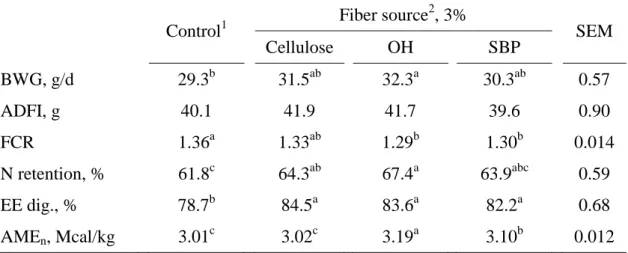
level of fiber source used (Tables 4 and 5).
Table 4.- Effects of dietary fiber on growth performance of broilers from 1 to 42 d of age (González-Alvarado et al., 2010)
Fiber source Control1 OH SBP SEM
BWG, g/d 55b 60a 56b 0.9
ADFI, g 88ab 90a 85b 1.0
FCR 1.59a 1.49b 1.53b 0.014
Energy efficiency2 20.8 20.4 20.5 0.19
1
Sepiolite was substituted (wt/wt) by 3% OH or SBP
2
MJ AMEn/kg BW
Table 5.- Effects of fiber inclusion in low fiber diets in broilers from 1 to 21 d of age (González-Alvarado et al., 2007)
Control1
Fiber source2, 3%
SEM
Cellulose OH SBP
BWG, g/d 29.3b 31.5ab 32.3a 30.3ab 0.57
ADFI, g 40.1 41.9 41.7 39.6 0.90
FCR 1.36a 1.33ab 1.29b 1.30b 0.014
N retention, % 61.8c 64.3ab 67.4a 63.9abc 0.59
EE dig., % 78.7b 84.5a 83.6a 82.2a 0.68
AMEn, Mcal/kg 3.01c 3.02c 3.19a 3.10b 0.012
1
Contained 1.5% CF
2
Sepiolite in the control diet was substituted (wt/wt) by CEL, OH, or SBP
In general, dietary fiber increased gizzard weight and benefit reverse peristaltism
and endogenous enzymes production, resulting in a reduction in gizzard pH and in an
improvement in nutrient digestibility (Hetland et al., 2003; Amerah et al., 2009;
Table 6. Effect of inclusion of oat hulls (OH) and sugar beet pulp (SBP) in the diet on the pH of the digesta of the proventriculus, gizzard and duodenum of broilers at 6 days
of age (Jiménez-Moreno et al., 2013b)
Fiber inclusion
(%)
Proventriculus Gizzard Duodenum
Control 0 4.51a 4.07a 6.19b
OH 2.5 4.23abc 3.15b 6.21b
OH 5.0 4.27abc 3.09b 6.27b
OH 7.5 4.31ab 2.97b 6.28ab
SBP 2.5 3.99c 3.02b 6.30ab
SBP 5.0 4.07bc 2.92b 6.37ab
SBP 7.5 4.14bc 2.90b 6.40a
S.E.M.1 0.099 0.099 0.043
P-value2
Diet 0.017 <0.001 0.010
OH inclusion
Linear 0.206 <0.001 0.083
Quadratic 0.111 <0.001 1.000
SBP inclusion
Linear 0.026 <0.001 <0.001
Quadratic 0.005 <0.001 0.396
Fibre source 0.017 0.139 0.005
1
Standard errorof the mean (n = 6 replicates of 12 birds each per treatment).
2
The interaction source x level of fiber were not significant (P > 0.10).
High quality ingredients are commonly used in diets for young chicks to reduce
the incidence of enteric disorders and increase growth performance (Mateos et al.,
2002). The amount of fiber contained in these diets is maintained limited to maximize
voluntary feed intake and increase nutrient digestibility. However, low fiber diets might
compromise GIT function and nutrient utilization (Svihus, 2011; Jiménez-Moreno et al.,
Table 7.- Influence of increasing levels of pea hulls in the diet on broiler performance from 1 to 18 d of age (Jiménez-Moreno et al., 2011)
Pea hulls1, %
SEM
02 2.5 5.0 7.5
BWG, g/d 30.0b 31.2b 34.5a 31.1b 1.01
ADFI, g 41.2 41.2 45.9 39.6 1.15
FCR 1.38a 1.32b 1.33b 1.38a 0.014
Energy eff.3 54.3b 56.1a 56.2a 55.4ab 0.57
1
The control diet diluted (wt/wt) with 2.5, 5.0 or 7.5% of pea hulls
2
Contained 3.9% NDF
3
g BW gain/MJ AMEn intake
Fiber inclusion reduced gizzard pH (Jiménez-Moreno et al., 2009a,b), improved
digestive juices secretion, gizzard function, and digesta flow, and might modify
microbiota profile in the GIT of the birds (González-Alvarado et al., 2010; Svihus,
2011; Mateos et al., 2012) (Table 8).
Table 8.- Effects of dietary fiber on microbiota profile in broilers at 36 d of age (Mateos et al., 2012)
Fiber source 0%3 5% OH 5% SBP
Crop
Lactobacilli 7.9b 7.1b 8.4a
Ceca
Lactobacilli 9.8 8.6 10.0
Clostridium perfr. 5.9a 1.2b 6.2ª
Enterobacterias 8.4a 5. 9b 8.4a
1
Log10 cfu/g
2
Reared in floor pens
3
Contained 3.9% NDF. Diets diluted (wt:wt) with fiber source
In this respect, Gonzalez-Alvarado et al. (2007) reported that the inclusion of an
with approximately 1.5% CF, improved nutrient digestibility and growth performance
of the birds (Table 5).
Not all fiber sources will show similar effects on bird growth. Solubility, water
holding capacity, viscosity, bulk, fermentative capability, and other physico-chemical
properties of fibrous ingredients affect the development and pH of the GIT and
consequently, they may have nutritional implications in poultry (Montagne et al., 2003;
Jiménez-Moreno et al., 2009b). In this respect, soluble fibrous fractions such as pectins
from sugar beet pulp (SBP), are dispersible in water and might increase viscosity and
bulk of the digesta, reducing feed intake (Table 4). Also, an increase in digesta viscosity
may reduce the rate of diffusion of digestive enzymes into the digesta, hampering
nutrient absorption. On the other hand, insoluble fibrous fractions, such as those present
in OH, stimulate gizzard activity, reduce gizzard pH, and favour GIT refluxes which
may improve nutrient digestibility (Hetland and Svihus, 2001; Hetland et al., 2003;
Jiménez-Moreno et al., 2010, 2013b). Consequently, the inclusion of high levels of SBP
in the diet might result in poor growth performance whereas the inclusion of OH might
have opposite effects (Table 9).
Table 9. Effect of inclusion of oat hulls (OH) and sugar beet pulp (SBP) in substitution of the whole diet (g:g) on body weight gain of broilers (Jiménez-Moreno et al., 2013a)
BW (g) Fibre inclusion
(%) 6 d 12 d
Control 0 132abc 311
OH 2.5 131abc 318
OH 5.0 134a 319
OH 7.5 127bc 305
SBP 2.5 132ab 317
SBP 5.0 129bc 307
SBP 7.5 126c 297
S.E.M.a 1.7 6.3
P-value
The inclusion of 25 to 75 g/kg of a fibre source in the diet stimulated the
development of the organs of the GIT in young broilers (Jiménez-Moreno et al., 2013b).
At similar levels of inclusion, OH was more beneficial for the development of the
gizzard than SBP inclusion, and therefore, lower levels of OH than of SBP might be
required to stimulate gizzard function. The inclusion of 75 g SBP/kg diet, however, had
detrimental effects on intestinal mucosa morphology at early ages. Consequently, diets
for young broilers should be formulated with a minimum and a maximum level of
dietary fibre. The recommended level of dietary fibre in broiler diets will depend on the
age of the bird as well as on the physico-chemical characteristics of the fibre source
used. To notice that the “old concept” suggesting negative effects of dietary fiber on
bird growth is still valid; an excess of fiber (e.g., > 4-5% CF) might have detrimental
effects on the structure of the jejune mucosa and reduce nutrient digestibility (Table 7).
In particular, an excess of soluble, easily fermented fiber source, might reduce feed
intake and broiler growth (Tables 4 and 9). However, a very low level of dietary fiber
(e.g., < 2.0% CF), especially in young chicks, might reduce growth performance.
5.- Conclusions
Broiler productivity has increased steadily in Europe for the last 7 years in spite
of the ban of use of “in feed” antibiotics as growth promoters. The continuous efforts of
the breeding companies involved in the genetic of the birds might maintain these
improvements for the next 10 years. However, new regulations on animal welfare might
change objectives from increasing body weights to improving feed efficiency. On the
other hand, the lower use of “in feed antibiotics” in broiler diets to improve food safety,
guarantees the implementation of new feeding strategies to reduce the incidence of wet
management of the farm, new studies on feed form and particle size, inclusion of whole
grains, and level of crude protein and fiber of the diet might facilitate GIT development
and function, resulting in an improvement of broiler production.
6.- References
Abdollahi, M. R., V. Ravindran, T. J. Wester, G. Ravindran, and D. V. Thomas. 2010.
Influence of conditioning temperature on the performance, nutrient utilisation
and digestive tract development of broilers fed on maize- and wheat-based diets.
Br. Poult. Sci. 51:648-657.
Abdollahi, M. R., V. Ravindran, T. J. Wester, G. Ravindran, and D. V. Thomas. 2011.
Influence of feed form and conditioning temperature on performance, apparent
metabolisable energy and ileal digestibility of starch and nitrogen in broiler
starters fed wheat-based diet. Anim. Feed Sci. Technol. 168:88-99
Amerah, A.M., V. Ravindran, R.G. Lentle, and D. V. Thomas. 2007. Feed particle size:
implications on the digestion and performance in poultry. World’s Poult. Sci. J.
63:439-451.
Amerah, A.M., V. Ravindran, and R.G. Lentle. 2009. Influence of insoluble fibre and
whole wheat inclusion on the performance, digestive tract development and ileal
microbiota profile of broiler chickens. Br. Poult. Sci. 50:366-375.
Bjerrum, L., R. M. Engberg, T. D. Leser, B. B. Jensen, K. Finster, and K. Pedersen.
2006. Microbial community composition of the ileum and cecum of broiler
chickens as revealed by molecular and culture-based techniques. Poult. Sci.
Engberg, R.M., M.S. Hedemann, and J.B. Jensen. 2002. The influence of grinding and
pelleting of feed on the microbial composition and activity in the digestive tract
of broiler chickens. Br. Poult. Sci. 43:569-579.
Gabriel, I., S. Mallet, M. Leconte, G. Fort, and M. Naciri. 2003a. Effects of whole
wheat feeding on the development of coccidial infection in broiler chickens.
Poult. Sci. 82:1668-1676.
Gabriel, I., S. Mallet, and M. Leconte. 2003b. Differences in the digestive tract
characteristics of broiler chickens fed on complete pelleted diet or on whole
wheat added to pelleted protein concentrate. Br. Poult. Sci. 44:283-290.
Gabriel, I., S. Mallet, and M. Leconte. 2008. Effect of whole wheat feeding on the
development of the digestive tract of broiler chickens. Anim. Feed Sci. Technol.
142:144-162.
González-Alvarado, J. M., E. Jiménez-Moreno, R. Lázaro, and G.G. Mateos. 2007.
Effects of type of cereal, heat processing of the cereal, and inclusion of fibre in
the diet on productive performance and digestive traits of broilers. Poult. Sci.
86:1705-1715.
González-Alvarado, J.M., E. Jiménez-Moreno, D.G. Valencia, R. Lázaro, and G.G.
Mateos. 2008. Effects of fibre source and heat processing of the cereal on the
development and pH of the gastrointestinal tract of broilers fed diets based on
corn or rice. Poult. Sci. 87:1779-1795.
González-Alvarado, J.M., E. Jiménez-Moreno, D. González-Sánchez, R. Lázaro, and
G.G. Mateos. 2010. Effect of inclusion of oat hulls and sugar beet pulp in the
diet on productive performance and digestive traits of broilers from 1 to 42 days
Hetland, H., and B. Svihus. 2001. Effect of oat hulls on performance, gut capacity and
feed passage time in broiler chickens. Br. Poult. Sci. 42:354-361.
Hetland, H., B. Svihus, and V. Olaisen. 2002. Effect of feeding whole cereals on
performance, starch digestibility and duodenal particle size distribution in broiler
chickens. Br. Poult. Sci. 43:416-423.
Hetland, H., B. Svihus, and Å. Krögdahl. 2003. Effects of oat hulls and wood shavings
on digestion in broilers and layers fed diets based on whole or ground wheat. Br.
Poult. Sci. 44:275-282.
Huang, D.S., D.F. Li, J.J. Xing, Y.X. Ma, Z.J. Li, and S.Q. Lu. 2006. Effects of feed
particle size and feed form on survival of Salmonella typhimurium in the
alimentary tract and cecal S. typhimurium reduction in growing broilers. Poult.
Sci. 85:831-836.
Jiménez-Moreno, E., J.M. González-Alvarado, A. de Coca-Sinova, R. Lázaro, and G.G.
Mateos. 2009a. Effects of source of fibre on the development and pH of the
gastrointestinal tract of broilers. Anim. Feed Sci. Technol. 154:93-101.
Jiménez-Moreno, E., J.M. González-Alvarado, A. González-Serrano, R. Lázaro, and
G.G. Mateos. 2009b. Effect of dietary fibre and fat on performance and digestive
traits of broilers from one to twenty-one days of age. Poult. Sci. 88:2562-2574.
Jiménez-Moreno, E., J.M. González-Alvarado, R. Lázaro, and G.G. Mateos. 2009c.
Effects of type of cereal, heat processing of the cereal, and fibre inclusion in the
diet on gizzard pH and nutrient utilization in broilers at different ages. Poult. Sci.
88:1925-1933.
Jiménez-Moreno, E., J.M. González-Alvarado, D. González-Sánchez, R. Lázaro, and
performance and digestive traits of broilers from 1 to 21 days of age. Poult. Sci.
89:2197-2212.
Jiménez-Moreno, E., S. Chamorro, M. Frikha, H.M. Safaa, R. Lázaro, and G.G. Mateos.
2011. Effects of increasing levels of pea hulls in the diet on productive
performance and digestive traits of broilers from one to eighteen days of age.
Anim. Feed Sci. Technol. 168:100-112.
Jiménez-Moreno, E., M. Frikha, A. de Coca-Sinova, J. García, and G.G. Mateos. 2013a.
Oat hulls and sugar beet pulp in diets for broilers. 1. Effects on growth
performance and nutrient digestibility. Anim. Feed Sci. Technol. 182:33-43.
Jiménez-Moreno, E., M. Frikha, A. de Coca-Sinova, R. Lázaro, and G.G. Mateos.
2013b. Oat hulls and sugar beet pulp in diets for broilers. 2. Effects on the
development of the gastrointestinal tract and of the structure of the jejunal
mucosa. Anim. Feed Sci. Technol. 182:44-52.
Mateos, G.G., R. Lázaro, and M. I. Gracia. 2002. The feasibility of using nutritional
modifications to replace drugs in poultry feeds. J. Appl. Poult. Res. 11:437-452.
Mateos, G.G., E. Jiménez-Moreno, M.P. Serrano, and R.P. Lázaro. 2012. Poultry
response to high levels of dietary fiber sources varying in physical and chemical
characteristics. J. Appl. Poult. Res. 21:156-174.
Montagne, L., J.R. Pluske, and D.J. Hampson. 2003. A review of interactions between
dietary fibre and the intestinal mucosa, and their consequences on digestive
health in young non-ruminant animals. Anim. Feed Sci. Technol. 108:95-117.
Plavnik, I., B. Macovsky, and D. Sklan. 2002. Effects of feeding whole wheat on
Serrano, M. P., D. G. Valencia, J. Mendez, and G. G. Mateos. 2012. Influence of feed
form and source of soybean meal of the diet on growth performance of broilers
from 1 to 42 days of age. 1. Floor pen study. Poult. Sci. 91:2838-2844.
Serrano, M. P., M. Frikha, J. Corchero, and G. G. Mateos. 2013. Influence of feed form
and source of soybean meal on growth performance, nutrient retention, and
digestive organ of broilers. 2. Battery study. Poult. Sci. 92:693-708.
Svihus, B., and H. Hetland. 2001. Ileal starch digestibility in growing broiler chickens
fed on a wheat based diet is improved by mash feeding, dilution with cellulose
or whole wheat inclusion. Br. Poult. Sci. 42:633-637.
Svihus, B., E. Juvic, H. Hetland, and A. Krogdalhl. 2004. Causes of improvement in
nutritive value of broiler chicken diets with whole wheat instead of ground
wheat. Br. Poult. Sci. 45:55-60.
Svihus, B., 2011. The gizzard: function, influence of diet structure and effects on