
The term executive functions refers to a set of skills involved in the generation, supervision, regulation, execution, and readjustment of behavior to achieve complex goals, especially those that require a novel and creative approach (Verdejo-García & Bechara, 2010). Executive functions comprise different processes, such as goal setting, hypothesis formulation, planning, focal attention, concentration, strategy generation, monitoring, response to feedback, the capacity to solve problems, abstract thinking, cognitive fl exibility, working memory, and emotional control (Korzeniowski, 2011). Alterations in these processes during childhood and adolescence cause diffi culties in an extensive
range of domains, including cognitive, behavioral, and social problems.
In this regard, many studies have shown the close relationship between the presence of executive defi cits and specifi c problems in concrete areas such as reasoning, mathematics, reading, and writing (García, Rodríguez et al., 2013; Latzman, Elkovitch, Young, & Clark, 2010; Raghubar, Barnes, & Hecht, 2010; Stelzer & Cervigni, 2011; Van der Ven, Kroesbergen, Boom, & Leseman, 2013). Numerous studies have also shown how the inadequate development of these processes is related to diffi culties in the individual’s adaptation to the environment (Brock, Rimm-Kaufman, Nathanson, & Grimm, 2009; Garon, Bryson, & Smith, 2008; McClelland et al., 2007).
The study of the executive functions has also been particularly useful in the differential diagnosis of numerous childhood and adolescent disorders, mainly Attention Defi cit with Hyperactivity Disorder (ADHD; Di Trani et al., 2011; Hale et al., 2011; Makris, Biederman, Monuteaux, & Seidman, 2009; Shimoni, Engel-Yeger,
Psychometric characteristics of the BRIEF scale for the assessment
of executive functions in Spanish clinical population
Trinidad García Fernández, Julio Antonio González-Pienda, Celestino Rodríguez Pérez, David Álvarez García
and Luis Álvarez Pérez
Universidad de Oviedo
Abstract
Background: The Behavior Rating Inventory of Executive Functions (BRIEF) scale, completed by families, is widely known in the assessment of executive functions in children and adolescents. However, its application is limited to English-speaking population. Method: This study analyzes the preliminary results from its application in a Spanish clinical sample, comprising 125 participants aged 5-18 years. Internal structure and reliability of the translated scale were analyzed, as well as its relationship with other behavioral measures through the analysis of their correlations with the Assessment of Attention Defi cit Hyperactivity Disorder Scale (EDAH). The results were compared with those from the original validation study.
Results: The data revealed the presence of the same internal structure, as well as acceptable internal consistency and signifi cant correlations with the Attention Defi cit and Hyperactivity components of the EDAH scale.
Conclusions: This study provides preliminary evidence of the utility of the BRIEF scale in cultural contexts different from the original, particularly in Spanish clinical population.
Keywords: BRIEF, Spanish, executive functions, family.
Resumen
Características psicométricas de la escala BRIEF para la evaluación de funciones ejecutivas en población clínica española. Antecedentes:
la escala Behavior Rating Inventory of Executive Functions (BRIEF), cumplimentada por familias, es ampliamente conocida en la evaluación de las funciones ejecutivas en niños y adolescentes. Sin embargo, su aplicación está limitada a población de habla inglesa. Método: en este estudio se analizan los primeros resultados procedentes de su aplicación a una muestra clínica española, formada por 125 participantes de 5 a 18 años. Se analizó la estructura interna y fi abilidad de las puntuaciones de la escala traducida al español, así como su relación con otras medidas comportamentales a través del análisis de sus correlaciones con la escala de Evaluación del Défi cit de Atención con Hiperactividad (EDAH). Los resultados se compararon con los del estudio de validación original.
Resultados: los datos mostraron la presencia de una misma estructura interna de las puntuaciones, así como una aceptable consistencia interna y correlaciones estadísticamente signifi cativas con los componentes de Défi cit de Atención e Hiperactividad de la escala EDAH. Conclusiones:
este estudio aporta evidencia preliminar sobre la utilidad de la escala BRIEF en contextos culturales diferentes al originario, concretamente en población clínica española.
Palabras clave: BRIEF, español, funciones ejecutivas, familia.
Received: May 22, 2013 • Accepted: September 5, 2013 Corresponding author: Celestino Rodríguez Pérez Facultad de Psicología
Universidad de Oviedo 33003 Oviedo (Spain)
& Tirosh, 2012), Autistic Spectrum Disorders (Han et al., 2011; Kenworthy, Black, Harrison, Della Rosa, & Wallace, 2009), and other clinical conditions (Donders, Den Braber, & Vos, 2010; Neri et al., 2012; Vinţan, Palade, Cristea, Benga, & Muresanu, 2012; Wilson, Donders, & Nguyen, 2011).
However, although nowadays the relevance of the executive functions is clear in research, their assessment is often complex. This complexity is partially due to the type of measurement instruments employed, as most of them are performance-based. For some authors, this type of measures, such as the Stroop Test, the Tower of Hanoi or the Wisconsin Card Sorting Test, present low ecological validity and are not representative of the individual’s functioning in real life settings (Gioia, Kenworthy, & Isquith, 2010; Henry & Bettenay, 2010; Lezak, Howieson, Bigler, & Tranel, 2012; Toplak, Bucciarelli, Jain, & Tannock, 2009; Verdejo-García & Bechara, 2010). These tasks, which are excessively structured and based on quantitative criteria, disregard much relevant information about children and adolescents’ daily functioning, such as the type of strategies they employ to solve problems, their capacity to plan and to recall certain rules or guidelines, to inhibit behaviors or impulses, or to adapt to new settings or situations.
An alternative to this type of measures is the use of questionnaires based on the observation of the behavior, such as the BRIEF (Behavior RatingInventory of Executive Function; Gioia, Isquith, Guy, & Kenworthy, 2000). There are several hetero-report versions of this questionnaire. The most frequently employed is based on information provided by the family. It is applicable from ages 5 to 18 years and it assesses the frequency with which children and adolescents display certain problematic behaviors related to defi cits in executive functions at home and/or in school. For this purpose, it uses a Likert-type response format ranging from 1 to 3, where 1 is never, 2 is sometimes, and 3 is often. The scale is made up of 86 items (72 computable items and 14 additional ones). The latter do not contribute to the score but are useful to orient possible interventions. The remaining 72 items form 8 scales: Inhibit, Shift, Emotional Control, Initiate, Working Memory, Plan/Organize, Organization of Materials, and Monitor, which in turn are grouped into two main indexes: the Behavioral Regulation Index (BRI), made up of the fi rst three scales, and the Metacognition Index (MI), made up of the remaining fi ve. Both indexes made up the Global Executive Composite (GEC) score. High scores in these scales and indexes indicate executive defi cit. It also includes two validity scales to identify problematic response styles. These scales are based on the analysis of the excessive frequency assigned to certain items (Negativity) or the correspondence between pairs of items (Inconsistency) and are not submitted to statistical analysis.
This instrument has shown its utility for the assessment of executive functions in a broad range of clinical conditions (Anderson & Reidy, 2012; Lee et al., 2011; Toplak et al., 2009; Wilson et al., 2011), especially in ADHD (Jarratt, Riccio, & Siekierski, 2005; McCandless & O’Laughlin, 2007; Toplak et al., 2009). In this regard, numerous studies have analyzed the executive profi le in ADHD and its subtypes, as well as in comorbidity with other disorders such as Reading Diffi culties (RD). These studies have pointed to response inhibition and working memory as key issues in the differentiation of ADHD, fi nding greater impairment of response inhibition in groups with hyperactivity/impulsivity and more impairment of working memory in groups with inattention (García et al., in press; Gioia et al., 2000; McCandless
& O’Laughlin, 2007; Riccio, Homack, Jarratt, & Wolfe, 2006), as well as differential executive profi les in groups with ADHD and ADHD with associated RD. Specifi cally, García et al. (2013) found greater executive defi cit in the group with ADHD and associated RD than in the group with isolated ADHD, mainly in working memory and plan, coherent with previous studies carried out by Pratt (2000) with the BRIEF scale, as well as by Bental and Tirosh (2007), Van De Voorde, Roeyers, Verté and Wiersema (2010), and Willcutt et al. (2010) with performance-based tests.
However, despite being one of the most extensively employed scales, its use has been limited to English-speaking countries, except for a new version available in Dutch (Huizinga & Smidts, 2011; Smidts & Huizinga, 2009). Therefore, to determine its potential utility beyond its original context, we translated the scale into Spanish.
This aim of this work is to address the fi rst analysis of the internal structure of the BRIEF scores, and also to obtain evidence of their reliability and the degree of its association with other behavioral measures, specifi cally the scale “Evaluación del Défi cit de Atención con Hiperactividad” (EDAH; Farré & Narbona, 1997; in English, Attention Defi cit with Hyperactivity Assessment). For this purpose, we conducted a non normative study with a heterogeneous clinical sample of 125 Spanish children and adolescents, aged from 5 to 18 years, whose families completed the translated scale. The results obtained were contrasted with those of the original validation study in a clinical sample (Goia et al., 2000).
Method
Participants
We used a non probabilistic clinical sample, made up of 125 participants (range = 5-18, M = 12.68, SD = 5.22), 54 females (43%) 71 and males (57%). The main clinical groups were: ADHD (N = 112, 89%), Intellectual Disability (N = 27, 21.6%), RD (N = 63; 50.4%), Anxiety (N = 49, 39.5%), and Emotional Maladaptation (N = 12, 9.6%). The participants were initially identifi ed by the Pediatric Unit following the criteria of the Diagnostic and Statistical Manual of Mental Disorders-IV-TR (American Psychiatric Association [APA], 2002), and referred to a clinic for more extensive assessment. The fi nal diagnosis was based on the information provided by the interviews, behavior rating questionnaires administered to the families and children, as well as diverse psychometric and neuropsychological tests. Assessment included the semi-structured Diagnostic Interview Schedule for Children (DISC-IV; Shaffer, Fisher, Lucas, Dulcan, & Schwab, 2000) adapted to Spanish, and also data from the developmental history, direct observation of the child, and the prior neuropediatric examination.
The IQ of the sample, assessed with the Wechsler Intelligence Scale for Children (WISC-IV; Wechsler; 1974/2005), included scores ranging from 54 to 125 (M = 92.58, SD = 13.75). Some participants presented various associated disorders. No participant was receiving medication at the time of assessment.
Instruments
into Spanish (hereafter, BRIEF-E, Table 1). In view of the importance of adapting linguistic and cultural aspects during the translation process, and following the guidelines on the use of psychological and educational tests (Elosúa, 2003) and those of the International Test Commission (ITC),described by Muñiz, Elosua, and Hambleton (2013), this process began with two independent translations carried
out by members of the research team. The translations were then reviewed by a committee consisting of three translators specialized in the fi eld of Psychology and assessment. After reviewing the translated version and making some linguistic corrections, prior to the study, the scale was administered to a reduced sample of families to verify their comprehension of the statements.
Table 1
Items from BRIEF Scale (BRIEF-E and BRIEF)
01. Reacciona de forma exagerada ante pequeños contratiempos [Overreacts to small problems]
02. Cuando se le dan tres cosas que hacer, recuerda solo la primera o la última [When given three things to do, remembers only the fi rst or last] 03. Le cuesta empezar las tareas por sí mismo [Is not a self-starter]
04. Deja la habitación de juegos hecha un lío [Leaves playroom a mess]
05. Se resiste o tiene problemas para aceptar diferentes maneras de resolver un problema con los deberes, los amigos, las tareas… [Resists or has trouble accepting a different way to solve a problem with schoolwork, friends, chores, etc.]
06. Se enfada ante situaciones nuevas [Becomes upset with new situations]
07. Tiene arrebatos de mal genio explosivos [Has explosive, angry outbursts]
08. Aborda del mismo modo un problema una y otra vez, incluso cuando no funciona [Tries the same approach to a problem over and over even when it does not work]
09. Mantiene la atención durante muy poco tiempo [Has a short attention span]
10. Necesita que le digan que comience una tarea, incluso cuando tiene disposición para hacerla [Need to be told to begin a task even when willing]
11. Olvida traer a casa los deberes, hojas con tareas, el material escolar, etc. [Does not bring home homework, assignment sheets, materials, etc.]
12. Se enfada cuando hay un cambio de planes [Acts upset by a change in plans]
13.Le molestan los cambios de profesor o de clase [Is disturbed by change of teacher or class]
14. No revisa el trabajo en busca de posibles errores [Does not check work for mistakes]
15. Tiene buenas ideas pero no puede plasmarlas en un papel [Has good ideas but cannot get them on paper]
16. Le cuesta encontrar ideas sobre qué hacer en el juego o en su tiempo libre [Has trouble coming up with ideas for what to do in play or free time]
17. Tiene problemas para concentrarse en las tareas, en el trabajo escolar… [Has trouble concentrating on chores, shoolwork, etc.]
18. No entiende la conexión entre las tareas o deberes y las notas que obtendrá posteriormente [Does not connect doing tonight´s homework with grades]
19. Se distrae fácilmente con los ruidos, las actividades, las vistas… [Is easily distracted by noises, activity, sights, etc.]
20. Se pone a llorar fácilmente [Becomes tearful easily]
21. Comete errores por descuido [Makes careless errors]
22. Olvida entregar las tareas, aun cuando están terminadas [Forgets to hand in homework, even when completed]
23. Se resiste a los cambios de rutina, comidas, lugares, etc. [Resists change of routine, foods, places, etc.]
24. Tiene difi cultades con tareas que implican más de un paso [Has trouble with chores or tasks that have more than one step] 25. Tiene explosiones de mal genio por pequeñas cosas [Has outbursts for little reasons]
26. Presenta cambios de humor frecuentes [Mood changes frequently]
27. Necesita la ayuda de un adulto para seguir realizando una tarea [Needs help from an adult to stay on a task]
28. Se centra en los detalles y pierde la visión global de las cosas [Gets caugh up in details and misses the big picture]
29. Pone la habitación hecha un desastre [Keeps room messy]
30. Tiene problemas para acostumbrarse a nuevas situaciones (clases, grupos, amigos) [Has trouble getting used to new situations (classes, groups, friends)]
31. Tiene mala letra [Has por handwriting]
32. Olvida de lo que estaba haciendo [Forgets what he/she was doing]
33. Cuando se le envía a por algo olvida lo que supuestamente debería traer [When sent to get something, forgets what he/she is supposed to get]
34. No es consciente de cómo su conducta afecta a los demás [Is unaware of how his/her behavior affects or bothers others]
35. Tiene buenas ideas pero no consigue llevarlas a cabo, le falta persistencia [Has good ideas but does not get job done (lacks follow-through)]
36. Se agobia ante grandes tareas o trabajos [Becomes averwhelmed by large assignments]
37. Tiene problemas para terminar las tareas (deberes, trabajo escolar) [Has trouble fi nishing tasks (chores, homework)]
38. Actúa de modo más salvaje o tonto que los demás (en fi estas de cumpleaños, en el recreo) [Acts wilder or sillier than others in groups (birthday parties, recess] 39. Piensa demasiado en un mismo tema [Thinks too much about the same topic]
Table 1 (continuated)
Items from BRIEF Scale (BRIEF-E and BRIEF)
41. Interrumpe a los demás [Interrupts others]
42. No se da cuenta de cuándo su conducta provoca reacciones negativas en los demás [Does not notice when his/her behavior causes negative reactions]
43. Se levanta de la silla cuando no debe [Gets out of seat at the wrong times]
44. Pierde el control más que sus amigos [Gets out of control more than friends]
45. Reacciona de forma más brusca ante las situaciones que otros niños [Reacts more strongly to situations than other children]
46. Comienza trabajos o tareas en el último minuto [Starts assignments or chores at the last minute]
47. Tiene problemas para empezar los deberes o las tareas [Has trouble getting started on homework or chores]
48. Tiene difi cultades para organizar actividades con amigos [Has trouble organizing activities with friends] 49. Dice bruscamente las cosas [Blurts things out]
50. Su humor es fácilmente infl uenciable por la situación [Mood is easily infl uenced by the situation] 51. No planifi ca las tareas escolares con antelación [Does not plan ahead for school assignments]
52. Es poco consciente de sus fortalezas y debilidades [Has poor understanding of own strengths and weaknesses]
53. Sus tareas escritas están poco organizadas [Written work is poorly organized]
54. Actúa de modo incontrolado (salvaje o fuera de control) [Acts too wild or “out of control”]
55. Le cuesta poner frenos a sus acciones [Has trouble putting the brakes on his/her behavior]
56. Se mete en problemas si no es supervisado por un adulto [Gets in trouble if not supervised by an adult]
57. Tiene difi cultades para recordar cosas, incluso durante pocos minutos [Has trouble remembering things, even for a few minutes]
58. Tiene problemas para llevar a cabo acciones encaminadas a conseguir objetivos (guardar dinero para algo especial, estudiar para sacar buena nota) [Has trouble carrying out the actions needed to reach goals (saving money for special item, studying to get a good grade)]
59. Se pone demasiado tonto [Becomes too silly]
60. Su trabajo es poco cuidadoso [Work is sloppy]
61. Le falta iniciativa [Does not take initiative]
62. Los estallidos de ira y llanto son intensos pero terminan rápidamente [Angry or tearful outbursts are intense but end suddenly]
63. No se da cuenta de que ciertas conductas molestan a los demás [Does not realize that certain actions bother others]
64. Pequeñas cosas disparan grandes reacciones [Small events trigger big reactions]
65. Habla en el momento equivocado [Talks at the wrong time]
66. Se queja de que no tiene nada que hacer [Complains there is nothing to do]
67. No puede encontrar cosas en el escritorio o pupitre [Cannot fi nd things in room or school desk ] 68. Deja sus cosas en cualquier sitio al que va [Leaves a trait of belongings wherever he/she goes]
69. Ensucia cosas que otros tienen que limpiar [Leaves messes that others have to clean up]
70. Se enfada fácilmente [Becomes upset to easily]
71. Se pasa el día tumbado (“tirado a la bartola”) [Lies around the house a lot (“couch potato”)]
72. Tiene el armario desordenado [Has a messy closet]
73. Le cuesta esperar turno [Has trouble waiting for turn]
74. Pierde el bocadillo, el dinero, las autorizaciones, los deberes… [Loses luch box, lunch money, permission slips, homework, etc.]
75. Es incapaz de encontrar sus cosas (ropa, gafas, zapatos, juguetes, libros, lápices, etc.) [Cannot fi nd clothes, glasses, shoes, toys, books, pencils, etc.)] 76. Obtiene bajos resultados en las pruebas o exámenes incluso cuando conoce las respuestas correctas [Test poorly even when knows correct answers ]
77. No termina proyectos a largo plazo [Does not fi nish long-term projects] 78. Tiene que ser supervisado de cerca [Has to be closely supervised]
79. Actúa sin pensar [Does not think before doing]
80. Tiene problemas para cambiar de una actividad a otra [Has trouble moving from one activity to another]
81. Es nervioso, desasosegado [Is fi dgety] 82. Es impulsivo [Is impulsive]
83. No puede centrarse en un mismo tema cuando está hablando [Cannot stay on the same topic when talking]
84. Se atasca en un tema o actividad [Gets stuck on one topic or activity]
85. Dice las mismas cosas una y otra vez [Says the same thing over and over]
We also used the “Evaluación del Défi cit de Atención con Hiperactividad” (EDAH) scale (Farré & Narbona, 1997). This scale assesses the presence of a series of behaviors related to the symptoms of hyperactivity and attention defi cit. Like the BRIEF, it was administered in the family form.
Procedure
The study was conducted according to The Helsinki Declaration of the World Medical Association (available in Williams, 2008), which presents the ethical principles for research with human beings. All the participants’ families gave written informed consent after receiving a complete description of the study. After an initial interview, the families completed the EDAH and BRIEF scales. The children and adolescents underwent a broad psychoeducational assessment, performed at a specialized clinical center, during two 30-minute sessions that took place in the afternoon. Participation in the study was voluntary, and the anonymity and ethical treatment of the data were guaranteed. The participants did not receive any incentive for their collaboration.
Administration of the BRIEF scale was supervised by a member of the research team, and these scores were not taken into account to establish the diagnosis. After obtaining the data, they were analyzed and compared with the results provided by the study with the original English version of the test. Following the authors’ recommendations, scales with more than two missing values on the same subscale were excluded from the study, whereas the remaining missing values were substituted by the value 1 (Gioia et al., 2000, p. 7). Although in the original work, the authors’ recommend treating reports with scores higher than 7 on the Negativity scales and higher than 9 on Inconsistency with caution (Gioia et al., 2000, pp. 10-15), they were also eliminated from this study.
Data analysis
Firstly, to obtain evidence of the internal structure of the questionnaire scores, as in the original study, we carried out Principal Component Analysis (PCA), selecting the components with Eigenvalues higher than 1. In view of the probability of correlations among components, we used direct Oblimin as the rotation method (Ferrando & Anguiano-Carrasco, 2010). Next, we analyzed the internal consistency of the scores for each subscale and index with Cronbach’s alpha. Lastly, to explore convergent validity with other variables, we calculated the Pearson correlations among the subscales and indexes of the BRIEF scale and the EDAH (Farré & Narbona, 1997). All the analyses were performed with the SPSS-17.0 software.
Results
Analysis of the internal structure
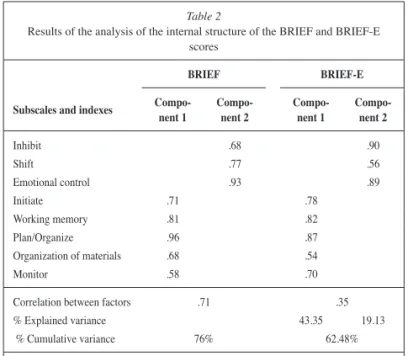
Table 2 presents the results of the analyses of the internal structure of the scores carried out with the original version of the BRIEF scale and with the version of the present study (BRIEF-E).
In both studies, the same two-component structure was obtained: the fi rst component (Metacognition) is made up of Initiate, Working Memory, Plan/Organizing, Organization
of Materials, and Monitor, and the second one (Behavioral Regulation) is made up of Inhibit, Shift, and Emotional Control. These components explain 76% of the cumulative variance in the BRIEF, versus 62.48% in the BRIEF-E. Although in the original study with the BRIEF, these data were not provided, in this study with the BRIEF-E, the fi rst component explained 43.35% of the variance, and the second one explained 19.13%. The correlations between the components were .74 in the BRIEF versus .35 in the BRIEF-E.
Regarding the weight of each subscale on its component, a similar pattern was obtained although some differences between the studies were also found. Thus, in both scales, Plan/Organizing and Working Memory were the subscales with the highest weight on the Metacognition component (for Plan/Organize, .96 in the BRIEF versus .87 in the BRIEF-E, and for Working Memory (.81 versus .82, respectively). Regarding the Behavioral Regulation component, the variable with the highest weight on the BRIEF was Emotional Control (.93), whereas Inhibit (.90) obtained the highest weight on the BRIEF-E, followed by Emotional Control (.89).
Analysis of internal consistency
The internal consistency coeffi cients (Cronbach’s alpha) for the subscales and indexes of the BRIEF and BRIEF-E are presented in Table 3. The coeffi cients were generally higher in the BRIEF, albeit following the same tendency. Thus, Initiate obtained the lowest values in both cases (α = .82 in BRIEF versus .57 in BRIEF-E), and the highest values were found in the GEC (α = .98 versus .92, respectively).
The alpha coeffi cients obtained were very similar to those of the original study for Emotional Control and Organization of Materials (α = .92 in the BRIEF versus .89 in the BRIEF-E for Emotional Control, and .88 versus .85, respectively, for Organization of Materials).
Regarding the main indexes (BRI and MI) and the GEC, the Cronbach alpha coeffi cients of the BRIEF-E were high, around .90 in all cases, although lower than those of the BRIEF.
Table 2
Results of the analysis of the internal structure of the BRIEF and BRIEF-E scores
BRIEF BRIEF-E
Subscales and indexes
Compo-nent 1
Compo-nent 2
Compo-nent 1
Compo-nent 2
Inhibit .68 .90
Shift .77 .56
Emotional control .93 .89
Initiate .71 .78
Working memory .81 .82
Plan/Organize .96 .87
Organization of materials .68 .54
Monitor .58 .70
Correlation between factors .71 .35
% Explained variance 43.35 19.13
% Cumulative variance 76% 62.48%
Convergent validity with other variables (EDAH Scale)
Although, in the original study, the ADHD Rating Scale-IV (ADHD-IV; DuPaul, Power, Anastopoulos, & Reid, 1996) was used, in this case, we administered the EDAH scale (Farré & Narbona, 1997). However, both scales assess behavioral problems related to attention defi cit and hyperactivity.
As seen in Table 4, in both studies, statistically signifi cant correlations were found between the BRIEF and BRIEF-E subscales and the ADHD-IV and EDAH scales, respectively, although with some differences.
Firstly, in the case of BRIEF-E, Inhibit, Shift, Emotional Control, and the BRI were signifi cantly related only to the Hyperactivity subscale of the EDAH, whereas in the original study, they were related to both the ADHD-IV subscales, although
more so to Hyperactivity. In both studies, the Inhibit subscale had the highest correlation with Hyperactivity (.73 in the BRIEF versus .71 in the BRIEF-E), followed by the BRI (.70 versus .68, respectively).
Secondly, Initiate, Working Memory, Plan/Organize, Organization of Materials, Monitor, and the MI all correlated signifi cantly with both subscales, although more so with Attention Defi cit in both studies. Organization of Materials was the only variable that correlated exclusively with Attention Defi cit in the BRIEF, whereas in the BRIEF-E while in this study was initiate which showed an exclusive correlation with this variable. In both studies, Plan/Organize and Working Memory obtained the highest correlations with the Attention Defi cit subscales (.63 and .60, respectively, in the original study versus .55 and .47 in this study).
Lastly, in both studies, the GEC had statistically signifi cant correlations with both subscales, but its correlation was higher with Attention Defi cit than with Hyperactivity in the BRIEF (.58 and .47, respectively), and they were practically the same in the BRIEF-E (.60 and .63, respectively).
Discussion and conclusions
The goal of this study was to obtain preliminary data in a convenience clinical sample of 125 Spanish children and adolescents about the potential utility of the BRIEF scale as an instrument to assess executive functions. For this purpose, the internal structure and consistency of its scores were analyzed, as well as its convergent validity with behavioral variables by analyzing its correlations with the EDAH scale (Farré & Narbona, 1997). The results were compared with those obtained in the original validation study with a clinical sample (Gioia et al., 2000).
In general terms, the results obtained suggest good, albeit improvable, psychometric properties of the scale, coinciding to a great extent with those obtained in the original study. For instance, we obtained the same factor structure, made up of two components (Metacognition and Behavioral Regulation), each one in turn, comprising the same subscales.
Regarding reliability of the scores, the internal consistency coeffi cients were generally higher in the original study. Nevertheless, in both studies, a similar pattern was obtained, with Initiate being the subscale with the lowest coeffi cients, and the GEC presenting the highest. The BRI and MI scores presented high internal consistency, very similar to that of the original study.
Lastly, evidence of convergent validity with other behavioral variables was obtained, with statistically signifi cant correlations found between the components of the BRIEF-E scale and the Hyperactivity and Attention Defi cit subscales of the EDAH scale. These results coincide with those obtained by Gioia et al. (2000) in the original study, although the results of the present study suggest a higher discriminatory capacity of the Behavioral Regulation component, which only correlated with Hyperactivity. Similar results were found by McCandless and O’Laughlin (2007) using the Behavior Assessment System for Children (BASC: Reynolds & Kamphaus, 1992).
However, although these results provide preliminary data supporting the potential utility of the BRIEF scale in different cultural settings from the original one, some aspects of the study, as well as of the instrument itself, should be taken into account. Table 3
Internal consistency coeffi cients (Cronbach’s alpha) of the subscales and indexes of the BRIEF and BRIEF-E scales
Alpha coeffi cient
Subscales and indexes BRIEF BRIEF-E Elements
Inhibit .94 .85 10
Shift .88 .72 8
Emotional control .92 .89 10
Initiate .82 .57 8
Working memory .92 .81 10
Plan/Organize .91 .68 12
Organization of materials .88 .85 6
Monitor .85 .60 8
BRI .96 .91 28
MI .96 .89 44
GEC .98 .92 72
Note: BRI = Behavioral Regulation Index; MI = Metacognition Index; GEC = Global
Executive Composite. Clinical Sample: BRIEF (N = 852), BRIEF-E (N = 125).
Table 4
Correlations of the BRIEF and BRIEF-E scales with the ADHD rating scale-IV and the EDAH scale
BRIEF – ADHD-IV BRIEF-E - EDAH
Subscales and indexes Attention
defi cit
Hyperac-tivity
Attention defi cit
Hyperac-tivity
Inhibit .42** .73** .05 .71**
Shift .39** .59** .07 .34**
Emotional control .39** .56** .12 .59**
Initiate .55** .36** .47** .12
Working memory .60** .44** .47** .21*
Plan/Organize .63** .33** .55** .22*
Organization of materials .49** .15 .26** .29**
Monitor .54** .45** .39** .39**
BRI .44** .70** .10 .68**
MI .67** .38** .62** .32**
GEC .63** .60** .47** .58**
Note: BRI = Behavioral Regulation Index; MI = Metacognition Index; GEC = Global
One on them is the small sample size and the broad age range used in this study, as well as the heterogeneity of the clinical groups that make up the sample, and the high rate of ADHD in the groups. All this makes it necessary to perform new studies, with larger and more representative samples. This would allow analysis by age group, thereby obtaining a developmental profi le of defi cits in executive functioning. Also, in view of the diversity of the cognitive and behavioral manifestations of these disorders, it would be interesting to establish differences among them, thereby providing new data about the utility of the scale. In this sense, two prior studies were carried out with Spanish samples (García et al., 2013; García et al., in press), providing evidence of the existence of differential profi les of the ADHD subtypes, as well as of their comorbidity with RD.
The large number of items that make up the scale should also be taken into account. Lejeune et al. (2010) recently conducted a study with a brief version of the scale, made up of 24 items. Although in view of its recent appearance, there are still no data about its diagnostic capacity, a shorter questionnaire would
be particularly useful in cases where families are requested to complete a broad range of reports or when administering it for epidemiological studies.
Although our results contribute preliminary evidence of the utility of the BRIEF scale in a Spanish clinical sample, following Muñiz et al. (2013), if the fi nal goal is to achieve maximum correspondence and adequacy between both instruments, it is necessary to continue to analyze and to study in more depth the adequacy of the methodological, cultural, linguistic, conceptual, and metric aspects of the scale. This would open up new lines of research in this direction.
Acknowledgements
This study was carried out with funds from the “Severo Ochoa” program with reference nr. BP: 11-067, of the Foundation for Promotion of Scientifi c and Applied Research and Technology in Asturias (FICYT).
References
Anderson, P.J., & Reidy, N. (2012). Assessing executive function in preschoolers. Neuropsychological Review, 22, 345-360.
Baym, C.L., Corbett, B.A., Wright, S.B., & Bunge, S.A. (2008). Neural correlates of tic severity and cognitive control in children with Tourette Syndrome. Brain, 131, 165-179.
Bental, B., & Tirosh, E. (2007). The relationship between attention, executive functions and reading domain abilities in attention defi cit hyperactivity disorder and reading disorder: A comparative study.
Journal of Children Psychology and Psychiatry, 48(5), 455-463.
Brock, L.L., Rimm-Kaufman, S.E., Nathanson, L., & Grimm, K.J. (2009). The contribution of ‘hot’ and ‘cool’ executive function to children’s academic achievement and classroom behavior. Early Childhood
Research Quarterly, 24, 337-349.
Di Trani, M., Casini, M.P., Capuzzo, F., Gentile, S., Bianco, G., Menghini, D., & Vicari, S. (2011). Executive and intellectual functions in attention-defi cit/hyperactivity disorder with and without comorbidity.
Brain and Development, 33(6), 462-469.
Donders, J., Den Braber, D., & Vos, L. (2010). Construct and criterion validity of the Behaviour Rating Inventory of Executive Function (BRIEF) in children referred for neuropsychological assessment after pediatric traumatic brain injury. Journal of Neuropsychology, 4(2), 197-209.
DuPaul, G.J., Power, T.J., Anastopoulus, A.D., & Reid, R. (1996). ADHD
Rating Scale-IV: Checklist, norms and clinical interpretation. New
York: Guilford Press.
Elosua, P. (2003). On test validity. Psicothema, 15(2), 315-321.
Farré, A., & Narbona, J. (1997). Escala de Défi cit de Atención
e Hiperactividad (E.D.A.H.) [Scale of Attention Defi cit and
Hyperactivity (E.D.A.H.)]. Madrid: TEA Ediciones.
Ferrando, P.J., & Anguiano-Carrasco, C. (2010). El análisis factorial como técnica de investigación en Psicología [Factor analysis as a research technique in Psychology]. Papeles del Psicólogo, 31(1), 18-33. García, T., González-Castro, P., Rodríguez, C., Álvarez, D., Cueli,
M., & Álvarez, L. (in press). Application of the BRIEF scale in the delimitation of clinical subgroups of ADHD: An exploratory study.
Aula Abierta.
García, T., Rodríguez, C., González-Castro, P., Álvarez, D., Cueli, M., & González-Pienda, J.A. (2013). Executive functioning in attention defi cit hyperactivity disorder and reading disabilities. International
Journal of Psychology & Psychological Therapy, 13(2), 179-194.
Garon, N., Bryson, S.E., & Smith, I.M. (2008). Executive function in preschoolers: A review using an integrative framework. Psychological Bulletin, 134, 31-60.
Gioia, G.A., Isquith, P.K., Guy, S., & Kenworthy, L. (2000). BRIEF: Behavior Rating Inventory of Executive Function professional
manual. Lutz, FL: Psychological Assessment Resources.
Gioia, G.A., Kenworthy, L., & Isquith, P.K. (2010). Executive function in the real world: BRIEF lesson from Mark Ylvisaker. Journal of Head
Trauma Rehabilitation, 25(6), 433-439.
Hale, J.B., Reddy, L.A., Semrud-Clikeman, M., Hain, L.A., Whitaker, J., Morley, J., ..., & Jones, N. (2011). Executive impairment determines ADHD medication response: Implications for academic achievement.
Journal of Learning Disabilities, 44(2), 196-212.
Han, Y.M.Y., Leunga, W.W., Wong, C.K., Lamc, J.M.K., Cheung, M., & Chan, A.S. (2011). Lymphocyte subset alterations related to executive function deficits and repetitive stereotyped behavior in autism.
Research in Autism Spectrum Disorders, 5, 486-494.
Henry, L.A, & Bettenay, C. (2010). The assessment of executive functioning in children. Child and Adolescent Mental Health, 15(2), 110-119. Huizinga, M., & Smidts, D.P. (2011). Age-related changes in executive
function: A normative study with the Dutch version of the Behavior Rating Inventory of Executive Function (BRIEF). Child
Neuropsychology, 17(1), 51-66.
Jarratt, K.P, Riccio, C.A., & Siekierski, B.M. (2005). Assessment of Attention Defi cit Hyperactivity Disorder (ADHD) using the BASC and BRIEF. Applied Neuropsychology, 12(2), 83-93.
Kenworthy, L., Black, D.O., Harrison, B., Della Rosa, A., & Wallace, G.L. (2009). Are executive control functions related to autism symptoms in high-functioning children? Child Neuropsychology, 15(5), 425-440.
Korzeniowski, C.G. (2011). Developmental evolution of executive functioning and its relationship with academic learning. Revista de Psicología, 7(13), 7-26.
Latzman, R.D., Elkovitch, N., Young, J., & Clark, L. (2010). The contribution of executive functioning to academic achievement among male adolescents. Journal of Clinical and Experimental
Neuropsychology, 32(5), 455-462.
Lee, N.R., Fidler, D.J., Blakeley-Smith, A., Daunhauer, L., Robinson, C., & Hepburn, S.L. (2011). Caregiver report of executive functioning in a population-based sample of young children with Down syndrome.
American Journal of Intellectual Development Disabilities, 116(4),
290-304.
LeJeune, B., Beebe, D., Noll, J., Kenealy, L., Isquith, P., & Gioia, G. (2010). Psychometric support for an abbreviated version of the Behavior Rating Inventory of Executive Function (BRIEF) Parent Form. Child
Lezak, M., Howieson, D., Bigler, E., & Tranel, D. (2012). Neuropsychological
assessment (5th ed.). New York: Oxford University Press.
Makris, N., Biederman, J., Monuteaux, M.C., & Seidman, L.J. (2009). Towards conceptualizing a neural systems-based anatomy of attention-defi cit/hyperactivity disorder. Developmental Neuroscience, 31, 36-49. McCandless, S., & O’Laughlin, L. (2007). The clinical utility of the
Behavior Rating Inventory of Executive Function (BRIEF) in the diagnosis of ADHD. Journal of Attention Disorders, 4(10), 381-389. McClelland, M.M., Cameron, C.E., Connor, C.M., Farris, C.L., Jewkes,
A.M., & Morrison, F.J. (2007). Links between behavioral regulation and preschoolers’ literacy, vocabulary, and math skills. Developmental
Psychology, 43, 947-959.
Muñiz, J., Elosua, P., & Hambleton, R.K. (2013). Guidelines for the translation and adaptation of tests: Second edition. Psicothema, 25(2), 151-157.
Neri, M.L., Guimaraes, C.A., Oliveira, E.P., Duran, M.H., Medeiros, L.L., Montenegro, M.A., …, & Guerreiro, M.M. (2012). Neuropsychological assessment of children with rolandic epilepsy: Executive functions.
Epilepsy & Behavior, 24(4), 403-407.
Pratt, B.M. (2000). The comparative development of executive functions in elementary school children with reading disorder and attention-defi cit/hyperactivity disorder. Dissertation Abstracts International:
Section B: The Sciences and Engineering, 60(9-B), 4933-4944.
Raghubar, K.P., Barnes, M.A., & Hecht, S.A. (2010). Working memory and mathematics: A review of developmental, individual difference, and cognitive approaches. Learning and Individual Differences, 20, 110-122.
Reynolds, C.R., & Kamphaus, R.W. (1992). Behavior Assessment System
for Children. Circle Pines, MN: American Guidance Service.
Riccio, C.A., Homack, S.P., Jarratt, K., & Wolfe, M. (2006). Differences in academic and executive function domains among children with ADHD predominantly inattentive and combined types. Archives of
Clinical Neuropsychology, 21, 657-667.
Shaffer, D., Fisher, P., Lucas, C., Dulcan, M., & Schwab, M. (2000). NIMH Diagnostic Interview Schedule for Children Version IV (NIMH DISC-IV): Description, differences from previous versions and reliability of some common diagnoses. Journal of the American Academy of Child
and Adolescent Psychiatry, 39, 28-38.
Shimoni, M., Engel-Yeger, B., & Tirosh, E. (2012). Executive dysfunctions among boys with Attention Defi cit Hyperactivity Disorder (ADHD):
Performance-based test and parents’ report. Research in Developmental Disabilities, 33(3), 858-865.
Smidts, D.P., & Huizinga, M. (2009). BRIEF Executieve Functies
Gedragsvragenlijst: Handleiding. Amsterdam: Hogrefe.
Stelzer, F., & Cervigni, M.A. (2011). Academic achievement and executive functions in childhood and adolescence. A review of the literature.
Revista de Investigación en Educación, 9(1), 148-156.
Toplak, M.E., Bucciarelli, S.M., Jain, U., & Tannock, R. (2009). Executive functions: Performance-based measures and the Behavior Rating Inventory of Executive Function (BRIEF) in adolescents with attention defi cit/hyperactivity disorder (ADHD). Child Neuropsychology, 15(1), 53-72.
Van der Ven, S.H., Kroesbergen, E.H., Boom, J., & Leseman, P.P. (2013). The structure of executive functions in children: A closer examination of inhibition, shifting, and updating. British Journal of
Developmental Psychology, 31(1), 70-87.
Van De Voorde, S., Roeyers, H., Verté, S., & Wiersema, J.R. (2010). Working memory, response inhibition, and within-subject variability in children with attention-defi cit/hyperactivity disorder or reading disorder. Journal of Clinical and Experimental Neuropsychology, 32(4), 366-379.
Verdejo-García, A., & Bechara, A. (2010). Neuropsychology of the executive Functions. Psicothema, 22(2), 227-235.
Vinţan, M.A., Palade, S., Cristea, A., Benga, I., & Muresanu, D.F. (2012). A neuropsychological assessment using computerized battery tests (CANTAB), in children with benign rolandic epilepsy before AED therapy. Journal of Medical Life, 5(1), 114-119.
Wechsler, D. (1974). Manual for the Wechsler Intelligence Scale for Children-Revised. NY: Psychological Corporation [Spanish translation: Escala de Inteligencia Wechsler para niños-IV edición (WISC-IV). Madrid: TEA Ediciones, 2005].
Willcutt, E.G., Betjemann, R.S., McGrath, L.M., Chabildas, N.A., Olson, R.K., DeFries, J.C., & Pennington, B.F. (2010). Etiology and neuropsychology of comorbidity between RD and ADHD: The case for multiple-defi cit models. Cortex, 46(10), 1345-1361.
Williams, J.R. (2008). Revising the Declaration of Helsinki. World
Medical Journal, 54(4), 120-122.
Wilson, K.R., Donders, J., & Nguyen, L. (2011). Self and parent ratings of executive functioning after adolescent traumatic brain injury.
![onwards,wheretheygenerallymanifestthemselvesthroughbiting,throwingtoysand Inrelationtothisstage,theuseofphysicalaggressioncanbeconsiderednormaland , , ]. Inthisline,researchshowsthatitisdifficultforachildwhohasnotexhibitedanyaggressionproblemsbeforetheageo](data:image/gif;base64,R0lGODlhAQABAIAAAP///wAAACH5BAEAAAAALAAAAAABAAEAAAICRAEAOw==)