
Analysis of the main groups of textile distribution in Spain
49
0
0
Texto completo
(2) Natalia Sanchis Sánchez INDEX 1. EXECUTIVE SUMMARY. 3. 2. INTRODUCTION. 4. 3. PEST ANALYSIS. 5. 3.1. 3.2. 3.3. 3.4. 3.5.. POLITICAL ECONOMIC SOCIAL TECHNOLOGICAL ECOLOGICAL. 5 8 12 14 16. 4. PORTER'S FIVE FORCES OF COMPETITIVE POSITION ANALYSIS. 18. 4.1. 4.2. 4.3. 4.4. 4.5.. 19 20 21 25 27. RIVALRY AMONG EXISTING COMPETITORS THREAT OF NEW ENTRANTS THREAT OF SUBSTITUTE BARGAINING POWER OF BUYERS BARGAINING POWER OF SUPPLIERS. 5. THE COMPETITIVE ADVANTAGES OF THE TEXTILE GROUPS. 29. 5.1. 5.2. 5.3. 5.4. 5.5.. 30 33 35 37 39. INDITEX H&M MANGO PRIMARK GRUPO CORTEFIEL. 6. CONCLUSION. 42. 7. BIBLIOGRAPHY. 44. Analysis of the main groups of textile distribution in Spain. 1.
(3) Natalia Sanchis Sánchez INDEX OF ILLUSTRATIONS Illustration 1. Imitation Product Aliexpress __________________________________ 24 Illustration 2. Genuine Product Zara ______________________________________ 24 Illustration 3. Primark stores in Europe ____________________________________ 37 INDEX OF CHART Chart 1. GDP Evolution _________________________________________________ 9 Chart 2. Unemployment ________________________________________________ 10 Chart 3. Average annual consumption ____________________________________ 11 Chart 4. Evolution textile companies ______________________________________ 12 Chart 5. Balance migratory in Spain ______________________________________ 13. INDEX OF DIAGRAM Diagram 1. The five forces of Porter ______________________________________ 18 Diagram 2. The Value Chain ____________________________________________ 29. Analysis of the main groups of textile distribution in Spain. 2.
(4) Natalia Sanchis Sánchez 1. EXECUTIVE SUMMARY The textile sector is a sector increasingly on the rise. The businesses of retail distribution are increasingly but only a few achieve great levels of sales at both the national and international levels. The objective of this work is to analyse the internal process of each one of the leaders in fashion in Spain such as Inditex, H&M, Mango, Primark and Cortefiel group and find in each one of them the competitive advantage they have with respect to their competitors. Firstly, an analysis is made on the external environment of the sector, and thus, know the current situation of the environment that surrounds it. Due to the economic crisis that this sector has suffered due to the decrease in consumption on the part of customers and to the tax movements on the part of the government, but has improved thanks to the incorporation of Information and Communication Technologies, and ecommerce. In second place, pushing down into the five forces of Porter, we performed a more specific analysis of the sector and thus know the forces that have a more direct impact on these companies, and know the main competitors in the sector and that target audience. Finally, due to the analysis of the five forces of Porter, we found that the group’s leaders in textile distribution, are similar with respect to the design of the garments and their prices, and that many of them are directed to the same target audience, making the consumer will be able to meet your need in the different groups, because they are similar to each other. Therefore, each group has a competitive advantage over their rivals. Therefore, we analysed each group in its primary activities to find out what they have in particular with regard to the other and by that attract consume. Analysis of the main groups of textile distribution in Spain. 3.
(5) Natalia Sanchis Sánchez 2. INTRODUCTION Over the years, the sector of the fashion industry has gained ground in the society, due to the stimulation that provides the brand and the need to translate the personality in something material. Today in the fashion market there are a wide variety of shops that covers that need, but what are some brands and shops that generated in the consumers a compulsive consumption, what they are doing to ensure that their customers are always faithful, what is behind the world of fashion and textiles that generates rivalry between company? Why a leader and the other not, but it is also has great sales volumes? To answer these questions we are going to analyse each one of the most important textile chains and leaders in sales of the countries and discover what's so special to generate both sales volume. The objective of this project focuses on obtaining sufficient information of the textile groups and analyses the data to know that competitive advantage on their competitors. Can be divided into three parts, on the one hand, we need to find the factors that affect the industry, both political, economic and social among others, pushing down into the PESTEL analysis and with this we get the situation in which the society is currently and that influences the sector. On the other hand, we analyse the competitive forces to understand the structure of the industry. We will use the five forces of Porter, and we'll walk through each of the forces we get the threats that can harm the sector, competitors that there are and the rivalry between them, the power that they have both customers and suppliers. And finally, to relying on the value chain we will analyse the primary activities of each of the five leading textile chains for sale in Spain, as are, Inditex, H&M, Mango, Primark and Cortefiel group and how they have those sales, systems that adopt to have a competitiveness before their rivals and what strategies used to be competitive in the market. We'll break down each activity in its manufacturing process to see what they have for different from the others, as it does and why they succeed. The effectiveness of the competitive advantage of each company depends on the coordination and internal communications for the optimal development of the activities that encompasses each company, to respond quickly and effectively to consumer demand. Each of the companies to analyse has a requirement that makes it a competitive advantage over the other.. Analysis of the main groups of textile distribution in Spain. 4.
(6) Natalia Sanchis Sánchez 3. PEST ANALYSIS To have knowledge about the environment that surrounds the textile industry, we are going to support in the Pestel analysis, to be able to identify the environmental factors that may affect the companies that constitute the framework of the textile sector.. Then, let's break each of the dimensions that comprise this analysis, and so identify what factors has an impact on the activities of the textile companies. Textile groups where we are going to fix our attention are Spanish groups that operate in both the national and international, focusing on what affects them in the regulations and the Spanish economic situation. 3.1.. Political. In this dimension, has teamed up both political issues such as the legal issues that affect the textile sector, shown the rules economic, legal, and social influence in the textile sector. Spain, currently has a policy not one hundred per cent stable due to the creation of new political parties that promote a change in the country and to the disgruntled citizens by the rise in taxes, cuts in areas vital to the citizens, the lack of employment and the cases of corruption that monopolize all the headlines. And with the general election scheduled for November of 2015, generates a certain political uncertainty. According to the barometer of February 2015 from the CIS (Centre for Sociological Research), survey of the Spanish population, the Spaniards qualify the current political situation in Spain, very poor with a 43.5 %, and 38.5 % think that within a year the situation will remain the same. The main problem that is of concern to the Spanish is the unemployment with a 55% followed by corruption and fraud with a 22.5 %.. Currently, Spain is immersed in an economic crisis, for this reason, a fundamental policy in order to combat this crisis is the fiscal policy, this policy is important in a country, because it influences the evolution of economic life and the distribution of income. Its main components are the public spending and taxes, that an increase or decrease, it creates an effect or the other in the situation of the country.. The current government to be able to combat the crisis raised the taxes, as an example a 15.2 % increase of tax bases. They also reduced public spending, cutting in areas such as health care and education, decreased investment in R&D. As a result of these adjustments, decreased demand affecting the production and increasing. Analysis of the main groups of textile distribution in Spain. 5.
(7) Natalia Sanchis Sánchez unemployment, to increase the taxes the Spanish families saw as was significantly reduced his income, causing a reduction in consumption, affecting businesses and sectors. The government decided in September of 2012, perform a tax measure, raising taxes, in particular, the increase in the Value Added Tax (VAT), which increased the general type tax from 18% to 21% and the reduced rate of 8% to 10 %, and keeping in a 4% of the super-reduced rate. This increase leads to a decrease in consumption by consumers. This affected the textile sector, in particular, to the chains and shops dealing in the final product, clothing and footwear, as these articles have a general type of tax. The three leading companies in the sector Inditex, Mango and Cortefiel announced that due to the rise would reduce the gross prices to adapt to the new taxes, but in the final retail Price is not notary any difference before the imposition of the new tax. This sector has evolved thanks to the increased globalization of the textile activity in developing countries has grown the textile activity. The companies have taken advantage of the low labour cost for these countries, to undertake part of their process of industrialization there. Prior to the Uruguay Round in 1994, was established the Multifibre Arrangement (Multifibre Agreement) which is fixed in form bilateral import quotas, because the import of any product in particular could cause some damage to the domestic economic. In 1995, was replaced by the Multi-fibre Agreement the Agreement on Textiles and Clothing (Agreement on Textiles and Clothing) of the World Trade Organization treaty in the Uruguay Round, the agreement was the European Union, Norway and the United States.. The objective of the Agreement on Textiles and Clothing was the progressive liberalization in a period of 10 years, in the European Union of the 218 restrictions that had been in the Multi-fibre Agreement were still being applied 210 import quotas1 in countries of the World Trade Organization, including China.. In 2015, these contributions which were still extant of the earlier treaty were eliminated in the year 2005, thus increasing the release of the international traffic in textile products of the sector, was favourable for the expansion of world trade in textiles but 1. Import quotas; provide a quantity of goods originating in another country to import it during a given period of time, without having to pay the tariff-rate quotas, or be paid such fees but at a lower value than you would.. Analysis of the main groups of textile distribution in Spain. 6.
(8) Natalia Sanchis Sánchez also increased the competition in the European Union on the part of the producer countries, one of them China. This situation caused a relocation of textile companies that decided to pull its company in Spain and situating it in countries such as China and India, taking advantage of the competitive advantage of low labour costs and the proximity of the raw material, the government imposed a Support Plan for re-industrialise the Textile areas damaged by such relocation.. By 2013, some companies returned to relocate in Spain due to changes in China, as increased wages, there are more labour demands and the workers are not willing has work more hours. Due to the crisis, it is more competitive now produce in Spain and in addition to other factors that produce in Spain, as a better image of the brand due to not manufacture in countries whose labour is cheap and the exploitation of workers, the best quality and finish of the products and the best control, and replenish the products faster, because, they are produced at the national level.. At the national level, there have been a series of policies designed to support innovation and the conversion and thus combat textile international competition. On the part of the Instituto Nacional de Credito Oficial (ICO) has created a line of funding aimed at promoting the competence of the textile sector, introducing the innovation to the industrial processes of the textile sector and toward segments less adversely affected by the global competition of the market.. In terms of industrial and intellectual property covers the manufacturing techniques, the copyright, designs, trademarks and patents. This property is a protection against unfair competition; the textile sector is the most concerned with regard to intellectual property in particular in the design and brand of the products by counterfeiting. As well as the protection of trademarks and distinctive signs are protected by Law 17/2001.. Unfair competition is subject to the Law 15/2007, which improves the system against unfair competition, control the competition and the penalized. Finally, in 2007 the Ministry of Health pact with manufacturers and designers mix the sizes of the garments in all chains and textile shops, to prevent diseases from eating disorders and promote a canon of beauty more healthy.. In conclusion, due to trade policies imposed by the World Trade Organization, trade was liberalized international producing a massive influx of textile imports from China.. Analysis of the main groups of textile distribution in Spain. 7.
(9) Natalia Sanchis Sánchez Due to the cheap labour the Spanish textile companies, relocation, and moved to Mediterranean countries such as Morocco and Tunisia, and Asian, such as China, Taiwan, causing the dismissal of workers in the industry, and the closure of businesses. Due to the economic crisis, in addition to the relocation, textile companies closed, due to the decrease in demand caused by consumers who decreased their disposable incomes due to the high unemployment generated. 3.2.. Economic. In this dimension we are going to deal with the economic situation that is going through Spain at the moment, and how it influences in the textile sector. Is going to consist of two parts, the first part focused on the Spanish textile consumption and the second part the economic situation that have the textile companies, thanks to the crisis. To begin, supporting us on the data of the barometer of February 2015 the CIS, the Spanish population believes that the current economic situation is Spanish "bad" with a 41% and within a year this same situation will remain the same with a 42.7 %. In recent years, the world economy has suffered a major recession, in particular, from 2008 to the present, Spain is submerged in an economic depression, because of several factors such as the real estate bubble, the banking crisis and rising unemployment. The textile sector has been affected by this crisis, due to a simple string: citizens are losing their jobs, therefore, the Spanish homes restrict the consumption of certain goods and services, including the consumption of textiles, causing a decrease in consumption and thus forcing textile companies to seek competition of creditors or close. To analyse the economic situation we will rely on the results of the Gross Domestic Product (GDP) obtained by the National Institute of Statistics, in the first quarter of 2015, there is a quarterly growth of 0.9 %, two tenths higher than that recorded in the last quarter, 0.7 %, as shown in Chart 1.. Analysis of the main groups of textile distribution in Spain. 8.
(10) Natalia Sanchis Sánchez Chart 1. GDP Evolution Interannual variation rates GDP 3 2 1 0 -1 -2. -3 1ºT 2ºT 3ºT 4ºT. 2010 -1 0,1 0,5 0,5. 2011 0,1 -0,4 -0,9 -1,3. 2012 -1,7 -2,1 -2,1 -2,5. 2013 -2,2 -1,7 -1 0. 2014 0,7 1,3 1,6 2. 2015 2,7. Source: Own elaboration from based on data obtained at the INE.. The growth rate of GDP, in annual terms is 2.7 %, seven tenths of a percentage point more than the previous quarters. By analysing the chart we see that from the beginning of the year 2014, the GDP begins to grow, which indicates that there is a growth of the productive activity of the country, and as a result of such floods produce more jobs.. In relation to the number of jobs, unemployment is another factor that hinders the Spanish economic system generated by the crisis, Spain has high rates of unemployment that have increased since the beginning of the crisis in 2008. Since 2013, the highest point reached with a 26.09% unemployment rate, begins to drop slightly, currently, in the first quarter of 2015 the unemployment rate is 23.78 % unemployment. It could be said that the economy is recovering, but it would be remiss if it failed a lot in order to achieve the level of the year 2007, 8.23 % unemployment for having a favourable economic situation.. Analysis of the main groups of textile distribution in Spain. 9.
(11) Natalia Sanchis Sánchez. Chart 2. Unemployment. Evolution unemployment 30 25 20 15 10 5 0. 2007 2008 2009 2010 2011 2012 2013 2014 2015 % unemployment rate 8,23 11,25 17,86 19,86 21,39 24,79 26,09 24,44 23,78 Source: Own elaboration from based on data obtained at the INE.. With regard to the consumption of the Spaniards, we're going to see the evolution of the average consumption of Spanish households and average consumption per person, according to data published in the INE on the "Survey of Family Budget". The most recent data that are published are in the INE of the year 2013, in the same year, the Spaniards had a average expenditure per household of 27.098 €. The groups most affected by low power consumption of the homes were: hotels, cafes and restaurants; leisure, entertainment and culture and alcoholic beverages and tobacco. With regard to the group of articles of apparel and footwear, the homes were destined 1.348€ of average expenditure, households spent 3.9 % less than in 2012.. Putting us in the year 2007, the year before the crisis, the average expenditure per household of articles of apparel was 2.075, 51€ and the average expenditure per person in those articles was 755.68 €. The beginning of the crisis in 2008, the Spanish households spent 6.4 % less on clothing and footwear for the year 2007, a significant drop caused by the loss of employment in the Spanish homes and spends the proceeds in other needs.. The average cost of Spanish households for the articles of clothing in 2008 is 1.942,64 €, whose difference is 132.87 € less compared with the year 2007. Since the start of the crisis until the year 2013, as can be seen in the table, spending on clothing and. Analysis of the main groups of textile distribution in Spain. 10.
(12) Natalia Sanchis Sánchez footwear on the part of the Spanish homes is reduced by 30.6 %, watching as well, which from 2008 until 2013 the Spaniards spent less family budget in clothing and footwear with a difference of 595€ less since the crisis began.. Chart 3. Average annual consumption. Average annual spending on clothing and footwear Average annual expenditure. 2.500,00. 2.000,00. 1.500,00. 1.000,00. 500,00. 0,00. 2007. 2008. 2009. 2010. 2011. 2012. 2013. Average annual spending 2.075,51 1.942,64 1.743,99 1.654,10 1.544,77 1.403,10 1.348,38 on clothing and footwear Source: Own elaboration from based on data obtained at the INE.. To know about the economic situation, first of all, we are going to analyse the RPI since 2007 until April 2015. Based on the results obtained by the National Institute of Statistics, the RPI gives us the changes month to month of prices of a set of goods and services that make up the consumer basket of families in Spain, by measuring the cost of life at the moment. The variations of RPI influence the wage agreements, mortgages, and pensions among others.. The month of April 2015 closes with a monthly change in RPI of 0.9 %, increasing in three tenths with regard to March, 0.6 %. This increase was due to the rise in prices of clothing and footwear due to the rise in the prices compared to the spring-summer season, an increase of the transport, thanks to the rise in fuel prices, rising in hotels, cafes and restaurants as a result of the holiday period of Holy Week, where the price increases to be high season, and prices to rise by the leisure and the culture.. Analysis of the main groups of textile distribution in Spain. 11.
(13) Natalia Sanchis Sánchez In contrast, negatively affects the rate of RPI, the lowering of prices of fruit and fresh fish, including in the group food and non-alcoholic beverages. Everything explained above, it is concluded that the families would have had to be spent 0.9 % more to purchase a basket of goods and services. Finally, the period between 2008 and 2012, 46,300 jobs were lost in that sector and 3,779 companies had to close down due to the economic crisis. As shown in Figure 4, starting from the year 2013 there is a growth of firms with 14,814 firms, 6,575 companies more than the year 2012. Due to the growth of exports rose by 5.2 % in 2012. Chart 4. Evolution textile companies. Many textile companies 16.000 14.000 12.000. 10.000 8.000 6.000 4.000 2.000 0 Series1. 2008 12.018. 2009 10.115. 2010 9.444. 2011 8.665. 2012 8.239. 2013 14.814. Source: Own elaboration from based on data obtained at the INE.. In 2013, the textile sector contributed 4.4 % to the total turnover in 2013, positioning itself as the third sector that most invoice, with a turnover of 13,978 million. Exports generated 4,095 million euros, a figure which fell by 1.7 % less than the year 2012.. In conclusion, the Spanish economic situation is growing, in a period of economic recovery, gradual decline in unemployment, slightly increasing the consumption of Spanish homes, and a GDP of 2.7 %, which includes the consumption of households, government spending, capital investment, and exports and imports. Therefore, the positive percentage, and increasing, means a better Spanish economic situation. 3.3.. Social. In this section we will look at the demography of Spain, the distribution of income and consumption habits of the Spanish families. Analysis of the main groups of textile distribution in Spain. 12.
(14) Natalia Sanchis Sánchez In this section we will look at the demography of Spain, the distribution of income and consumption habits of the Spanish families. One of the problems that has been the crisis is the emigration of Spanish residents abroad, see, immigrants with nationality or returning citizens immigrating to other countries. Below is a chart of migration balance in Spain in the period from 2008 to 2013. Chart 5. . Balance migratory in Spain. Balance migratory in Spain Growth per thousand inhabitants. 8,000000 6,000000 4,000000 2,000000 0,000000 -2,000000 -4,000000 -6,000000 -8,000000 Migratory Balance. 2008 6,755546. 2009 0,277028. 2010 -0,916503. 2011 -0,806621. 2012 -3,048165. 2013 -5,398447. Source: Own elaboration from based on data obtained at the INE.. As shown the migration balance has decreased due to the high output of immigrants and also the output of immigrants. According to the National Institute of Statistics, the population in Spain on 1 July 2014 is 46,464,053, declining 48,146 persons compared to the previous year. This reduction is due to a number of reasons as to the increase in migrants, either, immigrants with nationality that he returns to his home country of origin or Spanish who migrate to other countries, as we have seen above in the migration balance. The number of foreigners decreased due to the reasons mentioned above and the obtaining of the Spanish nationality.. The countries with more population resident in Spain are among the countries of Romania, Morocco and the United Kingdom. Due to immigration, Spain has multitude of cultures that have influenced the consumption habits of citizens, as a result, religions or ways of life.. Analysis of the main groups of textile distribution in Spain. 13.
(15) Natalia Sanchis Sánchez The companies can be routed in different ways to the final consumer that you want to capture, focusing on their way of life, religion or age. In recent years, the Spanish society has released a little more, accepting the diversity of types of families that there is today, as for example parent families, families of separated parents, families with homosexual fathers or mothers, thus creating with the different types of family, forms of life, age or religion a wide variety of persons to whom the companies can be routed differently to capture and deliver products that suit your circumstances. At the social level, fashion is a factor that expresses the personality of the consumers, in the wake of the multiculturalism in Spain; fashion identifies its identity, its values and religion. Due to globalization, the most important textile chains are located in all the continents spreading current trends, but by adhering to the standards and culture of each country. Due to the crisis, the 35% of Spaniards has changed the habit of consumption, to stop consuming the unnecessary and focus on the property of first necessity. Buy less, but pay more attention to reduce the total cost, the most affected households are young couples with children and adult couples without children. With respect to textiles, the homes they defer consumption in textiles and gifts for another period or when really needed. Households use more of the promotions and discount coupons, but they have also. changed. from. establishments. to. find. products. more. affordable.. The. establishment’s outlets have increased their sales due to the sale of surplus with high discounts. Finally, we are going to rely on the Gini2 coefficient to measure inequality of income distribution in Spanish homes, the last statistic, according to the barometer of Spain social dating back to 2013, and is 33.7 % lower compared to previous year, with 35% the largest in its history. Therefore, Spain is a country in which there is not a great inequality of income in the household, but there isn’t equity between the rents. 3.4.. Technological. In the next dimension, we will focus on new developments in communication and sales, and the advances in logistics and distribution that have the textile companies. The world of fashion is increasingly on the rise in our society, creating a higher consumption of textile, the result of this increase has created new working mode,. 2. The Gini coefficient measures the inequality of the distribution of household income in a country, and " 0" a perfect equality, and " 100" a perfect inequality of distribution.. Analysis of the main groups of textile distribution in Spain. 14.
(16) Natalia Sanchis Sánchez taking advantage of the popularity it has internet in this sector and to reach all parts of the world. During the last years, there have appeared the so-called "bloggers" or "youtubers", in which, through its media, as is a blog or a video on the YouTube web, move to their subscriber’s views, looks, and recommend various clothing stores or brands. The brands have benefited from the rise of these new jobs, for sponsored and reach by other means to your target public, and increase their demand. Therefore, the rise of the Internet has benefited both the marks, since, have another alternative advertising cheaper. In recent years, companies have introduced in their areas of work the Information and Communication Technologies (ICT) thanks to the presence of the Internet. The big chains textiles they want new trends are in the market as soon as possible, so that this work behind there is a team of design, clothing, logistics and distribution. The system of distribution and logistics is responsible at all times that their stores have products available, distributing to the time many parts, because it has connected suppliers, logistics centres and points of sale for an effective distribution, all of them is facilitated through an internal communication and ICT. One of the trends that have been made possible thanks to the introduction of ICTS has been the e-commerce.. With this looking for a perfect harmony between the e-. commerce and the various programs of internal management (ERP), to reduce costs and formalities, optimize the process and generate confidence and security to the customer. According to the Survey on the use of ICT and e-commerce in the companies held by the INE, between the 25.2 % of the sales through ecommerce, is the textile and clothing among others and in 2013, 15.1 % the volume of business of the Spanish companies was generated by the e-commerce. For companies to have a global positioning by GPS, allows them to do a follow-up of the merchandise and know if it meets the itinerary and if it will arrive as scheduled, and in turn the client to find out what the situation is and if your order is delivered on the date previously. As well as the traceability allows them to know throughout the supply chain, its location and trajectory, know the information of the product, where applicable, the levels of elaboration of the product and its distribution. On the other hand, is the part of the consumer where, according to the Survey on the Equipment and Use of Information and Communication Technologies in the homes of the National Institute of Statistics, made in 2014, in the last quarter of the year, the 27.5 % of the people bought over the internet, which is significantly better than the 2013 (22.9 %) due to the improvement of the security of payment and the flexibility of. Analysis of the main groups of textile distribution in Spain. 15.
(17) Natalia Sanchis Sánchez delivery obtained, thus increasing the confidence of consumers and the convenience of shopping from your own home. Another track of e-commerce, are the applications created by different brands and chains textiles for mobile devices and tablets, thus providing the purchase in any place. Applications for sale online, has more benefits in addition to the sale itself, improving the shopping experience of the consumer. In the case of the implementation of Zara and Mango, it can know with precision what store closer to the current location is available a garment in particular and the sizes available. In conclusion, the new technological innovations that are implanted in the companies to improve internal communication and greater efficiency for which the product arrives at its destination or final consumer are increasing and facilitate processes making them more reliable and less expensive. 3.5.. Ecological. There is a big problem currently concerned about; it is climate change and the consequences that it brings with it. The company is responsive to the consequences, which might cause if climate change continues. Therefore, companies should try to reduce their emissions, and manage their waste and citizens are becoming increasingly aware of how important it is to recycle. The law of environmental responsibility (Law 26/2007) claims that companies be held accountable for the damage caused by its activities to the natural resources such as ground, water, wildlife and habitats protected. Companies set attention in its manufacturing processes and the different materials used for making the garment, various groups have created eco-friendly clothing, using recycled materials and natural, and its process of development reduces the consumption of resources such as water, replacing the cotton fibre by the bamboo, which requires less water. Consumers can identify that their clothes are ecological through certificates as "Made in Green" or " Oeko-Tex Standard". Made in Green is a European certificate that ensures that all the centres of manufacture and the chain of manufacture of the product it has been done with respect for the environment. The Oeko-Tex certificate standard analyses that the garment is free of prohibited substances and chemicals harmful to the health giving security to the consumer. In regard to the textile industry, it generates waste, wastewater with chemical and atmospheric emissions, also the consumption of energy and water, which is. Analysis of the main groups of textile distribution in Spain. 16.
(18) Natalia Sanchis Sánchez detrimental to the environment and creating for the company a cost due to the law of environmental responsibility, where they would have to repair the damage caused. Should minimize the generation of waste, optimize the debris that can be recycled, such as fibres and cotton waste, cardboard, plastics, glass, etc. , because that, these same residues can be used for the development of other raw materials.. Analysis of the main groups of textile distribution in Spain. 17.
(19) Natalia Sanchis Sánchez 4. PORTER'S FIVE FORCES OF COMPETITIVE POSITION ANALYSIS Focus on making an exhaustive analysis of the competitive environment of the textile sector; we have to rely on the Porter model, i.e. the five forces of Porter (1982). This model allows you to analyse the structure of the textile industry, as well as demonstrate itself is attractive or not for the companies that are active or wish to be entered in this sector. These five forces is a comprehensive way to observe the industry and understand the underlying structure and determine its profitability and competition. It is structured in three sections, the first will focus on the threats, with new entrants and substitute products, the second the bargaining power of the customers and suppliers and finally the core of the forces, the rivalry and competition of the market. Diagram 1. The five forces of Porter. Threat of new entrants. Bargaining power of suppliers. Rivalry among existing competitors. Bargaining power of buyers. Threat of substitute. Source: Own elaboration. In these five forces also look at the changes that have emerged in the Spanish companies and if it has been beneficial or counterproductive for their business. Before you begin, we are going to position ourselves in that modality of shops or groups we want to focus on, and that public are targeted. In Spain, according to the web magazine "modaes.is" leader in economic information of the business of fashion, the three main groups Spanish textile that lead the Spanish market according to their volume of sales in 2014 are: leading the ranking Inditex. Analysis of the main groups of textile distribution in Spain. 18.
(20) Natalia Sanchis Sánchez followed by Mango and thirdly Cortefiel group. Currently, given that it has completed the year 2014 according to the forecasts were not very favourable for the Cortefiel group, since it was believed that the Catalan brand Desigual you would replace the post. But according to the exercises in the year 2014, remains in its position thus closing the year with a turnover of 1,011 million euros. Therefore, we will focus on textile groups according to their volume of sales, because, for the Spanish are the main places to acquire their textile products. 4.1.. Rivalry among existing competitors. Over the past few years, the small textile companies, i.e. family businesses, small boutiques in smaller cities and towns have been superseded by a large Spanish group Inditex due to its business strategy and its low prices and changing collections, could therefore be said that Inditex is the rival of all the other shops, clothing boutiques that cover our entire Spanish geography. But the question here is, international firms have been positioned in our country and are direct competition of the large Spanish groups and other forms of business for sale of textiles. In addition to the leading Spanish textile groups in Spain, there are two international groups that are among the first three of higher sales volume of Spain. In second place behind Inditex is the Irish Primark belonging to the group associated British Foods and third the Swedish group Hennes & Mauritz, alias, H&M. These two groups are similar with the Spanish textile groups, since they possess similarities as the sale price to medium-low, be directed to the same niche markets. The Swedish group H&M, entered in Spain in 2000, in the 2015 sum with 159 shops in the Spanish geography in Primark change came to Spain in 2006 by multiplying its size in these years, in the year 2014 a total of 9.3 million people visited their establishments, with a total of 47 shops. The rivalry between Inditex, Mango, Cortefiel group, H&M and Primark, is that, all cover the same need, with similar technology. The attractiveness of this industry increases due to the large number of competitors, and the power of the five dominant groups in the textile market. The textile industry is at an intermediate point between concentrated industries and fragmented, already, that there is a large number of companies dedicated to the textile trade, but the sales volumes are significant for the great previous groups. As an objective of this section, is to analyse the rivalry in the sector and how it affects companies that are within the industry, the rivalry in the sector depends on the number. Analysis of the main groups of textile distribution in Spain. 19.
(21) Natalia Sanchis Sánchez of competitors that are mentioned above and the size. The different groups textiles are similar between them, therefore the rivalry in this sector is greater. Respect, to the differentiation of the products, all the companies mentioned above are similar, with respect to the product and the price they offer, it is very likely that due to these similarities consumers will tend to replace a few products by others from different companies, since, are similar in appearance, quality and price generating rivalry between them. With regard to the sale of the product, Mango, Cortefiel group and H&M are supported in promotions to encourage consumption, because increases in rebates and when there are promotions. With respect to, Mango and Cortefiel group want to customer loyalty and therefore becoming a partner through a card in the case of the establishments Cortefiel group and in the case of mangoes by logging into your website, the user and partner has special promotions. In the case of H&M, also makes promotions on everything in your web site to encourage the consumption and thus increase their online sales due to the fact that H&M opened last year sale online in your web site. With regard to the rivalry of Primark, Inditex created Lefties, which sold the remains of past collections of Zara, but seeing the boom that meant the sale of clothing excessively cheap, focused on creating your own collections and make direct competition with Primark. Therefore, to conclude this point it should be noted that there is the rivalry between the groups, and despite the fact that the groups strives through promotions and strategies to reach his rival, Inditex, this remains sales leader at the national level and world level due to its competitive strategy that will be seen in the next paragraph. 4.2.. Threat of new entrants. The goal of this competitive strength is to assess the possibility of the entry of new firms to the sector. This sector is attractive to individuals who wish to open a trade with your own designs but should be aware that the demand is satisfied and that there are large companies that lead the market. A market is very easy to replace because of the great diversity of textile brands and chains that meet the needs of consumers. To enter this sector, there is a set of obstacles that new companies wishing to access must overcome. In the first place there are economies of scale, due to the increased volume of production the fixed costs are spread over more units by reducing the unit price of the product. The textile groups in question tend to economies of scale due to the high volume of production that have to be current with respect to trends.. Analysis of the main groups of textile distribution in Spain. 20.
(22) Natalia Sanchis Sánchez Secondly, is the product differentiation, must be products that the consumer might perceive only. Spanish consumers remain faithful in their purchases from the usual outlets. Between the big chains textiles there is little differentiation in the product and the price, except Primark, whose price and quality of the clothing is less. Primark found a gap in the market of the Spanish fashion, due to the economic situation, offering clothing and accessories by following the trends and at low prices, distinguishing itself from its rivals. Another of the factors to keep in mind, it is the experience of the rival groups, these people have settled in Spain years ago and has a loyal public, and the location of these is favourable. Normally, the establishments of these groups are concentrated in the shopping areas or shopping centres, for a better reach for the customers. It is difficult to establish a retail trade where are these establishments, but on the contrary, if that can happen, if it is a large textile group internationally. The direct competitor of the latest current textile groups is the American group GAP. Of the three major groups in global distribution of fashion, GAP is in third place, being the leader and Inditex followed by H&M. Go back to the same segment, woman, man and child. The feature of GAP in Spain is that it doesn't have an establishment itself, but, you have a "corner" in the shopping centre "El Corte Ingles", but separate from the other brands by crystals providing exclusivity. The first establishment was at the Airport of Malaga and then in El Corte Inglés in the Rambla of Barcelona, is expected to finish 2015 with five franchises more in airports and in spaces of this shopping centre. Therefore, the small textile businesses do not pose any threat to these groups textiles, is more than they would have difficulty entering the sector, because of the factors mentioned above and their rivals are groups that operate in national and international levels. On the other hand, implies a threat the international groups who wish to enter in national territory, as in its day was a threat to the entry of H&M and Primark to Spanish groups and whose characteristics are similar.. 4.3.. Threat of substitute. What is the need of consumers in the textile sector?. To answer this question, we must start from the beginning of time in which the man hunting their prey and their skins were made clothing for protection against the cold. It would cover a basic necessity according to the "Maslow's Pyramid" in which maintain the body temperature with a dress.. Analysis of the main groups of textile distribution in Spain. 21.
(23) Natalia Sanchis Sánchez Over the years, this need has undergone changes, depending on religion, customs or level of the hierarchy. Formerly, according their social status, dressed in a different way. Currently, the fashionable differs from much of prehistory, since, aims and can convey the personality of each of the consumers using the garments purchased. Currently, in addition, to cover the basic need, consumers are purchasing clothing for fashion, trend, urban tribes, status, appearance among others, as we see does not differ much from other eras. The current textile groups more defendants at the national level, covering the basic need, in addition to the need to pursue a fashion or trend that is currently in the main pages of the major fashion magazines. Respect, to substitute products of textile products, there isn’t other product to replace the function of dress. Therefore, in this regard would not substitute product. But on the other personal needs such as following a trend or fashion, we couldn't find substitutes, respect, and the style of dress or the purchasing power of each person. To do this, greatly influences the behaviour of consumers, according to their social class or their personal factors. For a person with a low social class tries to imitate the high, and the easiest way to be able to imitate her is through the imitation of firms of textile products, and with this we can say that cover the same needs but in a different way, the basic need the cover equal. Imitation is a substitute product, but also, a scourge for the firms of fashion, that is to say, it is a potential threat to the Spanish textile sector since, copied their products with worse quality and yet low cost lost the exclusivity that many consumers want to buy their products. We're not going to refer to the imitation of the original idea with modifications to that it is not identical, but identical to the imitations, in shapes, sizes and even brand logo. One of the largest textile manufacturers and therefore, also one of the countries with the greatest concentration of clandestine factories that create with accuracy the most exclusive designs of the big brands is China. China is a country where the majority of the firms of fashion implanted their factories, because of the low cost of labour. In recent years, the network has increased the number of pages "Chinese" in the products that offer identical to the originals but at relatively low prices. One of the major distributors of products of imitation is Alibaba Group, in particular Aliexpress that is within the group. The web of Alibaba is directed to the wholesale, on. Analysis of the main groups of textile distribution in Spain. 22.
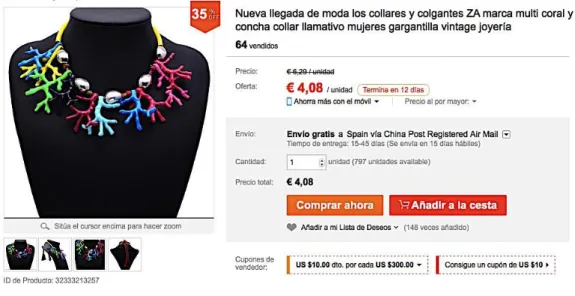
(24) Natalia Sanchis Sánchez the other hand, the web of Aliexpress is intended for retail sale and in addition this website is in Spanish. In particular, we focus on Aliexpress since, conducting a ranking of the most visited pages in Spain, according to the Alexa3 web portal, Aliexpress ranks 18th, of the most visited, and is the only web between the 18 posts of the ranking that is devoted to the supply of textile products. Aliexpress, is within the Alibaba group, the group, which is passed in September of 2014, he went out on the stock exchange on Wall Street by raising $25,000 million. This website consists of a multitude of vendors, which are classified according to reputation and reliability. Markets, in part, of textile products and accessories, all kinds of products as kitchenware, electronic products, jewellery, until facial products and makeup. This website has sellers that marketed with identical or similar products to the large firms, leading to the Alibaba group receives demands on the part of the big fashion houses, the most recent case is the lawsuit filed by Gucci and Balenciaga to Alibaba Group, due to the forgeries Alibaba is aware that its platform for sales, there are imitations and tries to stop the sellers market, banning the sale and deleting advertisements, but it is difficult to put an end to that market. Focusing, in the textile part, and the imitation, there are a huge number of pages and forums where they give you advice and practical guides to know seeks, in particular, the brand that you want to acquire. Since, the analysis focuses on the firms or Spanish groups will seek counterfeit products of these. For example, to search for clothing of Zara, we would have to put in the search engine "zar", "za","za ** " and so we would get clothing and accessories of imitation of Zara. Inquiring best, we are, in the spring 2015 season of Zara, an identical in Aliexpress accessory.. 3. www.alexa.com, is a website specializing in the collection of statistical information on traffic on the Internet and evaluated the websites most important on a global level, by country and by category, generating a ranking.. Analysis of the main groups of textile distribution in Spain. 23.
(25) Natalia Sanchis Sánchez. Illustration 1. . Imitation Product Aliexpress. Illustration 2. Genuine Product Zara. As noted, the products are identical, except that the value of the product of imitation is of 4.08 € and the value of the genuine product is 22.95 €. Therefore a person wishing to purchase products from brands, but they cannot, either by its purchasing power level or your budget you can purchase the same products to a. Analysis of the main groups of textile distribution in Spain. 24.
(26) Natalia Sanchis Sánchez value that far from the original price, therefore it meets the needs of consumers that you want to wear clothes or accessories of that brand and even cheaper price. The degree of substitution is different in different customers, because customerconsuming products of imitation is covering his need to bring a little brand of prestige and therefore be able to cover the need for recognition, to be able to enter the social circle which it aspires. Years ago, counterfeit products could be found in flea markets, or bazaars. Also has been known that the counterfeit products were concentrated in the so-called big bazaars of Middle Eastern countries such as the Grand Bazaar in Istanbul (Turkey), in which, host’s a hundred backstage manipulations in the selling textile products, accessories, watches and jewellery from imitation. Marketed from the hiding. The major change in a few years toward here, has been being able to buy via the internet, in which the market of the imitation has been a gap in the market to be able to position itself, where it appears a legal vacuum that known to the authorities but it is very difficult to control and only operates when the marks are sued for imitation and plagiarism, as we have previously mentioned. 4.4.. Bargaining power of buyers. In the first place, it could be said that all people are clients of the textile sector, since; it has to cover the basic need for dress. But by focusing on the main Spanish textile groups, as we have previously mentioned, Inditex, Mango and Cortefiel group, each one of the chains by which each group is composed, is directed at a target groups. The three strings have the same kind of target groups, are people who want to be trendy, and buy clothing inspired by the most exclusive brands at a lower price. Each group has different brands and each one is intended for a specific client group. These companies textile distribution are segmented demographically, depending on the gender, age, and income. Zara and Mango would cover all the functions, since they offer products for both men and women, for children in the case of both and for teenagers in the case of Trafaluc Zara. Also depending on the income, since they are considered low cost.. Breaking down the shops of these groups, we see that each of them encompasses different types of groups of customers, and according to the prices of the products we can see that focuses on certain groups whose income is low or higher, that is to say, use a segmentation strategy of marketing mix differentiated in the covering the needs of the majority of the segments of this market, but moulded to each specific segment.. Analysis of the main groups of textile distribution in Spain. 25.
(27) Natalia Sanchis Sánchez Groups, Inditex and Cortefiel group have similar shops and destined for the same public, causing are competing among themselves. Below are the shops that are aimed at different public, for both groups. In the case of a young public, both men and women, of Inditex, would be Bershka and Pull & Bear, Cortefiel group, Springfield; all the shops have affordable prices for the public. For the same type of customers but focusing only on women would be Stradivarius. Secondly, focusing on the female gender would be the shops of lingerie for women as Oysho, in the case of Inditex and Women'Secret in the case of Cortefiel group. Focus on all stages of a woman, except girls, from teens to mature woman. Finally, both for the male gender as for females, but whose purchasing power is greater, would be Uterqüe and Massimo Dutti, for Inditex, and Cortefiel group, Pedro del Hierro and Cortefiel. The brand Pedro del Hierro does not have a physical store, but, that is a section of the Cortefiel shops. These stores would be oriented toward a few customers with higher incomes, since their prices are high in comparison with the other strings of the groups. In the case of Mango, H&M and Primark, is different because the string itself does not have another type of establishment aimed at a specific segment and with a different name that differs from the original. In the case of Mango, in the past few years has created a line for men called H. E. by Mango and another for women who use up to size 52, Violet by Mango, this last two lines are marketed regardless of the branch shop Mango, and finally within Mango is the area of women, a sporty and another line Mango Kids. On the other hand, the case of H&M, all of the segments that are directed are in the same establishment. Including a sub-brand divided for young people. Finally, with regard to Primark, has no sub-brand that differentiates a segment from another, in their establishments meets garments for women, intimate, of man, of children, accessories and home. A Spanish citizen media can be reached to spend in a year 532.16 €, according to data obtained by the National Institute of Statistics in 2013. A figure that is considerably less than the previous years, due to the crisis, a circumstance that affects the purchasing habits of the Spaniards generating bargaining power in the industry. Companies must be competent in the price and quality, since it is because of the high competition and the similarity of the products a variation of the price of their products can reduce the demand, thus impacting on the company's revenue. The crisis economy has been a point in favour in the bargaining power of customers already, due to the low consumption of textile on the part of consumers has been lobbying for the decline in. Analysis of the main groups of textile distribution in Spain. 26.
(28) Natalia Sanchis Sánchez prices on the part of the textile chain, due to the trend of buying in rebates and when there are promotions. The fashion industry over the years has grown due to reflecting the fashion of the personality of the people, making them feel good and faithful to his own style, encouraged also by the epoch in which we live as it is a showcase for the public and the multitude of designers, brands, styles and trends that you can play. For this reason, each time growing more consumers of clothing, in the sense of pursuing a fashion, trend and create a style of its own regardless of the basic need for dress. Therefore, there are increasingly more businesses that choose to enter into the sector by the attractive and diversity. The client has a certain power, already that, faced with so much variety of stores, brands and companies of fashion, and paying more attention to the leading groups, which are poorly differentiated among themselves, since, offer similar articles, similar prices and that they follow all the different trends that break the market, the customer can buy in all the establishments that you already cover the same need. Therefore, the companies have to have a competitive advantage that makes them attractive to the eye of the customers. In conclusion, there is a factor that gives power to the customers as the crisis and that there is little differentiation between the products of the textile chain. But to have a volume of individual sale and do not buy in-group, low the bargaining power of these, being in a market and industry wide and not be geographically concentrated the power of the customers regarding the production of the companies is very low. 4.5.. Bargaining power of suppliers. It is well known that the majority of these large textiles perform a percentage of their production in other countries, such as Asian countries, India and North Africa. These companies are limited to the use of yarns, fabrics and accessories for the production of their clothes, and the construction of these same. These service providers are linked to the decisions that you have the consumers with respect to the fashion of the time, trends and the design, which comes in the form of guidelines by the company for the dressmaking therefore the suppliers haven’t power of decision. The only differentiation that may have the suppliers it is at the time of the dressmaking, if doing the work of good quality, if they have special techniques for some types of embroidery, could be differentiated from other suppliers. The bargaining power of suppliers in the fashion industry is low, due to the vertical integration that have strings textiles. Inditex is the textile group with a vertical integration, from design to distribution form part of your team, and has factories where. Analysis of the main groups of textile distribution in Spain. 27.
(29) Natalia Sanchis Sánchez it produces articles, only uses external suppliers to the realization of the labour of clothing more generic change in fashion garments and more complex are manufactured at the domestic level. The 87% of their total production is done internally in the own factories of Inditex, whereas 13% occurs through subcontracting to suppliers, therefore in this case the suppliers haven’t bargaining power, because, if they don’t meet the need and demand criteria that Inditex, you can change suppliers. In the case of Mango, the process of production of the garment supports more suppliers, focusing on the specialty of the product and in the proximity, the providers that are responsible for the manufacturing are of the southeast Asian countries and India, on the other hand the production workshops are closest, such as Spain, Portugal and north Africa. Due to the fact that each season incorporates more suppliers to meet the market demand for the same time, reducing the bargaining power of these same, yet still maintaining long-term relationships with its suppliers. In the contrary case of Inditex, is the Swedish group H&M, in which, collaborate with suppliers in Asia and Europe, which manufactured products and supplying fabrics and materials required and hasn’t own factory, everything contrary to Inditex. One of the threats for companies in the sector, it is forward integration of suppliers. This happened with a supplier of Inditex, Comdiput was exclusive provider of the group and is engaged in the manufacture of the collections of lefties, the flagship model of the low cost of Inditex, and in 2005 began in the sale to for less, with Friday's project, but in 2010 were redirected its business toward the distribution with the shops Shana. Ceased to be only suppliers and create your own brand. Opted for the creation of a brand made for young audiences and at low prices, because they found a gap in the market that cover due to the demand for more economic fashion due to the economic crisis, and similar characteristics due to constant renewal of the garments of the brand. Through this case, we can check that the suppliers may be able to be the own competitors of the companies that provided, being a competitive threat. But there bargaining power in this sector is low due to suppliers receiving the orders of the textile companies on the design and the garments therefore the suppliers have no decisionmaking power in the process.. Analysis of the main groups of textile distribution in Spain. 28.
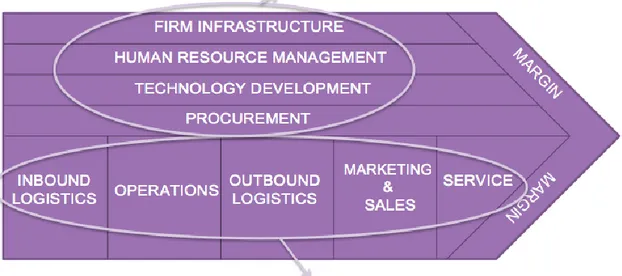
(30) Natalia Sanchis Sánchez 5. THE COMPETITIVE ADVANTAGES OF THE TEXTILE GROUPS Michael E. Porter (1980) said "The competitive strategy is to take actions defensive or offensive to establish a sustainable competitive position in an industry to effectively face the five competitive forces", therefore in the next section we are going to analyse that competitive strategies have the textile groups such as Inditex, Mango, H&M, Primark and Cortefiel group to deal with the market and why they are the groups with more sales in Spain, and some leaders worldwide. Internally to analyse each one of the textile chain and see the competitive advantage that has respect to the rest of us are going to support in the value chain of Porter (1987), already that, "the enterprise is disaggregated into core activities that are necessary to sell a product or service. Activities are classified into two groups; primary activities, is responsible for the production process, transfer and sales, and support activities, serve to support primary activities and that the company might have a proper operation. As shown in chart 1, are the various activities that encompass both the primary and support. In this case we will rely on primary activities because they form part of the productive process. Diagram 2. The Value Chain. Source: Own elaboration from Porter (1987). Analysis of the main groups of textile distribution in Spain. 29.
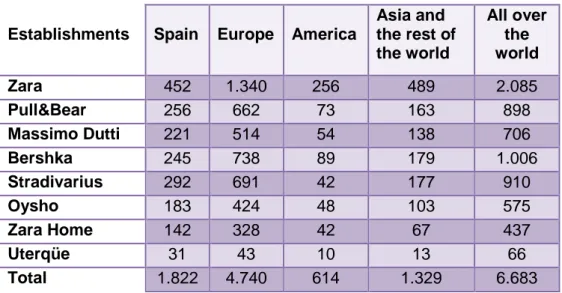
(31) Natalia Sanchis Sánchez 5.1.. Inditex. The textile chain leader at both the national and international levels, he began his business in the year 1963 as a manufacturer of garments, in 1975 opened in A Coruña its first Zara store, during the following years opens more stores in the Spanish capital due to the great reception by the public of the vision that you have on the fashion. In 1977, it installed the first factories coming to a Coruña. In 1984 is created the first logistics centre of distribution in Arteixo. In 1988 the leap by opening its first international Zara store in Porto, Portugal, a year after crossing the Atlantic by opening its first store in New York then in Paris and Mexico. In 1991 it was incorporated into the group Pull & Bear and Massimo Dutti. Since 1993 expands in Europe, South America Asia and Middle East. In 1999 the Group incorporates Stradivarius. In the year 2001 is created the brand of lingerie Oysho. In the year 2001 Inditex enters for the first time in the stock market. Continues by opening establishments around the world and in 2002 opened its distribution centre in Zaragoza to expand which is located in Arteixo. In 2004, Inditex is located in 56 countries and in 2005 ends the year with 2,692 establishments. In the year 2008 is created the brand Uterqüe since 2007, it has opened new distribution centres in Spain, in Madrid, Leon and Barcelona two years later. In 2011, Inditex has a presence in five continents with 5,500 stores operating in 82 markets. That same year opens all its brands to the ecommerce. In 2012 Zara opens in the main streets of London and New York. Table 1. Inditex establishments in the world Establishments. Spain. Europe. America. Zara Pull&Bear Massimo Dutti Bershka Stradivarius Oysho Zara Home Uterqüe Total. 452 256 221 245 292 183 142 31 1.822. 1.340 662 514 738 691 424 328 43 4.740. 256 73 54 89 42 48 42 10 614. Asia and the rest of the world 489 163 138 179 177 103 67 13 1.329. All over the world 2.085 898 706 1.006 910 575 437 66 6.683. Source: Own elaboration based on data obtained by Inditex.. Analysis of the main groups of textile distribution in Spain. 30.
(32) Natalia Sanchis Sánchez As shown in chart 2, Inditex has 6,683 establishments across the globe. In the case of Spain, has a percentage of 38% of the total European.. Inditex has a competitive strategy that makes him different and imitated among its rivals. The success of Inditex is given by the quickly that there is in their internal system to have new garments in all its stores in less than two weeks. Inditex integrates vertically in all the main activities of the value chain, therefore, will analyse internally to Inditex through the Porter value chain by focusing more on primary activities. First of all, we are going to analyse the activities closer to the productive process, i.e. primary activities: . Inbound logistics. The logistics centres, which is responsible for the storage and maintenance of their raw materials, work in progress and final products. The raw materials are purchased through suppliers that provide them with the area in about a week. With regard to the tissue, are obtained in advance due to the high volume that has the company, some fabrics are purchased without any dye, for then the same dyeing the fabrics, and other in change are ready for use. . Operations. In the first place, each team of designers of each brand of the group, designs the garment, once carried out the final design and pattern, arrives at the factory and digitally created the parts to be cut in the cloth, and then they are cut. Once sewn and ironed the garment, a computerized quality control manual and then another. Later the garments must be submitted to shop bent, folded and packaged, on the other hand if must be hung have crept into the hangers, they applied the alarm, label and are protected with a biodegradable plastic. The garments in trend occur internally, i.e. in Europe, to ensure the quality and make it available as soon as possible, on the other hand, to reduce the costs of basic clothing garments and more price-sensitive are outsourced in Asia. When it comes to clothing more elaborate are carried out in workshops of Galicia and Portugal, which maintains a long-term relationship. . External logistics and distribution. The advantage of ICTS in logistics centres is known in situ the consumer response to the demand, providing a greater depth of knowledge, and reducing the cost of inventories, using the inventory management system Just In Time (JIT), whose supply chain is fast, due to the trends and to the customers' responses to the clothing, you can. Analysis of the main groups of textile distribution in Spain. 31.
(33) Natalia Sanchis Sánchez tell if the model like it or not generating a production on demand, and a centralised distribution reducing stocks, thereby lessening in inventory costs. The collection does not like to customers, is redesigned or moved to another market, which would be good to your brand Lefties. Therefore, we are faced with the competitive advantage of Inditex, due to a vertical integration, which covers most of the activities, to its logistics system, the quick response to have before the consumer, and the proximity of their factories allowed to carry the clothing to distribution centres in Spain in less than 24 hours and distributed to all the shops of Spain twice per week by incorporating new garments for a renewal of the offer. . Marketing and sales. Advertising at Inditex is little; it focuses more the location of their establishments and in their shop windows. Inditex invests in the rental of premises located in the best streets of the cities and in the aesthetics of their shops and your store window as image toward the public. . After-sales service.. In the post-sales service, Inditex offers an affinity card, which offers the possibility to the customers to pay in instalments their purchases. In regard to the return of the garments, there is a period of one month and the full amount will be refunded. With regard to the competitive strategy of Inditex, can be observed that employs two competitive strategies. First, the strategy of cost leadership, due to their economies of scale the costs of production and warehouse are low in comparison to the benefits you get, due to continuing to offer. Secondly, the differentiation strategy, Inditex has a strategic goal cover all segments in terms of fashion. Its difference to the other competitors is, the speed, in the design of the clothing, that since it is designed a garment until it reaches the shops only have spent the last two weeks, and also the clothes are inspired by the unique designs of the great designers at affordable prices. In the constant renewal of garments, more customers visit their establishments by the fear that the garment that wish to not be found in the following weeks or to find new models. Therefore, thanks to the vertical integration, Inditex may allow continuous updating of the collections, creating fashion changing every two weeks, creating a stimulus to the client in which you have to regularly visit the shops to be found with the new collections.. Analysis of the main groups of textile distribution in Spain. 32.
(34) Natalia Sanchis Sánchez Therefore, they have an efficient team that captures the response of the consumer and the trends, creating a design, and in two weeks they are in the shops, thanks to the integration of their factories in its production process and because of the proximity of the distribution centres that enables them to distribute the clothing in a day to the European countries and 48 hours the rest of the world 5.2.. H&M. In 1947, Västerås, Sweden), it opens the first shop Hennes (for her in Swedish) in which only sells clothing for women. In 1964 went to Norway, and in 1968 acquired Mauritz Widforss, and begins the sale also for men and children, it marked the beginning of a call Hennes & Mauritz. In 1974 listed on the Stockholm Stock Exchange and in 1998 begins to sell on the Internet. In 2000, arrives in Spain, in the year 2006 begins the expansion of sales on the internet, and in the year 2014 is coming to Spain the sale online. Currently have 3,600 stores in 59 markets of the world, is the second string of the textile market, with sales of 16,158 million euros in the year 2014. The manufacturing process of H&M is far from that of Inditex, H&M does not have its own factories, but collaborates with 900 suppliers in Asia and Europe that are responsible for the preparation of their garments. H&M has a design team distributed in offices of different countries creating three seasons at the same time. But it also must be able to create sub collections, for the course between seasons. Focusing on the primary activities of the value chain. H&M works with its suppliers therefore the activities of internal logistics and the production of garments are outsourced. By providing them with larger margins due to manufacturing system is cheaper. Collections should designing them in advance, therefore in the shops have the same clothes and there are a large number of stocks. With respect to the large volumes of commodities must be ordered in advance, but the garments in trend occur in less time. . External logistics and distribution. Once the garments are completed it is sent to the logistics centres. H&M wants a most environmentally friendly form of transportation, 90% of the transport is via rail or shipping. H&M has to prepare their collections in advance, due to the fact that the manufacture is external and takes from idea to the end of the process between two and three months, reducing the capacity to meet the actual demand and the speed to replenish the garments in clothing.. Analysis of the main groups of textile distribution in Spain. 33.
(35) Natalia Sanchis Sánchez The garments in trend are manufactured in limited quantities and are distributed to the major cities on the other hand; the basic with large volume is distributed more broadly to more sites. . Marketing and sales.. This is the strong point of H&M, your competitive advantage. H&M uses various advertising campaigns to reach your audience. One of its main strategies is the use of the "cobranding".. H&M is usually done. collaborations with major designers of prestige brands, getting "masstige"4. With this strategy you want to ensure that the consumer can buy luxury goods and renown but at prices not prohibitive, the consumer is not buying an imitation but garments or accessories inspired by the luxury, creating in the consumer image of approximation to the luxury thanks to H&M, between their collaborations are creative directors from brands like Chanel, Versace among others. These collections are desired and are sold in the establishment of the great capitals, the first collaboration of H&M was with Karl Lagerfeld, Chanel designer, was exhausted in an hour. H&M makes great advertising campaigns working with the best models of the moment or singers of reputation, the dissemination is wide reaching all possible communication channels such as television, newspapers, radio, billboards, etc. . After-sales service.. Products purchased through the online sales have complication as the return. These must be returned by mail, at a cost of 1.95€, which will be deducted from the reimbursement, and up to 14 days to make the return and refund. Creating the consumer some mistrust to buy online. The competition has a different return system with regard to the returns of purchases online, may be returned in their physical stores and receiving the reimbursement of the purchase at the time. It is a weak point, with regard to online sales still than the other competitors are more advanced. In regard to the competitive strategy, it is a differentiation of prices, its goal encompasses all the segments, women, men and children and their prices should be lower than the competition, the public should know, therefore, in the advertising campaigns alongside the model put the price of the garment. Also, differ from the rest of its competitors to create alliance and create collections with designers.. 4. The masstige is a word formed by the words "mass" and "prestige". Its union means bear the marks of prestige to the broad masses.. Analysis of the main groups of textile distribution in Spain. 34.
(36) Natalia Sanchis Sánchez In conclusion, H&M is a textile chain focused on the low-cost fashion and which wants to bring to its public the fashion of the luxury, more geared their advertising investments and partnerships to create a brand image in their consumers. 5.3.. Mango. In 1984 Isak Andic, opened its first store in the Paseo de Gracia in Barcelona, after a year, it had five stores in the city. In the year 1988, improves its logistics system by applying the Just In Time. In the year 1992, begins its international expansion by opening two stores in Portugal. In 1995, opens to the Internet creating your website, Mango.com. Continues by opening stores in the main shopping streets of Paris and London. In the year 2000 embarks on sale online. In 2005, creates MangoTouch, intended exclusively for the accessory. The following year opens to the North American market by opening stores in Chicago, Dallas, Los Angeles, etc. In the year 2008, Mango extends its target and directed to the male segment with the creation of H. E. ByMango. In 2014, launches a new Violet mark by Mango, addressed to young women from size 40 to 52. Account with more than 2,000 stores in 105 countries. In terms of its value chain, Mango has a centralized system, the part more decentralized your system is the production, as it is sub-contracted. In the first place, the designs, the designs your computer in the centre Hangar Design Centre, which they are working on more than 600 professionals in different areas of design, procurement, quality, image and advertising, expansion, logistics, information systems, etc. Creates a collection for each season of the year, in addition to clothing in trend that breaks the market. It also makes collaborations as H&M with designers and personality but not so relevant. Mango doesn’t manufacture, subcontracts throughout the whole production, 140 suppliers are responsible for the production located in China, Morocco, India, etc. To which a supplier is part of Mango has to undergo a selection process that may last for a year, since looking for a partner. Each partner has a different activity, some act as manufacturers and others are specialized workshops in the garment. In regard to the manufacturers providers are responsible for purchasing the raw materials and production, these providers are in southeast Asia and India on the other hand the raw materials for the production workshops are acquired by Mango, are countries of north Africa, workshops are closest to the headquarters and logistics centres due to the fact that these workshops will focus on the production of garments of seasons that should be incorporated into the market in a few weeks and not in collections identified,. Analysis of the main groups of textile distribution in Spain. 35.
Figure
Documento similar
In the preparation of this report, the Venice Commission has relied on the comments of its rapporteurs; its recently adopted Report on Respect for Democracy, Human Rights and the Rule
H I is the incident wave height, T z is the mean wave period, Ir is the Iribarren number or surf similarity parameter, h is the water depth at the toe of the structure, Ru is the
In the “big picture” perspective of the recent years that we have described in Brazil, Spain, Portugal and Puerto Rico there are some similarities and important differences,
- Competition for water and land for non-food supply - Very high energy input agriculture is not replicable - High rates of losses and waste of food. - Environmental implications
We will now try to provide an analysis of the strategies and news treatment of items involving terrorism on the websites of the main television groups in Spain.. Study of the
In the previous sections we have shown how astronomical alignments and solar hierophanies – with a common interest in the solstices − were substantiated in the
We advance the hypothesis that fraudulent behaviours by finan- cial institutions are associated with substantial physical and mental health problems in the affected populations.
teriza por dos factores, que vienen a determinar la especial responsabilidad que incumbe al Tribunal de Justicia en esta materia: de un lado, la inexistencia, en el
