Catalytic Intermolecular
Hetero-Dehydro-Diels-Alder
Cycloadditions: Regio- and
Diasteroselective Synthesis of
5,6-Dihydropyridin-2-ones
†
Jesús Manuel Fernández-García,
aManuel Á.
Fernández-Rodríguez,
band Enrique Aguilar
a,*
a Instituto Universitario de Química Organometálica “Enrique Moles”, Universidad
de Oviedo, C/Julián Clavería, 8, 33006, Oviedo, Asturias (Spain).
b Departamento de Química, Área de Química Orgánica, Facultad de Ciencias,
Universidad de Burgos, Pza. Misael Bañuelos, s/n, 09001, Burgos, Spain. [email protected]
Received Date (will be automatically inserted after manuscript is accepted)
ABSTRACT
A novel catalyzed intermolecular hetero-dehydro-Diels-Alder reaction between push-pull 1,3-dien-5-ynes and aldimines or silylaldimines is reported. The sequence is promoted both by gold(I) or silver(I) catalysts and leads to the diastereo- and regioselective formation of 5,6-dihydropyridin-2-ones.
The field of metal-catalysis (together with bio-, and organo-catalysis, one of the three feet of the vital catalytic tripod in the current scenario of organic synthesis) has achieved considerable improvement over the last decade.1
† Dedicated to Professor Rafael Suau, in memoriam.
(1) For selected recent reviews on catalysis: (a) Grondal, C.; Jeanty, M.; Enders, D. Nature Chem. 2010, 2, 167-178. (b) Díez-González, S.; Marion, N.; Nolan, S. P. Chem. Rev. 2009, 109, 3612-3676. c) Hargaden, G. C.; Guiry, P. J. Chem. Rev. 2009, 109, 2505-2550. (d) Fürstner, A. Chem. Soc. Rev. 2009, 38, 3208-3221. (e) Gorin, D. J.; Sherry, B. D.; Toste, F. D. Chem. Rev. 2008, 108, 3351-3378. (f) Dondoni, A.; Massi, A. Angew. Chem. Int. Ed. 2008, 47,4638-4660. (g)
R
MeO
CO2Me [M],
N R
O R1CO2Me
R2 (H) R1
N R2
In this regard, the well-recognized ability of coinage metals (especially gold derivatives) and platinum to activate triple bonds for the attack of different nucleophiles has resulted in the development of an impressive array of organic transformations, mainly cyclizations;2 moreover,some of them represent efficient routes to substituted heterocyclic compounds.3 However, relatively few gold-catalyzed intermolecular cycloadditions have been reported.4
We have recently described an efficient and simple procedure for the synthesis of push-pull dienynes 1 and 2,5 which have proved to be appropriate substrates for metal-catalyzed transformations. For instance, the carboxylic acid substrates 2 undergo an unusual cycloaromatization reaction6,7 to afford 2,3-disubstituted phenols 3 (Scheme 1); moreover, non-activated nitriles regioselectively attack the metal-complexed triple bond of esters 1 leading, after cyclization, to tetrasubstituted pyridines 4,8 this being the first example of an intermolecular catalyzed hetero-dehydro-Diels-Alder (HDDA) reaction.9
For an insight comprised of a series of commentaries and reviews, see:
Small Molecule Catalysis (Eds.: Mitchinson, A.; Finkelstein, J.) in
Nature 2008, 455, 303-349. For recent reviews on bio-catalysis, see: (h) Reed, M. T. Angew. Chem. Int. Ed.2011, 50, 138-174. (i) Yu, H.-L.; Ou, L.; Xu, J.-H. Curr. Org. Chem. 2010, 14, 1424-1432. For a recent special issue on Organocatalysis, see: j) (Eds.: Jacobsen, E. N.; MacMillan, D. W. C.) in Proc. Nat. Acad. Sci. 2010, 107, 20648-20677. k) For a highlight on gold and organocatalysis combined see: Hashmi, A. S. K.; Hubbert, C. Angew. Chem. Int. Ed. 2010, 49,1010-1012.
(2) Selected recent reviews: (a) Hummel, S.; Kirsch, S. F. Beilstein J. Org. Chem. 2011, 7, 847-859. (b) Garayalde, D.; Nevado, C. Beilstein J.
(3) For reviews on gold-catalyzed synthesis of heterocyclic motifs, see: (a) Rudolph, M.; Hashmi, A. S. K. Chem. Commun. 2011, 47, 6536-6544. (b) Hashmi, A. S. K.; Buhrle, M. Aldrichimica Acta 2010,
43, 27-33. (c) Hashmi, A. S. K. Pure Appl. Chem. 2010, 82, 657-668. (d) Cossy, J. Pure Appl. Chem. 2010, 82, 1365-1373. (e) Das, A.; Abu Sohel, S. M..; Liu, R.-S. Org. Biomol. Chem.2010, 8, 960–979. (f) Shen, C. Tetrahedron2008, 64, 7847–7870. (g) Shen, C. Tetrahedron
2008, 64, 3885–3903. (h) Krause, N.; Belting, V.; Deutsch, C.; Erdsack, J.; Fan, H.-T.; Gockel, B.; Hoffmann-Roder, A.; Morita, N.; Volz, F.
Pure Appl. Chem. 2008, 80, 1063–1069.
(4) Recent examples: (a) Davies, P. W.; Cremonesi, A.; Dumitrescu L. Intermolecular and Selective Synthesis of 2,4,5-Trisubstituted Oxazoles by a Gold-Catalyzed Formal [3+2] Cycloaddition Angew. Chem. Int. Ed. DOI : 10.1002/anie.201103563, Published Online: July, 26, 2011. URL (accessed July 27, 2011). (b) Melhado, A. D.; Rodríguez, M. A.; Bernardo de la Rúa, R.; Ballesteros, A.; Aguilar, E.; Tomás, M. Angew. Chem. Int. Ed. 2007, 46, 2610-2612.
(6) García-García, P.; Fernández-Rodríguez, M. A.; Aguilar, E.
Angew. Chem. Int. Ed. 2009, 48, 5534-5537.
(7) For a gold-catalyzed cyclization involving other 1,3-dien-5-yne systems, such as o-(alkynyl)styrenes, see: Martínez, A.; García-García, P.; Fernández-Rodríguez, M. A.; Rodríguez, F.; Sanz, R. Angew. Chem. Int. Ed. 2010, 49, 4633-4637, and references cited therein.
(8) Barluenga, J.; Fernández-Rodríguez, M. A.; García-García, P.; Aguilar, E. J. Am. Chem. Soc. 2008, 130, 2764-2765.
(9) Wessig, P.; Müller, G. Chem. Rev. 2008, 108, 2051-2063.
Continuing with our interest to explore the reactivity of dienynes 1, we have considered testing their behaviour against aldimines 5 which, through an HDDA reaction, should lead to 1,2-dihydropyridines 6 or, more probably, to 5,6-dihydropyriridones 7 after hydrolysis; the methoxy substituted triple bond carbon would behave this way as a masked carbonyl surrogate. Interestingly, the 5,6-dihydropyridin-2-one skeleton is found in compounds presenting antibacterial, or antiviral activities, as well as in herbicides, plant growth regulators10 or in free radical scavengers; moreover, properly substituted 5,6-dihydropyridin-2-ones have been regarded as useful intermediates for the preparation of spatially defined non-peptidic scaffolds, constrained counterparts of natural amino acids.11
Scheme 1. Metal-catalyzed transformations involving push-pull dienynes 1 and 2.
Taking into account our previous results in the reaction with nitriles,8 the initial essays were carried out with dienyne 1a (c = 0.1 M) and aldimine 5a (5 equiv). 1,2-Dichloroethane (DCE) was used as solvent, the temperature was settled at 85 ºC, and several transition metal complexes were tested as catalysts for the desired transformation. No reaction was observed with transition metals such as Pd, Fe, Ni;12 however, the reaction proceeded with coinage metals (Table 1, entries 1-5, 8-10) as well as with Pt and Zn (entries 6, 7). After work-up, dihydropyridone 7a was isolated, albeit in low yield, for Zn (entry 7), or observed by NMR for Pt (entry 6) and for several cationic Au(I) catalysts bearing aromatic phosphines (entries 2-4), independently of the electronic nature of the phosphine ligand. Moderate yields were reached for Cu(II) (entry 8), Au(III) (entry 1), Ag (entries
9 and 10) and a cationic Au(I) (generated in situ by mixing 5 mol % of AuClPEt3 and 5 mol % of AgSbF6, entry 5) complexes. After these results, an extensive screening of other reaction condition parameters (temperature, solvent, concentration, number of equivalents of imine, catalyst loading) was performed, either employing AgSbF6 by itself or the system AuClPEt3/AgSbF6, as catalysts.13 Thus, the best conditions found were AuClPEt3 (5 mol %)/AgSbF6 (5 mol %) [entry 5, Method A], or AgSbF6 (5-10 mol %), [entry 10, Method B], in DCE at 85 ºC, which led only to moderate yields of adduct 7a.
Table 1. Catalyst Screening for the Intermolecular HDDA Cycloaddition of 1a with Aldimine 5a.12
Ph
Isolated yield based on the starting dienyne 1a; in brackets, NMR estimated yield (7a not isolated) employing 1,3,5-trimethoxybenzene as internal standard.
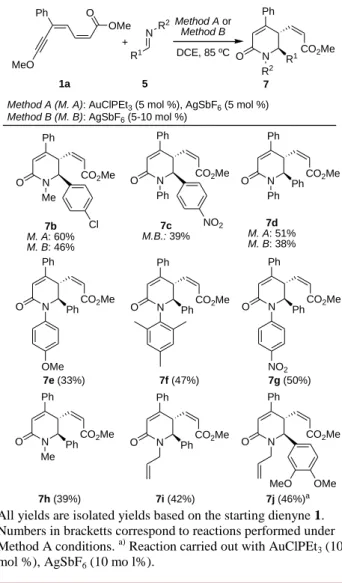
Once Method A or Method B conditions were established as the best ones found for the desired transformation, a wide variety of aldimines 2 were tested to analyze the scope and limitations of this novel HDDA cycloaddition (Scheme 2). Usually, the reactions were completed overnight (12-14 h) under both conditions. Interestingly, except for compound 7a, whenever both methods were employed to prepare the same adducts (7b,d), Method B provided lower yields than Method A; therefore, the latter one was chosen to perform most of the scope screening reactions. Indeed, the process works nicely for aldimines with phenyl (7d-i), or either electron-withdrawing (7b,c) or electron-donating (7j) aryl substituents. Apparently, ortho-substitution does not lead to a decrease in the reaction yield (7f). The substitution pattern at the nitrogen atom is of a wider scope as it tolerates methyl, phenyl and both electron-withdrawing and electron-donating substituted phenyl rings. Of particular relevance are the cases of the p-methoxyphenyl
(13) For silver or gold catalyzed reactions see: Hashmi, A. S. K. In
Silver in Organic Chemistry, Harmata, M., Ed.; John Wiley & Sons, Inc.: Hoboken, NJ, 2010; pp 357-379.
(7e) and allyl (7i,j) groups, which are prone to undergo removal leading to NH-dihydropyridones. In all cases, complete diastereo- and regioselectivity were observed in the cycloaddition.
Scheme 2. Scope of the intermolecular HDDA cycloaddition.
Ph
All yields are isolated yields based on the starting dienyne 1. Numbers in bracketts correspond to reactions performed under Method A conditions. a) Reaction carried out with AuClPEt3 (10 mol %), AgSbF6 (10 mo l%).
The identity of compounds 7 was ascertained by NMR spectroscopic experiments (including COSY, HSQC, HMBC and NOESY).12 Even though the relative confirmation the proposed trans stereochemistry.12
To analyze the substrate electronic requirements, the intermolecular HDDA reaction conditions were tested in simpler substrates. However, dihydropyridone formation was not observed either for (E)-1-phenyloct-1-en-3-yne 8
(a neutral enyne; Figure 1) nor (Z)-methyl nona-2-en-4-ynoate 9 (an electron-deficient enyne), while just traces were GC/MS-detected for (E)- 4-ethoxy-1-phenylbut-1-en-3-yne 10 (electron-rich enyne). Therefore, as it happened for the reaction with nitriles, the electronic nature of the conjugated system is crucial for the intermolecular HDDA reaction to occur: a push-pull system is needed. On the other hand, that is not the only requisite; interestingly, methyl (E)- 5-ethoxy-pent-1-en-3-ynoate 11 led only to GC/MS-traces of the desired adduct, thus indicating that remaining double bond of dienynes 1 may also play some role in the reaction.
MeO2C Bu synthesis of N-unsubstituted dihydropyridones, which are in principle more appealing, interesting and versatile substrates. The reactions were carried out employing the previously developed Method A conditions; in this case, a further hydrolysis step was required15 and led to N -unprotected trans-5,6-dihydropyridin-2-ones 13 in moderate yields (Scheme 3).
The scope of the reaction was explored regarding the substitution both at the dienyne and the silyl aldimine counterparts. Thus, several aryl groups with different electronic properties [phenyl (13a), bearing electron-donating groups (13c,d) or electron-withdrawing groups (13b,f)] and substitution patterns [ortho (13c,f), para (13b,d,h-l)], heteroaryl (13e), and tert-butyl (13g) substituents are tolerated at the silyl aldimine moiety while the R group at the dienyne displays a wide scope as it may be a phenyl (13a-g), an electron-withdrawing substituted aryl group (13h), an electron-donating substituted aryl (13i), a silyl (13j), an alkyl (13k) or an alkenyl (13l) substituent.
The formation of dihydropyridones 5 (or 13) can be
(15) Dihydropyridines 14a,b were isolated in just 29% and 13% yield in preliminary reactions carried out between dienyne 1a and N -trimethylsilyl benzaldimines 12a,b. The low yield of 14, probably due to product decomposition during chromatographic purification, prompted us to perform an in situ additional hydrolysis step.
14a (X = H), 29%
Scheme 3. Scope of the intermolecular HDDA cycloaddition employing silyl aldimines.
All yields are isolated yields based on the starting dienyne 1.
Ph
Figure 2. Proposed origin of the diastereoselectivity
diastereo- and regioselective formation of 5,6-dihydropyridin-2-ones. Labeling, designed NMR experiments and theoretical calculations directed to gain some insight into the reaction mechanism and work to expand this new method to other unsaturated nucleophiles are currently underway in our lab and will be reported in due course.
Acknowledgment. We are deeply grateful to Prof. Barluenga (Universidad de Oviedo) for his constant support and for fruitfully maintained discussions. We also acknowledge the financial support received from MICINN (Spain) (grants CTQ2009-09949, CTQ2010-16790, PTA2008-1524-P contract to J. M. F.-G. and Ramón y Cajal postdoctoral contract to M. A. F.-R.) and FICYT (project IB08-088).