The Virtual Space of the Dynamic Hypermedia Device, a
Habitable Space
Abstract
The hybrid contemporary space, which integrates urban and interactive virtual spaces, implies particular
ways of inhabiting that suggests new identities, promoting the constant alternation between its different
worlds. This article proposes to analyze and understand the design, construction and appropriation
processes in this new social space-time. These processes are not only guaranteed by the accessibility to new
media, but they involve the organization of complex strategies which included the development of
instruments and landscapes that allow the migrations and interweaving between two realities: the urban and
the virtual. This project generated an accumulation of unforgettable experiences that turned into a
multiplicity of words and images that expanded through informal media or planned strategies. These
activities allow reflecting upon the behaviors, meanings, and diverse thresholds that were constructed by
the actors themselves during this process, and suggest new ways of being-in-the-world.
1.
INTRODUCTION
The purpose of this article is to consider the characteristics of the virtual space of a Dynamic Hypermedia
Device as a habitable space that promotes its appropriation. This issue is examined in the author’s ongoing
doctoral thesis, entitled “The Interface-Space of the Dynamic Hypermedia Device”1
; in projects that are
part of the Research, Development, and Technology Transfer Program “Dynamic Hypermedia Device”;
and in a high-impact R&D project for public universities of the Center-East region of Argentina, at the Nº209/09, and by the CAI+D’09 Research Program at Universidad Nacional del Litoral, Santa Fe.
2 For more information, see http://www.cifasis-conicet.gov.ar/index.php?grupo=5 PICTO-2010-0143
"Hacia el desarrollo y utilización de Repositorios de Acceso Abierto para Objetos Digitales Educativos en
el contexto de las universidades públicas de la región centro-este de Argentina” Convocatoria PICTO CIN
According to San Martin [1], a Dynamic Hypermedia Device –DHD– is a complex entity that results from
the integration of two indissociable and interdependent dimensions: a set of technologies and social aspects
that shape a sociotechnical network. This network allows subjects – in the current virtual-physical context –
to interact responsibly with others to research, teach, learn, dialogue, debate, compose, evaluate, produce,
disseminate and transfer within the collaborative environment of a workshop, utilizing the
communicational, transformative, and open potentiality of Information and Communication Technologies
(ICT). This perspective integrates the dynamic presence of technologies, interactive links, and
representations in a potential space where exchanges that enable co-construction take place.
In this sense, interactive virtual spaces are considered to be habitable spaces that, when integrated with the
urban landscape, are part of the human habitat. This new social space-time, augmented and hybrid, implies
particular ways of dwelling that shape new identities, promoting constant alternation amongst its various
worlds. The processes of design, construction, and appropriation of these spaces are not only guaranteed by
the degree of accessibility to new media, but also involve the organization of complex strategies that should
include the management of devices and landscapes that allow migrations and entanglements between both
worlds [2].
To have access to an interactive virtual space an interface is needed, as these are mediated spaces. Interface
design is not only a problem of representation, of designing the image of the information, but of the organization and the degree of accessibility to it, with the aim of reducing cognitive entropy, “…it’s about
designing the experience that is implied by its use” [3], about shaping interactive virtual spaces that are
appropriate in the sociotechnical context of the Knowledge-Based Society, equipped with the cognitive and
methodological instruments through which it unfolds, and in relation to the different profiles of its
inhabitants.
“…we do not only act in the space, perceive the space, exist in the space and think about
the space, but we also create space to express the structure of our world…” [4]
The space expresses our way of being-in-the-world, giving answers not only to our pragmatic necessities
but also to our affective ones, to our desires, and to our fears. For the average user to be able to appropriate
safety threshold is indispensable, to then be able to, within the context, create an "atmosphere" that
motivates participation, modelling the syntactic and semantic dimensions.
This article will contextualize in an introductory fashion the theoretical and design issues of the
interface-space, starting from a case in which an initial experimental prototype called "Memory Looms" was
developed, within the framework of the interdisciplinary research project "Wheelwright, virtual-physical
community: design and implementation of a Dynamic Hypermedia Device for the construction of the
civitas"3, in which collaborative and plural writing of a book of community memories by the inhabitants of a town, was encouraged [5]. The aforementioned requirement paved the way for the design, development,
and testing of an initial interface-space prototype for the co-production, edition, and discussion of contents,
based on criteria of heuristics and usability, in relation to the complexity defined as “DHD-interactivity”
[6], from an open access-open source perspective. “Memory Looms” includes an ad hoc development called “Hypermedia Memory Book", which proposes an innovative graphic and navigation interface that is
technologically integrated to Moodle environment.
The project begins with an initial diagnostic carried out on collaborative systems in use, like Moodle [7]
and Sakai [8], and Open Access repository systems like D-Space [9], that still exhibit weaknesses in terms
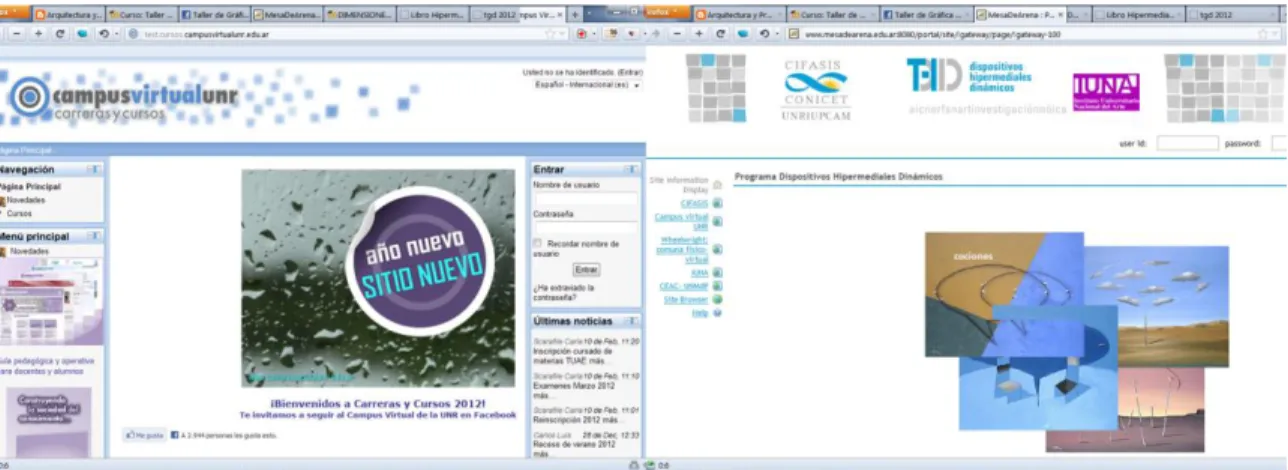
of the orientation and interface comprehension requirements on the part of the users (Figure 1). The spatial
proposal, the organization and visualization of resources and contents, and the strategies used to navigate
the space, are unintuitive or are not clearly signposted, making them difficult to interpret, which provokes
disorientation in the users that do not find what they are looking for, lose the path that they have taken, or
utilize the options in an incorrect fashion.
3
Santa Fe INNOVA 2009. Secretaría de Ciencia, Tecnología e Innovación. Gobierno de Santa Fe.
Competition for research projects about matters of provincial interest developed by research groups
belonging to the science, technology and innovation system. Project Title: “Wheelwright, comuna
físico-virtual: Diseño e implementación de un Dispositivo Hipermedial Dinámico para la construcción de civitas.”
Figure 1: UNR Virtual Campus at Moodle (left) Dynamic Hypermedia Device Program at Sakai (right)
Following this introduction, a first part will cover the basics that guided the decisions and design operations
implemented in the aforementioned prototype. In principle the project developed in the town of
Wheelwright takes place in a holistic context that includes not only the design of the space but also, and
fundamentally, the implementation of the experience that implied the deployment of a complex strategy
that, according to Laddaga, corresponds to an epistemological framework in which the boundaries of
traditional disciplines blur together. Then, in order to account for certain peculiar characteristics of the
proposal, the concepts of syntagma and paradigm, time and space will be addressed as they relate to the
database as a cultural and symbolic shape of the Knowledge-Based Society proposed by Manovich, in
opposition to the narrative and cartesian lineal perspective as a "symbolic shape" of the modern era. Jay
continues the debate, recovering the baroque vision as one of the scopic regimes that persists even in the
present, suggesting a possible transposition to the approach proposed in the case of the design of the
Hypermedia Memory Book. Afterwards, the strengths of the spatial conception of the project are described,
and finally, the conclusions of the paper and possible avenues for further inquiry are presented.
2.
A POST-DISCIPLINARY CULTURE OF ART
Art has the capacity of being a place to explore the boundaries and potential of life during a specific
historical moment. For some years artists, designers, and researchers started to design and develop projects
that intended to renew this capacity through the organization of complex strategies and interfaces of
these experiences may present cognitive and linguistic difficulties stemmed from the artificial separation of
knowledge, and it is there that the design of the work becomes an interface in the biological sense, in a post-disciplinary ecosystem of directed action [10].
These projects require the implementation of forms of collaboration that facilitate the long term association
of a group of people from different places, of different ages and from different fields; strategies that
articulate processes that modify local situations and the production of representations, in a way that both
aspects are mutually reinforced; and the design of publishing devices that facilitate the distribution of these
collaborations in a way that maximizes their visibility for their community of origin and constitutes them as
material for a debate on community identity, but is also openly available to spectators and potential readers
[11].
Artists, designers and researchers are gradually more interested in participating in the development of
cultural ecologies than in building works. This participation implies abandoning the gestures, forms and
operations inherited from the art culture that sprung up in the last years of the 18th century and that had
spread and deepened up until the last quarter century, when the institution of the work as a “personal
monument” began to weaken and it became evident that the modern universe was dissipating [11].
Among the premises that sustain these kinds of projects, today works are not considered objects; they are
considered to be processes that enable the participation of the spectators as co-authors of the work. Ascott,
an artist renowned for his dedication to linking art, technology, and awareness since the ´60s, proposes an
optimistic vision of art in relation to the global systems of communication, since they place the spectator in
an active position - through interaction and exploration – in the creation of an authentic artistic experience,
and the collaboration in the production of meaning, evolution, and definition of the work [12].
Artists, designers, and researchers react in the face of the bankruptcy of the modern paradigm, selecting just
some of its principles: the belief in the interrogative value of certain configurations of images and
discourses that, articulated with the exploration of the essence and meanings of a community, set out to
revise “…what a community is, has been and could be; how community connects to the individuals and what the relationships between these are like…” [11], to foster the symbolic reconstruction of collective
It is about experimental projects that, as a place for debate on the relationship between the production of
representations and the new forms of citizenship, propose the integration of the virtual space with different
forms of use of the urban space in which they operate, through joint actions on the part of its inhabitants.
That is to say, that in this new historical context, the space of virtuality is intertwined with the urban space
creating a hybrid social space-time that stores the expressions of the new forms of dwelling.
In these projects that connect art, design and technology, new types of collaborations between citizens and
multidisciplinary researchers devoted to the decentralized creation of discourse and images, facilitated by
devices that allow the realization and communication of the project, and that are conceived as the proper
habitat of these practices, giving way to emergence of a text that integrates diverse languages and is the
result of a process of plural construction [11].
Experiments with open source programming are carried out; strategies that articulate local and global
networks are created; stories and anecdotes that, through different versions and discussions, update the
political praxis and weave the plot of the narrative, identifying tensions and marginal phenomena and their
relations with the community, fostering an act of decentralization, of research into the differences and
contradictions, all of them dimensions that rehearse forms of a post-disciplinary culture of art.
3.
DATABASE AS A NEW SYMBOLIC FORM
Following the general tendency of the new media culture towards the spatialization of all experience,
Manovich considers that cultural interfaces spatialize time in unconnected sequences [13]. To prove this he
resorts to the polarity between the narrative and the database, as symbolic forms that represent a different
model of the world as it relates to the linguistic concepts of syntagma and paradigm. We will begin with the
definition of these concepts.
The syntagma is a word or group of words that are connected amongst them constituting a functional unit.
The syntagma is a combination or lineal sequence of signs (for example the nominal syntagma: the black
dog). The structural articulation of a text corresponds to the syntagmatic dimension. Each element in a
syntagma is chosen based on a set of elements with which it is connected: the paradigm.
omission- of certain elements within a system of signs (words, images, etc.). The paradigms are a source of
diversity.
In literary narrative, the syntagmas and the specific phrases that make up a story have a real existence,
while the paradigms to which those elements belong and shape the imaginary world of the author, only
exist virtually. The “database” of options –the paradigm- which is the starting point in the construction of
the narrative, is implicit, while the narrative itself -the syntagma- is explicit [13].
According to Manovich, the new media turn this relationship upside down. The database (DB), a set of
elements of equal hierarchy and random access that structures all the objects of the new media, has a real
existence (the paradigm is explicit); while the syntagmatic chain remains latent, the narrative is virtual,
potential. The user selects elements from the plane of the paradigm (spatial axis of language), and
determines its sequential order -the syntagma- in the temporal transformation of the work.
The fact that all the elements of a database share the same hierarchy implies a flattening of the data that
privileges space (paradigm) instead of time (syntagma), a “spatialization” that tends to denarrativize all
representations and experiences. In the culture of the new media the notions of space and time vary
radically when compared to previous artistic languages. Time is reduced to a presentational need, since it
would be impossible to visualize all the data simultaneously, but it is not time as a narrative principle, but a
fragment of time within a succession of infinite presents.
A literary narrative and a database propose a different model of what the world is. If we consider cartesian
lineal perspectivism as the “symbolic form” of the modern era, we could define the DB as the new
symbolic form of the knowledge-based society, a new way of structuring our experience of ourselves and
the world, that presents itself as an interminable, and apparently destructured, set of images, texts, sounds,
and other data. Since all of the objects of the new media respond in some way to the logical structure of the
DB [13], it is pertinent to pause for a moment in the design of the DB to develop an aesthetic and an ethic
for it. Creating a work in the digital environment can be interpreted as the design and construction of a
means of access to a DB: an interface.
The design process of an object of the new media develops the connections between the DB -place of the
contents- with the visual elements of the interface. Usually in hypermedia design, the narrative is
from one element to another. For example, a virtual library constitutes a database that can be accessed from
predefined metadata such as: subject, title, or author. The narrative is therefore reduced to a set of
predefined links among the stored elements [13].
In the interfaces that offer a menu with multiple choices (indexed access), the user is aware that he is
following one possible trajectory among others. He is selecting one trajectory from the paradigm of all the
trajectories that are already defined, developing a classic syntagmatic experience that may be compared to
the construction of a phrase, where successive words are chosen from many possible words using the
paradigm as a starting point. The artist-designer sets the paradigm and the user sets the syntagma. Although
these interfaces make the paradigmatic dimension explicit, according to Manovich they continue to be
organized based on a linear sequence of screens [13], a linguistic syntagma that is typical of the old media.
4.
A PERMANENT VISUAL POTENTIALITY
The baroque vision, defined by Martin Jay as one of the scopic regimes of the modern era, together with
cartesian perspectivism and the art of describing, are revisited with the aim of establishing a transposition
of the characteristics of this kind of vision, to the visualization proposed in our experimental prototype,
which presents all the contents simultaneously and which will be described later.
The author considers that if it were possible to point to a scopic regime that has maintained its integrity
until the present, it would be the baroque. In the 20th century we have witnessed a remarkable challenge
against cartesian perspectivism and its attempt to offer a true vision, which was vigorously attacked both from the fields of philosophy and visual arts. Proof of this are the rise of hermeneutics and the return of
pragmatism, structuralist and post-structuralist thought as they apply to language [14].
In this way, Jay compares renaissance art, which he considers a narrative art (human forms represented
actions based on poetic texts), and dutch art, which suppresses the narrative and textual references in favor
of description and the visual surface, stressing the previous existence of a world of objects, regardless of
the position of the spectator. This world is not entirely contained within the frame (of the albertian
window), but instead appears to extend beyond the frame. The frames are arbitrary. Dutch art, indifferent to
hierarchy, focuses on the fragmented, detailed, and richly articulated surface of a world that is content with
In opposition to the rational, lineal, solid, fixed, flat, and closed shape, monocular geometrization, together
with the illusion of a three-dimensional homogeneous space of the cartesian tradition of the renaissance, the
baroque was colourful, fool of nooks and crannies, unfocused, multiple and open, suggesting a permanent
visual potentiality, the confused and disoriented excess of images from the visual experience, the pluralism
of points of view, the illegibility and the undecipherable character of reality. The baroque rejects any
attempt to reduce the multiplicity of the visual spaces to a unique, coherent essence [14].
The baroque city directed not to reason but to the senses, proposed the fragmentation of the planes, the
elasticity of the curves, variety and not uniformity in its facades. The public squares had secret enclaves
that gradually revealed themselves, creating a surprise effect.
The baroque vision celebrated visual madness, which can produce ecstasy in some, but perplexity and
confusion in others, and acknowledged the intimate relationship that existed between rhetoric and vision
(images were signs and concepts always contained an irreducible portion of the image), seeking to
represent the irrepresentable. That is why it approaches the aesthetic of the sublime, due to its craving for a
presence that can never be satisfied, the desire, both in its erotic and its metaphysical forms [14].
In the baroque the body returns to dethrone the detached viewpoint of the cartesian spectator. One aspect of
the difference between cartesian perspectivism and other viewpoints could be in this fracture of visual
space relative to the presence of the body and relates to performativity, the idea of performance and the insertion of the corporeal in the visual field [14].
5.
PROJECT DESCRIPTION
The goal of the “Wheelwright virtual-physical township…” was to design, develop, implement, evaluate
and transfer a Dynamic Hypermedia Device in a participative fashion, which enables the construction of a
hypermedia memory book, retrieving the cultural heritage –tangible and intangible- of the Wheelwright
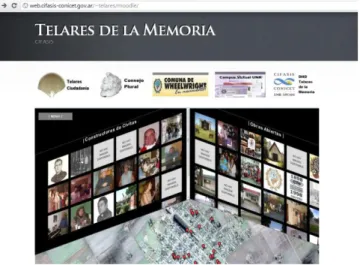
Figure 2: Memory Looms
"Memory Looms" is a dynamic and complex sociotechnical network that contributes knowledge, proposes
new practices integrating ICTs and allows consensus actions that challenge the notion of citizenship in an
attempt to redefine it, starting from processes that take place in the community centered on the construction
and writing of memory. The intention is to make the ample processes of governance tangible, where the
responsibility and concern for the common good, belong to all politically.
The diverse experiences developed in the production of the “Memory Looms” shape new forms of civic
participation and artistic expression, a “cultural ecology” in which the work arise from a process of plural
construction, where all participants –researchers, designers and citizens- are co-authors that collaborate in
the production of meaning, from the decentralized creation of discourses, images and sounds.
The project proposes to recover values, characters, and anecdotes from the past to give meaning and
identity to the present, giving way to the expression of its community in experimental form using voluntary
actions and narratives in varied languages (verbal, iconic, and musical) that rearrange historic events in
unpredictable ways through different versions that narrate other issues related to the life of the community,
giving rise to the emergence of marginal phenomena, differences and contradictions.
As already stated, this type of projects cannot be classified from the perspective of traditional disciplines
because while it does not correspond to visual arts, architecture, or anthropology, it nonetheless belongs to
them all. “Memory Looms” implied the implementation of a complex strategy that unfolds in a hybrid
realization and distribution. A research-action work about the characteristics and links within the
community was carried out. These characteristics and links were classified in three categories of contents:
builders of civitas, open works, and inhabited places, for the collaborative construction of the collective memory text that implies interests and power plays, situating the production of public goods in an arena of
dispute and appropriation.
"Building a DHD entails... developing a relational, polyphonic, and hypertextual outlook
focused on the possibility of generating space for social inclusion, on respect for
diversity, on open access to information and knowledge, and on free citizen
participation..." [15]
5.1
The design of the complex space of the DHD
As mentioned above, virtual space is considered part of the social space, constituting a habitable space that
allows us to settle down, perform diverse activities, communicate and share meanings. Furthermore, the
experiences that take place in virtual space represent spatial experiences. In this frame, it is clear that in
order to be able to participate in the 2.0 society, an interface, a place where interaction is possible, will
always be necessary. An interface is a space of mediation in the relation among the subjects, the digital
media, and the cultural productions.
"The interface is not an object; it is a space that articulates the interaction of the human
body, the tool, and the object of the action.” [16]
The concepts of frontier and threshold "...conceived as a semiotic event or chronotope…” [17], are used to
understand a tension that is arises in the hybrid space in relation to the appropriation, a threshold that articulates the physical with the virtual and that must be broken through: the interface, as a place that
separates and unites, as a sign of resistance or of meeting, a frontier in constant movement that may exclude
or provoke the dialogic meeting. This threshold, as a border area between two territories, draws a boundary
between them establishing not only discontinuities, but also enabling possible "border crossings" between
them. The thresholds do not refer only to the trajectories of the subjects, but also to anything that, as a sign,
“Memory Looms” includes several spaces of collaborative work: Citizenship Looms, Plural Management
Council, Research and Development, and the “Hypermedia Memory Book”, an ad hoc system that gives place to the transition of a diversity of signs in a performative space, whose interface it’s based on the
database as symbolic form and suggests the baroque visual culture as perceptual framework.
The Hypermedia Memory Book proposes an experience that fragments space-time in a superimposition of
infinite presents. In a traditional hypermedia interface the narrative is built through pre-established links
between the database and the interface, where the access and visualization of each content is consecutive,
organizing itself starting from a linear sequence of screens, a linguistic syntagma that is typical of old
media where time is the narrative principle.
There are no previously defined trajectories in the Hypermedia Memory Book, as the narrative is
constructed by each subject’s contingent, particular outlook, establishing his own links with the scene in
each navigation and visualising the relations that he himself has created between the elements of the
database. The paradigm is explicit: the complete DB is always present before the user with all the available
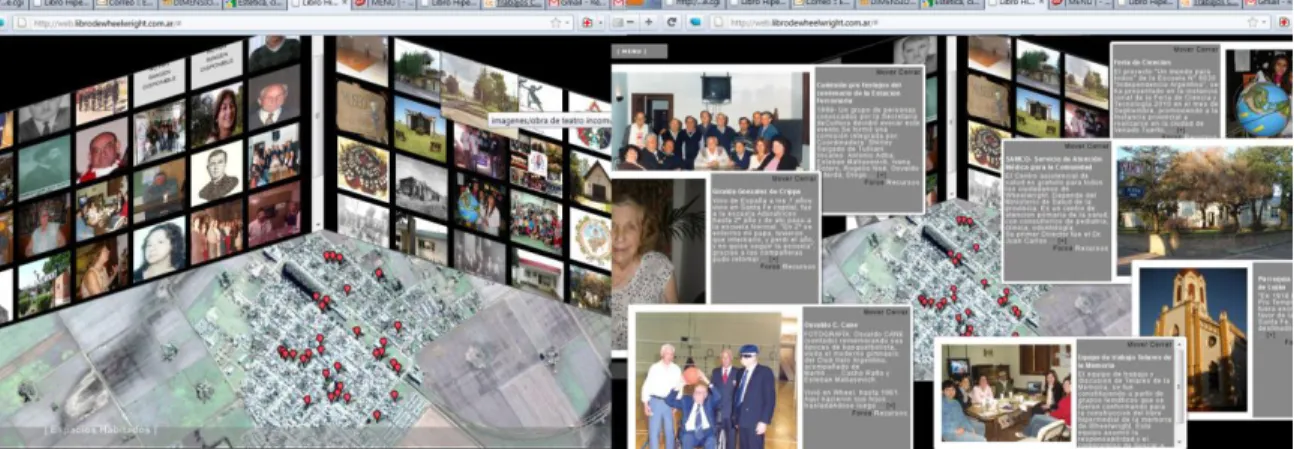
categories, objects, and options. Yet this interface proposes an innovative syntagma: all the contents can be
accessed simultaneously (Figure 3) and not starting from a linear sequence of screens, a spatial syntagma
which leads to visualize everything at the same time from multiple viewpoints. Navigation constitutes a
complex experience full of heterogeneities, lacking linearity, which permits the oscillation between the
observation of the whole and the plotting of trajectories that narrate unique events.
The category of chronotope developed by Bakhtin proposes that the social construction of time is
inseparable from the configuration of space, from the social relations and from the cultural imaginary of a
society. Time and space constitute the categories that organise what is real and every symbolic construction
of subjects and collective identities [18]. The notion of space takes on vital importance both as product and
producer of interactions and interrelations, condition of possibility for multiplicity and diversity, changing,
in process, unfinished; hence its symbolic, political, and identitarian potentiality [19].
Since a spatial proposal denotes a way of understanding the world, it involves the desire to provoke specific
sensations, and offers the possibility of updating certain rites and generating certain spatial appropriation
behaviors. From the symbolic point of view, the design of the graphic interface of the Hypermedia Book
offers the representation of a three-dimensional space (from three juxtaposed planes that present the
contents). The intention is to spatialize the experience so that the users perceive themselves “inside” a
suggestive space that stimulate participation, the place of the inscriptions, stories, journeys and the
innumerable possibilities of reading the same writing [20].
“…all information, all data, can become architectonic and habitable… placing humans
within the space of information…” [21]
The interface acts as a hub and threshold that provides access to an underlying database but it can also
transform data retrieval into a performance, into a unique experience for the user. Since virtual space is considered a habitable space, from the functional point of view, the interface-space of the Hypermedia
Book offers simultaneous navigation throughout the database in an "open plan" that guarantees orientation.
In this unique polyfunctional and proliferating non-hierarchical space is where all events and interactions
occur in parallel. Its complexity is expressed through the surface fragmentation, the superimposition and
the articulated diversity that, as in dutch art, enhance the particularity of visual experience.
The interface-space of the Hypermedia Book http://dimensionesdhd.cifasis-conicet.gov.ar/libro/ is virtual,
in the sense of latent potential [22] which is gradually discovered as the baroque city, “… and it is updated in a circumstantial and creative way because it depends on an event” [23]. It is also fluid, continuous,
topological, and tries to blur the boundaries between inner and outer, describing a multi-coloured and full
The interface-space of the Hypermedia Book is infinite, in its unsatisfied desire of representing the
boundless character of reality, which manifests itself in a fractal conception of space that houses no end of
objects, participants and relations in a dynamic way, as it grows and changes its shape and content
constantly because of the contributions and interactions. As baroque vision, it offers a profusion of images
that suggests a permanent visual potentiality from a multiplicity of points of view, which is related to
performativity and the entry of the body in the visual field.
The Hypermedia Book is open, it relates to and is inter-defined with other sub-spaces of “Memory Looms”
in Moodle environment (“Citizenship Looms”, “Plural Management Council”), where the debates and exchanges that reinforce feelings of belonging in the citizenry take place.
The Hypermedia Book is constructed plurally, all the citizens may contribute their experiences, memories
and dreams; and promotes the construction of civitas, the participation and the commitment of citizens with the social, cultural, and political life of their own community, knotting together individual stories with
those that gave way to public actions, to foster a reflective view of themselves and reinforce the collective
identity.
6.
INHABITING A NEW SPACE-TIME
The design and management of the different spaces created around the writing of plural memory entailed
moments of conflict and resistance that evidenced -though complex processes of discussion- old
confrontations, power relations and conflicting interests within the community comprised by citizens and
researchers. These facilitate the comprehension of the dynamics of participation in the construction of
civitas, mediated by the new media[2].
The hypermedia writing of memory gradually acquired unique characteristics as the community
appropriated the project as its own and groups that were socially relevant, heterogeneous, and with diverse
interests started to form; groups of citizens and researchers that gradually “constituted” the artifacts [24]
from the meanings that they attributed to them while dwelling in this hybrid space that oscillates, opposing
or joining the physical and the virtual.
The project gathered a large number of people who collaborated in the writing of the book and fostered the
exploration of the issue in other settings. For example, during the political campaign leading up to 2011
the political dynamics of the community, a debate on the present organised in the light of the reflection of a
past community that was updated through discursive development in the hypermedia book. In parallel, the
project was followed by a growing number of inhabitants that witnessed the proliferation of contributions
in its website, where the inputs were more and more numerous, “… as if certain unvoiced wishes had found
an appropriate language…” [11].
7.
CONCLUSIONS AND FUTURE WORK.
The different moments of the project generated an accumulation of unforgettable experiences that turned
into a multiplicity of words and images that expanded through informal media or planned strategies:
meetings, symposiums, and workshops in different parts of town; interviews with local protagonists on the
town radio and in a high-impact regional newspaper; distribution of posters; and a bus excursion to a
nearby rural area in which students, inhabitants, researchers, and local officials participated. These
activities allow reflecting upon the behaviors, meanings, and diverse “thresholds” that were constructed by
the actors themselves during this process, and suggest new ways of being-in-the-world.
This experience gave way to a constant development of the "Memory Looms" prototypes during 2010 and
2011, with the goal of completing the first experimental prototype which will be transferred to the
community of Wheelwright by approximately March 2012. This involves the installing the system in the
township’s server and the autonomous management of the DHD, both in its social and technological
aspects. The final adjustments carried out correspond to the optimization of the information loading chips,
help for these loads, and the integration of the interface of the Hypermedia Book to Moodle environment, associating it to the tool glossary.
The reflection carried out in this article has contextualized the interface-space of the DHD in an
introductory fashion as it relates to the “Memory Looms” project. However, it is considered that the spatial
and technological proposal exceeds the scope of this project and that it will be modelled and then
transferred to open source management systems such as Moodle, Sakai, or D-Space, as a new form of navigation and content visualization in different dimensions.
The issue and the meta-space of the DHD will be further explored and developed, integrating in its multiple
dimensions: spaces of collaborative construction of knowledge, the Moodle platform, the Facebook and
of making resource use more intuitive and unforced, through an interface-space that allows access and
simultaneous availability to all of them.
References
1. San Martín, P., Hacia un dispositivo hipermedial dinámico. Educación e investigación para el
campo audiovisual interactivo, Colección Música y Ciencia, N°III, Universidad Nacional de
Quilmes Editorial, Buenos Aires, 2008.
2. Tosello, M., Martino, S., Rodriguez, G., El libro hipermedial de la memoria plural. Una historia
sin fin, in: Chiarella, M., Tosello, M., eds., Cultura Aumentada: XV SIGraDi Conference
Proceedings, Universidad Nacional del Litoral, Santa Fe, 2011, 551-554.
3. Montagú, A., Groisman, M., Pimentel, D., Cultura Digital. Comunicación y Sociedad, Paidos,
Buenos Aires, 2004.
4. Norberg Schulz, C., Existencia, espacio y arquitectura, Blume, Barcelona, 1975.
5. San Martín, P., Martino, S., Tosello, M., Guarnieri, G., Rodriguez, G., Un Dispositivo
Hipermedial Dinámico para la construcción participativa del patrimonio intangible, in: Terceras
Jornadas del Mercosur sobre el Patrimonio Intangible Conference, Universidad Nacional de Mar
del Plata-CICOP, Mar del Plata, 2011.
6. Guarnieri, G., El modo interactivo del Dispositivo Hipermedial Dinámico, PhD Thesis,
Universidad Nacional de Rosario, Rosario, 2011.
7. www.moodle.org [10-01-2011].
8. www.sakaiproject.org [10-01-2011].
10. Martin Iglesias, R., Hacia un nuevo paradigma de diseño colaborativo, in: Chiarella, M., Tosello,
M., eds., Cultura Aumentada: XV SIGraDi Conference Proceedings, Universidad Nacional del
Litoral, Santa Fe, 2011, 123-126.
11. Laddaga, R., Estética de la emergencia, Adriana Hidalgo Editora, Buenos Aires, 2010.
12. Ascott, R., El web Chamántico. Arte y conciencia emergente,
http://aleph-arts.org/pens/ascott.html [10-01-2012].
13. Manovich, L., El lenguaje de los nuevos medios de comunicación, Paidós Comunicación, Buenos
Aires, 2006.
14. Jay, M., Regímenes escópicos de la modernidad, in: Foster, H., ed., Campos de fuerza. Entre la
historia intelectual y la crítica cultural, Paidós, Barcelona, 2003, 221-252.
15. San Martín, P., Guarnieri, G., Construir un dispositivo hipermedial dinámico en la universidad
pública, Revista Cuadernos Sociales, 2009, Vol. 9, Universidad Nacional de Rosario, 111-127.
16. Bonsiepe, G., Del objeto a la interfase. Mutaciones del diseño, Infinito, Buenos Aires, 1999.
17. Gustafsson, J., Apacible fluye la frontera. Diálogo, exclusión y utopía en Machuca y Los tres
entierros de Melquíades Estrada, deSignis, 2010, N°15, La Crujía, Buenos Aires, 82-90.
18. Dalmasso, M., Andacht, F., Fatala, N., deSignis, 2010, N°15, La Crujía, Buenos Aires, 7.
19. Arfuch, L., Espacio, tiempo y afecto en la configuración narrativa de la identidad, deSignis, 2010,
N°15, La Crujía, Buenos Aires, 32.
20. Machado, A., El advenimiento de los Medios Interactivos, in: La Ferla, J. y Groisman, M., eds., El
Medio es el Diseño, Oficina Publicaciones Ciclo Básico - UBA, Buenos Aires, 1996.
21. Novak, M., Liquid Architectures in Cyberspace, in: Benedikt, M., ed., Cyberspace: First Steps,
22. Levy, P., Becoming Virtual: Reality in the Digital Age, Da Capo Press, 1998.
23. Giordano, R., Tosello, M., Laberinto, una Biblioteca para la Virtualidad, in: Bermudez, J.,
Cardozo, J., Montagu, A., Paysse, M., Stipech, A., eds., IIISIGraDi Conference Proceedings,
Universidad de la República, Montevideo, 1999, 83-86.
24. Thomas, H., Buch, A., Actos, Actores y Artefactos, Universidad Nacional de Quilmes, Buenos