A Fault-Tolerance Protocol for Parallel Applications
with Communication Imbalance
Esteban Meneses School of Computing Costa Rica Institute of Technology
Cartago, Costa Rica [email protected]
Laxmikant V. Kal´e Department of Computer Science University of Illinois at Urbana-Champaign
Urbana, Illinois, USA [email protected]
Abstract—The predicted failure rates of future supercom-puters loom the groundbreaking research large machines are expected to foster. Therefore, resilient extreme-scale applications are an absolute necessity to effectively use the new genera-tion of supercomputers. Rollback-recovery techniques have been traditionally used in HPC to provide resilience. Among those techniques, message logging provides the appealing features of saving energy, accelerating recovery, and having low performance penalty. Its increased memory consumption is, however, an important downside. This paper introduces memory-constrained message logging (MCML), a general framework for decreasing the memory footprint of message-logging protocols. In particular, we demonstrate the effectiveness of MCML in maintaining message logging feasible for applications with substantial communication imbalance. This type of applications appear in many scientific fields. We present experimental results with several parallel codes running on up to 4,096 cores. Using those results and an analytical model, we predict MCMLcan reduce execution time up to 25% and energy consumption up to 15%, at extreme scale.
Keywords-fault tolerance; message logging; communication imbalance
I. INTRODUCTION
Many scientific fields are addressing challenging problems thanks to the wide availability of supercomputing power. Ma-chines with a vast number of processors enable the exploration of scenarios that would have been considered too complex a decade ago. As supercomputers evolve, they incorporate more components to satisfy the computational needs of scientists and engineers. However, this relentless growth in the size of the machines brings an undesirable consequence: lower reliability. The high failure rate of future supercomputers has been recognized as one of the major roadblocks to achieve exascale [1], [2], [3]. It is imperative to provide extreme scale systems with some form of fault tolerance mechanism. Otherwise, the menacing threat of frequent failures will render future systems unusable [4].
Rollback-recovery techniques have long been the pre-ferred fault tolerance method in high performance computing (HPC) [1], [3], [5]. The general idea behind rollback-recovery is simple: save the state of the system at checkpoints, rollback to the latest checkpoint in case of a failure, and resume execution. The checkpoint/restart scheme has adopted several variants [5], [6], [7]. A promising variant is called message logging, which logs application messages as the program
executes. A failure in the system will only roll back the failed nodes, and have the rest of the system replay the stored messages to recover the restarted nodes. Message logging has been demonstrated to save energy [8], [9], reduce recovery time [10], and have a small overhead [11], [12]. The main drawback of message logging is its potentially large memory footprint due to the message log.
This paper presents a new framework to reason and design new message-logging protocols that trade off a reduction of the memory pressure for an increase in the recovery effort. Figure 1 presents a general view of the different alternatives to store communication in a message-logging infrastructure. The process-basedapproach has dominated the literature on the topic. In that view, a process is output-logging or input-logging, depending whether it stores the outgoing or the incoming communication, respectively. Or, it does not store communication and it becomes non-logging. Most message-logging protocols use output-message-logging processes [5], [11], [13]. However, some scenarios may call for new protocols where a combination of the above types of processes provides a more efficient solution. Another approach for message-logging protocols is thechannel-based, in which each channel either logs outgoing, incoming, or no communication. This per-spective provides a more general framework for developing new message-logging strategies that radically decrease the memory footprint and minimally impact the recovery effort. This paper describes a channel-based protocol that targets applications with communication imbalance. This paper makes the following contributions:
• Section III offers a characterization of communication imbalance in parallel applications.
• Section IV provides the design of memory-constrained message logging (MCML), a general framework for devel-oping protocols aimed at reducing the memory footprint of message logging.
• Section V presents experimental results showing the reduction in memory overhead of MCMLwith a collection of representative applications.
• Section VI extends an analytical model to provide per-formance projections of MCML at extreme scale.
input-logging
output-logging non-logging
Process-based Channel-based
Communication not logged Communication logged
Fig. 1: Communication-Logging Alternatives.
II. BACKGROUND
A. System Model
We conceive a parallel application as a setP of processes. Each process holds a portion of the application’s data in its own private memory. The only mechanism to share informa-tion is through message passing. The state of an applicainforma-tion at any point in time is the collection of the state of the individual processes plus the set of in-flight messages. The state of the application can be determined using a distributed systems algorithm for global snapshots [14]. This description captures popular parallel programming paradigms, in particular the Message Passing Interface (MPI). An application runs on a system that comprises a set of nodes. The nodes are connected through an interconnect with channels that respect first-in-first-out (FIFO) ordering. Therefore, two messages from same source and same destination can not be reordered. The nodes of the system may fail according to the fail-stop model [5]. That means, a failed node becomes immediately unresponsive and has to be replaced. We assume the system has enough spare nodes to replace all failed nodes. Alternatively, the average repair time of nodes is smaller than the mean-time-between-failures (MTBF) of the system.
B. Checkpoint/Restart
Traditionally, fault-tolerance approaches in HPC belong to the rollback-recovery family [5]. More specifically, check-point/restart is thede factostandard implementation of reliable supercomputing applications. Checkpoint/restart is based on the principle that an application will periodically save its state to stable storage and it will restart from the previous checkpoint if there is a failure in the system. There are many variants of checkpoint/restart, but all follow the same general guideline. Normally, the checkpoints are stored in the network file system. That approach does not scale well as it may cause congestion during checkpoint time [3]. A variant to that approach is called double-local checkpoint [6]. In that case, every node stores two copies of its checkpoint: one in its own local storage (memory, SSD, local disk) and one in the local storage of its checkpointbuddy. Should a node fail, all nodes will rollback using its locally stored checkpoint. The checkpoint buddy of the failed node will provide a checkpoint to the replacement node. This approach has been shown to
be scalable and it can recover from most failures in real HPC systems [10]. Other variants of checkpoint/restart create a multilevel framework where checkpoints can go to local or shared storage [7]. These frameworks usually provide a model to determine the best combination of the different types of checkpoints. Checkpointing can also besynchronized, i.e., use global synchronization points to checkpoint the application. Synchronized checkpoint/restart does not require to store the state of the channels as part of the checkpoints, because it is guaranteed that at checkpoint time there are no in-flight messages. It has general applicability as most HPC applications feature global synchronization phases. Also, the size of synchronized checkpoints may be drastically reduced if the programmer writes checkpoint methods that only save the necessary data (also calledapplication-levelcheckpoint).
C. Message Logging
The major downside of checkpoint/restart is that it requires aglobalrollback: all processes are forced to resume execution from the latest checkpoint. That leads to a huge waste of time and energy [8], [9]. An enhancement to checkpoint/restart is message logging [15], a technique that stores checkpoints and, in principle, stores all the messages in an execution. There are multiple implementations of message logging for HPC systems [10], [16], [17]. The benefit of storing com-munication is that a failure only requires the failed node to rollback, hence only local rollback is needed. To achieve a correct recovery, message-logging protocols usually rely on the piece-wise deterministic (PWD) assumption, which states that storing all non-deterministic decisions in a program is sufficient to obtain a consistent recovery. Message logging uses a mechanism called determinants to store non-deterministic decisions. For example, message reception order is, in gen-eral, non-deterministic. A determinant d generated after the reception of message m is a tuple with four components:
d = #m = sender, receiver, ssn, rsn. Every time a message fromsender with a sender-sequence-number (ssn) is received at receiver, it gets a unique receiver-sequence-number (rsn). Determinantduniquely represents the reception of a message and if provided to a recovering process, it will ensure the recovery exactly replicates the events that happened before the crash. We will assume message reception is the only source of non-determinism for the rest of the paper.
Time
m1
a1
m3⊕d2 a2
m2⊕d1 Process A
Process B
Process C
m4
Fig. 2: Simple Causal Message Logging (SCML).
D. Related Work
An important drawback of message logging is the increase in memory pressure due to the message log. Message logging may not be practical for an application sending large messages with high frequency, since the total physical memory can be quickly exhausted. Recently, hierarchical protocols have been explored [18], [19], [12]. In these protocols, processes are grouped intoteams. Messages crossing team boundaries are logged, but messages within teams are not logged. Therefore, if teams manage to capture a high volume of the communica-tion in the applicacommunica-tion, the size of the message log reduces dra-matically. Teams act as recovery units: if one member fails, the whole team rolls back. Therefore, team-based message logging trades off a reduction of memory pressure for an increase in the recovery effort. Fortunately, several applications in HPC have a structured communication pattern with clusters of processes enclosing a high portion of the communication volume [20]. These communication patterns often result from traditional parallel programming patterns and can be found in multiple programs. The team-based approach was also extended to work in conjunction with parallel computing platforms that allow load balancing [21]. Therefore, teams can be dynamic and adapt as processes are migrated from one node to another.
III. APPLICATIONS WITHCOMMUNICATIONIMBALANCE Although team-based message logging demonstrated to be an effective mechanism in reducing memory overhead of message-logging protocols, its fundamental premise is that an application features a well-structured, balanced commu-nication pattern. That is true for most scientific computing applications, but there is an emerging type of parallel pro-grams that exhibit a non-uniform, communication-imbalanced profile. In this class of applications, there is usually a skewed distribution of the communication load, with few processes transmitting significantly more bytes than the rest of processes in the system. In addition, sometimes the communication graph is unstructured, resulting in the team-based approach being ineffective.
There are various reasons for the emergence of communi-cation imbalance patterns in parallel applicommuni-cations:
• Dynamic load imbalance: as the program executes, some processes may accumulate more data, potentially per-forming more computations and effectively communi-cating more bytes to other processes. For instance, in particle-interaction programs, hot-spots agglomerating many particles can form on few processes [22].
• Adaptive communication algorithms: where the exact target of a message cannot be statically determined, but
depends on which process owns a particular data item at runtime. For example, some graph algorithms use a distributed lookup table that associates nodes to home
processes [23].
• Variability in computation: which implies not all data items represent the same computational complexity. A well distributed load in the system may lead to imbal-anced communication on some processes (those having many but fast-to-compute data items). One case ap-pears in computational fluid dynamics (CFD) simulations, where each specie requires different computation time to solve the chemical reactions [24].
A. Communication Profile
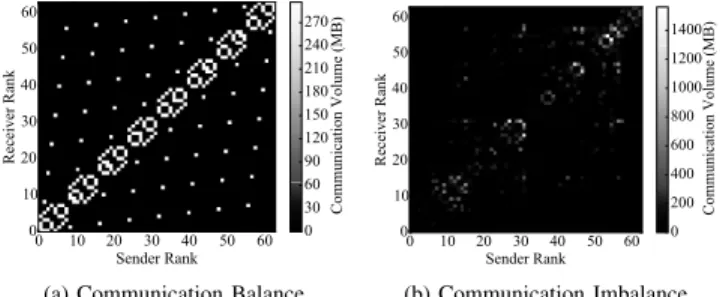
Understanding the communication characteristics of ap-plications with communication imbalance is fundamental to develop effective message-logging approaches. We introduce the communication analysis of applications by showing the exchange matrix of two benchmarks in Figure 3. The figure displays a heatmap of the point-to-point communication vol-ume between every pair of sender and receiver MPI ranks. Col-lective communication operations, in the applications studied, carry a small portion of the data, and will be ignored in the rest of the paper. We contrast a program with balanced communica-tion (NPB-CG, a conjugate gradient computacommunica-tion) in Figure 3a versus a program with communication imbalance (MiniAMR, an adaptive mesh refinement algorithm) in Figure 3b. Figure 3a presents a well-structured exchange pattern, with every active channel (pair of sender-receiver) sending exactly the same amount of bytes. In contrast, Figure 3b displays a very non-uniform distribution of the communication between pairs. Besides, there is no constant pattern repeated across the main diagonal. The communication matrix is, however, symmetric.
(a) Communication Balance (b) Communication Imbalance
Fig. 3: Balanced and Imbalanced Communication.
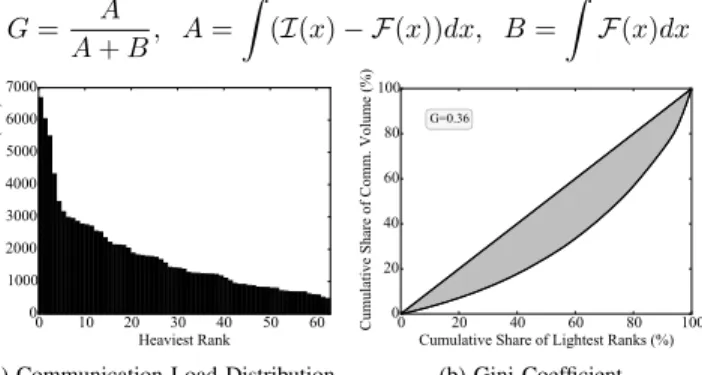
The main characteristic of communication imbalance pat-terns is its markedly skewed distribution of the communication load across the set of processes. Figure 4 presents a deeper analysis on the type of communication imbalance correspond-ing to Figure 3b. A distribution of the communication load per process (or rank) is presented in Figure 4a. The ranks have been sorted according to their communication load. The distribution is skewed, showing a few ranks concentrating a big portion of the communication volume. We also present in Figure 4b the Gini coefficient for the distribution in Figure 4a. The Gini coefficient is a measure of statistical dispersion that is usually applied to determine the degree of inequality in a distribution. If ranks are sorted in increasing order according to their communication volume, it is expected that the cumulative share of communication grows steadily as more ranks are considered. Therefore, a perfectly uniform distribution of the communication load would imply that the accumulated communication functionF grows with the identity functionI. If there is inequality, functionFwill deviate from the identity and create a gap (shown as a gray region in Figure 4b). The relative size of the gap betweenF and the identity determines the Gini index. In other words, the Gini indexGis defined by the formula:
G= A
A+B, A=
(I(x)− F(x))dx, B=
F(x)dx
(a) Communication Load Distribution (b) Gini Coefficient
Fig. 4: Skewed Communication Volume Distribution.
Figure 4b shows the Gini index of MiniAMR is 0.36, a value that attest the highly imbalanced distribution in commu-nication. For comparison, the Gini index of NPB-CG is0.
IV. MESSAGE-LOGGINGPROTOCOL
Message-logging protocols are a promising alternative to provide HPC applications with fault tolerance. The perfor-mance overhead of those strategies can be kept low [11], [12], they feature a very efficient energy profile [8], [9], and they make possible to parallelize recovery [10]. To leverage all those features, it is imperative to address the major drawback of message logging, namely its increase in memory footprint. We introduce Memory-Constrained Message Logging
(MCML), a generalized message-logging protocol that honors a predetermined memory threshold for the message log and provides a framework to optimize the rollback cost after a fail-ure. MCMLaims at reaching a balance by which the message log size growth is kept under control, without sacrificing the advantages of message logging during recovery. The design
of MCML is based on the channel-based view of Figure 1. It combines output-logging and non-logging channels. Message logging of channels in MCMLare either active or inactive, i.e. messages from the channel’s source to the channel’s destina-tion are either logged or not, respectively. Initially, message logging is active on all channels. As computation proceeds and the total size of the message log reaches critical levels, MCMLchooses channels where message logging is turned off. Otherwise, a regular message-logging protocol will be forced to checkpoint (presumably at a suboptimal frequency) to avoid the memory footprint from reaching unsustainable levels. The downside of MCML is that recovery may require more rollbacks. Different strategies in MCML provide a different tradeoff between memory overhead and recovery cost.
A. Algorithm
We extend the SCMLalgorithm of Section II to provide an algorithmic specification of MCML. The details of the protocol are presented in Algorithm 1 and Algorithm 2. The constant THIS represents the unique identifier of a process. Constant THRESHOLD is used to represent the maximum size of the message log in process THIS. The necessary data structures are displayed at the top of Algorithm 1.
Function SENDMSG and RECEIVEMSG represent the core of the protocol. We assume these functions are located at an intermediate layer in the software stack, below the runtime sys-tem layer, and above the communication network layer. There-fore, once SENDMSGfinishes preparing a message, it will call NETSENDMSG, which is a low-level function that effectively transmits the message. Function SENDMSG first populates the header of the message with the necessary information to generate a determinant at reception. The message carries the determinants accumulated up to that point. Before sending the message, the current size of the message log is checked and reduced if necessary. Function TURNCHANNELLOGOFF chooses a channel from the communication graph and turns off message logging on that channel. The default strategy chooses the heaviest channel. In addition, all messages to that destination are removed from the message log. Finally, the message is stored only if the logging on that channel is active. On the receiver side, function RECEIVEMSG first checks whether the message is out-of-order (duplicate or old messages). It then creates a determinant and acknowledges the received determinants from the sender. We must emphasize the two types of determinants. Alocaldeterminant is created on a process after a message reception. Those determinants are stored indetBuf and piggybacked on outgoing messages until they are safely stored on other processes. A remote
determinant is one created on other process and received with an incoming message. Those determinants are stored in
Algorithm 1MCML: Memory-Constrained Message Logging Data Structures:
ssn: sender sequence number
rsn: receiver sequence number
rsnM ap: associative array storingsender, ssn →rsn inc: incarnation number of current process
incM ap: associative array storingsender →inc detBuf: temporary buffer of local determinants
detLog: storage of remote determinants
msgLog: storage of messages
commGraph: graph storing communication volume and channel status 1:procedureSENDMSG(msg, target)
2: msg.sender←THIS Populate message header 3: msg.recver←target
4: msg.ssn←INCREMENT(ssn) Updatessn
5: msg.inc←inc
6: msg.dets←detBuf Piggyback determinants 7: if|msgLog|>THRESHOLDthen
8: TURNCHANNELLOGOFF(commGraph) Turn off log on a channel 9: end if
10: ifcommGraph[THIS][target].logthen
11: msgLog←msgLog∪ {msg} Store message 12: end if
13: NETSENDMSG(msg, target) 14:end procedure
15:procedureRECEIVEMSG(msg)
16: ifOUTOFORDER(msg)then return Check for out-of-order
17: end if messages
18: rsnM ap(msg.sender, msg.ssn)←INCREMENT(rsn) 19: detBuf←detBuf∪ {msg.sender,THIS, msg.ssn, rsn} 20: detLog←detLog∪msg.dets Add remote determinants 21: NETSENDDETACK(msg.dets, msg.sender)
22: PROCESSMSG(msg) 23:end procedure
24:procedureRECEIVEDETACK(dets)
25: detBuf←detBuf\dets Remove determinants 26:end procedure
27:procedureCHECKPOINT( )
28: EMPTY(detLog, detBuf, msgLog) Empty logging structures 29: data← ssn, rsn, rsnM ap, inc, incM ap, commGraph
35: ifcommGraph[THIS][Y].logthen
36: SENDMSGSFROMLOG(Y) Replay messages
37: else
38: RESUMEFROMCHECKPOINT() Message logging toYwas off 39: end if
40:end procedure
41:procedureRECEIVEDETS(dets)
42: for alldet∈detsdo Receive determinants and populates 43: rsnM ap(det.sender, det.ssn)←det.rsn rsnM ap
44: end for
45:end procedure
46:procedureRESUMEFROMCHECKPOINT 47: data←RETRIEVECHECKPOINTANDDATA() 48: ssn←data.ssn
49: rsn←data.rsn
50: ANNOUNCEROLLBACK() 51:end procedure
52:procedureROLLBACK(Z)
53: ifcommGraph[THIS][Z].logthen
54: SENDMSGSFROMLOG(Z) 55: else
56: RESUMEFROMCHECKPOINT() Message logging toZwas off 57: end if
58:end procedure
along with Y. When process Z rolls back, it retrieves the latest checkpoint and announces its rollback. The difference between functions FAILURE and ROLLBACK lies in the fact that the latter does not provide the stored determinants to rolled back processes. A rolled back (not failed) process is assumed to have its determinants available. The recovery process is illustrated in Figure 5.
Algorithm 2MCMLAuxiliary Functions 1:procedureSENDDETSFROMLOG(target) 2: dets← ∅
3: for alldet∈detLogdo Collect all determinants 4: ifdet.recver=targetthen bound totarget
5: dets←dets∪ {det} indetLog
11: for allmsg∈msgLogdo Collect all messages 12: ifmsg.recver=targetthen bound totarget
13: NETSENDMSG(msg, target) inmsgLog
V. EXPERIMENTALEVALUATION
A. Setup
To evaluate the effectiveness of the MCML protocol pre-sented in Section IV, we built a profiling library to explore the communication pattern of MPI applications and understand the benefits and tradeoffs of the algorithm. We used the MPI Pro-filing Interface to build a communication library that intercepts all communication calls in an MPI application. The library outputs the communication graph of the execution, along with additional information on collective-communication calls. We ran the communication library on a collection of representative applications from several HPC software projects. Table I summarizes the main features of these applications. All these codes use MPI operations for communication and provide the user with a collection of runtime parameters to calibrate the execution. We chose those scenarios in the applications that present communication imbalance, either because of load im-balances or the proper communication pattern of the program.
Application/Project Domain Problem
FLASH/FLASH Physics Multigrid solver Graph500/Graph500 Graph analytics Breadth-first search
Lassen/ASC Physics Front tracking MCCK/CESAR Neutronics Monte Carlo sim. MiniAMR/Mantevo Physics Adaptive mesh ref.
MiniFE/Mantevo Physics Finite element NPB-MZ/NPB Linear Algebra Block tridiagonal
TABLE I: Main Features of Applications Used in Evaluation.
(a) FLASH (b) Graph500 (c) Lassen
(d) MCCK (e) MiniFE (f) NPB-MZ
Fig. 6: Skewed Communication per Rank Distribution of Applications with Communication Imbalance.
Application Number Rank Avg. Rollback Set Size (% of|P|) Avg. Rollback Chain Size (% of|P|)
of Cores Gini Idx. θ= 30 40 50 60 70 θ= 30 40 50 60 70
FLASH 256 0.27 57.42 30.08 18.36 12.89 7.42 0.78 0.78 0.78 0.78 0.78
Graph500 256 0.44 2.34 1.17 0.78 0.39 0.39 0 0 0 0 0
Lassen 256 0.35 1.56 1.17 0.78 0.39 0.39 0 0 0 0 0
MCCK 256 0.37 1.17 0.39 0.39 0.39 0.39 0.39 0 0 0 0
MiniAMR 256 0.32 39.45 28.90 14.84 7.81 4.69 0.78 0.78 1.17 1.17 1.56
MiniFE 256 0.28 69.53 47.65 30.86 8.98 2.34 3.51 1.95 1.95 1.56 0.78
NPB-MZ 256 0.20 60.55 15.62 8.20 3.12 0.39 8.20 3.91 3.12 1.56 0
TABLE II: Effect of MCML on Rollback Effort.
The nodes are connected through an Infiniband FDR network.
B. Results
Figure 6 shows a heatmap representing the data exchange volume in each application. Similar to Figure 3b, the commu-nication matrices are symmetric but present a high variation in the communication distribution. Figures 6a and 6e show strongly defined clusters along the main diagonal, but com-munication distribution diffuses as we move away from the diagonal. Figures 6c and 6d present imbalanced communica-tion patterns, but with specific zones that clearly concentrate a huge communication volume. Figure 6b highlights a few processes centralizing most of the data exchange. Figure 6f offers a case of a more chaotic communication pattern that leads to prevalent imbalances.
Table II quantifies the communication imbalance using the Gini Index of the rank distribution. There is a good spectrum
of values, but in general the numbers in the table are high, which attest for the skewed distribution in the communication volume. Table II also shows the impact of using MCML proto-col in reducing the message log. We measured two quantities:
average rollback set size and average rollback chain size. The former refers to the total number of processes that must rollback after a single-process failure. The latter represents the maximum depth of the rollback chain. For instance, in Figure 5 the rollback set size is3, and the rollback chain size is 2. Both quantities are expressed in relative terms to the size of the process setP. Table II measures both rollback set size and rollback chain size based onθ, which represents the
threshold used by MCML as a percentage of the maximum message log size in SCML. As expected, higher values ofθ
fetch better benefits.
the average rollback set size as the program scales from 512 to 4,096 cores. MCMLis very effective withθ= 60. Its benefits reduce as the Gini index decreases.
Cores Gini Avg. Rollback Set Size (% of|P|) θ= 30 40 50 60 70
512 0.30 42.00 29.10 14.45 6.25 1.37
1,024 0.24 59.18 41.50 28.81 16.60 7.32 2,048 0.23 57.42 38.33 24.07 13.23 5.52 4,096 0.17 84.45 47.34 27.68 11.08 3.49
TABLE III: Weak-Scale Experiment.
Results from a strong-scale experiment with Graph500 (scale=16, edge factor=16) are listed in Table IV. Ranging from 512 to 4,096 cores, the benefits improve as the commu-nication distribution becomes more imbalanced. At the highest scale, MCML effectively uses a smaller message log with a negligible cost in rollback.
Cores Gini θAvg. Rollback Set Size (% of= 30 40 50 60 |P|70)
512 0.27 1.95 0.78 0.19 0.19 0.19
1,024 0.34 0.78 0.30 0.10 0.10 0.10
2,048 0.42 0.39 0.10 0.05 0.05 0.05
4,096 0.51 0.10 0.02 0.02 0.02 0.02
TABLE IV: Strong-Scale Experiment.
The MCML protocol allows different strategies to choose the channels on which message logging is turned off. We evaluated two strategies in Table V using FLASH code on 256 cores. The default strategy is calledheaviest link first, as it prefers the channel with the highest amount of communication. The second strategy builds a hierarchical clustering of the processes, also called a dendrogram. Channels are chosen based on the clustering, preferring those in the near vicinity. For instance, in a system with 8 processes [0-7], process 5 would prefer to turn off channels to the following clusters with that priority: [4-5], [4-7], and [0-7]. The results in Table V suggest that for an application with communication imbalance, but with a clustered structure, a smarter strategy improves results. From Figure 6a, it is clear that FLASH features clusters of processes and thus a clustering strategy exploits that fact.
Strategy θAverage Rollback Set Size (% of= 30 40 50 60 |P|70)
Heaviest Link First 57.42 30.08 18.36 12.89 7.42 Hierarchical Cluster 53.12 17.19 3.12 0.78 0.39
TABLE V: Comparison of Strategies to Reduce Message Log.
VI. EXTREME-SCALEPROJECTIONS
We use an analytical model to project the performance of MCML at extreme-scale and to run a comparative analysis between SCML and MCML protocols. The model uses theo-retical formulations presented elsewhere to estimate execution time [10] and energy consumption [8]. The basic formula
in the model decomposes the execution time into four parts:
T =TSolve+TCheckpoint+TRecover+TRestart, and finds ap-propriate analytical expressions to approximate each part. The model contains several parameters to represent fundamental variables that affect the total execution time of protocols such as SCML. The output of the model is the optimum value ofτ, the checkpoint period, for which the total execution timeT is minimized. A formula for energy consumption can be derived from the execution time equation by considering the power levels at which each of the parts of the formula executes.
A straightforward extension of the base analytical model is used to project execution time and energy consumption of MCML. The extended formula needs the selection of values for the parameters. We chose values based on the available literature [8], [10], and the results of Section V. Table VI summarizes the values of the main parameters in the model. In particular,ωrepresents the fraction of the optimum checkpoint period (τ) that is attainable without using MCML. For instance, a value ofω= 0.3 means the system reaches the maximum size of the message log (in at least one process) and it is forced to checkpoint after 0.3τ time units of the latest checkpoint. The underlying assumption is that without MCML, a system using SCMLwill perform suboptimal checkpointing. Parameteroreflects the portion of the system that is forced to rollback after a crash when using MCML.
Parameter Description Value
W Time to solution 24h
MS Mean-time-between-failures per socket 40y
δ Checkpoint time 5m
R Restart time 0.5m
μ Message-logging slowdown 1.05
φ Message-logging recovery speedup 1.2
ω Fraction of optimumτ [0.3-0.7]
o Fraction of recovering processes 0.1
H High power level 100W
L Low power level 50W
TABLE VI: Values of Parameters of the Model. The model projects a clear benefit of MCML in both exe-cution time and energy consumption when the system scales from 8,000 to 512,000 sockets. Figure 7 shows the relative performance of MCMLcompared to SCML. The various curves represent different values forω. In all cases, we assume MCML checkpoints at optimum frequency, while SCML checkpoints at a suboptimal frequency dictated byω.
The relative execution time of MCMLcompared to SCMLis presented in Figure 7a. As the system scales in size, so does the failure frequency (which linearly depends on the number of sockets). The results show MCMLcan effectively reduce the execution time by maintaining the optimum checkpoint period. The fraction ω has a major impact on performance. At the highest scale, MCML reduces the execution time from2.7%
(a) Execution Time (b) Energy Consumption
Fig. 7: Performance of MCML Protocol at Scale.
is to have more processes recovering after a failure. Those processes will consume more energy during a faulty execution. MCMLmanages to reduce energy consumption thanks also to the reduction in execution time.
VII. CONCLUSION
The substantial waste in performance and energy of the classical checkpoint/restart approach has forced the commu-nity to look for alternative approaches. Message logging is a promising strategy, but a limiting factor is its potentially high memory consumption. This paper introduces memory-constrained message logging, MCML, a protocol that realis-tically assumes each process has a limit to the amount of messages that can be logged. The protocol dynamically adapts to the runtime conditions and reduces the size of the message log by turning off logging on particular channels. The goal of MCMLis to keep the memory overhead of message logging at bay, while avoiding a high cost in recovery. The experimental results showed that MCMLis very effective in reducing the size of the message log for applications with communication im-balance. In addition, MCMLprovides a generalized framework to design advanced memory-aware message-logging protocols.
ACKNOWLEDGMENTS
This work was supported by a machine allocation on XSEDE under award TG-CCR140007.
REFERENCES
[1] F. Cappello, A. Geist, W. Gropp, S. Kale, B. Kramer, and M. Snir, “Toward exascale resilience: 2014 update,”Supercomputing frontiers and innovations, vol. 1, no. 1, 2014.
[2] M. Snir, R. W. Wisniewski, J. A. Abraham, S. V. Adve, S. Bagchi, P. Balaji, J. Belak, P. Bose, F. Cappello, B. Carlson, A. A. Chien, P. Coteus, N. DeBardeleben, P. C. Diniz, C. Engelmann, M. Erez, S. Fazzari, A. Geist, R. Gupta, F. Johnson, S. Krishnamoorthy, S. Leyf-fer, D. Liberty, S. Mitra, T. Munson, R. Schreiber, J. Stearley, and E. V. Hensbergen, “Addressing failures in exascale computing,”IJHPCA, vol. 28, no. 2, pp. 129–173, 2014.
[3] E. N. Elnozahy, R. Bianchini, T. El-Ghazawi, A. Fox, F. Godfrey, A. Hoisie, K. McKinley, R. Melhem, J. S. Plank, P. Ranganathan and J. Simons, “System resilience at extreme scale,” Defense Advanced Research Project Agency (DARPA), Tech. Rep., 2008.
[4] J. Dongarra, P. Beckman, T. Moore, P. Aerts, G. Aloisio, D. Barkai, T. Boku, B. Chapman, X. Chi, A. Choudhary, S. Dosanjh, T. Dunning, R. Fiore, A. Geist, R. Harrison, M. Hereld, M. Heroux, K. Hotta, Y. Ishikawa, Z. Jin, F. Johnson, S. Kale, R. Kenway, D. Keyes, B. Kramer, J. Labarta, A. Lichnewsky, B. Lucas, S. Matsuoka, P. Messina, P. Michielse, B. Mohr, M. Mueller, J. Shalf, D. Skinner, M. Snir, T. Sterling, R. Stevens, F. Streitz, B. Sugar, A. V. D. Steen, J. Vetter, P. Williams, R. Wisniewski, and K. Yelick, “The international exascale software project roadmap 1.”
[5] E. N. Elnozahy, L. Alvisi, Y.-M. Wang, and D. B. Johnson, “A survey of rollback-recovery protocols in message-passing systems,”ACM Comput. Surv., vol. 34, no. 3, pp. 375–408, 2002.
[6] G. Zheng, L. Shi, and L. V. Kal´e, “FTC-Charm++: An In-Memory Checkpoint-Based Fault Tolerant Runtime for Charm++ and MPI,” in
2004 IEEE Cluster, San Diego, CA, September 2004, pp. 93–103. [7] A. Moody, G. Bronevetsky, K. Mohror, and B. R. de Supinski,
“De-sign, modeling, and evaluation of a scalable multi-level checkpointing system,” inSC, 2010, pp. 1–11.
[8] E. Meneses, O. Sarood, and L. V. Kale, “Energy profile of rollback-recovery strategies in high performance computing,”Parallel Comput-ing, vol. 40, no. 9, pp. 536 – 547, 2014.
[9] M. Diouri, O. Gluck, L. Lefevre, and F. Cappello, “Energy considera-tions in checkpointing and fault tolerance protocols,” in2nd Workshop on Fault-Tolerance for HPC at Extreme Scale (FTXS 2012), Boston, USA, Jun. 2012.
[10] E. Meneses, X. Ni, G. Zheng, C. L. Mendes, and L. V. Kale, “Using mi-gratable objects to enhance fault tolerance schemes in supercomputers,” inIEEE Transactions on Parallel and Distributed Systems, 2014. [11] E. Meneses, G. Bronevetsky, and L. V. Kale, “Evaluation of simple
causal message logging for large-scale fault tolerant HPC systems,” in
16th IEEE DPDNS, in 25th IEEE IPDPS., May 2011.
[12] A. Guermouche, T. Ropars, M. Snir, and F. Cappello, “Hydee: Failure containment without event logging for large scale send-deterministic mpi applications,” inIPDPS, 2012, pp. 1216–1227.
[13] D. B. Johnson and W. Zwaenepoel, “Sender-based message logging,” inIn Digest of Papers: 17 Annual International Symposium on Fault-Tolerant Computing. IEEE Computer Society, 1987, pp. 14–19. [14] K. M. Chandy and L. Lamport, “Distributed snapshots : Determining
global states of distributed systems,”ACM Transactions on Computer Systems, Feb. 1985.
[15] L. Alvisi and K. Marzullo, “Message logging: Pessimistic, optimistic, causal, and optimal,”IEEE Trans. Software Eng., vol. 24, no. 2, pp. 149–159, 1998.
[16] G. Bosilca, A. Bouteiller, F. Cappello, S. Djilali, G. Fedak, C. Germain, T. Herault, P. Lemarinier, O. Lodygensky, F. Magniette, V. Neri, and A. Selikhov, “Toward a scalable fault tolerant MPI for volatile nodes,” inProceedings of SC 2002. IEEE, 2002.
[17] A. Bouteiller, G. Bosilca, and J. Dongarra, “Redesigning the message logging model for high performance,”Concurrency and Computation: Practice and Experience, vol. 22, no. 16, pp. 2196–2211, 2010. [18] E. Meneses, C. L. Mendes, and L. V. Kale, “Team-based message
logging: Preliminary results,” in3rd Workshop on Resiliency in High Performance Computing (Resilience) in Clusters, Clouds, and Grids (CCGRID 2010)., May 2010.
[19] A. Bouteiller, T. H´erault, G. Bosilca, and J. J. Dongarra, “Correlated set coordination in fault tolerant message logging protocols,” inEuro-Par (2), 2011, pp. 51–64.
[20] T. Ropars, A. Guermouche, B. Uc¸ar, E. Meneses, L. V. Kal´e, and F. Cappello, “On the use of cluster-based partial message logging to improve fault tolerance for mpi hpc applications,” inEuro-Par (1), 2011, pp. 567–578.
[21] E. Meneses, G. Bronevetsky, and L. V. Kale, “Dynamic load balance for optimized message logging in fault tolerant HPC applications,” in
IEEE International Conference on Cluster Computing (Cluster) 2011, September 2011.
[22] E. R. Rodrigues, P. O. A. Navaux, J. Panetta, A. Fazenda, C. L. Mendes, and L. V. Kale, “A Comparative Analysis of Load Balancing Algorithms Applied to a Weather Forecast Model,” inProceedings of 22nd International Symposium on Computer Architecture and High Performance Computing (SBAC-PAD), Itaipava, Brazil, 2010. [23] “Graph500 benchmark,” http://www.graph500.org, 2015.