Ecclesiastical Justice in the Diocese
of Coimbra in the 16th Century:
Organization, Structure and Jurisdiction*
Justicia eclesiástica en la diócesis de Coimbra en el siglo XVI:
organización, estructura y jurisdicción
RECIBIDO: 28 DE MAYO DE 2017 / ACEPTADO: 25 DE ENERO DE 2018
Jaime Ricardo GOUVEIA Profesor de Historia Moderna
Universidad Federal de Amazonas. Manaos orcid 0000-0002-2435-7384 [email protected]
* This article benefited from the support of CHAM – The Portuguese Center of Global History (FCSH/NOVA-UAc) through the strategic project sponsored by FCT – Fundação para a Ciên-cia e a Tecnologia, the Portuguese national funding agency for science, research and technology (UID/HIS/04666/2013).
Abstract: A reorganization of the organisms of justice in the diocese of Coimbra during the first half of the 16th century culminated in the publication of a Regiment of the Episcopal Court (Auditório), ordered by the bishop of Coimbra D. João Soares in 1547. The prescripts issued by the Council of Trent, intended to reinforce vigilance and regulate and purify the Christian behaviour of prelates, also resulted in a reform of the ecclesiastical judicial system. It was in this context that D. Afonso de Castelo Branco ordered a new Regiment of the Episcopal Court which was published on 3 March, 1592. This normative corpus was central to the operation of the diocese, the rationalization of administrative procedures and the praxis of daily government, and is an invaluable source in the study of episcopal tribunals. By examining the profiles, competences and functions of the various agents who worked there, we will analyze the organization and internal structure of the tribunal of Coimbra. Keywords: Episcopal Court, Regiment, Diocese of Coimbra.
Resumen: La reorganización de los organismos de justicia en la diócesis de Coimbra durante la primera mitad del siglo XVI culminó con la publicación de una Reglamentación del Tribunal Episcopal (Audiencia), ordenada por el obispo de Coimbra D. João Soares en 1547. Las prescripciones del Concilio de Trento, desti-nadas a reforzar la vigilancia y regular el comporta-miento cristiano de los prelados, también dio lugar a una reforma del sistema judicial eclesiástico. Fue en este contexto que D. Afonso de Castelo Branco orde-nó un nuevo Regimiento del Tribunal Episcopal que fue publicado el 3 de marzo de 1592. Este corpus nor-mativo fue central para el funcionamiento de la dió-cesis, la racionalización de sus procedimientos admi-nistrativos y la praxisdel gobierno cotidiano, y es una valiosa fuente para el estudio de los tribunales epis-copales. Al analizar los perfiles, competencias y fun-ciones de los distintos agentes judiciales eclesiásticos, se da cuenta de la organización y de la estructura in-terna del Tribunal de Coimbra.
1. THEDIOCESANTRIBUNALS ASMECHANISMS OFVIGILANCE ANDSOCIALDISCIPLINING: HISTORIOGRAPHICALBALANCE
S
tudies in religious history published in recent decades have shed newlight in this field, particularly in certain categories and perspectives of analysis profusely discussed at the European level1. New approacheswere adopted, particularly in the seventies, and there was a gradual shift from the history of the church to religious history2. Another innovation was a
se-ries of comparative studies on confessional traditions3and the development of
control and social disciplining4, which for a long time had been limited to the
field of political history5. Moreover, in the eighties Wolfgang Reinhard and
Heinz Schilling came up with the concept of confessionalization and applied it to religious history to study the close ties between political power and the ins-titutions and agents of religious and ecclesiastical power6.
The new perspectives of interpretation that derived from the concepts of
confessionalizationand social discipliningled to an intensification of studies of reli-gious history in the 16th-18th centuries7. Furthermore, the framework of
analy-sis brought about by these concepts generated different and controversial inter-pretations, not only concerning the efficiency of the mechanisms and agents involved, but also the applicability of the model in some regions of central and
1 See F. P
ALOMO, Una bibliografía imperfecta o el análisis fragmentario a treinta años de estudios sobre historia religiosa de la Península Ibérica en los siglos XVI-XVIII, Lusitania Sacra 21 (2009) 173-235.
2 See K. T
HOMAS, Religion and the Decline of Magic: Studies in popular beliefs in sixteenth and seven-teenth century England, Penguin Books, Harmondsworth 1973; J. DELUMEAU, Le Catholicisme en-tre Luther et Voltaire, Presses Universitaires de France, Paris 1971.
3 See P. B
ENEDICT, What is Post-Confessional Reformation History, Archive for Reformation History 97 (2006) 277-283.
4 See G. O
ESTREICH, Neostoicism and the Early Modern State, Cambridge University Press, Cam-bridge 1982.
5 See H. B
IANCHI– M. SIMONDI– I. TAYLOR(eds.), Deviance and control in Europe: papers from the European Group for the Study of deviance and Social Control, John Wiley and Sons, London 1975.
6 See W. R
EINHARD, Reformation, counter-reformation, and the Early Modern State: a reassessment, The Catholic Historical Review 75 3 (1989) 383-404; W. REINHARD, Pressures towards Confessio-nalization? Prolegomena to a Theory of the Confessional Age, en S. DIXON(ed.), The German Refor-mation: The Essential Readings, Blackwell Publishing, Blackwell 1999, 169-192; W. REINHARD,
Disciplinamento sociale, confessionalizzazione, modernizzazione. Un discorso storiografico, en P. PRODI
(ed.), Disciplina dell’anima, disciplina del corpo e disciplina della società tra medioevo ed età moderna, So-cietà editrice il Mulino, Bologna 1994, 101-123; H. SCHILLING, Religion, Political Culture and the Emergence of Early Modern State. Essays in German and Dutch History, E. J. Brill, Leiden 1992.
7 See H. R
northern Europe, and its susceptibility to failure in other European spaces8.
Despite the definite proximity and similarity of the procedures experienced in Catholic and Protestant territories9, we should not overlook the differences, and
try to understand how measures that were impelled from the top of the hie-rarchy were subject to adaptation and negotiation in the various societies10.
Despite the number of ecclesiastical tribunals of first instance that existed during the period under study, namely the diocesan tribunals or Episcopal Courts (Auditórios), tribunals of the religious orders, the Inquisition, the Tri-bunal of the Legation (Tribunal da Legacia)or Nunciature, little work has been done in Portuguese historiography on social disciplining through religious courts. In the last thirty years more attention has been given to studying the Inquisition, while other institutions with a strong presence and disciplinary capacity in society have been overlooked11. In addition to the Holy Office,
bishops, religious orders, and the respective judicial instances were fundamen-tal centers for the organization of the modern religious arena. Although they have mostly been studied separately, historiography has seen a gradual increa-se in interest in their joint activity12. This question has been addressed in depth
in a book written by José Pedro Paiva in which he sustains that in modern Por-tugal inquisitors and bishops worked jointly in assuming the role of bastions of faith and discipline13. Apart from the inquisitorial tribunals, the inquiries
ca-8 See J. P. P
AIVA, El Estado en la Iglesia y la Iglesia en el Estado. Contaminaciones, dependencias y disi-dencia entre la monarquía y la Iglesia del reino de Portugal (1495-1640), Manuscrits 25 (2007) 45-57; L. ROPER, Allegiance and Reformation History, Archive for Reformation History 97 (2006) 289-297; E. F. SHAGAN, Can Historians End the Reformation?, Archive for Reformation History 97 (2006) 298-306; BENEDICTXVI, Confessionalization in France? Critical reflections and new evi-dence, en A. R. MENTZER– A. SPICER(eds.), Society and Culture in the Hugenot World, 1559-1685, Cambridge University Press, Cambridge 2001, 44-61; J. R. FARR, Confessionalization and Social Discipline in France, 1530-1685, ARG 94 (2003) 276-293; S. HENDRIX, Post-Confessional Research and Confessional Commitement, Archive for Reformation History 97 (2006) 284-287.
9 See J. H
EADLEY– J. HILLERBRAND– A. J. PAPALAS(eds.), Confessionalization in Europe, 1555-1700. Essays in honour and memory of Bodo Nischam, Ashgate, Burlington 2004, 17-25.
10 See F. P
ALOMO, A Contra-Reforma em Portugal, 1540-1700, Temas e Debates, Lisboa 2006.
11 See F. P
ALOMO, A Contra-Reforma..., cit., 30-31. For the main contributions in this area see J. R. GOUVEIA, A Quarta Porta do Inferno. A vigilância e disciplinamento da luxúria clerical no espaço luso-americano, 1640-1750, Chiado Editora, Lisboa 2015, 66-76. However, due to its scope, and the fact that it is largely a result of the above mentioned tendency in recent decades, I must acknowledge the first History of the Portuguese Inquisition: G. MARCOCCI– J. P. PAIVA(eds.),
História da Inquisição Portuguesa, 1536-1821, Esfera dos Livros, Lisboa 2013.
12 For a critical review of the works about the articulation between powers in the religious field see
J. R. GOUVEIA, A Quarta Porta..., cit., 76-81.
13 See J. P. P
rried out by bishops during pastoral visits, an indispensable instrument for the government of the dioceses, have also been the focus of important studies14.
Finally, we should consider the attention given by Portuguese and Brazi-lian historiography to the operation of the Episcopal Courts as institutions of vigilance and social disciplining. In his work about the History of the Church in Portugal, Fortunato de Almeida fails to address the operation of the struc-tures of the episcopal government, and he does not mention the existence of the various diocesan tribunals15.
A more recent work, the História Religiosa de Portugaledited by Carlos Moreira de Azevedo, dedicates a chapter to dioceses and ecclesiastical organi-zation, and José Pedro Paiva briefly gives an important view of how the dio-cesan bureaucracy and administrative mechanisms functioned. This author summarizes some of the ideas that figure in another article he wrote for the magazine Lusitania Sacra where he analyses the diocese of Coimbra16. The
ecclesiastical tribunals were the focus of analysis in an article by José Silva pu-blished in the Dicionário de História Religiosa de Portugal, which is generalized and contains some inaccuracies17. Another author, António Manuel Hespanha
14 See J. P. P
AIVA, La réforme catholique au Portugal – les visites pastorales des évêques, Arquivos do Cen-tro Cultural Calouste Gulbenkian XLIII (2002) 159-175; J. P. PAIVA, Visitações, en C. M. AZE -VEDO(ed.), Dicionário de História Religiosa de Portugal, Círculo de Leitores e Centro de Estudos de História Religiosa, Lisboa 2001, P-V-365-370; J. P. PAIVA, As visitas pastorais, en C. M. AZE -VEDO(ed.), História Religiosa de Portugal, 3 vols., Círculo de Leitores, Lisboa 2000, 2: 250-255; J. P. PAIVA, Inquisição e Visitas Pastorais. Dois mecanismos complementares de controlo social?, Revista de História e Teoria das Ideias 11 (1989) 85-102; J. CARVALHO, As visitas pastorais e a sociedade de Antigo Regime. Notas para o estudo de um mecanismo de normalização social, Coimbra 1985; J. CAR -VALHO, A jurisdição episcopal sobre leigos em matéria de pecados públicos: as visitas pastorais e o compor-tamento moral das populações portuguesas de Antigo Regime, Revista Portuguesa de História XXIV (1988) 121-163; J. CARVALHO, Comportamentos morais e estruturas sociais numa paróquia de Antigo Regime: Soure, 1680-1720: reconstituições, interpretações e metodologias, Faculdade de Letras, Coim-bra 1997; J. P. PAIVA– J. R. CARVALHO, A evolução das visitas pastorais da diocese de Coimbra nos séculos XVII e XVIII, Ler História 15 (1989) 29-41; B. LEAL, La crosse et le batôn, Gulbenkian, Pa-ris 2004; F. N. SOARES,A arquidiocese de Braga no século XVII. Sociedade e mentalidades pelas visi-tações pastorais – 1550-1700, Universidade do Minho, Braga 1993; M. A. F. LUÍS, Visitas Pastorais ao concelho da Lourinhã no século XVII, Lusitania Sacra 23 (2011) 169-187.
15 See F. A
LMEIDA, História da Igreja em Portugal, Portucalense Editora, Livraria Civilização Edito-ra, Porto 1968-1971, 5 vols.
16 See J. P. P
AIVA, Dioceses e organização eclesiástica, en C. M. AZEVEDO(ed.), História Religiosa de Por-tugal, ed. Carlos Azevedo, 3 vols., Círculo de Leitores, Lisboa 2000, 2: 187-199; J. P. PAIVA, A administração diocesana e a presença da Igreja. O caso da diocese de Coimbra nos séculos XVII e XVIII, Lusitânia Sacra 2ª-3 (1991) 71-110.
17 See J. A. S
makes an analytical summary in his work Poder e as Instituições no Antigo Regi-me of ecclesiastical jurisdiction from a legal perspective18. The only
mono-graph specifically dedicated to the analysis of an Episcopal Court appeared in 2003, written by Ana Trindade and Dulce Teixeira, and is centred on the Re-gimentoof the Episcopal Court of Funchal and several proceedings found in the documental archives of that tribunal19.
Moreover, in 2005 José Viriato Capela published a small study on the end of temporal jurisdiction in Braga during the government of Archbishop D. Frei Caetano Brandão. Despite some inaccuracies the article addresses im-portant issues such as the impact of reforms in ecclesiastical courts during the 18th century20.
One year later, João Rocha Nunes wrote an article in which he analyzed the activity of the Episcopal Court of Viseu between 1684 and 1689, based on a book from the Ecclesiastical Chamber with records of sentence summaries. This is a pioneer analysis which offers an insight into the main activities of this key ecclesiastical organism, but leaves other issues open because of a shortage of documents21.
A further article in which I analyze the interrogation ordered by D. Mi-guel da Anunciação in 1741 to be carried out by the diocesan tribunal of Coim-bra, reveals that these judicial organisms had mechanisms of internal discipline to purge possible unlawfulness and corruption22. Later, in a more
comprehen-sive study entitledA Quarta Porta do Inferno. A vigilância e disciplinamento da lu-xúria clerical no espaço luso-americano (1640-1750)which addresses clerical lasci-viousness, I dedicated a few chapters to a comparative analysis of Episcopal Courts in the Portuguese kingdom with some in the Brazilian colony between 1640 and 1750. I concluded that the structures of diocesan tribunals in Portu-gal were transferred to the other side of the Atlantic with few alterations23.
18 See A. M. H
ESPANHA, Poder e Instituições no Antigo Regime, Edições Cosmos, Lisboa 1992, 43-44, 56-57.
19 See A. T
RINDADE– D. TEIXEIRA, O Auditório Eclesiástico da Diocese do Funchal. Regimento e espólio documental do século XVII, Instituto Superior de Administração e Línguas, Funchal 2003.
20 See J. V. C
APELA, O Auditório Eclesiástico Bracarense e o fim da sua jurisdição temporal. O papel do ar-cebispo D. Frei Caetano Brandão, Bracara Augusta 108-121 (2005) 13-21.
21 See J. R. N
UNES, Crime e castigo: pecados públicos e disciplinamento social na Diocese de Viseu (1684-1689), Revista de História da Sociedade e da Cultura 6 (2006) 177-213.
22 See J. R. G
OUVEIA, Quod non est in actis, non est in mundo: mecanismos de disciplina interna e exter-na no Auditório Eclesiástico de Coimbra, Revista do Centro de História da Sociedade e da Cultura 9 (2009) 179-204.
23 See J. R. G
Shortly before, I had published an article entitled Os ladrões das honras e a re-pressão das desonras. A ação do Juízo Eclesiástico no Atlântico português (1640-1750)
in the magazine Ultramares. This comparative analysis focused on the bisho-prics of Coimbra, Maranhão and the captaincy of Minas, and addressed two questions: the actions undertaken on both sides of the Portuguese Atlantic by the diocesan judicial governing structures in terms of non-heresiarch clerical lisciviousness, and the impact of this action in the above mentioned terri-tories24.
Finally, there is a relevant article by Federico Palomo which examines some facts about the operation of ecclesiastical justice in the archbishopric of Évora25, and recently José Pedro Paiva analyzed the structures and the action
of the episcopal court of Viseu between the sixteenth and nineteenth centu-ries through the few sources that still exist26.
Turning our focus now to Brazilian historiography, it has to be said that the study of mechanisms of vigilance and disciplining of Christianity has been very incipient27. In 1993 Luis Carlos Villalta was one of the first authors to use
documents from the Ecclesiastic Justice. Based on an analysis of sentences issued by the diocesan tribunal of Mariana, he wrote a master’s dissertation on methods of punishment and rules regarding sexuality in the day-to-day society of Minas Gerais28.
In 1998 Marilda Silva defended a masters dissertation which examined the role of women in the Ecclesiastical Justice of the bishopric of Mariana between 1748 and 1830. The thesis was published in 2001, after she had pre-viously published an article in the Revista História Socialwhere she summari-zed some of the main arguments of her thesis and revealed a blatant
incohe-24 See J. R. G
OUVEIA, Os ladrões das honras e a repressão das desonras. A ação do Juízo Eclesiástico no Atlântico português (1640-1750), Revista Ultramares 4-1 (2013) 45-71.
25 See F. P
ALOMO, La autoridad de los prelados tridentinos y la sociedad moderna. El gobierno de don Teo-tónio de Braganza en el arzobispado de Évora (1578-1602), Hispania Sacra 47 (1995) 587-624.
26 See J. P. P
AIVA, As estruturas do governo diocesano, en J. P. PAIVA(ed.), História da Diocese de Viseu, Diocese de Viseu e Imprensa da Universidade de Coimbra, vol. 2 (1505-1819), Viseu 2016, 206-224.
27 See E. H
OORNAERT– R. AZZI– K. V. D. GRIJP– B. BROD, História da Igreja no Brasil, Editora Vo-zes, Petrópolis 1977; E. HOORNAERT, A Igreja no Brasil – colónia, 1550-1800, 3th ed., Editora Bra-siliense, S. Paulo 1994 (first edition was published in 1982), 12-22; J. LACOMBE, A Igreja no Brasil Colonial, en S. B. HOLANDA(ed.), História Geral da Civilização Brasileira, 11 vols., Difel, S. Paulo 1977, I, 2.
28 See L. C. V
rence between ecclesiastical and inquisitorial jurisdiction. The allegation that in reality civil society was more concerned with maintaining order, justice, and disciplining, and used the Tribunal as an instrument, lacks a plausible expla-nation, particularly because the tribunals were not only instruments used by Christianity, but also a mechanism that acted over it. An examination of the accusations received by the Auditóriofollowing the pastoral visits would lead to different conclusions29.
Two years later another work was published based on diocesan judicial sources which studied the social phenomena that led to the production of cer-tain records of that instance of the government. Marcia Krinski focused her analysis on marriage vows and promises, presenting at the end a series of transcripts of judicial documents from the Ecclesiastical Justice of S. Paulo. The transcripts were not accompanied, as would have been required, by the study of certain documents, like autos de esponsais(betrothment), autos de justi-ficação entre partes (defense by one of the parties) and autos de perguntas (in-quests). However, the dissemination of the documental archives that ensued with the release of the book must be acknowledged30.
In 2007 Bruno Feitler published a book which didn’t focus exclusively on the structure and policies of the Ecclesiastical Justice, but rather presented an overview of the ways in which the different mechanisms of religious and so-cial control interacted with each other and with the society of Northeast Bra-zil. This is a significant contribution in understanding how the Brazilian dio-ceses were structured judicially31.
In 2008 Fabricio Santos completed his master’s thesis about conflicts between the clergy and parishioners in Curitiba and Paranaguá. This author was one of the few who until then had attempted to analyze the criminal proceedings from the Archive of Dom Leopoldo Duarte in the state of São Paulo, which are currently in the care of the Universidade Federal do Para-ná. Although he admits that vicariates forane were inferior and peripheral
29 See M. S. S
ILVA, Normas e padrões do tribunal eclesiástico mineiro (1750-1830) e o modo de inserção das mulheres neste universo jurídico, História Social 7 (2000) 99-118; M. S. SILVA, Dignidade e trans-gressão: mulheres no Tribunal Eclesiástico em Minas Gerais, 1748-1830, Editora da UNICAMP, Campinas 2001.
30 See M. L. K
RINSKI(ed.), Promessas desfeitas: documentação paranaense em processos do Juízo Eclesiás-tico da Diocese de São Paulo, 1750-1796, Aos Quatro Ventos, Curitiba 2003.
31 See B. F
judicial sub-units, he doesn’t mention their subordination to the Episcopal Court32.
That same year the first attempt was made to thoroughly study the me-chanisms of government of a Brazilian bishopric. Maria do Carmo Pires em-barked on an analysis of the Ecclesiastical Justice of the bishopric of Mariana between 1748 and 1800. However, her attempt to appraise the functions and competences of the officials/officers through the normative corpuses turned out to be incipient. The book has substantial interpretive limitations, partly because her sources were limited to only one of the Brazilian Auditórios, and partly because of the scant Portuguese bibliography33.
The studies published at the beginning of this decade are the ones that have most marked the field. Not only because of the use of theoreti-cal and methodologitheoreti-cal tools that are better suited to so-theoreti-called scientific historical work, but especially because they derive from solid research hy-potheses and formulation of problems, which ocurr, largely, from contact with historians, historiographies and historical sources on both sides of the Atlantic.
The first consistent study done of the Episcopal Courts in colonial Bra-zil is owed to Pollyanna Muniz. In her doctoral thesis about the secular clergy and the Episcopal Court of Maranhão in the 18th century, she examines the bureaucratic structure and operation of the tribunal, extending her analysis to the sociology of its agents, relations with the spheres of power (namely in terms of collaboration, conflict, and appeals and grievances), and she exami-nes the population involved in the judicial network34. Another work by this
author was an innovative study published in 2011 where she underlines the importance of the documents produced by the Auditórioof the bishopric of Maranhão. This corpus was important to examine the daily life of Maranhão society, to perceive the concerns of ecclesiastical authorities (even in long pe-riods of office vacancy), to understand the attitudes and behavior of laymen and clergy, to perceive what crimes came under the jurisdiction of this
Tribu-32 See F. F. S
ANTOS, Conflitos setecentistas: sociedade e clero nas vilas de Curitiba e Paranaguá, Master diss., Paraná University, 2008.
33 See M. C. P
IRES, Juízes e Infratores. O Tribunal Eclesiástico do Bispado de Mariana, 1748-1800, ANNABLUME Editora, S. Paulo 2008.
34 See P. G. M
nal, and the degree of penetrability of ecclesiastical justice beyond the perio-dic pastoral visits35.
The following year the same author published an article in the magazi-ne Tempoabout infringements by religious orders, based on documents from the Overseas Council and lawsuits against the regular clergy filed by the Epis-copal Court of Maranhão. Before then nothing had been written about this subject36.
More recently, in 2013, two new contributions were made to this field by Patrícia Santos. Firstly, in her doctoral thesis she analyzed the collaboration, competition and conflict between secular and ecclesiastical authorities in the auriferous region of Minas Gerais before and after the creation of the bisho-pric of Mariana37. Secondly, that same year she published an article whereby
she examined the structures and circuits of the Episcopal Courts of Coimbra and Mariana. From a perspective of crossed history, she analyzed the com-plaints, disputes and accusations, and concluded that they were structurally si-milar in both dioceses38.
The book entitled Inquisição e Justiça Eclesiástica by Yllan de Mattos and Pollyanna Muniz, and published in 2013 assembled a series of articles that for the first time in historiography attempted a joint perspective of two of the most important Catholic judicial centers of the modern period. Ho-wever, in the book there was a huge gap between the analytical approach to Brazil and other latitudes of the Portuguese empire and the actual metro-polis39.
A year later there were new editorial initiatives. Pollyanna Mendonça wrote an article for one of the first issues of the magazine Fontesabout the do-cumental archives of the Episcopal Court of Maranhão. She discussed their
35 See P. G. M
UNIZ, O tribunal episcopal do bispado do Maranhão: dinâmica processual e jurisdição ecle-siástica no século XVIII, en B. FEITLER– E. S. SOUZA(eds.), A Igreja no Brasil. Normas e práticas durante a vigência das Constituições primeiras do Arcebispado da Baía, UNIFESP, S. Paulo 2011, 481-506.
36 See P. G. M
UNIZ, Ordens religiosas e transgressão no Maranhão colonial, Tempo 16-32 (2012) 115-136.
37 See P. F. S
ANTOS, Carentes de justiça: juízes seculares e eclesiásticos na «confusão de latrocínios» em Mi-nas Gerais, 1748-1793, PhD. diss., São Paulo University, 2013.
38 See P. F. S
ANTOS, A justiça eclesiástica e os mecanismos de busca de infratores: as queixas, as querelas e as denúncias no século XVII, Boletim do Arquivo da Universidade de Coimbra 26 (2013) 137-160.
39 See Y. M
value as historical sources and showed their analytical potential40. At the same
time, this author, together with Yllan de Mattos, wrote a study of the limits and complementarities between Ecclesiastical Justice and the Inquisition in Portuguese America41.
The documents of the Ecclesiastical Justice have served, albeit rather sporadically, for studies of a non-institutional nature. For example, in 2015 William Martins published an article about the procedures for executing wills in the Episcopal Court of Rio de Janeiro between 1720 and 1808. He exami-ned the control and execution of testamentary bequests, a matter of mixed ju-risdiction. This analysis is well consolidated in terms of bibliography and do-cumentation, but needs a more substantiated examination regarding the way the exercise of the law alternated between secular and ecclesiastical justices. It also calls for a full review of the bureaucratic organisms and circuits of the Ecclesiastical Justice, and the procedural steps42.
An article by Aldair Rodrigues was recently published in the E-journal of Portuguese Historyfurther developing some of the ideas he had defended in his doctoral thesis (also recently published in the form of a book). Through an analysis of the vicariates forane and the profile of their main officer, this author explains how the diocesan structures took root in Minas Gerais and São Paulo. He clarifies how the mechanisms were organized and what func-tion they fulfilled in the episcopal administrafunc-tion43.
A master’s dissertation is currently underway about the Episcopal Court of São Paulo between 1747 and 1822, under the authorship of Michelle de Britto. She published some preliminary conclusions in the annals of the 28th National History Symposium of ANPUH which took place in Florianopolis44.
40 See P. G. M
UNIZ, Os processos da Igreja: documentos do Tribunal Episcopal enquanto fonte histórica, Fontes 1-2 (2014) 15-27.
41 See Y. M
ATTOS– P. G. MUNIZ, Vigiar a ortodoxia: limites e complementaridades entre a Justiça Ecle-siástica e a Inquisição na América Portuguesa, Revista de História 171-2 (2014) 287-316.
42 See W. S. M
ARTINS, Contas testamentárias: a justiça eclesiástica e a execução de testamentos no Rio de Janeiro (c. 1720-1808), en R. GUEDES– C. RODRIGUES– M. WANDERLEY(eds.), Últimas vonta-des. Testamento, sociedade e cultura na América Ibérica (séculos XVII e XVIII), Mauad Editora, Rio de Janeiro 2015.
43 See A. C. R
ODRIGUES, Clergy, Society and Power Relations in Colonial Brazil: on the Vicar Forane (vi-gário da vara), 1745-1800, E-journal of Portuguese History 13-1 (2015) 40-67; A. C. RODRI -GUES, Igreja e Inquisição no Brasil. Agentes, carreiras e mecanismos de promoção social – século XVIII, Alameda, S. Paulo 2014, 283-341.
44 See M. C. B
In Spanish historiography progress has been made to determine the ac-tivities of ecclesiastical tribunals in Spanish territories45, and in Italy little has
been written on this subject46.
It can be concluded that despite the ongoing progress of historio-graphy in the field to which this study is dedicated, it has focused in recent years on carrying out a work that is tendentiously more multifaceted sin-ce it analyses both sides of the Atlantic, many aspects are still unknown about the operation of the Luso-American Ecclesiastical Courts. This in-cludes strategies for action and respective results, common offenses and their punishment, procedures, financial backing of the tribunals and the impact on Christian behavior. Also, little is known about the relationship between these tribunals and other judicial instances, how they influenced diocesan life, and whether they were always careful about the implemen-tation of justice. Finally, there is limited knowledge of the profiles requi-red of the officers of justice and the competences that were attributed to them.
45 See I. P. M
UÑOZ, Pecar, delinquir y castigar: el Tribunal Eclesiástico de Coria en los siglos XVI y XVII, Institución Cultural «El brocence», Diputación Provincial de Cáceres, Salamanca 1992; M. L. CANDAUCHACÓN, Los delitos y las penas en el mundo eclesiástico sevillano del XVIII, Diputación Provincial, Sevilla 1993; M. L. CANDAUCHACÓN, Delito sexual y justicia eclesiástica en los Tiempos Modernos, en J. I. FORTEA– J. E. GELABERT– T. A. MANTECÓN(eds.), Furor et rabies. Violencia, conflicto y marginalización en la Edad Moderna, Servicio de Publicaciones de la Universidad de Cantabria, Santander 2004, 410-411; J. L. DE LASHERASSANTOS, La criminalidad femenina ante la justicia episcopal en la Salamanca del siglo XVII, en I. M. R. D. BRAGA– M. T. HERNÁNDEZ
(eds.), As mulheres perante os tribunais do Antigo Regime na Península Ibérica, Imprensa da Univer-sidade de Coimbra, Coimbra 2015, 85-109; R. S. RUBIO, Instituciones y poderes eclesiásticos en la Extremadura de finales del siglo XVIII, Norba 3 (1985) 113-125; C. TRASELLI, Du fait divers à l’histoire sociale. Criminalité et moralité en Sicile au debut de l’epoque moderne, Annales E.S.C. 28 (1973) 226-246.
46 Noteworthy are the following: S. S
2. EPISCOPALCOURTS(AUDITÓRIOS)IN THEPORTUGUESEATLANTIC
In the framework of the ecclesiastical judicial hierarchy, the Auditórios, important pillars of diocesan judicial power, were merely ordinary tribunals of the first instance (A quo)47. The second instance (Ad quem), comprised the
Relações Eclesiásticas (Courts of Appeals), with headquarters in the main metro-politan dioceses: Lisbon, Evora and Braga in Portugal; Goa (after 1557) and Bahia (after 1676) in the colonial territories. The third instance comprised the Nunciature or Legacia (Legation Tribunal), which had jurisdiction of second instance in causes pertaining to metropolitan dioceses and to exempti nullius diocesis. It was possible to appeal a decision of the religious tribunals in a secu-lar court, namely the Tribunal da Relação(Royal High Court) and the Casa da Suplicação(Court of Appeal). It was also possible to appeal a judicial decision to the Apostolic See48.
The jurisdiction of the Episcopal Courts on both sides of the Atlantic dealt, according to the language of the time, with two distinctive situations: by reason of the person (ratione personae), and by reason of the subject matter
(ratione materiae). In the first case the courts had jurisdiction over all secular clergy. In the second case, that is, the nature of the offenses, it had compe-tences to try anyone who committed public sins, whether they were laymen or clerics. The antistes had causae mixti fori competences, not bound exclusively to one Tribunal49.
The ecclesiastic judicial system was a hierarchic network of tribunals where the application of the Law was based on constitutions and compilations of cannon law50. The first known Regiment of an Episcopal Court is the one
ordered in Evora in 1535 by bishop D. Afonso. It circulated as a manuscript,
47 See J. P. P
AIVA, Dioceses..., cit., 187-199.
48 Told to us by F. A
LMEIDA, História da Igreja..., cit., 2: 231-236. However, there are not sufficient studies to clarify the type of court of appeals existed and in what molds it what possible to ap-peal. On procedures for the Tribunal da Legacia(Legation Tribunal) see G. M. CAMINHA, Trata-do da Forma Trata-dos Libellos, Oficina dos Irmãos e Sobrinho Ginioux, Coimbra 1764, 152-157.
49 See F. A
LMEIDA, História da Igreja..., cit., 2: 231-236; A. M. HESPANHA, Poder e Instituições..., cit., 43-44, 56-57; J. A. SILVA, Tribunais Eclesiásticos..., cit., 303-305; Enciclopedia de la Religión Católica, Dalmau y Jover, S. A., Barcelona 1956, 7: 352; T. T. ZWI(ed.),New Catholic Encyclopedia, New York, 14: 284-287; Enciclopedia Cattolica, Casa Editrice G. C. Sansoni, Firenze 1954, 12: 495-510. See also, on concordats, G. P. DECASTRO, Monomachia sobre as concórdias que fizeram os reis com os prelados de Portugal nas dúvidas da jursidição eclesiástica e temporal, José Francisco Mendes, Lis-boa 1738.
50 See F. A
and various addendums were made to it in 1565 during the administration of archbishop D. João de Melo. Following the Council of Trent, almost all the dioceses, including those overseas, published their regiments of the courts in print, usually in editions of the Constituições Sinodais51.
Apart from defining the composition of the tribunals, these regiments es-tablished the profile and competences of the various officers and determined certain aspects of the praxisof daily administration, namely the procedures of court hearings, sanctions imposed on offending officials, procedures of sum-mary cases, course of action in cases of suspicion against officials of the Epis-copal Court, embargoes and grace periods in pending causes52.
In Brazil, bishoprics were only granted their own ecclesiastical legisla-tion in the first decade of the 18th century. Until then they had been entirely governed by the normative codes of the archbishopric of Lisbon. Further-more, the Regimento do Auditório Eclesiástico and the Primeiras Constituições do arcebispado da Bahia, dating from 1704 and 1707 respectively, did not intro-duce any major alterations in the structure of the organisms of episcopal jus-tice53.
The bishop was the highest figure in the diocesan administration. When the See was vacant other officers presided over the Tribunal, although some regiments, were negligent in this matter54. Apart from relying on the
prela-te, the Ecclesiastical Justice counted on various other agents whose compe-tences were similar in the bishoprics of the metropolis and those of the Bra-zilian colony55.
The activity of the Episcopal Courts in Portugal and in the colonies was carried out in four ways: general interrogations (devassas gerais), special
interro-51 See J. P. P
AIVA, Dioceses..., cit., 187-199; J. P. PAIVA, The Portuguese secular clergy in the sixteenth century and seventeenth centuries, en E. ANDOR– I. G. TÓTH(eds.), Frontiers of Faith. Religious Ex-change and the Constitution of Religious Identities, 1400-1750, Central European University, Euro-pean Science Foundation, Budapest 2001, 157-166.
52 See
Regimento dos officiaes do Auditorio Ecclesiastico do bispado de Coimbra, Antonio de Mariz, im-pressor da Universidade, Coimbra 1592; J. P. PAIVA, Dioceses..., cit., 187-199; J. P. PAIVA, The Por-tuguese secular clergy, 157-166.
53 For a more in-depth study of this question, see J. R. G
OUVEIA, A Quarta Porta do Inferno..., cit., 174-185.
54 See
Regimento dos officiaes..., cit., fol. 1-2v. See also J. R. NUNES, Crime e castigo..., 177-213; P. G. MUNIZ, O tribunal episcopal..., cit., 5; P. F. SANTOS, Carentes de justiça..., cit., 178-179.
55 See
gations (devassas especiais), disputes (querelas) and accusations56. Of all the
com-mon causes, only matricom-monial, beneficial (beneficiais), and criminal between par-ties (criminais entre partes) could be dispatched in the Ecclesiastical Chamber57.
Contestation of judicial officers was provided for in the regiments of the Episcopal Courts, but this implied delays in trials. In order to prevent the de-fendants from appealing to other tribunals, the Auditóriosrequired a deposit in their treasuries at the time of the petition to cover the costs incurred by the deferment. If the accused was poor, the payment was moderate. If it was pro-ven that the defendant’s suspicions regarding a particular officer were well-founded, the money would be returned. If the opposite was true, they lost this money and they had to pay an additional penalty that was stipulated in the sentence. For the accusations to be accepted they had to be written by one of the lawyers of the Auditórioand presented by a registrar or an apostolic notary to the same Tribunal. Before the sentence was determined, the defendant was taken to the audience chamber where he was informed of the nature of the ac-cusations made against him, as well as the name of the claimants, because he had the right to another hearing. Definitive sentences could only be commu-ted by the bishop, and in more serious cases, it was sometimes necessary to ob-tain a bull of absolution.
The procedural practice of the Episcopal Courts could differ according to each offense, but always took place in the same format according to whe-ther the defendants were laymen or clergy. Procedures only differed among summary causes, which were dealt with swiftly, and ordinary causes, which re-quired other formalities like «libelo (indictment), contestação da lite (appeal),
conclusão da causa (closing the cause)», among others. The numerous articles and «feitos» (steps involved in a legal process) varied in number from one case to another58.
56 See
Regimento dos officiaes..., cit.; Regimento do Auditorio Ecclesiastico do arcebispado da Bahia..., cit.; A. V. CABRAL, Pratica judicial muyto util e necessaria para os que principiam os officios de julgar, e ad-vogar, e para os que solicitão causas nos auditorios de hum e outro foro tirada de varios autores practicos e dos estylos mais praticados nos auditórios, Officina de Carlos Esteves Mariz, Lisboa Ocidental 1740, 94. On the different routine formalities, moments and deadlines during the proceedings, as well as the officials responsible for those tasks see J. R. GOUVEIA, A Quarta Porta do Inferno..., cit., 174-185.
57 See
Regimento dos officiaes..., cit., fol. 6-6v.
58 For a more in-depth study of this question, see J. R. G
Court hearings were to take place regularly and all the officers were re-quired to be present. These could be fined and suspended in the case of con-tempt of court59. According to some studies, punishment varied little and went
from fines, end of term or oath of amendment, to loss of the right to exercise certain functions inherent to the ecclesiastical ministry, or even prison and exile. Sanctions were much heavier for clerics than for laymen, which caused some defendants to appeal for commutation. Definitive sentences could only be commuted by the bishop, and in more serious cases, it was sometimes ne-cessary to obtain a bull of absolution60.
The ecclesiastical tribunals did not possess temporal coercive power. To apply coercive measures they had to ask the secular arm and make a petition to the relevant territorial judge, which sometimes resulted in conflicts, espe-cially when the defendants were secular judicial officers61.
In the Brazilian colony the instances of diocesan judicial administration had more difficulty in fulfilling their duties efficiently because of the bond to royal patronage62. The slowness of communications with the crown, whose
corroboration was required in the decision-making process, often presented an obstacle63. The crown was informed and asked for consent for decisions
such as the need to substitute an unsuitable parish priest64, initiate inquests
59 The
Mesa do Despacho (Ecclesiastical Chamber) had to meet frequently, especially on the eve of he-arings, and the feitos (procedural steps) could only be dispatched in the presence of the provisor, vicar general and judges. See, for example Regimento dos officiaes..., cit., fol. 10v-14v; 18v-19.
60 See J. R. G
OUVEIA, A Quarta Porta do Inferno..., cit., 174-185; P. G. MUNIZ, O tribunal episcopal..., cit. For requests for commutation of fines see, for example, Arquivo da Universidade de Coim-bra [from now on AUC], Caixas da Câmara Eclesiástica, III-D, 1º, 6, 2, 9-14, 17, doc. 15.
61 See A. M. H
ESPANHA, Poder e Instituições..., cit., 43-44; F. ALMEIDA, História da Igreja..., cit., 2: 231-236; P. F. SANTOS, Carentes de justiça..., cit., 102-122.
62 On matters of patronage see F. B
ETHENCOURT, A Igreja, en F. BETHENCOURT– K. CHAUDHU -RI, História da Expansão Portuguesa, 5 vols., Temas e Debates, Lisboa 1988, 2: 369-386; J. P. PAI -VA, Os Bispos de Portugal e do Império, Imprensa da Universidade de Coimbra, Coimbra 2006, 38-78, 171-288; J. P. PAIVA, A Igreja e o Poder, en C. M. AZEVEDO, História Religiosa de Portugal, 3 vols., Círculo de Leitores, Lisboa 2000, 2: 138-143; N. da S. GONÇALVES, Padroado, en C. M. AZEVEDO, Dicionário de História Religiosa de Portugal, 4 vols., Círculo de Leitores e Centro de Es-tudos de História Religiosa, Lisboa 2001, 3: 364-368; P. GANSTER, Churchmen, en L. S. HO -BERMAN– S. M. SCOLOW, Cities and Society in Colonial Latin America, University of New Mexi-co Press, Albuquerque 1986, 137-163. For Mexi-consultation of bulls that granted the right of royal patronage over the overseas territories see: Corpo Diplomático Portuguez, Typographia da Acade-mia Real das Sciencias, Lisboa 1865, 1: 254-257.
63 See examples in: Arquivo Histórico Ultramarino [from now on AHU], ACL, CU, 009, cx. 26,
doc. 2725; AHU, ACL, CU, 013, cx. 13, doc. 1199; AHU, ACL, CU, 013, cx. 14, doc. 1280.
against priests for immoral behavior65, or even to review processes of Indian
women against clerics66. Conflicts of jurisdiction in other judicial instances
also helped limit the sphere of action of the diocesan Ecclesiastical Justice67.
That situation led some authors to argue, with obvious exaggeration, that the ecclesiastical administration was a sort of department of the State, lea-ving the bishops immobilized and inoperative68. Obviously, the ecclesiastical
structures were subordinated to imperial interests, but this does not mean that their activity was any different in the metropole and other Portuguese colonies69.
The episcopal administration, headed by the bishop, provisor and vicar general, all of whom were assisted by a number of judicial officers, was struc-tured around two organisms that worked in a cooperative and complementary way70. On one side, there was the Ecclesiastical Chamber or Mesa do Despacho
where matters of spiritual nature were dealt with. On the other, the Episcopal Court was the tribunal that judged crimes that came under ecclesiastical ju-risdiction71. Only the provisor, with the corresponding registrar and judges,
had entry to Mesa do Despacho. The vicar general, delegated by the bishop, normally presided over the sessions in the Auditório, but the provisor could also oversee judicial causes that were related to his jurisdiction, that is, those of spiritual nature72. Thus the need for the
Regimento do Auditórioto register
65 See AHU, ACL, CU, 015, cx. 109, doc. 8452. 66 See AHU, ACL, CU, 013, cx. 37, doc. 3500.
67 See AHU, ACL, CU, 015, cx. 219, doc. 14833; AHU, ACL, CU, 015, cx. 129, doc. 9775; AHU,
ACL, CU, 015, cx. 195, doc. 13411.
68 See S. B. H
OLANDA(ed.), História Geral da Civilização Brasileira, 11 vols., Difusão Europeia do Livro, S. Paulo 1960, 2: 51-75; E. HOORNAERTet al.,História da Igreja..., cit., 180, 280; R. RE -NOU, A cultura explícita, en J. SERRÃO– A. H. O. MARQUES, Nova História da Expansão Portugue-sa, Editorial Estampa, Lisboa 1992, 7: 373.
69 See J. P. P
AIVA, Os bispos..., cit., 182-213; J. P. PAIVA, Os bispos do Brasil e a formação da sociedade co-lonial (1551-1706), Textos de História, revista da pós-graduação em História da UnB 14-1/2 (2006) 11-34; J. P. PAIVA, A Igreja e o Poder..., cit., 135-139. I personally substantiated this in comparative studies on vigilance and disciplining of clerical lasciviousness in the metropolis and the Brazillian colony, see J. R. GOUVEIA, A Quarta Porta do Inferno..., cit.
70 See J. P. P
AIVA, Dioceses..., cit., 187-199.
71 See J. P. P
AIVA, A administração diocesana..., cit., 71-110. Patrícia Ferreira proposes a different ter-minology, arguing that the Ecclesiastical Justice was distributed into two forums: graciosoand contencioso(civil actions and crimes), although, like this author ends up admitting based on stu-dies by Paolo Prodi, the word forum is very complex in legal and theological literature. See P. F. SANTOS, Carentes de justiça..., cit., 15, 125, 131.
72 The vicar general could also superintend the
the profiles and competences of the provisor and respective registrars of the
Mesa do Despacho73.
The different activities of judicial bureaucracy took place in several phy-sical spaces. First and foremost was the Episcopal Palace, official residence of the bishop. Then there was the Episcopal Court, which had its own building with a chamber of audiences and other quarters for the agents of the Tribu-nal. Both the provisor and the general vicar worked in their residences with the corresponding registrars, as did the judges of the Mesa do Despacho, who dealt with matters related to episcopal justice in their homes. And finally the-re was a prison to hold defendants who wethe-re to appear in hearings or serve sentences74.
However, there was actually great divergence among the different dio-ceses regarding this matter. In some, the physical spaces of diocesan justice were separate, while in others they coexisted in the same building. In the Brazilian colony the situation was much more precarious than in the metro-polis; some dioceses didn’t even have an episcopal palace, and most had no prison75.
3. THEEPISCOPALCOURT(AUDITÓRIO) OF THEDIOCESE OFCOIMBRA IN THE16THCENTURY: PROFILES ANDCOMPETENCES
OFJUSTICEOFFICERS
The diocesan Ecclesiastical Justice was composed of several ministers who worked there daily, and received salaries that varied according to the na-ture and quantity of cases they dealt with. To qualify for the office they had to meet certain prerequisites relating to conduct, age, purity of blood and edu-cation. Some of these officers were awarded regular or occasional
prerogati-73 The registrars of the
Mesa do Despachowere so closely associated to the bureaucracy of the Tri-bunal that the Coimbra’s regiment ordered by D. Afonso de Castelo Branco stipulated that no individual be freed without his release being registered by the registrars of the chamber, auditó-rioand visitation. Regimento dos officiaes..., cit., fol. 10v-14v; 19.
74 Two documentary examples of these private physical spaces where diocesan judicial matters were
dealt with can be found in AUC, Devassas da cidade de Coimbra, Liv. 32 (1709); AUC, Caixas da Câmara Eclesiástica, III D, 1º, 6, 2, 8, doc. 9, fol. 2.
75 See Belém, Arquivo da Cúria Metropolitana de Belém, Livro de provisões, 1722-1821, fol. 2, 11;
ves and distinctions that were similar to those granted to secular justices76.
The most eminent offices were generally filled by individuals who were of the confidence of the bishop or whoever governed the diocese when the See was vacant77.
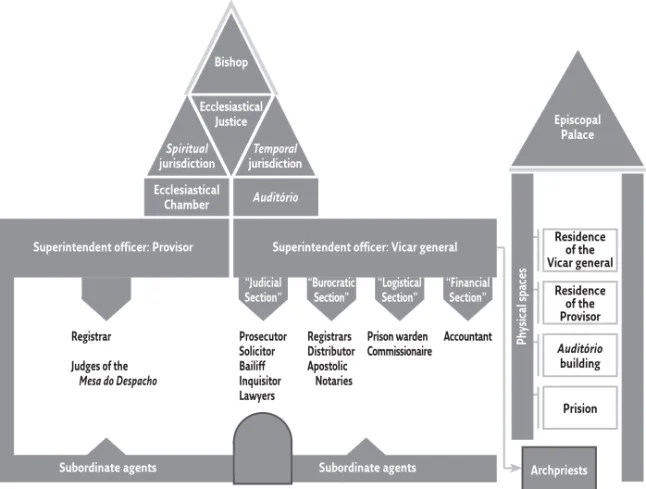
The functions and profiles of these officers, defined on regiments, were so specialized that their responsibilities can be easily categorized. The first re-giment of the Coimbra Episcopal Court was ordered in 1547 by the bishop D. João Soares. In 1591 the bishop D. Afonso de Castelo Branco ordered a new regiment, published in 1592, incorporated in the Constituições Sinodais, and re-printed again in 1728. I have divided the officers into various informal sections in the following scheme to better comprehend the organization of Coimbra’s Episcopal Court in the 16th century.
Fig. 1. Structure of Coimbra’s diocesan judicial system in the 16th century.
76 See F. A
LMEIDAHistória da Igreja..., cit., 2: 231-236.
77 See J. P. P
AIVA, Dioceses..., cit., 187-199. Bishop Ecclesiastical Justice Spiritual jurisdiction Temporal jurisdiction Ecclesiastical Chamber Auditório
Superintendent officer: Provisor Superintendent officer: Vicar general
“Judicial Section” “Burocratic Section” “Logistical Section” “Financial Section” Prosecutor Solicitor Bailiff Inquisitor Lawyers Registrars Distributor Apostolic Notaries Prison warden Commissionaire Accountant Registrar
Judges of the
Mesa do Despacho
Subordinate agents Subordinate agents Archpriests
Surveys of sources produced by Auditório of Coimbra allow us to conclu-de that this structure continued in existence until at least the mid-18th cen-tury. The number of officials in each section varied by dioceses, as well as ac-cording to the different chronological periods. The profiles and competences of each of these officers will be analyzed below.
3.1. Presiding Judge of the Ecclesiastical Justice: The Bishop
Apart from having to choose, nominate and discipline the officers who worked in the Ecclesiastical Justice, as presiding judges they also had a num-ber of other competences in the judicial administration of the diocese. These included: commutation of final rulings and waivers of temporary sentences, visits of the Cathedral Chapter – in spiritual and temporal matters, establi-shing residences for the justice officers, allocating places of exile, ordering the application of apostolic decrees on any kind of benefits, imposing holy days and fasting days, knowledge of pardons regarding remission of a crime or res-pective sentences. The antiste delegated important functions to the provisor and vicar general78.
3.2. The Ecclesiastical Chamber/Episcopal Directorate (Mesa do Despacho)
The nomination of the agents who worked in the Ecclesiastical Chamber, with the exception of the judges, and the discrimination of their functions in the Regimento dos oficiais do Auditório(Regiment of the officers of the Auditório), shows that the Ecclesiastical Chamber and the Episcopal Court (Auditório) had different but complimentary, judicial roles79.
3.2.1. Superintendent Officer: Provisor
The office of provisor was designed for the spiritual administration of souls and the ministry of sacraments. The individual who took this post had to be a priest, mature in age, «serious», an experienced scholar, and not obs-tinate80. His judicial responsibilities included taking the visitation books to the
78 See
Regimento dos officiaes..., cit., fol. 1-2v, 6-7v, 10v-14; J. P. PAIVA, A administração diocesana..., cit., 71-110.
79 See
Regimento dos officiaes..., cit., fol. 10v-14v; 19.
80 See
Mesa do Despachoto follow up on the offenses that were within his jurisdiction, issue licenses of absolution for those who had deceased in excommunication but had (previously) shown signs of contrition, issue letters to participants against unruly people who didn’t confess within the obligatory period81.
Ma-rriage impediments announced in churches were brought to him, or submit-ted to the Mesa do Despacho for appraisal. He was also entrusted with asking the customary matrimonial questions before a trial became litigious. In the event that the parties agreed to marry he could acquiesce, but if there was di-sagreement, it was up to the vicar general to decide on the case82.
3.2.2. Subordinate Officer: Registrar
The registrar of the Ecclesiastical Chamber prepared the written records of the most important matters of the bishopric, which he kept in a special coffer in the Cabido(Chapter of the See). He was required to be fair, honest, prudent, and discrete. He was responsible for keeping a book to record and transcribe all the letters of «confirmação de benefícios» (confirmation of parochial benefits)83. Each
page was signed and numbered by the provisor or vicar general.
He was prohibited, under penalty of suspension and payment of fines, to issue certificates of autos(edicts) to any individual, unless the parties had re-quested it and the judges had previously given their formal consent84. Neither
the registrars of the Ecclesiastical Chamber nor of the Episcopal Court could get involved in each other’s business85.
3.3. The Episcopal Court (Auditório)
3.3.1. Superintendent Officer: Vicar General
Only individuals who were ordained and over thirty years of age could occupy the position of vicar general. To be eligible they were required to be doctors, graduated in cannon law, or be sufficiently scholarly. They had to show rectitude in their conduct, benignity, meekness and benevolence. Like
81 See
Regimento dos officiaes..., cit., fol. 2v-4.
82 See
Regimento dos officiaes..., cit., fol. 2v-4.
83 See
Regimento dos officiaes..., cit., fol. 17v-22v.
84 See
Regimento dos officiaes..., cit., fol. 17v-22v.
85 See
the provisor, this person had to be accommodating to all those involved in the
Auditório86.
The vicar general was responsible for presiding over court hearings that involved disputes and accusations of offenses that pertained to the ecclesiasti-cal forum. He was required to publish the processes or «feitos» that he had dealt with so that the lawyers could emit their opinions; make the summaries and have defendants arrested or released; investigate offenses that came under the Tribunal’s jurisdiction; take care of testaments, execute the pious wills of the deceased and write out a «quitação em forma» (settlement) after certifying that these had been fulfilled and signing the list of witnesses87.
It was also the duty of the vicar general to be informed of all the crimes and accusations registered in visitations, if reduced to the litigious forum, to question witnesses in cases of serious crimes, and to perform all the tasks that pertained to the office of provisor if the later were absent or inexistent, as was often the case in the Brazilian dioceses. It was his duty to impose penalties on officials who didn’t turn up at the court hearings of people held in prison. Fi-nally, he had to sign the sentences once the registrar had given proof that all the officers had been remunerated88.
3.3.2. Subordinate Officers
3.3.2.1. Judicial Section
A) Prosecutor
The prosecutor was the officer in charge of legally requesting with dili-gence all causes pertaining to episcopal jurisdiction. He was required to hold a degree in Canon Law or Civil Law, oversaw all crimes that qualified to be judged in the Tribunal, and initiated the court procedures. He also had the responsibility of ensuring procedural secrecy89.
The vote and opinion of the prosecutor took precedence over lawyers in court proceedings. He had to present the «feitos da justiça» (procedural steps) in court hearings as well as the lists of prisoners and individuals held in
cus-86 See
Regimento dos officiaes..., cit., fol. 4-5.
87 See
Regimento dos officiaes..., cit., fol. 4-5; 7v-9.
88 See
Regimento dos officiaes..., cit., fol. 4-5; 7v-9; 16v-17v.
89 See
tody (seguros), and emit his opinion about all those whose defense he was in charge of. He was to follow up on «autos de querela» (disputes) and inquests even if the plaintiffs had withdrawn their accusations, unless the vicar gene-ral closed the case. It was his job to issue indictments (libelos da justiça)after notifying (correr folha) all the registrars of the Auditório, the Chamber and the visitation. He also had to issue edicts against defendants who had been char-ged in the interrogations of pastoral visits once they were formally indicted by the Mesa do Despacho. He then had to proceed with the interrogation of the relevant witnesses. Little is known about his salary except that he was paid the same amount as the prosecutors and that it was stipulated by the crown tribunals90.
B) Solicitor
The solicitor was responsible for safeguarding the correct administration of episcopal justice. He had a list of all the procedural steps(feitos da justiça)
according to which he was supposed to officially summon all those guilty. It was up to him to be informed of all crimes committed in the diocese, and pro-vide true and correct information to the prosecutor91.
It fell to him to solicit interrogations and to accompany the inquisitor and registrars. Finally, he was to encourage the brief and efficient dispatch of these processes. If he was accountable for any delays, he would not receive the proceeds due, and would have to pay both deferment costs and a fine, to co-ver justice expenses. In the case of a relapse the penalty was bigger and could lead to suspension. Apart from receiving the salary stipulated for solicitors of secular justice, solicitors of the Auditórioreceived a fourth of all justice feitos da justiça (court procedures) that they solicited92.
C) Bailiff
The bailiff was the officer in charge of holding defendants in the episco-pal prison and denouncing public crimes. He was required to be fair, prudent and impartial, and was obliged to present arrest and search warrants, except in
90 See
Regimento dos officiaes..., cit., fol. 15-16v.
91 See
Regimento dos officiaes..., cit., fol. 26v-27.
92 See
situations of flagrante delicto. If he made an arrest that went against the terms of the Regimento, he would be provisionally suspended. In case of negligence he would be convicted and substituted by the prosecutor93.
He was forbidden to discuss his fees with the parties before a sentence was not issued, nor could he accept donations or sleep in the house of indivi-duals confronted with the law. Whenever the bailiff presented charges the prosecutor had to serve as prosecutor. He received an allowance of one tostão
(testoon) for each detention he made in Coimbra. If he made an arrest outsi-de of the city, his fee increased by one tostãofor every league traveled by foot. He was paid by the party involved in the process, by the actual prisoner, or by the expenses of justice. If he charged more than he was due, he had to refund the double of that amount and was suspended for one year94.
D) Inquisitor
The inquisitor was the officer in charge of carrying out interrogations re-lated to causes pending in the Episcopal Court. In the absence of an inquisi-tor or if there was some impediment, a commissioner would be nominated. With time this practice became the norm, the position of inquisitor ceased to exist, and priests were paid a commission to carry out this task95.
For each cause the inquisitor had to interrogate up to twenty witnesses. If he interrogated others, the depositions would not have effect, and neither he nor the registrar would receive a salary. As a representative of justice he could only interrogate witnesses who had been registered, under punishment of paying a thousand réis96.
Interrogations were initiated with cross-examinations of the witnesses of the «author» (plaintiff), and only after that those of the defendant. Regarding cases of marital and «beneficial» crime (irregularities in naming priests) in which the «quality» of the witnesses justified it, the inquisitor could never ini-tiate an interrogation without first informing the vicar general. If he failed to proceed in this way, he would be obliged to pay four hundred réis, the court
93 See
Regimento dos officiaes..., cit., fol. 22v-24v.
94 See
Regimento dos officiaes..., cit., fol. 22v-24v.
95 See AUC, Caixas da Câmara Eclesiástica, III, D, 1, 6, 2, 25, doc. 20. See also AUC, Caixas da
Câmara Eclesiástica, III, D, 1, 6, 2, 27, doc. 4; Lisboa, Arquivo Nacional da Torre do Tombo [from now on ANTT], Inquisição de Coimbra, processo nº 19.
96 See
sessions would be declared null and void, and other penalties indicated in the Royal Regimentowould be applied97.
Failure to fulfill the duties of his office without presenting a valid justifi-cation resulted in a six month suspension. It was then up to the vicar general to provide a substitute98.
E) Lawyers of Defence/Prosecution (Procuradores)
The procuradores were laymen licensed in Law, and did not work exclusi-vely for the Auditório. To exercise their office they needed authorization from the bishop, and the validity of was up to the discretion of the prelate99.
Their role was to prepare trials, and to defend and prosecute. They le-gally represented the parties, whether they were present or absent or unable to appear in the Tribunal hearings. They could not, however, represent indi-viduals that were absent from the Kingdom without previously paying a bond. They were responsible for issuing suspicions against justice officers who inhi-bited indictments100.
They were required to be diligent and avoid delays; otherwise they had to pay one tostãoper each day of deferment. They were not allowed to exerci-se power of attorney until they had paid the debt101. In cases of mixed justice,
the procuradoreswho bypassed episcopal justice in favour of royal justice were suspended and only readmitted by decision of the bishop102. Their salaries
were calculated according to the Regimentoof the courts of the crown. All that is known is that for each of the more serious criminal cases, the procuradores
would receive nine hundred réis103.
3.3.2.2. Bureaucratic Section
A) Registrars
The number of registrars that worked in the episcopal Tribunal varied according to the number of procedural causes in each one. Registrars working
97 See
Regimento dos officiaes..., cit., fol. 24v-25v.
98 See
Regimento dos officiaes..., cit., fol. 24v-25v.
99 See
Regimento dos officiaes..., cit., fol. 5; 16v-21.
100 See
Regimento dos officiaes..., cit., fol. 6-7v, 10v-14.
101 See
Regimento dos officiaes..., cit., fol. 6-7v, 10v-14.
102 See
Regimento dos officiaes..., cit., fol. 6-7v, 10v-14.
103 See
under the vicar general did so on a rotating basis and according to seniority; in Coimbra their term lasted one month. The main task of the registrars who assisted the vicar general was to write the minutes of the court proceedings that took place daily in the Episcopal Court, and record trials, hearings and rulings. The other registrars only carried out distribution orders104.
The activity of the registrars was revised yearly by the vicar general. They were prohibited, unless expressly authorized by the judge, to work from home. They were assigned the task of accompanying the inquisitor and recording all depositions made by the witnesses listed in a roster signed by the vicar general105.
Registrars had to deliver the written drafts solely to the vicar general and
procuradoreswithin a stipulated deadline, which if not met would incur a pe-nalty. It was also their duty to give previous notification to all parties, inde-pendently of whether the trials were in the city or elsewhere, under penalty of a fine of four hundred réis106.
Like all other officers, they could not redirect a lawsuit to a secular jud-ge without the consent of the bishop or the vicar jud-general, under penalty of sus-pension and a fine of two thousand réis. Nor could they adjourn a trial, under penalty of paying the costs of deferment and four hundred réis. For the sake of equity, registrars could not take on a case without it first being duely allocated to them. Infringement resulted in a six month suspension, without remission. If they repeated the offense, they were suspended for a year and were obliged to pay a fine of ten cruzados. If they recidivated, they would be banned107.
The salaries of the registrars varied. If they had to travel to record the depositions of someone who had requested the Tribunal to initiate court pro-ceedings, the plaintiffs paid them an amount stipulated by the vicar general at the end of the interrogation. If, on the other hand, the party interested in the carrying out enquiries was the Tribunal, the registrars would pay the expenses and submit them to the Auditório, where all their costs would be added up. These were presented to the sentenced party who was then obliged to reim-burse the registrars108.
104 See AUC, Caixas da Câmara Eclesiástica, III D, 1º, 6, 2, 8, doc. 9, fol. 2. 105 See
Regimento dos officiaes..., cit., fol. 7v-9; 18-22v.
106 See
Regimento dos officiaes..., cit., fol. 7v-9; 18-22v.
107 See
Regimento dos officiaes..., cit., fol. 7v-9; 18-22v. In the Brazilian bishoprics the work of the re-gistrars’ was also controlled, see C. BOSCHI, As Visitas Diocesanas e a Inquisição na Colónia, en Actas do 1º Congresso Luso-Brasileiro sobre Inquisição, 3 vols., Sociedade Portuguesa de Estudos do século XVIII, Universitária Editora, Lisboa 1989, 2: 965-996.
108 See
B) Apostolic Notaries
The apostolic notaries did not work exclusively for the episcopal tribu-nal. Their role was to write notifications and certifications of the legal proce-edings. They were nominated by the prelates through a delegation of the pa-pal jurisdiction109. The rescript of Julius II Ex querela carissimiof 28 June 1505
directed to the archbishops and bishops of Portugal, ordered an examination of the notaries of the respective dioceses and those found not competent to be divested of their office110.
C) Distributor
The distributor was responsible for the distribution of the bureaucratic work of the Auditório. He distributed all the ordinary court procedures of the episcopal tribunal. He also had to deliver indictments, embargos and autos dos processos to the vicar general. He was required to distribute the work fairly among the registrars111.
He was obliged to record the distribution of all work in a bound book, in clear handwriting and without smudges, which was to be kept in strict confi-dence under penalty of excommunication and payment of a fine which would increase in case of reoccurrence. The distributor was supervised by the vicar general, who analyzed the distribution book every trimester and heard the re-gistrars on this subject. The book was to be kept for thirty years and only du-ring the first five years was it available for consultation. In the absence of a dis-tributor this work was done by a registrar112.
D) Letter Carrier (Corredor de folhas)
Although this office is not mentioned in theRegimentoof 1592 it appears in later documents, namely in general inquests, and was probably created as a result of the bureaucratic growth in the Episcopal Court. Letter carriers dis-patched documents between the various officials of the Tribunal113.
109 See
Regimento dos officiaes..., cit., fol. 7v-9; 18-22v.
110 See F. A
LMEIDA, História da Igreja..., cit., 2: 231-236.
111 See
Regimento dos officiaes..., cit., fol. 25v-26.
112 See
Regimento dos officiaes..., cit., fol. 25v-26.
113 See AUC, Caixas da Câmara Eclesiástica, Devassa geral para se saber do procedimento dos