MÁSTER EN PROFESOR DE EDUCACIÓN SECUNDARIA OBLIGATORIA, BACHILLERATO, FORMACIÓN PROFESIONAL Y ENSEÑANZA DE IDIOMAS
LITERATURE CIRCLES AND SECONDARY
EDUCATION IN SPAIN: A PROPOSAL FOR
INTERVENTION
TRABAJO FIN DE MÁSTER
Autor: PATRICIA TERESA RODRÍGUEZ MORAL
Tutor: TAMARA PÉREZ FERNÁNDEZ
INDEX
1. INTRODUCTION 3
2. THEORETICAL FRAMEWORK 5
2.1 The use of literature in the EFL class: A brief review. 5 2.2 Literature as a teaching resource: Why or why not? 6 2.3 Literature, CEFRL and the Spanish curriculum. 9
2.4 Using literature in class 12
2.4.1 Selecting texts. 12
2.4.2 Approaches to the text. 14
2.5 Literature circles 16
2.5.1 Literature circles and EFL 18
2.5.2 Just benefits? 19
3. PROPOSAL FOR INTERVENTION 21
3.1 Introduction 21
3.2 Objectives 22
3.3 Methodology 23
3.4 Class profile 26
3.5 Selection of the text 26
3.5.1 Why a short story? 26
3.5.2 Selection of the text 27
3.5.3 Adaptation of the text 28
3.6 Assessment 34
4. DESCRIPTION OF THE PROPOSAL 37
4.1 Session 1 39
4.2 Session 2 41
4.3 Session 3 43
4.4 Session 4 44
4.5 Session 5 45
4.6 Session 6 46
5. CONCLUSION 48
6. BIBLIOGRAPHY 50
1.
INTRODUCTION
The use of literature as a teaching resource in EFL classes is not very popular – at least when we talk about English lessons in Secondary Education in Spain (Medina Calzada, 2013). However, teaching English through literature is a topic that has been widely studied and that has been proved to be effective (Brumfit and Carter, 1986; Little and Wood, 2005; Alam 2002 in Ali & Ahmed, 2015). In this paper we want to support this idea and demonstrate that literature not only can be a perfectly adequate resource for teaching a foreign language, but that in fact it can be more beneficial than teaching from a merely linguistic approach. How can we demonstrate this? By revising a strong theoretical framework and using it to design a proposal for intervention that includes literature in a specific context – a context provided by the Spanish secondary education system.
Literature is a very large area, so we are going to focus on a particular kind of text and a particular methodology in our proposal. Regarding the texts, short stories seem to be the most adequate kind of text for secondary education due to the age of the students (from 12 to 18 years old) and their level of English (which can vary depending on the person but which usually corresponds to an A2 to B1 – or B2 in the highest levels – according to CEFR (Pathan, 2013; Erkaya, 2005). They are short, easy to read, usually dealing with moral issues that can lead students to think and discuss. As we will see, these features appear in the secondary education curriculum as part of the competences and skills fostered and required to acquire during this stage (RD 1105-2014). Moreover, there is a huge variety of topics that we can choose according to their preferences. For these reasons, and as we will explain later, many authors support the use of short stories in secondary education (Pathan & Al-Dersi, 2013; Jalilifar & Assi, 2008; Khatib, 2011; Erkaya, 2005).
Although the original text is accessible enough for mostly every kind of student, it is going to be adapted in this proposal in order to better fit the characteristics of our target class. There will be three different kinds of adaptation: linguistic, content and cultural adaptations1.
Regarding the methodology of this proposal, we have focused on literary circles. Literary circles are small groups – usually of five people – in which a text is read and discussed (Daniels, 2002). In this paper we will explain and analyze all the benefits that literary circles provide, and also we will discuss some problems that could arouse when moving into practice, according to different authors (Clarke and Holwadel, 2007; Medina, 2013; Lloyd, 2004). Then, after reviewing both positive and negative aspects of literature circles, we will discuss how to adapt this model into a Spanish secondary education class – more specifically, a course belonging to the 4th year of E.S.O.2 in Castilla y León.
So what we want to do in this paper is to make a proposal for intervention designed specifically for the 4th course of E.S.O in Castilla y León. In this proposal, literature – short stories in particular – is used in order to teach English as a foreign language by using literature circles. Besides, we will adapt and modify the original idea suggested by Daniels in order to fit the Spanish curriculum and also to try to avoid the problems presented by other researchers. These modifications include mainly the addition of a final project, the adjustment of students’ roles according to the characteristics of the target class and a more active presence of the teacher.
1
See pages 29-32.
2
2.
THEORETICAL FRAMEWORK
In this section we will discuss the theoretical framework. First, we will review the use of literature in the EFL class along the past decades. Then, we will discuss some authors that are both against and in favour of the use of literature as a teaching resource. Thirdly, we will how does literature fit in the Spanish curriculum, and after this we will explain how texts can be selected and approached in the class. Finally, we will move to literary circles: we will define, explain and review the original model proposed by Daniels together with its use in the EFL class. To finish with, we will expose some problems reported by other authors when using literature circles in class.
2.1
THE USE OF LITERATURE IN THE EFL CLASS: A BRIEF
REVIEW.
The use of literature as a tool for teaching a foreign language has been a widely studied, and somehow controversial, topic along the twentieth century. In the last decades there has been a renewed interest in literature as a teaching resource, but it has not been considered like this – a useful resource – for many years.
In the first part of the twentieth century, the Grammar Translation method3 was the one and only method to use in terms of teaching foreign languages. Literature was one of the main components of this approach, as it provided an exemplary model of the language, especially in terms of grammar and vocabulary. The texts selected belonged just to canonical literature and the approach was merely linguistic; they did not focus on content (Duff and Maley, 1990; Carter, 2007; Llach, 2007).
With the arrival of Structural methods3 literature was put aside. The interest fell on functional, communicative and authentic aspects of language, and literature was not considered to have any of these characteristics (Carter, 2007). Moreover, the Grammar Translation method was not valued any more, and literature represented largely this approach, so its status as a teaching resource decreased.
Later on, in the 1980s, the Communicative approach3 was introduced and with it the interest on literature was recovered. The recognition of literature as a valuable teaching
3
For more information about this method, see: Richards, J. C., & Rodgers, T. S. (2014). Approaches and
resource, especially when talking about reading and writing skills, and as an authentic material, led researchers and teachers to rethink the possible benefits of literature for the foreign language students. Besides, literature was no longer approached from a merely linguistic point of view; it was also recognized “the fact that more imaginative and representational uses of language could be embedded alongside more referentially utilitarian output” (Carter, 2007, p. 6).
However, despite the revival of the interest on literature in the EFL classroom, we are far from coming to a general agreement on the main point: Should literature be used as a teaching resource in the EFL context?
2.2
LITERATURE AS A TEACHING RESOURCE: WHY OR
WHY NOT?
As in every research field, there is a wide variety of opinions regarding the use of literature in the EFL class. And some of these opinions – albeit less in this case – are against it.
The most common arguments that detractors maintain are related to structure and use of language, together with the possible cultural barriers and the ultimate goal of foreign language students, which usually has little to do with literary aspirations – a similar argument to those that were contended when the structural approach was on its peak (McKay, 1982).
the original version of Beowulf in an EFL class with a low level of English is an arguable decision.
Regarding cultural barriers, McKay argues that “literature often reflects a particular cultural perspective; thus, on a conceptual level, it may be quite difficult for students” (1982: p. 529). A text with a lot of specific cultural references might create problems for the students when trying to understand the content.
Finally, the ultimate goal of students when they decide to learn a new language is usually related to an academic or professional field (McKay, 1982) – or, in some cases, they are simply required to study it, as in secondary education. And literature, as it has been said before, has usually little or nothing to do with these aims, which lead teachers and researches to wonder whether literature adjusts to the student’s needs or not.
Other kinds of questions are also regarded as potential problems, as the importance of selecting an appropriate text or the possible lack of adequate literature formation of EFL teachers. A good selection of texts, made taking into account all the relevant characteristics of the class – age, level of English, interests, number of people, etc. – can overcome many – if not all – of the problems explained before (Carter and Long, 1991; McKay, 1982). And if the original texts are not appropriate enough, they can always be adapted to fit the characteristics and needs of the group.
Khatib et al. suggest more specific solutions to the most common arguments against literature, as the syntactic and lexical complexity found in literary texts, which “can become a source for practice especially for the learners at the intermediate and the above levels” (2011a: p. 203). The amount of new vocabulary and syntactic patterns or structures that students acquire while being exposed to literature is huge, and more important, varied; and with literary texts we ensure that the language to which they are exposed is employed at its finest. So we could argue that this complexity of form is nothing more than a tool for students to enrich their language.
foreign one can be many and complex, and it is for this reason that they should have the chance of being aware and understand these differences as soon as possible. Therefore, it is necessary that students get exposed to those cultural barriers so they can jump over them in a controlled context – as it is a classroom – where they can ask for help: explanations, opinions, examples…
Regarding the contribution of literature to specialized or academic fields, it is true that it could be difficult to find a literary text including English for specific purposes, but as we are focusing on ESL instruction it could be said that the very first step is to learn the language itself, and as Khatib indicates, “it can be a positive catalyst for quickening language learning process” (2011a: p. 204).
But, does literature actually help students to learn the language itself, its basis? Absolutely yes. Many authors concur on the richness of literature in terms of developing the basic four skills: reading, writing, listening and speaking (Carter, 2007; Hişmanoğlu, 2005; Khatib, 2011a; Llach, 2007; McKay, 1982; Rai, 2012; Sage, 1987).
As for reading, literature provides the perfect tools for practicing both intensive and extensive reading. The material is practically endless, and as we have mentioned before, it is a way of exposing students to the best forms of language. And, of course, they can enjoy the content – especially if the texts have been selected according to their interests.
Also, literary texts offer the opportunity to practice writing in a creative and encouraging way, as well as speaking and listening. From literary discussions to recreations of theatre plays, dramatic readings or lecture clubs, all of these activities provide good and original chances to practice oral skills.
But literature goes besides linguistic skills. As Sage points out, “By modeling language, literature teaches sustained, significant communication. ESL is more than just a matter of gaining mastery of many isolated communicative situations […]. Literature, in short, models and teaches coherence of language and thought.” (1987: p. 17).
against it (Savvidou, 2004; Robson, 1989; McKay, 1982), it has been proved to be an effective, helpful, creative and productive resource for the EFL instruction.
2.3
LITERATURE,
CEFRL
AND
THE
SPANISH
CURRICULUM.
As we have seen, there are a number of authors who support the benefits of using literature in an EFL context. But in the Spanish curriculum, English literature is not included as a subject or as part of the Second Language syllabus. Does it mean that literature cannot be used as a resource for teaching English language? Not at all.
In fact, both the Spanish Royal Decree and the Official Gazette/Boletín Oficial of, in this case, Castilla y León, give particular attention to the sociocultural and artistical side of foreign languages, apart from linguistic skills themselves:
Regarding the general objectives of Secondary Education:
Artículo 11. Objetivos de la Educación Secundaria Obligatoria
i) Comprender y expresarse en una o más lenguas extranjeras4 de manera apropiada.
j) Conocer, valorar y respetar los aspectos básicos de la cultura y la historia propias
y de los demás, así como el patrimonio artístico y cultural.
l) Apreciar la creación artística y comprender el lenguaje de las distintas
manifestaciones artísticas, utilizando diversos medios de expresión y representación.
(RD 1105/2014: p. 176)
Artículo 15. Proceso de aprendizaje y atención individualizada.
3. En esta etapa se prestará una atención especial a la adquisición y el
desarrollo de las competencias y se fomentará la correcta expresión oral y escrita y el
uso de las matemáticas. A fin de promover el hábito de la lectura, se dedicará un
tiempo a la misma en la práctica docente de todas las materias. (RD 1105/2014: p.
180)
4
General objectives in Bachillerato:
Artículo 25. Objetivos.
f) Expresarse con fluidez y corrección en una o más lenguas extranjeras.
l) Desarrollar la sensibilidad artística y literaria, así como el criterio estético, como
fuentes de formación y enriquecimiento cultural. (RD 1105/2014: p. 188)
As for the general description of the foreign language subject (English in this case):
El uso efectivo de lenguas extranjeras supone necesariamente una visión abierta y
positiva [...]Las competencias sociales y cívicas, y la conciencia y la expresión
culturales, tanto las circunscritas a los entornos más inmediatos como las propias
de ámbitos cada vez más amplios de actuación, forman así parte de las habilidades
que comprende una competencia intercultural integrada en el aprendizaje de
lenguas extranjeras. (RD 1105/2014: pps. 422-423)
In the Boletín Oficial de Castilla y León, we find similar references, as in the description of the contents of foreign languages subjects:
[…]Por su parte, los contenidos del bloque 4, Aspectos socioculturales y consciencia
intercultural, contribuyen a que el alumnado conozca costumbres, formas de relación
social, rasgos y particularidades de los países en los que se habla la lengua
extranjera, en definitiva, formas de vida diferentes a las suyas. Este conocimiento
promoverá la tolerancia y el respeto, acrecentará el interés por el conocimiento de
las diferentes realidades sociales y culturales y facilitará la comunicación
intercultural, porque por medio de las lenguas se accede a los modelos y los valores de
las culturas que representan. (DECRETO 52/2007: p. 50)
Regarding the specific objectives of this subject, we should highlight:
3. Leer y comprender de forma autónoma textos diversos de un nivel adecuado
a las capacidades e intereses del alumnado con el fin de extraer información general
y específica, y utilizar la lectura como fuente de placer y de enriquecimiento
personal. (DECRETO 52/2007: p. 51)
Comprensión general e identificación de informaciones específicas en diferentes
textos sencillos auténticos y adaptados, en soporte papel y digital, sobre diversos
temas adecuados a su edad o relacionados con contenidos de otras materias del
currículo.
Iniciativa para leer con cierta autonomía textos adecuados a la edad, intereses y
nivel de competencia.
Uso de estrategias básicas de comprensión lectora: identificación del tema de un
texto con ayuda de elementos textuales y no textuales, uso de los conocimientos
previos, inferencia de significados por el contexto, por elementos visuales, por
comparación de palabras o frases similares en las lenguas que conocen. (DECRETO
52/2007: p. 52)
We have argued before that one of literature’s most powerful elements is the representation of culture – and the huge profit that it provides to students. Bearing in mind all the specific references to culture and artistic values – apart from the direct references to reading and literature – and that literature is a great resource for teaching these aspects, we could say that it is perfectly feasible to use literature as a didactic resource in a foreign language class in order to achieve all the objectives marked by the law.
Besides, everything concerning language education is included in the Common European Framework of Reference for Languages (MCERL in Spanish), which is the document on which the Royal Decree is based regarding foreign languages (RD 1105/2014: 516). And is in this document where we find direct allusions to the use of literature:
Los usos imaginativos y artísticos de la lengua son importantes tanto en el campo
educativo como en sí mismos.[…] Comprenden actividades como las siguientes: […]
volver a contar y escribir historias, etc.; escuchar, leer, contar y escribir textos
imaginativos (cuentos, canciones, etc.) incluyendo textos audiovisuales, historietas,
cuentos con imágenes, etc.; representar obras de teatro con guion o sin él, etc.;
presenciar y escenificar textos literarios como, por ejemplo, leer y escribir textos
(relatos cortos, novelas, poesía, etc.), representar y presenciar como espectador
recitales, obras de teatro y de ópera, etc. […] Las literaturas nacionales y regionales
contribuyen de forma importante a la herencia cultural europea, que el Consejo de
Europa considera «un patrimonio común valioso que hay que proteger y
Los estudios literarios cumplen muchos más fines educativos, intelectuales, morales,
emocionales, lingüísticos y culturales que los puramente estéticos. Se espera que
muchas secciones del Marco de referencia resulten adecuadas para las
preocupaciones de los profesores de literatura de todos los niveles y que sean útiles
a la hora de lograr que los objetivos y métodos sean más transparentes. (MCERL,
2002: 59-60)
This document also states the type of texts that can be used in the EFL context:
Textos escritos: libros, ficción y no ficción, incluyendo publicaciones literarias;
revistas; periódicos; manuales de instrucciones (bricolaje, libros de recetas de
cocina, etc.); libros de texto; tiras cómicas;[…]) (MCERL, 2002: 93)
Finally, regarding general competences that the students should have, we find the follwoing:
5.1.1.2. El conocimiento sociocultural
Estrictamente hablando, el conocimiento de la sociedad y de la cultura de la comunidad o
comunidades en las que se habla el idioma es un aspecto del conocimiento del mundo. Sin
embargo, tiene la importancia suficiente como para merecer la atención del alumno, sobre todo porque, al contrario que muchos otros aspectos del conocimiento, es probable que no se encuentre en su experiencia previa, y puede que esté distorsionado por los estereotipos.
5.1.1.3. La consciencia intercultural
[…]la conciencia de la diversidad regional y social en ambos mundos[…] se enriquece con la
conciencia de una serie de culturas más amplia de la que conlleva la lengua materna y la segunda lengua, lo cual contribuye a ubicar ambas en su contexto. Además del conocimiento
objetivo, la consciencia intercultural supone una toma de conciencia del modo en que aparece
la comunidad desde la perspectiva de los demás, a menudo, en forma de estereotipos
nacionales. (MCERL, 2002: 100-101)
2.4
USING LITERATURE IN CLASS.
Now that the reasons for using literature in an EFL context have been exposed, together with its place within the European and Spanish legal context, it is time to discuss how literature is introduced in the classroom.
The very first thing to take into account is the selection of texts. As we have mentioned before, choosing a suitable or unsuitable text can determine the success or the failure of a program. By making a good selection of texts we can avoid almost every possible problem, as linguistic complexity or cultural barriers (Carter and Long, 1991; McKay, 1982). But, how do we select the appropriate text?
We have to take into account several factors, all of them dealing with the type of course and the students’ profile – age, maturity, linguistic proficiency, interests and cultural background – or the kind of text – structure, plot, stylistics, themes and its exploitability (McKay, 1982; Sage, 1987; Lazar, 1993).
Regarding the type of course, it is important to consider all the characteristics of the course and the class: the length of the course – is it possible to work all over the year or do we have just a semester?; the number of students in the class; the kind of English required; or the reasons why they want to learn this language – it is a secondary English class? Or it is an English for Specific Purposes course? Do they need English for their professional future? Or do they just want to travel? (Lazar, 1993)
It is also important to revise the syllabus and determine if it is flexible enough to include literature – if it is not included yet. In certain courses, especially the last year of secondary education, the syllabus is focused on a final test (an official exam to enter the university) and for this reason it can be difficult to fit tasks dealing with literature, as it is not part of that final test.
As for the students’ profile, the age is a determinant factor to take into account. Age is probably going to condition many other factors, as intellectual maturity or interests. And we also have to consider that the class might not have same aged students – as in Official Language Schools or language academies.
Intellectual maturity is sometimes linked to age, but not always. The complexity of themes, topics and structure of the text selected has to be equated with their capability for understanding and processing the content (Lazar, 1993).
(1982) suggests choosing simpler texts – as young adult novels – or adapting complex ones for the students with a lower level.
In relation to personal interests, the ideal option would be that students could select the texts themselves, according to their preferences. This might be possible in some cases, but not always, as we have to ensure that the text they are going to work on is appropriate in every sense, and that it contains the elements from the syllabus that we want to focus on. And sometimes students would not take these aspects into account in order to select a text. An intermediate option is giving them a list of possible choices – previously selected by the teacher – so they can choose in a controlled manner (Furr, 2004).
The students’ cultural background is relevant as well, but as it has been argued before, what some authors consider as cultural barriers can be in fact a positive aspect for students to learn about this crucial aspect of language – culture. They might find some difficulties understanding certain cultural references, but this is something that the teacher should have taken into account when choosing the text, so these cultural references can be explained and even provide a chance to develop topics that would remain untouched otherwise.
Now, taking into account all the information about the course and students, we can proceed to apply it to the characteristics of the texts. We need to find a text that satisfies the needs and features of our students as far as possible. If we are not able to find an appropriate text, we can adapt or modify some aspects of the text that is closer to what we need. Some important factors on the text to consider are the genre and the main theme – regarding the students’ interests, the stylistics – according to the students’ linguistic proficiency and their literary background, the structure, plot and topics appearing in the text – in regard to intellectual maturity and, again, to interests, or the exploitability of the text together with the fit with the course’s syllabus.
Once the text is properly selected, it is time to discuss the different approaches we can use to work on it.
Different approaches to the literary texts in the EFL context have been discussed and proposed (Khatib, 2011a): the Critical Literary Approach, the Stylistic Approach (Maley, 1989); the Story Grammar Approach, the Reading Response Approach (Amer, 2003); the Integrated Approach (Timucin, 2001; Savvidou, 2004) and the Van’s Approaches (2009), subdivided in New Criticism, Structuralism, Stylistics, Reader-Response, Language-based and Critical Literacy, among others. But in this paper we are going to focus on the three approaches suggested by Carter and Long (1991): the Language-Based Approach, Literature as Content and, especially, Literature as Personal Enrichment.
The first approach, the Language-Based Approach or the Language Model, is one of the most common approaches, and it focuses mainly in the linguistic features of the text, normally in order to exemplify a particular aspect – as, for example, reported speech (Carter and Long, 1991). It is similar to the Stylistic Approach suggested by Maley.
Literature as Content, also called the Cultural Model, is a traditional approach to literature, in which the attention falls on the content of the text – plot, themes, characterization, discussion… The cultural side of the novel is also included – historical background, politics, social criticism, traditions, etc. (Khatib, 2011a). The acquisition of language is achieved by reading and discussing literature, and not by directly working on the set linguistic features in the text.
The last approach proposed by Carter and Long is Literature as Personal Enrichment, or the Personal Growth Model. In this approach, the main aim is to engage the student with literature. It focuses on the relation between the text and personal experiences, thoughts, feelings and opinions. The predominant kind of activities in this approach is related with discussions, a relaxed environment, small groups in which students are encouraged to express their opinions (Savvidou, 2004). It could be said that a very representative example of this approach are literary circles – small groups, texts selected according to the students’ interests, discussions and exposition of opinions, thoughts and feelings – as we will discuss later.
First of all, we should discuss the definition of task. Shekan suggests that a task is “an activity in which meaning is primary; there is some sort of relationship to the real world; task completion has some priority; and the assessment of task performance is in terms of task outcome” (qtd. In Khatib 2011b).
According to this definition of communicative tasks, we could say that the previous methodological approaches discussed – especially Literature for Personal Enrichment – fit completely in the definition of task. They provide a link with the real world, a focus on the content and, above all, a chance for real interaction in a real communicative environment.
Bearing all these in mind, Khatib proposes an approach to literature from a communicative task-based model. He divides his approach in three parts: pre-task, during-task and task activities (also known as pre-reading, while-reading and post-reading activities).
In the pre-task stage, students get familiarized with the main topic and make the schema building (2011b: p. 217). These are introductory activities in general in order to get in touch with the text, as for example, trying to predict the topic of the text just by the title, little discussions about the background and context of the text and author and so on. Then, in the during-task step, Khatib suggests many activities so as to exploit the text and ensure that students comprehend properly all the text. These activities are, for example, skimming, scanning, predicting what would happen in the story, role-plays or summarizing.Finally, the main component of the post-task stage is the reflection on the task. Here the students and the teacher can discuss about what they have read, write about it or make a final project related with the text – as a play, wall paintings, a critical review or any other final task in which students could be interested in.These are examples of the kind of activities that can be done in these three stages, but the possibilities are actually endless.
2.5
LITERATURE CIRCLES
Literature circles are defined by Daniels as “small, peer-led discussion groups whose members have chosen to read the same story, poem, article or book” (2002: p. 2). This idea came from the concept of adult book clubs, which were so popular few decades ago – and in fact, it is something that had been put in practice for centuries. Reading a book and commenting it with a bunch of friends seemed to be a fun, relaxed and original way to achieve the same goals that literature lessons had (Furr, 2004).
Daniels, together with other researchers, has develop this idea in order to make literature courses more attractive and productive. They delimit the concept of literature circles so it fits in an academic context. Daniels presents a list of essential elements that these circles should have:
1. Students choose their own reading materials.
2. Small temporary groups are formed, based on book choice.
3. Different groups read different books.
4. Groups meet on a regular, predictable schedule to discuss their reading.
5. Kids use written or drawn notes to guide both their reading and discussion.
6. Discussion topics come from the students.
7. Group meetings aim to be open, natural conversations about books, so personal
connections, digressions, and open-ended questions are welcome.
8. The teacher serves as a facilitator, not a group member or instructor.
9. Evaluation is by teacher observation and student self-evaluation.
10. A spirit of playfulness and fun pervades the room.
11. When books are finished, readers share with their classmates, and then new groups
form around new reading choices.
(2002: p. 18).
represented in it and reality, their own world – connected with the associative aspect; and an illustrator, who is in charge of representing graphically the most important point of the text – by drawing, making map minds or flow charts, sketching, etc. They are all connected with the symbolic aspect of the text.
The other four roles are summarizer, vocabulary enricher, travel tracer – in charge of creating a time line or diagram representing the story – and investigator – who will find information about the historical context, background or the author. (Hsu, 2004; Medina Calzada, 2013).
Each student will be provided with a role sheet in which it is explained what they have to do according to their role, and where they have to write down their notes and commentaries both to guide and record the discussion.
2.5.1 Literature circles and EFL
Literature circles were originally developed for native speakers of English in a literature class – from elementary school to university. But, how about learners of English as a Second Language? Would literature circles work in this context?
A number of researchers have discussed about this activity in EFL (Bedel, 2012; Medina Calzada, 2013; Furr, 2004; Hsu, 2004), and all of them agree on the benefits of using this circles in an EFL context.
specific linguistic feature to be practiced (Bedel, 2012). Besides, it is a student-centered approach, in which the teacher is merely a guide, a facilitator (Daniels, 2002). This gives autonomy to the students, making them responsible of their own learning, and again, fostering motivation – as they are the ones who decide what to read and what, how and why to discuss.
Furr agrees with the fact that literature circles can be used effectively in EFL instruction, as he states that: “in many respects, an EFL Literature Circle does closely resemble a literature circle in an L1 classroom […].” (2004: 6). However,he also suggests some changes in the key elements that Daniels exposed in order to achieve a more effective and successful practice.
The first variation Furr makes concerns the selection of the material. While in the L1 context it is the students who choose their reading, in the EFL class the texts should be selected by the teacher – always taking into account all the relevant factors when selecting texts. Also, the groups can be formed by students, but always under the instructor’s discretion (2004: 4). Furr considers that EFL students need more guidance than native students, as they need to work with a text that is appropriate for their linguistic proficiency and that provides a basis for discussion in English.
Finally, another change suggested by Furr is that all the groups read the same text: “With each group reading the same stories, I can allow the students to first get hooked by the story and then sneak in a mini-lecture to the entire class after the groups have finished their discussions.” (2004: 5).By including these little variations in the development of literature circles in the EFL class – and following the classic methodology for the rest of the aspects – Furr ensures that literature circles are magic:
EFL Literature Circles are magic because at their heart lie something that I did not
even really touch on in my paper […] let us not forget that at the heart of a literature
circle is a great story. In all cultures, over thousands of years, people have been
fascinated by a good story, and I can say from experience, that my students have been
no exception. (2004: 9).
As we have seen, literature circles provide an excellent way of working with literature in the English class; either they for native speakers or for secondary language learners. But there are also some difficulties that have emerged on practice.
Medina Calzada (2013) mentions three main problems when putting literature circles into practice. The first one – and the most common – is the overuse of the mother tongue. This is a common problem in regular EFL classes. When we talk about a lesson based on small discussion groups where the teacher is an observer and a guide, the probability of finding students speaking in their native language is much higher. A reason for this behavior could be that the text or the topic of discussion is too difficult for their actual level of English, and they are unable to express themselves in English. This happens even in native speakers classes, where students struggle to say what they want to say (Clarke and Holwadel, 2007: 23).
Also, given the degree of autonomy provided, students getting out of control could be another problem. Literature circles are made to, among others, create a supportive and relaxed atmosphere around calmed discussions, but this is not always the case. Clarke and Holwadel (2007) explain the case of a class in which there was a high degree of hostility between the students. These behaviour problems can spoil the lesson, and should be avoided as much as possible.
3.
PROPOSAL FOR INTERVENTION
3.1
INTRODUCTION
The entire theoretical framework has been revised, and it has been made clear that the use of literature is a perfect resource for the EFL class. Also, and more specifically, we have discussed the potential that literature circles have regarding EFL classes – although they also present some challenges to the teacher when put into practice. But, how can we transform these theoretical assumptions into reality? The first step is to design a practical approach.
In this section we will discuss a proposal for intervention in which, following Daniels’ idea of literature circles, we will develop a program that fits within the Spanish curricula of Secondary Education. In order to do so, we will modify some components of the original literature circles proposed by Daniels – for example, the students’ roles5.
What we understand by proposal is a lesson plan designed for a number of hours, normally corresponding with a standard unit (five or six hours) of a course syllabus, dealing with a specific topic and that can be evaluated while it is developed (Estaire, 2004). Literature circles were originally designed as a resource to teach literature to native speakers of English, and duration was not specified in any case – although it could be inferred that literature circles were used all along the course. They were approached as a methodology to follow in the literature class, not as a specific unit included in a syllabus. So, why do we suggest this? Why not suggesting general exercises that could fit into the context described before? Or, why not a proposal on a full course syllabus?
Medina Calzada (2013) points out that a possible problem when using literature circles in the EFL class is that these lessons could be at some point monotonous and repetitive. If we design a lesson plan with a duration of five to six hours, the chances for this to happen decrease automatically. It can be approached as something occasional at first, to see if this methodology really fits and functions having into account the characteristics of the course and its students, and as a way of introducing a fresh and original way of learning English as seen by students. Of course, this proposal can also serve as a model
5
for designing more lesson plans, or even a full course syllabus, which is an option that cannot be discarded. However, and for the time being - using literature circles in the EFL Spanish context is such a new way of teaching English, that has barely been put into practice in Spanish Secondary Education, and designing a full course syllabus can be too risky.
Also, a duration of six hours (six lessons) fits perfectly with the elements that Daniels claims to be essential in literature circles: groups are temporary, students meet regularly and evaluation is made during the class (2002). The major objection that we could find is that six lessons could be too short for students to read a full novel, or any other type of text with a considerable length. Consequently, we have decided to use adapted short stories in this proposal. They are short enough for students to read during one or two weeks and they are short enough for students to analyze and discuss about them in six hours. Further reasons for using short stories will be discussed in the subsequent sections.
3.2
OBJECTIVES
Our proposal for intervention has three main objectives. The first one is to suggest a methodology for teaching the same contents that have been traditionally taught in a more effective, original and innovative way besides promoting a development of students’ literary skills: using literature in the EFL class. This is the most important objective, not only belonging to the proposal but to this entire work, as it represents what every author working on the use of literature as a teaching resource defends.
Medina Calzada (2013) is one of the authors that support and put in practice the idea of using literature circles in the Spanish Secondary Education context, and the final experience was positive (2013: 93), which is another reason that boosts the idea of practicing this methodology. But she also points out that some aspects need further revision – the overuse of students’ mother tongue, the possibility of the activity to become monotonous and some behaviour problems (2013: 87). Taking these aspects into account we get to our third objective: trying to suggest solutions to the most common problems that can emerge from this practice and filling the gaps indicated by other authors, regarding both the Spanish Secondary Education context and other contexts as well (Medina Calzada, 2013; Clarke and Holwadel, 2007). This objective will be tried to achieve by modifying some of the elements provided by Daniels and adjusting them to our specific context.
3.3
METHODOLOGY
text and many more6. The reason for varying the original guideline proposed by Daniels is that students might not take into account their own level of English, the length of the text or if it provides a proper basis for discussion, whereas the teacher should be capable of noticing every of these aspects and find the appropriate text. Also, the text might need to be adapted, and this has to be done by the teacher. In the next section we will discuss the selection of texts made for this proposal.
Another variation in Daniels’ suggestions is related to group formation. In literature circles group work is essential. That is why it is so important to form adequate groups of students so to avoid behaviour problems or any possible conflicts between classmates, as well as to create balanced groups in terms of linguistic proficiency, personality or active participation. So, as Furr suggests (2004:4) that groups can be formed by students, but always under the instructor’s discretion. So in this proposal, the teacher will choose one of the members of each group and then it will be the students’ task to choose the rest of the members of their group, as we will explain later. By this we can control the formation of the groups as well as maintaining students’ autonomy.
Regarding discussion topics, students choosing the topic to discuss is an interesting proposal, but being this proposal the first time in which this way of working is put in practice, it seems necessary to guide them a little bit more and present possible topics – which can be chosen and discussed later the way students prefer. Therefore, some general topics will be showed in different lessons, taking into account what they have read for that specific lesson and what the text was about, if they have finished the text or they have not started, and so on. Then, students will choose how to discuss and what aspect of the general topic proposed are they going to focus – always under the teacher guidance, so they do not deviate excessively.
As for evaluation, self-evaluation will be contemplated in the general evaluation, although the main responsibility will be taken by the teacher. Observation, as Daniels indicates (2002: 18), will be essential; but the teacher will also evaluate written work so he or she can assess every linguistic skill, as well as evaluate any possible student that has not participated as much as the rest of students.
6
Another important variation regarding Daniels’ key elements in literary circles is the fact that students are going to read the same text in this proposal. He suggests (2002) that different groups should read different texts – in fact, groups are formed around text choice. Why are our students going to read the same text? As we have mentioned before, if we talk about the specific context of this proposal, and that the teacher will have a more active part in the class than in the original suggestions by Daniels, making all the students read the same text enables the teacher to implement the same guidance activities or explanations for the whole class, while if every group would read a different text, this extra-guidance would not be possible to achieve. In addition, although every group is going to work by themselves, any contribution from one group or one student to the rest of the class would be welcome.
Regarding the remaining key elements proposed by Daniels, all of them will be followed: Groups will meet regularly, as this proposal is thought to be made during a whole unit (6 lessons), so it is probable that students will meet three days per week. Also, expression of personal feelings, ideas, opinions and digressions are welcome, so discussions will require an open-minded attitude; and the discussions are meant to be natural, relaxed, playful and, if possible, funny. Finally, students will use written notes and sheets to self-guide their discussions, and they will be assigned different roles.
As we explained in the previous section, different roles (four main roles and four optional ones) were suggested by Daniels. In this proposal we are going to maintain some of them, however, some others will be modified, and one new role will be introduced.
hand to the teacher. Also, it is a way of verifying that they have worked all along the lessons, showing a product in which there is included every aspect seen before.
3.4
CLASS PROFILE
The target audience of this proposal is a class of 25 to 30 people belonging to the fourth course of Secondary Education in Castilla y León. They will not belong to a bilingual program, and they will study in a state secondary school in which there are not many resources; this means, computers and access to the Internet inside the class, electronic blackboards, tablets or any other kind of expensive, electronic resource. Why this profile? Because this proposal is intended to be as realistic as possible, and to cover as many situations as possible, at least regarding Secondary Education in Spain. And the reality is that many secondary schools have many more problems than it is thought: overcrowded groups, lack of electronic and digital resources, old facilities and other kind of inconveniences. The only resources needed to carry out this proposal are photocopies given by the teacher. Students do not even need to buy a book: as the text selected is an adapted short story (this will be discussed in the next section), it can be easily photocopied and distributed by the teacher.
3.5
SELECTION OF THE TEXT
3.5.1 Why a short story?
We have selected one single text for this proposal because, as it has been mentioned before, every group is going to read the same text during the six sessions suggested in this proposal. That is precisely the main reason why this text is a short story, instead of a play, a novel or a poem. A short story is usually short enough to be read and discussed in one or two weeks (taking into account that we have an average of three sessions per week), but long enough to have a definite plot and varied topics to be discussed. Moreover, different authors recommend the use of short stories in the EFL context above any other genre, especially if it is the first time that English literature is presented to the students (Brumfit and Carter, 1986; Collie and Slater, 1991; Khatib, 2011; Medina Calzada, 2013; Pathan and Al-Dersi, 2013).
These authors also allude to the importance of reading real literature, and all the linguistic benefits that it entails. Pathan and Al-Dersi indicate that “the controlled length, with the concise writing and with carefully selected vocabulary and lexis, is another linguistic benefit of the use of short-stories for EFL teachers and learners […]” (2013: 5). Also, the topics covered by short-stories are usually more accessible for students of these characteristics (Secondary students, 15 to 16 years old) than topics included in, for example, poetry. Short stories are faster, more practical and more approachable than any other genre (Khatib, 2011: 153).
3.5.2 Selection of the text.
The short story that has been selected for this proposal is “Harrison Bergeron”7, by Kurt Vonnegut. It is a dystopian science-fiction story about social equality. It is five pages long, and it has – as it was pointed out previously – a definite and precise plot structure. The main topics of this story are the social equality taken to an extreme point, as well as oppression, a dystopian future and rebellion. It is written in an agile style, with short sentences and a fast development – which makes it suitable for teenagers.
7
So, what factors have been taken into account to select this text? First of all, the type of course. As we have mentioned before, we are talking about a Secondary Education course belonging to the fourth year, which means that students should have a B1 level of English according to CEFRL. Bearing in mind the linguistic characteristics of the story (short sentences, predominance of past tenses, everyday language among others – to be discussed in the following section the level of English of these students should not be a major problem.
Regarding the type of students, the first thing to consider is their age. Students of this course are 15 to 16 years old, an age in which they should have enough intellectual and emotional maturity to understand and discuss this text. It is true that this story covers some moral, social and political aspects, aspects that sometimes can become complex, but the point of view presented in the text is so exaggerated, evident and clear that its topics should be perfectly understandable in terms of maturity.
In relation to students’ interests, dystopian futuristic settings are trendy right now. The number of young adult novels and films placed in these kinds of worlds are high – The Hunger Games, Divergent, The Moon Dwellers, Delirium, The Maze Runner, Matched and The Host are some examples, and all of them have been published in the past three or four years. In addition, there are many TV series and videogames on this issue nowadays. And its target audience is, in its majority, teenagers. So it seems to be clear that these topics are currently in vogue, and can attract the students’ attention. But, why choosing “Harrison Bergeron”, a short story published in 1961, instead of one of these young adult novels? Apart from the length of the text, by choosing a story written by Kurt Vonnegut – an important and recognized author – we ensure to a large extent that the quality of our text is high. Also, by showing our students that these topics that are now so interesting for them have been addressed before in contemporary classical literature – in Vonnegut’s, Orwell’s or Huxley’s works - we open their minds and change their opinions about classical authors. Of course, each student has different interests, and it is possible that this text does not please all of them.
background is required, as this proposal is not going to focus on stylistic features or deep literary analysis.
3.5.3 Adaptation of the text
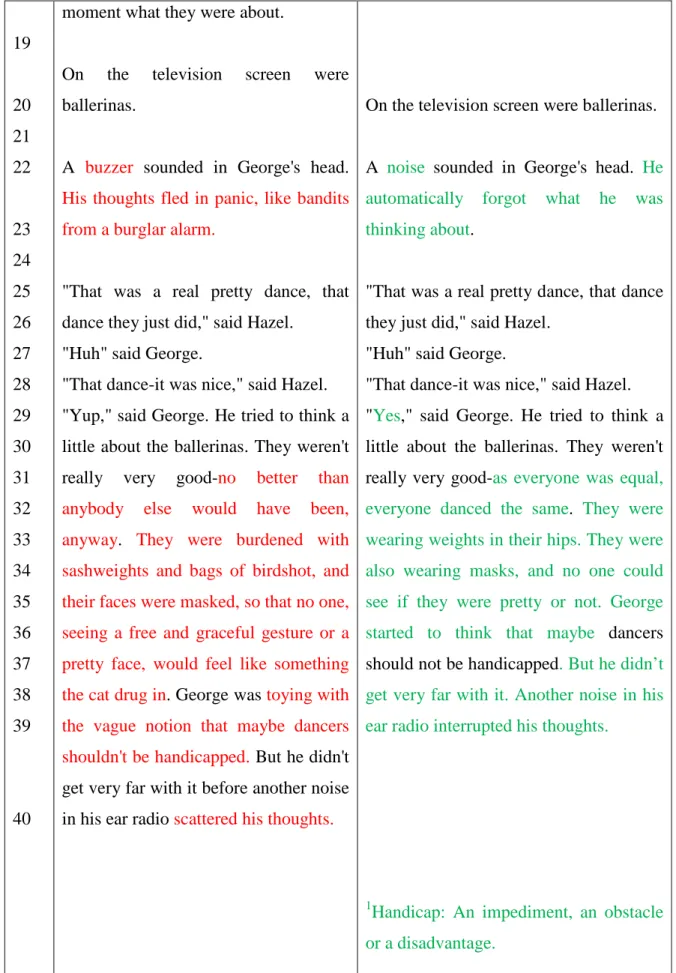
Although the original text is short, accessible and simple enough for our students to understand, we have preferred to adapt it to this specific course. We have selected two extracts of the original text and their equivalents in the adapted version to better show the kind of modifications that we have made.
First of all, we will talk about linguistic adaptations, as it is shown in the following table.
Line ORIGINAL TEXT ADAPTED TEXT
1 2 3 4 5 6 7 8 9 10 11 12 13 14 15 16 17 18
It was tragic, all right, but George and Hazel couldn't think about it very hard. Hazel had a perfectly average intelligence, which meant she couldn't think about anything except in short
bursts. And George, while his
intelligence was way above normal,
had a little mental handicap radio in his
ear. He was required by law to wear it at all times. It was tuned to a
government transmitter. Every twenty
seconds or so, the transmitter would
send out some sharp noise to keep
people like George from taking unfair
advantage of their brains.
George and Hazel were watching television. There were tears on Hazel's
cheeks, but she'd forgotten for the
It was tragic, all right, but George and Hazel couldn't think about it very hard. Hazel had an average intelligence, so she could think just for little periods of time.
And George had a little mental handicap1
radio in his ear because he was more
intelligent than the average people. He
had to wear it all the time by law. The
radio was connected to a government
radio. Every twenty seconds or so, the
radio sent out some sharp noise to prevent people like George from thinking too much.
George and Hazel were watching television. Hazel was crying, but she had
19 20 21 22 23 24 25 26 27 28 29 30 31 32 33 34 35 36 37 38 39 40
moment what they were about.
On the television screen were ballerinas.
A buzzer sounded in George's head.
His thoughts fled in panic, like bandits
from a burglar alarm.
"That was a real pretty dance, that dance they just did," said Hazel.
"Huh" said George.
"That dance-it was nice," said Hazel. "Yup," said George. He tried to think a little about the ballerinas. They weren't really very good-no better than anybody else would have been,
anyway. They were burdened with
sashweights and bags of birdshot, and
their faces were masked, so that no one,
seeing a free and graceful gesture or a
pretty face, would feel like something
the cat drug in. George was toying with
the vague notion that maybe dancers
shouldn't be handicapped. But he didn't
get very far with it before another noise in his ear radio scattered his thoughts.
On the television screen were ballerinas.
A noise sounded in George's head. He automatically forgot what he was
thinking about.
"That was a real pretty dance, that dance they just did," said Hazel.
"Huh" said George.
"That dance-it was nice," said Hazel. "Yes," said George. He tried to think a little about the ballerinas. They weren't really very good-as everyone was equal, everyone danced the same. They were wearing weights in their hips. They were
also wearing masks, and no one could
see if they were pretty or not. George
started to think that maybe dancers should not be handicapped. But he didn’t get very far with it. Another noise in his
ear radio interrupted his thoughts.
1
Handicap: An impediment, an obstacle
or a disadvantage.
The main modifications introduced in the adaptation are the following: subordinate sentences have been turned into simple or coordinate sentences, as we can see in the following example: They were burdened with sashweights and bags of birdshot, and their faces were masked, so that no one, seeing a free and graceful gesture or a pretty face, would feel like something the cat drug in (lines from 30 to 35 in the original text). This sentence is transformed into two simple sentences: They were wearing weights in their hips. They were also wearing masks, and no one could see if they were pretty or not. (lines 30 to 33 in the adapted text). Other examples can be found in lines 4-5, 29-30 or 35-47.
Another important modification is the replacement of difficult vocabulary by more accessible words or expressions. This is the case, for example, of periods of time instead of bursts (lines 4-5); sound instead of buzzer (line 20) or weights instead of sashweights and bags of birdshot in lines 31-32. Other examples are in lines 3, 10 or 39.
There are some words along the text that have not been replaced due to its importance regarding the story. Here we have an example with the word handicap (line 5). Instead of replacing it, a footnote has been added with some other synonyms to help the student to understand the term.
Finally, some convoluted expressions have been eliminated. One example is would feel like something the cat drug in, which has been eliminated as it was a complex expression and added little to nothing to the main meaning of the text. Other examples of convoluted expressions that have been eliminated are in lines 9-10 and 21-22.
As verbal tenses presented in the text are simple – most of them are past simple, past continuous or, the most complex, past perfect – there has not been a necessity to change them. The same happens with punctuation – the only changes made have been the ones made when transforming complex sentences into simple ones.
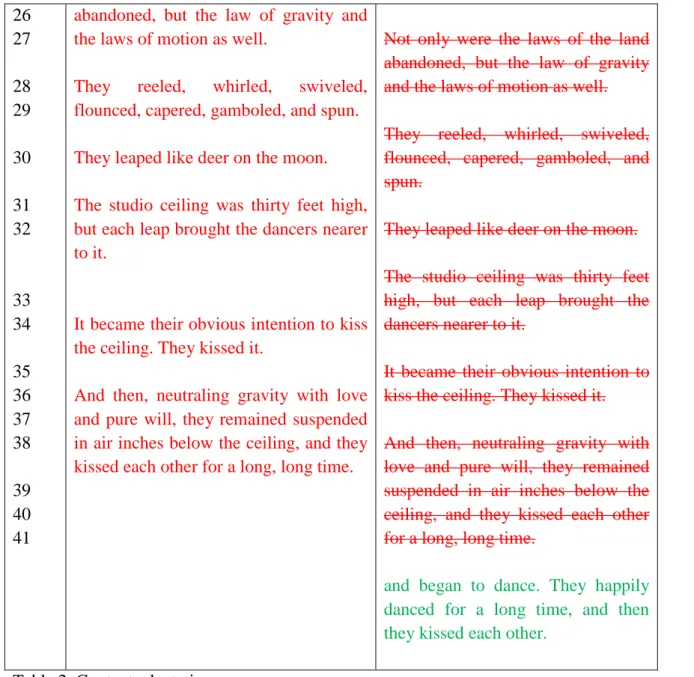
summarized easily without losing any important detail for the development of the story. Here we have an extract in which the eliminated text has been crossed out:
Line ORIGINAL TEXT © Kurt Vonnegut ADAPTED TEXT
1 2 3 4 5 6 7 8 9 10 11 12 13 14 15 16 17 18 19 20 21 22 23 24 25
The musicians scrambled back into their chairs, and Harrison stripped them of their handicaps, too. "Play your best," he told them, "and I'll make you barons and dukes and earls."
The music began. It was normal at
first-cheap, silly, false. But Harrison
snatched two musicians from their
chairs, waved them like batons as he sang the music as he wanted it played. He slammed them back into their chairs.
The music began again and was much improved.
Harrison and his Empress merely listened to the music for a while-listened gravely, as though synchronizing their heartbeats with it.
They shifted their weights to their toes.
Harrison placed his big hands on the girls tiny waist, letting her sense the weightlessness that
would soon be hers.
And then, in an explosion of joy and grace, into the air they sprang!
Not only were the laws of the land
The musicians went back to their chairs, and Harrison took off their
handicaps, too. "Play your best," he told them, "and I'll make you barons and dukes and earls."
The music began. It was normal at
the beginning, silly, false. But Harrison picked up two musicians from their chairs, waved them while he sang the music he wanted to hear
like batons as he sang the music as
he wanted it played and pushed
them back to their chairs.
The music began again and was much improved.
Harrison and his Empress merely listened to the music for a while,
while-listened gravely, as though synchronizing their heartbeats with it
They shifted their weights to their toes.
Harrison placed his big hands on the girls tiny waist, letting her sense the weightlessness that
would soon be hers.
26 27 28 29 30 31 32 33 34 35 36 37 38 39 40 41
abandoned, but the law of gravity and the laws of motion as well.
They reeled, whirled, swiveled,
flounced, capered, gamboled, and spun.
They leaped like deer on the moon.
The studio ceiling was thirty feet high, but each leap brought the dancers nearer to it.
It became their obvious intention to kiss the ceiling. They kissed it.
And then, neutraling gravity with love and pure will, they remained suspended in air inches below the ceiling, and they kissed each other for a long, long time.
Not only were the laws of the land abandoned, but the law of gravity and the laws of motion as well.
They reeled, whirled, swiveled, flounced, capered, gamboled, and spun.
They leaped like deer on the moon.
The studio ceiling was thirty feet high, but each leap brought the dancers nearer to it.
It became their obvious intention to kiss the ceiling. They kissed it.
And then, neutraling gravity with love and pure will, they remained suspended in air inches below the ceiling, and they kissed each other for a long, long time.
and began to dance. They happily danced for a long time, and then they kissed each other.
Table 2. Content adaptations.
We should underline that this is the most significant elimination that has been made in the full story.
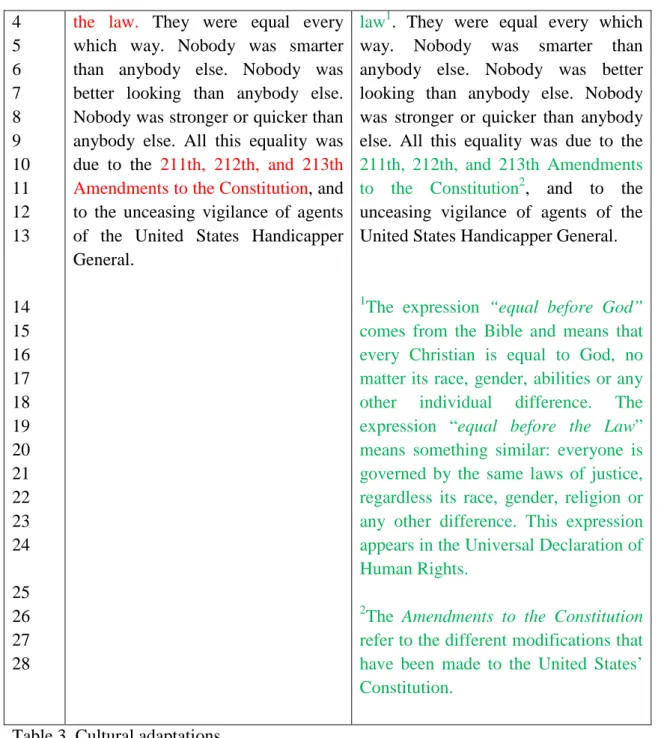
Finally, regarding cultural adaptations, only two little explanations regarding cultural references have been added with footnotes, as we see in the following table:
Line ORIGINAL TEXT ADAPTED TEXT
1 2 3
THE YEAR WAS 2081, and everybody was finally equal. They weren't only equal before God and
4 5 6 7 8 9 10 11 12 13 14 15 16 17 18 19 20 21 22 23 24 25 26 27 28
the law. They were equal every
which way. Nobody was smarter than anybody else. Nobody was better looking than anybody else. Nobody was stronger or quicker than anybody else. All this equality was due to the 211th, 212th, and 213th
Amendments to the Constitution, and
to the unceasing vigilance of agents of the United States Handicapper General.
law1. They were equal every which way. Nobody was smarter than anybody else. Nobody was better looking than anybody else. Nobody was stronger or quicker than anybody else. All this equality was due to the
211th, 212th, and 213th Amendments to the Constitution2, and to the unceasing vigilance of agents of the United States Handicapper General.
1
The expression “equal before God” comes from the Bible and means that every Christian is equal to God, no matter its race, gender, abilities or any other individual difference. The expression “equal before the Law” means something similar: everyone is governed by the same laws of justice, regardless its race, gender, religion or any other difference. This expression appears in the Universal Declaration of Human Rights.
2
The Amendments to the Constitution refer to the different modifications that have been made to the United States’ Constitution.
Table 3. Cultural adaptations.
The first explanation makes reference to the expressions “equal before God” and “equal before law”. Although these are not specific cultural references – they are, somehow, worldwide assumptions that can be seen or heard also in Spain or any other country – students of this age might have not heard about them or do not know what they mean, so there is a footnote explaining its meaning and where it comes from.
3.6
ASSESSMENT.
To finish with this proposal, we are going to discuss how this proposal will be assessed. The evaluation consists of three parts: first, the continuous assessment, which will value all class-work; then, the final assessment, which will evaluate the final project and finally, attitude and participation in class.
Continuous assessment will be a 60% of the final mark for this unit. It will be divided in turn in two parts: student performance in class and written role-sheets handed to the teacher in every lesson8 lesson. Regarding the student performance, the teacher will be walking around every group observing how each group works, and watching if every student is adequately adhered to his or her role and valuating their oral skills: how the student handle a conversation, if conventional rules are respected, the adequacy of their content, cohesion and coherence. Then, at the end of the lesson, each student will give their role-sheets to the teacher, which will be evaluated according to the student’s writing skill – grammar, adequacy of the vocabulary, cohesion and coherence – and also it will be taken into account if the student has correctly developed his role. For example, the English Guard will have to give to the teacher the summary he has done for that lesson; the Vocabulary Enricher will have to indicate all the words, expressions and any other information about the text that they have learned that day, and so on. Some roles, due to its nature, will be better assessed during the class and some others will be better assessed with the role sheet – but every student will be observed in the class and evaluated by their role-sheets.
Regarding the final project assessment, it will be again divided in two parts: oral skills and written skills. The written skills will be assessed according to the script they have to write – an alternative ending for the story, following the guidelines indicated by the teacher – and that students will use for the later representation. The teacher will take into account grammar and vocabulary used, coherence and cohesion, adequacy of the content and the structure of the text.
The oral skills will be evaluated when the students perform their representation on the alternative ending of the story. As they are going to follow a written script, emphasis will be put in fluency, accuracy, pronunciation and intonation.
8
4.
DESCRIPTION OF THE PROPOSAL
Now, we will explain in detail this proposal for intervention, which has a suggested duration of six hours. The first session will be an introductory lesson on what literary circles are, what text is going to be read, what they will have to do and which is the final project. In the second session, students will start discussing the first part of the text – which is divided into three parts, as it will be explained later – and working in groups. In the following session students will continue working on the text and discussing in groups. The fourth session is slightly different, and the students will start preparing their final project by predicting the ending of the story. In the fifth session, students will have read the last part of the text and will discuss about it, as well as finishing their final project which will be presented on the sixth lesson.
As mentioned before, we modified the original roles suggested by Daniels and added a new one. The roles selected for this proposal are: Discussion director, connector, illustrator, vocabulary enricher and English guard. There are five different roles because the groups will be composed of five students. The three first roles (Discussion director, connector and illustrator) are the same that Daniels proposed. The fourth role, vocabulary enricher, is a modified version of the original role and, finally, the last role is new.