Clinical characteristics and
predictors of neuroleptic malignant syndrome:
A Mexican experience
Alonso Montoya MD,*,** Antonio Torres-Ruiz MD,** Magdalena Ocampo MD**
* Brain Imaging Group, Douglas Hospital Research Centre, McGill University, Montreal, Canada. ** Instituto Nacional de Neurología y Neurocirugía Manuel Velasco Suárez. México, D. F., México.
ARTÍCULO DE INVESTIGACIÓN
Address for correspondence: Alonso Montoya MD
Brain Imaging Group. Douglas Hospital Research Centre. McGill University 6875 Boul. LaSalle. Verdun, Québec H4H 1R3. Tel: (514) 761-6131 ext. 3362. Fax: (514) 888-4064. E-mail: [email protected]
RESUMEN
Antecedentes. El síndrome neuroléptico maligno (SNM) constituye una complicación infrecuente, pero po-tencialmente fatal, asociada con el uso de neurolépticos (NLPs).
Objetivos. Estimar la frecuencia, presentación clínica, curso y evolución del SNM en el Instituto Nacional de Neu-rología y Neurocirugía MVS.
Métodos. Retrospectivamente se revisaron los casos de SNM diagnosticados entre 1990 y 1999 examinando las condiciones psicopatológicas previas al estableci-miento del síndrome y las características clínicas de la presentación, tratamiento, curso y evolución de los episo-dios. Posteriormente, se realizó un seguimiento prospec-tivo (36 meses en promedio) de la evolución y la presen-cia de síntomas residuales.
Resultados. De un total de 4,831 pacientes expuestos a NLPs, ocho presentaron un episodio de SNM (incidencia de 0.165%). Siete casos estuvieron asociados con la admi-nistración de haloperidol. Otros NLPs asociados con la presencia de SNM fueron pipotiazina y levomepromazina. Un paciente recibió concomitantemente litio. La mayoría de los casos presentaron, previamente al establecimiento del SNM, características psicopatológicas consideradas como factores de riesgo para el síndrome, tales como agitación psicomotora, confusión, desorganización conductual y sín-tomas catatónicos. No se detectaron fatalidades y en sólo un paciente se reportaron secuelas, consistentes en sínto-mas cerebelosos y extrapiramidales, después de tres años del SNM.
Conclusiones. La frecuencia del SNM encontrada en este estudio, relativamente menor a la reportada en otros países, puede deberse en parte al advenimiento y uso de los nuevos antipsicóticos atípicos, a los estrictos criterios diagnósticos para SNM y a la poca familiaridad con el diag-nóstico del SNM por parte de los médicos. La presencia de agitación psicomotora, confusión, desorganización
con-ABSTRACT
Background. Neuroleptic Malignant Syndrome (NMS) is an uncommon but potentially fatal complication of antipsy-chotic and neuroleptic drug treatment.
Objectives. This study estimated the frequency, clinical presentation, and outcome of the NMS in a referral center for neurological, neurosurgical, and psychiatric disorders in Mexico.
Methods. Authors conducted a through search of psychiatry, neurology, neurosurgery, and intensive care unit (ICU) records for cases of NMS during the 10-year period between 1990 and 1999. They examined prece-ding psychopathological status, clinical features, cour-se, and treatment of the NMS episodes, and performed a follow-up survey for residual symptoms and clinical outcome. The mean time to follow-up assessment was 36 months.
Results. A total of 8 of 4,831 neuroleptic-treated pa-tients had an episode of NMS (incidence 0.165%). Seven of the eight patients were treated with haloperidol. Other neuroleptics agents associated were depot pipotiazine palmitate and levomepromazine. One patient received concomitantly lithium. Preceding psychopathological fea-tures such as psychomotor agitation, confusion, disorgani-zed behavior, and catatonia postulated as clinical risk fac-tors for the neuroleptic malignant syndrome were found in most cases. No fatal outcome was found. Only one patient developed persistent clinical sequelae, consisting of extra-pyramidal and cerebellar symptoms, after three years of the NMS episode.
ductual y síntomas catatónicos previos al establecimiento del SNM en la serie de casos estudiados fortalece el su-puesto papel putativo de estos síntomas como factores de riesgo para desarrollo del SNM.
Palabras clave: Síndrome neuroléptico maligno, NMS, neurolépticos, frecuencia, factores de riesgo.
NMS diagnostic criteria and the lack of familiarity with the diagnosis between physicians.
Key words: Neuroleptic malignant syndrome, NMS, neuroleptics, frequency, incidence.
INTRODUCTION
Neuroleptic malignant syndrome (NMS) is a po-tentially fatal adverse effect of neuroleptics.1 Since
the initial description forty-two years ago 2 a large
quantity of clinical data has accumulated on the manifestations, course, treatment and pathogene-sis of this serious drug reaction. NMS is a rare form of neuroleptic drug-induced hyperthermia, al-tered level of consciousness, extrapyramidal effects, autonomic instability and muscle rigidity.3 This
dangerous condition requires early recognition, im-mediate discontinuation of neuroleptic treatment, intensive medical and nursing care, and search for infection or other treatable conditions.4 Although
NMS is uncommon, the widespread use of neurolep-tic drugs suggests that the absolute number of ca-ses is not insignificant. Estimates of the incidence of NMS have varied depending on the population at risk, prescribing practices and methods of assess-ment. Surveys of NMS in different psychiatric popu-lations reported in various countries have yielded frequencies of 0.02 to 2.4 percent.4-9 Heightened
vi-gilance on the part of clinical providers has reduced morbidity and mortality caused by this disorder over the past decade.3 To our knowledge, there are
not published estimates of the frequency of NMS in Mexico. The aim of this retrospective investigation
and prospective follow-up study was to determine the frequency, clinical presentation and outcome of NMS, as well as to examine the psychopathological status preceding the onset of NMS, in Mexican inpa-tients exposed to neuroleptics.
METHODS
A through search of psychiatry, neurology, neuro-surgery, and ICU records for cases of NMS during a 10-year period was conducted. The study population consisted of 4,831 inpatients (58% males, 42% fe-males) treated with neuroleptic agents (conventional as well as the newer atypical antipsychotics) in the National Institute of Neurology and Neurosurgery in Mexico City from January 1990 to December 1999. All those inpatients diagnosed with NMS were selec-ted. The NMS diagnosis was re-evaluated according to the Diagnostic and Statistical Manual of Mental Disorders Fourth Edition (DSM-IV TR) research cri-teria (Diagnostic cricri-teria are listed in Table 1),10 and
information from the NMS episode, such as clinical features of onset, course, treatment, and outcome, was collected. In addition, we also assessed the pre-sence of postulated putative psychopathological risk factors, namely psychomotor agitation, confusion, di-sorganization, and catatonia. These symptoms were considered as present or absent based on specific
Table 1. Research criteria for neuroleptic malignant syndrome.
A. The development of severe muscle rigidity and elevated temperature associated with the use of neuroleptic medication. B. Two (or more) of the following:
1. Diaphoresis 2. Dysphagia 3. Tremor 4. Incontinence
5. Changes in level of causciousness ranging from confusion to coma 6. Mutism
7. Tachycardia
8. Elevated or labile blood pressure 9. Leucocytosis
10. Laboratory evidence of muscle injury (e.g., elevated CPK)
C. The symptoms in Criteria A and B are not due to another substance (e.g., phencyclidine) or a neurological or other general medical condition (e.g., viral encephalitis).
D. The symptoms in Criteria A and B are not better accounted for by a mental disorder (e.g., Mood Disorder With Catatonic Features).
definitions11 and whether or not they were
promi-nent in the clinical presentation of each patient. Psy-chomotor agitation was considered as present when severity of this symptom required mechanical res-traints in one or more episodes. Confusion was ra-ted as positive when disorientation to time and to place and/or impairment in cognition (memory, lan-guage, or attention) were predominant without an identifiable cause.
Disorganization was considered as present in case of disorganized speech (derailment, tangentiali-ty, incoherence) and/or disorganized behavior (unusual and inappropriate behaviors or untrigge-red agitation). Catatonia was consideuntrigge-red in the pre-sence of specific motor behaviors, including negati-vism, mutism, rigidity, posturing, and withdrawal as part of an overall state of hypoactivity that can re-ach the point of stupor and/or overall state of hyper-activity (excitement, impulsivity, and combative-ness).11 Subsequently, a prospective follow-up
survey for residual symptoms and clinical outcome was carried out. The study was approved by the Ins-titutional Ethical and Research Committee.
Statistical analysis
Descriptive statistics employing measures of cen-tral tendency and measures of dispersion were cal-culated as appropriated.
RESULTS
Out of the total number of 4,831 inpatients treated with neuroleptic agents during the ten-year study pe-riod, 8 separate patients (3 males, 5 females) had a definite episode of NMS, for an incidence of 0.165 per-cent (1.65 per 1,000 cases treated with neuroleptics). There were not fatal cases. The clinical characteristics of patients with NMS are summarized in table 2.
The mean age of patients was 30 years (SD = 14.26), ranging from 17 to 56 years. The primary psychiatric diagnoses for these patients were:
deli-rium (3/8), schizophrenia (2/8), bipolar disorder II (1/8), brief psychotic disorder (1/8), and schizo-phreniform disorder (1/8). The documented causes of delirium were probable viral encephalitis in two cases, and substance withdrawal delirium (dextro-propoxiphene) in other one. The mean duration of primary psychiatry illness was 1.4 years (SD 1.97), ranging from 2 weeks to 5 years.
Five patients had previous exposure to neurolep-tics, while for the three others it represented their first time exposition to neuroleptic agents. Neuro-leptics implicated as a causative factor of NMS were: haloperidol, alone or in combination with levo-mepromazine or lithium (7/8), depot pipotiazine palmitate (1/8) and levomepromazine (1/8). Two pa-tients received anticholinergic agents (Biperiden) at the time of NMS development, and one patient was treated concomitantly with lithium and haloperidol. Lithium levels in serum were in therapeutic range (0.6-1.4 mEq/L). Lithium toxicity and other causes of fever and neurologic deterioration related with li-thium were ruled out.
Two patients developed NMS symptoms within 24 hours of initiating neuroleptic treatment, five by one week, and one after three weeks. Mental status changes (e.g., confusion, nervousness) were the first manifestations of the syndrome in six patients, fever in one, and rigidity in another one. Other signs pre-sented include: sialorrhea and tachycardia (6/8); tre-mors, diaphoresis and tachypnea (5/8), and labile blood pressure and incontinence (3/8). One patient presented, in addition, dysarthria, dysphagia, catato-nia and myoclonus, and he developed myoglobinuric renal failure, and clinical evidence of disseminated in-travascular coagulation. His brain imaging studies (CT scan and MRI), cerebrospinal fluid examination and sepsis evaluation were negative, and nonfocal ge-neralized slowing was reported on electroencephalo-graphy (EEG). Measures of serum creatine kinase were assessed only in half of the patients (4/8), and levels were found elevated at mean of 9,016 U/L
(re-Table 2. Clinical characteristics of 8 patients NMS.
Subject Age Gender Primary Previous Duration NMS Drug Mean CPK Follow-up assessment
psychiatric exposure episode implicated (U/L) (mean 36 months)
diagnosis to NLP (days) MMSE GAF
Case 1 27 F Bipolar disorder II Yes 10 HPD/Li 27,340 29 71
Case 226 F Delirium No 13 HPD 4,355 29 71
Case 3 17 F Schizophreniform disorder No 10 HPD 6,322 30 80
Case 4 17 M Schizophrenia No 15 HPD 8,774 29 61
Case 5 56 M Schizophrenia No 14 PPT 5,789 26 71
Case 6 25 F Delirium No 14 HPD/LVP 380 28 61
Case 7 24 M Brief psychotic disorder No 17 HPD 9,764 29 71
Case 8 48 F Delirium Yes 14 HPD 9,863 28 80
ference range= 5-270 U/L). Leucocytosis was docu-mented in seven patients.
In terms of treatment, in addition to the disconti-nuation of neuroleptic medications and establish-ment of supportive therapies (intravenous fluids, an-tipyretics, etc), five patients received central cholinergic blockers (e.g., Biperiden hydrochloride), dopamine agonists (e.g., bromocriptine) and benzo-diazepines (e.g., Midazolam hydrochloride and diaze-pam). Two patients received systemic antibiotics and prophylactic antiepileptic therapy. None received elec-troconvulsive therapy (ECT). All patients were trea-ted in neurology or psychiatry services except for two patients whom were transferred to the ICU. The mean recovery time for the acute hyperthermic symptoms was estimated at 13.3 days. Six of the eight patients recovered within two weeks, and all within 30 days, including the patient who received long-acting depot neuroleptic.
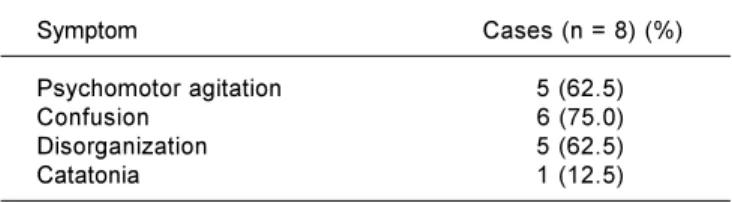
In terms of the psychopathological status prece-ding the onset of NMS evaluating, we examined the presence of four key psychiatric symptoms (psycho-motor agitation, confusion, disorganization and cata-tonia) in all patients (Table 3). In six patients mental status changes, characterized by confusion and ner-vousness, were the first manifestations of the syn-drome. One patient presented with an acute and se-vere catatonic syndrome, in addition to all the three key psychiatric symptoms. Five patients showed frag-mented, disorganized psychotic symptoms with psy-chomotor agitation. Two patients presented with an acute psychotic episode, with two or three key psychiatric symptoms, but not catatonia.
A prospective follow-up investigation for clinical outcome, residual symptoms, and current level of functioning was conducted in all patients. The mean time to follow-up assessment was 36 months. Phy-sical and neurological examination, clinical evalua-tion using the Mini-mental status Examinaevalua-tion (MMSE)12 and the Structured Clinical Interview
(SCID) for the DSM-IV,13 EEG and CT scan were
per-formed in 5 patients. The other 3 patients were con-tacted and interviewed by telephone using the same clinical scales.
Most of the patients recovered from NMS epi-sode without any major complication. The total
MMSE scores ranged from 25 to 30 points, and the mean score was 28.2. All patients had a Global Assessment of Functioning (GAF) > 60 (scores ranged from 61 to 80). One patient developed a re-sidual catatonic-parkinsonian state that persisted for two months, and after 3 years of NMS episode he still showed mild but persistent extrapyramidal and cerebellar symptoms, such as intention tre-mor, past-pointing, disdiadochokinesia and rigidi-ty, however no abnormalities were found in the CT scan and EEG.
DISCUSSION
This study showed that of the 4,831 inpatients treated over a ten-year period with neuroleptic agents, 8 (0.165%) manifested an episode of NMS. This frequency is consistent with one previous stu-dy (Deng et al., 1990), although it is slightly low compared with the average combined incidence of NMS (0.2%) found in several large studies.14 More
than a half of the patients (5/8) had been exposed previously to neuroleptics although none had expe-rienced a similar episode during prior treatments. In all cases doses of neuroleptics were within the therapeutic range. The most frequent antipsychotic employed was haloperidol (7/8) alone or in combi-nation, and the most frequent route of administra-tion was parenteral (6/8). The dosage range of halo-peridol was between 5 and 20 mg per day. The fact that three patients were exposed for he first time to neuroleptics, and seven were treated with haloperi-dol may suggest that previously untreated patients and those treated with high-potency neuroleptics are at major risk to develop NMS.15
The use of haloperidol as frequent first-line the-rapy, a common trend among Mexican psychiatrists during the nineties,16 may explain the high
frequen-cy (7/8) of patients with NMS treated with haloperi-dol in our sample. Even though data about whether adjunctive or concomitant medications (e.g., anti-parkinsonian drugs or lithium) increase the risk of NMS are inconclusive,17 there is a general
consen-sus that combinations of psychotropics may contri-bute to the risk of NMS. In our sample, four pa-tients received more than one psychotropic; three patients received concomitant anticholinergic agents (e.g., biperiden), one received lithium, and other re-ceived two neuroleptics simultaneously.
Psychomotor agitation, confusion, disorganiza-tion, and catatonia were characteristic symptoms in the pre-NMS presentation in our case series, which is consistent with previous reports that raise the possibility that they are risk factors for the syndro-me.11 All cases presented with an acute psychotic
episode before the onset of the syndrome, in which Table 3. Psychopathological status preceding the onset of NMS.*
Symptom Cases (n = 8) (%)
Psychomotor agitation 5 (62.5)
Confusion 6 (75.0)
Disorganization 5 (62.5)
Catatonia 1 (12.5)
NMS: Neuroleptic malignant syndrome.
fragmented psychotic symptoms and disorganized speech and behavior were characteristic. Catatonic symptoms (present in one case), antecedent to neu-roleptic administration, have been described previo-usly.17,18 However, the fact that quantitative rating
scales were not used to measure the severity of psy-chomotor agitation, confusion, disorganization, and the dimension of the sample, limit the interpretation of these findings.
No fatal cases were identified, and most of the patients recovered from NMS episode without any life-threatening complication. Only one patient deve-loped persistent clinical sequelae after three years, which is consistent with other previous reports.19
The slightly low frequency of NMS in our sample may be at least partially attributable to the advent and use of the newer atypical antipsychotics in Mexico,16 or to rigorous demands for NMS
diagnos-tic criteria. In the other hand, because the disorder is too infrequent and idiosyncratic, physicians may not be familiar with the diagnosis. In addition, a broad range of conditions may resemble NMS (Ta-ble 4), thus the differential diagnosis of NMS is cha-llenging and include many disorders presenting with fever, necessitating a through medical and neurolo-gic evaluation. In some patients, despite meticulous investigation, the cause of NMS may remain obscure or the diagnosis NMS elusive (Table 5). Therefore, Table 4. Differential diagnosis of NMS
Primary brain disorders
Infections, tumors, trauma, status epilepticus, strokes, idiopathic lethal catatonia, serotonin syndrome
Systemic disorders
Infections, toxins, heatstroke, dehydration, endocrinopathies, drugs autoimmune disorders
Table 5. Medical and neurologic evaluation of possible NMS.
Basic
Physical examination
Electrolytes, including calcium and magnesium Renal and hepatic function tests
Complete blood count
Serial tests of creatine phosphokinase levels Urinalysis
Lumbar puncture Computed tomography or
magnetic resonance imaging scan of the head
Optional
Arterial blood gases Coagulation studies Blood cultures Toxicology screen Lithium level Iron deficiency tests
Adapted from: Pelonero et al., 1998.
the possibility exists that milder cases of NMS were not diagnosed and hence not included in the study. Finally, the methodological flaws inherent to the re-trospective design of this study (e.g., completeness and accuracy of medical records) must be conside-red. Also, quantitative rating scales were not used to measure the severity of psychomotor agitation, confusion, disorganization, and lastly the dimension of the sample, which could be insufficient in the identification of possible risk factors.
Recognition of this condition is essential because its complications are potentially lethal. More large-scale prospective studies including more clinical and laboratory data on non-NMS neuroleptic-treated pa-tients as well as papa-tients with mild and moderate forms of NMS are needed to refine the frequency of NMS in Mexican population. Multicenter case-con-trol studies, as suggested by Deng et al,5 which
would improve statistical reliability by increasing sample size, thereby enabling better definition of the risk factors involved in the development of this seve-re complication of tseve-reatment with neuroleptics.
REFERENCES
1. Caroff SN. The neuroleptic malignant syndrome. J Clin Psychiat 1980; 41: 79-83.
2. Delay J, Pichot P, Lemperiere T, Elissade B, Peigne F. Un neu-roleptique majeur non-phenothiazine et non reserpinique, lhaloperidol, dans le traitement des psychoses. Annales Medi-co-Psychologique 1960; 118: 145-52.
3. Gurrera RJ. Is neuroleptic malignant syndrome a neurogenic form of malignant hyperthermia? Clin Neuropharmacol 2002; 25(4): 183-93. (Review).
4. Addonizio G, Susman VL, Roth SD. Symptoms of neuroleptic malignant syndrome in 82 consecutive inpatients. Am J Psychiatry 1986; 43: 1587-90.
5. Deng MZ, Chen GQ, Phillips MR. Neuroleptic malignant syndro-me in 12 of 9,792 Chinese inpatients exposed to neuroleptics: a prospective study. Am J Psychiatry 1990; 147(9): 1149-55. 6. Gelenberg AJ, Bellinghausen B, Wojcil JD, Falk WE, Sachs GE.
A prospective study of neuroleptic malignant syndrome in a short-term psychiatric hospital. Am J Psychiatry 1988; 145: 517-8.
7. Hermesh H, Aizenberg D, Weizman A, Lapidot A, Mayor K, Mu-nitz H. Risk for definite neuroleptic malignant syndrome: a pros-pective study in 223 consecutive inpatients. Br J Psychiatry 1992; 161: 254-7.
8. Keck PE, Pope HG, McElroy SL. Frequency and presentation of neuroleptic malignant syndrome: a prospective study. Am J Psychiatry 1987; 144: 1344-6.
9. Keck PE, Pope HG, McElroy SL. Declining frequency of neuro-leptic malignant syndrome in a hospital population. Am J Psychiatry 1991; 148: 880-2.
10. Diagnostic and Statistical Manual of Mental Disorders, 4th ed,
Text Revision. Washington, D.C. American Psychiatric Associa-tion, 2000.
11. Berardi D, Amore M, Keck PE Jr, Troia M, DellAtti M. Clinical and pharmacologic risk factors for neuroleptic malignant syndro-me: a case-control study. Biol Psychiatry 1998; 44(8): 748-54. 12. Folstein MF, Folstein SE, McHugh PR. Mini-Mental State: A
practical method for grading the state of patients for the clini-cian. J Psychiatr Res 1975; 12: 189-98.
14. Caroff SN, Mann SC, Campbell EA. The neuroleptic malignant syndrome. In: Adverse Drug Reaction Bulletin. Lippincott Williams & Wilkin; August 2001, No. 209, p. 799-802.
15. Pelonero AL, Levenson JL, Pandurangi AK. Neuroleptic malig-nant syndrome: A review. Psychiatric Services 1998; 49: 1163-72.
16. Palmer CS, Brunner E, Ruiz-Flores LG, Paez-Agraz F, Revicki DA. A cost-effectiveness clinical decision analysis model for treatment of Schizophrenia. Arch Med Res 2002; 33(6): 572-80. 17. Das Gupta K, Young A. Clozapine-induced neuroleptic
malig-nant syndrome. J Clin Psychiatry 1991; 52(3): 105-7.
18. Kasantikul D, Kanchananakhin P. Severe catatonia and neuro-leptic malignant syndrome: report of 3 cases. J Med Assoc Thai 1999; 82(9): 942-6.
19. Caroff SN, Mann SC, Keck PE Jr, Francis A. Residual catatonic state following neuroleptic malignant syndrome. J Clin Psycho-pharmacol 2000; 20(2): 257-9.