Language Acquisition
and Contact in the
Iberian Peninsula
Edited by
Alejandro Cuza
ISSN 1861-4248
Library of Congress Cataloging-in-Publication Data
A CIP catalog record for this book has been applied for at the Library of Congress.
Bibliographic information published by the Deutsche Nationalbibliothek
The Deutsche Nationalbibliothek lists this publication in the Deutsche Nationalbibliografie; detailed bibliographic data are available on the Internet at http://dnb.dnb.de.
© 2018 Walter de Gruyter, Inc., Boston/Berlin Typesetting: Integra Software Services Pvt. Ltd. Printing and binding: CPI books GmbH, Leck Cover image: xxxxxx
Pedro Guijarro-Fuentes and Alejandro Cuza
Introduction: Language contact and change in the Iberian Peninsula 1
Anna Gavarró
Language acquisition and change: The acquisition of the Catalan partitive and locative clitics 11
Aurora Bel and Estela García-Alcaraz
Pronoun interpretation and processing in Catalan and Spanish bilingual and monolingual speakers 37
Alejandro Cuza and Pedro Guijarro-Fuentes
The distribution of copulas ser and estar in Spanish/Catalan bilinguals 63
Laia Arnaus Gil, Amelia Jiménez-Gaspar & Natascha Müller
The acquisition of Spanish SER and ESTAR in bilingual and trilingual children: Delay and enhancement 91
Pilar Barbosa, Cristina Flores & Cátia Pereira
On subject realization in infinitival complements of causative and perceptual verbs in European Portuguese: Evidence from monolingual and bilingual speakers 125
Raquel Fernández Fuertes and Juana M. Liceras
Bilingualism as a first language: language dominance and crosslinguistic influence 159
Francisco Dubert-García, Juan Carlos Acuña-Fariña
https://doi.org/10.1515/9781501509988-007
Raquel Fernández Fuertes, Universidad de Valladolid Juana M. Liceras, University of Ottawa and Universidad Nebrija
dominance and crosslinguistic influence
Abstract: Even though research on bilingual first language acquisition (2L1) could be conceptualized as monolingual acquisition (L1) of two individual languages, the fact that in 2L1 acquisition there is exposure to input from two languages has consequences in terms of how the two language systems interact in the mind of the bilingual. This century has seen two important developments in this respect. First, a consensus seems to have been reached on the idea that the two systems are differentiated from the early stages (e.g. Genesee 1989; De Houwer 1990; Genesee, Nicoladis & Paradis 1995; Köppe & Meisel 1995; Genesee 2003). The second devel-opment is related to how the 2L1 language faculty compares to the L1 language faculty and the consideration that the grammatical processes and operations in both bilingual and monolingual speech must be accounted for in the same terms (MacSwan 2000; Liceras, Spradlin & Fernández Fuertes 2005; Liceras et al. 2008, among others). However, while it is unquestionable that L1 and 2L1 acquisition share similar mechanisms and processes, there are core issues such as language dominance, crosslinguistic influence and code-mixing that are specific to simul-taneous bilingual acquisition.
Determiners and Nouns, child and adult spontaneous production data differ from experimental data in that while the former show a preference for the Spanish Determiner (the category which is more grammaticized), the latter prefer the English Determiner.
We propose constructs such as the Grammatical Features Spell-Out Hypothe-sis or the Analogical Criterion to account for these patterns. The analyHypothe-sis of these language contact phenomena provides an insight on how language properties shape bilingual production.
1 Introduction
While the mechanisms and processes that shape bilingual first language acquisi-tion (2L1) should, in principle, resemble those of monolingual acquisiacquisi-tion (L1) in the case of each of the languages involved, the fact that in 2L1 acquisition there is exposure to input from two languages forces us to confront two fundamental research questions: whether and how the two language systems interact in the mind of the bilingual and what the outcomes of this interaction may be. Conse-quently, the main objective of this chapter is to discuss specific ways in which these research questions have been approached in the acquisition literature.
The very title of the chapter makes it clear that we will be dealing with simul-taneous bilingual acquisition, namely with children who are exposed to the two languages from birth, rather than so-called sequential (or consecutive) bilingual acquisition which deals with children who are exposed to the second language after being exposed to the first language for at least two or three years (Baker 2011; De Houwer 2009; Silva-Corvalán 2014, among others). When the acquisition of a second language occurs past three years of age, it is usually referred to as child second language acquisition (cL2) rather than sequential bilingual acqui-sition (Meisel 2008).
As for crosslinguistic influence (i.e. Döpke 2000; Genesee, Nicoladis & Paradis 1995; Liceras, Fernández Fuertes & Alba de la Fuente 2012; Müller 1998; Nicoladis 2002; Yip & Matthews 2000), it is important to point out that, within the view of the bilingual mind that we maintain, and even if the two language systems share a single computational component, the realization of universal principles is to be mediated by the existence of two lexicons and two phonological components. This implies that the combinations of features present in the functional catego-ries (i.e. pronouns, determiners, auxiliacatego-ries, complementizers …) and the lexical or substantive categories (i.e. nouns, lexical verbs, adjectives …) in the two lan-guages may differ and, therefore, may result in crosslinguistic influence. It may also be the case that a feature or a set of features be realized as one lexical item in one language but as two lexical items in the other language. A case in point is the values of copula be in English that are realized as two different lexical items –
ser and estar – in Spanish. The obligatory use of overt subjects in English but not in Spanish and the systematic availability of null subjects in Spanish but not in English have also been discussed as relevant loci for crosslinguistic influence. Thus, a second objective of this chapter is not only to discuss some potential loci
for crosslinguistic influence in 2L1 acquisition but also to show that, while cross-linguistic influence can cause interference, it can also have a facilitating effect.
Finally, code-mixing or code-switching has also been investigated as an outcome of 2L1 acquisition, both as a diagnostic for language dominance as well as a reflection of how the properties of the two language systems may interact. We will use code-mixing and code-switching interchangeably even though the first term has been used to refer to mixing that occurs before children have incorpo-rated the functional categories of the two languages (Köppe & Meisel 1995).
In order to discuss the above-mentioned outcomes, we will use data from the simultaneous bilingual acquisition of English and Spanish in Spain. We will specifically discuss 2L1 data from the bilingual twins in the FerFuLice corpus in CHILDES (MacWhinney 2000; Fernández Fuertes & Liceras 2010) in relation to L1 monolingual acquisition of both Spanish and English and paying special attention to copula omission and null and overt subject production, two con-structions that have received a great deal of attention in the 2L1 acquisition liter-ature (i.e. Paradis & Navarro 2003; Silva-Corvalán 2014). This will contribute to the understanding of individual bilingualism which can then be used as a point of comparison with societal bilingualism (Bathia & Ritchie 2012).1 In our specific case, we will be discussing a case of individual rather than societal bilingualism
and a situation where Spanish is the majority language while English is the minority language. Nonetheless, we want to address language dominance, crosslinguistic influence and code-mixing as outcomes of bilingualism that can be investigated across the board, as determined by the mere contact between two different language systems and, in principle, abstracting from the specific setting as such or the specific amount of input.
2 The characterization of bilingual first language
acquisition
As Baker (2011), referring to Grosjean (1995, 2008) and Jesnner (2008), points out, two contrasting views of individual bilinguals have been argued for in the liter-ature: the view of the bilingual as “two monolinguals in one person” (the “frac-tional” view) and the view of the bilingual as having a unique linguistic profile which is not the sum of two monolinguals (the “holistic” view). While the concep-tualization of the problem is different because it pertains only to the initial stages of acquisition, the availability of two language systems is also at the core of the debate between those who argue that the mind of the young bilingual child con-tains a single language system (Lindholm & Padilla 1978; Redlinger & Park 1980; Vihman 1985; Volterra & Taeschner 1978) and those who defend that the two lan-guage systems are differentiated from the early stages (De Houwer 1990; Genesee 1989, 2003; Genesee et al. 1995; Köppe & Meisel 1995). This debate seems to have been won by the latter. However, we would like to frame the fractional/holistic debate as well as the single/two different language system view within the Min-imalist framework, as argued by MacSwan (2000, 2014), where the grammatical processes and operations in both bilingual and monolingual speech must be accounted for by the same universal mechanisms. This is so because the bilingual language faculty is made up of two lexicons and two phonological components but a single language-specific computational system: the only one available for human language.2 That is, under Minimalist premises, this view of the bilingual
(e.g. Spanish as minority / heritage language in the US), may have a facilitating effect in the ac-quisition of the dominant language (e.g. English as majority language in the US).
language faculty offers a universal framework within which feature activation will proceed depending on the specific language, as well as feature valuation and the outcomes of the operations MOVE, MERGE, and AGREE. Therefore, this view provides us with the framework needed to discuss the outcomes that are specific to 2L1 acquisition but are, at the same time, shaped by the mechanisms and pro-cesses that pertain to L1 acquisition. It also implies that Universal Grammar is a central component of the Language Acquisition Device (LAD) and that linguistic structures reflect mentally represented knowledge (Meisel 2011, among others).
Even though in terms of ability, the field of bilingualism differentiates between active and passive bilinguals, we will only be discussing the acquisition of two languages that leads to active (comprehension and production) bilingual-ism. It is a fact that ability is a dimension of a continuum (Valdés Kroff et al. 2011) and that in the course of development the bilinguals whose data we will be discussing might become passive bilinguals in one of the two languages, but discussing this potential developing outcome is out of the scope of this chapter.
Active bilingualism may not necessarily imply that the receptive and produc-tive competence in the two languages is “balanced” and this is why language dominance has been systematically discussed in the bilingual literature in general and in the 2L1 acquisition literature in particular.
Petersen (1988) lists prevalence of overall functional words from one of the two languages as a diagnostic internal to the linguistic system and parents’ per-ception and amount of exposure as diagnostics external to the linguistic system. Nicoladis and Secco (1998) define language dominance in terms of relative vocab-ulary size in each of the two languages while for Genesee et al. (1995) or for Yip and Matthews (2006) the dominant language is the one for which the child has a higher Mean Length of Utterance (MLU).
We agree with Baker (2011) that balance and dominance tests are dependent upon language proficiency and performance and can only partially access the bilingual’s language capacity and language ability. Also, dominance need not coincide with balance and, as Baker (2011) puts it, “it is possible to be approx-imately equally proficient in two languages, yet one may be dominant” and so, for instance, “speed of processing may provide evidence about balance but not about dominance in actual language use” (p. 35). In fact, language dominance can change overtime and it may be easier to identify at the lexical and phonolog-ical levels than at the morphosyntactic level, a difference that has been systemat-ically pointed out in the case of language transfer.
overt subjects in the Spanish of English-Spanish bilinguals (Silva-Corvalán 2014) than in monolingual Spanish, or the lower omission of copula be in the English of English-Spanish bilinguals (Fernández Fuertes & Liceras 2010; Liceras et al. 2012) would be identified as an instance of crosslinguistic influence. However, the use of an expression such as dame una mano in Spanish for “give me a hand” would be an instance of transfer since the Spanish expression is échame una mano (“throw me a hand”). We adopt this distinction and follow a quantitative approach to crosslinguistic influence in subsequent sections.
Crosslinguistic influence has been said to be pervasive at the interfaces between internal and external modules of language, such as the syntax-prag-matics interface (i.e. Tsimpli & Sorace 2006). However, many researchers have challenged this view of the so-called Interface Hypothesis both as a locus for crosslinguistic influence or for learning difficulty (for an overview of the Interface Hypothesis see Sorace (2011) and commentaries). We should also point out that there are not many studies that use data from the early stages of 2L1 acquisition to test whether crosslinguistic influence plays a relevant role at the interfaces. As we have indicated above, we will discuss crosslinguistic influence as having a facilitating or an interfering effect in 2L1 development and will argue, as in the case of language dominance, that the features and combinations of features that make up the functional and lexical categories of the language pair constitute a valuable tool for both predicting and accounting not only for the type of influence (facilitating or interfering) but also for its directionality (i.e. which language will be the source or locus of influence and which one the target of influence).
3 The FerFuLice corpus: simultaneous acquisition
of English-Spanish by two identical twins
In order to discuss language dominance and crosslinguistic influence, we use spontaneous and experimental data from the simultaneous bilingual acquisition of English and Spanish by two identical twins who were born and grew up in Spain and we compare these data with available data from other bilinguals and monolinguals.
The twins, Simon and Leo, were born in Salamanca (Spain) from an Eng-lish-speaking mother from the US and a Spanish-speaking father from Spain. The parents have always used the so-called rule of Grammont, the one parent-one language strategy, and so the father always speaks to the children in Spanish and the mother always addresses them in English. According to an extensive and a comprehensive parental questionnaire, this practice was followed from the moment the twins were born. The parents generally speak Spanish with each other, except during the summer when they travel to the United States for approx-imately two months or when a monolingual English speaker is present. There-fore, this is a case of bilingual English/Spanish first language acquisition in a monolingual-Spanish social context, a type of bilingualism which is referred to in the literature as individual bilingualism (Bhatia & Ritchie 2004).
The spontaneous data from Simon and Leo come from the FerFuLice corpus available through the CHILDES project (MacWhinney 2000). The data cover the age range of 1;01 to 6;11. A total of 178 sessions were recorded on videotape and DVD, of which 117 were in an English context (i.e. with an English interlocutor such as the interviewer or their mother) and 61 in a Spanish context (i.e. with a Spanish interlocutor such as the interviewer or their father). The Spanish recordings were made at intervals of 2 to 3 weeks until age 3;00 (with some interruptions during the summer holidays), and then once a month after that. The English recordings were sometimes made more frequently, but the sessions were usually much shorter and recorded on consecutive days. The children were recorded in naturalistic settings, usually at home, and appeared together in the majority of the sessions. They were mostly engaged in normal play activities with the interlocutor.
As in Fernández Fuertes and Liceras (2010: Table 2), a comparison of the twins’ MLUs in both languages with the corresponding MLUs of two age-matched Spanish monolinguals and two English monolinguals yields very similar results3.
As argued by Hickey (1991) and Miller and Chapman (1981), among many others, MLU has consistently been found to be the most stable measure of comparison between children.
Taking into account the information gathered both in a parental question-naire and in an extensive vocabulary check-list, as well as the corresponding MLUs with age-matched monolingual English and monolingual Spanish chil-dren, Fernández Fuertes and Liceras (2010) conclude that the twins’ proficiency in English and Spanish is quite balanced between the two languages and rela-tively equal to their respective monolinguals in both languages.
The experimental data from the twins that we discuss in this chapter come from a code-mixing acceptability judgment task that we describe below. We compare the twins’ data to data from other 2L1 bilingual children and adults.
4 Language dominance in bilingual first language
acquisition
The notional definition of language dominance that constituted the point of departure for more theoretically grounded research refers to the situation where one of the languages of the bilingual is at a more advanced stage and develops faster than the other, a definition that is, in principle, dependent on measuring the proficiency in each of the languages of the bilingual. For Yip and Matthews (2006) language dominance is a property of the bilingual mind which is assessed by comparing the MLU in the child’s two languages. The language with the higher MLU is the dominant language. They argue that the directionality of transfer goes from the language with higher MLU to the language with lower MLU and that there is a correlation between the MLU difference and the pervasiveness of cross-linguistic influence.4 These authors specifically show that in the English of Eng-lish-Cantonese bilinguals who are Cantonese-dominant, null objects – which are
speaker and in each file/transcript. MLU calculations for the twins were based on word measures (MLUw), while those of the English monolingual children were measured on morphemes (stand-ard MLU). When comparing stand(stand-ard MLU and MLUw values, Malakoff, Mayes, Schottenfeld, and Howell (1999) found that MLU correlates with MLUw at .97 for English, and Aguado (1988) found a correlation of .99 for Spanish (see MacWhinney, 2009, p. 103).
illicit in standard English – are used more frequently by those with a larger MLU differential use than by those with a lower MLU differential use.
According to Petersen’s (1988) version of the Dominant Language Hypothesis, in an English-Danish bilingual system where the dominant language is Danish, (1) but not (2) may be a code-mixed utterance, whereas, the opposite would be true if English were the dominant language.
(1) Hendes dolly [her dolly]
(2) Her duke [her dolly]
Thus, the dominant language provides the functional category of the switched DP (Determiner Phrase) – Danish in (1) and English in (2).
Liceras, Spradlin, and Fernández Fuertes (2005) and Liceras, Fernández Fuertes, Perales, Pérez-Tattam, and Spradlin (2008) propose a reinterpretation of the concept of language dominance using the theoretical framework provided by the Minimalist Program (Chomsky, 1995, 1998, 1999), and in the spirit of MacSwan (2000). They formulate the Grammatical Features Spell-Out Hypothesis (GFSH) according to which, in the process of activating the features of the two grammars, the child makes choices in terms of the language that will provide the functional vocabulary to a given functional-lexical mixing. These choices are dependent on how these features are ‘grammaticized’ in the two grammars, namely their degree of ‘saliency’ and their ‘computational value’. This implies that in the case of English-Spanish child acqui-sition data, mixed utterances such as (3) will prevail over (4) because the Spanish Determiner but not the English Determiner carries a Gender feature.
(3) El(masc.) book [the book]
(4) The libro(masc.) [the book]
Ta ble 1: C hi ld b ilingua
l D-N mi
xing s: Sp ani sh/Engli sh, F renc h/Engli sh and It ali an/Germ an. M anuel a [Deuc har C HILDE S] M ar io [F antini 1985] Le o [F ern ánd . et a l. 2002–2005]
Simon [Fern
ánd . et a l. 2002–2005] 5 c hi ldr en [Lind ho lm & P adi lla 1978] Mic hael [Sw ain 1972] Li
sa [Taesc
hner 1983] Giu lia [T ae sc hner 1983] Languag e p air
Sp / Eng
Sp / Eng
Sp / Eng
Sp / Eng
Sp / Eng
Fr
e / Eng
It / Ger
It / Ger
Def
Ar
t
‘the’
1 –
18
–
1 –
3 –
7 2
1 –
10 4
5 6
Ind
Ar
t
‘a/n’
4 –
16 –
3 –
1 –
5 1
2 –
1 6
1 8
Dem. ‘this’
– 2
2
–
– –
– –
6 –
– –
1 –
8 1
Indef
.
‘another’
11 –
1 –
17 –
– –
– –
– –
– 5
– – Po ss . ‘m y’ – – 6 – 1 –
1 –
– –
3 2
1 1
3 2
To
ta
l
16 / 2
43 /
–
22 / –
5 / –
18 /
3
6 / 2
13 / 16
Child bilinguals systematically choose the Spanish Determiner because they have to specify the features that will make the computational component of the Spanish system work, and this computational component happens to require this type of AGREE operation. In fact, it follows from the GFSH that the free morphemes which encode highly grammaticized features are especially important for the require-ments of the computational system and, therefore, for L1 acquisition. This pref-erence for the Determiner which is marked for gender also shows in the case of the French-English bilingual (Swain, 1972) in Table 1 (column 7) since, although there are only eight DPs in total, six have a French Determiner and only two, an English Determiner. The GFSH also predicts that, in a language pair where gender is equally grammaticized in both Determiners, no preference for either Determiner will appear because the bilingual will have to activate both features in the two lan-guages. As Table 1 shows (columns 8 and 9), the code-mixed utterances produced by Lisa and Giulia (Taeschner 1983) support this prediction.
According to Ong and Zhang (2010), the GFSH is also supported by the fact that their English-Mandarin bilinguals overwhelmingly prefer the use of Chinese Deter-miner + English Noun switches. What these authors argue is that, due to the fact that Mandarin Nouns do not inflect for number, the reported preference is triggered by the lexical category, the English Noun, rather than the functional category. This is so because the English Noun has the added feature [Number]. So as per the GFSH, the preference goes in favor of the language whose features are more relevant for the computational component, which in this case happens to be the English Noun, thus making the Chinese Determiner + English Noun switches the favored option.
Further evidence for the GFSH comes from the DPs produced by the Eng-lish-German bilinguals in Jorschick, Endesfelder Quick, Glässer, Lieven and Tomasello (2011), since, regardless of the dominance, these children use sig-nificantly more mixed DPs with German Determiners and English Nouns than English Determiners which German Nouns, which is expected, given the fact that German Determiners but not English Determiners bear the Gender feature. In summary, and even though more analyses of naturalistic and experimental data are needed, what the bilingual mixed DPs evidence is that language dominance can be defined in relation to how children activate the formal features of language, which in turn determines how features are represented in the mind of the bilingual.
5 Crosslinguistic influence in bilingual first
language acquisition
concerned with how the simultaneous development of the two L1s of the bilin-gual proceeds. In particular, bilinbilin-guals’ two L1s have been said to develop either autonomously, and, therefore, in a similar way to their monolingual counterparts; or interdependently, and so phenomena such as crosslinguistic influence appear, which make bilingual development different from monolingual development. Some studies comparing bilinguals and monolinguals have found no differences in their developmental paths (e.g. De Houwer 1990; Nicoladis 1994; Paradis & Genesee 1996) and this has been so in several areas of grammar: functional ele-ments such as verb finiteness, negation, and weak and strong pronominal sub-jects (Paradis & Genesee 1996), root infinitives (Unsworth 2003), pronominal objects (Paradis, Crago & Genesee 2005/2006), subjects and objects (Serratrice 2002; Serratrice, Sorace & Paoli 2004) and, in the case of Spanish, null and overt subjects (Liceras et al. 2012; Liceras, Fernández Fuertes & Pérez Tattam 2008).
Other studies have found differences between monolinguals and bilinguals attributed to crosslinguistic influence, that is, to the transferring of properties from one L1 to the other L1. Crosslinguistic influence has also been attested in dif-ferent studies (e.g. Döpke 2000; Fernández Fuertes & Liceras 2010; Hulk & Müller 2000; Liceras & Fernández Fuertes 2018; Liceras et al. 2012; Müller 1998; Paradis & Navarro 2003; Yip & Mathews 2000) and in different grammatical areas (e.g. phonological, morphological, and syntactic) as well as in different interfaces (e.g. the syntax-pragmatics and the syntax-lexicon/syntax-semantics).
In summary, the characterization of crosslinguistic influence has been linked to linguistic theory, language dominance or input and there are two factors that have centered most attention in this respect: the effect of crosslinguistic influence (i.e. facilitating or interfering) and the directionality of crosslinguistic influence.
The effect of crosslinguistic influence in 2L1 acquisition
property is already acquired in language A, it could be transferred to language B making bilinguals produce the adult structures in language B sooner than would be the norm in monolinguals. Crosslinguistic influence, in this case, has a facil-itating effect.
In the case of the copula, it has been shown that Spanish children seldom omit the verb in these constructions (Bel 2001; Sera 1992). However, Becker (2000) showed that English children go over an initial omission stage in which they omit the copula as in (5).
(5) a. I _ (am) in the kitchen [Nina 2;01] (Suppes 1974, CHILDES) b. Patsy _ (is) a girl [Peter 2;03] (L. Bloom 1970, CHILDES)
Becker (2000) argues that, while omission is higher in the case of predicates denot-ing temporal properties (5a), it is significantly lower in copula predicates denotdenot-ing permanent properties (5b). In the case of Spanish-English bilinguals, Fernández Fuertes and Liceras (2010) found very low copula omission rates both in the Spanish and in the English production of the children and for both predicate types. The comparative results of these studies appear summarized in Table 2, adapted from Becker’s (2004) Table 1 (p. 159) and from Fernández Fuertes and Liceras (2010).
Table 2: Explicit copula in Spanish-English bilinguals and monolinguals.
Copula with
permanent properties Copula with temporal properties English monolinguals
(Becker 2000) % of explicitcopula [EN] 76.3% 18.8%
Spanish monolinguals
(Bel 2001) % of explicitcopula [SP] 99.5%
Spanish-English bilinguals
(Fernández Fuertes & Liceras 2010)
% of explicit copula [EN] 91.2% 88.6%
% of explicit copula [SP] 96.7%
transfer into English the properties they have already acquired in Spanish and, as a result, less non-adult-like cases are produced and the adult grammar is acquired earlier than in English monolinguals. This facilitating role of Spanish is triggered by the presence of two copulas in Spanish (ser and estar) and the division of labor they have: ser depicts individual-level predicates and estar stage-level predicates (as in Carlson 1977; Schmitt & Miller 2007). As opposed to the saliency of Spanish in the use of the two copulas for the two predicate types, in English, both types of predicates are depicted by copula be.
In the case of sentential subjects, children acquiring Spanish and English produce cases of subject omission, as in (6), in spite of the fact that null subjects are possible in adult Spanish but not in adult English.
(6) a. (it) Roars [Simon 2;05] (FerFuLice corpus) b. (yo) Tengo más [Manuela 1;11] (Deuchar corpus)
[(I) have more]
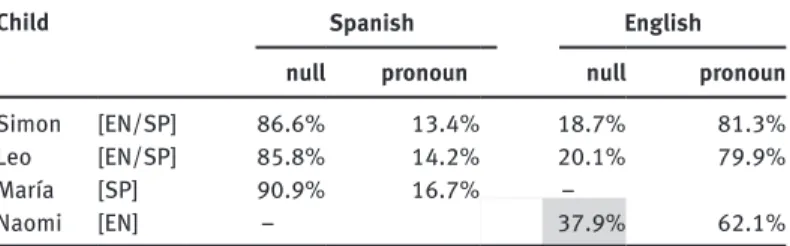
The patterns of subject production/omission have been the focus of attention when comparing the monolingual and bilingual acquisition of Spanish and English. If crosslinguistic influence occurs from English into Spanish, this could be reflected in the overproduction of subjects in Spanish; if it goes from Spanish into English, the English of the bilinguals could contain more null subjects than those characterizing the production of English monolinguals. Liceras et al. (2012) and Liceras and Fernández Fuertes (2018) have carried out a comparative analy-sis of Spanish and English subjects by analyzing the spontaneous production of monolinguals and bilinguals. The results appear in Table 3.
Table 3: Sentential subjects in Spanish-English bilinguals and monolinguals.
Child Spanish English
null pronoun null pronoun
Simon [EN/SP] 86.6% 13.4% 18.7% 81.3%
Leo [EN/SP] 85.8% 14.2% 20.1% 79.9%
María [SP] 90.9% 16.7% –
Naomi [EN] – 37.9% 62.1%
Table 3 shows that, in the Spanish spontaneous production, the rate of null versus
which points to the lack of crosslinguistic influence from English into Spanish in the bilinguals’ Spanish production.
However, when comparing null and pronominal subjects in the English pro-duction of the three children, data show that the monolingual child (Naomi) produces a significantly higher number of non-adult null subjects than the bilin-guals. Liceras and Fernández Fuertes (2018) attribute this lower production of null subjects by the two bilinguals to Spanish playing a facilitating role. As in the case of the copula, Spanish has two different realizations of the subject: null, licensed by a rich verbal inflection, and overt. This makes bilingual children realize earlier than monolinguals that the null subject is not an option for English verbs. Therefore, crosslinguistic influence from Spanish into English makes bilin-guals reach the adult grammar earlier than monolinbilin-guals.
and Fernández Fuertes (2018) have shown no indication of explicit subject overuse in the production of the two bilingual children they analyze (Table 3 above). Since these children were exposed to peninsular Spanish, it may well be the case that Manuela’s overuse of overt subjects be a consequence of the type of input to which she was exposed, rather than of influence from English.
The directionality of crosslinguistic influence in 2L1 acquisition
Crosslinguistic influence between the two L1s of the bilingual can go in the direc-tion of language A to language B or the reverse. As we have indicated above, while some researchers relate the directionality of crosslinguistic influence to dominance so that influence goes from the dominant to the non-dominant lan-guage (e.g. Silva-Corvalán 2014), other researchers argue that the nature of gram-matical properties can also dictate the directionality of crosslinguistic influence. Namely, if a language presents a lexical-syntactic distinction that is absent in the other language (null and overt subjects or ser and estar copulas in Spanish), this language may be a good candidate as the source of influence (Liceras et al. 2012). This implies that in the case of Spanish-English bilinguals, crosslinguistic influence will go from Spanish into English and not in the reverse direction, and this would be so regardless of dominance. However, as we indicated above, we believe that for crosslinguistic influence to occur, a certain degree of competence in Spanish, in this case, is necessary. If the level of Spanish is too low, it would behave as an L2 and, in that case, influence will not take place.
pronominal subjects are a pure syntactic phenomenon and are, therefore, not located at an interface; and (ii) as null subjects in Spanish are a robust phenome-non, children would not mis-analyze the Spanish input in terms of the obligatory presence of English pronouns. In fact, as Table 3 above shows, no overproduction of pronominals occurs in the Spanish production of these bilinguals.
If crosslinguistic influence from Spanish into English takes place, it would result in the overproduction of null subjects in English. If so, crosslinguistic influ-ence would have an interfering effect. However, this is not expected either since (i), although pronominal subjects in Spanish are governed at the syntax-pragmatics interface, null subjects, i.e. the transferred property, are a pure syntactic phenome-non; and (ii) it is far from clear that English would provide robust superficial input which could be mis-analyzed as mirroring the Spanish structures where null sub-jects are licensed, since, in English, null subsub-jects with inflected verbs only occur with coordinated structures. As seen in Table 3 regarding the effect of crosslinguis-tic influence and as predicted under this view of crosslinguiscrosslinguis-tic influence direction-ality, no overproduction of null subjects in the English of these bilinguals occurs.
6 Code-mixing
Code-mixing or code-switching has also been investigated as an outcome of 2L1 acquisition. Zentella (1981, 2000) defines code-mixing as alternating languages in unchanged speech situations. Cantone and Müller (2008, p. 811) consider code-mixing (CM) as the ability of a bilingual speaker to use both languages within a discourse (inter-sentential CM, as in 7), or within an utterance (intra-sentential CM, as in 1 to 4 above), according to grammatical and socio-linguistic constraints.
(7) Sometimes I’ll start a sentence in Spanish y termino en español
(Poplack 1980) [sometimes I’ll start a sentence in Spanish and I finish in Spanish]
MacSwan (1999, 2000), however, proposes that only the grammars of the two languages involved constrain language mixing so that no additional con-straints are required. MacSwan (2000: 45), taking the Minimalist Program (MP) as a framework, defines code-switching “as the simple consequence of mixing two lexicons in the course of a derivation” which emphasizes the role of the lexicon (and the features it encodes) when accounting for CM. The MP also guides the analysis carried out by Liceras et al. (2005), Liceras et al. (2008) and Liceras, Fernández Fuertes, and Klassen (2016). These authors carry out an analysis of Spanish-English CM in the spontaneous production of child and adult 2L1 bilinguals as well as in the experimental data of child 2L1 bilinguals. They focus on the specific CM Determiner + Noun, in (1), (2), (3), (4), and as in the examples in (8).
(8) a. los rockets [Mario 3;08] (Fantini 1985) [the rockets]
b. el cake [Manuela 2;02] (Deuchar, CHILDES) [the cake]
c. la rock [Leo 3;05] (FerFuLice, CHILDES) [the rock]
d. the vaca (Lindholm & Padilla 1978) [the cow]
e. the piscina [Simon 4;04] (FerFuLice, CHILDES) [the swimming-pool]
These authors were concerned with the prevalence of one functional category over the other (Spanish Determiner, as in 8a-8c, or English Determiner, as in 8d and 8e) and, in the case of the Spanish Determiner, with gender agreement (the so-called analogical criterion where the Spanish Determiner agrees with the English Noun as if the English Noun ‘inherits’ the gender features of the Spanish translation equivalent Noun). Under the analogical criterion (AC; a term initially proposed by Otheguy & Lapidus 2005), a contrast is established between the Spanish Determiner mixes in (9).
(9) a. elmasc. book=libro (masc.) [+AC] [the book]
b. lafem. book=libro (masc.) [-AC] [the book]
the Spanish translation equivalent (libro). In contrast, in (9b) there is a mismatch of gender features between the feminine feature of the Spanish Determiner and the masculine feature that the English Noun inherits from its Spanish translation equivalent. This idea of imposing gender on the English Noun makes it possible that the valuation of gender features in the CM phrase proceeds as in the Spanish monolingual DP.
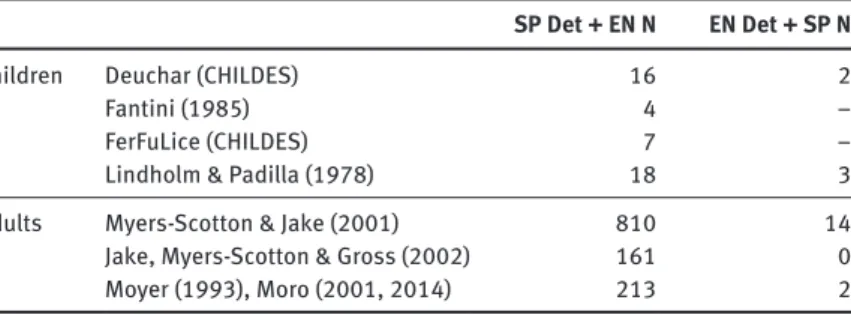
What Liceras et al. (2005, 2008) show is that, regardless of dominance, as defined by Petersen (1998), Spanish-English 2L1 bilinguals (both children and adults) have a very similar behavior in the spontaneous production of mixed Determiner-Noun sequences. In fact, as shown in Table 4, Spanish Determiners are clearly favored in Determiner+Noun mixes by both child and adult 2L1 bilin-guals, and this is so regardless of whether they are rather balanced (as in the FerFuLice corpus) or whether Spanish is their dominant language or not (as in the Deuchar corpus).
Table 4: Code-mixed Det-N sequences: the spontaneous production of 2L1 bilinguals.
SP Det + EN N EN Det + SP N
Children Deuchar (CHILDES) 16 2
Fantini (1985) 4 –
FerFuLice (CHILDES) 7 –
Lindholm & Padilla (1978) 18 3
Adults Myers-Scotton & Jake (2001) 810 14
Jake, Myers-Scotton & Gross (2002) 161 0
Moyer (1993), Moro (2001, 2014) 213 2
To account for these preferences, Liceras et al. (2008) formulate the substitute this for GFSH (Section 3) and formalize the AC as the Gender Double-Feature Val-uation Mechanism in order to capture the strength of linguistic features and, in particular, of gender features that leads to (i) the preference for the functional category which is more grammaticized (i.e. the Spanish Determiner) as it encodes gender features; and (ii) the need to enforce gender agreement between the Spanish Determiner and the English Noun as a linguistic operation rooted in the mind of Spanish dominant Spanish-English bilinguals.
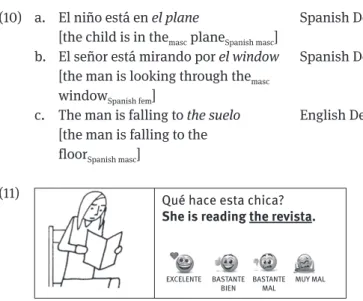
children in the FerFuLice corpus as well as a group of 2L1 bilingual children with a similar linguistic profile (i.e. they also live in Spain and come from families where each of the parents is a native speaker of one of the two languages and where the one parent-one language strategy of communication is used with the children).
(10) a. El niño está en el plane Spanish Det, [+AC], MM [the child is in themasc planeSpanish masc]
b. El señor está mirando por el window Spanish Det, [-AC], MF [the man is looking through themasc
windowSpanish fem]
c. The man is falling to the suelo English Det, Spanish masc N [the man is falling to the
floorSpanish masc]
(11)
The results of the judgment task (Figure 1) show that the 2L1 children significantly prefer sequences with an English Determiner (the two rightmost columns) over sequences with a Spanish Determiner (remaining columns to the left) (p=.013). This is, in a way, to be expected as this CM structure has less processing costs given that no gender valuation operation needs to be implemented as the English Determiner carries no gender features.
Qué hace esta chica? She is reading the revista.
EXCELENTE BASTANTE
BIEN BASTANTEMAL MUY MAL
0 1 2 3 4
MM MF FF FM M Noun F Noun
SP Det + EN N EN Det + SP N
In the case of the Spanish Determiner CM structures, there is a preference for [+AC] options that is almost statistically significant (p=.068). That is, this group of 2L1 bilingual children rate CM in (10a) more favorably than that in (10b). This preference for the matching option seems to suggest that Spanish gender fea-tures have a high representational value in the mind of these bilinguals in that they need to implement this valuation procedure between the gender features of the Spanish Determiner and those of the Spanish translation equivalent of the English Noun.
Studies like Liceras et al. (2008, 2016) point to, at least, two issues that have often been discussed in the analysis of CM in 2L1 bilingual acquisition research: the role of language dominance and the social status of CM. With respect to inance, and given the results presented above, the GFSH captures a view of dom-inance based on the features encoded in the lexicon of a particular language and on the saliency these features have in this language. Therefore, the dominant lan-guage would be the one whose features are most grammaticized because they are the ones that would guide how structures are generated, regardless of whether this particular language is the one in which the bilingual is most proficient or to which he has been more exposed.
The social status of CM has to do with whether CM is part of the speech of the community and, therefore, a common practice, or rather a more ad hoc phe-nomenon. And this is linked to the social context in which the 2L1 bilingual is immersed. As seen in Section 1 above, there are different 2L1 acquisition contexts, so that, while some are more restricted to the family context (as in individual bilingualism), others are part of a broader social context (as in societal bilin-gualism). Some authors have suggested that the study of CM should be limited to those 2L1 bilinguals who actually use CM on a daily basis, that is, to code-switch-ers (e.g. Guzzardo Tamargo, Valdés Kroff & Dussias 2016; Valdés Kroff, Dussias, Gerfen, Perrotti & Bajo 2016).5 However, potentially all 2L1 bilinguals can code-switch and have intuitions about code-code-switched structures.6 Besides, as shown in
5 These authors specifically argue that bilinguals who code-switch at the societal level may produce code-switches that differ from those produced and processed by other bilinguals (i.e. non-code-switchers) (e.g. Beatty-Martínez & Dussias 2017; Guzzardo Tamargo et al. 2016; Valdés Kroff 2016; Valdés Kroff et al. 2016). Although the populations in these studies do not involve children in Spain, as it is our case, their Spanish-English bilinguals mostly prefer Spanish-mas-culine Determiner – English Noun CM structures. And this seems to be so for both US east coast bilinguals (who arguably may now be more English dominant) but also for Spanish dominant Puerto Ricans.
Table 4, children who are immersed in an individual bilingualism context (Spain in the case of the FerFuLice corpus, or the UK in the case of the Deuchar corpus), also produce instances of CM. Furthermore, and in the case of experimental data, what is being tested is the internal knowledge speakers have of their two gram-mars and how these gramgram-mars interact. The fact that the judgments, as shown in Figure 1, are around the mid value 2 could be accounted for in this respect: these speakers are not used to code-switching. However, as the statistical anal-yses show, these speakers do not treat all CM in (10) in the same way: unlike in production, in the grammaticality judgment task they prefer English Det mixes where no gender agreement features are involved because processing this DP is less costly. However, if gender features appear (i.e. in Spanish Det mixes), they show a clear preference for the enforcement of the gender agreement mechanism, that is, for the implementation of the AC.
7 Conclusions and future directions
In this chapter, we have provided an analysis of data from two English-Spanish 2L1 bilinguals growing up in Spain as compared to data from other bilinguals and monolinguals. We have focused on two core issues that are specific to 2L1 acquisition: language dominance and crosslinguistic influence. Our analysis has pointed to how language properties shape the directionality and the effect of crosslinguistic influence. In particular, Spanish lexical specialization explains that, in the early stages of English-Spanish 2L1 acquisition, Spanish be the lan-guage that constitutes the locus of influence and that influence has a facilitating effect. This is reflected in how the adult grammatical requirement in both copula constructions and sentential subjects emerges earlier in the spontaneous pro-duction of these English-Spanish bilinguals as compared to that of English and Spanish monolinguals. Differences with other bilinguals (e.g. Paradis & Navarro 2003) could rather be attributed to input differences or a rather weak command of one of the two languages (Silva-Corvalán 2014) and not so much to negative influence from Spanish into English or to lack of crosslinguistic influence.
Language properties and, in particular, Spanish highly grammaticized fea-tures, are also behind the CM preferences that appear in the spontaneous and experimental data of these bilingual children as well as in that of other bilingual
children and adults. As captured under the GFSH and the Gender Double-Feature Valuation Mechanism, the strength of Spanish gender features makes these bilin-guals prefer the Spanish Determiner in switched DPs and enforce gender agree-ment between the Spanish Determiner and the Spanish translation equivalent of the (ungendered) English Noun. Although a contrast is seen in spontaneous
versus acceptability judgment data, the strength of Spanish gender features is
seen not only in the preference for the Spanish Determiner (spontaneous data) but also in the preference for the [+AC] Spanish Determiner (judgment data; examples 10a versus 10b).
While many future directions may be taken to investigate the outcomes of 2L1 acquisition, we would like to mention four that are relevant to the outcomes that we have discussed. First, both the locus and directionality of crosslinguis-tic influence as well as language dominance should be investigated with other language pairs where the semantic values (i.e. beversusser/estar) take different realizations. Second, it would be important to carry out analyses of both exper-imental and spontaneous data from other language pairs to determine whether constructs such as the GFSH or the Analogical Criterion hold across the board and whether other constructs have to be proposed to deal with alternative scenarios. For instance, what is the spontaneous output and what are the preferences when mixing a language with a three gender value DP and a language without grammat-ical gender or with a two gender value DP (German vs. English or Spanish as in Klassen 2016)? Third, in order to complement the results obtained from the anal-ysis of spontaneous data and off-line experimental data, the outputs and prefer-ences of 2L1 representation and processing should be investigated using on-line tasks, eye-tracking, ERPs or neuroimaging (as in Dussias, Valdés Kroff, Guzzardo Tamargo & Gerfen 2013). Fourth, language dominance, crosslinguistic influence and code-switching should be investigated in both contexts of 2L1 individual bilin-gualism and 2L1 societal bilinbilin-gualism.
Acknowledgements: This research has been funded by the Castile and León Regional Government Education Division (Spain) and FEDER [VA009P17] and by the Distinguished University Professor Fund of the University of Ottawa (Canada).
References
Baker, C. 2011. Foundations of bilingual education. Bristol: Multilingual Matters.
Beatty-Martínez, A. L. & P. E. Dussias. 2017. Bilingual experience shapes language processing: evidence from codeswitching. Journal of Memory and Language 95. 173–189.
Becker, M. 2000. The development of the copula in child English: The lightness of Be. Los Angeles: University of California doctoral dissertation.
Becker, M. 2004. Copula omission is a grammatical reflex. Language Acquisition 12(2). 157–167. Bel, A. 2001 Teoria lingüística i adquisició del llenguatge. Anàlisi comparada dels trets
morfològics emcatalà i en castellà. Barcelona: Institut d’Estudis Catalans.
Belazi, H, E. Rubin & A. J. Toribio. 1994. Code-switching and X-bar theory: The functional head constraint. Linguistic Inquiry 25. 221–237.
Bhatia, T. J. & W. C. Ritchie. 2004. The handbook of bilingualism. Oxford: Blackwell. Bhatia, T. J. & W. C. Ritchie. 2012. The handbook of bilingualism and multilingualism. Oxford:
Wiley-Blackwell.
Burkholder, M. 2018. Language mixing in the Nominal Phrase: Implications of a Distributed Morphology perspective. Languages 3(2).10. Special Issue Romance Languages at the Forefront of Language Acquisition Research (volume 1), edited by J. M. Liceras & R. Fernandez Fuertes. doi:10.3390/languages3020010
Cantone, K. F. & N. Müller. 2008. Un nase or una nase? What gender marking within switched DPs reveals about the architecture of the bilingual language faculty. Lingua 118. 810–826.
Carlson, G. 1977. Reference to kinds in English. Amherst: University of Massachusetts doctoral dissertation.
Chomsky, N. 1995. The minimalist program. Cambridge, MA: MIT Press.
Chomsky, N. 1998. Minimalist inquiries: the framework. MIT Working Papers in Linguistics 15. Also in R. Martin, D. Michaels & J. Uriagereka (eds.), Step by step: essays on minimalist syntax in honor or Howard Lasnik (2000). Cambridge, MA: MIT Press.
De Houwer, A. 1990. The acquisition of two languages from birth: A case study. Cambridge: Cambridge University Press.
De Houwer, A. 2009. Bilingual first language acquisition. Clevendon: Multilingual Matters. Deuchar, M. & S. Quay. 2000. Bilingual acquisition: theoretical implications of a case study.
Oxford: Oxford University Press.
Döpke, S. 2000. Generation of and retraction from crosslinguistically motivated
structures in bilingual first language acquisition. Bilingualism: Language and Cognition 3(3). 209–226.
Dussias, P. E., J. R. Valdés Kroff, R. E. Guzzardo Tamargo & C. Gerfen. 2013. When gender and looking go hand in hand. Grammatical gender processing in L2 Spanish. Studies in Second Language Acquisition 35. 353–387.
Fantini, A. E. 1985. Language acquisition of a bilingual child: a sociolinguistic perspective (to age ten). Clevedon: Multilingual Matters.
Fernández Fuertes, R. & J. M. Liceras. 2010. Copula omission in the English developing grammar of English/Spanish bilingual children. International Journal of Bilingual Education and Bilingualism 13(5). 525–551.
Gaulin, R. 2008. Examination of copula omission within the data of Spanish-English twin infants, Leo and Simon: The effects of transfer. University of Ottawa MA research paper.
Genesee, F. 2003. Rethinking bilingual acquisition. In J. M. de Waele (ed.), Bilingualism: Challenges and directions for future research, 158–182. Clevedon: Multilingual Matters. Genesee, F., E. Nicoladis & J. Paradis. 1995. Language differentiation in early bilingual
development. Journal of Child Language 22(3). 611–631.
Grosjean, F. 1982. Life with two languages: an introduction to bilingualism. Cambridge, MA: Harvard University Press.
Grosjean, F. 1985. The bilingual as a competent but specific speaker-hearer. Journal of Multilingual and Multicultural Development 6. 467–477. Also in M. Cruz-Ferreira (ed.), Multilingual norms, 19–31. Frankfurt am Main: Peter Lang.
Grosjean, F. 2008. Studying bilinguals. Oxford: Oxford University Press.
Guzzardo Tamargo, R. E., J. R. Valdés Kroff & P. E. Dussias. 2016. Using code-switching as a tool to study the link between production and comprehension. Journal of Memory and Language 89. 138–161.
Hulk, A. and N. Müller. 2000. Bilingual first language acquisition at the interface between syntax and pragmatics. Bilingualism: Language and Cognition 3(3). 227–244.
Jake, J. L., C. Myers-Scotton & S. Gross. 2002. Making a minimalist approach to codeswitching work: Adding the matrix language. Bilingualism: Language and Cognition 5(1). 69–91. Jessner, U. 2008. A DST dynamic system theory. Modern of multilingualism and the role of
metalinguistic awareness. The Modern Language Journal 92(2). 270–283. Jorschick, L., A. Endesfelder Quick, D. Glässer, E Lieven & M. Tomasello. 2011. German–
English-speaking children’s mixed NPs with ‘correct’ agreement. Bilingualism: Language and Cognition 14(2). 173–183.
Klassen, R. 2016. The representation of asymmetric grammatical gender systems in the bilingual mental lexicon. Probus 28(1). 9–28.
Köppe, R. & J. Meisel. 1995. Code-switching in bilingual first language acquisition. In L. Milroy and P. Muysken (eds.), One speaker, two languages, 276–301. Cambridge: Cambridge University Press.
Lanza, E. 1997. Language mixing in infant bilingualism: a sociolinguistic perspective. Oxford: Oxford University Press.
Liceras, J. M. & R. Fernández Fuertes. 2018. Subject omission/production in child bilingual English and child bilingual Spanish: The view from linguistic theory. Probus 29(1). Liceras, J. M., R. Fernández Fuertes & A. Alba de la Fuente. 2012. Overt subjects and copula
omission in the Spanish and the English grammar of English-Spanish bilinguals: On the locus and directionality of interlinguistic influence. First Language 32(1–2). 88–115. Liceras, J. M., R. Fernández Fuertes & R. Klassen. 2016. Language dominance and language
nativeness: the view from English-Spanish codeswitching. In R. E. Guzzardo Tamargo, C. M. Mazak & M. C. Parafita Couto (eds.), Spanish-English codeswitching in the Caribbean and the U.S., 107–138. Amsterdam: John Benjamins.
Liceras, J. M. R. Fernández Fuertes, S. Perales, R. Pérez-Tattam & K. T. Spradlin. 2008. Gender and gender agreement in bilingual native and non-native grammars: a view from child and adult functional-lexical mixings. Lingua 118. 827–851.
Liceras, J. M., R. Fernández Fuertes & R. Pérez-Tattam. 2008. Null and overt subjects in the developing grammars (L1 English/L1 Spanish) of two bilingual twins. In C. Pérez-Vidal, M. Juan-Garau & A. Bel (eds.), A portrait of the young in the new multilingual Spain, 111–134. Bristol: Multilingual Matters.
Lindholm, K. J. & A. M. Padilla. 1978. Language mixing in bilingual children. Journal of Child Language 5. 327–335.
Malakoff, M.E., L. C. Mayes, R. Schottenfeld & S. Howell. 1999. Language production in 24-month-old inner-city children of cocaine-and-other-drug-using mothers. Journal of Applied Developmental Psychology 20. 159–180.
Meisel, J. M. 2008. Child second language acquisition or successive first language acquisition? In B. Haznedar and E. Gavruseva (eds.), Current trends in child second language
acquisition: a generative perspective, 55–80. Amsterdam: John Benjamins.
Meisel, J. M. 2011. First and second language acquisition. New York: Cambridge University Press.
MacSwan, J. 1999. A minimalist approach to intrasentential code switching. New York: Garland. MacSwan, J. 2000. The architecture of the bilingual language faculty: evidence from
intrasentential code switching. Bilingualism: Language and Cognition. 3 (1). 37–54. MacSwan J. (ed.). 2014. Grammatical theory and bilingual codeswitching. Cambridge, MA: MIT
Press.
MacWhinney, B. 2000. The CHILDES project: tools for analyzing talk. 3rd edn.. Mahwah, NJ: Lawrence Erlbaum Associates.
Moro, M. 2001. The semantic interpretation and syntactic distribution of determiner phrases in Spanish/English codeswitching. Paper presented at ISB3, Briston, UK.
Moro, M. 2014. The semantic interpretation and syntactic distribution of determiner phrases in Spanish-English codeswitching. In J. MacSwan (ed.), Grammatical theory and bilingual codeswitching, 213–226. Cambridge, MA: MIT Press.
Moyer, M. 1993. Analysis of code-switching in Gibraltar. Bellaterra: Universidad Autónoma de Barcelona doctoral dissertation.
Myers-Scotton, C. 2005. Supporting a Differential Access Hypothesis. In J. Kroll and A. de Groot (eds.), Handbook of bilingualism, psycholinguistic approaches, 326–348. New York: Oxford University Press.
Myers-Scotton, C. & J. L. Jake. 2001. Explaining aspects of code-switching and their
implications. In J. L. Nicol (ed.) One mind, two languages: bilingual language processing, 84–116. Malden, MA: Blackwell.
Müller, N. 1998. Transfer in bilingual first language acquisition. Bilingualism: Language and Cognition 1(3). 151–172.
Nicoladis, E. 1994. Code-mixing in young bilingual children. Montreal: McGill University doctoral dissertation.
Nicoladis, E. 2002. The cues that children use in acquiring adjectival phrases and compound nouns: Evidence from bilingual children. Brain and Language 81. 635–648.
Nicoladis, E. & G. Secco. 1998. The role of translation equivalents in a bilingual family’s code-switching. In A. Greenhill, M. Hughes, H. Littlefield & H. Walsh (eds.), Proceedings of the 22nd annual Boston University Conference on Language Development, 576–585. Somerville, MA: Cascadilla Press.
Nicoladis, E. & F. Genesee. 1998. Parental discourse and code-mixing in bilingual children. International Journal of Bilingualism 2. 85–99.
Ong, K. K. W. & L. J. Zhang. 2010. Metalinguistic filters within the bilingual language faculty: A study of young English-Chinese bilinguals. Journal of Psycholinguistic Research 39(3). 243–272. Otheguy, R. & N. Lapidus. 2005. Matización de la teoría de la simplificación en las lenguas en
contacto con otras lenguas, 143–160. Madrid and Frankfurt: Editorial Iberoamericana / Vervuert Verlag.
Paradis, J. & S. Navarro. 2003. Subject realization and crosslinguistic interference in the bilingual acquisition of Spanish and English. Journal of Child Language 30. 1–23. Paradis, J. & F. Genesee. 1996. Syntactic acquisition in bilingual children: Autonomous or
interdependent? Studies in Second Language Acquisition 18(1). 1–25.
Paradis, J, M. Crago & F. Genesee. 2005/2006. Domain-general versus domain-specific accounts of Specific Language Impairment: Evidence from bilingual children’s acquisition of object pronouns. Language Acquisition 13(1). 33–62.
Petersen, J. 1988. Word-internal code-switching constraints in a bilingual child’s grammar. Linguistics 26. 479–493.
Poplack, S. 1980. Sometimes I‘ll start a sentence in Spanish y termino en español: Toward a typology of code-switching. Linguistics 18. 581–618.
Redlinger, W. E. & T. Park. 1980. Language mixing in young bilinguals. Journal of Child Language 7. 337–352.
Sera, M. D. 1992. To be or to be: Use and acquisition of the Spanish copulas. Journal of Memory and Languages 31. 408–427.
Serratrice, L. 2002. Overt subjects in English: evidence for the marking of person in an English-Italian bilingual child. Journal of Child Language 29. 327–355.
Serratrice, L., A. Sorace & S. Paoli. 2004. Crosslinguistic influence at the syntax-pragmatics interface: Subjects and objects in English-Italian bilingual and monolingual acquisition. Bilingualism: Language and Cognition 7(3). 183–205.
Schmitt, C. & K. Miller. 2007. Making discourse-dependent decisions: The case of the copulas ser and estar in Spanish. Lingua 117. 1907–1929.
Silva-Corvalán, C. 2003. Linguistic consequences of reduced input in bilingual first language acquisition. In S. Montrul and F. Ordoñez (eds.) Linguistic theory and language development in Hispanic languages. 375–397. Somerville, MA: Cascadilla Press Silva-Corvalán, C. 2014. Bilingual language acquisition: Spanish and English in the first six
years. Cambridge: Cambridge University Press.
Sorace, A. 2011. Pinning down the concept of “interface” in bilingualism. Linguistic Approaches to Bilingualism 1(1). 1–33.
Swain, M. 1972. Bilingualism as a first language. Irvine: University of California at Irvine doctoral dissertation.
Taeschner, T. 1983. The sun is feminine: a study on language acquisition in bilingual children. New York: Springer Verlag.
Toribio, A. J. 2001. On the emergence of bilingual code-switching competence. Bilingualism: Language and Cognition 4 (3). 203–231.
Tsimpli, I. M. & A. Sorace. 2006. Differentiating interfaces: L2 performance in syntax-semantics and syntax-discourse phenomena. In D. Bamman, T. Magnitskaia & C. Zaller (eds.), Proceedings of the 30th annual Boston University Conference on Language Development, BUCLD 30, 653–664. Somerville, MA: Cascadilla Press.
Unsworth, S. 2003. Testing Hulk & Müller (2000) on crosslinguistic influence: Root infinitives in a bilingual German/English child. Bilingualism: Language and Cognition 6(2). 143–158. Vihman, M. 1985. A developmental perspective on code-switching conversations between a pair
of bilingual siblings. TESOL Quarterly 19(2). 371–373.
Valdés Kroff, J. R. 2016. Mixed NPs in Spanish-English bilingual speech: using a corpus-based approach to inform models of sentence processing. In R. E. Guzzardo Tamargo, C. Mazak & M. C. Parafita Couto (eds.), Spanish-English code-switching in the Caribbean and the US, 281–300. Amsterdam: John Benjamins.
Valdés Kroff, J. R., P. E. Dussias, C. Gerfen, L. Perrotti & M. T. Bajo. 2017. Experience with code-switching modulates the use of grammatical gender during sentence processing. Linguistic Approaches to Bilingualism 7. 163–198.
Wapole, C. 2000. The bilingual child: One system or two? In E. V. Clark (ed.), The Proceedings of the 30th Annual Child Language Research Forum, 187–194. Stanford: CSLI.
Yip, V. & S. Matthews. 2000. Syntactic transfer in a Cantonese-English bilingual child. Bilingualism: language and cognition 3(3). 193–208.
Yip, V. & S. Matthews. 2007. The bilingual child: early development and language contact. Cambridge: Cambridge University Press.
Zentella, A. C. 1981. Hablamos los dos. We speak both: Growing up bilingual in el Barrio. Philadelphia: University of Pennsylvania doctoral dissertation.
Zentella, A. C. 2000. Puerto Ricans in the United States: Confronting the linguistic