
Development of a framework for the e education of educators of special groups aiming to improve their compatibility with their learners
474
0
0
Texto completo
(2) The ESG Framework PhD Thesis of Maria Pavlis-Korres, University of Alcalá. 2.
(3) The ESG Framework PhD Thesis of Maria Pavlis-Korres, University of Alcalá. Table of contents Resumen.........................................................................................................................9 List of figures...............................................................................................................11 List of tables.................................................................................................................13 Acknowledgments........................................................................................................15 Introduction..................................................................................................................19 THEORETICAL PART...............................................................................................23 Learning Technology ...................................................................................................25 Learning Objects’ Instructional Technology .......................................................27 Learning objects...................................................................................................28 Learning Object Metadata....................................................................................32 Learning Objects, instructional design and andragogy........................................33 Instructional Systems Design...............................................................................34 Multicultural education................................................................................................39 Educators of special groups and transformative learning ....................................40 Compatibility between educator and learner .......................................................44 Adults’ Education ........................................................................................................49 Characteristics of adults as learners.....................................................................50 Requirements for effective adult learning............................................................53 The role of the educator of adults ........................................................................55 The E-learning environment for adults ........................................................................59 Immediacy and Interaction in online educational environments .............................60 Immediacy in online education environment.......................................................60 Interaction in online educational environment ....................................................62 Online communication modes .................................................................................65 Asynchronous learning environment ...................................................................65 The role of communication tools in an asynchronous E-learning environment in reducing isolation and promoting immediacy, active participation, interaction and collaboration..................................................................................................67 The importance of forum/electronic discussions groups in an asynchronous Elearning environment ...........................................................................................68 Community learning networks.................................................................................70 The role of the Educator in E-learning ....................................................................72 The development of a learning group ..................................................................73 Instructional design theories ........................................................................................77 Instructional objectives ............................................................................................78 Development of the cognitive domain.....................................................................79 Selecting the appropriate instructional theory .....................................................85 Development of the affective domain......................................................................85 Attitudes...............................................................................................................86 Attitudes’ measurement .......................................................................................87 Attitudes functions ...............................................................................................89 Instructional design and attitudes change ............................................................90 Instructional design theories for affective development, transformative learning and effective adult learning..................................................................................94 Sequence of Learning Objects .................................................................................95 Problem statement and objectives..............................................................................101 Problem Statement .................................................................................................101. 3.
(4) The ESG Framework PhD Thesis of Maria Pavlis-Korres, University of Alcalá. Objectives ..............................................................................................................102 Main expected contributions..................................................................................103 Methodology ..........................................................................................................105 The development of a framework for the e-education of educators of special groups: the ESG Framework...................................................................................................107 Needs analysis........................................................................................................108 Needs analysis taxonomy...................................................................................108 Design ....................................................................................................................110 Learning Objectives taxonomy ..........................................................................111 Defining the content of Learning Objects..........................................................113 Defining the presentation of Learning Objects..................................................114 Hierarchy and mapping between content and presentation in providing personalized LOs addressed to Educators of Special Groups (ESG) ................119 The instructional design theories in the ESG Framework .................................120 The ESG Instructional Design Model................................................................121 The instructional process in the ESG Instructional Design Model....................122 Integrating adults’ characteristics and requirements for effective adult learning in the ESG Framework...........................................................................................129 Selecting a platform to be used for the e-education of educators of special groups using the ESG Framework .................................................................................130 Development ..........................................................................................................133 LOs in the ESG Instructional Model .................................................................133 Sequence of LOs in the ESG Framework ..........................................................136 Learning Objects for the Educators of Special Groups (ESG) and their Metadata ............................................................................................................................136 Implementation ......................................................................................................141 Promoting interaction in the ESG Framework...................................................141 Τhe role of the educator in the ESG Framework ...............................................143 Evaluation ..............................................................................................................144 Maintenance of the Community Learning Network ..............................................144 The Conceptual Framework for the E-education of Educators of Special Groups146 Summing up the parameters which synthesize the ESG Educational Framework 147 PRACTICAL PART ..................................................................................................149 Testing the “ESG Framework”- Pilot application .....................................................151 Case study: The Greek Educators of Roma ...............................................................153 Roma in Greece – Some sociological features ......................................................154 Phases of the pilot application ...................................................................................157 Needs analysis........................................................................................................159 The focus, the method and the sample of the needs assessment........................159 Resutls of the needs assessment.........................................................................163 Design ....................................................................................................................169 Formulation of educational objectives...............................................................169 Instructional theories..........................................................................................170 Adults’ education ...............................................................................................171 Selection of an e-platform..................................................................................173 Development ..........................................................................................................174 Selection of existing LOs...................................................................................174 Creation of LOs..................................................................................................176 Authoring metadata of LOs ...............................................................................180 Sequence of LOs ................................................................................................183. 4.
(5) The ESG Framework PhD Thesis of Maria Pavlis-Korres, University of Alcalá. Duration of the course........................................................................................184 Implementation ......................................................................................................185 The Participants’ profile ....................................................................................185 Participants’ preparation ....................................................................................186 Description of the course ...................................................................................189 Educational material ..........................................................................................192 Communication tools used in the course ...........................................................193 Development of the learning group ...................................................................194 Monitoring .........................................................................................................195 Creation of a closed learning group in the Face Book.......................................195 The course in a snapshot ....................................................................................196 Final meeting .....................................................................................................197 Evaluation ..............................................................................................................198 Evaluation of the structure of the course ...........................................................198 Formative evaluation of the course structure.....................................................199 Summative evaluation of the course structure ...................................................203 Evaluation of the outcome of the course............................................................217 Formative evaluation of the outcome ................................................................219 Summative evaluation of the outcome of the course .........................................221 The initial compatibility test ..............................................................................222 The analysis of the course archives ...................................................................223 1st Learning Path ................................................................................................223 2nd Learning Path ...............................................................................................226 3rd Learning Path................................................................................................230 4th Learning Path................................................................................................233 5th Learning Path................................................................................................235 6th Learning Path................................................................................................238 7th Learning Path................................................................................................240 The participants’ view of the course and their self-assessment.........................255 Measuring the improvement of compatibility....................................................258 The development of the learning group .............................................................269 Evaluation of the E-learning vs conventional educational methods..................271 Evaluation of the course in the final meeting ....................................................273 Maintenance of the Learning Community Network ..............................................277 Conclusions and Future work ....................................................................................279 References..................................................................................................................285 Appendixes ................................................................................................................314 Appendix 1.................................................................................................................315 Questionnaire of the needs assessment ..................................................................315 Appendix 2.................................................................................................................342 Detailed results of the needs assessment ...............................................................342 Compatibility between educators and learners ..................................................342 Learning profiles of the educators .....................................................................350 Appendix 3.................................................................................................................355 Greek manual for the use of Dokeos platform.......................................................355 Ο∆ΗΓΙΕΣ ΓΙΑ ΤΗ ΧΡΗΣΗ ΤΗΣ ΠΛΑΤΦΟΡΜΑΣ DOKEOS ΣΤΟ ΠΡΟΓΡΑΜΜΑ «ΤΑΞΙ∆ΕΥΟΝΤΑΣ ΣΤΟ ∆ΙΑΦΟΡΕΤΙΚΟ. LACIO DROM!» ............................................................................................................................355 Appendix 4.................................................................................................................365. 5.
(6) The ESG Framework PhD Thesis of Maria Pavlis-Korres, University of Alcalá. Initial compatibility test between educators and Roma learners which has been used at the beginning of the course ................................................................................365 Appendix 5.................................................................................................................371 Description of the seven Learning Paths and the two learning activities for the development of the learning group ........................................................................371 A. LEARNING PATHS.....................................................................................371 First Learning path. "Let's hear with their ears and see with their eyes"...........371 Second learning path "Stereotypes and prejudices"...........................................373 Third learning path: Roma and education..........................................................374 Fourth, Christmas learning path: Free subject regarding the Roma culture ......376 Fifth learning path: “Stigma”.............................................................................377 Sixth learning path: “Let’s laugh hahaha” .........................................................379 Seventh learning path: “Problem solving”.........................................................380 B. THE TWO LEARNING ACTIVITIES FOR THE DEVELOPMENT OF THE LEARNING GROUP.............................................................................................395 1st Activity.........................................................................................................395 LET'S GET STARTED! LACIO DROM..........................................................395 2nd Activity .......................................................................................................396 WE ARE BOTH SIMILAR AND DIFFERENT...............................................396 Appendix 6.................................................................................................................397 Responses of the learners (ESG) in learning paths and the “Commons and differences among the members of the learning group” activity...........................397 Responses of the learners in the forum/threaded discussion for each Learning Path 397 1st learning path..................................................................................................397 2nd Learning Path................................................................................................401 First Part of the Learning Path. ..........................................................................401 Second Part of the Learning Path.......................................................................408 3rd Learning Path................................................................................................414 5th Learning Path................................................................................................420 6th Learning Path................................................................................................427 Responses of the learners in the “Common and differences among the members of the learning group” activity ...........................................................................431 Appendix 7.................................................................................................................435 Questionnaire of the Formative Evaluation ...........................................................435 We are somewhere.... in the middle of the course... ..........................................435 Appendix 8.................................................................................................................443 Questionnaire of the Summative Evaluation .........................................................443 Reaching the end…............................................................................................443 Appendix 9.................................................................................................................458 Material of the final meeting..................................................................................458 Exercise of self-awareness and encouragement:................................................458 Exercise on the most important milestones in the course:.................................459 Exercise “The group is over…and…” ...............................................................463 Photographs of the final meeting .......................................................................464 Appendix 10...............................................................................................................467 Photographs with Roma during the preparation of the educational material.........467 Appendix 11...............................................................................................................473 Audio files..............................................................................................................473 Interviews with Roma (in Greek) ..........................................................................473 Jokes on Roma (in Greek)......................................................................................473. 6.
(7) The ESG Framework PhD Thesis of Maria Pavlis-Korres, University of Alcalá. “Dedicated to the man of my life, my dearest husband Euripides Paul Korres”. 7.
(8) The ESG Framework PhD Thesis of Maria Pavlis-Korres, University of Alcalá. 8.
(9) The ESG Framework PhD Thesis of Maria Pavlis-Korres, University of Alcalá. Resumen. En las sociedades multiculturales modernas la diversidad es una característica que se extiende incuestionablemente a la educación. Educadores y estudiantes de diferentes culturas y etnias, con diferentes orígenes lingüísticos y sociales tienen un punto de encuentro e interacción en los procedimientos educativos. En la educación multicultural el papel del profesor es primordial para potenciar o no a los estudiantes en la clase, por lo que es muy importante mejorar las capacidades docentes del formador a este respecto si se desea conseguir la igualdad educativa. Esto cobra mayor relevancia aún cuando los educadores se hacen cargo de grupos espaciales, es decir, de cualquier grupo social cuyas características (sociales, culturales, étnicas, lingüísticas, físicas, etc) sean causa de exclusión social, marginalización o estigmatización de sus miembros (inmigrantes, gitanos, ex-convictos, ex-adictos o personas con necesidades especiales). En la educación de grupos especiales la compatibilidad entre educadores y educandos, o lo que es lo mismo, el nivel de conocimiento y aceptación del grupo de discentes y la actitud positiva hacia el mismo afecta directamente a la eficiencia y éxito del procedimiento educativo. Por otro lado, y dado el auge de las nuevas tecnologías en la educación –con el potencial que esto conlleva–, la utilización de las mismas para conducir programas educativos personalizados ha llegado a ser una práctica globalmente adoptada. Esto permite que la personalización se adecúe a las necesidades del educador en cualquier momento y lugar y que. se puedan reducir costes asociados a la educación del. educador. En este documento se presenta un marco (denominado ESG) para la educación a través de medios electrónicos de los educadores de grupos especiales para la mejora de su compatibilidad con los educandos. El marco ESG se sustenta tanto en la tecnología educativa como en la educación multicultural y la educación de adultos, combinando elementos necesarios de todos estos campos. El marco ESG está basado en el modelo de diseño instruccional ADDIE (Analysis, Design, Development, Implementation, Evaluation) con la adición de una fase nueva: Mantenimiento de la. 9.
(10) The ESG Framework PhD Thesis of Maria Pavlis-Korres, University of Alcalá. red de la comunidad educativa. El marco ESG proporciona para cada fase directrices dinámicas, flexibles y claras que pueden ser seguidas por diseñadores, desarrolladores, administradores y educadores, optimizando el aprendizaje electrónico personalizado y dotando de una educación efectiva a los educadores de grupos especiales. Para validar el marco ESG se ha llevado a cabo una aplicación piloto con educadores de un grupo de personas de raza gitana en Grecia. La evaluación del curso piloto ha probado que el marco ESG es eficiente y funcional para la mejora de la compatibilidad entre educadores y estudiantes y que ofrece la posibilidad mediante el uso de tecnologías de e-learning de una personalización de los programas educativos de acuerdo a las necesidades del educador independientemente del lugar y momento en el que se requieran las acciones formativas.. 10.
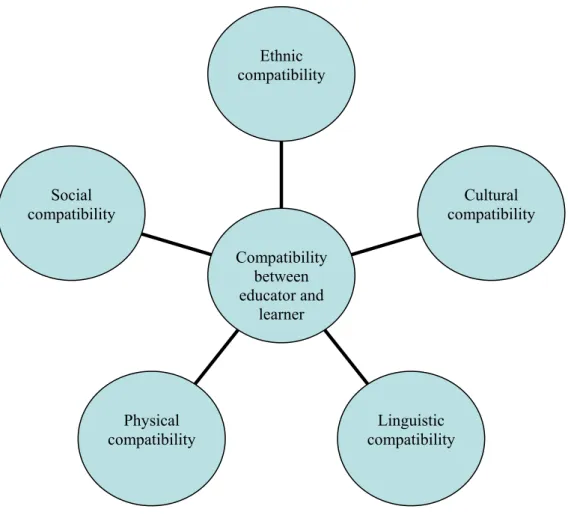
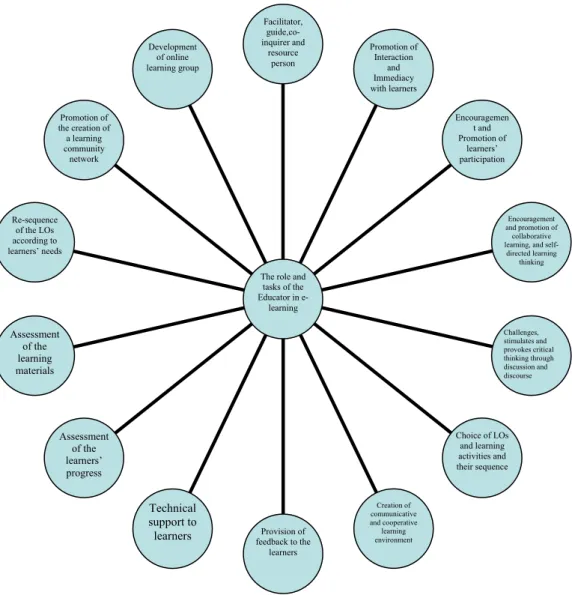
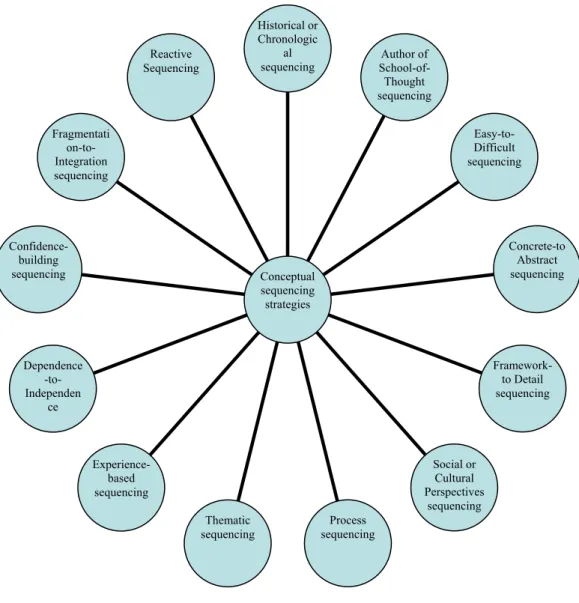
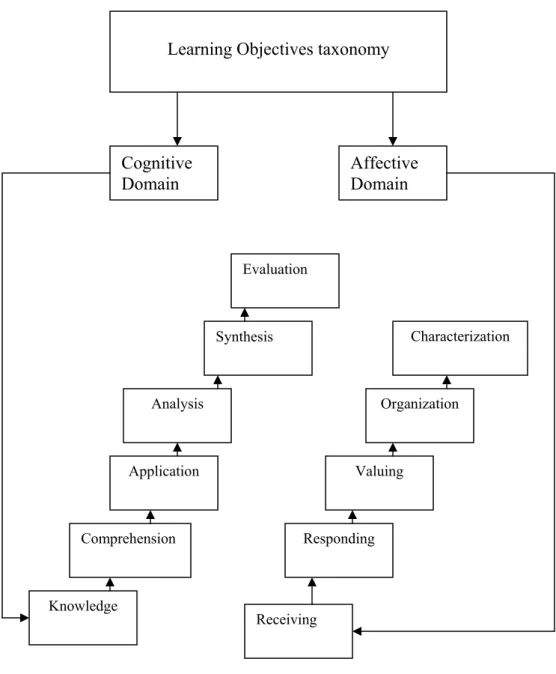
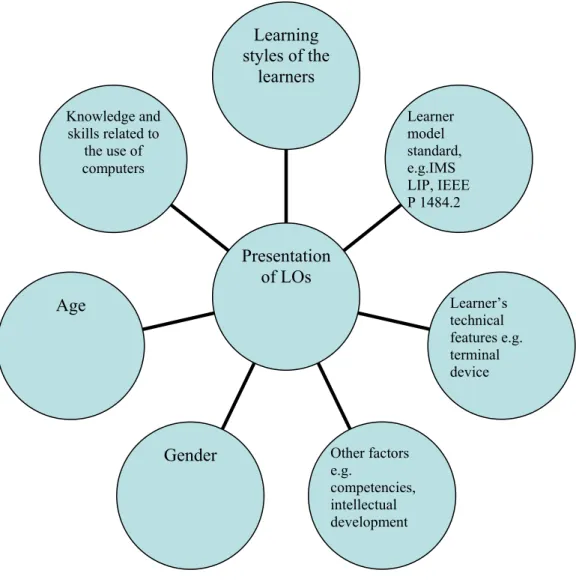
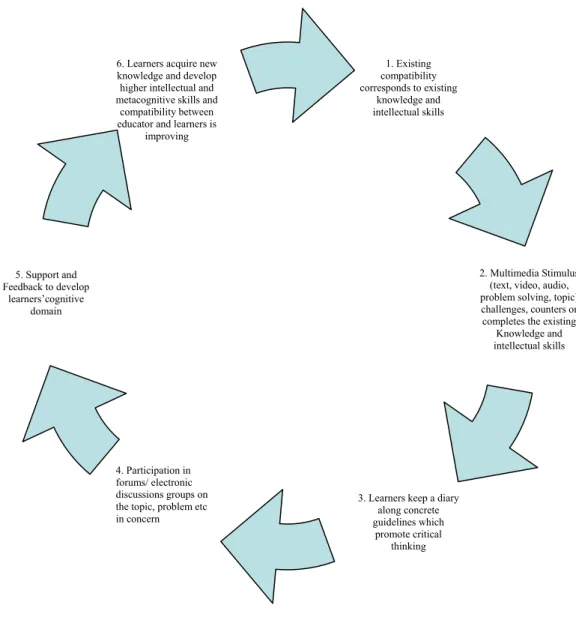
(11) The ESG Framework PhD Thesis of Maria Pavlis-Korres, University of Alcalá. List of figures Figure 1. The types of compatibility between educator and learner. 45. Figure 2. The role and the tasks of the online educator. 76. Figure 3. Cranton’s conceptual sequencing strategies. 99. Figure 4. Needs analysis taxonomy. 109. Figure 5. Learning objectives taxonomy. 112. Figure 6. The factors which affect the presentation of the LOs. 118. Figure 7. The instructional process in ESG Instructional Design Model for the development of the cognitive domain. 123. Figure 8. The instructional process in the ESG Instructional Design Model for the development of the affective domain. 124. Figure 9. The structure of the course addressed to Educators of Special Groups using Dokeos open source platform. 132. Figure 10. A possible structure of a Learning Path. 134. Figure 11. A new taxonomy refining the term “teacher” in LOM IEEE category 5. Educational, 5.5. Intended end user role. 138. Figure 12. Types of interaction which occur in the online environment for the education of educators of special groups. 142. Figure 13. Interaction between learner and interface as well as interaction between educator and interface runs through the other 3 types of interaction. 143. Figure 14. The conceptual e-framework for the educators of special groups (ESG) 146 Figure 15. The picture that triggered negative feelings for the most of the respondents. 164. Figure 16. The picture that provoked the most positive feelings to the respondents 165 Figure 17. Preferences on working individually or in a group. 167. Figure 18. Learner’s interface in the last step of the 1rst Learning Path. 180. Figure 19. Learners’ interface of the initial page of the course. 189. Figure 20. Course description in Dokeos platform. 190. Figure 21. Learners’ preference of Learning Paths. 205. Figure 22. Participants’ initial compatibility with Roma. 222. Figure 23. Participants’ initial compatibility with Roma. 267. Figure 24. Participants’ final compatibility with Roma. 267. Figure 25: Total differentiation of learners’ (ESG) attitudes towards Roma between the beginning and the end of the course. 268 11.
(12) The ESG Framework PhD Thesis of Maria Pavlis-Korres, University of Alcalá. Figure 26. Drawing 1: A plant is seeded at the beginning of the course, growing as the course proceeds and flowers in the end. 275. Figure 27. Drawing 2: The path of the course pictured as a series of bends, like a river, each bend corresponding to a learning path with the ones favoured by the learner (ESG) standing higher and carrying comments. 276. 12.
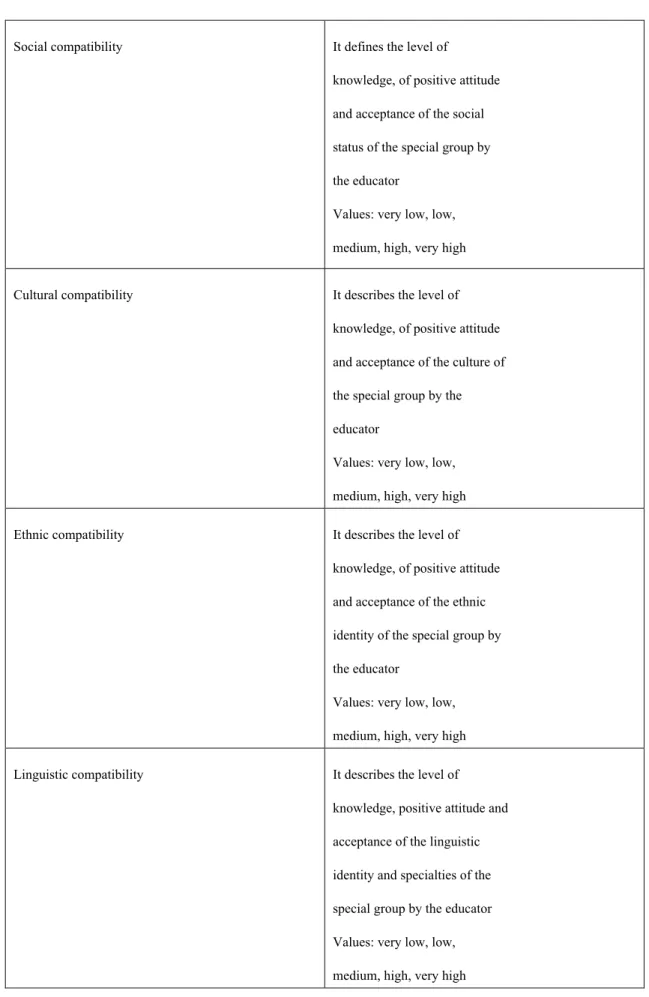
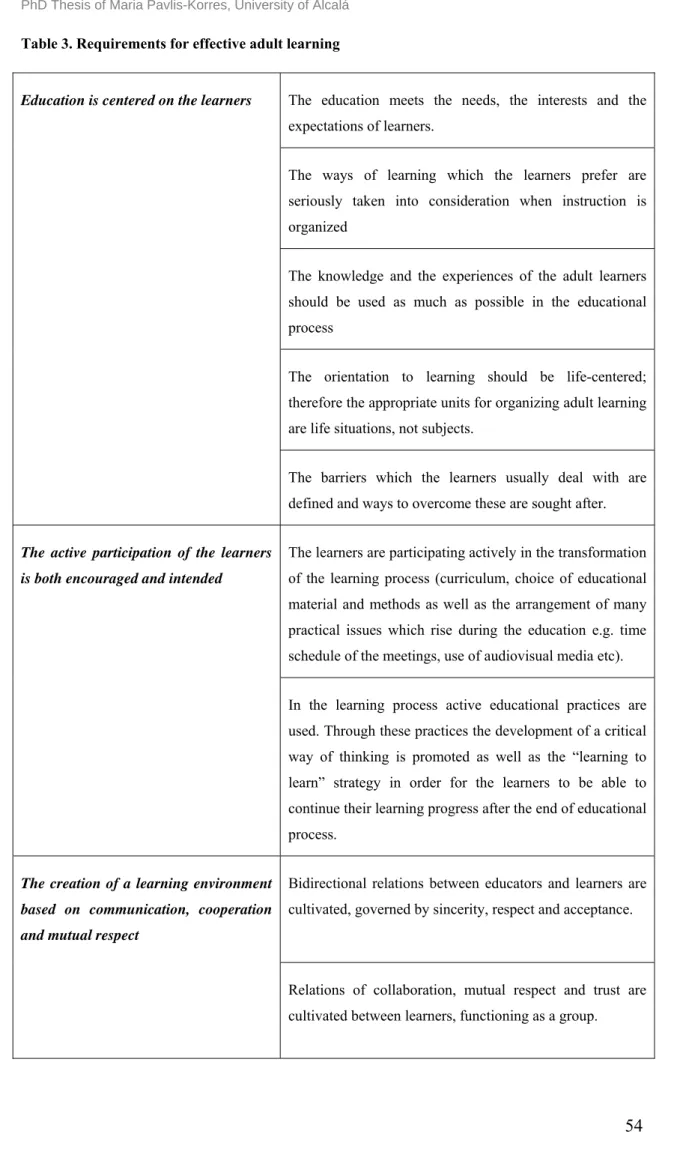
(13) The ESG Framework PhD Thesis of Maria Pavlis-Korres, University of Alcalá. List of tables Table 1. Vocabulary of types and values of compatibility. 46. Table 2. Characteristics of adults as learners. 50. Table 3. Requirements for effective adult learning. 54. Table 4. Conformance test between instructional process of ESG model and Kamradt and Kamradt theory and Simonson and Maushak. 126. Table 5. Classification. purpose. special attributes. 139. Table 6. Preferences on learning tools. 168. Table 7. Results for existing LOs in MERLOT repository related to our educational purposes. 175. Table 8. Educational objective and presentation type of the Learning Paths. 177. Table 9. Example of a LO Metadata Profile in ESG framework application. 181. Table 10. An overview of the course within its timeframe. 196. Table 11. Learners’ preference on the learning activities of the course. 204. Table 12. Use of the communication tools between participants and Administrator. 206. Table 13. Learners’ participation in threaded discussions. 207. Table 14. Learners’ participation in chat rooms. 207. Table 15. Type of interaction in relation with communication tools and learning Activities 208 Table 16. Announcements by administrator. 209. Table 17. Direction and distribution of e-mails during the course. 210. Table 18. Direction and distribution of SMS during the course. 211. Table 19. Learners’ participation in the Forum/threaded discussions throughout the course. 211. Table 20. Learners’ (ESG) affection by other learners’(ESG) comments in the forum. 212. Table 21. Learners’ participation in the course’s activities. 213. Table 22. Learners’ (ESG) favoured elements of the course. 214. Table 23. Elements of the course the participants would like to change. 215. Table 24. Elements of the course the participants would like to change. 218. 13.
(14) The ESG Framework PhD Thesis of Maria Pavlis-Korres, University of Alcalá. Table 25. Change of learners’ thoughts and beliefs regarding Roma people. 219. Table 26. Change of learners’ feelings towards Roma people. 220. Table 27. Change of learners’ attitudes towards the “different”. 220. Table 28. Change of learners’ (ESG) attitudes towards their Roma students. 256. Table 29. Change of learners’ (ESG) attitudes towards members of special groups. 257. Table 30. Change of learners’ (ESG) beliefs, feelings and behaviors. 257. Table 31. Compatibility of each learner (ESG) at the beginning and at the end of the course. 259. Table 32: The differentiation of each learner’s (ESG) attitude towards Roma between the beginning and the end of the course. 268. Table 33. Objectives of our research against results and areas for future work. 283. 14.
(15) The ESG Framework PhD Thesis of Maria Pavlis-Korres, University of Alcalá. Acknowledgments. It has been said that the course of a PhD is an essentially lonely journey towards the knowledge, the stamina and the creativeness of each candidate doctor. I had the luck and the joy of having several fellow travellers in the key sections of this journey, companions who softened the loneliness and the difficulty of each path that had to be followed during the 5 years of its elaboration. My faithful companion from the beginning till the end of this work has been my husband, Euripides Korres. I thank him from the depths of my heart for the evening discussions on the couch whenever I reached a dead end, for the endless hours of tireless support at all levels, for lending an ear whenever I needed one, for his creative contribution in every part of this achievement, for the Jobean patience he has showed during all these years of anxiety, stress and pressure, especially during the composition of my doctoral thesis. Luckily, for both of us, these years were also creative, joyful and pleasant. Miltiadis Lytras was the person that set me off in this course, opening new horizons for me and giving me the opportunity to convert the most difficult period of my professional life into an extremely productive phase. My supervisors Miguel Angel Sicilia and Elena García Barriocanal have encouraged and guided me all these years through the difficulties of my task, working with me in a most constructive and creative way. Elena, in particular, has stood beside me and supported me in everything I needed, from the most simple and practical matters through to my most significant scientific inquiries. Thanassis Karalis responded immediately and effectively to all my needs for the practical application of my thesis, which without him would have been very difficult, working with me in a flawless manner during its whole implementation. The whole group that took part in the pilot application gave life and substance to my theoretical model and, through their energetic participation, fertile thinking and 15.
(16) The ESG Framework PhD Thesis of Maria Pavlis-Korres, University of Alcalá. positive attitude, helped me test and restructure the material in its final form. The members of this group, in alphabetical order, were: Anagnostopoulou Sofia, Batara Sassa, Bofou Maria, Gotzari Elianna, Ioannidis Kostas, Karanika Anastasia, Kyriakopoulou Maria, Lappa Ioanna, Leftheriotou Piera, Pelekani Chrisso, Petroutsou Maria, Putsiakas Nikos, Roussou Katerina, Spanouli Rita, Vlastou Stergiani, Voulgaris Sotiris. My special thanks to: Rita Spanouli for our endless evening discussions in my place during the pilot application, for her patience and her support, but also for her feminine contribution in all the Roma matters we have been sharing since 1985 to this day. Piera Leftheriotou for the endless telephone calls on issues of my thesis relating to adult education and methodology, as well as for her support in the processing of the needs assessment in a very difficult period in her life. Platon Andritsakis for his contribution in recording and editing the Roma interviews and more so for the not smoking in the process, a real Hercules’s labour. Lilly Avlonitis for her contribution in recording the jokes in the educational material. Poly Karagiannis for her valuable help in sourcing articles. Ramiro Gomez for his immediacy in communication and problem solving in the use of the platform during the pilot application. Salvador Sanchez Alonso for his help during my preparation for the advanced studies degree. Dimitris Arapakis for his support and for having faith in me that I could pull it through with computers. George Papakonstantinou for his total support and help in using SPSS, his immediate response to all my inquiries and, not to be neglected for his supply of first class oranges and pergamonts.. 16.
(17) The ESG Framework PhD Thesis of Maria Pavlis-Korres, University of Alcalá. My beloved Roma Dimitriou family, grandmother Eleni, mother Maria, father Giannis and the children Thanos and Elena for the way they express their friendship by supporting me in every aspect. I also appreciate their good spirits, especially little Elena’s who was sick during the interviews and I thank them all for offering to non Roma the possibility of empathizing in their reality. Last but not least, I want to thank my mamma for her faith in me, her encouragement and her financial support in completing my PhD thesis.. 17.
(18) The ESG Framework PhD Thesis of Maria Pavlis-Korres, University of Alcalá. 18.
(19) The ESG Framework PhD Thesis of Maria Pavlis-Korres, University of Alcalá. Introduction. This is a research project aiming to create and prove a framework for the e-education of educators of special groups based on the assessment and improvement of the educators’ compatibility with their learners. The multicultural society being a fact in the 21st century, more and more educators and learners from different cultural, ethnical, linguistic and social backgrounds meet and interact in the educational process. In multicultural education, the educator’s role and capacity in empowering or dis-empowering learners has been identified as a major factor in the achievement of equal education prospectives for all learners. This becomes even more important for educators addressing learners belonging in special groups, where lack of compatibility between educator and learner could diminish the above educators’ role. In using the term special group we refer to the social group whose characteristics (social, cultural, ethnic, linguistic, physical etc) cause social exclusion, marginalization, and stigmatization, to its members (i.e. immigrants, Roma, repatriated-refugees, prisoners/ex-cons, ex-addicts, persons with special needs). By using the term compatibility we refer to the level of knowledge and acceptance of, and positive attitude towards, the special group on the part of the educator (Pavlis-Korres, 2007, 2009). On the other hand, the use of new technologies in education is rapidly increasing and provides education with enormous potential, facilitating learning and instruction. The shift from traditional classroom education to computer-mediated distance learning poses enormous challenges to instructors and learners. The rapid growth of the Internet and the needs of a mobile society have made online learning environments very attractive and numerous studies have shown that they are not only feasible, but they have many advantages over traditional education, such as the convenience of asynchronous participation, a permanent record of the class, and a plethora of analysis tools (Hiltz, 1997; Kearsley, 1998). Like any new technology, the implementation and optimization of online learning environments needs research and. 19.
(20) The ESG Framework PhD Thesis of Maria Pavlis-Korres, University of Alcalá. experimentation over a period of time and more so to approach the maximum potential this new technology offers (Clark, 2009). The creation of educational material using the computer mediated technology for an improved education of the educators of special social groups is, today more than ever, an interesting challenge. The main objective of this document consists in the development of a framework for educators of special groups exploiting E-learning technology to deliver personalized educating programs and provide appropriate educational material tailored to each educator’s needs anywhere, anytime, enhancing their compatibility with the learners and reducing the cost of the educators’ education. To achieve the development of such a framework, standing in the crossroads of learning technology, multicultural education and adults’ education, the necessary elements from all these main fields have been examined in the related literature. The notion of compatibility between educator and learners has been introduced as the main core of the whole approach and the instructional design theories on cognitive domain as well as on affective domain (attitude change) have been reviewed and adapted. In order to dovetail together E-learning, multicultural education, transformative learning and adult learning in a practical online learning environment, which will be educationally effective, the following research questions were inquired in this document: •. Which are the fundamental elements of adult learning that should be taken into account and integrated in the E-learning design?. •. Through which way should the elements of adult learning and multicultural education be integrated into the structure of the E-learning educational framework so that we obtain the most efficient educational result without dramatically increasing the cost?. •. Which are the most appropriate instructional design theories to be used in order to improve compatibility between educator and learners and how can these theories be effectively incorporated in an E-learning environment?. 20.
(21) The ESG Framework PhD Thesis of Maria Pavlis-Korres, University of Alcalá. •. Which vocabularies and extensions to existing metadata standards are necessary for us to create, in order to clearly define the educational material, so that it can be easily retrieved and then reused in other educational environments?. Sound answers to the above questions shall be provided through theoretical approach, development of the ESG Framework and a pilot implementation of this framework with educators of Roma in Greece. The ESG Framework intends to provide dynamic, flexible but clear guidelines to be followed in each phase of its structure by the designers, developers, administrators and educators, optimizing the personalized E-learning and effective education of the educators of special groups. Within this framework an instructional model has been developed integrating adults’ requirements for effective learning in an online learning environment. In the pilot e-course educational material, in the form of learning objects, has been developed and tested for the educators of Roma in Greece. The ESG Framework for the e-education of the educators of special groups will cover major needs of modern educational procedures and systems where multicultural education and E-learning take new dimensions due to the widespread immigration and globalization, improving the compatibility between educators and their learners. By exploiting the benefits of a flexible E-learning environment, organizations which educate educators of special groups could reduce the cost of the education and provide customized educational programs for the educators, overcoming the barriers of time and space. This document contains a theoretical part and a practical part. In the treoritical part the necessary elements of learning technology, multicultural education, adults’ education and instructional theories have been examined in the related literature, leading in the development of the ESG Framework. In the practical part of the document a pilot course for the education of educators of Roma in Greece has been carried out following all the phases of the ESG Framework and a pilot educational material -in the form of Learning Objects- has been designed, developed and tested.. 21.
(22) The ESG Framework PhD Thesis of Maria Pavlis-Korres, University of Alcalá. The qualitative analysis of the course as well as the formative and summative evaluations of the pilot application have provided valuable information for the weak and strong points of the ESG Framework so that remedies have been integrated in the final synthesis. Due to the fact that in our framework there are educators and learners, but the learners are educators themselves, in order to avoid confusion between the terms “educator” and “learner”, the initials ESG (educators of special groups) are added wherever it has been considered necessary.. 22.
(23) The ESG Framework PhD Thesis of Maria Pavlis-Korres, University of Alcalá. THEORETICAL PART. 23.
(24) The ESG Framework PhD Thesis of Maria Pavlis-Korres, University of Alcalá. 24.
(25) The ESG Framework PhD Thesis of Maria Pavlis-Korres, University of Alcalá. Learning Technology. “Learning objects currently lead other candidates for the position of technology of choice in the next generation of instructional design, development, and delivery, due to their potential for reusability, generativity, adaptability, and scalability” Willey (2000). The last decades have seen tremendous growth in the use of technology in education so that “Learning Technology” has now justified itself as a full discipline in is own right (Grooms, 2003). Learning Technology (also called Educational Technology) is the study and ethical practice of facilitating learning and improving performance by creating, using and managing appropriate technological processes and resources (Richey, 2008). Knowing for sure that Educational Technology does result in learning (Marshall, 2002) and provides education with new potential facilitating learning and training (Montgomery, 1995; Ziegahn, 2001, 2005; Beatty, 2002; Sadler-Smith & Smith, 2004; Conceicao, 2006; Hew & Cheung, 2007), our effort concentrates in selecting the most appropriate theories, media and solutions which learning technology offers for the purpose of our research. In the last years, the so called “digital revolution” brought the computer into the classroom in order to support and enhance pedagogical practices. Technologies available in classrooms today range from simple tool-based applications to internet based multimedia, e-mail communication, blogs, wikis and podcasts. The use of these technologies has a positive effect on education, motivating students, promoting learning, and changing classroom interaction (Picchio, 2001; Honey, McMillan Culp & Spielvogel, 2005), the most profound impact of the Internet being its ability to support and expand the various aspects of social learning. The era of E-learning 1.0, which was focused on using the internet to replicate the instructor-led experience, is long passed and E-learning 2.0 is built around collaboration. Understanding of content is now socially constructed through conversations about that content and through grounded interactions, especially with. 25.
(26) The ESG Framework PhD Thesis of Maria Pavlis-Korres, University of Alcalá. others, around problems or actions. The focus is not so much on what we are learning but on how we are learning (Brown & Adler, 2008). In literature two general distinctions have been made. Students can learn "from" computers—where computers are essentially tutors and technology primary serves the goal of increasing students’ basic skills and knowledge, or they can learn "with" computers—where technology is used as a tool that can be applied to a variety of goals in the learning process and can serve as a resource to help develop higher order thinking, creativity and research skills (Reeves, 1998; Ringstaff & Kelley, 2002). Wilson and Lowry (2000) have introduced three core principles concerning the effective use of the web in teaching: - Provide access to rich sources of information. - Encourage meaningful interactions with content. - Bring people together to challenge, support, or respond to each other. As Conrad (2008) points out “Our 21st century's e-learning conversation now involves issues of social networking, reflection, socialization, knowledge transfer, and simulation”. As the use of technology is not an end , but it is a means for the facilitation of learning, the most appropriate tools, techniques and applications which Learning Technology offers today have to be matched with the respective educational or training goals in each case (Kirkwood & Price, 2006). The elements found in most effective learning environments by current educational research (Saunders & Werner, 2002; Merill, 2009) which include problem-based learning, collaborative learning, activation of previous knowledge, demonstration and application of new knowledge, integration of new knowledge into the learner’s world and assessment of the learning process and learners’ progress, are also in line with the effective requirements of adult education (Cranton, 2000; Leftheriotou, 2005; Rogers, 2007). With ever-expanding content and technology choices, from video to multimedia to the Internet, Marshall (2002) suggests that there is an unprecedented need to understand the recipe for success, which involves the learner, the content, and the environment in which technology is used.. 26.
(27) The ESG Framework PhD Thesis of Maria Pavlis-Korres, University of Alcalá. One important factor for the above recipe of success is the collaboration between the people who create the technological means and the instructors, in a way that, through synergy, the appropriate learning tools and technologies are produced to support the various educational and instructional needs and efforts beyond the limits of time and space (Horton & Horton, 2003). In the context of our research, among the multitude of educational tools Learning Technology has to offer, the Learning Management Systems (LMS) seem to be the key tools supporting the aforementioned elements, as they favor the active learning focusing on the learner, improve relations between instructors and learners, foment the responsibility, improve the handling of time and space, offer equality of opportunities for learners, and facilitate the internationalization of education (Torres, Dodero, & Padron, 2004).. Learning Objects’ Instructional Technology. The learning objects paradigm (Downes, 2001) is deeply rooted in the evolution towards a knowledge society, which entails the need for lifelong learning and for more flexible, adaptive learning systems, inside and outside the public education system (Paquette, 2003). The use of learning objects (LOs) is a relatively newly emerged approach and technique for modeling and implementing learning contents. It promotes the reuse and sharing of learning material between institutions around the world. The use of the Learning Objects’ Instructional Technology in Learning Management Systems enables reusability and shareability of educational resources among different LMS, as well as in different context within each system (Horton & Horton, 2003). This is very important in our days as with the spread of new technologies of Information and Communication, we are living a huge demand for Web-based resources for work and learning and thus for the reusability and interoperability of digitized information materials (Jemni & Bahattab, 2005).. 27.
(28) The ESG Framework PhD Thesis of Maria Pavlis-Korres, University of Alcalá. Wiley (2000) quotes that “Learning objects seemed to be poised to become the instructional technology of online learning.” Horton & Horton (2003, p.538) refer that “Many predict that we are heading toward a learning-object economy in which people design, build, market, buy, combine, and deploy reusable modules of elearning content”. It has also been claimed that the learning object paradigm may transform online education. Whether these claims are going to prove valid or not, learning objects can always be employed to implement online learning strategies. Using learning objects technologies in appropriate ways enable teachers to have as much control as possible over the production process, and students to be supported to access online learning experiences in ways that suit them best (Reid, 2007). In order to facilitate the widespread adoption of the learning objects approach various advisory and research groups (e.g. LTSC=IEEE Learning Technology Standards Committee, IMS=Instructional Management Systems, ARIADNE=Alliance of Remote Instructional Authoring and Distributions Networks for Europe etc) have developed and promoted instructional technology standards and have worked towards the development of information content metadata. With such standards, universities, corporations and other organizations around the world assure the interoperability of their instructional technologies, specifically their learning objects. The main standards concern packaging, communications, metadata, and quality, and more are on the way (Wiley, 2000; Horton & Horton, 2003).. Learning objects. Many definitions of Learning Objects (LOs) have been given in as many attempts to express their meaning and yet universal definition is still missing. According to Wiley (2000) “the main idea of LOs is to break educational content down into small chunks that can be reused in various learning environments, in the spirit of object-oriented. 28.
(29) The ESG Framework PhD Thesis of Maria Pavlis-Korres, University of Alcalá. programming”. The LOs “are modular digital resources, uniquely identified and metatagged, that can be used to support learning” (National Learning Infrastructure Initiative). The Learning Object Metadata Working Group (1999) of the Institute of Electrical and Electronics Engineers (IEEE) Learning Technology Standards Committee (LTSC) quotes “Learning Object is defined here as any entity, digital or non-digital, which can be used, re-used or referenced during technology-supported learning” and the same in 2002 refers to LOs as "any entity, digital or non-digital, which can be used for learning, education or training”. Wiley (2000) restricted the above definition by charactering a Learning Object as “any digital resource that can be reused to support learning”. Some other definitions are more restricted as they connect Learning Objects with learning aims and under this scope LOs must not be confused with information objects (Metros & Bennet, 2002). Dalziel’s (2002, p.7) approach gives to the term "Learning Object" a more narrow meaning as he defines: “A Learning Object is an aggregation of one or more digital assets, incorporating meta-data, which represent an educationally meaningful stand-alone unit”. In the same direction McCormick (2003) supports that Learning Objects should include some learning objectives and outcomes, assessments and other instructional components. The New Media Consortium (NMC), as part of its Learning Object Initiative, has adopted the following definition for Learning Objects: “A learning object is any grouping of materials that is structured in a meaningful way and is tied to an educational objective. The “materials” in a learning object can be documents, pictures, simulations, movies, sounds, and so on. Structuring these in a meaningful way implies that the materials are related and are arranged in a logical order. But without a clear and measurable educational objective, the collection remains just a collection” (R.S. Smith, 2004). The above definition refers to any digital asset which can be used to enable teaching or learning. It does not require a learning object to be of some particular size. It may refer to many different types of objects, from simple images or video clips to collections of objects arranged in one or more sequences (Tzikopoulos, Manouselis, & Vuorikari, 2007). These learning objects can be delivered or accessed over the Internet or across a local or private network. Learning objects are instructional tools 29.
(30) The ESG Framework PhD Thesis of Maria Pavlis-Korres, University of Alcalá. which are more reusable and more able to be transported and used in multiple contexts than the traditional instructional tools. As Reid (2007) supports the learning object technology provides the capacity for interoperability, scalability and functionality in the development of E-learning systems. We are approaching a time when, through the design and deployment of learning objects, we can: reuse parts of training rather than starting from scratch every time; cost-effectively and quickly customize learning to meet the needs of the individual or small group; and, dramatically reduce maintenance costs (The Herridge Group, 2002). In the literature many questions and discussions arise, and most of them remain still open, concerning the size of learning objects (how large a learning object should be ), the level of instruction within which they will be used (course, unit or individual lesson), and the type of learning objects. There are different ideas on what is the lowest desirable level of granularity for reusable learning objects. Many researchers believe that it is desirable for learning objects to contain only one concept or one objective because they are more reusable or re-purposable than complex objects that focus on a number of concepts (Edwards, Rai, Phillips, & Fung, 2007). There is also some debate whether learning objects should contain instructional design data in relation with their reuse, as pedagogical and instructional design data may limit the reuse of a learning object to a particular context or learning method. Concerning the type of learning objects we must mention Wiley’s taxonomy (2000), which defines five types of learning objects according to certain qualities which learning objects have. Such qualities are the number of individual elements (such as video clips, images etc) combined in order to make the learning object, the type of learning objects that may be combined to form a new learning object, the reusable component objects, the manner in which the learning object type is generally used, the common function of algorithms and procedures within the learning objects, etc. It is the difference in the degree to which (or manner in which) they exhibit these qualities that makes one type of learning object different from another. The taxonomy differentiates between five learning object types: • • • •. fundamental combined-closed combined-open generative-presentation 30.
(31) The ESG Framework PhD Thesis of Maria Pavlis-Korres, University of Alcalá. •. generative-instructional. Wiley supports that his taxonomy of learning object types is instructional design theory-neutral, making it compatible with practically any instructional design theory (Wiley, 2000). Dalziel (2002) defines three levels of aggregation with the smallest objects “digital assets” consisting of the basic digital resources (e.g. texts, HTML, images etc), “learning objects” which consist of learning content with stand-alone educational value, based on one or more digital assets and last “learning activities” which include discussion groups and chat rooms and are made up of one or more learning objects. Furthermore, Edwards et al. (2007) have proposed a conceptual framework that defines four different levels of aggregration/granularity for Learning Objects: • • • •. data objects, information objects, knowledge objects and learning objects.. Each of the four objects has a different level of granularity and complexity. Data objects (e.g. images, videos, audio files) and information objects (e.g. an image or audio resource and textual document containing information about the image or the audio, a news item with or without images, a textual document which imparts information about a particular topic ) are free of pedagogical metadata while knowledge (e.g. lecture notes with or without added resources, a lesson that includes reference documents and a practical exercise, a document that gives instructions on how to carry out a problem solving) and learning objects contain pedagogical metadata. They conclude (Edwards et al., 2007) that learning objects could contain one or more data objects, information objects or knowledge objects. A Learning Object will contain educational metadata, learning objectives and may contain some form of assessment for the topic covered. Cheal and Rajagopalan (2007) have constructed a taxonomy to show the relationships between educational theory, instructional design and learning objects. They divide learning objects in simple and complex, accordingly to the possibility of reuse and the possibility of interactivity when used. Complex learning objects combine simple learning objects together to form larger objects that have the possibility of interactivity. 31.
(32) The ESG Framework PhD Thesis of Maria Pavlis-Korres, University of Alcalá. It is obvious that a number of unresolved issues still exists, which affects the reuse and interoperability of Learning Objects such as the absence of a standard definition for learning objects and their granularity or the absence of a common accepted typology of learning objects. Another issue, concerning the sequence of LOs, arising from the instructional design theories, is addressed later, under the relevant section.. Learning Object Metadata. Metadata is defined as structured information that describes, explains, locates, or otherwise helps retrieving, using or managing a resource. It is often called “data about data” or “information about information” (Wiley, 2000; Duval, Hodgins, Sutton, & Weibel, 2002; NISO, 2004). In the context of E-learning technology, standards are generally developed to be used in systems design and implementation for the purposes of ensuring interoperability, portability and reusability. These attributes should apply to both the systems themselves and the content and the metadata they manage (Friesen, 2005). The development of technical standards and specifications in E-learning can be seen as part of the maturation of this recently emerging field or industry (Friesen, 2005). Several metadata specifications have been developed in recent years. These include IMS Metadata, Dublin Core, ARIADNE and CanCore specification. With the joint submission of metadata specifications by IMS and ADRIANE to IEEE LTSC, the joint specifications have since been approved as a standard and renamed as IEEE LOM (Koohang & Harman, 2007). According to the IEEE Learning Objects Metadata (LOM) characteristics of a. specifications,. Learning Object (LO) are grouped under certain categories:. general, life-cycle, meta-metadata, technical, educational, rights, relation, annotation,. 32.
(33) The ESG Framework PhD Thesis of Maria Pavlis-Korres, University of Alcalá. classification. However, the LOM standard is a general-purpose specification and in many cases it does not capture the specificities of certain domains. For this reason, metadata systems allow for extensions so that particular needs of a given application can be accommodated (Duval et al., 2002). Such extensions may take the form of new terms for existing vocabularies, new vocabularies for existing elements or new elements. Many researchers have proposed new ways of categorizations of metadata, namely Recker and Wiley (2001) who differentiate metadata that is created by the original design team of learning objects, calling them “authoritative metadata”, from the metadata which is generated by users, calling them “ non-authoritative metadata”; Sanchez and Sicilia (2003) have proposed the Design by Contract (DBC) learning objects, providing metadata information expressing requirements and outcomes as the best way of “preparing” learning objects to a later search, selection and retrieval from LO repositories; many others have advocated going beyond the existing description model with a greater emphasis on instructional design and pedagogical aspects for more effective use and reuse of learning objects (Koohang & Harman, 2007). Whatever the system of specifications used to describe LOs, metadata play a vital role in efficient search, retrieve and adaptation of resources, as well as in combining them for creating new learning experiences.. Learning Objects, instructional design and andragogy. In order to enable teaching or learning, learning objects have to be connected with instructional design theories and pedagogy/or andragogy1 (depending on the age of the learners). Bednar et al. (1991) pointed out the importance of linking theory to 1. Andragogy is a term first used by Malcolm Knowles, to describe the education of adults. In contrast to pedagogy, the teaching of children, Andragogy refers to “the art and science of teaching adults” (Knowles, 1980, p.43). 33.
(34) The ESG Framework PhD Thesis of Maria Pavlis-Korres, University of Alcalá. practice in the design and development of any instructional system and emphasized that “… effective design is possible only if the developer has a reflexive awareness of the theoretical basis underlying the design”. In the same direction Wiley (2000, p. 29) quotes “Like any other instructional technology, learning objects must participate in a principled partnership with instructional design theories if they are to succeed in facilitating learning”. He also notes that the potential of learning objects as an instructional technology is great, but will never be realized without a balanced effort in technology and instructional design areas. Lim (2007, p. 90) stresses that “The driver of a successful learning object-based environment, like any other online environment, should be pedagogy and not technology” and points out that “Learning objects by themselves will not transform learning. Transformation comes by incorporating learning objects as an integral part of curriculum”. Furthermore, some have already indicated that without clearly stated instructional objectives, the development and use of learning objects is subject to becoming just another technological fad (Hudak, 2007). Instructional design considerations entail the most appropriate way of designing an instruction for teaching while pedagogical/andragogical considerations focus on how learning. occurs.. Both. instructional. design. and. pedagogical/andragogical. considerations are required to complement each other in the design of effective instruction and learning (Lim, 2007).. Instructional Systems Design. Instructional Systems Design (ISD) is the systematic process in which all parts (teachers, students, materials, and learning environment) are considered critical to successful learning (Dick & Carey, 1978; Dick, L. Carey, & J. Carey, 2001) The process broadly consists of determining the current state and needs of the learner, defining the end goal of instruction, and then designing, developing, implementing and evaluating the instruction (Gagne & Briggs, 1979; Cranton, 2000; Gustafson & Branch, 2002; Kruse, 2002; Malachowski, 2002, L. Nadler & Z. Nadler, 2003;. 34.
(35) The ESG Framework PhD Thesis of Maria Pavlis-Korres, University of Alcalá. Koohang & Harman, 2007). There are many instructional design models but most are based on the ADDIE generic model (Kruse, 2002; Malachowski, 2002; Molenda, 2003), an acronym used to designate the five steps process of instructional design which begins with Analysis, Design, Development, Implementation and Evaluation. Each step has an outcome that feeds the subsequent step. During analysis, the instructional problem and the goals and objectives are clarified, while the learners’ needs, existing knowledge, skills and attitudes, and any other relevant characteristics are investigated. Analysis also considers the learning environment, any constraints and the delivery options. During Design phase, a systematic process of specifying learning objectives takes place.The Design phase is where the instructional strategies are designed and media choices are made. The actual creation of the content and learning materials based on the Design phase is completed in the Development phase. During Implementation, the plan is put into action and a procedure for training the learner and/or educator is developed. Materials are delivered or distributed to the learners’ group. After delivery, the effectiveness of the training materials is evaluated. The phase of Evaluation consists of formative and summative evaluation. Formative evaluation is present in each stage of the ADDIE process. The ADDIE model proceeds from one stage to another with formative evaluation and revision occurring throughout the design process to ensure that the object of design does not run askew from the instructional goals (Farrell & Carr, 2007). Summative evaluation consists of tests designed for criterion-related referenced items and providing opportunities for feedback from the users. Sabau (2007) supports that the ADDIE model is applicable to the creation of learning objects and there are many models concerning E-learning which have been based on the strengths of ADDIE model e.g. the ‘Learning Object Design Model’ (Farrell & Carr, 2007). Dick and Carey (1978), with their Systems Approach Model, view instruction as an entire system focusing on the interrelationship between context, content, learning and instruction. The components of the Systems Approach Model, also known as the Dick and Carey Model, are: Identify Instructional Goal(s), Conduct Instructional Analysis, Analyze Learners and Contexts, Write Performance Objectives, Develop Assessment Instruments, Develop Instructional Strategy, Develop and Select Instructional. 35.
(36) The ESG Framework PhD Thesis of Maria Pavlis-Korres, University of Alcalá. Materials, Design and Conduct Formative Evaluation of Instruction, Revise Instruction and Design and Conduct Summative Evaluation. With this model, components are executed iteratively and in parallel rather than linearly. Reigeluth (1996) supports that the Instructional Systems Design (ISD) process is basically a process for making decisions about the nature of instruction - the nature of ways to facilitate learning. His new paradigm of ISD models view the ISD process as an iterative series of ASEC cycles (Analysis-Synthesis-Evaluation-Change) for progressive sets of design decisions. He defines Analysis, Synthesis and Evaluation as three useful activities for making good decisions and draws attention to issues of Change needed to support the instructional system. Lim (2007) lists some of the major instructional design processes which constitute the macro perspective of a design for instruction: 1. Identifying learning/training needs and outcomes (needs analysis in order to fill the gap between existing condition and the desired one) 2. Specifying learning/training goals based on the learning/training needs (specifying goals) 3. Formulating learning objectives 4. Establishing structure for instruction and learning, which include the nature and scope of domain knowledge, skills and attributes to be covered, course structure, course duration, prerequisites, learning resources, support etc. 5. Determining assessment strategy 6. Evaluating the course or module or program All the aforementioned approaches converge in the basic five steps of Analysis, Design, Development, Implementation and Evaluation and in all of them the process begins with a rigorous analysis of the needs of the learners on the subject of the course and the outcome of this analysis leads to the development of the learning objectives of the course. The learning objectives lead to the determination of the necessary course materials, which are then broken into units or modules. At this stage designers and developers may collaborate with instructors for the creation of the learning objects. When the learning objects and structure of the course are in place,. 36.
(37) The ESG Framework PhD Thesis of Maria Pavlis-Korres, University of Alcalá. the instructor will then implement and evaluate this design by engaging the learners in participating in the course and facilitating their mastery of the subject. Feedback and observation of the learners’ learning process and manipulation of the objects leads to continuous improvement and re-evaluation. The learning objects thus created become self-standing modular units, which can be re-organized in a variety of sequences depending on the objectives at hand (Sabau, 2007). As we have seen in the aforementioned approaches the process of instructional system design and development is described as a larger or smaller number of stages/phases. Often the process is presented as a series of stages and often these procedures and their relationships to each other are shown in flow charts or diagrams. Gagne and Briggs (1979, p. 20) emphasize “that in practice there is much “recycling”-going back over previous work, modifying it in view of insights gained later. There are also “forward projections” which are later revised”. And they noted (p. 40) “That is to say, in practice there is much working backwards and forward in a non-linear fashion, because work done at any one stage gives new insights into other stages” and (p. 21) “These second attempts to improve work at various stages, while costly in time and effort, actually do improve and strengthen the system, as do the later changes which are occasioned by formative evaluations and field tryouts. Even experienced designers have learned to expect imperfections in their first efforts. It is this very recycling, based on empirical testing of the system, that leads to its later effectiveness”.. 37.
(38) The ESG Framework PhD Thesis of Maria Pavlis-Korres, University of Alcalá. 38.
(39) The ESG Framework PhD Thesis of Maria Pavlis-Korres, University of Alcalá. Multicultural education “An important aim of teacher education in the first decades of the new century is to help teachers acquire the knowledge, values, and behaviors needed to work efficictively with students from diverse groups. Teachers also need to acquire the knowledge and skills necessary to help students from mainstream groups to develop cross-cultural knowledge, values, and competencies” J.A. Banks & C.A.M. Banks (2001). Diversity is a principal characteristic of all the expressions of life in modern multicultural society, with the education area unquestionably included. Educators and learners of different cultural backgrounds inevitably meet and interact in educational procedures (Freire, 1970; Brookfield, 1986, 1995; J. A. Banks and C. M. Banks, 1989; Knowles, 1998; Mezirow, 1991; Gorski, 2001; Ndura, 2006; Rogers, 2007). Educators take/bring with them in the classroom their values, beliefs, dispositions, and practices which will influence their ability to work with learners effectively. Their knowledge, awareness, understanding, and attitudes towards learners – especially those who are ethnically and culturally different from themselves – will necessarily influence the teaching and learning dynamic (Jackson, 1995). There has been growing debate about the best way to face the educational challenge of learners’ diversity (Coballes-Vega 1992). Some researchers (S. M. Wilson, 1990) have raised questions about the efficacy of teacher education programs attempting to deal with learner diversity and exploring changes in prospective teachers' roles. However, other researchers (J. A. Banks and C. M. Banks, 1989; Bennett, 1990; Sleeter and Grant, 1988; Gay, 2000; Villegas and Lucas, 2002; Irvine, 2003) not only support teachers’ educational programs but they have also recommended the content that must be included in the teachers’ education curriculum.. 39.
Figure
+7

Documento similar
It is generally believed the recitation of the seven or the ten reciters of the first, second and third century of Islam are valid and the Muslims are allowed to adopt either of
ABSTRACT Transformation of the Specialized Knowledge of Future Primary Teachers on Fraction Division
From the phenomenology associated with contexts (C.1), for the statement of task T 1.1 , the future teachers use their knowledge of situations of the personal
In the preparation of this report, the Venice Commission has relied on the comments of its rapporteurs; its recently adopted Report on Respect for Democracy, Human Rights and the Rule
The main goal of this thesis is to contribute to the knowledge in planetary science through the study of the upper atmosphere of giant planets undergoing hydrody- namic escape. We
The main goal of this work is to create an extensible 3D based crowd simulation framework that enables the simulation of crowds with a special focus on the navigation, crowd
We seek to characterize the transport in a time-dependent flow by identifying coherent structures in phase space, in particular, hyperbolic points and the associated unstable and
“ CLIL describes a pedagogic approach in which language and subject area content are learnt in combination, where the language is used as a tool to develop new learning from a
In the “big picture” perspective of the recent years that we have described in Brazil, Spain, Portugal and Puerto Rico there are some similarities and important differences,
