
Mapa Geológico de España E 1:50 000 Hoja 933 ALCANTARILLA
26
0
0
Texto completo
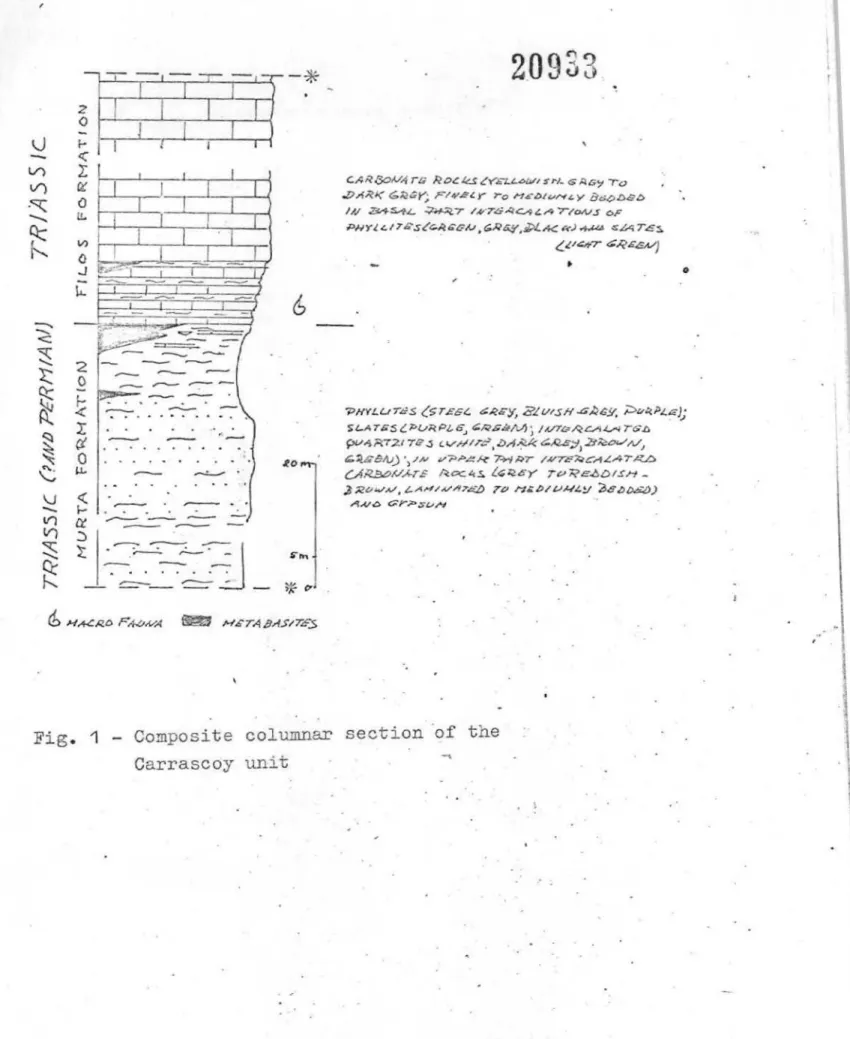
(2) I n t r o d u c t i o n. 209UU. -----------------------. north-easterr-. prolongation - is an isolated raoun-uain. formin3 its ranEe. in considerable detail br W.. been studied. team from the. Kampschuur1s. 1. end. of 1972,. Carrascoy ation. 1.. :. in a thesis entitled:. zone.. ¡.e.. Filabride. (2). complex,. complex,. investigations. A recent. see also. the. unit,. (d). schome of the. geology,. Carrascoy forms part. and. (4). (b). the. of. the. Generally indí-. which is. 1959 b).1. g¡ves U-. general CD. `%-,he. four major tectonic. the L.-lalaguide. (1). complex.. outlines units. the L'evado(3). t_'-,e. KampscIr-uur1s. Garrascoy have resulted in the. units,. ¡.e.. (from below to above�:. Carrascoy unit,. (e). the Pestillos. the Navela unit. Fol-owing the foreEoinE tectonic Zone,. Betic. the Romero and. Carrascoy units may be. referred to the Ballabona-Cuchar6n complex, to. the. given in the. the Ballabona-Cuchar6n complex,. in the Sierra de. Romero unit,. and. cross-sections,. the. (from below to above):. distinction of foar sepa-rate (a). the Sierra de. su,-.,mar-izing publication by. eas-V'.-ern part. 'V'J'ithin its. are distinEuished,. Alpujarride. 50.000,. Cordilleras,. Zo-nel.. Egeler & SÍ:non (1969a, of this. :. GeologT of. on alpine pol-yphase deform-. - The Sierra de. of the Bet-ic IBetic. cated as the. Carras-. Sierra de. either based on or copied from Kampschuur's. are. setting.. zone. Cordilleras.. adaptation was made by 0.G. Egeler.. The. Geological internal. with emphasis. '. and the description of the. present manuscrípt, manuscript.. of the Betic. His results will be published before. geological map 1. illuslurations. a member. University of. Institute of the. eastern part. 10.000.. (SE Spain), The. Kampschuur,. included the mapping of the. studies. coy on a seale the. Geological. working C) in the. Amsterdam,. geoloEj, has recently. I~Gs. trendin- approximately. of the. Sierra del Puerto. Carrascoy - together-wi-uh the. The Sie=a dc. the Alpujarride. co--,,-Dlex,. and. the. the l�l-avela unit. Pestillos unit to. the. complex-. Previous work.. - '*_hen n"-ampschuur started mappin�;. Garrascoy in 1967,. no detailed investi6atílons within this. reSion. ho-wever,,. consi-. had yet been ca=íed derable difference. --.,he Sierra de. out.. Older. .,iritinc-c3 reveal, w. of opinion concerning the. stratiuraphy and. 1 ó Í.
(3) 2. 20 9 `3 the. Sorae examples m-ay be. tectonics.. originally described Icrystalline but. the. in a later publication. the rocks to (195C). them -cith the. a single nappe a Mesozoic. Blunenthal,. cover.. left. open the. in the east. Sierra de. (Blumenthal.,. lAlpujarrides'.. Patijn (1937),. of the western Sierra de. the. in his. Staub. (1934). latuer believed. Delga & Fontboté. represents. and. the rocks. of Mala-a,,. elements. but. are presen-u. (1960) ranged the. complex.. In 1964 Simon forwarded the hypothesis that leasb partly,. but. turn, referred. Carrascoy within the Alpujarride. Carrascoy,at. the. first referred. 1933),. Carrascoy to the Betic. Durand. to. with an Hercynian basement. possibility that Alpujarride Las-uly,. consisting of. sequence. on the other hand,. to be represented,. (19710). with a cover of Penibetic,. (1948) referred. the Betic of 'LIa-iaEa. ranged. Fallot. Sierra de Carrascoy as. of the Sierra Nevada'. Betic of lv.,ala,�:a.. mentioned.. the Sierra de. the Alma-ro unit,. a major. tectonic element distinguished by him in the Sierra de Alma-ro (1063).. The presence,. one tectonic. unit. distinguished gave the and the. five. within the. Sierra de. Carrascoy,. was pointed out by Az6ma et al. separate. following tentative. elements.. (1965),. who. (l9ó3). in the. elements. Sierra de. Almagro: Sierra de AljaZro Betic of. Sierra de Carrascoy. ZialaCa. element. 5. Variegato unit. element 4. Ballabona-Cucharón unit. elements. Almagro unit. element. Later investigations elements. 1 and. led Simon (1966 a). 3 of Azéma et al.. than. Bodenhausen & Símon (l9ó5). correlatíon between these. units distinguished by Simon. of more. 3 and 2 1. to conclude that. (1965) form part. the. of a sin-le. tectonic unit. - the Almagro-Cuc'-r-ar6n unit. - with a continuous. stratigraplAc-. succession. l9ó6 b).. (see also Simon,.
(4) S t r a t i g r a p h y. ----------------------Romero unit. General statement Aecordin¿ to Tampschuur (1972) this lowermost tectonic unit of the Sierra de Carrascoy embraces two formations: top: Fuente Aledo formation carbonate rocks; intercalated slates; locally quartzites, gypsum and rauhwackes*) Pocito formation argillites and slates; quartzites; local intercalations of carbonate rocks Within sheet Alcantarilla only the Pocito formation is represented. Pocito formation LitholoEy. - The rock sequence of the Pocito formation ecnsists essentially of an alternation of red, greyish-purple, yellow and green argillites, and purple, grey, Green and brown quartzites. Brownish-yellow, mediumly bedded carbonate rocks are locally intercalated. Fossi1s. - With the exception of burrow-structures in the argillites and quartzites, no fossi1s have been found.. *) The rock sequenres oi all 2our tectonic units distinguished in the Sierra de Carrascoy contain rauhwackes. In a recent monograph on rauhwackes Leine (1968) discussed the Eenesis of these rocks and tneir distriburion within the Permo-Triassic to Triassic rock sequences of the Betíe Cordilleras. le claims that the rauhwackes are weathered carbonate breccias of tectonic oriGin (see also Leine & Egeler, 1962) and distinEuis'hed two mair. types, ¡.e. (T) monomiet rauhwackes formed, in tie first place, by frag~ mentation of only one type of rock, and (b), polymict rauhwackes, formed by fraEmentation and mixin3 of two or more types of rocks. Boti types of rauhwackes are usually develosed in zones parallel to the Eeneral stratilication and are mostly closel-y associated with evaporites..
(5) 4 A. 209`9. ra. Ik. V). ¿. leo. Fig. 1. Z,.4. 7-HA1,1. Composite columnar section of the Carrascoy unit.
(6) 2 0 9` Contact relations. exposed.. In the. The base. the formation is. part of the Sierra de. sheet Alcantarílla the Focituo 'post-nappe. of. deposits'. unit. Further to the. sequence. is commonly overlain by. senting the higher part - No more. of. Carrascoy. in the Sierra del Puerto,. Pocito formation are foun.d in tectonic. Th-ickr-ess.. Carrascoy lyinE withir-. and locally by rocks of the east,. nowhere. rocks of the. contact with rocks. repre-. the Fuente Aledo formation.. can be. said than t--hat. the. mínirum exposed. thickness amounts to 40 m.. The. combined. data on the macro- and mic--ofauna from the. Aledo formation of Sierra de. the. Carrascoy. Romero unit. (sheet Totana). essentially of Ladínian a-e.. southern part of the. sug6es-U". that. this. sequence. is. The rocks of the underlyinE Focito. formation of the Romero unit may be Ladinian. in the. Fuente. tentatively _referred to. the. (? and older).. Carrascoy unit. (see Fig.. 1). General- s tat ement The. Carrascoy unit, which tectonically overlies. Irom a regional schuur, top... point. of view,. comprises. the Ronero unit. two formations. (1',amp-. 1972): Filos formation mainly ca-rbonate rocks part. intercalations. (part-'-,v, rauhwackes):. of phyllitues and. in basal. slates. Murta formation alternation of upper part rauhwackes). phyllites,. intercalations and of. quartzites;. of carbonate rocks. in. (partly. gypsum.. The upper part of the rock locally contains basic. slates and. sills,. sequence. of. the :áurta format-Lon. represented by metabasites..
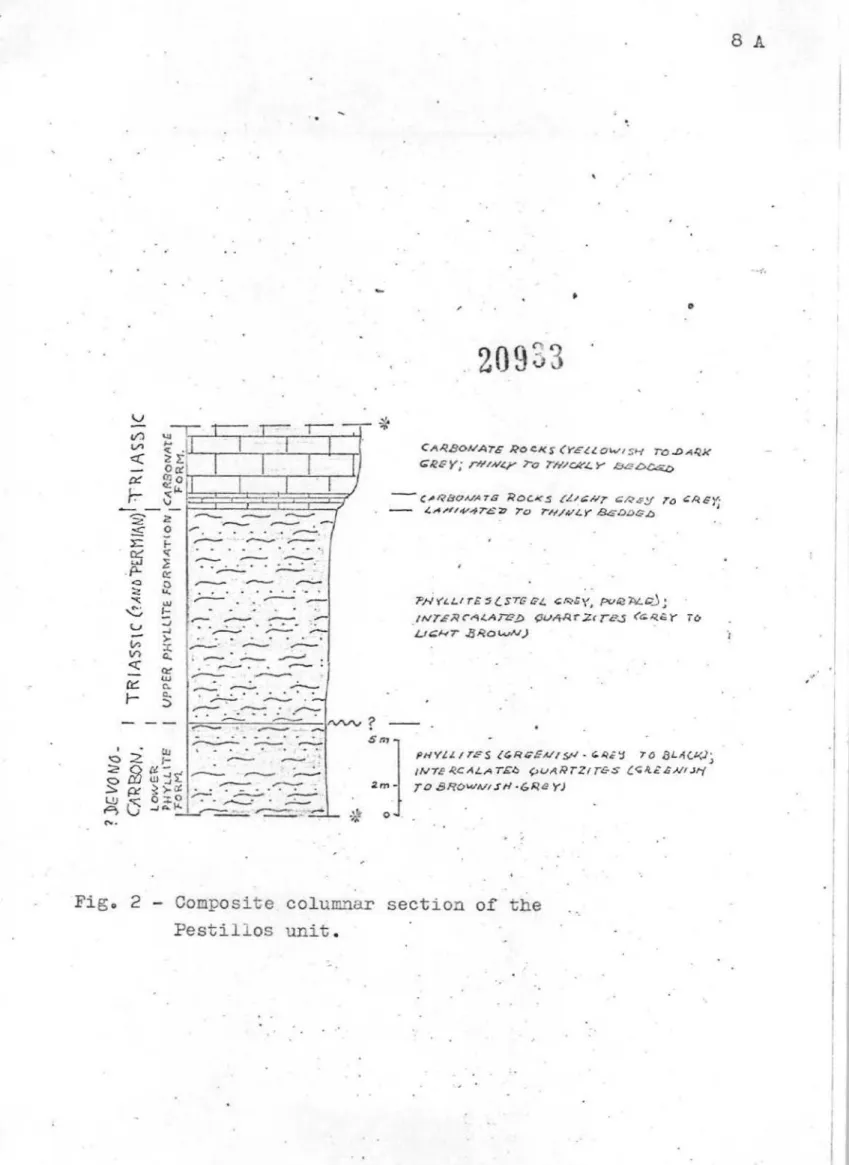
(7) 20 9 -D 1.1.urta-formation Lithology.. - The rock sequence of the I-Jurta formarion mainly. consists of phyl_lites, with colours varyinF_ from steel Grey to bluish-grey, dark gre-, and purple. There are local gradatiors into slates,. characterized by purple and Sreenish colours.. ted to medium1y bedded quartzites, brown and green colours, oceurs in the topmost. TI-Jamina-. exhibitin- white, dark Erey,. are present as intercalations,. Gypsum. part of the Murta sequence, vihich also. contains intercalations of laminated to medium-iy bedded carboriate rocks.. The presence of gypsum within the rock seque-nce of the Lurta formation calls for attention, as this is a very characteristuic feature. Layers shoviing a banding parallel to the general stratification indicat-e that the gypsum is partly normally in-1U--ercalated. However, gypsum also oceurs as irregularly shaped masses (up to 100 m thick) with a chaotic structure and obviously resulting from tectonization. Locally the formatíon is exclusively represented by -vpsum. Abundant foreign blocks are enclosed, exhibitin- a randor. orientation. They mainly consist of rocks of the ¡¡'!ur-ta or the Filo S formation, but at the contact with rocks of other tectonic units fraEments derived from. the latter may also be present. The ej-psum masses, both. laterally and vertically,grade into meSa-breccias, containing polymict rauhzackes as main constituent. Fractures in quartzites may contuain malachíte and azu--rite 700 m E of Casas de la Fuente del Pino). Fossi1s. - With the exception of burrow-struct-ures no fossi1s hwíe been found. Contact relations. - Tne base of the Murta forma-tion is formed by a major thrust-plane. The boundary v.jith the overlying Filos formation is of normal stratiEraphic nature; the contactu is conveniently drawn where carbonate rocks become predomínant. Thickr.ess.. - m_he ex-osed thickness of the LIurta ser.,u.,,n-ce varias. from 0 - 150 m..
(8) 6. Filos fornation Lit11olo6~Y. searps.. The rock. dark grey, tions. - The rocks. of. of: the Filos formation give rise to. sequence. r_ainly consists. mediumly bed*,Ijed carbonate rocks.. finely to. greyish-black and. Ereer- phy1. slates are found in the basal part of of pyrit-e. cubes. is characteristic.. widespread distribution; sometimes pass abrupt1y Haematite Fossi1s. the. is -. present. 14. -�-tu-es. the. or of. The. D--esc-,¿,---e. in the basal part. of the Filos a_-e found. shell remains. contain well-preserved Aviculopecten. rocks. sequence.. in some. part of the. (Dr.Fr.Hirsc,h,. formation is. of. layers wh.-ch. into non-brecciated carbonate. - The Filos. -reen. Lonomict rauhwack-es are. Green slates from the basal. Contact relations.. intercala-. liGht. succession.. the-,» form discontinuous. Indeterminable. carbonates.. of yellowish-Erey to. of. formatior,. pers.co=.).. tectonically over-. lain by the Pestillos unit. Thickness.. - The maximum exposed thickness. The for-i-,iation wed6es out Igneous rocks.. amounts. to 190 mw. locally.. - The principal body of metabasite. the top of the 1.11urta formation,. v;here. it. attains. is located at. a thiccness. of. 70 M. �kEe An exact. datuing of the. is rendered. contact-. the. a detachment. -01ane. Carrascoy unit. with the u_r_derlyinC 2,oLero unit.. (Simon,. 1969;. of the rwo unitLI-s. rock sequences. stra�ui-raphic. the Romero. 'independer.t'. nappes,. open.. case. In that. a Triassic al�e.. see also 10 66 a). one. the. lf. merely. is. that the. of a conti-. If,. on the. Carrascoy unit represent Car_—ascoy sequence. car- on1y statue that. the. one. Carrascoy unit. of the Romero unit.. unit and the the aEe of. - i.e.. initially fo-rmed part. succession - the rocks o_f the. are obviously you-n>c-zer than those other hard,. the. impossible by the lack of diaGnostic, fossi1s.. assumes that. nuous. sedirentary rocks of. is. two. entuirely. sugEests.
(9) 20 k`etabasites bodies of basíe. As mentioned already, the. sequer.ce. term. of the. in view oi. regional metamorpnism which the --ocks ha-ve liave. original diabases. by the. occurrence. the. and. of fínely granular. General. Stíll,. 'u.'.ney. textural and. oriGin -indicate. T'-,-Ie intrusíve r.ature. The. low Srade. suffered.. invariably retained their massive habit. mineralogical relies of magmatic. oecur. (Iiurta formation).. Carrascoy unit. seems appropriateg. Imetabasites'. i6-neou-s rocks. that. they are. of t.,ie bodies. is. 'chilled borders'. evidenced. and by. metamorDhism suffered by the ad-jacent. sediments.. the country rock. and the bodies are obviously. is a1ways concordant. Tne relation- wJLth. sills. PetroEraphy. colourless biotite, quartz. - Relict minerals. e--Lino-pyroxene,. plagioclase. origin inc-Iude:. brovj--i to Ereenish-brown hornblei-de, ar-d. (An 37-50). c,�rai-,ophyrie. interC-rowths. of. and pot-ash-fe1dspar.. The minerals actinolitic less. of ma --- r_-íastic. mica,. produced. amphibole, chlorite,. Al! transitions ophitic texture. by metamorphj.--a inc-lude: crossíte.. Quartz and. are. (rare),. albite,. minerals of. bluish-Green essentially. CO�.OUI'-. the epidote-Urou--... found from rocks with a Dractical1v in-lact. and w¡th abundant relict. minera_s,. to rocks. -uhe. igneous orig--'In of which is bareiy reco6nizable under the microC) seope.. PlaGioclase. aggreZates. of. is usually completely pseudomor-hosed by. colourless. contain chessboard. raica ar-d. aibite,. epidote. minerals.. Some. slides. presumably formed by aibítization. of. potash-feldspar. The assembiaje. of minerals formed by metamorphisr, indicates. greenschist facies.. However,. sugGests local transition Contact phenomena. may exhibitto. several. spots,. a chanGe tens. to. the. oecasional. the u. glaucop�iane. of centimetres. ly to-ether with bio-4LI-¡te,. minerals at. in width). colourless. suGGests that the the. E---.-*-t -J,. - Carbonate rocks a-u t1,_e in in colour with a narroví zone. cor.sistin�-, of carbonu-le material,. Kampschuur. presence. cor-t�;,cts of the. the. of cros-site 'acies.. (measurinl.7 up. and futher brownish albitue a---d ore,. mica,. chIorite and epidote.. absence. thick basic. oj-" h¡.b-h temperature. sills,. combined v:¡th.
(10) Ty; cr. P-o. ct�. z. v,4. ¿. -rC Z--j_ 4. y% pue 7y_ 4jr Tó. i, V) <. uj. Fig. 2. í 1 7'.E� S ¿C.. Composite columnar section of 4L--.he Pestillos unit.. C. Ñ¿ v. 7. L A (-í<J.
(11) 8. 20. a. the narrowness of the contact zone, indicates that intrusion took pla-Cle in unconsolidated, v.:et sediz¡ents. This would obviousiy 1=11,y, a Triassic a-e for the basic rocks.. Pestillos uni.t. (see Fig. 2). General-state.,n,ent Tectonically overlying the Carrascoy unit is the Pestillos unit, for vihich Kampschuur (1072) gives the folio-,,,.,inE scheme: top:. Carbonate fornation carbonatle rocks; locally monomict rauhwackes rl2-;Der_p�:Zllite-f ormauion phyllites; intercalalUed quartzites Lovier p. llite formation. phyllítes;. inzercalazed cuartzites. Lower phyllite formation Lithology. - The Lower phyllite formation comprises greenisn-grey t-o black phyllites with intercalated Ereenish tuo bro�vnisi�---grey quartzitues. Iví.,inor outcrops of black, more or less quartzitic schists, -jíhich ac-.ordi--g to Simon (1967) perhaps represent older rocks, are incorporated in the Lower phyllite formation for want of conclusive criteria for distinction. Contact relations. - The basal contact is of tectonic nature. The boundary with the Up-er phyllite forriation is very clear in difference in colour. hov:ever, the field, due to the consuicuous .t the true nature of the contact reiríains uncertain. -_phyl72�e formation Litholoiz,:y. - The Upper phyllite formation mainly consísts of steel grey phyllitic rocks, with subordínate purple coloured varieties and intercalated brown cuartzites. --,Iumerous veins and lenses of quartz oecur and appear tuo be c.--aracter-is-'Uic of zhe sequence, Contact rel(-.zior.s. - The Lovier -,,h-.Yllite f ormation is of ten absent, in Y.,hich case the rocks of the Upper phyllíte formation.
(12) 9 A. NAVELA. UNI1. PESTILLO5 CARSOW4TE IÍ. i L. ti ppeR >,myLLirL, F.. CARRASCOY. VNIT. v4maí* o& 4.5 AE:SríL405. -Geological sketch-Lnap and cross-section of the upper part oIC -t---e Rambla de los Pestil--Los, showin- distribution of the various rock sequences of the Pestillos unit (after kam.pschuur, 1972).. 9 0 19. n..
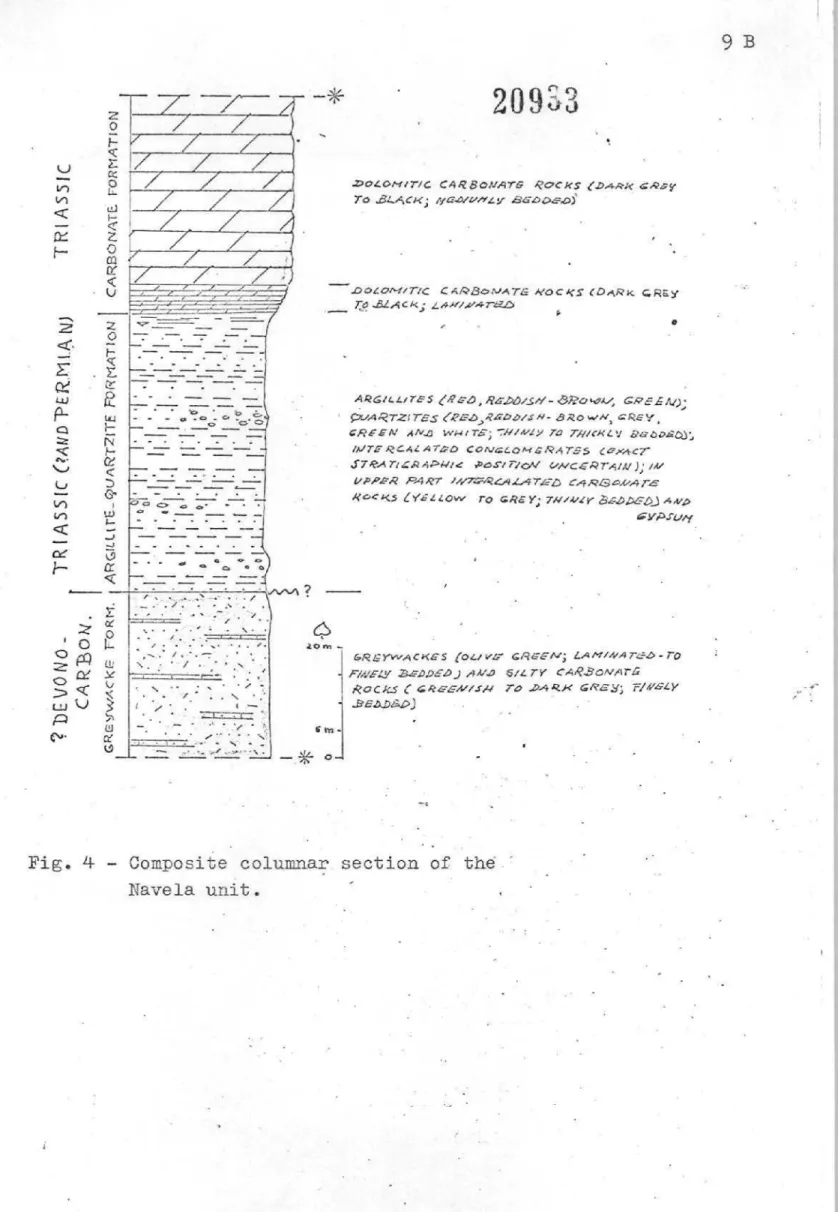
(13) 9. 209UU direct1y overli---. rocks of the. Carrascoy unit.. The contact. the U p per phyllites and the rocks of the overlyin- Carbonatue of stratigraphíc. lormatior, is. nature.;. it. is. invariably stror-E-1.y. tectonized. For complicated outcrop pattern see Fig. Thickness.. - The maxímum exposed thickness. 3.. amounts. to about. 100 m. Carbonate-formation Litholo5y.. - The Carbonate formatior. is poorly represerIted. the norther-n part. of. a small nunber. scattered. of. the Sierra de. Carrascoy;. outerops.. formed yellowish-grey to dark grey, bonate rocks, consists. partly developed. liBht grey,. Thickness.. The. is restricted to. sequeríce. is níainly. thinly to thickly bedded. as rauhv.,ackes.. larainated to. it. wit-nin. its basal. part. thinly bedded ca-rboníates.. - The maximum exposed thickness amounts. to 5 r_.. ,kle OwinE to absence. of. fossi1s. the age. of the rocks. of the. unit has to be based on comparisor. with correlatable from the Alpujarride. complex elseuhere. in the Betic. Pestillos. sequences Zone.. This. leads Simon tLo the follow4-nS scheme. Carbonate. formation. Upper phyllitic Lower phyllite. Triassic. formation formation. Triassic. (?. Palwozoic. Navela unit. (see. and zlercian). (? Devono-Carboni-ferousi. Fig. 4). General- stat e ment For this liic,hes-u. tectonic unit. followinE tentative top:. scheme. of. the. Sierra de. is given (Kampschuur,. Carrascov t-,--e 1972):. Carbonate -"F'cr,-at4-on. i_ainly dolomitic. carbonate rocks tkr �Ti 11 i. 4-e::qjz_. ar6illites. anc-,. -¡te formatior. quartzites;. rocks,conglomerates 2reZv:lek-e Ereyv.,ackes. locally. and gypsu-n. fo_=ation and. carbonate rocks. siates,carbor.atue.
(14) 209 vi. LY< (D^RK. Z--7-. Cl. uj t:. r_-.s -. -. -- -. �v - '5;Z 0 �.',V, a R¿E Y.. 1. 74 7,910<¿Y 1,,J7 - RC,4¿ A 7. S7-11,4 rí--A. ¡A,, ro c.RE Y; 7MI-tWk-. A Wp. 0 YVVA C K-� 5 r¡41.-zj1. -9,v-o. liC 7-Y 7-4. Fig. 4. Composite columnar section of the Navela unit.. C-AIC-21OV/1r.G. .U,4R.$< aRC&�. FI&WI-V.
(15) - 10. 209�3 Kampschuur distinEuishes four minor tectonic. elements. within the. Navela unit. GpyEac.'ke-f ormation LitholoEy.. - The. sequence. olive-Ereen greywackes,. bedded,. dark-Erey coloured, wackes. mainly consists of. laminated to. with intercalations. finely bedded. finely. of Greenish to. silty carbonate rocks.. The. Erey-. sometimes exhibit. a marked EradinS,. as weil as cross~lamin-. ation and sole-markings.. Plant remains are. linearly oriented.. rocks. interpreted as havinE been deposíted. are. The. by turbidity. currents. Rocks of of. the. the. Ereywacke. formation are. two hijer tectonic - With the. Fossi1s.. only present at. (see. elements. the base. above).. exception of plant remains. no fossi1s have. been found. Contact relations.. - The contact. at. the base. formation is always of tectonic nature. lying Irgillite-quartzite formation is due that. to. conspicuous difference. the. no. formation and the Thickness.. - The exposed. iililliti:q2litpite LitholoEy.. - =e. Greywacke. stratiGraphic. It. it is. oversharp,. should be noted. angular unconfornity which. the boundary between tTe. oecur at. overlying. the. The contact with the. in lithology.. evidence has been found of the. is usually assumed to. of. Greywacke. sequence. thickness amounts to 25 m.. formation sequence. consists of an alternation of red to. reddish-brown and Ereen argillites and red to reddish-brown, green and white. intercalations. layered Eypsum. are either red. The upper part. of thinly bedded. ConS-omeratic layers coloured. jarossite. in the. (south of. of the. quartzites CollIdo de. sequence. carbonate rocks and. occur in several. ard rich in well-rounded. Ereyish and rich in well-rounded Fractures. argillites to. Gradations from the. of local occurrence.. slates are contains. quartzites.. pebbles of. jrey,. levels.. of They. quartz pebbles. carbonará. may contain malachitel. or. rocks. azurite. and. la FAbrica).. A.
(16) 209�3 Contact relations. - The ArEillite-quartzite formation is conformably overlain by rocks of the Carbonate formation. The boundary seems to be Eradational;. the contact is conveniently drawn. above the uppermost argillites.. It. is commonly stronEly tectonized.. Thickness. - Tie maximum exposed thickness is 50 m. Carbonate formation ~ ----------LitholcEy. - The sequence consists of dark Grey to black, mediumly bedded carbonate rocks, P artlY chanSed to rconomict rauhwackes. The basa! part is characterized by the oceurrence of laminated dolomitic rocks, transected by numerous veins. Fossi1s. - Shell-remains are locaily present. Contact relations. - The rocks of the Carbonate formazion are unconformably overlain by 'post-nappe depositsI. Thickness. - The exposed thickness amounts to 40 m. 02 Owing to lack of diagnostic fossi1s the rocks of the Navela unit of the Sierra de Carrascoy can be only tentatively dated on the basis of lithologic correlation with �iala6uide successions from elsewhere in the betic Zone. This leads to the following schere: Carbonate formation. - Triassic. Axgillite juartzite formation. - Triassic (? and Permian) - (? Devono-Carboniferous).. Greyvjacke formation.
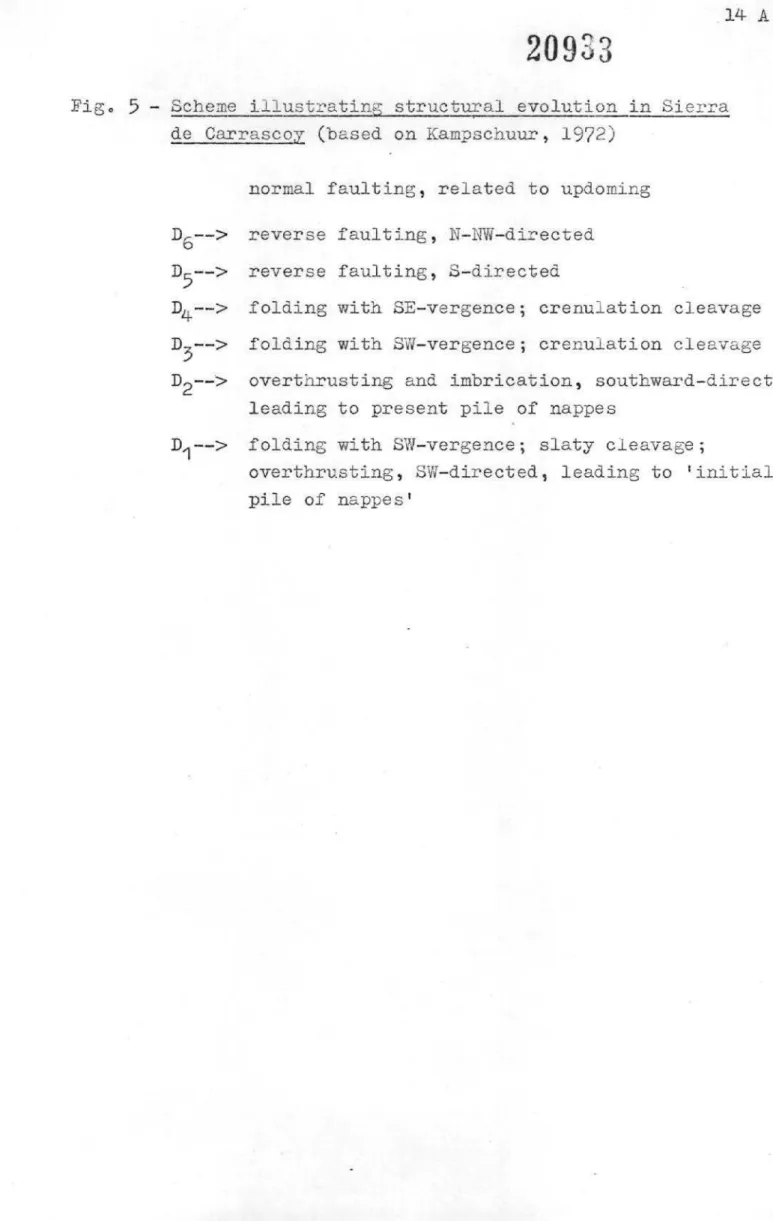
(17) 12 T e c t o n i e s. 2 0 9 zi. General. four major «'U---ctonio units,. representing. complex,. (3). the Pestillos uni-J,. complex,. ar-d. (4). In addition. (1 and 2). the Ballabona-Cuchar6n. representin- t.-ie ivialasuide. comple:-,--. are represented.. deposits1. studies reveal that. Kam,psc_'nuur's. comprises. representíng the Alpujarride. the llavela unit ,. 'post-nappe. Carrascoy. (from below to above):. ¡.e.. and Carrascoy units,. the Romero. Sierra de. in the fore--cinG the. As mentíoned. the roc'-'�r.-s sequences. of all fou--. effectuís of six, ap-parently correlatablíe, 6\. In the part of the Sierra de phases of alpine deformation (D i-D ) Carrascoy lying - strucu vjithín the sheet Alcantarilla the resulting� tectonic. show the. units. tures are especially well-developed Carrascoy unit; Pestillos. in the rock sequence. also found in the roc'k sequences. they are. of the o1,. __1 e t",_. and Navela units.. Structures In the well-bedded rocks sequences tions of. has led to the formation of folds 1 Isoclinal folds p_redominate, but close and t¡Eht. types v.,e--e also. forianed.. axial plane. attributable phase. -ood for the C>. rocks. of. 2 units syn-D. local forr_ation of a. the ArEillite-quartzite. latter rociKs. formation,. slaty cleavage. D l_isoclinal folds were formed. of the. and the. Carbonate, formation.. in the Sierra de. Carrascoy.. metamo--phisn of the rocks. tlirustin- post-dates. Navela unit In the. in 'the. in the well-bedded. emplacement. The- fact of the. thaz. t".-.e. Biavela unit. of the tectonic de-ree of is d-*Lstinctly. lower than that of the rocks o.-J�' the undierlying units, this. sa--e. formation of the 1,'avela unit.. is held responsible for the final. 1. foldinE. In the Pestillos unit. of the Upper phyllite. holds. D. cleavaSe.. mostly characterized. by a con-. has not been recoGnized. Hov.,rever, thist first 1 responsible 'Lor the forniatior- of the slaty cleava-e. in the phyllites. basal. They are. to D. is held. In the. the L'4urta and Filos forna-. Carrascoy unit D. the. on all scales.. spicuo-us. of. Di.. The. internal. proves. that. imbrication of the. is presunably also a D 2-feature.. Carrascoy unit. dinE from open to. D. has pro-duced folds on all scales, gra3 isoclin,-,,:L, .-.ith axíal planes dippinE at about.
(18) 40. 0. 13 -. 2 0 9`3 NE and w-.th a well-developed. phyllites. of. the. Pestillos unit. crenulation cleavaSe. most D--fo1ds are ti¿-,:ht. D. folds in rocks of the ArEillite-quartzite 3Navela unit vary from open to tight. D4 produces coy unit, at about. In the. m.eso- and macroscopic. folds. to. formatuion of. in rock-s of. isoclina2. the. the. Carras-. varying froin gentle to open, and with axial plar-es dippi.n,,-0 M4-NMI. The crenulation cleavage is vieak-. D.-f o1ds in 50. the phyllites. of the. Pestillos un--*,t. are. essentially of the. same. ty-,e.. The Argillite-quartzite.formation of the ¡Zavela unit-sho-,vs. folds. on a mesoscopic. The rock sequences. scale. of the Sierra de. ted by southward-direc-ued. Carrascoy were further affec-. -reverse faulting. (D 5. ward-direc-111--ed reverse. faulting. (D 6).. follo-jied by north-.
(19) 14 A. 209 Fig.. Scheme de. illustratir�,:��. Carrascoir. struct"I'Íll. evolutio-n in Sierra. (based on Kampsc-quurj. normal faulting,. related. 197,2). to updomir.g. D,-->. reverse fault2ng,. N-I<Ti-di--ected. D. reverse. S-directed. 5-->. faultinS,. D4-->. folding with SE-vergence;. D --> 3. foláing with S-1-veráence; crenulation cleavage. D 2-->. overt.irustinE. and imbrication,. leading to present pile D 1-->. overthrusting, of nappes1. southward-directed,. of nappes. foldinE with S'�,I-ver�,,ence;. pile. crenuiation. cleavage CD. slaty cleavaEe;. &¿V-directed,. leading to. linitial.
(20) 14 -. G e o_l_o_E i c a 1. Th,e of. strati-raphic colur_ns. the Pestillos. h i s t o~r. of t^ne. indicate. an abruDt charip:e. renders. as to. the age. column of detritus. (Fig.. overthrust (D. 2. ing. unit,. The fact. is shown by the,. the. Carrascoy is. It. complex navure. belts. attributed. able. of nappes',. the nappe. and that. of different. postulate. kineriatic. to. southward-directed. at least. in the. -chat. structure. these. of the. two inajor p.hases. the development. is. in a la.ter ¡.a.. stage,. It will be clear that responsible. The fact. Zone had. a. Acceptance over-ulirusb. of. the. leads. oro6enic. Generation of the that. this. by translation of. initial consider-. evidenced by the discontínuit-7 of tlie. the. within the present. t'_ue. pile.. question vihether Karapschuur's. for the generatíon of' the. very important but at. stress. of overthrust. in an early suage. metamorphism Y.,as connected.. -UP-e. vi¡-th tectonic depth,. of a pile of rapres with which the. maZnitude,. Betic. is. of E-eler &. authors. metamorphism in alpine. in sor2,e ivay or othe-,-,. was dJ_sturbeG_. sense. character have played a role.. metamorrhism at major t.1�ust planes. is. The resulting. mover-er-tslvíhich led to. may be recalled here,. is related,. evolution,. pile'. pile. conce-t that regional. t-"ne-n to. oro,-eny.. AccordinE to 1,.ampschuur this first phase. .. linitiai. evolutio-n of. moveLients. in-formation on. taking -lace durino.�j CD a second phase of def o--MThe regional me-uamorphism is linked wit1h ear-",ie.- fold~. (1959).. the. influ-x of terrigeneous. movements,. formati9n of an. of. stratigraphic. the pile of nappes now represented. furtherresronsible for ma—*or thrust. tnat. Balia-. that these conditions. vihich reflects. shows that. 5 ). during DI. Simon. Carrascoy unit. condítions of deposition in the. evolution du-ring the Alpine. within the Sierra de. ation. Triassic bounda—y.. investígations have, furnished ample. structural. scheme. presumably. in 111,iddle Triassic time.. Kampschuur's the. - -.1�.:iddle. afore-mentioned,. the Romero. Carrascoy -. conditions,. of the rocks of the. bona-Cuchar6n realm hazardous. from the. Sierra de. in de�-ositional. speculation on the. differed. the. rock sequences. the 1J'a1aGuide realm res-lectively. somev.�nere near the Lower Triassic Uncertaintuy. (Permo)Triassic. aná Pavela units of. represe.nting the Alpujar-ride and. 209ÜU. same. initial pile. time verv delicate. of. -í::oint,. DI. pb_ase. nappes a as.
(21) 15 -. 20gu(3 a ,�l�ears. to be. if correct,. definite. evide��,ce. to be. escaping thie conclusior- that. no. mover,ents in the Betic. Zone were. the. ri there sees. initial ove--thrust. southward-direcued.. The datinE of D aecurate,. up to and includíng D4 is necessarily very in1 as the youngest rocks affected by these phases are of. Triassic age and the oldest rocks not The. 'post-narpe deposits1. were. affected i,íiddle !,.,I-iocene.. affected by D. and D faultinG at 6 5 sone time between the Liddle and Upper Plíocene. Subsequent no--mal. faulting is assumed1y related to the updoming of the. Síerra..
(22) 16 E e o n o m_i_c___- e o 1 o_-_y. 20 9 In t.r--e -ioith-eas-.ern parz of widespread of the. oecurrence. Carrascoy unit.. gypsum, is mined. at one. J>ierra de. of. as a constituent. C¿irrz�,sc--v Wpsum is. of the. 1,lurta formation. l�otwizhstandínE good accessibilituy the -iocali'.y only,. ¡.e.. north of Fuente de. las. Palomas. In the. past. some attempts have been made. galeníte,. is present. in sriall cuantities. carbonate rocks of the Eavela unít, Finally the mentioned, of the the. local. oecurrence. along joints. at e-.�cploitation. of. east. in brecciated. of Caserio de !,-ave'La.. malachite and azurite may be. of quartzitic, rocks of the. L-urta forz.ation. Carrascoy unit and of the Argillite-quartzite. Navela unit.. of. formation of.
(23) D. lletamorrli-ism. 209qjn5 The rocks o--E' a¡¡ «L;'our tectonic units distinguished in the Sierra de Carrascoy shovi tñe effect.s of low-grade alpine metamorphisri. For t.-Le comparison of the de-ree of metainorphism with.-;n the respective units the pelitic rocks appea--r to be the most suitable. In th.e field a rough subdivision can be r-a-,'Ie into ar-iilites, slates and phyllites. In the argillites metamorphism has resulted in neoformation of sericitic material, chlorire (?albite') and quartz and in the slates and phyllites in neoformation of colourless mica (muscovite, sometimes paraEor.ite), cl,.lorite, albite and quartz. Aceording -lu-o Zan-�sc-iuur (1972) the formation of -jhese mínierals is synkir.ematie and re-lated to the first phase of deformation (D1), zrhích is four-d te have af-Cected tile rock sequences of all four unLts (see below), The de��ree of the metuamorphism ve--y seldom surpasses the Ereen~ schist facies. It may be recalled, hojiever, that the presence of crossite in some metabasítes suEGests local transitions to t-he conditions of the glaucophane schist facies. Kampschuur J-ound it impossible -uo range the .-ocks of the diffe�-ent tectonic units aceording to the degree of -ietamoruh--sm, merely on -L1�e basis of mieroscopic study. He therefore used dif'racto,:-,-rams of powder samules of rock s-pecimens from the sequence o.-L" each unit, in order to es-,.�ablish the muscovite-paragonite coexistence, the íllite crystallir-i-',-y and the chlorite crys-uallinity. The results led him to conciude that: (1) the metamorphisr� of the rocks o_f tne Rome-ro unit is lower than that of the rocks of the Carrascoy unit, equal to or slic,-,atlY lo,J.,er than that of tne rocks of the Pestillos unit, and equal to or sliGht1y higher than that of the rocks of the Navela unit, (2) t'--ie metamorphism of the rocks of the C-i=ascoy unit is equal tuo or slightly higher than that, of the rocks of the Pestillos unit, ar-d hiGher than that of the rock-s of the 1,Zavela unit, and (3) the 1-1-etamorph-4Ism of the rocks of the Pesti-llos unit is hiG-her than that of the rocks of the Navela unit..
(24) 18. L i t e r-a-t-u-r-e. 209`3. Az6ma, J., J.*�í.�,.Bodenhausen, F.Fernex, & O.J.Simon, Remarques sur la structure de la Sierra de Carrascoy (prov.de 1flurcie, Es-pagne, C.R. somm. S.G.F., 51-53 (1965). Elumenthal, MI., Das Pallozoikum von DIalaga als teIctonische Leitzone ¡m alDidischen Andalusien. Geol. Rundschau, 24, 17J-11-87 (!Q33)* Blumenthal, M., Eine Uebe=icht Uber die tek-IU--onische Fer-ster der Betischen Cordilleren. Libro Jubilar, 1849-1949, Inst. geol. y Min. EspaFía,. 1. 237-313 (1950).. Bodenhausen, J.71.A. & O.J. Simon, On the tectonics of the Sierra de Carrascoy (province of �--arcia). Geol. en iviiijnb., 44, 2-1-253 (1965)* Boogaard, M.var- den, Post-Carboniferous conodonts from south-easter, Spain, '-roc. Xon..'Ned.Akad.v. Wvetensch., 69, 1-8 (19�-56). Dupuy de L^Ome, E. & S.Lozano, Ii1apa Geol6Eico de Espaha, escala 1: 50.000, Explicaci6n de la Hoja no.954, Totana (Murcia). y min. Espalía, 1-70 (1958). Durand Delga,, LI. & J.M.Fontuboté, Le problIme de l'a^¿e des nappes alpujarrides dIAndalousie. -2,ev. G6oEr. phys. et Géol. dwn. (2), III, fasc.4, 181-187 (196C)* E-eler, C.G. & O.J. Simon, Sur la tectoníq�ue de la Zone BÉ5tique (Cordille'res,Br'zltiques, Es,,aEne). ntude- basée sur les recherches dans le secteur compris entre Almerlá et V6lez Rubio. Verh. Kon. Ned.Akad.v. YVetensch., Afd. Natuurk. eerste reeks, 25, 35 1-90 (1969 a). Egeler, C.G. & O.J. Simon, Orogenic evolution of the Betic Zone (Betic- Cordilleras, Spain), with emphasis on the nappe st-ructures. 481 29-0 -305 (1969 b). Geol. en ', Egeler, 0.G.,. -I.E. Rondeel & O.J. Simon, Considerations on the. groupinz�-<w1_ o-f the tectonic units of the Betie Zone, -:iout^l-ier-,,i Spain. Est.Geol., 27, Ó, 46��-473 (1972)..
(25) Kampschuur, W., Geolo,-.-y of the Sierra de Car-ascoy (SE Sp-in) with em-,has-is on alpine poly--hase deformíation. Thesis - 19 Amsterdam (1972). Fallot,. P.,. E-",at. b eItíque. et sub-b'tique. e. Fallot,. P.,. Les. de. nos. connaissances. sur la structure. Livre jubí. Soc.. Cordilléres 36tiques.. G6ol.. des. chalínes. Fran.ce.. 279-30'-. Estud.Gueol., 4,. 83-172. (1948).. y, Leine,. L.,. RauLh-,.vackes. Anisterdam, Leine,. L.. so-called. in the. 1-112. (1QY68).. & C.G.. ESeler,. Betic. "konElomera~,,ische. en ljijnb.,. Martinez, la 1. D.T.. & J.. 5,01.000,. :. 41,. iiier�rel". Inst.. Meseguer Pardo,. Montenat,. C.,. y min.. Acad.. Patijn,. Sci.Paris,. R.J.II.,. 270.. Geolorische. south-eastern Spain.. Simon,. the Sierras. &z. Miinb.,. '15,. The a¿je de. O.J.,. Carrascoy, Murcie. (1952).. 112-113 of. t�ie. Ca2,rascoy,. _`iote. in the. 43,. et de 1,urcie).. oos-ue'Lij2ke Be-U~'isc'-.ir-'. 1-164. Si=a de Almar-ro, �-1 (lgó3')*. a new structural 331-334. element-. Carrascoy. in the. (1964).. sur lla^Ee des roches de. l'<unit6. (province de Lu_—cie,. (l96'a). co.nodont-bearin3 carbonate rocks from-. de Almagro and Alhamilla and froi--,i the. Zarcilla de Ramos region (SE Spain). Z Series B, 69, PI-19 (lqóób). Simon,. esca-. (1937).. Thesis Amsterdam,. 1,,-,ote pr6liminaire. en Dlijnb., O.J.,. (SE S-pain).. (1970).. investigations. Cuchar6r_> dans la Sierra de Geol.. in. Alhamía de 1,,,,urcia. onderzoekinGen in de. The Almagro unit;. Zone? Geol. O.J.,. 1-71. 3194-3197. Geolo-ical C. Simon,. "Rauhvjackes". los F¡l,_,,bres. (Provinces dIAlicante. Simon, O.J.,. Betic. the. Mapa Géologico de Espaha,. Espaha,. Thesis Amsterdam 1-130. O.J.,. assocílated. la Hoja no.933,. Cordille--en.. Simon,. origin of. Sur llimportance des mouvements crog6niques r6cents. dans le Sud-Est de llEspagne C.R.. TI-1,21SIS. (1962).. 305-314. Eeol.. and. Sierra de. Exp-I-ícación de. (Murcia).. (Spaín).. Preliminary note on the. the reEion of 1..'enas de Ser6n, Geol.. Cordilleras. pr6lininaire. de Orihuela et- de. Proc.11-on..'L'.<--a-,'.. sur la Elologie des Sic_-ras de. Callosa de Seú-ura. et VAlicante, EsDa--ne).. v.. O.R.. somm.. (provínces. S.G.F., 42-44. 909. de (190-7)9.
(26) 2o. 209`3 Staub,. R.,. Der Decker.bau SUdspaniens. Vierteljahrsc'-,ir. Trigueros, Murcia,. E.. d.. & A.. escala 1. 1-.aturf.. Ges.. in den. Z-Uricli,. 70,. Col-dilleren. 271-332. (lgy-�).. Navarro,. Mapa Geol6Gico de la Provincia de. 200.C005. Inst.. Seol.. y min. EspaZa. (-1956)..
(27)
Figure
Documento similar
UNIDAD GEOLOGICA PROVINCIA (SIGLAS JEF.. [FICHA BIBLIOGRAFIC�j Nº REFERENCIA. Instituto Tpcfx)kxj¡cu jLwr9 de
TURMALINA LEUCOXENO �f ESTIMACION CUANT., ZIRCON LIMONITA.
Estos depósitos son --le plataforma costera, algo menos --ro-. funda que el
ya que todas estas serios han resultado azoiras, ro tenLendo en cuenta que borde de.. regLón estudiada se
ROCAS METAMORFICAS ORTODERIVADAS NEISES MESOCRATOS ORTONEISES GLANDULARES j- ORTONEISES GLANDULARES 0 LEUCONEISES.. TIPO SAN MEDEL TIPO
Estos cristales crecieron el el e 3 S2 periodo inter F F Para justificar esta asignación al período 2- 3* inter F F argumentaremos los mismos hechos que nos llevaron a en2- 3
Lámina transparente Levigado Celdilla Probeta... �j ,y� CONTROL
al,ro �le cuarzo y í*rec*uejites res-Los de itadiola— espiculas y tilo bige t-ináceos de pequeña.... L,'l levioado incluye conita
