Otras secciones de este sitio:
☞ ☞ ☞ ☞
☞ Índice de este número ☞
☞ ☞ ☞
☞ Más revistas ☞
☞ ☞ ☞
☞ Búsqueda
Others sections in this web site:
☞ ☞ ☞ ☞
☞ Contents of this number
☞ ☞ ☞ ☞
☞ More journals
☞ ☞ ☞ ☞ ☞ Search Artículo:
A new insight into the differences among non-cirrhotic and cirrhotic patients using the liver disease quality of life instrument (LDQOL)
Copyright © 2005: Mexican Association of Hepatology
ANNALS OF HEPATOLOGY
Number 4 October-December 2 0 0 5
Volume 4
MG
edigraphic.com
Annals of Hepatology 2005; 4(4): October-December: 264-271
Annals of Hepatology
Abstract
Our aims were to validate the Brazilian Portuguese
version of the Liver Disease Quality of Life
Question-naire instrument (LDQOL1.0) and evaluate this tool in
non-cirrhotic patients. Methods: The LDQOL1.0
con-sists of the SF-36 generic measure of health-related
quality of life (HRQOL) and 12 disease-specific
dimen-sions for patients with liver disease. The Brazilian
Por-tuguese version instrument was administered to 103
patients with liver disease. Reliability was analyzed by
studying the internal consistency of the individual
dis-ease-specific dimensions of the LDQOL, as well as by
studying the test-retest reliability in a sub-group of 74
patients who completed the questionnaire on two
occa-sions 1 to 2 weeks apart. Validity was analyzed by
de-termining the instrument’s ability to discriminate
be-tween groups of patients according to severity of the
liver disease. Results: Internal consistency in the
dis-ease-specific dimensions was good (CACs 0.66-0.94), as
well as test-retest reliability in all dimensions (ICCs of
0.64-0.96) p < 0.05. We found statistically significant
differences in six domains when compensated cirrhotic
patients, Child A, were compared with non-cirrhotic
patients. We also found statistically significant
differ-ences when we compared cirrhotic patients evaluated
assessed by Child-Pugh and Meld classifications.
Pa-Original Article
A new insight into the differences among
non-cirrhotic and cirrhotic patients using
the liver disease quality of life instrument (LDQOL)
María Cristina Dias Teixeira;
1María de Fátima Gomes de Sá Ribeiro;
2Edna Strauss
1,31LIM-14, School of Medicine, University of São Paulo. 2Gastroenterology Clinic, Heliopolis Hospital.
3Department of Hematology, Pro-Sangue-Hemocentro of São Paulo.
Address for correspondence: Edna Strauss
Rua Flórida 169 ap.91 – CEP 04565-000, São Paulo- Brazil E-mail: [email protected]
Abbreviations used: LDQOL (Liver Disease Quality of Life
Questionnaire instrument), HRQOL (Health-related Quality of Life), CAC (Cronbach’s Alpha Coefficients), ICC (Intraclass Correlation Coefficient), QOL (Quality of Life), HCV (Hepatitis C Virus), CHC (Chronic Hepatitis C), MELD ( Model for End-Stage Liver Disease).
Manuscript received: 15 September, 2005 and accepted: 26 October, 2005.
tients with Child C and Meld
≥≥≥≥≥
15 showed worse quality
of life. Moderate ceiling and floor effects were found in
some disease-specific dimensions. In Conclusions: the
Brazilian Portuguese version of the LDQOL 1.0 is very
useful for measuring HRQOL in liver diseases.
Key words: Questionnaires, LDQOL, chronic liver
dis-ease, chronic hepatitis C health- related quality of life.
Introduction
The need to evaluate quality of life (QOL) originated
in the social sciences with the advent of welfare. The shift
from a social to an individual health problem arises from
the spread of chronic diseases and the need to integrate
measures that evaluate individual and community
out-comes.
1At present, the patient is considered ultimately
respon-sible for major decisions about his/her own health. In
ad-dition, a patient’s subjective perception of his/her QOL is,
in most cases, different from that of a professional.
The clinical paradigm, with its biomedical model,
stresses the notion of QOL as a functional capacity
fo-cused on traditional variables such as physiological and
clinical outcomes, and fails to consider other aspects of
life such as carrying out daily activities or having good
social relationships.
2Assessing health-related quality of life (HRQOL) is
particularly meaningful in chronically ill subjects,
espe-cially those with a low probability of cure and who have
to endure this condition for a lifetime.
3Standardized measures of HRQOL are increasingly
used as a means of measuring the impact of disease and
the effectiveness of treatments. Such measures may be
ei-ther disease specific or generic. The Liver Disease
Quali-ty of Life Questionnaire instrument (LDQOL 1.0) is an
questionnaire instrument developed to measure HRQOL
in patients with different types of liver disease or patients
submitted to liver transplant.
4Chronic liver disease ranges
diseas-Dias TMC et al. Quality of life in liver disease 265
edigraphic.com
Table I. Sociodemographic and clinical characteristics of the patients.
Patients (n) (103)
Non-cirrhotics (40)
Cirrhotics (63)
Mean age, in years (SD)*
Non-cirrhotics 37 (10.8)
Cirrhotics 46 ( 9.2)
Gender (% males)
Non-cirrhotics 12 (60)
Cirrhotics 47 (64.4)
Child- Pugh (classification%)
Child- A 34 (53.98)
Child- B 1z4 (22.22)
Child- C 15 (23.80)
Etiology of cirrhosis (%)
Viral hepatitis 21 (33.33)
Alcohol 30 (47.62)
7 (11.11) Nash (nonalcoholic steatohepatitis)
Cryptogenic 5(7.94)
Etiology of non-cirrhotic (%) Hepatitis C 40 (100%)
* Standard deviation
es, infection with the hepatitis C virus (HCV) has
emerged as a public health problem. In addition,
emerg-ing literature suggests that, even in the absence of
clini-cally significant liver disease, chronic HCV infection
causes a consistent and clear impairment in HRQOL
com-pared with that of healthy individuals.
5,6However,
specif-ic instruments to evaluate HRQOL in cases of liver
dis-ease are rarely used in medical practice. The instrument
referred to here was recently translated and adapted into
Brazilian Portuguese.
7The domains of the LDQOL are
re-lated to daily activities that HCV patients have to
under-take. The objectives of this study were to validate the
Bra-zilian Portuguese version of the LDQOL, and also to
eval-uate this tool in non-cirrhotic patients, especially those
with chronic hepatitis C (CHC).
Patients and methods
Instruments
The LDQOL1.0 consists of a generic instrument
(SF-36) and 12 disease-specific scales containing 75 items.
The SF-36 was previously translated and validated for
use in Brazilian Portuguese,
8and the Brazilian version
of the questionnaire has been included here (appendix).
The 12 disease-specific scales in LDQOL are:
Symp-toms of liver disease (17 items), Effects of liver disease
(10 items), Concentration (7 items), Memory (6 items),
Quality of Social Interaction (5 items), Health Distress
(4 items), Sleep Problems (5 items), Loneliness (5
items), Hopelessness (4 items), Stigma of Liver Disease
(6 items), Sexual Functioning (3 items), and Sexual
Problems (3 items). The Brazilian Portuguese version of
the disease specific questions questionnaire was drawn
up using the standard recommended methodology of
for-ward and back translation followed by testing in
inter-views with patients.
7,9The authors supplied the original
version and authorized the translation.
4The punctuation
of the questionnaire varies of 0-100 and higher scores
means better quality of life.
9Study population. The Brazilian Portuguese version
of the LDQOL was administered in the cross-sectional
study to the sample of 103 patients with liver disease. The
questionnaires were self-administered whenever possible.
Other dates collected included age, gender, type of liver
disease, Child-Pugh and MELD classification.
The reliability was evaluated applying the
question-naire in a sub-group of 74 on two occasions separated
by approximately 1-2 weeks. The patients were
clini-cally stable. Reliability was analyzed by studying the
internal consistency of the individual disease-specific
dimensions of the LDQOL, as well as by studying the
test-retest reliability.
Preliminary validity testing was performed by
analyz-ing the questionnaire’s ability to discriminate between
groups of patients expected to differ in severity of liver
disease. One hundred-three patients were analyzed, of
whom 40 were non-cirrhotic with chronic hepatitis C
(CHC) and 63 were cirrhotic with several etiologies,
alco-holic liver disease, viral hepatitis, NASH (nonalcoalco-holic
steatohepatitis) and cryptogenic cirrhosis. The cirrhotic
group were classified assessed by Child - Pugh and
MELD classification, and 34 were Child A, 14 Child B
and 15 Child C. In the non-cirrhotic group, all patients
were submitted to liver biopsy and had moderate or
se-vere CHC with indication for antiviral treatment. In
ac-cordance with the guidelines of the Brazilian Society of
Pathology and Hepatology, all biopsy samples were
semi-quantified for the following parameters: architectural
staging (0-4); grading of portal inflammation (0-4);
inter-face hepatitis (0-4) and parenchymal necro-inflammatory
lesions (0-4).
12The CHC patients with treatment
indica-tion presented architectural staging
≥
2 and/or interface
hepatitis > 2.
12The following comparisons were made:
1. Non-cirrhotic vs Child A
2. Child A vs Child B vs Child C
3. MELD < 15 vs MELD
≥
15
Statistical analysis
The internal consistency of the disease-specific
dimen-sions was assessed using Cronbach’s alpha, and test-retest
reliability was assessed using the intraclass correlation
coef-ficient (ICC).
13The Kruskal-Wallis test was used for
MG
edigraphic.com
Table II. Internal Consistency of Disease-Specific Dimensions in the Brazilian Portuguese Version of the LDQOL1.0 Questionaire instrument
N = 34 compensated cirrhotic patients and 40 non-cirrhotic patients
Dimension Cronbach’s % Scoring the floor % Scoring the ceiling
Symptoms related to liver disease 0.76 0.0 10.4
Effects of liver disease on activities of daily living 0.84 0.0 9.6
Concentration 0.84 0.0 10.0
Memory 0.94 0.0 10.0
Quality of social interaction 0.66 1.4 12.3
Health Distress 0.76 10.2 3.2
Sleep problems 0.74 3.5 0.0
Loneliness 0.84 1.4 19.8
Hopelessness 0.82 2.8 12.7
Stigma of liver disease 0.72 1.2 20.4
Sexual function 0.76 24.7 20.2
Sexual problems 0.74 17.8 24.3
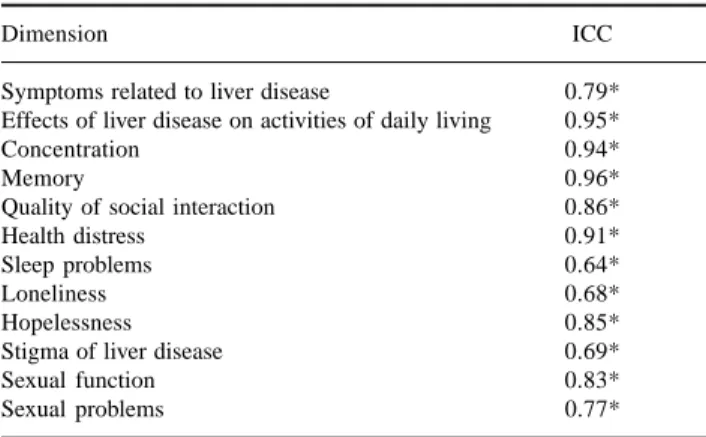
Table III. Test-retest reliability of disease-specific dimensions in the
Brazilian Portuguese Version of the LDQOL1.0 Questionnaire instrument. N = 34 compensated cirrhotic patients and 40 non-cirrhotic patients.
Dimension ICC
Symptoms related to liver disease 0.79* Effects of liver disease on activities of daily living 0.95*
Concentration 0.94*
Memory 0.96*
Quality of social interaction 0.86*
Health distress 0.91*
Sleep problems 0.64*
Loneliness 0.68*
Hopelessness 0.85*
Stigma of liver disease 0.69*
Sexual function 0.83*
Sexual problems 0.77*
*p < 0.05
ICC; intraclass correlation coefficient
Figure 1. Questionnaire LDQOL, 1.0. Comparison by MELD
classifi-cation - cirrhotic patients. N = 63. According to the MELD classifica-tion, statistically significant differences were found in the following domains of the LDQOL: symptoms of liver disease, effects of the liver disease (p = 0.015), Sleep Problems (p = 0.009) and Stigma of liver disease (p = 0.002). The scores of the patients with MELD ≥ 15 were significantly lower than those with MELD < 15.
0 10 20 30 40 50 60 70 80 90 100
Symptoms of liver disease
Effects of liver disease
Sleep Problems
Stigma of liver disease
Meld < 15 Meld≥15
inferred at the level of 5%. Ceiling and floor effects (the
per-centage of patients with maximum and minimum scores,
re-spectively) were also calculated for each dimension.
Results
Patient socio-demographic and clinical characteristics
are shown in Table I. The internal consistency of
dis-ease-specific dimensions of the LDQOL was very good,
with all coefficients being over 0.66 (Table II).
Test-re-test reliability was also good in all dimensions and all
ICCs were statistically significant, p < 0.05 (Table III).
The comparison by MELD classification showed
statisti-cal significance among patients with MELD scores < 15
and
≥
15, p < 0.001. Worse quality of life was found in
patients with Meld scores
≥
15 for the following
do-mains, symptoms of liver disease, effects of liver
dis-ease, sleep problems and stigma of liver disease (Figure
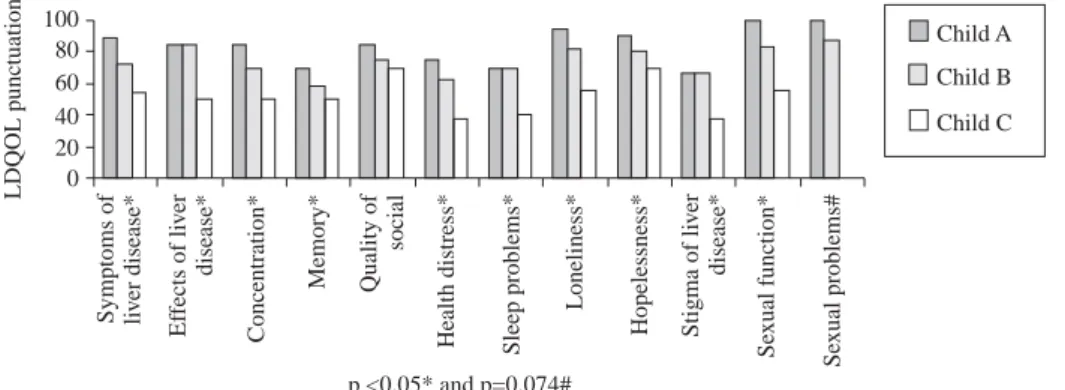
1). We also observed statistically significant differences
in some domains when cirrhotic patients were compared
by Child-Pugh classification. Worse quality of life was
Dias TMC et al. Quality of life in liver disease 267
edigraphic.com
Symptoms related to
liver disease* 0.036 Concentration* 0.03
Memory* 0.038
Health distress* 0.021 Sleep problems* 0.021 Stigma of liver disease* < 0.001
Figure 3. LDQOL Questionnaire
instrument, 1.0. Comparison with Non-cirrhotic (HCV carriers) vs Cirrhotic (Child A).
LDQOL - CHILD AvsNon-Cirrhotic
50 60 70 80 90 100 Domains Non-cirrhotic-hcv patients Child A Scores LDQOL
Symptoms related to li
v
er disease*
Ef
fects of li
ve
r
disease
Concentration*
Memory* Quality of
social interaction Health distress* Sleep problems*
Loneliness
Hopelessness
Se
xual function
Stigma of li
ve
r
disease*
Se
xual problems
Non-cirrhotic and compensated cirrhotic patients (Child
A) showed statistically significant HRQOL differences in
six domains: symptoms of liver disease, memory,
concen-tration, health distress, sleep and stigma of liver disease.
The scores of the compensated cirrhotic patients in five of
these domains were lower than those of non-cirrhotic
pa-tients, p < 0.05 (Figure 3). Just in one domain, which is
stigma of liver disease, the group of non-cirrhotic patients
constituted by HCV carriers, demonstrated lower
punctua-tions. We found some ceiling and floor effects in some of
the disease-specific dimensions (Table II). In 3.8% of the
subjects, LDQOL disease target scores were missing, what
is considered acceptable for missing data.
Discussion
The aims of this study were: 1) To validate the
Brazil-ian Portuguese version of the Liver Disease Quality of
Life Questionnaire instrument. 2) Give an insight into the
differences in disease-specific HRQOL instruments using
LDQOL among non-cirrhotic and cirrhotic patients.
Figure 2. Questionnaire LDQOL,
1.0. Comparison by Child-Pugh Classification. The Child A patients had better quality of life and the Child C patients had worse quality of life. The Child B patients beha-ved sometimes like Child A and so-metimes like Child C.
0 20 40 60 80 100
p <0.05* and p=0.074#
Child A
Child B
Child C
LDQOL punctuation
Symptoms of liv
er disease*
Ef
fects of li
ve
r
disease*
Concentration*
Memory* Quality of
social
Health distress* Sleep problems*
Loneliness*
Hopelessness*
Se
xual function*
Stigma of li
ve
r
disease*
Se
xual problems#
Symptoms of liver disease, concentration and memory: A > B = C Effects of liver disease, sleep and sexual function: C < B = A
Quality of interaction social, loneliness and hopelessness: A > C, B = A and B = C Health distress and stigma of liver disease: A > B > C
Sexual problems-only A and B: A = B
MG
edigraphic.com
sustraídode-m.e.d.i.g.r.a.p.h.i.c
cihpargidemedodabor
:rop odarobale FDP
VC ed AS, cidemihparG
arap
acidémoiB arutaretiL :cihpargideM
sustraídode-m.e.d.i.g.r.a.p.h.i.c
Appendix - Translated version-Questionário sobre qualidade de vida nas doenças hepáticas (LDQOL 1.0).
Questionário sobre qualidade de vida nas doenças hepáticas (LDQOL 1.0)
1. Estas questões são sobre sintomas ou problemas de saúde que você pode ter ou não. Nas últimas 4 semanas, quantas vezes você experimentou cada um dos seguintes sintomas? (sejam causados por sua doença hepática ou qualquer outro problema).
Todo dia ou 4-5 vezes por 2-3 vezes por 1 vez por menos de 1 vez
quase todo dia semana semana semana por semana Nunca
A Dores musculares 1 2 3 4 5 6
B Dores no corpo 1 2 3 4 5 6
C Coceira 1 2 3 4 5 6
D Tontura 1 2 3 4 5 6
E Dor de cabeça 1 2 3 4 5 6
F Perda de apetite 1 2 3 4 5 6
G Alteração no paladar 1 2 3 4 5 6
H Inchaço nos pés ou pernas (edema) 1 2 3 4 5 6
I Inchaço no abdome (ascite) 1 2 3 4 5 6
J Alterações na visão 1 2 3 4 5 6
K Sangramento nasal 1 2 3 4 5 6
L Sangramento nas gengivas 1 2 3 4 5 6
M Náusea ou vomito 1 2 3 4 5 6
N Fezes escuras 1 2 3 4 5 6
O Aumento da freqüência urinária 1 2 3 4 5 6
P Esgotamento físico 1 2 3 4 5 6
Q Falta de ar 1 2 3 4 5 6
2. Algumas pessoas se incomodam com os efeitos das doenças hepáticas em sua vida diária, enquanto outras não se incomodam. Quanto cada um dos seguintes efeitos incomodou você, nas últimas 4 semanas, nas seguintes áreas:
Intolerável incomoda muito moderadamente um pouco não incomoda não se aplica
A Restrição a líquidos 1 2 3 4 5 6
B Restrição alimentar 1 2 3 4 5 6
C Habilidade de executar
tarefas domésticas 1 2 3 4 5 6
D Ir a eventos sociais fora de casa 1 2 3 4 5 6
Chronic liver disease leads to significant morbidity
and mortality; its manifestations affect not only the
physical symptoms but also the psychological and social
functioning of affected individuals.
14,15Some authors
have developed a disease-targeted HRQOL measure for
persons with chronic liver disease, such as the “Chronic
Liver Disease Questionnaire” produced in 1999.
16How-ever, this measure may not capture potentially important
areas. A disease-targeted HRQOL measure with 15
items was also developed in 1998, specifically for
pa-tients with chronic hepatitis C virus.
17As with the
“Chronic Liver Disease Questionnaire” produced in
1999, this instrument also excludes some aspects of liver
disease and problems relating to chronic HCV carriers.
The LDQOL includes domains such as memory,
concen-tration, sexual functioning, social functioning and
self-perceived stigma of liver disease. These characteristics
are very important because a disease-targeted measure
should be able to demonstrate its value in providing
ad-ditional HRQOL information. LDQOL 1.0 is able to
pro-vide unique information that a generic instrument alone
would not capture in persons with chronic liver disease.
This study was conducted in order to apply the
instru-ment in patients with and without cirrhosis and to
com-pare different levels of liver disease. We believe that this
disease targeted instrument will be useful in studies that
attempt to evaluate the HRQOL outcomes of patients
be-fore and after liver transplantation,
18as well as in
evalu-ating several features of the different stages of liver
dis-eases and the impact of their respective medical
treat-ments, such as interferon in chronic hepatitis C.
Nowadays, it is understood that HCV carriers show
many physical and emotional alterations before and
dur-ing treatment.
19,20We have demonstrated statistically
sig-nificant differences between different stages of liver
dis-ease recorded by Child-Pugh and Meld classification as
the original authors of this questionnaire,
4however,
be-tween cirrhotic and non-cirrhotic patients. is the first
time. We have shown that the results of the
disease-spe-cific domains of the LDQOL worsened with worsening
of the liver disease stage. This tool has proven to be
ap-propriate in evaluating these issues.
Further testing of other types of validity, as well as the
instrument’s sensitivity to change, is required.
Dias TMC et al. Quality of life in liver disease 269
edigraphic.com
E Executar alguma atividade delazer ou recreação dentro de casa 1 2 3 4 5 6
F Habilidade de viajar 1 2 3 4 5 6
G Vida sexual 1 2 3 4 5 6
H Medicamentos 1 2 3 4 5 6
O quanto você concorda com a seguinte afirmativa:
Concordo muito Concordo em parte Não sei ao certo Discordo em parte Discordo totalmente
I Muito do meu tempo é gasto
lidando com minha doença hepática 1 2 3 4 5
Quanto do seu tempo nas últimas 4 semanas...
A maior parte
Todo o tempo do tempo Algumas vezes Raríssimas vezes Nunca
J A sua doença hepática fez com que perdesse o humor? 1 2 3 4 5
As questões seguintes são a respeito de problemas de concentração que você possa ter.
3. Quanto do seu tempo, nas últimas 4 semanas, você encontrou dificuldades em...
A maior parte
Todo o tempo do tempo Algumas vezes Raríssimas vezes nunca
A Concentrar-se na conversa 1 2 3 4 5
B Concentrar-se na execução de alguma tarefa 1 2 3 4 5
C Executar atividades envolvendo concentração e raciocínio 1 2 3 4 5
4. Quanto do seu tempo, nas últimas 4 semanas, você...
A maior parte
Todo o tempo do tempo Algumas vezes Raríssimas vezes Nunca a Teve dificuldade em manter a concentração numa
atividade prolongada? 1 2 3 4 5
b Ficou confuso? 1 2 3 4 5
c Reagiu vagarosamente a alguma coisa dita ou feita? 1 2 3 4 5
d Teve dificuldade em raciocinar ou resolver problemas? 1 2 3 4 5
As seguintes questões são sobre memória:
5. Quanto do seu tempo, nas últimas 4 semanas, você experimentou dificuldades em se lembrar de...
A maior parte
Todo o tempo do tempo Algumas vezes Raríssimas vezes Nunca
a Nome de pessoas 1 2 3 4 5
b Onde você pôs as coisas 1 2 3 4 5
c Alguma coisa que alguém te falou/disse 1 2 3 4 5
d Algo que você leu recentemente. Ex: o jornal pela manhã 1 2 3 4 5
6. Quanto do seu tempo, nas últimas 4 semanas, você...
A maior parte
Todo o tempo do tempo Algumas vezes Raríssimas vezes Nunca
a Teve dificuldades com a memória? 1 2 3 4 5
b Esqueceu coisas que aconteceram recentemente? 1 2 3 4 5
Questões sociais
7. Quanto do seu tempo, nas últimas 4 semanas, você...
A maior parte
Todo o tempo do tempo Algumas vezes Raríssimas vezes Nunca
a Isolou-se das pessoas? 1 2 3 4 5
b Foi carinhoso com as pessoas? 1 2 3 4 5
c Irritou-se com as pessoas? 1 2 3 4 5
d Pediu coisas não razoáveis a seus amigos ou
membros da família? 1 2 3 4 5
MG
edigraphic.com
Preocupação com a doença8. Quanto do seu tempo, nas últimas 4 semanas, você...
A maior parte
Todo o tempo do tempo Algumas vezes Raríssimas vezes Nunca
a Sentiu-se desencorajado em virtude de sua doença hepática? 1 2 3 4 5
b Sentiu-se frustrado em virtude de sua doença hepática? 1 2 3 4 5
c Preocupou-se com sua doença hepática? 1 2 3 4 5
d Sentiu-se depreciado em virtude de sua doença hepática? 1 2 3 4 5
O próximo conjunto de perguntas é sobre suas funções sexuais e seu grau de satisfação com elas.
9. A perda do interesse sexual é hoje um problema para você?
Não é um problema 1
Um pouco problemático 2
Moderadamente problemático 3
Muito problemático 4
10. Quanto à doença hepática interferiu nos seus relacionamentos sexuais:
Nunca 1
Raríssimas vezes 2
Algumas vezes 3
A maior parte do tempo 4
O tempo todo 5
11. Você manteve alguma relação sexual nas últimas 4 semanas?
Sim 1 (continue na próxima questão)
Não 2 (pule para a questão 14)
12. Quão problemático foi para você cada um dos seguintes itens nas 4 últimas semanas:
Homens: responder de (a) a (c) Mulheres: responder de (d) a (f)
Sem problema Pequena dificuldade Com alguma dificuldade Muita dificuldade
a Dificuldade em conseguir ou manter uma ereção 1 2 3 4
b Dificuldade em atingir orgasmo 1 2 3 4
c Habilidade de satisfazer sexualmente a parceira 1 2 3 4
d Lubrificação inadequada 1 2 3 4
e Dificuldade em atingir orgasmo 1 2 3 4
f Habilidade de satisfazer sexualmente o parceiro 1 2 3 4
13. De um modo geral, qual seu grau de satisfação com suas funções sexuais nas últimas 4 semanas?
Muito satisfeito 1
Satisfeito 2
Nem satisfeito nem insatisfeito 3
Insatisfeito 4
Muito insatisfeito 5
Sono
14. Por quanto tempo, nas últimas 4 semanas, você...
A maior parte
Todo o tempo do tempo Algumas vezes Raríssimas vezes Nunca
a Dormiu o suficiente para se sentir descansado pela manhã? 1 2 3 4 5
b Sentiu sonolência durante o dia? 1 2 3 4 5
c Teve dificuldade de se manter acordado durante o dia? 1 2 3 4 5
d Cochilou (5 minutos ou mais) durante o dia? 1 2 3 4 5
e Dormiu a quantidade de tempo que necessita? 1 2 3 4 5
Isolamento
15. Quanto do seu tempo, nas últimas 4 semanas, você...
A maior parte
Todo o tempo do tempo Algumas vezes Raríssimas vezes Nunca
a Não teve companhia 1 2 3 4 5
b Não teve ninguém com quem contar 1 2 3 4 5
c Sentiu-se abandonado 1 2 3 4 5
d Sentiu-se isolado dos outros 1 2 3 4 5
Dias TMC et al. Quality of life in liver disease 271
edigraphic.com
Esperança16. Quanto você concorda com as seguintes afirmativas:
Concordo Discordo Discordo
Concordo muito em parte Não sei ao certo em parte totalmente a Agora planejo menos o futuro do que antes da
doença hepática 1 2 3 4 5
b Tenho grande fé no futuro 1 2 3 4 5
c Meu futuro parece sombrio 1 2 3 4 5
d Encaro o futuro com esperança 1 2 3 4 5
17. O quanto você concorda com as seguintes afirmativas:
Concordo Discordo Discordo
Concordo muito em parte Não sei ao certo em parte totalmente
a Algumas pessoas me evitam por causa de minha doença 1 2 3 4 5
b Sinto vergonha de minha aparência. 1 2 3 4 5
c Evito me expor em virtude de minha doença hepática 1 2 3 4 5
d Algumas pessoas sentem-se incomodadas quando estão
comigo por causa de minha doença hepática 1 2 3 4 5
e Minha doença faz com que eu me sinta deslocado em público 1 2 3 4 5
f Sinto-me prejudicado e incompleto em virtude de
minha doença hepática 1 2 3 4 5
References
1. Leplège A, Hunt S. The problem of quality of life in medicine. JAMA 1997; 278: 47-50.
2. Wilson IB, Cleary PD. Linking clinical variables with health-related quality of life: a conceptual model of patient outcomes. JAMA 1995; 273: 50-65.
3. Cirrincione R, Taliani G, Caporaso N, Mele A, et al. Quality of life assessment in chronic liver, disease. Hepato-Gastroenterol 2002; 49: 813-816.
4. Gralnek IM, Hays RD, Kilbourne A, Rosen HR, Keeffe EB, Artinian L, Kim S, et al. Development and evaluation of the Liver Disease Quality of Life instrument in persons with advanced, chronic liver disease-the LDQOL 1.0. Am J Gastroenterol 2000; 95(12): 3552-65. 5. Foster GR, Goldin RD, Thomas HC. Chronic hepatitis C virus infec-tion causes a significant reducinfec-tion in quality of life in the absence of cirrhosis. Hepatology 1998; 27: 209-212.
6. Bonkovsky HL, Wooley JM. Reduction of health-realted quality of life in chronic hepatitis C and improvement with interferon therapy. The Consensus Interferon Study Group. Hepatology 1999; 29: 264-270. 7. Teixeira MCD, Strauss E. Tool to evaluate quality of life in patients
with liver diseases- LDQOL 1.0 (Liver Disease Quality of Life). Trans-lation and adaptation into Portuguese language. GED Portuguese 2004; 23(6): 255-259.
8. Ciconelli RM, Ferraz MB, Santos W, Meinão I, Quaresma MR, et al. Brazilian Portuguese version of the SF 36. A reliable and valid qual-ity of life outcome measure. Rev Bras Reumatol Portuguese 1999; 39(3): 143-150.
9. Guillemin F, Bombardier C, Beaton D. Cross-cultural adaptation of health-related quality of life measures: literature review and proposed guidelines. J Clin Epidemiol 1993; 46: 1417-32.
10. Pugh RN, Murray-Lyon IM, Dawson JL, Pietroni MC, Williams R, et al. Transection of the esophagus for bleeding oesophageal varices.
Br J Surg 1973; 60: 646-9.
11. Kamath PS, Wiesner RH, Malinchoc M, Kremers W, Therneau TM, Kosberg CL, D’Amico G, Dickson ER, Kim WR, et al. A model to predict survival in patients with end-stage liver disease. Hepatology 2001; 33(2): 464-70.
12. Gayotto LCC e Comitê SPH/SBH. Visão histórica e Consenso Nacional sobre a classificação das hepatites crônicas. GED 2000; 19(3): 137-140.
13. Nunnally J, Berstein IH. Psychometric Theory. 3rd ed. New York : McGraw-Hill; 1994: xx20.
14. Younossi ZM, Guyatt G. Quality of life assessments and chronic liver disease. Am J Gastroenterol 1998; 93: 1037-41.
15. Petrou S. Measurement and application of health-related quality of life in chronic viral hepatitis. Viral Hepatitis Rev 1997; 3: 253-65. 16. Younossi ZM, Guyatt G, Kiwi M, et al. Development of a disease
specific questionnaire to measure health-related quality of life in pa-tients with chronic liver disease. Gut 1999; 45: 295-300.
17. Bayliss MS, Gandek B, Bungay KM, et al. A questionnaire to assess the generic and disease specific health outcomes of patients with chronic hepatitis C. Qual Life Res 1998; 7: 39-55.
18. Casanovas T, Vallejo G, Herdman M, Casado A, Ribas S, et al. Vali-dation of the Spanish Version of the Liver Disease Quality Of Life questionnaire in transplant patients. Transplantation Proc 2003; 35: 1803-05.
19. Bagheri H, Fouladi A, Barange K, Lapeyre-Mestre M, Payen JL, Montastruc JL, Vinel JP, et al. Follow-up of adverse drug reactions from peginterferon alfa-ribavirin therapy. Pharmacotherapy 2004; 24(11): 1546-53.