ULTRASONIC AND X-RAY TECHNIQUES FOR NONDESTRUCTIVE EVALUATION OF WOOD
PACS : 43.35 Z c
BUCUR Voichita
Univesité Henri Poincaré , Nancy I, Faculté des Sciences et Techniques Biologiques, Laboratoire d’ Essais et Recherches sur le Matériau Bois, BP 239, 54506
Vandoeuvre lès Nancy, France Tel : + 33.3.83.9.24.54
Fax : + 33. 3. 83.91.21.02 E mail : [email protected]
ABSTRACT The aim of this article is to show the development of ultrasonic and X-ray technique for quality evaluation of trees, wood material and wood based composites. For quality assessment of these products we discuss the nondestructive evaluation of different factors such as : moisture content, temperature, biological degradation induced by bacterial attack and fungal attack. During the last decades the development of the equipment for X-ray and ultrasonic computed tomography was possible. These techniques were adapted for scanning trees, timber and wood based composites.
1. INTRODUCTION
Nondestructive evaluation of wood physical properties has its origin in the necessity to solve practical problems without destruction of the integrity of the object under inspection. The earliest nondestructive evaluation of wood was visual inspection, largely used for the selection of load bearing members in timber. The development
of scientific nondestructive methods was possible in the early 20th century with the
development of the theory of elasticity and of instrumentation for the measurement of wood properties.
- development of nondestructive techniques for the evaluation of different properties such as : physical, mechanical, chemical, esthetical, etc.
- improvement of natural qualities of wood through the modification of properties
with different treatments
- creating new products using wood as a major raw material, corresponding to te
requirements of a modern society.
Despite the great attention given to quality control in the development of manufacturing processes for glue laminated timber, laminated veneer lumber or plywood and other wood _ based composites, interfaces are still the weakest link in the performance of these products. The interfacial discontinuities, delaminatioons, cracks, porosity or density variation may be detected by nondestructive techniques such as : acoustic, microwave, thermal, radiographic or classical static methods. These techniques can help in the understanding of material behavior under different environmental conditions but difficulty still remains for detection and for quantitative description of structural discontinuities and defects. It is important to relate the nondestructive measurements to mechanical properties of wood and wood-based composites. The basis of such relations is the dependence of the interfacial strength on one or more mechanical characteristics related to the nature and morphology of defects. The development of nondestructive techniques will lead to intelligent manufacturing processes for wood products, resulting in processes that will identify defects without characterizing “good material” as defective.
The second approach is the quality assessment of improved wood products from different chemical or mechanical treatments and requires the development of nondestructive techniques appropriate to each material. The third approach is to create new products. Progress can be expected from a better understanding of the behavior of smaller and smaller scales of the basic constituents of wood.
Given the hierarchical structure of wood (Bucur and Rasolofosaon 1998) it is obvious to seek the multiscale characterization tools. The problem of selecting the most relevant scale for the study of the properties of the equivalent medium has to be addressed for all applications. Mechanics of heterogeneous media requires the definition of the representative elementary volume (Bourbié, Coussy and Zinszner 1987). The large number of potential methods for nondestructive evaluation of wood requires a synergism of many scientific and engineering disciplines. Beall (1996) synthesized the nondestructive evaluation opportunities and the needs in the wood products. Sobue (1993) proposed the classification of nondestructive methods as a function of wood physical properties and necessity for applications. An attempt to comprehensively review of numerous aspects of nondestructive characterization of wood products ranging from the scale of forests and trees to the most complex wood composite can be based on the classification of nondestructive methods according to the frequency of the radiation involved which interacts with wood specimen (Bucur 2002).
The aim of this article is to present two complementary techniques used for nondestructive evaluation of wood properties and for imaging of wood structure : ultrasonic and X–ray techniques having a resolution ranging between 2 m and 10-9 m.
2. ULTRASONIC TECHNIQUE
The development of ultrasonic technique for the characterization of wood mechanical behavior was promoted in United Kingdom by Hearmon (1965) . Since 1970 the activity of laboratories all over the world has been stimulated by symposia organized by Pellerin and coworkers in collaboration with Forest Products Laboratory, Madison, USA. (Ross and Pellerin 1991, 1994). The outstanding modern wood structure ultrasonic imaging technique is a logic extension of nondestructive techniques developed previously.
2.1. ULTRASONIC CHARACTERIZATION OF WOOD MECHANICAL BEHAVIOR
Global mechanical characterization of wood with ultrasonic technique is based on the assumption that its properties can be represented by an equivalent anisotropic continuum. The orthotropic symmetry closely approximate wood structure. Monoclinic symmetry can be also accepted (Bucur and Rasolofosaon 1998). Applying the principles of crystal physics and solid mechanics to obtain precise estimates of the mechanical properties of wood leads to the development of ultrasonic technique to measure ultrasonic velocity and attenuation and to calculate the elastic constants (Bucur 1995). Ultrasonic parameters can be measured with broadband pulses or with narrow-band bursts. Either the immersion technique or the direct transmission technique can be used for wood. Immersion is more appropriate for laboratory testing while direct transmission is convenient for both laboratory and field measurements. The principal advantage of ultrasonic technique is the flexibility. Measurements can be made on trees, logs, timber and wood-based composites.
Local mechanical characterization of wood can be achieved using acoustic microscopy. Wood is always inhomogeneous and anisotropic at all structural levels because of the juxtaposition of its anatomic elements. The recent development of acoustic microscopy can provide a very refined tool for the measurements of the elastic constants of anatomical elements. A second aspect of this technique lies in its subsurface capabilities. At that moment the most promising frequency range appears to be between 1 and 200 MHz , where the penetration of ultrasonic wave is of about several millimeters
2.2 ULTRASONIC IMAGING OF WOOD
However, unlike’ X-rays, ultrasonic waves do not travel in a straight line through heterogeneous and anisotropic materials. Ultrasonic imaging technique applied to wood must be able to distinguish between the natural structure of the material and its pathological features. Ultrasonic velocities and attenuation in different anisotropic directions, the reflective properties of wood surfaces and the back scatter of ultrasonic waves from the inhomogeneities must be considered. Proper signal processing methods must be chosen in concordance with the structural characteristics of wood at macroscopic and microscopic scale. Ultrasonic tomographic reconstruction techniques can be classified as :
- techniques based on the projection slice theorem (filtered backprojection and
direct Fourier transform) which are fast, but restricted to projections data which are sets of straight rays.
- techniques based on iteration procedures (algebraic reconstruction technique and
simultaneous iterative reconstruction techniques) which are relatively slow, but may be used with complex sampling geometry and bending ray path.
In wood science pioneering works on wood structure imaging reconstruction by scanning from ultrasonic data such as velocities and stiffnesses were developed (McDonald 1978; Chazelas, Vergne et al.1988; Biernacki and Beall 1993). More recently high resolution ultrasonic imaging (of trees, logs, timber at macroscopic and microscopic scale, wood based composites) was reported by Tomikawa, Iwase et al. (1986), Biagi, Gatteschi et al. (1994); Berndt, Schniewind et al. (1999) , Socco, Sambuelli et al. (2001) , Martinis (2002).
2.2.1. IMAGING OF INTERNAL STRUCTURE OF STANDING TREES.
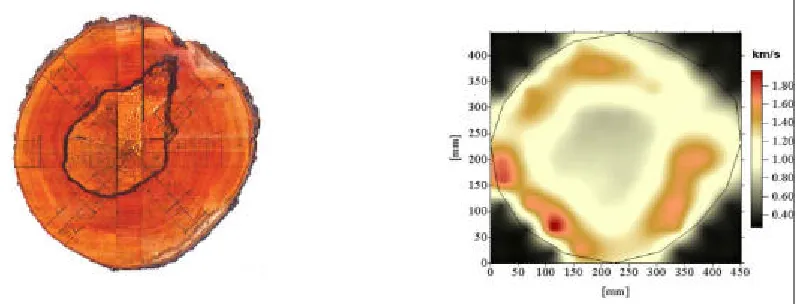
Ultrasonic tomographic imaging of internal structure of a standing tree (450mm diameter with an important decayed zone) is shown in Fig. 1 using the velocity calculation with SIRT. The ultrasonic velocity was measured with contact transmission method using exponential probes operating at 54kHz. The transducers were located on 16 equidistant points around the trunk perimeter selected for the tomography. By changing the reciprocal position of the transmitter and receiver foe each measurements, finally 120 independent acquisitions were obtained. The velocities measured in transversal plane ranging between 1000 and 1800 m/s . In the central decayed zone the velocities are relatively low compared with sound wood zones. This is due probably to the low density of the tissue produced by the fungal attack.
2.2.2 . ULTRASONIC IMAGING OF TIMBER AND OF WOOD-BASED COMPOSITES
In this section several typical images are discussed. The images were obtained at macroscopic and microscopic levels.
At microscopic scale, Berndt, Schniewind et al. (1999) reported images obtained with C scan on pine samples immersed in water, with 1 MHz focused transducers. It was possible to recognize the earlywood, the latewood and the grain direction.
At macroscopic scale Neuuenschwander, Niemz et al.(1997) published ultrasonic images of lumber obtained in C san mode by immersion in water and with 2.25 MHz broadband transducers. Typical patterns of the latewood and earlywood as well as deviation of the slope of grain around the knots can be observed. The presence of the compression wood can be observed. Cracks of several millimeters are visible in the first annual ring
voids were simulated by holes of different diameters bored into the thickness of the board. The image was obtained in C scan mode, by transmission technique, with specimen immersed in water and with broadband transducers of 0.5 MHz. central frequency.
3. X-RAY TECHNIQUE
X-ray (or gamma ray) technique was one of the first nondestruuctive method developed for internal inspection of wood material. and for the measurement of its microdensity. This technique produces an image parallel to the object under inspection. Conventional radiographic image is produced by sample translation. X-ray microanalysis was used to study the densitometric pattern of the annual rings. Moreover, insight into annual ring pattern produced by the development of the X-ray technique through microdensitometric analysis permitted the development of dendrochronology. In parallel, X-ray diffraction technique was developed for the study of crystallinity of cellulose.
X-ray computed tomography (CT) scanning provides tridimensional information about the internal inhomogeneous structure of the specimen. Attenuation coefficient of X-ray is measured. CT is a radiation nondestructive method that allow the conversion of the attenuation coefficient in density data and then into image. The tomograms or slices show several images perpendicular to the main axis of the object. CT images are obtained from the translation and rotation of the source and detectors around the specimen. The tomograms can be coded by color or by gray scale.
The image reconstruction methods are :
- - analytical methods, based on Fourier transforms and related techniques. Using
a huge amount of computation, data obtained from convolution can be processed immediately as collected and the virtual image build by projection is available immediately.
- - algebraic (iterative) methods need a very large amount of data for image
reconstruction and better results are obtained from relatively few projections. -
The advantages of CT are numerous compared with conventional radiography, such as :
- - this technique eliminates the intermediate steps involving photographic film and
optical densitometry and is able to make data available in real time. In process control and in manufacturing situations the density feedback is very important for technological competitivity.
- an important advantage of direct scanning technique is the improvement of the
calibration procedure because the mass attenuation coefficient can be determined directly , using a scintillation detector with standard radiation pulse shaping and counting equipment, which allows the user to select the energy range counted.
- - a large volume of material can be inspected quickly and implementation of
scanning technology in sawmills and other factories for wood material will have an important payback for wood processors.
- The factors affecting the quality of the image are: beam path, spatial and contrast resolution , anisotropic direction of wood . The maximum radiation resolution is determined by density variation in wood specimen, energy and intensity of X-rays.
The field of applications of X-ray CT is very large including building inspection, wood preservation, stability of wooden constructions, trees and pole inspection, arboriculture, growth rate assessment, wood quality assessment, forest science, wood technology, wood biology, dendrochronology, climatology, etc. (Bucur 2002). The choice of specific inspection must be made on economic grounds.
Because of space limitation we selected only two interesting applications : examination and inspections of trees, and pollution effect on wood quality.
3.1. INSPECTION OF TREES
For the examination of trees Habermehl and Ridder (1998) proposed two types of portable apparatus , one with a parallel beam system and another with a fan beam system (Fig 2). The source is 137 Cesium having a half life of 30 years and emitting gamma rays of a quantum energy of 662 keV. The size and the location of the defects which can be observed are cavities and decay in trunk, mechanical injuries, fissures, holes, the presence of metallic inclusions in trunk, in some species differences between sapwood and heartwood induced by the difference in moisture content, as well as zones of health wood. The devices are very effective for the examination of park and street trees. The decision of the environmental authority to conserve or not the trees after examination of tomographic images can be objective and the safety of the traffic on streets assured. For forest trees the questioned answered by the portable apparatus are related to the effect of fertilization on the sapwood to heartwood ratio, to the water pathways above the trunk cross section, to the existence of frost cracks, to the existence of wet cores and other specific internal structures that can affect the variation of the attenuation coefficient of the radiation and consequently of the density.
3.2 POLLUTION EFFECT ON WOOD QUALITY
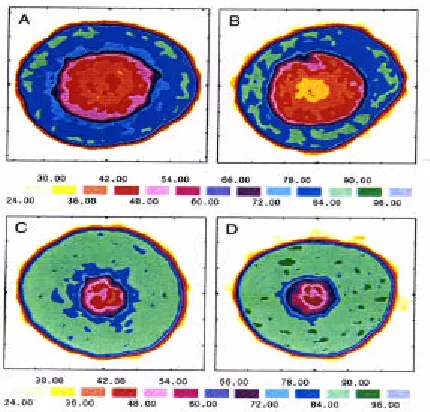
Studies related to the pollution effect on trees (Pinus sylvestris) induced by
CONCLUDING REMARKS
The development of specific nondestructive techniques for wood characterization has as principal purpose to reduce the uncertainty of products behavior induced by the biological nature of this material. Imaging of wood structure with ultrasonic or X ray computed tomography allows the mapping of different measured parameters using algorithms and advanced computational procedures for data collection, image reconstruction and display. In the future these techniques are expected to become of general use.
REFERENCES
Beall F 1996 Future of nondestructive evaluation of wood and wood-based materials. Holzforschung und Holzverwert 5 : 73-75; Berndt H, Schniewind AP, Johnson GC 1999 High resolution ultrasonic imaging of wood. Wood Sci. Techn. 33:185-198; Biagi E, Gatteschi G, Mazotti L et al 1994 Tomografia ad ultrasuoni per la caratterizzazione difettologica del legno. Alta Freq. 6,2 : 48-57; Bucur V 1995 Acoustics of wood. CRC Publ. Comp. Boca Raton; Bucur V 2002 Nondestruc tive characterization and imaging of wood. Springer Verlag (in press); Bucur V, Rasolofosaon P 1998 Dynamic elastic anisotropy and nonlinearity in wood and rock. Ultrasonics 36 : 813-824; Habermehl A Ridder HW 1998 Gamma ray tomography in forest and tree science. Proc. SPIE (Int. Soc. Optical Eng) 3149 : 234-244; Hearmon RFS 1965 The assessment of wood properties by vibrations and high frequency acoustic waves. 2nd Symp. Nondestructive Testing
[image:7.596.108.512.453.605.2]of wood , Washington State Univ. : 49-66; Kätzel R, Ridde HW, Habermehl A 1997 Investigation of ammonia stressed Scots pitne (Pinus sylvestris) with computed tomography in an immission area around a cattle farm. Phyton 37,1 : 141-149; Martinis R. 2002 Nondestructive techniques for decay diagnosis on standing trees . Thesis University of Florence, Italy; Ross RJ and Pellerin RF 1991 Nondestructive evaluation of wood, past, present and future. In Nondestructive characterization of materials. Ed C.O. Ruud, Green RE Plenum press, New York, vol IV : 59-64; Sobue N 1993 Nondestructive characterization of wood. Mokuzai Gakkaishi 39 : 973-979; Socco V, Sambuelli G, Martinis R, Nicolotti G, Comino E 2001 Feasability of ultrasonic tomography for NDT of decay on living trees. Manuscript of the article for publication; Tomikawa Y, Iwase Y, Arita K, Yamada H1986 Nondestructive inspection of wooden pole using ultrasonic computed tomography. IEEE Trans. UFFC 33,4: 354-358
Figure 2: Mobile apparatus for computed tomography Habermehl and Ridder (1998) Legend : a) parallel beam system ; b) fan beam system
Figure 3 : Development of sapwood in pine induced by the ammonia pollution, compared with a normal tree (Kätzel R, Ridde HW, Habermehl A 1997)
Legend : A) maximum pollution, tree with 624 cm² cross section in site 1 at 200 m from the farm B) : tree with 745 cm² cross section, in site 2 at 280m from the farm C) minimum pollution, tree with 513 cm² cross section in site 3 at 2900m from the farm