N Sotelo et al.Fanconi – Bickel Syndrome 163
www.medigraphic.com
Annals of Hepatology 2008; 7(2): April-June: 163-167
Annals of Hepatology
Case Report
Fanconi – Bickel Syndrome – two cases report
Norberto Sotelo;1 Ramiro García;2 René Tostado;3 Nagasharmila Dhanakotti4
1 Head of the Department of Pediatric Internal Medicine. 2 Head of the Department of Pediatric Nephrology. 3 Medical Pediatric Resident.
4 Associated to Department of Pediatric Internal Medicine.
From the Hospital Infantil del Estado de Sonora, México
Address for correspondence: Norberto Sotelo
[email protected] and [email protected]
Manuscript received and accepted: 15 February and 24 March 2008
Abstract
A one year eight month old male child and his nine month old female sibling were presented with Growth retardation, abdominal distension, doll-like faces, hepatomegaly, phosphaturia, proximal renal tubular dysfunction. The elder sibling also presented with glu-cosuria, hyperglycemia, hypoinsulinemia. The young-er one latyoung-er presented with galactosemia. Biopsy of liv-er on these two patients revealed the accumulation of glycogen in hepatocytes.
Key words: Fanconi- Bickel syndrome, glucosuria, phosphaturia, glycogenosis.
Introduction
FBS is known from 1949 as Hepato Renal glycogeno-sis, with proximal renal tubular alteration characterized by glucosuria. Within the classification of glycogenosis FBS is denominated as type XI. From the description made by Fanconi,1 until now a little more than 100 cases were published in the world literature.2
An Autosomal Recessive Disease due to an enzymatic defect which has been not yet identified. A pathogenic mutation in GLUT- 2 gene of hepatocytes, β cells of pan-creas and renal tubules, was discovered in 1997. This dis-order is characterized by growth retardation, rickets, hepatomegaly due to hepatic accumulation of glycogen, may also present as fasting ketotic hypoglycemia, fol-lowed by postprandial hyperglycemia, during this stage there is also hypoinsulinism due to the altered sensitivi-ty of β cells of pancreas to glucose. Due to the conse-quence of proximal renal tubular dysfunction, they also present hypophosphatemia and rickets.2
Case report
Case 1
A one year eight month old male child who is first born of non consanguineous parents of 21 year old both, native of Caborca, Sonora. Parents are apparently healthy. However, maternal grandmother family has con-sanguinity.
This child is a product of first conception, during which the mother had regular antenatal visit and did not have any antenatal problem. Born of normal delivery, cried and respired spontaneously with birth weight of 3,600 g and discharged along with the mother, was not breast fed. Feeding was started with formula feeds, main-tained with the same, until one year of age. Complimen-tary feeds started since 6 months of age with cereals and baby food. Development: Head control at 5th month, sit-ting with support and attempted to crawl from the age of 8th month. Child yet to walk.
At one year of age, the child presented with growth re-tardation, abdominal distension, doll- like face and hepatomegaly. Laboratory investigation showed Fasting hypoglycemia followed by postprandial hyperglycemia. Liver function tests were normal.
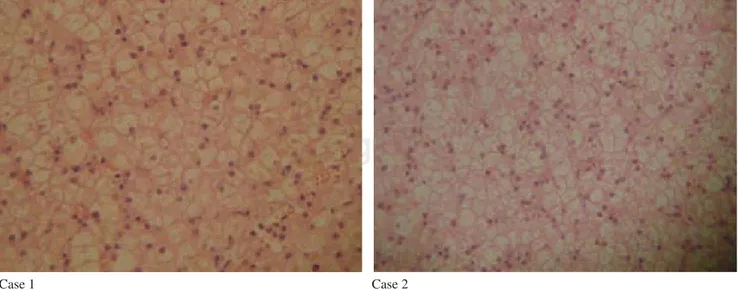
Ultrasonography of abdomen revealed hepatomega-ly without any diffuse parenchymal abnormality. Liver biopsy was made, reported as large hepatocytes with clear cytoplasm, ballooning and positive for PAS staining, characteristic of glycogenosis (Figure 1). Hence the diagnosis of Von-Gierke disease was made and advice was made regarding feeding frequency and corn starch feeds.
At the age of one year seven month, was presented with respiratory distress, the Silverman Anderson score of 3, signs of acidosis, pallor, diaphoresis, tachypnea and tachycardia, hence the child got hospitalized. The labo-ratory examination showed leucocytosis with shift to left. There was hyperglycemia. The Gasometry was re-ported as metabolic acidosis (PH 7.10, PCO
2 11, PO2 108, HCO3 3.4, Base deficit 23.8, S O2 96.5), on repeated gas-ometry also, the similar reports were obtained. X- ray of thorax demonstrated pulmonary condensation. Clinical condition continued to detoriate, mandating elective in-tubation and ventilatory support at Pediatric Intensive Care Unit. More than the treatment of antibiotics Penicil-lin and Aminoglycoside, Metabolic acidosis was treated
Artemisa
www.medigraphic.com
with continuous bicarbonate infusion calculated as per acid base deficit depending upon the gasometry. Due to persistent hyperglycemia, determination of C peptide level was requested, with result of 0.3 ng/mL, with refer-ence value of 1.1- 5.0 ng/mL; Insulin level < 0.200μU/L with reference value of 5.0- 25μU/L. The antibiotic scheme was modified, started on Dicloxacillin, Cefotax-im and Fluconazole as Urine culture was positive for Candida Albicans of 100,000/HPF. With this, the child improved clinically, radiologically and values of labora-tory examination, hence extubated and transferred to us for continued evaluation and treatment.
The physical examination showed, Head circumfer-ence of 48 cm ( 50th centile for age), length of 73 c (< 5th centile for age), weight of 11,100 g (< 25th centile for age); Doll-like face was more prominent, small thorax and rachitic changes noted in the costal cartilage. Dis-tended abdomen with hepatomegaly of 6 x 5 x 5 cm (Figure 2), with genitals relevant to his age and sex also noted. Rest of the systemic examination was normal.
Repeat Gasometry, C peptide, Insulin were request-ed and were continurequest-ed to be below the normal values (metabolic acidosis, 0.3 ng/mL and 1.3μU/L
respec-tively). Hence, the possibility of FBS associated with glycogenosis was considered. Due to persistent aci-dosis, Nephrology and Genetic opinion was sought. Serum and urinary electrolytes of 24 hours were re-peated. While analyzing Phosphaturia, Negative an-ion gap curve of Hyperchloremic type was observed, this was compatible with tubulopathies (Figure 3 and Table I).
Radiography of long bones showed evidence of rick-ets. Ultrasonography of Abdomen showed hepatomegaly without diffuse hepatic parenchymal lesions. Kidneys, Pancreas and Spleen were normal in shape and size.
In the beginning, the diagnosis of type I glycogenosis Von Gierke Disease was considered in this patient. How-ever, during the course of evolution, the patient present-ed with metabolic acidosis, due to renal tubular dysfunc-tion, pre-prandial hypoglycemia with ketosis followed by postprandial elevated blood glucose , associated de-creased Insulin and C Peptide levels, but at the same time not following the clinical course of type I diabetes too. After the biochemical analysis and renal functional test to demonstrate the proximal renal tubular dysfunction, with the results of glucosuria, phosphaturia, bicarbonate
Case 2 Case 1
A B
A B
www.medigraphic.com
loss, hypoglycemia, hypophosphatemia, hypocalcemia, hypoglycemia with radiological evidence of rickets, the diagnosis of FBS was made in this case as regard to the clinical picture.
The treatment was started with 25 hydroxy Vitamin D (0.25μg/24 h or 2,000 MI/kg/24), Disodium phos-phate with Phosphoric acid as 85% (58.5 g in 1,200 mL of normal water) 5 times a day and Bicarbonate of 15 mEq/k/24 h. Dietary advice was made as
mater-nized cow’s milk in the beginning, later whole milk was given as the galactose level in the blood was nor-mal. In addition to that, fruits, frequent small feeds and use of corn starch in the diet of the child also rec-ommended. The diet was calculated to provide the cal-orie of 140 kcal/kg of body weight and 5 grams of pro-tein/kg of body weight. Regular follow up on outpa-tient basis was advised with Pediatric and Nephrology departments.
Figure 3. Demonstrating the displacement of anion gap curve towards left (hyperchloremic) in proportion to urinary chloride (1- Case 1; 2 – Case 2). AG = urinary Na + urinary K – urinary Cl (Case 1: 87 + 14 = 101-57 = +44; Case 2: 32 + 23 = 52-23 = +32).
0 10 20 30 40 50
0 10 20 30 40 50 60
Proportion of urinary chloride
Anion
Gap
1
2
Table I. Laboratory test.
Blood/Serum Urine Reference Parameter Case 1 Case 2 Reference value Parameter Case 1 Case 2 value Arterial blood PH 7.10 7.33 7.35 – 7.45 Sodium (mEq/L) 8 7 3 2 85 – 250
Sodium (mEq/L) 142 131 135 – 145 Potasium (mEq/L) 1 4 2 3 2.5 - 125 Potassium (mEq/L) 3.9 3.9 3.5 – 5.0 Chloride (mEq/L) 5 7 2 3 15 - 40 Chloride (mEq/L) 110 9 8 95 – 105 Phosphorous (mg/dL) 28.4 2 3 0.6 – 1.5 Bicarbonate (mEq/L) 9 9.3 22 – 26 Glucose (mg/dL) 1,000 Negative Negative Calcium (mg/dL) 9 8.9 8.8 – 9.5 Ketone(Mm/dL) 150 Negative or Neg Phosphorous (mg/dL) 2.3 2.2 4.0 – 7.0 Amino acid Negative Negative Negative Urea (mg/dL) 1 1 1 4 15 – 40 Chromatography
Creatinine (mg/dL) 0.4 0.1 0.6 – 1.2 Glucose (mg/dL) 117 117 70 - 110 Uric acid (mg/dL) 1.5 – 2.0 – 2.7 Alkaline phosphatase IU 1 4 1 2 30 – 120 Cholesterol (mg/dL) 125 139 < 200 Trigliceride (mg/dL) 370 215 85 – 150 Insulin (uU/L) 0.20 1.9 5.0 – 25 C Peptide (ng/mL) 0.3 0.41 1.1 – 5.0 Alanin amino tranferase U/L 51.0 37.0 0-38.0 Asparte amino transferase U/L 37.0 28.0 7- 41 Prothrombin time (sec) 14 .0 13.0 11 – 14 Thrombo plastin time (sec) 24 .0 21.0 20 – 40 Total Bilirubin (mg/dL) 0.7 1.4 0-1.1 Direct Bilirubin (mg/dL) 0.1 0.7 0-0.3 Unconjugated Bilirubin (mg/dL) 0.6 0.7 0-0.9 Total protein (g/dL) 7.6 6.8 6-8.7 Galactose (mg/dL) 4.5 46.8 0-5.0
www.medigraphic.com
Case 2
Eight month old female infant, who is born of second conception (sibling of case 1), delivered via naturalis with birth weight of 2,500 g, length of 48 cm and head circumference of 32 cm. During the neonatal period, was hospitalized for transient tachypnea, transient unconju-gated hyperbilirubinemia and hypoglycemia not associ-ated with seizures. The newborn metabolic screening was negative, however the estimation of blood galactose lev-el later reported to be lev-elevated.
At the age of 7 month, infant was brought to hospital for delay attaining age appropriate milestones (not at-tained head control, not started sitting and crawling).
The physical examination revealed weight of 7,950 g, length of 63 cm, which are less for age (3rd centile),
Doll-like face, prominent abdomen and hepatomegaly
of about 6 cm below the right costal margin (Figure 4). Because of these finding, FBS was suspected and the following laboratory analysis were requested: Arterial blood gas, Serum and Urinary Electrolytes, calcium, phosphorous, cholesterol, triglyceride, ultra sonogram of abdomen and x-ray of thorax and long bone. They were reported as metabolic acidosis (Table I), rickets and hepatomegaly devoid of any specific ultrasono-graphic pattern. Based on these results, liver biopsy was done and revealed histopathological changes typical of glycogenosis (Figure 1). Hence, the suspicion of FBS was confirmed and treatment was continued with phos-phate and bicarbonate replacement. The dietary advice was given based on the calculation of 140 kcal/kg of body weight, protein of 4.5 gm/kg of body weight in the form of maternized cow’s milk, formula of soya, pu-ree of fruits and vegetables.
Discussion
FBS is a rare clinical entity and rare presentation with in the same family affecting the infants between the ages of 2 month to 1 year of life. The clinical picture, which is noticed in majority of the patients, is characteristic faces «Moon- shaped» face or «Doll- like» face. In addition, short stature, rickets, protuberant abdomen, and hepatomegaly3-5 are associated features in FBS. In
addi-tion, biochemical changes encountered as a consequence of the altered Proximal Renal Tubular function (gluco-suria, phosphaturia, bicarbonate loss and hypophos-phatemia, aminoaciduria). Preprandial ketotic hypogly-cemia and significant post prandial hyperglyhypogly-cemia and hypergalactesemia are noted due to low hepatic uptake. There is also hypoinsulinemia due to altered sensitivity of β cells of Pancreas to glucose, associated with reduced release of monosachroide by hepatic cells during fasting
Figure 4. Case 2 exhibits Doll-like face and hepatomegaly (mar-ked by lines).
Figure 5. Percutaneous liver biopsy of Case 1 and Case 2 (HE 40x) showed large and ballooned hepatocytes with clear cytoplasm.
www.medigraphic.com
ESTE DOCUMENTO ES ELABORADO POR MEDI-GRAPHIC
and intra cellular accumulation with inhibition of glyco-genolysis leading on to glycogen accumulation and hepatomegaly.6,7
During the period of fasting, there is reduced blood glucose level which is generally not associated with con-vulsions. This hypoglycemia is accompanied by ketosis followed by postprandial hyperglycemia, making to con-sider the possibility of ketosis to have a neuro protective effect.2,8 It is also possible to encounter elevation of
cho-lesterol and triglyceride in these patients due to accumu-lation of secondary metabolite.6,7
With respect to recent discovery in Genetic aspect of the disease, mutations in GLUT-2 gene was detected in 34 cases.7,9,10 Parental consanguinity was observed in 2/
3rd of these patients. Some of these cases were identified
through Neonatal Screening for Galactosemia. This gene is localized much in hepatocytes like in the β cells of pancreas, enterocytes and renal tubules.2
There is no specific treatment exist for this disease in the therapeutic form, besides intravenous hydra-tions, to provide with Vitamin D in the form of 1, 25 dihydroxy Vitamin D3. Citrate up to 15 mEq/kg/day given every 4th hourly to maintain bicarbonate more
than 20 mEq/dL, phosphate solution orally; to offer with fructose and corn starch to provide glucose in slow release form and also which do not require dis-eased metabolic pathway. Because of the possible as-sociation of Galactosemia with FBS, it is
recommend-ed to provide the diet free of Galactose, until the re-sults of metabolic studies are known.2,6,10
References
1. Fanconi G, Bickel H. Die chroische Aminoacidurie (Aminosaeurediabetes oder nephrotischglukourischer Zwergwuchs) bei der Glykogenoseund der Cystinkrankheit. Helv
Pediat Acta 1949; 4: 359-396.
2. Pascual JM. Hereditary syndrome of glucose transport. Med Clin
(Barc.) 2006; 127(18): 709-714.
3. Garty R, Cooper M, Taibachnik E. The Fanconi syndrome asso-ciated with hepatic glycogenosis and abnormal metabolism of galactose. J Pediatr 1974; 85: 821-823.
4. Velasquez JL. Síndrome de Fanconi. Bol Med Hosp Infant Mex
1987; 44: 509-510.
5. Santer R, Schneppenheim R, Suter D, Schanb J, Steinman B. Fanconi-Bickel syndrome- the original patient and his natural history, historical steps leading to the primary defect, and a re-view of the literature. Eur J Pediatr 1998; 157: 783-797. 6. Velasquez-Jones L, Portillo HV, Sanjines R, Gamboa-Marrufo
A, Feria-Kaiser K, Valencia-Mayoral P. Síndrome de Fanconi-Bickel. Bol Med Hosp Infant Mex 1991; 48: 255-259.
7. Santer R, Steinmann B, Schaub J. Fanconi-Bickel syndrome a congenital defect of facilitative glucose transport. Curr Mol Med
2002; 2: 213-227.
8. De Vivo D, Lackie M, Ferrendelli J, McDougal D. Chronic keto-sis and cerebral metabolism. Ann Neurol 1987; 3: 331-337. 9. Sakamoto O, Ogawa E, Ohura T, Igarashi Y, Matsubara Y,
Narisawa K, et al. Mutation analysis of the GLUT 2 gene in patients with fanconi-Bickel syndrome. Pediatr Res 2000; 48: 586-589.
10. Karande S, Kumbhare N, Kulkarni M. Fanconi-Bickel syndrome.