Acute kidney injury in cardiac surgery
Bernardo Moguel-González,* Michael Wasung-de-Lay,* Pamela Tella-Vega,* Constanza Riquelme-Mc-Loughlin,**
Antonio R. Villa,***
,**** Magdalena Madero,* Gerardo Gamba*
,**
*Departamento de Nefrología, Instituto Nacional de Cardiología Ignacio Chávez.
**Unidad de Fisiología Molecular, Instituto Nacional de Ciencias Médicas y Nutrición Salvador Zubirán e Instituto de Investigaciones Biomédicas, Universidad Nacional Autónoma de México.***Departamento de Salud Pública, Facultad de Medicina, Universidad
Nacional Autónoma de México.****Facultad de Ciencias de la Salud, Universidad Panamericana. ARTÍCULO ORIGINAL
ABSTRACT
Introduction. Acute kidney injury (AKI) associated with cardiac surgery is a common postoperative complication that increases the morbidity and mortality substantially. However, there is limited information of AKI after cardiac surgery in our institution. Material and methods. We conducted a prospective, observational, and longitudinal analysis of adult patients that underwent to cardiac surgery requiring cardiopulmonary bypass and aortic cross clamp. Patients with preoperative chronic renal insufficiency that were on dialysis, with AKI detected up to 24 h before the procedure, or that received contrast agents 72 h before surgery were excluded. AKI was defined by the AKIN classification. Patients were followed up to 7 days after surgery or before if discharged from the intensive care unit. We analyzed age, sex, body mass index (BMI), co-morbilities, previous cardiac surgery, left ventricular ejection fraction, New York Heart Association class, type of procedure, cardiopulmonary bypass time, cross clamp time and bleeding. Results. Our analysis included 164 patients submitted to cardiac surgery. In the follow up, 84% did not have AKI, 11% had AKIN 1 and 2 accompanied by increase in serum creatinine and 6% had AKIN 3. Patients with AKI were older, had a higher preoperative creatinine, plasma glucose level, and a lower left ventricular ejection fraction. All together patients with AKIN had a longer hospital stay and a higher mortality (p < 0.001). The preoperative use of insulin was associated with the development of AKI, and there was a higher number of patients with a New York Heart Association class III and IV for heart failure in the more sever forms of AKI (p = 0.01). The logistic regression analysis revealed that patients with a high preoperative blood urea nitrogen (> 20 mg/dL) creatinine level (> 1 mg/dL), uric acid (> 7 mg/dL) and lower albumin (< 4 g/dL) or lower intraoperative hemoglobin (< 8 g/dL) had a higher risk for postoperative AKI. Conclusions. The prevalence of AKI in our Institute is of 17%. Patients with AKIN 2 and 3 had a higher mortality and a longer stay in the intensive care unit. The major risk factors for AKI development were identified.
Insuficiencia renal aguda en cirugía cardiaca
RESUMEN
that patients who develop elevated postoperative creatinine levels demonstrate a significantly increa-sed probability of developing end-stage renal disease in the future, even though they might not need re-nal replacement therapy (dialysis); this risk is also higher in patients who require dialysis.15 Because of these reasons, it is necessary to evaluate the status of AKI in our environment in order to implement programs that might lead to a lower incidence of this complication.
Several studies have assessed the prevalence and risk factors associated with the development of AKI. The type of surgery, female gender, congestive heart failure, type II diabetes mellitus, peripheral vascular disease, preoperative use of the intra-aortic counter-pulsation balloon pump, chronic obstructive pulmo-nary disease, emergency surgery and elevated preoperative serum creatinine are the most frequen-tly reported risk factors.3,9,16
Our group previously carried out studies in expe-rimental animals, which suggested that mineralocor-ticoid receptor blockade with spironolactone could be useful to prevent or reduce AKI due to ischemia, even after exposure to renal ischemia.17-19 Thus, knowing the situation in our environment is neces-sary in order to implement these potential therapies in the clinic. However, no prospective studies have been designed specifically to determine the prevalen-ce of AKI in patients undergoing cardiac surgery at our institution and to identify perioperative factors associated with its development. Therefore, the pur-pose of this study was to determine the incidence and risk factors for AKI in a prospective cohort of patients undergoing cardiac surgery.
MATERIAL AND METHODS
This was a prospective, longitudinal, and obser-vational study designed to determine the incidence and risk factors for AKI in patients who underwent cardiovascular surgery due to various causes at the Instituto Nacional de Cardiología Ignacio Chávez. We excluded patients with advanced chronic kidney disease who were placed on dialysis prior to the sur-gical procedure, patients with AKI criteria within 24 h prior to the surgical procedure, and patients who had been administered iodinated contrast media in INTRODUCTION
Despite the exponential growth of cardiovascular hemodynamics as a therapeutic tool for various heart diseases, cardiac surgery with an extracorpo-real circulation pump remains the most frequently performed surgical procedure worldwide.1 Like all surgical procedures, cardiac surgery is not without potential complications. One such complication is the development of acute kidney injury (AKI) due to ischemia, of particular importance in extracorporeal circulation, which can occur in the range of 1 to 30% of patients.2-6 The causes of AKI are multifacto-rial, but ischemia/reperfusion during extracorporeal circulation plays a key role.
Both the percentage of patients who develop AKI in various centers and the severity of this complica-tion vary, ranging from a seemingly harmless mild and transient elevation of serum creatinine to a complete loss of function requiring renal replace-ment therapy by dialysis. According to various se-ries, between 2 and 10% of patients undergoing cardiac surgery will eventually require postoperative dialysis,2-7 which increases the mortality rate up to 50-80%.8 In fact, the development of severe AKI is a dreaded complication because despite advances in cardiopulmonary bypass techniques and critical pa-tient management, morbidity and mortality associa-ted with AKI have not changed significantly in the past 25 years.3,6,8 In addition to metabolic and hemo-dynamic consequences, AKI also prolongs hospital stay, increases the risk of infections and has a signi-ficant effect on the cost of care.10
Postoperative AKI presents more serious implica-tions than what had been previously believed for many years, as it was thought that postoperative elevations in serum creatinine that did not require dialysis were not important and that even patients who required dialysis for AKI recovered ad inte-grum. However, numerous studies in recent years have shown that this is not the case. On the one hand, we now know that even a minimum increase in postoperative serum creatinine is associated with increased mortality in the first month after sur-gery.11 In addition, AKI is an important risk factor for the development of chronic kidney disease.12-14 In this regard, epidemiological studies have shown
el desarrollo de LRA fueron: edad, creatinina basal mayor, niveles de albúmina y ácido úrico y la FEVI.
Palabras clave. Insuficiencia renal aguda. Necrosis tubu-lar. Creatinina. Diálisis.
the previous 72 h at a dose higher than 5 mL/kg for each mg/dL of SCr. In-hospital reoperation cases were included only for the first surgical event. The elimination criteria consisted of patients who requi-red further surgery within seven days after the sur-gical procedure, those requiring the use of intravenous contrast solutions, and those who died within the first 24 h after cardiac surgery.
Patients
Adults who underwent elective cardiac surgery from October 10, 2010 to June 31, 2011 were inclu-ded in this study. Informed consent was deemed un-necessary because this was an observational study that involved no risk and no cost to the patient.
Measurements
The following data were collected on baseline on the day before surgery: anthropometric measure-ments, vital signs, history of comorbidities, current drugs and the serum levels of hemoglobin (Hb), hematocrit (Hct), leukocytes, platelets, fasting glu-cose, creatinine, uric acid, albumin, sodium and po-tassium. The left ventricular ejection fraction (LVEF) measurement from the last echocardiogra-phic analysis report was recorded. The surgical pe-riod was conducted at the discretion of the surgical and anesthesiology team. Data recorded in the immediate postoperative period, including the pro-cedure performed, duration of extracorporeal circulation (pump), aortic clamping time, surgical complications and other findings, were entered into the database.
After surgery and according to the intensive care unit (ICU) postoperative routine, urinary volumes were recorded on an hourly basis, verifying uresis in mL/kg/hr on each shift (3 times daily). In addition, serum creatinine and blood urea nitrogen (BUN) levels were recorded every 24 h, as these values are routi-nely determined for patients remaining in the ICU.
Definition of variables
The development of AKI was defined according to universally accepted criteria shown in table 1.20 The types of cardiac surgery that were recorded included valve replacement, coronary artery bypass graft (CABG) surgery, combined surgery (valve replace-ment surgery and CABG), and other surgeries (clo-sure of atrial or ventricular communications, tumor resection, etc.). Patients were followed-up during the first 7 days after cardiac surgery.
Statistical analysis
The cohort was initially classified into the follo-wing 4 subgroups:
• No AKI.
• AKI stage 1-2, which was defined solely by chan-ges in urinary volume without chanchan-ges in SCr (these patients presented decreased urinary volu-mes that were successfully managed with volume replacement, without subsequent changes in serum creatinine).
• AKI stage 1-2 due to changes in SCr; and • AKI stage 3.
Significant differences were found between continuous variables in these patients using an analysis of variance with the nonparametric Kruskal-Wallis test. The comparison of categorical variables for the 4 subgroups was performed using the chi-square test. In an additional analysis, the group without AKI (n = 84) was compared to patients from subgroups 3 and 4, who developed AKI according to elevated serum creatinine levels (n = 28). The Fisher’s exact test (2-tailed) was used to test for differences in categorical variables between the two groups (no AKI vs. AKI). An un-conditional logistic regression analysis was perfor-med to estimate the probability of AKI in accordance with pre-and intraoperative varia-bles. A p value < 0.05 was considered statistically significant. The SPSS/PC V17.0 statistical program (Chicago, IL) was employed for analysis.
RESULTS
As shown in figure 1, 206 patients who consecuti-vely underwent cardiac surgery were included dur-ing the study period. A total of 42 patients were excluded for the following reasons: perioperative death in the first 24 h (5 patients), lack of a base-line urine sample (7), incomplete basebase-line data (2), because it was decided not to perform aortic clam-ping and therefore no cardiopulmonary bypass du-ring the surgical procedure (13), and due to the cancellation of surgery for various reasons (15). The final study sample consisted of 164 patients.
AKI stage 1-2 due to elevated SCr (group 3), and only 6% developed AKI stage 3 (group 4) (Figure 1).
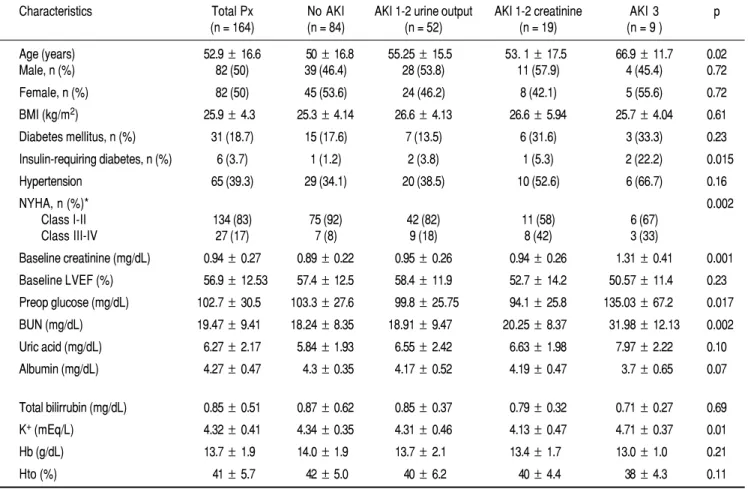
Table 2 shows the general features of the study population, classified by their type of kidney injury. The mean age of the patients was 52.9 ± 16.6 years, with the patients who developed AKI stage 3 presen-ting a significantly older age. Body mass index and the presence of diabetes mellitus did not demonstrate a significant difference in the AKI group, although there was a trend for a higher prevalence of diabetes in the population that developed AKI. Similarly, preoperative serum glucose levels were higher in the AKI stage 3 group, but this difference did not reach statistical significance. Baseline SCr levels were lower in patients who did not develop AKI (0.89 ± 0.22 mg/dL) than those with AKI, and this level was significantly increased in patients who developed AKI stage 3 (1.31 ± 0.41 mg/dL) (p < 0.001). Other
preoperative variables that showed statistically sig-nificant differences between AKI groups included BUN (p < 0.0001) and serum potassium (p = 0.01). There was a trend for serum albumin (p = 0.07). There was no difference in sex distribution between groups, and there were also no differences in the history of diabetes mellitus, systemic arterial hypertension, systemic vascular disease, acute myocardial infarction, peripheral vascular disease, neoplasia and immunosuppressive therapy. The use of insulin as part of prior treatment was significantly associated with AKI (p = 0.01). In addition, greater numbers of patients were classified as having heart failure (NYHA stage III and IV) in the most severe AKI categories (p = 0.01).
As shown in table 3, we observed no statistically significant difference in the percentage of patients who had previously used medications such as diuretics,
l
Table 1. Classification and staging systems for AKI.20
Stage Serum creatinine criteria (SCr) Urine output criteria
1 Serum creatinine increase ≥ 0.3 mg/dL < 0.5 mL/kg/h for 6 h or increase to 1.5-2.0-fold from baseline
2 Serum creatinine increase > 2.0-3.0-fold from baseline < 0.5 mL/kg/h for 12 h
3 Serum creatinine increase > 3.0-fold from baseline OR < 0.3 mL/kg/h for 24 h or anuria for 12 h. serum creatinine ≥ 4.0 mg/dL with an acute increase Or need for RRT
of at least 0.5 mg/dL or need for RRT
AKI: acute kidney injury. AKIN: AKI Network. RRT: renal replacement therapy.
F 1 Figure 1. 1 F
Figure 1. Studied cohort for acute kid-ney injury after cardiac surgery.
Patients undergoing cardiac surgery (n = 206) p
No AKI AKI stage 1-2 AKI stage 3 n = 84 (51%) n = 71 (43%) n = 9 (6%)
AKI stage 1-2 AKI stage 1-2 Serum creatinine n = 19 (11.5%) Urine output n = 52 (31.5%)
Excluded patients 3 Death during first 24 h 2 Transoperative mortality 7 Baseline urine sample missing 2 Incomplete files
15 Change day of surgery 13 No clamp surgery
NSAIDs, ACEI/ARA2, spironolactone, and statins bet-ween the groups with and without AKI. In the imme-diate postoperative period, NSAIDs were administered to three patients without AKI, as well as one from the AKIN 1-2 group but none from the AKIN 3 group.
The following transoperatory variables were as-sessed: extracorporeal circulation (pump) time, aor-tic clamping time, bleeding, and low hemoglobin as a hemodilution factor. None of these variables showed statistically significant differences between groups (Table 4). However, we observed an increase in the postoperative length of stay at the ICU for AKI stage 1-2 patients with increased SCr levels (group 3) and AKI stage 3 patients (group 4) (p < 0.001). A total of ten patients died, with an overall mortality rate of 6%. However, it should be noted that no patient in group 1 or group 2 died during the postoperative period, whereas 6 out of 19 patients in group 3 and 4 out of 9 patients in group 4 died during the first postoperative days, yielding mortality rates of 31 and 44%, respectively. This
finding reveals the significant mortality associated with the development of AKI (p < 0.001).
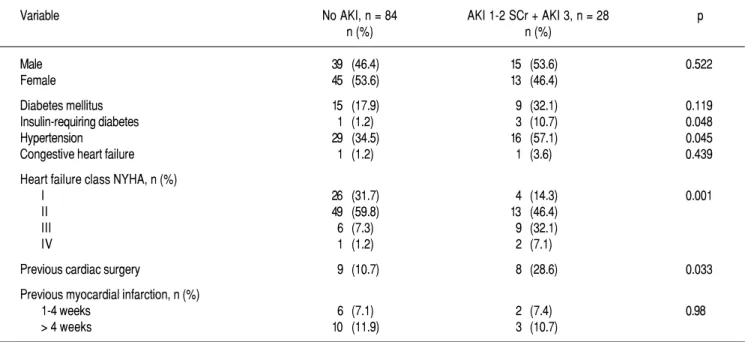
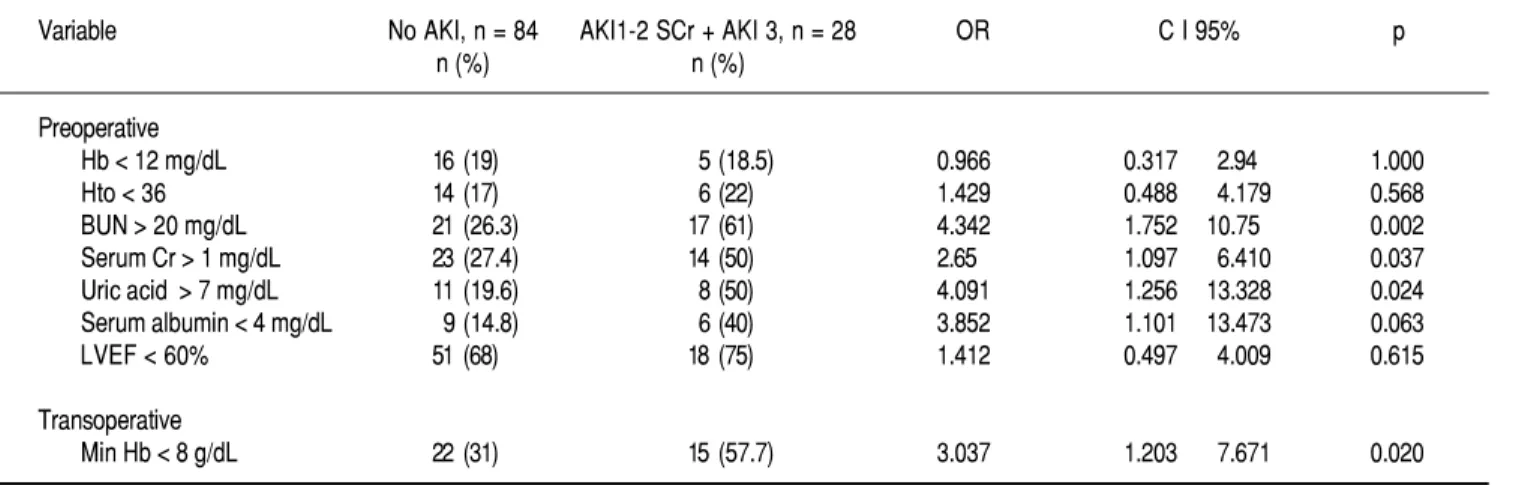
Table 5 shows the results obtained after reclassi-fying the cohort into only two groups: those without AKI (originally group 1) and those with AKI due to elevated serum creatinine (originally groups 3 and 4). In patients with diabetes mellitus, the analysis showed a difference that was not statistically signifi-cant between groups, with prevalence values of 32% in the AKI group vs. 18% in the control group (p = 0.12). However, the use of insulin and the presence of systemic arterial hypertension showed significant differences between the groups (p < 0.05). There was also a higher prevalence of heart failure (NYHA stage III and IV) in the AKI group (p = 0.001), and one-third of the patients in the AKI group had a history of previous cardiac surgery, compared to 11% in the non-AKI group (p = 0.03) (Table 5). There was no difference in the type of surgery between AKI groups. Table 6 shows the results of logistic regression analysis for the preoperative and intraoperative
Table 2. Patient baseline characteristics.
Characteristics Total Px No AKI AKI 1-2 urine output AKI 1-2 creatinine AKI 3 p (n = 164) (n = 84) (n = 52) (n = 19) (n = 9 )
Age (years) 52.9± 16.6 50±16.8 55.25±15.5 53. 1±17.5 66.9±11.7 0.02 Male, n (%) 82 (50) 39 (46.4) 28 (53.8) 11 (57.9) 4 (45.4) 0.72
Female, n (%) 82 (50) 45 (53.6) 24 (46.2) 8 (42.1) 5 (55.6) 0.72
BMI (kg/m2) 25.9± 4.3 25.3±4.14 26.6±4.13 26.6±5.94 25.7±4.04 0.61
Diabetes mellitus, n (%) 31 (18.7) 15 (17.6) 7 (13.5) 6 (31.6) 3 (33.3) 0.23
Insulin-requiring diabetes, n (%) 6 (3.7) 1 (1.2) 2 (3.8) 1 (5.3) 2 (22.2) 0.015
Hypertension 65 (39.3) 29 (34.1) 20 (38.5) 10 (52.6) 6 (66.7) 0.16
NYHA, n (%)* 0.002
Class I-II 134 (83) 75 (92) 42 (82) 11 (58) 6 (67)
Class III-IV 27 (17) 7 (8) 9 (18) 8 (42) 3 (33)
Baseline creatinine (mg/dL) 0.94± 0.27 0.89±0.22 0.95±0.26 0.94±0.26 1.31±0.41 0.001
Baseline LVEF (%) 56.9± 12.53 57.4±12.5 58.4±11.9 52.7±14.2 50.57±11.4 0.23
Preop glucose (mg/dL) 102.7± 30.5 103.3±27.6 99.8±25.75 94.1±25.8 135.03±67.2 0.017
BUN (mg/dL) 19.47± 9.41 18.24±8.35 18.91±9.47 20.25±8.37 31.98±12.13 0.002
Uric acid (mg/dL) 6.27± 2.17 5.84±1.93 6.55±2.42 6.63±1.98 7.97±2.22 0.10
Albumin (mg/dL) 4.27± 0.47 4.3±0.35 4.17±0.52 4.19±0.47 3.7±0.65 0.07
Total bilirrubin (mg/dL) 0.85± 0.51 0.87±0.62 0.85±0.37 0.79±0.32 0.71±0.27 0.69
K+ (mEq/L) 4.32± 0.41 4.34±0.35 4.31±0.46 4.13±0.47 4.71±0.37 0.01
Hb (g/dL) 13.7± 1.9 14.0±1.9 13.7±2.1 13.4±1.7 13.0±1.0 0.21
Hto (%) 41± 5.7 42±5.0 40±6.2 40±4.4 38±4.3 0.11
l
Table 3. Preoperative medication.
Medication Total Px No AKI AKI 1-2 AKI 1-2 AKI 3 p
n = 164 (%) n = 84 (%) Urine output Creatinine n = 9 (%) n = 52 (%) n = 19 (%)
Diuretics 81 (49) 37 (43.5) 28 (53.8) 11 (58) 5 (55.6) 0.45
NSAID 13 (7.8) 8 (9.4) 3 (5.8) 1 (5.3) 1 (11.1) 0.51
ACEI/ARBs 99 (60) 53 (62.3) 28 (53.8) 13 (68.4) 5 (55.6) 0.88 Spironolactone 35 (21) 17 (20) 9 (17) 7 (36.8) 2 (22.2) 0.73 Statins 52 (31.5) 26 (30.5) 19 (36.5) 3 (15.8) 4 (44.4) 0.63
Table 4. Transoperative variables.
Variables Total Px No AKI AKI 1-2 AKI 1-2 AKI 3 p
(n = 164) (n = 84) Urine output Creatinine (n = 9) (n = 52) (n = 19)
Pump time (min) 109.7 ±46.3 108± 41.8 107.7±45.6 125.8±60.2 104.7±62.8 0.48 Clamp time (min) 77.3 ±36.6 78.6± 34.2 77.07±39.9 75.33±37.7 69.7±42.6 0.91 Bleeding (mL) 929.9 ±622 937.5± 653 898±591 961±528 972±765 0.97 Minimal Hb (mg/dL) 9.23 ±5.51 8.89± 2.04 10.6±1.42 7.84±1.89 8.02±1.24 0.21
Post-operative
ICU stay (days) 4.6 (1-41) 3.4 (1-22) 3.2 (2-8) 8.89 (1-41) 15.7 (4-33) <0.001 Hospital mortality n (%) 10 (6.0) 0 0 6 (31.5) 4 (44.4) <0.001
.
Table 5. Comparison between No AKI and AKI Serum creatinine (included subgroups 3 and 4).
Variable No AKI, n = 84 AKI 1-2 SCr + AKI 3, n = 28 p
n (%) n (%)
Male 39 (46.4) 15 (53.6) 0.522
Female 45 (53.6) 13 (46.4)
Diabetes mellitus 15 (17.9) 9 (32.1) 0.119
Insulin-requiring diabetes 1 (1.2) 3 (10.7) 0.048
Hypertension 29 (34.5) 16 (57.1) 0.045
Congestive heart failure 1 (1.2) 1 (3.6) 0.439
Heart failure class NYHA, n (%)
I 26 (31.7) 4 (14.3) 0.001
II 49 (59.8) 13 (46.4)
III 6 (7.3) 9 (32.1)
IV 1 (1.2) 2 (7.1)
Previous cardiac surgery 9 (10.7) 8 (28.6) 0.033
Previous myocardial infarction, n (%)
1-4 weeks 6 (7.1) 2 (7.4) 0.98
> 4 weeks 10 (11.9) 3 (10.7)
values according to reference values. A statistically significant association was found between preopera-tive BUN > 20 mg/dL and the probability of develop-ing AKI (OR = 4.34, 95% CI 1.75-10.75, p = 0.002). Likewise, other variables that showed significant
hemoglobin < 8 g/dL (OR 3.04 95% CI 1.20-7.67, p = 0.02).
In the multivariate model using the method of progressive steps for the variables of diabetes, hypertension, age, insulin use, heart failure and temperature, only two variables were selected: heart failure (adjusted OR 2.35, 95% CI 1.17-4.76; p = 0.017) and temperature (adjusted OR 6.62, 95% CI 1.02-42.50, p = 0.047). The remaining variables did not reach statistical significance.
DISCUSSION
AKI associated with cardiac surgery represents a serious postoperative complication that significantly increases the risk of death or subsequent develop-ment of chronic kidney disease.1-15,21 According to the literature, the incidence of AKI in patients un-dergoing cardiac surgery ranges between 1 and 30%.2-6,8,9 In the present study, the incidence of AKI was 48.7% (80 of 164) when considering all AKI pa-tients (groups 2, 3 and 4). However, this figure was likely overstated, as the 52 patients who were initial-ly classified with AKI stage 1-2 according to a tran-sient decrease in urine volume did not demonstrate any consequences on renal function. If we only con-sider patients classified as AKI stage 1-2 with elevat-ed serum creatinine levels and those classifielevat-ed as AKI stage 3, this incidence was 17% (28 of 164), which is more consistent with what has been repor-ted in the literature.1,3-6,9 The percentage of patients requiring renal replacement therapy (RRT) was 6% (AKI stage 3), which is also similar to that reported in the literature.2,3-9 One limitation of this study was that we only included patients who underwent elec-tive surgery, and it is likely that the AKI incidence
would be higher in a cohort that included patients undergoing emergency surgery, in which renal per-fusion pressure is likely not optimal.
Similar to what has been observed in other stu-dies,9,11,15 patient mortality and length of stay in the surgical intensive care unit were higher in the group that developed AKI. Our data showed that mortality, which was calculated at 6%, occur-red only in patients with AKI. In other words, all patients in this cohort who died had developed postoperative AKI. In our cohort of patients requi-ring RRT, 70% underwent valve replacement and 30% underwent bypass surgery. However, we found no gender differences upon comparing the total number of surgeries and the number of patients who developed AKI, although previous reports9,16 have shown that 65.4% of AKI cases correspond to female patients when no distinction of the type of cardiac surgery is made. Our subgroup analysis further showed that gender distribution in our cohort was similar. In addition, 90% of the patients who died underwent valve replacement surgery; of the-se cathe-ses, 50% received aortic valve replacement, 20% received mitral and tricuspid valve replace-ment, 10% received mitral valve replacement and 10% received aortic valve replacement surgery com-bined with Coronary Artery Bypass Graft. In total, bypass surgery presented a mortality rate of 10%.
The level of baseline or preoperative serum crea-tinine has been shown to be an independent risk fac-tor for the development of AKI in the postoperative period.1-9,22 Our observations agree with this find-ing, as a significant difference was found regarding the preoperative creatinine level (p < 0.001) in the 3 AKI groups. Regarding the other preoperative varia-bles, we observed that the probability of developing
Table 6. Univariable associations with AKI.
Variable No AKI, n = 84 AKI1-2 SCr + AKI 3, n = 28 OR C I 95% p
n (%) n (%)
Preoperative
Hb < 12 mg/dL 16 (19) 5 (18.5) 0.966 0.317 2.94 1.000
Hto < 36 14 (17) 6 (22) 1.429 0.488 4.179 0.568
BUN > 20 mg/dL 21 (26.3) 17 (61) 4.342 1.752 10.75 0.002 Serum Cr > 1 mg/dL 23 (27.4) 14 (50) 2.65 1.097 6.410 0.037 Uric acid > 7 mg/dL 11 (19.6) 8 (50) 4.091 1.256 13.328 0.024 Serum albumin < 4 mg/dL 9 (14.8) 6 (40) 3.852 1.101 13.473 0.063 LVEF < 60% 51 (68) 18 (75) 1.412 0.497 4.009 0.615
Transoperative
AKI was associated with levels of BUN > 20 mg/dL, uric acid > 7 mg/dL and serum albumin < 4 g/dL. These data suggest that in our patients undergoing cardiac surgery, those demonstrating evidence of re-duced preoperative renal function and an elevated state of inflammation were more likely to develop AKI in the postoperative period.
Regarding the relationship between the use of cer-tain medications and the subsequent development of AKI in the postoperative period, there is some evi-dence to suggest that certain drugs that alter renal blood flow can lead to tubular injury and, through interactions with additional factors, increase the risk of AKI.17,23-24 However, we found no relations-hip between the previous use of medications, such as diuretics, NSAIDs, angiotensin converting enzyme blockers, angiotensin AT1 receptor blocker, spirono-lactone or statins, and postoperative development of AKI. In fact, insulin was the only drug used in the preoperative period that was related to the develop-ment of AKI, and this result is similar to those re-ported in other series.3,7 The association between insulin administration and the increased risk of postoperative AKI can likely be explained by the fact that the use of insulin is related to the severity of diabetes, which is associated with an increased risk of postoperative complications.1,9-10,24
Metha, et al.,1 assessed the association between AKI and the use of an aortic counterpulsation balloon pump and observed an 11.8% incidence of AKI in this patient group. In another series,9 23% of patients with AKI had received treatment with an aortic counterpulsation balloon pump compared to 7% who did not develop AKI. In our series, only 2.4% of all patients required a counterpulsation bal-loon pump, and only 0.6% of these cases were asso-ciated with AKI. However, the number of patients in this subgroup was low because our cohort was com-posed of patients who underwent elective surgery; therefore, most of our patients were in stable condition. Coronary Artery Bypass Graft surgery is perfor-med more frequently in patients with decreased LVEF compared to other patients undergoing cardiac surgery.2,3,5,6 In our cohort, the mean LVEF in patients undergoing bypass surgery was 52%, in comparison to 58% in patients undergoing other types of surgery. In addition, patients in AKI group 3 (LVEF 52.7% ± 14.2) and AKI group 4 (LVEF 50.6% ± 11.4) demonstrated lower LVEF values as compared to patients in group 1 (LVEF 57.4% ± 12.2) and group 2 (LVEF 58.4% ± 12), although this difference was not significant difference (p = 0.20). However, there was a higher prevalence of heart
failure (NYHA stage III and IV) in AKI groups 3 and 4 (p = 0.001).
Variables associated with the surgical period, such as aortic clamping time, extracorporeal circu-lation time, and a minimum hemoglobin level of 8 mg/dL, have been shown in several reports to be directly related to the development of AKI.1,9,25,26 In our cohort, there was no significant difference between groups regarding these variables; howe-ver, in the logistic regression analysis, minimum intraoperative hemoglobin < 8 g/dL was identified as a risk factor for the development of AKI (OR 3.04 95% CI 1.20-7.67, p = 0.02). One possible me-chanism by which low hemoglobin concentrations are associated with AKI could be the reduced diffu-sion of O2.23-26
CONCLUSIONS
The incidence of AKI and renal replacement the-rapy in adult patients during the postoperative pe-riod after receiving cardiac surgery with extracorporeal circulation at our institute was 17 and 6%, respectively, similar to what has been reported in the literature. In addition, AKI was sig-nificantly associated with mortality. In patients who developed AKI, we observed significantly higher levels of preoperative serum creatinine, BUN and uric acid; lower values for serum albumin; an advanced NYHA stage classification; lower LVEF; and reduced perioperative hemoglobin values < 8 g/dL.
ACKNOWLEDGMENTS
We thank the personnel of the ICU of the Instituto Nacional de Cardiología Ignacio Chavez for their help during the conduction of the present study. Supported by the grant No. 138464 form the Fondo Sectorial de Salud/Conacyt to GG and the Carlos Slim scholarship for health research to BMG.
REFERENCES
1. Mehta R, Grab J, O’Brien S, Bridges C, Gammie J, Haan C, et al. Bedside tool for predicting the risk of postoperative dialysis in patients undergoing cardiac surgery. Circulation 2006; 114: 2208-16.
2. Conlon PJ, Stafford-Smith M, White WD, Newman MF, King S, Winn MP, et al. Acute renal failure following cardiac sur-gery. Nephrol Dial Transplant 1999; 14: 1158-62.
3. Palomba H, Castro I, Neto A, Lage S, Yu L. Acute kidney injury prediction following elective cardiac surgery: AKICS Score. Kidney Int 2007; 72: 624-31.
of 500 consecutive patients. J Thorac Cardiovasc Surg 1976; 71: 323-33.
5. Gailiunas P Jr., Chawla R, Lazarus JM, Cohn L, Sanders J, Merrill JP. Acute renal failure following cardiac operations.
J Thorac Cardiovasc Surg 1980; 79: 241-3.
6. Ostermann ME, Taube D, Morgan CJ, Evans TW. Acute renal failure following cardiopulmonary bypass: A changing picture.
Intensive Care Med 1980; 26: 565-71.
7. Chertow GM, Lazarus JM, Christiansen CL, Cook EF, Ham-mermeister KE, Grover F, Daley J. Preoperative renal risk stra-tification. Circulation 1997; 95: 878-84.
8. Yeboah E, Petrie A, Pead J. Acute renal failure and open heart surgery. BMJ 1972; 415-8.
9. Thakar C, Arrigain S, Worley S, Yared J-P, Paganini EP. A cli-nical score to predict acute renal failure after cardiac surgery. J Am Soc Nephrol 2005; 16: 162-8.
10. Mangano CM, Diamondstone LS, Ramsay JG, Aggarwal A, Herskowitz A, Mangano DT. Renal dysfunction after myocar-dial revascularization: Risk factors, adverse outcomes and hos-pital resource utilization. Ann Intern Med 1998; 128: 194-203. 11. Lassing A, Schmidlin D. Minimal change of serum creatinine predicts prognosis in patients after cardiothoracic surgery. J Am Soc Nephrol 2004; 15: 1597-605.
12. Leung KC, Tonelli M, James MT. Chronic kidney disease fo-llowing acute kidney injury-risk and outcomes. Nat Rev Ne-phrol 2013; 9: 77-85.
13. Chawla LS, Kimmel PL. Acute kidney injury and chronic kid-ney disease: an integrated clinical syndrome. Kidney Int 2012; 82: 516-24.
14. Hsu CY. Yes, AKI truly leads to CKD. J Am Soc Nephrol
2012; 23: 967-9.
15. Chawla LS, Amdur RL, Amodeo S, Kimmel PL, Palant CE. The severity of acute kidney injury predicts progression to chronic kidney disease. Kidney Int 2011; 79: 1361-9.
16. Thakar CV, Liangos O, Yared JP, Nelson D, Piedmonte MR, Hariachar S, Paganini EP. ARF after open-heart surgery: In-fluence of gender and race. Am J Kidney Dis 2003; 41: 742-51. 17. Mejia-Vilet JM, Ramirez V, Cruz C, Uribe N, Gamba G, Boba-dilla NA. Renal ischemia-reperfusion injury is prevented by the mineralocorticoid receptor blocker spironolactone. Am J Physiol Renal Physiol 2007; 293: F78-F86.
18. Ramirez V, Trujillo J, Valdes R, Uribe N, Cruz C, Gamba G, et al. Adrenalectomy prevents renal ischemia-reperfusion injury.
Am J Physiol Renal Physiol 2009; 297: F932-F942.
19. Barrera-Chimal J, Pérez-Villalva R, Cortés-González C, Ojeda-Cervantes M, Gamba G, Morales-Buenrostro LE, et al. Hsp72 is an early and sensitive biomarker to detect acute kidney in-jury. EMBO Mol Med 2011; 3(1): 5-20.
20. Mehta RL, Kellum JA, Shah SV, Molitoris BA, Ronco C, War-nock DG, et al. Acute Kidney Injury Network. Acute Kidney Injury Network: report of an initiative to improve outcomes in acute kidney injury. Crit Care 2007; 11: 31.
21. Koyner J, Garg A, Coca S, et al. Biomarkers predict progres-sion of acute kidney injury after cardiac surgery. J Am Soc Ne-prol 2012; 23: 905-14.
2 2 . Ashraf SS, Shaukar N, Kamaly ID, Durrani A, Doran B, Graotte GJ, Keenan DJ. Determinates of early and late morta-lity in patients with end- stage renal disease and undergoing cardiac surgery. Scand J Thorac Cardiovasc Surg 1995; 29: 187-93.
23. Bonventre JV, Weinberg JM. Recent advances in the patho-physiology of isquemic acute renal failure. J Am Soc Nephrol
2003; 14: 2199-210.
24. Okusa MD. The inflammatory cascade in acute ischemic renal failure. Nephron 2002; 90: 133-8.
25. Swaminathan M, Phillips-Bute BG, Conlon PJ, Smith PK, New-man MF, Stafford-Smith M. The association of lowest hemato-crit during cardiopulmonary bypass with acute renal injury after coronary artery bypass surgery. Ann Thorac Surg 2003; 76: 784-92.
26. Karkouti K, Beattie WS, Wijeysundera DN, Rao V, Chan C, Dat-tilo KM, et al. Hemodilution during cardiopulmonary bypass is an independent risk factor for acute renal failure in adult cardiac surgery. J Thorac Cardiovasc Surg 2005; 129: 391-400.
Reimpresos:
Dr. Gerardo Gamba
Instituto Nacional de Ciencias Médicas y Nutrición Salvador Zubirán
Vasco de Quiroga, Núm. 15 Col. Sección XVI
14080, México, D.F. Tel.: 52 55 5513-3868
Correo electrónico: [email protected]