Features
• High Current Drive Capability (200mA) • Adjustable Duty Cycle
• Temperature Stability of 0.005%/°C • Timing From µSec to Hours • Turn off Time Less Than 2µSec
Applications
• Precision Timing • Pulse Generation • Time Delay Generation • Sequential TimingDescription
The LM555/NE555/SA555 is a highly stable controller capable of producing accurate timing pulses. With monostable operation, the time delay is controlled by one external resistor and one capacitor. With astable operation, the frequency and duty cycle are accurately controlled with two external resistors and one capacitor.
8-DIP
8-SOP 1
1
Internal Block Diagram
F/F
OutPut Stage 1
7
5 2
3
4
6 8
R R R
Comp.
Comp. Discharging Tr.
Vref
Vcc
Discharge
Threshold
Control
Voltage
GND
Trigger
Output
Reset
Absolute Maximum Ratings (T
A
= 25
°°°°
C)
Parameter Symbol Value Unit
Supply Voltage VCC 16 V
Lead Temperature (Soldering 10sec) TLEAD 300 °C
Power Dissipation PD 600 mW
Operating Temperature Range LM555/NE555
SA555 TOPR
0 ~ +70
-40 ~ +85 °C
Electrical Characteristics
(TA = 25°C, VCC = 5 ~ 15V, unless otherwise specified)
Notes:
1. Supply current when output is high is typically 1mA less at VCC = 5V 2. Tested at VCC = 5.0V and VCC = 15V
3. This will determine maximum value of RA + RB for 15V operation, the max. total R = 20MΩ, and for 5V operation the max. total R = 6.7MΩ
Parameter Symbol Conditions Min. Typ. Max. Unit
Supply Voltage VCC - 4.5 - 16 V
Supply Current *1(Low Stable) ICC
VCC = 5V, RL = ∞ - 3 6 mA
VCC = 15V, RL = ∞ - 7.5 15 mA Timing Error *2 (Monostable)
Initial Accuracy Drift with Temperature Drift with Supply Voltage
ACCUR ∆t/∆T ∆t/∆VCC
RA = 1kΩ to100kΩ
C = 0.1µF
- 1.0 50 0.1 3.0 0.5 % ppm/°C
%/V Timing Error *2(Astable)
Intial Accuracy Drift with Temperature Drift with Supply Voltage
ACCUR ∆t/∆T ∆t/∆VCC
RA = 1kΩ to 100kΩ C = 0.1µF
-2.25 150 0.3
- %
ppm/°C %/V
Control Voltage VC
VCC = 15V 9.0 10.0 11.0 V
VCC = 5V 2.6 3.33 4.0 V
Threshold Voltage VTH VCC = 15V - 10.0 - V
VCC = 5V - 3.33 - V
Threshold Current *3 ITH - - 0.1 0.25 µA
Trigger Voltage VTR
VCC = 5V 1.1 1.67 2.2 V
VCC = 15V 4.5 5 5.6 V
Trigger Current ITR VTR = 0V 0.01 2.0 µA
Reset Voltage VRST - 0.4 0.7 1.0 V
Reset Current IRST - 0.1 0.4 mA
Low Output Voltage VOL
VCC = 15V ISINK = 10mA
ISINK = 50mA
- 0.06 0.3 0.25 0.75 V V VCC = 5V
ISINK = 5mA - 0.05 0.35 V
High Output Voltage VOH
VCC = 15V ISOURCE = 200mA
ISOURCE = 100mA 12.75
12.5 13.3
- V
V VCC = 5V
ISOURCE = 100mA 2.75 3.3 - V
Rise Time of Output tR - - 100 - ns
Fall Time of Output tF - - 100 - ns
Application Information
Table 1 below is the basic operating table of 555 timer:
When the low signal input is applied to the reset terminal, the timer output remains low regardless of the threshold voltage or the trigger voltage. Only when the high signal is applied to the reset terminal, timer's output changes according to threshold voltage and trigger voltage.
When the threshold voltage exceeds 2/3 of the supply voltage while the timer output is high, the timer's internal discharge Tr. turns on, lowering the threshold voltage to below 1/3 of the supply voltage. During this time, the timer output is maintained low. Later, if a low signal is applied to the trigger voltage so that it becomes 1/3 of the supply voltage, the timer's internal discharge Tr. turns off, increasing the threshold voltage and driving the timer output again at high.
1. Monostable Operation
Table 1. Basic Operating Table
Threshold Voltage (Vth)(PIN 6)
Trigger Voltage
(Vtr)(PIN 2) Reset(PIN 4) Output(PIN 3)
Discharging Tr. (PIN 7)
Don't care Don't care Low Low ON
Vth > 2Vcc / 3 Vth > 2Vcc / 3 High Low ON
Vcc / 3 < Vth < 2 Vcc / 3 Vcc / 3 < Vth < 2 Vcc / 3 High -
-Vth < Vcc / 3 Vth < Vcc / 3 High High OFF
10-5 10-4 10-3 10-2 10-1 100 101 102 10-3 10-2 10-1 100 101 102 10M ΩΩΩΩ 1MΩΩΩΩ 10k ΩΩΩΩ 100k ΩΩΩΩ
RA=1
kΩΩΩΩ C a pa ci ta nce(uF ) Time Delay(s)
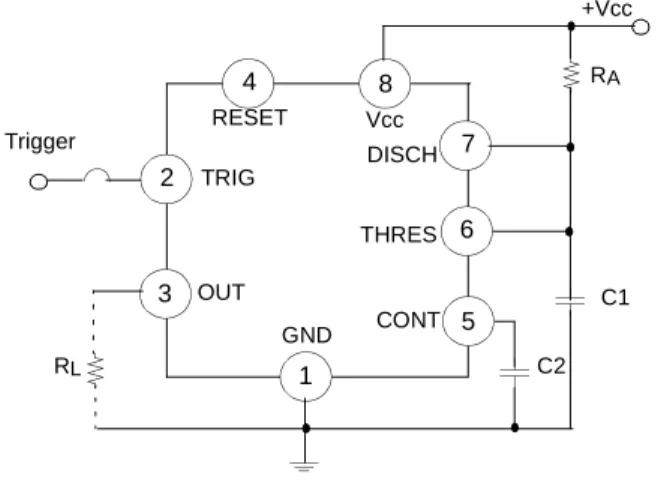
Figure 1. Monoatable Circuit Figure 2. Resistance and Capacitance vs. Time delay(td)
Figure 3. Waveforms of Monostable Operation
Figure 1 illustrates a monostable circuit. In this mode, the timer generates a fixed pulse whenever the trigger voltage falls below Vcc/3. When the trigger pulse voltage applied to the #2 pin falls below Vcc/3 while the timer output is low, the timer's internal flip-flop turns the discharging Tr. off and causes the timer output to become high by charging the external capacitor C1and setting the flip-flop output at the same time.
The voltage across the external capacitor C1, VC1 increases exponentially with the time constant t=RA*C and reaches 2Vcc/3 at td=1.1RA*C. Hence, capacitor C1 is charged through resistor RA. The greater the time constant RAC, the longer it takes for the VC1 to reach 2Vcc/3. In other words, the time constant RAC controls the output pulse width.
When the applied voltage to the capacitor C1 reaches 2Vcc/3, the comparator on the trigger terminal resets the flip-flop, turning the discharging Tr. on. At this time, C1 begins to discharge and the timer output converts to low.
In this way, the timer operating in monostable repeats the above process. Figure 2 shows the time constant relationship based on RA and C. Figure 3 shows the general waveforms during monostable operation.
It must be noted that, for normal operation, the trigger pulse voltage needs to maintain a minimum of Vcc/3 before the timer output turns low. That is, although the output remains unaffected even if a different trigger pulse is applied while the output is high, it may be affected and the waveform not operate properly if the trigger pulse voltage at the end of the output pulse remains at below Vcc/3. Figure 4 shows such timer output abnormality.
2. Astable Operation
Figure 4. Waveforms of Monostable Operation (abnormal)
100m 1 10 100 1k 10k 100k 1E-3
0.01 0.1 1 10 100
10M 1M
100k 10k
1k
(RA+2RB)
C
a
p
a
cit
a
nce(uF
)
Frequency(Hz)
Figure 5. Astable Circuit Figure 6. Capacitance and Resistance vs. Frequency
1
5 6 7 8 4
2
3
RESET Vcc
DISCH
THRES
CONT GND
OUT TRIG
+Vcc
RA
C1 C2 RL
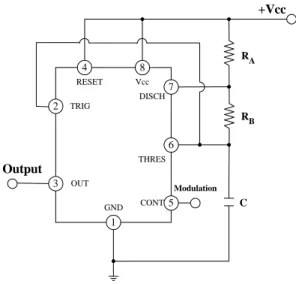
An astable timer operation is achieved by adding resistor RB to Figure 1 and configuring as shown on Figure 5. In astable
operation, the trigger terminal and the threshold terminal are connected so that a self-trigger is formed, operating as a multi vibrator. When the timer output is high, its internal discharging Tr. turns off and the VC1 increases by exponential function with the time constant (RA+RB)*C.
When the VC1, or the threshold voltage, reaches 2Vcc/3, the comparator output on the trigger terminal becomes high, resetting the F/F and causing the timer output to become low. This in turn turns on the discharging Tr. and the C1 discharges through the discharging channel formed by RB and the discharging Tr. When the VC1 falls below Vcc/3, the comparator output on the trigger terminal becomes high and the timer output becomes high again. The discharging Tr. turns off and the VC1 rises again.
In the above process, the section where the timer output is high is the time it takes for the VC1 to rise from Vcc/3 to 2Vcc/3,
and the section where the timer output is low is the time it takes for the VC1 to drop from 2Vcc/3 to Vcc/3. When timer output
is high, the equivalent circuit for charging capacitor C1 is as follows:
Since the duration of the timer output high state(tH) is the amount of time it takes for the VC1(t) to reach 2Vcc/3, Figure 7. Waveforms of Astable Operation
Vcc
RA RB
C1 Vc1(0-)=Vcc/3
C 1
dv c1 dt
---V
cc–V 0-( ) R
A+RB
---= ( )1
VC1(0+) = VCC⁄3 ( )2
V
C1( )t VCC 1 2 3 ---e
- t
RA+RB
( )C1
---–
–
The equivalent circuit for discharging capacitor C1 when timer output is low as follows:
Since the duration of the timer output low state(tL) is the amount of time it takes for the VC1(t) to reach Vcc/3,
Since RD is normally RB>>RD although related to the size of discharging Tr.,
t
L=0.693RBC1 (10)Consequently, if the timer operates in astable, the period is the same with
'T=tH+tL=0.693(RA+RB)C1+0.693RBC1=0.693(RA+2RB)C1' because the period is the sum of the charge time and discharge time. And since frequency is the reciprocal of the period, the following applies.
3. Frequency divider
By adjusting the length of the timing cycle, the basic circuit of Figure 1 can be made to operate as a frequency divider. Figure 8. illustrates a divide-by-three circuit that makes use of the fact that retriggering cannot occur during the timing cycle.
V C1( )t
2 3 ---V
CC=VCC 1 2 3 ---e
-tH
RA+RB
( )C1
---– –
= ( )4
t
H = C1(RA+RB)In2=0.693 R( A+RB)C1 ( )5
C1
RB
RD VC1(0-)=2Vcc/3
C1 dvC1
dt
--- 1 RA+RB ---VC1=0
+ ( )6
VC1( )t 2 3 ---V
CCe
- t
RA+RD
( )C1
---= ( )7
1 3
---VCC 2 3 ---V
CCe - R tL
A+RD
( )C 1
---= ( )8
t
L = C1(RB+RD)In2=0.693 R( B+RD)C1 ( )9
frequency, f 1
T
--- 1.44
R A+2RB
( )C
1
4. Pulse Width Modulation
The timer output waveform may be changed by modulating the control voltage applied to the timer's pin 5 and changing the reference of the timer's internal comparators. Figure 9. illustrates the pulse width modulation circuit.
When the continuous trigger pulse train is applied in the monostable mode, the timer output width is modulated according to the signal applied to the control terminal. Sine wave as well as other waveforms may be applied as a signal to the control terminal. Figure 10 shows an example of pulse width modulation waveform.
5. Pulse Position Modulation
If the modulating signal is applied to the control terminal while the timer is connected for astable operation as in Figure 11, the timer becomes a pulse position modulator.
In the pulse position modulator, the reference of the timer's internal comparators is modulated which in turn modulates the timer output according to the modulation signal applied to the control terminal.
Figure 12 illustrates a sine wave for modulation signal and the resulting output pulse position modulation : however, any wave shape could be used.
Figure 8. Waveforms of Frequency Divider Operation
Figure 9. Circuit for Pulse Width Modulation Figure 10. Waveforms of Pulse Width Modulation
8 4
7
1 2
3
5 6
CONT GND
Vcc DISCH
THRES RESET
TRIG
OUT
+Vcc
Trigger
RA
C
Output
6. Linear Ramp
When the pull-up resistor RA in the monostable circuit shown in Figure 1 is replaced with constant current source, the VC1
increases linearly, generating a linear ramp. Figure 13 shows the linear ramp generating circuit and Figure 14 illustrates the generated linear ramp waveforms.
In Figure 13, current source is created by PNP transistor Q1 and resistor R1, R2, and RE.
For example, if Vcc=15V, RE=20kΩ, R1=5kW, R2=10kΩ, and VBE=0.7V,
VE=0.7V+10V=10.7V
Ic=(15-10.7)/20k=0.215mA
8 4
7
1 2
3
5 6
CONT GND
Vcc DISCH
THRES RESET
TRIG
OUT
+Vcc
RA
C RB
Modulation
Output
Figure 11. Circuit for Pulse Position Modulation Figure 12. Waveforms of pulse position modulation
Figure 13. Circuit for Linear Ramp Figure 14. Waveforms of Linear Ramp
1
5 6 7 8 4
2
3
RESET Vcc
DISCH
THRES
CONT GND
OUT TRIG
+Vcc
C2
R1
R2
C1 Q1
Output
RE
IC V
CC–VE R
E
---= ( )12
Here, VE is
V
E VBE
R2
R1+R2 ---V
CC +
When the trigger is started in a timer configured as shown in Figure 13, the current flowing to capacitor C1 becomes a constant current generated by PNP transistor and resistors.
Hence, the VC is a linear ramp function as shown in Figure 14. The gradient S of the linear ramp function is defined as
follows:
Here the Vp-p is the peak-to-peak voltage.
If the electric charge amount accumulated in the capacitor is divided by the capacitance, the VC comes out as follows:
V=Q/C (15)
The above equation divided on both sides by T gives us
and may be simplified into the following equation.
S=I/C (17)
In other words, the gradient of the linear ramp function appearing across the capacitor can be obtained by using the constant current flowing through the capacitor.
If the constant current flow through the capacitor is 0.215mA and the capacitance is 0.02uF, the gradient of the ramp function at both ends of the capacitor is S = 0.215m/0.022u = 9.77V/ms.
S
Vp p – T
---= ( )14
V T ---- Q T⁄
C
Mechanical Dimensions
Package
Dimensions in millimeters
6.40 ±0.20
3.30 ±0.30 0.130 ±0.012
3.40 ±0.20 0.134 ±0.008 #1
#4 #5
#8 0.252 ±0.008
9.20
±
0.20
0.79
2.54 0.100
0.031
()
0.46
±
0.10
0.018
±
0.004
0.060
±
0.004
1.524
±
0.10
0.362
±
0.008
9.60 0.378
MAX
5.08 0.200
0.33 0.013 7.62
0~15°
0.300
MAX
MIN
0.25+0.10–0.05
0.010+0.004–0.002
Mechanical Dimensions
(Continued)Package
Dimensions in millimeters
4.92
±
0.20
0.194
±
0.008
0.41
±
0.10
0.016
±
0.004
1.27 0.050
5.72 0.225
1.55 ±0.20 0.061 ±0.008
0.1~0.25 0.004~0.001
6.00 ±0.30 0.236 ±0.012
3.95 ±0.20 0.156 ±0.008
0.50 ±0.20 0.020 ±0.008
5.13 0.202
MAX
#1
#4 #5
0~8
°
#8
0.56 0.022
()
1.80 0.071
MAX0.10 MAX0.004 MAX
MIN
+
0.10 -0.05
0.15
+
0.004 -0.002
0.006
Ordering Information
Product Number Package Operating Temperature
LM555CN 8-DIP
0 ~ +70°C
LM555CM 8-SOP
Product Number Package Operating Temperature
NE555N 8-DIP
0 ~ +70°C
NE555D 8-SOP
Product Number Package Operating Temperature
SA555 8-DIP
-40 ~ +85°C
LIFE SUPPORT POLICY
FAIRCHILD’S PRODUCTS ARE NOT AUTHORIZED FOR USE AS CRITICAL COMPONENTS IN LIFE SUPPORT DEVICES OR SYSTEMS WITHOUT THE EXPRESS WRITTEN APPROVAL OF THE PRESIDENT OF FAIRCHILD SEMICONDUCTOR CORPORATION. As used herein:
1. Life support devices or systems are devices or systems which, (a) are intended for surgical implant into the body, or (b) support or sustain life, and (c) whose failure to perform when properly used in accordance with instructions for use provided in the labeling, can be reasonably expected to result in a significant injury of the user.
2. A critical component in any component of a life support device or system whose failure to perform can be reasonably expected to cause the failure of the life support device or system, or to affect its safety or effectiveness.
www.fairchildsemi.com
DISCLAIMER