26 Revista Mexicana de Mastozoología 3: 26-44. 1998.
DAVID VALENZUELA
Instituto de Ecología, UNAM, A.P. 70-270, Ciudad Universitaria, México, D.F.; C.P. 04510, Fax (5) 22-9004 y Fundación Ecológica de Cuixmala, A.C., A.P. 161, San Patricio
Melaque, Jalisco, C.P. 48980, Fax (335) 1-00-40. E-mail: [email protected]
Abstract. From November 1994 to March 1997, I studied the ecology of the White-nosed coati (Nasuanarica; Procyonidae) in the central portion of its geographical range, in the tropical dry forests of the Chamela-Cuixmala Biosphere Reserve (CCBR), Jalisco, Mexico. I present here information about density, group size, diet diversity and feeding habits, ectopara-site load, mortality factors and reproduction. Average density estimates was 42.94 ± 16.88 ind. / km² (mean ± 95 % confidence interval) and average group size was 6.1 ± 0.49 (n = 142). Fecal analysis, demonstrated a trophic niche breadth of 2.674 with 85.11 % of the diet consisting of fruit and arthropods: two resources whose spatio-temporal availability is strongly affected by seasonality. The results are compared with available data and discussed in the context of seasonality effects on the ecology of this species.
Resumen. De noviembre de 1994 a marzo de 1997, estudié aspectos de la ecología del coatí (Nasua narica; Procyonidae) en la porción media de su distribución geográfica, en la selva baja caducifolia de la Reserva de la Biosfera de Chamela Cuixmala, Jalisco, México. Presento aquí información sobre su densidad, el tamaño de sus grupos, la diversidad de su dieta y sus hábitos alimentarios, la carga de ectoparásitos, algunos factores de mortalidad y algunos aspectos reproductivos. El promedio de estimaciones de densidad fue 42.94 ± 16.88 ind. / km² (media ± intervalo de confianza al 95%), y el tamaño promedio de grupo fue de 6.1 ± 0.49 (n = 142). El análisis de heces fecales demostró una diversidad trófica de 2.674, y que el 85.11 % de la dieta consiste de frutas y artrópodos: dos recursos cuya disponibilidad espacio-temporal es fuertemente afectada por la estacionalidad climática. Los resultados se discuten en el contexto del los efectos de un ambiente estacional en la ecología de esta especie.
Key words: tropical dry forest; climatic seasonality; Jalisco, México; Carnivore; Nasua narica
INTRODUCTION
Mexico, the species occurs throughout the country, except on the Baja California Peninsula and the central highlands, and is most common on the coastal slopes of the Pacific Ocean and the Gulf of Mexico. The White -nosed Coati is the most abundant carnivore by both density and biomass in neotropical forests, as is the case in the study site (Ceballos and Miranda, 1986) and is the only truly social carnivore species inhabiting this environment.
The species has been studied only in the extremes of its distribution range (Gompper, 1994, 1996; Hass, in litt.; Kaufmann, 1962; Kaufmann et al., 1976; Ratnayeke et al. 1994; Risser, 1963; Russell, 1982; Saenz , 1994), and few studies have been conducted in the central portion of its range. In Mexico, two comparative studies of the coati and other carnivores have been conducted, one on food habits in the Western Sierra Madre (Delibes et al., 1989), and the other on home range and habitat use patterns in Northeast Mexico (Caso, 1994 ).
Basic ecological patterns related to resource availability and dispersion appear to emerge from these studies. All previous studies show that coatis depend heavily on fruit and litter arthropods, and that spatio - temporal variations in abundance of both resources, are related to changes in density, group sizes, home ranges and activity patterns of coatis and to differences between sites (Gompper, 1995; Ratnayake et al. 1993; Russell, 1982). Comparing data from the extremes of the distribution range indicates that in wet forests at the southern part of the distribution, where resources are more abundant and less dispersed, coati densities are higher and home ranges are smaller than in the semiarid zones at the northern part of its range, where resources are less abundant and more dispersed (Gompper, 1997; Haas, 1997). Data on group sizes do not show a clear tendency, but indicate a high intrapopulation variability and fluctuation from year to year in relation to food abundance (Gommper, 1995, 1997). In addition daily activity and size and use of home ranges have been observed to differ between seasons as dispersion of resources increases and resource abundance decreases during the progression from rainy season to dry season (Russell, 1982; Saenz, 1994). Reproductive events are also timed with the period of maximum food availability (Russell, 1982; Smythe, 1970).
abundance of food resources than in the wet forests in Panama; and iii) differences in density between the two study sites that differ in resource abundance, being higher in the site with more abundance of resources.
STUDY SITE AND METHODS
Study site
TheCCBR is located in western Mexico on the coast of Jalisco, 140 kilometers south of Puerto Vallarta and 100 km north of Manzanillo, between 19° 22' 03" and 19° 35' 11" northern latitude and 104° 56' 13" and 105° 03' 25" western longitude (Figure 1). The reserve comprises 13, 141 hectares with a topography of hills and coastal plains on an altitude interval from sea level up to 400 meters above sea level. The dominant vegetation type is tropical dry forest (TDF) with semi-deciduous forest along the larger valleys and wetland vegetation types near coastal lagoons.
A marked feature of this forest type is the sharp climatic seasonality, with a rainy season concentrated in five months from June to October, followed by a seven month dry season from November to May. Annual average rainfall varies between 700 mm and 1000 mm, and annual average temperature is around 25 °C (Bullock, 1986; Fundacion Ecologica de Cuixmala, in litt.). A detailed description of the area and the reserve is given by Ceballos and García (1995).
Within the reserve, the study was conducted at two sites with contrasting resource abundance and dispersion, and different levels of human activity: Cumbres and Cuixmala (Figure 1). Cumbres is the main portion of the reserve, with peaks and valleys between 100 to 400 m. The dominant vegetation type is TDF with occasional areas of semi-deciduous forest along the courses of seasonal streams. Level of human activity at Cumbres is minimum and there are no permanent water sources. The second study site, Cuixmala, occurs in the south-eastern portion of the reserve and includes wetlands on the coastal plain of the Cuixmala River, with TDF and 8 other vegetation types associated with the wetlands. This site also contains agricultural land with permanent water sources in the form of natural and artificial lagoons, channels, and the Cuixmala River.
Methods
Figure 1. Localization of the Chamela-Cuixmala Biosphere Reserve and of the Cumbres and Cuixmala study sites.
January 1995; late March to early June 1995; October to December 1995; and late march to early June 1996. In Cuixmala, trapping was initiated in 17 different sites distributed all over the site. In Cumbres, trapping was started until the second trimester and was carried out at 24 different sites, mostly arroyos sites close to water sources. Fifteen traps were set at each site for 4 to 8 days or until there were no captures for 3 consecutive days.
relative scale from 0 to 5, by inspecting head, back, belly, anterior and posterior legs of each animal. A value of 0 denotes that no ectoparasites were detected in the revision, and a value of five denotes that ectoparasites were detected in all areas of the body.
In order to obtain an estimate of relative density, visual counts on diurnal walks were carried out in September and November-December of 1994; March 1995, March 1996 and in February 1997, in days without rain and during periods of maximum coati activity, between 0700 and 1100 hrs and between 1600 and 1900 hrs. Due to the dense vegetation cover in the reserve, routes for visual counts were selected from existing dirt roads and trails in the reserve, choosing the longest sections with less curves. Routes average length was 4 km, and were walked at a speed of 3-4 km / hour. The following information was recorded for each coati encounter: time, location in route, sex and age category (when possible), angle and distance of the animal to the observer and, perpendicular distance of the animal at first sight to the center of the route. For each observed group, the distance to the closest individual and the number of individuals were recorded. A metric tape and a compass were used to obtain distances and angles. Binoculars use helps in obtaining ancillary information. Flushing behavior were observed carefully to diminish the possibility of double counting, and all individuals or groups suspected to be a double count, were not recorded. King estimator, with modifications suggested by Glanz (1982, 1990) and by Wright et al (1994), was used to estimate density. This method was choose to facilitate comparison with previous coati density estimates (Wright et al. 1994 and reference within). King’s estimator is D = N/ (2LR), where D is the estimation of density of groups or solitary individuals, N is the total numbers of female groups or solitary males observed on each walk, L is the length of the route, and R is the mean distance between animal (or group) and the observer at the moment of encounter. Density of groups was obtained and multiplied by mean number of individuals per sighted group. Average observed group size was estimated from the diurnal walks data and from occasional observations.
Shannon Diversity Index (Zar, 1984): H’= (n log n - 3 fi log fi)/ n, where n is the number of total occurrences of all trophic categories in all examined faeces, fi is the number of faeces where the ith category occurs and log fi is the logarithm of fi. Values of B are between 1 and the number of trophic categories considered, values of H’ are between 0 (no diversity) to the log of the categories considered. Diet compo-sition and trophic diversity values were obtained for all faeces and pooling faeces by season and site.
In order to permit comparison with other sites, B and H’ values were calculated from reported data for Panama (Gompper, 1996), Costa Rica (Saenz, 1994), Durango, Mexico (Delibes et al. 1986) and Arizona, USA (Hass, in litt.), considering only five trophic categories: mammals, reptiles, litter arthropods, fruits and birds.
During all study period, information on reproduction was obtained from inspection of captured females and from occasional field observations of individuals, and information on mortality of coatis, was obtained whenever a dead coati was found and recording date and site of encounter, sex and age category (if feasible), possible cause of death, and all helpful observations to estimation of cause. Additional information on coati natural history was recorded from occasional observations during the study. Published information from other study areas was reviewed, and data obtained with similar methodology is compared. The Normal approximation to the Mann-Whitney test (Z critical value; two tailed, a 0.05) was used to test differences between sexes in morphometrics and, between sites in ectoparasite load and average observed group size. A Mann-Whitney test (U critical value; one tailed, a 0.05) was used to test differences in density estimates between sites. The latitudinal pattern for density was tested using Pearson correlation analysis, as well as the relation of density with precipitation rates at each locality, as an exploration of a possible explanation for the latitudinal trend. Differences between H’ trophic diversity values were compared with t-tests modified by Hutchinson (Zar, 1984).
.
RESULTS
Capture success and morphometrics
From both study sites, excluding recaptures a total of 146 animals were captured in 4,107 trap days, with a total capture success of 3.6 %. From the 146 captured animals, 32 were captured at Cumbres in 3,215 trap-days, with an overall capture success of 1 %, and 114 animals were captured at Cuixmala in 892 trap-days with a total capture success of 12.8%.
= 42; data is mean ± 95 % confidence interval) and nearly 8% larger than adult females (Z = 5.612, P=0.000; Males = 1,200. 6 ± 24.4 mm, n =24; Females = 1,102.0 ± 14.9 mm , n= 42).
Density and group size
A total of 314 km of walks were conducted, 165.8 km in the Cuixmala site and 148.8 in the Cumbres site. For each sampling period, density estimate were obtained considering the sum of all routes covered as a sample. Average density was significantly greater for Cuixmala site than for Cumbres site (U 0.05 (1), 3, 4 = 12; P = 0.05; Table 1). Averaging all estimates, the density value for the reserve as a whole during the study period was 42.9 ± 16.9 ind. / km². A decrease in density values was detected over the study period in both sites (Table 1).
A correlation analysis of density and latitude, incorporating present estimate to previously reported, yielded a significant negative correlation (r = -0.8458; t = -170; P < 0.05). By using the average density value for Cuixmala site only, the correlation is not significant (r = -0.7833; t = -2.520; P > 0.05) but using the density
Table 1. Total number of encounters of groups (NG) and solitary males (NM) average distance between animal (or group) and the observer at the moment of encounter (R), transect length (L), group and male sighting rates per km (GSr and MSr), density estimates (ind / km²), for groups (DG) and for solitary males (DM). Average observed group size used was 6.1 individuals by group.
Site Period L (km) NG NM GSr MSr R (m) DG DM DT
Cuixmala Sep-94 40 11 11 0.275 0.275 15 9.17 9.17 65.08
Nov-Dec 45 14 5 0.311 0.111 15 10.37 3.70 66.96
Mar-95 38.1 12 5 0.315 0.131 22 7.16 2.98 46.65
Feb-97 42.7 7 2 0.164 0.047 12 6.83 1.95 43.62
Cumbres Mar-95 79.1 11 1 0.139 0.013 14 4.97 0.45 30.75
Mar-96 29 4 3 0.138 0.103 17 4.06 3.04 27.79
Feb-97 40.7 5 0 0.123 0.000 27 3.23 0.00 19.72
value obtained for Cumbres only, produce a better significant correlation (r = -0.8751; t = -3.616; P < 0.05).
Average group size observed at the Cumbres site was 5.76 ± 0.7 ind. (n = 55 sights) and at the Cuixmala site was 6.28 ± 0.6 ind. (n =110 sigths), but this was no statistical significant between sites (Z = 0.712, ; P = 0.4764). Overall, average group size observed at the reserve was 6.1 ± 0.47 ind. (n = 165 sigths).
Feeding habits
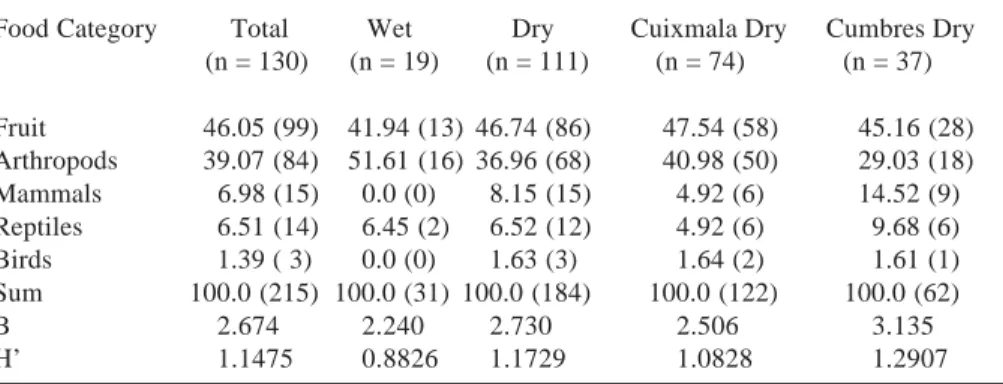
A total of 130 faeces were collected and analyzed. Collection of faeces were more difficult during the wet season and in Cumbres site. On average 14 faeces were collected by dry season month, while five were collected by wet season month. Of the identified remains in all faeces, 46.05 % were of fruit; 39.07% of arthropods; and 14.88 % of vertebrates (6.98% mammals, 6.51 % reptiles, 1.39 % birds). The most important artrhopod remains were from the orders Coleoptera and Orthoptera, while the plant remains identified in the faeces were from Ficus sp, Guazumaulmifolia,
Jacquiniapungens, Randiaarmata, Acaciahindsii, and other legume species (Tables 3 and 4).
Trophic diversity values obtained were B = 2.674 and H’ = 1.147 (Table 4). Inspecting data by season, reveals that trophic diversity index (H’) is significantly higher during the dry than during the wet season (t = -2.778, v = 56.39; P < 0.01; Table 4). Litter arthropods represents the higher proportion of the Coati diet during the wet season, while fruit it is so at the end of the dry season. Vertebrates were much less consumed during the wet season than during the dry season (Table 4).
Due to reduced number of feaces collected in the wet season, differences in diet composition between sites were explored only for the dry season. In Cumbres there was a higher proportion of vertebrates in diet during this period than in Cuixmala (Table 4), trophic diversity values H’ were not statistically different (t = 1.951, v = 146; P > 0.05).
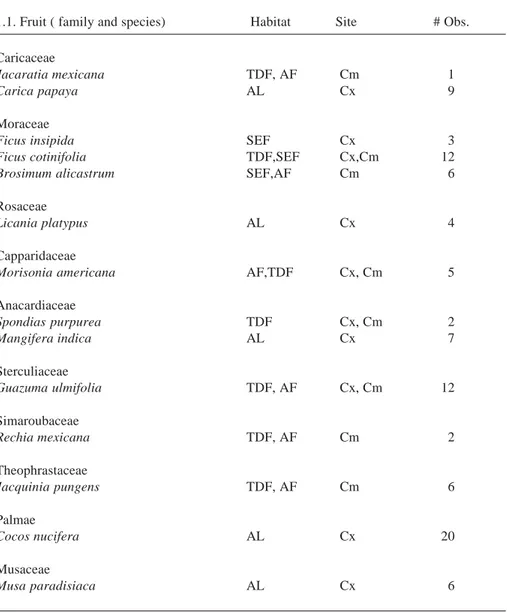
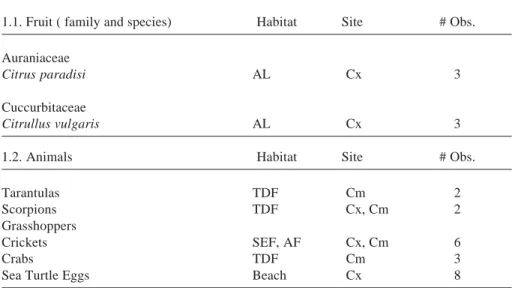
In observation of feeding events, the fruits most commonly consumed were from Jcaquinia pungens, Brosimum alicastrum, Rechia mexicana, Spondias purpurea, Jacaratia mexicana, Ficus sp., Morisonia americana and Guazuma ulmifolia. Cultivated fruits were also commonly consumed, in particular papaya (Carica papaya), coconut (Cocos nucifera), banana (Musa paradisiaca), mango (Mangiferaindica), grapefruit ( Citrusparadisi) and watermelon (Citrullusvulgaris; Table 3).
Table 2. Published data on density and group sizes of the White-nosed coati. TRF = Tropical rain forest; TDF = Tropical dry forest; TSF = Tropical semideciduous forest; XS = Xerophitic shrubland ; POF = Pine oak forest. Lat. = Latitude; D = density value as ind / km²; Group size is average number of individuals observed per group.
Reference Site Lat. Rain (mm) Vegetation D Group size
Wrigth et al., Barro Colorado 9º 09’ 2,600 TRF 55.6 7.2
1994 Island, Panamá
Vaughan and Manuel Antonio, 9º 45’ 3,000 TRF 70
-MacCoy, 1984 Costa Rica
Burger and Palo Verde, 10º 20’ 1,750 TDF - 5.4
Gochfeld, 1992 Costa Rica
Saenz, 1994 Santa Rosa, 10º 45’ 1,600 TDF -
-Costa Rica TSF
Glanz, 1990 Tikal, Guatemala 15º 00’ 1,350 TRF -
-Coates - Estrada; Los Tuxtlas, 18º 30’ 4,900 TRF 33 22.5¹
and Estrada, México 1986
Present Study CCBR, Mexico 19º 30’ 780 TDF 42.4, 6.1
26.8 55.6 ++
Caso, 1994 Tamaulipas, 23º 27’ 927 XS -
-México
Delibes et al., Durango, Mexico 23º 27’ 600 POF -
-1989
Lanning, 1976 Arizona, USA 32º 00’ 466 XS / POF 1.2 - 2
-Hass, in litt. Arizona, USA 32º 00’ 466 XS / POF 1.7
¹ Estrada et al., 1993
++These are the values on average for the reserve, for the Cumbres site and for the Cuixmala site, respectively.
(t = 5.70, v = 398.4; P = 0.000) and Arizona (t = 4.688, v = 366; P = 0.000) but similar to the estimated value for Durango (t = 0.905, v = 157.52; P>0.05; Table 5).
Reproduction
captures and 23 recaptures) in different months (no adult female were captured in Fe-bruary, July and September).
The nest of one female was located in a tree within the forest; she gave birth to four youngs around the last week of July. Another female, nested for two consecutive years in a big flowerpot of one house at Cuixmala site. The first year gave birth in late July to 3 young. The second year gave birth to 4 young in the first week of July.
One of the pregnant females captured, was kept in captivity to observe gestation and early growth processes. Three young were born in the first week of July, with eyes closed. At birth, the young weighed 100 - 120 gr, and average length was 280 mm. After the first week, the eyes opened, and the young weighed 195 gr, measuring 350 mm in length. By the fourth week, the young were able to walk and tooth eruption had started, the weight was 400 gr and length was 430 mm. By the sixth week, weight was 750 gr, and length was 540 mm. The young were released with the mother by week 12, weighing 1,100 gr, and measuring 700 mm in length. Based on recapture data, the juveniles had acquired 2 kg of weight by the first year of age. From a total of 31 youngs captured, only six weighted 2 kg or more and all were trapped between late April to early June.
From 13 adult females captured that were lactating , 10 of them were captured in late November and early December. Young coatis captured with those lactating females, averaged 1, 411 ± 66 gr (n = 14). Based on Risser (1963) data on weight gain of captive coatis, a weight of 1,400 - 1,500 gr, is achieved around 100 days of age, hence, birth date for captured young coatis of this weight, could be estimated around the middle of August.
Gestation period in coatis is 70-77 days (Gompper, 1995), hence, based on all these observations, breeding seems to occur between late March and late April, with births occurring between late June and the middle of August, during the early wet season.
Ectoparasites and some mortality factors
Ectoparasite load differed significantly between sites (Z=2.312; P = 0.0208), with a 1.05 ± 0.192 load rating (average ± 95 % confidence interval ) for Cuixmala site (n= 78 individuals) and a 0.434 ± 0.286 load rating (n = 23 individuals) for Cumbres. As expected ectoparasite load was high in Cuixmala site, were estimated density is also higher. Overall, ectoparasite load was relatively low, with an average 0.91 ± 0.203 rating (n = 101 individuals). Over both study sites some individuals carrying rabies antibodies were identified, indicating that this coati population has been exposed to the disease (J.A. Montaño, in litt.).
Table 3. Food items of coatis in the Chamela-Cuixmala Biosphere Reserve based on direct observations. Cx = Cuixmala, Cm = Cumbres; TDF = Tropical dry forest, AF = Arroyo Forest, AL = Agriculture Land, SEF= Semi-Evergreen Forest.
DIRECT OBSERVATIONS
1.1. Fruit ( family and species) Habitat Site # Obs.
Caricaceae
Jacaratia mexicana TDF, AF Cm 1
Caricapapaya AL Cx 9
Moraceae
Ficusinsipida SEF Cx 3
Ficuscotinifolia TDF,SEF Cx,Cm 12
Brosimumalicastrum SEF,AF Cm 6
Rosaceae
Licaniaplatypus AL Cx 4
Capparidaceae
Morisoniaamericana AF,TDF Cx, Cm 5
Anacardiaceae
Spondiaspurpurea TDF Cx, Cm 2
Mangiferaindica AL Cx 7
Sterculiaceae
Guazumaulmifolia TDF, AF Cx, Cm 12
Simaroubaceae
Rechiamexicana TDF, AF Cm 2
Theophrastaceae
Jacquiniapungens TDF, AF Cm 6
Palmae
Cocosnucifera AL Cx 20
Musaceae
during the 94-95 dry season. Ten could be attributable to diseases, eight to predation, three were animals hit by vehicles in the main road on the eastern limit of the reserve, and 10 were of unknown causes.
Of the 10 animals that die from diseases, seven presented a severe scabies infestation, with almost no fur present, and were thin and weak; four of those that were captured, died within few hours and presented diarrhea, convulsions, and an acute infection of Escherichiacoli. The remaining three animals were captured and presented low locomotion coordination, irritated eyes with signs of infection, a weak appearance and no alert behavior in response to human presence. A veterinarian that inspect them suggest that could be canine distemper, but laboratory confirmation could not be obtained.
From inspection of remains, eight animals could be classified as having died by predation, three from unknown predator and five from jaguar predation. All these five animals, were marked with radiotransmitters and hence remains could be found consisting in the radiotransmitter, a pile of hair, no skull remnants or only very small pieces; in one case half mandible and a portion of the tail was also found. Nine out of 10 of the coatis that died because of disease were recorded in the Cuixmala site, while seven out of eight of the coati predations occurred in the Cumbres site.
Table 3. Continues...
1.1. Fruit ( family and species) Habitat Site # Obs.
Auraniaceae
Citrusparadisi AL Cx 3
Cuccurbitaceae
Citrullusvulgaris AL Cx 3
1.2. Animals Habitat Site # Obs.
Tarantulas TDF Cm 2
Scorpions TDF Cx, Cm 2
Grasshoppers
Crickets SEF, AF Cx, Cm 6
Crabs TDF Cm 3
Table 4. Feeding habits of coatis in the Chamela-Cuixmala Biosphere Reserve based on analysis of 130 faeces collected over one year. Data is percentage of occurrence = number of faeces where the ith category of remains occurs (number in parenthesis) by 100 / sum of occurrences of all faeces. B is the niche trophic diversity. Faeces were pooled by seasons, sites and year (Total). Seasons are: wet season (July-October), dry season (November-June).
Food Category Total Wet Dry Cuixmala Dry Cumbres Dry
(n = 130) (n = 19) (n = 111) (n = 74) (n = 37)
Fruit 46.05 (99) 41.94 (13) 46.74 (86) 47.54 (58) 45.16 (28) Arthropods 39.07 (84) 51.61 (16) 36.96 (68) 40.98 (50) 29.03 (18)
Mammals 6.98 (15) 0.0 (0) 8.15 (15) 4.92 (6) 14.52 (9)
Reptiles 6.51 (14) 6.45 (2) 6.52 (12) 4.92 (6) 9.68 (6)
Birds 1.39 ( 3) 0.0 (0) 1.63 (3) 1.64 (2) 1.61 (1)
Sum 100.0 (215) 100.0 (31) 100.0 (184) 100.0 (122) 100.0 (62)
B 2.674 2.240 2.730 2.506 3.135
H’ 1.1475 0.8826 1.1729 1.0828 1.2907
DISCUSSION
Capture success and morphometrics
The capture success was markedly lower on the Cumbres site, what can be explained by the combination of a lower coati density and coatis ranging over wider areas in this site. Weight and total length of coatis in this study are comparable with data reported for Panama (males average: 5,100 gr and 1,142 mm, n = 51; females average = 3,700 gr and 1,037 mm , n = 37; Gompper, 1996) and for Arizona (males average: 4,800 gr and 1,256 mm, n = 15; females average: 4,000 gr 1,199 mm, n = 30) in the southern and northern extremes of its distribution, respectively. This suggests a small latitudi-nal variation in body measures.
The largest weight recorded was 9,000 gr for a male captured at the Cuixmala site. This male was seen repeatedly in a zone near the beach where probably was able to feed routinely on sea turtle eggs.
Density and group size
limitation of present estimates is the small sample size, that increases variation in density estimates.
Previous suggestions of an inverse relation between coati density and the latitude at which each coati population is located, is supported with results of the correlation and linear regression analysis used to explore this relation. Such variation that should be explained by differences in precipitation, which in turn influence variations in resource abundance, particularly food resources. A further examination of this relation, requires more detailed information on the spatio-temporal abundance of food resources and coati densities, throughout the distribution range.
Interestingly in the Cuixmala site, where food and water abundance is higher and less dispersed spatio-temporally (e.g. there are nearly 130 hectares of fruit plantations and several permanent lagoons), the density estimate is similar to values from the southern range of the species, and as expected, is higher than at the Cumbres site, where food and water are severely limited during the dry season. This reflects, on a smaller scale, the expected pattern. The difference between sites in density esti-mates is supported by considering capture success andsighting rate data, that shows the same pattern, higher in Cuixmala than in Cumbres. The higher density in Cuixmala site, also must be an effect of food supplementing, a common practice of local inhabitants, before the reserve was established, in order to observe the coati groups. There were reports of feeding congregations of more than 70 coatis at the sites in which food was provided.
Table 5. Coati trophic diversity values based on scat analysis. B = Levin’s niche breadth (1968), H’ = Shannon Diversity Index. Values for Panama (Gompper, 1996), Arizona (Hass, in litt.), Durango (Delibes et al., 1989), and Costa Rica (Saenz, 1994) were calculated from data presented by the authors, considering five trophic categories: fruit, arthropods, mammals, reptiles and birds.
Site Dominant Vegetation B H’
Barro Colorado Island, Panama tropical rain forest 1.868 0.6575 Santa Rosa, Costa Rica mixture of perturbed and unperturbed 2.063 0.7795
tropical dry and semideciduous forests
La Michilia, Durango, Mexico oak-pine forests 2.464 1.054
Arizona, USA xerophitic shrubland and oak - 2.086 0.8143
pine forests
This study tropical dry and semideciduous 2.674 1.1475
High coati density fluctuations have been reported as a result of changes in food availability (Kaufmann, 1962) or diseases (Risser, 1963). In this study, the decline in density over the study period could be explained partially by the impact of the 1994 -1995 dry season, and by the effects of the outbreak of scabies detected at the Cuixmala site (Valenzuela, 1999).
Feeding habits
Results from faeces analysis show that coatis at the CCBR consume predominantly fruit (46.05 %) and litter arthropod (39.07%). This is similar to what has been reported in other sites, using the same methodology, but there are differences in the percentage of those resources in the diet and in trophic diversity values. Fruit and litter arthropods were 100 % of the diet (63.3% and 36.7% respectively; n = 86 scats) in Panama (estimated from Gompper, 1996); 97% (46.8 % and 50.2 %; n= 194 scats) in Costa Rica (Saenz, 1994); 88.1% (37 % and 51.1%; n = 87) in Durango, México (Delibes et al., 1989) and; 97.5 % (53.1% and 44.37%; n = 92) in Arizona, USA (estimated from C. Hass, in litt.). Trophic diversity at the reserve, is higher than for other studies which may be related to the high climatic seasonality at the reserve which affects the predictability and availability of food resources. Theory on feeding strategies, generally predict that food niche breadth will increase as absolute abundance of food decreased (Schoener, 1971). This seems to be the case in the reserve, where trophic diversity was lower during the wet season and increased as the dry seasons progressed, being the highest at the end of the dry season (Table 4). While vertebrates represented less than 10 % of the diet during the wet season by the end of the dry season this percentage is nearly 20 %. Besides, the percentage of litter arthropods decreased and that of fruit increased during the dry season in comparison with wet season values (Table 4).
Reproduction
many other vertebrates in seasonal environments (Ceballos, 1996; Wolda, 1988), that increases the probabilities of survival of newborns.
Ectoparasites and some mortality factors
Pathogens and parasites could became a density dependent factor of mortality and a management and conservation problem (Aguirre and Starkey, 1994; Holmes, 1996; May, 1988). The dispersion of a disease or parasite is determined by a combination of factors that includes individual susceptibility, how many individuals are affected and how intensely, and the rate of contact between vectors (Holmes, 1996). In the present study the estimated ectoparasite load was greater and more animals that died by the disease were detected at the Cuixmala site, where estimated density was also higher. On the contrary, in the Cumbres site, where estimated density was lower, ectoparasite load was also lower. Besides, of the dead animals found there, only one was attributed to disease, but 7 were classified as having died by predation. This could indicate that predation events are more common in the Cumbres site, a suggestion that requires more detailed investigation. However, such idea was supported by the scat analysis results from an ongoing jaguar an puma research in the CCBR, that revealed that jaguar diet consisted in up to 20 % of coati in this site (R. Nuñez, pers. comm.). Jaguar or puma predation on coatis had been reported for other sites (C. Hass, in litt.; Aranda, 1993).
Interestingly the majority of the death records of coati were from dry season months, a period of food and water shortage, that must impose severe constraints for the organisms survival. This could be even more important in drier years, as it was 1994, with an atypical wet season (in which rainfall was less than half of the annual average), followed by the 1994 -1995 extremely dry season. More than half of the total death records of coatis were found during this dry season, that could be related to the higher food and water limitations of this period. In Panama, a peak in mortality of adult and subadult coatis was during the dry season and it was attributable to predation and declining food availability (Russell, 1982; Milton, 1990).
The present study supports some of the previously observed ecological pat-terns and shows that, while the ecology of this species at the CCBR is similar to that found at the extremes of its geographical range, the species natural history is tuned to patterns in resource abundance and dispersion particular to each site, and it is affected by seasonal variations in this patterns. The species presents a high behavioral plasticity to cope with seasonality which it is one of the main reasons for the species success in the neotropics.
environmental factor on the ecology of vertebrates. In the case of social carnivores, such studies are of particular interest because of the relation between resource dispersion and sociability; coatis are an ideal species to do this type of studies.
ACKNOWLEDGEMENTS
I sincerely thank to all those friends that help in field work. To friends and colleagues from the Instituto de Ecología of the Universidad Nacional Autónoma de México (UNAM) and from the Chamela-Cuixmala Biosphere Reserve. To G.Ceballos for his advice. Fundación Ecológica de Cuixmala, A.C. offered me enormous logistical and financial support. I thank Idea Wild and PADEP of the UNAM for financial support. K. Renton, R. List, and H. Drummond reviewed earlier versions of the manuscript and their suggestions help me to improve it. While doing this research I was supported by a Ph.D. scholarship from the Consejo nacional de Ciencia y Tecnología (CONACYT).
LITERATURE CITED
Aguirre, A.A. and E.E. Starkey. 1994. Wildlife disease in U.S. National parks: historical and coevolutionary perspectives. Conservation Biology 8: 654-661.
Aranda, M. 1993. Habitos alimentarios del jaguar (Panthera onca) en la Reserva de la Biosfera de Calakmul, Campeche. Pp. 231-238, in Medellín, R. y G. Ceballos (eds.).
Avances en el estudio de los mamíferos de México. Publicaciones Especiales, Vol. I, AMMAC. México, D.F., México.
Bullock, S.H. 1986. Climate of Chamela, Jalisco, and trends in the south coastal region of Mexico. Archives for Meteorology, Geophysics, and Bioclimatology. 36: 297-316. Burger, J. and M. Gochfeld. 1992. Effect of group size on vigilance while drinking in the
coati, Nasuanarica in Costa Rica. Animal Behavior 44: 1053-1057.
Caso, A. 1994. Home range and habitat use of three neotropical carnivores in northeast Mexico. Unpublished MS thesis. Texas A & M University, Kingsville, Texas, USA. Ceballos, G. 1996. Vertebrate diversity, ecology, and conservation in neotropical dry forests.
Pp. 195-220, in Seasonally dry tropical forests (S.H. Bullock, H. A. Mooney and E. Medina, eds.). Cambridge University Press, Cambridge, UK.
Ceballos, G. and A. García. 1995. Conserving neotropical biodiversity: the role of dry forests in western Mexico. Conservation Biology 9: 1349-1356.
Ceballos, G. and A. Miranda. 1986. Los Mamíferos de Chamela, Jalisco. Instituto de Biología, Universidad Nacional Autónoma de México. México, D. F.
Delibes, M., L. Hernandez, and F. Hiraldo. 1989. Comparative food habits of three carnivores in Western Sierra Madre, Mexico. Zeitschrift Säugetierkunde, 54:107-110.
Estrada, A., G. Halffter, R. Coates -Estrada y D. A. Merritt. 1993. Dung beetles attracted to mammalian herbivore (Alloutta palliata) and omnivore (Nasua narica) dung in the tropical rain forest of Los Tuxtlas, Mexico. Journal of Tropical Ecology, 9: 45-54. Glanz, W.E. 1982. The terrestrial mammal fauna of Barro Colorado Island: censuses and long
- term changes. in The Ecology of a Tropical Forest: Seasonal Rhythms and Long Term Changes (E.G. Leigh, A.S. Rand and D. S. Windsor, eds.) 2nd. Ed., Smithsonian Institu-tion. Washington, D.C., EUA.
Glanz, W.E. 1990. Neotropical mammal densities: how inusual is the community on Barro Colorado Island, Panama?.Pp. 287-313 in Four Neotropical rainforests. (A.H. Gentry, de.). Yale University Press. New Haven, CT, USA.
Gompper, M. 1994. The importance of ecology, behavior, and genetics in the maintenance of coati (Nasua narica) social structure. Ph. D. dissertation. University of Tennessee. Knoxville, Tennessee, USA.
Gompper, M. 1995. Nasua narica. Mammalian Species , 487: 1-10.
Gompper, M. 1996. Sociality and asociality in white-nosed coatis (Nasuanarica): foraging costs and benefits. Behavioral Ecology, 7: 254-263.
Gompper, M. 1997. Population ecology of the white-nosed coati (Nasuanarica) on Barro Colorado Island, Panama. Journal of Zoology (London) 241: 441-455.
Holmes, J. C 1996. Parasites as threats to biodiversity in shrinking ecosystems. Biodiversity and Conservation 5: 975-983.
Kaufmann, J.H. 1962. Ecology and social behavior of the coati, Nasua narica on Barro Colorado Island, Panama. University of California Publications, Zoology, 60: 95-222. Kaufmann, J. H., D. V. Lanning and S. E. Poole. 1976. Current status and distribution of the
coati in the United States. Journal of Mammalogy 57: 621-637.
Lanning, D.V. 1976. Density and movements of the coati in Arizona. Journal of Mammalogy 57: 609-611.
Leopold, S.A. 1959. Wildlife of Mexico. University of California Press. Berkeley, California, USA.
Levins, R. 1968. Evolution in changing environments: some theoretical explorations. Princetown University Press, Princetown, USA.
Lister, B. C. and A. García . 1992. Seasonality, predation, and the behaviour of a tropical mainland anole. Journal of Animal Ecology 61: 717-733
May, R. 1988. Conservation and disease. Conservation Biology 2: 28-30
Milton, K. 1990. Annual mortality patterns of a mammal community in central Panama. Journal of Tropical Ecology 6: 493-499.
Ratnayeke, S., A. Bixler and J.L. Gittleman. 1994. Home range movements of solitary, reproductive female coatis, Nasuanarica, in south eastern Arizona. Journal of Zoology (London) 233: 322-326.
Russell, J.K. 1982. Timing of reproduction by coatis (Nasuanarica) in relation to fluctuations in food resources. in The Ecology of a Tropical Forest: Seasonal Rhythms and Long Term Changes. (E.G. Leigh, A.S. Rand and D. S. Windsor, eds.). 2nd. Printing. Smithsonian Institution, Washington, D.C., USA.
Sáenz, J. 1994. Ecología del pizote (Nasuanarica) y su papel como dispersador de semillas en el bosque seco tropical, Costa Rica. Tesis de Maestria en Manejo de Vida Silvestre, Universidad Nacional, San José, Costa Rica.
Schoener, T.W. 1971. Theory of feeding strategies. Annual review of Ecology and Systemat-ics 2: 369-404.
Smythe, N. 1970. The adaptative value of the social organization of the coati (Nasua narica). Journal of Mammalogy, 51: 818-820.
Valenzuela, D. 1999. Efectos de la estacionalidad ambiental en la densidad, la conducta de agrupamiento y el tamaño de área de actividad de coatí (Nasua narica) en selvas tropicales caducifolias. Tesis doctoral, Instituto de Ecología, UNAM, México, D.F.
Vaughan, C. y M. McCoy, 1984. Estimación de las poblaciones de algunos mamíferos en el Parque Nacional Manuel Antonio, Costa Rica. Brenesia 22: 207-217.
Wolda, H. 1988. Seasonality and the community. Pp. 69-95, in The organization of communities (J.H. Gee and P.S. Giller, eds.). Blackwell Scientific Publications, Oxford, UK.