A SURVEY ON SYSTEMS INTEGRATION IN THE ENERGY
AUTOMATION DOMAIN THROUGH OPC INTERFACE
Isaías González Pérez, Antonio José Calderón Godoy
Escuela de Ingenierías Industriales, Universidad de Extremadura, {igonzp, ajcalde}@unex.es
Abstract
The Object Linking and Embedding for Process Control (OPC) interface provides an effective means to exchange data between automation-related entities, both hardware and software. Since its creation, it has been profusely used not only for industrial scenarios but also for other spheres, among which energy automation is an important scope. In order to portray the relevance of such protocol, this paper presents a survey of applications of OPC communication to manage systems integration in the context of energy automation.
Palabras Clave: industrial communications, OPC, energy automation, Smart Grid, interoperability.
1
INTRODUCTION
The energy scope is a field where automation and monitoring play a critical role for the proper behavior. Both energy and data flows have to be efficiently managed in order to achieve features like stability, quality, reliability and good performance. To this aim, automation devices, sensors, actuators, computers and other instruments are integrated to compose a complex and heterogeneous network. In this sense, a noteworthy remark is the great efforts devoted to systems integration and interoperability management. Handling these heterogeneous nodes with different protocols, devices, operating systems (OSs), and services is a challenging task. In fact, research efforts must be performed in the direction of defining standard protocols, languages, and methodologies [7].
Concerning energy facilities, during years a set of innovative approaches have been conceived and increasingly implemented. The first issue to mention is the growing utilization of sources like biomass and wind turbines.
An advanced framework corresponds to the hybridization of different Renewable Energy Sources (RES) with an Energy Storage System (ESS), configuring a Hybrid Renewable Energy System (HRES) [21]. Integration with hydrogen production
and storage technology improves the ability of the system to deal with power fluctuations by using hydrogen for long-term energy storage [25].
Moreover, the penetration of Digital Information and Communication Technologies (DICTs) has impacted the energy sphere giving birth to the Smart Grid (SG) concept. These intelligent power grids are a result of a co-evolution of energy systems and DICT [10]. Apart from generation and distribution of electric power, SGs are able to store, communicate and make decisions [45]. The integration of advanced technologies in communication, smart energy metering and intelligent control confers such capabilities to SGs [32]. Another energy-related trend is the automation of buildings, which is receiving greater attention due to its potential for reducing energy consumption and facilitating building operation, monitoring and maintenance, while improving occupants' satisfaction [15].
Within the abovementioned scenarios, in the path towards facilitating interoperability, an open and standardized communication platform constitutes a key component [18]. Among the available industrial communication interfaces, Object Linking and Embedding for Process Control (OPC) is a technology for standardized data exchange profusely used in the automation domain.
The application of this protocol is being progressively expanded out of the traditional manufacturing industry, reaching advanced concepts like the Internet of Things (IoT), the Industry 4.0 or the Cyber-Physical Systems (CPS).
This paper provides a brief survey about OPC communication in the energy automation scope. The remainder of the rest of the paper is as follows. Section 2 describes the main features of the OPC interface. A survey about the state of the art of the application of OPC in the energy domain is conducted. Finally, main conclusions are outlined.
2
BRIEF DESCRIPTION OF OPC
An industrial automation industry task force created in 1996 a set of communication standards to provide a common communication channel for computer-Actas de las XXXIX Jornadas de Automática, Badajoz, 5-7 de Septiembre de 2018
based software applications and automation equipment, the OPC interface. Since then, it acts as a successful technology for interoperability in process automation applications. Nowadays, this protocol comprises ten specifications managed by the OPC Foundation [23]: Data Access (DA), Alarms and Events (A&E), Historical Data Access (HDA), Data eXchange (DX), XML-Data Access (XML-DA), Complex Data (CD), Security, Batch, Express Interface (Xi) and Unified Architecture (UA).
The so-called OPC Classic comprises the first eight specifications, where OPC DA is the most extensively applied. It must be noted that currently there are no developments regarding the OPC Classic. The last specification, UA, was developed as the successor to OPC Classic; released in 2006, being the IEC international standard numbered as 62541. This specification provides greater interoperability, removing the dependency of MS-Windows OSs. I.e., UA is able to work in different OSs like those based on UNIX. UA is built around the Service Oriented Architecture (SOA) and based on web services, facilitating OPC connections over the Internet.
In order to reduce dependencies between systems, OPC provides a connectivity layer or middleware mainly devoted to vertical integration in automation infrastructures. Some of the key advantages of OPC utilization are: wide support from hardware and software manufacturers, open connectivity, generality, scalability, modularity, just to name a few. Refer to [20] for further information.
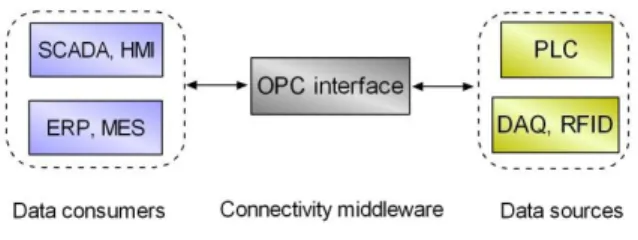
Figure 1 portrays the basic layout of communication using OPC. Hardware devices play the role of data sources whilst software applications act as data consumers; the OPC interface implements a connectivity middleware, enabling the information transmission. Data consumers are usually software programs related to process monitoring and planning applications, i.e., Supervisory Control and Data Acquisition (SCADA) systems, Human-Machine Interfaces (HMIs), Enterprise Resource Planning (ERP) programs, Manufacturing Execution Systems (MES), or Customer Relationship Management (CRM). On the other hand, the prevalent hardware equipment with OPC connectivity is Programmable Logic Controllers (PLCs). Other devices to be linked through OPC are Data Acquisition Cards (DAQs), remote Input/output units, Intelligent Electronic Device (IED), Radio Frequency IDentification (RFID) readers, etc. By means of the OPC communication, the client applications access and manage the field information without need of knowledge about the physical nature of data sources [20].
Figure 1: Basic layout of communication based on OPC interface
3
SURVEY
ABOUT
OPC
COMMUNICATION IN ENERGY
AUTOMATION
This section performs a survey of applications of OPC communication in the energy automation scope. For this purpose, a division into four subsections in order to classify the surveyed works attending to the nature of the energy facility has been made. Namely, RES-based systems, SGs, Building Automation Systems (BAS) and Other energy facilities.
3.1 RES-BASED SYSTEMS
In [43] a non-linear algorithm to model fed-batch microalgae bioreactors is experimentally validated. The experimental setup includes an OPC link to send flowrates set points from a Matlab program to the control unit of the bioreactor.
For solar thermal plants, nonlinear control techniques like Model Predictive Control (MPC) and sliding mode control are evaluated in [14]. The control algorithms are coded in Matlab and integrated in a LabVIEW-based SCADA system. An OPC interface is used to acquire all data related to sensors and actuators required to apply the control laws. Iacob [24] describes a Hardware-in-the-Loop (HIL) system to test in real-time controllers applied to a thermal plant. Such plant is simulated with LabVIEW and a PLC implements the controller. OPC is in charge of communicating the simulated and real environments. Regarding Photovoltaic (PV) facilities, Silvestre et al. [41] develop an OPC-based supervisory system for PV plants. In this system the inverters perform the data acquisition task (irradiance, current, voltage, temperature, etc.) and the OPC HDA specification provides access to such information to the client software.
order to assist the collaboration between different applications in the context of wind farms.
Concerning HRES, in [50] and [51] the management, operation and automation infrastructure of a HRES is detailed. The control strategy and system monitoring is based on a SCADA system developed using General Electric (GE) Automation iFIX. The infrastructure integrates various networks and industrial protocols (CAN, PROFIBUS, RS-485, TCP/IP) in order to manage the heterogeneity between the chemical and electrical subsystems. To achieve homogeneity, all those different protocols are translated to OPC-based format. The OPC client driver corresponds to GE Power Tool while three OPC servers are used: LabVIEW, Twincat and Matrikon. Koller et al. [27] expose three grid applications of the Zurich 1 MW battery-based ESS combined with RES. Different grid configurations are tested under the supervision of a dedicated SCADA platform. Such system is OPC-connected to additional controllers and devices for effective data exchange. A recent research is reported in [5], where a HRES is developed as test-facility to address the integration challenges. The control system supervisory level is materialised by a PC where the energy management strategy is implemented in Matlab. A WAGO PLC is associated to each power subsystem and integrated with various measuring devices into a Local Operating Network (LON). Matlab OPC Toolbox is used to provide the OPC communication between such network and the supervisory level.
3.2 SMART GRIDS
Proper monitoring and control of SGs impose effective data transmission and digital communication networks [19]. SGs have multiple networks, and multiple distributed energy resources and loads; therefore effective communication and coordination to monitor, analyse and stabilize the grid at various hierarchical levels are mandatory [39]. SG will need to communicate with customer-owned smart appliances, energy management systems, and electric vehicles [3]. As mentioned in the Introduction section, heterogeneity and interoperability issues should be addressed to foster advancements, namely for SGs, standards are essential to operate seamlessly and securely these complex systems [3]. In [16] the need for convergence into a common protocol platform for SGs is highlighted. In the same sense, Sucic and Capuder [42] assert that there is a need for developing standard-compliant platform which will enable streamlined integration of Distributed Multi-Generation (DMG) systems into the energy system. In other words, standards-compliant integration is an indispensable requirement for successful SG
automation [11]. As stated by Järventausta et al. [26], open standards like OPC make possible to develop new types of intelligent systems integrations in the context of SGs.
Sucic and Capuder [42] develop and simulate a middleware platform for DMG energy systems. The presented solution integrates the standards OPC UA and IEC 61850 to facilitate the control and integration of DMG systems into the SG environment. The proposed framework is verified in a simulation environment where Matlab models the DMG facility and the FICO Xpress software performs optimization tasks. Two PCs, connected by an Ethernet link, host the aforementioned software. Matlab acts as OPC UA server while the FICO Xpress application acts as OPC UA client. In [11] mapping models and algorithm to realise the integration of IEC 61850-6 with OPC UA are proposed.
A standard-compliant protection system for SG-ready substations is designed in [9]. A PLC performs the protection functions and is connected to sensors and actuators through EtherCAT bus. An OPC UA link allows interfacing the Graphical User Interface (GUI) of the control system with the PLC. Arnone et al. [4] expose a multi-objective optimization framework aimed at the management of a multi-carrier energy system involving both electricity and hydrogen in the SG context. This facility comprises renewable energy generators, water electrolyzers, fuel cells and hydrogen solid storage units, managed by an energy management system. Such system exchanges information via OPC with a set of PLCs and with a WinCC-based SCADA interface. Cintuglu et al. [13] perform an in-depth survey about SG testbeds for research activities around the world. The usage of OPC protocol as middleware solution to create an interface between different power system protocols for real-time data exchange in numerous SG testbeds is reported. For instance, OPC is used in The Intrusion and Defense testbed in University College Dublin, and in The PowerCyber testbed at Iowa State University.
gathered can be used to implement intelligent decision and control system [32]. Within the AMI, in the consumer side, SGs implies smart metering to monitor the load energy usage and the performance on the grid [36]. In [36] an energy management system is developed with integration of Smart Meters (SMs) in SG context. The SMs are connected to a Siemens WinCC SCADA system that supervises a network of PLCs. In addition, such SCADA communicates with Matlab software to implement advanced controllers. Data transfer between both platforms is performed by OPC connection using the Simatic Net OPC server.
Within the SG concept, Electric Vehicles (EVs) constitute a relevant entity due to their load nature and to their contribution to develop a sustainable energetic scenario. EVs can be accommodated as dynamic loads and potential energy buffer in SG [32]. Related with EVs research, some works have incorporated OPC interface. Manbachi et al. [30] present a system to study the impact of EVs in the Volt-VAR optimization of smart distribution networks, i.e. SGs. The Volt-VAR optimization algorithm is developed in Matlab whereas the distribution grid is modelled in Real Time Digital Simulator (RTDS). The communication between them is carried out with OPC using the Matlab OPC Toolbox and a Kepware OPC server. The information required for such algorithm is provided by the AMI. Bouallaga et al. [8] propose a methodology to develop supervisory systems based on fuzzy and Boolean logics in order to coordinate EVs load with wind and photovoltaic power. The supervisory system is developed in Matlab suite and a real test grid is modelled with PowerFactory software. The latter one runs a simulation that shares data with Matlab using OPC communication. In this framework, both references and results values are exchanged through an OPC server.
Another SG-related concept corresponds to microgrids, which can be defined as small scale SGs which can be autonomous or grid-tied [28]. In this regard, numerous works deal with microgrids automation including OPC communication. For instance, Tsiamitros et al. [44] present a control system for energy storage management and demand-side management of an experimental microgrid-based SG topology. Such a system is based on building energy efficiency technologies, namely the standard protocol for building automation KNX. Few KNX devices are included in the grid topology whereas the rest are monitored using DAQ cards. A dedicated PC incorporates a LabVIEW application to process data and an iterative control algorithm implemented in Matlab. Besides, a KNX OPC server feeds the data of the KNX devices to the LabVIEW application, making them also available for the Matlab algorithm.
A power management system (PMS) for microgrids based on RES is described in [38]. To test such system a software simulator is used so the PMS is implemented in a PLC and the simulation runs in a PC. The real-time data exchange between them is performed via OPC connection. A decentralized hierarchical control for microgrid operation based on a multiagent framework is proposed in [12]. Various IEC 61850 standard-compliant devices for measurement and a PLC collect data from the elements of the microgrid (loads, generators, etc.). This data is fed to the Java-based agents. Additionally, a Cloud data service is integrated in order to publish data gathered via OPC UA so remote OPC clients can use them through the network.
In [52] the energy exchange algorithm of an autonomous RES-enabled microgrid is addressed. The presented monitoring and control infrastructure serves as proof-of-concept of the transformation from the traditional SCADA system to IoT-enabled architecture. In such architecture, open communication protocols like OPC contribute to overcome the limitations of contemporary systems. In [37] and [47] a hydrogen-based labscale microgrid to test different control approaches and their influence on the plant efficiency is proposed. A central PLC receives all sensor signals and manages the actuators. On the other hand, a SCADA system implements advanced controllers through Matlab environment. The communication between these elements is performed through OPC interface. In [31] an identical approach is used to manage a microgrid combined with an electric vehicle charging station.
3.3 BUILDING AUTOMATION SYSTEMS
Referring to automation of buildings, higher and higher penetration of communication technologies and automation shall lead to connected and increased intelligence devices capable to perform their routine tasks autonomously and without much human intervention [6]. A BAS can be defined as an intelligent network of electronic devices to monitor and control the lighting, internal climate and other systems in a building aiming to optimize energy usage, safety, security, information, communication and entertainment facilities [6].
As addressed by Domingues et al. [15], there is a problem concerning the heterogeneity of BAS due to the custom solutions, which can be a barrier for BAS technologies development. Some protocols that emerged from automation standards have gathered support for BAS such as OPC. A comparative discussion of functional aspects of diverse technologies (OPC, BACnet, oBIX) related with BAS is found in [15]. In BAS applications, OPC can act as middleware, required to distribute information acquired from sensors/devices interconnected within a field bus distributed in the building [46].
The term Smart Building (SB) refers to buildings that include a BAS with communication capabilities to exchange data with the grid operator. SBs have the inherent potential to help to manage the electrical energy demand on the SGs [29]. The interaction with the SG is as follows: SBs respond to demand response requests from the utility operator to manage peak demand to minimize demand charges or to adjust operations based on the real-time price of electricity [29]. In this sense, one big step helping with SB-SG communication is the development of standard protocols that allow equipment from different vendors to interact with the SG [29]. In this regard, in [17] a SCADA system is developed for energy management in intelligent buildings, i.e., SBs. Concerning the control of temperature and luminosity in rooms, a hierarchical control is implemented using a network of PLCs as field devices and a WinCC-based supervisory system. Besides, a predictive controller algorithm runs in Matlab. The communication channel between Matlab software and the SCADA application is OPC.
Four open standards commonly used in BAS, namely KNX, BACnet, LonWorks, ZigBee, are mapped to OPC UA in [22]. Authors assert that OPC UA is advantageous at the management level due to its capabilities to model process data.
On the other hand, Bhatt and Verma [6] implement a wired BAS including several devices and protocols like MODBUS, EIA-486. A LabVIEW-based GUI is
used for acquisition, analysis, record and report of data provided by various transducers deployed at different building locations. The NAPOPC software acts as server for data acquisition from the MODBUS modules and exchange with the LabVIEW-based main controller. An architecture integrating OPC UA with MODBUS and BACnet for SBs is proposed in [46]. The proposal combines OPC UA servers to communicate via fieldbus with devices and OPC UA clients for graphic display of the acquired information. The configuration of a set of smart plugs integrated into MODBUS fieldbus is presented as practical example.
3.4 OTHER ENERGY FACILITIES
Out of the scope of RES and SGs, some application cases of OPC technology for nuclear energy have been reported. Wang and Yang [49] implement a real-time surveillance and diagnostics system for nuclear plants. In this case, data collected from sensors and actuators (temperature, valves, etc.) are stored in Comma-Separated Values (CSV) files and passed to an expert system by means of an OPC bridge.
Another example is found in [48] that expose a system for continuous monitoring the core parameters of a nuclear plant. In such system, data acquired from the plant are stored in a data base hosted in a set of servers. This information is displayed in several graphic workstations which act as user interfaces, i.e. SCADA systems developed with the iFIX software. An OPC server is in charge of feeding the graphic displays with the process data.
4
CONCLUSIONS
This paper has presented a survey of applications of OPC communication in the context of energy automation. The OPC interface provides an effective means for systems integration in order to exchange data between hardware and software components devoted to automation. It is widely used not only for industrial scenarios but also for other scopes. Energy automation is an important field of application as can be derived from the conducted survey. Moreover, this protocol is achieving an increasing presence in advanced frameworks like the next generation of energy grids, SGs.
Acknowledgments
References
[1] Alizadeh, S.M., Ozansoy, C., (2016) “The role of communications and standardization in wind power applications – A review”, Renewable and Sustainable Energy Reviews, vol. 54, pp. 944-958. DOI: 10.1016/j.rser.2015.10.061.
[2] Alvial-Palavicino, C., Garrido-Echeverría, N., Jiménez-Estévez, G., Reyes, L., Palma-Behnke, R., (2011) “A methodology for community engagement in the introduction of renewable based smart microgrid”, Energy for Sustainable Development, vol. 15, 2011, pp 314-323. DOI:10.1016/j.esd.2011.06.007.
[3] Arnold, G.W., (2011) “Challenges and Opportunities in Smart Grid: A Position Article”, Proceedings of the IEEE, 99 (6), pp. 922-927. DOI: 10.1109/JPROC.2011.2125930.
[4] Arnone, D., Bertoncini, M., Paternò, G., Rossi, A., Ippolito, M.G., Sanseverino, E.R., (2016) “Multi-objective Optimization of Energy Hubs at the Crossroad of Three Energy Distribution Networks”, Proceedings of the 6th International Conference on Smart Grids, Green Communications and IT Energy-aware Technologies, Lisbon, Portugal.
[5] Baumann, L., Boggasch, E. (2016) “Experimental assessment of hydrogen systems and vanadium-redox-flow-batteries for increasing the self-consumption of photovoltaic energy in buildings”, International Journal of Hydrogen Energy, vol. 41(2), pp. 740-751. DOI: 10.1016/j.ijhydene.2015.11.109.
[6] Bhatt, J., Verma, H.K., (2015) “Design and development of wired building automation systems”, Energy and Buildings, vol. 103, pp. 396-413. DOI: 10.1016/j.enbuild.2015.02.054.
[7] Botta, A., de Donato, W., Persico, V., Pescapé, A., (2016) “Integration of Cloud computing and Internet of Things: A survey”, Future Generation Computer Systems, vol. 56, pp. 684-700. DOI: 10.1016/j.future.2015.09.021.
[8] Bouallaga, A., Davigny, A., Courtecuisse, V., Robyns, B., (2017) “Methodology for technical and economic assessment of electric vehicles integration in distribution grid”, Mathematics and Computers in Simulation, 2017, vol. 131,
pp. 172-189. DOI:
10.1016/j.matcom.2016.05.003.
[9] Büscher, M., Kube, M., Piech, K., Lehnhoff, S., Rohjans, S., Fischer, L., (2016) “Towards Smart
Grid-ready substations: A standard-compliant protection system. Proceedings of the 19th Power Systems Computation Conference (PSCC), Genoa, Italy. DOI:
10.1109/PSCC.2016.7540824.
[10] Camarinha-Matos, L.M., (2016) “Collaborative smart grids – A survey on trends”, Renewable and Sustainable Energy Review, vol. 65, pp. 283-294, DOI: 10.1016/j.rser.2016.06.093
[11] Cavalieri, S., Regalbuto, A., (2016) “ Integration of IEC 61850 SCL and OPC UA to improve interoperability in Smart Grid environment”, Computer Standards & Interfaces, vol. 47, pp. 77-99. DOI: 10.1016/j.csi.2015.10.005.
[12] Cintuglu, M.H., Mohammed, O.A., (2015) “Multiagent-based decentralized operation of microgrids considering data interoperability.
Proceedings of the IEEE International Conference on Smart Grid Communications (SmartGridComm), Florida, USA. DOI: 10.1109/SmartGridComm.2015.7436334.
[13] Cintuglu, M.H., Mohammed, O.A., Akkaya, K., Uluagac, A.S., (2016) “A Survey on Smart Grid Cyber-Physical System Testbeds”, IEEE Communications Surveys & Tutorials, vol. 19,
pp. 446-464. DOI:
10.1109/COMST.2016.2627399.
[14] De Andrade, G.A., Álvarez, J.D., Pagano, D.J., Berenguel, M., (2015) “Nonlinear controllers for solar thermal plants: A comparative study”,
Control Engineering Practice, vol. 43, pp. 12-20. DOI: 10.1016/j.conengprac.2015.06.002.
[15] Domingues, P., Carreira, P., Vieira, R., Kastner, W., (2016) “Building automation systems: Concepts and technology review”, Computer Standards & Interfaces, vol. 45, pp. 1-12. DOI: 10.1016/j.csi.2015.11.005.
[16] Emmanuel, M., Rayudu, R., (2016) “Communication technologies for smart grid applications: A survey”, Journal of Network and Computer Applications, vol. 74, pp. 133-148. DOI: 10.1016/j.jnca.2016.08.012.
[17] Figueiredo, J., Sá da Costa, J., (2012) “A SCADA system for energy management in intelligent buildings”, Energy and Buildings, vol. 49, pp. 85 – 98. DOI: 10.1016/j.enbuild.2012.01.041.
“Guarded state machines in OPC UA”,
Proceedings of 41st Annual Conference of the IEEE Industrial Electronics Society, IECON2015, Yokohama, Japan.
[19] González, I., Calderón, A.J., Andújar, J.M., (2017) “Novel Remote Monitoring Platform for RES-Hydrogen based Smart Microgrid”,
Energy Conversion and Management, vol. 148,
pp. 489-505. DOI:
10.1016/j.enconman.2017.06.031.
[20] González, I., Calderón, A.J., Barragán, A.J., Andújar, J.M., (2017) “Integration of Sensors, Controllers and Instruments Using a Novel OPC Architecture”, Sensors, vol. 17(7), 1512. DOI: 10.3390/s17071512.
[21] González, I., Calderón, A.J., Calderón Godoy, M., Herrero, J.L., (2015) “Monitoring of Electric Power Systems: Application to self-sufficient Hybrid Renewable Energy Systems”,
Proceedings of the IEEE 9th International Conference on Compatibility and Power Electronics (CPE), Caparica, Portugal. DOI: 10.1109/CPE.2015.7231137.
[22] Granzer, W., Kastner, W., (2012) “Information modeling in heterogeneous Building Automation Systems”, Proceedings of the 9th International Workshop on Factory Communication Systems (WFCS), Lemgo/Detmold, Germany. DOI: 10.1109/WFCS.2012.6242577.
[23] https://opcfoundation.org/
[24] Iacob M., Andreescu G.D., (2011) “Real-Time Hardware-in-the-Loop Test Platform for Thermal Power Plant Control Systems”, IEEE 9th International Symposium on Intelligent Systems and Informatics, September 2011, Subotica, Serbia.
[25] Ismail, M.S., Moghavvemi, M., Mahlia, T.M.I., Muttaqi, K.M., Moghavvemi, S., (2015) “Effective utilization of excess energy in standalone hybrid renewable energy systems for improving comfortability and reducing cost of energy: A review and analysis”, Renewable and Sustainable Energy Reviews, vol. 42, pp. 726– 734. DOI: 10.1016/j.rser.2014.10.051.
[26] Järventausta, P., Repo, S., Rautiainen, A., Partanen, J., (2010) “Smart grid power system control in distributed generation environment”,
Annual Reviews in Control, vol. 34, pp. 277-286. DOI: 10.1016/j.arcontrol.2010.08.005.
[27] Koller, M., Borsche T., Ulbig, A., Andersson, G., (2015) “Review of grid applications with the Zurich 1 MW battery energy storage system”, Electric Power Systems Research, vol.
120, pp. 128-135. DOI:
10.1016/j.epsr.2014.06.023.
[28] Koohi-Kamali, S., Rahim, N.A., (2016) “Coordinated control of smart microgrid during and after islanding operation to prevent under frequency load shedding using energy storage system”, Energy Conversion and Management, vol. 127(1), pp. 623-646. DOI: 10.1016/j.enconman.2016.09.052.
[29] Lawrence, T.M., Boudreau, M.C., Helsen, L., Henze, G., Mohammadpour, J., Noonan, D. et al., (2015) “Ten questions concerning integrating smart buildings into the smart grid”,
Building and Environment, vol. 108, pp. 273-283. DOI: 10.1016/j.buildenv.2016.08.022.
[30] Manbachi, M., Sadu, A., Farhangi, H., Monti, A., Palizban, A., Ponci, F. et al., (2016) “Impact of EV penetration on Volt–VAR Optimization of distribution networks using real-time co-simulation monitoring platform”, Applied Energy, vol. 169, pp. 28-39. DOI: 10.1016/j.apenergy.2016.01.084.
[31] Mendes, P.R.C., Valverde, L., Bordons, C., Normey-Rico, J.E., (2016) “Energy management of an experimental microgrid coupled to a V2G system”, Journal of Power Sources, vol. 327, pp. 702-713. DOI: 10.1016/j.jpowsour.2016.07.076.
[32] Mwasilu, F., Justo, J.J., Kim, E.K., Do, T.D., Jung, J.W., (2014) “Electric vehicles and smart grid interaction: A review on vehicle to grid and renewable energy sources integration.
Renewable and Sustainable Energy Reviews, vol. 34, pp. 501-516. DOI: 10.1016/j.rser.2014.03.031.
[33] Nguyen, T.H., Prinz, A., Friiso, T., Nossum, R., Tyapin, I., (2013) “A framework for data integration of offshore wind farms”, Renewable Energy, vol. 60, pp. 150-161. DOI: 10.1016/j.renene.2013.05.002.
[35] Nguyen, V.H., Tran, Q.T., Besanger, Y., (2016) “SCADA as a service approach for interoperability of micro-grid platforms”,
Sustainable Energy, Grids and Networks, vol. 8, pp. 26-36. DOI: 10.1016/j.segan.2016.08.001.
[36] Pereira, R., Figueiredo, J., Melicio, R., Mendes, V.M.F., Martins, J., Quadrado, J.C., (2015) “Consumer energy management system with integration of smart meters”, Energy Reports,
vol. 1, pp. 22-29.
DOI:10.1016/j.egyr.2014.10.001.
[37] Petrollese, M., Valverde, L., Cocco, D., Cau, G., Guerra, J., (2016) “Real-time integration of optimal generation scheduling with MPC for the energy management of a renewable hydrogen-based microgrid”, Applied Energy, vol. 166, pp. 96-106. DOI: 10.1016/j.apenergy.2016.01.014.
[38] Pinceti, P., Vanti, M., Brocca, C., Carnessechi, M., Macera, G.P., (2015) “Design criteria for a power management system for microgrids with renewable sources”, Electric Power Systems Research, vol. 122, pp. 168-179. DOI: 10.1016/j.epsr.2015.01.010.
[39] Reddy, K.S., Kumar, M., Mallick, T.K., Sharon, H., Lokeswaran, S., (2014) “A review of Integration, Control, Communication and Metering (ICCM) of renewable energy based smart grid”, Renewable and Sustainable Energy Reviews, vol. 38, pp. 180-192. DOI:10.1016/j.rser.2014.05.049.
[40] Sayed, K., Gabbar, H.A., SCADA and smart energy grid control automation, Chapter in Smart Energy Grid Engineering. Editor: Gabbar, H.A. Editorial: Academic Press, Elsevier. ISBN: 978-0-12-805343-0. 2017.
[41] Silvestre, S., Mora-López, L., Kichou, S., Sánchez-Pacheco, F., Domínguez-Pumar, M., (2016) “Remote supervision and fault detection on OPC monitored PV systems”, Solar Energy, vol. 137, pp. 424-433. DOI: 10.1016/j.solener.2016.08.030.
[42] Sucic, S., Capuder, T., (2016) “Automation of flexible distributed multi-generation systems by utilizing optimized middleware platform”,
Applied Energy, vol. 169, pp. 542-554. DOI: 10.1016/j.apenergy.2016.02.065.
[43] Surisetty, K., Siegler, H.H., McCaffrey, W., Ben-Zvi, A., (2010) “Robust modeling of a microalgal heterotrophic fed-batch bioreactor”,
Chemical Engineering Science, vol. 65, pp. 5402-5410. DOI: 10.1016/j.ces.2010.06.008.
[44] Tsiamitros, D., Stimoniaris, D., Poulakis, N., Zehir, M.A., Batman, A., Bagriyanik, M. et al., (2014) “Advanced energy storage and demand-side management in smart grids using buildings energy efficiency technologies”, Proceedings of the 5th IEEE PES Innovative Smart Grid Technologies Europe (ISGT Europe), Istanbul,
Turkey. DOI:
10.1109/ISGTEurope.2014.7028841.
[45] Tuballa, M.L.; Abundo, M.L., (2016)” A review of the development of Smart Grid technologies”, Renewable and Sustainable Energy Reviews, vol. 59, pp. 710-725. DOI: 10.1016/j.rser.2016.01.011.
[46] Ungurean, I., Gaitan, N.C., (2016) “Monitoring and control system for smart buildings based on OPC UA specifications”, Proceedings of the International Conference on Development and Application Systems (DAS), Suceava, Romania. DOI: 10.1109/DAAS.2016.7492552.
[47] Valverde, L., Rosa, F., Bordons, C., Guerra, J. Energy Management Strategies in hydrogen Smart-Grids: A laboratory experience.
International Journal of Hydrogen Energy, 2016, vol. 41, pp. 13715-13725. DOI: 10.1016/j.ijhydene.2016.05.279.
[48] Végh, J., Pós, I., Horváth, Cs., Kálya, Z., Parkó, T., Ignits, M., (2015) “VERONA V6.22 – An enhanced reactor analysis tool applied for continuous core parameter monitoring at Paks NPP”, Nuclear Engineering and Design, vol.
292, pp. 261-276. DOI:
10.1016/j.nucengdes.2015.06.006.
[49] Wang, W., Yang, M., (2016) “Implementation of an integrated real-time process surveillance and diagnostic system for nuclear power plants”, Annals of Nuclear Energy, vol. 97, pp. 7-26. DOI: 10.1016/j.anucene.2016.06.002.
[50] Ziogou, C., Ipsakis, D., Elmasides, C., Stergiopoulos, F., Papadopoulou, S., Seferlis, P., Voutetakis, S., (2011) “Automation infrastructure and operation control strategy in a stand-alone power system based on renewable energy sources”, Journal of Power Sources, vol.
196, pp. 9488-9499. DOI:
10.1016/j.jpowsour.2011.07.029.
International Journal of Hydrogen Energy, vol.
37, pp. 16591-16603. DOI:
10.1016/j.ijhydene.2012.02.179.
[52] Ziogou, C., Voutetakis, S., Papadapoulou, S., (2016) “Design of an energy decision framework for an autonomous RES-enabled Smart-Grid network”, Proceedings of the 23rd International Conference on Telecommunications (ICT), Thessaloniki, Greece. DOI: 10.1109/ICT.2016.7500384.