
El lloguer turístic: conseqüències econòmiques, socials i mediambientals
29
0
0
Texto completo
(2) TABLE OF CONTENTS. LIST OF TABLES ............................................................................................... 3 SUMMARY ......................................................................................................... 4 INTRODUCTION ................................................................................................ 5 METHODOLOGY ............................................................................................... 6 SECTION 1. Economic overview of the tourist sector in the Balearic Islands .... 7 1.1 Socio-economic profile of the Balearic Islands .......................................... 7 1.2 Positive and negative aspects of the tourist sector in the Balearic Islands 9 SECTION 2. The tourist rental phenomenon in the Balearic Islands ................ 12 2.1 From the moment when the tourist rental started to gain importance in the Balearic Islands ............................................................................................. 12 2.2.1 From the former law to the latest ...................................................... 14 2.3 Macroeconomic data regarding the touristic rental.................................. 15 2.4 Reflections on whether legalizing or not the tourist stays in houses in the Balearic Islands ............................................................................................. 17 SECTION 3. Economic, social and environmental consequences because of the tourist rental phenomenon ................................................................................ 19 3.1 Economic consequences ........................................................................ 19 3.2 Social consequences .............................................................................. 22 3.3 Environmental consequences ................................................................. 24 CONCLUSIONS ............................................................................................... 26 BIBLIOGRAPHY............................................................................................... 28. 2.
(3) LIST OF TABLES. Table 1. Tourist flow with main destination the Balearic Islands (2011-2018) .... 7 Table 2. Tourist expenditure with main destination the Balearic Islands (20112018) .................................................................................................................. 8 Table 3. Seasonality level in the Balearic Islands and per island (2018) ........... 8 Table 4. Labour indicators in the Balearic Islands (2006-2018). Measured in thousand people ............................................................................................... 12 Table 5. Labour indicators in the Balearic Islands (2006-2018). Measured in percentages rates............................................................................................. 13 Table 6. Tourist flow with main destination the Balearic Islands and type of accommodation (2009-2018)............................................................................ 15 Table 7. Tourist flow with main destination the Balearic Islands and type of accommodation rental housing (2009- 2018) ................................................... 16 Table 8. Perception of the economic benefits for the residents of the Balearic Islands regarding tourist rental ......................................................................... 19 Table 9. Perception of the economic costs for the residents of the Balearic Islands .............................................................................................................. 20 Table 10. Percentage distribution of total household expenditure by expenditure groups (2007-2017) .......................................................................................... 21 Table 11. Perception of the social benefits for the residents of the Balearic Islands regarding the tourist rental ................................................................... 22 Table 12. Perception of the social costs for the residents of the Balearic Islands regarding the tourist rental................................................................................ 22 Table 13. Perception of the environmental benefits for the residents of the Balearic Islands regarding the tourist rental ..................................................... 24 Table 14. Perception of the environmental costs for the residents of the Balearic Islands regarding the tourist rental ................................................................... 24. 3.
(4) SUMMARY The present investigation attempts to analyse the recent tendency of the rental housing for a touristic use, phenomenon which has been developed with force since the appearance of online apps for renting houses. Therefore, a study is carried out considering the economic, social and environmental aspects, to later evaluate its effects for both the Balearic Islands and its residents. In the case of the Balearic Islands, the new trend began because of the economic crisis, taking on such strength that it has reach a break point where the social and environmental costs due to this practice are alarming and require a solution. Throughout the investigation, a socioeconomic analysis of the islands is executed, emphasizing the tourist industry, and subsequently, a more complete inquiry into the dynamics of the tourist rental and its present regulation. Additionally, it is determined that the Balearic Islands are a great touristic power in the Mediterranean, with an increasing tendency, encompassing a great flow of tourists which is growing year after year that require of an accommodation, which should tend towards the traditional touristic establishments and the single-family homes isolated or marched. Key words: tourist rental, Balearic Islands, online apps for renting houses, traditional touristic establishments, regulation.. RESUMEN La presente investigación trata de analizar la tendencia reciente del alquiler de casas para un uso turístico, fenómeno que se ha visto desarrollado con fuerza desde la aparición de aplicaciones online de alquiler de casa vacacionales. Para ello, se lleva a cabo un estudio considerando los aspectos económicos, sociales y medioambientales, para posteriormente estudiar sus efectos tanto para las Islas Baleares como para sus residentes. En el caso de las Islas Baleares, la nueva tendencia empezó a raíz de la crisis económica, cogiendo tal fuerza que se ha llegado a un punto de inflexión dónde los costes sociales y medioambientales debidos a esta práctica son alarmantes y precisan de una solución. A lo largo de la investigación, se ejecuta un análisis socioeconómico de las islas haciendo hincapié a la industria turística, y posteriormente, una indagación más completa sobre la dinámica del alquiler turístico y a su presente regulación. Adicionalmente, se determina que las Islas Baleares son una gran potencia turística en el Mediterráneo, con tendencia creciente, abarcando un gran flujo de turistas que no deja de crecer año tras año que precisan de una acomodación, la cual debería inclinarse por los establecimientos turísticos tradicionales y las viviendas unifamiliares asiladas o apareadas. Palabras clave: alquiler turístico, Islas Baleares, aplicaciones online de alquiler de casas, establecimientos turísticos tradicionales, regulación.. 4.
(5) INTRODUCTION In the last years, the tourist rental phenomenon has emerged worldwide thanks to online apps renting houses, such as Airbnb, Booking, Homelidays and HomeAway platforms, which have introduced the possibility of private housing accommodation. This new tendency has shaken up the traditional touristic model which has caused several arguments in favour and against it. The case of the Balearic Islands has not been an exception and the tourist rental phenomenon has grown with a huge intensity within the last years. There have been some situations in which the Balearic Islands have doubled the population because of the huge number of tourists coming. But where are all those tourists accommodating during their stay in the Islands? Well, principally at traditional touristic establishments, although, every time more the tourist chooses housing intended for touristic use (private housing accommodation) whatever it may be their administrative situation. The Balearic Islands currently are facing a huge polemic, where behind there are as many people against it as in favour, and on the top of that, it is very difficult to manage. Should the tourist rental phenomenon be fully liberalized, since it clearly implies economic benefits for a part of the population? Should this type of accommodation system be banned because it is an unfair competition for traditional tourist establishments? Or do we have to bet on a regulation although many already think that this new conception of tourism has taken so much importance that it is already impossible to stop it with laws and regulations? Having said this, this report will discuss how has the economic, social and environmental situation evolved from the beginning of the touristic rental phenomenon in the Balearic Islands up to now. Because of the big controversy that this topic has had in the last years, it is interesting to make a deep research and analysis, and subsequently come to conclusions on to what extend this phenomenon has been positive or negative for the economy, residents and environment in Balearic Islands.. 5.
(6) METHODOLOGY The methodology used to give shape to this research is through documentary investigation, or in other words, to gather information about a topic that is currently existing. The documentary investigation provides a sight on the state of that topic, comparing various research sources. To develop the research, official printed, electronic and graphic information has been used. The research sources used along the research have been both primary and secondary. The primary research sources are those which provide new data and information about a topic, as for this research, IBESTAT and INE are the two main sources from which the tables have been elaborated. The secondary research sources are those which offer the information extracted from another source which has been analyzed, organized and criticized by the author presenting it. This research is composed basically by secondary research sources. The process behind it, was first to read all the information collected, compare it and afterwards choose the most convenient and reliable one to base the report on.. 6.
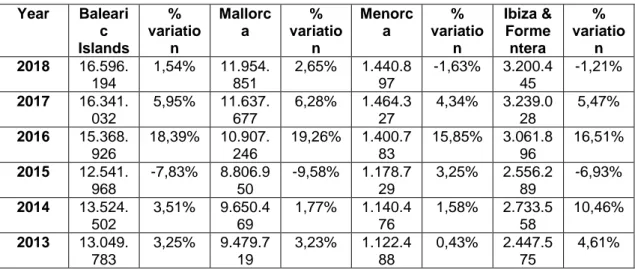
(7) SECTION 1. Economic overview of the tourist sector in the Balearic Islands The first section of the report will introduce the topic to the reader, making an economic overview of the tourist sector in the Balearic Islands starting by an explanation of their socio-economic profile followed by the positive and negative aspects of the tourism itself for the Islands. 1.1 Socio-economic profile of the Balearic Islands Starting by one of the most important macroeconomic measures, it can be stated that from the period 2013 to 2017 there was a great improvement of the GDP of the Balearic Islands with a total amount of 25.508 million euros and 29.911 million euros respectively (Datosmacro, 2017) Furthermore, according to Expansion (2017), the GDP per capita increased from 22.924 euros to 25.772 euros during the same period. Comparing with the rest of the Spanish autonomous communities, this ranks the Balearic Islands in the seventh position regarding the GDP per capita, situating itself above the national average (25.064) (INE, 2018). However, below the European Union average (29.200) (Union, 2019). Going deeper into the socio-economic explanation, with data regarding 2016, the tertiary sector was at the head of the ranking being a total of 82,9% of the GDP, followed by the secondary sector (16,5%) and the primary sector (0,5%) (Union, 2019). As the GDP numbers indicate, the tourism sector is one of the main bases of the economy of the Balearic Islands. Since its beginning, in the boom of the sixties, the touristic phenomenon has done nothing but exponentially increase throughout the years, becoming the Balearic Islands a touristic leader spot worldwide, especially for Europeans travellers. The Balearic Islands received a total of 16.596.194 tourists in the year 2018, from which 3.699.448 and 2.811.561 came from Germany and the United Kingdom, respectively (Balears I. d., IBESTAT, 2018). This figure shows how the influx of tourists comes from Europe, and specially from the two countries previously mentioned. The total expenditure amount by tourists was 16.370,62 million euros in 2018 according to the same source. Table 1. Tourist flow with main destination the Balearic Islands (2011-2018) Year. 2018 2017 2016 2015 2014 2013. Baleari c Islands 16.596. 194 16.341. 032 15.368. 926 12.541. 968 13.524. 502 13.049. 783. % variatio n 1,54% 5,95% 18,39% -7,83% 3,51% 3,25%. Mallorc a 11.954. 851 11.637. 677 10.907. 246 8.806.9 50 9.650.4 69 9.479.7 19. % variatio n 2,65% 6,28% 19,26% -9,58% 1,77% 3,23%. Menorc a 1.440.8 97 1.464.3 27 1.400.7 83 1.178.7 29 1.140.4 76 1.122.4 88. % variatio n -1,63% 4,34% 15,85% 3,25% 1,58% 0,43%. Ibiza & Forme ntera 3.200.4 45 3.239.0 28 3.061.8 96 2.556.2 89 2.733.5 58 2.447.5 75. % variatio n -1,21% 5,47% 16,51% -6,93% 10,46% 4,61%. 7.
(8) 2012. 12.626. 1,51% 9.173.7 2,70% 1.117.6 -1,18% 2.334.6 -1,90% 128 94 12 92 2011 12.435. 8.925.7 1.130.8 2.378.9 958 61 37 67 Source: adapted from Institut d’Estadística de les Illes Balears (IBESTAT) 2011-2018. Table 2. Tourist expenditure with main destination the Balearic Islands (2011-2018) Year. Baleari % Mallorc % Menorc % Ibiza & % c variatio a variatio a variatio Formen variatio Islands n n n tera n 2018 16.370, 2,03% 11.892. 2,68% 1.394.8 4,03% 2.303.4 -5,88% 630 600 00 82 2017 16.037, 10,64% 11.574. 9,61% 1.338.5 12,48% 2.438.9 3,27% 490 020 60 62 2016 14.331, 20,31% 10.461. 22,34% 1.171.5 15,25% 2.359.2 2,36% 030 880 20 39 2015 11.420, -4,72% 8.124.4 -5,65% 992.815 5,59% 2.303.4 -5,88% 740 48 82 2014 11.960, -0,48% 8.583.7 -1,06% 937.328 -4,33% 2.438.9 3,27% 040 45 62 2013 12.017, 5,07% 8.674.3 6,31% 977.928 3,22% 2.359.2 6,13% 620 95 39 2012 11.408, 2,93% 8.126.7 3,48% 946.462 4,89% 2.214.5 4,54% 870 53 63 2011 11.074, 7.844.0 900.212 2.113.9 270 14 13 Source: adapted from Institut d’Estadística de les Illes Balears (IBESTAT) 2011-2018. The data is provided in million euros.. Therefore, on the other hand, being the tourism the bases of the economy and the main source of wealth of the Balearic Islands, it does not erase the fact that there is direct high dependence on it as well. Being the Balearic Islands known worldwide for the sun and beach tourism (among other types), the economy is tied to high seasonality problems. Table 3. Seasonality level in the Balearic Islands and per island (2018) Year 2018. Mallorca. Menorca. January. Balearic Islands 224.812. 11.607. Ibiza & Formentera 33.744. % Balearic Islands 1,35%. 179.461. February. 254.336. 210.081. 11.484. 32.771. 1,53%. March. 571.295. 473.377. 26.976. 70.942. 3,44%. April. 1.159.927. 938.881. 43.499. 177.548. 6,99%. May. 1.924.224. 1.400.948. 138.257. 385.018. 11,59%. June. 2.450.572. 1.707.574. 237.404. 505.594. 14,77%. July. 2.843.800. 1.930.332. 318.943. 594.525. 17,14%. August. 2.771.924. 1.839.725. 324.262. 607.937. 16,70%. September. 2.322.531. 1.612.884. 219.456. 490.190. 13,99%. 8.
(9) October. 1.473.267. 1.146.808. 82.795. 243.665. 8,88%. November. 304.386. 258.137. 15.375. 30.873. 1,83%. December. 295.120. 256.643. 10.840. 27.638. 1,78%. Source: adapted from Institut d’Estadística de les Illes Balears (IBESTAT) 2018.. The table above (Table 3), shows the strong seasonality that the Balearic Islands must face. From the month of May until the month of September the Islands are receiving the 70% of the total of tourists that come throughout the year. Hence, it is crucial to place an emphasis on the product innovation and the increase in its quality, besides hedge the touristic offer beyond the sun and beach tourism to break with the seasonality problem. In addition, it is important to manage effectively the natural resources and the territory. Therefore, to promote a better workforce conditions regarding the salaries but also the stability of the place of work to achieve an increase in competitiveness in the touristic sector of the Balearic Islands (Gadeso F. , 2018). 1.2 Positive and negative aspects of the tourist sector in the Balearic Islands This section will analyse the tourist sector, explaining the positive and negative aspects of itself for the economy, the people working in the sector and the environment. According to (Garau Taberner, 2014) the positive aspects associated to the tourist sector can be divided into six. Firstly, the tourist specialization as opposed to other economic sectors, has a production process quite easy and simple. The inputs needed to generate the tourist offer in the Balearic Islands are found mainly inside the territory, for instance, the climate with mostly sunny days throughout the year with warm temperatures during the summer months, the landscape with amazing and idyllic beaches but also restaurants, bars and nightlife as complementary offer. Therefore, for the Balearic Islands the tourist sector is a good alternative due to avoid the costs of producing other types of goods or importing them for selling afterwards. Secondly, the tourist sector is involved with the foreign market, competing directly with it. Being international, means that visitors, tour operators and travel agencies can analyse the product the Balearic Islands are selling, compare it with other world destinations, and afterwards choosing the most convenient option. Therefore, it is a good incentive to stimulate the innovation and excellence of the tourist product. The third positive aspect is that thanks to the tourist sector, the visitors coming to the Balearic Islands make the nature and own culture of the Islands more valuable and important. Hence, the visitors come to the Balearic Islands to experience, feel, enjoy and learn about these two elements in person 9.
(10) considering that they cannot consume neither experience these two elements in their own place of residence. Fourthly, the tourist sector generated the 32,0% of the employment of the Balearic Islands in 2018 (Balears I. d., IBESTAT, 2018). This sector has the necessity of a high workforce number, as to clean all the accommodation rooms, deliver food and drinks in restaurants or bars and drive the means of transport, a huge number of people is required. Another positive point is that the tourist sector indirectly generates increases in sales and production in other sectors of the Balearic Islands. It is true that the visitors are mainly coming for going to the beach, doing an excursion or enjoying the nightlife, but while their stay in the Islands the commercial sector takes advantage selling typical products as shoes, wines and food. Hence, the commercial sector has no need to invest in exportation as the own visitor is buying it in the Balearic Islands and then exporting it to its own place of residence. Lastly, the huge expenditure done by tourists coming to the Balearic Islands, with an amount of 16.370,62 million euros in 2018 (Balears I. d., IBESTAT, 2018), generates also income for the public sector thanks to the tax collection of VAT, the tax on tourists stays, etc. On the other hand, the negative aspects can be divided into five (Garau Taberner, 2014). Firstly, going back to one positive aspect concerning the tourist sector as it is the high amount of workforce needed, in and on itself leads to a negative aspect which is the disincentive of the population education. Just the 22% of the workers in the tourism sector counts with the appropriate education for the place of work (Press, 2018) leading to two consequences: due to the big offer of low profile workplaces there is a disincentive in education and training of the sector and also when the requisite for working is not the academic training, the way to compete in the market is the willingness to work for a lower salary. Secondly, considering that the inputs needed to generate the tourist offer are primarily natural resources, those have been subjected to a high level of consumption. Evidence of the urbanization and a widespread growth that the Balearic Islands have experienced the last years with highways, golf courses, accommodation buildings, etc. Thirdly, the tourist sector is not encouraging the innovation and development. The main type of tourism which are selling the Balearic Islands, or in other words sun and beach tourism, does not require of imagination or innovation to continue being successful. As explained, the production process is probably one of the simplest in the world and the easiest to imitate and replicate. Fourthly, the tourist sector entails the workers to a lower productivity level. As explained, the tourist sector leads to a disincentive of the population education and there is a slight degree of effort in innovation, research and development as 10.
(11) the main idea of tourism it is still taking advantage of the own weather and landscape. Therefore, the productivity is not increasing -by reason of the absence of new technologies, new production processes and the workforce is not better trained- but decreasing. Lastly, the tourist sector has a strong necessity of the public goods created by the public sector. As it is competing worldwide, having powerful and modern infrastructure helps in the market competition. Moreover, it needs of an overblown infrastructure for those specific days during the year with more arrivals, more congestions in the highways, etc. And all those costs are high.. 11.
(12) SECTION 2. The tourist rental phenomenon in the Balearic Islands Going deeper into the topic, the second section will be a discussion about the tourist rental phenomenon in the Balearic Islands dividing it into four subsections. Starting by an introduction of at which moment the phenomenon started to be more important, followed by the past and current regulation of the tourist rental, moving to some macroeconomic data and finally, considering some reflections towards legalizing or not the tourist rental. 2.1 From the moment when the tourist rental started to gain importance in the Balearic Islands The economic recession had a hard impact over the economic activity in Spain whose consequences in the market were basically the destruction of the employment and the rapidly increase of the unemployment rate. The real estate bubble started with strength in Spain during the year 2008, fact that caused a decrease of almost 3,3 million of jobs and just a creation of 274 thousand new ones between the years 2008 and 2012 (Rocha, n.d.). Nevertheless, from all the autonomous communities in Spain, the Balearic Islands has been the one which in a faster way has overcome the economic crisis with a rapid growth in the GDP level and GDP per capita, apart from a constant decrease of the unemployment rate (Hora, Baleares ha sobrevolado la crisis gracias al turismo, 2015). As it can be observed in the Table 5, the unemployment rate exponentially decreased from 23,17% in 2012 to 11,52% in 2018 (Hora, Sólo Baleares ha recuperado los niveles de empleo de antes de la crisis, 2017). Table 4. Labour indicators in the Balearic Islands (2006-2018). Measured in thousand people Year. Active population. Employed population. Unemployed population. Inactive population. 560,1. Employed population in the service sector 381,2. 2018. 633,1. 72,9. 349,6. 2017. 613,9. 537,5. 360,5. 76,3. 343,9. 2016. 616,2. 530,6. 356,4. 85,6. 328,7. 2015. 616,3. 509,6. 340,6. 106,7. 320,7. 2014. 603,6. 482,9. 333,7. 120,7. 326,5. 2013. 612. 475,8. 336,1. 136,2. 312,1. 2012. 614,2. 471,8. 316,7. 142,3. 302,4. 2011. 595,2. 465,1. 315,8. 130,1. 313,9. 2010. 598,9. 478,4. 324,3. 120,5. 304,1. 2009. 590. 484,3. 320,4. 105,7. 305,7. 12.
(13) 2008. 571,6. 513,5. 320,1. 58,1. 307,9. 2007. 549. 509,7. -. 39,3. 303,5. 2006. 528,9. 494,8. -. 34,1. 291,7. Source: adapted from Instituto Nacional de Estadística (INE) 2006-2018. Measured in units of thousand people. Table 5. Labour indicators in the Balearic Islands (2006-2018). Measured in percentages rates Year. Active population 64,42%. Employed population 57,00%. Unemployed population 11,52%. 2018 2017. 64,09%. 56,12%. 12,43%. 2016. 65,22%. 56,15%. 13,89%. 2015. 65,77%. 54,39%. 17,31%. 2014. 64,89%. 51,91%. 20,00%. 2013. 66,23%. 51,49%. 22,26%. 2012. 67,00%. 51,48%. 23,17%. 2011. 65,47%. 51,16%. 21,86%. 2010. 66,32%. 52,98%. 20,12%. 2009. 65,87%. 54,07%. 17,92%. 2008. 64,99%. 58,39%. 10,16%. 2007. 64,40%. 59,78%. 7,16%. 2006. 64,45%. 60,30%. 6,44%. Source: adapted from Instituto Nacional de Estadística (INE) 2006-2018. Measured in percentage rates.. In the year 2012, the influx of tourists started to increase again in the Balearic Islands and consequently, the phenomenon of the touristic rental in housing started to gain more importance in the sector, despite that it was already a spread practice in the Balearic Islands, mainly in the housing located in the countryside. “In this vein, tourist exploitation of houses has become crucial for the realization of value and the reproduction of capital, which implies in somehow a shift from the secondary circuit of capital (linked to financialization) to the primary (linked to tourism)” (Murray Mas, Yrigoy Cadena, & BlázquezSalom, 2017). Hence, the tourist rental in housing accentuated thanks to the emergence of online apps renting houses, such as one of the most known platforms worldwide: Airbnb (Murray Mas, Yrigoy Cadena, & Blázquez-Salom, 2017). 13.
(14) 2.2 Companies that commercialize tourist stays in housing (touristic rental) 2.2.1 From the former law to the latest The President of the Balearic Islands implemented the new Law 6/2017 of 31th July, to modify the previous Law 8/2012 of 18th July, of the tourism in the Balearic Islands, related to the commercialization of tourist stays in housing. According to the article 49 of the Law 8/2012 of 18th July, the concept of the companies that commercialize tourists stays in housing was defined as follows: Are companies that commercialize tourist stays in housing the natural person or legal entity who sell the use of homes that, having the disposition and configuration of a single-family house isolated or matched, in principle designed for residential use, provide tourist accommodation services that alternate with the own residential use that has the property in the conditions established in this law and in the dispositions that implement it. (BOE, Agencia Estatal Boletín Oficial del Estado, 2012). Therefore, regarding the article 52 of the same law, the section number 2 clearly exposed that “Under no circumstances are considered as isolated the independent housing located in multi-family or attached under the condominium regime, and consequently it is prohibited the commercialization of tourists stays in this kind of housing” (BOE, Agencia Estatal Boletín Oficial del Estado, 2012). Hence, just the single-family houses isolated or matched could be used for the commercialization of tourist stays. However, the modification of the law was proposed with the purpose of regulate the possibility of the tourist commercialization in all housing typologies and consequently, to avoid the existent prohibition with respect to multi-family housing. The article 49 of the Law 6/2017 of 31th July, makes possible the tourist commercialization of the single-family house isolated or marched, as well as there is the conditioned admission of other typologies, making a clear reference to the multi-family housing. That said, the concept of the companies that commercialize tourists stays in housing is defined in the new Law 6/2017 of 31th July as follows: Are companies that commercialize tourist stays in housing the natural person or legal entity that commercialize in a touristic way the entirety of the residential housing, for short periods of time, under immediate use condition and with a lucrative purpose, commercialization that can be alternate with the strictly speaking use of housing that characterizes. (BOE, Agencia Estatal Boletín Oficial del Estado, 2017).. This new law has a series of special features for those cases once the suitable areas for the commercialization are delimited. As it is explained above, the modification was proposed with the purpose to regulate the possibility of the tourist commercialization of multi-family housing, hence the possibility is real whether all the requirements are fulfilled (BOE, Agencia Estatal Boletín Oficial del Estado, 2017). 14.
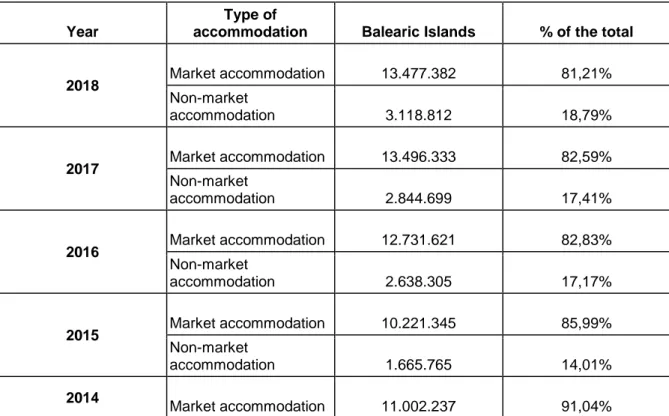
(15) a. The places must necessarily be acquired to the institution that manages the places (Consorci borsa allotjaments turístics). b. The acquisition of places will be for a provisional period of 5 years or for which it has been set by regulation, with the possibility of extension. After the implementation of the new law, the neighbourhood association of Palma requested that when the suitable areas for the commercialization of multi-housing rental were delimited, Palma should be declared as a forbidden place for the commercialization of multi-housing rental having the support of the Palma town hall (NOTICIES, 2017). Palma town hall approved the definitive regulation of tourist rental in the capital, the one forbidding the rental of flats to the tourist in the city itself, and only allowing the commercialization of tourist stays in single family homes, such as isolated houses, in certain areas. Palam has become the first capital of the state forbidding this economic practice (Constantini, Vázquez, Bohórquez, Blanchar, & Lucas, 2018). 2.3 Macroeconomic data regarding the touristic rental This section will highlight the touristic rental accommodation numbers based on the IBESTAT (Institut d’estadística de les Illes Balears) information. It is important to differentiate the market accommodation from the non-market accommodation. IBESTAT classifies the market accommodation as the sum of hotels and similar, rental accommodations and other market accommodation. Furthermore, the non-market accommodation is classified as the sum of housing property, family/friends housing and other non-market accommodation (Balears I. d., IBESTAT, 2018). Table 6. Tourist flow with main destination the Balearic Islands and type of accommodation (2009-2018). Year. 2018. 2017. 2016. 2015. 2014. Type of accommodation. Balearic Islands. % of the total. Market accommodation. 13.477.382. 81,21%. Non-market accommodation. 3.118.812. 18,79%. Market accommodation. 13.496.333. 82,59%. Non-market accommodation. 2.844.699. 17,41%. Market accommodation. 12.731.621. 82,83%. Non-market accommodation. 2.638.305. 17,17%. Market accommodation. 10.221.345. 85,99%. Non-market accommodation. 1.665.765. 14,01%. Market accommodation. 11.002.237. 91,04%. 15.
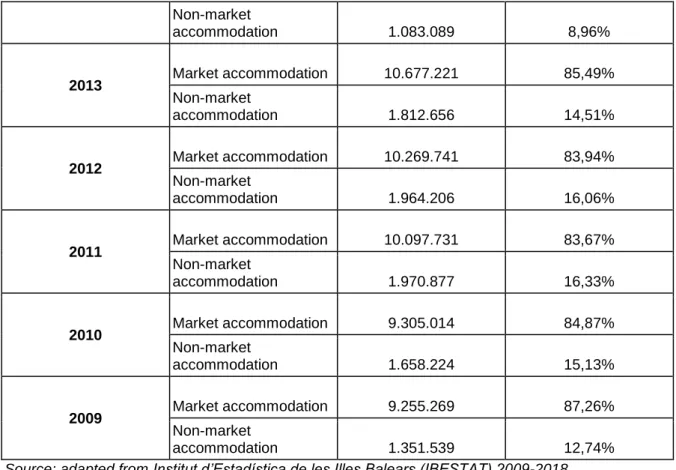
(16) 2013. 2012. 2011. 2010. 2009. Non-market accommodation. 1.083.089. 8,96%. Market accommodation. 10.677.221. 85,49%. Non-market accommodation. 1.812.656. 14,51%. Market accommodation. 10.269.741. 83,94%. Non-market accommodation. 1.964.206. 16,06%. Market accommodation. 10.097.731. 83,67%. Non-market accommodation. 1.970.877. 16,33%. Market accommodation. 9.305.014. 84,87%. Non-market accommodation. 1.658.224. 15,13%. Market accommodation. 9.255.269. 87,26%. Non-market accommodation 1.351.539 12,74% Source: adapted from Institut d’Estadística de les Illes Balears (IBESTAT) 2009-2018. Table 7. Tourist flow with main destination the Balearic Islands and type of accommodation rental housing (2009- 2018). Year. Balearic Islands. % variation. % over market accommodation. 2018. 2.191.103. -13,91%. 16,26%. 2017. 2.495.845. 22,07%. 18,49%. 2016. 1.945.112. 12,42%. 15,28%. 2015. 1.703.607. -18,02%. 16,67%. 2014. 2.010.660. 17,79%. 18,28%. 2013. 1.652.899. 5,63%. 15,48%. 2012. 1.559.895. 31,29%. 15,19%. 2011. 1.071.774. 19,26%. 10,61%. 2010. 865.337. -7,07%. 9,30%. 2009 926.501 10,01% Source: adapted from Institut d’Estadística de les Illes Balears (IBESTAT) 2009-2018.. 16.
(17) The market accommodation encompasses 81,21% of the total while the nonmarket accommodation encompasses the 18,79% remaining, looking at the year 2018. As explained above, the non-market accommodation is constituted by housing property, family/friends housing and other non-market accommodation. This percentage (18,79% in 2018) is quite elevated and hardly credible, as a part of that percentage could be of illegal rental housing. In any case, that statement is difficult to analyse and a further research on that should be done to confirm it. Additionally, the market accommodation is constituted by hotels and similar, rental accommodations and other market accommodation. The rental accommodation represented a 16,26% of the total in 2018, number that has been reduced by 13,91% with respect to the previous year for non-defined reasons. Hence, the market accommodation destined to hotels and similar represent an 83,74%. Despite the last decrease, the percentage regarding rental accommodation is quite meaningful, presenting two different ideas: a significant percentage of the local population increases their own economic wealth thanks to the commercialization of this housing typology but also does the public sector with the taxation for its economic activity. 2.4 Reflections on whether legalizing or not the tourist stays in houses in the Balearic Islands The reflections that will be discussed in this section address whether is positive the legalization of the rental in flats, apartments or multi-housing buildings. As explained before, the law 8/2010 of 18th July, under no circumstances accepted the commercialization of tourist stays in flats, apartments or multi-housing buildings, fact that changed with the entry into force of the new law 6/2017 of 13th July, which legalizes the commercialization of the last providing that are under the delimited commercial areas. According to (Blasco Esteve, 2015) there are five arguments against the legalization of the commercialization of tourists stays in flats, apartments or multi-housing buildings that will be described below. There is a clear incompatibility of the housing usage between the residential use and the touristic use. The lifestyle, schedules and customs of the residents are totally different to the tourist ones (the tourists have the purpose to enjoy their holidays, enjoying the nightlife fact that can cause higher noise levels etc.) and their coexistence can create numerous problems. The next problem tight to the first one, is that from the moment which the commercialization of tourists stays in flats, apartments or multi-housing buildings is accepted, it will cease to exist a request of professionalism which is given for the touristic companies (such as hotels), considering that the service would be provided by an individual and not by a company specialized in the tourist sector, and therefore, could cause a decrease in the quality of the service.. 17.
(18) The fact of legalizing the commercialization of tourists stays in flats, apartments or multi-housing buildings entails an increase with difficulty acceptance of new accommodation places. From the entry into force of the Law 4/1998 of 19 of May it has been accomplished in the Balearic Islands a policy to remove from the market the obsolete touristic accommodation places. Hence, it is absurd the permission of the legalization of the commercialization of tourists stays in flats, apartments or multi-housing building as there are medium-low accommodation places. In addition, it could also emerge a problem regarding the offered prices by the regulated touristic companies, such as hotels, as it would be a clear direct competence. One of the problems of the touristic rental is that many of them work from the illegality, as much in the economic as the fiscal one. The fact of allowing the legalization of the commercialization of tourists stays in flats, apartments or multi-housing building could entail that all those illegal rentals would come out into the open. Although, the most probable situation is that the fact would not totally happen, as the touristic rental is a difficult phenomenon to control and easy to work from the illegality. The last argument against that legalization is that doing so would break the urban planning done by the municipality which is responsible of doing it. Allowing the legalization would lead to a decrease of the municipalities legal authority upon qualifying the plot and establishing distinguishable zones, leading to a mixture between the residential and touristic use without the municipalities being able to separate one from the other.. 18.
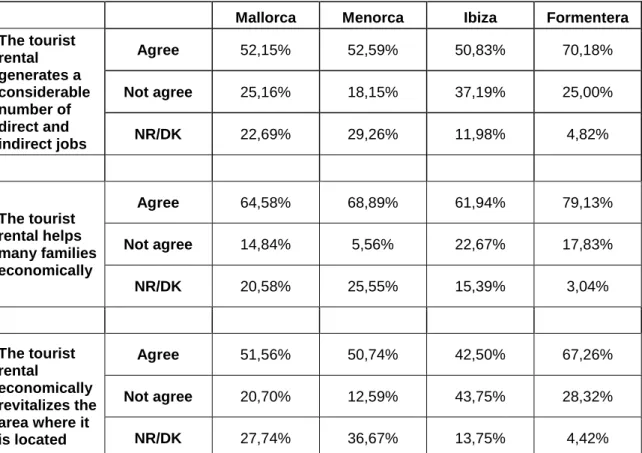
(19) SECTION 3. Economic, social and environmental consequences because of the tourist rental phenomenon The last section of the report will encompass the consequences, whereas economic, social and environmental, that the tourist rental phenomenon has caused in the Balearic Islands during the recent years. Along the report, has been basically analysed macroeconomic data regarding the socio-economic model and situation of the Balearic Islands in addition to the tourist rental itself. Throughout the section three an analysis from a different point of view will be made: the resident’s opinion about the touristic rental phenomenon. Th resident’s opinion about the touristic rental phenomenon is extracted from a work in the field done at the University of the Balearic Islands in 2016. This study of the resident’s perception of the touristic rental was based on 1.515 questionnaires administrated through the four islands (Garau Vadell, Gutierrez Taño, Orfila Sintes, Soriano Guasch, & Martínez Gavaldà, 2017). In addition, the information will be combined with more secondary source information. 3.1 Economic consequences Table 8. Perception of the economic benefits for the residents of the Balearic Islands regarding tourist rental. The tourist rental generates a considerable number of direct and indirect jobs. The tourist rental helps many families economically. The tourist rental economically revitalizes the area where it is located. Mallorca. Menorca. Ibiza. Formentera. Agree. 52,15%. 52,59%. 50,83%. 70,18%. Not agree. 25,16%. 18,15%. 37,19%. 25,00%. NR/DK. 22,69%. 29,26%. 11,98%. 4,82%. Agree. 64,58%. 68,89%. 61,94%. 79,13%. Not agree. 14,84%. 5,56%. 22,67%. 17,83%. NR/DK. 20,58%. 25,55%. 15,39%. 3,04%. Agree. 51,56%. 50,74%. 42,50%. 67,26%. Not agree. 20,70%. 12,59%. 43,75%. 28,32%. NR/DK. 27,74%. 36,67%. 13,75%. 4,42%. Source: adapted from the study of the resident’s perception of the touristic rental done. at the University of the Balearic Islands (UIB) 2006.. 19.
(20) Table 9. Perception of the economic costs for the residents of the Balearic Islands The tourist rental produces precarious and lowquality jobs. The tourist rental destroys existing jobs in hotels. The area where the tourist rental is implemented makes the costs of living higher. Mallorca. Menorca. Ibiza. Formentera. Agree. 33,20%. 30,37%. 48,95%. 47,39%. Not agree. 31,90%. 22,59%. 29,96%. 43,13%. NR/DK. 34,90%. 47,04%. 21,09%. 9,48%. Agree. 40,29%. 37,04%. 50,21%. 38,32%. Not agree. 30,51%. 26,30%. 37,02%. 55,14%. NR/DK. 29,20%. 36,66%. 12,77%. 6,54%. Agree. 51,56%. 50,74%. 42,50%. 67,26%. Not agree. 20,70%. 12,59%. 43,75%. 28,32%. NR/DK. 27,74%. 36,67%. 13,75%. 4,42%. Source: adapted from the study of the resident’s perception of the touristic rental done at the University of the Balearic Islands (UIB) 2006.. The resident’s perception towards the economic consequences support the idea that the main economic activity in the Balearic Islands is the tourist sector, and not just that but also that the recent phenomenon of the tourist rental is of utmost importance for the family’s economy. It is interesting to highlight that among the four islands, Formentera is the one with higher percentages being agree regarding the questions “the tourist rental generates a considerable number of direct and indirect jobs” and “the tourist rental helps many families economically” with a 70,18% and 79,13% respectively. Nevertheless, although residents agree that the tourist rental generates work places, we find a high percentage mainly in Ibiza (48,95%) and Formentera (47,39%) which also agree that those are precarious and of a low-quality. The current discussion is about whether the tourist rental has influenced or affected negatively the housing rental prices for residents, being the consequence of their recently increase. The resident’s answers regarding the question “the area where the tourist rental is implemented makes the cost of living higher” situates Mallorca and Menorca on the same level (51,56% and 50,74% respectively), where in Ibiza 42,50% of the residents agree with the statement, and in Formentera the percentage reaches the 67,26%.. 20.
(21) Table 10. Percentage distribution of total household expenditure by expenditure groups (2007-2017) 2017. 2015. 2013. 2011. 2009. 2007. 100. 100. 100. 100. 100. 100. 13,37. 14,02. 13,65. 13,20. 13,57. 13,10. Alcoholic beverages, tobacco and narcotics. 1,9. 2,00. 1,86. 1,94. 1,87. 1,78. Articles of clothing and footwear. 5,02. 4,91. 4,53. 4,68. 4,33. 5,36. Housing, water, electricity, gas and other fuels. 30,8. 33,30. 35,79. 34,02. 32,94. 26,13. Furniture, household equipment and current housing maintenance costs. 4,46. 4,05. 4,38. 4,59. 4,95. 5,69. Health care. 2,85. 3,68. 2,62. 2,97. 2,53. 2,46. Transport. 13,49. 11,59. 11,67. 12,63. 11,87. 14,76. Communications. 3,4. 3,19. 3,45. 3,65. 3,75. 3,31. Leisure shows and culture. 5,54. 5,33. 5,54. 5,38. 5,79. 6,48. Education. 1,24. 1,01. 1,12. 0,86. 0,84. 0,78. Hotels, cafes and restaurants. 9,91. 9,47. 7,73. 8,48. 9,34. 11,77. Total Food and non-alcoholic beverages. Other goods and services 8,02 7,44 7,66 7,60 8,23 8,37 Source: adapted from the source Institut d’Estadística de les Illes Balears (IBESTAT) 20072017.. To analyse it in depth, the table above (Table 10) shows the percentage distribution of the total household expenditure in the Balearic Islands from the year 2007 to 2017 based on IBESTAT data. It can be observed a decrease in household expenditure regarding “housing, water, electricity, gas and other fuels” from the year after the beginning of the real state bubble (32,94% in 2009 to 30,8% in 2017). It is important to clarify, that the data regarding the table 10 includes all the municipalities of the four islands and therefore there is an average done were it cannot be distinguished the housing expenditure from the countryside to the one in the city. “It is not the same the countryside than the intensive city centres, being of an explicitly tourist nature or of a residential nature” (Gadeso Q. , 2018) Although there is no certainty with the data above whether the household expenditure towards housing has been increased, it can be stated that the rise in demand of rental housing for tourists has led to a rise on its offer as well. The more housing destined to tourists means a less amount remaining for the residents looking for a rent. The current issue has been on the cover creating an interest among the reader. For instance, the search for rental housing mainly during summer months has become a nightmare for those professionals willing to work in the Balearic Islands as there is not enough offer for everyone (Balears A. , 2017). 21.
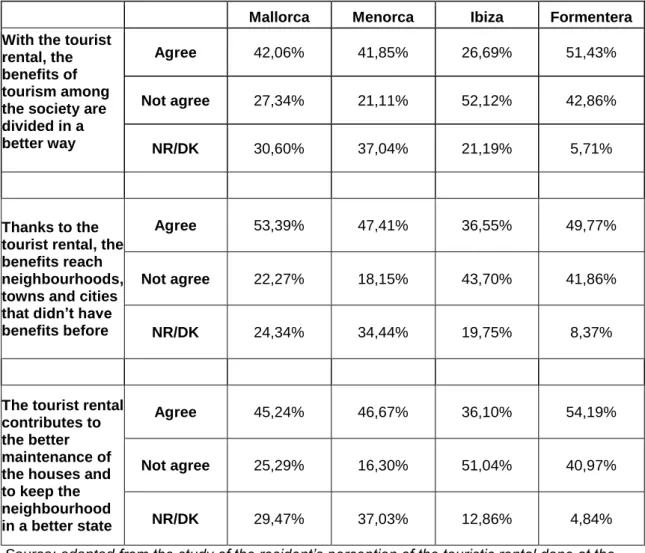
(22) In addition to that new, according to (Balears E. P., 2018) the average price which a citizen of the Balearic Islands is willing to pay for the housing rent is 1.563€ per month, amount that is doubled in Formentera and some municipalities in Ibiza. Price which increased between 10% and 15% in some city centres in the year 2018 comparing it with the one before (País, 2018). 3.2 Social consequences Table 11. Perception of the social benefits for the residents of the Balearic Islands regarding the tourist rental. With the tourist rental, the benefits of tourism among the society are divided in a better way. Thanks to the tourist rental, the benefits reach neighbourhoods, towns and cities that didn’t have benefits before. The tourist rental contributes to the better maintenance of the houses and to keep the neighbourhood in a better state. Mallorca. Menorca. Ibiza. Formentera. Agree. 42,06%. 41,85%. 26,69%. 51,43%. Not agree. 27,34%. 21,11%. 52,12%. 42,86%. NR/DK. 30,60%. 37,04%. 21,19%. 5,71%. Agree. 53,39%. 47,41%. 36,55%. 49,77%. Not agree. 22,27%. 18,15%. 43,70%. 41,86%. NR/DK. 24,34%. 34,44%. 19,75%. 8,37%. Agree. 45,24%. 46,67%. 36,10%. 54,19%. Not agree. 25,29%. 16,30%. 51,04%. 40,97%. NR/DK. 29,47%. 37,03%. 12,86%. 4,84%. Source: adapted from the study of the resident’s perception of the touristic rental done at the University of the Balearic Islands (UIB) 2006. Table 12. Perception of the social costs for the residents of the Balearic Islands regarding the tourist rental. The tourist rental causes a deterioration of the citizen coexistence. Mallorca. Menorca. Ibiza. Formentera. Agree. 34,51%. 40,74%. 57,20%. 57,27%. Not agree. 34,24%. 23,70%. 22,63%. 28,63%. 22.
(23) (more noise, vandalism…). The tourist rental causes the expulsion of habitual residents of the neighbourhood or city where it is implemented. Because of the tourist rental, calm and quality of life are being lost. NR/DK. 31,25%. 35,56%. 20,17%. 14,10%. Agree. 28,26%. 32,22%. 52,08%. 39,64%. Not agree. 44,40%. 32,59%. 28,33%. 48,20%. NR/DK. 27,34%. 35,19%. 19,59%. 12,16%. Agree. 42,07%. 34,07%. 61,89%. 51,98%. Not agree. 33,64%. 28,89%. 26,23%. 34,80%. NR/DK. 24,29%. 37,04%. 11,88%. 13,22%. Source: adapted from the study of the resident’s perception of the touristic rental done at the University of the Balearic Islands (UIB) 2006.. Regarding the perception of the social consequences for the residents, Mallorca and Menorca can be grouped together and then analyse Ibiza and Formentera separately. It can be stated that Ibiza, is more averse to the positiveness that the tourist rental has contributed in the social aspect. Answer to the question “with the tourist rental the benefits of tourism among the society are divided in a better way”, the residents of Ibiza which don’t agree reach the 52,12%, while with the question “the tourist rental contributes to the better maintenance of the houses and to keep the neighbourhood in a better state” the amount is 51,04%. The same pattern happens in the second table “The resident’s perception of the social costs regarding the tourist rental”. Ibiza is at the head of the ranking agreeing the negativity that supposes that economic practice. With the question “because of the tourist rental, calm and quality of life are being lost” Ibiza reaches the 61,89% of residents agreeing to this statement. There is a clear problem regarding how the tourist rental is affecting the own population of Ibiza. Although economically the tourist rental is generating benefits for the residents, the social costs are quite high. Ibiza is the Islands which has had a greater impact regarding the rental of holidays homes. Since the tourist rental phenomenon began to gain strength, it has contributed with 7.027 legal accommodation places plus other 18.000 accommodation places, which are illegal. The fact that there are that many accommodation places for tourists has meant that the offer of rental housing for residents has decreased, being the demand the same and even greater during the high season. The rise in rental prices has led to Ibiza with the problem that, 23.
(24) 82% of the average salary is used to pay the rent of housing (Villalonga, Murray Mas, Pons Buades, & Calvo Cubero, 2017). 3.3 Environmental consequences Table 13. Perception of the environmental benefits for the residents of the Balearic Islands regarding the tourist rental. The tourist rental is more sustainable than the traditional tourist establishments because there is no need to build more. The tourist rental values more the protected natural areas. The tourist rental is more respectful with the environment. Mallorca. Menorca. Ibiza. Formentera. Agree. 51,63%. 57,04%. 31,69%. 50,23%. Not agree. 18,77%. 12,59%. 46,91%. 41,01%. NR/DK. 29,60%. 30,37%. 21,40%. 8,76%. Agree. 34,64%. 42,59%. 17,36%. 38,39%. Not agree. 23,57%. 16,30%. 59,09%. 47,32%. NR/DK. 41,79%. 41,11%. 23,55%. 14,29%. Agree. 36,20%. 43,33%. 15,90%. 35,32%. Not agree. 24,61%. 15,19%. 60,25%. 49,08%. NR/DK. 39,19%. 41,48%. 23,85%. 15,60%. Source: adapted from the study of the resident’s perception of the touristic rental done at the University of the Balearic Islands (UIB) 2006. Table 14. Perception of the environmental costs for the residents of the Balearic Islands regarding the tourist rental. The tourist rental generates a lot of pollution (especially noise pollution, rubbish…). Mallorca. Menorca. Ibiza. Formentera. Agree. 37,03%. 35,93%. 57,20%. 57,71%. Not agree. 33,25%. 27,04%. 24,69%. 33,92%. NR/DK. 29,72%. 37,03%. 18,11%. 8,37%. 24.
(25) The tourist rental has a high responsibility regarding the traffic congestion in the islands. The tourist rental leads to a faster deterioration of the neighbourhood infrastructure. The tourist rent collapse the areas which usually are used by the residents of the islands. Agree. 46,22%. 45,19%. 56,79%. 62,01%. Not agree. 24,09%. 21,48%. 23,87%. 31,88%. NR/DK. 29,69%. 33,33%. 19,34%. 6,11%. Agree. 29,37%. 29,63%. 48,15%. 45,81%. Not agree. 35,38%. 29,26%. 48,15%. 45,81%. NR/DK. 35,25%. 41,11%. 3,70%. 8,38%. Agree. 52,47%. 42,59%. 56,73%. 53,95%. Not agree. 25,13%. 22,59%. 25,71%. 41,67%. NR/DK. 22,40%. 34,82%. 17,56%. 4,38%. Source: adapted from the study of the resident’s perception of the touristic rental done at the University of the Balearic Islands (UIB) 2006.. Regarding the environmental consequences, as it has been made with the social consequences, Mallorca and Menorca can be grouped together and then analyse Ibiza and Formentera separately. Once again, Ibiza is favourable to the fact that the tourist rental has no environmental benefits for the residents of the island, reaching a 60% which not agree with the questions “The tourist rental values more the protected natural areas” and “The tourist rental is more respectful with the environment”. On the other hand, regarding the perception of the environmental costs for the residents of the Islands, Ibiza and Formentera go hand in hand for the analysis. In both islands, residents agree with high percentages the questions “The tourist rental generates a lot of pollution (especially noise pollution, rubbish…)” and “The tourist rental has a high responsibility regarding the traffic congestion in the islands”. It can be observed that the four islands agree to the fact that “the tourist rent collapses the area which usually are used by the residents of the islands” situating Mallorca, Ibiza and Formentera above the 50% and Menorca with a percentage of 42,59%. Information provided by el Diario de Mallorca, states that in Mallorca there were 547.108 cars during the year 2000, figure that has been increased to 741.598 in the year 2016 (Magro, 2017). That means a 35% increase without including the 100.000 rent a car not registered to vote. 25.
(26) CONCLUSIONS After developing this research regarding how the tourist rental is affecting the tourist sector and the residents of the Balearic Islands, it can be concluded that the level of tourist’s arrivals has incremented during the last years, reaching the 16.596.194 in 2018, creating a need of accommodation which has led to the same positive evolutionary effect of the holiday rental housing representing a total of 16,26% over the market accommodation. Moreover, the development of the new tendency has been reinforced thanks to online apps accommodation. Knowledge has been acquired about the legislation of the tourist rental in the Balearic Islands, being the last law referring at companies that commercialize tourist stays in housing the law 6/2017 of 31th July which makes possible the commercialization of independent housing located in multi-family or attached under the condominium regime, provided that the areas in which are located fulfil the requirements. Is in that point, that in my opinion, the controversy about the topic increases as the residential use and touristic use have to coexist. It can be also concluded that the holiday rental was a great help to families of the Balearic Islands at the time of getting out of the economic crisis as more and more people opted for the commercialization of their second residence, mainly located in the countryside. This new business model has enriched part of the population, and the benefits of tourism have been distributed in a more equitable way among the families of the islands. But the problem has gotten out of hand, becoming a very difficult practice to control since, not only are the houses located in the countryside rented, but now it is also legal to do it in apartments and residential houses whenever they are in the areas requested. In addition, the big problem is also that percentage of rental housing operating from the illegality, since there is a clear fiscal illegality as they don’t pay the required taxes, a fact that negatively affects the economy of the Balearic Islands, and only benefits the owner of the property. We have perceived, that the economic benefits come hand in hand with social problems (the increase of noise and vandalism, the increase in the price of renting flats for the residents and consequently their expulsion as for workers searching for a house during the high season) as with environmental problems (where between 2016 and 2017 the amount spent on water shot up by 15%, the generation of garbage and plastics grew up to 20%, and traffic congestion has been increased by 35% in the last two decades). In addition, it can be established that the island with the most negative consequences due to holiday rentals in the case of Ibiza, where the situation there is alarming and specially during summer, since a clear situation of gentrification is taking place. As for the economy of the Balearic Islands, the holiday rental has contributed positively to the GDP, generating revenues of more than 4,000 million euros in 2017 and what is more, for many the holiday rental is seen as a seasonalize element since, although the demand is low during the low season, the vacation rental does not suffer from the fixed costs as opposed to the traditional accommodation companies which only compensates economically to open if there is a minimum occupation. 26.
(27) Taken all the information into account, I personally do not agree with the legality of the commercialization of tourist stays in flats, apartments or multi-housing buildings, as although creating economic benefits to a part of the society, the social and environmental costs generated are that high, that on one way or another, do not compensate the economic benefits. The tourist is not another resident of the Balearic Islands, as it is a person who is coming for leisure, business or other motivations, for a period over twentyfour hours who needs to accommodate somewhere. The accommodation places should be the traditional establishments plus the single-family housing isolated or matched, in principle designed for residential use, providing tourist accommodation services that alternate with the own residential use. In that way, the flats, apartments and multi-housing building would be strictly destined to the residential use, being available for those people coming during the high season for working or for those students moving to the city centre to be nearer University. A starting measure could be, to limit the arrivals of tourists to the Balearic Islands, although a future investigation should be done to analyse the impact that such standard would have to the touristic model of the Balearic Islands.. 27.
(28) BIBLIOGRAPHY. Balears, A. (2017, Abril 9). Les víctimes de la "bombolla" del lloguer a les illes. ARA Balears. Balears, E. P. (2018, Mayo 14). La "bombolla" de l'habitatge a les illes: lloguers per 1.560 euros al mes i 6.600 euros el m2. IB3 Notícies. Balears, I. d. (2018). IBESTAT. Retrieved from Institut d'Estadística de les Illes Balears: https://ibestat.caib.es/ibestat/estadistiques/economia/turisme/fluxeturistes-frontur/043d7774-cd6c-4363-929a-703aaa0cb9e0 Balears, I. d. (2018). IBESTAT. Retrieved from https://www.caib.es/ibestat/estadistiques/1a023ac3-f6cb-4dac-83d1a162da1a4f6f/73611186-a182-48ac-be132bdb60b821d5/es/I302033_0330.px Balears, I. d. (2018). IBESTAT. Retrieved from Turismo: https://ibestat.caib.es/ibestat/estadistiques/economia/turisme/0b70b29481e0-413a-b7b2-3cc3a33593a8 Blasco Esteve, A. (2015). Lloguer d'habitatges a turistes. In M. Abril Sellarés, M. Allegretti, J. M. Arrom Munar, M. d. Azpelicueta Criado, E. Bardolet Jané, B. Bestard Figuerola, . . . M. Sánchez Fernández, Anuari del Turisme de les Illes Balears 2015 (pp. 101-116). Palma de Mallorca: Fundació Gadeso. BOE. (2012, Agosto 8). Agencia Estatal Boletín Oficial del Estado. Retrieved from Legislación: https://www.boe.es/boe/dias/2012/08/08/pdfs/BOE-A2012-10610.pdf BOE. (2017, Septiembre 15). Agencia Estatal Boletín Oficial del Estado. Retrieved from Legislación: https://www.boe.es/boe/dias/2017/09/15/pdfs/BOE-A-2017-10539.pdf BOE. (2017, Septiembre 28). Agencia Estatal Boletín Oficial del Estado. Retrieved from Legislación consolidada: https://www.boe.es/eli/esib/dl/2017/08/04/3/con Constantini, L., Vázquez, C., Bohórquez, L., Blanchar, C., & Lucas, Á. (2018, Julio 30). Los ayuntamientos ponen límite a la proliferción del alquiler turístico. El Pais. Cortés, A. (2019, Marzo 28). La Zonificación del Consell ha permitido 10.000 nuevas plazas de alquiler turístico. Diario de Mallorca. Datosmacro. (2017). Datosmacro. Retrieved from https://datosmacro.expansion.com/pib/espana-comunidadesautonomas/islas-baleares Efe/Palma. (2019, Marzo 2). El Tribunal Superior investigará la prohibición del alquiler turístico en pisos de Palma. Diario de Mallorca. Gadeso, F. (2018, Juny). Gadeso. Retrieved from http://gadeso.org/files/2018/06/QG%20341.pdf Gadeso, Q. (2018, Junio). Anàlisi de la realitat socioeconòmica de les Illes Balears. Retrieved from Opinió ciutadana sobre el Turisme: http://gadeso.org/files/2018/06/QG%20341.pdf Garau Taberner, J. (2014). El Turisme i l'economia Balear: un encaix difícil però necessàri. In M. Jaén Mercadal, J. Garau Taberner, R. Borràs 28.
(29) Ensenyat, M. L. Dubon Pretus, J. Mateu Lladó, M. Vadell Balaguer, . . . B. Deyà Tortella, Anuari del Turisme de les Illes Balears 2014 (pp. 8397). Palma de Mallorca. Garau Vadell, J. B., Gutierrez Taño, D., Orfila Sintes, F., Soriano Guasch, J. M., & Martínez Gavaldà, N. (2017, Abril 28). Govern de les Illes Balears. Retrieved from Agència d'Estratègia Turística de les Illes Balears: http://www.caib.es/sites/estadistiquesdelturisme/f/226578 Hora, U. (2015, Marzo 20). Baleares ha sobrevolado la crisis gracias al turismo. Ultima Hora. Hora, U. (2017, Diciembre 20). Sólo Baleares ha recuperado los niveles de empleo de antes de la crisis. Ultima Hora. Hosteltur. (2017, Junio 23). El alquiler turístico genera en Baleares el 11% del PIB. Hosteltur. INE. (2018, Diciembre 21). INE. Retrieved from Instituto Nacional de Estadística: https://www.ine.es/dyngs/INEbase/en/operacion.htm?c=Estadistica_C&ci d=1254736167628&menu=ultiDatos&idp=1254735576581 Magro, A. (2017, Abril 24). Los malos humos se disparan: Mallorca tiene 200.000 coches más que a principio de siglo. Diario de Mallorca. Murray Mas, I., Yrigoy Cadena, I., & Blázquez-Salom, M. (2017). The role of the crises in the production, destruction and restructuring of tourist spaces. The case of the Balearic Islands . Investigaciones turísticas, 129. NOTICIES, I. (2017, Julio 27). Palma rebutja el lloguer turístic als pisos de tota la ciutat. Retrieved from https://ib3.org/palma-rebutja-el-lloguerturistic-als-pisos-de-tota-la-ciutat País, E. (2018, Julio 28). Els Ajuntaments posen límits a la proliferació del lloguer turístic. El País. Pauné, M. M., Quelart, R., Fajardo, C., & Andrés Durà, R. (2017, Junio 16). La cara oculta del alquiler vacacional en España. La Vanguardia. Press, E. (2018, Abril 25). Europa Press. Retrieved from https://www.europapress.es/turismo/nacional/noticia-falta-formacionprincipal-amenaza-sector-turistico-empresas-20180425111934.html Rocha, F. (n.d.). Retrieved from La crisis económica y sus efectos sobre: http://docpublicos.ccoo.es/cendoc/035344CrisisEconomicaEfectos.pdf Terrasa, M. (2019, Marzo 3). Noguera responde a Habtur que ha desaparecido un 53% de alquiler turístico ilegal. Diario de Mallorca. Union, E. (2019, Enero 18). European Comission. Retrieved from https://ec.europa.eu/growth/tools-databases/regional-innovationmonitor/base-profile/balearic-islands Villalonga, L. d., Murray Mas, I., Pons Buades, G. X., & Calvo Cubero, J. (2017, Octubre). Capacidad de carga socioambiental de la isla de Ibiza. Estado de la cuestión. Retrieved from Content Server.. 29.
(30)
Figure



+6

Documento similar
1. S., III, 52, 1-3: Examinadas estas cosas por nosotros, sería apropiado a los lugares antes citados tratar lo contado en la historia sobre las Amazonas que había antiguamente
In the previous sections we have shown how astronomical alignments and solar hierophanies – with a common interest in the solstices − were substantiated in the
From the measurement results in the vertical arrangement it can be concluded that the ceiling-floor system of the prototype modules reaches a good level of airborne and impact
MD simulations in this and previous work has allowed us to propose a relation between the nature of the interactions at the interface and the observed properties of nanofluids:
Government policy varies between nations and this guidance sets out the need for balanced decision-making about ways of working, and the ongoing safety considerations
Lo que se conocía entonces como Plaza Nueva, no era sino el resultado de uno de los primeros logros en la cubrición del Darro, es decir, surgió gracias a que se ganó al río todo
If the concept of the first digital divide was particularly linked to access to Internet, and the second digital divide to the operational capacity of the ICT‟s, the
Based on this premise, the objective of this research study is to analyse the placement of tourist space as a product placed in the narrative and dramatic structure of
