
Privatization and regulatory reform: A case of modeling Latin American economies
228
0
0
Texto completo
(2) PRIVATIZATION AND REGULATORY REFORM: A CASE OF MODELING LATIN AMERICAN ECONOMIES. by. Alejandro Ibarra-Yúnez, MA, MAE. Dissertation. Presented to the Faculty of the Graduate School of Business and Leadership of the Instituto Tecnológico y de Estudios Superiores de Monterrey in Partial Fulfillment of the Requirements for the Degree of Doctor of Philosophy. Instituto Tecnológico y de Estudios Superiores de Monterrey April, 1998.
(3) PRIVATIZATION AND REGULATORY REFORM: A CASE OF MODELING LATIN AMERICAN ECONOMIES. APPROVED BY THE MEMBERS OF THE DISSERTATION COMMITTEE:. Sydney Weintraub (chair): Chandler Stolp: Luis E. Derbez:. DIRECTOR OF THE DOCTORAL PROGRAM. Maria de Lourdes Dieck:.
(4) DEDICATION TO AURORA, MAURI, AND ALEX FERDI who have given me encouragement in all these years of intellectual inquiry and throughout this project.
(5) ACKNOWLEDGEMENTS I would like to take this opportunity to thank the members of my reading and examining committee: Dr. Sidney Weintraub, Dr. Chandler Stolp, and Dr. Luis E. Derbez, for the encouragement and time spent in reading and discussing the various parts of this research project. I would like to add special thanks to my principal advisor, Dr. Weintraub, not only for his direction in accomplishing this paper effectively, but for more than ten years of intellectual contact and guidance. To Dr. Stolp, I acknowledge his careful evaluation of the report, especially of the quantitative analysis during this project; I also feel honored for the high level of discussions we have maintained on quantitative methods and economics for more than a decade. To Luis Derbez, I thank him for his friendship and encouragement to always succeed. Finally, I want to thank colleagues in the Department of Economics at Monterrey Institute of Technology (ITESM-Monterrey), and in the Graduate School of Business and Leadership, for their support.. V.
(6) RESUMEN DE LA DISERTACIÓN. ESCUELA DE GRADUADOS EN ADMINISTRACIÓN Y DIRECCIÓN DE EMPRESAS INSTITUTO TECNOLÓGICO Y DE ESTUDIOS SUPERIORES DE MONTERREY, CAMPUS MONTERREY. Grado: Doctor en Filosofía Programa: Programa de Doctorado en Administración Nombre: Alejandro Ibarra-Yúnez Asesor Principal: Sidnev Weintraub Título: PRIVATIZACIÓN Y REFORMA REGULATORIA: UN CASO DE MODELACIÓN DE LAS ECONOMÍAS LATINOAMERICANAS. La privatización, la reforma regulatoria y la liberalización internacional del comercio y el capital, han sido parte importante de las reformas gubernamentales de los países en desarrollo. Sin embargo, el esfuerzo teórico no ha resultado en un campo unificado del cuestionamiento intelectual, sino que cada subdisciplina ha avanzado de manera, en general, divergente. En la práctica, la privatización y la reforma regulatoria han permanecido como estrategias de gobierno difusas y no coordinadas, e incluso se les ha considerado como sustitutas, de acuerdo con líneas de acción características de los países desarrollados. La región de América Latina y el Caribe ha sido muy activa en los esfuerzos de privatización en el mundo durante los ochenta y noventa. Sin embargo, la mayoría de las privatizaciones, sobre todo de sectores y empresas con poder de mercado y externalidades —como la banca, las telecomunicaciones, la energía— se ha llevado a cabo donde las regulaciones han vi.
(7) permanecido rezagadas y el desarrollo de instituciones como mecanismos de vigilancia ha estado ausente. Para la región, los tres conjuntos de políticas deben considerarse como complementos. Además, la dinámica de la secuencia de aplicación de estas políticas es de especial importancia, por lo que la presente investigación se concentra en estos aspectos. Los objetivos principales de investigación son los de (a) generar un modelo teóricamente consistente que integra privatización y reforma regulatoria con condiciones de apertura económica; (b) aplicar pruebas empíricas sobre la complementariedad o no, de tales políticas; (c) hacer uso de secuencias alternativas bajo escenarios de primero y segundo óptimo, donde la imperfección de contratos e inconsistencias temporales pueden insertarse en el modelo mediante teoría de juegos y dinámica; y (d) probar empíricamente los determinantes de las decisiones de secuencias alternativas en países de América Latina. Para ello, el análisis utiliza modelos de decisión bivariada cualitativa en un panel de siete países y para los años 1985-1995. Adicionalmente, se utiliza un modelo modificado Tobit de tipo 4 para responder a los escenarios de secuencia de políticas. Finalmente, un estudio de caso, sobre las telecomunicaciones en Chile y México, permite analizar variables de esfuerzo y compromiso de empresas privatizadas, donde existió reforma regulatoria en el primer caso, pero no en el segundo. Los hallazgos de investigación permiten aclarar el tipo de problemas de tipo agencia en la privatización y desregulación, así como determinar la importancia de la liberalización de capital en la región. Se presentan implicaciones de política económica, instituciones y negocios. vii.
(8) ABSTRACT OF DISSERTATION GRADUATE SCHOOL OF BUSINESS AND LEADERSHIP, INSTITUTO TECNOLOGICO Y DE ESTUDIOS SUPERIORES DE MONTERREY, CAMPUS MONTERREY. Degree: Doctor of Philosophy. Program: Doctoral Program in Administration. Name of Candidate: Alejandro Ibarra-Yúnez Committee Chair: Sidney Weintraub Title: PRIVATIZATION AND REGULATORY REFORM: A CASE OF MODELING LATIN AMERICAN ECONOMIES. Privatization, regulatory reform, and trade and capital market liberalization have traditionally constituted part of an overall government reform in developing economies, yet they are theorized along divergent lines of intellectual inquiry. Moreover, privatization and regulatory reform have been addressed as fuzzy correlates, where theory assumes them as imperfect substitutes in policy making in developed countries. Latin America and the Caribbean has been one of the most active regions in instrumenting privatization efforts during the eighties and nineties, both impelled by multilateral institutions but also by government strategies from within each main country. However, most privatizations of sectors with market power and externalities, such as banking, telecommunications, utilities and capital viii.
(9) goods, have been applied without regulatory reform or where institutional development of oversight mechanisms has been absent. In the region, the three sets of policies need to be considered complements. Additionally, the sequencing dynamics is key if main privatizations were implemented in a rush and with lagging or backward regulatory changes. The main objectives of the present research are to generate a theoretically consistent model of privatization with regulatory reform and under international economic opening, and to test empirically for complementarities; to make use of sequencing options under first best and second best scenarios, where time and contract imperfectness are prone to be analyzed under game theoretical dynamics; and to test empirically the choice options faced by authorities of the region. For that, the analysis follows models of qualitative bivariate choice in a panel of seven main countries for the years 1985-1995; Tobit modified type 4 models, to explain results of privatization under the various sequences and economic opening; and a case study of the telecommunication sector in Mexico and Chile, where regulatory shields existed in the first privatization but not in the second. The findings clarify the agency problems encountered in privatization and regulatory change sequences, the importance of trade and capital market liberalization in the region's privatization efforts, and the implications for businesses. The research generates policy questions for regulatory reform in Latin America and other emerging economies at the end of the century.. ix.
(10) TABLE OF CONTENTS PAGE LIST OF FIGURES. xiii. LIST OF TABLES. xiv. CHAPTER 1.. 2.. INTRODUCTION AND OBJECTIVES OF THE RESEARCH. 1. I. Introduction and Purpose of the Dissertation II. Characteristics of Latin American Privatization and Regulatory Reform III. Research Focus and Objectives IV. Plan of the Study V. Main Contributions and Limitations of the Study VI. Extensions and Conclusions. 1. THE THEORETICAL BASIS OF PRIVATIZATION AND REGULATORY REFORM I. Introduction II. Review of Mainstream Studies and Approaches a. Public Firms (SOEs) b. Private Firm c. Model with Deviations from Social Welfare and Agency Problems d. Private Firm's Deviations and Modeling e. Trade-offs responding to Market Structures f. Extensions of Agency Conduct and Analytical Techniques. 5 11 14 16 19. 21 21 22 25 27 28 35 38 43. III. The Relationship between Privatization and Regulatory Reform in Developing Countries a. Regulatory Conditions in Developing Countries b. A Proposed Model of Sequencing c. Investment Related to Privatization Choice. 48 52 59 64. IV. The International Setting Related to Privatization and Regulatory Change. 65.
(11) TABLE OF CONTENTS (continued). 3.. 4.. EVIDENCE OF PRIVATIZATION AND REGULATORY REFORM IN LATIN AMERICAN COUNTRIES. 68. I. Introduction II. The Dynamics and Scope of Privatization and Regulatory Reform in LAC a. The Scope of Privatization in LAC b. Fiscally Driven privatizations? c. Privatization and Private Investment d. Use of Proceeds and Government Restructuring. 68. III. Regulatory Change and Adjustment: An Evaluation a. Timing of Oversight Mechanisms in LAC b. Regulations and Economic Opening c. Independence and Conflicts among Oversight Agencies ... 88 90 94 96. IV. International Capital Markets and Relationship to Privatization Measures V. Conclusion. 100 104. STATISTICAL MODELING AND DATA BASES FOR EMPIRICAL ANALYSIS. 105. I. Introduction II. Choice Models on Qualitative Dependent Variables and Switching a. Models with Panel Data and Heckman' s Procedure b. Lee's Simultaneous Equation Choice Models c. Multivariate Probit Models and Switching III. Proposed Approaches to Privatization and Regulatory Reform Sequence IV. Nature of the Data Set for Privatization and Regulatory Reform in LAC V. Conclusion xi. 69 71 77 82 85. 105 106 107 110 112. 119 123 126.
(12) TABLE OF CONTENTS (continued). 5.. EMPIRICAL ANALYSIS OF PRIVATIZATION AND REGULATORY REFORM IN LAC. 128. I. Introduction II. Data Description a. Analysis of Raw Data b. Evaluation of Linear Models. 128 131 137 139. III. Multivariate Probit Models and Models of Sequence a. Bivariate Probit Models b. The Tobit Model of Switching and Privatization Revenues. 142 144. IV. The Case of Telecommunications Sectors in Chile and Mexico .. a. Chile's Reform b. Mexico's Reform c. Empirical Evidence of Privatization and Regulatory Reform: Telecommunications. 160 164 168. V. Implications and Conclusion. 176. GENERAL CONCLUSIONS, IMPLICATIONS, AND FUTURE DIRECTIONS. 178. I. Introduction II. Main Findings and Implications III. Limitations and Lines for Future Research. 178 181 190. 7.. APPENDIX: DATA FOR MACRO AND MICRO MODELS. 195. 8.. REFERENCES. 201. 6.. BIOGRAPHICAL SKETCH. 155. 170. 212. xii.
(13) LIST OF FIGURES FIG. No.. PAGE. 1. Benefits and Costs of Policy Sequence. 51. 2. Game Scenarios. 62. 3. Relationship between Privatization Year and Private / Public Investment Changes. 83. 4. Options in Sequencing. 121. 5. List of Variables for the Model of Sequence. 125. 6. Sources of Data for the Choice Model. 136. 7. Privatization Choice and Sample. 137. xiii.
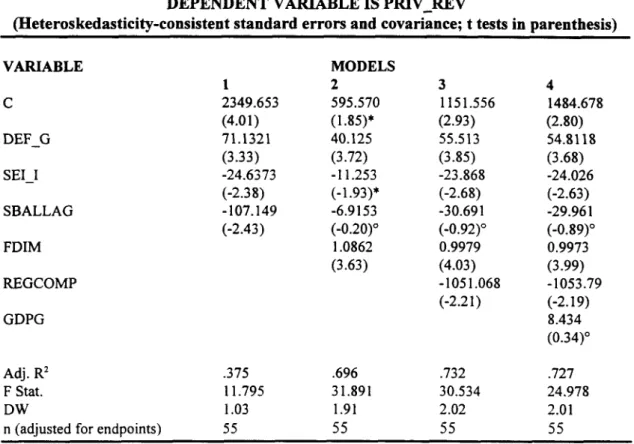
(14) LIST OF TABLES TABLE No.. PAGE. 1. Number of SOEs Privatized between 1980-91. 72. 2. Yearly Distribution of Privatization Efforts (millions of dollars). 74. 3. Sectoral Distribution of Privatizations in ALC by Year (millions of dollars). 77. 4. Overall Balances and Budgetary Burden of SOEs as Percentage of GDP Previous to Privatization (Selected Countries). 78. 5. Average Overall Balance of SOEs as Percentage of GDP during Privatization Efforts (Selected LAC Countries). 79. 6. Deficit of Central Government as Percentage of Total Expenditure plus Lending minus Repayments and Year of Privatization Beginnings (Selected LAC Countries). 81. 7. State of Regulatory Mechanisms in LAC. 94. 8. Leading Emerging Capital Markets. 102. 9. Participation of ADR and GDR by Selected LAC Countries: 1989-95 (millions of dollars). 103. 10. Linear Regression Results of Privatization Revenue of the Raw Data: Pooled Sample 1985-1995 of Seven LAC Countries. 139. 11. Probit Model of Privatization Choice in LAC: Entire Sample with Economic Opening ad Regulatory Variables. 146. 12. Ordered Bivariate Probit Model of Privatization Choice (lower level), and Regulatory Choice (upper level) with No Restrictions. 147. xiv.
(15) LIST OF TABLES (continued) 13. Non-Restricted Ordered Bivariate Probit with Sample Selection: PRIV when REGCOMP, First Best Solution. 148. 14. Non-Restricted Ordered Bivariate Probit with Sample Selection: REGCOMP when PRIV, Second Best Solution. 149. 15. Tobit Model of Privatization Revenue: Selection Rule for Priv,Reg={l,l}. 157. 16. Tobit Model of Privatization Revenue: Selection Rule for Priv, Reg = {0,0}. 158. 17. Comparative Analysis of Response to Privatization: Telecommunications in Chile and Mexico (Lag Structure of Responses by Variable). 174. xv.
(16) CHAPTER 1 INTRODUCTION AND OBJECTIVES OF THE RESEARCH. I. INTRODUCTION AND PURPOSE OF THE DISSERTATION At the time that the subject matter of this dissertation was chosen, the study of liberalization, privatization, and market regulatory reform in developing countries had not been entirely developed with respect to generating a coherent, theoretically founded, yet applicable approach. There are indeed many theories about the effect and measurement of trade and investment liberalization in countries which undertook such policies in Latin America, Asia, and other latitudes of the world. Privatization literature is also abundant in its role to understand changes in property rights and impacts on welfare, as well as to lay out the ground for government political and economic motivations to sell state-owned enterprises (SOEs). Diverse methods of sale have also been analyzed, and even World Bank economists have developed project plans and schedules for the entire process of privatization. Regarding regulatory reform, treatment has been generated to theorize around its structure or scope. Theories on regulation and deregulation determine the economic models to promote internal economic efficiency, allocative efficiency or. 1.
(17) welfare, and dynamic efficiency or technological change. Analytical approaches extend beyond economics to political science, and even legal paradigms. However, from the above theories and pragmatic applications it is not settled how these interplay and affect what could be called modernization of institutions, mostly applied to leading developing countries. This is the general objective of the proposed dissertation project. Developing countries and transition economies face liberalization and privatization with backward and even inconsistent regulatory frameworks, for which a study of the degree of the related depth of privatization and regulatory reform is needed. It is also unclear how middle-income developing countries, such as those in Latin America, have sequenced these policies, and how internationalization plays into changing the institutional developments or the rules of the game. For modelers and theoreticians of international economics and policy, industrial organization, and political science, the problems of understanding, structuring, criticizing, and generating propositions for policy-making under the new set of rules seem almost insurmountable. The problems faced by scientific inquiry can be classified under theory, data, and motivation. Fortunately for theory, a new body of relevant treatments around agency problems and game theory, in stressing the dynamics of agent behavior, have given rise to growing insights of discrete processes of decision making such as opening up, privatization, and instrumentation of regulatory reform. These can be plugged into optimization models derived from 2.
(18) traditional theory. In developing consistent models, the researcher can then define relevant variables for empirical analysis in order to make sense of actions taken by governments commited to these policies. Moreover, the approach seems ripe for application in privatization and regulatory reform experiences hi a group of developing economies in Latin America, how these policies relate to each other, how internationalization relates to the institutional change, and what are possible outcomes of these efforts in key industries. Second, while data problems exist in every research program, the fact that privatization and regulatory reform are very recent, makes modeling a difficult task. Moreover, reforms have been achieved in various ways by different countries, for which problems of analyzing qualitative and quantitative information, at a micro- and macroeconomic level, seem even more difficult to be put together in a consistent way and be subject to statistical analyses of data in panels. It is possible that, because of the diverse implementation of opening up, privatization, and deregulation by countries and industries, most research concentrates in cases of one sector or one country. Fortunately again, econometric techniques in the area of multiple choice models, path analysis, and cumulative or learning processes have appeared in the literature in the past decade, which can be applied to the subject matter under study. The third problem encountered by the researcher in this area seems that of motivation. As evidenced by the review of economic approaches in the body of the dissertation, privatization and regulatory reform have been analyzed under a broad 3.
(19) umbrella which places them as fuzzy correlates of financial and country risk assessments by private, public, and multilateral institutions. The aim of these institutions is to promote modernization in developing and transition economies, in which governments gain reputation as international partners and are more prone to develop transparent, non-discretionary economic policies, closer to the developed countries. However, it is important to separate and analyze the sequence of policies, because the impact on economic and social agents of insufficient or suboptimal dynamics in policies might lead to less than successful results, which could be subject to criticism from viewpoints not in accordance with economic reason. The problems that this dissertation aims to solve are: to model the privatization and regulatory reform in a set of Latin American and Caribbean economies (LAC), following agency theory and the logic of sequencing; to use evidence from more than one sector and a set of countries for analysis of these reforms; to shed light on the relationships of these policies to trade and capital liberalization, as correlates in countries involved with opening up, or what could be called "open economy domestic endogenous reforms;" and to seek the relationships of the game theory approaches to new econometric methods of choice modeling. In terms of hypotheses, the following questions are relevant:.
(20) HI) LAC privatization shows second best solutions if regulatory reform is insufficient and not accomplished ex ante. The hypothesis needs to be tested by modeling if sequencing differences are explained by divergent variables and structural settings of countries.. H2) A second hypothesis is to test whether regulatory reform and privatization in the case of LAC, are complements rather than substitutes, opposed to traditional theory applied to developed economies.. H3) If regulatory reform is a continuum that needs upgrading and acommodating to tackle agency problems (contract imperfectness), regulatory changes may reduce agency problems even under second best. By testing this hypothesis one can come to grips with the dynamics of LAC institutional change and institutional commitment.. H4) A final hypothesis is to test the assertion that trade and investment liberalization complement and even trigger mechanisms of privatization and regulatory reform to improve outcomes of their implementation in LAC..
(21) II. CHARACTERISTICS OF LATIN AMERICAN PRIVATIZATION AND REGULATORY REFORM Privatization as a choice has been accompanied with deregulation in some cases, and regulation in others. Moreover, international trade and investment liberalization have been implemented in most developing economies in Latin America at different levels of depth, as indebted countries saw no alternative way to overcome macroeconomic problems in the middle of the eighties. During that decade, and extending into the nineties, developing economies have experimented with these policies within their government and social levels, but influenced by philosophies in some developed economies, mainly in the UK and the USA, international organizations such as the World Bank and GATT, and the thrust of globalization by leading economic sectors. Reportage abounds on forms of privatization, deregulation experiences, and sectoral performance after privatization. Moreover, international financing institutions such as the World Bank have coordinated financial rescue packages to many developing countries pointing out towards more market oriented government strategies, which include liberalization, privatization, and deregulation, or what has been called the "Washington consensus." The vision is apparent that the three sets of policies are a clear signal of commitment, that policy errors will decline in less developed countries (LDCs) and economic efficiency and allocation will grow. By.
(22) reducing the room for discretion, errors by these LDC authorities would be minimized. Since financial institutions aim at evaluating risks for financing packages and advise, they do not spell out conditions under which LDCs could move forward hi attaining economic and social improvement through distinct privatization and regulatory reforms and sequence. In the setting of a developed economy, a "first best" axiom is generally assumed that before privatization takes place, monitoring institutions and regulations are well developed and operate effectively to minimize problems of internal and allocative inefficiency (MacAvoy 1995; Vickers and Yarrow 1995). However, the choices presented to LDC authorities, and the consequences of these choices, are varied and respond to different economic, sectoral, and strategy variables, something which could be characteristic of "second best" solutions, because regulatory reform and monitoring institutions are underdeveloped (World Bank 1995). The sequencing of policies and credibility of regulatory agencies is then. key. Turning now to a description of Latin America's position, between 1983 and 1995, over 80 countries in the world have privatized part of their economies, and in the past 12 years more than 8,500 state-owned enterprises (SOEs) have seen their property structure changed. Privatizations, in general, have moved from low- value and small size SOEs to larger privatizations, that include takeover by private capital (not only divestiture through closings) both from domestic and international origins. 7.
(23) In the case of Latin America and the Caribbean, which represents around 12% of world privatizations but is the most active region with these policies among developing economies, the following countries have moved forward in privatization strategies: Argentina, Bolivia, Chile, Dominican Republic, Ecuador, Jamaica, Mexico, Peru, and Venezuela. Others such as Brazil, Panama, or Uruguay have postponed privatization or simply have not embarked on full blown privatization measures as part of government policy. Still others, Venezuela being the most important case, have moved back from privatization and into more traditional policies of statist sectoral control and regulation (World Bank 1995). The key sectors subject to privatization in Latin America include: telecommunications with around 25% of the region's total value of privatizations; banking (22%); energy (14%); and steel (11%). The first three sectors operate in monopolisitic structures with externalities. As for airlines, other manufacturing SOEs, and operation of ports, they represent competitive sectors with a less pressing need of regulations. Other privatization efforts are unique to specific countries, such as mining in Chile and Mexico. Highways were privatized only in parts of Mexico. Energy at provincial level has been privatized in Brazil. And the privatization of social security is well-known in Chile, although underway in Argentina and Mexico as well. Now, the political economy of privatization has made emphasis on the capacity of authorities to gain social support for privatization. Separating SOEs into 8.
(24) various activities to reduce conflicts with unions and vocal opposing groups has been tried. Speed of privatization and a favorable macroenvironment are additional considerations in the process. If domestic capital markets are shallow and underdeveloped, authorities have also tried to substitute their insufficiencies with liberalization, and by modifying rules on foreign investment limits and partnerships with domestic capital. Given different economic structures and policy options across countries, restructuring before divestiture and mode of sale have varied across countries. Preparation and form of divestiture create incentive mechanisms, which have affected not only the number of private capital interests in the process, but also the price and the regulatory shield to privatized SOEs. Sequencing of privatization and regulatory reform, while lending themselves to econometric analysis of choice, have clear effects on reputation, rules of the game, institution development, and ex post performance of privatized SOEs, as stressed by the literature on property rights (De Alessi 1980; Sappington and Stiglitz 1987; World Bank 1995). Sequencing shows some evidences of "second best" solutions. For example, during privatization, sectors such as banking were deregulated to be sold to private capital and regulations continue to be part of the market, aligned to international standards. However, oversight mechanisms could be insufficient to promote economic efficiency, as stressed by various discussion papers and meetings in the Private Sector Development Department of the World Bank, as well as new developments on government commitment and accountability in Europe (Moran and 9.
(25) Proser 1994). Banking under-performance is apparent in the case of Mexico (McComb, Gruben, and Welch 1994). In telecommunications, re-regulation of entry (but not of prices) was implemented after privatization in Mexico and Argentina, while regulatory oversight and promotion of competition existed in Chile before privatization. Still in other cases, regulation seems not to have changed after privatization. Regulatory frameworks are also varied. Chile, Colombia, Venezuela, and Argentina, seem to have modern regulatory agencies with clear regulations, as well as limits on their operation, mainly relating to competition policies and entry conditions. However, the realm of criticisms on institutions is similarly varied and even the aforementioned countries are not exempt from criticism. Other countries such as Mexico are beginning to experiment with independent agencies like these. Others such as Brazil, Bolivia, or Peru have seen little or no change in the institutional setting surrounding privatization efforts, despite international agreements such as MERCOSUR. The same applies to liberalization policies. Chile and Mexico show the deepest and broadest liberalization, encompassing trade, investment, and institutional changes, whereas the Andean countries have followed a narrower liberalization effort, and MERCOSUR shows uneven liberalization by sectors and institutions. For the case of liberalization, countries under regional trade agreements have somewhat spelled out treatment around property rights, standards, dispute mechanisms, and capital, as is apparent in Mexico with NAFTA, Caribbean countries with CARICOM, 10.
(26) and Argentina with MERCOSUR. Chile has also changed the rules of the game both unilaterally and through its trade agreements with Mexico and its associate membership status with MERCOSUR. As signatories to GATT, main Latin American countries have also been influenced by international monitoring mechanisms around regulatory issues such as intellectual property, dispute settlements, and government subsidies. A key element in opening up is the access to international capital around the privatization efforts. Countries opening in the region have benefited from such an access and have promoted development of their own domestic capital and markets. To sum up, privatization and regulatory reform are dynamic, cumulative processes; they consist of discrete decisions, either sequenced or not; are applied by different countries and to different sectors; and have been accompanied by various degrees of trade and capital liberalization. Also, these shocks are to be evaluated with respect to a set of expected performance measures in positive capitalization (both domestic and international), lower relative prices, market power reduction and entry conditions.. III. RESEARCH FOCUS AND OBJECTIVES In deciding how to approach the modeling of privatization and regulatory reform in Latin American economies, along with the intent to integrate these sets of policies into the context of economic opening, there were several decisions to be 11.
(27) made. These related to the methodological approach and the theoretical approach to the subject matter. While there is a growing body of methodological literature to treat cumulative knowledge, decision processes, or curve fitting and smoothing, under the heading of path analysis and multiple choice models in econometrics, the proposed modeling methodology is that of switching and censored data analysis, which is an econometric technique of multinomial/ multivariate choice using what is known as the two- step Heckman procedure. Switching models and analyses of censored data were originally applied to labor markets and consumer choices, where observations of a decision maker deciding on, say, a type of consumer good, were conditional on the income population where the consumer was drawn in the sample. Hence, a "switch" is based on sample separation information on consumer choice and income setting; similarly for the case of labor markets, a constrained labor supply depends on previous situations of the population, where the worker could have been unemployed or not. The technique can be extended to privatization and regulatory reform in LAC economies, where the choice of regulatory reform would be drawn conditional on privatization or not- privatization observations (Goldfeld and Quandt 1973; Greene 1980; Hensher 1986). The time variable or decision moment of policy can be plugged in such a model which uses a panel of data by country, industry, and policy in a time frame of around ten years between the eighties and beginning of the nineties. Preliminary data analysis was conducted on years for the beginning of modeling on 12.
(28) privatization choice, determinants of privatization in macroeconomic, fiscal, revenue, and sectoral terms, as well as the status of regulatory competence. Whereas some countries began these policy changes early in the seventies or beginning of the eighties (Chile), others moved forward during the entire past decade (Argentina and Mexico); still other countries have more recently moved to privatize and apply regulatory reforms in the nineties, (Bolivia, Brazil). The time variable is thus dependent upon the moment a country moved forward with reform. The panel of data for the model is treated using various cuts or clusters, by country, and by case of sequencing and depth of reforms. Then an analysis of reforms as they relate to trade and capital liberalization by country and industry is applied. The database for the panel is for around 15 years (1980-1995), for seven LAC countries. In order to make the analysis manageable, it concentrates on main privatized sectors of their economies and where regulatory reform is necessary, both directed to specific sectors, and overall monitoring. Examples are telecommunications, energy, and banking. Then the analysis concentrates on two main cases of overall reforms around telecommunications as a sector with monopoly power, in order to explore more deeply the effects of different sequencing of policies and breadth of regulatory reform and international liberalization: Chile and Mexico. The theoretical approach taken was to not exclude from the model considerations that have not been tested because there is not enough theoretical evidence in the privatization and regulation literature. Various theories exist on how 13.
(29) property rights are affected by privatization policies, with apparently contradictory results when it comes to economic welfare. On adjustment and new rules of the game between public and private sectors, political economy approaches theorize about the effects of these power changes but do not, in general, address the incentive mechanisms for both privatization and regulatory reform ex ante and ex post. Hence, emphasis is placed on new developments in agency theory within the new body of research on economic opening, privatization, and regulation. By following the proposed approach the researcher is able to make sense of the relationships between the microanalysis and the modeling processes, in order to generate consistent parameters to be extended to other cases.. IV. PLAN OF THE STUDY This dissertation presents the development of privatizations and regulatory reform in a group of Latin American countries that have internalized these sets of policies, and analyzes their coherence. As logically sequential decision choices in possibly "second-best" solutions, the dissertation will provoke the comprehension and evaluation of policy choices and outcomes, and how they are taken in an increasingly open economic system by middle income developing economies. The analysis is valuable since no former treatment has been assigned to inter-country, inter-industry situations using both theoretical and econometric methods which have recently been developed in the economics literature. Chapter 2 examines the various theoretical 14.
(30) approaches to privatization and regulatory reform, and then integrates the agency methods which are state-of-the-art in the framework of analysis to be followed in the rest of the dissertation. A treatment is presented on the logic of policy sequencing and its evaluation to the subject matter in a mathematical model. Chapter 3 follows a historical and country / industry path of liberalization, privatization, and regulatory reform, and locates the various "rounds" of privatization in a selected group of Latin American countries which have internalized these policies. The analysis in this chapter comes to grips with implementation problems and typifies them as inputs to the quantitative analysis. Chapter 4 reviews the econometric literature on choice models, defines the two step Heckman procedure to be followed, and examines its strengths and weaknesses. The proposed model of privatization and regulatory reform is specified. Additionally, key international variables enter into the proposed model. Chapter 5 is divided into two main parts. In the first section, data pretests are run and the panel of data is then analyzed under the specification of choice models. Then, results of the estimation are presented and analyzed under various clusters by country and sequence. Finally, an interpretation of results and directions for model improvement are presented. In the second part of the chapter, an extension of the analysis is applied to telecommunications privatization and regulatory reform in Chile and Mexico, in order to make sense of qualitative policy changes in a setting much considered as a "best practice" in Chile, and a less evident case in Mexico. Agency 15.
(31) problems will show that institutional change needs to consider problems of imperfection of contracts, even in a case of aduced "best practice." Chapter 6 presents conclusions on the theoretical, modeling, and information aspects, and lines for further research in the area.. V. MAIN CONTRIBUTIONS AND LIMITATIONS OF THE STUDY The study of privatization as a choice linked to regulatory reform, and trade and investment liberalization offers the following contributions. A first one is to elucidate analyses of these sets of polices in a coherent manner, as they are distinct, yet interrelated strategies. International and multilateral institutions have been interested in finding clearer market conditions which represent governments' commitment to marketize economic relations in their societies, as preconditions for country risk assessment and financing of projects. However, these evaluations do not give specific weights to each of these sets of policies and their potential outcomes. By specifying the differences in policy making and sequencing, one will be able to come to grips with the different paths and outcomes in Latin American economies even under "second best" argumentations. A second contribution of the present analysis is the use of agency theory, which has been applied in industrial organization research but little or not used in liberalization, privatization and regulatory reform. A related contribution is to use the proposed theoretical approach across countries and industries, by finding common 16.
(32) denominators of these policies as applied to a select group of Latin American economies which have experimented with them. Since Latin America as a region has lagged in modernization strategies, but at the same time has experienced some of the most profound policy changes in the world, a fourth contribution of the proposed analysis is to clarify the extent of success or implementation problems of these policies, in order then to find applications in further rounds of privatization and regulatory reform in the region and in other parts of the world. A fifth contribution is to discuss the applicability of strategies of international trade and capital liberalization within the context of these institutional reforms, and whether there are similarities and convergences which would ease the path towards deepening regional liberalizations and policy coordination and relatedness in the future of the region. A sixth contribution of the dissertation is the use of a new body of econometric treatments to models of accumulated knowledge, thresholds, censored data analysis, multivariate and multinomial choice, as they apply to the subject matter. Given the panel of data and experiences of a group of countries with these policies, the two step Heckman procedure and a modified Tobit type 4 model are used for application in the subject matter, something not experimented before in this area of economics research. Finally, the entire study will contribute to the understanding of some of the main implementation problems encountered in the experiences of the selected group 17.
(33) of Latin American countries, and how regulatory lag or underdevelopment could be substituted by economic opening to generate internal and allocative efficiency results in privatized SOEs. On the side of limitations, adding to the fact that information is disperse, much is not quantifiable, and there is much diversity in implementation of these sets of policies in Latin America, the study concentrates only on the dynamics of privatizations which comprehend private control results, rather than liquidations, since the latter imply closings of former SOEs and present little interest for the subject matter. Moreover, salient privatizations are emphasized which mainly encompass key national sectors. A limitation exists in that the evaluation of why liquidations were decided by many countries also gives evidence of modernization or reputation moves by governments. Hence such a relationship is not entirely pursued in the dissertation. Another limitation of the study is that the analysis is mostly directed towards privatizations at the national level, rather than subnational policy strategies so often found in economies such as the US. This is a minor limitation, however, since main privatizations in Latin America have been directed towards key national sectors and SOEs. Still another element that deserves mention is that a conclusion on how governments should generally operationalize modernization policies is not possible. One can, however, see how sequencing and scope of privatization and regulatory 18.
(34) reform have fared for the selected group of countries which have initiated these policies. In other words, it is difficult in the analysis to present a final normative theory of privatization and regulatory reform, as has been discussed in Crampes and Estache (1997). However, lessons from the empirical findings and analysis are clearly derived for other cases. Still another limitation is the framework of regulatory reform aimed at entry conditions and marketization of sectors which were privatized. No direct treatment is presented on other regulatory changes such as consumer protection mechanisms, dispute resolution, or intellectual property. As in many studies, a boundary is generally determined to the scope of the research. Finally, even if the proposed econometric approach results from a broad evaluation of new data analyses and techniques, the present development of these methods is far from settled.. VI. EXTENSIONS AND CONCLUSIONS With the awareness of limitations notwithstanding, the dissertation sheds light on an issue of much current and, most importantly, future relevance as middle sized developing economies try to move forward towards modernization and participation in the global concert of countries through liberalization, privatization and regulatory reform. In countries such as in LAC, a problem exists that regulations to the market are rampant at the same time that they are often outdated or myopic by globalized standards. Then reform is a long process that has been accelerated by privatization 19.
(35) and economic opening, as governments try to gain reputation as they signal commitments to modernize and move their economies towards more market forces. The analysis accomplished in this dissertation sheds light on key issues faced by main Latin American economies which could then be possibly applied to efforts in other parts of the world. Agency problems and the theoretical framework for analysis is operationalized by new econometric methods of multivariate choice or the so called two-step Heckman procedure, which in itself is a main contribution to the literature and could extend itself to research by the analyst in other areas of knowledge for years to come. Finally, freedom of governments or incentives to privatize and deregulate are conditioned by political preference, degree of economic development, structure of institutions, and capacity to internalize agency oversight and restructuring in order to foster so called modern rules of the game. A study such as the present one clarifies the structure of reforms applied to cases of the sample used, even assuming second best situations, in which dynamic adjustments and opening up could serve in the dynamics of change. The experiences of main Latin American economies with these reforms will shed light on the challenge ahead for this region and aide in the design of policy making by governments and international institutions.. 20.
(36) CHAPTER 2 THE THEORETICAL BASIS OF PRIVATIZATION AND REGULATORY REFORM. I. INTRODUCTION The present chapter will present a consistent model of privatization, regulatory reform, and how economic opening is viable to be plugged into a proposed model. According to the theoretical literature, most models of privatization present a first best solution such that regulatory bodies and laws are well set in a country embarking with privatization, where the so-called framer aims only at setting the adecuate price limits to monopoly conduct. In the following models, however, the framer faces problems of sequencing, as well as has to define regulatory frameworks which not only encompass price or rate of return standards but also entry conditions and rent seeking. This is more in line with privatization phenomena in developing countries. The chapter also inserts agency problems in the relationship between privatized firms and the framer or authority, often present in government changes in Latin American and Caribbean (LAC) economies. Finally, the chapter makes capital market 21.
(37) development a domain in the objective function of governments, which affects the results. With this exercise, the theoretical basis is possible for further empirical analyses in other chapters of the research project.. II. REVIEW OF MAINSTREAM STUDIES AND APPROACHES According to Hartley and Ort (1991), economic inquiry on privatization became a fashionable response to economic problems faced by governments and state-owned enterprises (SOEs) during the eighties. Indeed, the UK experience is mentioned as a benchmark in most studies on privatization and deregulation, for its depth and scope, and also for the underlying political philosophy of the Thatcher administration. Privatization and deregulation experiences in other parts of the world, e.g. the USA, were also increasingly studied. The recent privatization spree in Latin American economies, began with Chile around 1973 but became a noticeable case in the early eighties. Mexico, Argentina, and more recently other economies in the region, have seen experiences of privatization, regulatory reform, and trade and investment liberalization of various degrees. Moreover, privatization has become a key topic not only for governments and academics but also for advising and financial institutions which fund structural changes in these economies and the development of the private sector as a dynamo for economic growth and development (WB 1992). The subject matter has also been debated, given the events in Central and Eastern European economies in transition, where privatization is but one of the 22.
(38) multifaceted problems of governance under new economic rules (Bos 1991). As these economic phenomena are inserted into an environment of rapid change, into a redefinition of what governments should take as their objectives, and under globalized capital markets and internal and external liberalization, economics has changed the focus mainly to the normative aspects (welfare impacts of alternatives), and mostly in the dynamics of privatization and deregulation. However, equilibrium theory and its traditional- constrained optimization method has remained a key part in the analysis. Moreover, the theoretical discussion about public and private enterprise dates back to the forties with analyses of public firms such as the Heyworth Reports in the UK by industries (around prices and demand serviced). During the seventies, seminal work was done by Klevorick (1971, 1973) in a partial equilibrium model of optimal rate of return, and then on regulatory review on utilities. Niskanen (1971), in a now classical work on bureaucratic objectives of government, demonstrates how representative bureaucrats generate inferior welfare results in SOEs. Stigler's public choice method and market for regulations is in the same line of argument, showing a critical eye for government regulation (Stigler 1971). The main thrust of inquiry was to produce a generalizable principle of private enterprise, or what could be called the basic axiom of private firms on economic efficiency:. 23.
(39) Put succinctly, assume a firm that faces a demand function as. z = z(p). Zp<0. (1). where market clearing implies that z is also quantity supplied. The production of a single output implies a cost function which depends on volume demanded and a level of effort by management:. c = c(z, e). c z >0and c e <0; c ee >0. (2). Now, the manager has a utility function positively related to income (I), and negatively related to effort (e). Say that I is fixed and independent of e. Moreover, the manager is willing to work if his utility is higher than a reservation utility VB AR that will make him quit the job. V(I,e)>VBAR. V(I,e)-VBAR>0, V,>0, V e < 0. With the above equations, it is straightforward to compare the static equilibria between a public firm denoted state-owned enterprise (SOE), and a private firm.. 24. (3).
(40) a. Public Firms (SOEs) Following Sappington and Stiglitz (1987), a framer is the regulator of an agent defined as an SOE. The framer acts as a principal, and the SOE acts as an agent, for which agency problems will be generated when the SOE conceals information or actions. In the simplest case, the framer maximizes social welfare, measured as the sum of the consumer's and producer's surplus, exerting the objective upon the SOE:. Consumer. S= S(p). sp = - z ( p ). Producer. U = p z ( p ) - C (z, e ) -1. (4) (5). Maximizing with respect to the principal's instruments (p, I, e ) and subject to the agent's constraint in (3), then welfare is shown in the following Lagrangean:. I = S(p) +pz(p)-C(z,e)-I-p[V(I,e)-VBAR]. (6). where P stands for a shadow price of the agent on its participation constraint. Differentiating with respect to p gives the following price-cost margins for allocative efficiency (B6s 1991):. 25.
(41) (p-Cz)zp = 0. (7). The first order condition in an SOE shows that price equals marginal cost for optimal allocative efficiency. Now differentiating with respect to I, and e, gives:. -Ce-pVe = 0. V e /V, = Ce. (8). which implies that the marginal rate of substitution (MRS) between effort and income, which is increasing in effort, will equal the cost of effort, for internal or X efficiency. Following Stigler (1971), internal efficiency operates on costs, to give some internal efficiency equilibrium where relative effort (MRS) is equal to relative cost CJ C, or MRT. If MRS < MRT, then effort is too low and internal inefficiency occurs. The above is exacerbated not only by taking e as an input in the above simplified model, but when it becomes an element of the game of agency.. 26.
(42) b. Private Firm Now take shareholders as the principals whose objective is to maximize the firm's value through profit. Then the term S (p) will vanish in the lagrangean, which is again differentiated with respect to the instruments p, I, and e:. z(p) + pz p -C z z p = 0 1 + (p - CJ = 0. arranging. (p-CJ/p=-l/e. (9). which shows an equilibrium through monopoly prices related to the price elasticity of demand, hence not showing allocative efficiency. Unless a regulation is already established to move monopoly behavior towards allocative efficiency as in SOEs, the price would not adjust accordingly. This is precisely the argument of Caves (1980), where a perfectly regulated private SOE is equivalent to a regulated SOE, or where he expresses concern about the policy insufficiency of privatization without former regulatory reform and oversight. To complete the Lagrangean, it is straightforward to show that under private firm, internal efficiency is similar to the simplified case of SOEs:. (10). 27.
(43) Now, what makes the aforementioned axiom that favors private firm to SOEs has at least two conditions. First, if indeed social welfare maximization is attainable costlessly with respect to regulation-led private monopoly, then no reason for privatization would exist. However, the cost of attaining welfare maximization is taken to be higher than regulating private monopoly. For this reason, it is argued that any economic activity that is equally attainable by the state or private capital should be transferred to private capital. A second argument in favor of the private firm has to do with the implicit different costs in the agency relationships, between public principals (framer) and the agent (SOEs), as opposed to the relationship between public and private principals (framers and the market), and the agent (private or privatized SOEs). The nature of incentives is then crucial in determining the proprivatization axiom.. c. A Model with Deviations from Social Welfare and Agency Problems The basic model does not account for various possible and observed deviations from the social welfare specification of the objective function. These deviations form key variables to observe in an empirical analysis of SOEs that makes privatization justifiable. A first deviation arises from the governments' assigning extra weight to maximizing consumer surplus, or when distributional objectives emerge for political, rather than pure economic reasons. Another deviation exists 28.
(44) when the government is not indifferent to transfer payments to the SOEs, or generating public funds for the subsidy. The two elements create distortions of economic decisions not only in the objective function of the framer / government but in other markets as well (Following Vickers and Yarrow, 1995, in individuals supplying work, or consumers burdened by extra taxes). Adjusting the basic equation (6) to a fraction a of distributional objectives, and on taxes, then the Lagrangean is modified as:. I = S ( p ) + o c [ p z ( p ) - C ( z , e ) - I ] - p [ V ( I , e ) - VBAR] - X T (11). where 0 < a < 1, showing the strength of distributional objectives. Also, A, T represents the cost of extra distortions on the economy by raising of public funds, which here is presented as additive in the maximization. The first order condition for allocative efficiency is. (l-a)z(p)-(l-a)[p-CJzp= 0. (12). which shows politically driven underpricing, resulting from two elements: (i) the strength of distributional objectives, which is a direct function of the price/ cost 29.
(45) margin, such that the higher is a, the lower is the margin; and (ii) the position of demand, a deviation from allocative efficiency. Now with respect to the instruments income and effort (I, e), the first order condition shows that. -a I - P V, = 0. -aC e -pV e = 0. V e /V, = C e / I. (13). which differs from (8) in that the MRS of effort has to equal the cost of effort adjusted by the level of I. Even if VT is taken in this simplified version as a lumpsum, income is inversely related to net effort, for which internal efficiency is not granted in SOEs. So, given distributional objectives and transfer needs, the solution moves SOEs to a less than optimal equilibrium under economic efficiency grounds, which coincides with Bos (1991) and with Vickers and Yarrow (1995). Moreover, even under salutary objectives of distribution, the need to raise funds and at the same time not discipline the market through cost reduction, innovation, and similar strategies, would originate one of the main reasons for privatization. The problem is a subsidy to SOEs which is high and growing, along with the underlying needs of the government to generate funds through debt and other instruments that adversely affect macroeconomic budget constraints to society. Such a problem could be named myopic planning. 30.
(46) The determination of the balance between the cost of distribution objectives directly provided by SOEs, and regulation of private firms' growth to service an increasing market, is a complex one. If the cost expressed as A, T is lower than monopoly conduct or deadweight loss of privatized SOEs, then SOEs would still be preferable to private monopolies, at least on allocative efficiency grounds. However, empirical cases in developing countries could show that the monopoly deadweight loss of, say 2% of GDP is lower than subsidies needed in a SOEs before privatization. Now, it is explicit in the above model that social welfare is well defined in SOEs, an assumption only useful for the basic comparison of equilibria but which is far from realistic. A second deviation is the existence of agency problems, that become the basis for the axiomatic preference towards private firms. The question is whether the mechanisms of monitoring and asymmetries in information generate deviations from optimal welfare of SOEs, both in a static and a dynamic manner. It is here that the theoretical and empirical discussion have concentrated, extending from developed countries to privatization efforts in developing economies. In order to summarize agency problems in a simplified model consistent with the basic one, assume the following phenomena that dramatically affect the results. First, if the costs of monitoring privatized SOEs are overall high, then the tendency is to underprivatize because of the costs of monitoring rather than the foregone benefits of promoting private competition. This could happen if no regulatory bodies exist, or are less than independent or professional, or if the 31.
(47) economic base is such that privatized SOEs are prone to become national champions and exert their influence as agents upon the government principal. With such institutional problems, rather frequent in developing countries, regulatory lag or institutional lag affects the speed and scope of privatization. Second, on the benefits of not monitoring, arguments on agency theory show that if the framer observes promotion or reelection depending on who benefits from a monitoring effort, then it might deviate from objectives of economic efficiency. If internal efficiency of a SOEs is reached at the expense of a reduction in welfare of unions or workers in the industry, then the framer/ monitor will not act in grievance to workers' salaries or employment but will accept a higher fiscal burden of raising funds to sustain this compensation, since the public will be imperfectly informed on the burden at the same time that general voters will not determine the framer's promotion or reelection (Stigler 1971, Niskanen 1975, Shapiro and Willig 1990). Third, information gathering by the framer and on the firm's decisions might be difficult. Information gathering is entrusted in a single body under the SOEs model (with a private agenda as shown). In contrast, many individuals participate in financial information, competition and operational performance, degree of leverage, and other information factors in the case of a privatized SOEs or a private firm. This is the argument of Vickers and Yarrow (1995), where preference for private firms results from control by shareholders, or other firms seeking to take over the enterprise under study. Also, control by creditors through risk of bankruptcy, is an element of 32.
(48) effective monitoring with respect to a single non-informed, but self-interested principal. Hence, even under public interest theories of SOEs, private monitoring might render a more effective means of control. Whereas monitoring costs need to be modeled in addition to the basic set of equations, the mentioned factors affect both the cost function and effort in the above model. Continuing with the basic model, if demand is stochastic or costs have a stochastic variability element, not observable by the framer, then the profit function could be redefined from (5), with elements 0 representing such phenomena:. n = p z ( p , 6 ) - C [ z ( p , 9), e]. if demand is volatile. (14). Il = p z ( p ) - C [ z ( p ) , e, 6). if costs are volatile. (15). Since in SOEs salaries are bound to be established ex ante such that 0 is not internalized because it is not observable ( non-contractible), then effort will be too low, giving rise to a deviation from internal efficiency. If it is assumed that in a privatized SOE, salaries are prone not to be determined ex ante, but will depend on ex post performance of profits, sales, or net income, then income would be modeled in the following way, without the need to model agency dynamics explicitly:. I = k + aD(p,e, 0). (16) 33.
(49) where D is the difference between revenues and costs; 0< a < 1 is a fraction of net income of the firm; and the manager maximizes his utility. Following Bos (1991) the shareholder principal maximizes. L = (1-a) E D( p, e, 0) - k - p [ E V (k + aD (.), e (.) - VBAR]. (17). which is similar to (6) except that given 0, an expectation generator is now inserted to establish income flows and net utility. Given 0 and risk aversion in e (.), salaries will be higher than in SOEs but the risk taking will be accrued to the manager, leaving shareholders unaffected. In the case of SOEs, salaries are predetermined and higher than effort by definition. Differentiating L with respect to I, e, one obtains too low an effort, since. (18). V e / V , = aC e. Only if a = 1, the firm will attain internal efficiency. It is further argued, however, that a=l can be attained through final product competition, even if 0 persists. In countries where regulatory frameworks and competition are reduced by political or institutional backwardness or insufficient economic opening, equilibrium 34.
(50) would move away from efficiency. The same phenomenon would be apparent with distributional and political deviations from optimal SOEs, along with agency problems in monitoring managers, workers' effort, and the existence of asymmetrical information. Net costs of each alternative will generate the result. Under the former constraints, however, the privatization axiom is taken to be salutary. Moreover, marketization of the economies coincides with the typical case (Vickers and Yarrow 1995). However, it is assumed that privatized SOEs work under competitive markets, with effective controls, in dynamic markets, and where a regulatory framework is already in place, something far from reality. The above analysis centers upon the problems faced by SOEs in a stylized way, but does not take account of necessary and sufficient conditions for privatized SOEs to clearly improve allocative and internal economic efficiency. Let us turn now to considerations of privatized SOEs and deviations.. d. Private Firm's Deviations and Modeling So far the case of a monopoly SOE and a privatized monopoly SOE have been presented. It is argued that agency problems subsist in a private setting, but as opposed to the case of SOEs, incentives persist for less than political reasons, mainly through: shareholders' monitoring; risk of takeover by other firms or aspiring firms; and risk of bankruptcy exerted by creditors of the privatized SOEs. Michael Spence (1975) presented a study on conditions under which monopoly regulatory shields can 35.
(51) give rise to innovative behavior in privatized SOEs. Baumol's contestability theory (1982), and its impact on allocative efficiency, is also an important contribution because it was subject to much debate and then to criticism on the assumptions, which then helped to generate a new wave of recent approaches on private competitive incentives. Another seminal work was done by Averch and Johnson (1962), where the well known A-J effect of overcapitalization in a regulated SOE deviates from optimal allocative and internal efficiency. More recently, Caves and Christensen (1980) raised the question that privatized monopolies, without adjustment in the regulatory framework established to check for monopoly rents, would render privatization ineffective with respect to allocative efficiency. De Alessi (1980) reviewed some of the basic assumptions on property rights as conditions for allocative and internal efficiency in both SOEs and private firms. Taking Alchian and Kessel's work, as well as Demsetz, Coase, Stigler, or Pelzman, De Alessi concludes that property rights are a necessary condition for the establishment of credible incentives to economic conduct and welfare. Moreover, as common and usufruct rights are weaker incentives than private rights, De Alessi concludes that private firms generate higher internal efficiency than public ones. The key is the nature of incentives to "owners" of a typical firm (public or private). For Shapiro and Willig (1995), the difference is in the location of private information between public and private enterprises. In all, modeling of the objective of the. 36.
(52) privatized SOEs and the framer are needed and show the mechanism of incentives in a game. Take the simplified model in (1) through (3) and (9), (10). The private agent or manager and the principal face the demand schedule and the cost structure, now denoted as. C = (k-8d-e)z + t + h(d). (19). where costs depend on some fixed pay k to the agent, reduced by the principal in some amount d and the agent's effort. Following Bos (1991), the principal can exert control up to an efficiency parameter 8. This parameter is randomly distributed between a worst and a best level 5. and 8*. The variable t is remuneration for effort, and h (d) represents the cost of control. Since the principal does know the actual value of 8, as opposed to the principal of an SOE, the principal and the agent get involved in the following contract, considering the manager's participation constraint expressed in U (t, e ) > UBAR > U(0,0). T=. t. ife = e *. 0. otherwise. (20). 37.
(53) The result is monopoly prices, efficient control by the principal, efficient effort. In the case of imperfect information, the agent does not disclose 5, which is private information. However, then a game cannot be simply a weighted determination of allocative and internal efficiency factors such as in the SOEs, and the result will depend on the degree of truth-telling by the agent. If the incentive mechanisms on costs and effort are efficient, then efficiency will be unequivocally superior under private than under public ownership. Here the role of external versus internal regulation is important.. e. Trade-offs Responding to Market Structures Total privatization and refinements have been presented in a simplified, static model. However, privatization implies proceeds from the sale, and also privatization is performed not only in monopoly structures, but also in competitive and oligopoly settings. Whereas main privatization in LAC —called the second round— entails large, legal or natural monopoly SOEs, such as telecommunications, gas, or electricity, other government divestitures have touched upon less than monopolistic enterprises. Such is the case of airlines, banks, or steel and other manufacturing. The following model takes account of the different structures and also the strike price of a sale. Take an extension of the models already presented as the objective function of government, with A representing absolute change:. 38.
(54) (21). The summation sign now implies a time frame of the welfare function. The changes hi consumer surplus S (t) and profits IT (t) are now discounted by p, and a new addition to the expression considers a cost of selling the SOEs at a price difference between private willingness to pay and actual price of (Zp - Z). Finally, X,g - \ stands for the difference between a multiplier of government revenue and the multiplier of private funds, which accounts for the efficiency in the use of proceeds of privatization. For the choice to sell, e.g., A W > 0, either of the following should be present: (a) A S (t) > 0. This depends on the use of monopoly power by the privatized SOEs. If monopoly power or rent seeking by the management of the divested firm are present, then A S (t) < 0. Hence this part of the expression is a decreasing function of market power. If competitive structure/ behavior results, the expression is positive. (b) X,g A n (t) > 0. It is anticipated that internal efficiency will be unequivocally positive under private ownership rather than under public ownership, as presented above. However, as shown above, a situation characteristic of LAC is one in which control by lenders, shareholders, or 39.
(55) rivals is insufficient; lack of competition is frequent, and capital markets do not exert implicit control over a firm's operation. This is compounded by the possibility of stochastic demand or cost, as shown. It is an empirical question whether these adverse factors would reverse the sign of the expression. Assume that A IT will still be positive. Moreover, regulatory lag could be assumed to exert a positive effect (if regulations are temporary and pre-announced). (c) A,g - Xp needs to be negative, or Zp - Z < 0. The first set implies that the value assigned by the government to the use of proceeds for, say fiscal cleanup, should be less than the private weighted value to increase internal efficiency. If the government's valuation of money arising from the sale is needed only to reduce the fiscal deficit (what is called a fiscally driven privatization), then the sign will be positive and larger than private valuation, and will reduce welfare, ceteris paribus. The same result will be apparent if Xp is small, reflecting a suboptimal level of investment effort after privatization, as presented by Jones, Tandon, and Vogelsang (1990). In sum, a frequent situation in LAC is X,g > "k^. (d) As for Zp - Z < 0, this term explicitly measures the maximum price the private enterprise or group is willing to pay for the SOEs, relative to the actual price. In the case of risk aversion or economies of scale, as shown 40.
(56) above, the buyer's willingness to pay will be smaller than government's willingness to sell. As a result, a regulatory shield or restructuring before privatization will be pressed by potential buyers onto the government. Assume willingness to sell, denoted by Zg = Z under government's neutrality. However, evidence on expected returns on privatized SOEs could imply that the expression is positive rather than negative. It would be positive also if selling draws many bidders.. Since the terms in the second part of the expression are prone to be positive, then a general necessary condition for the choice to successfully sell (A W > 0), needs that:. I p1 { A S (t) + \ A n (t)} > (\ - \) (Z p - Z), if the sale weighted price is the only element that matters and a less than monopoly structure is assumed; but if a natural or legal monopoly SOEs is divested, then choice to successfully sell will imply:. Zp'{\An(t)}>Zpt{AS(t)}-(?ig-?tp)(Zp-Z). If regulation ex post privatization on monopoly prices reverses the sign of A S (t), or entry conditions are eased, a return to the first condition will occur. Now, in 41.
(57) case privatization implies no internal control by shareholders, rivals, or lenders, or capital markets are undeveloped, then lack of discipline may change the sign of A n (t). Then a condition for the choice to sell will imply the existence of price regulation or selling only competitive industries:. Finally, assume a probable scenario of privatization in LAC. Invoke a case where important privatizations have occurred in monopolies or privatized SOEs that have been shielded from deregulation. Also invoke a case where privatization has somewhat coincided with trade and capital liberalization to substitute for undeveloped domestic capital markets, but where governments sought privatizations mainly for fiscal reasons. Imagine also that privatizations have generated rapid internal change within firms and internal efficiency subject to discount factors larger for governments than for firms. Finally, invoke a probable case where willingness to pay has been higher than realized price, subject however to previous costs of restructuring. In such a stylized but realistic case the signs would be clearly positive on internal efficiency \ A n (t), negative for allocative efficiency A S (t), positive for Zp - Z, and possibly positive for A,g - \. Hence a condition for privatization choice is. 42.
(58) Ep'{XgAn(t)}>Ip'{AS(t)}+(?ig-?S))(Zp-Z). Using this expression and the simple equations (1)- (6) with no risk, private information and agency problems leads to the following general privatization choice equation at the microanalytic level:. Zp'?ig{PAz(P)-Ac(z,e)-AI}+2pt{ASt(P)}-(?ig-^p)(Zp-Z) =. (22). f. Extensions of Agency Conduct and Analytical Techniques So far, full privatization and full SOEs show the extreme cases. However, for Sappington and Stiglitz, even if subcontracting were possible short of privatization, in which the bidding aspiring contractor makes a commitment to produce or sell by truth-telling its true costs to the SOEs or the framer, the result would generate inefficiency under risk aversion or in a less than contestable market. The favoring of privatization is then not so much a problem of property rights but on how the incentive mechanism works on economic performance. This approach frees itself from static equilibrium models, as well as it makes sense of empirical evidence encountered where privatized SOEs unexpectedly did not show welfare improvements. Traditional theories could not make complete sense of the findings.. 43.
(59) Moreover, in cases of repeated games (say, privatization, external regulatory change, internal regulation through market competition, predation, to name important research aspects), separating domains of decision variables for modeling is then possible because sequential games use backward induction. Under the agency approach, if the government decides to foster true information on costs, then commitment and the dynamics under alternative incentives need to be accounted for. Vickers and Yarrow also ascertain that in a privatization process, the shift from welfare to profit maximization of a privatized SOE is a complex phenomenon. If the non-informed principal observes only the outcome (e.g. output, investment, or productivity of the agent), then such principal makes decisions on the incentive scheme, which is subject to two constraints. First, the agent will behave rationally and attending to self-interest. Second, the incentive scheme must be attractive enough for the agent to participate. If the agent is risk averse, the principal must offer a premium in case of bad states of the world. This viewpoint lends itself to empirical methods on the dynamics of privatization and incentives. Vickers and Yarrow (1995) go on by emphasizing the following key points to check as elements of a successful privatization, already mentioned in the above section: (a) the structure of shareholder rights and how they are formed; (b) the structure of competition as a check for rent seeking, e.g. risk of takeover and sectoral differences; ( c) the firm's creditors pressing the firm for bankruptcy risk, which promotes at least internal efficiency. 44.
(60) As far as techniques are concerned, the above point (a) lends itself to empirical analysis in the field of mergers and acquisitions (M&A), as well as on capital efficiency. For example, in the not too many dissertations on privatization in recent years, Uhlenbruck (1996) approached privatization resorting to a M&A approach and technique on a modified capital asset pricing model, and then on predicting systemic risk of privatized SOEs for East-Central Europe. Point (a) also lends itself to studies on productivity before, during, and after privatization, where most of the studies in this area use TFP productivity measures by standard methods in econometrics on lags in sectors or firms. Point (b) lends itself to analyses of industrial organization structure and performance. As privatization has touched upon SOEs operating in competitive, monopolistic, and monopoly markets, the new methods around agency problems can be applied to sectors. Also, agency models can be applied to comparative performance between a privatized SOEs and other firms in international markets in time series of prices, output growth, or capitalization, among other variables. It is much less frequent to tie in regulatory oversight and its effectiveness on privatization models, although much discussion on privatization/deregulation is taking place in WB forums (Guasch and Spiller 1994; Holden and Rajapatirana 1995). On point (c), game theory analyses of signals have been developed, although the empirical content has not been habitual in models of performance.. 45.
Figure
Documento similar
Generally, the results of eigenvector centrality (with a relatively balanced presence of Latin American and Spanish publishers in the top 10) and betweenness centrality (with
We consider that the ongoing economic integration developments in Latin America such as Caribbean Community and Common Market, Central American Common Market,
The faculty may have uploaded some file with the complete timetable by subjects.. 7) Scroll down and click on the academic course. You will find all the classes grouped by
In the preparation of this report, the Venice Commission has relied on the comments of its rapporteurs; its recently adopted Report on Respect for Democracy, Human Rights and the Rule
Thus, to know the effects of clusters in the local economies, the analysis dimensions are the following seven: (1) Agglomeration economies, (2) Knowledge spillovers, (3) Increased
The relevance of this theory to study the interdependence between the American public communication and political systems in the context of the transnational and
In order to respond to these hypotheses, there is implemented a process with a general objective: to understand how television networks perform on mobile communication, by
These data can lead us to think that within Latin American and European universities aimed at teaching and researching on communication as an object of study,
