
Development of a corporate social responsibility plan for Castellon's down syndrome foundation
53
0
0
Texto completo
(2) TABLE OF CONTENTS 1. EXECUTIVE SUMMARY...............................................................................................3 2. INTRODUCTION...........................................................................................................4 3. STRATEGICAL ANALYSIS..........................................................................................5 3.1. Fundamental direction of the company..................................................................5 3.1.1. Stakeholders management...................................................................................6 3.1.2. Corporate governance.........................................................................................18 3.1.3. Sustainability........................................................................................................21 3.1.3.1. Social..................................................................................................................21 3.1.3.2. Economic............................................................................................................22 3.1.3.3. Environmental.....................................................................................................23 3.2. External analysis.....................................................................................................23 3.2.1. General business environment analysis (PESTLE)..........................................23 3.2.2. Specific business environment analysis (PORTER)........................................28 3.3. Internal analysis......................................................................................................31 3.3.1. Resources and capabilities analysis.................................................................31 3.4. SWOT analysis........................................................................................................37 4. STRATEGICAL OBJECTIVES DEFINITION..............................................................37 5. PLANNING AND CONTROL OF THE STRATEGY....................................................38 5.1. Balanced Score Card (BSC)...................................................................................38 6. CONCLUSION.............................................................................................................50 7. BIBLIOGRAPHY.........................................................................................................51. 2.
(3) 1. EXECUTIVE SUMMARY During the past few years, the term “Corporate Social Responsibility” (CSR) has gained a lot of momentum in the corporate activities of many companies. This concept was born from a voluntary decision, taken by organizations, that derived from both social and environmental concerns. The CSR has a positive impact on society and its policies directly revert on competitiveness and, therefore, on business profits. The Spanish Ministry of Labour's forum of experts in charge of advising and assisting the government in the subject of CSR stated the following:“The CSR is, in addition to the strict compliance of the laws in force, the voluntary integration into its government, strategies, policies and procedures of the social, labour, environmental and respect of Human Rights that emerge from the transparent dialogue and relationship with their interest groups, taking responsibility, therefore, of the consequences and the impacts that derive from their actions”. From the definition above displayed, we learn that the Corporate Social Responsibility must be comprised of three big aspects: corporate governance, sustainability (social, environmental and economic) and the integration of the stakeholders‟ expectations. A company that complies with all these characteristics ensures both the long-term creation of value and the contribution to attain solid competitive advantages. In this project, we are going to design a CSR plan for Castellon's Down Syndrome Foundation. In it, we are going to analyse the characteristics of the organization and its setting, how many of the aforementioned aspects is the organizations currently carrying out and which initiatives could contribute to improvements in the area of sustainability, ordered in different action plans.. 3.
(4) 2. INTRODUCTION Castellon's Down Syndrome Foundation and Organization is a non-profit association that seeks to improve the quality of life of people with Down's syndrome and/or intellectual impairment, with the aim of boosting their inclusion in all the ambits (familiar, social and labour). The association was founded in 1995, thanks to the push of a group of families that required a similar share of necessities. Given the high demand that they achieved and the necessity of obtaining more resources and broadening the amount services offered, those very same families made up their minds and created the foundation a year later, in 1996.The entity became a member of Down Spain on March 27, 2004. Although both entities pursue the same goals, they have a large amount of differences in terms of legislation, constitution or management. Therefore, we will solely ground this project around everything related to the foundation. However, we can't omit the part of the association, considering it is a key element in every decision the organization takes. Both entities work hand in hand and share the same resources with the objective of obtaining the same benefit. Thus, we are going to consider the association as a strategic ally of the foundation. Castellon's Down Syndrome has a wide offer of programs and services individually tailored to the needs of each person, without regard of age, and even for the family and the people close to their environment. The Centre for Child Development and Early Intervention, the Occupational Activities Centre and their social attention are just some examples of the many courses and programs that they offer. Currently, the company has 200 users of all ages and around 30 highly qualified professionals to help this collective cope with ease with any and every aspect of their lives. Castellon's Down Syndrome describes itself as a social company in which the best characteristics of an NGO and those of a traditional company converge. Their fundamental difference with an NGO is that this entity is dedicated to offer a solution to a current social lack and therefore, it receives an economic compensation for it. As for their differences with a traditional company, we see that they all revolve around the fact that the organization does not seek to obtain the maximum economic benefit, but generating the biggest positive impact in society.. 4.
(5) 3. STRATEGICAL ANALYSIS 3.1. Fundamental direction of the company As the foundation states in its Code of Ethics (2018, p.7): •''Offering answers to the needs of our users in an effective, efficient and quality manner, in a process of continuous renovation and development that may enable us to improve their health and quality of life''.. •''To be recognized for the quality of our services and the excellence of our team of professionals''.. •''Trust, attention and respect towards our users, who, ultimately, are our true value''.. Source: Compiled by myself.. As far as their objectives are concerned, as the foundation itself states in its report (2017, p.3), they are focused on: The development and execution of as many activities that could improve the lives of people with Down's syndrome and other intellectual impairments as possible, favouring, with them, the full integration in every scenario (familiar, social and labour) of these people so they can enjoy a normalized life, one to which they have as many rights as any other person. Castellon's Down Syndrome Foundation is regulated by a Code of Ethics based on transparency. This code transpires solid values and a culture grounded on their compromise towards offering their users quality services, guaranteeing the security and well-being of their employees, and both raising awareness and creating policies respectful with the environment. The entirety of these aspects will be explained in detail throughout the project.. 5.
(6) 3.1.1. Stakeholders management The management of the groups of interest turns out as an essential element, for any organization, to develop an effective plan of Corporate Social Responsibility. With the inclusion of the stakeholders‟ expectations, the companies are provided with legitimacy, which generates a competitive advantage thanks to, from amongst other aspects, the innovation, knowledge and improvement of the reputation. The stakeholder‟s theory is based on involving them in the objectives and decisions of the company. Taking all this into consideration, it appears as natural that strengthening this kind of ties can have a really positive impact in the proper functioning of the organization. If Castellon's Down Syndrome has something going for them is their socially responsible actions, in which they incorporate politics and decisions based on the concerns of their groups of interest. This entity involves its different departments in pursue of enabling the integration to happen in the most effective manner possible. In order to carry out a proper management of their stakeholders, it is essential to analyse the different stages that enable their inclusion inside the company.. Figure 1. Stages in the management process of the groups of interest. 5. Control and information. 1. Identification. 4. Analysis of objectives and expectations. 2. Classification. 3. Communication channel Source: Compiled by myself.. 6.
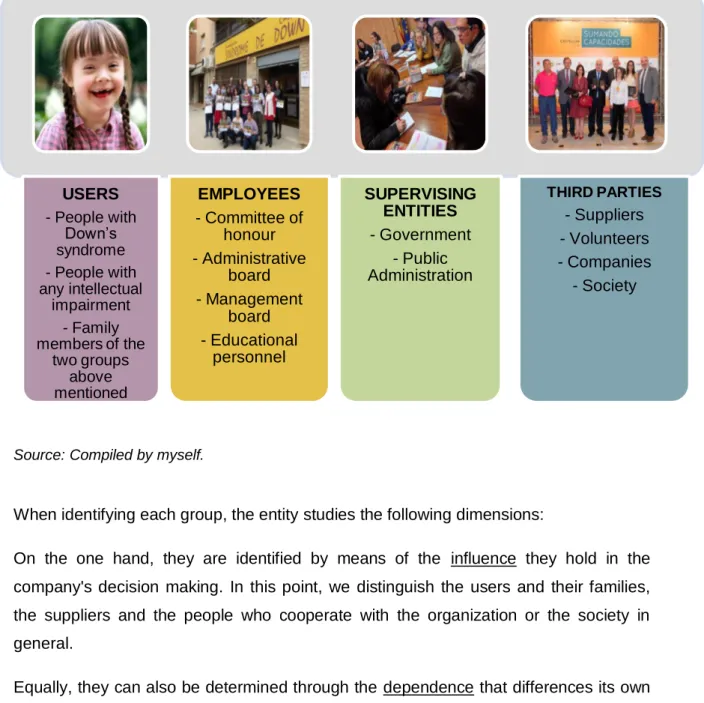
(7) Identification: In order to do that, it is essential, first and foremost, to identify the most relevant groups of interest and to analyse their requests and expectations with the aim of getting them involved in the company's strategy.. Table 1. Castellon's Down Syndrome Foundation groups of interest identification. USERS - People with Down‟s syndrome - People with any intellectual impairment - Family members of the two groups above mentioned. EMPLOYEES - Committee of honour - Administrative board - Management board - Educational personnel. SUPERVISING ENTITIES - Government - Public Administration. THIRD PARTIES. - Suppliers - Volunteers - Companies - Society. Source: Compiled by myself.. When identifying each group, the entity studies the following dimensions: On the one hand, they are identified by means of the influence they hold in the company's decision making. In this point, we distinguish the users and their families, the suppliers and the people who cooperate with the organization or the society in general. Equally, they can also be determined through the dependence that differences its own user base: in terms of Down‟s syndrome users, in 2017 there were 62 males and 49 female users. As for the users with intellectual impairment, there were 52 men and 37 women registered in 2017.. 7.
(8) Chart 1. Gender distribution of the Down's syndrome users. Women. Down's syndrome. Men. 0. 10. 20. 30. 40. 50. 60. 70. Source: Compiled by myself.. Chart 2. Gender distribution of the intellectually impaired users. Women. Intellectual impairment. Men. 0. 10. 20. 30. 40. 50. 60. Source: Compiled by myself.. On the other hand, they are established by means of closeness, as it is the case of the internal stakeholders, or those that interact on a daily basis with the company, such as the employees and volunteers. 8.
(9) Last but not least, they are also identified by responsibility. These are the people or institutions with which there are and will be legal obligations, both in the present and in the future, as would be the case with the Public Administration or the Government.. Classification: Once identified, it is convenient to sort out the interest groups based on similar characteristics and also according to the amount of impact they have on the entity itself. This last process is done through Gardner‟s interest-power matrix. This tool lets the organizations analyse and classify their stakeholders, while also enabling them to assemble the ones with more relevance and a bigger impact on the business decision taking. The matrix will be modified as the entity deepens and furthers its relationship with its groups of interest. According to its author (R. Gardner, 1986), the interest groups are classified depending on the power and influence they hold in the organization's strategies and in the degree of interest they show in the business decision taking.. Matrix 1. Interest-power matrix. Attentively manage them (key roles) USERS AND THEIR FAMILIES. Keep them contented THIRD PARTIES. Monitor them (minimum effort). Keep them informed EMPLOYEES. SUPERVISING ENTITIES Source: Compiled by myself.. 9.
(10) As far as the users and their families are concerned, they hold a great amount of power and a big interest to influence the organization's strategies, which is why they require a thorough management. The organization‟s main objective is to fulfil the needs of this group; as a result, any and every suggestion provided by them is taken into account when taking decisions. As for the employees, the organization classifies them in the quadrant as the group that always has to be informed about all the decisions carried out, for they have a high interest in the business decision-making, although the power they have over them is very limited. So they can properly carry out all their tasks, it is vital to maintain a constant communication with this group. In addition to that, their opinions are of a great importance and affect to a large degree on how the organization is going to perform. The supervising entities are situated in the quarter in which a minimum control and supervision is required. Both their power and interest in the strategies applied by the company is low, but they require a certain degree of monitoring to verify that the company is complying with all the relevant regulations, such as the payment of their tax liabilities or the proper use of the subsidies received. Third parties hold a great amount of power in the decision-making department however they have no interest in modifying the business strategy of the company. Castellon's Down Syndrome is a non-profit association that has any person or entity that can provide them both economically and with volunteer manpower as suppliers. As they provide the main resources the foundation needs, this group is situated in the quadrant that requires having them contented. Owing to the quirky nature of this group, it can easily move to the quadrant dedicated to the users and their families. The creation of this matrix is vital to achieve the business success upon the roll out of the social responsibility strategy. At the same time, it grants the organization the chance to efficiently manage the expectations of the most relevant interest groups.. Communication channel: Once identified and classified, it is necessary to see to how the entity communicates with their stakeholders in order to analyse which objectives they have and whether those are coherent with the core values the foundation seeks or not. A good communication with the interest groups is key for a better business decision-making.. 10.
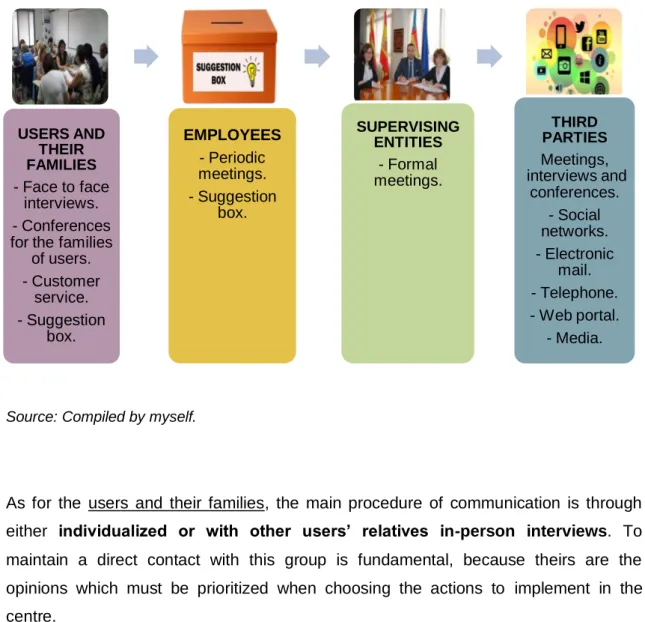
(11) Table 2. Ways to communicate with the different stakeholders. USERS AND THEIR FAMILIES - Face to face interviews. - Conferences for the families of users. - Customer service.. - Suggestion box.. SUPERVISING ENTITIES - Formal meetings.. EMPLOYEES - Periodic meetings. - Suggestion box.. - Electronic mail. - Telephone. - Web portal. - Media. - Telephone.. - Social networks. - Electronic mail. - Telephone.. THIRD PARTIES Meetings, interviews and conferences.. - Social networks. - Electronic mail. - Telephone. - Web portal. - Media.. Source: Compiled by myself.. As for the users and their families, the main procedure of communication is through either individualized or with other users’ relatives in-person interviews. To maintain a direct contact with this group is fundamental, because theirs are the opinions which must be prioritized when choosing the actions to implement in the centre. This is done with the main objective of attentively handle all the concerns and interests that the families or the users could have and advise and guide them in the best way possible. These interviews are organized by the professionals, comprised of the technical staff of the centre, and take place in a biweekly, monthly or bimonthly manner, always depending on the circumstances of both professionals and families. “Families are one of the most important central axis of both our job and mission, which inspires us to push ourselves to encourage their well-being and quality of life.” (Castellon's Down Syndrome Association report, 2017, p.37).. 11.
(12) Castellon's Down also organizes conferences catered towards the attention of the families, which consist on providing them all the necessary information so they can better understand how this collective lives and which are the needs of its members. Moreover, the users of the centre have a suggestions box at their disposal where they can contribute all their own ideas.. Commercial 1. Conferences for the families of people with Down's syndrome and/or intellectual impairment. Source: Castellon’s Down Syndrome Foundation.. 12.
(13) The main means of communication with the employees, on a similar way to what happens with the users and their families, is through regular meetings. The employees play a key role for the company's survival, which is the reason why it is vital to always keep them informed of every decision and try to understand and meet their expectations. As we have previously noted, the meetings are done in a biweekly, monthly or bimonthly basis, or in every situation in which they could be relevant, in order to both analyse the direction the organization and work out any sort of doubts. The interviews take place inside the centre and always with the whole of the personnel's involvement. On the same way as with the users, the employees have a suggestions box at their disposal in which they can contribute all their doubts or offer their advice to the board of directors. This option proves to be optimal to provide new ideas or points that could be addressed in forthcoming meetings. There is also a merely formal communication with the regulator entities, given that there must always be a control required from the public administration because of the company being an organization. In turn, there are meetings in place to settle agreements such as conventions between the entity and the Municipal Council, informative campaigns about the programme of Employment with Support and the solidary acts, from amongst many others. As for the third parties (volunteers, companies and suppliers), a continuous communication is maintained through several media in order to satisfy all their enquiries. For one, the voluntary service is very relevant in the company, so much so that there are continuous training conferences and meetings in place, both for newcomers that seek information and for the entity's regulars. “To maintain the proper operation and the integration of the figure of the volunteer forces inside our entity, there have been periodic meetings through the year in order to know first-hand which are their preoccupations and expectations.” (Castellon's Down Syndrome Association report, 2017, p.30) These conferences have the goal of favouring an interaction between both collectives, getting to know like this which are the main preoccupations and expectations of the group and how the company can meet them. It is also important to mention their webpage, given that it is the company‟s main communication channel at an external level. This portal is one of the most visited ones 13.
(14) and is being constantly renewed in order to show everything related to the entity: the tasks carried out, news and events, information about impairments, courses and programmes, policy on transparency (reports, Code of Ethics, quality policy), amongst many other things. Furthermore, their presence in social networks is also worth noting. Castellon's Down Syndrome has accounts on the following platforms: Facebook, Twitter, Instagram, LinkedIn and YouTube. Although they may not be the channels that provide the highest degree of reliability, they do actually turn out to be very convenient to interact with a great amount of people and, also, to receive their opinions. It should be noted that most volunteers choose to cooperate with the organization because of the information they obtained through the foundation‟s social networks. With the companies and suppliers there is an ongoing communication always in place through regular interviews and meetings, but also through electronic mail, telephone or, to a lesser degree, through social networks. Finally, the media plays a fundamental role because it involves another type of interaction that enables them to communicate with society and spread their message to far wider boundaries, otherwise out of their reach. As the foundation points out in its own report (2017, p.42): “We are happy to count with an ever increasing support by the media, which voices our news through different channels, achieving with it a greater impact. This enables society to have a better knowledge of our entity.” Putting all the emphasis in promoting a strong communication with their stakeholders, the organization puts at their disposal a customer service help desk, in which they handle and analyse all the complaints both though e-mail and telephone.. Analysis of objectives and expectations: In fourth place, the objectives and expectations of each interest group are analysed. However, the organization must be prudent and only give significance to those petitions that may be relevant and comply with the values that the company pursues. Otherwise, to try and satisfy every one of their proposals proves to be infeasible and can cause the company a lot of problems.. 14.
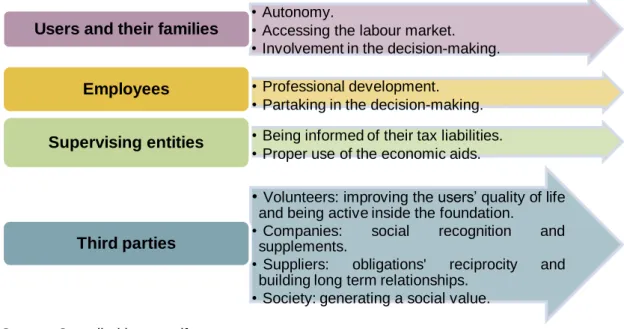
(15) Table 3. Inventory of the interest groups’ main objectives and expectations. Users and their families. Employees Supervising entities. • Autonomy. • Accessing the labour market. • Involvement in the decision-making. • Professional development. • Partaking in the decision-making. • Being informed of their tax liabilities. • Proper use of the economic aids.. • Volunteers: improving the users‟ quality of life Third parties. and being active inside the foundation. • Companies: social recognition supplements. • Suppliers: obligations' reciprocity building long term relationships. • Society: generating a social value.. and and. Source: Compiled by myself.. The objective of the families is, mainly, to grant their relatives the greatest degree of wellbeing possible. As of today, there is still a big stigma regarding people with Down's syndrome and/or intellectual impairment. That's the reason why one of the main preoccupations is to provide the users the best quality of life possible and enable them to manage every situation by themselves. During several interviews carried out by users of the Castellon's Down Syndrome Foundation and Association, it was made clear that most of the users‟ objectives revolved around having more autonomy to carry out their activities, the chance of accessing the labour market or to be treated in the same way as the rest of society. Equally, this group also wishes to be informed about the decisions taken in terms of programmes or actions being developed, and for their opinions to be taken into account. As the Code of Ethics of Castellon's Down Syndrome Foundation states (2018, p.14): The users have the right to partake in the decision-making process and, whenever permitted, either give or retire their consent for the realization of the procedures. Additionally, the wishes and wills of the users will be attended to, according to the regulations in force. As for the employees‟ objectives, they wish to grow professionally or to obtain a greater degree of participation in the decision-making. In turn, aspects like reconciling family 15.
(16) and professional life, workplace hazard prevention or the hygiene in their workplace are some of the most commonplace requirements asked from the centre by the employees so to properly carry out all of their functions, which actually do perfectly line up with the company's philosophy. “Castellon's Down Syndrome Foundation promises to provide respectable and fair working conditions to all its employees, no matter what rank they may hold. Any kind of discrimination is strictly forbidden.” (Code of Ethics, 2018, p.11). On the side of the spectrum, the main objectives of the supervising entities are making sure that the organization knows its tax liabilities and that every economic aid received is destined to where it was devised to. When it comes to the third parties, we separate them in different groups because each one of them has different objectives. On the one hand, most volunteers choose to cooperate out of their own volition with the sole objective of giving the people of this collective a better quality of life, to deepen their knowledge about how the foundation works and to understand how can they take a part in its labour.. On the other hand, the companies that choose to hire people with Down syndrome and/or intellectual impairment, in addition to doing a good service to society, expect both to get an acknowledgement that may enable them to attain a competitive advantage and a series of economic gratifications. The suppliers have, on another note, the main expectation of receiving, on a monthly basis, income for the services they provide; that is to say, they want reciprocity between them and the organization. In turn, they also hope to build long term relationships with the company.. In the last place, society expects that the actions adopted by the foundation generate a social value, which is already happening. Following the analysis of objectives and expectations of the stakeholders, it is possible to verify that many of them coincide. This facilitates, in some areas, the work of the company, as it is able to use one same tool to satisfy different groups.. 16.
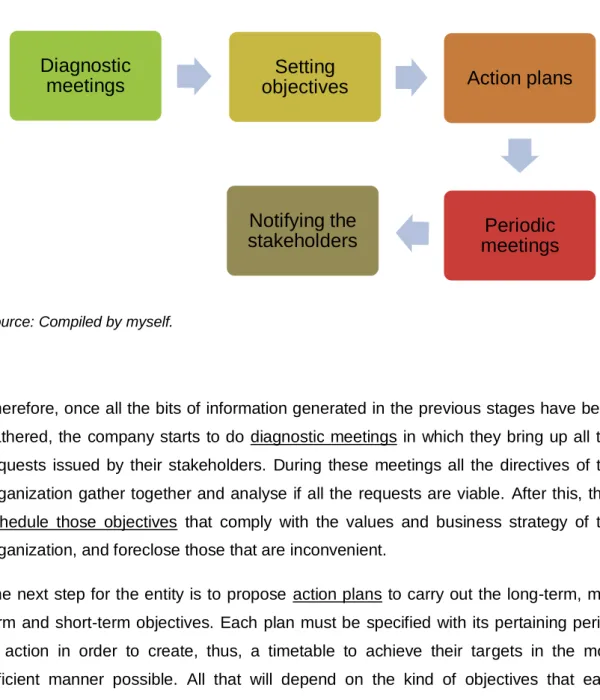
(17) Control and information: To conclude with the stages of interest groups‟ management, we highlight the control and notifying. In other words, how the organization makes sure to carry out the compromises established with its stakeholders and how it lets them know about it. Figure 2. Stages of the interest groups’ control. Diagnostic meetings. Setting objectives. Action plans. Notifying the stakeholders. Periodic meetings. Source: Compiled by myself.. Therefore, once all the bits of information generated in the previous stages have been gathered, the company starts to do diagnostic meetings in which they bring up all the requests issued by their stakeholders. During these meetings all the directives of the organization gather together and analyse if all the requests are viable. After this, they schedule those objectives that comply with the values and business strategy of the organization, and foreclose those that are inconvenient. The next step for the entity is to propose action plans to carry out the long-term, midterm and short-term objectives. Each plan must be specified with its pertaining period of action in order to create, thus, a timetable to achieve their targets in the most efficient manner possible. All that will depend on the kind of objectives that each individual interest groups may have. Once suggested and settled how to carry out these decisions, the organization‟s board of directors sets the dates of the meetings on a trimester, semester or yearly manner. In these meetings, they analyse if all the obligations they committed to are being 17.
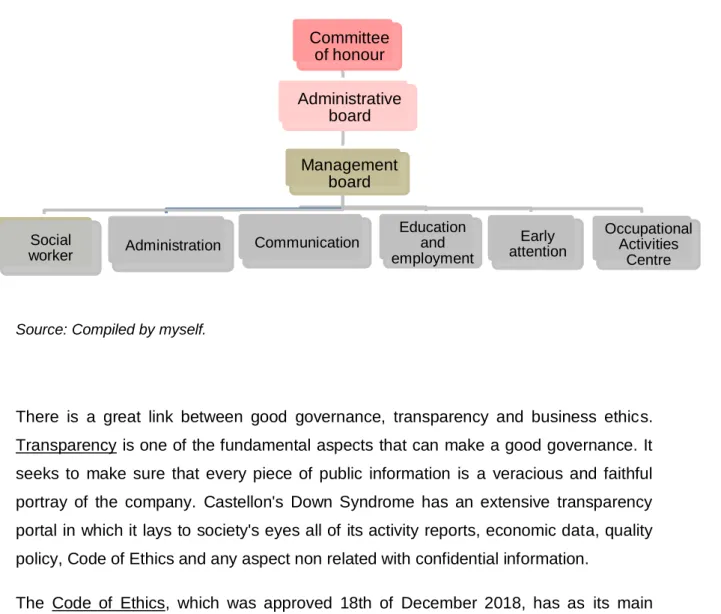
(18) carried out and in what way. Therefore, sustaining an active communication, the entity is capable of identifying if it is reaching its goal or if it needs to correct and/or modify some aspect. At the end of the process, the entity is responsible of reporting its stakeholders of every measure being carried out to integrate their queries and which are the results obtained. This process of notifying the requests will be taken into account at the time of developing the strategical wording of the plan.. 3.1.2. Corporate governance The corporate governance is based in a series of regulations and procedures that regulate the intervention of the executives, together with the interested parties, with the aim of integrating the objectives of the last ones in the decision-making process. Transparency, familiarity and good business practices are some of the characteristics that define the organization and that grant it with a responsible business conduct, which could help mitigate the errors from the past and generating business value. The committee of honour is established as the main governance body in charge of both the administration and the representation. In turn, the Administrative Board is the body in charge of the management. Amongst its main functions, it is in charge, for example, of giving the green light to the yearly accounts, the executives designation or the statutes‟ modifications. Each department has a manager in charge of monitoring the other employees pertaining to their same department, who is also in charge of standing up for their interests and making them reach the board of directors.. 18.
(19) Figure 5. Castellon’s Down Syndrome Foundation organization chart. Committee of honour Administrative board Management board. Social worker. Administration. Communication. Education and employment. Early attention. Occupational Activities Centre. Source: Compiled by myself.. There is a great link between good governance, transparency and business ethics. Transparency is one of the fundamental aspects that can make a good governance. It seeks to make sure that every piece of public information is a veracious and faithful portray of the company. Castellon's Down Syndrome has an extensive transparency portal in which it lays to society's eyes all of its activity reports, economic data, quality policy, Code of Ethics and any aspect non related with confidential information. The Code of Ethics, which was approved 18th of December 2018, has as its main objective “to advertise the policies of regulation‟ compliance and the quality standards established by the organization.”This Code of Ethics was approved by the Administrative Board, and the committee of compliance was in charge of broadcasting it and making it arrive to the hands of every person in the company: Administrative Board, executives, employees and every third parties with links to the organization.. The Committee functions are not just restricted to broadcasting the Code of Ethics, but also to supervise its fulfilment, answer any queries that may arise, and also revising and updating it according to the regulations in force. This Committee is constituted by the Administrators of the organization, which is constituted in turn by 12 counsellors, with Rosa Prades, the president, amongst them. This group meets twice a year to analyse if the policies in force are being properly carried out, or if it is necessary to intervene in their modification.. 19.
(20) The evaluation of the Code of Ethics compliance will also be carried out by external agents such as the Saá consultant and the Yaben Lawyers Ltd. Co., which are in charge of guaranteeing that the company complies with the regulations in force. Amongst the main courses of action this Code of Ethics develops, we find: Good conduct. Data protection. Prevention of risk at work. Prevention of capital risks. Confidentiality. Loyal competence. Interest conflicts. Anti-corruption and bribery.. As well as transparency and business ethics, one of the main indicators of a good governance is the fight against corruption. The foundation has a Communication and Complaints Channel through which the Committee is informed of any sign of the Code of Ethics being violated. This can be used in case of personal and professional conflicts of interests between employees, executives or administrators of the company. An example of that could be in the event of taking business decisions encouraged by personal interests, with the objective of attaining a personal profit and disregarding how it could affect the organization.. To carry out a denounce, a form must be filled and sent to the reports evaluation service via email. The external consultant will be the one in charge of managing all the reports produced by the company. Equally, both organisms grant the data confidentiality of the information comprised in the report by using a reference number for each of them. Castellon's Down Syndrome Foundation also has the quality assurance certification ISO 9001:2015, which shows their compromise to give quality service, granting the continuous improvement in their processes and with the consequential clients satisfaction. This certificate endorses the sacrifices the foundation made during the last years. Additionally, the Generalitat Valenciana bestowed upon the entity the mark “Fent Empresa. Iguals en Oportunitats”, a certificate that praises the foundation for the measures adopted to grant equal opportunities between men and women. 20.
(21) Image 1. ISO 9001:2015 Certificate. Source: Castellon’s Down Syndrome Foundation.. After analysing all the policies carried out by the company, we can conclude that, nowadays, the foundation has big projects that label them as a responsible organization on the subject of corporate governance.. 3.1.3. Sustainability 3.1.3.1. Social A socially responsible organization has people as the core of all its proceedings, integrating their users objectives with those of the company. This allows to retain talented individuals and create internal value, while attaining a higher level of employees‟ motivation when carrying out all their activities. Integrating the Corporate Social Responsibility in the company's politics transcends the mere fact of complying with the law, since it is necessary to solve the social challenges 21.
(22) they face through the commitment towards their employees. Therefore, a proper management of the human capital proves to be vital in any organization that identifies itself as sustainably responsible. Given the philosophy and the values that the foundation sought after, this one is distinguished for being a fundamental pillar in sustainability development, contributing to an improvement of people‟s lives. Castellon's Down Syndrome counts with a Human Resources policy in which it shows its commitment to develop all the capabilities of is employees in order to create the best team possible. For the foundation, its staff is its main competitive advantage. Therefore, they try to retain them and grant them all the tools they require to grow both as professionals and in their personal lives. In turn, the foundation thoroughly forbids any kind of discriminations, and fights to grant the security, dignity and equality in its centre. From amongst the main commitments the company grants, we want to highlight: Respect and egalitarian treatment. Equal opportunities. Personal dignity. Human Rights and fundamental freedoms. Reconciling family and professional life. Occupational safety and health. Equal pay for equal work.. 3.1.3.2. Economic The organization's sustainability depends, to a large degree, in the agreement of their decisions and actions with their values and objectives. Therefore, we talk about economic sustainability once there is a benefit that involves not only the organization but also the society. A solid financial management grants the surviving of the company in the long run, so the correct use and distributing of the resources is a fundamental aspect. As we will expound later on, the entity is fundamentally founded through the subsidies perceived by the Government. Even though, because of the usual unpredictability of the payments, the foundation ought to have an exhaustive control in order to continue providing its services and, in short, to subsist. As Rosa Prades, the foundation president, noted in an interview for the newspaper Levante de Castellón: 22.
(23) We operate thanks to the loans; with them, we pay our expenses. It is once we receive the subsidies that we settle our debts. It would be optimal to have a payment's calendar, because then we could know when we would receive the money. Currently, nonetheless, such a calendar does not exist. Everything is either really unpredictable or doesn’t let you plan with no qualms. All the resources obtained by the entity are entirely reallocated in the centre. The main mission of Castellon‟s Down is to help educating and integrating people with Down's syndrome and/or intellectual impairment in the labour market and to favour their inclusion in society. With the courses and workshops they carry out, the foundation helps this collective to attain a greater degree of independence, develop socializing capabilities and acquire a greater education to apply for a professional position. The fact that this mission is carried out boosts the economic sustainability of the foundation, and, in turn, of the society, through encouraging values and allowing to provide a greater economic benefit, not only to the users of the centre, but also to the rest of society.. 3.1.3.3. Environmental Castellon's Down Syndrome is a company aware with the environment, which is why they put in place good practices to try and minimize the negative impact of their actions that could increase the climate change. The company complies with all the regulations in place in order to carry out all its activities in the less harmful manner possible, trying to lessen the number of resources used and waste produced, and encouraging the proper treatment of the waste. However, the company does not count with any plan or programme of environmental management. If they did, they could incorporate in it the measures that decrease the negative impact of their actions or, simply, contribute to diminish the global activity.. 3.2. External analysis 3.2.1. General business environment analysis In order to evaluate the whole of the strategical elements surrounding the company, it is necessary to carry out a series of analysis, both internal and external, which would enable it to identify which is its current standing in the market. 23.
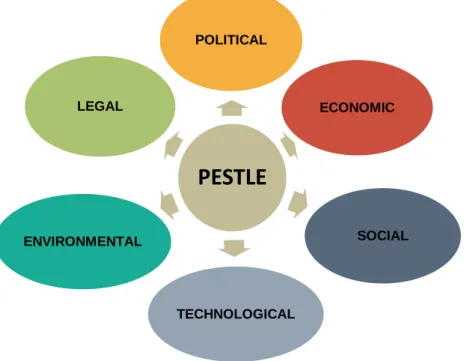
(24) The elements external to the company are the first to be analysed. These are, therefore, those that the company cannot control and that significantly influence its business strategy. In order to achieve that, we are going to carry out a PESTLE analysis in which we are going to take into account the following factors: political, economic, social, technological, legal and environmental. With this, the entity can know which are its main threats and opportunities and know how to react to them in the most appropriate manner.. Figure 3. PESTLE analysis. POLITICAL. LEGAL. ECONOMIC. PESTLE SOCIAL. ENVIRONMENTAL. TECHNOLOGICAL. Source: Compiled by myself.. The political instability currently ongoing in Spain is highlighted from amongst the political factors. Mariano Rajoy's last 2018 motion of censure, the short term of office of the current socialist president, Pedro Sanchez, the emergence of new extremist political parties or the convocation of early elections have generated a series of uncertainties in the national scene.. 24.
(25) A research elaborated by the company KPMG concluded that 8 out of 10 companies‟ board members thought of the political uncertainty as the main threat to the Spanish economy. That is because it makes it impossible to arrive at a consensus to apply key reforms such as the retirement pension system or the financing of the Autonomous Communities. This uncertainty can be detrimental for the Down's Syndrome Foundation insomuch as, with each new government, there are new regulations established which could prove to be harmful for the entity. Examples of that could be the increase of its taxation or a reduction of the subsidies received.. From amongst the economic factors, we are going to highlight how, during the last trimester of the past 2018, 36,000 jobs were created in Spain. This was accompanied by an unemployment rate decrease, which closed the year at 14.45%. For 2019, the Economic Forecasting Center (CEPREDE) forecasts that the unemployment rate will decrease to 14% from the second trimester and the number of employed people will increase to 19.88 million for this year, surpassing 20.28 in the next year.. Chart 3. Evolution of the unemployment rate. Source: EPA.. 25.
(26) In spite of the good data at hand, these tendencies are due to precarious employment, most of them being temporal and ill paid jobs. Although there has been an increase of the employment rate, the wages haven‟t followed suit, and that has produced worse quality jobs. According to the OECD: “The considerable and increasing proportion of low-paid or involuntary part-time jobs is one of the main reasons that explains the negative evolution of wages in Spain”. This tendency has an impact on a large portion of the Spanish population. Nevertheless, the most affected are still women and disabled people.. As for the socio-cultural factors, one of the most negative aspects we find at present in the Spanish society is inequality. Spain managed to place itself as one of the European Union's countries with more labour inequality. Despite the improvement in employment since the economic crisis, both women and disabled people still have to bear with the worst job precariousness out of all the population. According to the UN, in Spain, women income is, in average, 23% lower than their male colleagues, and that only a minority holds job positions of responsibility. As for the situation of disabled people and, more specifically, those that have Down's syndrome, only 5% of them does actually have a job.. Setting our sights on the technological factors, Spain has partaken in the great boom that information and communication technologies have experienced in recent years. According to the ITU, Spain ranked as the world's 27 th in the area of the ICT, while ranking 19th in Europe. Last year this sector was a 6.4% increase In Spain, and, by the day, more and more companies request the usage of these technologies. As a matter of fact, for 2019, it is expected that more than 80% of the companies hire employees knowledgeable in this area.. The. most. requested. skills. are. the. usage. of. computing. services,. telecommunications, communication devices and computers. “Yo me prep@ro” is a course from the Spanish Down Federation being imparted in more than 20 towns all around Spain. Specifically, the company prepares several. 26.
(27) activities that enable this group to acquire technological knowledge which may help them to apply for a professional position.. As for the environmental trends, Spain is ranked as one of the most environmentally conscious country of the world. Just as a survey performed by Ipsos Global Advisor in 28 countries pointed out, the Spanish citizenship considers global warming to be one of their first concerns, closely followed by air pollution and waste management. Vicente Castellanos, Public Affairs director of Ipsos Spain, said that: “the Spanish public opinion is very perceptible to information related with climate and environmental problems, and reflects perfectly the preponderant message in the media.” Therein, Castellon's Down Syndrome is really aware with this problem, and applies all the appropriate policies in the development of their activities so as to be as harmless to the environment as possible. All this comprehends the commitment to, amongst many others; comply with all the regulations related to the environment, avoid producing unnecessary waste, and raise awareness on the proper processing of the waste and their subsequent destruction.. Finally, we are going to specify the legal factors. The Universal Declaration of Human Rights established that every person has right to a job, without place for it to happen any kind of discrimination, be it because of age, gender, race, social standing, religion or impairment of any sort. As a matter of fact, the Royal Legislative Decree 1/2013 on the Spanish General Impairment Law establishes that, any company with more than 50 employees in their staff must grant 2% of those job positions to disabled people. The goal of this is to boost their social inclusion. However, a lot of companies don't comply with this law because of the stigma still lingering in society against people with Down‟s syndrome and/or an intellectual impairment and their capabilities when it comes to occupy a job position. In accordance with a study performed by the Adecco Foundation, 70% of the companies struggle when it comes to hire people pertaining to this collective.. 27.
(28) As a closure of the aspects previously analysed, we can notice how the instability problems and labour inequality gain a greater importance in the national scope. The lingering exclusion that, even nowadays, people with Down's syndrome and/or intellectual impairment have to face, alongside the job precariousness in Spain, makes it really difficult for them to access the labour market, with just a measly 5% of them having a job. On another note, we can observe how some legal requirements are being infringed, such as the companies‟ obligation to save jobs for disabled people on organizations with more than 50 workers on payroll. In addition, we consider the really positive effect both the technological and environmental areas have for the foundation. On the one hand, the demand generated by the ICT and the creation of job positions it carried with it enable this collective to opt for a job, given all the training they receive in this area. On the other hand, the compromise assimilated by the organization regarding the environment gives them a good reputation for their compromise towards both society and the environment.. 3.2.2. Specific business environment analysis After analysing the factors that can have an impact in the general surroundings of the foundation, we are going to detail the specific business environment. In order to do so, we are going to study Porter‟s Five Forces, which enable us to analyse the competitive environment surrounding the entity and determine the industry's profitability. This analysis will differ from the ones traditionally performed in the rest of organizations, given the particularity of the company we are grounding our study on. As we have previously commented, this company is not considered an NGO, nor it is considered a traditional company, so its objectives, strategies, and, mostly, its rivals, differ from those of the others.. 28.
(29) Figure 4. Porter's five forces. Suppliers. Threat of new entrants. Industry rivalry. Substitutive products. Users. Source: Compiled by myself.. Industry rivalry: Castellon's Down Syndrome is a non-profit making entity with the sole objective of producing a social benefit both for its users and the society; therefore, we consider that its industry rivalry is virtually nil. That is due to the foundation not competing as such, since it does not try to generate an economic profit greater than the other organizations or to seize all the market share. As a matter of fact, it‟s only objective is to provide a better quality of life to these people. However, there do actually also exist other entities with very similar characteristics to those of the foundation and that we will deem as “rivals” only because of the growth in this regard. At the present, there are companies that try to fight the exclusion of people with special needs; it is even worth considering other organizations such as those that pursue fighting against climate change, poverty or those that advocate in favour of animal rights. These entities, also non-profit, can be considered as “rivals”, given that they try to gather volunteers or institutions that may fund them or try to cooperate with them, even if not all of them may pursue the same social goal.. 29.
(30) Potential rivals: Nowadays, there has been an ongoing rising trend on the number of companies that apply CSR politics on their business plans, so many are the organizations that venture onto creating programmes and social services. These organizations are potential “rivals”, because they lure away some users that, otherwise, could have fulfilled their needs with the services offered by the foundation. Some of the barriers of entrance in this sector are, on one side, the economic investment required to develop the projects. The programmes with social impact do not generate money; that is the reason why the organizations must have solid financial resources that may let them carry out all their social responsibility initiatives. On the other side, it is also important to highlight the existence of the so-called “experience effect” that the organizations providing these kind of services for much more time sustain. This is important because, thanks to that, they know their users and their specific requirements. Therefore, to enter this sector can prove fairly difficult when faced against already existing organizations.. Suppliers negotiation power: As aforementioned, Down's Syndrome Foundations is a non-profit entity, so their suppliers can be any person, entity or government that can supply them either economically or with volunteer workforce. So, the reason why the negotiation power of the suppliers is really high is because the survival of the company rides, to a large degree, on the shoulders of the resources they provide, given that the foundation does not produce nor markets any goods or services that it could sell to an outer party. It should to be noted that the organization receives funds through consultant's offices or the conferences they organize. However, these actions do not suffice to cover even a part of the expenses of the centre.. Substitutive services: Castellon's Down Syndrome provides a wide range of educational services which comprise people since childhood to adulthood. These seek to encourage autonomy, socializing and developing professional abilities. Although the services the foundation. 30.
(31) provides are really complete and cover a lot of the shortages that these collectives have, in these days, there are other organizations that offer either the same or similar services, so we do in fact consider the presence of substitutive services.. Users negotiation power: If we talk about the user's negotiation power, we could also consider it to be really high, given that the main objective of the organization is to grant a better quality of life to this collective. Therefore, the users hold enough power to even change the way the foundation works, either through their needs or opinions. On the other side of the spectrum, the existence of organizations that offer similar services is not scarce, so the foundation has to try and stick out from amongst the other offerings to attract the biggest amount of users possible. As a conclusion, we can observe how the industry rivalry is nil because the only objective the foundation has is generating a social benefit. In spite of that, it is convenient to note that, currently, there are no shortage of entities with similar characteristics that devote themselves to carrying out a social labour and that “compete” to attract bigger amounts of users and volunteers.. 3.3. Internal analysis 3.3.1 Resources and capabilities In the same way as in the external analysis, it is essential to carry out an internal analysis of the company to identify which are its main strengths and weaknesses. In order to do so, we are going to evaluate the resources and capabilities the organization has at hand, which will, in turn, help us analyse if we could establish competitive advantages.. 31.
(32) Table 4. Castellon's Down Syndrome Foundation resources and capabilities. CAPABILITIES. RESOURCES 1.- Human: - Qualifications. - Experience. - Motivation. - Skills.. 1.- Material: - Establishments. - Facilities. - Equipment. 2.- Financial: - Subsidies. - Contributions. - Services provided. - Individualized educative services‟ offer. - Recruit and hold onto talented individuals.. 2.- Non human: - Quality certificate. - Transparency - Reputation - Network of connections.. - Adaptability in the face of changes. - Facilitate the social inclusion of people with Down's syndrome and/or intellectual impairment.. Source: Compiled by myself.. The resources are the elements available in the company, which enable it to create organizational capabilities. This concept comprises both tangible and intangible elements. Nowadays, the foundation has its own local in Alcora Avenue nº132, in Castellón. It has a ground floor and two first floors connected to another local where the association is. On the other hand, the company also rents a space for the Occupational Activities Centre, which is located in Alcora Avenue nº164. Regarding their facilities, the foundation has 7 fully equipped lecture rooms, a computer laboratory, six teachers‟ offices, a waiting room, a lift, a kitchen-dinner and a canteen. In addition, it must be highlighted that the company is also equipped with a wide variety of didactic materials, and the devices and hardware necessary for the proper development of their functions. As a matter of fact, the foundation received a subsidy the past 2017 from the Equality and Inclusive Policies Department so they could increase the equipment of the centre with new electronic devices, and storage and cleaning material.. 32.
(33) On the other hand, the financial resources are all the capital the company has; so to speak, it is its primary money income or monetary contributions it receives. Castellon's Down Syndrome Foundation is basically funded through official subsidies offered by the Education, Research, Culture and Sport departments, and by the Equality and Inclusive Policies Department of Castellon's Municipal Council. A great amount of the programmes developed are done through these subsidies, and many of the users that enter the centre do it so through the scholarships offered by several ministries. The foundation also receives donations from its volunteers and from the organizations that want to cooperate in a selfless way. Castellon's Down offers different services which they provide as consultancy or reports for other organizations. However, this aspect does not even represent a small percentage of their income. Finally, it is interesting to point out that it maintains an strategical alliance with the association, seeing that that union also benefits them upon receiving revenues. For instance, the foundation does not have partners whereas the association does indeed have them and they are in fact one of the main source of income they procure. In the same way, the membership fees of affiliate members and societies alike towards the organization also represent a good share of the benefits. It ought to be mentioned that all the income received is reinvested in the centre, in continuing to offer quality services and in helping the biggest amount of users possible.. The intangible elements stand out since they are more difficult to gauge, and they are differentiated between human and non-human. The human resources are those that comprise every competence that the company holds inside its organization. Castellon's Down Syndrome has a big staff with more than 30 employees in the areas of social workers, psychologists and educational psychologist, all of whom are highly qualified and experienced, which enables them to provide an individualized attention to every user of the centre. Every employee of the foundation has to go through a rigorous selection process with the objective of assuring both the users and their families that the professionals are fully qualified to carry out their work. The main competences required for these professionals are: relevant education, experience, social abilities, or teamwork.. 33.
(34) The organization is fully involved in fulfilling the workplace hazard prevention regulations, as well as those related to health and job security. Furthermore, the organization also grants their employees internal promotions, materials, technical equipment and continuous training days. This assures a good labouring atmosphere and motivates the employees to carry out their activities in an effective manner.. The non-human resources are those technological and organizational aspects the entity possesses. The past 2018, the foundation achieved the certification ISO 9001:2015, which recognizes all its efforts and commitment towards offering quality in all of their services. This acknowledgement was product of a long process of effort in which all the employees of the company were involved. Another of the most outstanding aspects of the organization is its transparency. Transparency is one of the key components of the Corporate Social Responsibility, and is one in which the company puts a lot of emphasis, given that it allows to show which its working system is and which practices they are carrying out, both internally and externally. Castellon's Down Syndrome has been awarded in several occasions thanks to its social work. This has provided the company a respectable reputation and a good network of connections. As Rosa Prades, the president of the foundation, told the newspaper Levante de Castellón in an interview: “Heretofore, we were forced to be constantly on the move, looking for events that wanted to include us but, for three years now, more and more people comes to our entity to propose things to us.”. Castellon's Down Syndrome counts with a wide range of resources which have to be properly managed in order to be turned into competences. These competences are business related abilities; so to speak, those are the abilities bound to the human assets with which the company can carry out its activities. One of the most prominent capabilities of the organization is its offer of individualized educative services. There is a wide variety of courses and courseware at Castellon's Down Syndrome Foundation that facilitates the life of people with Down's syndrome and/or intellectual impairment and helps the later to be able to cope with every ambit of their lives (familiar, social and labour). All the programmes are developed by highly qualified professionals in this subject, and carried out in an individualized manner to 34.
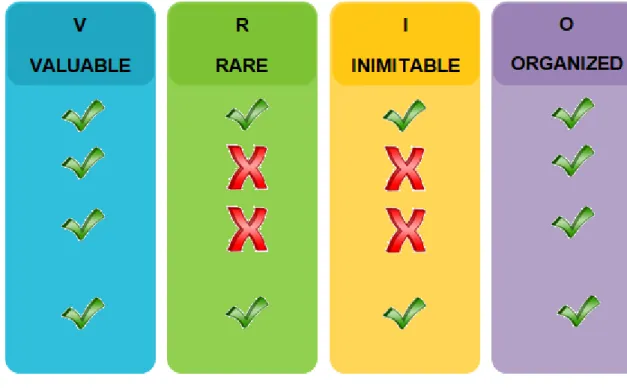
(35) adapt it to the level of every user. The organization also has programmes of support for the users‟ families.. The company also excels for its capability to recruit and retain talented professionals. Castellon's Down Syndrome counts with professionals of the industry and a great labour atmosphere in which values such as teamwork and the importance of its employees in the decision-making prevail. Furthermore, all of them have regulations that makes them feel as a part of the organization, as for example: workplace hazards prevention, equality of opportunities, respectful and egalitarian treatment, security and health, and family and professional life reconciling. Another of the main capabilities of the entity is related to its constant renovation ability. The organization updates in a yearly basis all its software and attunes it accordingly to society's evolution. This is tangible in its courses offer, computer software or in areas pertaining to the electronics, actually in high demand by the companies. Equally, the company is always keeping track of all the research and publications being developed about this pathology, and are also constantly studying new methodologies to apply in the centre. In addition to all that, one of the main capabilities the organization possesses, and one that differentiates it from many others, is its capability to facilitate the social inclusion of people with Down's syndrome and/or intellectual impairment in society. Castellon‟s Down works as a non-profit making organization with the sole objective of aiding this collective and helping them attain a greater degree of autonomy, teaching them and preparing them to access the labour market.. VRIO analysis: After identifying the resources and capabilities the company has at hand, it is necessary to value the potential of those that can produce benefits. In order to do so, we are going to carry out the VRIO analysis. This technique spots which abilities, from those of the foundation, have the four attributes that form this acronym: valuable, rare, inimitable and organized. It also permits to identify the aspects that make them unique when put against other organizations.. 35.
(36) Table 5. Abilities that comply with the attributes of the VRIO analysis. Source: Compiled by myself.. As we can assess from the table above, the organization counts with precious abilities special enough to produce substantial market opportunities and that prove to be key for making the foundation stand out in its industry. In turn, a capability alone does not generate a competitive advantage, but, combined with other resources, it helps to increase its performance and successfully develop its activities. Therefore, all the current abilities count with the attributes of valuable and organized.. At the same time, the foundation counts with a series of capabilities that makes it stand out from amongst the rest of the companies. These also stand out for being unique and difficult to imitate. Examples of them are the ability to offer individualized and specific educative services for people with Down's syndrome and/or intellectual impairment and to make it easier for this collective to be social included in society.. Even so, other aspects such as retaining talent or its adaptability to change are capabilities that every company that sought to continue surviving has to have in their organizations. Therefore, the last ones are not unique or difficult to mimic, but are at the reach of any company. That is why, as a result, they do not count as a competitive advantage in front of their rivals. 36.
(37) 3.4. SWOT analysis After separately carrying out the internal and external analysis of the company, a SWOT analysis is also carried out. In it, the main aspects previously highlighted are collected, those that can enable the organization to produce a competitive advantage.. Matrix 2. SWOT analysis. THREATS - To be excluded from the labour market by companies - Emergence of new organizations. WEAKNESSES - Volunteers shortage - Resources‟ scarcity - Difficulties to include people with Down syndrome and/or intellectual impairment in the labour market.. SWOT STRENGTHS - Individualized programmes - Transparency - Good network of connections - Reputation - Social values generator - Environmental concern. OPPORTUNITIES - Change of society's perception. Source: Compiled by myself.. 4. STRATEGICAL OBJECTIVES DEFINITION The main intention when developing a CSR plan is to stablish a series of projects in this field that both reinforce the strengths and rectify the weaknesses of the organization, all the while enabling to seize opportunities that are given in its surroundings and facing up to the threats. Elaborating a CSR plan, it is aimed to define the strategy of Castellon's Down Syndrome Foundation from the social, economic and environmental perspectives, while also deepening the bonds it has with its interest groups. Therefore, we are going. 37.
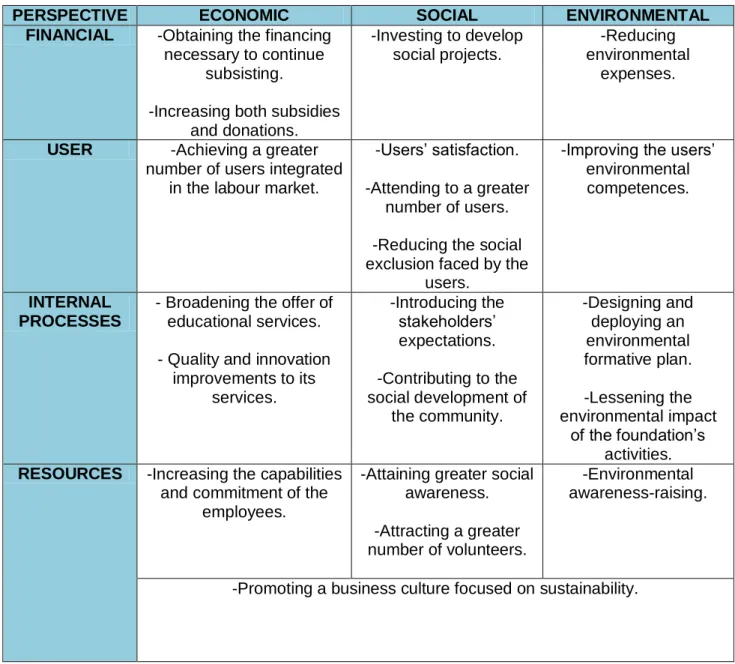
(38) to elaborate a strategic plan with feasible objectives for the time frame comprised between 2020-2022. Specifically, after analysing all the actions the organization carries out in the subject of social responsibility, we are going to define its strategy for sustainability, taking into account its mission, outlook and values, establishing like that the most optimal measures to take. Once we have them, we will compose a series of objectives according to the strategical planning. From amongst the main general objectives that we will develop in this plan we are going to highlight: 1. - Incorporating Social Responsibility as the business management model in every aspect. 2. - Consolidating a long term model that guarantees a value for every interest group, taking into consideration the criteria of transparency and sustainability. It ought to be remembered that, although we are developing a CSR plan, the foundation does already have integrated sustainability in both its mission and activities.. 5. PLANNING AND CONTROL OF THE STRATEGY 5.1. Balanced Score Card The Balanced Score Card, a business management tool that enables to measure the objectives and strategies the foundation wants to carry out in the subject of sustainability. All of that through an efficient social behaviours control, measured through indicators and action plans. The first element Kaplan and Norton‟s (1997) model contemplates for implementing a BSC is the elaboration of a strategy map. This method allows to devise the foundation's objectives under four realizable actuation perspectives: financial, users, internal processes and resources. The objectives to be shaped derive from the mission and strategical outlook of the company and it is necessary to connect the cause-effect relations with arrows in order to obtain a more visual depiction of them.. 38.
(39) With the strategy map we attain a wider perspective on how the objectives, from the perspective of the resources, encourage the development of the internal processes‟ objectives and, in turn, those form the users and, finally, the financial ones.. Table 6. Balanced Score Card. PERSPECTIVE FINANCIAL. USER. INTERNAL PROCESSES. ECONOMIC -Obtaining the financing necessary to continue subsisting. -Increasing both subsidies and donations. -Achieving a greater number of users integrated in the labour market.. - Broadening the offer of educational services. - Quality and innovation improvements to its services.. RESOURCES. -Increasing the capabilities and commitment of the employees.. SOCIAL -Investing to develop social projects.. ENVIRONMENTAL -Reducing environmental expenses.. -Users‟ satisfaction.. -Improving the users‟ environmental competences.. -Attending to a greater number of users. -Reducing the social exclusion faced by the users. -Introducing the stakeholders‟ expectations. -Contributing to the social development of the community.. -Attaining greater social awareness.. -Designing and deploying an environmental formative plan. -Lessening the environmental impact of the foundation‟s activities. -Environmental awareness-raising.. -Attracting a greater number of volunteers. -Promoting a business culture focused on sustainability.. Source: Compiled by myself.. 39.
(40) Drawing 1. Strategy Map. Source: Compiled by myself.. 40.
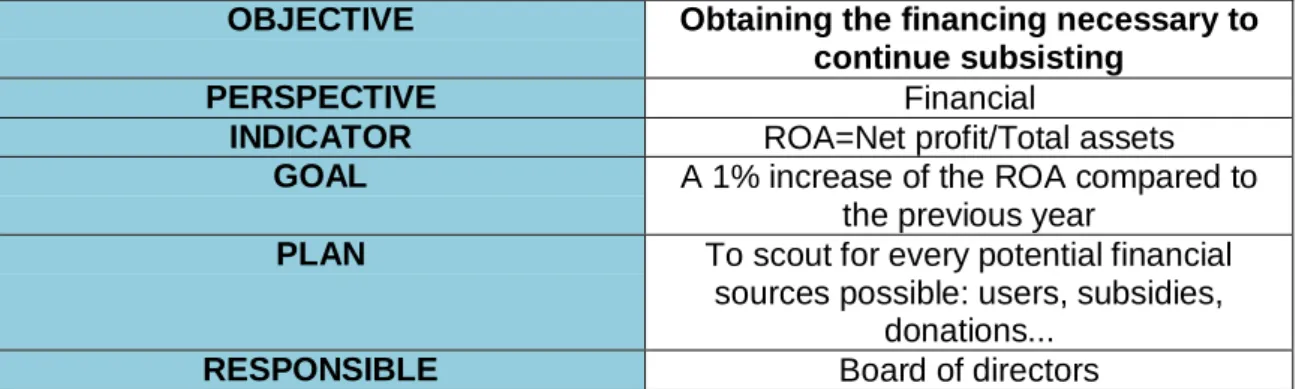
(41) The several strategic objectives of the organization in the subject of sustainability are depicted in the table above (social, economic and environmental). However, it should be noted that Castellon's Down Syndrome is a small entity with limited resources, so we will only expound on the objectives that prove viable according to the foundation‟s possibilities and that, equally, could cover several requirements. All its objectives have a goal and a yearly plan to fulfil them. The higher board of directors will be in charge of controlling every plan carried out. The plans will be gauged every six months to check if the objectives proposed are being achieved or if, contrarily, they require applying corrective actions.. Table 7. Objective: Obtaining the financing necessary to continue subsisting. OBJECTIVE. Obtaining the financing necessary to continue subsisting Financial ROA=Net profit/Total assets A 1% increase of the ROA compared to the previous year To scout for every potential financial sources possible: users, subsidies, donations... Board of directors. PERSPECTIVE INDICATOR GOAL PLAN. RESPONSIBLE. Source: Compiled by myself.. As we previously commented, the foundation's main strategy is not centred around trying to obtain a greater economic benefit, but contributing a social value to the community. Despite that, if the foundation wants to keep offering their services, it is significant to count with enough resources to keep them up and running. Otherwise, if there is a lack of the necessary means to reach it, any goal proves irrelevant. It is necessary to address that all the benefits obtained are exclusively reinvested on the centre to keep offering quality services and improving the quality of life of people with Down‟s syndrome and/or intellectual impairment.. 41.
(42) Table 8. Objective: Achieving a greater number of users integrated in the labour market. OBJECTIVE PERSPECTIVE INDICATOR. GOAL PLAN RESPONSIBLE. Achieving a greater number of users integrated in the labour market Users Number of users that have got a contract/Users of the centre of Training and Employment and of the Occupational Activities Centre A 5% increase of the compared to the previous year Participation and intervention in the different employment trade shows Coordinators of the Training and Employment and Occupational Activities Centres‟ workshop. Source: Compiled by myself.. To boost the access to the labour market, the foundation has treaties signed with several institutions that enable the students of the Training and Employment and Occupational Activities Centres to do their internships and have their first contact with the labour market. Another initiative possible would be to take part in the several employment trade shows that take place in the autonomous region. One example of them would be the employment trade show Work Forum or Crea Ocupació, which happens on a yearly manner in the province of Castellon. This yearly event organized by the Municipal Council is catered towards people looking for labour market opportunities. It offers courses, workshops, presentations and interviews with the companies.. On the one hand, the show has practical workshops with an endless number of activities to prepare the attendants for job interviews, and to show them how to have self-confidence and stand out from their rivals, from amongst many others. On the other hand, the guest speeches are done by professionals, and they seek to motivate the attendants and let them know what the companies are looking for. Additionally, the candidates can have interviews with every company that comes to the event, which could boost their hiring opportunities.. The Employment trade shows are carried out all though the year and could prove to be very convenient for the users that are preparing to enter the labour market. With these events, the students can interact with a lot of companies and have a first contact with 42.
(43) them. Furthermore, with this initiative, the very same companies can get to know how does the foundation operate and what capabilities do its users have. They can also get to know the value that hiring a person with Down's syndrome and/or intellectual impairment can produce, both socially and economically. In fact, the very same foundation is in charge of educating the users to carry out the activities the companies ask for, aspect that greatly facilitates the hiring of this collective.. There is still nowadays a big stigma against this collective; that is why boosting their hiring opportunities is one of the big challenges faced by the organization.. This initiative allows, on one side, a continuous education that draws the users closer to what the companies ask for and, on the other side, to take part and learn to cope with new situations and environments. Equally, this project can be implemented in the short term and putting it into action does not require great financing, just the barely necessary to cover transportation costs.. Table 9. Objective: Reducing the social exclusion faced by the users. OBJECTIVE. Reducing the social exclusion faced by the users Users Number of people that visits the centre per year Attracting at least 10 centres during the first year Establishing Open Doors Days in the foundation Board of directors. PERSPECTIVE INDICATOR GOAL PLAN RESPONSIBLE. Source: Compiled by myself.. Another of the distinguished initiatives to try and achieve a greater social integration of this collective in the community would be performing Open Doors Days in the foundation. This initiative tries to attract different kinds of people so they can know how does the centre operate and how the people that lives in it really are. In principle, the main idea is to attract the youngest population; so to speak, kids and teenagers of school years. These Open Door Days would be comprised of activities and workshops, similar to the 43.
(44) ones carried out at the centre, so the young attendants can connect with the youngest users and socialize with them. This can enable the youngest to be aware of the requirements this collective has, in order to, thus, facilitate their integration in society. This initiative generates a great social benefit, both to society, because it helps to raise awareness about the existence of people with special needs, especially amongst the youngest, and to the centre, by enabling their integration and socialization with the community. Additionally, this practice encourages an education based in values; that is to say, to see this collective normally without having a distorted image of them. This project would be carried out during school hours and the foundation would be in charge of advertising it through its social networks or any other means of communication. Equally, it would also be in charge of contacting the schools and high schools to show them its initiative and arrange dates. Both centres would then convene on a date, and the educational centres would have to move their students to the foundation. Once there, in order to give them more importance and responsibility, the students of the entity would be the ones in charge of showing their visitors around the facilities and explaining them the activities they carry out. As for the plan, its implementation would be viable in the medium to long term, since it requires a greater amount of work.. Table 10. Objective: Improving the users’ environmental competences. OBJECTIVE PERSPECTIVE INDICATOR. GOAL PLAN RESPONSIBLE. Improving the users’ environmental competences Users Number of hours devoted to environmental education/Total of educational hours A 40% increase compared to the previous year Establish talks and educational outings to carry out environmental actions. Board of directors. Source: Compiled by myself.. One of the main actions to try and convey a greater environmental awareness and get the users to improve their competences in this regard starts with education. On the one. 44.
Figure
+7

Documento similar
Improvement of the Rett Syndrome phenotype in a Mecp2 mouse model upon treatment with Levodopa and a Dopa Decarboxylase Inhibitor?. The lack of Mecp2 protein results
Regarding the first goal of the study (to study the effects of maintenance load levels on CMI tasks in people with DS and ND), an expected load effect was observed globally in
Both anec- dotal stories like that of Dido ’s foundation of Carthage and the overall framework of the division of history into the four ages of universal empire and the aftermath of
Acute febrile neutrophilic dermatosis (Sweet's syndrome) in association with myelodysplastic syndromes: a report of three cases and review of the literature.. Billstrom R, Heim
These syndromes [Cardio-facio-cutaneous syndrome (CFC), Costello syndrome (CS), LEOPARD syndrome (LS), Neurofibromatosis type 1 (NF1) and Noonan syndrome (NS)] share
This booklet includes top tips for those who experience a mental health condition to help improve their quality of life and think about their sense of belonging and place in
–No assessment of tic severity68 QoL quality of life, GTS Gilles de la Tourette syndrome, CTDs chronic tic disorders, ADHD attention-deficit and hyperactivity disorder,
Porcine reproductive and respiratory syndrome virus (PRRSV) infection is one 36.. of the major health problems for the swine
