CHEMICAL ENGINEERING
TRANSACTIONS
VOL. 70, 2018
A publication of
The Italian Association of Chemical Engineering Online at www.aidic.it/cet
Guest Editors: Timothy G. Walmsley, Petar S. Varbanov, Rongxin Su, Jiří J. Klemeš
Copyright © 2018, AIDIC Servizi S.r.l.
ISBN 978-88-95608-67-9; ISSN 2283-9216
Environmental Performance of Peruvian Waste Management
Systems under a Life Cycle Approach
Kurt Ziegler-Rodriguez
a,*, María Margallo
b, Rubén Aldaco
b, Angel Irabien
b, Ian
Vazque-Rowe
a, Ramzy Kahhat
aaPeruvian LCA Network, Department of Engineering, Pontificia Universidad Católica del Perú, Avenida Universitaria 1801, San Miguel 15088, Lima, Peru
bDepartment of Chemical and Biomolecular Engineering, University of Cantabria, Avda. Los Castros s/n, Santander, Spain [email protected]
Peru generated in 2014 a total of 7.5 million metric tons of municipal solid waste (MSW). Of these, 47 % of residues ended up in open dumpsites and only 21 % were sent to controlled landfills. Efforts must be made to conduct a change from open dumpsites to sanitary landfills, reaching an adequate and sustainable waste management system. This study aims at meeting this challenge by means of the Life Cycle Assessment (LCA) methodology. In particular, the objective of this study is to develop a life cycle model that will allow the estimation of environmental impacts linked to waste landfilling in Peru, and to compare in further studies alternatives to determine a more environmentally sustainable solution. The model is flexible in order to be adapted to the three main geo-climatic regions in Peru: the hyper-arid coast, the Andean Highlands and the Amazon Rainforest. The life cycle model was developed with the EASETECH software, taking into account the phases of construction, operation and end-of-life the Peruvian landfills. The main parameters of this model include waste composition and the characteristics and treatment of the leachate and landfill gas, taking into consideration local parameters such as temperature, humidity and precipitation intensity. The model lays the foundation stone to determine the main hotspots in Peruvian sanitary landfills. This information will allow achieving an adequate and sustainable waste management by proposing improvement measures to help stakeholders in the decision-making process.
1. Introduction
Waste management is a sector that, through time, has required increasing attention. However, huge differences regarding waste generation, composition and management are found between developed and developing countries (Laurent et al., 2014). From a global waste production of 1.3 billion metric tons per year, Organization for Economic Co-operation and Development (OECD) nations make up close to half of the world’s waste, c.a. 673,200 thousand metric tons in 2016 (OECD, 2017). This is consistent with the premise that the higher income level, the higher waste generation. For waste management, the trend is that while developed countries seek more integrated and sustainable waste management systems (Laurent et al., 2014), emerging nations are still basically fighting to switch from the disposal of residues in open dumpsites to disposing of them in controlled landfills (Guerrero et al., 2013). This is the situation in most Latin American and Caribbean (LAC) countries. In the particular case of Peru, in year 2014 a total of 7.5 million metric tons of municipal solid waste (MSW) were generated. Of these, 47 % of residues ended up in open dumpsites and only 21 % were sent to controlled landfills. Regarding the remaining fraction, 17 % was recycled, 12 % was openly burned, 3 % spilled into any water source and the final 1 % had another unknown destination (MINAM, 2017). As the Peruvian waste management situation is a well-known problem by the government, all along the last decade there has been an intended compromise from it to improve the situation. In this sense, the development of an adequate waste management system will be facilitated by the use of environmental tools, such as Life Cycle Assessment (LCA). LCA quantifies the environmental benefits and impacts of production processes (Laso et al., 2016), helping organizations to perform their activities in the most environmental friendly way along the whole value chain (Margallo et al., 2016) and performing the green economy transition (Mah et al., 2017). This methodology has
DOI: 10.3303/CET1870293
Please cite this article as: Ziegler-Rodriguez K., Margallo M., Aldaco R., Irabien A., Vazquez-Rowe I., Kahhat R., 2018, Environmental performance of peruvian waste management systems under a life cycle approach , Chemical Engineering Transactions, 70, 1753-1758 DOI:10.3303/CET1870293
been widely applied to the management of the Municipal Solid Waste (MSW) sector, in particular, in Europe and Asia, mainly in Italy, UK, Germany and China (Margallo et al. 2018). However, there is a lack of studies in LAC and it is important to address that European case studies may not be representative of the LAC scenario due to their technological and geo-climatic conditions (Henriksen et al., 2017). Therefore, this study aims at filling this gap, developing a life cycle model to estimate the environmental impacts of waste landfilling in Peru. The model will be flexible in order to be adapted to the three main geo-climatic regions in Peru: the hyper-arid coast, the Andean Highlands and the Amazon Rainforest.
2. Waste management in Peru
Landfilling is the most common treatment method in Peru and many LAC countries (MINAN, 2017). However, there are huge differences between sanitary landfills, controlled landfills and open dumpsites. A sanitary landfill comprises spreading and compaction of waste on a waterproof bed, daily coverage and an adequate management of leachate and gases, whereas a controlled landfill does not have the infrastructure of a sanitary landfill, but some control measures. In contrast, in open dumpsites (referred to in the region as “botaderos”) waste is disposed of without any control and protection to the environment and thus, the chemical and biological contaminants in wastes will find their way back to humans to affect health and quality of life (Rushbrook, 1999). Between 2012 and 2013 it was denoted approximately 105 open dumpsites in 177 municipalities of Peru with more than 10,000 inhabitants, excluding the areas of Metropolitan Lima and Callao. Figure 1a shows the location of the 20 most critical open dumpsites. Three of them, located in La Libertad (“El Milagro”), Ancash (“Coishco”) and Puno (“Chilla”), treat 34 % (1450 metric tons) of the total waste disposed in these 20 open dumpsites (OEFA, 2014). Efforts are being made to conduct a change from open dumpsites to sanitary landfills (Figure 1b).
Figure 1: (a) Location of critical open dumpsites and (b) sanitary landfills in Peru in 2017
3. Environmental assessment 3.1 Literature review
LCA of a waste management system is divided in the same stages as the LCA of a product. The main difference between the LCA of a product and of waste resides in defining the cradle and grave approach. Whilst it shares the same grave as individual products, the lifecycle of waste does not share the same cradle (Margallo, 2014). Moreover, whereas product-based LCA usually follows a single product from cradle-to-grave, a waste-LCA will assess the handling of several waste fractions from end-of-life to grave or remanufacturing. Generic LCA tools are not designed for the modelling of a reference flow consisting of a mix of materials (Clavreul et al., 2014). To take into account these very heterogeneous reference flows, several “add-on” models have been developed from the 2000s. Among all of them, the Technical University of Denmark (DTU) launched EASETECH, an upgrade of the EASEWASTE model developed in 2004, which provides inventories of waste management technologies to users for LCA modelling (EASETECH, 2017). This software allows modeling a range of different environmental technologies from a systems perspective, using a toolbox of processes. For each flow the user can define the collection system, transport mode and treatment in a defined number of processes (Clavreul et al., 2014). Since 2014, this software has been widely applied in LCA studies summarized in Table 1.
Sanitary Landfills in Perú 1. Cajamarca 2. Chicama 3. Carhuaz 4. Independencia 5. Cajacay 6. Zapallal 7. Modelo del Callao 8. Huaycoloro 9. Portillo Grande 10. Ica 11. Quebrada Honda 12. Llata 13. Ambo 14. Pozuzo 15. Oxapampa 16. Santa Cruz 17. Pampaya 18. Yauli 19. Ccochaccasa 20. Cangallo 21. Coracora 22. Huaya 23. San Miguel 24. Chuquibambilla 25. Anco Huallo 26. Huancarama 27. Anta 28. Nauta 29. El Treinta a) b)
Table 1: Review of LCA studies on waste management using EASETECH model. MSW: municipal solid waste; BA: bottom ash; FW: food waste; CDR: construction and demolition residues
Authors Year County Type of waste Description
Hadzic et al. 2017 Croatia MSW Comparison of landfill combining mechanical separation of
recyclable fractions of mixed MSW
Syeda et al. 2017 Pakistan MSW Comparison of open dumpsite with a biogasification plant
Bisinella et al. 2017 Denmark MSW Quantification of the influence and uncertainty on LCA results
associated with selection of waste composition data
Liu et al. 2017 China MSW Analysis of five scenarios based on landfilling and incineration
Grzesik and Malinowski
2017 Poland Mixed MSW Assessment of mechanical-biological treatment (MBT)
Grzesik and Malinowski
2017 Poland RDF Analysis of RDF production from mixed MSW, in a MBT plant
Grzesik 2017 Poland mixed waste Comparison of incineration and landfilling
Benavente et al. 2017 Spain Olive mill
wastes
Analysis of hydrothermal carbonization to treat olive mill wastes
Manfredi and Cristobal
2016 Europe FW Environmental and economic analysis of management
European FW Di Gianfilippo et
al.
2016 Italy Incineration BA Evaluation of BA landfilling/ recycling as a filler for road sub bases
Vergara et al. 2016 Colombia MSW Analysis of alternative scenarios to formalize the recycling
sector
Berge et al. 2015 USA FW and CDR Evaluation of hydrothermal carbonization of food wastes
Butera et al. 2015 Denmark CDR Modelling of CDR management
Carlsson et al. 2015 FW Determination of the influence of FW pre-treatment efficiency
Jain et al. 2014 USA MSW Assessment of end-use management options for materials
deposited and mined from an unlined landfill
Yang et al. 2014 China MSW Analysis of construction and operation of MSW sanitary
landfills
Starostina et al. 2014 Russia MSW Study MSW system landfilling
Figure 2: (a) System boundaries and (b) flow diagram of the operational stage Table 2: Model characteristics
Model variables Description
Landfill gas (LFG) generation First order decay model (USEPA, 1998, 2005; IPCC, 2006) LFG collection, burning No
Energy generation No
Leachate treatment Recirculation
Daily and cell coverage Clay, geotextiles and geo-membranes of HDPE
3.2 Model description and results
The life cycle model (Table 2) was developed with EASETECH (EASETECH, 2017), which suggests to include construction, operation and end-of-life phases. Based on this assumption, the system boundaries (Figure 2a)
Operational stage a) b) Waste composition Landfill gas generation Leachate generation and treatment Gas collection system Venting Oxidation daily cover Oxidation intermediate cover Oxidation in final cover
included raw material acquisition, landfill construction, transport and supply of materials, energy consumption and the release of pollutants in the three stages. Table 2 shows some technical characteristics of the model. As the main function of the system is to treat MSW, the functional unit (FU) was one metric ton of waste disposed of at the landfill to which all the inputs and outputs will be referred to. Primary data were collected from questionnaires supplied by different sanitary landfills. For secondary data the EASETECH software (EASETECH, 2017), the Ecoinvent database v3.3 (Ecoinvent, 2016) and bibliographic data were used.
3.2.1 Operational stage
Waste composition and the characteristics and treatment of the leachate and landfill gas (LFG) are the main parameters of operational step (Figure 2b), taking into consideration local parameters such as temperature, humidity and precipitation intensity. Table 3 shows the average waste composition in Peru (MINAM, 2017).
Table 3: Waste composition
Waste streams Average composition (%) Lower limit composition (%) Upper limit composition (%)
Organic mater 52.2 % 50.6 % 61.0 %
Wood and pruning waste 2.30 % 0.30 % 4.80 %
Paper and cardboard 8.10 % 3.90 % 15.0 %
Glass 3.10 % 1.30 % 4.60 % Plastics 9.80 % 5.35 % 14.1 % Beverage carton 0.20 % 0.10 % 1.38 % Metals 2.60 % 0.70 % 3.49 % Textiles 1.90 % 0.60 % 2.45 % Others 19.8 % 13.7 % 22.5 %
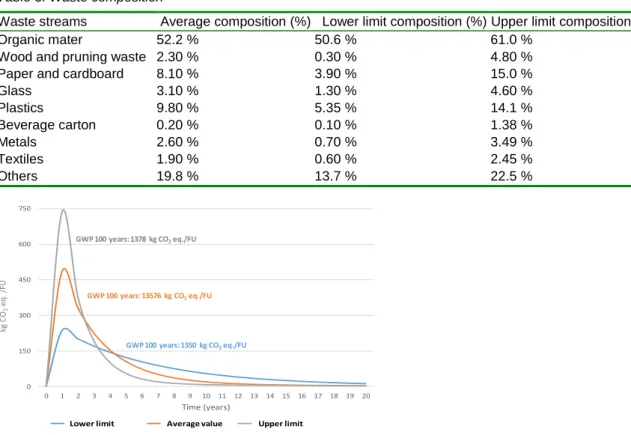
Figure 3: Global Warming Potential (kg of CO2 eq./ t waste) in landfill gas generation for 20 years
However, waste generation and composition vary according to socioeconomic aspects, climatic, geographical and cultural conditions, the existence of waste planning systems or food habits (Taghipour et al., 2016). Moreover, rural areas and low income countries are likely to have a greater amount of vegetable, fruit and garden waste than inner city areas and high income countries ((White et al. 1997). These variations are visible in the three geo-climatic regions of Peru, which will have influence on both leachate and LFG generation. When speaking of landfilling, the location of the facility is critical in terms of waste degradation (Henriksen et al., 2017). Figure 3 shows global warming impact taking into account the lower, upper and average waste composition and the climatic conditions of the country. Total emissions generated in 100 years varies according to climatic conditions from 1350 to 1378 kg CO2 eq./ t waste. These results confirm that landfills located in areas with warm
tropical weathers and with a high organic matter content will have a higher generation of LFG and leachate, as temperature affects directly the anaerobic decomposition rates of waste, as well as other parameters (Machado, 2009). This happens as the LFG generation follows a first order decay model. The rate used in this equation fluctuated throughout the different modeled scenarios due to variations in geo-climatic conditions. Moreover, Figure 3 denoted that the highest emissions of greenhouse gases are produced in the 5 first years after waste disposal, getting after a steady state that is reached earlier for the upper limit waste composition.
Leachate was modelled having in mind local conditions, such as humidity, temperature and precipitation intensity. However, due to inability of measuring site-specific composition of both leachate and LFG,
0 150 300 450 600 750 0 1 2 3 4 5 6 7 8 9 10 11 12 13 14 15 16 17 18 19 20 Kg C O 2e q Time (years)
rango inferiorLower limit rango medioAverage value rango superiorUpper limit
GWP 100 years: 1350 kg CO2eq./FU GWP 100 years: 13576 kg CO2eq./FU GWP 100 years: 1378 kg CO2eq./FU
kg C O2 eq . / FU
bibliographic data from the EASETECH software was used (Olesen and Damgaard 2014).
3.2.2 Capital goods of the landfill
Certain studies exclude capital goods because they present a low contribution to environmental impacts (Brogaard et al., 2013). However, in this study capital goods such as infrastructure and machinery were quantified and assigned to the FU according to their lifespan, the landfill’s lifetime and the amount of residues intended to perceive during the whole landfill’s life. Nevertheless, because of their low contribution to the whole impact (0.17 %), these elements were modelled using the Ecoinvent database v3.3 (Ecoinvent, 2016).
4. Conclusions
The removal of open dumpsites and the improvement of sanitary landfills are some of the challenges that Peru should meet in the not too distant future. This study develops a life cycle model to evaluate the environmental performance of the current sanitary landfills based on the technological and geo-climatic conditions of Peru. The model includes as key parameters waste composition, characteristics and treatment of the leachate and landfill gas, as well as temperature, humidity and precipitation intensity. These parameters can be adapted to the three geo-climatic regions of the country. The model lays the foundation stone to determine the main hot spots of the Peruvian sanitary landfills. Based on these results, further studies will be focusses on the comparison of several waste alternatives. This information will allow achieving an adequate and sustainable waste management strategy by proposing improvement measures to help stakeholders in the decision-making process.
Acknowledgments
This project is part of the International Climate Initiative (IKI). The Federal Ministry for the Environment, Nature Conservation, Building and Nuclear Safety (BMUB) supports this initiative on the basis of a decision adopted by the German Bundestag. The authors thank Ignacio Sánchez and Adriana Zacarías (UN Environment); Ricardo Estrada and Roxana Díaz (MINAM); Joel Inga, Andrés Miguel Hinostroza, Percy Taco and Fernando Vargas.
References
Benavente V., Fullana A., Berge N.D., 2017, Life cycle analysis of hydrothermal carbonization of olive mill waste: Comparison with current management approaches, Journal of Cleaner Production, 142, 2637-2648. Berge N.D., Li, L., Flora J.R.V., Ro K.S., 2015, Assessing the environmental impact of energy production from
hydrochar generated via hydrothermal carbonization of food wastes, Waste Management, 43, 203-217. Bisinella V., Götze R., Conradsen K., Damgaard A., Christensen T.H., Astrup T.F., 2017, Importance of waste
composition for Life Cycle Assessment of waste management solutions, Journal of Cleaner Production, 164, 1180-1191.
Brogaard, L.K., Stentsøe, S., Willumsen, H. C., Christensen, T.H., 2013, Quantifying capital goods for waste landfilling, Waste Management and Research, 31(6), 585-598.
Butera S., Christensen T.H., Astrup T.F., 2015, Life cycle assessment of construction and demolition waste management, Waste Management, 44, 196-205.
Carlsson M., Naroznova I., Moller J., Scheutz C., Lagerkvist A., 2015, Importance of food waste pre-treatment efficiency for global warming potential in life cycle assessment of anaerobic digestion systems, Resources, Conservation and Recycling, 102, 58-66.
Clavreul J., Baumeister H., Christensen T.H., Damgaard, A., 2014, An environmental assessment system for environmental technologies, Environmental Modelling and Software, 60, 18-30.
Di Gianfilippo M., Costa G., Pantini S., Allegrini E., Lombardi F., Astrup T.F., 2016, LCA of management strategies for RDF incineration and gasification bottom ash based on experimental leaching data, Waste Management, 47, 285-298.
Easetech, 2017, Technical University of Denmark, 2013-2017 <easetech.dk/EASEWASTE> accessed 20.11.2017.
Ecoinvent, 2016, Ecoinvent Database Version 3.3, Ecoinvent Centre, Bern, Switzerland.
Guerrero L.A., Maas G., Hogland W., 2013, Solid waste management challenges for cities in developing countries, Waste Management, 33(19), 220-232.
Grzesik K., 2017, Comparative environmental impact assessment of the landfilling and incineration of residual waste in Krakow, Environment Protection Engineering, 43(4), 135-148.
Grzesik K., Malinowski M., 2017, Life cycle assessment of mechanical-biological treatment of mixed municipal waste, Environmental Engineering Science 34(3), 207-220.
Grzesik K., Malinowski M., 2017, Life cycle assessment of refuse-derived fuel production from mixed municipal waste, Energy Sources, Part A: Recovery, Utilization and Environmental Effects, 38(21), 3150-3157.
Hadzic A., Voca N., Golubic S., 2017, Life-cycle assessment of solid-waste management in city of Zagreb, Croatia, Journal of Material Cycles and Waste Management, 20, 1286-1298.
Henriksen T., Astrup T.F., Damgaard, A., 2017, Linking data choices and context specificity in life cycle assessment of waste treatment technologies: a landfill case study, Journal of Industrial Ecology. In press, DOI: 10.1111/jiec.12709.
IPCC, 2006, Intergovernmental Panel on Climate Change guidelines for national greenhouse gas inventories. Institute for Global Environmental Strategies, Hayama, Japan, 2, 48-56.
Jain P., Powell J.T., Smith J.L., Townsend T.G., Tolaymat T., 2014, Life-cycle inventory and impact evaluation of mining municipal solid waste landfills, Environmental Science and Technology, 48(5), 2920-2927. Laso J., Margallo M., Celaya J., Fullana P., Gazulla C., Aldaco R., Irabien A., 2016, Finding the best available
techniques for an environmental sustainable waste management in the fish canned industry, Chemical Engineering Transactions, 52, 385-390.
Laurent A., Bakas I., Clavreul J., Bernstad A., Niero M., Gentil E., Hauschild M.Z., Christensen T.H., 2014, Review of LCA studies of solid waste management systems–Part I: Lessons learned and perspectives, Waste Management, 34(3), 573-588.
Liu Y., Sun W., Liu J., 2017, Greenhouse gas emissions from different municipal solid waste management scenarios in China: Based on carbon and energy flow analysis, Waste Management, 68, 653-661.
Machado S.L., Carvalho M.F., Gourc J.P., Vilar O.M., do Nascimento J.C., 2009, Methane generation in tropical landfills: Simplified methods and field results, Waste Management, 29(1), 153-161.
Manfredi S. and Cristobal J., 2016, Towards more sustainable management of European food waste: Methodological approach and numerical application, Waste Management and Research, 34(9), 957-968. Mah C.M., Fujiwara T., Ho C.S., 2017, Concrete waste management decision analysis based on life cycle
assessment, Chemical Engineering Transactions, 56, 25-30.
Margallo M., Aldaco R., Bala A., Fullana P., Irabien A., 2018, Contribution to closing the loop on waste materials: valorization of bottom ash from waste-to-energy plants under a life cycle approach, Journal of Material Cycles and Waste Management. In press, DOI 10.1007/s10163-018-0709-6.
Margallo M., Onandía R., Aldaco R., Irabien A., 2016, When life cycle thinking is necessary for decision making: emerging cleaner technologies in the chlor-alkali industry, Chemical Engineering Transactions, 52, 475-480. Margallo M., 2014, Life cycle model of waste to energy technologies in Spain and Portugal, PhD thesis,
University of Cantabria, Santander, Spain.
MINAM, 2017, Environmental Ministry of Peru < minam.gob.pe> accessed 14.11.2017. OECD, 2017, <data.oecd.org/waste/municipal-waste.htm> accessed 05.04.2018.
OEFA, 2014, <oefa.gob.pe/wp-content/uploads/2013/12/reporte-3-botaderos-criticos.jpg> accessed 20.01.2018.
Olesen A.O.U. and Damgaard A., 2014, Landfilling in EASETECH – Data collection and modelling of the landfill modules in EASETECH. Internal report, DTU Environment, Technical University of Denmark, Denmark. Rushbrook P., 1999, Solid waste landfills in Middle- and Lower-income countries. A technical guide to planning,
design, and operation, World Bank technical paper (426), 1-248.
Starostina V., Damgaard A., Rechberger H., Christensen T.H., 2014, Waste management in the Irkutsk Region, Siberia, Russia: environmental assessment of current practice focusing on landfilling, Waste Management Research, 32(5), 389-396.
Syeda A.B., Jadoon A., Chaudhry M.N., 2017, Life cycle assessment modelling of greenhouse gas emissions from existing and proposed municipal solid waste management system of Lahore, Pakistan, Sustainability, 9(12), 2242.
Taghipour H., Amjad Z., Aslani H., Armanfar F., Dehanzadeh R., 2016, Characterizing and quantifying solid waste of rural communities, Journal of Material Cycles and Waste Management, 18, 790-797.
USEPA, 1998, Landfill air emissions estimation model (version 2.01). EPA-68-D1- 0117, EPA 68-D3-0033, US Environmental Protection Agency.
USEPA, 2005, First-order kinetic gas generation model parameters for wet landfills. EPA-600/R-05/072, US Environmental Protection Agency.
Vergara S.E., Damgaard A., Gomez D., 2016, The efficiency of informality: quantifying greenhouse gas reductions from informal recycling in Bogotá, Colombia, Journal of Industrial Ecology, 20(1), 107-119. White P.R., Franke M., Hindle P., 1997, Integrated solid Waste management: A life cycle inventory. Blackie
Academic and Professional, London.
Yang N., Damgaard A., Lü F., Shao L.M., Brogaard L.K.S., He P.J., 2014, Environmental impact assessment on the construction and operation of municipal solid waste sanitary landfills in developing countries: China case study, Waste Management, 34(5), 929-937.