
The acquisition of vocabulary through three memory strategies
131
0
0
Texto completo
(2) DOCUMENTO DIGITAL PARA REPOSITORIO El presente formulario debe ser diligenciado en su totalidad como constancia de entrega del documento para ingreso al Respositorio Digital (Dspace). Using Online Thesis Generators to Write Persuasive Essays in EFL with Secondary School Students TITULO SUBTITULO Pérez Morales, Libia Maritza AUTOR(ES) Apellidos, Nombres (Completos) del autor(es) del trabajo Estrategias de vocabulario PALABRAS CLAVE (Mínimo 3 y máximo 6). Memorización Adquisición de vocabulario. RESUMEN DEL CONTENIDO (Mínimo 80 máximo 120 palabras). El presente estudio explora la aplicación de tres estrategias de vocabulario: tarjetas de palabras, asociación con imágenes, y asociación con un tema a través de fábulas en la adquisición de vocabulario en un grupo de adolescentes con bajo nivel de competencia en inglés en un colegio público. Los participantes tenían dificultades para memorizar y recordar palabras. Los resultados mostraron que estas estrategias ayudan a incrementar el aprendizaje de las palabras y a mejorar la capacidad para recordarlas. El estudio encontró que estas estrategias involucran factores cognitivos y afectivos que pueden afectar la percepción de los estudiantes acerca de las estrategias. La aplicación de estas estrategias informa a la comunidad educativa la necesidad de implementarlas como parte del programa de inglés.. Autorizo (amos) a la Biblioteca Octavio Arizmendi Posada de la Universidad de La Sabana, para que con fines académicos, los usuarios puedan consultar el contenido de este documento en las plataformas virtuales de la Biblioteca, así como en las redes de información del país y del exterior, con las cuales tenga convenio la Universidad. De conformidad con lo establecido en el artículo 30 de la Ley 23 de 1982 y el artículo 11 de la Decisión Andina 351 de 1993, “Los derechos morales sobre el trabajo son propiedad de los autores”, los cuales son irrenunciables, imprescriptibles, inembargables e inalienables..
(3) Running head: THE ACQUISITION OF VOCABULARY THROUGH THREE MEMORY STRATEGIES. The Acquisition of Vocabulary through Three Memory Strategies. Libia Maritza Pérez Morales. Master in English Language Teaching –Autonomous Learning Environments Department of Foreign Languages and Cultures Universidad de La Sabana Chía, 2012. 1.
(4) THE ACQUISITION OF VOCABULARY THROUGH THREE MEMORY STRATEGIES. The Acquisition of Vocabulary through Three Memory Strategies. By: Libia Maritza Pérez Morales. Submitted in fulfillment of the requirements for the degree of Master in English Language Teaching –Autonomous Learning Environments. Directed by: Elizabeth Hope Goodwin. Master in English Language Teaching –Autonomous Learning Environments Department of Foreign Languages and Cultures Universidad de La Sabana Chía, 2012.
(5) THE ACQUISITION OF VOCABULARY THROUGH THREE MEMORY STRATEGIES. This research report is the result of my own work and includes nothing that was done in collaboration with others. Name: Libia Maritza Pérez Morales. Signature:.
(6) THE ACQUISITION OF VOCABULARY THROUGH THREE MEMORY STRATEGIES Acknowledgements My special acknowledgment goes to my thesis director, Professor Elizabeth Hope Goodwin who has continuously given me advice and support throughout this research. I also want to express special thanks to my research professors the Lecturers and Researchers Luz Dary Arias and Liliana Cuesta who guided and encouraged me to enjoy and enrich my professional development throughout the process of this study..
(7) THE ACQUISITION OF VOCABULARY THROUGH THREE MEMORY STRATEGIES Table of Contents Abstract……………………………………………………………….………………...…2 Introduction……………………………….………………..……..………...………..…... 4 Chapter 1. Statement of the Problem…………………………..……………….…….… 7 Research Question..……………….………………………………………................... 13 Objectives……………………………………………………………………….…….. 14 Rationale……………………………………………………………………………..... 14 Chapter 2. Theoretical Framework……………………….…………………………….... 17 The Acquisition of Vocabulary and Long Term Memory…………….………………. 17 Vocabulary Strategies…………………………………………………………….….... 22 Research discussion on vocabulary strategies………………………………….….27 Word cards……………………………………..………………………………..... 28 Word association with pictures…….……………..…………………………........ 31 Word association with a topic……………………..……….…………………..…. 32 Chapter 3. Research Design………………………….…………..………..…………….. 35 Type of Study…………………………………………………………………………. 35 Research Setting and Participants……………………………………………………... 35 Context…………………………………………………………………………..... 35 Participants……………………………………………………………..……...….. 36 Researcher’s role……………..…………………………………………………… 38 Data Collection Instruments………………………………………………….…..…… 39 Questionnaires…………………..……………………………………………….... 39 Researcher’s journal………………..……………………………………………... 40 Tests…………………………..…………………………………………………... 40 Validity of the instruments…………………………………………………………..... 41 Ethical considerations………..……………………………………………….…... 42 Data Collection Procedure.……………………………………………………….…… 42 Designing and Validation of the Instruments and Procedures………………...….. 43 Chapter 4. Pedagogical Intervention………………………………………………….…. 46 Action Plan…………………………………………………………………………..... 46 The Instructional Design…………………………………………………………….... 47.
(8) THE ACQUISITION OF VOCABULARY THROUGH THREE MEMORY STRATEGIES Materials………………………………………………………………………………. 49 Lesson Plan…………………………………………………………………………..... 52 Main aim…………..…………………………………………………………….... 52 Subsidiary aim………..………………………………….……………………..… 52 Assumed knowledge…..………………………………………………………..… 52 Sub-skill………………………………..……………………………………….… 52 Anticipating problems and planning solutions………………………………….… 53 Methodology………………………………………………………………………...… 53 Chapter 5. Data Analysis……….…..……………………………………………….…... 55 Procedure for Data Analysis………………………………………………………...… 55 Data Management …………………………………………………………………….. 56 Data Reduction……………………………………………………………………...… 56 Data Display and Verification………………….………………………………….….. 56 Categories…………………………………………………………………………...… 58 Category: Memory Strategies as Didactic Tools..…………………………………….. 59 Subcategory: Affective factors……..…...………..………………..………......... 59 Subcategory: Cognitive factors…….………..………………………………..…….… 65. Chapter 6. Conclusions, Pedagogical Implications and Further Research…….………. 79 Conclusions ……………………………………………………………………………79 Limitations…………………………………………………………………………...... 81 Pedagogical Implications…………………………………………………………….... 82 Further Research……………………………………………………………………..... 84 References Footnotes Tables Figures Appendices.
(9) THE ACQUISITION OF VOCABULARY THROUGH THREE MEMORY STRATEGIES Tables Table 1. SABER results……………………………………………………..……..…...... 8 Table 2. CEF levels in Colombia………………………………………………………... 9 Table 3. An outline syllabus to use word cards……………………………….…………. 30 Table 4. Methodology plan………………………………………………..…………..….49 Table 5. Anticipated problems and solutions……………………………………………. 53 Table 6. Methodology of the lesson plan…………………………………………......…. 54 Table 7. Data analysis methods………………………………………………………….. 55 Table 8. Vocabulary test results and strategies………………………………………..… 66 Table 9. Final vocabulary test………………………………………………………..….. 73 Table 10. Comparing the three vocabulary strategies………………………………….... 74.
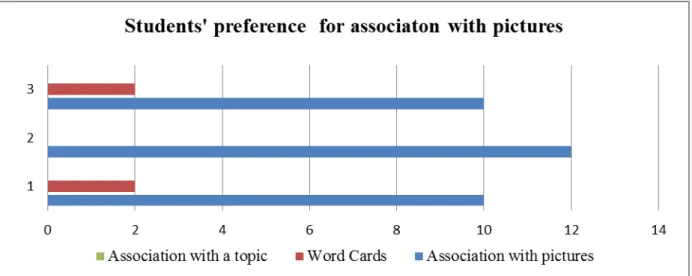
(10) THE ACQUISITION OF VOCABULARY THROUGH THREE MEMORY STRATEGIES Figures Figure 1. Axial coding…………………………………..….……….………………….... 57 Figure 2. Core category: vocabulary strategies as didactic tools……………………....... 58 Figure 3. Interaction of the participants………………………………….....................… 63 Figure 4. Students’ preference for association with pictures………….......................… 64 Figure 5. Increasing memorization of words……………………………………….……. 67 Figure 6. Adapted version of word cards……...…………………….………..............… 76 Figure 7. Own illustration of the words...……...…………………….……….............… 76 Figure 8. Pictures based on the content of the fable the ox and the frog…..….............… 76 Figure 9. Illustration of the fable the tortoise and the hare .……….……….................… 76 Figure 10. Association with a picture strategy…………………………………………... 76.
(11) THE ACQUISITION OF VOCABULARY THROUGH THREE MEMORY STRATEGIES Appendices Appendix A. Firs type of students’ questionnaire……………………………...….......… 95 Appendix B. Second type of students’ questionnaire………………………………...….. 98 Appendix C. Research journal………………………………………………………....… 101 Appendix D. Consent letters………………………………...……………..………..…... 102 Appendix E. Final vocabulary test……………………………………...…….……….… 105 Appendix F. Word card test……………………………….…………………………...... 106 Appendix G. Association with picture test ……………………………………………… 108 Appendix H. Association with a topic test………………………………….…………… 112 Appendix I. Timeline of the process…………………………………………………..… 113 Appendix J. Timeline of data collection and procedures………………………………... 114 Appendix K. Methodology of the lesson plan………………………………………….... 116 Appendix L. Nine short readings……………………………………………….….......... 119 Appendix M. Open coding sample………………………………………………………. 120.
(12) THE ACQUISITION OF VOCABULARY THROUGH THREE MEMORY STRATEGIES. Abstract The present study explores the implications of applying three vocabulary strategies: word cards, association with pictures, and association with a topic through fables in the acquisition of vocabulary in a group of teenagers with a low-level of English proficiency in a public school at Espinal, Tolima, Colombia. The participants had not used these vocabulary strategies before and struggled to memorize and recall words. The results showed that these strategies were effective to enable students to expand their range of words progressively and improve the ability to recall words. The study also found that these strategies involve cognitive and affective factors that can affect students’ perceptions about the strategies. The implementation of these strategies informs the educational community about the need to train learners on the use of vocabulary strategies and to include them as part of the English language program. Key words: vocabulary strategies, memorization, vocabulary acquisition..
(13) THE ACQUISITION OF VOCABULARY THROUGH THREE MEMORY STRATEGIES Resumen El presente estudio explora las implicaciones de la aplicación de tres estrategias de vocabulario: tarjetas de palabra, asociación con imágenes, y asociación con un tema a través de fábulas en la adquisición de vocabulario en un grupo de adolescentes con bajo nivel de competencia en inglés como lengua extranjera, estudiantes de un colegio público en el Espinal, Tolima, Colombia. Los participantes no habían utilizado estrategias de vocabulario y tenían dificultades para memorizar y recordar palabras. Los resultados mostraron que estas estrategias ayudan de manera eficaz a los estudiantes a incrementar progresivamente el aprendizaje de las palabras, desarrollar y mejorar su capacidad de recordar palabras. El estudio también encontró que estas estrategias involucran factores cognitivos y afectivos que pueden afectar la percepción de los estudiantes acerca de las estrategias. La aplicación de estas estrategias de vocabulario informa a la comunidad educativa sobre la necesidad de capacitar a los estudiantes en su uso y de implementarlas como parte del programa de inglés. Palabras clave: estrategias de vocabulario, memorización, adquisición de vocabulario.
(14) THE ACQUISITION OF VOCABULARY THROUGH THREE MEMORY STRATEGIES Introduction. This research is intended to investigate the acquisition of vocabulary with a group of teenagers with a low-level of English proficiency (A- and A1) in a public school at El Espinal, which is a town in Tolima, Colombia, through three memory strategies: word cards, association with a picture, and association with a topic or story. This study is based on a pedagogical intervention in which three memory strategies were implemented as part of the school program of 11th graders who applied the strategies using nine fables to learn fifteen words from each one. Because the sample was limited to twelve students who signed consent letters allowing the researcher to collect data from their questionnaires and vocabulary tests designed for this implementation, the findings are limited to this sample and the conclusions of this research might not apply to other language learning contexts. The fables were chosen based on the students’ interest for this kind of material, the fables’ short length, the students’ language level, the repetition of vocabulary. This is one of the materials suggested by the Ministry of Education of Colombia to be used with students with A1 level. The focus of this study was addressed to the use of these vocabulary strategies and the use of the fables was limited to the intentional vocabulary learning not to reading comprehension. Schmitt (2008) indicated that “one thing that students, teachers, materials, writers, and researchers can all agree upon is that learning vocabulary is an essential part of mastering a second language” (p. 329). In the needs analysis, the data collected from the scores that SABER Exam reported in the SIE of the eleventh graders, the graders’ comments in class, the English teachers’ meeting of area and the researcher’s personal observation indicated that the students struggled to memorize vocabulary, to recognize words they had learned in former years, and to recall words. Both English teachers and eleven graders expressed the need to expand the range.
(15) THE ACQUISITION OF VOCABULARY THROUGH THREE MEMORY STRATEGIES of words to increase the ability to convey meaning and the low scores registered on the SABER¹ exam indicated the students were unable to achieve a B1 language performance after six years of academic English learning. As Wilkins (1972) highlighted, “while without grammar little can be conveyed, without vocabulary nothing can be conveyed” (p. 111). Hence, the implementation of the three vocabulary strategies of this study could provide teachers with elements that they could use to train their learners in vocabulary development. Likewise, students would be aware of how they could train their long term memory to extend their range of vocabulary. This could help the researcher find responses to her community’s needs in the teaching and learning process as a first step to improve the current situation of these students and their English performance. The present study is organized in six chapters. The first chapter, which is the introduction of this study, presents the statement of the problem, the research question and objectives, and the rationale to carry out this project. The second chapter discusses the theoretical framework, which considers key concepts related to the constructs through point of view of the theory and state of art of other similar national and international projects related to vocabulary learning and memory strategies. The third chapter presents the research design, which includes the type of study that was carried out, the researcher’s role, the context, the participants, and the data collection instruments and procedures, and the action plan used to carry out this research. Afterwards, the fourth chapter, which is the pedagogical intervention and implementation of this study, provides a description of the steps and processes to follow to solve the research problem, including a timeline, a description of the materials, methodology, and how the lessons were carried out. Next, the fifth chapter explains in detail how the data analysis was conducted: categories, subcategories, sample data, interpretation of it, comparison with theory and other.
(16) THE ACQUISITION OF VOCABULARY THROUGH THREE MEMORY STRATEGIES research projects. Finally, the sixth chapter draws conclusions, pedagogical implications, limitations, and some considerations for further research..
(17) THE ACQUISITION OF VOCABULARY THROUGH THREE MEMORY STRATEGIES Chapter One: Statement of the Problem At the time the researcher initiated this research project and diagnosed the problem, the participants of this study were in tenth grade, but when the study was implemented, the learners were in eleventh grade, but just twelve of them signed the consent for data usage. These eleventh grade students, whose average age was 16, began studying English in sixth grade with two one-hour lessons per week. Their instruction had always been delivered in Spanish using a grammar-based approach. The students were required to learn rules and vocabulary that after years of study the students were unable to use. Mock exams had been implemented in the 10th and 11th grades as part of the institutional strategies to grade learners’ performance in English and to ensure students obtained better outcomes on the governmental SABER exam. However, school documents of these mock test results repeatedly showed that students had a low level English performance according to the Common European Framework. According to the National Standards of Colombia for English and the Common European Framework, these students should be in a B1 level and, they should have a vocabulary that allows them to “produce simple connected text on topics, which are familiar, or of personal interest. [They should also be able to] describe experiences and events, dreams, hopes and ambitions and briefly give reasons and explanations for opinions and plans” (Common European Framework of Reference for Languages, 2001, p. 24). Nevertheless, these students are currently ranked in A- and A1 level. At A1 level the students should be able to “understand and use familiar everyday expressions and very basic phrases aimed at the satisfaction of needs of a concrete type. [They should be able] to introduce [themselves] and others and … ask and answer questions about personal details … [They should] interact in a simple way provided the other.
(18) THE ACQUISITION OF VOCABULARY THROUGH THREE MEMORY STRATEGIES person talks slowly and clearly” (Common European Framework of Reference for Languages, 2001, p. 24). At A1 level the students use “their mother tongue to demonstrate reading or speaking comprehension” (Estándares Básicos de Competencias en Lenguas Extranjeras: Inglés, 2006, p. 18). The placement of more than 50% of students at A- level indicates that they were not able to convey meaning and use English to complete the task required on the SABER exam (see Table 1). An analysis of the SABER exam published by SNIEE from 2009 to 2011showed that more than 50% of 11thgraders had not even achieved level A which is the level designed for primary students (third grade), and only 42% to 32 % had reached A1. Hence, in order to label this level of performance, the SABER exam has created a new level: A-. Table 1 SABER Results of 11th Graders’ Language Level of the Public in which this Study Took Place in Espinal. Adapted from SNIEE for 2009, 2010 and 2011. Percentage of students in each language level using the CEF scale Level A-. 2009 57,50. 2010 51,92. 2011 65,67. A1 A2 B1. 42,50 -. 42,30 1,92 3,84. 32,78 1,63. The twelve participants of this study took a mock SABER exam applied by the school as a way to prepare 10th and 11th graders for the standardized SABER exam. The scores on the mock exam showed that ten of the students were at A- level and two of them were at A1 level. These results, compared with general performance of the 11th grade illustrated in Table 1, indicated these learners had a low-language level..
(19) THE ACQUISITION OF VOCABULARY THROUGH THREE MEMORY STRATEGIES The Ministry of Education of Colombia has created an equivalent version of the English level of Common European Framework. It also has indicated a group of grades at which each language level should be achieved and the English standards required by grades that learners must achieve at that level. As indicated in Table 2, A1 (beginner) is the lowest level designated. In this study, the term “low-level” refers a level of English proficiency at A1 or A-. Table 2 Equivalent Version of the English Levels of the Common European Framework in Colombia. (Estándares Básicos de Competencias en Lenguas Extranjeras: Inglés, 2006, p. 10). Group of grades. CEF levels. Tenth to Eleventh Eight to ninth. B1. Sixth to seventh. Colombian Ministry of Education nomenclature B 1.2. Pre-intermediate 2. B 1.1. Pre-intermediate 1. A 2.2. Basic 2. A 2.1. Basic 1. A1. Beginner. A2 Fourth to fifth First to third. A1. The institution is supposed to follow the National Ministry of Education guidelines for English learning in the National Plan of Bilingualism. This program is designed to foster learning English as a foreign language among Colombian citizens. Hence, this public high school had adopted the English standards set by the Colombian government in its PEI. The English syllabus design should reflect the English standards of the Colombian government, but in practice, at this institution, the language skills were not an important part of the syllabus because it focused only on grammatical aspects of the language and Spanish was the instructional language to the English classes. These classes were organized in two one-hour English lessons per week. Sixty percent of the eleventh graders expressed in class discussion.
(20) THE ACQUISITION OF VOCABULARY THROUGH THREE MEMORY STRATEGIES that they took their English class because it was a compulsory subject in the curriculum; therefore, not all of them were openly willing to learn English. The fact that students had been labeled A- and A1, as shown in Table 1, indicated that students still needed to extend their range of vocabulary and “develop strategies that help [them] understand some words, expressions and sentences that [they] read [so they can] identify common contextualized words about a topic familiar for them [or] to apply diagrams to organize information about short tales [they should have] read in class” as stated in the English standards and the receptive skills (Estándares Básicos de Competencias en Lenguas Extranjeras: Inglés, 2006, p. 18). Even though the SABER exam might not include fables, Estándares Básicos de Competencias (2006) indicates the use of “short narrative texts [which include] tales” (p. 18) as one the main materials English teachers should use with A1 level students to increase vocabulary. Because the students of this study chose fables and the standards set by the Ministry of Education recommended them in a class at a Beginner level, the researcher implemented this material in the research project. When the students were asked in class about the main difficulty they faced while taking this SABER exam, the students reported struggling to identify the meaning of the words and to convey meaning since the tests had a great number of unknown words that made it difficult for them to be sure of their answers. This illustrates that from the students’ viewpoint they experienced frustration trying to understand items in the exam and not being able to respond correctly because of the lack of vocabulary. The students of this public school are confronted with this problem when they take the mock SABER exam and the standardized SABER exam..
(21) THE ACQUISITION OF VOCABULARY THROUGH THREE MEMORY STRATEGIES When the researcher asked the English teachers in the departmental meeting about the students’ main difficulties in the SABER exam and the main reasons for these difficulties, the minutes show that teachers reported that the students struggled to understand the instructions and the texts because of their lack of vocabulary. When the teachers were asked about the reason for this deficiency in vocabulary, two expressed that they taught vocabulary in class, but the students were responsible for learning it and three reported that they used wordlists, dictionaries and pictures to help the students but English was not a real daily need for the learners so they forgot the words. When they were asked about an action plan to address this problem, the teachers said that they had only implemented the mock SABER exams in 10th and 11th grades. This indicates that although teachers agreed with the students about the need to increase vocabulary, they were unsure about the best way to help their students overcome this problem. Therefore, this study was developed with these eleventh graders to try to find a solution to this problem and establish tools that could help English teachers get acquainted with the use of memory strategies. In this way, they could use the result of this study to help their students be aware of memory strategies to improve vocabulary learning. When the thirty eleventh graders were asked in a class discussion prior to the implementation of this study if they knew how to learn vocabulary and if they had been instructed in how to learn it, twelve students indicated that they made wordlists, eight reported that they used a dictionary and ten used both wordlists and a dictionary. Even though they used these kinds of strategies, these twenty eight students reported they did not how to learn vocabulary so that they could remember the words. When they were asked if they would like to know how to learn vocabulary, they answered “yes.” During a preliminary needs analysis activity in class, the researcher observed that these students struggled to identify, recall, and use.
(22) THE ACQUISITION OF VOCABULARY THROUGH THREE MEMORY STRATEGIES words that they were supposed to have known since the sixth grade, such as vocabulary related to family, places, and daily routines or free time activities. The class was divided in groups for a warm-up activity and each group was asked to write thirty words about their daily routines and free time activities in the context of school activities on the board in ten minutes. The first student of each group had to write a word and the second had to write another by using the final letter of the word written previously. The students started to skip their turn, asking their partners what word they should write, checking their notes of the previous class on their notebooks and asking the teacher to let them use the dictionary. This warm-up activity was aimed at recycling vocabulary from previous lessons and activating learners’ previous vocabulary knowledge so the teacher could use these words to introduce a topic about people’s lifestyles and how they used their free time later in the lesson. The researcher observed that the students were unable to remember thirty words from vocabulary learned in previous lessons and years. This indicated that the students struggled to recall vocabulary from their long term memory and retrieve it when they needed it and that the dictionary had become their primary resource to recall words. What it is more, during the development of another lesson in which the learners had to use “be going to” to answer yes/no questions about their personal plans in the context of their vacation plan, the learners struggled to brainstorm places to visit, activities to do there, things to carry out, means of transportation, and family members during the beginning of the lesson in the warm up activity. During ten minutes, in groups of five students, they had to write five words for each aspect based on the title “a family’s plan for their vacation” written on the board; however; most of the groups were only able to write eight words. Some of the learners started asking if they had to write them in English, others asked the teacher-researcher about the meaning and the spelling of the words, and most of them started using the dictionary again..
(23) THE ACQUISITION OF VOCABULARY THROUGH THREE MEMORY STRATEGIES Most of the students failed to recall vocabulary about family. They were only able to remember the words father, mother, and brother, but they were unsure about the spelling of them. Some of them wrote fader and moder instead of father and mother. Then at the final stage of the lesson when they had to use this vocabulary to plan their vacations, they started again to use the dictionary to check the meaning of the words. When they were asked about the reason they were unable to recall, they answered that they did not remember the words well because they had learnt them some years ago when they had to take an English test in the class. This showed again that the students used to rely on the dictionary as the main strategy to identify the meaning of the words, but they failed to remember them and looked them up on the dictionary over and over again. This also highlighted that these 11th graders struggled to recall the words they had learnt because they had only used their short term memory to learn vocabulary to answer tests and had not really developed vocabulary strategies that enable them to store words in their long-term memory. The use of vocabulary strategies could provide students the tools they need to “store information in their LTM and retrieve it easily whenever it is necessary for speaking, reading, writing or listening to the foreign language” (Arias, 2003, p. 117). The lack of vocabulary can affect the students’ language performance; therefore, there is an imperative need to search for possible solutions that could help low-level learners to increase their vocabulary learning.. Research Question What might the implementation of memory strategies inform us about the acquisition of vocabulary through fables in a group of teenagers with a low-level of English proficiency in a public school at El Espinal?.
(24) THE ACQUISITION OF VOCABULARY THROUGH THREE MEMORY STRATEGIES Objectives • To evaluate the effectiveness of the implementation of three memory strategies to acquire vocabulary through fables. • To compare the memory strategies in order to determine which one is more effective on vocabulary retention.. Rationale Through this study, the teacher-researcher wants to contribute to the field of English teaching and learning by looking for a possible solution to a specific learning problem and inform educators about the importance of making decisions based on “theory, applied research, and teachers’ ideas to contribute to practice and enrich each other” (Krashen ,1984, p. 34). In this way, the students would benefit from research findings. As an English teacher at a public school, the researcher hopes to persuade her colleagues to start teaching the low-proficiency strategies to acquire and recall vocabulary so the learners become users of those strategies to increase their vocabulary storage and to retrieve vocabulary when they need it. This study could also give English teachers tools to start considering strategies to make it possible for them to adjust the Institutional Education Project (PEI²) of the school so the English syllabus addresses the students’ need for increasing their count of words to fit not only the National Standards for English in Colombia but primarily to be functional in this language. Thornbury (2004) claims that “most of the researchers nowadays recommended a basic vocabulary of at least 3,000 word families, while for more specialized needs, a working vocabulary of over, 5,000 word families is probably desirable” (p. 21) to be able to understand at.
(25) THE ACQUISITION OF VOCABULARY THROUGH THREE MEMORY STRATEGIES least 90% of a text. In order to reduce the number of unknown words in a text and give the students the tools to improve their reading comprehension, there is a strong need to equip learners with at least a core vocabulary of the 2000 most frequently used words (Thornbury, 2004). Although the CEF has not specified the word families required for each level, the CEF states that at an A1 level the students should have “a basic vocabulary repertory of isolated words and phrases related to particular concrete situations” (Common European Framework of Reference for Language, 2001, p. 112). Under this circumstance there is an imperative need to empower learners with strategies that increase their number of words and ensure that the words that will be selected for learning really will be learnt. Bearing in mind the low level results on SABER tests and that the classes used to be grammar based without a high effect on students’ language performance, this research could change the way teachers teach English vocabulary in this public school because it is focused on looking for a solution to help students extend their range of words instead of teaching them as a word list. Many teachers neglect to use methods to teach vocabulary because as Arias (2003) stated, “it has to be given a special treatment in the language classroom, it demands constant use of memory for learners and they could not know how to help learners to deal with it” (p. 115). Thus, the researcher could persuade English teachers to start working on methods that train learners’ memory towards the acquisition of vocabulary and the development of their language skills. Folse (2004) indicated that when “vocabulary is not systematically covered in most curricula … ESL learners-even after completing an English course successfully-say in exit surveys that they need much more vocabulary practice and instruction” (p. 10). Thus, the results.
(26) THE ACQUISITION OF VOCABULARY THROUGH THREE MEMORY STRATEGIES of this study could also give EFL teachers the opportunity to realize the effectiveness of memory strategies in the acquisition of vocabulary and could give English tools to guide the EFL students towards the development of a second lexicon that could help them to start improving their basic communicative skills. In this way, the researcher believes students would feel that their language needs are being taken into account. Schmitt (2008) pointed out that “the best means of achieving good vocabulary learning is still unclear, partly because it depends on a wide variety of factors” (p. 329). Thus, continued research is needed to discover those strategies that best help learners to increase their vocabulary. Hence, this study seeks to inform researchers and English teachers about the effectiveness of word cards, association with a picture, and association with a topic on vocabulary learning in Aand A1 proficiency EFL learners. Finally, this research could also impact the way the English classes have been taught and the way learners see them so they could find a real reason to learn vocabulary and start increasing their range of words. The fact that they could use a strategy to acquire vocabulary and convey meaning could be more motivating for learners than memorizing a list of words out of context (Nakata, 2008). This could help teachers and learners to know how to train their long term memory instead of only using their short-term memory, making vocabulary learning more fruitful and useful for learners..
(27) THE ACQUISITION OF VOCABULARY THROUGH THREE MEMORY STRATEGIES Chapter Two: Theoretical Framework Since learning vocabulary is an important component in mastering a second language (Schmitt, 2008), vocabulary acquisition is key to being functional in an EFL context. This research project states that after five years of formal English study, these A- and A1 teenagers of 11th grade in a public high school struggled to store and recall vocabulary possibly due to the lack of knowledge about how to use some vocabulary strategies. The project proposes to overcome this problem by applying three vocabulary strategies, which are word cards, word association with pictures, and word association with a topic. In fact, these students need to be trained in vocabulary learning strategies that could facilitate and contribute to their EFL learning process. This study is supported with a review of the literature and research studies conducted in the same or similar area for vocabulary acquisition. The constructs are (a) the acquisition of vocabulary and long term memory and (b) vocabulary strategies.. The Acquisition of Vocabulary and Long Term Memory One aspect of the acquisition of vocabulary teachers, students, and researchers agree on is the fact that learning and increasing vocabulary is an indispensable part of mastering a foreign language (Schmitt, 2008). Regarding this, Wilkins (1972) highlighted “that while without grammar very little can be conveyed, without vocabulary nothing can be conveyed” (p. 111). He clearly stated the importance of vocabulary learning and that lexical development never stops in our first language nor should it stop in the foreign language..
(28) THE ACQUISITION OF VOCABULARY THROUGH THREE MEMORY STRATEGIES Although language is made of texts that need to be understood to communicate and convey meaning (Kucer, 2009) and words are the smallest component of a language, the lack of vocabulary can make decoding any text, whether written or spoken, difficult even with some basic grammar knowledge. Folse (2008) illustrated this through a personal experience when he was unable to make a simple purchase because he had no idea how to say flour in Japanese. He put himself in the language students’ situation, noting “how frustrating it is when you want to say something and are stymied because you don’t know the word for a simple noun!” (Folse, 2008, p. 23). Folse’s conclusion was that “without vocabulary no communication is possible” (Folse, 2008, p. 25) which is aligned with Wilkins (1972) who stated “without vocabulary nothing can be conveyed” (p.111). This is especially true for A- and A1 EFL whose insufficient English vocabulary knowledge could discourage them from reading a text or prevent them from communicating and conveying meaning. Students will always need to develop the capability of extending their stored level of words because the more words they acquire, the better their ability to communicate, convey meaning, and develop their language skills. However, acquiring vocabulary is more than memorizing a list of isolated words. Vocabulary learning means that learners are able to remember and recall words when they meet and re-meet these words in different contexts and that learners use these words when they are cues to also deal with unknown vocabulary (Mastropiery & Scruggs, 1998; Nation, 2008). Thus, passive acquisition requires that learners build up a store of words for later recognition. Thornbury, (2004) stated that “acquiring vocabulary requires not only labeling but categorizing skills” (p. 18), which involves creating a second lexicon in an EFL context. This means that students should be able to organize, interconnect, and link previous word knowledge in order to process new information. He explained this idea using the following metaphor:.
(29) THE ACQUISITION OF VOCABULARY THROUGH THREE MEMORY STRATEGIES “Learning a second language is like moving to a new town – it takes time to establish connections and turn acquaintances into friends. And what is the difference between an acquaintance and a friend? Well, we may forget an acquaintance, but we can never forget a friend” (Thornbury, 2004, p. 20). In other words, words are the friends that learners should never forget, a relationship that should be cultivated through the years and a need that should be supplied in terms of developing a consciously LTM use. This highlights the importance of presenting vocabulary in context and providing students the time they need to identify the meaning of the words and make meaningful connections so that the words can be remembered. In fact, Arias (2003) stated, “LTM is the type of memory that language students must improve if they want to be good users of the foreign language” (p. 116). This means students need to learn to process the information so it can be stored in LTM. Zimbardo (1992) indicated that episodic memory, used to store facts and experiences, and semantic memory, used to store data such as vocabulary, are two distinct types of LTM. Thus, students need to train their LTM to store vocabulary meaningfully and make useful and practical connections of the words with the material, the context, and the situation or topic they are working on. Materials such as fables chosen by the learners and suggested by Ministry of Colombian Education to be used with students at A1 level (Estándares Básicos de Competencias en Lenguas Extranjeras: Inglés, 2006, 18) could be used to bring the participants of this study the opportunity to use the content of the fables and the situations presented in them to make meaningful connection between the words and the material, their previous knowledge and the meaning of the words. However, this does not mean that the information stored in LTM is never forgotten. This is why research into memory suggests some principles, including repetition, retrieval, spacing,.
(30) THE ACQUISITION OF VOCABULARY THROUGH THREE MEMORY STRATEGIES pacing, use, cognitive depth, organization, imagining, and mnemonics to ensure that the information moves into permanent LTM (Sprenger, 1999; Thornbury, 2004). These principles are reflected in memory strategies such as arranging in order, making association, and reviewing (Oxford, 1990), so following them, it is expected that students learn vocabulary in a meaningful way and retrieve it appropriately. Repeating exposure is key to learning vocabulary; this should be understood as meet and re-meet a word in different situations so it can be learnt and retrieved (Nation, 2001). In this regards, Schmitt (2008) stated that “[w]ords will have to be met in many different contexts in order to develop mastery of the different word knowledge types, and this entails a long-term recursive approach to vocabulary learning” (p. 335). This indicates that when thinking about acquisition and pedagogy, there are some aspects of vocabulary that should be intentionally learnt such as word meaning and word form. This requires a more explicit teaching component in which repeated exposures to the word can benefit its learning. Indeed, research states that a single episode of vocabulary instruction might not be enough for vocabulary learning, but intentional vocabulary learning and repeated encounters with the word can bring a better chance of retention. Webb (2007) reported when comparing the learning of words from the study of L2L1 word pairs, that a single exposure to the words had little effect on retention. Nation (1990) suggested that from 5 to 16 exposures are needed. Rott (1999) found that six exposures benefit vocabulary learning and Thornbury (2004) stated that it takes six or more encounters with a word. Waring and Takaki (2003) claimed that at least eight encounters were required to recognize a word in a vocabulary test. Pigada and Schmitt (2006) indicated that more than 10 exposures benefit vocabulary learning. Although researchers disagree on the number of exposures needed for the mastery of a new word, it is clear that repetition and recycling is an.
(31) THE ACQUISITION OF VOCABULARY THROUGH THREE MEMORY STRATEGIES important factor to address the forgetting process. Thus, to make words memorable, teachers should give learners the chance to meet and re-meet words to enhance their learning. The use of short fables, that could share the same lexical items, could give these low-level students the opportunity to meet and re-meet words they might have been learning during the lessons and to increase the opportunity the words could be learned. Schmitt (2008) claimed based on memory research that “most forgetting occurs soon after the learning session and then eventually slows down…, so the first recycling [is] particularly important and need[s]to occur quickly” (p. 343). In this regards, Gu (2003) reported some results related to this forgetting process such as the study done by Anderson and Jordan (1928), who examined the number of words that could be recalled immediately after initial learning one week, three weeks, and eight weeks thereafter and discovered a learning rate of 66%, 48%, 39%, and 37% respectively. A similar result can be found in Cheng and Good (2009), who observed that research participants obtained high scores on the immediate vocabulary recall test after their first encounter with the text, then the scores decreased on the first delayed vocabulary recall test and afterwards these increased on the second delayed vocabulary test. This shows that a process of forgetting starts after having learned a word, but this process could be reduced if the students were exposed to repeated review of the words whether it was for meeting and re-meeting them or recycling them. Since forgetting is part of a vocabulary learning process, the findings highlight the need of giving learners instructions about how to learn and store vocabulary for long life use. This could be useful for A- and A1 learners who expressed difficulty in remembering words from earlier grades because of the lengths of time between their learning and their use. So the implementation of the vocabulary strategies could give the participants of the study the resources to reduce the forgetting process..
(32) THE ACQUISITION OF VOCABULARY THROUGH THREE MEMORY STRATEGIES Vocabulary Strategies Although current training books, methods, and techniques have focused their efforts on the four language skills, this does not mean that teachers know how to face the challenge of helping their students to acquire vocabulary. Some teachers might believe that vocabulary learning is an easy issue, but the fact is that EFL students struggle to recall large quantities of words. Other teachers may be aware of the power of memory strategies, and may even try to instruct their students in how to use them; however, research has found that learners rarely use such strategies (Oxford, 1990). The challenge for English teachers is to help learners be familiar with memory strategies as ways to make vocabulary easy to remember so they are able to extend the limited storage of words. Vocabulary can be learnt through incidental vocabulary learning from reading or direct intentional learning of vocabulary. According to Nation (2001), intensive reading could improve incidental vocabulary learning when, for example, students read for pleasure. Nevertheless, this kind of vocabulary learning is more likely to occur when students have a high proficiency level. Folse (2007) stated, “the use of context clues, an integral part of reading proficiency in L1 and L2, is problematic for learning new vocabulary” (p. 77), so strategies such as this can be more for students with a very limited number of words or who struggle to remember words learned such as the participants of this study. Low level students such as the participants of this study could profit more from a direct intentional vocabulary approach (Neilson, 2006; Scarcella & Oxford, 1994) while using fables because it is effective when the goal is to learn vocabulary. Schmitt (2008) stated that the focus on direct vocabulary learning “always leads to greater and faster gains, with a better change of retention and of reaching productive level of mastery”.
(33) THE ACQUISITION OF VOCABULARY THROUGH THREE MEMORY STRATEGIES (Schmitt, 2008, p. 341) than incidental vocabulary learning from reading. Hence, vocabulary strategies addressed to learn vocabulary could better address the language needs of the students of this study. Rivers (1983) claimed “vocabulary cannot be taught. It can be presented, explained, included in all kinds of activities in all manner of associations…but ultimately it is learned by…a personal selection of items, organized into relationships in an individual way” (p. 123). Rivers' statement informed a number of decisions in this research project, yet for these low-level learners, who are less self-directed, some guidance in vocabulary learning techniques for training their long-term memory and some instruction on vocabulary strategies would benefit their English learning, but more importantly would foster their independent learning. Thornbury (2004) indicated that studies have shown that good learners do the following: •. They pay attention to the form –which, in vocabulary terms, means paying attention to the constituents of the words, to their spelling, to their pronunciation and to the way they are stressed.. •. They pay attention to meaning.. •. They are good guessers.. •. They take risks and are not afraid of making mistakes.. •. They know how to organize their own learning –by, for example, keeping a systematic record of new words, using dictionaries, and other study aids resourcefully, using mnemonic techniques, and putting time aside for the “spade work” in language learning, such as repetitive practice. (p. 145). Hence, training in vocabulary strategies cannot only help students improve the process of remembering words by making decisions about which strategy or strategies can be more.
(34) THE ACQUISITION OF VOCABULARY THROUGH THREE MEMORY STRATEGIES successful to enhance vocabulary learning but also can direct them to achieve a measurable level of autonomy that can help them be more self-directed learners by developing their own vocabulary learning strategies. Ghazal (2009) remarked: Vocabulary learning is one of the major challenges foreign language learners face during the process of learning a language. One way to allay the burden is to assist students in becoming independent learners during the process of L2 vocabulary learning. This could be achieved by instructing learners to apply vocabulary learning strategies as efficiently as possible. (p. 84) For example, in his study, Sanaoui (1995) indicated the relationship between vocabulary strategies and success in acquiring and retaining vocabulary items and concluded that those students who had a more structured approach to learning vocabulary were more successful in retaining vocabulary taught in their classroom than those learners who had an unstructured approach. Therefore, the close relationship between strategy use and success in language learning cannot be overlooked. Students need to learn vocabulary, retain the word learnt, and use it when they require conveying meaning. In general terms, researchers have been interested in determining if and to what extent memory strategies are effective for vocabulary retention. This is why comparative studies have been developed to identify and measure the superiority of one strategy in respect to another and different procedures have been implemented. Erten and William (2008) developed a comparative study to look into how to measure the effectiveness of vocabulary learning strategies in real learning tasks by using two statistical procedures. They claimed that these types of studies “can generate more useful results in order to better explore the effectiveness of.
(35) THE ACQUISITION OF VOCABULARY THROUGH THREE MEMORY STRATEGIES different strategies. Therefore, further studies incorporating such tasks are needed to further our understanding of vocabulary learning strategies” (Erten & William, 2008, p. 69). Another comparative study was carried out by Homzie, Noyes and Lovelace (1973) in which they compared children’s abilities to memorize vocabulary by using pictures versus word responses in paired items through recall and recognition tests. The research reported that the learners had different outcomes depending upon the kind of test. Hence, in a four-alternative cognition task, there was no difference among picture and word responses, but with a modified recognition test picture responses were recalled better. Although students struggled to decode images or verbal representation of word, the nature of the strategy itself was a critical factor. These research findings are useful because this research studies word cards and picture strategies and their effect on vocabulary retention in an EFL context. One 2009 research study investigated the most frequently used and most useful vocabulary language learning strategies among Chinese EFL postsecondary (age 17) students in Hong Kong. The research studied the learners’ perception of the frequency and usefulness of vocabulary learning strategies. The research findings indicated that learners found strategies significantly useful for learning vocabulary and that the more learners used a strategy, the more useful they considered the strategy to be. The study concluded that learners preferred cognitive strategies, where they repeat the spelling of the word in their minds, analyze the word by breaking it into sound segments, remember words by doing a project and ask classmates for the meaning of a word. Additionally, this study revealed the fact that vocabulary strategies had a positive effect on vocabulary acquisition and their selection was related to the students’ learning context. This research is particularly useful in the sense that it highlights the fact that from the.
(36) THE ACQUISITION OF VOCABULARY THROUGH THREE MEMORY STRATEGIES learners’ perception there is not only a need to be trained in different vocabulary strategies but also, after using them, they can clearly indicate their preferences (Hong, 2009). Vocabulary strategies are useful tools that students can implement to work with unknown words. Kusumarasdyati (n.d.) studied the strategies learners applied to work with unfamiliar words in readings in order to find out the patterns of the strategies used by learners. He stated that learners utilized basically four vocabulary strategies: context cues, monolingual dictionary, bilingual dictionary, and skipping. The researcher concluded that learners expect instructions that could help them work with unknown words. Additionally, the study indicated that learners need to be encouraged to practice different types of vocabulary strategies so they can discover which are most suitable for them. Thus, this study also emphasizes that learners need an opportunity to try vocabulary strategies to explore the way they can use or also adapt them to their learning preferences, something that will not be possible unless the students are trained in them and know their benefits. Here in Colombia, Pineda (2010) explored the language learning strategies applied by the students of different languages at a university level language program and claimed that the evidence showed an inefficient use of strategies by the learners. He concluded that training in the identification and practice of language learning strategies could change that situation and produce positive language learning results enabling learners to become more independent and effective language learners. He also indicated that it was important that teachers be prepared to share and expose their learners to the strategies that better fit their students’ needs. These findings are fully aligned with what Cárdenas (2001) stated is one of the main challenges for teachers in the Colombian setting: effective vocabulary teaching. She pointed out that teachers.
(37) THE ACQUISITION OF VOCABULARY THROUGH THREE MEMORY STRATEGIES usually do not know how to explain to the students how they can learn more vocabulary. She argued that this situation is because the teachers focus their attention on the four language skills or emphasize grammar and the students are not taught enough words in class even though those aspects involve words. She concluded that teachers should devise their own vocabulary questions, activities and techniques so these could respond better to their students’ characteristics (Cardenas, 2001). Ovalle (2001) developed a study to inform teachers how to help learners increase vocabulary and learn language in context and found that real and unreal contexts created in the class can make it easier for students to acquire vocabulary. She also recommended a constantly reviewing of the known words in groups to reduce the forgetting process of the words by the learners when these are not practiced enough (Ovalle, 2011). However, more studies on vocabulary strategies need to be implemented in an EFL context such as Colombia so that the teacher-researchers can help the students to acquire vocabulary in this setting. Researcher Discussion on Vocabulary Strategies. In order to make vocabulary learning meaningful and significant for learners, research on vocabulary has been developed. Nemati (2009) studied the impacts of teaching vocabulary through memory strategies in terms of short and long memory retention between an experimental group and a control group. The results indicated that the experimental group had a better performance with memory strategies in short-term and long-term retention and recommended that “as many learners do not develop sufficient mastery of the vocabulary, explicit instruction of memory strategies and giving strategy awareness can facilitate them to store and retrieve new vocabulary items” (Nemati, 2009, p. 1). Thus, these memory strategies, also called mnemonics, are important to this study since these are powerful mental tools that can enable students to learn vocabulary. Learners.
(38) THE ACQUISITION OF VOCABULARY THROUGH THREE MEMORY STRATEGIES would not be able to retrieve words unless they were appropriately stored in their memory, and vocabulary strategies could help learners cope with this problem. The study highlights the strong relationship between vocabulary strategies and their effect on vocabulary retention, which is an important aspect of developing the language skills and being functional in a foreign language. The memory strategies in this research, word cards, association with pictures, and association with a topic, attempt to create mental linkages and to apply images so the learners can learn and recall words better. Word Cards. Word cards promote deliberate vocabulary learning effectively because they facilitate the learning of a large number of words in a short time and the recalling of them for a very long time (Nation, 2008; Mastropieri & Scruggs, 2000). In this regard, Troutt-Ervin (1990) indicated that some studies have proven the effectiveness of this mnemonic technique and keyword method for learning foreign language. DeWitt (2010) carried out a research study to provide memory-enhancing strategies for students with or without disabilities to develop supplementary English material for the Scholastic Assessment Test (SAT) vocabulary instruction which is a college admission test applied in the United States. The memory-enhancing strategies were mnemonic devices that targeted specific vocabulary and provided practice using visual aids that could help learners encode new information and retrieve it easily. She concluded that students preferred and enjoyed the use of the mnemonic strategies more than traditional instruction. These findings indicate that mnemonic strategies provided the low proficiency language learners of this study the opportunity to memorize their vocabulary to ensure they can store words and have fun at the same time..
(39) THE ACQUISITION OF VOCABULARY THROUGH THREE MEMORY STRATEGIES The basic limitations of the word cards strategy are (1) the students fail to directly access the meaning of the unknown L2 words because they focus their attention on the L1 translation of the words. This could prevent the students from developing an independent lexicon. (2) The students could believe that vocabulary learning is an easy task that does not demand hard work so the words may not be committed to memory (Thornbury, 2004). Despite these limitations, the fact that word cards use translation and seem easy to use does not mean that the students can apply this strategy without instruction. For example, when students are learning this strategy, they need to know that some kinds of words can interfere with other words when they are put in a set of cards; consequently, students will struggle to retrieve those words from their memories (Thornbury, 2004). Hence, some considerations should be taken into account in its application such as avoiding combinations of words that are (a) similar in spelling or sound, (b) similar in meaning but not exactly the same, (c) opposites, and (d) members of a lexical set (Nation, 2008). Additionally, research in this deliberate vocabulary learning strategy has provided useful guidelines about how to organize and develop this word card technique (Nation, 2001; Pressley, Levin & Delaney, 1982). Table 3 summarizes some suggestions made by Nation to apply this strategy. Table 3 An Outline Syllabus for Training Learners to Use Word Cards (Nation, 2008, p. 108). Part of the strategy. Training. Monitoring. Choosing words or phrases to put on cards.. Show learners how to choose words and phrases to meet their language use needs.. Observe the learners´ skill in finding this information.. Explain to learners about interference and the type of interfering relationships..
(40) THE ACQUISITION OF VOCABULARY THROUGH THREE MEMORY STRATEGIES Going through the cards. Explain about changing the order of the cards. Train learners in the word strategy.. Encourage learners to reflect and report on their recent experience with cards. Test the learners’ ability to apply the word part strategy. Get learners to learn the most common 15-20 prefixes. Repeatedly coming back to Explain about spaced and distributed learning. the words. Get learners to report on their success rates over a series of spaced repetitions. Motivating to use and keep Get learners to work in pairs testing each other on their using the strategy. word cards.. Check to be sure the learners are making and using the cards.. Encourage learners to keep a graph of repetition and successful recalls. Based on Table 3, learners should be informed about how to choose the word, how to avoid interference, and how to use the cards and to space their use. Additionally, in order for them to be motivated to use the strategy, learners should have the opportunity to work in pairs. In so doing, the students will have the opportunity to re-meet vocabulary and take more responsibility for their own vocabulary learning. Thornbury (2004) provided useful activities to develop in subsequent class lessons in order to train learners in this strategy and encourage the independent use of the words such as peer teaching and testing, association games, guess my word, ghost writing, and categories. These activities can engage learners in the use of the strategy and foster the vocabulary learning in class. This means that word cards should not be seen as an inflexible strategy; teachers could exploit it in the class in many ways to benefit students’ language learning..
Figure


+3


Documento similar
In the light of the above, the main objectives of this research study were: (1) to evaluate global loss of VSCs at ppb-level by permeability effect through Nalophan® sampling bags
A revision of the methodology for the study of attitudes toward mathematics for the correct validation of the instrument is carried out in this research, and an estimation of
Important evidence of this research was (a) the use of a common interest activity to increase social interactions between peers and ASD students; (b) the use of a school setting
effect of the recycled plastics on the strength at break is small; the blends of LDPE with AF200. or AF231 generally show lower values than the pure LDPE, but the decreases are
In the preparation of this report, the Venice Commission has relied on the comments of its rapporteurs; its recently adopted Report on Respect for Democracy, Human Rights and the Rule
This research project was proposed after exploring the results of a previous study concerning the reduction of tinnitus perception through acoustic therapies. The
The research objective offered in this chapter is to study an analysis of how Spanish research centers of Consejo Superior de Investigaciones Científicas and public universities
The first published study on biomarkers research in bronchoalveolar lavage (BAL) was conducted by Admyre et al. 117 also published on this topic. Both of them pointed out
