
Developing oral interaction skills through the use of storytelling
83
0
0
Texto completo
(2) 1 FORMATO RESUMEN ANALÍTICO EN EDUCACIÓN - RAE Código: FOR020GIB. Versión: 01. Fecha de Aprobación: 10-10-2012. Página 1 de 83. 1. Información General Tipo de documento. Trabajo de grado.. Acceso al documento. Universidad Pedagógica Nacional. Biblioteca Central. Titulo del documento. Developing Oral Interaction Skills Through the Use of Storytelling (Desarrollo de habilidades de interacción oral a través de la narración de historias). Autor(es). Bello González, Deicy. Director. Pérez Gómez, Francisco. Publicación. Bogotá. Universidad Pedagógica Nacional, 2017. 80 p. Unidad Patrocinante. Universidad Pedagógica Nacional. Palabras Claves. NARRACIÓN, INTERACCIÓN, HABLAR, HISTORIAS, HABILIDAD ORAL. 2. Descripción El presente estudio se enmarca como una investigación acción cualitativa que tiene como fin contribuir al desarrollo de las habilidades de interacción oral en estudiantes de segundo grado de primaria del colegio Domingo Faustino Sarmiento a través de la narración de historias. Para ello, el estudio se llevó a cabo en tres etapas. En la primera etapa se identificó el problema y se aplicaron algunos instrumentos de recopilación de datos tales como diarios de campo, cuestionario y diagnóstico. La segunda etapa comprendió el diseño y la implementación de la propuesta pedagógica. En la última etapa, se analizaron los datos recogidos y se aplicaron los procesos de triangulación de los datos. Como resultado, se halló que la implementación de la narración de historias en la clase de inglés tuvo una mejora significativa en las habilidades de interacción oral de los estudiantes. Adicionalmente, se evidenció un cambio positivo en relación con las actitudes y respuestas de los estudiantes frente a la clase de inglés y frente al proceso de aprendizaje mismo. 3. Fuentes Bailey, C. A. (2007). A guide to qualitative field research. Sage Publications. Brown, H. (2001). D. (2001). Teaching by Principles: An Interactive Approach to Language Pedagogy. White Plains, NY: Pearson Education. Burns, A. (1999). Collaborative action research for English language teachers. Cambridge: Cambridge University Press. Burns, A. (2010). Doing Action Research in English Language Teaching. A Guide for Practitioners. Routledge: New York Burns, A., & Joyce, H. (1997). Focus on Speaking. National Centre for English Language Teaching and Research, Macquarie University, Sydney, New South Wales, Australia 2109..
(3) 2 Bygate, M. (1987). Speaking. Oxford: Oxford University Press. Cohen, L., Manion, L., & Morrison, K. (2007). Research Methods in Education. New York: Routledge. Creswell, J. W. (1994). Qualitative and quantitative approaches. Qualitative and quantitative approaches. Cruz, T.C. (2001). Enhancing Literacy through the Techniques of Storytelling, (Online). Retrieved August 14th 2008, from http://www.asha.org/about/public ations/leader- online/archieves/2001/storytelling.. Díaz, E., Rodríguez, C., & Triana, L. (2000). Encouraging speaking through the use of storytelling. Profile: Issues in Teachers' Professional Development, 1(1), 34-37. Domingo Faustino Sarmiento I.E.D. (2016). Manual de convivencia: “Liderazgo y emprendimiento, gestores de proyecto de vida”. Farris, P.J. (1993). Language Arts: A Process Approach. Illinois: Brown & Bechmark Publishers. Fisher, W. R. (1984). Narration as a human communication paradigm: The case of public moral argument. Communications Monographs, 51(1), 1-22. Harmer, Jeremy. (2007). The Practice of English Language Teaching, Fourth Edition. Pearson Longman: Harlow. Lewis, L.H. & Williams, C.J. (1994). In Jackson, L. & Caffarella, R.S. (Eds.). Experiential Learning: A New Approach (pp. 5-16). San Francisco: Jossey-Bass. Pesola, C. A. (1991) Culture in the elementary foreign language classroom. Foreign Language Annals 24, 331-346. Porras González, N. I. (2010). Teaching English through stories: A meaningful and fun way for children to learn the language. Profile Issues in Teachers Professional Development, 12(1), 95-106. Richards, K. (2003). Qualitative inquiry in TESOL. Springer. Robinson, H. A. (1997). The Ethnography of Empowerment – The Transformative Power of Classroom Interaction. (2nd Ed.). Sage Publications. Newbury Park, U.S.A. Rossiter, M. (2002). Narrative and stories in adult teaching and learning. (Report No. EDO-CE02241). Washington, DC: Education Resources Information Center. Schatzman, L., & Strauss, A. L. (1973). Field research: Strategies for a natural sociology. Prentice Hall. Selinker, L. (1972). Interlanguage. IRAL-International Review of Applied Linguistics in Language Teaching, 10(1-4), 209-232. Strauss, A. L., & Corbin, J. M. (1998). Basics of Qualitative Research: Techniques and Procedures for Developing Grounded Theory. London: Sage Publications, Inc. Thuan, L. T., & Nhu, N. T. (2010). Theoretical Review on Oral Interaction in EFL. Studies in literature and language, 29-48. Tudor, I. (2001). The dynamics of the language classroom. Ernst Klett Sprachen. Vale, D. & Feunteun, A. 1995. Teaching English Children. Cambridge: Cambridge University Press. Page 7 Vargas, A. F., & Zamora, C. A. (2016). Improving the speaking skill through the use of fables in third grade students from Liceo Femenino Mercedes Nariño. Unpublished undergraduate thesis. Bogotá: Universidad Pedagógica Nacional. Vera, E., Chapetón, & Buitrago. (2016). “An Informed and Reflective Approach to Language.
(4) 3 Teaching and Materials Design”. Bogotá. In Press. 4. Contenidos El presente documento está compuesto por seis capítulos. El primer capítulo presenta la caracterización de la población y su contexto tanto local como institucional, los resultados del diagnóstico, la delimitación del problema, y la pregunta y objetivos de investigación. En el segundo capítulo se presentan los referentes teóricos de la investigación y el estado del arte. El tercer capítulo comprende el diseño metodológico de la investigación, el enfoque investigativo y los instrumentos de recolección de datos. En el cuarto capítulo se presenta la propuesta pedagógica a implementar junto con la visión de lengua y aprendizaje. El capítulo quinto se refiere al análisis de los datos y a los resultados del estudio investigativo. Finalmente, en el capítulo seis se presentan las conclusiones y las limitaciones que surgieron a lo largo de la implementación del proyecto. 5. Metodología La presente investigación se realizó bajo los parámetros de la investigación acción y se llevó a cabo con un grupo de 32 estudiantes de segundo grado de primaria del colegio Domingo Faustino Sarmiento. Para su realización se tuvo en cuenta los principios de la investigación acción y el proceso cíclico de aplicación: diagnosticar la población e identificar el problema, planear una acción, ejecutar dicho plan de acción, y reflexionar sobre los posibles hallazgos. Adicionalmente, los instrumentos de recolección de datos que se aplicaron fueron: diarios de campo, logs de los estudiantes y grabaciones; esto con el fin de atender a los procesos de validez y confiabilidad de la investigación a través del proceso de triangulación. 6. Conclusiones En conclusión, la narración de historias tuvo un impacto significativo en el proceso de aprendizaje del inglés como lengua extranjera en los estudiantes, ya que no solo contribuyó con el mejoramiento de diferentes aspectos del proceso de aprendizaje, como las habilidades oral y auditiva; sino que también hubo un cambio positivo en el ambiente de aprendizaje del inglés. Se desarrollaron y mejoraron aspectos como la interacción oral de los estudiantes, el vocabulario, las percepciones de los estudiantes hacia el aprendizaje del inglés y los niveles de atención y motivación. A lo largo de la intervención, la narración de historias fue el recurso principal para desarrollar habilidades de interacción oral en principiantes, y también se convirtió en la principal fuente de motivación y participación en la clase de inglés. Los datos mostraron que la aplicación de la estrategia de narración en la clase de inglés tuvo un impacto significativo principalmente en tres aspectos: en el desarrollo de las habilidades de interacción de los niños, en sus percepciones frente la clase de inglés y en el vocabulario de los estudiantes. Elaborado por:. Deicy Bello González. Revisado por:. Francisco Pérez. Fecha de elaboración del Resumen:. 15. 11. 2017.
(5) 4. ABSTRACT This qualitative action research examines the assumptions of implementing storytelling as a pedagogical strategy in order to develop oral interaction skills in second grade students at Domingo Faustino Sarmiento School. In order to do so, an action research project was carried out and conducted in three main stages. In the first stage, the problem was identified and the application of some data collection instruments took place so as to get to know the population, its context, and interests. The second stage comprised the design and the implementation of the pedagogical proposal. In the last stage, the data collected was analyzed and the triangulation processes were applied. As a result, findings suggest that the implementation of storytelling in the EFL classroom had a significant improvement on students’ oral interaction skills. Key words: storytelling, oral interaction, speaking, stories. La presente investigación de acción cualitativa examina la influencia de implementar la narración como estrategia pedagógica para desarrollar habilidades de interacción oral en estudiantes de segundo grado del colegio Domingo Faustino Sarmiento. Para ello, se llevó a cabo un proyecto de investigación-acción que consta de tres etapas principales. En la primera etapa se identificó el problema y se aplicaron algunos instrumentos de recopilación de datos para conocer mejor la población, sus contextos e intereses. La segunda etapa comprendió el diseño y la implementación de la propuesta pedagógica. En la última etapa, se analizaron los datos recogidos y se aplicaron los procesos de triangulación de los datos. Como resultado, se halló que la implementación de la narración en el salón de clases tuvo una mejora significativa en las habilidades de interacción oral de los estudiantes. Palabras clave: narración, interacción oral, hablar, historias..
(6) 5. Table of Content CHAPTER I: CHARACTERIZATION…………………………………………………………..8 1.1. Context .................................................................................................................... 8 1.1.1 Local Context .............................................................................................. 8 1.1.2 Institutional Context .................................................................................... 8 1.1.3 Description of the Population.................................................................... 10 1.1.4 Diagnosis ................................................................................................... 12. 1.2. Rationale of the Study........................................................................................... 16. 1.3. Statement of the Problem ...................................................................................... 18. 1.4. Research Question ................................................................................................ 19. 1.5. Objectives ............................................................................................................. 20 1.5.1 General Research Objective ...................................................................... 20 1.5.2 Specific Research Objectives .................................................................... 20. CHAPTER II:THEORETICAL FRAMEWORK AND STATE OF THE ART .......................... 21 1.6. Theoretical framework .......................................................................................... 21 1.6.1 Speaking & Interaction ............................................................................. 21 1.6.2 Storytelling ................................................................................................ 24. 1.7. State of the Art ...................................................................................................... 26. CHAPTER III: RESEARCH DESIGN ......................................................................................... 30 1.8. Type of Research .................................................................................................. 30. 1.9. Research Method .................................................................................................. 31. 1.10. Data Collection Instruments ................................................................................. 32. 1.11. Data Collection Procedures................................................................................... 34.
(7) 6 1.12. Ethical Issues ........................................................................................................ 34. CHAPTER IV: PEDAGOGICAL INTERVENTION .................................................................. 36 1.13. Vision of Language ............................................................................................... 36. 1.14. Vision of Learning ................................................................................................ 36. 1.15. Instructional Design .............................................................................................. 37. 1.16. Pedagogical Intervention ...................................................................................... 39. 1.17. Significance of the Results.................................................................................... 41. CHAPTER V: DATA ANALYSIS AND FINDINGS ................................................................. 43 1.18. Procedure of Data Analysis .................................................................................. 43. 1.19. Categories of Analysis .......................................................................................... 45. CHAPTER VI: CONCLUSIONS AND LIMITATIONS............................................................. 57 References ..................................................................................................................................... 61 Annexes…………………………………………………………………………………………..64.
(8) 7 LIST OF TABLES Table 1: Data Collection Instruments Table 2: Timeline – Cycles of the Implementation. LIST OF FIGURES Figure 1: Students’ Questionnaire Figure 2: Categories of Study. LIST OF ANNEXES Annex 1: Students’ Survey Annex 2: Field Notes – Observation Annex 3: Diagnostic Test Annex 4: Students’ Log 1 Annex 5: Informed Consent Annex 6: Audio Recordings Annex 7: Field Notes – Implementation Annex 8: Students’ Log 2 Annex 9: Lesson Plan.
(9) 8 CHAPTER I CHARACTERIZATION This chapter comprises the elements related to the characterization of the project as the local and institutional contexts in which the participants of this current research are immersed, as well as the description of the population. Also, the diagnosis, the rationale of the study, and the statement of the problem are presented. 1.1. Context 1.1.1. Local Context. The present research took place at Domingo Faustino Sarmiento School which is a public school located in Rionegro neighborhood in the locality of Barrios Unidos. The school is located on the Suba Avenue, more precisely at street 56 No. 94-02 in front of the Transmilenio station Suba calle 95. The school is surrounded by houses and some companies, as well as a few stores due to the fact that it is located right on the avenue. The school has four branches, located all in the same neighborhood and in the branch D is where this research took place. This institution offers education to the levels of preschool, primary, and secondary. Domingo Faustino Sarmiento School has a total of 250 students among the four branches. In regards to the students of the branch D, where this research took place, most of them belong to the socioeconomic strata 2 and 3. They come from the localities 11 and 12 of Bogotá; that is to say, from Suba and Barrios Unidos localities. Branch D holds the level of preschool and primary. 1.1.2. Institutional Context. The Institutional Educational Project (PEI) of Domingo Faustino Sarmiento School is “Calidad Educativa para la Formación Integral y Laboral” (Domingo Faustino Sarmiento, 2016..
(10) 9 p.7). It aims at the education of agents of their own life projects based on leadership and personal undertaking. In regards to the mission, the school transcends with high-quality education in order to build learning processes and experiences, teaching students about their own human development. All of this is reached through constant motivation towards knowledge, the growing of principles and values, and the development of creativity, autonomy, and an entrepreneurial spirit, always respecting diversity. In relation to the vision of the school, it projects to transcend in the formation of people with human and professional qualities through the strengthening of English as a foreign language, the defense of human rights, the defense of the environment, and majoring in accounting for financial and commercial transactions. On the other hand, the pedagogical model, which assumes the school, was defined from an exercise of reflection and collective construction in which it was agreed to adopt the historical cultural or socio-constructivism model. The goal of this model is to form critical thinking and creative people who take ownership of socially constructed knowledge; people able to be in constant search of divergent and ethical alternatives for solving the problems that affect society. The branch D is formed by three big house shaped building. There are seven classrooms in total, divided in the following way: in the first building, you can find the classrooms of preschool and kindergarten, as well as the teachers’ room. The second and third buildings are located across the playground. In the second one, there are the classrooms of transition and in the third building the classrooms of the two first grades. The restrooms and a cleaning room are next to the third building. Additionally, this branch has a playground, a sand park, a big yard, and a relaxing room for kids..
(11) 10 The target observed group was first grade located in building number three. The classroom was small and cramped to hold twenty eight students. So, there was little space to walk around the classroom and among students’ places. The students were placed in five tables, of five or six students each, and mixed between boys and girls. There was a big board in front of the classroom, visible to all the students, and many posters on the wall including a calendar, the schedule, and the days of the week in English. There were also some farm animals pictures, a big poster about the water care pasted on the back part of the classroom, and some posters with short readings in Spanish for students to practice. Also, there was an old T.V which was never used in class and a clock right in front of the classroom. In one corner, next to the board, there was the teacher’s desk full of materials. In a second corner, beside the door, there was a medium sized library full of books of different subjects; but all of the books they had were in Spanish. In the other corner, there was a desk with a variety of materials for students´ daily use such as crayons, colors, pencils, cardboards, etc. Conclusively, first grade students took their classes in a classroom that offered a good learning environment but it was still very small for the group’s size. 1.1.3. Description of the Population. During the observation phase, the population was students from first grade who were between 6 to 8 years old. This was a group of 28 students: 13 girls and 15 boys, from which 3 boys were disabled. The head-teacher and the educational psychologist from the school stated that the first student, who was 7 years old, suffered from a cognitive impairment; the second boy was 9 years old and had Down Syndrome, and the third boy was 7 years old who suffered from a mild cognitive disability. All the students came from the localitites of Suba and Barrios Unidos and belonged to the socioeconomic strata 2 and 3..
(12) 11 During the implementation phase, the population became second grade students and the group increased its number due to the change of the school year. The group changed to a total of 32 students: 15 girls and 17 boys. Including 5 new students; one who was taking second grade again and four other boys who were coming from a different school. Based on the surveys made (Annex 1), most of the students lived with their parents, except two kids, one who lived with his grandmother and a girl who lived in a foundation. In regards to homework, all the students said that they had a person at home who helped them with their homework: in most of the cases their parents, and in some others their aunts, sisters or grandmothers. Regarding students’ behavior, it was possible to observe that there might be a problem of discipline in the classroom, as most of the time, students used to fight and argue among them. The head-teacher was always calling their attention and asking them to behave correctly and to respect each other. In regards to students’ participation, it is possible to say that they did not participate in the English class perhaps due to a lack of knowledge or vocabulary of the language or a difficulty in understanding the teacher’s words. Otherwise, through the observations done and the field notes collected (Annex 2), it was possible to observe that there was not interaction between students when learning English, even though they used to sit in groups of 5 students on each table. Instead, there was only teacher-student interaction. Therefore, when it came to speaking, the teacher asked questions and the students answered them by repeating after the teacher..
(13) 12 1.1.4. Diagnosis. First of all, it is worth mentioning that the information presented in this diagnosis was taken from the data collection instruments used such as class observation, field notes, and a diagnostic test applied to the students (Annex 3). Hence, the results given are shown below. The diagnostic test was applied in the following way: first, the writing and reading skills were tested. During this first part, students were given the diagnostic worksheet for them to answer a few questions individually but following the teacher-researcher’s instructions and keeping the same work speed for the whole class. The second part was focused on testing listening and speaking skills. To do so, the class was divided in small groups of four students each in order to make the speaking test easier for them. The teacher-researcher worked with each group by separately and asked them some simple questions according to their age and level related to commands, greetings, and colors. (See Annex 3 – speaking test) To begin with, based on the observations and the diagnostic test applied, it is possible to say that most of the students liked learning English and the English subject in general. Nevertheless, the English class was the only scenario where the students could get in contact with the language, taking just one hour of English class per week. Even though all the students expressed that they enjoyed learning English, the class time intensity was very low and the class was based on vocabulary only and focused on repetition and memorization. Second, teaching was based on vocabulary learning which relied on memory. So, it was possible to observe that the students repeated the words after the teacher as many times as possible in order to memorize them. The vocabulary taught was mainly about commands, greetings, school supplies, colors, and numbers. This vocabulary was taught through choral practice and looking at some pictures shown by the teacher. However, it is worth noting that.
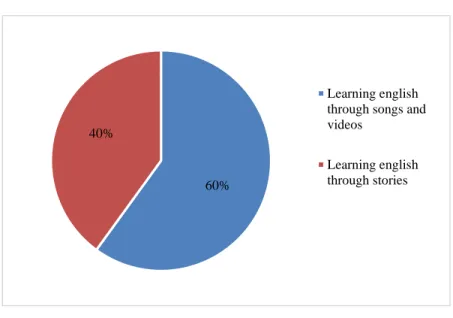
(14) 13 there were no meaningful activities such as drawing, singing, coloring or any hands-on activities for students to practice this vocabulary. All the same, through the observations made, it was seen that memorizing might be a difficult process for most of the students due to the fact that most of them could not remember the vocabulary the teacher taught them. For this reason, most of the time, the teacher needed to help students with the correct answers when it came to asking them the vocabulary learnt. On the other hand, it was evident that the students did not develop any activity about writing, reading or speaking or any other kind of exercises during the session of class, they merely listened to their teacher. In this sense, it seemed to be that speaking, reading and writing skills were left aside. The teacher did not emphasize on the relationship between the four skills. Consequently, the language was split into too many parts and the students could not see learning as a whole. Taking into account the questionnaire answered by the students, 95% of them stated that they liked learning English; either because they considered it important or because they enjoyed learning new things in a foreign language. On the one hand, 60% of the students said that they would like to learn English by doing activities related to songs and videos. On the other hand, 40% stated that they would like to listen to stories and use puppets in order to learn English. Based on the above, it was possible to say that although most of the students liked the English class, they would like to have more meaningful activities to develop that go beyond repetition and memorization..
(15) 14 Figure 1: Students’ Questionnaire. Learning english through songs and videos. 40%. 60%. Learning english through stories. Based on the percentages presented above and despite the students’ desire to learn English through songs and videos, the research was centered on the use of storytelling, as there were not the necessary technological resources at school to conduct the study on that topic. In order to work with videos and songs, at least a T.V and a radio were needed in the classroom, but there was only an old and small T.V, which did not function. The computer room was used once a week, one hour maximum, and there were not enough cmputers to cover the number of students. Therefore, the research was developed based on the second option of the questionnaire’s results: stories. Regarding the writing and reading skills, it is important to note that there was no emphasis done. The students did not write or read any words or even images during the English class; they just had to repeat what they listened. According to the head-teacher, this was to avoid interference with the native language learning, as students were just beginning that process. For instance, the students did not have any English book or notebook to read or write on. Thereby, the learning of a foreign language, in this case English, was isolated and seemed to be far from.
(16) 15 the students context due to the fact that there was not a connection between the vocabulary they were taught and students’ reality. Furthermore, and taking into consideration the results of the questionnaire applied, 80% of the students stated that they prefer working in groups or in pairs than working individually. Also, it was possible to see that hardly ever did the students interact among them; there was only teacher-student interaction but there was no space for student- student interaction while in class. Thus, the students did not have the possibility to be exposed to a real speaking practice with their classmates, nor only because there was just teacher-student interaction, but also because they were limited by vocabulary and knowledge of the target language in general. The observations made showed that the students could not communicate in English because they did not know how to do so. Every time they wanted to express themselves in English, they were not able to do it, so they remained silent or ended up speaking in Spanish. Moreover, the interaction with the teacher was based only on answering simple questions she asked. For this reason, it is also necessary to highlight the lack of emphasis on the speaking skill. Classroom interaction is a tool that helps the students to get involved in their own learning process. So, speaking and interacting with others in the classroom should be fostered by exposing students to an appropriate environment where student-student interaction can take place in groups or pair work. Concerning the cognitive learning of the students, it was possible to observe that most of the students were visual and kinesthetic learners. When the head teacher taught them the target vocabulary using pictures, students internalized the words more easily and it was faster for them to remember them. Also, when it came to realizing any physical movements about following commands or instructions, the students showed interest in participating actively..
(17) 16 Based on the diagnostic test administered to the students, the results showed that the knowledge students had of the target language was much reduced and almost null. When the diagnostic test was applied and the instructions given in order for the students to develop the test, most of them did not understand what they had to do and no one knew what to answer. According to the “Estándares Básicos de Competencias en Lenguas Extranjeras: Inglés” (2006) for the first cycle of education, children need to start working on the oral interaction process in English to communicate effectively in the classroom. Also, they should be able to answer questions about themselves, other people, objects and places of their environment. But after analyzing the results of the tests, it was seen that the students did not have even the basic knowledge of English a first grade student should have. Above all, the results also showed that in any of the four skills tested: listening, writing, speaking and reading, the students did better. Finally, it is worth noting that although many problems related to the four skills were portrayed, there were some strengths that also needed to be highlighted. One of them was the fact that the students were willing to learn English, they showed interest in the English class and were always expecting new experiences. Also, most of the students were very visual and enjoyed hands-on activities in which they could be part of their own learning process. Additionally, they liked participating in class and answering correctly. However, one of the main concerns at this stage was the oral skill, since there was no emphasis on it in the English class and students did not have the chance to interact orally between them while learning the target language. 1.2. Rationale of the Study Since language teaching aims at addressing learners towards the use of language in. order to communicate with others, speaking is a crucial aspect of language learning. However, along the years, the implementation of proper strategies and techniques has emerged as a vital.
(18) 17 issue to assure the development of oral skills and accuracy in the students along their learning process. It is a hard task to make students aware of the importance of developing oral skills when learning a foreign language. Taking in account that oral interaction is an important aspect in the development of EFL learning processes and based on the diagnostic test applied, communication in the English class was limited and hindered mainly by the students’ lack of vocabulary and knowledge of the target language in general. Consequently, factors such as team and pair work and building social knowledge were affected. That is why, this research study aims to apply storytelling strategies to develop oral interaction skills. Furthermore, this project might contribute to the reaching of the National Plan Standards proposed by the Educational Ministry (2014), where the ideal is to have a systematic process for preparing bilingual students to use the target language in the right communicative contexts. Besides, learning speaking skills is very challenging for students in EFL contexts since they have very few opportunities to use the target language inside and outside the classroom. On the one hand, the speaking practice within the classroom was often based on the teacher asking questions and the students giving answers; and on the other hand, the lack of exposure to authentic English language environments that allow them to use the target language for communication in a natural way. In this sense, this pedagogical proposal aims to develop and foster oral interaction skills through the use of storytelling at early learning stages, which may allow students to start communicating in English since the beginning of their learning process. Through the implementation of oral activities in the EFL classroom, students are given the opportunity to interact with others while developing their own oral skills. Additionally, this research is useful.
(19) 18 because it may give language teachers an overview of possible ways to improve and develop speaking skills in students. And also because the methodological strategy proposed in this project, as it is storytelling, may allow students to express their feelings, opinions, and ideas regarding a topic, instead of just repeating what they hear. Likewise, in this project different oral communication activities were designed in order to keep students’ interest and attention alive. In addition, the project is intended to change that vision of language that assumes learning as separated skills that function in isolation, forgetting the importance of linking such skills in order for students to understand and learn the language as a whole rather than as a fragmentary process. Furthermore, this work may contribute to the school and its teachers since it presents a different view of understanding and teaching language, and could be a meaningful resource for teachers who might be interested in implementing it in their teaching practice. 1.3. Statement of the Problem Taking into account that the English class was centered on repetition and memorization,. the students were limited to listening but they did not have the chance to work and explore the other learning skills. So, keeping in mind that one of the main goals of teaching a language is to lead the learners towards the use of such language to be able to communicate themselves (Brown, 2001), it was possible to see that this communicative function of language was not being reached, but on the contrary, it was left behind. Therefore, through the observations and field notes made, it was noticed that the students recognized isolated vocabulary, but they were not able to use it in oral communication with others because they did not know how to speak in English. Basically, the students were said to repeat and memorize words only..
(20) 19 During the observations carried out in the school, it was also seen that it is still more common to emphasize on the aspects of traditional education. That is to say, learners are passive absorbers of content and the teacher is seen as a source of information and authority. Also, the lesson’s content and delivery are considered to be the most important and the students are said to master knowledge through drills, repetition, and memorization. Hence, for the present case, the use of the language for human communication tends to be forgotten and left aside and also to be simplified into a mere exercise of memorization. All in all, the results of the observations and the collected data showed that the development of the speaking skill of the foreign language was being affected because of the deficiency in the communicative practices. Practice that should be focused on oral communication and interaction; instead of on repetition and memorization only. In conclusion, the main aim of this project was to favor an environment where oral interaction skills in the use of English could be developed in the population through the implementation of storytelling. The main focus is on the speaking skill, although is inevitable the benefits and the connection that storytelling has also on the development of the listening skill. The storytelling was based on students’ ages and preferences and provided them with content, simple structures, and new vocabulary in context in order to enhance their English knowledge. 1.4. Research Question How might second grade students’ oral interaction skills be developed by the use. storytelling at Domingo Faustino Sarmiento School?.
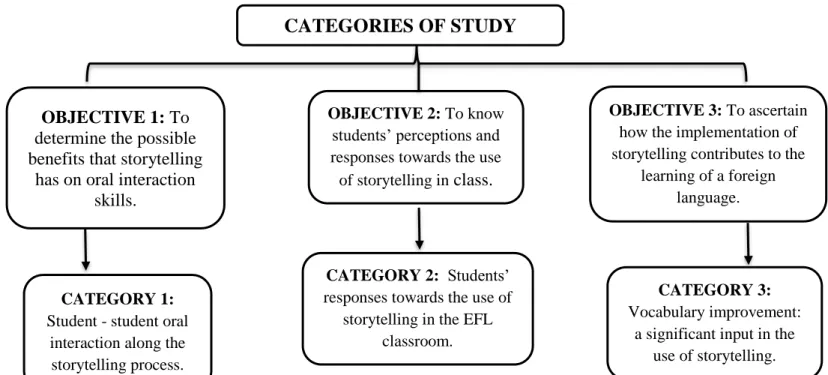
(21) 20 1.5. Objectives 1.5.1. General Research Objective. To ascertain how the use of storytelling contributes to the development of oral interaction skills of second grade students at Domingo Faustino Sarmiento School. 1.5.2. Specific Research Objectives. • To determine the possible benefits that storytelling has on oral interaction skills. •. To know students’ perceptions and responses towards the use of storytelling in the EFL classroom.. •. To ascertain how the implementation of storytelling contributes to the learning of a foreign language.. •. To design and implement a pedagogical intervention in order to use storytelling as a methodological strategy to develop oral interaction skills between students..
(22) 21 CHAPTER II THEORETICAL FRAMEWORK AND STATE OF THE ART In this part of the study, the theoretical framework and the concepts regarding speaking and storytelling, which aimed at contributing to a better understanding of the research problem, are presented and described. Also, the state of the art that guides this project is discussed. 1.6. Theoretical framework In first place, this section displays some theoretical aspects of the nature of speaking skill. in relation to communicative competence as well as the definition of storytelling and its elements. The theoretical background presented here, concerning speaking aims at understanding the concept of speaking, the elements this skill includes, and the oral communicative skills necessary when teaching a language. In this sense, some of the authors taken into account to define speaking in this project are Brown (2001) and Bygate (1987). 1.6.1. Speaking & Interaction. Firstly, Bygate (1987) stated that “speaking is a skill which deserves attention as much as the literary skills in both native and foreign languages” (p. 67). If students feel confident and comfortable when speaking, they will be able to interact better in daily real situations. As it is known, speaking is a complex act that conveys different elements interacting to produce effective communication. Hence, sometimes students do not feel confident enough to express themselves for different reasons. This might be due to lack of confidence, limited language or vocabulary knowledge; but very often, students do not know how to express their ideas even in their mother tongue. Therefore, Bygate (1987) says that there are two aspects that need to be considered in order to reach a communicative goal: knowledge of the language and skill in using this knowledge..
(23) 22 That is to say, it is not enough to have certain knowledge of the language, but the speaker of this language should be able to use this knowledge in different real situations: People do not merely know how to assemble sentences in the abstract: they have to produce them and adapt to the circumstances. This means making decisions rapidly, implementing them smoothly, and adjusting our conversation as unexpected problems appear in our path. (Bygate, 1987, p. 3) Based on the above, Bygate sees speaking as a language skill that consists of two main components: the production skills and the interaction skills. This means that the speaker should not only acquire the knowledge of the language and use it in the oral production; but also, he should be able to interact actively with others when using such a language. In other words, both speakers and listeners must be good at processing and understanding spoken language, as well as at being good communicators and facilitators of language. On the other hand, Brown (1994), Burns & Joyce (1997) states that speaking is an interactive process of constructing meaning that involves producing and receiving and processing information. It is a process in which its form and meaning depend on the context where it occurs and takes different elements into account such as the participants, their experiences, the internal and external contexts, the physical environment and the purpose of speaking. Additionally, Brown (2001) suggests that the main goal of learning a foreign language is to be able to speak and to communicate in that language. It means not only learning about language´s structure, grammar, and vocabulary, but also about the communicative nature of language. In this respect, language is understood as a tool for communication. A tool that allows us to communicate with others, to express our thoughts and ideas, and to know others’ as well..
(24) 23 Thus, the importance of speaking skills is huge and inevitable for the learners of any language and that is why, the purpose of this project is to encourage the development of oral interaction skills in the process of learning a foreign language. In regards to interaction, Brown also says that “interaction is the heart of communication, it is what communication is all about” (2001, p. 165). Interaction refers to sending and receiving messages, to interpret those messages in a certain context, to negotiate meanings with others, and to collaborate between them in order to accomplish language purposes. In other words, oral interaction is the exchange of thoughts, ideas, feelings, knowledge, and opinions between two or more people and which produces a reciprocal effect on each other. Taking into account that the main aim of learning a language is to use it in communication in its spoken or written forms, classroom interaction is a key to reach that goal. As Robinson (1997) states: “Interaction is the process referring to “face-to-face” action. It can be either verbal channeled through written or spoken words, or non-verbal, channeled through tough, proximity, eye-contact, facial expressions, gesturing, etc” (Robinson, 1994, p.17). Based on the previous statement, classroom interaction consists of two types: non-verbal interaction and verbal interaction. Non-verbal interaction refers to behavioral responses in class, such as head nodding, hand raising, body gestures, and eye contact. On the contrary, verbal interaction contains written and oral interaction. While written interaction refers to students interacting with others through written words, oral interaction implies that students interact with others by speaking in class, answering and asking questions, making comments, and taking part in discussions. Classroom interaction can occur between the teacher and learners or between learners themselves: that is teacher-student interaction and student-student interaction. Teacher -student.
(25) 24 interaction is the most common form of interaction followed in different classrooms. Under this type of interaction, the teacher often asks questions to students and students answer the questions and vice versa. It is usually initiated and controlled by the teacher. Whereas student-student interaction occurs among learners. In here, the teacher´s role is to monitor the class, as learners are the main participants. As to the present research, both verbal and non-verbal interaction are taken into account in the EFL learning process, since all of the factors around these two types of interaction can lead to a better and easier learning of the target language. Hence, in this research study oral interaction is seen as a process. A process of exchanging and expressing information with others verbally and non-verbally. In the first stages, interaction might be mainly teacher-student interaction but in the continuous learning process, it may become more autonomous, that is more student-student interaction. Based on the concepts presented above, this research project takes as its basis the theoretical aspects of speaking and interaction given by Bygate (1987) and Brown (2001), since I considered them as two of the most complete theories that define these two aspects, its components, functions, and their importance when comes to learning a language. And also because these theories are directly related to the focus of this present research which is the development of beginners´ oral interaction. In the following section, the attention will be centered on defining and describing storytelling in the EFL classroom. 1.6.2. Storytelling. It is well known that there are many different techniques and strategies that can be used in the classroom in order to improve the teaching and learning processes. For instance, Brown (2001) states that techniques are the specific activities manifested in the classroom. In other.
(26) 25 words, a technique is any of a wide variety of exercises, activities, or tasks done in the language classroom. Then, one of the many strategies that can be used and applied in classroom activities is storytelling. Through the time, storytelling has been assumed as the practice of telling stories for all kinds of societies. In fact, there is an association in charge of the preservation and perpetuation of the art of storytelling named the National Storytelling Network, established in the United States. The association defines storytelling as “the interactive art of using words and actions to reveal the elements and images of a story while encouraging the listener’s imagination” (National Storytelling Network, 2015). In this context, storytelling goes beyond the only act of retelling a story through the use of speaking skills. It is also the act of involving students into the story and in this way encourage them to develop their imagination. On the one hand, Cruz (2001) explains that the storytelling is an ancient oral art that can demonstrate the power of words. Storytelling not only helps to develop different aspects of language learning such as the speaking and listening skills, but also to increase comprehension, and to create mental images on students. Besides, it makes students enjoy language learning and is an entertaining practice that stimulates children’s imagination. On the other hand, storytelling has special pedagogical benefits for the foreign language classroom and learners. For instance, Rossiter (2002) points out that: Stories are effective as educational tools because they are believable, rememberable, and entertaining. The believability stems from the fact that stories deal with human-like experience that we tend to perceive as an authentic and credible source of knowledge. Stories make information more rememberable because they involve us in actions of the characters. In so doing, stories invite active meaning making. (p.19).
(27) 26 Taken into account the above, foreign language learners can benefit from storytelling because stories help them to develop communication skills and encourages shared learning experiences. Additionally, through the stories, learners become aware of cultural values different from theirs, sharpen their memory and develop the ability to predict and infer. As Wendelin (1991) states (cited in Farris, 1993), telling stories enhances oral language and sharpens listening. That is to say, storytelling is seen as a shared experience between the teller and the listener. It offers a natural language experience for students as it enables them to play an important role in reconstructing the story. 1.7. State of the Art The following section presents a review of the research background related to the use of. storytelling as a pedagogical strategy when working with oral communication skills. This review provides a broad understanding of the main constructs that guide this research project. In first place, Edith Díaz, Claudia Rodríguez and Lucía Triana (2002) from the National University of Colombia, carried out a research project named Encouraging Speaking through the use of Storytelling. The project was carried out with second graders at Nuevo Gimnasio Cristiano School. The main objective of this research was to evaluate the progress of basic oral production like greetings, expressions, routines, asking and answering questions, through the use of continuous repetition of stories they decided to implement. The researchers used the “Spotlight on Literacy” method, which included the four language skills in a way that would be more related to students´ interests and would encourage them to practice meaningful sentences instead of learning a list of disconnected vocabulary. As a result, they found that the students enjoyed the stories, which were illustrated to help understanding and.
(28) 27 were able to understand the questions and answered them correctly. Additionally, students became more confident and were less afraid of speaking. This study is useful for this research because of the pedagogical strategy it used. It showed the importance of using pedagogical strategies that aimed at setting learning in contexts in order to make students aware of the purposes of using language. A second study done related to this present project is the one entitled Teaching English through Stories: A Meaningful and Fun Way for Children to Learn the Language (2010). This action research project was carried out by Nohora Inés Porras González at a public elementary school in Bucaramanga, Colombia. The population was children from first, second and third grades. The main objective of the project was to use storytelling for teaching English to young learners in a fun and meaningful way. The specific objectives were to create stories based on students’ interests and likes, to teach the language in context around stories, and to make foreign language learning a fun and lifelong process for the young learners. The results showed that different aspects in the classroom were improved and increased such as children’s motivation, participation in the different activities, comprehension of the stories, and acquisition of the new vocabulary. Also, the researcher found that storytelling made the language learning process meaningful and fun for the children as the stories were appealing and interesting to them. The previous study is relevant for this current research mainly for the pedagogical strategy used. The stories used for storytelling were created based on children´s likes and interests. Consequently, stories became the central component of the process and children’s response was positive every time they listened or read a story. Additionally, the results showed the importance of implementing storytelling in the classroom, not only to increase students´ motivation towards.
(29) 28 learning, but also, to improve understanding of the stories and their language learning process. I consider that these are important aspects one should take into account when implementing a new or different pedagogical tool in the English class. Another related research was done by Andrés Felipe Vargas and Camilo Andrés Zamora form Universidad Pedagógica Nacional, called Improving the Speaking Skill through the Use of Fables in Third Grade Students from Liceo Femenino Mercedes Nariño carried out in 2015. The authors´ objective was to ascertain the impact of using fables as a tool to improve the speaking skills in third grade students at Liceo Femenino Mercedes Nariño School. In their study, they stated that the use of fables strengthens, on the one hand, prior knowledge of the students thanks to their familiarity with the context, and on the other hand, it strengthens the rates of attention and motivation because students are exposed to stories that are entertaining and are connected to their reality. The implementation of this pedagogical proposal revealed that the fables helped to motivate students towards the English class and they enjoyed the activities proposed around the pedagogical approach to actively participate in all of them. In this sense, they found appropriate environments for using English without being forced to do so but showing and expressing what they knew. In terms of vocabulary, students were able to use new vocabulary and expressions to interact among themselves and with the teacher-researchers too. They also understood that it is possible to produce something in English without translation. The previous research, as the current one, looked for enhancing the communicative skills and participation in order to strengthen and make meaningful the learning of a target language. In this sense, this study was relevant for the current research as it provided an overview of the different advantages of using literature with beginners as a useful strategy to teach a language..
(30) 29 To sum up, the previous studies were useful for this research as they provided an overview of how storytelling has positively impacted children’s oral skills development in the EFL learning contexts. Additionally, those studies portrayed the different teaching aspects that can be improved through the use of storytelling..
(31) 30 CHAPTER III RESEARCH DESIGN In this chapter, the elements of the research design which are the research paradigm and the research method used in this intervention are presented. Also, the data collection instruments and the procedures necessary for this research, as well as the ethical issues are explained and defined. 1.8. Type of Research Creswell (1994) defines Qualitative Research as follows “Qualitative Research is an. inquiry process of understanding based on distinct methodological traditions of inquiry that explore a social or a human problem.” Qualitative Research is a method of inquiry employed in exploring issues, understanding phenomena, and making sense of data. (Denzin & Lincoln, 2005). In other words, this type of research focuses on understanding the reality of a social group by living their experiences and the environment in which they are immersed. Thus, the current research was located in the qualitative research paradigm because it aimed at understanding educational phenomena by attempting to find answers to research questions. Also, because it was not focused on measuring any variables, but on drawing out understandings and perceptions about an educational phenomenon taken from a real context which could be described as students were situated and embedded in local real contexts. Additionally, this type of research allows the researcher to build a complex picture, to analyze words, to report detailed views of informants, and to gather and characterize data from their context and social behaviors. Moreover, this study was framed into the qualitative research paradigm also because it aimed to describe a phenomenon as a whole. It means that the population, procedures, and events were not taken by implementing isolated variables that led to a single result; but there was a.
(32) 31 holistic perception and description about all of factors involved in the research. Additionally, the qualitative paradigm allowed the researcher to gather and characterize data from the students’ oral interaction as well as from their context and social behaviors. Also, it provided the opportunity to reflect about the researcher’s teaching practice and include it as an important part in the investigation process. 1.9. Research Method The method selected for carrying out this current research was action research. Richards. (2003) states that “action research has two essential elements: to improve and to involve” (p.42). It is characterized as research that is done by teachers themselves which are interested in improving the teaching and learning processes. Moreover, action research allows teachers to inquire about learning problems and reflect upon their pedagogical practice. In addition, Burns (2009) in her book “Doing Action Research in English Language Teaching”, provides the following definition as regards to action research: Action research (AR) can be a very valuable way to extend our teaching skills and gain more understanding of ourselves as teachers, our classrooms, and our students. One of the aims of AR is to identify a “problematic” situation or issue that the participants consider worth looking into more deeply and systematically. So, the central idea of the action part of AR is to intervene in a deliberate way in the problematic situation in order to bring about changes, and, even better, improvements in practice. (p. 2) Thereby, the current project fell into the action research method since it was a type of participatory and inclusive research done by teachers in their teaching practice. It aimed at identifying a problematic situation and intervening it in order to lead to change and.
(33) 32 improvements through a reflective research cycle that comprised planning, acting, observing, and reflecting. (Burns, 2009) Regarding the reflective research cycle, Bailey (2007) states that action research for language teachers is “an approach to collect and interpret data which involves a clear, repeated cycle of procedures” (p.36). Here, the researcher has to go through the following steps: develop a plan of action to improve what is already happening in the classroom, to implement the plan, to observe the effects that this plan has over the community and the problem itself, and to reflect on the effects to improve or change the initial plan if it is necessary. Thus, this study was considered to be an action research, not only because of the aspects already mentioned, but also because it was a dynamic process that followed the repeated cycles proposed by the action research. Through these cycles one can lead to changes required for the academic and social improvement. 1.10. Data Collection Instruments In order to collect data, the following three instruments were used to ensure the collection. of valid and reliable information: field notes, students’ logs, and audio recordings. This process was done with the purpose of answering to triangulation issues and to the necessity of making my study valid and reliable. As it is shown by Burns (2010), action research can achieve objectivity through triangulation. That is to say, a combination of different types of data that allows the researcher to cross verifying the same information from different perspectives. The following table is a visual representation of the data collection intruments used..
(34) 33 Table 1 DATA COLLECTION INSTRUMENTS Research Question. Source 1. Source 2. Source 3. How might 2nd grade students’ oral interaction skills be developed by the use. Field notes. Audio Recordings. Students’ logs. storytelling at Domingo Faustino Sarmiento School?. Field Notes. Field notes are some specific formats that contain written descriptions, statements, and explanations of the different aspects that appeared during a specific situation or time, as it is stated by Schatzman & Strauss (1973). Using field notes helped to gather specific information of the observations done and to write down aspects of the lesson observed in a wellstructured and organized way, in order to go further in the process of analysis. Some of the principles and aspects included in the field notes were: date, grade, time, place of observation, name of lesson, specific facts, details of what happened at the site, and comments. Audio Recordings. As Burns (1999) states, this term is related to audio or video recordings that provide objective records of what occurred inside the classroom, which can be reexamined. These recordings are written using conventions for identifying speakers and indicating pauses or any necessary non-verbal information. So, through audio recording I was able to understand, interpret, and analyze how students’ oral interaction skills were shaped and improved by the implementation of storytelling in the classroom. Student’s Log. According to Burns (2010) a log is a classic tool that allows a person to record his/her beliefs, thoughts or ideas about a specific event or practice. Hence, significant reflections and perspectives could be known through the students’ log taking into account the date, the story told, and the activities developed around the story. Based on the population and.
(35) 34 the research objectives of this study, a student’s log was used to collect data, not only because it was structured and organized, but also because it was more flexible to the answers of young learners. Consequently, three logs were implemented to record the children’s perspectives about the use of storytelling, the project itself, and the English class (See Annex 4). 1.11. Data Collection Procedures The three data collection instruments explained above were implemented in the following. way: the teacher-researcher wrote down field notes in every class session along the cycles in order to collect information about the students. The field notes were structured taking into account aspects such as the name of the school, the class time, the date, the name of the lesson, the class descriptions, and the comments or reflection. The students’ logs were applied at the end of every cycle. In this research, students’ logs intended to collect information about the student’s perception on the class activities, as well as to check their learning in regards to the topics of each cycle. Finally, the audio recordings were taken every time students produced something orally in class. The data collected in the audio recording was analyzed to see the possible development of oral skills through the use of storytelling. 1.12. Ethical Issues In order to avoid ethical issues, parents’ permission for students to participate in this study. was asked through a consent form (See Annex 5). In this consent form, the parents would say whether or not they allowed their children to be part of the study. Also, it is worth mentioning that students’ identity was not revealed at any moment; instead, students were called with a fictitious name that they selected if they liked to..
(36) 35 To conclude, in this chapter the elements of the research design were presented: type of research, research method, data collection instruments, data collection procedures and ethical issues. In the following chapter, the pedagogical intervention which comprises the vision of language, vision of learning and teaching methodology, as well as a summary of the lessons to be applied are displayed and defined..
(37) 36 CHAPTER IV PEDAGOGICAL INTERVENTION The following chapter outlines the pedagogical basis on which this project was supported. It comprises the visions of language and learning, and the teaching methodology. In addition, the implementation phases this project went through are presented and explained. 1.13. Vision of Language The vision of language in this study is language as self-expression. Vera, Chapetón, and. Buitrago, (2016, In press) state that language is the means “by which we build up personal relationships, express our emotions and aspirations, and explore our interests” (p.65). These authors say that self-expression is related to personal meaningfulness, how people make sense, and construct their realities. Under this vision of language, learners are encouraged to express their feelings, thoughts, and personal experiences in a supportive environment with no fear of judgment or rejection; in this way, they are able to find personal meaningfulness while learning the language. (Vera, Chapetón, and Buitrago, 2016). Therefore, in the present study language is seen as a tool, a means for communication and expression of students’ likes, dislikes, and interests. Under this conception, students use language in ways shaped by the interaction with others, language is at the center of students’ construction of reality and identity. It allows students to express freely their opinions, thoughts, and interpretation of the stories with no fear of judgment, and last but not least, students build up relationships not only with the teacher, but also with their classmates and with the story itself. 1.14. Vision of Learning In this project, learning is seen as experiential. According to Vera, Chapetón, and. Buitrago, experiential learning “implies a naturalistic form of learning or picking up the language.
(38) 37 which requires direct experience of the language” (2016, p. 78). It emphasizes the idea of learning by doing which requires two important factors: the use of language for communicative purposes and the exposure of input in the language that is being learned. In experiential learning, students learn by doing, by experiencing knowledge themselves. In this sense, the participants are first immersed in a storytelling experience and in all the activities developed around it, and then, they are encouraged to reflect about the experience in order to develop new skills, new attitudes, or new ways of thinking (Lewis and Williams, 1994). Experiential learning is characterized by having a mixture of content and process, an absence of excessive judgment, by encouraging the role of reflection in the students, by creating emotional investment, and above all, by developing meaningful relationships in the classroom. 1.15. Instructional Design This proposal is centered on the use of storytelling as a pedagogical strategy to develop. oral interaction skills in first graders. In this sense, storytelling is seen as a “theory of symbolic actions, words, and/or deeds that have sequence and meaning for those who live, create or interpret them” (Fisher, 1984, p.56). Telling stories makes the speaking activity become joyful for all its participants since it could help students tell the chronological events of the story easily. Through storytelling, students can not only demonstrate their comprehension of the story, but also express if they feel identified with it or with any of the characters or events of the story. It allows the participants to express their likes and dislikes, the connection the story has with their lives and with reality, and to develop their imagination and creativity while they enjoy learning the language. Likewise, Vale and Feunteun (1995) state that storytelling is a strategy in teaching language. It.
(39) 38 demonstrates the value of practical tasks as social, motivational, and language teaching tools in the learning situation. Furthermore, the above authors claim that storytelling is a good teaching strategy because stories promote students´ interest, help students create vivid mental images in order to understand the concept easily, and stories activate the thinking process as well. Additionally, stories take information out of isolation and place it in a real context making that new information meaningful and memorable for students. Besides the positive aspects of storytelling already presented above, there are many more advantages of using storytelling in the EFL classroom. Regarding the educational advantages of storytelling, we can find that telling stories interests students, lowers affective filters (Krashen, 1995), and allows learning to take place more readily and more naturally within a meaningful interactive communication context. Pesola (1991) describes storytelling in foreign language classrooms as “one of the most powerful tools for surrounding the young learner with language” (p. 129). All in all, storytelling is promoted as fostering natural communication allowing students to experience authentic language input. Regarding the structure of the research, this study will have three stages that need to be followed when implementing it in the classroom: pre-storytelling, during storytelling, and poststorytelling. In the first stage or pre-storytelling, the main focus is to capture children’s attention, to connect to their prior knowledge and experiences, to teach them new vocabulary or expressions that will appear in the story, and also to have students predict what will happen in the story based on the book cover, the tittle of the story, the pictures of the scenes, etc. During the second stage or during-storytelling, the teacher tells the students the story and involves them as if they were part of it. It means, that along the storytelling, the teacher may ask students.
(40) 39 comprehension, yes/no, and wh questions. Also, the teacher can ask children to predict or infer what comes next in the story. In the post-storytelling stage, students produce something orally in order to put into practice what they learnt during the previous two stages. Some of the activities in this stage could be group retelling, description of their favorite character, creating their own ending, role playing, story mapping, and dramatization. In regards to the interaction, it will be fostered throughout the three stages in the following way: in the first two stages interaction will be developed mostly in the way of studentteacher interaction, since students at these stages are just getting familiar with the stories and their content, and still do not have enough language input to interact by themselves with their classmates. But in the last stage, the focus will be on student-student interaction, as in this stage they start expressing themselves with others regarding the story and what they learnt from it. 1.16. Pedagogical Intervention The pedagogical intervention was developed in two cycles. Each cycle comprised. different lesson plans (Annex 9) and each lesson followed the stages of storytelling explained above. There were two stories covered, one for each cycle. In each cycle, students recognized and had a first contact with storytelling in a foreign language since they heard, interacted, and learnt from the stories. This first part of the cycle comprised an immersion of students into the storytelling practice by exploring new vocabulary, words, expressions, a different way of learning, and the use of authentic materials that were used to support and make visible the story told. Then, students were exposed and participated in the telling of the story as well as carry out various activities around it in order to start articulating what they learnt in the previous.
(41) 40 stages. Therefore, create a natural environment that allowed students to express themselves and to develop their oral production and interaction based on the story learnt. When the first cycle ended, the reflection process proposed by action research took place. The data and results gathered from the first cycle were analyzed and a reflection process was made based on the positive and negative aspects obtained; also the necessary adjustments and improvements were made in order to apply the second cycle. The following table (table 2) shows the cycles, their stages, the objectives and the estimated time of each implementation. Table 2. Timeline C. Sessi. Date. Stage. Objectives. on 1. February 22nd,. Introduction. To introduce each other and to let students know what the purposes and the expectations of the research are.. March 1st, 2017. Pre-storytelling. To stablish a good climate setting and environment to storytelling. To test previous students´ knowledge in regards to the content of the stories.. March 08th, 2017. Pre-storytelling. To make students familiar with the content of the first story “Little red hen” To teach new vocabulary and expression that will appear in the first story related to animals, verbs, and adjectives.. March 15th, 2017. During-. To have a first contact with storytelling, to hear, understand and interact with the first story. To identify in the story vocabulary learnt related to animals.. 2017. 1 2. 3. storytelling. 4 March 22nd, 2017. 5. storytelling. To listen and participate in the first story by using statements with “It is a ____”. To learn the expressions “I like…. And I don´t like….”. Post-storytelling. To encourage students’ oral productions and interaction by students making simple descriptions of what they heard in the story such as: I can see a __________. It is big /blue. During-. March 29th, 2017. 6.
(42) 41 To do a story mapping exercise. April 5th, 2017. 7. END. 2. OF FIRST. To start expressing orally the likes and dislikes about the story learnt. To interact with others by role-playing the story. Post-storytelling To create a drawing and to describe it orally using simple sentences such as “It is a ___, It is red, It likes ____” about what students learnt from the first story. CYCLE ANALYSIS AND REFLECTION PROCESS. 8. April 12th, 2017. Pre-storytelling. 9. April 19th,2017. Pre-storytelling. 10. May 3rd,2017. Pre-storytelling. 11. May 10th,2017. During. To make students familiar with the content of the second story “Things I like” To teach new vocabulary, words and expressions related to the second story: action verbs and hobbies. To teach action verbs and to get familiar with the question and answer: “What is she/he doing? He/she is playing. To put into practice the vocabulary and expressions learnt in the last two sessions by doing different written and speaking exercises. To have a second approach to storytelling by hearing and learning with the second story.. storytelling. 12. May 17th,2017. During-. To listen to the second story and answer yes/no and simple wh questions.. storytelling May 24th,2017. To identify in the story vocabulary learnt about actions verbs.. storytelling. 13. 14. During-. May 31st,2017. Post-storytelling. June 07th,2017. Post-storytelling. To express their likes and dislikes in terms of the second story: the character and events they liked or they did not like and if they liked or disliked the ending of the story. To use pictures so that students can organize the story and retell it to a classmate. To articulate all the vocabulary and expressions learnt in order to dramatize the story by interacting with others.. 15. 1.17. Significance of the Results By implementing this pedagogical proposal I expect to reach the objectives set in chapter. number 1 and to answer my research question. Furthermore, I expect to show the significance.
(43) 42 and positive aspects of using storytelling as a useful pedagogical strategy to develop students’ oral interaction in the EFL classroom. Also, the results of this study aim at helping future language teachers, the teaching field in general, and principally the students, as it gives them a different way of approaching the teaching and learning processes. To conclude, storytelling is a pedagogical strategy that educates, illustrates, and inspires its participants. Storytelling not only makes language learning easier and meaningful for students, but it also gives relief from the routine and stimulates their mind. It is a great motivator for teachers as well as for students..
Figure

Documento similar
In doing so, central and subnational governments must fulfill one of the main objectives of the National Plan of Good Living (Plan Nacional del Buen Vivir), that is,
Based on this situation, the Ministry of Economy of the state began a study to propose a strategy for the integral development of this region, favoring enterprises that use mainly
rous artworks, such as sonorou s poetry; d) instances of nOlHu1islie music, such as sonorous activiti es with soc ial, bu t not necessarily aes thetic, funct ions. Lango
On the other hand at Alalakh Level VII and at Mari, which are the sites in the Semitic world with the closest affinities to Minoan Crete, the language used was Old Babylonian,
The main goal of this work is to extend the Hamilton-Jacobi theory to different geometric frameworks (reduction, Poisson, almost-Poisson, presymplectic...) and obtain new ways,
The paper is structured as follows: In the next section, we briefly characterize the production technology and present the definition of the ML index as the geometric mean of
teriza por dos factores, que vienen a determinar la especial responsabilidad que incumbe al Tribunal de Justicia en esta materia: de un lado, la inexistencia, en el
We analysed the prevalence of gross (GH) and microscopic (mH) haematuria in 19,895 patients that underwent native renal biopsies from the Spanish Registry of Glomerulonephritis..
