
Influencia de la competencia metafórica en lengua de señas sobre la comprensión lectora en un grupo de estudiantes sordos con estilo cognitivo documentado
367
0
0
Texto completo
(2) INFLUENCIA DE LA COMPETENCIA METAFÓRICA EN LENGUA DE SEÑAS SOBRE LA COMPRENSIÓN LECTORA EN UN GRUPO DE ESTUDIANTES SORDOS CON ESTILO COGNITIVO DOCUMENTADO. TESIS DOCTORAL. YENNY RODRÍGUEZ HERNÁNDEZ. Director CHRISTIAN HEDERICH MARTÍNEZ Ph.D. UNIVERSIDAD PEGADÓGICA NACIONAL DOCTORADO INTERINSTITUCIONAL EN EDUCACIÓN BOGOTÁ, D.C 2017.
(3) Dedicatoria A mi padre Gracias por el amor, los consejos, la compañía, el apoyo y por estar siempre a mi lado. Desde el cielo estarás acompañándome en mi próxima meta. Te extraño….
(4) FORMATO RESUMEN ANALÍTICO EN EDUCACIÓN - RAE Código: FOR020GIB. Versión: 01. Fecha de Aprobación: 10-10-2012. Página 1 de 14. 1. Información General Tipo de documento. Tesis de grado de doctorado. Acceso al documento. Universidad Pedagógica Nacional. Biblioteca Central. Título del documento. Influencia de la competencia metafórica en lengua de señas sobre la comprensión lectora en un grupo de estudiantes sordos con estilo cognitivo documentado. Autor(es). Rodríguez Hernández, Yenny. Director. Hederich Martínez, Christian. Publicación. Bogotá. Universidad Pedagógica Nacional, 2017. 369 p.. Unidad Patrocinante. Universidad Pedagógica Nacional. Palabras Claves. SORDO, METÁFORA COGNITIVA, LECTURA, LENGUA DE SEÑAS. 2. Descripción Tesis de grado donde el autor describe la relación que se da entre la competencia metafórica en lengua de señas colombiana LSC, la comprensión lectora y el estilo cognitivo en la dimensión DependenciaIndependencia de Campo en un grupo de estudiantes sordos. La investigación se desarrolló en tres fases. La primera, la exploratoria tenía como objetivo identificar y clasificar las metáforas cognitivas presentes en la lengua de señas colombiana para ser usadas como estímulos en una prueba que midiera la habilidad de la persona para comprender y producir metáforas. La segunda, la de diseño, buscaba el diseño de una prueba de competencia metafórica y de un programa pedagógico para desarrollar la competencia metafórica en lengua de señas. La tercera, la experimental tenía como objetivo identificar los efectos del programa pedagógico sobre la competencia metafórica y la comprensión de lectura en un grupo de estudiantes sordos. En la tesis se asume la competencia metafórica como una estrategia cognitiva que le permite a la persona sorda establecer relaciones entre la L1 (lengua de señas) y la L2 (español escrito).. 3. Fuentes Aceti, K, Jane, K. y Wang, Y. (2010). The teaching and learning of multimeaning words within a metacognitively based curriculum. American annals of the deaf. 155(2). pp.118-123. Alba, J.M., Estaire, Sh., García, A. y et.al. (1999). La enseñanza del español mediante tareas. Zanón, J. (Coordinador). Editorial Edinumen. Madrid. Alfonso de Barahona, L. (2004). La lectura: ¿Un problema sin solución para los Sordos? Universidad Pedagógica Nacional. Recuperado de: http://www.culturaSorda.eu/resources/Alfonso_INSOR_Lectura_problema_sin_solucion_Sordos_2009.pdf Allen, T.E. (1986). Patterns of Academic Achievement among Hearing Impaired Students. Deaf Children in America. Schildroth and Michael, A. Karchmer. College-Hill Press. pp. 161-206. Andrews, J. F. y Mason J. M. (1991). Strategy usage among deaf and hearing readers. Exceptional Children. 57(6). Pp. 536-545. Asensio, M. (1989). Los procesos de lectura en los deficientes auditivos. Tesis doctoral. España. Universidad Autónoma de Madrid. Bachman, L. (1990). Fundamental considerations in language testing. Oxford: Oxford University Press. Bandurski, M. y Galkowski, T. (2004). The Development of Analogical Reasoning in Deaf Children and Their Parents’ Communication Mode. Journal of Deaf Studies and Deaf Education. 9(2).pp.153-175.
(5) FORMATO RESUMEN ANALÍTICO EN EDUCACIÓN – RAE Código: FOR020GIB. Versión: 01. Fecha de Aprobación: 10-10-2012. Página 2 de 14. Banner, A. y Wang, Y. (2010). An Analysis of the Reading Strategies Used by Adult and Student Deaf Readers. Journal of Deaf Studies and Deaf Education. 6(1). pp. 2-23. Barrett, M. (1995). Early lexical development. The Handbook of Child Language. Fletcher, P. and MacWhinney, B (Eds.). Oxford. pp. 362–392. Bartolomé, P. (1986). La investigación cooperativa. Educar. 10. pp. 51-78. Recuperado de: http://ddd.uab.cat/pub/educar/0211819Xn10/0211819Xn10p51.pdf Becerra, C. (2008). Metáforas en lengua de señas chilena. Psykhe. 17 (1). pp. 41-57. Becker, W.C. (1977). Teaching reading and language to the disadvantaged–what we have learned from field research. Harvard Educational Review. 47. Pp. 518-543. Bermúdez, N., Calabrese, P., Choi, D., Díaz, H., Di.Stefano, M. y Fernández, M. (2006). Metáforas en uso. Editorial Biblos. Argentina. Bereiter, C. (1960). Verbal and ideational fluency in superior Tenth grade students. Journal of Educational Psychology. 61 ( 6). Págs. 337-345 Bottini G., Corcoran R., Sterzi R., Schenone P., Scarpa, P., Frackowiak, R. S. J., y Frith, C. D. (1994). The role of the right hemisphere in the interpretation of Figurative Aspects of Language: A Positron Emission Tomography Activation Study. Brain.117 (2). Brennan, M. (1990). Word formation in British Sign Language. Tesis Doctoral. Stockholm University. Faculty of Humanities. Reino Unido. Burad, V. (2009). Una teoría interpretativa para el binomio lengua de señas-lengua hablada. Recuperado de: http://www.culturasorda.eu/resources/Burad_teoria_interpretativa_binomio_lengua_senas_lengua_hablada_2009.pdf Burad, V. (2008). La glosa: Un sistema de notación para la lengua de señas. Recuperado de: http://www.cultura-sorda.eu/resources/Burad_GLOSA_notacion-LS-2008.pdf Cacciari, C., y Glucksberg, S. (1994). Understanding figurative language. Handbook of Psycholinguistics. Academic Press. Pp. 447–477. Calbris, G. (2008). From left to right…Coverbal gestures and their symbolic use of space. Metaphor and gesture. Gesture studies. 3. Cienki, A. y Müller, C. Editores. pp. 27-54. John Benjamins Publishing Company. Camaraco de Suárez, Z (2008). La interacción verbal alumno-docente en el aula de clase (un estudio de caso). Laurus 14 (26) pp. 189-206. Venezuela: Universidad Pedagógica Experimental Libertador. Canale, M. y Swain, M. (1980). Theoretical Bases of Comunicative Approaches to Second Language Teaching and Testing. Applied Linguistic. 1(1). Recuperado en: https://www.researchgate.net/profile/Merrill_Swain/publication/31260438_Theoretical_Bases_of_C ommunicative_Approaches_to_Second_Language_Teaching_and_Testing/links/0c960516b1dada d753000000/Theoretical-Bases-of-Communicative-Approaches-to-Second-Language-Teachingand-Testing.pdf Carroll, J. B. (1993). Human Cognitive Abilities: A survey of factor Analytic Studies. Cambridge: Cambridge University Press. Casasanto, D. (2009). Embodiment of abstract concepts: Good and bad in right and left handers. Journal of Experimental Psychology.139 (3). pp. 351-367. Casasanto, D. y Boroditsky, L. (2008). Time in the mind: using space to think about time. Cognition. 106. pp. 579-593. Casasanto, D. y Bottini, R. (2014). Spatial language and abstract concepts. Cognitive Science. Wiley Interdisciplinary Reviews: Cognitive Science, 5(2). pp. 139-149. Cassany, D. (1989). Describir el escribir. Cómo se aprende a escribir, Barcelona, Paidós. Clark, E. (2004). Language and Conceptual Development series. How language acquisition builds on cognitive development. Trends in Cognitive Sciences. 8(10). Recuperado de: http://www.univie.ac.at/mcogneu/lit/clark.pdf.
(6) FORMATO RESUMEN ANALÍTICO EN EDUCACIÓN - RAE Código: FOR020GIB. Versión: 01. Fecha de Aprobación: 10-10-2012. Página 3 de 14. Clark, E. (2004). How language acquisition builds on cognitive development. Trends in cognitive sciences. 8(10). pp. 472-478. Recuperado de: http://dingo.sbs.arizona.edu/~charleslin/indv101/review_reading/clark.pdf Conrad, R. (1979). The Deaf School Child. London: Harper y Row. Croft, W. y Cruse, D. (2004). Cognitive Linguistics. Cambridge University Press. Cuadro, A. y Almansa, X. (2008). Caracterización de los lectores Sordos: un estudio comparativo con los buenos lectores oyentes. XV Jornadas de Investigación y IV Encuentro de Investigadores en Psicología del Mercosur. Facultad de Psicología. Universidad de Buenos Aires. Recuperado de: http://www.aacademica.com/000-032/108.pdf Cuenca, M.J. y Hilderty, J. (2007). Introducción a la lingüística cognitiva. Barcelona: Editorial Ariel. Cummins, J. (1977). Interdependencia lingüística y desarrollo educativo de los niños bilingües. Review of Educational Review. 49(2). Recuperado de: http://coordinadoraendl.org/aletramiuda/outros/recomendacions/recom_15_2.pdf Danesi, M. (2008). Conceptual errors in second-language learning. Applications of Cognitive Linguistics. Cognitive approaches to pedagogical grammar. Knop, S. y De Rucker, T. (Ed.). Mouton De Gruyter. Germany. pp. 231-257. Danesi, M. (2004). Metáfora, pensamiento y lenguaje. Una perspectiva viquiana de teorización sobre la metáfora como elemento de interconexión. Traducción. Sevilla, J.M. Universidad de Toronto. Danesi, M. (1995). Learning and teaching languages: the role of conceptual fluency. International Journal of Applied Linguistics. 5(1) pp. 3-20. Danesi, M (1994). Recent Research on Metaphor and the Teaching of Italian. Itálica. 71(4) pp. 453-464. Danesi, M. (1993). Metaphorical competence in second language acquisition and second language teaching: the neglected dimension. Language, Communication and Social Meaning. J. E. Alatis (ed.), Georgetown University Press. pp. 489-500. Danesi, M. (1988). Metaphorical competence in second language acquisition and second language teaching: The neglected dimension. Georgetown University round table on languages and linguistics 1992. Language, Communication, and Social Meaning. Washington, D.C: Alatis, J. (ed). Georgetown University Press. pp. 489-500. Davey, B. y Lasasso, K. (1984). The Interaction of Reader and Task Factors in the Assessment of Reading Comprehension. Journal of Experimental Education. 52. pp. 199-206. Diccionario Básico de la Lengua de Señas Colombiana. (2006). Recuperado de: http://www.ucn.edu.co/ediscapacidad/Documents/36317784-Diccionario-lengua-de-senas.pdf Edwards, L., Figueras, B., Mellanby, J. y Langdon, D. (2011). Verbal and Spatial Analogical Reasoning in Deaf and Hearing Children: The Role of Grammar and Vocabulary. Journal of Deaf Student and Deaf Education. 16 (2). pp. 189-197. Emmorey, K (2008). Language, cognition and the brain. Insight from Sign Language Research. London: Lawrence Erlbaum Associates. Emmorey, K., Bellugi, U., Friederici, A., y Horn, P. (1995). Effects of age of acquisition on grammatical sensitivity: Evidence from on-line and off-line tasks. Applied Psycholinguistics. 16(01). pp. 1-23. Emmorey, K. y Kosslyn, S. (1996). Enhanced Image Generation Abilities in Deaf Signers: A Right Hemisphere Effect. Brain and Cognition. 32. pp. 28–44. Escudero, I. (2010). Las inferencias en la comprensión lectora: Una ventana hacia los procesos cognitivos en segundas lenguas. Revista Nebrija de Lingüística Aplicada. 7. Evans, V. y Green, M. (2006). Cognitive Linguistics. An Introduction. Edinburgh University Press. Inglaterra. Everhart, V. y Marschark, M. (1988). Linguistic flexibility in signed and written language productions of dead children. Journal of Experimental Child Psychology.46 (2). pp.174-193. Fauconnier, G., y Turner, M.(1998).Conceptual Integration Networks. Cognitive Science. 22(2). pp.133-187.
(7) FORMATO RESUMEN ANALÍTICO EN EDUCACIÓN - RAE Código: FOR020GIB. Versión: 01. Fecha de Aprobación: 10-10-2012. Página 4 de 14. FENASCOL (2010). Plan de Estudios. Lengua de Señas Colombiana. Grado Preescolar, Primero y Segundo de Básica Primaria. Secretaría de Educación de Bogotá. Fiebert, M. (1967). Cognitive Styles in the Deaf. Perceptual and Motor Skills. 24. pp. 319-329. Figueroa, V. y Lissi, M.R. (2005). La lectura en personas sordas: consideraciones sobre el rol del procesamiento fonológico y la utilización del lenguaje de señas. Estudios Pedagógicos. 31(2). pp.105-119. Recuperado de: http://www.scielo.cl/scielo.php?script=sci_arttext&pid=S071807052005000200007 Finney, E. y Dobkins, K. (2001). Visual contrast sensitivity in deaf versus hearing populations: exploring the perceptual consequences of auditory deprivation and 1 experience with a visual language. Cognitive Brain Research. 11. pp. 171–183. Gardner, H. y Winner, E. (1978). The Development of Metaphoric Competence: Implications for Humanistic Disciplines. Critical Inquiry. 5(1). pp. 123-141. Recuperado de: https://www2.bc.edu/ellenwinner/pdf/develmetcompetence.pdf Gallese, V. y Lakoff, G. (2005). The brain’s concepts: the role of the sensory-motor system in conceptual knowledge. Cognitive neuropsychology. 22 (3/4). pp. 455–479. Gentner, D. (1983). Structure-Mapping: A Theorical Framework for Analogy. Cognitive Science. 7 pp. 155170 Gentner, D. y Wolff, Ph. (1997). Alignment in the Processing of Metaphor. Journal of memory and language. 37. pp. 331-355. Gibbs, R. W. (1994). The Poetics of Mind: Figurative Thought, Language, and Understanding. Cambridge University Press. Gibbs, R. W., Jr. y Matlock, T. (2008). Metaphor, imagination, and simulation: Psycholinguistic evidence. The Cambridge Handbook of Metaphor and Thought. Cambridge University Press. Pp. 161-76. Gick, M. & Holyoak, K. (1983). Schema Induction and Analogical Transfer. An analysis of the process of analogical thinking predicts. Cognitive Psychology. 15. pp. 1-38. Giora, R. (2003). On our mind. Salience, context, and figurative language. Oxford University Press. Giora, R. (1997). Understanding figurative and literal language: the graded salience hypothesis. Cognitive Linguistics. 8(3). pp. 183-206. Giorcelli, L. (1983) The Comprehension of Some Aspects of Figurative Language by Deaf and Hearing Subjects. [Tesis]. University of Illinois at Urbana-Champaign. Glucksberg, S., Newsome, M. R. y Goldvarg, Y. (2001). Inhibition of the literal: Filtering metaphorirrelevant information during metaphor comprehension. Metaphor and Symbol.16 (3-4). Pp. 277–293. González, A.M., Linero, M.K. y Barajas, C. (2009). La comprensión de sentidos no-literales en adolescentes Sordos y oyentes. Infancia y Aprendizaje. 32(9) pp. 343-358. González, B. y León, A. (2008). Interacción verbal y socialización cognitiva en el aula de clase. Universidad Nacional Experimental de Los Llanos Occidentales Ezequiel Zamora. Venezuela: Universidad de Los Andes. Gregory, M. y Mergler, N. (1990). Metaphor comprehension: In search of literal truth, possible sense, and metaphoricity. Metaphor and Symbolic Activity. 5(3). pp. 151–173. Guilford, J. (1983). Transformación de habilidades y funciones. Journal of Creative Behavior, 17(2). pp. 7583. Guilford, J. (1968). Intelligence, creativity and their educational implications. Michigan University. Hampe, B. (2005). From Perception to meaning: image schemas in Cognitive Linguistics. Recuperado de http://books.google.es/books?hl=es&lr=&id=W7rfPeliy0C&oi=fnd&pg=PR4&dq=cognition+Talmy+Leonard&ots=Hf3nI_gA4P&sig=dYerY58ksKIx4US SwawMqHa-tpI#v=onepage&q=cognition%20Talmy%20Leonard&f=false Hederich, C. (2013) Estilística Educativa. Revista Colombiana de Educación. 64. pp. 21-56. Recuperado de: http://www.scielo.org.co/pdf/rcde/n64/n64a02.pdf.
(8) FORMATO RESUMEN ANALÍTICO EN EDUCACIÓN - RAE Código: FOR020GIB. Versión: 01. Fecha de Aprobación: 10-10-2012. Página 5 de 14. Hederich, C. (2013). Prueba del Nivel del Agua. Manual de aplicación y puntuación. Centro de Investigaciones –CIUP- Grupo de Estilos Cognitivos. Seminario Virtual. Estilos Cognitivos. [Doctorado Interinstitucional en Educación]. Universidad Pedagógica Nacional. Hederich, C. (2010). Acerca de la noción general de estilo en la educación pertinencia, importancia y especificidad. Revista Actualidades Pedagógicas. 55. Recuperado de: file:///C:/Users/INTEL/Downloads/879-1651-1-SM%20(2).pdf Hederich, C. (2004). Estilo cognitivo en la dimensión Independencia-Dependencia de Campo- Influencias culturales e implicaciones para la educación. [Tesis doctoral]. Universidad Autónoma de Barcelona. España Hederich, C. y Camargo, A. (2015) Cognitive style and educational performance. The case of public schools in Bogotá, Colombia. Educational Psychology 36(4). Págs. 719-737. DOI: 10.1080/01443410.2015.1091916 Hernández, R., Fernández, C. y Baptista, P. (2010). Metodología de la investigación. 5ª ed. México: Editorial Mc Graw Hill. Herrera, V. (2005). Habilidad lingüística y fracaso lector en los estudiantes Sordos. Estudios Pedagógicos (Valdivia). 31(2). pp. 121-135. Hillion, M. y et al. (1995). Les eleves sourds: Style cognitif et education bilingue/biculturelle (Deaf Students: Cognitive Style and Bilingual/Bicultural Education). International Center for Research on Language Planning, Quebec, Canadá. Recuperado de: http://files.eric.ed.gov/fulltext/ED391363.pdf Hurtienne, J. (2009). Image Schemas and Design for Intuitive Use. New Guidance for User Interface Design. [Disertación doctoral]. Universidad de Berlin. Alemania. Ibáñez, A., Becerra, C., López, V., Sirlopú, D. y Cornejo, C. (2005). Iconicidad y metáfora en el lenguaje chileno de signos (Lense): un análisis cualitativo. Relieve, 11 (1), 27-45. Disponible en http://www.uv.es/RELIEVE/v11n1/RELIEVEv11n1_2.htm Ibarretxe-Antuñano, I y Valenzuela, J. (2012). Lingüística Cognitiva. España: Antropos. ICFES. (2014). Prueba de Lenguaje. Saber. Noveno. Recuperado de: file:///C:/Users/INTEL/Downloads/Lenguaje%209%20-%202014%20(1).pdf ICFES. (2011). Pruebas Saber. Guía para la lectura e interpretación de los reportes de resultados institucionales de la aplicación muestral de 2011. Recuperado de: file:///C:/Users/INTEL/Downloads/GuiaInterpretacionResultados21%20mayo%2011%20octubre%2 012.pdf ICFES. (2011). Circular No. 002 PRUEBAS SABER 3o, 5o y 9o. PARA SECRETARÍAS DE EDUCACIÓN, COLEGIOS Y PADRES. Recuperado en: file:///C:/Users/INTEL/Downloads/circular002boletinpruebassaber35y9-120831101622phpapp01.pdf ICFES. (2006). Informe Nacional. SABER 3°, 5° y 9°. Resultados Nacionales 2009–2014. Recuperado en: file:///C:/Users/INTEL/Downloads/Resultados%20nacionales%20saber%203%205%209%202009 %202014.pdf Iran-Nejad, A. y Ortony, A. (1980).The comprehension of metaphorical uses of English by deaf children. Universidad de Illinois. Recuperado de: https://www.ideals.illinois.edu/bitstream/handle/2142/17933/ctrstreadtechrepv01980i00184_opt.pdf ?sequence=1yorigin=publication_detail Jiménez, J., Hernández, C., Rodríguez, C. y García, E. (2007). Adaptación y baremación del test de pensamiento creativo de Torrance: expresión figurada. Educación Primaria y Secundaria. Programa para la atención educativa al alumnado con altas capacidades intelectuales de Canarias. España..
(9) FORMATO RESUMEN ANALÍTICO EN EDUCACIÓN - RAE Código: FOR020GIB. Versión: 01. Fecha de Aprobación: 10-10-2012. Página 6 de 14. Johnson, M. (2005). The philosophical significance of image schemas. From Perception to Meaning: Image Schemas in Cognitive Linguistics. pp. 15-33 Berlín: Mouton de Gruyter. Dirven, R., Langacker, R. y Taylor, J. Editores. Johnson, J. y Rosano, T. (1993). Relation of cognitive style to metaphor interpretation and second language proficiency. Applied Psycholinguistics. 14(21). pp 59-175. Kaneko, M. y Sutton-Spence, R. (2012). Iconicity and metaphor in sign language poetry. Graduate School of Education. University of Bristol. Reino Unido. Recuperado de: http://www.bristol.ac.uk/education/research/sites/micsl/downloads/research-materials/iconicity.pdf Kazemi , S., Mahdavi-Zafarghand, A. y Tahriri, A. (2016). The Relationship between Learning Styles and Vocabulary Recall among Sensorineural Hearing Loss EFL Learners. Journal of Applied Linguistics and Language Research. 3(4). pp. 325-346. Recuperado de: http://www.jallr.com/index.php/JALLR/article/view/360/pdf360 Katz, A., Paivio, A,, Marschark, M. y Clark, J. (1988). Norms for 204 Literary and 260 nonliterary metaphors on 10 psychological dimensions. Metaphor and Symbolic Activity. 3(4). pp. 191–214. Kogan, N. (1983). Stylistic variation in childhood and adolescence: Creativity, metaphor, and cognitive styles. A Handbook of Child Psychology. J. H. Flavell y E. M. Markman Eds. John Wiley and Sons.Capítulos 3 y 4. Pp. 695–706. Kogan, N., Connor, K. y Fava, D. (1980). Understanding visual metaphor: developmental and individual differences. Monographs of the Society for research in child development. 45 (1). Pp. 1-78 Lakoff, G. (2008). The Neural Theory of Metaphor. The Cambridge Handbook of Metaphor and Thought. Gibbs, R. (ed). New York: Cambridge University Press. pp. 17-38. Lakoff, G. (1992). The Contemporary Theory of Metaphor. Metaphor and Thought. Ortony, A. New York: Cambridge University Press. pp. 203-251 Lakoff, G. (1990). Women, fire, and dangerous things. What categories reveal about the mind. The University of Chicago Press. Lakoff, G. y Johnson, M. (2005). Metaphors we live by. Traducción González, Carmen. 6ª ed. Madrid: CÁTEDRA. Colección Teorema. Lakoff, G. y Johnson, M. (1999). Philosophy in the flesh. The embodied mind and its challenge to western thought. Estados Unidos: Basic Books. Lakoff, G. y Johnson, M. (1980). The Metaphorical Structure of the Human Conceptual System. Cognitive Science. 4. pp. 195-208. Lakoff, G. y Johnson, M. (1980). Metaphors we live by. Recuperado de: http://www.cabrillo.edu/~ewagner/WOK%20Eng%202/Lakoff%20&%20Johnson%20%20Metaphors%20We%20Live%20By.pdf Lakoff, G. y Turner, M. (1989). More Than Cool Reason: A Field Guide to Poetic Metaphor. University of Chicago Press. Lapenda, M.E. (2013). Lengua de señas argentina (LSA) y español en la alfabetización de alumnos sordos. Aportes para la práctica educativa. Normas. Revista de Estudios Lingüísticos Hispánicos. 3. pp. 77-97. Ley No. 982. Diario Oficial 45995 de la República de Colombia. Bogotá, Colombia, 2 de agosto de 2005. Recuperado de: http://www.alcaldiabogota.gov.co/sisjur/normas/Norma1.jsp?i=17283 Li, Th. (2002). The acquisition of metaphorical expressions, idioms, and proverbs by Chinese learners of English: A conceptual metaphor and image schema-based approach. Tesis Doctoral. Chinese University of Hong Kong. Limbrick, E., McNaughton, S y Clay, M. (1992). Time engaged in reading. A critical factor in reading achievement. American Annals of the Deaf. 137 (4). pp. 309-314..
(10) FORMATO RESUMEN ANALÍTICO EN EDUCACIÓN - RAE Código: FOR020GIB. Versión: 01. Fecha de Aprobación: 10-10-2012. Página 7 de 14. Littlemore, J. (2010). Metaphorical Competence in the First and Second Language. Cognitive Processing in Second Language Acquisition. Pütz, M y Sicola, L. John Benjamins Publishing Company. pp. 293316. Littlemore, J. (2008). The relationship between associative thinking, analogical reasoning, image formation and metaphoric extension strategies. Confronting Metaphor in Use. An applied linguistic approach. Zanotto, M., Cameron, L. y Cavalcanti, M. (ed). John Benjamins Publishing Company. Estados Unidos. p.p 199-222 Littlemore, J. (2004). What kind of training is required to help language students use metaphor-based strategies to work out the meaning of new vocabulary? D.E.L.T.A. 20(2) pp. 265-279. Littlemore, J. (2001). Metaphoric Competence: A Language Learning Strength of Students with a Holistic Cognitive Style? TESOL QUARTERLY. 35(3) pp. 459-491. Littlemore, J. y Low, G. (2006). Metaphoric competence and communicative language ability. Applied Linguistics. 27(2). Pp. 268-294. López, F. y Osorno, M. L. (2004). Análisis de las categorías de tiempo, aspecto y modalidad en la lengua de señas colombiana. Tesis de grado. Maestría. Facultad de Lingüística. Universidad del Valle. Cali, Colombia Low, G. (2008). Metaphor and education. Capítulo 12. The Cambridge Handbook of metaphor and thought. Gibss, R (Ed). Cambridge University Press. Estados Unidos. Págs. 212-231. Low, G. (1988). On teaching metaphor. Applied linguistics, 9(2). pp. 125-147. Mandler, J. (2010). The spatial foundations of the conceptual system. Language y Cognition. 2(1) pp. 2144. Recuperado de: http://www.cogsci.ucsd.edu/~jean/abstract/FoundationsPublished10.pdf Mandler, J. (2004). Thought before language. Trends in cognitive sciences. 8 (11) pp. 508-513. Recuperado de: http://citeseerx.ist.psu.edu/viewdoc/download?doi=10.1.1.140.1847yrep=rep1ytype=pdf Mandler, J. (1992). How to build a Baby. II. Conceptual Primitives. Psychological Review. 99(4). pp. 587604. Recuperado de: https://pdfs.semanticscholar.org/0f3d/c8fda72b596652c2452908a3a141a809f59f.pdf Marschark, M. y West, S. (1985). Creative language abilities of deaf children. Journal of Speech, language, and Hearing Research. 28. pp. 73-78. Martín, E. (2004). ¿Qué significa trabajar en clase con tareas comunicativas?. Red ELE. Revista Electrónica de Didáctica. Consultado en: http://www.mecd.gob.es/dctm/redele/MaterialRedEle/Revista/2004_00/2004_redELE_0_18Martin.pdf?documentId=0901e72b80e0c9e3 Martínez, V. (2009). Métodos en Psicología II. Diseño pre-experimental. Universidad Autónoma de Baja California. Facultad de Medicina y Psicología. Massone, M.I., Buscaglia, V. y Bogado, A. (2010). La comunidad Sorda: del trazo a la lengua escrita. Lectura y Vida. Recuperado de: http://www.lecturayvida.fahce.unlp.edu.ar/numeros/a31n1/31_01_Massone.pdf Massone, M. I. y R. Martínez. (2013). La metáfora conceptual en el discurso político Sordo. En N. Pardo, E. García, T. Oteiza y M. Asqueta Estudios del discurso en América Latina. Homenaje a Anamaría Harvey (pp. 208-237). Asociación Latinoamericana de Estudios del Discurso. Argentina: Universidad de Buenos Aires. McDonald, C., Holly, K., Craig, S. y et. al. (2006). The Age at Which Young Deaf Children Receive Cochlear Implants and Their Vocabulary and Speech-Production Growth: Is There an Added Value for Early Implantation? Ear y Hearing. 27(6). pp. 628-644. Recuperado de: http://lsl.usu.edu/files/Connor-early-implantation.pdf Mead, R. A. y Lapidus, L. B. (1989). Psychological Differentiation, Arousal, and Lipreading Efficiency in Hearing-Impaired and Normal Children. Journal of Clinical Psychology. 45(6). pp. 851-859..
(11) FORMATO RESUMEN ANALÍTICO EN EDUCACIÓN - RAE Código: FOR020GIB. Versión: 01. Fecha de Aprobación: 10-10-2012. Página 8 de 14. Meadow, K. (1980). Cognitive development in deaf children. Capítulo 3. Deafness and child development. University of California Press. Medina, M.M., Fernández, J., Martín, B. y Rodríguez, C. (2004). Analogías de uso frecuente en la enseñanza de la biología. XXI Encuentros de Didáctica de las Ciencias Experimentales, San Sebastián. Meir, I. (2010). Iconicity and metaphor: Constraints on metaphorical extension of iconic forms. Language. 86 (4). Pp. 865-896 Meir, I. y Sandler, W. (2007). A language in Space: The story of Israeli Sign Language. Lawrence Erlbaum Associates. Estados Unidos. Recuperado de: http://books.google.es/books?hl=es&lr=&id=T0MdEZ8tYtUC&oi=fnd&pg=PP2&dq=Conjoining+wor d+and+image+in+British+Sign+Language+(BSL):+An+exploration+of+metaphorical+signs+in+BS L.&ots=RVgd3kgF0-&sig=94apFPdaRkne3yZQ92AkIez6Npk#v=onepage&q&f=false Melendres, G. (2009). Los marcadores discursivos de cohesión en la lengua de señas colombiana en la narración de historias de vida de tres sordos usuarios de dicha lengua. [Trabajo de Grado]. Universidad Nacional de Colombia. Facultad de Ciencias Humanas. Departamento de Lingüística. Bogotá. Messick, S. (1996). Bridging cognition and personality in education: The role of style in performance and development. ETS Research Report Series. 2. Recuperado de: http://onlinelibrary.wiley.com/doi/10.1002/j.2333-8504.1996.tb01700.x/pdf Miller, P. (2006). What the processing of real words and pseudohomophones can tell us about the development of orthographic knowledge in prelingually deafened individuals. Journal of deaf Studies and Deaf Education. 11(1). pp. 21-38. Miller, P. (1997). The effect of communication mode on the development of the phonemic awareness in prelingually deaf students. Journal of Speech-Language and Hearing Research. 40(11). pp. 51-63. Miller, P y Clark, D. (2011). Phonetic awareness is not necessary to become a skilled deaf reader. Journal of Developmental and Physical Disabilities. 23(5). pp. 459-476 Molina, V. (2008) Discurso en el aula en Lengua de Señas Colombiana. Lenguaje, 36(2). pp. 573 - 591 Morgan, G., Herman, R., Barriere, I. y Woll, B. (2008). The onset and mastery of spatial language in children acquiring British Sign Language. Cognitive Development. 23. pp. 1–19 Morimoto, Sh. & Loewen, Sh. (2007). A comparison of the effects of image-schema-based instruction and translation-based instruction on the acquisition of L2 polysemous words.Language Teaching Research. 11(3). Pp. 347–372 Morrison, R., Kraswczyk, D., Holyak, K., Hummel, J. & Chow, T. (2004).A Neurocomputational model of analogical reasoning and its breakdown in frontotemporal lober degeneration. Journal of Cognitive Neuroscience. 16(2). Consultado en: t http://dx.doi.org/10.1162/ 089892904322984553 Nelson, K. (2002). Language in cognitive development. The emergence of mediated mind. Cambridge University Press. Ochoa, L., Gómez, A.C. y Osorno, M.L. (2013). Evaluación de un programa de acompañamiento en los procesos de lectura y escritura a estudiantes Sordos. Revista Entornos. 26(2). Universidad Surcolombiana. pp.171-179. Organización de las Naciones Unidas para la Educación, la Ciencia y la Cultura (1994). Declaración de Salamanca y Marco de Acción para las necesidades educativas especiales. Salamanca: Ministerio de Educación y Ciencia España. Orlando, A y Schulman, B. (1989). Severe-to-profound hearing-impaired Children´s comprehension of figurative language. Communication Disorders Quarterly.12. pp. 157-165. Ottó, I. (1998). The relationship between individual differences in learner creativity and language learning success. TESOL Quarterly. 32. pp. 763-773..
(12) FORMATO RESUMEN ANALÍTICO EN EDUCACIÓN - RAE Código: FOR020GIB. Versión: 01. Fecha de Aprobación: 10-10-2012. Página 9 de 14. Paivio, A. (2006). Dual Coding Theory and Education. Educational applications of DCT. Draft chapter for the conference on «Pathways to Literacy Achievement for High Poverty Children». The University of Michigan School of Education, September 29- October 1. Recuperado de: http://www.umich.edu/~rdytolrn/pathwaysconference/presentations/paivio.pdf Paivio. A. (1990). Mental representations. A dual coding approach. Oxford Psychology Series. No. 9. New York: Oxford University Press. Paivio, A. (1969). Mental imagery in associative learning and memory. Psychological Review. 7(3). pp. 241-263. Recuperado de: http://www.nclack.k12.or.us/cms/lib6/OR01000992/centricity/domain/840/Mental_Imagery.pdf Paivio, A. y Walsh, M. (1993). Psychological processes in metaphor comprehension and memory. Metaphor and Thought. Ortony, A. (ed). Cambridge University Press. pp. 307-328. Panasiuk, M. (1990). The development of thinking in deaf children. Warsaw, Polonia: WSiP. Parasnis, I. (1983). Effects of Parental Deafness and Early Exposure to Manual Communication on the Cognitive Skills, English Language Skill, and Field Independence of Young Deaf Adults. Journal of Speech and Hearing Research. 26. pp.588-594. Parasnis, I. y Long, G. (1979). Relationships Among Spatial Skills, Communication Skills, and Field Independence in Deaf Students. Perceptual and Motor Skills. 49(3). pp.879-887. Pascual-Leone, J., y Burtis, J. (1975). Manual for FIT: Figural intersections test. Unpublished manuscript. York University Department of Psychology. Toronto. Cited in Johnson J. (1991). Developmental versus language-based factors in metaphor interpretation. Journal of Educational Psychology. 83(4). Pp. 470–483. Paul, P. V. (1998). Literacy and Deafness: The development of reading, writing and literate thought. Boston: Allyn and Bacon. Peña, M.S. (2012). Los esquemas de imagen. Lingüística Cognitiva. Ibarretxe-Antuñano, I. y Valenzuela, J. (ed). pp. 69-96. Barcelona, España: Antropos. Peña, M.S. (1998). Conceptual projection and image-schemas. EPOS. 14. pp. 451-461. Recuperado de: file:///C:/Users/INTEL/Downloads/10066-14632-1-PB%20(2).pdf Programas de innovación educativa. (2005). Programa de enriquecimiento extracurricular: actividades para estimular el pensamiento divergente en el alumnado de Educación Primaria. (PREPEDI). Canarias. España Richards, I.A. (1936). The Philosophy of Rhetoric. Oxford, Oxford University Press. Richland, L. E., Morrison, R. G., y Holyoak, K. J. (2004). Working memory and inhibition as constraints on children’s development of analogical reasoning. Proceedings of the Twenty-sixth Annual Conference of the Cognitive Science Society. K. Forbus, D. Gentner y T. Regier. Ed. pp. 11491154. Rittenhouse, R, Morreau, L. e Iran-Nejad, A. (1981). Metaphor and Conservation in Deaf and Hard-ofHearing Children. American Annals of the Deaf. 126(4). pp. 450-453. Rittenhouse, R. y Stearns, K. (1999). Figurative language and reading comprehension in American deaf and hard of-hearing children: Textual interactions. International Journal of Language y Communication Disorders. 25(3). pp. 369-374 Rodríguez, S., Herráiz, N. y et.al. (2011). Métodos de investigación en educación especial. Recuperado de: https://www.uam.es/personal_pdi/stmaria/jmurillo/InvestigacionEE/Presentaciones/Curso_10/Inv_a ccion_trabajo.pdf Rodríguez, Y. (2016). Metáforas cognitivas usadas en la lengua de señas colombiana en cinco relatos autobiográficos y los esquemas de imagen con los cuales se relacionan. Revista Folios. 44. Pp. 39-58. Recuperado de: http://www.scielo.org.co/pdf/folios/n44/n44a03.pdf.
(13) FORMATO RESUMEN ANALÍTICO EN EDUCACIÓN - RAE Código: FOR020GIB. Versión: 01. Fecha de Aprobación: 10-10-2012. Página 130 de 14. Rodríguez, Y. (2014). Tendencias investigativas en la educación del Sordo. Artículo sin publicar. [Doctorado Interinstitucional en Educación]. Grupo de Estilos Cognitivos. Bogotá: Universidad Pedagógica Nacional. Rodríguez, Y. (2013). Estilo Cognitivo en un grupo de estudiantes sordos congénitos de Bogotá. Revista Colombiana de Educación. 64. Pp. 245-272. Recuperado de: http://www.scielo.org.co/pdf/rcde/n64/n64a11.pdf Rubiales, J. Bakker, L, y Russo, D. (2013). Fluidez verbal fonológica y semántica en niños con trastorno por déficit de atención e hiperactividad. Revista Neuropsicología Latinoamericana. 5(3) pp. 7-15 Russo, G. (1997). A conceptual fluency framework for the teaching of Italian as a second language. Tesis Doctoral. Departamento de Estudios Italianos. Universidad de Toronto. Russo, T. (2005). A crosslinguistic, crosscultural analysis of metaphors in two Italian sign language. Sign Language Studies. 3. Pp. 333-359 Russo, T. (1999). Immagini e metaforenelle lingue parlate e segnate. Modellisemiotici e applicazionialla LIS (Lingua Italiana dei Segni).Tesis Doctoral. Universidad de Palermo. Italia. Santibáñez, F. (2002). The object image-schema and other depend schemas. Atlantis. 24(2) pp. 183-201 Sawa, H. (1966). Analityc thinking and sinthetic thinking. Bulletin of Faculty of Education. Universidad de Nagasaki. 13. Pp. 1-16 Schimmel, C., Edwards, S. y Prockett, H. (1999). Reading (I got it): Innovative reading techniques for successful deaf readers. American Annals of the Deaf. 144 (4). pp. 298-308. Sharpe, S. L. (1985). The primary mode of human communication and complex cognition. American Annals of the Deaf. 130. pp. 39–46. Sierra, J. J. (1994). Estilo cognitivo (dimensión dependencia/independencia de campo) en niños Sordos. Implicaciones educativas. [Tesis Doctoral]. España: Universidad Complutense de Madrid. Smith, F. (1971). Understanding reading. A Psycholinguistic Analysis of Reading and Learning to Read. Singleton, D. y Ryan, L. (2004). Language acquisition, the age factor. 2ª ed. 9. Multilingual Matters. Soriano, C. (2012). La metáfora conceptual. Lingüística Cognitiva. Ibarretxe-Antuñuno, I. y Valenzuela Javier (ed). Barcelona, España: Antropos. Soureshjani, K. y Safikhani, A. (2012). Reconsidering Metaphorical Performance of EFL learners with a focus on their cognitive features. Journal of Pan-Pacific Association of Applied Linguistic. 16(1). pp. 19-32. Sternberg, R. (1977). Component Processes in Analogical Reasoning. Psychological Review. 84(4) pp. 353-378. Recuperado de: http://portal.unifreiburg.de/cognition/lehre/archiv/WS0910/analogiemat/3rdsitting/Vortrag/Sternberg%201977.pdf Sternberg, R. y O’Hara, L. (2005). Creatividad e inteligencia. Traducción de Eva Aladro. Cuadernos de Información y Comunicación. Consultado en: http://revistas.ucm.es/index.php/CIYC/article/view/CIYC0505110113A/7295 Stockseth, D. (2002). Comprensión de la sintaxis española por lectores Sordos chilenos. Revista Signos. 35 (51-52). pp. 271-290 Talmy, L. (2006). The fundamental system of spatial schemas in language. From Perception to Meaning: Image Schemas in Cognitive Linguistics pp. 199-234. Dirven, R., Langacker, R. y Taylor, J. (ed). Alemania: Mouton de Gruyter. Talmy, L. (1983). How language structure space. Spatial Orientation. Theory, research and application. Pick, H. y Acredolo, L. (ed). Recuperado de: http://doursat.free.fr/docs/HSS512F_F09/Talmy_1983_space_language.pdf Tapia, V. y Luna, J. (2008). Procesos cognitivos y desempeño lector. Revista de Investigación en Psicología. 11 (1) pp. 37-68..
(14) FORMATO RESUMEN ANALÍTICO EN EDUCACIÓN - RAE Código: FOR020GIB. Versión: 01. Fecha de Aprobación: 10-10-2012. Página 14 de 14. Taub, S. (2001). Language from de body. Iconicity and metaphor in American Sign Language. Cambridge University Press. Taub, S. y Galvan, D. (2004). Patterns or Conceptual encoding in ASL. Motion Descriptions. Sign Language Studies. 1. pp. 175-200. Tennant, M. (1988). Psychology and adult learning worcester. Reino Unido. Billing y Sons ltda. Tinajero, C., y Páramo, F. (1998). Field Dependence-Independence in Second-Language Acquisition: Some Forgotten Aspects. The Spanish Journal of Psychology. 1(1). Pp. 32-38. Recuperado de: https://revistas.ucm.es/index.php/SJOP/article/viewFile/SJOP9898110032A/29561. Tomasello, M. (2005). Beyond formalities: The case of language acquisition. The Linguistic Review 22. pp. 183–197 Trezek, B. y Wang, Y. (2006). Implications of Utilizing a Phonics-Based Reading Curriculum With Children Who Are Deaf or Hard of Hearing. Journal of Deaf Studies and Deaf Education. 11 (2). pp. 202213. Vidal, F (2006). V Informe de políticas sociales. La exclusión social y el estado de bienestar en España. Barcelona, España: Icaria Editorial. Wilbur, R. (1987). American Sign Language: Linguistic and applied dimension. Estados Unidos. CollegeHill-Press. Wilcox. Ph. (2000). Metaphor in American Sign Language. Washington, Estados Unidos: Gallaudet University Press. Wilcox, Sh.,Wilcox, Ph. y Jarque, M.J.(2003). Mappings in conceptual space: Metonymy, metaphor, and iconicity in two signed languages. Jezikoslovlje. 4(1). pp. 139-156. Wilson, M. (2008). How Did We Get from There to Here? An Evolutionary Perspective on Embodied Cognition. Handbook of Cognitive Science: An Embodied Approach. Calvo, P. y Gomila, A. (ed). Recuperado de: https://people.ucsc.edu/~mlwilson/publications/EvolEmbodChapt.pdf Wilson, M. (2002). Theoretical and review articles. Six views of embodied cognition. Psychonomic Bulletin y Review. 9 (4). pp. 625-636. Winkielman, P., Schwarz, N., Fazendeiro, T. y Reber, R. (2003). The hedonic marking of processing fluency: implications for evaluative judgment. The Psychology of evaluation: affective processes in cognition and emotion. Musch, J. y Klauer, K. (eds). New York: Lawrence Erlbaumn, Mahwah. Witkin, H. A. (1950). Individual differences in ease of perception of embedded figures. Journal of Personality. 19. pp. 1–15 Witkin, H. y Goodenough, D. (1977).Field dependence revisited. Research Bulletin and Research Bulletin. 77(17). Págs. 76-39. Disponible en: http://onlinelibrary.wiley.com/doi/10.1002/j.23338504.1977.tb01141.x/pdf Wu, Y. (2009). Image-schemas and Word Formation in Taiwan Sign Language. [Trabajo de Grado]. National Chung Cheng University. Yu, N. (2008). Metaphor from Body and Culture. The Cambridge Handbook of Metaphor and Thought. Gibbs, R. (Ed). Cambridge University Press. New York. pp. 247-261..
(15) FORMATO RESUMEN ANALÍTICO EN EDUCACIÓN - RAE Código: FOR020GIB. Versión: 01. Fecha de Aprobación: 10-10-2012. Página 12 de 14. 4. Contenidos La tesis doctoral tenía como objetivo general identificar y describir las relaciones existentes entre competencia metafórica y la comprensión de lectura en estudiantes Sordos usuarios de la lengua de señas colombiana (LSC). Entre los objetivos específicos se encuentran: a) determinar los indicadores que permiten medir la competencia metafórica en estudiantes Sordos; b) diseñar un programa que desarrolle la competencia metafórica en lengua de señas; c) definir el papel que desempeña el uso de la competencia metafórica en lengua de señas (L1) en la comprensión de lectura en una L2 (español escrito) en estudiantes Sordos; d) describir los efectos del programa que desarrolla la competencia metafórica en lengua de señas sobre la comprensión lectora en un grupo de estudiantes Sordos con estilo cognitivo en la dimensión DIC; y e) explicar la relación existente entre competencia metafórica en LSC, comprensión de lectura y estilo cognitivo (DIC) en estudiantes Sordos. En documento se estructura en siete capítulos. En el primero se presenta el problema de investigación y se exponen antecedentes centrados en: a) los avances realizados alrededor de la educación del Sordo, b) la caracterización del proceso lector en esta población, c) la comprensión del lenguaje figurado, d) el desarrollo de procesos cognitivos, y e) los acercamientos que se han dado en torno a la descripción del estilo cognitivo en esta población. En el segundo se expone el marco teórico en el que se presenta información relacionada con la metáfora cognitiva en la lengua de señas y se aborda el esquema de imagen. En el tercero se describe la metodología de la investigación, se presentan los diseños empleados, los instrumentos, el procedimiento para el análisis de datos y los resultados de cada uno de tres estudios desarrollados. En el cuarto capítulo se describen los dos productos diseñados durante la investigación (la prueba de competencia metafórica y el programa pedagógico). El quinto capítulo expone la efectividad del programa pedagógico sobre la competencia metafórica y la comprensión de lectura. El sexto presentan las discusiones que surgen del análisis cualitativo y cualitativo y de los comportamientos observados en los estudiantes durante las diferentes sesiones de trabajo. En el último se enuncian las conclusiones en las que se resuelven las preguntas de investigación orientadas a la comprensión de las relaciones competencia metafórica en L1 y comprensión de lectura en L2, competencia metafórica en LSC y estilo cognitivo, y estilo cognitivo y comprensión de lectura en L2.. 5. Metodología La fase exploratoria. Diseño: descriptivo-observacional. Corpus: cinco relatos autobiográficos en las que participaron cinco sujetos Sordos congénitos entre 18 y 29 años. Muestra: 55 expresiones metafóricas extraídas de los cinco relatos autobiográficos. Unidad de análisis: glosa, traslación, identificación de la metáfora y clase de metáfora. Procesamiento de los datos: análisis de las muestras, elaboración de una plantilla en Excel en la que se presenta información relacionada con la expresión metafórica, el esquema de imagen, la metáfora y la clase de metáfora; análisis por parte de jueces expertos y elaboración de un análisis de frecuencia de las metáforas más usadas. Fase de diseño. Diseño de la prueba de Competencia Metafórica. Diseño: Investigación-acciónparticipativa. Participantes: Tres expertos en Lingüística Cognitiva y en la Teoría de la Metáfora Cognitiva quienes participaron en la validez de contenido del instrumento diseñado. Fases: Revisión de la literatura, definición y operacionalización de la variable, validación por jueces expertos y pilotaje. Diseño del programa pedagógico. Fases: exploración bibliográfica centrada en aspectos pedagógicos y fundamentos conceptuales, diseño de la unidad didáctica, pilotaje y elaboración de ajustes. Participantes: nueve estudiantes Sordos del ciclo cuarto, cuatro mujeres y cinco hombres cuya edad promedio fue 19 años de una institución educativa distrital..
(16) FORMATO RESUMEN ANALÍTICO EN EDUCACIÓN - RAE Código: FOR020GIB. Versión: 01. Fecha de Aprobación: 10-10-2012. Página 13 de 14. Fase experimental. Diseño: Cuasi-experimental con grupo control y grupo experimental, y con medición inicial y final. Variables: Independiente (exposición al programa pedagógico), dependiente (competencia metafórica y comprensión de lectura), asociada (estilo cognitivo en la dimensión DIC). Muestra: 20 estudiantes Sordos congénitos usuarios de la LSC del ciclo cuarto, de dos instituciones para niños Sordos de la ciudad de Bogotá. Instrumentos: a) Prueba de Competencia Metafórica en LSC versión pre y post, y Prueba de Comprensión de Lectura (Prueba de Lenguaje ICFES pre y post versión 2009 y 2012). Fases: Evaluación inicial de la competencia metafórica en LSC y de la comprensión lectora; implementación del programa pedagógico con el grupo experimental; evaluación final de la competencia metafórica en LSC y de la comprensión lectora; análisis cuantitativo y cualitativo de los resultados. Procesamiento de datos: Análisis de varianza, correlación de Pearson, Pruebas no paramétricas.. 6. Conclusiones Las conclusiones se organizan alrededor de los siguientes aspectos: Competencia metafórica en L1 y comprensión de lectura en L2. El análisis correlacional entre las dos variables mostró relaciones significativas entre la Identificación de Metáforas pre-test y la Fluidez Interpretativa post-test (p= 0,04), entre la Identificación de metáforas post-test y el tiempo empleados para el desarrollo de la tarea (p=0,03) y entre la Fluidez Interpretativa pre-test y la Producción de Metáforas (p=0,00). Sin embargo, el análisis de varianza no mostró una relación entre la Competencia Metafórica en L1 y la Comprensión de Lectura en L2. Indicadores de la competencia metafórica en estudiantes sordos. Son indicadores de la competencia metafórica en LSC el número de metáforas identificadas en estímulos dados, el tiempo empleado para reconocer la metáfora, y el número de metáforas que están presentes en los discursos producidos. Competencia metafórica en L1 y aprendizaje de la L2. Esta relación se ha estudiado solo en lenguas orales (con representación gráfica). Por eso los resultados de esta investigación se convierten en pioneros de una línea de investigación hacia a la comprensión de esa relación entre una lengua visogestual y una lengua oral en modalidad verbal-escrita. El estudio también concluye que los desempeños de los estudiantes Sordos evidencian la necesidad de desarrollar una buena suficiencia comunicativa en la L1 para poder alcanzar los logros de aprendizaje en la L2. Competencia metafórica y estilo cognitivo en la dimensión DIC. A pesar que el análisis de varianza no muestra ninguna diferencia significativa en el desempeño en la Prueba de Competencia Metafórica según el estilo cognitivo, las medias muestran unas tendencias que podrían ser revisadas en próximos estudios. Los resultados de la presente investigación relacionados con la interpretación de metáforas en población Sorda coinciden con los de Soureshjani y Safikhani (2012) en población de oyentes, relacionados con la interpretación de lenguaje figurado (modismos). Los puntajes de los DC son mejores que los de los IC y el estilo cognitivo en la dimensión DIC no tiene un efecto diferenciador en el desempeño de los sujetos en este tipo de tarea. Competencia metafórica en LSC, comprensión de lectura y estilo cognitivo en la dimensión DIC en estudiantes sordos. Los resultados de la investigación no mostraron una relación entre la competencia metafórica en la L1, la comprensión de lectura en la L2 y el estilo cognitivo en el grupo de estudiantes. A pesar de que el análisis estadístico no muestra diferencias significativas en las medias ni correlaciones entre las variables, los datos muestran una tendencia que debe ser profundizada en próximos estudios. Los estudiantes DC suelen obtener los puntajes más altos en las competencias que se evalúan en la prueba de comprensión de lectura..
(17) FORMATO RESUMEN ANALÍTICO EN EDUCACIÓN - RAE Código: FOR020GIB. Versión: 01. Fecha de Aprobación: 10-10-2012. Página 14 de 14. Elaborado por: Revisado por:. Yenny Rodríguez Hernández Christian Hederich Martínez. Fecha de elaboración del Resumen:. 23. 08. 2017.
(18) TABLA DE CONTENIDO TABLA DE CONTENIDO…………………………………………………………………1 ÍNDICE DE TABLAS ............................................................................................... 6 ÍNDICE DE GRÁFICAS ........................................................................................... 9 ÍNDICE DE ILUSTRACIONES .............................................................................. 10 ÍNDICE DE IMÁGENES ........................................................................................ 12 INTRODUCCIÓN .................................................................................................. 13 CAPÍTULO I EL PROYECTO ................................................................................ 18 1.1. ANTECEDENTES .................................................................................... 18 1.1.1. LA EDUCACIÓN DEL SORDO EN EL CONTEXTO MUNDIAL......... 18 1.1.2. ACERCAMIENTOS INVESTIGATIVOS AL PROCESO DE LECTURA EN LAS PERSONAS SORDAS ..................................................................... 21 1.1.3. COMPRENSIÓN DEL LENGUAJE FIGURADO EN PERSONAS SORDAS ........................................................................................................ 24 1.1.4. ACERCAMIENTO A LA DESCRIPCIÓN DE LOS PROCESOS COGNITIVOS EN LA PERSONA SORDA ..................................................... 26 1.1.5. ESTILO. COGNITIVO. EN. LA. DIMENSIÓN. DEPENDENCIA-. INDEPENDENCIA DE CAMPO: APROXIMACIONES INVESTIGATIVAS EN LA POBLACIÓN SORDA ............................................................................... 30 1.2. PLANTEAMIENTO DEL PROBLEMA ...................................................... 36 1.3. INTERROGANTES DE LA INVESTIGACIÓN .......................................... 37 1.4. OBJETIVOS DE LA INVESTIGACIÓN ..................................................... 37 1.4.1. OBJETIVO GENERAL ....................................................................... 37 1.4.2. OBJETIVOS ESPECÍFICOS ............................................................. 38 1.5. ASPECTOS METODOLÓGICOS ............................................................. 38 1.6. ALCANCES Y LIMITACIONES ................................................................ 39 CAPÍTULO II LA METÁFORA Y LOS ESQUEMAS DE IMAGEN EN LA CONSTRUCCIÓN DE CONCEPTOS ................................................................... 41.
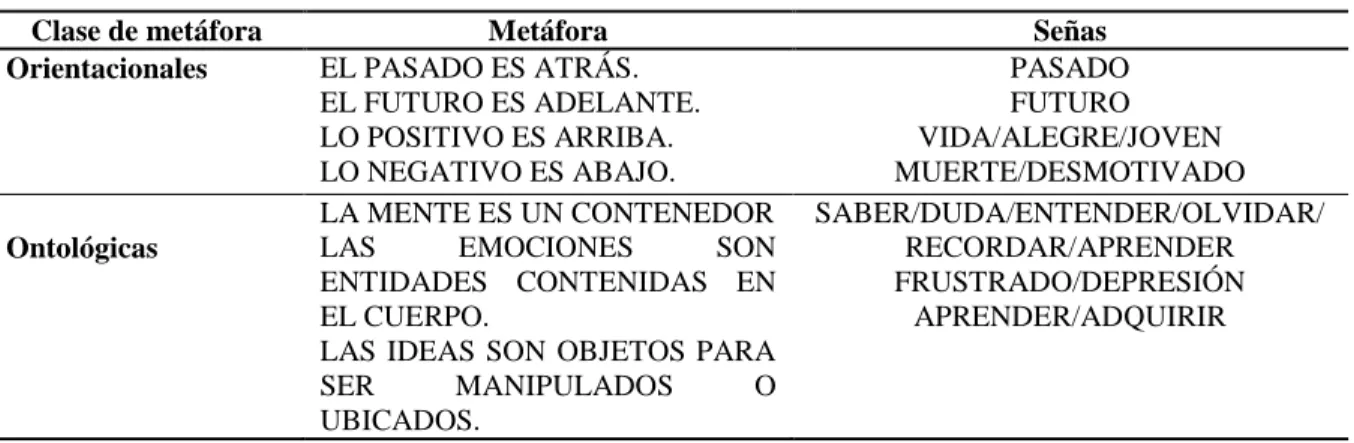
(19) Competencia metafórica en lengua de señas y comprensión de lectura 2. 2.1. LA COGNICIÓN CORPOREIZADA: EVIDENCIA DE LA RELACIÓN CUERPO-CONTEXTO ...................................................................................... 42 2.2. LOS ESQUEMAS DE IMAGEN Y SU PAPEL EN LA CONSTRUCCIÓN DE CONCEPTOS .................................................................................................... 43 2.3. LA METÁFORA COGNITIVA ...................................................................... 48 2.3.1. LA METÁFORA COGNITIVA DESDE LA LINGÜÍSTICA COGNITIVA: CONCEPTO Y ESTRUCTURA ...................................................................... 48 2.3.2. CLASIFICACIÓN DE LAS METÁFORAS COGNITIVAS ...................... 50 2.4. LA METÁFORA COGNITIVA EN LA LENGUA DE SEÑAS ........................ 54 2.4.1. MODELO DE CONSTRUCCIÓN ANALÓGICA .................................... 60 2.4.2. MODELO DEL DOBLE MAPEO: DE LA ICONICIDAD A LA METAFORIZACIÓN ....................................................................................... 63 2.5. COMPETENCIA METAFÓRICA .............................................................. 65 2.6. COMPETENCIA. METAFÓRICA. Y. PROCESOS. COGNITIVOS. ASOCIADOS ..................................................................................................... 67 CAPÍTULO III METODOLOGÍA DE LA INVESTIGACIÓN ................................... 80 3.1 FASE EXPLORATORIA: METÁFORAS EN LENGUA DE SEÑAS .............. 80 3.1.1. OBJETIVOS DE LA FASE ................................................................. 81 3.1.2. PRIMERA PARTE. SELECCIÓN DE LAS METÁFORAS .................. 82 3.2. FASE DE DISEÑO: PRUEBA DE COMPETENCIA METAFÓRICA Y PROGRAMA PEDAGÓGICO ............................................................................ 95 3.2.1. DISEÑO DE LA PRUEBA DE COMPETENCIA METAFÓRICA ........ 96 3.2.1.1.. VALORACIÓN POR JUECES ........................................................ 98. 3.2.1.2.. PILOTAJE DE LA PRUEBA DE COMPETENCIA METAFÓRICA 100. 3.2.2. DISEÑO DEL PROGRAMA PEDAGÓGICO .................................... 101 3.3. FASE EXPERIMENTAL ......................................................................... 104 3.3.1. OBJETIVOS DE LA FASE ............................................................... 104 3.3.2. ASPECTOS METODOLÓGICOS .................................................... 105 3.3.2.3.2. ESTILO COGNITIVO EN LA DIMENSIÓN DIC EN LA MUESTRA 110 3.3.3. MORTALIDAD EXPERIMENTAL..................................................... 116.
(20) Competencia metafórica en lengua de señas y comprensión de lectura 3. CAPÍTULO IV ...................................................................................................... 120 PRODUCTOS DESARROLLADOS ..................................................................... 120 4.1. PRUEBA DE COMPETENCIA METAFÓRICA EN LSC............................ 120 4.1.1. CRITERIOS DE CALIFICACIÓN ..................................................... 122 4.1.2. CONFIABILIDAD DE LAS PRUEBAS PRE-TEST Y POST-TEST .. 123 4.2. PROGRAMA. PEDAGÓGICO. PARA. EL. DESARROLLO. DE. LA. COMPETENCIA METAFÓRICA ...................................................................... 126 4.2.1. OBJETIVOS DEL PROGRAMA ....................................................... 126 4.2.2. FUNDAMENTOS CONCEPTUALES Y PEDAGÓGICOS ................ 126 4.2.3. ESTRUCTURA DEL PROGRAMA .................................................. 128 4.2.4. TALLERES Y VIDEOS QUE CONFORMAN EL PROGRAMA ........ 130 CAPÍTULO V ....................................................................................................... 134 EFECTIVIDAD DEL PROGRAMA EN EL DESARROLLO DE LA COMPETENCIA METAFÓRICA EN LSC Y DE LA COMPRENSIÓN DE LECTURA ..................... 134 5.1. ANÁLISIS CUANTITATIVO .................................................................... 134 5.1.1. PRUEBA DE COMPETENCIA METAFÓRICA ................................ 134 5.1.2. BENEFICIOS. DEL. PROGRAMA. SOBRE. LA. COMPETENCIA. METAFÓRICA.............................................................................................. 144 5.1.3. PRUEBA DE COMPRENSIÓN DE LECTURA ................................ 145 5.1.4. BENEFICIOS DEL PROGRAMA SOBRE LA COMPRENSION DE LECTURA .................................................................................................... 146 5.1.5. RESULTADOS DE LAS PRUEBAS SEGÚN EL ESTILO COGNITIVO EN LA DIMENSIÓN DIC .............................................................................. 148 5.2. ANÁLISIS CUALITATIVO ....................................................................... 151 5.2.1. DESEMPEÑOS INDIVIDUALES...................................................... 151 5.2.2. ESTILO. COGNITIVO-COMPRENSIÓN. DE. LECTURA-. COMPETENCIA METAFÓRICA: ANÁLISIS CUALITATIVO ........................ 174 5.2.3. APORTES DE LA INVESTIGACIÓN A LA COMPRENSIÓN DE LOS PROCESOS COGNITIVOS EN SORDOS: EVIDENCIAS DEL ESTUDIO ... 177 CAPÍTULO VI ...................................................................................................... 192 DISCUSIÓN ........................................................................................................ 192.
(21) Competencia metafórica en lengua de señas y comprensión de lectura 4. 6.1. ADQUISICIÓN TARDÍA DE LA LENGUA DE SEÑAS Y DESARROLLO COGNITIVO EN LA PERSONA SORDA ......................................................... 192 6.2. LENGUA DE SEÑAS Y COMPETENCIA METAFÓRICA ........................ 196 6.3. COMPRENSIÓN DE LECTURA EN ESTUDIANTES SORDOS ............... 198 6.4. ESTRUCTURA DEL PROGRAMA ........................................................... 200 6.5. ¿EDUCACIÓN INCLUSIVA O EDUCACIÓN ESPECIAL?........................ 204 CAPÍTULO VII ..................................................................................................... 208 CONCLUSIONES................................................................................................ 208 7.1. COMPETENCIA METAFÓRICA EN L1 Y COMPRENSIÓN DE LECTURA EN L2 ............................................................................................................... 208 7.2. INDICADORES DE LA COMPETENCIA METAFÓRICA EN ESTUDIANTES SORDOS ......................................................................................................... 210 7.3. COMPETENCIA METAFÓRICA EN L1 Y APRENDIZAJE DE LA L2 ....... 213 7.4.. COMPETENCIA. METAFÓRICA. Y. ESTILO. COGNITIVO. EN. LA. DIMENSIÓN DIC ............................................................................................. 217 7.5. COMPETENCIA METAFÓRICA EN LSC, COMPRENSIÓN DE LECTURA Y ESTILO COGNITIVO EN LA DIMENSIÓN DIC EN ESTUDIANTES SORDOS217 BIBLIOGRAFÍ A ............................................................................................... 221 ANEXO A ............................................................................................................ 236 PRUEBA DE COMPRENSIÓN DE LECTURA .................................................... 236 COMPETENCIAS E INDICADORES .................................................................. 236 PRUEBA INICIAL ................................................................................................ 236 ANEXO B ............................................................................................................ 249 PRUEBA DE COMPRENSIÓN DE LECTURA .................................................... 249 COMPETENCIAS E INDICADORES .................................................................. 249 PRUEBA FINAL .................................................................................................. 249 ANEXO C ............................................................................................................ 263 CONFIABILIDAD DE LA PRUEBA DE COMPRENSIÓN DE LECTURA PRE-TEST ............................................................................................................................ 263 ANEXO D ............................................................................................................ 268.
(22) Competencia metafórica en lengua de señas y comprensión de lectura 5. CONFIABILIDAD DE PRUEBA DE COMPRENSIÓN DE LECTURA POST-TEST ............................................................................................................................ 268 ANEXO E ............................................................................................................ 271 CONFIABILIDAD DE LA PRUEBA DE COMPETENCIA METAFÓRICA ............ 271 ANEXO F............................................................................................................. 279 TALLERES .......................................................................................................... 279 ANEXO G ............................................................................................................ 330 SYLLABUS DEL PROGRAMA ............................................................................ 330 ANEXO H ............................................................................................................ 341 FORMATOS DE AUTOEVALUACIÓN ................................................................ 341 ANEXO I .............................................................................................................. 346 CORRELACIONES. COMPRENSIÓN. DE. LECTURA. Y. COMPETENCIA. METAFÓRICA ..................................................................................................... 346 ANEXO J CORRELACIONES ENTRE SUB-COMPETENCIAS DE LA COMPRENSIÓN DE LECTURA EN L2 Y SUB-PRUEBAS DE LA COMPETENCIA METAFÓRICA EN L1 ............................................................................................................................ 348.
(23) Competencia metafórica en lengua de señas y comprensión de lectura 6. ÍNDICE DE TABLAS. Tabla 1. Características de la Dependencia y de la Independencia de Campo en la dimensión DIC. Tomada de Rodríguez (2013) ................................................................................................. 30 Tabla 2. Clasificación de las metáforas. Adaptada de Soriano (2012)....................................... 50 Tabla 3. Clasificación de las metáforas y ejemplos. Adaptada de Lakoff y Johnson (2005). . 53 Tabla 4. Doble mapeo en YO-INFORMAR-TÚ. Adaptada de Taub (2001). ................................. 63 Tabla 5. Tareas de fluidez. Adaptada de Bereiter (1960). ............................................................ 73 Tabla 6. Ejemplo de las líneas de notación en la metáfora la vida es un camino .................... 85 Tabla 7. Distribución de las metáforas por sujeto ....................................................................... 86 Tabla 8. Ejemplos de las metáforas presentes en la configuración de la seña en LSC .......... 86 Tabla 9. Ejemplos de metáforas cognitivas presentes en expresiones metafóricas en LSC . 87 Tabla 10. Esquema de imagen en las tres clases de metáforas. ................................................ 89 Tabla 11. Mapeo temporal con referencia al espacio. Adaptada de Nuñez, Motz y Teuscher (2006) ................................................................................................................................................ 91 Tabla 12. Mapeo de la vida con referencia al camino .................................................................. 94 Tabla 13. Características iniciales de los grupos según sexo e institución educativa ......... 109 Tabla 14. Medias de los grupos control y experimental ........................................................... 109 Tabla 15. Media de los puntajes obtenidos en la prueba de estilo cognitivo ......................... 110 Tabla 16. Distribución de puntajes prueba EFT ......................................................................... 110 Tabla 17. Componentes y habilidades de la prueba Saber ICFES Lenguaje .......................... 115 Tabla 18. Características de los estudiantes que afectan la validez interna del estudio ...... 116 Tabla 19. Características finales de los grupos según sexo e institución educativa ............ 118 Tabla 20. Medias de los grupos control y experimental finales ............................................... 118 Tabla 21. Componentes y criterios de la prueba de competencia metafórica en LSC .......... 122 Tabla 22. Estadísticos de los ítems finales de la Prueba pre-test de Identificación de Metáforas y Fluidez Interpretativa ............................................................................................... 123 Tabla 23. Estadísticos de los ítems finales de la Prueba post-test de Identificación de Metáforas y Fluidez Interpretativa ............................................................................................... 124 Tabla 24. Estructura general del programa pedagógico ........................................................... 129 Tabla 25. Descriptivo de los talleres ........................................................................................... 130 Tabla 26. Descriptivo de los videos............................................................................................. 133 Tabla 27. Porcentaje de respuestas por ítems. Sub-prueba Identificación de Metáforas pretest .................................................................................................................................................. 135.
(24) Competencia metafórica en lengua de señas y comprensión de lectura 7 Tabla 28. Resultados Sub-prueba Identificación de Metáforas pre-test tiempo en segundos ......................................................................................................................................................... 136 Tabla 29. Porcentaje respuestas por ítems. Sub-prueba Identificación de Metáforas post-test ......................................................................................................................................................... 138 Tabla 30. Resultados Sub-prueba Identificación de Metáforas post-test tiempo en segundos ...................................................................................................................................... 139 Tabla 31. Desempeño de “Francisco el Matemático” ................................................................ 152 Tabla 32. Desempeños de “Pepe el Solitario” ............................................................................ 155 Tabla 33. Desempeños de “Beto el Nerd” .................................................................................. 159 Tabla 34. Desempeños de “Chepe el Voluntarioso”.................................................................. 164 Tabla 35. Desempeños de “Pacho el Dormilón” ........................................................................ 167 Tabla 36. Desempeños de “Nany la Introvertida” ...................................................................... 171 Tabla 37. Confiabilidad final de la prueba de comprensión de lectura pre-test ..................... 263 Tabla 38. Confiabilidad final de la prueba de comprensión de lectura post-test ................... 264 Tabla 39. Confiabilidad inicial de la prueba de comprensión de lectura pre-test .................. 265 Tabla 40. Comportamiento de la confiabilidad al eliminar ítems. Prueba de comprensión de lectura pre-test............................................................................................................................... 266 Tabla 41. Características de los ítems eliminados en la prueba de comprensión de lectura pre-test ........................................................................................................................................... 266 Tabla 42. Confiabilidad inicial de la prueba de comprensión de lectura post-test ................ 268 Tabla 43. Comportamiento de la confiabilidad al eliminar ítems. Prueba de comprensión de lectura post-test............................................................................................................................. 269 Tabla 44. Características de los ítems eliminados en la prueba de comprensión de lectura final ................................................................................................................................................. 269 Tabla 45. Características de los ítems iniciales de la sub-prueba Identificación de Metáforas Pre-test ........................................................................................................................................... 271 Tabla 46. Características de los ítems iniciales de la Subprueba Fluidez Interpretativa Pretest .................................................................................................................................................. 272 Tabla 47. Características de los ítems iniciales de la sub-prueba Identificación de Metáforas Post-test ......................................................................................................................................... 272 Tabla 48. Características de los ítems iniciales de la sub-prueba Fluidez Interpretativa Posttest .................................................................................................................................................. 273 Tabla 49. Estadísticos total de elementos iniciales de la sub-prueba Identificación de Metáforas pre-test ......................................................................................................................... 274 Tabla 50. Comparación del Alfa de Cronbach sub-prueba Identificación de Metáforas pre-test ......................................................................................................................................................... 274 Tabla 51. Estadísticos total de los elementos finales en la sub-prueba Identificación de Metáforas pre-test ......................................................................................................................... 275.
(25) Competencia metafórica en lengua de señas y comprensión de lectura 8 Tabla 52. Estadísticos total de elementos iniciales de la sub-prueba Identificación de Metáforas post-test ....................................................................................................................... 275 Tabla 53. Comparación del Alfa de Cronbach sub-prueba Identificación de Metáforas posttest .................................................................................................................................................. 276 Tabla 54. Estadísticos total de los elementos finales en la sub-prueba Identificación de Metáforas post-test ....................................................................................................................... 276 Tabla 55. Estadísticos total elementos finales sub-prueba Fluidez Interpretativa pre-test .. 277 Tabla 56. Estadísticos total elemento finales sub-prueba Fluidez Interpretativa post-test .. 277 Tabla 57. Correlaciones pruebas comprensión de lectura y competencia metafórica pre y post ................................................................................................................................................. 346 Tabla 58. Correlaciones entre sub-competencias de la comprensión de lectura en L2 y subpruebas de la competencia metafórica en L1 ............................................................................ 349.
(26) Competencia metafórica en lengua de señas y comprensión de lectura 9. ÍNDICE DE GRÁFICAS. Gráfica 1. Distribución de la muestra según la tendencia de estilo cognitivo en la dimensión DIC _________________________________________________________________________ 111 Gráfica 2. Distribución de los promedios de tiempo empleados en la prueba pre-test. Subprueba Identificación de Metáforas ______________________________________________ 137 Gráfica 3. Promedio de tiempo empleado para identificar la metáfora post -test __ 140 Gráfica 4. Resultados Fluidez Interpretativa Pre-test ________________________________ 141 Gráfica 5. Resultados Fluidez Interpretativa Post-test _______________________________ 142 Gráfica 6. Medias sub-pruebas competencia metafórica por grupo____________________ 144 Gráfica 7. Medias competencias prueba de comprensión de lectura por grupos ________ 147 Gráfica 8. Medias sub-pruebas competencia metafórica según la tendencia de estilo cognitivo ____________________________________________________________________ 149 Gráfica 9. Medias comprensión de lectura según el estilo cognitivo por competencias ___ 150.
Figure


+7




Outline
LA EDUCACIÓN DEL SORDO EN EL CONTEXTO MUNDIAL
ACERCAMIENTOS INVESTIGATIVOS AL PROCESO DE LECTURA
ACERCAMIENTO A LA DESCRIPCIÓN DE LOS PROCESOS
ESTILO COGNITIVO EN LA DIMENSIÓN DEPENDENCIA-
INTERROGANTES DE LA INVESTIGACIÓN
LOS ESQUEMAS DE IMAGEN Y SU PAPEL EN LA CONSTRUCCIÓN DE
CLASIFICACIÓN DE LAS METÁFORAS COGNITIVAS
COMPETENCIA METAFÓRICA
COMPETENCIA METAFÓRICA Y PROCESOS COGNITIVOS
PRUEBA DE COMPETENCIA METAFÓRICA
Documento similar
Sólo que aquí, de una manera bien drástica, aunque a la vez coherente con lo más tuétano de sí mismo, la conversión de la poesía en objeto -reconocida ya sin telarañas
quiero también a Liseo porque en mi alma hay lugar para amar a cuantos veo... tiene mi gusto sujeto, 320 sin que pueda la razón,.. ni mande
Para ello, trabajaremos con una colección de cartas redactadas desde allí, impresa en Évora en 1598 y otros documentos jesuitas: el Sumario de las cosas de Japón (1583),
Entre nosotros anda un escritor de cosas de filología, paisano de Costa, que no deja de tener ingenio y garbo; pero cuyas obras tienen de todo menos de ciencia, y aun
d) que haya «identidad de órgano» (con identidad de Sala y Sección); e) que haya alteridad, es decir, que las sentencias aportadas sean de persona distinta a la recurrente, e) que
En este trabajo estudiamos la obra poética en español del escritor y profesor argelino Salah Négaoui, a través de la recuperación textual y análisis de Poemas la voz, texto pu-
La Ley 20/2021 señala con carácter imperativo los procesos de selección. Para los procesos de estabilización del art. 2 opta directamente por el concurso-oposición y por determinar
D) El equipamiento constitucional para la recepción de las Comisiones Reguladoras: a) La estructura de la administración nacional, b) La su- prema autoridad administrativa
