1 Lone founders, types of private family firms and firm performance
Julio Diéguez-Sotoa*1 and Pilar López-Delgadob
aFinances and Accounting Department, Faculty of Economics and Business Sciences, University of Málaga,
29071Málaga, Spain, email [email protected], tlf. (34) 952131286; bStatistics and Econometrics, Faculty of Economics and Business Sciences, University of Málaga 29071Málaga, Spain, email [email protected], tlf. (34)
952131202
The purpose of this article is to provide an explanation for the contradictory findings about the links between private family businesses (FBs) and organisational performance. The paper suggests that lone founder firms determine the results by explaining the
comparative performance of different private FBs and NFBs. In addition, we develop a parsimonious typology of private FBs that exploits the interactions of the components of family involvement to show that firms that achieve to avoid or minimize traditional agency conflicts tend to outperform the firms that do not. It appears that the use of ownership dispersion as a governance mechanism shepherds and monitors performance progress, and among FBs the conflict between owners and managers seems to be more costly than the conflict between large and minority shareholders.
Keywords: family businesses; lone founder; performance; agency theory
2 Lone founders, types of private family firms and firm performance
1. Introduction
Family businesses (FBs) represent the majority of firms around the world, and the research
focusing on the implications of family involvement in business ventures is growing
exponentially (Bennedsen, 2007; Chrisman and Chua, 2004; Sirmon, 2008; Steier,). On the other hand, performance is an essential indicator of the organisational success and competitive advantage of firms. If firms are able to identify the factors that determine improved performance, they could take advantage of their specific features. Thus, strategy scholars have considered financial performance to be an essential variable of interest (Nag, Hambrick and Chen, 2007). Consequently, the literature on business strategy and financial economics has paid more attention to the analysis of performance in FBs (Mazzi, 2011). Many studies have attempted to analyse the relationship between family involvement and performance, comparing the performance of family and non-family businesses (NFBs) (among others Anderson and Reeb, 2003; Arosa, Iturralde and Maseda, 2010; Cucculelli and Miccuci, 2008; Villalonga and Amit, 2006). However, most of the previous research
has shown conflicting results, which have been even more confused within FBs (Sharma
and Carney, 2012). Several literature review papers about the financial performance of FBs have recently been published (Amit and Villalonga, in press; Bertrand and Schoar, 2006; Mazzi, 2011; Stewart and Hitt, 2012), considering that there are different factors (such as
3 is a concept that fails to recognise which family factors lead to high performance. As the findings have been highly sensitive to the ways in which FBs are defined (Sacristán-Navarro, Gómez-Ansón and Cabeza-García, 2011), several researchers have suggested the need to create typologies to test them empirically (Chrisman, Chua and Kellermanns, 2009; Frank et al. 2010; Sharma and Nordqvist, 2008; Weshead and Howorth, 2006; Westhead and Howorth, 2007). Additionally, the conducted review reveals that most of the previous research on the performance of FBs focused on large listed firms (Mazzi, 2011; Zellweger, Nason and Nordqvist, 2012), and there is limited available evidence that pertains to the performance of privately held firms (Sharma and Carney, 2012). Thus, different empirical definitions of family involvement have led to contradictory results in the literature about the links between private FBs and organisational performance (James, 1999), and calls for additional studies have been made (Steier, Chrisman and Chua,2004).
It appears obvious that there are agency problems in FBs and that traditional assumptions and governance mechanisms work differently whether firms are privately and family owned or family managed (Shulze et al., 2001). Consequently, we strive to answer the following research questions on how lone founder and family involvement impact agency
costs in private firms and their consequences in performance.
The first question we raise is the following: Does the lone founder effect exist in private
4 and Amid, 2006). We consider the former agency costs I and II as traditional ones. Besides, FBs deal with specific agency costs and benefits. FBs may benefit from long-term contracting, family expertise, commitment or altruism (Gomez-Mejía, Núñez-Nickel and Gutiérrez, 2001; James, 1999). On the other hand, FBs might have to cope with agency costs that stem from taking advantage of the firm´s assets, fewer skilled candidates, increasingly complex conflicts and asymmetrical altruism (Anderson and Reeb, 2003; Hendry, 2002). In this regard, if lone founders and different types of FBs are analysed as a uniform entity, the findings are likely to be inconclusive because firm performance may indeed be sensitive to how each type of firm tackles the pros and cons that have been identified above.
We try to answer the former research questions using a sample of 3,525 private firms in Spain. First, we assess the sensitivity of the performance results to remove lone founders from the FB category. We utilise two univariate techniques to determine if lone founders
yield better or worse performances than private FBs; to the best of our knowledge, no study has investigated this question. Second, we illustrate 5 theoretical types of private FBs, depending on the presence or absence of the agency problem I and II and addressing a specific treatment for lone founders. Furthermore, we apply an exploratory factor analysis to empirically validate the expected behaviour of lone founders and the types of FBs that
are under consideration. We show that whether FBs are better or worse performers depends
on how the cope with traditional agency costs using ownership dipersion and family
management.
5 founders and each type of private FB may help academics and practitioners to better understand how each type of firm handles agency benefits and costs and, as a consequence, justifies the sensitivity of performance results to the natures of different firms.
The paper is organised as follows. In section 2, we summarise the empirical results about the lone founder effect and family involvement on performance. We devote section 3 to
theory and hypotheses and section 4 to data and variables. The research method and our main results are addressed in section 5, and finally, our main conclusions are presented in section 6.
2. The lone founder effect and family involvement on performance
In line with Miller et al. (2007), we define an FB as one in which multiple members of the same family, who are related by blood or marriage, are involved as owners, managers or members of the board, either contemporaneously or over time. Similarly, we differentiate between lone founder firms, in which, beyond the founder, there are not other family relatives in the business, and FBs, in which there are multiple owners, managers or directors from the same family.
Many studies have considered FBs as firms that only involve a lone founder, with no involvement by any of the founder’s relatives serving as owners, managers or directors. Miller et al. (2007) summarises a catalogue of worthwhile papers that chose this option and that, consequently, could not demonstrate whether firm performance stemmed from a lone founder or family effects. Miller et al. (2007) were able to separate both types of
performance effects in public firms and concluded that only businesses with a lone founder outperform the other types of firms.
6 identified 72 categories of FBs, depending on the extent of family involvement in ownership and management. Handler (1989) added governance and plans for transgenerational continuity or succession as two other components of family involvement. Nevertheless, we will focus on two factors—ownership and management—to determine the influence of each factor on performance, both in isolation and conjointly. To that end, we measure family involvement as a typology (García-Castro and Sharma, 2011).
7 highlighted the concept that family involvement generally has a positive effect on performance, as has been tested by Steward and Hitt (2012) in a recent paper review analysis, in which two-thirds of the papers that were analysed found positive effects. However, the main limitation of the former studies is that they have focused on publicly traded firms, despite the fact that most firms are private firms.
8 3. Theoretical framework and hypotheses
These former non-homogeneous results lead us to apply agency theory, as a theoretical framework, to explain how lone founders and FBs may be different not only with respect to private non-family businesses but from each other. Specifically, we propose that the arguments that have been made to distinguish lone founders and different types of private FBs might be useful to explain the above-noted inconsistent results.
3.1. Lone founders’ involvement and performance
Several studies have suggested that lone founders achieve higher performance than the other FBs in public firms (Anderson and Reeb, 2003; Barontini and Caprio, 2006; Chu, 2011; Le Breton-Miller, Miller and Lester, 2011; Villalonga and Amit, 2006). Miller et al. (2007), removing lone founder firms from the FB classification, concluded that FBs did not
outperform in their market valuations, but lone founder businesses outperformed in their market valuations. The previous results are usually explained by the fact that lone founders
9 perquisites is null, as his share of the firm´s profits is the maximum. It is an extreme case of ownership and management structures because the manager owns 100 per cent of the firm. Moreover, he is free from family succession issues and kinship squabbles (Miller et al., 2007).
The above literature overview of public firms shows that the inclusion of a lone founder
firm in the definition of an FB determines the conclusions that are obtained when FBs and NFBs performance is compared. To the best of our knowledge and belief, no study has investigated whether lone founders would contribute to the improvement or diminishment
of performance when private family and lone founder firms are included into a single category. We examine the impact of lone founder involvement on firm performance
addressing a specific issue: does the lone founder effect also exist in private firms?
This discussion suggests the following hypotheses:
H1. Lone founder firms outperform private family firms
3.2. The agency cost of family involvement in ownership and performance
11 cronyism or insularity in relating to external stakeholders; and (4) inferior growth, financial
returns, and market valuations”.
3.3. The agency costs of family involvement in management and performance
Agency theory has often been used to argue that FB governance is more efficient than that of NFB because there are fewer agency costs due to the alignment of goals between agents and principals, particularly in widely held firms (Gomez-Mejia, Nunez-Nickel and Gutierrez, 2001). Otherwise, an FB that is run by non-family CEOs could create agency problems due to ownership and management being in different hands. Thus, an alignment between owners and managers ensures effective decision making that can maximise a
family’s wealth (Zahra, 2005). In addition, a family CEO can bring expertise (Morck, Shleifer and Vishny, 1988), a superior commitment (Ward, 1988), identification with the firm (Davis, Schoorman and Donaldson, 1997), long-term focus and farsighted investments (Miller and Le Breton-Miller, 2006), lower executive compensation (Gomez-Mejia, Larraza-Kintana and Makri, 2003) and lower average wages (Sraer and Thesmar, 2007), among other benefits, which would trigger an even lower agency problem I. Similarly, altruism could foster communication and cooperation within an FB, thereby decreasing the information asymmetries among family agents and increasing the use of informal agreements (Daily and Dollinger, 1992;Schulze, Lubatkin and Dino, 2001).
12 less able, committed, industrious, or ethical, or whose interests are less compatible than the principal expects (Chrisman, Chua and Litz, 2004). Moreover, family managers can cause conflicts that are more complex between those who lead a firm and other family owners. Moral hazards, as Chrisman, Chua and Litz (2004) describe, involve the commission or omission of family managements’ actions in the interest of the agent but which are also detrimental to the principal. A CEO’s ability to effectively monitor and discipline family
agents is reduced (Schulze, Lubatkin and Dino, 2003). Inter-generational squabbles, conflicts and nepotism may detract from financial performance (Kaye 1991; Gomez-Mejia, Nunez-Nickel and Gutierrez, 2001).
3.4. The combined effects of family involvement in ownership and management on performance
13 management. However, we should also take into account other specific features of FBs, such as asymmetrical and symmetrical altruism, which might increase or decrease the effects of agency problem I. However, the net effect on performance of these types of FB characteristics cannot be determined conceptually in advance. The question of what type of FB will determine higher or lower total agency costs and how such costs rate in comparison with agency problems that are handled by NFBs can be empirically determined. Therefore, we will circumscribe our theoretical approach to the traditional versions of agency problems I and II that are present in FBs and NFBs. We can assume, as Villalonga and Amit (2006) do, that having a family CEO eliminates the conflict between owners and managers (traditional agency problem I) and that having a more dispersed family ownership reduces the possibility of expropriation by minority shareholders (traditional agency problem II).
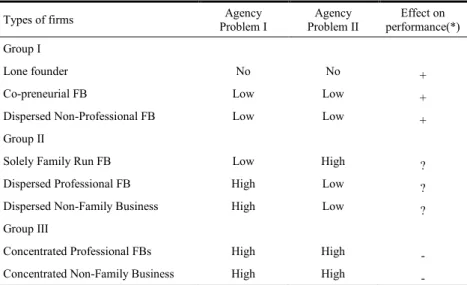
INSERT TABLE 1
According to the presence or absence of the traditional agency problems I and II, and addressing a specific treatment for lone founders, given the absence of any family
involvement, we yield a useful classification into seven types of firms (figure 1):
Lone founder. These firms do not have agency problems. Agency problem I is avoided
because the agent and the principal are the same person. Agency problem II is avoided because the possibility of expropriating minority shareholders does not exist.
Co-preneurial FB. These firms might not have agency problem I. Agency problem II is
14 Solely Family Run FB. FBs with more concentrated family ownership and management.
These firms might not have agency problem I, but they have an increased possibility of having agency problem II.
Dispersed Non-Professional FB. FBs with more dispersed family ownership and family
management. These firms might not have agency problem I, and they may reduce the possibility of having agency problem II.
Dispersed Professional FB. FBs with more dispersed family ownership and non-family
management. These firms might have agency problem I, but they have reduced the possibility of having agency problem II.
Concentrated Professional FB. FBs with more concentrated family ownership and
professional management. These firms have both agency problems.
Non-family business. Overall, NFBs have to cope with higher monitoring costs because
they usually use professional management. They may have agency problem I and agency problem II.
INSERT FIGURE 1
Figure 1 presents three groups that we can now analyse and compare as to their expected performance. Lone founders, Co-preneurial FBs and Dispersed Non-Professional FBs
(Group I) would be expected to perform better than the other firm types because they have no agency costs to bear (Lone founder) or they sustain lower agency costs I and II (
Co-preneurial FB and Dispersed Non-Professional FBs). On the other hand, Concentrated Professional FBs (Group III) will incur significant agency costs. They will experience a
15
Dispersed Professional FBs (Group II) only have to address one agency problem. The
former may cope with the expropriation of wealth by fewer shareholders, and the latter might need to tackle costs that are associated with a professional manager’s rules. Therefore, they are expected to outperform Concentrated Professional FBs (Group III) and to perform more poorly than lone founders, Co-preneurials and Dispersed
Non-Professional FBs (Group I). It is more difficult to predict whether Solely Family Run FBs
has a performance advantage or disadvantage compared with Dispersed Professional FBs. The answer to this question is scant and inconclusive because we do not know a priori what type of agency problem is more detrimental to firm performance. Finally, NFBs are supposed to cope with agency problem I, and, depending on their level of ownership concentration, they will have to address a higher or lower incidence of agency problem II. Therefore, if the NFB sample contains a higher percentage of concentrated ownership firms, they will tend to be in the same group as Concentrated Professional FBs (Group III);
however, if it contains a higher proportion of dispersed ownership firms, it would likely be in group III, next to Dispersed Professional FBs (Group II).
This discussion suggests the following hypotheses:
H2a. Group I (Lone founders, Co-preneurial FBs and Dispersed Non-Professional FB) will perform better than Group II (Solely Family run FB, Dispersed Professional FB and Dispersed NFBs) and Group III (Concentrated professional FBs and Concentrated NFBs)
H2b. Solely Family run FB and Dispersed Professional FB (Group II) will perform better than Concentrated Professional FBs (Grupo III)
4. Data and variables
16 The financial data have been selected from the 2009 Spanish database SABI (Analysis
System of Spanish Balance Sheets). To calculate certain variables, we extended the information that we used to 2008.This database collects annual balance sheet records from official registers for Spanish firms. The data exclude companies that did not have available financial information for the period 2002-2007; firms that were affected by special situations, such as bankruptcy proceedings; firms that were closing down, in liquidation or inactive and financial and insurance firms. Micro-companies were also excluded because their financial information is often not reliable, and they are excessively dispersed, which makes them unsuitable for statistical methods. After this process of scrutiny, SABI included 115,695 firms that fulfilled the above-stated conditions. To reduce heterogeneity, we stratified the sample by size (small, medium and large) and by industry (construction, services and manufacturing). In total, we worked with 3,525 companies (we started with 500 firms by stratum and removed firms with atypical data). The datarefer to the period from 2006 through 2007. Our sample consisted of businesses whose ownership structures were as concentrated in FBs as it was in NFBs (Blanco-Mazagatos, de Quevedo-Puente and Castrillo, 2007). This fact allowed us to distinguish between the effect of concentrated-dispersed ownership and the specific influence of family involvement.
17 the shareholders, in a similar way to Arosa, Iturralde and Maseda (2010), Gomez-Mejia, Nunez-Nickel and Gutierrez (2001) and Pérez-González (2006). As with Castillo and Wakefield (2006), we used these data because no better data source of FBs was publicly available to identify lone founder firms and several different types of FBs. Specifically, there is no official database of FBs in Spain; therefore, this study is an important effort that sheds light on the particularly private Spanish firm landscape. In the end, seven different classes of firms were identified as being operative:
Type 1.Lone founders. As a proxy of a lone founder, we consider that a firm in which the
same person holds the status of sole shareholder, director and CEO to be equivalent to a
lone founder firm.
Type 2. Co-preneurial FBs. Shareholders, directors and CEO are positions that are held by
just two people of the opposite sex and with different surnames. They are most likely to have family ties by marriage because all married women keep their maiden name after marrying in Spain.
Type 3. Solely Family Run FBs. There is a coincidence of surnames among shareholders
and CEO and/or directors, and some shareholders own more than 25% of the shares. In this case, someone in the family runs the company.
Type 4. Dispersed Non-Professional FBs, where there is a coincidence of surnames between
interest groups, and no shareholder owns more than 25% of the shares.
Type 5. Dispersed Professional FBs, where there is a coincidence of surnames between the
internal stakeholders, and no shareholder owns more than 25% of the shares. In addition, a non-family member is the CEO of the firm.
Type 6. Concentrated Professional FBs. The surnames of the shareholders and/or the
18 shareholders own more than 25% of the shares. A non-family CEO runs the company.
Type -1. Non FBs. We include general and limited partnerships, firms whose last owner was a business, and those firms in which there is no coincidence of surnames among the last shareholders, directors or CEO (internal group).
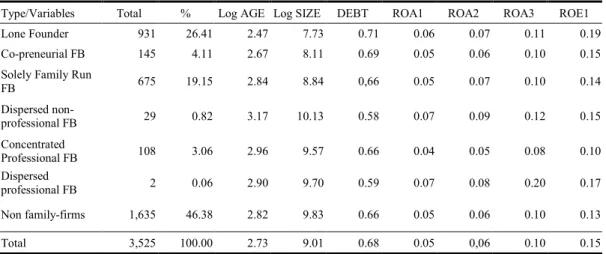
INSERT TABLE 2
From table 2, our analysis suggests that lone founder firms and FBs represent 26.41% and
27.21% of the studied sample, respectively, while NFBs represent 46.38% of the whole sample. By types of FB, Solely Family Run FB firms are the most numerous group,
representing 70.39% of FBs. Co-preneurial is the second largest type of FB (15.12%).
Concentrated Professional FB is the third largest type of FB (11.26%). Dispersed Non-Professional FB is the smallest group, representing 3.02% of the whole sample of FBs.
Finally, the number of members who are classified as Dispersed Professional FBs is insignificant.
4.2. Measuring financial performance
We use profitability as the main variable to examine the effect of family and lone founder
19 Operating Income scaled by Total Assets (ROA2). In the third approach, we use Operating income plus depreciation scaled by Total Assets (ROA3). We also determine Return on Equity (ROE) in line with Lindow, Stubner, and Wulf (2010), Blanco-Mazagatos, de Quevedo-Puente, and Castrillo (2007) and Maury (2006), which is calculated as Net Income divided by the book value of Equity (ROE1). ROA and ROE are the most widely used financial performance measures for unlisted FBs (Zellweger and Nason, 2008). Finally, we also measure cash-flow divided by the number of employees (CF EMPL) as a measure of productivity as performed by McConaughy, Matthews, and Fialko (2001). The other variables that were analysed were age, size and debt: Age as the record of the years since a firm´s inception; Size as the record of the book value of the total Assets of a firm; and Debt as the total Liabilities divided by the total Assets. Special comments are required about financial leverage and debt. First, Murphy (2005) determined that financial issues are deemed to be the most critical issues that are faced by private family firms. Specifically, raising capital was ranked as the most important financial issue. Second, this variable was analysed because family or lone founder involvement may influence a firm’s financial
structure (López-Gracia and Sánchez-Andújar, 2007). Third, family members who are not actively involved in a firm might enforce the use of higher amounts of debt, as they can serve as a governance mechanism to prevent family managers from managerial opportunism, reducing agency costs (Blanco-Mazagatos, de Quevedo-Puente and Castrillo, 2007; Molly, Laveren and Deloof, 2010).
4.3. Descriptive Analysis
20 coefficient of variation. In general, the dispersion of non-quoted firms data is much higher than the data of public firms. Despite this fact, we decided to analyse only those variables with an acceptable relative dispersion degree to obtain more robust conclusions. For example, we decided to drop the CF EMPL variable because the Pearson`s CV is not around one, and with such dispersion statistical methods cannot detect significant differences.
INSERT TABLE 3
5. Research method and main results
5.1. Univariate Analysis and the lone founderEffect
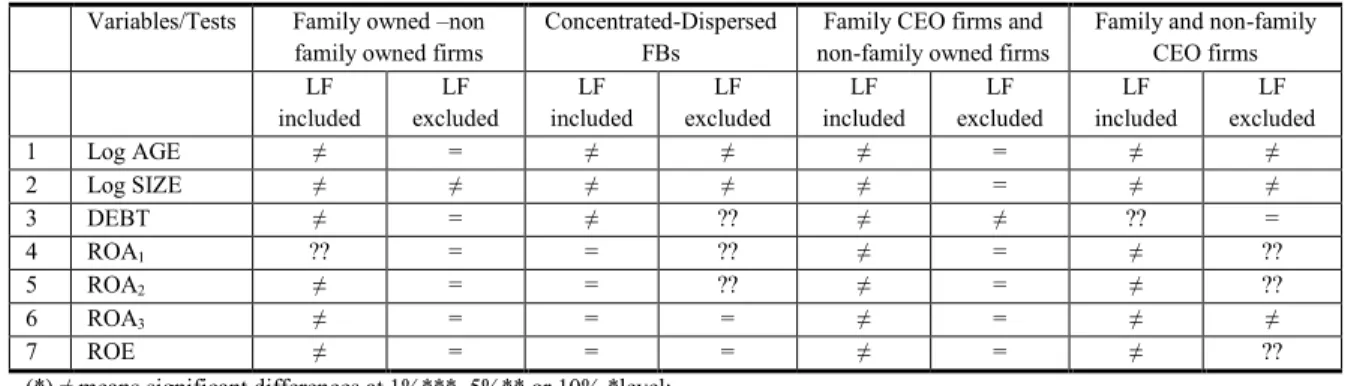
After the data processing, an analysis was run to test the hypothesis. A parametric test (Student t test) and a non-parametric test (Mann-Whitney test) were used., Despite the fact the sample is large, procedures that are based on the mean are often sensitive to the occurrence of extreme or outlying observations, which is why so-called distribution free or a non-parametric method was also considered (Andersen, Jensen, and Kousgaard 1987). Specifically, as a first step, we considered family and lone founder firms in a single category, that is, we included as FBs, firms in which there was only the involvement of a lone founder but no involvement by any relatives as owners, managers or directors, and we applied univariate techniques to determine the results of the differences of the means tests between the following:
family owned firms and non-family owned firms to determine the relationship between
family ownership and firm performance;
more diluted private owned FBs and more concentrated private family owned firms to
21 FBs that were managed by a family CEO and non-family owned firms to find out the
relationship between family management and firm performance;
FBs that were managed by a family CEO and FBs that were managed by a non-family
CEO to determine the relationship between family and professional management.
As a second step, we applied the difference of means tests to the same former samples, but we excluded lone founder firms from the analysis (table 4). The results changed sharply,
and consequently, the conclusions that were obtained also vary. Therefore, lone founder
firms determine the findings achieved and whether they were considered to be an FB is one of the likely reasons why the literature has obtained contradictory results when comparing FBs and NFBs in terms of performance.
INSERT TABLE 4
To confirm the above finding and to test H1, we compare lone founder firms with the whole group of private family firms. Table 5 shows the results of the difference of means tests between both groups:
INSERT TABLE 5
We found significant differences in every variable that was studied. Lone founder firms are
younger, smaller and more indebted than the rest of family owned firms. Moreover, these firms perform much better than family owned firms. In fact, all of the ROA and ROE variables show this same conclusion. Therefore, we confirm H1: lone founder firms
22 were obtained about performance when we compared FBs and NFBs if they were included in any of the former groups.
5.2 The interaction effects of family involvement in ownership and management on performance
We have developed a parsimonious typology of FBs based on three components of family involvement –family ownership, ownership concentration and management- and grounded on agency theory. Table 6 presents descriptive information for our typology of firms; we prefer to leave out Dispersed Professional FBs because their number is negligible. Lone
founder and Co-preneurial FB firms are the youngest firms, while Concentrated Professional FBs and Dispersed Non-Professional FBs are the oldest. In general, the same
results were obtained for size; lone founder and Co-preneurial FB firms are smaller than
the rest of the firms and Dispersed Non-Professional FBs and NFBs are the largest businesses. Lone founders also appear to use debt differently than the rest of the firms; lone
founders finance 71% of their assets through debt financing. Dispersed Non-Professional
FBs are on the opposite side; they only use debt to finance 58% of their total assets. Finally, in terms of performance, Dispersed Non-Professional FBs and lone founder firms
outperform the rest of the firms in terms of every profitability measure that was used: ROA1, ROA2, ROA3 and ROE. The results were robust because they were similar for 2006 and 2007.
INSERT TABLE 6
23 for every industry (construction, services and manufacturing) and size (small, medium and large), just 2 and 29 firms of 1,890 (lone founder firms and FBs) could classify as
Dispersed Professional and Dispersed Non Professional FBs, respectively. On the other
hand, just 110 firms of 1,890 used professional services from an external CEO.
To confirm the results achieved with descriptive and univariate analysis and to address the challenge that was proposed by Dyer (2006) about what type of FB leads to high performance and why, we applied Factor Analysis.
5.3. Exploratory Factor Analysis
To simplify and summarise the financial information that was obtained for lone founder
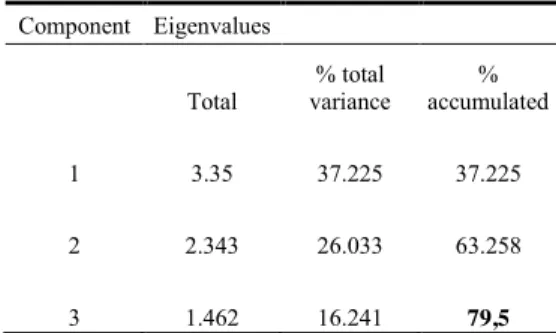
and different types of FBs, we applied Factor Analysis to create a new smaller set of standardised variables. Seven raw variables (log AGE, log Size, DEBT, ROA1, ROA2, ROA3, ROE) were transformed and orthonormalised. Three components were identified and chosen, accounting for 79.50% of the total variance (Table 7).
INSERT TABLE 7
To label each component, we based them on the component loadings that were statistically more significant (table 8). The following descriptive labels were chosen: Profitability factor (FAC1); Size factor (FAC2); Debt factor (FAC3).
INSERT TABLE 8
Given that the number of firms that are classified as Dispersed Professional FB is negligible, we only worked with lone founders, four types of FBs and NFBs. When we
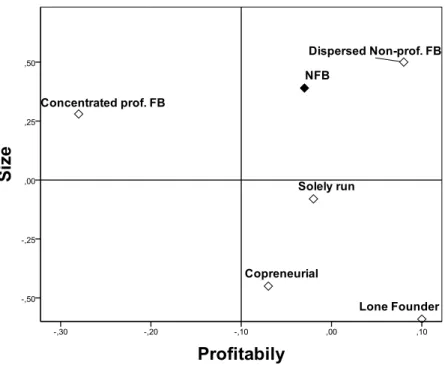
24 INSERT FIGURES 2 Y 3
Lone founders and Dispersed Professional FBs are the two superior performing firms, but these enviable results can be associated with very different average sizes and debts. While
lone founder firms are the smallest and more indebted firms, Dispersed Professional FBs
are the largest and have the lowest level of debt financing.
Co-preneurial firms, Solely Family Run FBs and NFBs perform similarly, and they should
be considered to be intermediate performing firms. Again, the strategy of growth and debt is completely dissimilar among them. As for size, Co-preneurial firms are smaller than
Solely Family Run FBs, and the latter are smaller than NFBs. Regarding debt, Co-preneurial firms are more indebted than NFBs, and the latter are more indebted than Solely Family Run FBs.
Finally, the worst performing firms are Concentrated Professional FBs. Curiously, they have mid-range values, such as size and debt, with respect to superior and intermediate performing firms.
5.4. Discussion
The nature of an FB changes over time due to the development of the family and the firm. Therefore, to better understand the influence of family involvement in performance, we decided to analyse lone founders and every type of FB within their own contexts. After
25 hand, Solely Family Run FBs (Group II) outperformed Concentrated Professional FBs
(Group III). Consequently, H2b is also confirmed.
The ownership development dimension distinguishes three different stages: Controlling Owner, Sibling Partnership and Cousin Consortium. The ownership development dimension begins when ownership is completely controlled by one owner or, less typically, a married couple, and the owner usually makes all of a firm’s decisions unilaterally. Thus,
lone founders and Co-preneurial FBs are immersed in the Controlling Owner Stage. We argue that lone founder firms become the first superior performing firms because they are
business and entrepreneurial orientated, and therefore, they have a higher capacity for growth. Lone founders possess unique skills and features, and they sustain a full
identification with the company’s goals, values and long-term focus. Furthermore, from an agency theory point of view, lone founders bear no agency costs, and they are able to use their high financial leverage to generate a higher return on equity. Their high indebtedness is explained because they are willing to apply growth strategies, they are likely to be less risk adverse and they may consider bank debt to be convenient because financial institutions rarely interfere in business operations after lending.
When two or more siblings enter a business with ownership control and they share decision making with a founder, the firms evolve to the Sibling Partnership stage. In general terms, we believe that Solely Family Run FBs may be functioning at this development stage. Regarding age, size and debt, Co-preneurial firms obtained intermediate values between
lone founders and Solely Family Run FBs. We interpret that Co-preneurial FBs might represent a transitional situation between the Controlling Owner stage, in which a lone
founder is the main character, and the Sibling Partnership stage, in which the family and the
26
Family Run FBs). Solely Family Run FBs and Co-preneurial FBs obtain similar results
regarding firm performance, but they are always lower than those that are obtained for lone
founders and Dispersed Non-Professional FBs. It appears that the negative aspects of
family ownership and management are initiated in the Co-preneurial stage, and they are also experienced by Solely Family Run firms. Both types of firms usually increase the
number of family members that is involved in the business using informal or formal means. This increase might lead to conflicts (Davis and Harveston, 1999), shirking, free riding or the consumption of perks, an unwillingness to monitor family members, unskilled members of the family, or members who are less hard working and less able compared to the founder (Morck and Yeung, 2004). Furthermore, Solely Family Run FBs also have to cope with
higher agency costs that arise from the expropriation of firm wealth at the expense of small shareholders (agency cost II).
The final phase that closes the family business lifecycle is the Cousin Consortium, in which more family members are directly or indirectly involved in a business and/or private individuals are taking part the ownership or management of a firm. Decision making becomes shared by different family generations and even by non-family members. Consequently, this stage requires that family governance issues be addressed. We interpret that Concentrated Professional FBs and Dispersed Non-Professional FBs are situated in
the Cousin Consortium stage. At this stage, we argue that some FBs choose to reduce some specific agency problems that are associated with family management, contracting a non-family professional manager, despite coping with both traditional agency costs (Concentrated Professional FBs). Other firms also opt to prevent traditional agency problem number II (Dispersed Professional FBs). Lastly, other firms seek to minimise both
27 dispersion (Dispersed Non-Professional FBs). In our sample, the Professional FB with
concentrated ownership is the worst type of firm with respect to performance. It appears that negative effects from both traditional agency problems are stronger than the positive effects that can be gained by avoiding certain specific agency costs from family management. Given its poor performance, their lower debt may stem from an unwillingness by creditors to provide it. Some creditors may be not willing to provide debt to these new generations of FBs (Molly, 2010) because they pay less attention to reinvesting their retained earnings (Schwass, 2005).
Finally, our second superior performing firms are Dispersed Non-Professional FBs. Although they share their noticeable good results regarding performance measures with
lone founder firms, they are characterised by opposite characteristics with regard to size,
28 To summarise, given the special behaviour of lone founders and every type of FB, it seems
essential to differentiate them when explaining the comparative performance between FBs and NFBs, and the different types of FBs.
6. Conclusions
This study separates the effect of family involvement per se from the idiosyncratic talent of the founder of a firm when explaining the comparative performance of private firms (Miller et al., 2007). Similarly, it explores certain types of private FB shape variations in firm economic performance (Westhead and Howorth, 2007) and how these variations are different from NFBs (Sharma, Chrisman and Gersick, 2012). A private firm taxonomy is elaborated, taking themes of family ownership and management structures and providing insights from how lone founders and each type of FB cope with their particular traditional
agency costs. This theoretical firm classification was validated using a Spanish sample of private firms composed by 3,525 companies stratified by size and industry.
Our analysis makes two main contributions to the extant literature. First, our work concludes that lone founder firms without family involvement outperform private family
firms, and given their unique nature, they should be analysed independently when explaining the comparative performance of family and non-family private firms. Second, we also develop a parsimonious typology of private firms taking into account the lone
founder effect and three components of family involvement—family ownership, ownership concentration and management. This study exploits the differentiation between the lone
29
lone founder firms and Dispersed Non-Professional FBs. It appears that because minority
shareholders enjoy weak investor protection in Spain, the use of ownership dispersion, as a governance mechanism, shepherds and monitors progress on performance. Among FBs, at least in the sample studied, the conflict between owners and managers seems to be more costly that the conflict between majority and minority shareholders. In addition, specific agency costs and benefits to FBs (e.g., symmetrical or asymmetrical altruism) do not succeed in changing the foreseeable effects that are caused by traditional agency costs.
Finally, we conclude that the inclusion of founder-led firms in FB samples and the treatment of private FBs as homogeneous entities may have been the cause for the contradictory results when comparing FBs and NFBs with regard to performance. Furthermore, we suggest that not all private FBs are alike derived from the ways in which each type of FB adresses agency costs, and as a consequence, their expected performance might be different. Therefore, this paper sheds light on the former confused performance results within private FBs.
30 This study is not free from limitations, and future research implications may be proposed. Agency theory tends to ignore that FBs have non-economic goals that might lead to outcomes and decisions that are substantially different from NFBs, whereas the role of non-economic goals is less essential (Chrisman et al., 2012). As agency theory taken alone cannot completely explain performance differences, future research should combine the use of complementary theories. Because FBs have economic and non-economic goals, variables should not only refer to financial returns, but they should also consider the level of underlying vision, attitudes, and intentions of the controlling family (Gomez-Mejía et al., 2007). Finally, researchers should conduct similar investigations in other countries to increase the validity of the findings.
References
Amit, R., & Villalonga, B. (in press). Financial performance of FBs. In L. Melin, M. Nordqvist, & P. Sharma (Eds.), Sage handbook of family business. Thousand Oaks, CA: Sage.
Ang, J.S., Cole, R.A., & Lin, J.W. (2000). Agency costs and ownership structure. Journal of Finance, 55(1), 81–106.
Andersen, EB; Jensen, N-E and Kousgaard, N. (1987). Statistics for Economics, Business Administration and the Social Sciences. Springer-Verlag, Berlin.
Anderson, R.C., Reeb, D.M. (2003). Founding-family ownership and FP: evidence from the S&P 500. Journal of Finance, 58, 1301–1328.
Anderson, R.; Mansi, S. and Reeb, D. (2003). Founding family ownership and the agency cost of debt.
Journal of Financial Economics, 68, 263-285.
Arosa, B., Iturralde, T., & Maseda, A. (2010). Ownership structure and FP in non-listed firms: Evidence from Spain. Journal of Family Business Strategy, 1, 88-96.
Barontini, R., & Caprio, L. (2006). The effect of family control on firm value and performance: Evidence from continental Europe. European Financial Management, 12, 689-723.
Barth, E., Gulbrandsen, T., & Schone, P. (2005). Family ownership and productivity: The role of owner-management. Journal of Corporate Finance, 11(1–2), 107–127.
Bennedsen, M., Nielsen, K. M., Pérez-González, F., & Wolfenzon, D. (2008). Inside the FB: The role of families in succession decisions and performance. Quarterly Journal of Economics, 122, 647-691.
Berle, A., Means, G. (1932). The Modern Corporation and Private Property. Harcourt, Brace, & World, New York, NY.
Bertrand, M., & Schoar, A. (2006). The role of family in fam- ily firms. Journal of Economic Perspectives, 20(2), 73-96.
31
Burkart, M., Panunzi, F., Shleifer, A. (2003). Family firms. Journal of Finance, 58, 2167–2202.
Castillo, J., & Wakefield, M. W. (2006). An exploration of firm performance factors in family business: do
family value only the ‘‘bottom line’’? Journal of Small Business Strategy, 17(2), 37–51.
Chrisman, J. J., Chua J. H., & Litz, R. A. (2004). Comparing the agency costs of family and NFBs: Conceptual issues and exploratory evidence. Entrepreneurship Theory and Practice, 28(4), 335–354.
Chrisman, J. J., Chua, J. H., & Kellermanns, F. W. (2009). Priorities, resource stocks, and performance in family and NFBs. Entrepreneurship Theory and Practice, 33(3), 739–760.
Chrisman, J., Chua, J., Pearson, A., Barnett, T. (2012). FI, Family Influence, and Family-Centered Non-Economic Goals in Small Firms. Entrepreneurship Theory and Practice, 36 (2), 267–293.
Chu, W. (2011). Family ownership and FP: Influence of family management, family control, and firm size. Asia Pacific Journal of Management, 28, 833-851.
Creed, G. W. (2000). “Family values” and domestic economies. Annual Review of Anthropology, 29, 329-355.
Cronqvist, H., & Nilsson, M. (2003). Agency costs of controlling minority shareholders. Journal of Financial and Quantitative Analysis, 38(4), 695–719.
Cucculelli, M., & Micucci, G. (2008). Family succession and FP: Evidence from Italian FBs. Journal of Corporate Finance, 14(1), 17-31.
Daily, C.M. & Dollinger, M.J. (1992). An empirical examination of ownership structure in family and professionally-managed firms. Family Business Review, 5, 117–136.
Davis, J. H., Schoorman, F.D., & Donaldson, L. (1997). Toward a stewardship theory of management.
Academy of Management Review, 22, 20-47.
Davis, P. S., & Harveston, P. D. (1999). In the founder’s shadow: Conflict in the FB. Family Business Review, 12, 311-323.
Demsetz, H., & Kenneth L. (1985).The structure of corporate ownership: Causes and consequences. Journal of Political Economy 93, 1155-1177.
Dyer, W. G., (2006). Examining the family effect on FP. Family Business Review, 19(4), 253–273.
Filatotchev, I., Zhang, X., & Piesse, J. (2011). Multiple agency perspective, family control, and private information abuse in an emerging economy. Asia Pacific Journal of Manage- ment, 28, 69-93.
Fogel, K. (2006). Oligarchic family control, social economic outcomes, and the quality of government. Journal of International Business Studies, 37, 603-622.
Frank, H., Lueger, M., Nose ́, L., & Suchy, D. (2010). The concept of ‘‘Familiness’’: Literature review and
systems theory-based reflections. Journal of Family Business Strategy, 1(3), 119–130.
Galve-Górriz, C. & Salas-Fumás, V. (2011). Growth strategies, professionalization, ownership structure and performance across generations of a FB. African Journal of Business Management, 5 (9), 3589-3604.
García-Castro, R. & Sharma, P. (2011). FI- FP Link: Winning Configurations Revealed by Set-theoretic methods. Universia Business Review, 32, 54-68.
Gersick, K. E., Davis, J. A., McCollom, M., & Lansberg, I. (1997). Generation to generation: Life cycles of the family business. Boston, MA: Harvard Business School Press.
Gomez-Mejia, L., Nunez-Nickel, M., & Gutierrez, I. (2001). The role of family ties in agency contracts.
Academy of Management Journal, 44(1), 81–95.
Gomez-Mejia, L., Larraza-Kintana, M., & Makri, M. (2003). The determinants of execu- tive compensation in family-controlled public corporations. Academy of Management Journal, 46, 226–237.
Gómez-Mejía, L. R., Haynes, K. T., Núñez-Nickel, M., Jacobson, K. J. L., & Moyano-Fuentes, J. (2007). Socioemotional wealth and business risks in family-controlled firms: Evidence from Spanish olive oil mills.
32
Handler, W. C. (1989). "Managing the FB Succession Process; The Next-Generation Family Member's Experience." Unpublished doctoral dissertation, School of Management, Boston University.
Haynes, G. W., Walker, R., Rowe, B. R., & Hong, G. (1999). The intermingling of business and family finances in family-owned businesses, Family Business Review, 12(3), 225–239.
Hendry, J. (2002). The principal’s other problems: Honest incompetence and the specification of objectives.
Academy of Management Review, 27, 98–113.
James, H. (1999). Owner as manager, extended horizons and the FB. International Journal of the Economics of Business, 6(1), 41–56.
James, H. (2006). Family capitalism. Cambridge, MA: Belknap-Harvard University Press.
Jensen, M.C. & Meckling, W. (1976). Theory of the firm: Managerial behavior, agency costs and ownership structure. Journal of Financial Economics, 3, 305–360.
Kaye, K., & Hamilton, S. (2004). Roles of trust in consulting to financial families. Family Business Review, 17, 151-163.
La Porta, R., Lopez-de-Silanes, F., Shleifer, A., and Vishny, R. (1998). Law and finance. The Journal of Political Economy, 106, no 6: 1113–1155.
Le Breton-Miller, I. & Miller, D. (2009). Agency vs. Stewardship in Public Family Firms: A Social Embeddedness Reconciliation. Entrepreneurship Theory and Practice, 33 (6), 1157–1271.
Le Breton-Miller, I., Miller, D., & Lester, R. H. (2011). Stewardship or agency? A social embeddedness recon- ciliation of conduct and performance in public FBs. Organization Science, 22, 704-721.
Lindow, C.M., Stubner, S., & Wulf, T. (2010). Strategic fit within FBs: The role of family influence and the effect on performance. Journal of Family Business Strategy, 1, 167-178.
López-Gracia, J. & Sánchez-Andújar, S. (2007). Financial Structure of the Family Business: Evidence From a Group of Small Spanish Firms. Family Business Review, 20, 269-287
Martínez, J. I., Stöhr, B. S., & Quiroga, B. F. (2007). Family ownership and FP: Evidence from public companies in Chile. Family Business Review, 20(2), 83–94.
Maury, B. (2006). Family ownership and FP: empirical evidence from Western European corporations. Journal of Corporate Finance,12, 321–341.
Mazzi, C. (2011). Family business and financial performance: Current state of knowledge and future research challenges. Journal of Family Business Strategy, 2, 166-181.
McConaughy, D., Matthews, C.H., and Fialko, A.S. (2001). Founding Family Controlled Firms: Efficiency, Risk, and Value. Journal of Small Business Management, 39(1), 31-49.
Miller, D., & Le Breton-Miller, I. (2006). Family governance and firm performance:Agency, stewardship, and capabilities. Family Business Review, 19(1), 73–87.
Miller, D., Le Breton-Miller, I., Lester, R. H., & Cannella, A. A. (2007). Are FBs really superior performers? Journal of Corporate Finance, 13, 829-858.
Miller, D., Le Breton-Miller, I., & Lester, R. H. (2011). Family and Lone Founder ownership and strategic behaviour: Social context, identity, and institutional logics. Journal of Management Studies, 48, 1-25.
Murphy, D. (2005).Understanding the Complexities of Private FBs: An Empirical Investigation. Family Business Review, 18 (2), 123-133.
Molly, V., Laveren, E., Deloof, M. (2010). Family Business Succession and Its Impact on Financial Structure and Performance Family Business Review, 23, 131-147.
Morck, R.K., Shleifer, A., Vishny, R. (1988). Management ownership and market valuation: an empirical analysis. Journal of Financial Economics, 20, 293–315.
33 Morck, R, & Yeung, B. (2004). Family Control and the Rent-Seeking Society. Entrepreneurship:Theory and Practice, 28 (4), 391–409.
Morck, R., Wolfenzon, D., & Yeung, B. (2005). Corporate governance, economic entrenchment, and growth. Journal of Economic Literature, 43, 655-720.
Nag, R., Hambrick, D. C., & Chen, M. J. (2007). What is strategic management really? Inductive derivation of a consensus definition of the field. Strategic Management Journal, 28, 935-955.
Perez-Gonzalez, F. (2006). Inherited control and firm perfor-mance. American Economic Review, 96(5), 1559-1588.
Sacristán-Navarro, M., Gómez-Ansón, S., Cabeza-García (2011). Large shareholders’ combinations in family
firms: Prevalence and performance effects. Journal of Family Business Strategy, 2 (2011) 101–112.
Schulze, W.S., Lubatkin, M.H., Dino, R.N., & Buchholtz, A.K. (2001). Agency relationships in FBs: Theory and evidence. Organization Science, 12, 99–116.
Schulze, W. S., Lubatkin, M. H., & Dino, R. N. (2003). Exploring the agency consequences of ownership dispersion among the directors of private FBs. Academy of Management Journal, 46, 179-194.
Schwass, J. (2005). Wise growth strategies in leading familybusinesses. New York: Palgrave Macmillan.
Sciascia, S., & Mazzola, P. (2008). FI in ownership and management: Exploring nonlinear effects on performance. Family Business Review, 21, 331-345.
Shleifer, A., & Summers, L. (1988). Breach of trust in hostile takeovers, in A. Auerbach, ed.: CorporateTakeovers: Causes and Consequences (University of Chicago Press, Chicago).
Sharma, P. (2002): Stakeholder mapping technique: Toward the development of a FB typology, Paper presented at the Academy of Management meetings, Denver, CO.
Sharma, P., & Nordqvist, M. (2008). A classification scheme for FBs: From family values to effective governance to FP. In J. Tapies & J. L. Ward (Eds.), Family values and value creation: How do family-owned businesses foster enduring values? New York: Palgrave Macmillan.
Sharma, P. & Carney, M. (2012). Value Creation and Performance in Private FBs : Measurement and Methodological Issues. Family Buisness Review, 25 (3), 233-242.
Sharma, P., Chrisman, J. & Gersick, K. (2012). 25 Years of Family Business Review: Reflections on the Past and Perspectives for the Future. Family Business Review, 25(1) 5–15
Sirmon, D. G., Arrègle, J.-L., Hitt, M. A., & Webb, J. W. (2008). The role of family influence in firms’
strategic responses to threat of imitation. Entrepreneurship Theory and Practice, 32, 979-998.
Sraer, D., & Thesmar, D. (2007) Performance and behavior of FBs: Evidence from the French stock market. Journal of the European Economic Association, 5(4), 709–751.
Steier, L.P., Chrisman, J.J., & Chua, J.H. (2004). Entrepreneurial management and governance in FBs: An introduction. Entrepreneurship Theory and Practice, 28, 295–303.
Stewart, A., & Hitt, M. A. (2012). Why can’t a family business be more like a nonfamily business? Modes of professional- ization in FBs. Family Business Review, 25, 58-86.
Storey, D. J. (1994). Understanding the small business sector. London: Routledge.
Villalonga, B., & Amit, R. (2006). How do family owner- ship, control and management affect firm value? Journal of Financial Economics, 80, 385–417.
Ward, J. L. (1988). The special role of strategic planning for family business. Family Business Review, 1(2), 105–118.
Westhead, P., & Howorth, C. (2006). Ownership and management issues associated with FB performance and company objectives. Family Business Review, 19, 301-316.
34 Zahra, S. A. (2005). Entrepreneurial risk taking in FBs. Family Business Review, 18, 23-40.
Zellweger, T., & Nason, R. (2008). A stakeholder perspective on FB performance. Family Business Review, 21(3), 203–216.
35 Types of firms Problem I Agency Problem II Agency performance(*) Effect on
Group I
Lone founder No No +
Co-preneurial FB Low Low +
Dispersed Non-Professional FB Low Low +
Group II
Solely Family Run FB Low High ?
Dispersed Professional FB High Low ? Dispersed Non-Family Business High Low ?
Group III
Concentrated Professional FBs High High -
Concentrated Non-Family Business High High -
(*) “+” is positive effect on performance because of no or lower both agency costs;; “-” is
negative effect on performance because of higher both agency costs;; and “?” is unknown effect
because it is not known a priori whether positive effect on performance of low agency problem I or agency problem II will be < or = or > that negative effect on performance of high agency cost II or agency problem I, respectively.
36
37
38
Table 1 Agency costs and benefits from family and lone founder involvement
Family Ownership Family management Lone founder Effect Lower agency costs
due to long-term contracting, reduction of managerial expropriation and fewer monitoring system mechanism (specific lower agency cost I)
Higher agency costs due to expropriation firm wealth at the expense of minority shareholders (higher
traditional agency cost II)
Lower agency costs due to goals alignment between agent and principal (lower
traditional agency cost I)
Higher agency costs from asymmetric altruism (unskilled candidates, unwillingness to monitoring family members...) (specific higher agency cost I)
No traditional agency costs I and II
Lower agency costs due to superior expertise, commitment, long-term focus, lower executive compensation (specific lower agency cost I)
Higher agency costs due to more complex conflicts between those family members who lead the firm and other family owners - shirking, free riding, consumption of perks- (specific higher agency cost I)
Unique skills and characteristics,
commitment, long-term focus, strong values and trust, freedom from family succession issues and kinship squabbles, among others features, avoid specific agency problems Lower agency costs due
39
Table 2 Number and percentage of lone founders, FBs types and NFBs (n= 3525)
Type/Industry Total % Total Firms % Total Family Firms
Lone Founder 931 26.41%
Co-preneurial FB 145 4.11% 15.12%
Solely Family Run FB 675 19.15% 70.39% Dispersed non-professional FB 29 0.82% 3.02%
Concentrated Professional FB 108 3.06% 11.26% Dispersed professional FB 2 0.06% 0.21%
Total Family firms 959 27.21% 100.00%
Non family-firms 1,635 46.38%
40
Table 3 Summary Statistics for the Full Sample (2007)
Min. Max. Mean
Standard
Deviation Pearson`s CV
ROA1 - 0.21 0.31 0.05 0.06 1.18
ROA2 - 0.26 0.40 0.06 0.08 1.27
ROA3 - 0.32 0.52 0.10 0.09 0.91
ROE1 - 0,60 1.23 0.17 0.22 1.32
CF EMPL - 183.90 362.19 16.20 30.31 1.87
Log AGE - 4.67 2.68 0.75 0.28
Log SIZE 2.94 15.64 8.90 2.10 0.24
DEBT - 1.89 0.70 0.23 0.33
41
Table 4 Results of difference of Means Tests excluding lone founder from the analysis (2007)
Variables/Tests Family owned –non family owned firms
Concentrated-Dispersed FBs
Family CEO firms and non-family owned firms
Family and non-family CEO firms LF included LF excluded LF included LF excluded LF included LF excluded LF included LF excluded
1 Log AGE ≠ = ≠ ≠ ≠ = ≠ ≠
2 Log SIZE ≠ ≠ ≠ ≠ ≠ = ≠ ≠
3 DEBT ≠ = ≠ ?? ≠ ≠ ?? =
4 ROA1 ?? = = ?? ≠ = ≠ ??
5 ROA2 ≠ = = ?? ≠ = ≠ ??
6 ROA3 ≠ = = = ≠ = ≠ ≠
7 ROE ≠ = = = ≠ = ≠ ??
(*) ≠ means significant differences at 1%***, 5%** or 10% *level; = means there are not significant differences;
42
Table 5 Difference of Means Tests between lone founderfirms and Family owned firms (2007)
Lone Founder firms (N=865) Family owned Firms (N=923) student) Sig(t Sig (Mann-Whitney) Conclusion
Mean Deviation Standard Mean Deviation Standard
1 Log AGE 2.49 0.67 2.85 0.61 0.000 0.000 ≠
2 Log SIZE 7.79 1.66 8.88 1.90 0.000 0.000 ≠
3 DEBT 0.70 0.21 0.65 0.21 0.000 0.000 ≠
4 ROA1 0.05 0.05 0.04 0.04 0.000 0.001 ≠
5 ROA2 0.07 0.07 0.06 0.06 0.002 0.004 ≠
6 ROA3 0.11 0.08 0.10 0.07 0.003 0.028 ≠
7 ROE 0.19 0.20 0.13 0.16 0.000 0.000 ≠
(*) ≠ means significant differences.
43
Table 6 Descriptive Statistics (2007)
Type/Variables Total % Log AGE Log SIZE DEBT ROA1 ROA2 ROA3 ROE1 Lone Founder 931 26.41 2.47 7.73 0.71 0.06 0.07 0.11 0.19 Co-preneurial FB 145 4.11 2.67 8.11 0.69 0.05 0.06 0.10 0.15 Solely Family Run
FB 675 19.15 2.84 8.84 0,66 0.05 0.07 0.10 0.14 Dispersed
non-professional FB 29 0.82 3.17 10.13 0.58 0.07 0.09 0.12 0.15 Concentrated
Professional FB 108 3.06 2.96 9.57 0.66 0.04 0.05 0.08 0.10 Dispersed
professional FB 2 0.06 2.90 9.70 0.59 0.07 0.08 0.20 0.17
Non family-firms 1,635 46.38 2.82 9.83 0.66 0.05 0.06 0.10 0.13
44
Table 7 Total Variance Explained
Component Eigenvalues
Total variance % total accumulated %
1 3.35 37.225 37.225
2 2.343 26.033 63.258
3 1.462 16.241 79,5
45
Table 8 Performance and control variables: varimax rotated components Matrix (2006 and 2007)
Varimax rotated components 2007 Varimax rotated components 2006
Variables 1 2 3 1 2 3
log AGE -0.087 0.432 -0.523 -0.087 0.432 -0.523
log SIZE -0.059 0.978 -0.051 0.052 0.980 -0.028
DEBT -0.171 -0.001 0.944 -0.244 0.020 0.924
ROA1 0.827 -0.018 -0.127 0.852 0.011 -0.026