
Implementing social strategies to improve speaking in interaction activities
103
0
0
Texto completo
(2) Running head: IMPLEMENTING SOCIAL STRATEGIES TO IMPROVE SPEAKING IN INTERACTION ACTIVITIES 2. Implementing Social Strategies to Improve Speaking in Interaction Activities. Juliana Díaz. Research Report submitted in partial fulfillment of the requirements for the degree of Master in English Language Teaching –Autonomous Learning Environments. Directed by Pedro Maldonado Department of Foreign Languages and Cultures Universidad de La Sabana Chía, Colombia.
(3) Running head: IMPLEMENTING SOCIAL STRATEGIES TO IMPROVE SPEAKING IN INTERACTION ACTIVITIES 3. 2014.
(4) Running head: IMPLEMENTING SOCIAL STRATEGIES TO IMPROVE SPEAKING IN INTERACTION ACTIVITIES 1 Declaration. I hereby declare that my research report entitled: Implementing Social Strategies to Improve Speaking in Interaction Activities . is the result of my own work and includes nothing which is the outcome of work done in collaboration except as declared and specified in the text;. . is neither substantially the same as nor contains substantial portions of any similar work submitted or that is being concurrently submitted for any degree or diploma or other qualification at the Universidad de La Sabana or any other university or similar institution except as declared and specified in the text;. . complies with the word limits and other requirements stipulated by the Research Subcommittee of the Department of Foreign Languages and Cultures;. . has been submitted by or on the required submission date.. Date: ____________________________________________________________ Full Name:. ____________________________________________________________. Signature:. ____________________________________________________________.
(5) Running head: IMPLEMENTING SOCIAL STRATEGIES TO IMPROVE SPEAKING IN INTERACTION ACTIVITIES 2 Abstract This action research project explored the possible effects of three social strategies in participants‟ oral interaction while they are communicating between peers in class tasks. The project was carried out with a group of thirteen students at a private university located in Chía, Colombia. They were enrolled in different undergraduate programs and took English as a graduation requirement of their programs. At the end of this qualitative research, the gathered data demonstrated that the students were able to interact, use the language to transmit and convey messages and, improve two linguistic components (vocabulary and fluency) along with their self-confidence when speaking. Key words: social strategies, oral interaction, interaction activities, fluency and vocabulary..
(6) Running head: IMPLEMENTING SOCIAL STRATEGIES TO IMPROVE SPEAKING IN INTERACTION ACTIVITIES 3 Resumen La investigación exploró los posibles efectos de tres estrategias sociales en la interacción oral de los participantes cuando se comunican entre pares en las actividades de interacción. Este proyecto fue llevado a cabo con un grupo de estudiantes de una universidad privada localizada en Chía, Colombia. Ellos se encontraban en diferentes programas de pregrado y tomaron el curso de inglés como un requerimiento para graduarse. Al final del proyecto cualitativo, los datos obtenidos demostraron que los estudiantes fueron capaces de interactuar, usar el lenguaje para trasmitir y expresar mensajes y mejorar dos factores lingüísticos (vocabulario y fluidez) al igual que su autoconfianza al hablar. Palabras claves: Estrategias sociales, interacción oral, actividades de interacción, vocabulario y fluidez..
(7) Running head: IMPLEMENTING SOCIAL STRATEGIES TO IMPROVE SPEAKING IN INTERACTION ACTIVITIES 4 Table of Contents Abstract .......................................................................................................................... ii Resumen ........................................................................................................................ iii Table of Figures ............................................................................................................ vii Table of Tables ............................................................................................................. vii Chapter One: Introduction................................................................................................2 Statement of the problem .............................................................................................3 General objective .........................................................................................................7 Specific objectives ...................................................................................................7 Rationale......................................................................................................................7 Chapter Two: Theoretical Framework ..............................................................................9 Speaking skills .............................................................................................................9 Oral interaction ...................................................................................................... 10 Interaction Activities .................................................................................................. 15 Social Learning Strategies .......................................................................................... 18 Chapter Three: Research Design .................................................................................... 25 Type of Research ....................................................................................................... 25 Context ...................................................................................................................... 26 Learners‟ Profile. ....................................................................................................... 27 Researcher‟s Role ...................................................................................................... 29.
(8) Running head: IMPLEMENTING SOCIAL STRATEGIES TO IMPROVE SPEAKING IN INTERACTION ACTIVITIES 5 Data collection instruments ........................................................................................ 30 Survey.................................................................................................................... 30 Think-aloud report ................................................................................................. 30 Observation ............................................................................................................ 31 Data collection procedures ......................................................................................... 31 Ethical Considerations ............................................................................................... 33 Chapter Four: Pedagogical Intervention and Implementation ......................................... 34 Vision of Language .................................................................................................... 34 Vision of Learning ..................................................................................................... 35 Vision of Curriculum ................................................................................................. 36 Instructional Design ................................................................................................... 37 Pre-implementation Stage. ..................................................................................... 38 While-implementation Stage .................................................................................. 38 Post-implementation Stage. .................................................................................... 40 Chapter Five: Results and Data Analysis ........................................................................ 41 Sources of Data .......................................................................................................... 41 Data Analysis Approach............................................................................................. 41 Data Management ...................................................................................................... 42 Data analysis and Findings ......................................................................................... 43.
(9) Running head: IMPLEMENTING SOCIAL STRATEGIES TO IMPROVE SPEAKING IN INTERACTION ACTIVITIES 6 Fostering of students‟ interaction and communication performance with peers. ...... 46 Linguistic improvement ......................................................................................... 53 Self-confidence when speaking. ............................................................................. 56 Chapter Six: Conclusions and Pedagogical Implications ................................................ 60 Limitations................................................................................................................. 61 Time management .................................................................................................. 61 Modification in the target group ............................................................................. 62 Design.................................................................................................................... 62 Pedagogical Implications ........................................................................................... 62 Further research ......................................................................................................... 63 References ..................................................................................................................... 65 Appendix A ................................................................................................................... 71 Appendix B ................................................................................................................... 72 Appendix C ................................................................................................................... 75 AppendixD .................................................................................................................... 76 Appendix E .................................................................................................................... 77 Appendix F .................................................................................................................... 82 Appendix G .....................................................................................................................7.
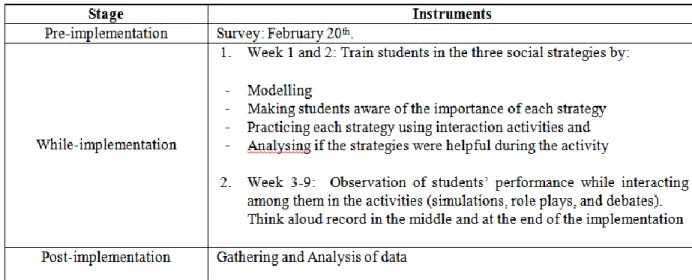
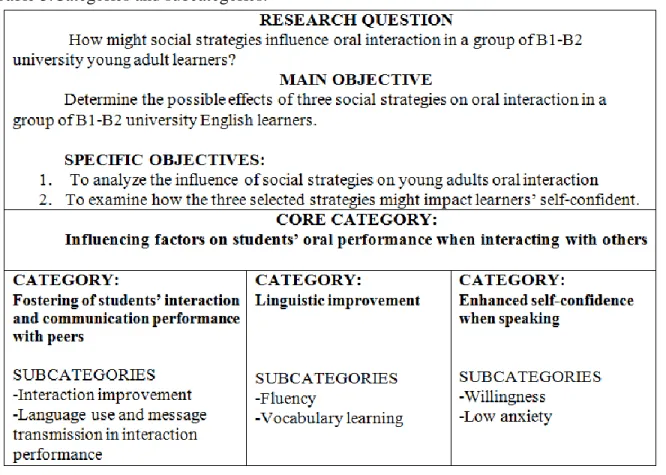
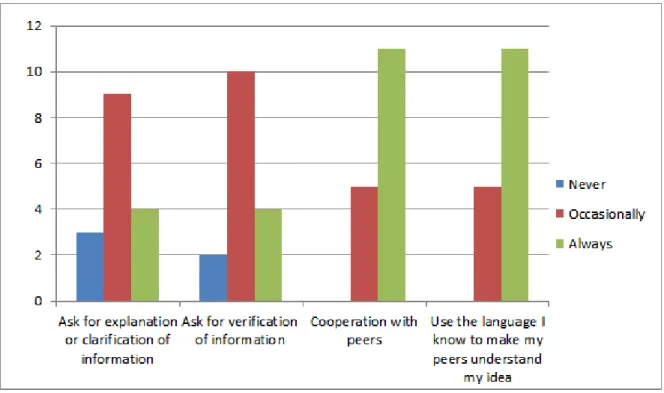
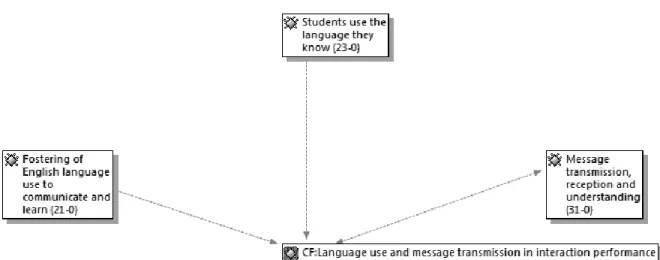
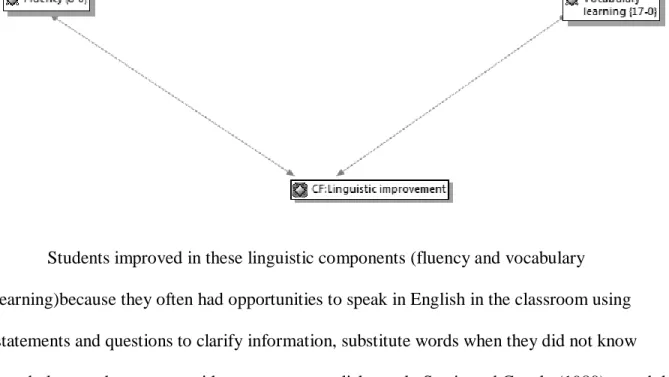
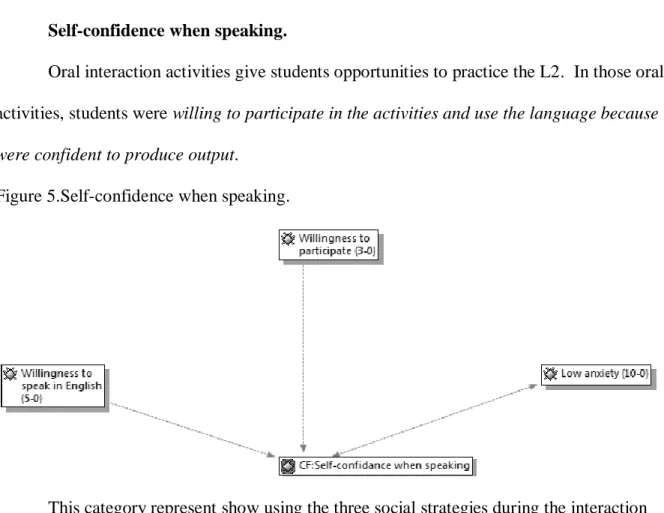
(10) Running head: IMPLEMENTING SOCIAL STRATEGIES TO IMPROVE SPEAKING IN INTERACTION ACTIVITIES 7 Table of Figures Figure 1. Survey results ................................................................................................ 45 Figure 2. Interaction improvement ................................................................................. 46 Figure 3.Language use and message transmission in interaction performance. ............... 50 Figure 4.Linguistic improvement. .................................................................................. 54 Figure 5.Self-confidence when speaking. ....................................................................... 56. Table of Tables Table 1.Salient students' behaviors. ..................................................................................5 Table 2.Stages in the Process and Instrument Design. .................................................... 38 Table 3.Categories and subcategories. ............................................................................ 44.
(11) SOCIAL STRATEGIES TO IMPROVE SPEAKING. i.
(12) Running Head: IMPLEMENTING SOCIAL STRATEGIES TO IMPROVE SPEAKING IN INTERACTION ACTIVITIES 2. Chapter One: Introduction Nowadays people live in a globalized world that has different cultures and beliefs which are mostly expanded through the use of mass media. Due to this close worldwide communication, new learning demands have arisen. Learning a new language such as English is a goal not only in South America, but also in developing countries all over the world. For the reason above, in 2004 the Colombian Ministry of Education sets a goal called “Programa de Fortalecimiento al Desarrollo de Competencias en Lenguas Extranjeras (PFDCLE)” to develop and raise second language proficiency in young Colombian citizens from private and public institutions. To this end, the communicative competences appear as the main components to work on in order to undergraduate gain some proficiency in a second language; in an EFL context, learners can develop this competence when they learn to use language in realistic situations. Recalling Oxford (1990), students need communicative competences, especially the sociolinguistic competence, to use the second language in various contexts. The sociolinguistic competence helps learners to understand and use appropriate utterances in various social contexts by means of spoken discourse such as apologizing, persuading and describing. The present study suggests the use of three social strategies-asking questions, cooperating with peers, and substitution (Oxford, 1990; Chamot et al., 1999) along with communicative activities to improve a group of adult learners‟ oral interaction. Thirteen students from a university in Chia, Colombian, participated in this study; although they were enrolled in various undergraduate programs, they were studying English to meet a graduation requirement. The main core of this project was to have students communicate more effectively by creating useful and dynamic activities that provide opportunities for spoken/oral interaction focusing on issues such as.
(13) Running Head: IMPLEMENTING SOCIAL STRATEGIES TO IMPROVE SPEAKING IN INTERACTION ACTIVITIES 3 students‟ attitudes, expectations, interests, and needs, as well as their ability to express their points of view and cultural values (Chastain, 1988; Given, 2009). Considering the importance of improving learners‟ oral interaction, Oxford (1990) and Mora (2013) reaffirmed that communication should occur through the use of interaction tasks. Learners can participate in those tasks using the language and focusing on different functional situations and contexts. Those tasks also foster students‟ speaking skills because they can connect their knowledge of the world with their cultural references. Statement of the problem The Department of Foreign Languages and Cultures at this private university focuses on training and preparing graduates to participate in a globalized world in which English is often the language with greater demand. The document called “Restauración de reestructuración curricular para el programa de proficiencia en lenguaextranjera en la Universidad de La Sabana” (2002) describes two main directives: to foster communicative competences and to provide an integral education; in addition, the department´s curriculum seeks to develop the four English skills in two face to face sessions and one online session per week in a blended program. The students participating in this study were young adults who are considered independent users at the B1-B2 level (CEFR). The students can understand the main points of clear standard input on familiar matters and topics about their university contexts; they can also deal with most situations likely to arise while traveling in an area where the language is spoken (North, 2000). Furthermore, students understand the importance of learning the English language not only they need to pass a required international proficiency exam for graduation, English competence offers study and job opportunities as they grow professionally..
(14) Running Head: IMPLEMENTING SOCIAL STRATEGIES TO IMPROVE SPEAKING IN INTERACTION ACTIVITIES 4. This research study sought to understand a phenomenon in a real context taking into account the participants‟ and university setting (Golafshani, 2003). In this study, one current issue in regards to students‟ speaking development is that the teacher does not promote a communicative atmosphere in which learners can use the language. Hence, the teacher used two needs analysis instruments, field notes of teacher‟s observations and a student questionnaire. She identified issues such as students‟ low performance while interacting with peers. The first instrument of these was field notes which can help the researcher to organize the “raw notes into cooked notes” (Shagoury & Power, 1993, p. 46) to identify students‟ behavior during speaking activities. After observing the students‟ speaking behavior for two weeks, the researcher found six salient student behaviors. The preliminary data analysis revealed that during interactive group speaking activities about a given topic, the pupils expressed their points of view using their first language (L1). Occasionally, some of them were silent or used monosyllables words; it was difficult for them to express themselves because they seemed to lack useful strategies to share their thoughts. Others did not use language that promoted discussion of given topics in class; instead, they used some isolated sentences in English to state their points of view, such as affirmative and negative words,short sentences to achieve the task demands, answer a question or make a list. In addition, most students indicated that they wanted to write down what they were going to say before speaking, so they could feel comfortable and prepared when communicating their ideas. These salient behaviors from the field notes are described below:.
(15) Running Head: IMPLEMENTING SOCIAL STRATEGIES TO IMPROVE SPEAKING IN INTERACTION ACTIVITIES 5. Table 1.Salient students' behaviors.. The teacher-researcher used a second needs analysis instrument to complement the preliminary data. She used questionnaires (Rothwell, 1996) and followed the author‟s most important components for questionnaires such as length, students‟ anonymity, introductory and closing sentences, nominal and ordinal questions, and a close remark sentence to create an appropriate and objective survey. One section of the survey asked questions about the four English skills. The responses indicated that the majority of students perceived speaking and reading as difficult skills, yet most of them indicated that speaking was the most important of the four language skills. Moreover, when asked about the frequency of English use in the classroom, the majority of the participants stated that they used English in class; however, in another question they also admitted that the frequency of using the language was not high. Another topic of the questionnaire involved the types of speaking activities students preferred. Those activities were simulations, debates and discussions, which demonstrate that learners understand the importance of learning and using English..
(16) Running Head: IMPLEMENTING SOCIAL STRATEGIES TO IMPROVE SPEAKING IN INTERACTION ACTIVITIES 6. Based on the data obtained during the needs analysis, the researcher concluded that the students may find difficulties expressing themselves because they might not feel confident while speaking and interacting with peers, so they can prefer to use their L1 or monosyllables words and no discussion was observed in the tasks. Swain and Canale (1980) pointed out that in order to learn other languages in the classroom; interaction must take place between the teacher and students and among learners. So, if the teacher provides opportunities for students to hear [input] from the L2 and produce [output], students are more apt to acquire the new language in the classroom setting. In this research context , some students made an effort to use the language when they tried to communicate ideas and feelings; however, these students could not use appropriate words or expressions to discuss a given topic and express their ideas with any degree of fluency. Participants needed of interaction activities to communicate thoughts and experiences without being worried the anxiety of speaking accurately. However, they did not know how to converse in English because they were not acquainted with speaking strategies. In order to address these issues, the teacher researcher promoted the use of social strategies by training students how to use them, and provided activities during which students could communicate authentically with their peers. Swain and Canale‟s study (1980) showed the importance of teachers reducing social and cognitive pressures in the classroom so that students could produce language that reflects more appropriately or precisely their intended meaning. Consequently, the teacher considered it necessary to create communicative situations and train students to use of social strategies, so they could easily share their points of view using the language they knew (Tsou, 2005). This research project investigated the possible outcomes of the integration of social strategies to improve oral interaction skills in interaction activities. It was driven by the following research question and objectives:.
(17) Running Head: IMPLEMENTING SOCIAL STRATEGIES TO IMPROVE SPEAKING IN INTERACTION ACTIVITIES 7 How might social strategies influence oral interaction in a group of B1-B2 young adults’ university English class? General objective To determine the effects of three social strategies on oral interaction in a group of B1-B2 university English learners. Specific objectives 1. To analyze the influence of social strategies in young adults‟ oral interaction. 2. To examine how the three selected strategies might impact learners‟ self-confidence. Rationale An area identified as the most problematic in the target group is the one regarding oral interaction.The focused observation of different classes and the data gathered from the questionnaire revealed that students used few sentences in English and some students did notparticipate in speaking activities in the classroom. As, English is now considered an important language for personal and professional success, the city government of Bogota has implemented a core project to promote English called Bogotá Bilingüe. The mission of this campaign is to help learners to be aware of the importance of learning this language in different contexts including the workplace, relationships, school and university. Taking into account the aforementioned context and problem, the researcher plans to implement social strategies as tools to communicate; thus, she has to set different social contexts appropriate to students‟ English level to develop the sociolinguistic competence. The activities should encourage learners to describe, give opinions and explain personal and cultural topics. Thus, students should be able to build meaning in conversations, informal/formal discussion and.
(18) Running Head: IMPLEMENTING SOCIAL STRATEGIES TO IMPROVE SPEAKING IN INTERACTION ACTIVITIES 8. meetings, goal-oriented co-operation, transactions to obtain goods and services, information exchange, interviews and be interviewed using sociocultural strategies (North, 2000). This contextualization suggests taking advantage of students‟ needs to foster their oral interaction skill.In recent studies, Gómez (2011) and Mora (2013) found that peer interaction provides students with opportunities to listen to what others have to say, so they can compare and contrast opinions and ideas. This finding reinforces the importance of providing students with tools such as social strategies to enhance communication. The following chapter presents the theoretical framework of the project, which includes relevant theories about the speaking skills, interaction based on sociocultural context and interaction activities where social strategies are embedded..
(19) Running Head: IMPLEMENTING SOCIAL STRATEGIES TO IMPROVE SPEAKING IN INTERACTION ACTIVITIES 9. Chapter Two: Theoretical Framework This literature review examines for current theories and literature regarding second language communication and particularly oral interaction. Speaking skills, oral interaction, interaction activities, and three social strategies –asking for clarification and verification, substitution, and cooperation with peers- rooted in the work of Oxford (1990) and Chamot et al. (1999) are the constructs to promote oral interaction. Research concerning those strategies relies on the cognitive psychology (Wiliams & Burden 1997, p.149) as its aim is to promote an educational environment, where pupils are actively learning by using tools, with an emphasis on creative expression. Additionally, this review will include a discussion of how these social strategies and interaction tasks intertwine to improve speaking skills, especially oral interaction. Speaking skills Speaking is the productive skill that is delivered orally. In order to develop speaking skills, learners can do it in two ways: individually or in face-to-face situations. For this project, speaking skills are focused on pupils‟ performance while using the second language to interact and share thoughts in group tasks. Nevertheless, the lessons from the target context most likely develop speaking skills. This is because the topics used during those sessions occasionally foster the language use and are not relate to the students‟ interests or experiences. In that sense, the teacher generally provides speaking activities relegated to the chat at the beginning and end of the lesson; those activities are simply ways of rehearsing pre-selected grammar items or functional expressions (Thornbury, 2009). Some researchers have identified the shortage of opportunities to practice speaking as an important contributing factor for speaking failure (Díaz, 2011; Gómez, 2011). Spending time in.
(20) Running Head: IMPLEMENTING SOCIAL STRATEGIES TO IMPROVE SPEAKING IN INTERACTION ACTIVITIES 10. class reciting grammar sentences and vocabulary items does not constitute practice (Díaz, 2011); instead, verbal skills are developed through interaction projects. Hence, while speaking practice takes place in order to achieve any degree of fluency, automaticity is necessary (Thornbury, 2009). Automaticity allows speakers to focus their attention on the aspects of the speaking activity that requires immediate either planning or articulating a speech by means of some strategies. Thus, learners use the language they know, for example prefabricated chunks to express thoughts of a given topic and in a communicative activity; however, when students have in-class opportunities to practice the language, they can transform those small units into bigger ones. Another problem that teachers face when trying to develop the speaking skills is preparing students to use the language in real situations. Although some researchers such as Brown (2007) in the EFL field consider speaking to concern pronunciation, word choice, and grammar as fundamental to speaking skills, others such as Chastain (1988) claimed that the focus of speaking instruction should be conveying and creating meaning. Consequently, in this research project, speaking skills are developed when undergraduates interact with their peers in communicative tasks. Oral interaction As stated earlier, speaking skills serve as a vehicle for students‟ participation in-class activities; hence, when students are engaged in a group task that requires communication, oral interaction occurs and oral proficiency is developed. When the teacher provides and uses interaction activities during the lesson, students will communicate with their peers who may share similar language and social backgrounds, and interests. Situations like these can lead to a natural conversation because learners may feel involved so their participation is relevant in the activity..
(21) Running Head: IMPLEMENTING SOCIAL STRATEGIES TO IMPROVE SPEAKING IN INTERACTION ACTIVITIES 11. Communication skills can be developed in various ways. For instance, Díaz (2011) found in his research that his students could develop speaking skills by being trained to perceive, recall and articulate sounds and structures. Moreover, he stated that speaking can also be developed using tasks where learners can use the language communicatively. In Mora‟s (2013) and Mohammed‟s (2008) research projects, they found that when participants worked together a task, they encouraged an active conversation which could lead to reflection and learners became more serious and responsive. Those kinds of in-class speaking opportunities gave students a chance for practicing speaking skills as preparation for using the language outside the classroom (Harmer, 2001). Hence, in this research project the researcher is going to focus on the “talking with” speaking process (Chastain, 1988, p. 275) in which speakers create meaning in the process of interacting with others to ensure comprehension. According to Brown (2007) learners should become proficient in maintaining conversation by activating the language they know. Besides, in studies such as in Kayi (2006), the students learned to speak in the second language by interacting with their peers. Alternatively, Taylor (1983) found that learners can put their grammatical knowledge into practice by speaking, but they cannot speak for the sole purpose of acquiring new grammatical structures of the language. In this research project, learners speak in English as a way of communicating ideas and expressing thoughts, so the researcher aims to provide students with opportunities to freely use the language. Gutiérrez (2005) found in his research project that using the language for a specific purpose helps learners to communicate. She reports that her students saw speaking as a developmental process in which pronunciation and grammatical mistakes played a part; however, speaking was used to express points of view in real-language situations. Also, Hulstijn and Hulstijn (1984) found that students who planned and monitored their speech had fewer grammatical errors; however, they.
(22) Running Head: IMPLEMENTING SOCIAL STRATEGIES TO IMPROVE SPEAKING IN INTERACTION ACTIVITIES 12. took thirty percent longer to say what they wanted to say and transmitted fourteen percent less information. This previous study demonstrates that the teacher can promote the use of language with interaction activities that invite students to participate by choosing topics related to their lives. Hence, students will speak the language they have in their minds exchanging personal, general and professional information. When learners are using the language to communicate, they take into account their linguistic, extra-linguistic and sociocultural knowledge. Chastain (1988) pointed out that speaking requires students to activate their linguistic knowledge, which is the language knowledge such as discourse patterns, genre, and functions. Moreover, Thornbury (2009) stated that extra-linguistic knowledge, which is the knowledge of the world, affects speaking positively because learners have to consider the topic, cultural and context knowledge, and the familiarity with the other learners. In a recent study Given (2009) found that the relation between students‟ cultural background and the classroom context influenced their classroom oral participation. In this research study, the teacher will focus her lessons on promoting communication among participants considering that the learners share common contexts. The sociocultural knowledge is also present in the oral interaction process; it joins the previous knowledge, extra-linguistic and linguistic, when students follow the values and norms of behavior in a given society, including the way these values and norms are realized through language (Thornbury, 2009). It is shown when Wang (2004) found in his study that global sociocultural values certainly trigger students‟ discussion participation. Hence, the researcher designed activities about real life topics, where learners easily shared their experiences or ideas because they have common characteristics such as their language level, age, an established knowledge of the topic and context..
(23) Running Head: IMPLEMENTING SOCIAL STRATEGIES TO IMPROVE SPEAKING IN INTERACTION ACTIVITIES 13. For interaction activities to be meaningful, students must communicate using the language. Ellis (1999) defined interaction as participants of equal status such as age and similar majors sharing related needs and interests while they make an effort to understand each other. He said that other factors that influence interaction are the nature of the task and characteristics of participants. Taking those characteristics into account, in this study classroom interaction should be based on principles and practices; in other words, the teacher-researcher will carry out activities of real life topics and inform the participants about an objective to fulfill in the task. This type of oral interaction implies that students interact with others by speaking in class, answering and asking questions, making comments, and taking part in discussions (Tuan & Nhu, 2010) In addition, Long (1996) and Ellis (1999) discussed the term negotiation of meaning in their Interaction Hypothesis (IH). This Hypothesis describes another important characteristic of interaction which is message conveyance. In the IH Long (1996) emphasized the role of negotiation of meaning in language development; he stated that negotiation triggers interactional adjustment, complemented by various types of feedback, which facilitates language acquisition because it connects input, internal learner capacities, and output in productive ways. That is to say, negotiation of meaning among learners in an interaction activity is necessary to help them notice the mismatches between input and output through negative feedback to finally modify the output. So, for language acquisition to occur, teachers must provide opportunities to negotiate meaning to prevent a communicative breakdown (Long, 1996). The IH acknowledges that during conversations, situations arise wherein a participant does not understand what the other says, but learning becomes more effective. Through negotiation, learners obtain feedback from interlocutors on their language output in the forms of the conversational adjustments; thus, learners notice new language features and compare this with the.
(24) Running Head: IMPLEMENTING SOCIAL STRATEGIES TO IMPROVE SPEAKING IN INTERACTION ACTIVITIES 14. existing output to modify their production. Long (1996) said that feedback occurs through recast, repetitions of the learners‟ errors using emphasis in order to improve vocabulary, morphology, and syntax. However, this research project draws on the principles of negotiation of meaning, viewed as a vehicle for speakers to interact and share ideas without paying attention to the usage of correct grammatical sentences; therefore, the negative feedback to enhance language forms is not relevant in this project. In addition, comprehension between learners while interacting does not depend on negotiation itself; instead, learners may benefit from dialogic interactions which enhance fluency by allowing the participants to produce the target language (Ellis, 1999). Research in this area reaffirms the importance of communication of ideas rather than mastery of appropriate grammatical structures while interacting. Buck (2001) and Osada (2004) stated that instead of creating accurate grammatical structures, students should use interaction skills, which involve making decisions about how to communicate an idea and the ability to use the language in order to satisfy particular demands. For this reason, speakers use their background and linguistic knowledge to create a message that will be meaningful to the audience. In the same way, Gómez (2011) found that peer interaction gives students an opportunity to listen to what others have to say in order to compare and contrast ideas. Similarly, Jurkowitz (2008) believed that negotiation of meaning requires both learners to work together using the L2. Peer collaboration and meaningful communication as described in these two research projects guided the researcher to emphasize interaction during class sessions because it would help learners to cope with communication problems using strategies without focusing their attention separately on grammatical forms. In essence, these studies also helped the teacher researcher to recognize the importance of giving students opportunities to negotiate meaning using the language..
(25) Running Head: IMPLEMENTING SOCIAL STRATEGIES TO IMPROVE SPEAKING IN INTERACTION ACTIVITIES 15. For a number of years, researchers have studied interaction among non-native speakers (NNS) in EFL contexts. Jurkowitz (2008) focused on NNS-NNS interaction because in an EFL environment the curriculum emphasizes communication and small group work, but opportunities of extensive practice are too infrequent. This is the reason for which communication through interaction must take place in classrooms in order to promote second language use. She also suggests that NNS-NNS interaction is beneficial to learners‟ L2 development and students conversational management techniques. Based on this, the teacher researcher acknowledges the importance of creating an environment where students feel confident enough to use the language. During communication exchange, Oxford (1990) stated that meaning includes not just the semantic and syntactic meaning of words, but also the pragmatic meaning (contextual appropriateness) of communication acts. In Given‟s research (2009), the participants noted that even though their language proficiency was limited, they believed that the more they knew about the subject matter, the more they were likely to contribute to discussions. Therefore, the activities should include topics that are related to the syllabus without leaving aside the students‟ context; thus, teachers should promote the use of a variety of communication skills in tasks that help students use the language. Students need to interact among themselves doing pair and group work, so they do not rely on the teacher as the only source of language input. Peers can provide great variety of language models (Long & Porter, 1984); therefore, students need to interact among themselves. In order to achieve that purpose, Chastain (1988) stated that in the activities proposed by the teacher, their objective should be clear for students, so they can participate in the exchange of information without forcing production; this will enhance motivation. Providing students with varied opportunities for speaking will increase the amount of talking time, work and interaction. Interaction Activities.
(26) Running Head: IMPLEMENTING SOCIAL STRATEGIES TO IMPROVE SPEAKING IN INTERACTION ACTIVITIES 16 The type of interaction which involves students‟ exchange of information is called interpersonal (Vygotsky, 1978). This occurs as a social behavior when people communicate in face-to-face activities through oral or written media. Vygotsky‟s theory is related to how learners can develop mental processes through another human or a sociocultural activity. In this research project, interpersonal communication will be demonstrated in interaction activities which help speakers to use the language among themselves, discussing real life topics. This was observed in recent studies that have investigated the role of interaction activities in fostering students‟ oral interaction (Garrido, 2012; Kayi, 2006; Herazo, 2010; Lopera, 2013; Mackey 1999; Mohammed 2008; Mora 2013; Tsou 2005). In those projects, tasks provided and exposed students to opportunities to contextualize and use the second language, and learners had more chance to participate and learn from their partners. Moreover, Chastain (1988) referred to this type of interaction as “talking with” in which two processes take place: the process of creating meaning and the process of interaction. Therefore, learners need to cooperate with others and the teacher-researcher needs to involve learners in common real-language use. In a local study, Cárdenas and Robayo (2011) involved their students in role plays related to their lives. They observed positive attitudes from students, who showed interest in the interaction with classmates. Because of this, the researcher is interested in promoting interaction and cooperative communication among participants in ample opportunities to speak and participate. Also, these opportunities highly motivate, after receiving participation instruction, and increase students‟ interest in the activity using comprehensible language (Tsou, 2005). The teachers in the mid to late 1970s were interested in natural language because they believed that the L2 acquisition process should resemble that of L1(Brown,1994). On the contrary,.
(27) Running Head: IMPLEMENTING SOCIAL STRATEGIES TO IMPROVE SPEAKING IN INTERACTION ACTIVITIES 17 “classrooms must not become linguistics courses but rather the locus of meaningful language involvement” (p. 254). Teachers must prepare their students to participate successfully in conversations by orienting them to handle the topic under discussion, establishing a context, and giving them potentially useful vocabulary. This was shown in Gómez‟s (2007) and Prieto‟s (2007) local studies, and Mohammed‟s (2008) international study when teachers used activities such as debates, oral presentation and discussion to trigger language use and help them construct sentences and ideas. In addition, in international studies done by Mora (2013) and Kayi (2006), they learned from her findings the significance of offering their students opportunities, ideally from real life scenarios, to create meaningful output and use the second language in action; therefore, using interaction activities, students are exposed to a context where they can use the language. After considering the importance of interaction activities for language use, Swain and Canale (1980) proposed different kinds of activities primarily to promote students‟ interaction and improve speaking fluency. The first one is performance activities, which provide students with opportunities to communicate in the language. The authors stressed that the focus is on engagement and communication, and that emphasis should not be placed on grammatical accuracy during the interaction. This, they claimed, would disappear over time. Consequently, because the main objective is to engage students in real communication, teachers should create a piece of classroom work which involves learners in comprehending, manipulating, producing or interacting in the target language while their attention is focused on meaning rather than form (Nunan, 1989). The second kind of activity is guided activities, which includes a model that students can change to talk about themselves and to communicate their own needs and ideas, and tasks which the students carry out using language taught beforehand. Finally, creative or freer activities, usually designed to provide practice on predicted language items and fluency, but where language.
(28) Running Head: IMPLEMENTING SOCIAL STRATEGIES TO IMPROVE SPEAKING IN INTERACTION ACTIVITIES 18. focus is less relevant. Some activities for freer practice are interaction or information gap, roleplays, simulations, discussions and games. These activities can be combined with cooperative techniques to motivate students to use and improve their English. In this project, the performance and creative and freer activities are used to prompt students to interact and increase participation through pair work (role-plays) and group work (simulations, debates and discussions). Gutiérrez (2005) and Lopera (2013) found that when teachers provide students with those three speaking activities, students could express ideas freely, so real communication is reached because the learners are given the chance to be more spontaneous. Therefore, they found that these performance and group discussion-type activities promoted communication and students are able to achieve a common goal. Finally, because one of the underpinning principles of this research project is to use social strategies (based on the sociolinguistic competence) to practice the language in various contexts, the researcher focused on those types of activities as they offer several benefits to the students. As they participate, students have opportunities to try out the language they already know, learn from how others express similar meaning, and use new strategies they have studied. In addition they gain experience in spontaneous interaction, and they use language purposefully and cooperatively. All of this simulates real life interaction, so they achieve communicative goals. Ellis (1999) said that ethnographers believe that interaction is constructed by participants as they dynamically exchange not just meaning, but also their role relationships, and their cultural and social identities. Therefore, it is necessary that the teacher -researcher provide students with opportunities in the classroom to interact where they can use certain social strategies in order to have positive effects on their participation and speaking fluency. Social Learning Strategies.
(29) Running Head: IMPLEMENTING SOCIAL STRATEGIES TO IMPROVE SPEAKING IN INTERACTION ACTIVITIES 19. Oxford (1990), who has worked on learning strategies and their relation with foreign language learning, stated that “learning a second language in a foreign context does not have immediate social and communicative functions within a community where it is learned; this means that the language can be learned everywhere to communicate” (p. 6). This study took place in an EFL context where learners usually did not speak in English during in-class activities; hence, the researcher‟s aim is to provide proper strategies and communicative activities which will increase student confidence and lead them to practice the language more. Macaro (2006), Weyers (2010) and Gallaher (20012) used a group of strategies, especially speaking strategies, with their students that proved effective in improving their oral performance. Those strategies focused students‟ attention on developing a task and maintain spoken communication. According to North (2000) and Oxford (1990), language entails communicative competences to express meaning and it can be expressed through the medium of speaking, writing, reading and listening. The authors describe four types of communicative competences: . Grammatical competence or accuracy is the mastery of the linguistic code such as vocabulary, grammar, pronunciation, spelling and word formation.. . Sociolinguistic competence is the appropriate use of utterances including knowledge of speech in different social contexts.. . Discourse competence is the ability to combine ideas to create cohesion and coherence.. . Strategic competence is the ability to use strategies without using the language to communicate, as in gestures, for example. Recalling that another objective of this research is to relate communication with the. sociolinguistic competence and interpersonal interaction, the oral interaction development was established in a social context by means of interaction activities. Swain and Canale (1980) pointed.
(30) Running Head: IMPLEMENTING SOCIAL STRATEGIES TO IMPROVE SPEAKING IN INTERACTION ACTIVITIES 20. out that if learners were to engage in socio-cultural-interpersonal interaction and the goal was for them to use authentic language, then they should be involved in activities based on their context as young adult teenagers who may share common interests in regards to their second language learning. For this reason, both activity and oral interaction are required; hence, in the lesson students collaborate and participate in the proposed activities, and new knowledge is constructed until the learners are in a position to appropriate it. Because language is the vehicle for communication, the use of strategies can contribute to the effectiveness of the process. McDonough (1999) stated that strategies have been isolated in the learning process for many years. Nowadays students use tools to learn the language, communicate in the language, and compensate for the lack of knowledge or breakdown of communication in different macro skill areas such as reading, writing, speaking and listening. Strategies are the tools for this research project because they will contribute to the communicative process and will permit students to participate in interaction activities. Oxford (1990) described strategies as an easy way to make learning easier, faster, more enjoyable, self-directed, effective, and transferrable to new situations; in addition, they are oriented to communicative competence. Among the strategies that Rebecca Oxford mentioned, the indirect social strategies are the foundation of this project, to be used by learners in the interaction activities in the implementation stage. In the implementation stage, the process involved in language production, the teacher determined what social topics she needed to take into account to improve students‟ oral interaction while participating in class tasks. Swain and Canale (1980) established some guidelines, while learners are using the language, in regards to behavior (what the speakers can do), semantics (what they can mean) and grammar (what they can say) decide whether the communication is appropriate or not. Ellis (1999) complemented this idea by saying that a social view of language learning.
(31) Running Head: IMPLEMENTING SOCIAL STRATEGIES TO IMPROVE SPEAKING IN INTERACTION ACTIVITIES 21 favors the metaphor of “participation” which entails active involvement rather than the traditional metaphor of “acquisition” which demands possession. Taking into account the main objective of this project, in the implementation stage learners will have opportunities to use the language in activities where a social context is set. Providing interaction activities are one way teachers can help learners develop sociolinguistic competence because the task‟s context and task can be designed for those purposes. Olshtain and Cohen´s study (1989) reported that learners of Hebrew could communicate and participate successfully in interaction activities because they were involved in sociolinguistic acts (interaction activities) by considering linguistic and cultural standards for acceptable performance when they used the second language and took into account the objective of each task. Those positive results would not have been achieved if they had not used social strategies. According to Oxford (1990) and Chamot et al. (1999), asking questions for clarification and verification, substituting, and cooperating with peers social strategies are aids to increase interaction and cultural understanding because those tools can help learners to maintain the conversation and achieve a task. In this research project, social strategies were used to promote participation and communication among participants. Asking questions for clarification and verification were necessary for students to communicate and solve comprehension problems, which could have occurred when something important needed assistance from group members to express an idea. Drawing on Oxford‟s (1990) work, paraphrasing, repeating and explaining are the structures that students can use to confirm understanding and avoid misunderstanding during an interaction. This strategy and these structures may not be part of learners‟ L2 repertoire, so the teacher may need to teach and monitor their use..
(32) Running Head: IMPLEMENTING SOCIAL STRATEGIES TO IMPROVE SPEAKING IN INTERACTION ACTIVITIES 22. The substituting strategy involves substituting known words or phrases when learners do not know or cannot remember a specific word or phrase so that communication continues. Learners may have not known sufficient vocabulary on all topics in the target language to participate effectively, and if they have constantly used a dictionary and asked the teacher for expressions or vocabulary, communication in the group can slow or stop. Finally, the cooperation with peers strategy can encourage positive interdependence and mutual support by giving learners a chance to share their strengths to accomplish a task. Students can collaborate among themselves to produce an outcome based on the objective of each activity; hence, they are going to use the language to communicate meaning and share thoughts. The cooperation with peer‟s strategy is apparent when students communicate during interaction activities; therefore, those activities are helpful to provide important opportunities for learners to practice speaking. In the implementation of this project, the researcher is satisfied of building stronger language motivation, have more language practice opportunities and greater use of different language functions. Hence, the researcher will take into account the learners‟ request in the needs analysis questionnaire to have communicative tasks such as role plays, simulations, and discussion during the lessons to practice and use the language learners know. As a result, the participants can communicate and negotiate a message being motivated to interact. Providing students with interaction activities has positive benefits in increasing students‟ motivation; in Herazo‟s study (2010), he found that in-class tasks which involved exchanging information and had relevant content will engage participants doing the task and encourage them to use the language in their attempt to find out more information..
(33) Running Head: IMPLEMENTING SOCIAL STRATEGIES TO IMPROVE SPEAKING IN INTERACTION ACTIVITIES 23. Consequently, those strategies will help students to be aware of their own process and become active learners. Gruyter (2009) reinforced this idea by saying that language learning awareness can increase whose competence and proficiency which in turn influences learner‟s strategies and motivation. Therefore, the target population in this project is expected to enhance their selfconfidence by working with their peers to communicate thoughts and ideas considering the social context given in the activity. This was showed in Yang‟s study (1996) who found that when learners used some learning strategies, group discussion increased. Another potential area that has already been explored about this project is that teachers and students might not be fully aware of the positive factors of teaching and using strategies in EFL context. Chamot et al. (1999) stated that students must first believe they are capable of becoming more independent learners; additionally, teachers must have confidence that the individual strategies are effective and communicate this to students. Díaz (2011) concluded that the teacher‟s role in promoting participation and work cooperation was important to create meaning. In the while-implementation stage of this project, the researcher played an important role in training students in the sociolinguistic skills and strategies use because s/he was able to help, facilitate, advice, coordinate and co-communicate those tools before students started interacting in the activities. Recent studies such as in Diniz de Figuereido and Mota (2009),Brett (2011), Mohammed (2008), Tsou (2005), and Osboe, Fujumura,and Hirschel (2007), it was shown and found that learners were motivated to participate more after receiving participation instruction. The teacher helped stimulated and encouraged students to be more comfortable as did opportunities to perform in smaller groups and talking about familiar topics. On the other hand, the researcher trained and taught students on the strategies, so that they were expected to learn their importance and when they were appropriate to use (Oxford, 1990). Without those skills,.
(34) Running Head: IMPLEMENTING SOCIAL STRATEGIES TO IMPROVE SPEAKING IN INTERACTION ACTIVITIES 24. learners would have been reluctant and not fully involved in the speaking practice because they would have lacked the confident to use the language and interact freely with their peers. As McDonough (1999) explained, teaching students how to use strategies will increase their proficiency in their use in different situations such as in role plays with different contexts, where they will adopt strategic approaches using them efficiently in less powerful areas. As a final point, Chamot et al. (1999) stated strategies teachability by saying that developing learning strategies, in this case social strategies, can help students become effective learners with a variety of tools to aid them in all types of learning and understanding. Therefore, teachers must name and define the strategy to explain why the strategy works and when to use it. Hence, in the training stage, the teacher- researcher has to explain the strategy with examples for students to know how to use them and guide the interaction process among learners..
(35) Running Head: IMPLEMENTING SOCIAL STRATEGIES TO IMPROVE SPEAKING IN INTERACTION ACTIVITIES 25. Chapter Three: Research Design This chapter provides a detailed account of the procedures followed during the study. The sections in this chapter include the type of study, the educational context, the participants‟ profile, the roles of the teacher-researcher, the data collection instruments, and the procedures of the implementation. Type of Research The present study is classified as an Action Research that allows teachers to inquire about learning problems and reflect on their pedagogical practice. This study corresponds to a smallscale intervention with the purpose of analyzing its impact, benefits, and positive or negative outcomes in the population (Burns, 2010). Taking into consideration that this study attempts to improve students‟ participation in interaction activities by means of learning strategies, action research represents the most appropriate type of research for this study. According to Cohen, Manion and Morrison (2007) action research is a systematic study that combines action and reflection with the intention of improving teaching practice. It combines diagnosis, action and reflection of practical and problematic issues in order to find possible solutions. Additionally, Stenhouse (1975) suggests that action research should contribute not only to practice but also to a theory of education and teaching accessible to other teachers, making educational practice a more reflective one. In research, the teachers first self-assess their own teaching practice, which leads them to understand and learn how to improve and make some changes in it. Cohen, Manion and Morrison (2007) stated that Action Research is a qualitative study because it describes and interprets an area that needs to be improved to generate patterns which are understood to explore possible resolutions. For this particular action research project, the teacher reflected on her learners‟.
(36) Running Head: IMPLEMENTING SOCIAL STRATEGIES TO IMPROVE SPEAKING IN INTERACTION ACTIVITIES 26. behavior and participation in interaction activities where they had to share their ideas using the English language. Based on the gathered data from the needs analysis, the teacher noticed that students did not use English to share their thoughts; instead, they remained silent or used monosyllabic words; furthermore, they needed to write their ideas first before starting speaking and mostly they used their first language. Context This research study was carried out at a private university located in Chia, Colombia. Its mission and vision are to educate professionals who would be desire to contribute to society and put their knowledge into practice to help people in need. This university tries to prepare students in a globalized world and feel confident enough to achieve and reach professional and personal standards established in the world. To accomplish those general standards, the undergraduate English program has a blended language learning methodology and the lessons are divided into two60-minute face-to-face (F2F) sessions and a one-hour online session per week. The participants in this research, who were in English level Six, had to develop various activities using Virtual Sabana, the university‟s online platform each week. Some of these activities involved group tasks and others were completed independently. The weekly online session, as part of the sixty four-hour English program, has activities assigned individually and/or collaboratively and contributes to the development of the target tasks stated in each academic term. Active participation in discussion forums is mandatory as the website is a space conceived for continuous reflection, contributions, and learning within a respectful and supportive learning environment. Independent work is set in VS, for students to.
(37) Running Head: IMPLEMENTING SOCIAL STRATEGIES TO IMPROVE SPEAKING IN INTERACTION ACTIVITIES 27. prepare classes and consolidate topics studied in class. The platform also serves as a scaffold because it provides resources for skill development and practice. The institution follows a communicative and task based approach because students are encouraged in the lessons to use and practice all of the English skill areas. The face-to-face and online activities are created based on the idea that learning a language successfully comes through communicating real meaning. When learners are involved in real communication, their natural strategies for language acquisition are used, and this allows them to learn to use the language (Richards & Rodgers, 2006). The English curriculum and course syllabi approved by the university direct the development of all of the skills with the objective that students are able to read authentic academic and scientific articles and listen to and understand social/transactional dialogues, talks, lectures and interviews. In addition, students can write compare/contrast, cause/effect and opinions essays and participate in discussions related to their academic, social and professional context. Teachers enhance students‟ autonomy and promote the ICT use inside and outside the classroom. These demonstrate that during the English lesson students are exposed to real language. The teacher-researcher uses and adapts the activities from the New Cutting Edge UpperIntermediate text book (Cunningham & Moor, 2005), but she also uses other activities from the web and textbooks to complement the lessons. The use and adaptation of those activities are set in order to help students to improve their English skills. Learners’ Profile. The participants of this research were sixteen male and female university students between eighteen and twenty two years old. The university uses a language proficiency exam to classify new and old learners; hence, the English level six course that the students are in corresponds to B1-.
(38) Running Head: IMPLEMENTING SOCIAL STRATEGIES TO IMPROVE SPEAKING IN INTERACTION ACTIVITIES 28. B2 according to the CEF (Common European Framework). Learners were from different undergraduate programs at the university, who were studying English as a graduation requirement and have to take an international exam when they finish the seven English levels. Most of the participants were able to read authentic academic and scientific articles and listen to and understand social/transactional dialogues, talks, lectures and interviews. In addition, they could write essays using present, past simple, perfect and future tenses, but they found difficulties writing coherent and cohesive essays with a continuous flow of ideas because they used isolated sentences develop their ideas in a logical order for readers. They also had difficulties using appropriate grammar structures in context when writing essays and in cloze grammar exercises. Based on the needs analysis findings, the area identified as the most problematic in the target group regarding speaking was oral interaction. The students had to use English when participating in discussions related to their academic, social, personal and professional context. The observation of different classes evinced that students were limited in their ability to express themselves. They produced some limited English sentences, monosyllabic words or expressed their point of view using their L1and remained silent in interaction activities. Likewise, when they were not able to discuss about a topic, they only shared isolated ideas and sometimes finding necessary to write them first..
(39) Running Head: IMPLEMENTING SOCIAL STRATEGIES TO IMPROVE SPEAKING IN INTERACTION ACTIVITIES 29. Moreover, students indicated in the preliminary survey for this research, as they had consistently done in end-of-course self- assessments conducted by the teacher, that speaking was the most important of the four language skills. They proposed activities such as debates /discussions and simulations to develop this skill; this proposal suggests that students may did not speak in English because the activities at the beginning of the project, in which they were involved, were not motivating enough (in contrast to the ones proposed by them).In addition, the teacherresearcher surmised that the students generally did not take risks because they feared embarrassment or appearing foolish with mistakes in front of their classmates. After considering the target group‟s profile and needs, the teacher-researcher decided that social strategies might serve as a possible tool to implement in her classes in order to solve this particular problem. These strategies could probably facilitate peer-interaction, by asking questions or using statements to continue talking and substituting words when vocabulary is missing. Yet, she believed that interactive activities had to be based not only on class objectives, but also on social contexts in order to make students feel comfortable and natural while speaking. Researcher’s Role The researcher participation in this action research study had different roles during the several stages of the project. Reflective action research (Burns, 2010) is evidenced when the teacher analyzes and reflects systematically on the daily classroom teaching practice; this is done in order to think about the possible solutions and how to address a specific problem presented in the classroom. In this part of the study, the teacher is also a researcher, acquainted with language learning theory, which guided her decisions about possible solutions previously thought by the teacher; also, theory helped the researcher to support and explain her points of view and the gathered data..
(40) Running Head: IMPLEMENTING SOCIAL STRATEGIES TO IMPROVE SPEAKING IN INTERACTION ACTIVITIES 30. Later in the research, the teacher played another important role as a facilitator and guide (Burns, 2010). For this particular study, called by the author participatory action research, the researcher trained students in using three social strategies –asking questions for clarification and verification, substitution, and cooperation with peers-for improving their speaking skills by presenting, naming and giving useful examples of them. Data collection instruments The instruments chosen to collect data in this research study were an initial and final survey, a teacher‟s journal and a think-aloud report. Survey According to Cohen, Manion and Morrison (2007), highly structured surveys using cloze questions are useful to measure and generate frequencies of response amenable to analysis. This survey had multiple choice questions in which the range of choices was designed to capture the likely range of responses to given statements (Cohen, Manion & Morrison, 2007). For the present study, this type of questionnaire determined if students were acquainted with the social strategies and how frequently the participants used them in the interaction activities (Appendix A) Previous to the implementation, the survey was administered to the whole group to know the frequency of students using social strategies and to see if they used them or at least if they were acquainted with them. Additionally, it was necessary that the surveys were complemented and compared to the teacher‟s observation journal to ratify the data collected. Think-aloud report This procedure is applied in language learning settings to keep a record of how a person processes language that is to determine which strategies a learner uses to complete a specific task (Chamot, et al., 1999). Also, because students compose these reports in real life settings, they are.
(41) Running Head: IMPLEMENTING SOCIAL STRATEGIES TO IMPROVE SPEAKING IN INTERACTION ACTIVITIES 31. not likely to forget their thought or invent false ones, giving this instrument a high degree of validity in connection with the task (p. 68). Generally, students verbalize their thoughts in the think-aloud technique, but for this research project, the teacher-researcher had the students use paper-based think-aloud reports to write their strategies use (Appendix B). For this research project, the teacher conducted the report individually as a follow-up activity in the middle and at the end of the implementation. Chamot, et al. (1999) said that students will probably need training and practice before using it, but once they are used to the technique; most of them will enjoy sharing their thoughts about their experience using the three social strategies in the communicative tasks. Periodically, students completed a chart to report which social strategies they used to complete various tasks and why they chose those strategies; then, they answered open ended questions to complement and validate their thoughts about the use of strategies and their learning process. Observation According to Oxford (1990) this instrument is useful as social strategies are directly observable and can yield information about how students currently go about learning languages. This technique is more reliable when was complemented with the survey at the beginning of the implementation. Also, observations were complemented with the think-aloud instrument to validate the data found. The author suggests that the researcher consider the level of detail she plans to observe. For this reason, the teacher- researcher focused the observation on the social strategies typically used by the whole group and the influence of each strategy in students‟ oral interaction, and then, she tracked the strategies used from small groupsin the target group. Data collection procedures.
(42) Running Head: IMPLEMENTING SOCIAL STRATEGIES TO IMPROVE SPEAKING IN INTERACTION ACTIVITIES 32. Before the teacher-researcher start the implementation stage, she asked peer workers at this university to revise and validate the data collection instruments; also, she received insights from her peers who are conducting research. As a complement to this, a pilot phase was conducted with the participants of the study to help the researcher validate the instruments by presenting their thoughts and reactions. Having followed both procedures, the teacher could make amendments in regards to the questions in order to not bias students‟ responses. Previous to the implementation, the survey was applied to the whole group to determine the participants‟ level of knowledge about social strategies and to what extent they used them. The teacher conducted this survey once to check students‟ schemata and use in regards to three social strategies; therefore, the survey was not conducted again at the end of the implementation. The “think-aloud” technique has evolved over the years and is now commonly used to gather more information form participants. Thus, Ericsson and Herbert (1984) recommend that the information should be collected in the form of retrospective reports after the task to avoid any interruptions of task flow. For this research project, the teacher conducted this technique individually as a follow-up activity as soon as students had done some activities. It is also a key instrument in the implementation stage because it helped the teacher understand and know from the participants their beliefs and experiences using questions to clarify and verify the information they were discussing among them, substitute words when they lacked of vocabulary and cooperate with their classmates. The participants felt comfortable answering the instrument because it was in Spanish and they wrote about the experiences that recently happened in the classroom. Finally, the researcher focused the observation on the social strategies typically used by the whole group, and then, she tracked the strategies from a small group in the target group. The.
(43) Running Head: IMPLEMENTING SOCIAL STRATEGIES TO IMPROVE SPEAKING IN INTERACTION ACTIVITIES 33. observation took place throughout the implementation when students used the social strategies in interaction activities. Ethical Considerations The research design instruments were validated by three peer workers, two peers who were doing research, and an experienced researcher/teacher. Also, each instrument includes information that explains the main goal of it to the student-participant. The teacher-researcher informed students that their identities would not be revealed and that the information gathered from them would not affect their grades..
(44) Running Head: IMPLEMENTING SOCIAL STRATEGIES TO IMPROVE SPEAKING IN INTERACTION ACTIVITIES 34. Chapter Four: Pedagogical Intervention and Implementation This chapter aims to explain the pedagogical intervention and implementation of the three social strategies in students‟ performance in communicative tasks. Moreover, it describes in detail the process and steps followed in the pre, while and post implementation stages including the instruments used in each stage, the objectives of each task in the implementation stage and the materials used. Vision of Language In this research project, students are learning a language in an EFL context; hence, teachers need to establish appropriate activities for students to share their thoughts easily. The teacherresearcher considered language as a vehicle for understanding and transmitting a message among the participants, who share common interests, ideas, and needs. The interaction activities for this study are designed to encourage these students in this context to share their knowledge using the language they know and to communicate a message effectively. The two foundations of communicative competence are sociolinguistic competence and strategic competence. The first is related to students‟ culture and context; the second refers to the interaction between two learners using the language they know along with certain techniques to overcome language gaps (Brown, 2007). Therefore, the teacher-researcher designed activities that not only followed the syllabus of the course, but also included real life topics for students use the language. Brown (2007) and Thornbury (2009) claimed that learners who share the same context have a similar culture with a previously established cognitive and affective behavior. Consequently, learners have the knowledge about the norms and rules about how to use the language in society and in a specific situation. This common socio-cultural knowledge drew the teacher-researcher‟s.
Figure
+3
Documento similar
work, they developed a social network to improve collaborative learning and social interaction. His research revealed that the use of this tool motivated the
His research interests fall in the areas of genetic social psychology, social interaction in learning and cognitive development, social representations of gender, intergroup
In the case of speaking, researcher shows that a rich variety of activities might be done to promote this particular language skill in the language
Significant intra- and inter-gland correlations between angiotensinase activities of pituitary and adrenal glands in non-treated Wistar–Kyoto (WKY) and spontaneously hypertensive
motivacional tarea en las tres necesidades psicológicas básicas en una UD. En este sentido, si el docente genera un clima motivacional tarea se espera que el alumnado
In the activities to come, we envision developing educational capabilities in OER STEAM Territories to foster an open community through activities of training (web seminars).
military activities and developments in and affecting the Territory, demining activities, and provision of logistic support to the UNHCR CBM programme. Within the
Public archives are well-established through the work of the national archive services, local authority-run record offices, local studies libraries, universities and further
