UNIVERSIDAD DE CUENCA
Facultad de Filosofía, Letras y Ciencias de la Educación Carrera de Lengua y Literatura Inglesa
Herman Melville’s short story "Bartleby, the scrivener: a story of Wall Street" and the analysis of Jorge Luis Borges’s translation.
Trabajo de titulación previo a la
obtención del Título de Licenciada en
Ciencias de la Educación en Lengua y
Literatura Inglesa
Autora: María Isabel Pérez Ortega C.I. 0104977111
Director: Juan José Santillán Iñiguez C.I. 0301916144
Resumen
Este proyecto de investigación tiene como objetivo analizar la influencia de la cultura
en una traducción. Para este proyecto dos textos fueron elegidos: Bartleby, de Herman
Melville y su traducción hecha por Jorge Luis Borges. Para alcanzar la meta a través de
un análisis comparativo, fueron establecidas cinco categorías de análisis: concisión,
técnicas de traducción, estructura gramatical del inglés comparada con la del español en
el estilo directo de los diálogos, registro y vocabulario. Los resultados corroboraron la
idea de que no hay texto que pueda ser transferido de un idioma a otro de una manera
exacta. Primero, los resultados mostraron que la traducción no fue leal al texto fuente en
el número de palabras, párrafos y frases. Segundo, las técnicas usadas por el traductor
provocaron cambios estructurales y culturales. Después, la estructura gramatical del
estilo directo en los diálogos mostró un cambio necesario producido por la estructura
del mismo idioma meta. Consecuentemente, este cambio llevó al análisis de la siguiente
categoría: el registro, producido por los diálogos de estilo directo, cambió en la
traducción. Finalmente, dos palabras específicas en la traducción, gracias a su origen,
establecieron un cambio cultural en el texto traducido. El análisis de éstas categorías
mostró cambios precisos en la estructura, expresiones, forma, personajes y,
principalmente, cultura. Estos cambios muestran la influencia de la cultura del traductor
en el texto.
Abstract
This research project intends to analyze the influence of culture in a translation. Two
texts were chosen: Bartleby by Herman Melville and its translation made by Jorge Luis
Borges. To carry out the objective of the project through a comparative analysis of both
texts, five categories of analysis were established: conciseness, translation techniques
and grammatical structure of the English language compared to the grammatical
structure of the Spanish language in the direct speeches, register, and vocabulary. The
results corroborated the idea that there are no texts that can be transferred to a target text
in the exact same form as it is in the source text. Firstly, results showed that the
translation was not loyal to the source text in the number of words, paragraphs and
phrases. Secondly, the techniques used by the translator provoked structural and cultural
changes in the target text. Afterwards, the grammatical structure of the direct speeches
showed a necessary change produced because of the language structure itself.
Consequently, this change lead to the analysis of the next category: the register,
produced by the use of the formal and informal language in the direct speeches which
changed in the translation. Finally, two specific words from the target text established a
cultural change in the text because of its origin. The analysis of these categories showed
precise changes in the structure, expressions, form, characters, personalities and mainly
culture. These changes can show the influence of the translator’s culture on the text.
Table of Contents
Translation studies and its relationship with culture. ... 17
Borges and translation ... 23
‘Bartleby’ translation analysis ... 27
Conclusion ... 29
Theoretical Framework ... 30
Translation: meaning and importance ... 30
The translators´ perspectives. ... 33
Vladimir Nabokov. ... 34
Octavio Paz ... 34
T. S. Eliot ... 35
Jorge Luis Borges... 35
Culture and translation ... 37
Intercultural and cross cultural communication. ... 38
The culture from the margin and from the center ... 39
Chapter III ... 42
Methodology ... 42
Approach ... 42
Research Design ... 45
Data Used in the Research: Bartleby, the Scrivener by Melville and Its Translation by Borges ... 46
Data Collection ... 48
Data Analysis ... 48
Chapter IV ... 51
Results ... 51
Analysis of Each Category and Their Respective Results ... 51
Conciseness ... 51
Discussion ... 53
Translation techniques. ... 54
Discussion ... 60
Comparison of the grammatical structures of the direct speeches. ... 60
Discussion ... 61
Conclusion and Recommendation ... 66
Conclusion ... 66
Recommendation ... 69
References: ... 71
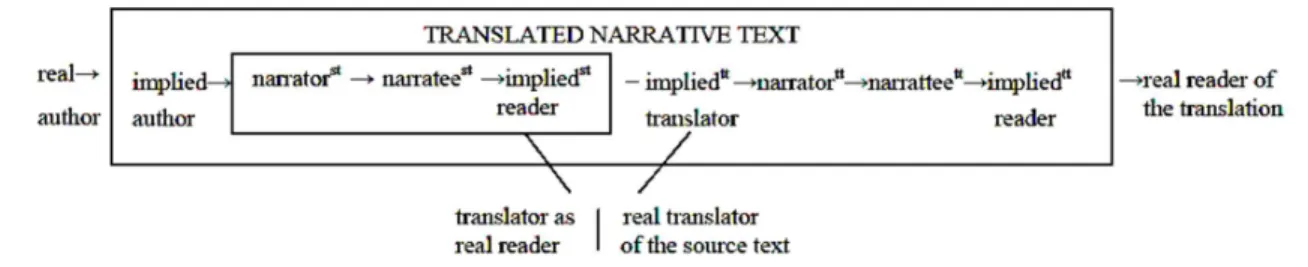
List of Figures and Charts Figure 1: Scheme of the translated narrative text and all its agencies ………23
Chart 1: Methodology table according to the research question. ... 43
Chart 2: Conciseness in the translation ... 52
Chart 3: Translation techniques used by Borges in ‘Bartleby’ short story ... 55
Dedication
This work is dedicated to my daughter
who is my encouragement and my force,
to my life partner, who has always pushed
me to finish what I start and to my big
Acknowledgements
I am grateful to my supervisor, Juan José
Santillán, and to all my teachers, who
have contributed to the development of
Introduction
Translation is an indissoluble element of literature. It forms part of the life of the
majority of readers because of the necessity to read a text that was previously written in
an unknown language. However, there is a characteristic of translation to which not
every reader pays attention: translation changes the source text. It makes a text become
an intercultural text with both cultures playing a role in the story.
This project, therefore, was developed with the aim of understanding how
culture influences a translation. To achieve this goal, the main objective of the project is
to recognize the influence of the translator’s culture on the source text and recognize the
changes produced because of that influence.
The project consists of five chapters. In the first chapter, the problem that
motivated this study is explained. Furthermore, the background and justification are
presented in this chapter.
Chapter two relates to the literature review and theoretical framework of the
project. This chapter is divided into two parts: some studies made about translation and
some specific studies made about Borges’s translation of ‘Bartleby’, and the theories
related to translation itself and translation techniques.
In the third chapter, the methodology used to carry out the project is explained.
This chapter mainly relates to the method applied in the project: content analysis, and
the instrument used in the research--document revision. In this chapter is stated the five
categories of analysis to be used in the study of the translation.
The results of the survey are presented in chapter four. This chapter features the
findings of the study according to each one of the categories of analysis.
Finally, in chapter five, the conclusions and recommendations are described as
Chapter I
Problem Statement
As stated by Sakellariou: “the translator is, each time, confronted with a
different text world […]. While striving to interpret and understand the source text, the
translator is already in the semiotic universe of the source culture” (Sakellariou, 2011,
p.11). Therefore, it could be said that a translation is an interpretation of the text which
leads one to understand that if a text could have different translations, the same text may
have different interpretations. Nevertheless, neither the translator nor the reader thinks
about it even though both appreciate the book from a different perspective. As an
illustration of the translator´s outlook of the book, Marias (2007) explains that
translation is an activity to which they are so accustomed that frequently they forget or
lose sight of some of its essential and adapting aspects1. On the other hand, most of the
audience to which the book is directed does not notice it because they tend to be
absorbed in the plot, content, or ideas of the text. For instance, when a reader has a
Spanish text that was originally written in English, that reader could normally think that
the text tells exactly what the original author wanted to tell rather than only being
influenced by the translator’s words, opinions, ideas, or interpretations.
Furthermore, when a translator takes a text and decides to translate it into his
own language, he has to choose among different options so that the text does not differ
too much from the original one; to put it differently, the translator must be as loyal as
possible to the original text. In spite of that intention, Marias (2007) asserts that a
translated work is not exactly and cannot be exactly the work that the author wrote: the
extreme modification of the language change invalidates that possibility, stops it being
the same work. However, the way a person translates a text is not really an issue; the
problem – or the question – comes when one starts thinking that the target text states the
same as the original one, if the read text is influencing the audience in the same way as
the original one would do, or if it has more or less the same ideas than the prime one, in
other words, if the translator’s personality, time, history, context and, especially culture,
affected the translation.
There are many writers who also have been their own translators. Calvo (2016)
mentions some of them: Tagore, Julian Green, Ungaretti, Samuel Becket, and Nabokov,
among others; and there are many others who were translators of other writers. Every
writer and translator uses a different method or makes a different choice in order to
express what the book tells. Just to give an example, Nabokov was a translator who
always affirmed that the only way of being faithful to a text was making a literal
translation, including all the necessary explanations of the real intention of the source
text, if the language of the translation does not have the precise equivalent of what is
said in the source language. On the other hand, in Borges’s case, which is the issue of
this project, he deals with this problem in a different way. Kristal (2002) emphasizes
that “Borges was interested in translation as a means of enhancing work because the
work mattered more to him than its author” (p. 16). For Borges, it did not matter if the
text changed completely as long as was improved. Di Giovanni confirms this when he
states that “one of the great luxuries of working with Borges is that he is interested only
in making things better and not in defending a text” (as cited in Kristal, 2002, p.14).
Under this circumstance, for Borges it was not important if the translated text did not
say or express exactly the same as the original one. Therefore, all those possible
about the translator. Given this, it is very important to establish the changes in Borges´s
translation – Melville’s Bartleby –, in order to understand all the aspects that Borges
believed were more important in order to enhance the text, and how those things
indicate Borges’s cultural approach.
Background
As is observed by Calvo, (2016) translation began as an occupation reserved for
royalty and the erudite. Later, it was in the hands of poets and it was a modality of
literary creation which shaped the Occidental canon. As shown above, for many years
there have been translators solely because of the natural human practice of
communication. It is a form in which different people can communicate across
boundaries so that they can know each other, learn about their cultures, and even
negotiate with them; but it has always been part of literature, and with the knowledge of
the different literary creations a large groups of writers started to emerge.
Even though translation has been an activity from antiquity, there are still many
conflicting viewpoints. There are many categorized translation perspectives and
methods, many authors who have written about it, and there are many others who have
translated according to their own beliefs of what translation is; but there is not any
consensus about the best translation methodology. Becchi (2018) explains that “in the
existing theoretical studies, there are in this respect two radically different approaches:
one theory propagates a maximal approximation of the target text to the source text, so
that the translation has to be faithful, and the other suggests taking the target audience
into consideration and adapt the text to the new context thereby giving more liberty to
According to Eco (2008), translation means understanding both the internal
system of a language and the structure of a particular text in that language, and
developing a replication of the textual system that, according to a particular
description2, might produce an analogous effect in the reader. That “particular
description” mentioned by Eco is what may differ among translators. It could be the
perspectives or methods used by the translators at the time of working with a text.
Some of those different perspectives and methods are used by significant writers
and translators. In order to show the contrast between two perspectives, it is important
to mention Nabokov, who maintains that the clumsiest literal translation is a thousand
times better than the prettiest paraphrases. He stated that he wanted translations
provided with footnotes that rise like skyscrapers until the top of the pages, until the
minimum expression of the line of a text is left between the comment and eternity (as
cited in Calvo, 2016, p. 76). Nabokov believed that a translation did not need to be an
interpretation, but a literal migration of every single word from the original text, and
that every little detail that could be lost in the target language needed to be explained
with unending footnotes.
In contrast with Nabokov’s opinion, Waisman (2005) asseverates that “when
Borges values literalness, it is for the kinds of aesthetic ‘pleasures’ it might provide, and
not because it leads to a fidelity grounded in linguistic complementation” (p.61). Borges
was a person who translated like a writer, a person who believed that translation is the
opportunity to improve an original and make it better. Waisman (2005) emphasizes that
Borges, with his stubbornness for writing for the good of literature, worked very hard to
build, shape, and expand a context and a perspective that represented himself, his
culture, and his literature. Calvo (2016) affirms that in a time when literalness and the
translator’s invisibility and the tacit prohibition of ‘taking liberties’ with the text were
being imposed, Borges attributed himself almost every liberty he could.
Justification
This project is interesting because analyzing a work of an important writer gives
you a great notion of the writer’s beliefs, thoughts, and culture, but in particular, it gives
you a notion of history and literature. Over the course of time, literature has been
changing and some of the changes have been done with translation. Jorge Luis Borges
was one of those translators who altered many texts with a view to adapt the literature
which had been written up to that time.
To have a sense of one of his translations gives people, the readers, a specific
example of his way of working. It has great impact because, as mentioned above, when
his words are analyzed, some of his most important aspects as writer, translator, and
thinker arise within.
There has been a lot of research about Borges and translation, and in most of
them there are some examples of the changes he did in texts, but it is very important to
go to the source text and evaluate it in order to find and corroborate some of the things
written about him. This research is original in the sense of analyzing the different
choices Jorge Luis Borges made in his translation of Melville’s “Bartleby, The
Scrivener: A Story of Wall Street” and how his culture affected and influenced his
choices.
It is hoped that readers will be benefited by this paper because they can have
clear conclusions about his work, his position from the margin – Latin American
In conclusion, this project is going to be focused on answering how culture and
the perspectives of Borges made the translation different from the prime text. Culture
plays an important role in this research because it is the principal component,
consciously or unconsciously, of the translator’s choices, and it is also the new view of
the translated text, the same that readers are going to appreciate and interpret. Lots of
people are going to take a text coming from another country, people, and context, and
they are going to read it as part of their own culture, or they are just going to understand
the author’s culture through the eyes of the translator.
Research question
How do the changes found in Borges’s translation show a cultural influence in
the text under discussion?
Objectives
General objective.
To analyze the influence and importance of culture in Borges´ translation of
Herman Melville’s short story "Bartleby, The Scrivener: A Story of Wall Street".
Specific objectives.
● To determine the translator's methods when translating Herman Melville’s short
story "Bartleby, The Scrivener: A Story of Wall Street".
● To establish content and structural changes produced in the translated text.
● To recognize the influence of culture in the target text according to the presented
Chapter II
Literature Review
As mentioned before, the aim of this project is to analyze the influence and
importance of culture in Borges’s translation of Herman Melville’s short story
"Bartleby, The Scrivener: A Story of Wall Street". To do this, it is necessary to develop
the study step by step through an analysis of translation in a specialized manner. This
means going from general information to more specific data. In order to support the
goal of this research and make it valid, studies about the topic will be reviewed.
Basically, it is mandatory to understand what translation is, its importance, and its
methods and strategies, together with the relationship between literature, translation,
and culture. After that, coupled with the general information about translation, it is
crucial to focus the attention on more specific aspects that directly concern this project:
the literature from the center and from the periphery in relation with Melville’s story
and Borges’s translation.
Translation studies and its relationship with culture.
Fernández (2012) explains in a detailed way two important translation aspects:
1) the literature dealing with cultural terms, and 2) the main translation procedures and
strategies used to solve the problems involved in translating. Fernández (2012) also
texts relied on cultural aspects in order to analyze the strategies used by the students in
the translation process. First, the author cites that “language is an expression of the
culture and individuality of its speakers” (p. 2) and groups some cultural terms
established as categories by some authors. These terms are categorized so that they
could be better understood at the moment of translation, in spite of all the difficulties
that a translator can find in the text. Fernández (2012) synthetizes the following
classifications: (1) Newmark’s classification: ecology, material culture, social culture,
organizations, and gestures and habits; (2) Katan’s levels: environment, behavior,
capabilities, strategies, and skills used in communication, values, beliefs, and identity;
(3) Ku’s taxonomy: environment, cultural heritage, social culture, and linguistic culture;
and (4) Fernández Guerra’s major types of realia: geographic and ethnographic terms,
words/expressions referring to folklore, traditions, and mythology, names of everyday
actions, objects, and events, and social and historical terms. After that, Fernández
(2012) explains that “translating realia or cultural terms, such as the types mentioned
above, causes many translation difficulties, but this does not mean that they cannot be
translated” (p. 4). The author shows many procedures and strategies that a translator can
choose to suit, in the best way possible, the source text (ST) with the target text (TT).
The ones mentioned by Fernandez (2012) in the study are the following:
● Adaptation – or cultural, dynamic, or functional equivalence – is the translator’s
creation of a new situation in the target culture because the one expressed in the
source culture is unknown for the implied readers.
● Borrowing, that is taking a word or expression straight from the source language
(SL) without even translating it.
● Calque, which Fernández (2012) describes as a mere literal translation of a
● Compensation is the action of balancing some elements that cannot be placed in
the same position as it is put in the ST.
● Compression, or also called reduction, condensation, or omission where the
translator synthetizes or suppresses information from the ST.
● Description, that is when the translator paraphrases the information of the source
text in order to explain in a better way what is meant in the text.
● Equivalence, that is to express the same situation of the ST in a different way in
the TT.
● Explicitation, or put it differently, expansion, amplification, or diffusion. In this
procedure the translator expresses more information in the translation than in the
ST – implicit in the original –, or translates the information using more words
than in the original.
● Generalization, which is the use of hypernyms or general/neutral terms.
● Literal translation or word by word translation.
● Modulation, that is to use another phrase that is different from the one used in
the ST, but that has the same meaning.
● Particularization, which is opposite to generalization, consists on the use of
hyponyms or more concrete terms.
● Substitution, which is the procedure where linguistic elements are replaced by
paralinguistic elements.
● Transposition, which involves a grammatical change or the replacement of a part
of the text.
● Variation, that consists on the changes in tone, style, and social/geographical
In the conclusion, the writer states that “translating culture-specific concepts
seems indeed a very challenging task and the choice of certain strategies can reveal
either the ‘subversiveness’ of the translator or the resistance and maintenance of the
source culture” (Fernández, 2012, p. 23). In the study with the students, results show
that most of them preferred to use borrowings, descriptions, and adaptations in their
translations due to the objectives and the potential readers of the translation. The author
concludes that borrowings could be done because of stylistic reasons, whereas
transformation and adaptation may be used to obtain a fluent discourse and ensure easy
readability.
In addition to a general view of the most preferred translation strategies and
procedures, it is important to revise the general aspects of translation and culture.
Literature tells more about a town, a community, and a group of people than just the
story written on the paper. It tells the culture behind each word, which means that a
single paper contributes to the knowledge of history about the society involved in the
plot. This idea can be illustrated in any narrative text, for example, it can be showed in a
single passage written by Pamuk (2002) in his book Nieve:
Comenzó entonces a escribir el poema empezándolo por la descripción de una
caja de chocolatinas que su tío le había traído de Suiza cuando era niño. Sobre la
caja, como ocurría con las paredes de las casas de té de Kars, había un paisaje
suizo. (p. 150)
[He started to write the poem beginning with the description of a chocolate box
that his uncle brought him from Switzerland when he was a child. Over the box,
as it was seen in the walls of the houses in Kars, there was a Swiss landscape.]
In a single story, between the lines and immersed in the narration of the action of
placed. The author, as it is demonstrated, is not talking about people´s cultural customs,
but about the character development in the plot. However, the text, one way or the other
and in one or more words, concludes by telling the reader about the culture where the
plot takes place.
Every piece of writing tells a plot and that plot needs to include the culture
where it is based on. That is why literature always shows more than just what is
expressed in words on paper.
When those writings become popular and people start reading them, the
knowledge retained in the text expands through different boundaries but, to make that
possible, translation is needed. Together with culture, comes the place where that
culture is developed, given, or acquired. In literature, as in many other fields, there are
two groups: the strong group and the weak one, or as it is called in literature the center
and the periphery. The center is defined by Dube (n.d.) as the “control of society. Those
in the center are able to tell their stories because they have the power to do so. The
result of this is that history is then recorded from the perspectives of those in the center”
(p. 2). In the same way, Dube (n.d.) defines the periphery as “those that are on the
margins of society. Those people or groups that are side lined and oppressed can be
described as the periphery. History, because of the control exerted by those in the center
over it, usually excludes the stories of those in the periphery” (p. 2). This phenomenon
has been forming during hundreds of years, as is illustrated by Calvo (2016) when he
says that translation was a modality of literary creation which shaped the Occidental
canon. From his point of view, Sakellariou (2011) explains, through a theoretical
analysis, how translation is a field of interpreting texts and, thereby, an act of
intercultural communication. He diagrams his argument by grouping concepts of
of Geertz, culture is a web of significance set by control mechanisms: plans, rules,
instructions, etc., which plays a vital role in human life (as cited by Sakellariou, 2011).
However, in reality there are many webs of significance, which means that there is
cultural diversity. Additionally, Sakellariou (2011) states that the verbal nature of the
human being implies a multiplicity of worldviews. These different viewpoints do not
present the world as a different entity according to the different perspectives, but as a
whole world-in-itself. These outlooks are used to represent broad or micro contexts of a
particular social situation through texts produced in a given social environment. On the
one hand, the existence of different languages and cultures constitutes the necessary
condition for translation; while on the other hand, the texts are each time co-constituted
through the interpretative act. It is here where translation takes place, meaning by
translation the interpretation performed by the interpreter within his/her personal
horizon. Sakellariou (2011) reports that “every translated text acquires its meaning in
virtue of a pre-existing text; but […] every translated text is constituted as a meaningful
whole because, first of all, the translator moves towards a different sphere of social
significations” (p.238). Within those social significations there are meaningful
structures (dependent activities upon the intention of performing an activity of some
other type) that can be designated by the so called: ‘thick description’, which, being
involved in translation, is directed to the source and the target text, consisting of
countless interpretative changes, or put differently, of a fusion of horizons. In the
conclusion of the articles, the author remarks that “translation is undoubtedly an act of
intercultural communication; this should be the unquestionable starting point for any
Borges and translation
In spite of the reception that Borges’s translation work had among the readers,
every translator is not visible in the eyes of the readers. In fact, Borges’s job as a
translator is often underestimated due to the lack of knowledge that the reader has about
the translator of the TT. However, nowadays, the importance of the voice and the
presence that the translator has in the text is vastly studied, which gives a relevant
perspective to Borges’s case. Zhang (2016) examines the true participation of the
translator and how his/her voice is part of the translated text. The voice in the narration
is described as the presence of the author, perceived through the act of narration. At the
same time, Herman stated that “the translated narrative discourse always contains more
than one voice … as an index of the Translator’s discursive presence” (as cited by
Zhang, 2016, p. 178). In this manner, the author proposes the existence of two voices in
the final text: the author’s and the translator’s. Zhang (2016) cites Chatman’s scheme of
the existing participants in an original text: author, implied author, narrator, narratee,
implied reader, and reader. In this case, the voice of the narration is that of the author
and implied author. On the other hand, when that text is translated, more participants
start being part of the process. Zhang (2016) cites O’Sullivan’s chart to point out the
effective participation of the implicated people in the translation process:
Nevertheless, the relationship between these two voices existing in the target
text is not the same. Zhang (2016) emphasizes that “the voice of the source language
author is retained in the target text, and the translator’s is thus ‘suppressed (in deference
to author)’ or else the translator’s voice comes to dominate” (p. 181). However, when
the real reader of the translation thinks about the voice of the text, he thinks
immediately about the real author and not about the translator’s voice. In Borges’s case,
he masters the text and makes it his own, which makes the reader think that the target
text belongs equally to the author as to the translator.
As an overview, the author compares the translator’s voice with its point of view
and style. Zhang (2016) explains that some researchers, such as Bosseaux and Munday,
think that the translator’s point of view is seen as the translator’s voice in the text. This
means that the choices made by the translator affects the novel’s point of view, what
makes the novel different from the original one, so, the TT has something else that the
ST did not have, and that is the translator’s perspective, or as mentioned before, the
translator’s voice. According to the style the text presents, the researchers state that the
real author’s style is always present in the text, while the translator’s style can be
described as the choices he or she makes in the translation process. The style is
sometimes taken as the voice of the narration. After that, the author of the article arrives
to the conclusion that the translator is always going to be part of the target text, in spite
of his/her invisibility. “In any literary work, the author can to some extent choose his
disguises; he can never choose to disappear […] It is the same with the translator”
(Zhang, 2016, p. 184).
A number of key issues start from the above presented point. From this, it is
relevant to say that Borges´ writings, as they are his main contribution, have been
to focus their attention on Borges’s other form of creation: translation. The most
well-known and important report about this field is the one made by Kristal (2002). This
study explains the way Borges worked with translations. Those explanations are
examined and described with examples. Five important methods that Borges used in his
job are analyzed by Kristal (2002): 1) Borges used to remove what he thought was
redundant, superfluous, or inconsequential aspects of the original text. 2) He removed
textual distractions to highlight what he considered to be more relevant. 3) Borges often
added major or minor nuances. 4) He sometimes rewrote a work based on the light of
another (as when he stated that Bartleby is a Kafkaesque text). 5) He sometimes
included literal translations of a work in his own works. Kristal explores the work
Borges did with the translations he worked on, but principally, the study states the
importance he gave to translation and what that activity meant for Borges and for the
literature he created.
Another study about Borges’s work as a writer and translator is the one written
by Arrojo (2004). In this text, the author explains the relationship between the two
forms of creation that Borges had: writing and translating. In order to accomplish that
goal, Arrojo (2004) presents arguments about two authors that influenced Borges and,
together with them, the texts Borges wrote in relation to these authors. With those
arguments under analysis, the author emphasizes the importance and meaning that
Borges gave to the translation field. Arrojo (2004) analyzes ‘Pierre Menard, author of
Quixote’, and she states that this text shows the importance that Borges gave to
translation. In this story, Borges tries to reproduce some excerpts written by Cervantes,
pleading that those pages where written by Pierre Menard. “The general theme of
‘Pierre Menard,’ that is, a radical revision of the relationship generally established
was stimulated to reflect upon on the basis of his own experience” (Arrojo, 2004, p. 38).
According to Arrojo, as this text was written in Borges’s early years, it could represent
more than just the story in the pages. For Arrojo (2004) “Menard's ‘methods’ for
reproducing Don Quixote […] could be viewed as an ironical criticism of the call for
faithfulness and invisibility typically associated with traditional translation theories and
practices” (2004, p. 32). As explained by Kristal (2002) “translation, as opposed to a
copy, suggests a transformation that may surpass the original” (p. 22). Borges tried to
fight against the belief that the translation, the reproduction of a text in other language,
was less or inferior to the original text. Pierre Menard is the writer that starts at the same
level as Cervantes. “Translation is generally viewed, in Borges’s terms, as a form of
rewriting which is not in any sense neutral or secondary to the original” (Arrojo, 2004,
p. 31). On the other hand, the author of the article reviews the poem “Himno del Mar”
(Hymn of the Sea) which is related to Walt Whitman and his book Leaves of Grass.
Arrojo (2004) points out that the poem, written also in Borges’s early years, has a
complete influence by the writer Walt Whitman. His writing of the poem shows the
period when Borges was shaping his own writing style with the influence that Whitman
had over Borges during his entire life. Some years later, the translation of the book
Leaves of Grass made by Borges was published. Arrojo (2004) interprets this fact as “emotionally and intellectually situated between (at least) two languages, two cultures
and two traditions” (p. 41). The author explains that Borges rose in the culture of the
English language and continued his life in a Latin American framework, a situation that
influenced his way of perceiving the world and his way of transmitting that perception
through his texts. However, there was something else that joined that experience of
belonging to two different places, cultures and literature. Arrojo (2004) expresses this in
translation into an essential vehicle that would allow him to move between the
languages that made up his personal history”. (p. 41)
‘Bartleby’ translation analysis
Finally, the focal point of this text: Herman Melville’s story: "Bartleby, The
Scrivener: A Story of Wall Street." This text tells the story about an elderly lawyer that
hires a peculiar scrivener into his law firm on Wall Street. Bartleby, the new scrivener,
has a different form of working and constantly and evermore slightly starts refusing his
responsibilities in the office by saying: “I would prefer not to”. The boss, the narrator,
cannot say anything against his imposition because he feels something strange for the
scrivener: sorrow and compassion. Those feelings that fight against the “normal”
actions that should be taken in society are constantly coming to his mind. As time goes
by, Bartleby’s reluctance to perform the labors in his job becomes bigger until he stops
doing anything. A lawyer on Wall Street cannot keep an employee that does not do
anything, so he has to fire him, but he cannot. Bartleby stays in that office will not
leave. At the end, after some resolutions taken by the boss, Bartleby starts lapsing until
his death.
It is not an overstatement to say that this single story teaches a lot about
American Culture, about how people respond to some actions inside a society, what
they expect from others, and their feeling about what people think about them. It is
interesting to know how those lessons are translated into another language and how they
are taught in another culture.
Some articles about how Borges translated this story are recorded. Two of them
article registers a few changes in Borges translation of Bartleby by Melville. The author
states that translation has been part of Borges work since the beginning and that the
translated texts that passed through his hands have more than just his signature on it,
they have his style. The same comment is mentioned by Piglia when he says that in The
Wild Palms, translated by Borges, there is found something that is difficultly found in translations: a complaint between Borges’s and Faulkner’s prose (as cited by Calvo,
2016, p. 50). The paper mentions some important changes in Borges´ translation of
Bartleby such as: 1) The conciseness of the text. According to Costa (1998), Borges
reduced the number of words used in the text: from 14,491 in English to 12,541 in
Spanish. 2) Increasing the register or, to put the matter in another way, removing overly
visible dialectical features of the text. Borges, in his way, as it is appreciated by Costa
(1998), considered it more important to emphasize other aspects of the text hidden in
the original by the dialect shown in the original; for that reason, he changed the register.
3) Reducing or simplifying the register. Costa (1998) explains that, at the beginning of
the story, the voice of authority and the educated foreign words (in Latin) shown in the
English version are simply eliminated in Borges’s translation. 4) The rewriting, a
strategy used by Borges where he does not translate the text in the same way as other
translators but he takes the text, reads it and meditates about it, and after that, acts with
liberty to recreate in the best way the ideas represented in the story. 5) The musicality of
the prose. Costa (1998) states that it is incredible how Borges reproduced in Spanish
certain sonorous patterns showed in English. In conclusion, those points presented in
the article, demonstrated by a content analysis of the story, shows that there are
Borgesian changes that can be found in the translation.
The second study reviewed here is the one made by Leone (2011). This article
he – the lawyer – changes in comparison to the original one. Some aspects of the
personality of Borges´ characters are mentioned as some of the changes presented in the
target text are exposed.
The author of the article reports that there is a complete influence of Borges’s
voice in the translation due to the similarities found in the analysis of the way Borges
created his characters and how the characters expressed themselves in the stories, along
with the personality of the narrator of Bartleby. As an example, the author, Leone
(2011) explains that “Melville’s self-deluding, self-justifying lawyer becomes
straightforward and sincere in Borges’s translation, free from the ironic treatment he
received in the English” (p. 1).
To conclude, the translator summarizes some other changes produced in the text
like the reduction of some parts of the text and use of adjectives in the descriptions of
the places instead of using a lot of adjectives to describe the personality of the
characters as well as the specialization of some parts of the text in order to give a more
precise view to the reader.
Conclusion
The data pyramid constructed in this paper will allow the project to accomplish
the expected results. Some changes in the translation of Borges of the short story
‘Bartleby’ will be found thanks to the previous information collected. The consolidation
of the general information of translation plus the translators’ experiences reviewed and
the information about the influence of culture on translation through an intercultural
exchange plus the specific information about Borges and his joint endeavor as
changes that Borges believed were necessary to make in the text afford an approach to
Argentinian culture-Borges’s culture.
Theoretical Framework
Translation: meaning and importance
Martin and Nakayama (2010) emphasize that “no one can learn all of the
languages in the world, that we must rely on translation and interpretation—two distinct
but important means of communicating across language differences” (p. 243). In other
words, translation is clearly needed for communication around the world. As an
illustration, most people in South America know just their mother tongue (according to
the personal experience that one can have). In North America, most people know just
English, and this can be appreciated because of the sufficient power they have with their
own language. Corral (2011) explains why it is so difficult for South American
literature -and any other literature different from the one written in English- to be read
by American readers, and it is mostly because the editorial companies in the United
States do not require these books to be translated, and if the libraries in the United
States have South American books, they have them in their original language. It is, in
fact, enough for their readers to have just the American literature available and it is what
most people read, just books in English because they do not know or even read in
another language. This is the way the center of literature has developed and continued,
but this is another point to mention later.
In addition to the knowledge people have of languages according to the place
they live, we can say that there are millions of languages in the world and nobody has
three, four, five, or more languages. This is on account of the continual contact of
traders, families, visitors, etc. coming from different places with different languages that
are known in countries from this ancient continent. However, even if those kinds of
people know some languages, they do not know them all. So, how do Chinese,
Nigerians, Pakistanis, Georgians, etc. communicate or read other authors who have a
different mother tongue? The principal method used to communicate across boundaries
is translation. According to Casanova (2006) translation is the big institution of specific
consecration in the literature universe. It is poorly appreciated due to its apparent
neutralism; however, it is the principal way to access universal literature.
In spite of that, according to Calvo (2016), translation generates low interest in
the population because it is a hard and unattractive work. People do not pay attention to
this part of the process of literature, but it is very necessary. Calvo (2016) remarks that
it is impossible to write the same book in two languages. If that were possible,
translation would not exist. The books would pass through a mechanical machine, like
Google, and that would be it. However, translation is extremely necessary because it is
not just a technique where a person takes a text and looks for the corresponding
meaning of each word and translates it. As it is expressed by Presas (2000), “the
translator must achieve sufficient3 mastery of his or her working languages” (p. 21).
Translation is a practice where the person in charge needs to have the necessary
knowledge of both languages in order to be able to express the same content from the
ST in the TT.
Translation has always been a difficult term to define. There are many
definitions of translation, and most of them vary according to the perspective that the
translator has about the final outcome of the text. In general words, the American
Heritage Dictionary (2018) defines translation as the action of expressing in different,
often simpler words. This definition is very simple and even mistaken. Newmark
announces “that semantic translation differs from literal translation in that it ‘respects
context, interprets and even explains (metaphors, for instance)” (as cited in Munday,
2016, p.72). A translation is, of course, the action of expressing something in a different
way, because a translation is the understanding of one language, interpreting a text, and
the change of the language into another, maintaining the text almost equally. On the
other hand, Kristal (2002) thinks that “a translator rewrites a sequence of words with a
different sequence of words” (p.2). It can be simpler or more difficult sequences of
words as long as they represent the same content in both texts.
Nabokov (2009), to give another example of what translation means, expresses
that translation is a difficult process that not everybody can perform. He explains that
sometimes to manipulate bigger or lesser foreign works can require a third person in the
sham. He believed that the translator was a person that could deteriorate the text
because of the changes he would make to it.
Another great definition is the one given by Marías (2009) who states that the
translator’s job does not consist just on promoting the comprehension of a text but on
incorporating that text in his language. Marias’ idea of translation is joined by Borges’s
idea (as cited in Waisman, 2005) in that language is not just a representation of a culture
but the representation of a whole universe. Waisman (2005) cites Borges when he
expresses that, according to the dictionaries, languages are repertoires of synonyms,
when they are really not. Bilingual dictionaries, on the other hand, make you believe
that each word in a language has its referent in another language, but this is a mistake
perceive the universe. From this point, it can be understood that the text needs to be
entirely part of that target language and not just to use the language to say what was in
the ST.
Beyond these definitions, Borges formulated a definition of translation:
“translation is a long experimental game of chance played with omissions and
emphasis” (as cited in Kristal, 2002, p. 18). In this definition, Borges points out that a
translation does not have necessarily the same structure as the original, but it can have
even some changes in the text. Borges explains that “a bad literal translation can
produce curious and even ridiculous effects and a recreation can be more faithful to an
original than a literal translation” (as cited in Kristal, 2002, p.21). Borges had a different
point of view of translation, not used by everybody, but it is the one that followed with
his beliefs of improving literature with every little production. For Borges, to take any
text and polish it was a step in the process of creating new literature. His idea of this job
was well expressed in Waisman’s (2004) words which clarifies that the position that
writing and translating are synonymous acts of creation.
The translators´ perspectives.
The meanings given to the term ‘translation’ vary according to the different
perspectives that each author/translator has of the task. According to the American
Heritage dictionary (2018) the term perspective is an understanding of how aspects of a
subject relate to each other and to the whole. With this in mind, it is important to review
the perspectives that some authors – writers and translators – have of the field in order
Vladimir Nabokov.
In the first place, Nabokov (2009) explains that the worst level of vileness is
achieved when a masterpiece is taken and is laminated and kneaded; it is embellished
vilely to shape a determined audience. According to him, the worst crime in literature
was to change a masterpiece so that an audience can read it, when, for him, the audience
has to do everything to be able to read the text as it was first written.
For instance, Nabokov (2009) stated that there are, in general terms, three types
of translators: the scholar who wants the world to appreciate the works that he
appreciates; the well-intentioned translator that works on it piecemeal; and the
professional writer that relaxes in the company of a foreign colleague.
As stated above, Nabokov (2009) did not like translation because of its changes.
That is why he practiced the auto translation with some of his books. This practice is
different from a mere translation because here the writer has the power to decide on the
changes to make in the TT without ‘damaging’ its content. Calvo (2016) mentions that
when Nabokov translated his Russian novel into English he tended to intensify sexual
elements, added puns, humor, and grotesque elements; he added details, made the
characters more ingenious, added irony and narrative distance. All the changes
produced in the TT are done to emphasize its pathetic and despicable aspects. Calvo
(2016) says that each time that Nabokov auto translated, he rewrote and added as much
as he wanted. The change in the style is, partly, a result of the necessity of rebranding
himself after adopting a new literary language.
Octavio Paz
Javier Marías (2007) cites Paz’s words when he says that the term representing
representation requires, not just the remainder and affinity with the represented thing,
but the concurrence and, especially, the similarity. For Paz, translation was a poetic
process where the election of the correct word was the main goal. Finding the perfect
sequence of words that corresponds to the ones written in the original resembles the
original content and is even similar to the original one. This is a perfect practice of what
translation must be.
T. S. Eliot
Kristal (2002) points out that “Eliot dismisses the need of those literary critics
who stress the individuality of a writer as a “prejudice” that should be overcome to see
literature as a collective enterprise, where the old speaks through the new and the new
reorients the significance of the old” (p. 10). In this way, Eliot expressed that literature
is a whole world by itself and that the writers who develop it are just the means of
creation in the process and not the most important feature of a text. For Eliot, the text
can live alone after being written and reborn each time it is read, but the author of the
text does not change what the original text is by itself.
For instance, this idea is the one that Borges admired and followed. Kristal
(2002) interprets that “[Borges’s] views on translation can be read as a compliment to
Eliot’s ideas on the depersonalization of literature” (p. 10).
Jorge Luis Borges
Likewise, Borges’s perspective of a text was different from most of the writers
of those times and nowadays. He always puts the text above everything else and for him
the text was always the focal point of his creations. Kristal (2002) states that “Borges
more to him than its author” (p. 16). He was able to change as much as possible to make
the text better. Kristal (2002) expressed that Borges thought it was always possible to
enrich the text and that every text, no matter which one or how many corrections the
text has passed through, is a draft that can be improved. The aforementioned ‘text’ is
related to the texts Borges wrote and also to the ones he translated. Kristal (2002) states
that “a good translator, according to him [Borges]4, might choose to treat the original as
a good writer treats a draft of a work in progress” (p. 2)
“According to Borges, translators should be willing to cut, add, and transform
for the sake of the work. The process can be as endless in a translation as in the creation
of an original” (Kristal, 2002, p. 2-3). This is the reason why Borges thought it was
correct to make the necessary changes in an original to express in the best way possible
the same in the target language (TL). Kristal (2002) illustrates that “Borges thinks it is
legitimate to “mutilate” an original if one has good reasons to do so” (p. 28).
Finally, the position of Borges as a translator in relation with the position of the
original author never troubled him. “Borges was certain that a translation could enrich
or surpass an original and that one of the most fertile of all literary experiences is a
comparative survey of the versions of a work” (Kristal, 2002, p. 2). Most people tend to
think that the translation is going to be below the original, but in this case it was
different. For Borges, the translation and the original were in the same level and the
translation even had the possibility of becoming better. As a result, “Borges expressed
his hope ‘that someday a translation will be considered as something in itself’” (Kristal,
2002, p. 23).
Culture and translation
Thinking about a translation in depth, it is used to connect two different people
with different languages, and of course, with different cultures – inasmuch as language
is one of the expressions of culture. But it is hard to understand how a person is capable
of understanding something completely new, strange, and distinct. In that sense, we are
like children when we face new situations we do not know, situations we are not used to
seeing or living. We are like children because we are facing new cultures, the ones that
become more known with time and with reading allow us to connect superficially.
However, we continue having our main context, events, routines, the ones that are
constantly fighting against the new information that comes to our minds--contrasting the
contexts. To illustrate, we can think about what happens when an occidental woman
listens to an oriental woman giving her testimony of life. Maybe that occidental woman
is going to think that the other is suffering a lot from her lack of freedom; maybe the
other woman is a sad person who is treated like a slave. Now, let’s imagine the other
side: the oriental woman would think that the occidental one is disrespected and treated
like an object by men. Consequently, each one of the perspectives is different because
their cultures are different.
Then, the translators’ job is to get used to a context -by reading about it,
traveling to those places, knowing their people, seeing their dress, and/or understanding
their manners- so that he or she can interpret most accurately what the author wanted to
say, and can transmit it to the other culture understandably. However, we do not even
know if that is possible. There are some authors that think the opposite, like Benjamin
(as cited in Waisman, 2005) which states that translation has an impossible goal. To
him, translation shows the instability between meaning and language: there is no way of
translation failure, and in that way reveals the distance that separates them. However,
there are many more opinions about it. According to Borges (as cited in Waisman,
2005) time and translation improve the texts, and for all Latin America, inasmuch as it
is a peripheral condition, it is fundamental to find the precise way so that the text wins.
In any case, it is established that culture plays the main role in the interpretation that one
can give to a text and over that interpretation, culture influences the way those ideas are
transmitted.
Intercultural and cross cultural communication.
Translation is a mixture of both forms of perceiving a culture: intercultural and
cross-cultural communication. On the one hand, “intercultural communication is the
sending and receiving of messages across languages and cultures. It is also negotiating
understanding of meaning in human experiences across social systems and societies”
(Arendt, 2009, p. 2). Meanwhile cross cultural communication is the comparison and
contrast between two cultural groups.
Translation becomes part of both groups: intercultural communication and cross
cultural communication. On the one hand, it relates to intercultural communication
because when a text is translated a negotiation between what is told in the original and
the language of the TT takes part in the process. It is impossible to tell a story from
another culture without even making changes in the expressions, idioms, vocabulary
from the TL. If a text did not have any change, the result of such a text would be
unintelligible. However, with the difference between what is told and how it is told, an
intercultural exchange becomes part of the translation. Calvo mentions Flavia
us be with other people. This shows that language does not just let us express but also
constructs, organizes, and directs us.
On the other hand, a translation is also a cross cultural communication because
in the process of translating the context of the text, a comparison between both cultures
will appear in order to be able to translate the ideas and express them according to the
connotations of the TL.
The culture from the margin and from the center
Together with culture, comes the place where that culture is developed, given, or
acquired. In literature, as in many other fields, there are two groups: the strong group
and the weak one, what are called in literature the center and the periphery, which are
defined above (chapter II, Literature Review). If we take a look at The Classics of
Literature, we see just creations from the north (Europe & North America), and most of
them from Europe. Correspondingly with this point, there is the Nobel Prize in
Literature which has been given, most of the time, to writers from the center. In the year
2017, the prize was given to Kazuo Ishiguro, a writer who was born in Japan but moved
to England when he was five; in the year 2016, Bob Dylan, a singer and song writer
from the United States won it; in the year 2015 Svetlana Alexievich won the prize, a
female writer from the periphery, but two years before, the prize was given to Patrick
Modiano and Alice Munro, two writers who come from France and Canada respectively
– both places and writers being part of the center. As one can appreciate, in the last five
years, the Nobel Prize in Literature, the most acclaimed prize and the one that dictates
which writers form part of the recognized literature, has selected as its majority, writers
However, translation changes this fact somehow, even though it is not capable of
changing the geographical center yet. With translation, people from the periphery can
transmit their ideas to the center – if people from the center decides to translate them –,
or the center can transmit their ideas to the periphery – which is the most required and
developed activity –. Waisman (2004) explains that with these words:
In the United States or in occidental Europe, a fluid translation that omits from
the text all those marks that show its “foreign” condition can be interpreted as
part of the cultural imperialism: a domestication that reinforces the imbalance of
power among countries. But the ethics and esthetic of the peripheral translation
are much more different from the one in the center. To use a raw metaphor, it is
not the same that the king steals a servant than that a servant steals from the king
nor are the consequences the same. The techniques which, in the center
improves the cultural imperialism, in the periphery work as a form of resistance.
Waisman (2005) maintains that, in the periphery, the innovation is never a mere
technique issue, neither bad translating a ludic mistake. […] there is a challenge in the
originality value and the traditions of the center: a change in the cultural and political
maps.
Borges and translation
As was mentioned above, Borges had a particular way of translating and with
those translations he made creations from an existing text. For that reason, Kristal
(2002) states that:
Borges committed no injustice to himself by foregrounding his translations.
Indeed, translation played a major role in every one of his literary endeavors,
become available only after a work has passed through many hands and
undergone many changes. In his presentation of himself as a translator, one
senses the reserved pride of a powerful literary mind able to appropriate and
transform what is presumably already present without seemingly changing
anything.” (p. 13)
The same Borges said the following: “I do not write, I rewrite. My memory
produces my sentences. I have read so much and I have heard so much. I admit it: I
repeat myself. I confirm it: I plagiarize. […] There are no longer any original ideas”
(Kristal, 2002, p. 135).
Borges followed some strategies when translating. According to Kristal (2002)
“Borges’s translations of novels tend to be literal even as he adjusts the nuances of the
original” (p. 40). In the same manner, this author expresses that Borges did with the text
what he wanted, as long as the changes produced would help to enhance the text.
“Borges’s penchant for cutting redundancies, to substitute synonyms for word
repetition, and to compress are still evident in the longer translations. Some also include
other slight modifications in content, not just style, that are decidedly Borgesian”
(Kristal, 2002, p. 41). For instance, this lead the reader of a Borges’s translation to think
that the text is more than the original author´s, or the translator´s: Borges. Costa (1998)
indicates that his lesson seems to be that it is possible to produce one’s own style even if
the writer is reproducing a text, which indicates that all the text that passed through
Borges’s hands are text that has his sign on them. For example, Piglia remarks that in
the Wild Palm translation made by Borges there is found ‘something’ that is not usually
found in translations: a fight between Borges’s and Faulkner’s prose (as cited in Calvo,
In the case of the translation of Bartleby made by Borges, Kristal (2002)
interprets that “Borges admired Kafka’s ability to situate, in realistic settings, the
inexplicable behavior of his characters. It was through the filter of the inexplicable in an
ostensible realistic setting that Borges then reinterpreted Melville´s ‘Bartleby’ as a
Kafkaesque tale” (Kristal, 2002, p. 129). Even if the short story was written before
Kafka existed, Borges found a connection between these two writers. He changed the
translation so that this could follow his appreciation of the connection of the story with
Kafka´s style.
Chapter III
Methodology
Approach
An overview of the methodology used in this project is developed in this
collect information, the short stories that are analyzed, and the procedure followed to
carry out the research.
In this study, the technique used was based on the research question, the
objectives, and the instrument to collect data, as it is shown in the chart below:
Chart 1: Methodology table according to the research question. Research
Note: This table is a summary of everything that is described below.
The qualitative method was used in this project to analyze a text. The main goal
of the project was to recognize the influence and importance of the translator’s culture
on the translation. The only necessary instrument to collect the data was document
revision which is the use of the both texts: the ST and the TT.
The qualitative method is defined by Mackey and Gass (2005) as the “research
procedures” (p. 162). This approach is mainly used in this paper because of the findings
of descriptive data in the analysis of the texts. Mackey and Gass (2005) explain the
features of this approach, some of which are extensively attached to this project. These
are, for example, rich description, natural and holistic representation, and emic
perspective.
The data being analyzed is part of a natural setting and a socio cultural context –
as is every literature master piece. This main feature of every text is the guide of this
research. Taking this into consideration, a detailed and careful description of the
important cultural aspects found in the text was needed.
Finally, this study takes an emic perspective rather than and etic one because it is
related to the internal elements of the data and its functioning rather than an external
scheme.
As Smith (2000) emphasizes, “[s]ometimes qualitative material can best reveal
innermost thoughts, frames of reference, reactions to situations, and cultural
conventions” (p. 313). These aspects of qualitative analysis are part of the main goal of
this research because most of the disclosures found in the text were recognized thanks to
these aspects of the ST and the TT. Smith (2000) states that “language both facilitates
and reveals the development of persons and cultures” (p. 313). This thought can be
attached to the fact that the language itself is an expression of culture. For that reason,
language guides the reader to understand, specifically, the culture. In the case of a
translation, both cultures play an important role in the ST and the TT. In the translation,
the SC plays the role of telling the story itself, and the TC plays to role of reaching the
people who are going to read the text. To demonstrate how in Borges’s translation of