UNIVERSIDAD DE CUENCA
FACULTAD DE FILOSOFÍA, LETRAS Y CIENCIAS DE LA EDUCACIÓN CARRERA DE LENGUA Y LITERATURA INGLESA
“Development of Pronunciation Activities regarding American English Vowel Sounds
and –ed Ending Sounds of Verbs and Adjectives for Eighth Grade Students”
Trabajo de Titulación previo a la obtención del Título de Licenciada en Ciencias de la Educación en Lengua y Literatura Inglesa
AUTOR:
Tatiana María Tinoco De Rubira
C.I. 0914550009
DIRECTOR:
Mgst.Rafael Benigno Argudo Vicuña
C.I. 0101287563
CUENCA – ECUADOR
RESUMEN
Dado que la pronunciación del inglés como idioma extranjero en colegios
públicos de Cuenca ha sido un problema para la mayoría de los estudiantes y
siendo una adecuada pronunciación de este idioma necesaria para comunicarse, las
técnicas para mejorar la pronunciación de los estudiantes deben ser revisadas y
mejoradas.
El presente trabajo de investigación provee información acerca de la
enseñanza y práctica de la pronunciación del inglés como idioma extranjero y
propone, como su principal objetivo, veinte actividades creadas o adaptadas para
trabajar la pronunciación en Octavo Año de Educación General Básica en dos
categorías: sonidos vocálicos y la pronunciación del sufijo –ed, presente en distintas categorías gramaticales.
Las diferentes actividades propuestas son el resultado de una investigación
significativa sobre Fonética y Fonología, metodologías de la enseñanza del idioma
extranjero, estudios recientes sobre el tema y un análisis del currículo de inglés de
octavo EGB. Además, información acerca de la práctica existente y deseada de
pronunciación se recolectó a través de dos entrevistas a profesores de inglés y una
Aprender a pronunciar adecuadamente los sonidos de la lengua extranjera y
practicarlos regularmente, ayudará a los estudiantes de inglés a mejorar su
pronunciación y, por consecuencia, su forma de comunicarse.
Palabras clave: pronunciación, actividades, sonidos vocálicos, sufijo –ed,
ABSTRACT
Given that the pronunciation of English in foreign language learning
environments in Cuenca’s public high schools has been an issue that troubles most
learners, and being an accurate pronunciation of English words necessary for
communicating in the target language, techniques to improve learners’ pronunciation
skills should be revised and improved.
This research paper provides information on the teaching and practicing of
pronunciation in EFL [English as a Foreign Language] classrooms and proposes, as
its main purpose, twenty developed/adapted activities for working on pronunciation in
eighth grade in two main categories: vowel sounds and the sounds of the –ed suffix of different parts of speech.
The different activities proposed follow a substantial research on phonetic and
phonological knowledge, foreign-language teaching methodologies, current studies
on the topic, and an analysis of the eighth grade EFL curriculum. In addition,
information about existing and desired foreign language pronunciation practice was
gathered from interviews to two public high school English teachers and a survey to
one hundred and seven eighth graders from public institutions of the city of Cuenca.
Learning to pronounce the sounds of the target language accurately and
practicing them on a regular basis, will help EFL learners improve their pronunciation
TABLE OF CONTENTS
RESUMEN ………..2
ABSTRACT ………...4
TABLE OF CONTENT ………..6
CLÁUSULA DE PROPIEDAD INTELECTUAL ………..8
CLÁUSULA DE DERECHO DE AUTOR ………9
DEDICATION ………10
ACKNOWLEDGEMENTS ………..11
INTRODUCTION ………...12
CHAPTER I: THE PROBLEM ………14
1.1 Topic ………14
1.2 Delimitation of the Problem ……….14
1.3 Justification of the Research ………..18
1.4 Research Question ………..20
1.5 Objectives ………..21
1.5.1 Aim ……….………21
1.5.2 Specific Objectives ………..21
CHAPTER II: MECHANISMS OF PRONUNCIATION ………..23
2.1 Basic Definitions ……….23
Figure 1: The Organs of Speech ………26
2.2 Classification of Vowels ………..38
Table 1: Tongue Position in Vowel Production ………40
2.3 Sounds of -ed Suffix in Verbs and Adjectives and the Plural of Nouns ………..42
2.4 English-Spanish Contrastive Analysis ……….……….46
2.5 A Historical Overview of the Teaching and Practicing of Pronunciation throughout EFL Methodologies ………..55
Table 2: Comparison of Pronunciation Principles from TL Teaching Methods ..61
2.6 Recent Articles and Studies concerning Teaching Pronunciation in EFL Environments ……….62
CHAPTER III: METHODOLOGIES ………..68
3.2 Beneficiaries and Participants ………70
3.3 Data Collection Techniques and Tools ……….72
CHAPTER IV: RESULTS - ANALYSIS AND INTERPRETATION OF DATA ………80
4.1 Survey Results ………..80
4.2 Interviews Interpretation ……….96
4.3 Curriculum Analysis ……….97
Table 3: Detailed Eighth Grade’s EFL Curriculum ……….101
CHAPTER V: ACTIVITIES FOR PRONUNCIATION PRACTICE ……….103
CONCLUSIONS ………146
RECOMMENDATIONS ………148
REFERENCES ………..149
APPENDICES ………162
Appendix A. Survey Template ……….163
Appendix B. Interview Template ……….165
Appendix C. Interviews’ Transcriptions …….………166
Appendix D. Material for activity 1 ………..173
Appendix E. Material for Activity 3 ………..….………..175
Appendix F. Material for Activity 5 ………..…….………..176
Appendix G. Material for Activity 6 …………..……….…….……….177
Appendix H. Material for Activity 7 ………..………….………..178
Appendix I. Material for Activity 9 ………..……….………180
Appendix J. Material for Activity 11 ……..……….……….185
Appendix K. Material for Activity 12 …..……….……….186
Appendix L. Material for Activity 14 …..……….……….188
Appendix M. Material for Activity 15 ..……….………...189
Appendix N. Material for Activity 17 ..……….………190
Appendix O. Material for Activity 18 ..……….………191
DEDICATION
I dedicate this work to my family,
near or far away,
ACKNOWLEDGEMENTS
I would like to thank the University of Cuenca for giving me the opportunity of
grasping a different and better future. I enjoyed being part of the university, of its
students and classrooms. I am also grateful to the English major and especially to its
teachers because they nourished my love for learning.
I also feel obliged to the institutions that made this research possible: Escuela Básica ‘Panamá’ and Escuela de Educación Básica ‘Federico Proaño’. A big thank
you to the principals of these schools, to the students of eighth EGB who did their
part by completing the survey, and to the interviewed EFL teachers who collaborated
INTRODUCTION
An accurate pronunciation of English as a foreign language has proved to be
essential for communicating in the target language [TL], and as far as formal
observation can tell, a great number of EFL students from public high schools of
Cuenca have trouble with this particular feature. The main reason for this to happen
remains in the fact that the native and foreign languages present several differences
in pronunciation and sounding and learners normally transfer their L1 knowledge to
the L2, with some of the former not corresponding to the latter, which causes
mispronunciation.
The sounds and pronunciation of English vowels and verbs and adjectives
with –ed suffix were considered essential for an accurate foreign language
communication, this being the reason that this research worked on both features.
Vowels in L2 have far more sounds than in L1 and the same letters in spelling do not
always represent them. On the other hand, the past tense of regular verbs and some
adjectives share the same ending, –ed, yet this suffix has three distinct
pronunciations according to the final sound of the word it is attached to. It is easy to
see why these features represent a problem for EFL learners.
Several methodologies for teaching a foreign language have emerged in the
course of history, yet only some of them have taken pronunciation as an important
considered only those methodologies and agreed with the doctrine that suggests that
all methods have their reasoning and are useful yet different principles should be
used according to context and needs. Moreover, current research has shown that
instruction in pronunciation has the effect of improving it; therefore, it is important
that high school students learn and practice some of the most difficult sounds for
Spanish speakers.
In conclusion, this research paper demonstrates the importance for EFL
learners to acquire an accurate TL pronunciation. This work contributes with
activities designed for this purpose; these activities are available for teachers and
they can include them in their class planning. Being able to propose twenty
Phonetics-based activities directed to Ecuadorian EFL eighth grade classes, the aim
of this study, was possible by gathering information from different sources, including
bibliographical research on TL pronunciation teaching and learning aspects, an
analysis of the current TL instruction in public institutions in Ecuador, a survey to
students, and an interview to teachers. All these led this study to comprise a
methodology based on both qualitative and quantitative approaches. While the
qualitative data were unfolded and analyzed in several chapters, percentage pies
with their respective interpretation comprehend the quantitative data. It is important
to mention that some of the data collection techniques involved points of view from
both EFL eighth grade teachers and students. Likewise, an analysis and
interpretation of the foreign language instruction from the eighth grade curriculum
CHAPTER I
The Problem 1.1 Topic
The main goal of this research consists in developing/adapting twenty
pronunciation-practice activities based on the features of the sounds of American
English vowels and the –ed suffix attached to different parts of speech, and are aimed for eight grade students of public high schools of Cuenca. These activities
have been created from the analysis of the eighth grade English curriculum along
with its respective guidelines. They are available for public high school teachers to
include them in their foreign-language class planning.
1.2 Delimitation of the problem
This research aims at analyzing and contributing with a solution to the
problem of pronunciation that most EFL learners present. According to Bell (2011),
an EFL student learning the target language in a country where it is not the used or
is not the official language, the classroom is generally the only environment where
the student is exposed to the language; there is no communicative need and few
opportunities for the learner to use the target language outside the classroom
because friends and family share the same mother language and culture as him/her.
This EFL learning reality particularly influences on the speaking skill, especially
fluency. Consequently, to learn English in an EFL class presents a difficulty in its
Furthermore, another difficulty that EFL learners may have to confront is the
difference between their mother tongue sounds and their pronunciation and those of
the target language. Spanish-speaking learners of English present this problem for
the reason that the majority of English sounds differ greatly from the ones of their
mother tongue. Therefore, many English utterances cause trouble among
Ecuadorian EFL learners.
As part of the curriculum of the English Language and Literature Major at the
University of Cuenca, students have to fulfill documented observations in EFL
classes in a public high school. These observations show that EFL learners present
a great difficulty in pronouncing the target language accurately. In addition, the
sounds of English vowels and the pronunciation of the –ed suffix present most of these difficulties, and, according to Allen (2011), the first are the ones that give more
trouble to EFL learners. This occurs because many English consonants have
Spanish equivalents in written as well as in spoken language, while the sounds of
the English vowels differ considerably from the Spanish ones. Youman (2014)
explains two rules about the English language. First, each letter of the alphabet can
correspond to more than one sound. Second, more than one letter can represent
each speech sound (p. 2). This is especially true for vowels. Therefore, there is a
vast difference between the number of vowel sounds of Spanish and those of
English, since the former has five vowels (letters) with one sound each and five
diphthongs while the latter has five vowels (letters) yet twelve vowel sounds plus
more than one sound, which makes the learning of the pronunciation of English
sounds difficult and confusing for Spanish speakers.
Likewise, the different sounds the –ed ending has troubles learners of English. The –ed suffix makes words into adjectives, i.e., bored, and also shows the simple past and past participle of regular verbs, i.e., looked. This suffix has three different pronunciations and they depend on the final sound of the word it is attached to. The
reason this happens may be explained by the principles of coarticulation. As said by
Ohala (1993), coarticulation occurs when two following sounds are articulated
together, thus creating a phenomenon of phonetic variation of a given sound due to
the assimilation of the features of other immediate sounds (p. 156). Nevertheless
having learned the rule for pronouncing the three sounds of the –ed suffix, most EFL learners tend to pronounce words including the ones with –ed ending, as they are written, in the same way as it is in their mother tongue, Spanish.
O’Connor (1998) explains that the mother tongue sometimes interferes in the
learning of a foreign language and it does not allow learners, both adults and young
adults, acquire a native-like pronunciation of the target language. In addition, the
same author explains that EFL learners have a small number of sound-units in their
own language that they arrange in many different combinations to form words and
sentences. By the time the learner is an adult, these sound-units become fixed into strong habits, making it difficult to break them to form new ones (O’Connor, 1998).
own language into the target language. This becomes a significant obstacle for
acquiring an accurate English pronunciation, because learners have to break the
arrangement of the Spanish sound-units and form new units that correspond to the sounds of the English language (O’Connor, 1998). Notwithstanding, O’Connor
(1998) points out that with children things are different since they have the gift of
imitation that makes them suitable to learn any language perfectly, yet this ability
lasts until the age of ten years old, and, after that, it diminishes.
In addition, EFL learners experience difficulty in positioning the speech organs
used in speech production in the right point of articulation for the creation of English sounds and words. Therefore, EFL learners’ mother tongue, Spanish, interferes with
the production of English since sometimes students make an English sound placing
the speech organs in the position they would use to produce a similar sound in
Spanish rather than the required foreign language position (Esling and Wong, 1983).
This situation strengthens the difficulty of acquiring an accurate pronunciation.
After observing carefully and determining all the above-mentioned reasons or
problems, this research tries to find a solution. Pronunciation activities regarding
phonetic practice of vowel sounds and the different sounds of the –ed ending of verbs and adjectives have been developed/adapted to be included in eighth grade
lesson plans. These activities are meant to be used from the first day of class in
1.3 Justification of the Research
Researchers, teachers, and linguists agree that an accurate English
pronunciation challenges learners when studying this target language. Celce-Murcia et al. (1996) emphasize that “given the ability of many adults second language
learners to attain targetlike proficiency in morphology and syntax, their apparent
inability to attain nativelike proficiency in pronunciation has often intrigued linguists and nonlinguists alike” (p. 15). This statement easily finds an application in Latin
American learners of English as a foreign language.
It is well known that most Latin Americans have a “Spanish accent” when
speaking English, and documented observation shows that this reality occurs in
Cuenca, Ecuador, as well. In Cuenca, public high school teachers usually focus on
teaching only the grammatical part of the target language (Calle et al., 2012); this is
one of the reasons why the teaching of English in public institutions of Cuenca has
traditionally emphasized on grammar rather than the acquisition of spoken
communicative skills, including accurate pronunciation. This emphasis on grammar
has created a teaching environment in which the pronunciation of the target
language is somewhat neglected. As Calle et al. (2012) found in their research, deficiency in the mastery of the language from EFL students occurs by “the use of
traditional teaching strategies, the teacher-centered approach, the lack of interaction
with and among students in the target language, and the confusion of teachers when applying different communicative strategies” (p. 1). Consequently, since the focus is
efficiently corrected during the first years of learning. As time passes, these errors
grow difficult to correct.
In addition, another feature that troubles EFL learning are errors. Errors are
very common in EFL environments and have always been considered as unwanted
aspects of the learning situation that must be avoided (Carrillo, Maicusi, & Maicusi,
1999). Also, it should be taken into consideration that error is not a synonym of
mistake, at least in the acquisition of a foreign language. According to Corder (1967) “an error takes place when the deviation arises as a result of lack of knowledge. It
represents a lack of competence [while] a mistake occurs when learners fail to perform their competence” (as cited in Feltsen, 2013, p. 5-6). This means that errors
result from the absence of knowledge on a particular point of the target language,
leading to a deficient competence from part of the learners. On the contrary,
mistakes have to do with poor performance of the learners since they know a target
language rule but fail to apply it when needed. Nevertheless, Ellis (1994) argues that
sometimes errors occur because of partial knowledge of the language by EFL
learners (as cited in Feltsen, 2013, p. 6); in these cases learners know the rule but
not all the contexts in which the rule applies, therefore they fail to perform it correctly.
Furthermore, production and pronunciation errors can also be caused by
wrong input in the EFL learning environment. Teachers of English in public
institutions of Cuenca, and the rest of the country as well, are usually the only model
students have to learn the foreign language and its features. The problem is that
Vargas (1995), these non-native teachers used not to have an appropriate
instruction in the teaching of the foreign language and it has been verified by the fact
that they used their mother tongue for teaching and English only in decontextualized
ways (Calle et al., 2012). Further ahead, a study made by Criollo and Pulla (2000) threw the results that only 41% of EFL teachers in Cuenca’s public institutions had a
degree on teaching English and proved also that at the time of their research the
target language was still almost not used by the teachers (Calle et al., 2012).
Therefore, if the English teacher, who is a model for learners, fails to provide
accurate input, students will make mistakes whenever using the target language
because they had learned it incorrectly.
With some of the general problems stated above, this research sees as an imperative to provide tools to improve Cuenca’s EFL high school students’
pronunciation of English so that they can be competent when communicating in the
before-mentioned target language.
1.4 Research Question
What are the features of effective Phonetics-based activities for pronunciation
practice for EFL eighth grade students?
1.5 Objectives
To develop/adapt Phonetics-based activities for pronunciation practice of
American English vowel sounds and –ed ending sounds of verbs and adjectives for eighth grade EFL students of public high schools of Cuenca.
1.5.2 Specific Objectives
• To analyze the pertinent literature which deals with the improvement and
teaching of English pronunciation in EFL Spanish speaking learners.
• To identify the English speaking skill teaching guidelines established by
the Ecuadorian Ministry of Education for eighth grade in order to link the
pronunciation practice activities to them.
• To design and carry out two interviews to public high school English
teachers about their methods and strategies for teaching pronunciation.
• To design and apply a survey to fifty eighth-graders who are part of
English classes in public high schools about the target language
pronunciation practice.
• To identify the topics to include in the activities through the analysis of
public education eighth grade English book and curriculum.
• To develop/adapt twenty Phonetics-based activities for pronunciation
CHAPTER II
Mechanisms of Pronunciation 2.1. Basic Definitions
Phoneme. A phoneme is a speech sound that has no meaning by itself
(Phonemic Awareness, n.d.) yet it has the characteristic of distinguishing words from
each other (Phoneme, 2015). Phonemes represent minimal units of speech;
therefore, they are not letters of the alphabet but sounds of a language (Gasser,
2006).
English phonemes are represented by a list of phonetic symbols developed by
professor Ion Youman for the purpose of teaching phonetics in the English Major of
the University of Cuenca. These phonetic symbols will be used throughout this work
in order to explain English sounds accurately.
According to Youman (2014), English has thirty-nine phonemes that symbolize all
the sounds of the language:
Speech. The American Heritage dictionary (2012) defines speech as “the
capacity to speak” (p. 792). This capacity is the reason that people are able to
communicate their ideas, feelings, and necessities.
Speech occurs when the flow of air coming from the lungs passes through the
larynx, then up through the vocal tract where it gets changed or modified by the
different muscles, and finally is expelled unto the environment (Roach, 2009, p. 8).
The positions of the different speech organs, when they come in contact with each
other, affect the production of sounds. Trujillo (n.d.) emphasizes that speech sounds
are distinguished from one another by means of the place and manner in which they
are articulated by the different organs of speech.
Speech Organs. The definition of speech organs in Dictionary.com (2016) says that they are “any part of the body [. . .] that participates, actively or passively,
voluntarily or involuntarily, in the production of the sounds of speech.” Their location
is simple; the vocal tract, containing the “buccal, oral, nasal, and pharyngeal cavities”
(Dictionary.com, 2016), and neck comprise the organs used in the production of
speech.
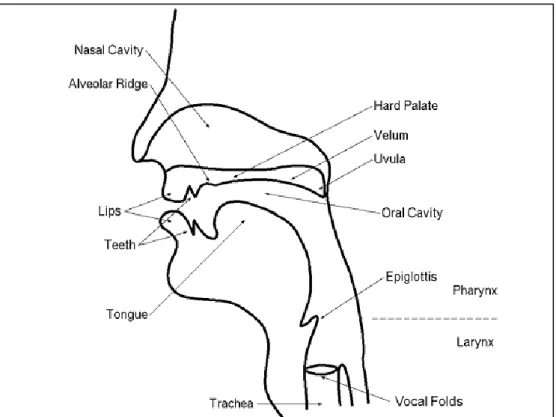
As claimed by Roach (2009), the vocal tract comprises the following speech
organs: the pharynx, the soft palate, the hard palate, the alveolar ridge, the tongue,
the teeth, and the lips (p. 8-9). The same author describes them starting from the
is divided in two, one part goes into the oral cavity, and the other into the nasal
cavity. The soft palate, also called velum, is at the back of the mouth; it allows the air
to go through the nasal or the buccal cavities, and, during speech, it rises so air does
not escape through the nose. Next, there is the hard palate or roof of the mouth; it
has a tender and curved surface. At its edge, there comes the alveolar ridge that
consists of a crest between the upper teeth and the hard palate. Then the tongue,
which moves into different positions, touches many places in the mouth, and folds
into different shapes. The tongue also comes in contact with the upper and lower
teeth for the production of certain sounds. Finally, in the outer part of the mouth,
there are the lips which can take different shapes and move in various directions.
Figure 1. The Organs of Speech. This figure illustrates the location of the speech organs. (Kent and Read, 2001).
In addition, Roach (2009) explains that the nose and nasal cavity as well as the
jaws are involved in speech because there exist some nasal sounds and the lower
jaw moves when speech is produced (p. 10). Moreover, Mohalawi (n.d.) explains that
the organs of speech do not serve only the purpose of speaking but others like
breathing, chewing, and swallowing.
Besides from the speech organs, in a person’s throat there exist some muscles
that also make speech possible. They are called vocal cords. The vocal cords
consist of elastic membranes located in the throat that produce noise when vibrating
come together and close the air duct; thus, when the air expelled from the lungs
passes through the closed vocal cords a vibrating noise is produced; on the contrary,
when the air passes freely through the open membranes, no noise is made (p.
14-15).
Articulators and Points of Articulation. The above-mentioned organs of speech do not share the same function; they can either be articulators or points of
articulation. According to Youman (2014), an articulator consists of a speech organ
that moves in order to produce different sounds, while a point of articulation, an
unmovable organ, is the place the articulator touches during the production of
speech (p. 16).
In English, the lower lip and the tongue act as articulators (Youman, 2014, p. 16).
The former touches other organs of speech to produce different sounds; for instance,
if pressed together with the upper lip, the sounds of /b/ and /p/ are created, or it touches
the upper teeth for the production of /f/ and /v/(Youman, 2014, p. 21). On the other
hand, the tongue is the major speech organ, the most movable and foldable one.
Mohawali (n.d.) divides it into five sections, according to the parts that are involved in
utterance production. The author explains that the tongue comprises (a) the apex or
tip of the tongue, (b) the front that is the part between the tip and the middle of the
tongue, (c) the center, (d) the dorsum or back of the tongue, and (e) the root, which
is the furthest part of the organ (p. 1). The same source also mentions that the apex
between the teeth to produce /1/and /!/. Additionally, the dorsum touches or approaches
the velum in /k/ or /g/production and the front section approaches the palate to make /y/
(p. 1).
Moreover, Youman (2014) states that the five points of articulation of the English
language include the alveolar ridge, the upper lip, the upper teeth, the palate, and
the velum (p. 16) into which the two articulators position or approach in order to
make speech sounds.
Voiced and Voiceless Sounds. Sounds of speech can vary depending if they are produced with closed or open vocal cords. The resonance of the vibrating vocal
cords that occurs when air passes through closed cords makes speech sounds
voiced; and the opposite is true, the speech sounds produced without this resonance
are voiceless (Youman, 2014, p. 20). For example, /z/ stands as a voiced sound
because the vocal cords vibrate when it is produced while the cords do not vibrate in
the /s/ sound.
Place of Articulation. The different places of articulation represent the location unto which the articulators place or approach and the points of articulation that are
involved when producing a speech sound (Youman, 2014, p. 21).
As stated by Gasser (2006), only two places of articulation involve the lips as
- Bilabial: the two lips are brought together and make contact. This position
happens with /p/, i.e. pet, and /b/, i.e., Bob.
- Labiodental: the lower lip and the upper teeth make contact when
producing a sound. This can be seen in the pronunciation of /v/, i.e., vase, and /f/, i.e., focus.
With the tongue as articulator involving any of its parts, Youman (2014)
explains the other six places of articulation (p. 21-23):
- Dental: when the front of the tongue positions between the teeth or against
the upper teeth. The two sounds resulting from this place of articulation
are the ones in thing and those.
- Alveolar: The front of the tongue touches or approaches the alveolar ridge.
The consonants sounds /d/, /t/, /s/, and /z/ are produced in this place of
articulation.
- Alveopalatal: The front of the tongue touches the space between the
palate and the alveolar ridge. The last sound in garage/j/ and the first in the word children/c/ are alveopalatal placed consonants.
- Palatal: The front of the tongue approaches the palate producing the
sounds heard in the words shoe/S/ and measure/Z/.
- Velar: The back of the tongue touches the velum, like in /k/, i.e., cake, and /g/, i.e., goat.
- Glottal: This place of articulation creates a sound in the throat, “with
sound” (p. 23). The back of the tongue touches the furthest part of the
mouth. /h/ is produced by this manner, as in happy.
As can be seen, the classification of the various sounds of speech of the English
language result from the places of articulation in which they are produced, although
they can be further classified by the noise or absence of noise the vocal cords make
during their production.
Manner of Articulation: Stops, Fricatives, and Affricates. A further
classification of consonant sounds is made by the degree of obstruction of the air as
it passes through the larynx and the mouth whenever they are produced (Youman, 2014, p. 27). This is referred to as ‘manner of articulation’ and it includes three
possible levels in the amount of air obstruction: stop, fricative, and affricate.
As stated in Youman (2014), six stops exist in the English language: the sounds
/p//t//k//b//d/ and /g/. The same author explains that a stop sound occurs when there is
complete but brief obstruction of the airflow; the lips, teeth, and/or tongue block the
air momentarily (Battenburg and Swamson, 2000). On the contrary, a fricative sound
results from partial obstruction of the airflow, causing a hissing sound that can be
prolonged (Youman, 2014, p. 27). Therefore, the nine English sounds that belong to
this category are the ones of the consonants/f/ /v/ /1/ /!/ /s/ /z/ /S/ /Z/ and /h/. Finally, Battenburg and
Swamson (2000) report that an affricate is a sound composed by a stop and a
the word church is an affricate made up by /t/+/S/ and the last sound in garage comes from the combination of /d/ + /Z/, resulting in the two affricate sounds of English: /C/ and /J/.
Sibilants. Aside from the place and manner of articulation, some consonant sounds can be grouped under two other categories because of particular sound
features. Sibilants, the first group, involve the characteristic of a hissing sound
(Youman, 2014, p. 29); in its production, the air escapes through a narrow passage
between the tongue and roof of the mouth creating turbulence (FangFang Li, 2008,
p. 10). Youman (2014) explains that English has six sibilant sounds: /s//z//S//Z//C//j/. The first
four are fricatives while the last two are affricates (29). FangFang Li (2008) explains
that as affricates are created with the sibilants /S/and /Z/, they constitute sibilant sounds
as well (p. 10).
Fluency. The American Heritage Dictionary (2012) defines this term as “having facility in the use of a language” (p. 326). Thornbury (2005) also explains
some features that characterize fluency. Speed of speech and the number of
syllables uttered between pauses determine fluency in a user of the language (p. 6).
Pausing is important as well; it should occur at meaningful transition points, as the
intersection of clauses or after a meaningful group of words; the frequency of the
pauses, related to the former, and the filling of pauses with vague expressions and
Segmental and Suprasegmental Features. In terms of Hussain and Sajid (2015), segmental is “any discrete unit that can be identified, either physically or
auditorilly, in the stream of speech” (p. 1). As Smolcic (n.d.) explains, segmentals are
the individual speech sounds, the vowel and consonant sounds that constitute a
language.
On the other hand, as explained by Hussain and Sajid (2015),
suprasegmental refers to “a vocal effect, which extends over more than one sound
segment in an utterance” (p. 1). They are specific features that go beyond the
segmental level, extending over groups of segmentals (p. 1-2). That is, how the
voice is used in speech beyond the pronunciation of single sounds (Smolcic, n.d.).
Suprasegmental features of a language include stress, length, tone, and intonation.
Stress refers to “the relative force with which a word or sound is spoken” (The
American Heritage Dictionary, 2012). Youman (2003) depicts that stress has the functions of giving emphasis to a particular word, e.g., ‘I want you to do it;’ of
contrasting words or ideas, e.g., ‘One or the other;’ and of indicating grammatical
category of words, e.g., ‘anaddress’ [noun] / ‘to address someone’ [verb] (p. 70).
As Kamalani (1996) explains, length refers to “the amount of time it takes to
produce a sound” (par. 5). According to Youman (2003), English vowels can always
be prolonged; depending on their surroundings, vowel sounds can be lengthened
Tone refers to “a variation in the pitch of the voice while speaking”
(Enclycopedia Brittanica, 2016); pitch being the highness and lowness of a speech sound (The American Heritage Dictionary, 2012) that depends on the tension or
vibration of the vocal cords (Youman, 2003, p. 74). As explained by Youman (2003),
tones in speech convey different linguistic and non-linguistic information; for
instance, changing the meaning of words and their grammatical category, marking
boundaries in syntactic units and utterances, and conveying a particular meaning
from the speaker (p. 74-75).
Finally, as stated by Youman (2003), intonation “is the pattern of pitch
changes that occur” in an utterance (p.75). These pitch patterns that extend over a
group of words or sentences are called tone groups and they convey differences in meaning (p. 75).
Allophone. As explained by Youman (2003), allophones refer to the variations on the pronunciation of phonemes (p. 15). These variations happen
because of the immediate phonetic environment of a phoneme; the other sounds
that occur around a particular phoneme influence it, creating, sometimes, different
pronunciations or allophones (Youman, 2003, p. 16). For example, the -s of plural nouns has two allophones: /s/ when the word ends in a voiceless sound, i.e., pets, and
Morpheme. As for the linguistic and grammatical part of the English language, the morpheme is its basic unit of meaning. A morpheme is “a linguistic unit that has
meaning and cannot be divided into smaller meaningful parts” (The American
Heritage Dictionary, 2012). The Rochester Institute of Technology (2014) lists the
main features of a morpheme; for instance, it is a word or part of a word that has
meaning by itself; it cannot be separated into smaller parts without changing its
signification or leaving a fragment with no meaning, and it has almost the same
meaning in any environment.
Packer (2001) states, as further characteristics of morphemes, that they can
vary in length because they may have one, two, or more syllables and still constitute
a single morpheme (p. 2), i.e., albatross and I; and also, different morphemes can be spelled and/or pronounced in the same manner (p. 2); for example, the morpheme
-er in the word gardener means “the one who” while in the word “smaller” means “to
a greater degree than.”
Moreover, linguists have established some categories under which to classify
morphemes. Packer (2001) explains that the first classification settles the difference
between morphemes that have meaning with sense, called lexical morphemes, and
the ones that establish a relationship between morphemes, named grammatical (p.
grammatical morphemes. Under each category, morphemes can be free or bound
units. Free morphemes can stand alone and have complete meaning while the
bound ones do not have meaning when standing isolated; they are parts of words
and always occur in combinations (Rochester Institute of Technology, 2014). For
example, in lexical morphemes, see is a free morpheme and vert in the word convert
represents a bound morpheme; for the part of grammatical morphemes, of is free yet
-s in sees is bound because it only has meaning if attached to the word see, denoting the third person singular of the verb.
In relation to this, morphemes and their pronunciation can change according
to their surrounding environment.
Allomorph. Having explained the meanings of a morpheme, it is important to mention that it can take variations depending on context. Allomorphs are the different
manifestations of a morpheme; for instance, two or more phonetically
representations of a single morpheme (Enclycopedia Brittanica, 2016). For example, the three distinct sounds of the noun’s plural morpheme -s, /s/ as in cats, /z/ as in dogs,
and /Qz/ as in churches.
Vowel. Vowels are speech sounds that involve obstruction of the flow of air when it passes through the larynx to the mouth and out (Roach, 2009, p. 10). In
addition, Youman (2014) presents the main characteristics that make vowels unique;
for instance, vowels form the core of a syllable because consonants are attached to
always be prolonged, as in the word bed; and they constitute voiced sounds, produced with closed vocal cords (p. 33).
The word vowel comes from the Latin vocalis: sounding (The American Heritage Dictionary, 2012), meaning that vowels always constitute voiced sounds because
they involve the vocal cords tightening and vibrating in some manner. The production
of vowels does not involve points and places of articulation but only concern the
main articulator, which is the tongue (Youman, 2014, p. 33). The tongue does not
place or touch any point of articulation, but, as Roach (2009) states, the shape and
position of the tongue differentiates the distinct vowels, their sounds, and establish
their classification (p. 11).
Furthermore, according to Youman (2014), in the American English language
exists twelve vowel sounds, each represented by a symbol in the phonetic alphabet
of the American Heritage dictionary. They are long e/e/, short i/I/, long a/a/, short e/E/, sheep a/2/, unstressed schwa/Q/, stressed schwa/q/, Spanish a/A/, long u/7/, short u/U/,
long o/9/, aw of law /O/. The phonetic symbols do not represent the vowel characters but their sounds, being they represented or not by the respective characters in the
written language. Gasser (2006) also states that the English vowel system is far
more complicated than the Spanish one for the reasons that its sounds differ greatly
among dialects and it is more likely to change over time; and Youman (2014)
completes the thought by saying that each vowel letter of the alphabet does not have
As mentioned before, vowel sounds can be prolonged in particular contexts.
Vowel lengthening refers to stretching the sound of a vowel, and it happens
whenever a vowel occurs before a voiced sound, e.g., in the word bag the sheep a
sound is lengthened because it precedes a voiced consonant, and in word final
position, when a vowel sound ends a word, e.g., pay (Youman, 2003, p. 22). In many instances, the length of a vowel distinguishes a word from a similar one.
On the other hand, vowel sounds can also be reduced or weakened. Payne
(2007) declares that the sounds of vowels are reduced in unstressed syllables;
therefore, changing into unstressed schwa. This happens because the syllable, and
specially its vowel, is weakly articulated (Gasser, 2006); for example, the word letter
has its last syllable unstressed and its pronunciation involves unstressed schwa
rather than the full quality of the vowel.
Diphthongization. The American Heritage dictionary (2012) defines diphthong as complex vocalic sounds that start with one vowel utterance and then change to
another (p. 241). The word diphthong comes from the Greek díphthongos [di two +
phthóngos sound], meaning two sounds (Dictionary.com, 2016). Youman (2014) also explains that diphthongs are complex sounds because during their production the
tongue moves from one position into another in height or advancement, like in complex vowels, although, in diphthongs the tongue’s location changes more
articulating another (p. 52). One main feature is that, in diphthongs, the tongue
moves with great speed from two vowel positions, making the utterance one
compact sound.
Subsequently, having analyzed the features of vowels and their sounds, they
must be classified in order to comprehend them better.
2.2. Classification of Vowels
Since vowels cannot be classified by place of articulation because they are
not produced in any, linguists have developed other labels under which to classify
the twelve English vowel sounds. Most authors classify vowels according to their
degree of complexity, tongue position and tenseness while others also classify them
by lip position.
Starting with tongue position, within the mouth this organ can advance
forward and backward or go up and down. Payne (2007) explains that there are nine
possible positions the tongue can move to, three in height and three in
advancement. The same author describes the three levels of tongue height: (a) high,
a position near the top or roof of the mouth, (b) mid, the middle area, and (c) low, the
lowest part of the mouth (p. 3). In addition, the levels of advancement consist of (a)
velum, and (c) back, near the velum (Payne, 2007, p. 3). As explained by Youman
(2014), in the high front position the vowel sounds of long e/e/ and short i/I/ are produced, as in sheep and ship, respectively; in the mid front position the vowel sounds of long a/a/ and short e/E/, e.g., age and edge; and in the low front position only the vowel sound of sheep a/2/ is produced, e.g., fat. Next, no high center vowel sound exists in American English; the mid center position is a relaxed one, for the
reason stressed and unstressed schwa, /q/ and /Q/, are produced, as in cut and above; low center has the production of the vowel sound called Spanish a/A/, e.g., car. Finally, the high back position of the tongue creates long u/7/ and short u/U/, e.g., pool and pull respectively; mid back position has the sound of long o/9/, e.g., go; and low back produces aw of law/O/, e.g., call.
Table 1
Youman’s (2014) Chart for Tongue Position in Vowel Production
Front Central Back
Furthermore, in order to recognize among the vowels produced in the same
tongue position, they are classified under simple or complex. As stated in Youman
the same position during their production while with complex vowels it is the other way around, “the tongue moves during the production of the sound” (p. 47). Simple
vowels tend to be shorter; therefore, their name of “short vowels,” and they constitute
pure sounds because the position of the tongue does not change; on the contrary,
complex or long vowels involve movement of the tongue during their creation and its
root pushing forward (Gasser, 2006). Correspondingly, Youman (2014) mentions
that short i, short e, sheep a, Spanish a, short u, aw of law, stressed and unstressed schwa form the group of simple vowels, whereas long e, long a, long u, long o are complex vowels (p. 46-47).
The third classification, tongue tenseness, refers to how flexed or relaxed the
tongue muscles are during vowel production (Payne, 2007, p. 4). The two possible
dimensions in the scale, clarified by Payne (2007), consist of (a) tense vowels, that
are produced with strong rigidity of the tongue and an advanced root or base
position, and (b) lax vowels, which involve little rigidity of the tongue muscles and a
retracted root. In addition, the first dimension concerns complex vowels while the
second one implicates simple vowels.
Finally, lip position also distinguishes the different vowel sounds of the English
language. Payne (2007) suggests that the lips can take three shapes during the
pronunciation of vowels; first, they can be rounded, the corners of the lips get closer
and the lips pushed forward (Roach, 2009), as in all vowels produced in the back
spread or stretched out as in high front vowels, i.e., the long e sound of sheep; and neutral position, in which lips are placed in their natural position; for instance, low
vowels are usually neutral, i.e., Spanish a in car.
The four mentioned labels help linguists classify, recognize, and organize the
twelve vowel sounds of English; nevertheless, English has three vocalic sounds that
go under the category of diphthongs. Youman (2014) explains the three diphthongs
or combinations of vowel sounds of English: /8/, as in line, /i/as in boy, and /u/as in now. The first one is the combination of Spanish a with long e, /A/+/e/,so the tongue starts the utterance in low center position and then moves to high front position. The second
one originates in low back position and changes to high front, from aw of law to long e, /O/+/e/. Finally,/u/ combines the low center sound of Spanish a and then the high back position of long u,/A/+/7/.
2.3. Sounds of the -ed suffix in verbs and adjectives and the plural of nouns
As mentioned above, morphemes are classified into lexical, grammatical,
bound, and free units. Besides, grammatical bound morphemes, known as affixes, are divided into derivational or inflectional affixes (Packer, 2001, p. 4). An affix is a bound morpheme that attaches itself to a root or free morpheme before or after it
(Rochester Institute of Technology, 2014); the ones that occur in front of the root are
Derivational affixes are either suffixes or prefixes and there exist an enormous
number of them in the English language (Packer, 2001, p. 4). Additionally, the
Rochester Institute of Technology (2014) explains that derivational affixes alter the
meaning or the grammatical category of words; for instance, the prefix un- in the word unhappy, changes the meaning of ‘happy’ to ‘not happy,’ and the suffix -ly in the word manly changes the grammatical category of ‘man’ from noun to adjective.
Some of the derivational prefixes of English are: un-, dis-, a-, and pre-, as in
unhealthy, disconnect, atypical, and prehistoric respectively; and some derivational suffixes: -ly, -ize, -ful, -ism, -ness, like in friendly, socialize, useful, feminism, and kindness.
Additionally, inflectional affixes consist of suffixes exclusively. Unlike
derivational morphemes, they do not change the syntactic categories or meaning of
words but rather indicate grammatical relationships between them (Burbano, 2014,
p. 33-34). The Rochester Institute of Technology (2014) states that the number of
inflectional suffixes in English is limited, consisting of only eight, each one of them
serving a different and specific grammatical function: (a) -s denoting the plural of nouns, (b) -’s expressing possession in nouns, (c) -s showing the present tense of verbs in the third person singular, (d) -ing denoting the present participle or gerund, (e) -ed showing verb past tense, (f) -en conveying past participle of verbs, (g) -er
expressing the comparative form of adjectives, and (h) -est showing the superlative form of adjectives.
The number of inflectional suffixes of English was not always so reduced. The
English language, as we know it today, is very different from the language that
started in England in the fifth century A.D. English has undergone many changes
during its history, making it possible for linguists to distinguish three periods,
according to their characteristics and developments: Old English, from 450 to 1150
A.D.; Middle English, from 1150 to 1500 A.D.; and Modern English, from 1500 until
today (p. 50). One of the most important and noticeable features of language change
is the loss of inflections. The same authors explain that Old English was a very
inflected language, denoting a grammatical relation between words by means of
inflections, which is called a synthetic language while Modern English appears to be an analytic language, which means that it relays on prepositions and word order to show grammatical relations (p. 54).
One of the categories that shows loss of inflections throughout time is the
noun. During the Middle English period, the inflections denoting the plural of nouns
had been so simplified as to establish a general formula, –s, to show almost all plural forms (Baugh and Cable, 1997, p. 156). On the other hand, Baugh and Cable (1997)
explain that Old English verbs suffered massive changes as well; they lost almost all
personal endings and the distinctions between the singular and the plural (p. 10). In
addition, the authors state that most verbs changed their strong conjugation, varied
forms of the past and past participle, to weak forms characterized by a consistent
pattern (p. 159). Consequently, most Modern English verbs belong to the weak or
Another main feature about the inflectional suffixes for the plural of nouns and
the past tense of regular verbs is that they are determined by the rules of
coarticulation. In the words of Ohala (1993), coarticulation refers to “the variation in
the phonetic manifestation of a given sound due to its taking on some of the features of nearby sounds” (p. 156). In addition, Youman (2003) claims that this interaction
among phonemes can occur in anticipation of a sound, named anticipatory
coarticulation, or it can happen because of a preceding sound (p. 6-8). The latter is called perseverative coarticulation, which means that the features of a sound persevere or stretch onto its following immediate sound, thus changing it (Youman,
2003, p. 8). This phenomenon is easily recognized in the pronunciation of plural
nouns that take an –s and in the past form of regular verbs.
Aside from some nouns that are the exception to the rule and have different
plural forms, the general rule for making the plural of nouns determines the addition
of the morpheme –s at the end of a word. Although one form is expressed in the written language, in speaking, the plural suffix has three sounds or pronunciations
represented phonetically as /s/, /z/, and /Qz/, meaning that the plural morpheme has three
phonologically conditioned allomorphs (Burbano, 2014, p. 38). Because of
perseverative coarticulation, the production of this morpheme depends on the sound
preceding it, that is, the final sound of the noun. Consequently, Celce-Murcia,
Brinton, and Goodwin (1996) explain that when a noun ends in a sibilant sound, the
kisses; when a noun ends in a voiced non-sibilant sound, the plural –s is produced as /z/, i.e., words, dreams, bags; and if a noun finishes in a voiceless non-sibilant sound, the plural morphemes is pronounced as /s/, i.e., hats, books, pants (p. 248). This rule also applies to the pronunciation of –s in the third person singular of verbs.
A similar phenomenon happens in the pronunciation of the inflectional suffix
for the simple past and past participle forms of weak verbs. As stated by
Marslen-Wilson and Tyler (1998), the majority of English verbs, about ten thousand, are
regular since they form their past tenses by adding the inflectional suffix –ed to the, most of the time, unchanged verb stem; in contrast, only about a hundred and sixty verbs have irregular past tense forms, which are “idiosyncratic and phonologically
unpredictable” (p. 428). On the other hand, Taatgen and Anderson (2002) claim that
in spite of English regular verbs having a high type-frequency, numerically greater, they have a low token-frequency, meaning that they do not occur very often in spoken or written language (p. 125).
As mentioned above, despite English regular verbs forming their past and
past participle forms in a predictable way, by adding –ed, it does not represent their different pronunciations. According to Youman (2014), the –ed morpheme has three allomorphs that are produced in the following instances: /t/ is pronounced when the
verb stem ends in a voiceless sound other than t, e.g., talked, walked, finished, hoped; /d/ when the verb ends in a voiced sound other than d, e.g., cleaned, played,
decided (p. 55-56). As can be seen, this corresponds to the phenomenon of coarticulation.
2.4. English-Spanish Contrastive Analysis
Baugh and Cable (1997) state that “the history of a language is intimately
bound up to the history of the people who speak it” (p. 1). English and Spanish are
languages that come from different paths throughout history, although it can be said
that they share many similarities.
English comes from the Germanic family of languages; it specifically belongs to a subgroup called West Germanic. The West Germanic family is divided into two
branches: High and Low German (Baugh and Cable, 1997, p. 30). Old English, the
antecessor of Modern English, comes from the Low German subdivision, which
differentiates itself from the other branch by a change in the pronunciation of the
consonants p, t, k, and d (p. 31).
According to Baugh and Cable (1997), the English language arrived to
England by the middle of the fifth century A.D. (p. 45, 49). The Germanic tribes from
the areas of Denmark and the Low Countries, the Jutes, the Angles, and the Saxons,
brought their Germanic dialects with them by the time they invaded the island from 449 onwards (p. 45). Therefore, Cable and Baugh (1997) state that “the English
spoken by the Germanic tribes who came to England” (p. 49). The inhabitants of the
island at that time were the Celts, who had lived under Roman control for more than
three hundred years, and they called their new conquerors Saxons, indistinctly of the tribe they belonged to, and later Anglia, which prevailed into the names Angles, Englisc, and Englaland (p. 44, 49).
As mentioned above, three periods of the English language can be
distinguished from the moment it started in England up until modern times. One of the major influences that changed the language’s vocabulary was Latin and some of
its derived languages, especially French. Cable and Baugh (1997) outline that the
greatest influence of the Latin vocabulary on the English language happened with
the conversion of the island to Christianity, which occurred in the seventh century (p.
80-82). From that time, several borrowed words were introduced into the language,
words that had to do with religion, of course, but also words about domestic life,
education and learning, and plants (p. 84). Later, by the time the French-speaking
Normans conquered England in 1066, a plethora of new vocabulary came into the
language as well (p. 105). French, a Latin-derived language, coexisted side by side
with English for a long time, but then, when the latter predominated upon the Normans’ language, hundreds of French words entered English (Youman, 2004, p.
112). Along with all the borrowed words, the Great Vowel Shift and neologisms
entering the language by the hundreds shaped English to the form it has today. This
history of Latin-derived loan words explains why English and Spanish share some
On the other hand, Spanish is a Romance language, for the reason that it
developed from Latin, the language of the Roman Empire. As stated in Cable and
Baugh (1997), Spanish belongs to the Italic family of languages; it comes from a branch named Latin, which was the language of Latium, now central-western Italy,
and specifically its capital city, Rome (p. 26). The same authors explain that as the
Roman Empire expanded throughout many regions of Europe and Africa, its
language expanded as well (p. 26). With the decay of the Roman Empire after the
fourteenth century (Youman, 2008, p. 12), the Latin language remained to be used in
the different conquered regions, although they evolved into distinct dialects and
languages. Cable and Baugh (1997) state that the Romance languages, namely
French, Spanish, Portuguese, and Italian, developed from Vulgar Latin, which was
the language spoken by the masses. In the Iberian Peninsula Latin developed into
Spanish and Portuguese, which resemble each other immensely, and yet have
significant differences in vocabulary and pronunciation (p. 26-27).
This language called Vulgar Latin developed into distinct languages for two
main reasons. Cable and Baugh (1997) explain the first reason as follows:
Vulgar Latin, like all languages, was constantly changing, and because the
Roman provinces were established at different times and the language carried
into them would be more or less the language then spoken in the streets of
Rome, there would be initial differences in the Vulgar Latin of the different
The same authors explain that the original languages spoken in the Roman
provinces before the conquest would have influenced on the adopted Latin (p. 28). Therefore, several languages flourished from the Roman’s language, each one with
unique features.
As mentioned above, the Latin-derived side of English results on it having
about thirty percent of its vocabulary being cognates with Spanish (Lapo, 2008, p. 2). Cognates, as Lapo (2008) explains, are “words that have similar meaning, spelling
and pronunciation in two languages” (p. 3). Youman (2004) completes the meaning
of cognates by saying that they consist of words from different languages that are related “by being derived from the same root” (p. 31). For example, the words difícil
-difficult, confusión-confusion, and sociedad-society are Spanish-English cognates. Moreover, Lapo (2008) shows that there exist many cognates in Spanish and
English that are unreliable for the reason that some of them have an extra different
meaning in only one of the languages; for instance, the word historia in Spanish means history of course but also a story or a tale. There can also be the case of cognates having a different connotation; for example, the word inferior in English has the same meaning as in Spanish yet with a negative association (p. 3). In addition,
the two mentioned languages share false cognates, which are spelled and sound
As long as the focus of this research is on pronunciation, a comparison
between the sounds and pronunciation of Spanish and English should be made. To
begin with, a difference must be established between the total number of sounds in
both languages. As stated by Youman (2014), there exist thirty-nine sounds in the
English language (p. 5), consisting of twelve vowel sounds, three diphthongs, and
twenty-four consonant sounds; while Spanish possesses twenty-eight sounds, from
which five are vowel sounds and twenty-three are consonant sounds (Real
Academia Española, 2016). Besides, as said by Lapo (2008), the English sounds
that Spanish does not posses consist of: vowel and consonant diagraphs, which are
combinations of two letters representing one sound, like ea in read and ph in photo; consonant clusters in initial, middle and final position, as in wr in write or gh in
enough; endings without a vowel, like –ts in adults; and contractions, e.g., I’d (p. 6).
According to Smith and Swan (2001), the main differences between the
sounds of English and Spanish rely on vowel sounds and sentence stress (p. 90). As
mentioned in a previous section, the number of vowel sounds in Spanish differs
greatly from that of English; therefore, some sounds of English do not exist in
Spanish; for example, stressed schwa/q/, making it difficult for Spanish speakers to pronounce words like cut. Nevertheless, there exists similar vowel sounds in the two languages; among them, the difference relies on the fact that English vowels have
the feature of length to characterize them (Youman, 2003, p.22), which differentiates
them from one another and also distinguishes similar words. All these can lead
one common Spanish equivalent. As Smith and Swan (2001) explain, it can happen that in some cases “two English vowels share the ‘phonetic space’ occupied by one
Spanish vowel” (91); for instance, English /e/ and /I/ correspond to the Spanish phonetic
space of the i vowel (p. 91). The same happens with Spanish vowel a, which is used by speakers of the language interchangeably for English sounds sheep a/2/, stressed
schwa /q/, and its equivalent Spanish a/A/; also, Spanish u representing English long and short u, /7//U/(p. 91). In addition, Lapo (2008) mentions that Spanish vowels are always pronounced the same regardless of their position within a word, while English
vowels pronunciation and length vary according to their place in words, specially in vowel pairings or combinations; for example, the combination ‘ou’ sounds different in
the words thou, thought, and tough (p. 5-6). Also, as stated above, English vowel sounds are weakened in unstressed syllables, as the u in suppose, which do not happen in the Spanish language, where all vowels are fully pronounced every time
they appear. According to Smith and Swan (2001), diphthongs are similar in English
and Spanish, although in the latter the second element of the diphthong combination
is pronounced with more emphasis than in English (p. 91-92).
As for the stress and rhythm of the languages, Smith and Swan (2001) claim
that in Spanish all syllables are pronounced with the same length of time, except for
occasional emphasis, which results in no greater distinction between stressed and
unstressed syllables; in English, the pronunciation of stressed syllables involves
pitch change in contrast with unstressed syllables that include a reduced vowel
and adverbs are stressed, emphasizing them over grammatical words, like
prepositions, articles, etc., which are unstressed (p. 95). This combination of stress
and rhythm within English sentences indicates structure and meaning (p. 95).
Additionally, the position of the stress within a word can change its grammatical
category or part of speech; for example, the word record with initial stress is a noun, whereas the same word with final stress is a verb; the same happens with words like
object, progress, and address (Marian, n.d.).
Another major difference consists in the relation between spelling and
pronunciation. These two features in the Spanish language are closely related
(Smith and Swan, 2001, p. 94), while in English the pronunciation does not represent
the spelling of words and vice versa. In English, the way in which the language is
written does not match how it is spoken or how each word is pronounced. This
phenomenon arises because the spelling system was not original of the language
(Knowles, 2014, p. 8). In the old days, Christian monks who spoke Latin were the
first to write down the English language (Youman, 2008, p. 19). They, of course, used the Latin spelling system they knew to put England’s language in paper
(Youman, 2008, p. 20). These monks also undertook the task of teaching English
people to read and write using the same spelling system for English as it was used
for Latin. As time passed, English also adopted many writing and spelling
conventions from French and other world languages (Knowles, 2014, p. 8). As a
Regarding consonants, Smith and Swan (2001) claim that most English
consonants have equivalents and near equivalents in Spanish; although, there exist
some consonant sounds in the former that the latter does not present (p. 92). The
letter v exists in Spanish yet its pronunciation does not differ from that of the letter b, while in English the mentioned consonant has a distinct and marked pronunciation, /v/,
as in vase or Victor. Also, the sounds /S//Z//j/ and /!/ are not present in the Spanish language (p. 92). The /1/ sound is equivalent to the sound of the letter z used by Spanish speakers from Spain. Furthermore, as Smith and Swan (2001) claim, initial
and final consonant clusters are not very common in Spanish as they are in English,
causing therefore trouble in their production (p. 93). Additionally, the same authors
explain that the most common feature about consonant transfer is the devoicing of
final strong consonants by Spanish speakers, as in using /t/ for /d/, /k/ for /g/, and not
aspirating initial position plosives /t//k//p/ (p. 91-92).
Lapo (2008) explains that “phonemic and phonological differences between
Spanish and English can result in interference from Spanish [speakers] during English acquisition” (p. 6). The author explains that interference or transfer refers to
the cross-linguistic influence between a person’s native and target languages (p. 2).
Interference can be positive or negative: positive transfer happens when knowledge of the native language facilitates the learning of the target language’s features
because they resemble L1 (p. 2), whereas negative transfer is the opposite and it
occurs when the learner uses native language features that do not exist or do not