
Extended enterprises' logistical best practices and it's impact in firm performance
170
0
0
Texto completo
(2) ,. TECNOLOGICO DE MONTERREY Hacemos constar que en la Ciudad de México, el día 3 de mayo de 2005, el alumno:. Daniel Zavala Río. sustentó el examen oral en defensa de la Tesis titulada:. Extended Enterprise's Logistical Best Practices and it's Impact in Firm Performance. Presentada como requisito final para la obtención del Grado de:. Doctor en Administración. Ante la evidencia presentada en el trabajo de tesis y en este examen, El Comité Examinador, presidido por el Dr. Ernesto Armando Pacheco Velázquez, ha tomado la siguiente resolución:. Director de Tesis. Dr. Ernesto Arlrtafi(trc:Jff>acheco Velázquez Lector. ki{~ Lector. Dr. Daniel J. Fonseca Lector. Campus Ciudad de México. L-,,,;,, c:el Puente 222. Col E11dos de Hu,pulco __. 14'.l80 T:;il¡;érn Mex,co D.F México (52/55) 5673 2500. 'L'' ,s;., 5éiJ 5483 2ü2CJ Fax.
(3) INSTITUTO TECNOLOGICO Y DE ESTUDIOS SUPERIORES DE MONTERREY. CAMPUS CIUDAD DE MÉXICO. TECNOLÓGICO DE MONTERREY G. BIBLIOTECA. BU~mattm EXTENDED ENTERPRISES' LOGISTICAL BEST PRACTICES AND IT'S IMPACT IN FIRM PERFORMANCE DOCTORADO EN ADMINISTRACIÓN. TESIS PRESENTADA POR DANIEL ZA VALA RIO. ASESOR DR. FERNANDO MATA CARRASCO. MAY02005.
(4) e:~ A--TF:5t~ 1-l D .38.S. ~38 ~oo"S". CJV.
(5) To Diana, you have always been an inspiration to be everyday a better husband, a better father, a better son, a better man. Thank you for your infinite patience and support in this important achievement in my life. 1 )ove you with all my heart.. To Daniel and Daniela, you have filled my life with joy, with )ove, with happiness. 1 am very proud of you both and will always love you.. To Mom and Dad, for believing, and always expecting the best from me. For your )ove and support.. ¡¡¡.
(6) AKNOWLEDGEMENTS. I want to thank Dr. Fernando Mata, Dr. Daniel Fonseca, Dr. Ernesto Pacheco, and Dr. Genaro Gutierrez thank you for ali their guidance through this entire work, and especially for their friendship and support.. I want to thank Dr. Macario Schettino for accepting me in this doctoral program and for helping me when I need it most.. Finally, 1 want to than. Ing. Andrés Sotomayor, and Ing. Fortunato Mendez for giving me the opportunity to study this doctoral program, which has enriched my academic and personal life. iv.
(7) ABSTRACT. Economy and manufacturing globalization, environmental awareness and stress over business and organizational structures, are factors that are gene:~ating considerable amounts of pressure that are having impact on enterprises policies and strategies in arder to adapt and react accordingly to these pressures. These pressures are forcing firms' integration into the Extended Entt::rprise model, an inter-enterprise network with highly developed agility and flexibility characteristics, with a strong sense of integration and with a responsible environmental awareness. This research statistically (Factor Analysis, Multiple Linear Regression, and T-Tests) examines the relationship between logistical practices typical of the extended enterprise and company performance in Mexico. The results provide empirical evidence that selected customer relations practices and supplier relations practices are strongly associated with the perceived financia) and operation al success of the Mexican firms responding the survey.. V.
(8) TABLE OF CONTENTS. Dedication . . . . .. .. . .. . .. . . . . . . . .. . .. . . .. . .. .. . . . . . . . . .. . . . . . . . . . . .. . . . . . . .. . . . . . . . . . . .. .. 111. Acknowledgements . . . . . . . . . . . . . . . . . . . . . . . . . . . . . . . . . . . . . . . . . . . . . . . . . . . . . . . . . . . . . . . . . . .. 1v. Abstract .. . . . . .. . . . . . . . . . . . . . . . . .. . .. . . . . ... ... . . . . .. . . . . . . . . . .. . . .. . . . . . . .. . . . . . . . . . . . . .. v. CHAPTER ONE. Introduction..................................................... 001. 1.1 Overview of Relevant Issues of Logistical Practices and its Impact on Firm. Performance......................................................................... 001. 1.2 Hypotheses of this Work...................................................... ..... 003. 1.3 Organization ofthe Report......... ... . . . . . . . .. . . . . . .. . . ... . . . . . . . . . . . . . .. .. . . .... 005. CHAPTER TWO. Evolution of the Extended Enterprise..................... 007. 2.1 Definitions and Concepts on Logistics...................................... ..... 007. 2.2 Definitions and Concepts on Supply Chain Management..................... O11. 2.2.1 Definitions and concepts............................................ .... O11. 2.2.2 Supply Chain Management evolution into Extended Enterprise.. O15. 2.2.2.1 Strategic alliances............................................. O18. 2.2.2.2 The network concept in Supply Chain Management.... 020. 2.2.2.J Cross-Enterprise collaboration.............................. 022. 2.2.2.4 Incentives alignment...................................... .... 026. 2.2.2.5 Environmental awareness................................... 028. 2.2.3 How Supply Chain Management is moving to the Extended. Enterprise.................................................... .. . . . . . . . . . . . 2.3 Definitions and Concepts on Extended Enterprise............................. VI. 031 037.
(9) 2.3.1 Definitions..... .... .. .. .. ...... .. . .. .. .. .. . .. .. .. ... .. . .. . .. ... .. .. .. ..... 037. 2.3 .2 Organizational Structure in the Extended Enterprise............... 042. 2.3.3 Agility and flexibility in the Extended Enterprise........................ 043. 2.3 .4 The network concept in the Extended Enterprise.................... 044. 2.3 .5 Sorne examples of Extended Enterprises............................. 046. 2.4 Summary.................. ... . . . . . . .. . . . . ... . . . . . . . .. . . . . .. . . . . . . .. . .. . . . . .. . . . . . . ... 047. CHAPTER THREE. Literature Review...................................... .... 050. 3.1 Objectivesand Scope............................................................... 050. 3.2 Methodological Review............................................................ 051. 3.3 Summary................................. ... . . . . . . .. . . . . . . . . . . . . . ... .. . .. . .. . . . . . . ... 061. CHAPTER FOUR. Followed Research Methodology and Analysis of Survey....................................... ..... 064. 4.1 Followed Research Methodology............................................ ..... 064. 4.1.1 Questionnaire............................................................. 065. 4.1.2 Power of the test.......................................................... 068. 4.1.3 Validity and reliability.. .... .. .. .. .... .. .. .. .. .. .. .. .. .. .. .. .... .. .. .... 069. 4.1.4 Factor analysis........................................................ .... 069. 4.1.5 Regression analysis...................................................... 070. 4.1.6 T-test for analyzing significant differences in performance means of firms with high logistics capabilities and firrr.s with low logistics capabilities.......................................... 070. 4.2 Multivariate analysis........................................................... .... 071. VII.
(10) 4.2.1 Multivariate Analysis for all the Firms........................... ..... 071. 4.2.1.1 Power of the test and Cronbach's alpha for all the firms. .. .. .... 072. 4.2.1.2 Factor analysis of all the firms.................................... ... 072. 4.2.1.3 Multiple regression analysis for all the firms................... ... 076. 4.2.1.4 Testing for significant differences in performance between all enterprises that use intensively logistical practices and those which not........................................ 081. 4.2.2 Multivariate Analysis Medium Size Enterprises................ ..... 084. 4.2.2.1 Power ofthe test and Cronbach's alpha for medium size enterprises...................................................... .... 084. 4.2.2.2 Factor analysis medium size enterprises.................. .. . . . . . . .. 085. 4.2.2.3 Multiple regression analysis medium size enterprises............ 089. 4.2.2.4 Testing for significant differences in performance between medium size enterprises that use intensively logistical practices and those which not... . . . . . . . . . . . . . . . . . . . . . . . . .. . . . . . . . . . ... 093. 4.2.3 Multivariate Analysis Large Size Enterprises... .. . . . . . . . . . . . . . . . . . .. 097. 4.2.3.1 Power of the test and Cronbach's alpha for large size enterprises ........................................ .. 097. 4.2.3.2 Factor analysis large size enterprises............................... 098. 4.2.3 .3 Multiple regression analysis large size enterprises............. ... 102. 4.2.3.4 Testing for significant differences in performance between large size enterprises that use intensively logistical practices and those which not................................................... VIII. 105.
(11) 4.3 Summary....... .................................................................. ..... 109. CHAPTER FIVE. Summary and Conclusions......... ...... ......... ... ... .... 112. 5.1 Overview of Findings in Extended Enterprise.................................. 112. 5.2 Overview of Findings in the Empirical Research........................... .... 115. 5.3 Recommendations for Management.......................................... .... 118. 5.3 Limitations........................................................................ ... 119. 5.4 Suggestions for Future Research... ... ......... .................. ......... ....... 121. BIBLIOGRAPHY...................................................................... 122. APPENDICES. APPENDIX A: Eight Key Business Processes............................. .... 130. APPENDIX 8: INEGI's 1999 economic census enterprise stratification... 132. APPENDIX C: Questionnaire................................................ ..... 133. APPENDIX O: T-tests, all firms..................... ... ...... ...... ... ...... .... 139. APPENDIX E: T-test, medium size firms...... ... ... .. . .. . .. . . . . .. . . . . . . . . . .... 144. APPENDIX F: T-tests, large size firms............ ......... ... .... .. ... ......... 150. ix.
(12) LIST OF TABLES Table. 2.1. Logistics Definitions comparative table................................... 009. 2.2 Logistics' set of activities..................................... ............... 010. 2.3 Supply Chain Management Definitions comparative table.............. O15. 2.4 Key business functions according to GSCF and Wisner................ 034. 3.1. Statistical Methodologies Utilized in Research Works... .. . . .. . .. .. ... 062. 4.1. Reliability Analysis of scales-all firms............................... ...... 072. 4.2 Factor Analysis-Customer Relations-All firms....................... ... 074. 4.3 Factor Analysis-Supplier Relations-All firms............................ 075. 4.4 Factor Analysis-Environmental Awareness-All firms................... 076. 4.5 Regression Models-All firms........................................... ..... 079. 4.6 Regression Matrix-All firms............................................. .... 080. 4. 7 Summary of Hypothesis Testing-All firms.......................... ...... 082. 4.8 Summary of Significant Relations of Hypothesis Testing-All firms with an alpha of 0.5 . . . . . . . . . . . . . . . . . . . . . . . . . . . . . . . . . . . . . . . . . . . . . . . . . . . . . . . . . .. 083. 4.9 Reliability Analysis of scales-Medium Size firms........... ........ ..... 085. 4.1 O Factor Analysis-Customer Relations-Medium size firms... .. .. . . . . . . ... 087. 4.11 Factor Analysis-Supplier Relations-Medium size firms................. 088. 4.12 Factor Analysis-Environmental Awareness-Medium size firms....... 089. 4.13 Regression Models-Medium size firms................................ .... 092. 4.14 Regression Matrix-Medium size firms. .... .. .. ... .. ... . .. .. . . . . .. .. .. ..... 093. 4.15 Summary of Hypothesis Testing-Medium size firms.... .. . .. . .. .. ...... 094. X.
(13) 4.16 Summary of Significant Relations of Hypothesis Testing-Medium size firms with an alpha of 0.5 . . . . . . . . . . . . . . . . . . . . . . . . . . . ... . . . . . . . . . . . . . . .. 096. 4.17 Reliability Analysis of scales-Large size firms.. ...................... .... 098. 4.18 Factor Analysis-Customer Relations-Large size firms.... . . . . . . . . . . . . .. 099. 4.19 Factor Analysis-Supplier Relations-Large size firms.. ... . . . . . . . . . . . . . .. 100. 4.20 Factor Analysis-Environmental Awareness-Large size firms... ... .... 101. 4.21 Regression Models-Large size firms.................................... ... 104. 4.22 Regression Matrix-Large size firms......................... . . . . . . . . . . .... 105. 4.23 Summary of Hypothesis Testing-Large size firms................... ..... 106. 4.24 Summary of Significant Relations of Hypothesis Testing-Large size firms with an alpha of 0.5 ... . . . . . . . . . . . . . . . . . . . . . . . . . . . . . . . . . . . . . . . . . .. 108. 4.25 Most Important Factors for Ali Firms firms...... ... . . . . . . . . . . . . . . . . . . ..... 109. 4.26 Most Important Factors for Medium Size firms.......................... 11 O. 4.27 Most Important Factors for Large Size firms............................. 111. 5.1 Summary of Hypothesis Testing.......................................... .... 117. 5.2 Most Important Practices in Customer Relations....................... ... 119. 5.3 Most Important Practices in Supplier Relations............................ 120. xi.
(14) LIST OF FIGURES Figure. Supply Chain Network Structure ............................. .. 021. 2. From Supply Chain Management to Extended Enterprise.... .. . . . . . . . . .. 036. 3. Graphical conceptualization of the Extended Enterprise............... ... 039. 4. Logistics, Supply Chain Management, Extended Enterprise............. 048. Xll.
(15) Chapter 1 Introduction. 1.1 Overview of Relevant Issues of Logistical Practices and its Impact on Firm Performance. Sorne managers consider that their firrns' performance could be better than nowadays or maybe they would like to make a benchmarking to the world class logistical models just to compare them with their firms' practices and determine if they are going to continue with their status quo, or they need a change. Now, if as a result of the benchmarking process, they determine that their companies are not following the best logistical practices, maybe they will not be able to adopt ali of these practices at the same time because oftime, money or technology constraints. lt would be very practica) to know which of these practices are significant to firm performance and which are not. Companies c:ould spend a lot of time, money, among other resources, trying to implement a logistical practice that could result not significant to performance (costs, response time, and service, among others). On the other hand, it is important to know, if for any logistical practice, there is a significant difference in performance between focusing intensively on that logística! practice or not.. There is research related to logistics or logistics management, or related to Supply Chain Management, or related to the Extended Enterprise. There are sorne research works relating the first two terms, logistics (or logistics management) and Supply Chain Management, but. 1.
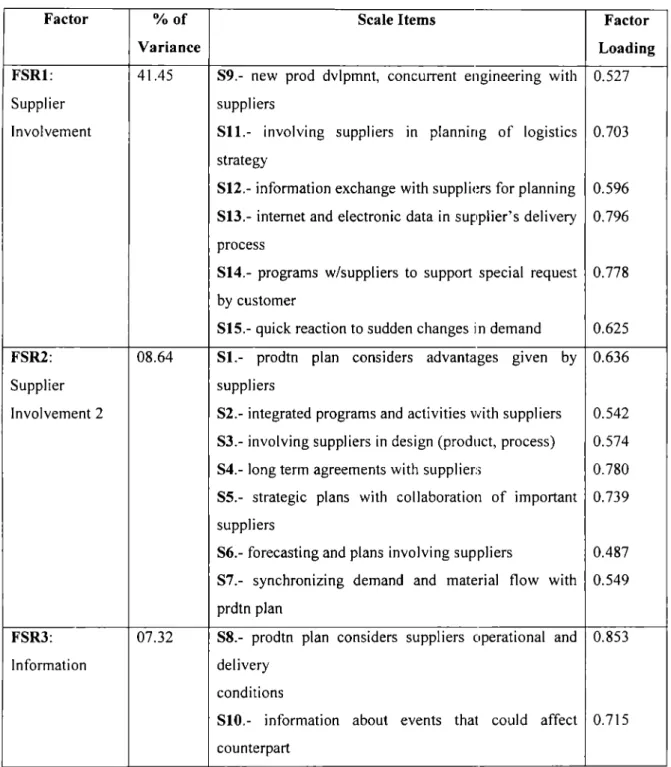
(16) there is very scarce work relating these two terms to the Extended Enterprise. lt is important to clarify: which are the differences and similarities between these three terms, how are these terms related? Which of these terms could be considered the state of the art? Which of these practices and models have a real impact on business performance and in consequence can help me enhance my firm's competitiveness? Which of these practices make a difference in firm performance when firms use them intensively compared to firms that do not use them intensively? The answering of all these questions, and the possibility relating logistics, Supply Chain Management and the Extended Enterprise model, motivated me to do this research work.. The clarification and answermg to all these questions 1s important, considering that Mexican companies are facing a fierce competition with global companies, so, in order to be competitive, these companies must allocate resources a.dequately, investing in implementing or improving logistical practices which can e1hance performance and competitiveness. According to Davila and Martinez (1999), international competition, specifically with Asían firms, and the opening of the economies, forced industrial sectors into interna! and external competitiveness. Iglesias ( 1999) states that Latín America is involved in this international competition, and must take action considering that constant interaction with the international community is an objective reality.. The objectives of this research are: ( 1) to present the relation between the logistics concept, the Supply Chain Management concept, and the Extended Enterprise concept, to clarify it they are the same thing, if one depends of any other, how are they related in case they are; (2) to determine statistically which logistical practices are significant to firm performance;. 2.
(17) and finally, (3) to determine if far any logistical practice there is a significant difference in performance between focusing intensively on that logistical practice or not.. 1.2 Hypotheses of this Work. Based on the second and third objectives of this research, s1x hypotheses have been developed. The first two hypotheses have to do with Customer Relations logistical practices. The first one looks far the significant Customer Relations practices that impact firm 's performance. The second one looks far practices which in case of being intensively used by a firm, that firm would have a superior performance over companies that do not use that practice intensively.. H 1.a: A customer relations focus, characterized by a profound involvement of customers in operations, information systems, collaborative design, forecasting, planning and strategic planning with involvement of customers, agility, and arder fulfillment, has a statistically signiticant impact on Mexican firm's performance.. H 1.b: Mexican Firms that strongly develop a customer relations focus will exhibit enhanced performance compared to those which not.. The third and fourth hypotheses have to do with Supplier Relations logistical practices. The third hypothesis looks far the significant Supplier Relations practices that impact firm's performance. The fourth one looks far practices which in case of being intensively used by. 3.
(18) a firm, that firm would have a superior performance over companies that do not use that practice intensively.. H2.a: A supplier involvement focus, characterized by a profouncl involvement of suppliers in operations, information systems, collaborative design, forecasti ng, planning and strategic planning with involvement of suppliers, agility, and order fulfillment, has a statistically significant impact on Mexican firm's performance.. H2.b: Mexican Firms that strongly develop a supplier involvement focus will exhibit enhanced performance compared to those which not.. The fi fth and sixth hypotheses have to do with Environmental A wareness logistical practices. The fifth hypothesis looks for the significant Environmental Awareness practices that impact firm's performance. The fourth one looks for practices which in case of being intensively used by a firm, that firm would have a superior performance over companies that do not use that practice intensively.. H3.a: An environmental awareness focus, characterized by a strong environmental responsibility, having defined processes for the recovery a:1d afterwards recycling, remanufacturing or final disposition of products, and the design of products with a longer life cycle, has a statistically significant impact on Mexican firm's performance.. H3.b: Mexican Firms that strongly develop an environmental awareness focus will exhibit enhanced performance compared to those which not.. 4.
(19) A questionnaire was developed, and questions on logistical practices were grouped in three sections: Customer Relations practices, Supplier Relations practices, and Environmental Awareness practices. A fourth section of the questionnaire consisted of performance measurement variables. The objective of the survey was to look for significant relations between the firms' capabilities on logistical practices, and the performance measurement variables.. The procedure to test hypotheses Hl.a, H2.a, and H3.a, was as follows; first of ali, a Factor Analysis was performed in order to group the variables of each of the three parts of the questionnaire that have to do with logistical practices, for each of the thirteen performance measurement variables, Multiple Linear Regression was carried out using the factors as independent variables, in order to determine which factors (groups of variables) were significant to firm's performance.. The procedure to test hypotheses H l.b, H2.b, and H3.b, was as follows; T-tests were carried out using the factors, for analyzing significant difference;; in performance of firms with high logistics capabilities and firms with low logistics capabilities.. 1.3 Organization of the Report. Chapter two shows the literature review on how the Logistics concept has evolved, first into the Supply Chain Management model, and afterwards into the Extended Enterprise model, which represent the state of the art of logistical practices. Chapter three shows the methodology literature review on related works, and the statistical methodology that was. 5.
(20) utilized in this research work. Chapter four show the results of literature review on related works, and the statistical results of this work. Finally, chapter five exposes the general conclusions of this work.. 6.
(21) Chapter 2 Evolution of the Extended Enterprise. Logistics and Supply Chain Management terms have been used indistinctly by sorne academicians and practitioners. On the other side, it has not been defined which are the differences and similarities between Supply Chain Management and the Extended Enterprise model. One of the objectives of this research is to show the relation between the logistics concept, the Supply Chain Management concept, and the Extended Enterprise concept, to clarify it they are the same thing, if one depends of any other, how they are related in case they are. This is presented in this chapter. lt is also presented the way in which logistics has been evolving into the Extended Enterprise.. 2.1 Definitions and Concepts on Logistics. Logistics has been positioned as one way for firms to differentia1:e their product or service offerings by enabling them to serve selected customers better than competitors do, or to serve those customers at lower a price for the same service leve) (Stank and Lackey, 1996).. In 1986, the Council of Supply Chain Management Professionals (CSCMP, previously called Council of Logistics Management, CLM), the leading-edge professional organization in the logistics area, defined logistics as:. 7.
(22) "The process of planning, implementing, and controlling the efficient, cost-effective flow and storage of raw materials, in-process inventory, finished goods, and related information flow from point- of-origin to point-of-consumption for the purpose of conforming to customer requirements" (Cooper, Lambert, and Pagh, 1997, p. l). In the l 990's, many of those academicians and practitioners writing, talking, and offering seminars on Supply Chain Management were using these words as a synonym for logistics. Supply Chain Management is a broader discipline than just logistics properly implemented. In fact, logistics is a sub-system of Supply Chain Management (Cooper et al., 1997).. In 1998, CSCMP announced a modified definition for logistics. That definition explicitly declares CSCMP's position that logistics management is only a part of Supply Chain Management, and that the two terms are not the same (Lambert, Cooper, and Pagh, 1998). This revised definition says that: ''Logistics is that part of the mpply chain process that. plans, implements, and controls the efficient, effective flow and storage of goods, services, and related informa/ion from the point-of-origin to the point-of-consumption in arder to meet customers' requirements ".. In 2004, the CSCMP's definition for Logistics was:. "Logistics management is that part of the supply chain management that plans, implements, and controls the efficient, effective forward and reverse flow and storage of goods, services, and related information between the point of origin and the point of consumption in arder to meet customers' requirements" (http://clml.org/ 2004, visited August 2004).. 8.
(23) This 2004 CSCMP's definition is considering not only an efficient and effective forward flow, but is also considering a reverse flow of goods, service and information, this definition is considering the supply chain as a closed loop, not only an unidirectional chain or network.. Table 2.1 shows the critical issues covered by each of the definitions. In this table, it can be observed how the definition of the logistics concept evolved ovec time until, from a simple management of flow and storage of products and information, to the considering of not only a forward flow, but also the considering of a reverse flow.. Table 2.1 Logistics Definitions comparative table. (Planning, Management Implementing, Controlling) of flow and storage. CSCMP, 1986. CSCMP, 1998. CSCMP,. '1. '1. '1. '1. '1. '1. '1. '1. '1. '1. '1. '1. '1. '1. 2004. Efficiency, cost effectiveness in management Conformity with customer requirements Forward flow Logistics as Management. part of the. Supply. Chain. Reverse flow. '1 Based on Boyson, Corsi, and Dresner (1999), and CSCMP (2004), it can be stated that logistics consists of a set of activities which are included in table 2.2.. 9.
(24) Table 2.2 Logistics set of activities Boyson et al. 1999. CSCMP. 2004. Traffic and transportation management Warehousing and storage Industrial packaging Materials handling Inventory management and control Order fulfillment Demand forecasting Production planning and scheduling Purchasing Customer service levels Plant and Warehousing site location Returned goods handling Parts and service support Salvage and scrap disposal Logistics network design Third Party Logistics service providers. " " " " " " " " " " " " " ". " " " " " " " " " " " ". Any organization with high performance standards recognizes that these activities are the core logistics and views them not as isolated technical functions but as a strategically important set of activities. This set of activities can yield a competitive advantage (Boyson et al., 1999) for any organization.. 10.
(25) 2.2 Definitions and Concepts on Supply Chain Management. This section presents the literature rev1ew concernmg the Supply Chain Management model, definitions and concepts, the supply chain management evolution, and how this evolution is taking the Supply Chain Management model into the Extended Enterprise model.. 2.2.1 Definitions and concepts. The concept of Supply Chain Management first appeared in the literature in the mid 1980's. The first writers stated that Supply Chain Management covers the flow of goods from supplier through manufacturing and distribution chains to the cnd user. This scope was afterwards expanded up to the source of supply and down to the point of consumption, which is the span of logistics defined by CSCMP. "In 1994, the members of The. lnternational Center for Competitive Excellence defined Supply Chain Management as "the integration of business processes from end user through original suppliers that provides products, services and information that add valuefor customers" (Cooper et al., 1997, p.2). This previous definition is beginning to consider business pro~esses, not just logistical activities.. The short term objective of the Supply Chain Management is to increase the value of products and services to all interna! and externa! customers in the supply chain, improving customer service and quality, while reducing inventory carrying costs and also reducing cycle time, its long-term strategic goals are to increase customer satisfaction, market share,. 11.
(26) and profits for ali members of the supply chain network (Wisner, 2003). Successful Supply Chain Management involves the coordination of activities within the firm and between members of the supply chain (Croxton, Garcia-Dastugue, Lamben:, and Roger, 2001 ).. Mentzer, et al. (2001, p.18), highlight a strategic focus when they define Supply Cha in Management as a ".5ystemic, strategic coordina/ion of the traditional business functions. within a particular company and across businesses within the supply chain, for the purposes of improving the long-term performance of the individual companies and the supply chain as a whole ". Bowersox, Closs, and Cooper (2002) state that Supply Chain Management consists of. ''firms collaborating to influence over the firms' strategic positioning and to improve operating efficiency". This definition emphasizes that the Supply Chain Management model spans ali functional areas within the organization and links ali trading partners across organizational boundaries to reconfigure business processes in a systematic way that seeks to optimize end-customer value by perfectly meeting customer needs and expectations with minimal waste.. Croxton et al. (2001 ), and Lambert et al. (1998) report the following definition of Supply Chain Management given in 1998 by The Global Supply Chain Forum: " Supply Chain. Management is the integration of key business processes from end user through original suppliers that provides products, services, and informa/ion that add value far customers and other stakeholders ".. 12.
(27) Davis (2004) accordingly stated that Supply Chain Management is about process management, more than isolated logistics activities. The Global Supply Chain Forum identified eight key processes that make up the core of Supply Chain Management (Croxton et al., 2001 ):. 1. Customer Relationship Management. 2. Customer Service Management. 3. Demand Management. 4. Order Fulfillment. 5. Manufacturing Flow Management. 6. Supplier Relationship Management. 7. Product Development and Commercialization. 8. Returns Management.. A definition of each process can be seen in Appendix A.. Simchi-Levi, Kaminski, and Simchi-Levi (2003, p.1) define Supply Chain Management as. a "set of approaches utilized to efficiently integrate suppliers, manufacturers, warehouses, ami stores, so that merchandise is produced and distributed at the right quantities, to the right locations, and the right time, in arder to minimize system wide costs while satisfying service leve! requirements ". This definition highlights business integration, complete chain integration.. 13.
(28) Davis (2004) states that many authors and organizations have described Supply Chain Management as an integration of processes incorporating acqui ~ition of ali physical and informational inputs, the further transformation of these inputs into customers solutions, and fulfillment of customer orders. In 2004, the CSCMP's definition for Supply Chain Management was the following:. "Supply Chain Management encompasses the planning and management of ali activities involved in sourcing and procurement, conversion, and al.' Logistics Management activities. Importantly, it also includes coordina/ion and coilaboration with channel partners, which can be suppliers, intermediaries, third-party service providers, and customers. In essence, Supply Chain Management integrates supply and demand management within ami across companies" (http://clml.org/ 2004, visited August 2004). This definition includes concepts such as coordination and collaboration with customers and suppliers. These are important issues for the Extended Enterprise concept.. Table 2.3 shows the critica! issues covered by each of the Supply Chain Management definitions. In this table, it can be observed how the definition of the Supply Chain Management concept varies from source to source. Simchi-Levi's may seem to be the more complete definition. Even though sorne definitions may seem limited, they are intrinsically involving the most basic Supply Chain Management's objectives regarding product, service and information flows and storages.. 14.
(29) 2.2.2 Supply Chain Management evolution into Extended Enterprise. According to Browne et al. (1995) and Beamon (1999), there are pressures in the economic and industrial environments, which emerge from a set of factors, sorne ofwhich are:. Table 2.3 Supply Chain Management Definitions comparative table Interna t. Center for Competitive Excellence. The Global Supply Chain Forum. 1994. 1998. Integration of Business Processes (functions). v. v. products, Provides services and information. v. v. Value Addition to customers and/or stakeholders. v. v. Mentzer, et al.. Simchi-Levi et al.. 200. 2003. v. v. v. v. v. Performance Improvement. v. Systern-Wide Cost Minirnization. v v. ( 1) Manufacturing is taking place in a global economy. •. Formation of strategic alliances.. •. Customized productor service.. •. Time to market is increasingly critical.. •. Customer driven manufacturing. Make to arder manufacturing.. 15. CSCMP. 2004.
(30) •. Markets globalization.. (2) Manufacturing systems are required to develop environmentally benign products and processes. •. More awareness of environmental impact of products and processes.. •. Compulsory designs in terms of energy utilization, the use of recyclable materials, the safe disposal and also the reuse of prod ucts at the end of their life cycle.. (3) Business and organizational structures are under increasing stress. •. Increased reliance and dependence on subcontractors and ~;uppliers.. •. Supplier networks.. •. Information technology to support this cross-enterprise working.. •. Organizational structures are being tlattened.. Ali the above pressures result in new forms of supply chains, which are based on a clase work with networks of suppliers on the one hand and customers on the other hand to develop customized products in very short lead times. Inter-enterprise networking represents the future shape of manufacturing systems (Browne et al., 1995; Browne and Zhang, 1999; Tracey and Tan, 2001). Global deregulation in many industries is opening markets to the entry of new competitors (McAdam, 2001 ). Increasing global competition, the demands of customers for higher product quality, greater product selection, and better customer service, the desire of firms to shrink their supply base~ while striving to contain costs, and the rising costs of natural resources today have led many organizations to adopt cooperative, mutually beneficia! partnership strategies with suppLers, distributors, retailers,. 16.
(31) and other firms within their supply chains to maintain or improve profitability and overall firm performance (Wisner, 2003).. Changing. work. practices,. technological. developments,. globalization,. increased. involvement in alliances and partnerships, and the emergence of new public policy issues cause firms to become more "extended" and to realize that their success (and therefore their value) increasingly depends more on relationships than cm the accumulation of conventional assets (Post, Preston, Sachs, and Sybille, 2002).. In the following sections, it is shown how sorne trends and practices from the business environment, have been determinant in the Supply Chain Management evolution, sorne of this trends and practices are:. a) Strategic alliances between members of the supply chain (Al-Mudimigh, Zairi, and M. Ahmed, 2004; Boardman and Clegg, 2001; Browne, Sackett, and Wortmann, 1995; Ellram, Zsidisin, Siferd, and Stanly, 2002; Hillebrand and Biemans, 2003; Kannan and Tan, 2002; McCormack and Kasper, 2002; O'Neill and Sackett, 1994; Poirier and Quinn, 2003; Tan, 2002; Wisner, 2003) b) Working asan enterprise network (Cooper et al., 1997; Lambert et al., 1998; Poirier and Quinn, 2003; Stank, Crum, and Arango, 1999; Wisner, 2003). c) Increasing the leve! of cross-enterprise collaboration (Al-Mudimigh et al., 2004; Bowersox, Closs, and Stank, 2003; Croxton et al., 2001; Ellram et al., 2002; Frohlich and Westbrook, 2001; McGuffog and Wadsley, 1999; Poirier and Quinn,. 17.
(32) 2003; Stank et al., 1999; Tan, Kannan, and Handfield, 1998; Tracey and Tan, 2001; Wisner, 2003). d) Incentive Alignment (Simatupang, Wright, and Sridharan, 2002; Simatupang and Sridharan, 2002; Narayanan and Raman, 2004) e) Becoming environmentally responsible (Browne et al., 1995; Beamon, 1999; De Burgos and Cespedes, 2001; Croxton et al., 2001; Ellram et al., 2002; and Sroufe, 2003).. These trends and practices have caused an evolution in the Supply Chain Management, which has permitted the supply chain become more efficient, mor•;! agile, more global, more integrated, with better response to customers requests.. 2.2.2.1 Strategic alliances. Over the past decade there has been a growing consensus concernmg the strategic importance of integrating suppliers,. manufacturers, and. customers (Frohlich. and. Westbrook, 2001 ).. Firms are developing strategic alliances with suppliers, and are also considering suppliers as partners instead of adversaries (Tan et al., 1998). Manufacturers are increasingly taking advantage of suppliers' technologies and expertise in product design and development, a concept commonly known as early supplier involvement. Firms utilize their suppliers' processes, technologies, and capabilities to improve competitive advantage. Buying firms are developing cooperative, mutually beneficial relationships w:th suppliers and viewing. 18.
(33) suppliers as virtual extensions of their firm. In doing so, they 5ignificantly increase their reliance on suppliers (Tan, Kannan, Handfield, and Ghosh, 1999). When Toyota's upper manager started considering how to get certain components for ther cars and trucks, the decision between buying and manufacturing seemed totally irrelevant. To Toyota, the real issue was to determine how the manufacturer and the suppliers could work jointly and fluidly to reduce costs and improve quality, thrnugh any formal or legal relation between them (Womack, Jones, Roas, and Carpenter, 1992).. Effectively selecting and evaluating suppliers and managmg their involvement in the supply chain are thought to be capabilities that enable manufacturers to achieve higher performance. Therefore, it is possible that an effective selection and evaluation of suppliers, promoting their involvement in critical logistical supplier chain activities will result in an improved firm performance via enhanced customer satisfaction {Tracey and Tan, 2001 ). Involving suppliers in product design decisions and continuous improvement efforts enables the firms to share knowledge and increase learning so that better solutions can be found to complex, inter-company problems that impact performance (Tracey and Vonderembse, 2000). Leading companies are jumping ahead of their slower rivals and are establishing positions of dominance, based largely on their ability to work collaboratively with carefully selected trading partners (Poirier and Quinn, 2003).. There is consistent evidence that the widest degree of integration with both suppliers and customers had the strongest association with performance improvement. The most successful manufacturers seem to be those that have carefully linked their interna) processes to external suppliers and customers in unique supply chains. For the new. 19.
(34) millennium, upstream and downstream integration with suppliers and customers has emerged asan important element of manufacturing strategy. The ,)pportunity to use process integration across functional boundaries is now considered a key to competitive success (Frohlich and Westbrook, 2001 ). The greatest inventory turnover benefits go to the company best able to strongly link up with suppliers and customers (Schonberger, 2003). Suppliers of a lean manufacturer know that if the work hard anc in a trustful relation, the manufacturer will guarantee a reasonable retum on investments. That's why, sharing with other members of the chain means that the chain benefits will improve and all the members of the chain will benefit (Womack et al., 1992).. By exploiting suppliers' capabilities, improvements in product qJality, quicker integration of technological breakthroughs, and shorter new product development lead times are the expected outcomes. Suppliers can also be involved in product design atan earlier stage and in doing so, generate more cost-effective design choices, develop altemative conceptual solutions, select the best components and technologies, and assist in design assessment (Kannan and Tan, 2002; Wisner, 2003).. 2.2.2.2 The network concept in Supply Chain Management. Browne et al. ( 1995) considered that the hierarchical paradigm of organizations with a focus on vertical command chains, will be probably replaced by a networking paradigm with the focus on horizontal (cross-enterprise) communication.. 20.
(35) Executives are becoming aware of the emerging paradigm of inter-network competition, and that the successful integration and management of key business processes across members of the supply chain will determine the ultimate success of the single enterprise. The supply chain is not just a chain of businesses with one-to--one, business-to-business relationships, but a network of multiple businesses and relationships. The supply chain has to be considered really as a supply network. Hence, the objective of Supply Chain Management can be understood as to maximize competitiveness and profitability for the company as well as the whole supply chain network including the end-customer (Lambert et al., 1998). Figure 1 shows Lambert's (1998) conceptualization of the supply chain network.. FIGURE 1 SUPPL Y CHAIN NETWORK STRUCTURE. Tier 3 to lnilial Suppliers. •. Tier2 Suppliers. Focal company. Tier 1 S1Jppliers. D. Tier 1 Customers. Tier 2 Customers. Members of the focal Company·s SJpply Chain. 21. Tier3 Consumersl End-customers.
(36) The Supply Chain conceptualization considers the integration and management of key business processes across the network of organization. lt's not only a partner's channel, nor a linear supply chain, but a network of organizations (Cooper et al., 1997; Croxton et al., 2001 ). The supply chain must be managed as a system (McAdam, 2001 ).. Individual companies are working together to form inter-enterprise networks, in order to survive and achieve business successes (Browne and Zhang, 1999). In the late l 990s, a big proportion of manufacturing and service businesses were moving to "network" models of organization, and many companies were establishing corporate logistics/supply-chain management centers to provide information, resources, and guidance to keep networks functioning on an optima] basis (Boyson et al., 1999). Building and sustaining supply networks are processes of aligning the interests of each network participant (Kinder, 2003).. Business management has entered the era of inter-network competition, and the final success of a single business will depend on the management's ability to integrate the company's intricate network of business relationships (Lambert et al., 1998). Corporations are recognizing that in the global business it is not a case of companies competing, but supply chains networks (McAdam, 2001; Cooper et al., 1997; Kinder, 2003; Tracey, 2000).. 2.2.2.3 Cross-Enterprise collaboration. Intensive competition in the market place has forced companies to respond more quickly to customer needs through faster production development and shorter delivery time. To be effective in matching demand with supply, manufacturers and retailers need to collaborate. 22.
(37) in the supply Chain (Simatupang and Sridharan, 2002). Since the mid 1980's it has been observed that many successful organizations are co-operating wi·:h partners in their supply chains (McAdam, 2001 ). In fact, the challenge to manufacturing in the future is to facilitate cross-enterprise networking in the supply chain (Browne ,;:t al., 1995). A closer coordination of activities both within and across the boundarie:; of firms throughout the supply chains is viewed as one important way to enhance performance (Stank and Lackey, 1996). lf supply chain participants do not behave as "partners" and have a shared view of underlying consumer or base demand behavior and of each other's constraints, they are condemned to suffer the consequences in poorer service and/or greater total cost (McGuffog and Wadsley, 1999). Coordination among independent firms, such as raw-material suppliers, manufacturers, distributors, third-party logistics providers and retailers, is the key to attaining the flexibility necessary to enable them to progressively improYe logistics processes in response to rapidly changing market conditions. The mam concern of supply chain management is how to coordinate the independent players to wcrk together as a whole to pursue the common goal of chain profitability in changing market conditions. (Simatupang et al., 2002). Wal-Mart is an example of a company which has benefited from enterprise collaboration. Wal-Mart transmits up-to-date sales and inventory information va satellite to its suppliers' systems to reduce order cycle time and enable stocking decisions to be based on observed early sales rather than on educated guesses. Wal-Mart focuses on the creation of customer services and non-price benefits and collaborates with its important suppliers in forecasting and replenishment. Both parties receive mutual benefits. Wal-Mart gains competitive retail. 23.
(38) pnce and a reduction in lost sales and stocking costs, while the suppliers are able to replenish goods as they are sold, minimize stock-outs, and improve brand loyalty. (Simatupang and Sridharan, 2002). Cross-enterprise collaboration emerges when two or more frrms voluntarily agree to integrate human, financial, or technical resources in an effort to create a new, more efficient, effective, or relevant business model. The essence cf cross-enterprise supply chain collaboration is to share information, jointly develop strategic plans, and synchronize operations. True cross-enterprise collaboration requires a company to modify work processes to incorporate and fuse the capabilities and competencies of other independent businesses (Bowersox et al., 2003).. Bowersox et al. (2003) also consider that the cross-enterprise collaboration is an organizational. model that seeks the benefits of vertical. integration without the. inconvenience of financial ownership. This challenging perspective (the cross-enterprise collaboration) emerged in the late 20th century. In the cross-enterprise collaboration model, participating firms voluntarily create joint policies and integrate operational processes to eliminate duplication and nonproductive redundancy while seeking maximum productivity. In fact, they create what's often referred to asan Extended Enterprise.. A collaborative supply chain simply means that two or more ind,!pendent companies work jointly to plan and execute supply chain operations with greater success than when acting in isolation (Simatupang and Sridharan, 2002). Stank et al. (1999) believed that a strong crossenterprise coordination in the supply chain would be related to absolute performance. 24.
(39) improvements in the following areas: inventory levels, transportation costs, warehousing costs, ordering costs, stock-outs, arder cycle time, arder cycle variance, on time deliveries, unacceptable deliveries, on time deliveries, product availability, customer satisfaction, transaction processes, arder cycle time, flexibility, and the assessment of customer needs. Bowersox (1990) reports that logistics alliances offer opportunities to dramatically improve customer service and at the same time lower distribution and storage operating costs.. Clase cooperation helps supply chain members to effectively match demand and supply to increase overall supply chain profitability (Simatupang and Sridharan, 2002). Supply Chain Management can extend a firm's capabilities by coordinating operations to include source, make, and delivery processes in collaboration with channel partners and suppliers. Coordination of sourcing, production, and logistical activities combined with crossenterprise cooperation, in a supply chain perspective, shifts channel arrangements from loosely linked groups of businesses to coordinated enterpris,~s, focused on efficiency improvement and increased competitiveness. The new organization is capable of rapidly responding to market demands by eliminating redundant activities and reducing response time through seamless flows of information, supply materials, and finished goods. Higher levels of coordination are expected to result in an improved logistics cost and customer service performance. Many firms have discovered that improved coordination and information flows can be achieved by strengthening their relat.onships with product and service suppliers and customers rather than relying on short-term, single-transaction arrangements. Benefits generally result from the synergy gained through shared expertise and resources, exchange of information, mutual planning and support, and joint problem solving fostered by win/win, mutually committed trading partners (Stank et al., 1999). The. 25.
(40) firms collaborating with each other agree in principie and practice to the voluntary commitment and integration of resources in pursuit of jointly dcfined goals. (Bowersox et al., 2003).. Optima) supply chain performance requires the manufacturer to share her initial forecast truthfully, but there may be an incentive to inflate forecasts to induce the supplier to build more capacity. The supplier is aware of this bias, and so may not trust the manufacturer's forecast, harming supply chain performance. There are contracts that allow the supp]y chain to share demand forecasts credibly under either complianc,~ regime. lt is always in the interest of a manufacturer with a high demand forecast to share her forecast with the supplier (Cachon and Lariviere, 2001).. Although collaboration is based on a mutual objective, it is a self-interested process in which firms will participate only if it contributes to their own survival. lnformation sharing and incentive alignment facilitate the collaboration process. (Simatupang and Sridharan,. 2002). 2.2.2.4 Incentives alignment. A supply chain develops strong relations only if every company on it has reasons to pull in the same direction. Every firm behaves in ways that maximize its own interests, but companies assume, wrongly, that when they do so, they also maximize the supply chains interests. Companies often don't act in ways that maximize the network's profits, consequently, the supply chains perform poorly. They also find it tedious and time-. 26.
(41) consuming to define roles, responsibilities, and accountability for a group of businesses they don 't manage directly. Besides, coordinating actions across firms is tough because organizitions have different cultures and companies can 't count on shared beliefs or loyalty to motivate their partners. To induce supply chain partners to behave in ways that are best for everybody, companies have to create or modify monetary incentives. (Narayanan and Raman, 2004). Incentives define how companies in a supply chain are to be rewarded or penalized for the decisions they make. Existing incentives influence individual member behavior and its interaction with other partners. Conflict of interest is likely to occur when the existing incentives lead to actions that max1m1ze personal gain but often reduce the total profitability (Clemons and Row, 1993). Traditional incentive s,::hemes are often based on local costs and short-term concessions that attempt to fill the gap in inventory between chain members. Incentives such as local inventory cost, transportation cost and lot-sizebased quantity discounts, often do not support the value creation process of improving customer services, because those incentives are tied to the action of reducing the interna! costs of one stage of the supply chain. This local optimization often sacrifices the total profit. Local perspective and opportunistic behavior of maximizing individual profit often occurs at the expense of other members and works against the overall supply chain profitability. This behavior causes that products or services may not flow properly to end customers, which results in a mismatch between supply and demand. One way to resolve such a contlict of interests is to offer incentive schemes linkecl to the global performance that reflects both value creation for the customers and profitability (Simatupang and Sridharan, 2002). Incentive alignment induces partner behavior which is consistent with. 27.
(42) customer focus and total profit. Examples from the practica! world suggest that incentive alignment can motivate chain members to satisfy customer needs and increase their total profit. (Simatupang, Wright, and Sridharan, 2002).. Narayanan and Raman (2004) stated that a supply chain works well if its companies' incentives are aligned. That is, if risk, costs, and rewards of doi:1g business are distributed fairly across the network. If incentives aren't in line, the compan ies' actions won't optimize the chain's performance. lndeed, misaligned incentives are often the cause of excess inventory, stock-outs, incorrect forecasts, inadequate sales efforts, and even poor customer service. Their research showed that if the companies work together to efficiently deliver goods and services to consumers, they will ali win. If they don 't, they will ali lose to another supply chain. The challenge is to get ali the firms in your supply network to play the game so that everybody wins. The only way you can do that .s by aligning incentives.. 2.2.2.5 Environmental awareness. Although the sustainability of econom1c development is a shared responsibility of, business, governments and consumers, the corporate role in slowing down the planet's environmental degradation is particularly relevant (De Burgos, 2001 ). Due to changing environmental requirements affecting manufacturing operations, increasing attention is given to developing environmental management strategies for the supply chain. There has been increasing public attention placed on the overall condition of the natural environment. Worldwide, there is an overall awareness ofthe worsening state of the environment, as well as a desire to reverse that trend (Beamon, 1999).. 28.
(43) The ultimate objective of extending the boundaries of the traclitional supply chain is to allow consideration of the total immediate and eventual environmental effects of ali products and processes. The fully integrated, extended supply chain contains ali of the elements of the traditional supply chain , but extends the chain to construct a semi-closed loop that includes product and packaging recycling, re-ust::, and/or remanufacturing operations. It is now imperative to analyze the entire Iifecycle effects of ali products and processes. Therefore, the traditional structure of the supply chain must be extended to include mechanisms for product recovery. This extension presents an additional leve! of complexity to supply chain design and analysis; more specifically, the addition of the product recovery mechanism gives rise to numerous issw!s affecting strategic and operational supply chain decisions (Beamon, 1999).. Browne et al. ( 1995) make emphasis in the increasing importance of environmentally benign production. Issues such as design for recycling, refurbishment, environmental costing, and legal matters can only be studied if the scope of study is enlarged to the chain of value adding activities, including ultimately end-of-life disassembly and refurbishment. O Neill and Sackett ( 1994) indicate that the manufacturer may ·:ake a product back when its capability to evolve has reached a Iimit, then sorne of its components may be recycled, or the product may be repackaged and used again. Today's visionary manufacturing companies are developing a total life cycle approach to their products (Browne et al., 1995). Recycling practices are an attempt to provide greater value to customers with fewer materials (Sroufe, 2003).. 29.
(44) Browne et al. (1995) indicate that in the context of the Extended Enterprise and the need for enterprise networking, they consider that nowadays the organizations are facing a reduced product life cycle (and the consequences in terms of tlexibility in the manufacturing capability), and the necessity of taking a total product life cycle view (dueto the heightened awareness of environmental problems).. Various aspects regarding the environment, such as legislation, stakeholder pressure, economic opportunities and ethical motives have led to firms applying environmentally sustainable strategies. Managers must accept that the firm's overall strategy and environmental questions inevitably go hand in hand. They mw;t, therefore, find a way of satisfying objectives of economic competitiveness and of environmental protection at the same time (De Burgos, 2001 ).. De Burgos (2001) also states that firms can obtain severa) benefits associated with the reduction of the organization's impact on the environment which can help towards obtaining a competitive advantage. Among the benefits devcloped from environmental performance improvement are: cost reduction; quality improvement; early adoption of new regulations; benefits in management and personnel; externa) benefits derived, such as: improved company image; access to new markets; engaged competitiveness; improved custorner loyalty; as well as improved stakeholder communication and feedback.. Croxton et al. (2001) consider that the effective management of returns is a critica! part of Supply Chain Managernent. While many firms neglect the return process because management does not believe it is important, this process can assist the firm in achieving a. 30.
(45) sustainable competitive advantage. Effective management of the return process enables the firm to identify productivity improvement opportunities and breakthrough projects.. lt is early in design practices that decisions are made that impac:t operations practices and set into place the actions that ultimately create waste stn::ams encountered in the transformation system. One way of controlling and reducing cnvironmental waste is to integrate systems and practices to achieve better environmental performance. Design activities, in general, present opportunities for firms to find salutions to environmental issues. Through the use of an environmental design approach, products and processes are designed such that emissions and wastes are either minimized or completely removed. The assumption is that better environmental management will Iead to better performance (Sroufe, 2003).. There must be a move towards sustainability, achieved through vast reductions in resource use and waste generation, and a move away from one-time use and product disposal. The first step in such a move is to extend the structure of the one-way supply chain to a closed loop, including supply chain operations designed for end-of-life product and packaging recovery, collection, and reuse (in the forms of recycling and/or remanufacturing) (Beamon, 1999).. 2.2.3 How Supply Chain Management is moving to the Extended Enterprise. During the l 990s researchers and practitioners began to view the supply chain as a whole, and promoted customer focus, supplier partnerships, cooperation and information sharing. 31.
(46) and business process management. As virtual organizations develop, business leaders need to take a holistic approach and consider the whole supply chain as one business (McAdam, 2001). Supply Chain Management, with its tendency to interact with many interna! and externa! stakeholders, has become the driving force in an effort to create the Extended Enterprise (Boyson et al., 1999).. For a modern supply chain to function well, its participants should not only be exchanging orders or invoices, but also they should be willing to share future plans and past performance data. Depending on the nature of the supply chai n, mutual benefits can be gained by jointly managing deliveries, inventory levels, service, etc. by communicating forward plans for distribution, production, and supply; jointly agreeing in the required response (Me Guffog and Wadsley, 1999). During the l 990s, many manufacturers and service providers collaborated with their strategic suppliers to upgrade traditional supply and materials management functions and integrate them as part of corporate strategy. Supply Chain Management is the chain linking each element of the manufacturing and supply process from raw materials to the end users, and treating ali firms within the supply chain as a unified virtual business entity. The Supply Chain Management scope was further expanded to include recycling. Leading organizations are adopting a strategic approach to managing the supply chain, such as forming strategic alliances with suppliers and distributors instead of vertical integrating, in order to exploit the competitive advantage associated with integrated processes (Tan, 2002).. Supply Chain Management's scope includes supply management from the supply of basic raw materials, to final product, and includes the possibility of recycling or re-use, trying. 32.
(47) with this to create a kind of virtual organization, or Extended Enterprise, with the goal of efficiently and effectively managing the processes and operations of the separate organizations. Research results suggest that manufacturers are integrating their supplier's knowledge into new product and process design. Supply Chain lvlanagement also involves downstream integration of customers (Tan et al., 1998).. When successful, Supply Chain Management creates a virtual organization composed of severa! independent entities, often linked by sophisticated enterprise resource planning systems providing global visibility of real-time information from any part of a company or its supply chain paiiners. The visibility enables more effective forecasting, production, and inventory decisions .To accomplish this, Supply Chain Management must integrate a number of key business functions, including purchasing, demand management, distribution planning,. transportation,. quality. management,. production. planning,. and. materials. management throughout the supply chain (Wisner, 2003).. Table 2.4 shows a comparison between the key business functions proposed by the Global Supply chain Forum and the key business functions proposed by Wisner, it can be observed that the Global Supply Chain Forum has a more comprehensive focus, which is closer to the extended enterprise' s focus.. Supply Chain Management is a major issue in many industries as organizations begin to appreciate the criticality of creating an integrated relationship with their suppliers and customers, as well as ali other stakeholders (Al-Mujdimigh et al., in press).. 33.
(48) Table 2.4 Key business functions according to GSCF and Wisner GSCF. Wisner. Customer Relationship Management. '1 Customer Service Management. '1 Demand Management. '1. '1. '1. '1. '1. '1. '1. '1. Order Fulfillment Manufacturing Flow Management Supplier Relationship Management Product Development and Commercialization. '1 Returns. '1 Qual ity Management. '1. McCormack and Kasper (2002) provide sol id evidence of the benefit to the Supply Chain Management by extending the supply chain to include suppliers and customers. Croxton et al. (2001) state that the companies that would be successful in the future would be those that are able to take a new approach to business, working closdy with partners to design and manage processes that extend across traditional corporate boundaries. Rolstadas ( 1998) agrees with the previous concepts when he argues that the modern enterprise will regard its customers and suppliers as part of its own company by establishing strategic alliances. He also states that sorne have started to talk about the virtual or Extc:nded Enterprise. Tan et al.. 34.
(49) (1999) consider that a key element of successful supply base management involves downstream integration of customers as well as the management of upstream suppliers. Each entity in the supply cha in is a supplier as well as a customer. Tan et al. ( 1998) state that when all strategic suppliers in the chain integrate and actas a single entity performance is enhanced throughout the chain.. Changing. work. practices,. technological. developments,. globalization,. increased. involvement in alliances and partnerships, and the emergence of new public policy issues all cause firms to realize that their success (and therefore their value) increasingly depends more on relationships than on the accumulation of conventional assets (Post et. al., 2002).. Based on Croxton et al. (2001) and Poirier and Quinn (2003), Figure 2 shows 3 levels of evolution far the Supply Chain in terms of collaboration and integration.. At Level 1, the company begins sorne inter-enterprise activities, involving important suppliers and customers in strategic and operative sessions; it also begins to work on collaborative product and process designs and to match supply more closely with demand. Also collaboratively works to discover savings through mutually beneficial initiatives that reduce cycle time, achieve faster time to market, and utilize assets more effectively. This level includes integrating customers and suppliers into the product development process in arder to reduce time to market. As product life cycles shorten, the right products must be developed and successfully launched in ever-shorter timeframes in arder to remain competitive.. 35.
(50) FIGURE2 FROM SUPPLY CHAIN MANAGEMENT TO EXTENJDED ENTERPRISE. Extended Enterprise's Evolution Sta1ges. Evolution Sta ge. III. Extended Enterpise II. Supply Chain Collaboration 1. Partner Collaboration. Time. At Leve! II, the organization moves forward with its positions in one or more networks. The company begins working very seriously with a smal I base of upstream and downstream partners. Now, the focus shifts into establishing a position of dominance in an industry for a particular network with the aid of ali the network partners. The company works with key vendors to enhance value for both parties. A serious sharing of information with key customers is launched with the objective of developing joint strategies and business goals that increase revenues and profits for both parties.. 36.
(51) At Leve! III, the most advanced stage of supply chain evolution is reached; this is when a Supply Chain works under the principies of an Extended :::nterprise. This leve! is characterized by communication connectivity across the total supply chain network. Collaborative design and manufacturing, and collaborative planning, forecasting, and replenishment appear in this leve!. Full network collaboration and the use of technology to gain positions of market dominance are utilized. This leve! is also characterized by Environmental Awareness, in terms of reverse logistics, recycling, refurbishment, remanufacturing, and environmental design.. 2.3 Definitions and Concepts on Extended Enterprise. In this section wi II be presented the literature review concerning the Extended Enterprise model, its related definitions as well as the organization, agility and flexibility concepts. The network concept applied to the Extended Enterprise model, and finally, sorne examples of companies that are actually using this new model.. 2.3.1 Definitions. The Extended Enterprise model cannot be realized overnight. lt evolves over time. Elements of it can already be seen in sorne industrial sectors. Indeed programs such as JIT, World Class Manufacturing, and Lean Production; processes such as Business Process Redesign, and Benchmarking, and technologies such as computer networking and EDI (Electronic Data Interchange) have allowed manufacturing enterprises to move in the. 37.
(52) direction of inter-enterprise networking (Browne et al., 1995). Large corporations are evolving into complex Extended Enterprises (Post et al., 2002).. Companies which manage logistics on a functional basis are some 30 years behind current best practices. Those who manage logistics well across the ent;!rprise but who refuse to manage Extended Enterprise relationships with the same intensity and effectiveness as they do internally are at least I O years behind current best practice. E ven those companies that have a high performance with unified management approache:;; and systems across the entire chain cannot afford to rest, because economic and technological forces continue to accelerate the speed of change (Boyson et al., 1999). Manufactui-ing enterprises are facing critica! challenges to reconstruct themselves in order to survive in an ever more volatile competitive market environment. Their success largely depends on their ability to quickly practice and adopt state-of-the-art manufacturing strategies and technologies. There is a shift from "self-centered" closed-enterprises to global open-enterprises. One of the terms used to describe this new approach is that of the "Extended Enterprise" (Browne and Zhang, 1999). This model is inevitable in sectors where the importance of the customer service is increasing (O Neill and Sackett, 1994).. The Extended Enterprise can be regarded as a kind of enterprise which is represented by ali those organizations or parts of organizations, customers, suppliers and sub-contractors, engaged collaboratively in the design, development, manufacture and delivery of a product to the end user. The Extended Enterprise can be seen in the context of enterprise partnerships, designed to facilitate co-operation and integration across the supply chain.. 38.
(53) The concept of the Extended Enterprise focuses on long-term enterprise relationships with suppliers and consumers across the supply chain (Browne and Zhang, 1999).. FIGURE3 GRAPHICAL CONCEPTUALIZATION OF THE EXTENDED ENTERPRISE. Prodoct& Process Oesign. e. Oesign co-ordinal:i~. Oistributor. Customers. ------(ustomer Ord ~ Fulfillment -. Yendor Supp y. _/. Production & Planning Control. The Extended Enterprise extends beyond traditional organizational boundaries. It includes the relationships that an enterprise has with its customers, suppliers, business partners, and even former competitors. The Extended Enterprise is responsible for the whole product life cycle, from material procurement to component production and manufacturing, to final assembly, further to distribution and customer service, and in an increasing number of cases, to the disposition and, where possible, recycling of end-of-life products (Browne and. 39.
(54) Zhang, 1999). Figure 3 shows Browne and Zhang's (1999) graphical conceptualization of Extended Enterprise.. The left side (the big box) of Figure 3 represents the conventionally called "forward manufacturing process" and associated "forward value chain", while the right side (the small box) represents an augmented business model to incorporate end-of-life product disposition and possible component recycling (Browne and Zhang, 1999).. The. forward. manufacturing process. includes. five. "conventional" processes:. co-. engineering, design co-ordination, vendar supply or supply chain management, customer arder fulfillment, and manufacturing/assembly. Four of those cross traditional enterprise boundaries (Browne and Zhang, 1999).. a) Co-engineering refers to the involvement of key specialist suppliers in the product/process design process (Browne and Zhang,. 1999). Suppliers may. participate earlier in the product design process to achieve more cost-effective design choices, develop alternative conceptual solutions, select the best components and technologies, and help in design assessment (Tan et al., 1999). There has been an mcrease m the sharing of information between suppliers and customers (AIMujdimigh et al., in press). A critica! responsibility is the developing and maintaining of long term strategic alliances with key suppliers. Research suggests that managing well supplier involvement can lead to a better supplier performance, improved manufacturing, and product and process advancements that, in turn, enhance customer satisfaction and firm performance. There is also a relative benefit. 40.
(55) to be gained through the involvement of suppliers on Jroduct development and continuous improvement teams. Such involvement has. 2.. significant positive total. effect on customer satisfaction and on firm performance (Tracey and Tan, 2001 ).. b) Design co-ordination is concerned with the design of product and the manufacturing process to meet customer need and, therefore, involves close interaction with customers and/or their representatives (Browne and Zhang, 1999). Knowledge about customers, including their receptivity to various communication modes and other forms of influence, not only guides marketing efforts, but also creates opportunities for collaboration in the search for mutually beneficial product-service improvements (Post et al., 2002).. e) The vendor supply process is concerned with the management of the flow of materials from suppliers in order to meet customer orders efficiently and costeffectively (Browne and Zhang, 1999). The global situation with the Extended Enterprise extends the customer satisfaction approach beyond the customer. It actually includes suppliers, vendors, financial institutions, and even owners. Having the best possible suppliers is nowadays regarded as an asset. There is therefore an open competition in the marketplace not only for customers, but also for suppliers and owners (Rolstadas, 1998).. d) The customer order fulfillment process is concerned with the delivery of that order. Frequently it involves specialist distribution and transport enterprises and, indeed, logistics service providers (Browne and Zhang, 1999).. 41.
(56) The three business processes that are emerging under the Extended Enterprise paradigm are, design for recycling/disassembly, product recovery and reverse logistics, and finally end-of-life product disposition (Browne and Zhang, 1999). It has been previously mentioned that according to Browne et al. (1995), public opinion is more and more aware of the environmental impact of manufacturing processes a~. well as the final and intermediate products of the manufacturing processes. Local and global agreements has increasingly forced and constrained product and process de:,ign in terms of energy utilization, the use of recyclable materials, the safe disposal and also the reuse of products at the end of their life cycle.. 2.3.2 Organizational structure in the Extended Enterprise. A very important issue to achieve a successful performance of the Extended Enterprise model is an adequate organizational structure. The Extended Enterprise demands a new organizational concept. The power of the conventional hierarchy is seriously weakened by the tlat, geographically distributed and transient structure of the Extended Enterprise. Decision making is widely distributed (O Neill and Sackett, 1994). Hierarchical authority systems that are widely spread in vertically integrated industrial firms are slow in identifying rapidly changing customer requirements and in reacting quickly with creative product offerings (Brown et al., 1995).. Effective management of the Extended Enterprise requires both a new conception of the firm (a network, rather than a hierarchy) and new approaches to the practica! issues and. 42.
Figure



+6




Documento similar
The growth of global markets for finance and specialized services, the need for transnational servicing networks due to sharp increases in international investment, the reduced
Government policy varies between nations and this guidance sets out the need for balanced decision-making about ways of working, and the ongoing safety considerations
In this guide for teachers and education staff we unpack the concept of loneliness; what it is, the different types of loneliness, and explore some ways to support ourselves
Thus, the main objectives of this work are (a) to assess the performance of the proposed transformer model to forecast ET 0 and to compare it to standard ML models
This research has gone beyond the concept of organizational ambidexterity and analyze theoretically and empirically certain of the antecedents proposed in the
Chapter 1 reports the results of a research with the main objective of clarifying the theoretical background of the IMC concept as a dynamic capability, linking it
The availability of small deformable mirrors with large number of actuators and stroke, on one hand, and versatile wavefront sensors (pyramid WFS), on the other, allows the
The objective of this study is to carry out a descriptive analysis in order to define and understand the concept of corporate social impact and analyze different methodologies
