
Authentic videos: a proposal to enhance productive skills within a cooperative learning environment in the EFL classroom
107
0
0
Texto completo
(2) AUTHENTIC VIDEOS: A PROPOSAL TO ENHANCE PRODUCTIVE SKILLS WITHIN A COOPERATIVE LEARNING ENVIRONMENT IN THE EFL CLASSROOM. NOTE OF ACCEPTANCE _____________________________________ _____________________________________ _____________________________________ _____________________________________ _____________________________________ _____________________________________. ___________________________________________ Signature. ___________________________________________ Signature. ___________________________________________ Signature. Bogotá, December 2019.
(3) AUTHENTIC VIDEOS: A PROPOSAL TO ENHANCE PRODUCTIVE SKILLS WITHIN A COOPERATIVE LEARNING ENVIRONMENT IN THE EFL CLASSROOM. Dedication To my mother, Sandra Patricia Gómez, who has been my major support and constantly inspires me to go further. There are not enough words to appreciate everything you have done for me. Thank you, mommy, for always believing in and supporting me unconditionally. I also want to thank my father, Francisco, for his love and care. To my grandmother, whose wisdom and love will always be with me. To my dear baby, for teaching me unconditional love and fidelity. Thanks to God for always blessing me and guide me along the best paths. To my family, for believing in me. To my cousins for their guidance, their friendship, and love. To my protocol girls, thank you for demonstrating the value of friendship and encouraging me to grow both professionally and personally. Last but not least, to all the teachers who have marked my life significantly, especially the language teachers from the UPN and the ones from my school Tomas Rueda Vargas. Thank you for guiding my path and inspiring me to be the best teacher day by day..
(4) AUTHENTIC VIDEOS: A PROPOSAL TO ENHANCE PRODUCTIVE SKILLS WITHIN A COOPERATIVE LEARNING ENVIRONMENT IN THE EFL CLASSROOM. Acknowledgements I would like to initially thank the Universidad Pedagógica Nacional for allowing me to fulfill this dream. For letting me be a part of this wonderful institution, teaching me and shaping me professionally and personally. Thank you for all the opportunities you gave me that enabled me to grow. I also want to thank the Liceo Femenino Mercedes Nariño for opening its doors and letting me develop this cherished process for me. Thanks to my students for their support and persistence in this process. Huge thanks to my advisor Nelson Mellizo for his excellent guidance, for supporting and encouraging me and for his patience throughout the development of this research. Finally, I would like to thank the teachers and classmates who are part of the Department of Languages and influenced my progress as a future teacher in one way or another. Thank you for your life lessons and your guidance.. 2.
(5) AUTHENTIC VIDEOS: A PROPOSAL TO ENHANCE PRODUCTIVE SKILLS WITHIN A COOPERATIVE LEARNING ENVIRONMENT IN THE EFL CLASSROOM. FORMATO RESUMEN ANALÍTICO EN EDUCACIÓN - RAE Código: FOR020GIB. Versión: 01. Fecha de Aprobación: 10-10-2012. Página 1 de 6. Tipo de documento. 1. Información General Trabajo de grado. Acceso al documento. Universidad Pedagógica Nacional. Biblioteca Central. Titulo del documento. Authentic Videos: A proposal to enhance Productive Skills within a Cooperative Learning environment in the EFL classroom (Videos auténticos: una propuesta para mejorar las habilidades productivas dentro de un entorno de aprendizaje cooperativo en el salón de inglés como lengua extranjera). Autor(es). Monzoque Gómez, Giselle Andrea. Director. Mellizo Guaqueta, Nelson. Publicación. Bogotá. Universidad Pedagógica Nacional, 2019. 107 p.. Unidad Patrocinante. Universidad Pedagógica Nacional. Palabras Claves. HABILIDADES PRODUCTIVAS; APRENDIZAJE COOPERATIVO; VIDEOS AUTÉNTICOS; INVESTIGACIÓN ACCIÓN.. 2. Descripción Trabajo de grado de tipo investigación acción que busca promover la adquisición del inglés como lengua extranjera a través de la creación y producción de videos auténticos mediante metodologías de aprendizaje cooperativo. La investigación se llevó a cabo con las estudiantes de quinto grado del Liceo Femenino Mercedes Nariño a partir de observaciones y diagnósticos en los que se encontró que presentaban dificultades al comunicarse escrita y oralmente en la lengua extranjera, así como problemas de convivencia entre ellas. Finalmente, se observó que los estudiantes desarrollaron las habilidades productivas en la lengua extranjera además de habilidades de trabajo cooperativo. De esta forma, los estudiantes obtuvieron confianza en sí mismos, son capaces de hablar en inglés sobre ellos mismos, sus gustos, su contexto y asimismo mejoraron la convivencia en el curso.. 3.
(6) AUTHENTIC VIDEOS: A PROPOSAL TO ENHANCE PRODUCTIVE SKILLS WITHIN A COOPERATIVE LEARNING ENVIRONMENT IN THE EFL CLASSROOM. FORMATO RESUMEN ANALÍTICO EN EDUCACIÓN – RAE Código: FOR020GIB. Versión: 01. Fecha de Aprobación: 10-10-2012. Página 2 de 6. 3. Fuentes Anguita, J. C., Labrador, J. R., & Campos, J. D. (2003, 05). La encuesta como técnica de investigación. Elaboración de cuestionarios y tratamiento estadístico de los datos (I). Atención Primaria, 31(8), 527-538. doi:10.1157/13047738 Bashrin, S. (2013). Productive Skills: Teaching Beginners in English Medium School. (Bachelor of Arts in English). BRAC University. Bergmann, J. & Sams, A. (2014, 01). Flip Your Classroom: Reach Every Student in Every Class Every Day. Alexandria, Va.: The Association for Supervision and Curriculum Development. doi:10.1111/teth.12165 Birks, M., & Mills, J. E. (2011). Grounded theory: A practical guide. Sage. Cann, R., Kempson, R. M., & Marten, L. (2005). Syntax ans semantics. an introduction. Elsevier Academic Press. Cerdà Vallès, C., & Querol Julián, M. (2014). El aprendizaje cooperativo para el desarrollo de la competencia comunicativa oral en lengua inglesa de primaria. Encuentro , 16-29. Chaves, M. J. (2014, 01). Creación de videos educativos como estrategia didáctica para la formación de futuros docentes de inglés / The creation of educational videos as a teaching strategy in the training process of future english teachers. Actualidades Investigativas En Educación, 15(1). doi:10.15517/aie.v15i1.17588 Chung, S. (2005). A Communicative Approach to Teaching Grammar: Theory and Practice. The English Teacher, XXXIV, 33-50. Glaveanu, V. P., Hanson, M. H., Baer, J., Barbot, B., Clapp, E. P., Corazza, G. E., Sternberg, R. J. (2019). Avances en la teoría e investigación de la creatividad: Un manifiesto sociocultural. Unipluriversidad, 19(1), 97-106. doi:10.17533/udea.unipluri.19.1.07 Golkova, D., & Hubackova, S. (2014, 08). Productive Skills in Second Language Learning. Procedia Social and Behavioral Sciences, 143, 477-481. doi:10.1016/j.sbspro.2014.07.520 González, S. (2009). Encouraging Interaction by Applying Cooperative Learning. PROFILE. Issues in Teachers' Professional Development, 2(1), 28-30. Retrieved from http://www.revistas.unal.edu.co/index.php/profile/article/view/11345 Gutiérrez, J. (2018). Collaborative podcasts and videocasts for english language proficiency development in a 10th grade. (Bachelor in languages). Universidad Libre.. 4.
(7) AUTHENTIC VIDEOS: A PROPOSAL TO ENHANCE PRODUCTIVE SKILLS WITHIN A COOPERATIVE LEARNING ENVIRONMENT IN THE EFL CLASSROOM. FORMATO RESUMEN ANALÍTICO EN EDUCACIÓN – RAE Código: FOR020GIB. Versión: 01. Fecha de Aprobación: 10-10-2012. Página 3 de 6. Harmer, J. (2007). The Practice of English language teaching. Pearson Education. Hendricks, C. (2009). Improving schools through action research: A comprehensive guide for educators. Pearson. Johnson, D. W., Johnson, R. T., & Holubec, E. J. (1999). Cooperative learning in the classroom. Association for Supervision and Curriculum Development. Kagan. (1991). Cooperative learning resources for teachers. Resources For Teachers. Karppinen, P. (2005). Meaningful learning with digital and online videos: Theoretical perspectives. AACE Journal, 13(3), 233-250. Kemmis, S. (2006, 12). Participatory action research and the public sphere. Educational Action Research, 14(4), 459-476. doi:10.1080/09650790600975593 Latorre, A. (2013). La investigación - acción: Conocer y cambiar la práctica educativa. Editorial Graó. Majekodunmi, N., & Murnaghan, K. (2012, 11). "In Our Own Words": Creating Videos as Teaching and Learning Tools. Partnership: The Canadian Journal of Library and Information Practice and Research, 7(2). doi:10.21083/partnership.v7i2.2007 Martínez A, Vargas A, Ramírez A,.(2018, 11). TED Talks as an ICT Tool to Promote Communicative Skills in EFL Students. English Language Teaching, 11(12), 106. doi:10.5539/elt.v11n12p106 Medina F, Muñoz C. (2018) Collaboration: A tool for increasing productive skills in students. (Bachelor of education in English).Universidad Distrital. McConnell, D. (2013). Implementing Computer Supported Cooperative Learning (3 ed.). London: Psychology Press. Mekheimer, M. (2011). The Impact of Using Videos on Whole Language Learning in EFL Context. Arab World English Journal, 2(2), 5–39. Merriam, S. B., & Grenier, R. S. (2019). Qualitative research in practice: Examples for discussion and analysis. Jossey-Bass, a Wiley Brand. Meurant, R. C. (2007, 10). L2 Digital Literacy: Korean EFL Students use their Cell Phone Videocams to Make an L2 English Video Guide to their College Campus. The 2007 International Conference on Intelligent Pervasive Computing (IPC 2007). doi:10.1109/ipc.2007.17 Monteagudo Valdi, P., Sánchez Mansolo, A., & Hernández, M. (2015). El video como medio de enseñanza. Educación Médica Superior., 2. Noble, H., & Smith, J. (2015, 02). Issues of validity and reliability in qualitative research. Evidence Based Nursing, 18(2), 34-35. doi:10.1136/eb-2015-102054. 5.
(8) AUTHENTIC VIDEOS: A PROPOSAL TO ENHANCE PRODUCTIVE SKILLS WITHIN A COOPERATIVE LEARNING ENVIRONMENT IN THE EFL CLASSROOM. FORMATO RESUMEN ANALÍTICO EN EDUCACIÓN – RAE Código: FOR020GIB. Versión: 01. Fecha de Aprobación: 10-10-2012. Página 4 de 6. Ni Luh Putu Ning Septyarini Putri Astawa, Artini, L. P., & Nitiasih, P. K. (2017, 11). Project-based Learning Activities and EFL Students’ Productive Skills in English. Journal of Language Teaching and Research, 8(6), 1147. doi:10.17507/jltr.0806.16 Nunan, D. (1999). Second language teaching & learning. Heinle & Heinle Publ. Ramírez, L., & Sanabria, L. (2017). El aprendizaje cooperativo para el fortalecimiento de la expresión oral en inglés a través de los storyboards en un grupo de estudiantes de cuarto grado (Bachelor's degree in humanities and languages). Universidad Libre. Rodríguez, D., & Valldeoriola, J. (2009). Metodología de la investigación. Barcelona: Eureca Media. Sam, W. (1990). Drama in Teaching English as a Second Language - A Communicative Approach. The English Teacher, XIX, 1-12. Sams, A., & Bergmann, J. (2012). Flip Your Classroom: Reach Every Student in Every Class Every Day. International Society for Technology in Education / ISTE. Savignon, S. J. (2017, 03). Communicative Competence. The TESOL Encyclopedia of English Language Teaching, 1-7. doi:10.1002/9781118784235.eelt0047 Serrano, J.; Tejero M. y Herrero M. (1997). Aprendizaje cooperativo en matemáticas: un método de aprendizaje cooperativo-individualizado para la enseñanza de las matemáticas. Murcia: Universidad de Murcia. Sharma, V. (2018). How do Productive Skills of Saudi Students Affect EFL Learning and Teaching. Journal of American Science;14(5) Scrivener, J. (2011). Learning teaching: The essential guide to english language teaching. Macmillan Education. Slavin, R. (2014). Cooperative Learning and Academic Achievement: Why Does Groupwork Work? Anales De Psicología, 30(3), 785-791. Strauss, A. L., & Corbin, J. (2012). Bases de la investigación cualitativa: Técnicas y procedimientos para desarrollar la teoría fundamentada. Universidad de Antioquía. Vaca, M. L., Rodríguez, D. V., & García, M. D. (2013, 02). Avances acerca de los efectos del aprendizaje cooperativo sobre el logro académico y las habilidades sociales en relación con el estilo cognitivo. Revista Colombiana De Educación, 1(64), 155-174. doi:10.17227/0120396.64rce155.174. 6.
(9) AUTHENTIC VIDEOS: A PROPOSAL TO ENHANCE PRODUCTIVE SKILLS WITHIN A COOPERATIVE LEARNING ENVIRONMENT IN THE EFL CLASSROOM. FORMATO RESUMEN ANALÍTICO EN EDUCACIÓN – RAE Código: FOR020GIB. Versión: 01. Fecha de Aprobación: 10-10-2012. Página 5 de 6. 4. Contenidos El presente trabajo se encuentra organizado por capítulos, siguiendo el enfoque de investigación-acción. En el primer capítulo se describe el lugar de intervención y su población, así como la descripción y justificación del problema de investigación el cual consiste en la creación de videos auténticos por parte de las estudiantes en los cuales utilicen las habilidades productivas en inglés, así como el uso de metodologías de aprendizaje cooperativo. Se concluye con el planteamiento de la pregunta y objetivos de la investigación. El segundo capítulo contiene el estado del arte y los contenidos teóricos que se tuvieron en cuenta para la investigación. Los constructos que se usaron en la investigación fueron las habilidades productivas (hablar y escribir), el aprendizaje cooperativo y los videos auténticos. El tercer capítulo se enfoca en el diseño de la investigación que comprende la Investigación-acción con enfoque cualitativo, así como los instrumentos que se tuvieron en cuenta para la recolección de datos. En el cuarto capítulo se explica la intervención e implementación pedagógica, el programa académico y la planeación de actividades. El capítulo cinco se muestra el análisis de los resultados recolectados a partir de la triangulación de datos, describiendo las diferentes fases de intervención pedagógica y sus respectivos resultados. Finalmente, el sexto capítulo, presenta las conclusiones del proyecto investigativo. También incluye recomendaciones generales en términos pedagógicos, disciplinares e investigativos.. 5. Metodología El presente estudio se realiza siguiendo el enfoque cualitativo junto a la metodología de investigación acción. A partir de esto, el investigador tiene como propósito desarrollar la propuesta pedagógica que permita la solución de la problemática identificada. Primero se realizó un proceso de observación y de pruebas diagnósticas para caracterizar la población y delimitar el problema, así como la pregunta de investigación y los objetivos. Posteriormente, se diseñó un plan de acción para tratar con el problema identificado y analizar los datos obtenidos que se enfocan en responder la pregunta y analizar las categorías y sus indicadores. Las técnicas e instrumentos empleados fueron encuestas, entrevistas, diarios de campo, fotografías, grabaciones de audio y video y las actividades de los estudiantes en la clase. Este proceso de recolección permitió el análisis de resultados y la realización de conclusiones a partir de los hallazgos.. 7.
(10) AUTHENTIC VIDEOS: A PROPOSAL TO ENHANCE PRODUCTIVE SKILLS WITHIN A COOPERATIVE LEARNING ENVIRONMENT IN THE EFL CLASSROOM. FORMATO RESUMEN ANALÍTICO EN EDUCACIÓN – RAE Código: FOR020GIB. Versión: 01. Fecha de Aprobación: 10-10-2012. Página 6 de 6. 6. Conclusiones Al final de la intervención las conclusiones aparecen desde las categorías propuestas a partir de la pregunta de investigación y de los objetivos general y específicos de este estudio. Se concluye que la propuesta pedagógica tuvo un impacto positivo en los estudiantes. Los videos auténticos representan el resultado de una creación cooperativa que establece el uso de las habilidades productivas (hablar y escribir). Tanto el proceso creativo como la producción de video exigieron el uso de estas habilidades, principalmente a través de guiones escritos y actuaciones de las estudiantes en las grabaciones. Del mismo modo, el diseñar un video para todo el salón de clases requería que los estudiantes trabajaran cooperativamente y desarrollaran un sentido de responsabilidad e identidad grupal. Finalmente, las habilidades productivas también fueron influenciadas por el aprendizaje cooperativo. Gracias al intercambio continuo con sus compañeros, los estudiantes se comunicaron empleando el idioma extranjero en un contexto real, desarrollando experiencias significativas en sus procesos de aprendizaje.. Elaborado por:. Monzoque Gómez, Giselle Andrea. Revisado por:. Mellizo Guaqueta, Nelson.. Fecha de elaboración del Resumen:. 04. 12. 2019. 8.
(11) AUTHENTIC VIDEOS: A PROPOSAL TO ENHANCE PRODUCTIVE SKILLS WITHIN A COOPERATIVE LEARNING ENVIRONMENT IN THE EFL CLASSROOM. Table of Contents Chapter I: Contextualization and Research Problem ……………………………………………….. 1 Characterization …………………………………………………………………………….... 1 Local and institutional context ……...…………………………………………………….. 1 Participants …….………………….…………………………….………………………... 2 Diagnosis ………………………………….…………………………………………………. 4 Statement of the problem ………………………………………………………………….…. 8 Rationale of the Study ...…………………………...……………………………………… 10 Research Question ………………………...………………………………………………… 11 General Objective ………………………………………………………………………….... 11 Specific Objectives ……………………………………………………………………….…. 11 Chapter II: State of the Art and Theoretical Framework .…………………………………………. 12 State of the Art ………………………………………………………………………...……. 12 Theoretical Framework …………………………………………………………………...… 17 Productive Skills ………………………………………………………………………… 17 Cooperative Learning ……………………………………………………………………. 20 Authentic videos as a language learning tool …………………………………………… 22 Chapter III: Methodological Design …………………………….………………………………… 26 Research Paradigm ……………………………………………………………………….…. 26 Research Methodology ……………………………………………………………………… 26 Categories of Analysis ……………………………………………………………………… 28 Data collection instruments …………………………………………………………………. 29 Field notes …………………………………………………………………………….…. 29 Surveys …………………………………………………………………………………... 29 Artifacts ……………………………………………………………………………….…. 30 Recordings …………………………………………………………………………….…. 30 Population and sample ……………………………………………………………………… 30 Data analysis approach ……………………………………………………………………… 31. 9.
(12) AUTHENTIC VIDEOS: A PROPOSAL TO ENHANCE PRODUCTIVE SKILLS WITHIN A COOPERATIVE LEARNING ENVIRONMENT IN THE EFL CLASSROOM. Ethical issues ………………………………………………………………………………... 31 Chapter IV: Pedagogical Intervention ……………………………………………………………... 32 Pedagogical Approach ……………………………………………………………………… 32 Vision of language ……………….…………………………………………………….…. 33 Vision of the learning …………….…………………………………………………….…. 34 Instructional Design ………………………………………………………………………… 35 Cycle 1: Discovering myself ………………………………………………………….…. 36 Cycle II: Me in the School ………………………………………………………………. 37 Cycle III: Our Liceo Femenino ……………………………………………………….…. 38 Academic program ……………………………………………………………………….…. 39 Lesson Plan Model ……………………………………………………………………….…. 41 Chapter V: Data Analysis .….……………………………………………………………………… 43 Data management …………………………………………………………………………… 43 Data Analysis …………………………………………………………………………….…. 45 Category 1: Productive Skills to express themselves in the target language ……………. 45 Indicator 1.1: Students are able to express with short phrases written and orally ….…. 45 Indicator 1.2: Students are able to communicate with their classmates orally .…….…. 48 Indicator 1.3: Students produce short texts following topics of their environment .…... 49 Category 2: Cooperative learning to acquire goals mutually ……………………………. 51 Indicator 2.1: Students plan the procedures together to achieve a common goal ……... 52 Indicator 2.2: Students share ideas to unravel collective problems ………………….... 54 Category 3: Target language acquisition through the production of authentic videos ….. 57 Indicator 3.1: Students develop creativity in the production of the videos …………… 57 Indicator 3.2: Students interact in the target language in the videos ………………….. 60 Summary of the Results …………………………………………………………………….. 63 Chapter VI: Conclusions ….….……………………………………………………………………. 66 General Recommendations …………………………………………………………………. 68 References …………………………………………………………………………………………... 70 Annexes …….……………………………………………………………………………………….. 74 Annex 1: Field Notes ……………………………………………………………………….. 78 Annex 2: Interview …………………………………………………………………………. 80 Annex 3: Surveys …………………………………………………………………………… 81. 10.
(13) AUTHENTIC VIDEOS: A PROPOSAL TO ENHANCE PRODUCTIVE SKILLS WITHIN A COOPERATIVE LEARNING ENVIRONMENT IN THE EFL CLASSROOM. Annex 4: Diagnostic test ……………………………………………………………………. 83 Annex 5: Inform consent ……………………………………………………………………. 85 Annex 6: Lesson plan ……………………………………………………………………….. 86 Annex 7: Development of Productive Skills ………………………………………………... 87 Annex 8: Resources created by students for the production of videos ……………………... 90 Annex 9: Cooperative Learning developments ……………………………………………... 92 Annex 10: Links for the videos …………………………………………………………...… 94. Index of Figures and Tables Figure 1: Examples from the diagnostic test …………………………………………………………. 7 Figure 2: Relation between Communication and Productive Skills ………………………………… 18 Figure 3: Joint conception of the theories for the study ………………………………………….…. 25 Figure 4: Writing and speaking task: Matching Information ………………………………………. 46 Figure 5: Evolution in the development of videos …………………………………………………. 48 Figure 6: Making of the script ……………………………………………………………………… 51 Figure 7: Recreating our school (Activity) …………………………………………………………. 53 Figure 8: Cooperative Learning in the production of the videos …………………………………… 55 Figure 9: Millionaire game: Peer assessment ………………………………………………………. 56 Figure 10: Students develop creativity in their productions ………………………………………... 58 Figure 11: Students develop creativity in the performance of the videos ………………………….. 59 Figure 12: Script for the last video …………………………………………………………………. 62 Table 1: State of the art – chart ……………………………………………………………………... 12 Table 2: Table of Categories ….………………………………………………………………….…. 28 Table 3: Cycle 1 Chart ………………………………………………………………………………. 37 Table 4: Cycle 2 Chart ………………………………………………………………………………. 38 Table 5: Cycle 3 Chart ………………………………………………………………………………. 39 Table 6: Academic program ……………………………………………………………………….... 39 Table 7: Lesson Plan Model ………………………………………………………………………… 41. 11.
(14) AUTHENTIC VIDEOS: A PROPOSAL TO ENHANCE PRODUCTIVE SKILLS WITHIN A COOPERATIVE LEARNING ENVIRONMENT IN THE EFL CLASSROOM. Abstract The present research follows a qualitative action-research methodology that was carried out with the fifth-grade students of the school Liceo Femenino Mercedes Nariño. Following the application of the data collection instruments came to light the lack of stronger practices concerning the productive skills and skills for group work in the classroom. Therefore, it is proposed to improve these skills through the production of authentic videos in a cooperative learning environment. The main objective is to determine the impact on the productive skills when implementing cooperative learning in the creation of authentic videos. In this manner, the students are able to put into practice their productive skills in an authentic context and among peers. In addition, they also adopt a sense of responsibility with the group and recognize the importance of interacting to help strengthen these language learning skills.. Keywords: Productive Skills, Cooperative Learning, Authentic Videos, Action Research.
(15) AUTHENTIC VIDEOS: A PROPOSAL TO ENHANCE PRODUCTIVE SKILLS WITHIN A COOPERATIVE LEARNING ENVIRONMENT IN THE EFL CLASSROOM. CHAPTER I Contextualization and Research Problem This chapter presents, firstly, the description of the local and institutional context in which the research participants are located. Secondly, the description of the participants is carried out in the characterization and diagnosis. Thirdly, the needs or difficulties in learning English as a foreign language are presented. Finally, the chapter ends with the statement of the problem, the formulation of the research question and its objectives.. Characterization Local and institutional context. This research project takes place at Liceo Femenino Mercedes Nariño. It was founded on October 5th, 1916 by Diego Garzón under the principles of promoting the formation of women from its programs. The school is located in Rafael Uribe Uribe locality in San Jose neighborhood, a commercial district where university areas and private institutions of higher education, clothing and footwear stores, shopping centers and financial institutions are influential. Therefore, the students’ immediate context relates to families whose trade is the manufacture and repair of footwear (shoemakers), since they work around the areas near the Lyceum. At last, the economic conditions of the locality locate the IED in the middle of Zonal Planning Units (UPZ) within a social field of strata 1, 2 and 3. In addition, the Institutional Educational Project (PEI) of the Liceo Femenino Mercedes Nariño is focused on a reflexive and autonomous process that aims at transforming society with scientific and technological perspectives. As a result of this, the institution’s mission and vision are constructed around the importance of education for women, as it assumes the challenge of. 1.
(16) AUTHENTIC VIDEOS: A PROPOSAL TO ENHANCE PRODUCTIVE SKILLS WITHIN A COOPERATIVE LEARNING ENVIRONMENT IN THE EFL CLASSROOM. achieving quality in education towards happiness, improving the strategy of school permanence by the slogan: Enjoy your Liceo! ... You count. Consequently, the school seeks to promote the integral formation of women in education by encouraging the values of respect, honesty, identity, solidarity and autonomy, that will generate the construction of the life project of the students, which will be oriented towards the transformation of the contexts where they interact, guaranteeing the enjoyment of a full life. Supported by the Pedagogical University, the institution began to work on teaching French in primary school in 2004 and then, by 2009 the work of Specialized Secondary Education (EME) started with an emphasis on Languages (English and French). In addition, the Liceo, in its Award Report on the Excellent Institutional Management (2012), affirms that the communicative and expressive viability of Strengthened Media Education (MF) in English and French allows the students to respond to the demands of speaking a foreign language to be more competitive in an increasingly globalized world, which allows them to improve their quality of life thereby reducing the marginalization gap between poverty and wealth during their life project. In this perspective, the curriculum intended to teach English as a foreign language at the Liceo Femenino seeks that students recognize the foreign language as a facilitator of communication and interaction globally. Concluding, it is intended that students make use of the language as a means of expression in written and oral communication. In its commitment to educational quality, Liceo Femenino, has implemented a curricular path focused on the implementation and development of the foreign languages in the pedagogical practices of the students.. 2.
(17) AUTHENTIC VIDEOS: A PROPOSAL TO ENHANCE PRODUCTIVE SKILLS WITHIN A COOPERATIVE LEARNING ENVIRONMENT IN THE EFL CLASSROOM. Participants The participants of this research are students from fifth grade (503) of Liceo Femenino school. This grade has 33 girls around the ages of 10 and 11 years. Moreover, their English lessons take place in the language laboratory, a room donated by the government following the Vive Digital plan (2014-2018) equipped with a smart board, speakers, special tables around which the students have to be seated in groups of four, and tablets for every student. With the purpose of understanding the students’ collective and individual characteristics, a survey (See Annex 3, Survey) was implemented to find out about their context, socioeconomical characteristics, their interests and perceptions towards the school and the English language. As to the socio-affective aspect, most of the students are outgoing, they like to talk and seek to be in groups although sometimes they are disorganized. The relationship the students have with the teacher is respectful despite the fact that many times the teacher has to call to order and be strict. The teacher is the one who leads the class; but when she leaves the classroom the students lose all discipline, they start walking in the classroom and talk and/or dispute with each other, so they need to be watched. Additionally, it was noticed through the data collected from the observations, the interview, and the surveys (See Annex 1, Field Notes; Annex 2, Teacher’s Interview and Annex 3, Survey) that the students’ responses are better when interacting with their partners. Although big fights are not common in the classroom, the attitudes among them are not the best. Some prefer not to work with certain partners. Moreover, it is evident that they have not developed yet the abilities to work in groups for there is always one student who leads the group and the others who talk around her.. 3.
(18) AUTHENTIC VIDEOS: A PROPOSAL TO ENHANCE PRODUCTIVE SKILLS WITHIN A COOPERATIVE LEARNING ENVIRONMENT IN THE EFL CLASSROOM. Concerning their daily work, first, it is important to state that at the Liceo Femenino Mercedes Nariño, for the students of primary education, the English class has one hour per week set in their curriculum. In regards to that, the teacher mentioned in the interview that this factor is very bad for the class results, owing to the lack of time and engagement of students since they often forgot their responsibilities. In relation to this, the students have to describe pictures and write sentences about the topics, and the development of this is also affected by the lack of time and the commitment of the students because in most of the cases they forgot what they have to do or bring, so the teacher has to come up with short activities and the repetition of topics for more than one class. This evidences that there is no assignment of roles for them to work better in the activities proposed for the class. Additionally, it was observed in the field notes (See Annex 1, Field Notes) that it is usual to find diverse activities like readings or drawings) focused on grammar; addressing topics such as the verb to be, adjectives and numbers. Moreover, there is perceived that there are few uses of the technological resources in the classroom for they are managed by the teacher as a board or to display pictures. Besides, according to the students' surveys (See annex 3, Survey), in their classroom there are computers and books though those are not used by them. However, they believed that those tools will be important for their learning processes and that they would like to use more videos, readings, and songs in their lessons. Diagnosis. Continuing, for the development of this research some instruments to collect data were designed and applied such as field observations that were made weekly (See Annex 1, Field Notes) to analyze the students’ behaviors and interests towards the class; an interview to the teacher (See Annex 2, Teacher’s Interview), to analyze her perceptions of the class; a survey and. 4.
(19) AUTHENTIC VIDEOS: A PROPOSAL TO ENHANCE PRODUCTIVE SKILLS WITHIN A COOPERATIVE LEARNING ENVIRONMENT IN THE EFL CLASSROOM. a diagnostic test conducted to the students (See Annex 3, Survey and Annex 4, Diagnostic test). In this segment, the results of the implemented data-collection instruments are presented following the features of the population selected with the aim of clarifying their strengths, difficulties, and needs towards their English learning process. During the observations (See Annex 1, Field Notes) it was perceived that there was not a strong emphasis as much as in writing skills, considering that in their lessons, the students had a grammar and writing focus only. However, in the surveys (See annex 3, Survey), the students mentioned they like to read and watch videos to learn the language. This was evidenced in the results of the diagnostic test in which the majority of the students passed obtaining positive responses (See Annex 4, Diagnostic test). Additionally, an interview that was conducted to analyze the perceptions of the teacher towards the class. Regarding the writing skill, she mentioned that this was one of the strengths of their students. Further, in the observation (See Annex 1, Field Note) it was noticed that this skill was potentialized throughout the lessons since the activities consisted in producing sentences and writing descriptions, and few students mentioned the writing ability as a difficulty (See annex 3, Survey). Despite this, as was noticed in the observation and as the students mentioned in the surveys (See Annex 1, Field Notes and Annex 3, Survey), the speaking skill was demanding for them considering they do not identify many words and do not know how to express their ideas due to lack of vocabulary. There could be noticed a change between what the teacher mentioned and the results of the diagnostic test. During the observation, proposal and the implementation stages, a diagnostic test (See Annex 4, Diagnostic test) was applied twice to the students to know more in-depth about their. 5.
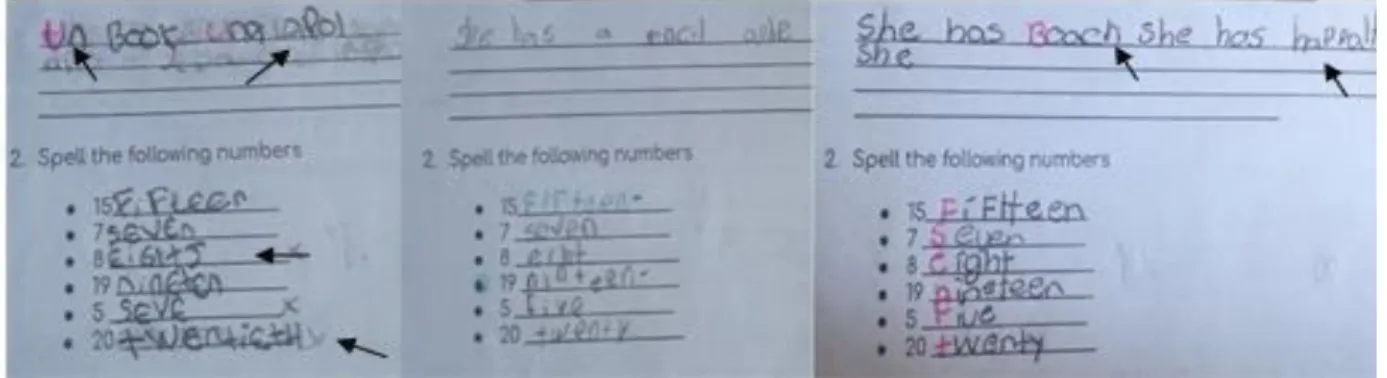
(20) AUTHENTIC VIDEOS: A PROPOSAL TO ENHANCE PRODUCTIVE SKILLS WITHIN A COOPERATIVE LEARNING ENVIRONMENT IN THE EFL CLASSROOM. language level .This test was designed by the researcher taking into account the contents of the curriculum for the third and fourth grade of their English class. Additionally, the four communicative competences, reading, writing, listening and speaking, were measured as well. In relation to the proficiency level of the students concerning the linguistic aspect, the students were good at listening and reading skills compared to the writing and speaking abilities. Data revealed that in both the diagnostic test and the observation notes in agreement with what was mentioned by the teacher, the students experienced some concerns when trying to communicate what they learned both written and verbally. These difficulties appeared in both the written and in the oral aspect since the students had problems to build complete sentences (they only stated one word in English and the rest in Spanish) and they also had difficulties with the spelling of words. As for the reading skill in the two tests, multiple choice reading comprehension questions were asked. While for the listening ability, in the first test, the comprehension of a recording about the parts of the body was evaluated, the second test evaluated the comprehension of personal information as spelling the name, the age, and the phone number. The results of the test showed that the students achieved good responses in these two skills since they reached at least three correct questions of four in both tests. As for the listening ability, the students also obtained good results in terms of comprehension; however, they also showed weaknesses in the spelling of some words (See Annex 4, Diagnostic test). Despite the good results in the reading and listening skills, in the results of the entrance tests the students demonstrated matters with writing and speaking skills about the spelling of words and the formation of sentences (subject – verb – complement). Concerning the writing skill, both examinations not only measured this skill but also the grammar aspect. In the first test,. 6.
(21) AUTHENTIC VIDEOS: A PROPOSAL TO ENHANCE PRODUCTIVE SKILLS WITHIN A COOPERATIVE LEARNING ENVIRONMENT IN THE EFL CLASSROOM. the students had to describe a picture of a girl using sentences with «she has» and the spelling of some numbers from one to twenty, whereas in the second test they had to write a short paragraph about their personal information (name, age, family, school). The results of both tests evidenced that most of them failed to comprehend and recognize what they had to do and how to do it; for instance, in the first examination, they were unable to compose a sentence and barely wrote some words related to the picture, while in the second they had plenty of spelling and grammar mistakes. Likewise, in terms of the speaking skill, students were asked questions about their personal information regarding their names, birthdates, phone number, address, and school. The following figure evidences the difficulties from students when responding to those questions since they were unable to compose short sentences and had some limitations to communicate their ideas related mostly to the lack of vocabulary:. Figure 1. Examples from the diagnostic test In consequence, this diagnosis evidences the matters that the students have, especially concerning the writing and speaking skills, since they were unable to construct sentences or identify vocabulary to express themselves properly. Moreover, concerning the learning features of the students, it was noticed that they have not developed the abilities to work in groups since they are doing the same activities most of the time and they do not like to participate with some partners. In relation to this, the lack of time represents a significant problem for the class 7.
(22) AUTHENTIC VIDEOS: A PROPOSAL TO ENHANCE PRODUCTIVE SKILLS WITHIN A COOPERATIVE LEARNING ENVIRONMENT IN THE EFL CLASSROOM. development because it affects the engagement from students as well as the activities that had to be proposed, reducing them to an emphasis on grammar, writing and speaking (See Annex 1, Field Notes; Annex 3, Survey and Annex 4, Diagnostic test). Statement of the problem As was mentioned before, the Liceo Femenino school seeks to promote the integral formation of women in education by implementing the use of English and French as foreign languages. In spite of having these objectives, based on the data obtained along the diagnostic stage, it is possible to state that the productive skills of the students of fifth grade of Liceo Femenino Mercedes Nariño are not being developed accurately. Consequently, the need to start strengthening those skills came to light. In relation with this, another problem that was noticed is that the level of the students ought to be A2. According to the Common European Framework of Reference for Languages (CEFRL), the students should introduce and give personal information and follow commands in the foreign language. Yet, following the results of the diagnostic stage, the academic reality that the students face is not the same. The matters that the students have were evidenced, especially concerning the writing and speaking skills, since they were unable to construct sentences or identify vocabulary to express themselves properly. Following the statements of Savignon (2018), “Human language communication, of course, takes both oral and written forms and develops in one or more languages wherever social interaction occurs” (p. 13). Despite this, the results of the diagnosis showed that, concerning the speaking skill, the students were not exchanging information or communicating their ideas about familiar topics. Similarly, in the writing skill, the students were unable to describe or identify. 8.
(23) AUTHENTIC VIDEOS: A PROPOSAL TO ENHANCE PRODUCTIVE SKILLS WITHIN A COOPERATIVE LEARNING ENVIRONMENT IN THE EFL CLASSROOM. contents related to their immediate environment. Here the problem that the students faced concerning the writing and speaking skill was evident. Considering the results of the diagnostic stage, the students were not using the language as they were supposed to. According to Ferreira (2012), lessons that focus on communication and meaningful learning prevent students from spending their time merely studying grammatical rules and memorizing vocabulary (p. 12). However, the lack of these practices shows the reality of the students. This was noticed especially in the practices that they had in their classroom with the activities focused on grammar and the repetition of sentences. In consequence the students were unable to communicate the language they were learning. Additionally, the PEI of the institution stated that students have to work in a cooperative environment regarding the management of English and French as foreign languages. However, they have not developed the abilities to work cooperatively because when performing in groups they do not assume roles or responsibilities, ceding the lead to only one student and therefore not accomplishing what is stated in the PEI of the school. Likewise, the equipment of the class, the group-work tables, and the technological resources are not being used since it is the teacher who manages them. For these reasons, the research maintains a focus on improving the productive skills. Through the enhancement of these skills, learners can acquire better strategies to express themselves in English. The diagnostic test exposed that students have problems with writing and oral abilities as well as problems with group work. Therefore, it is essential to implement alternative strategies that promote a more cooperative learning process situated in the authentic context of fifth-grade students. Rationale of the study. 9.
(24) AUTHENTIC VIDEOS: A PROPOSAL TO ENHANCE PRODUCTIVE SKILLS WITHIN A COOPERATIVE LEARNING ENVIRONMENT IN THE EFL CLASSROOM. Bearing in mind the above, this research aims at implementing a strategy in which the students of fifth grade of Liceo Femenino are able to use the productive skills of the English language in the cooperative creation of an authentic video that is related to their context. Consequently, it is necessary to continue doing research on the field of Productive Skills development due to the fact that these skills (speaking and writing) are significant since they allow learners to perform in many communicative aspects. For instance, speaking is intended for face-to-face communication. Yet, writing is always used by to express and communicate ideas to someone who is separated by both time and space (Scrivener, 2011). Thus, by developing the Productive Skills, the students of Liceo Femenino are given the opportunity to practice real-life communication about the language learned in the classroom. In addition to this, the Common European Framework of Reference for Languages (CEFRL) states that: “Progress in language learning is most clearly evidenced in the learner’s ability to engage in observable language activities and to operate communication strategies. They are a convenient basis for the scaling of language ability” (p. 57). In consequence, by working on the Productive Skills in the creation of a video, the students are able to reinforce what they have already been studying. Also, they are capable to perceive unfamiliar words and how to write them when practicing. Then again, the speaking skill is the principal instrument to express ideas as well as to listen to others’ ideas. Thus, the Productive Skills not only permit the individual learning of students but also allow the implementation of some cooperative strategies. According to what has been said, by implementing a research project focused on developing the Productive Skills within a framework of Cooperative Learning based on the creation of authentic videos, the students are allowed to enhance the Productive Skills and place them into practice in an authentic context. Medina and Muñoz (2018) state that “(…) confidence. 10.
(25) AUTHENTIC VIDEOS: A PROPOSAL TO ENHANCE PRODUCTIVE SKILLS WITHIN A COOPERATIVE LEARNING ENVIRONMENT IN THE EFL CLASSROOM. and practice develops productive skills and cooperative learning in the students” (p.18). Considering that, an efficient way to address the learning of the Productive Skills is by using the Cooperative Learning as a tool that allows the students not only to apply a joint construction of knowledge but also to use and take advantage of the resources of the class, which is stated in the PEI of the institution. Likewise, the authentic videos provide the EFL community with new academic resources. Taking this into account, the following research question and objectives are set in order to develop the research.. Research Question What is the impact on the enhancement of Productive Skills when implementing Cooperative Learning through the creation of authentic videos in a fifth graders EFL classroom?. General Objective To determine the impact on the Productive Skills when implementing Cooperative Learning in the creation of Authentic Videos in a fifth graders EFL classroom.. Specific Objectives To identify the Productive Skills that are developed through the design of authentic videos To analyze the role of Cooperative Learning in the development of Productive Skills To evaluate how the creation of authentic videos allows the use of Cooperative Learning. 11.
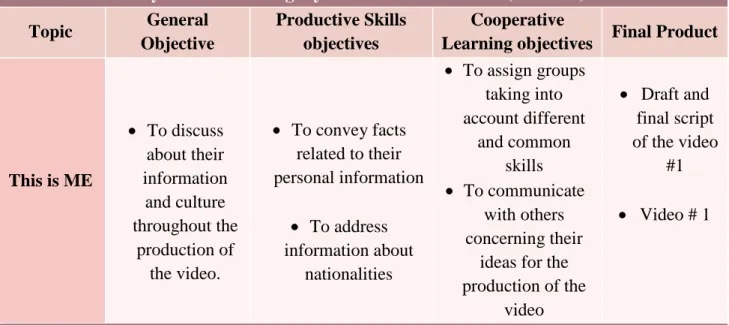
(26) AUTHENTIC VIDEOS: A PROPOSAL TO ENHANCE PRODUCTIVE SKILLS WITHIN A COOPERATIVE LEARNING ENVIRONMENT IN THE EFL CLASSROOM. CHAPTER II State of the Art and Theoretical Framework This chapter presents some studies of the theories that are considered for the development of this research. Then, the design of the historical background based on the theories from the state of the art are discussed. Finally, the main constructs that underpin this study such as Productive Skills, Cooperative Learning, and Authentic Videos as a language learning tool are exposed. State of the Art To design the state of the art, the researcher selected nine studies analyzed within the following chart (see Table 1) to carry out a historical review of the topics established in this research. From the above, the topics of the studies include: Productive Skills, Cooperative learning and the use of videos in the EFL. The background and potential branches of analysis were considered as well.. Title, author and institution.. Main objective. The article seeks to find out problems How do related to Productive productive skills in Skills of Saudi the language Students Affect acquisition process EFL Learning and to suggest the and Teaching, implementation of by Vipin some practices to Kumar Shamar attain effective (2018), Jazan English language University learning and teaching at Jazan University.. Methodology and findings. Importance for the research. The researcher explored the syllabus and evaluation modules of different classes to assess English language learning and interviewed a group of students from Jazan University. He found that the main focus for teaching English was only on reading and writing and no attention was given to the listening and the speaking skills.. This article is valuable for its conceptions about the importance of productive skills for the whole learning of a language. It underlines that the function of language is to exchange ideas, thoughts, and opinions formally or informally in multiple contexts. So, the author highlights the value of the resources with authentic materials (apart from textbooks), relating socio-. 12.
(27) AUTHENTIC VIDEOS: A PROPOSAL TO ENHANCE PRODUCTIVE SKILLS WITHIN A COOPERATIVE LEARNING ENVIRONMENT IN THE EFL CLASSROOM. Finally, Shamar (2018) suggested that teachers should be more creative when constructing learning experiences for their students.. Collaboration: A tool for increasing productive skills in students By Fabian Ricardo Medina and Carlos Javier Muñoz (2018), Universidad Distrital. TED Talks as an ICT Tool to Promote Communicative Skills in EFL Students By Maria Angélica Martínez and Junior Andrés Vargas (2018) Universidad Distrital. cultural aspects to improve the level of productive skills in contexts where the exposure to the foreign language is minimum.. The purpose of this article is to identify and analyze the direct relationship between collaboration and the development of productive skills in a foreign language class.. The research methodology consisted of first performing a written and oral diagnostic test. Then some activities focused on oral production and writing were designed and applied. Finally, their oral production and written language were evaluated again to compare if they really improved those factors.. This article is significant for the research since it is one of the few that relates cooperative work with productive skills. In addition, the author provides a reflection on implementing this methodology and advises that even if at the beginning the participants are frightened of the use of language, confidence and practice develops productive skills and cooperative learning in the students. Finally, the article underlines that collaborative work improves language production in students with variations in oral and written production.. The objective of this study was to evidence the impact of TED talks on the teaching and learning of English as a foreign language.. The article reflected on the incidence of TED talks in the teaching and learning of English as a foreign language. Likewise, videos were the main tool to promote the use of the English language inside the classroom because of their cultural content. Moreover, socio-cultural topics contained in the TED talks fostered the. The use of these videos provides the students with all the communicative elements that allow them to use English to express their ideas. In addition, the article also presents certain features in the videos that promote the use of the language and that are valuable for the proposals of this study. The language of the videos allows the students to gather words that (1) are normally used in the spoken. 13.
(28) AUTHENTIC VIDEOS: A PROPOSAL TO ENHANCE PRODUCTIVE SKILLS WITHIN A COOPERATIVE LEARNING ENVIRONMENT IN THE EFL CLASSROOM. motivation and interest of the students to participate actively in the proposed activities. These practices also led the students to realize the uses of language to express ideas and beliefs.. language, (2) are easy to use in context, and (3) are related with their lives, since they are the ones who chose the topic.. Cooperative learning for the strengthening of oral expression in English through storyboards in a group of fourth-grade students. By Lida Sanabria and Laura Ramírez (2017) Universidad Libre. The researchers applied a learning methodology that used storyboards through a series of cooperative techniques. Likewise, the storyboard The objective of represented a visual this research was to didactic strategy that strengthen oral could be applied to expression in different topics in English in fourthEnglish classes. grade students of The students’ needs were I.E.D Marco Tulio relevant to the aim of Fernández through strengthening the the implementation fundamental oral of storyboards expression in from cooperative communication. So, learning. students were able to produce more words to express ideas or describe what they observed in each of the stories associated with different topics.. The article is valuable for this study because it refers to the qualities of good teamwork. These are positive interdependence, face-to-face promotional intervention, personal responsibility and assessment, interpersonal and group skills. In addition, through cooperative learning, oral production and interactions improved thanks to the practice of conversations in work teams through strategies such as body language and gestures.. Advances towards the effects of cooperative learning about the academic. The principal objective of this research was to identify the impact of cooperative learning. The article is meaningful to this research study since it provides a first approach to the concepts of cooperative learning. The research also exhibits the favorable effects. As they applied three learning methodologies, characterized as individualistic, semicooperative and cooperative, they. 14.
(29) AUTHENTIC VIDEOS: A PROPOSAL TO ENHANCE PRODUCTIVE SKILLS WITHIN A COOPERATIVE LEARNING ENVIRONMENT IN THE EFL CLASSROOM. goal and social abilities in relation to the cognitive style. By Mery Luz Vega, David Vidal and María del Pilar García (2013) UPN. methodology in academic achievements and socials skills in relation to cognitive style in primary and high school students.. realized that the achievement of learning in the resolution of proportionality problems the academic performance of the participants to whom the cognitive learning methodology was applied increased considerably compared to those who only developed the subject with semicooperative and individualist methodologies.. of cooperative methodologies applied in the classroom. In summary, it promotes helpful academic skills and the interaction between learners as well as strong communication abilities and assertive behavior.. Through this research, it is evident how cooperative learning practices generate an appropriate classroom space. It allows the students to feel more relax when participating and also provides the opportunity to speak in pairs, within teams, or small groups. Additionally, cooperative learning helps students to acquire knowledge more easily because team-building activities create a flexible environment; thus, students felt more relaxed. This research is valuable for this study as it considers the use of recordings to explain the English language. It is significant to perceive that, as the author mentions, the. Encouraging interaction by applying cooperative learning. By Sonia Elena Gonzalez (2009) Universidad Nacional de Colombia. The purpose of this study was to improve oral interaction in English by applying cooperative learning methodologies to students of seventh grade in a public school in Bogotá.. The researcher applied a methodology based on Kagan’s (1991) theory about Cooperative Learning, in which the students have to work in groups to increase oral interaction; moreover, the author implements learning strategies that allow them to express their own ideas with freedom, and that are also a way to encourage them to interact with their classmates.. The Impact of Using Videos on Whole Language Learning in EFL Context. The project was developed to measure improvement gains in listening, speaking, reading. The methodology of the study consisted of intensive exposure to authentic video material based on several textbooks.. 15.
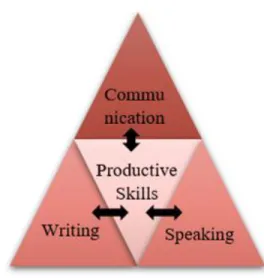
(30) AUTHENTIC VIDEOS: A PROPOSAL TO ENHANCE PRODUCTIVE SKILLS WITHIN A COOPERATIVE LEARNING ENVIRONMENT IN THE EFL CLASSROOM. by Mohamed Mekheimer (2011) King Khalid University. and writing skills with a group of college students.. By the end of the research, it was evidenced that the experiences with videos generated more discussions between student-teacher, studentstudent. Additionally, students were moved to keep writing, using vocabulary and listening journals.. To develop the project, students had to make College videos with their cell Students Use phones and upload them L2 English to on the instructor’s vlog, Make Campus This research was then they had to view Video Guides intended to develop and comment on them with Their critical importance using the target language. Phone However, some Videocams, and of L2 Digital Literacy within difficulties appeared to View and EFL pedagogy concerning the format of Respond to through the making the videos and the use of Their Videos of L2 English the platform to upload on an EFL video guides of the them as well as the use of Social campus of Hyejeon the target language to Networking College. comment the videos Site. since it was only By Robert C. available for the Korean Meurant (2007) language; this led the Hyejeon author to use an English College. website. Collaborative podcasts and videocasts for English language. This research sought to design a collaborative learning proposal, mediated by. The research was focused on the development of oral skills, using podcasts and videocasts, in a group of. effectiveness of the videos depends directly on how they are incorporated into the class. Finally, its most important significance is that the videos remain a flexible and familiar tool for students and allow them to use the language in their creation and analysis.. This research is meaningful for the research project, for it shows that the use of multimedia resources or L2 Digital Literacy have an enormous educational potential in English since it enables students and professionals to access the enormous depth and variety of English resources available on the Internet and creates an archive of material that can be overviewed and studied at any time.. This study is meaningful because it allows a first approach to the use of digital resources like podcast and videos. These proved to be user-friendly, and they trigger. 16.
(31) AUTHENTIC VIDEOS: A PROPOSAL TO ENHANCE PRODUCTIVE SKILLS WITHIN A COOPERATIVE LEARNING ENVIRONMENT IN THE EFL CLASSROOM. proficiency development in a 10th grade. By Juan Camilo Gutiérrez Fernández (2018) Universidad Libre de Colombia. podcasting and videocasting to promote oral interaction and providing spaces of expression and opinion in English.. tenth-grade students to provide spaces for expression and opinion in English. This study addresses issues of socioeducational context about the role of new technologies in the development of interaction skills, in a foreign language. The participants were focused on searching, listening, and watching their classmates’ interventions, helping each other.. creativity and build selfconfidence. In addition, collaborative peer work methodologies displayed better classroom interaction and engagement. The study highlighted the importance of addressing initial difficulties with podcasts and videocasts. It also underlined the use of ICTs opened creative alternatives, areas, and spaces of exploration for students and teachers.. Table 1. State of the art - chart The studies previously exposed are of profound importance in this research thanks to the information they provide. Firstly, the importance of Cooperative Learning as a language teaching strategy is highlighted since it helps with the confidence of the students when participating. Secondly, it also shows how good language learning is when it is put into practice, especially through writing and speaking. Lastly, although the videos in the teaching of EFL have been used as a tool and not as a creation, they also prove to remain a considerable influence on language learning. Theoretical Framework As mentioned above, the theoretical framework aims at explaining the constructs of the theories shown in this study. First, the conception of productive skills is presented. Subsequently,. 17.
(32) AUTHENTIC VIDEOS: A PROPOSAL TO ENHANCE PRODUCTIVE SKILLS WITHIN A COOPERATIVE LEARNING ENVIRONMENT IN THE EFL CLASSROOM. the construct of cooperative learning is described to finish with the concept of authentic videos as a language learning tool. Productive Skills. To properly define the concept of Productive Skills (PS), it is necessary to initiate with the process of acquiring a language. This process holds four stages or skills: listening, reading, speaking and writing. Harmer (2007) states that the four language proficiencies are divided into two types: receptive skills for the process of reading and listening, and Productive Skills for speaking and writing. In addition, Medina & Muñoz (2018) affirm that “Learners receive language by listening to conversation, music, and video and by reading comprehension, newspaper, book, and so on. Then they move on to Productive Skills: speaking and writing because learners need to articulate words and write to produce language” (p. 6); this means that the PS are the skills part of the process of language acquisition when the learners begin to produce the language, either in written or oral form. In addition, essentially oral and written skills are categorized as Productive Skills which require learners to produce rather than receive information through language. Golkova, D., & Hubackova, S. (2014), argue that “Productive Skills mean the transmission of information that a language user produces in either spoken or written form. Productive Skills would not exist without the support of receptive ones” (p.478). Thus, it is noticed that the above does not mean that the language learners must start the learning process with the receptive skills and then move to the Productive Skills; it means that the two can be developed at the same time or one before the other without any specific order.. 18.
(33) AUTHENTIC VIDEOS: A PROPOSAL TO ENHANCE PRODUCTIVE SKILLS WITHIN A COOPERATIVE LEARNING ENVIRONMENT IN THE EFL CLASSROOM. What is more, Productive Skills remain the starting point of communication since teaching how to speak and write means communicative teaching. Someone speaks or writes to somebody when the information the other person lacks is known. The same situation is recreated in the classroom. Ni Luh Putu Astawa, Artini, L. P., & Nitiasih, P. K. (2017) affirm that as both speaking and writing involve the activity of ‘producing’ language in the context of communication, these skills are frequently identified as Productive Skills. In this manner, language learners are considered successful speakers when they can perform communicative functions appropriately in various situations. This relation is displayed in the following figure (see Figure 2.).. Figure 2. “Relation between Communication and Productive Skills” (Designed by the researcher). In this perspective, it is necessary to mention that in the research the focus on language is primarily on strengthening the Productive Skills. The former considering that in an educational scenery, through speaking and writing activities, students are given the opportunity to experience with the target language. As Bashrin, S. (2013) states: “The next stage where they produce the language to express their thoughts is by using Productive Skills (…) speaking is the oral process. 19.
Figure


+7



Documento similar
Government policy varies between nations and this guidance sets out the need for balanced decision-making about ways of working, and the ongoing safety considerations
All too often, the multimedia adaptation modules are intended to adapt only a specific type of media (e.g., audio, video, images), or even a specific media format (e.g.,
rous artworks, such as sonorou s poetry; d) instances of nOlHu1islie music, such as sonorous activiti es with soc ial, bu t not necessarily aes thetic, funct ions. Lango
On the other hand at Alalakh Level VII and at Mari, which are the sites in the Semitic world with the closest affinities to Minoan Crete, the language used was Old Babylonian,
The aim of this paper is to demonstrate that reading authentic literary material in the English as a Foreign Language (EFL) classroom can improve students’ language learning skills as
What is perhaps most striking from a historical point of view is the university’s lengthy history as an exclusively male community.. The question of gender obviously has a major role
In the edition where the SPOC materials were available, we have observed a correlation between the students’ final marks and their percentage rate of
According to Gil (2010), cooperative learning is defined as a learning process based on group work, collective construction of knowledge and the development of mixed
