
Quantification of Nitrous Oxide Emissions in soils of Chihuahua Mexico
5
0
0
Texto completo
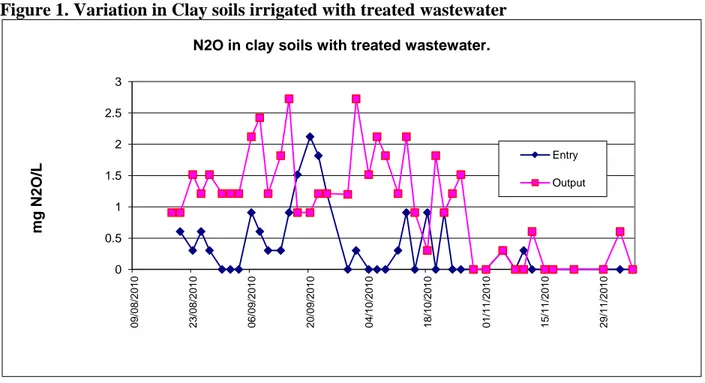
(2) The emission rate of N 2 O from agricultural soils is generally calculated using the default emission factor of 1%from IPCC (FE). Also, this rate has been calculated using estimation methods in other investigations to determine the N 2 O emissions depending upon the sources of N-input and other environmental factors.3 In this paper, the quantification was accomplished by direct sampling and subsequent analysis of the gas.4. Experimental Methods The potential rates of denitrification and N 2 O ratios were investigated in soil horizons in the experimental prototypes, where sensors were placed to sequester the gas in depths ranging from 0 to 15 cm, 0 to 45 cm, and 0 to 1m. These sensors were assigned the numbers 1, 2 and 3, respectively. Four sites were selected to place each of the three different depths of gas catchers, including the four green fields irrigated with treated wastewater. The main vegetation is grass and it provides a recreation area for people who use the parks. The land in these four areas was moderately well drained green space with two fine soil textures, classified as sandy and clay loam. The moisture content was maintained within the soil equal to field capacity during the investigation, and allowed the flowering process of the grass, in order to have the entire vegetative phase.5 Quantification was performed using a gas chromatograph equipped with packed semi column, electron capture detectors, and flame induction. The analysis included a year of observations to determine the behavior in both summer and winter.. Results and Discussion There was a significant difference (p <0.01) of the concentration of N 2 O between the soil surface horizons to that of from 0 to 15 cm in all soil classifications, both sand and clay. In the deeper soil horizons, from 0 to 1 m, concentration values of nitrous oxide were almost imperceptible. Nitrous oxide concentrations differed significantly (p<0.05) between Horizons 1 and 2. Multiple regression analysis revealed that N 2 O concentration increases with temperature and with a higher content of NO 3 -N in the treated wastewater, (Figure 1 y Figure 2) which together explained 88% of the variance (p <0.001). The results suggest that the potential rate of denitrification below the root zone was low. Therefore the nitrate depletion occurs through denitrification during diffusion transport through the soil profile to the atmosphere and/or groundwater..
(3) Figure 1. Variation in Clay soils irrigated with treated wastewater N2O in clay soils with treated wastewater. 3 2.5. mg N2O/L. 2. Entry. 1.5. Output. 1 0.5. 29/11/2010. 15/11/2010. 01/11/2010. 18/10/2010. 04/10/2010. 20/09/2010. 06/09/2010. 23/08/2010. 09/08/2010. 0. Figure 2. Variation in Sandy soils irrigated with treated wastewater. N2O in sandy soils with treated wastewater. mg N2O/L. 7 6. Entry. 5. Output. 4 3 2 1 06/12/2010. 29/11/2010. 22/11/2010. 15/11/2010. 08/11/2010. 01/11/2010. 25/10/2010. 18/10/2010. 11/10/2010. 04/10/2010. 27/09/2010. 20/09/2010. 13/09/2010. 06/09/2010. 30/08/2010. 23/08/2010. 16/08/2010. 09/08/2010. 0. Soils are the main sources of greenhouse gas N 2 O. Nitrous oxide emissions in the surface soil are the result of production processes and consumption at the root.6 High mineral content and high humidity favor the production of N 2 O, as occurs in clay soils where moisture retention is strong and higher mineral content is evident in the soil characteristics.7.
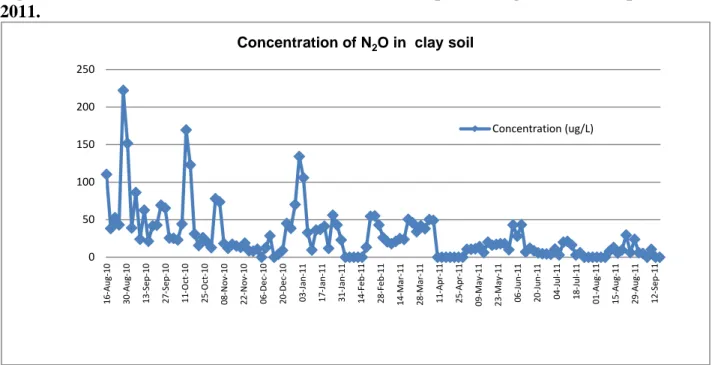
(4) The parameters that influence the concentration N 2 O emissions are independent of the type of soil as: the temperature, humidity and pH (Figure 3). From Figure 3 it can be seen that when the temperature is high the concentration of N 2 O is greatest. The temperature response is a function in the regression analysis because it has a direct and indirect effect on rates and product ratios of nitrification and denitrification.8 Figure 3. Variation concentration of nitrous oxide in the period August 2010 to September 2011. Concentration of N2O in clay soil 250 200 Concentration (ug/L) 150 100 50. 12-Sep-11. 29-Aug-11. 15-Aug-11. 18-Jul-11. 01-Aug-11. 04-Jul-11. 20-Jun-11. 06-Jun-11. 23-May-11. 25-Apr-11. 09-May-11. 11-Apr-11. 28-Mar-11. 28-Feb-11. 14-Mar-11. 31-Jan-11. 14-Feb-11. 17-Jan-11. 03-Jan-11. 20-Dec-10. 06-Dec-10. 22-Nov-10. 25-Oct-10. 08-Nov-10. 11-Oct-10. 27-Sep-10. 13-Sep-10. 30-Aug-10. 16-Aug-10. 0. SUMMARY This study determined the effects of the rainy and dry gas emissions from soils in the city of Chihuahua, defined as semi-arid. The N 2 O emissions from soil were three times higher in the dry season than in the rainy season. The emissions were twice as high in the sensors placed on the horizons of 0 to 15 cm, versus the captors of 0 to 45 cm. It was also found that the concentration ranges with state of the process, depending upon the vegetative and climatic conditions, causing values to vary by tens to hundreds of µg/L. Emissions were higher in clayey soils by up to 2 times that from sandy soils. It was found that the soil sampling time and water content had a significant effect on N 2 O emissions.. REFERENCES 1.. Blackmer, AM; Bremner, JM; The inhibitory effect of nitrate reduction of N 2 O to N 2 by soil microorganisms, Soil Biology and Biochemistry. 1978. 10,187-191..
(5) 2. Jahangir, M.M.R.; Khalil, M.I.; Johnston, P.; Cardenas, L.M.; Hatch, D.J.; Butler, M.; Barrett, M.; O'flaherty, V.; Richards, K.G.; Denitrification potential in subsoils: A mechanism to reduce nitrate leaching to groundwater. Agriculture, Ecosystems and Environment. 2012.147,13-23. 3. Lesschen, JP; Velthof, GL, De Vries, W.; Kros, J. Differentiation of nitrogen oxide emission factors for agricultural soils, Environmental Pollution. 2011. 159, 3215-3222. 4. Yang, W.H.; Teh, Y.A.; Silver, W.L.; A test of a field-based 15N-nitrous oxide pool dilution technique to measure gross N2O production in soil. Global Change Biology. 2011.17, 3577-3588. 5. Ciarlo, E.; Conti, M.; Bartoloni, N.; Rubio, G.; The effect of moisture on nitrous oxide emissions from soil and the N2O/(N2O+N2) ratio under laboratory conditions. Biology and Fertility of Soils. 2007. 43, 675-681 6. Chapuis, Mantecados, L.; Wrage, N.; Metay, A. C; Chotte, J.-L.; Bernoux, M.; Soils, a sink for N2O a review Global Change Biology. 2007.13,1-17. 7. Ponce-Mendoza, A.; Ceballos-Ramírez, J.M.; Gutierrez-Micelli, F.; Dendooven, L; Emission of nitrous oxide and carbon dioxide from semi-arid tropical soils in Chiapas México. Revista Brasileira de Ciencia do Solo.2010.34, 1617-1628. 8. Farquharson, R.; Baldock; Concepts in models of N2O emissions from land use J. Plant and Soil. 2008.309,147-167.. KEYWORDS Nitrous Oxide, Arid Soils, Treated Wastewater..
(6)
Figure
Documento similar
“the classical linear heat flow in R N can be derived as the gradient flow of the Boltzmann entropy with respect to the 2-Wasserstein metric on the space of probability measures on R
La solución que se ha planteado, es que el paso o bien se hiciese exclusivamente por el adarve de la muralla, o que una escalera diese acceso por la RM evitando la estancia (De
The faculty may have uploaded some file with the complete timetable by subjects.. 7) Scroll down and click on the academic course. You will find all the classes grouped by
In the preparation of this report, the Venice Commission has relied on the comments of its rapporteurs; its recently adopted Report on Respect for Democracy, Human Rights and the Rule
The draft amendments do not operate any more a distinction between different states of emergency; they repeal articles 120, 121and 122 and make it possible for the President to
The aim of this research is to study the impact of each above-mentioned factor on N 2 O emissions during three growing seasons in a maize field, considering three nitrogen
The iPhone model can have better or worse quality, but it cannot be defective; an iPhone unit can be defective if it has significant deviations from the
Lo más característico es la aparición de feldespatos alcalinos y alcalino térreos de tamaño centimétrico y cristales alotriomorfos de cuarzo, a menudo en agregados policristalinos,
