
TítuloKarsts in sandstones and quartzites of Minas Gerais, Brazil
12
0
0
Texto completo
(2) Cadernos Lab. Xeolóxico de Laxe Coruña. 2008. Vol. 33, pp. 127 - 138. to the draining in the cave. Remains of paths, with circular cross section up to one metre in diameter, can be found through residual tower-like surface landforms widely present in the landscapes. Their dissection is due to a generalised karstification in the area, resulting in closed canyons, megakarrens and kamenitzas. In Southern Minas Gerais, close to the Mantiqueira Ridge, the caves of the Ibitipoca state park can reach more than 2 km in length. These caves are associated with a very large hanging geological syncline. Several of these caves contain active streams, which flow for hundreds of metres before disappearing in sand-choked passages. Keyhole cross sections characterize steeply descending passages in these caves, indicating a change from slow phreatic flow towards a faster vadose flow responsible for the vertical incision of the passage. Such change is probably related to base level lowering and/or to turn in the direction of the water flow. Several generations of wall-pockets, from a few centimetres to over a metre long, occur into the caves. These features are good indicators of the initial phase of speleogenesis, generating the initial conduits by their coalescence. This mechanism is also responsible for cut-off meanders. In the area, the main river flows along the syncline axis and cuts through a rock barrier, generating a tunnel-like passage. This cave drains, through resurgences in its walls, part of the water that flows in other caves located in the flank of the syncline..
(3) CAD. LAB. XEOL. LAXE 33 (2008). INTRODUCTION The state of Minas Gerais (Brazil) exhibits several major karst areas located in sandstone and quartzite terrains and displaying a complex suite of underground and surface karstic forms. In this study, the term “karst” is used in the meaning of « characteristic forms from the classical karstic series (cave, doline, lapiaz…). Karsts in sandstones and quartzites 129. where the solution process plays the main role in the genesis of specific morphologies whatever the considered lithology (Willems, 2000; Willems et al., 2002). Three major sites are studied (Fig. 1). Two sites locate close the city of Diamantina: the Natural Park of Rio Preto and the cave of Salitre (a.). One site is in the south of the Minas Gerais, in the Serra of Ibitipoca (b).. Fig. 1: Location of the main studied areas. (a) area of Salitres Salitre and Natural Park of Rio Preto; (b) Serra of Ibitipoca.. 1. KARSTS OF THE NATURAL PARK OF RIO PRETO The karsts of the Natural Park of Rio Preto developed into quartzitic sandstones of the. Mesoproterozoic Formation of SopaBrumadinho (1 – 1.6 Ga) (Pouclet, 2003) (Fig. 2). The different forms are near the Rio Preto river, across a flat surface several tens of meters above the valley. Inselbergs with.
(4) 130 Willems et al.. tower-like shapes are around the flat surface. They form a ridge between the Rio Preto valley and the plane surface. Other karsts are lapiaz opened on vertical joints having a N-S orientation. The lapiaz cut older horizontal pipes with plane or cir-. CAD. LAB. XEOL. LAXE 33 (2008). cular cross sections. The walls of the horizontal pipes present solution sculptures and roof/floor flow channels typically of mechanical erosion. This kind of horizontal passages is found in inselbergs around the flat surface.. Fig. 2: Schematic cross-section of the Rio Preto Natural Park and localization of karsts. Note that the Rio Preto valley is controlled by a reverse fault.. Downstream from the surface in the inselberg ridge, a wide residual cave makes a junction with the valley side. The cave is characterised by crust or impregnation on its walls, channels from concentrated flood and alveoli. Our preliminary observation allows proposing a hypothesis for the formation of the karsts of Rio Preto in relation with the valley digging (Fig. 3). Weathering zones, like weathering cores, develop in the upper. aquifer, along structural surfaces, shear planes or stratification planes (Fig. 4 a). With the down-cutting of the valley, an hydraulic gradient takes place and organizes the aquifer drainage. It causes underground flows and the beginning of mechanical erosion. Little by little, the aquifer dries up and the surface erosion forms the actual flat level which previously may have worked as a poljé (Fig. 4, b and c) ..
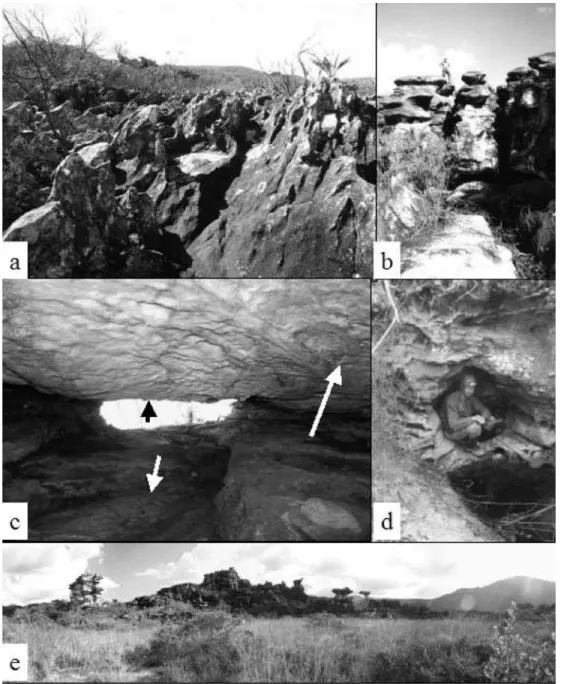
(5) CAD. LAB. XEOL. LAXE 33 (2008). Karsts in sandstones and quartzites 131. Fig. 3: Karsts of Rio Preto. a.: clints and solution pan (photo L. Willems); b.: clints (photo L. Willems); c.: horizontal passage between two mega clints– roof with characteristic solution sculptures; a roof channel and a floor channel (photo J. Rodet); d.: remain of a circular and horizontal passage inside an inselberg located to the limit of the flat surface (photo J. Rodet); e.: , flat surface with tower-like shape ridge with dismantled caves and horizontal passages. The ridge separates the horizontal surface from the valley side of Rio Preto (photo L. Willems)..
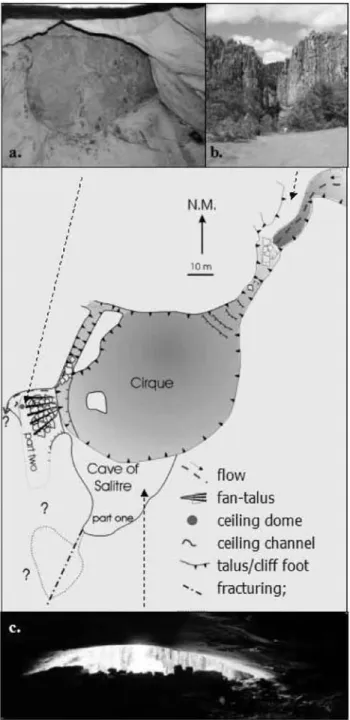
(6) 132 Willems et al.. CAD. LAB. XEOL. LAXE 33 (2008). Fig. 4: Hypothesis of karst genesis – Natural Park of Rio Preto (a,b,c, see text).. 2. KARSTS OF SALITRE The site of Salitre is developed inside a quartzite massif affected by numerous grikes (lapiaz/lenar). The main entrance of the cave is located at the back of a large depression with vertical walls (Fig. 5). These walls are pitted by numerous alveoli. The main entrance of the. cave is in the axis of a big faulted anticline and the cave development follows the curve of the strata and the vertical fractures which cross the anticline structure. The cave is a swallow hole where the river disappears and has generated some characteristic forms like a roof channel. Several solution forms like dome pits without.
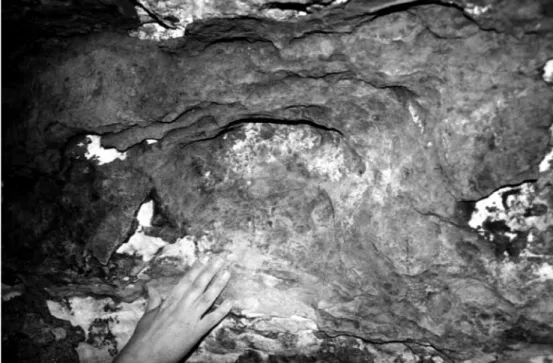
(7) CAD. LAB. XEOL. LAXE 33 (2008). Karsts in sandstones and quartzites 133. fracture are found with, in numerous places, a dark/brown coating or impregnation on the walls (Fig. 6). Analyses reveal that these deposits are made by cryptomelane or pyro-. lusite (respectively K(Mn4+,Mn2+)8 O16 and MnO2), produced by the leaching of the saprolite. This crust/impregnation indurates the rocks and preserves partially the older solution forms.. N.M.. ,, ,,, ,,. r. ,. "m. ,, ,,,. ,. ,,. CIIque. ....... flow. -=. ?. •. , ? Fig. 5: Main morphologies of the Salitre site. a.: ceiling dome (metric diameter) without fracturation; b.: view of the entrance of the Salitre canyon with lapiaz surface; c.: main entrance of the Salitre cave.. ,' ,. ~. fan-talus ceiling dome ceiIJng channel. -..,.... talusj cliff foot ..... fractu ring ;.
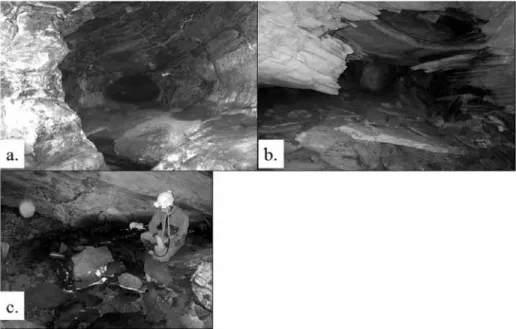
(8) 134 Willems et al.. CAD. LAB. XEOL. LAXE 33 (2008). Fig. 6: Example of coating crust and impregnation on the wall of Salitre cave which maintains old solution forms. The white part of the photo is fresh rock, free of coating crust/impregnation locally dismantled (photo A. Pouclet).. 3. KARSTS IBITIPOCA. OF THE. SERRA OF. The Serra of Ibitipoca is a complex of perched synclines and anticlines, some hundred metres above the surrounding landscape. Numerous big caves with several kilometres of development have been explored by Brazilian speleologists and are developed into Mesoproterozoic quartzites (Fig.7 and Fig. 8). Some of the caves have an underground river with a blind end. Different kinds of alveoli are exposed. Some of them are quite big with several metres in diameter. In some case small alveoli reshape and dismantled the bigger and older one. Their development direction is often par-. allel to the stratification but sometimes perpendicular to that. In numerous places, quartzite is very crumbly and a lot of underground passages are dismantled by collapses (Fig. 69). So, it is quite remarkable that in these conditions, a lot of passages are still open until now and that blind cave with river are not completely filled. As in Salitre, rests of coatings on numerous walls are found and keep the walls in place in spite of a very crumbly rock. They support walls in place. Cross section of the galleries show typically a polyphase genesis as shown in the figure 7 going from a general dissolution process to mechanical process by an underground flow..
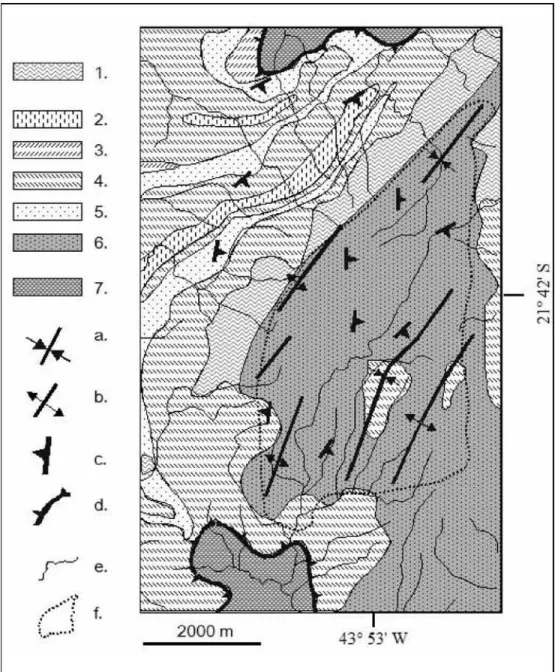
(9) CAD. LAB. XEOL. LAXE 33 (2008). Karsts in sandstones and quartzites 135. ~ 1. ',',' ,', ', ',','. 2.. N//N /N N/. 3.. "NNNN"". "'-" ",,, "". " ....',. ",,,...,,,,. 1» 1». 4.. <1 5. >:1 6. en. ~. 7.. .,. ,'". a.. '". y.. b.. ~. c.. ./. d.. J ...........' l........... e. f.. 2000 m. 43' 53' w. Fig. 7: Geological map of the Serra of Ibitipoca (modified from S.M. Da Sylva, 2004). 1.: Quaternary colluvium; 2.-6.: Meso and Neoproterozoic formations. 2.: Amphibolites; 3.: schists with garnet, muscovite and biotite; 4.: gneiss with garnet and biotite; 5.: quartzites and schists with muscovite; 6.: coarse quartzites with intercalated fine quartzites; 7.: Palaeoproterozoic formations: biotite-rich gneiss. a. syncline axis; b.: anticline axis; c.: dip; d.: thrust front; e.: river; f.: limit of the Serra of Ibitipoca..
(10) 136 Willems et al.. CAD. LAB. XEOL. LAXE 33 (2008). Fig. 8: a.: Cave developed inside quartzites of the Serra of Ibitipoca. b.: Ddecametric room dismantled by collapses. c.: Swallow hole at the accessible end of a cave (photos J. Rodet).. Fig. 9: Traces of polyphase genesis of a cave (National Park of Ibitipoca) (picture J. Rodet). 1. first stage: alveoli made by dissolution; 2: second stage: lateral erosion; 3.: third stage: vertical erosion..
(11) CAD. LAB. XEOL. LAXE 33 (2008). 4. DISCUSSION The digging by piping or suffusion process as main genetic process of the caves could be dismissing in many cases because the cave are the place of swallow hole and there is no resurgence. Thus, detrital material cannot be evacuated by regressive erosion from a spring towards the rock massif. Only a wide and general preliminary chemical erosion of the quartzite may explain the origin of the big caves. We propose that the initial karst genesis takes place in anaerobic conditions on very large time ranges. When the system comes to open air, the conditions became aerobic and cause the crust or impregnations which recov-. Karsts in sandstones and quartzites 137. ers the preliminary karstic forms. Those deposits make more resistant the walls of the previous forms and partially protect them against the later erosion processes. When the water flow takes place in the vadose zone, the mechanical erosion becomes the main process in the evolution of the cavities and widely reshapes older forms (Fig. 10). The process of forming and development of cavities in sandstones and quartzites of Minas Gerais are due to the dissolution of siliceous cement and/or quartz grains. The important development of caves, swallow hole, underground rivers, lapiaz, sinkholes and poljes set up complete karst systems. Further studies must be be undertaken to determine the age of the various studied forms and to specify their genetic process.. Fig. 10: Hypothetical relationships between environmental conditions and main genetical process for the karsts in silicated and non-carbonated rocks..
(12) 138 Willems et al.. REFERENCES DA SILVA, S.M. (2004). “Carstificação em rochas siliciclàsticas: estudo de caso na Serra do Ibitipoca, Minas Gerais”. Dissertação de Mestrado, Pós-Graduação em Geologia do Instituto de Geociências da Universidade Federal de Minas Gerais, 197 p. + 12 appendixs., 2004. POUCLET, A. (2004). “Etude géologique de la région de Januaria (vallée du São Francisco) et de Diamantina (Serra do Espinhaço), Minas Gerais, Brésil”. UMR 6113, Univ. Orléans, rapport, mars 2004, 113 p.. CAD. LAB. XEOL. LAXE 33 (2008). WILLEMS, L. (2000). «Phénomènes karstiques en roches silicatées non carbonatées. Cas des grès, des micaschistes, des gneiss et des granites en Afrique sahélienne et équatoriale». Thèse de doctorat, 257 p., 145 figs., 137 photos, Université de Liège, Belgique., Juillet 2000. WILLEMS, L., POUCLET, A. and J.-P. VICAT, J.-P. (2002). “Existence de karsts en roches cristallines silicatées non carbonatées en Afrique sahélienne et équatoriale, implications hydrogéologiques”, Bull. Soc. Géol. France, t. 173, n° 4, 337345, 2002..
(13)
Figure


+5

Documento similar
Although some public journalism schools aim for greater social diversity in their student selection, as in the case of the Institute of Journalism of Bordeaux, it should be
In the “big picture” perspective of the recent years that we have described in Brazil, Spain, Portugal and Puerto Rico there are some similarities and important differences,
1. S., III, 52, 1-3: Examinadas estas cosas por nosotros, sería apropiado a los lugares antes citados tratar lo contado en la historia sobre las Amazonas que había antiguamente
The RT system includes the following components: the steady state detector used for model updating, the steady state process model and its associated performance model, the solver
Keywords: Metal mining conflicts, political ecology, politics of scale, environmental justice movement, social multi-criteria evaluation, consultations, Latin
In the previous sections we have shown how astronomical alignments and solar hierophanies – with a common interest in the solstices − were substantiated in the
Even though the 1920s offered new employment opportunities in industries previously closed to women, often the women who took these jobs found themselves exploited.. No matter
The expansionary monetary policy measures have had a negative impact on net interest margins both via the reduction in interest rates and –less powerfully- the flattening of the
