UNIVERSIDAD NACIONAL DE EDUCACIÓN Enrique Guzmán y Valle
Alma Máter del Magisterio Nacional
FACULTAD DE CIENCIAS SOCIALES Y HUMANIDADES Escuela Profesional de Lenguas Extranjeras
MONOGRAFÍA
The role of drama in EFL
Examen de Suficiencia Profesional Res. N°0322-2019-D-FCSYH
Presentada por:
Obdulia Celinda Lozano Laura
Para optar el Título Profesional de Licenciado en Educación
Especialidad: A.P. Inglés - A.S. Francés
Lima, Perú
Dedication:
I would like to thank to my God, to my
professors and to my mother for their
kind help and valuable advice they
Contents Index
Jury members and signatures ………... ii
Dedication ………..………. iii
Contents ………..………. iv
List of figures ……….. vii
Introduction ………..………viii
Chapter I . Basic conceptsof Drama 1.1 What is drama? ... 9
1.2 What can drama achieve? ... 12
1.3 Drama for learning ... 16
1.4 Drama and thinking skills ... 17
1.5 High quality drama ... 18
1.6 Drama strategies as intra-and Inter-thinking frames ... 20
1.7 Drama and the brain ... 21
1.8 Drama and emotions ... 21
1.8.1 Newral pathways and networks………..23
1.9 Imitation and mimicry ... 23
1.9.1 Theatre and mirror………...24
1.10 Drama and Emotional Intelligence……….25
1.11 Drama and multiple intelligences ... 26
1.12 Drama for creativity in Education ... 28
2.2 Historical review of Drama Teaching ... 30
2.3 The right conditions for drama ... 32
2.3.1 Relationships ... 33
2.3.2 Physical environment ... 33
2.4 Some issues to problematize ... 35
2.5 Teaching the course book with drama ... 38
2.5.1 Teaching the four skills……….38
2.5.2 Teachingspoken communication skills……….39
2.6 The role of the teacher……….39
2.6.1 Demands does drama make of the individual teacher………..40
2.7 The role of the student ... 41
2.8 The future of drama in ELT ... 43
Chapter III . Drama Techniques 3.1. Why use drama techniques in Language Teaching? ... 45
3.2 Forms of drama activities in a foreign language class ... 49
3.3 Drama techniques and Activities in the classroom………...51
3.3.1 Role play ……… ………51
3.3.2 Improvisation……….. 52
3.3.3 Miming/ Pantomime………52
3.3.4 Mirroring………..52
3.3.5 Designing Costumes………....53
3.3.6 Drawing/ MakingProps and Backdrop……… 53
3.3.7 Freeze Frame/ "Still Picture"………....53
3.3.8 Slow Motion ( an extension of freeze frame)………...54
3.3.9 Paired Conversation……….54
3.3.10 Making Puppets………..54
3.3.11 Acting with Puppets………. 55
3.3.12 Hot Seating……….. 55
3.3.13 Storytelling………. 56
3.3.15 Conscience Alley……… 57
3.3.16 Reader´s Theatre………57
3.3.17 Dance Drama……….57
3.3.18 Drama Performance……… 58
Chapter IV. Didactic Aplication Lesson Plan ……….. 65
Conclusions ... ……….73
Critical appraisal and suggestions ... …… 73
List of figures
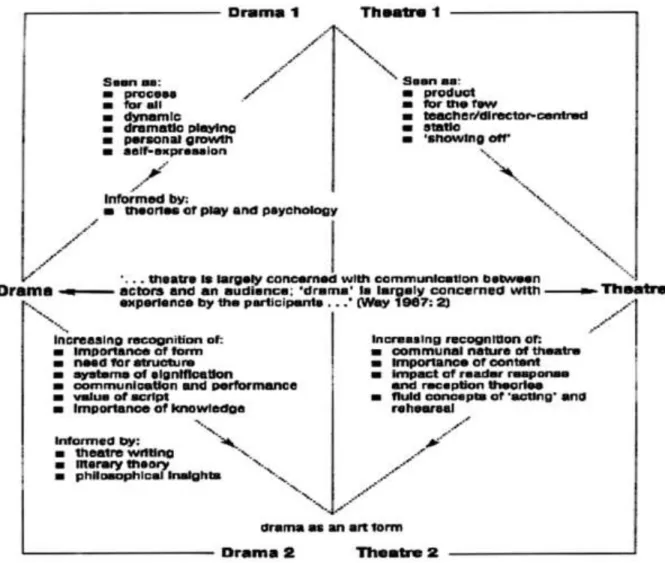
Figure 1. Differences between drama and theater ……… 32
Figure 2. Tables/desks and chairs stacked against the walls with a large space in the center. 34 Figure 3. Horseshoe semi-circular arrangement ………... 34 Figure 4. Full circle ………. 34
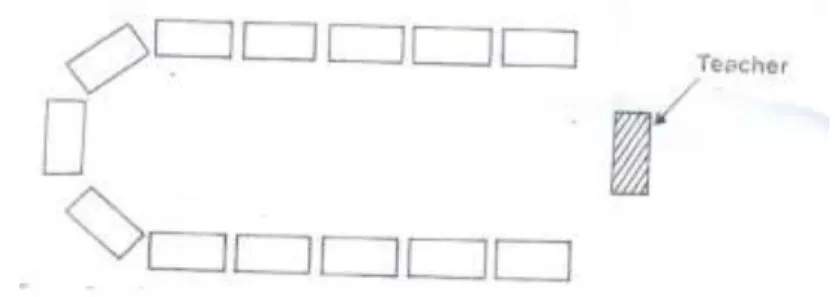
Figure 5. Grouped seating - for simulation and other group activities ……… 35 Figure 6. The horseshoe arrangement. ……….. 35 Figure 7. Benefits of Drama ……….. 51
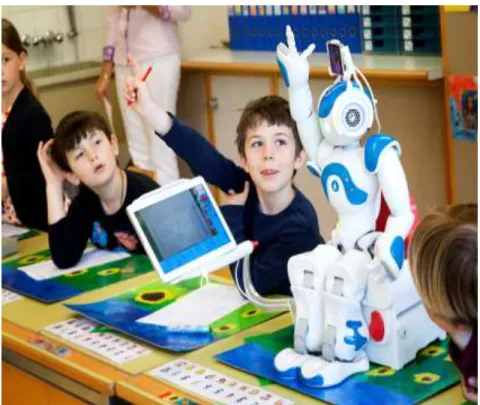
Figure 8. Robot has motivation ……… 59
Figure 9. Character of the chant ……….. 60
Figure 10. Five little Monkeys ……… 60
Figure 11. Character of the chant ……… 60
Figure 12. Puppets in the classroom ……… 61
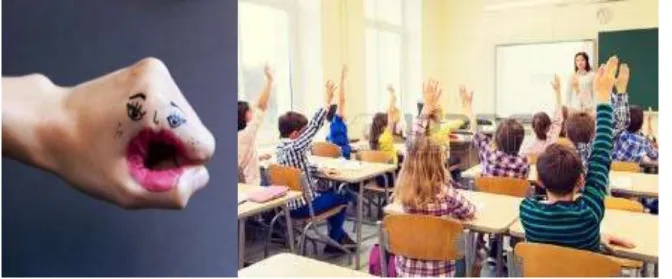
Figure 13. Face on Fist ……….. 62
Figure 14. Sponge Puppet ………. 63
Figure 15. Simulation Dialog ………... 64
Introduction
Drama is a creative way of learning and teaching, it joined in cooperative process to the learners.
Thus drama activities can be considered one of the toughest tasks for the teacher. The teacher is
the best person to decide how this method affect his or her class.
Using drama teacher will get more ambitions activities like play, improvisations, role play,
dialogs, etc.; this is especially for teacher who feel more confident about using drama as part
integral of their lesson and for to prepare a performance in a show.
This monograph intends to explain the important role of Drama in teaching English as a
foreign language. So it is divided into 4 chapters: chapter I deals with the concept of drama, the
relation with the learning process and the cognitive development with the students, and we shall
take its relationship with the different multiple intelligences.
Chapter II, it explains the relation of using drama with learning and the role of teacher and the
student. Therefore, it covers aspects related to the appropriate use dramatic activities and where
to develop them.
Chapter III, it analyzes the diverse strategies and techniques that teachers could use in
drama and its benefit in the classroom.
Chapter IV, develops the didactic application through a learning session, synthesis, conclusions,
Chapter I
Basic Concepts of Drama
1.1What is drama?
As the author Ladouse (1987) has concluded, drama is a greek word that means “to do” or “to
act”, that is as natural thing. Drama is something that happen in our day today live, for
example someday when we get up with a headache or attacked with a depression, and in spite
of this you are going to cope with people pretending that nothing is happen and we show our
cheerful face. We use a mask to occult our problem, because we want to maintain our dignity
and to have a good relationship with others persons. Drama is an invention, drama is a
simulation.
According to Guliyeva (2011) while we are in the middle of studying a dramatic text,
we can also learn how it should be presented, as well as make decisions and ask questions to
help reach those decisions. This information is not necessarily provided by the play writer,
thus it is on the dramatic actor the duty to improvise, as actors do not have to follow what is
written in the text to the letter. The actor should ask himself the following questions: “who am
I?”, “What is my relationship with the other characters?”, “Why do they hate me?”, “Why do
In addition, the actor or actress must convey information to the audience,
communicating information about what the role of a character in the story is. Therefore, if the
actor fully comprehends why the character does what he does, it will allow him to identify
with the character and this in turn will make the performance more believable and appealing
to the audience, as the feelings and motivations of the character will be transmitted to the
spectators.
When the students are choosing to play certain roles in a theatre play, they might be
asked to think the reason behind their character’s lines of dialog or what they seek to achieve
at that moment by saying those lines. The learners can describe their actions by using verbs.
This will allow the students’ lexis to improve and also these phrases will be stored in the
students’ memories to be used in other contexts and circumstances.
These scenarios must the following elements:
- Situation, problem, solution
- Experiences, emotions, planning.
- Children learn anything specially living their own experience.
Way (as cited in Lodous, 1987) explains that for example when a boy wants to know what
does mean blind person we can say it means when person can´t see. He know the meaning of
the word, but if we say close your eyes and find the pen on the table, the boy will know
That is the reason because we have to be realize the importance to provide our student
with the direct experience of doing it, our student will never forget the meaning of the words,
phrases or any situation that is being studding.
On the other hand dramatizing a text is very important and amusing. This kind of activity
can be used with students of all levels, and thanks to its flexibility, students can use their
creativity to present them however they find it more appropriate. Students will always be
motivated and interested if they know that their group will be asked to show what they have
done and if they are filmed or putting on a public performance.
The dramatizing can be applied from an early age, students act in scenes and stories more
or less than three or four years. They can also play to invent stories as doctors or as if they had
a store, etc. This is the way to live your fantasy and realize your creativity in a fun way.
Finally, when we ask students to perform in front of an audience, we are rewarding their
efforts, also when we put our interest and all attention in their enjoyment of the doing being it
the final consolidate.
Don´t forget to increase their knowledge through living or participating in any activity
of drama to get the direct experience of being, to stimulate their imaginations and their
intellects: “Tell me and I´ll forget. Show me and I may remember. Involve me and I’ll
understand”.
In current times, teachers face the situation that happens when our words fail to convey
for this is that oftentimes classrooms are excessively large or when bad behavior is prevalent
in the classroom.
Drama can help students’ learning through direct experience but for it to fully work,
drama should not be limited to isolated aspects of the language and rather it should be
thoroughly implemented in the curricula.
Drama in education needs different materials that is used by characters in the classroom. In
particular it uses improvisation, facial expression, body language and mime, while in the
theatre all thing is useful and it benefit to the public. I can add too that drama improve their
form of learn, involving students in cooperative, process of learning, through techniques and
activities. Thus, due to all these characteristics, drama is definitely not an easy task for the
teacher, mainly due to the fact that the methodology for teaching drama in the classroom is
more often than not neglected in the teacher training curricula. Taking this into account, it
would be very important that in all institutions offer workshops or even a real training course
of the use of drama techniques in language teaching.
1.2 What can drama achieve?
In learning English, drama has techniques for teaching the language. The drama is currently a
strong theory to teach English, the participation of the student in this technique is important,
since it has to be active instead of passive. The true problem of this methodology is that
teachers often find it difficult to put it into practice.
First of all, the authentic communication, involves speaking to another person, but not
conversation have hesitations, interruptions, distractions, misunderstandings, and even
silences.
Secondly, our feelings are involved in accordance to the subject that the conversation
is about, thus it can elicit a wide range of feelings, from tender love to rage in the speakers
who could be total strangers, friends, relatives, lovers, officials, and so on.
Relationships in turn will be affected by the status of each individual speaking. Is A
superior, and B her subordinate? Or does A merely think she is? And how will she address B
in order to gain this superiority? Is B aware of A’s deception? The status of each speaker can
also be linked to the environment in which the conversation takes place. For instance, a
condescending customs officer who works at the airport will undergo an extreme change of
status when stopped by a traffic police officer for exceeding the speed limit on the motorway.
Finally, the language, facial expressions and non- verbal sounds can be important as words.
We know when people like us if they lean towards us when they speak to us, open their arms,
and generally look approachable. We find it difficult to speak to someone who need our eyes,
shuffles about, or whose whole body says keep off. As for on verbal cues, a series of grunts,
oohs, and so on can be used on a telephone conversation.
More often than not, these features of real communication are not given enough
importance in classroom tasks or course books, which is why it should not come as a surprise
that a good number of learners are not able to produce effective communication outside of the
classroom, or that many students end up failing the course.
As a solution to this problem, it would be ideal if course book conversations were
and to use much longer dialogues like the ones in Hartley and Vine’s Streamline series too.
Nevertheless, drama can still be used to motivate learners and keep them engaged in the
lessons with fun and interactive tasks. The use of drama would improve in great consideration
the issues authentic of communication discussed earlier: these are: experiences, body
language, relationships, emotions, statuses, and a number of other paralinguistic features.
Drama must give more than authentic communicative ability. As Maley & Duff (1997)
have demonstrated, drama can be used to teach grammar and lexis, and it is too a useful
technique for correction and practice; to give a simple example verbs and the contexts in
which they occur can be taught and revised through mime. Using improvisation, original
dialogues can be created from a basic situational vocabulary list.
At the other end of the scale, there are the projects based on drama plays, which is a
two level communicative task: of working on a project for a period within a group of students,
which involves constant discussion and interaction in the practice language. And informal
type of natural acquisition to conscious learning. In these kind of activities, learners are
engaged in the purest sense of the word, as they are involved in the process of drama creation
and can produce a communicative activity that they themselves selected.
Dunlop (1997) writes “The passive side of learning is itself highly important since a
great deal of what is ever learnt is unspecifiable, and hence has to be picked up or acquired at
In the book entitled Principles and Practice in Second Language Acquisition, the linguist Stephen Krashen makes a distinction between the two types of learning outlined above, and
calls them “acquisition” and “learning”.
Discussing and planning the different stages in the drama project satisfies this principle
through focusing not on form but on communication and meaning. This should be the central
aim of all communicative language teaching, but it is rarely achieved. Possibly one of the
most significant aspects of the drama project is this unconscious learning in a natural,
uncontrived manner. The same type of acquisition happens, though on a smaller scale, in a
group of students discussing a simulation or planning a role play.
About this psychological spin – off, Richard Via (1972) explains:
We are involved with putting on a play rather than with the task of learning English,
and we do what everyone who teaches English really hopes to do – that is, to have the
students learn by doing. We are amused, and the students will get great joy out of
performing, and the audience, even their parent who don´t speak English, will be
happy and delighted to see the performance. You will have given the students a taste of
success, which is so important …Success is important for everyone. So, using drama,
1.3 Drama for learning
As quoted by Baldwin (2004) young students that possess lots of imagination and can show it
in their plays are more proficient in dealing with stressful situations in later stages of their life.
Children from all cultures and backgrounds have the ability to create imaginative plays
whether it is with the involvement of adults or not.
The human brain is programmed to learn from these imaginary worlds and apply the
skills acquired in them in real life, and to understand how the real world works. Thus, this
serves them as a training on their way to becoming adults.
Students try to understand the world that surrounds them via these plays, in other words
through acting and reenacting real and imaginary situations and experiences. Students use the
language they have been learning and they also experience the appealing emotions that come
with the performance of a role play; the students’ brains are largely stimulated when they are
performing a “what if” kind of play: visual, spatial, auditory and motor functions are
heightened in this process, as well as the neural pathway gets ready to absorb new knowledge.
The use of drama plays can help the brain of the child learn:
- Learning to learn
- Learning to deal with adulthood and their problems
- Behaving like other people via imitation
- Learning their body’s motor function and capabilities
- Distinguishing between what is internal and what is considered external
Dramatic play has the power to enrich young children’s brain and to keep their attention
for several minutes, if not hours, even surpassing the boundaries “established” by some
teachers regarding the amount of time a child can keep focus. The reason for this is because
their hands-on involvement in the activity catches their attention and maintains interest
throughout the whole activity. Therefore, a drama lesson guided by an enthusiastic teacher can
serve to improve the teaching of the curriculum.
1.4 Drama and thinking skills
Developing children’s thinking skills has become a must in recent times, gaining more and
more traction with the passing of years and it is clear that drama plays have much in common
with the desirable high-quality thinking process (Baldwin, 2004).
As mentioned by Baldwin (2004): “A packet of work based on the Cognitive
Acceleration in Science Education model includes a number of ideas for the teaching of
specific cognitive skills in lessons that use drama plays” (p. 15).
Contrary to what many may think, these are not drama plays that have been adapted to teach
thinking skills. Instead, they are thinking skill lessons that apply drama methodology. In other
words, their main objective is to enhance thinking skills via drama plays, not to develop drama
skills. However, while not the main aim, drama skills are developed simultaneously, or at the
very least practiced.
Other LEA’s, have also leaned towards the infusion model, using it to develop certain
The main difference between these two is that the former aimed to teach thinking skills as
their main objective, whereas the latter put the drama lessons over thinking skills in terms of
importance, only teaching thinking skills when it was considered necessary by the teacher.
1.5 High quality drama
How the drama will develop is unknown by anybody beforehand, not even by the teacher, as
how the learners will respond to it and what ideas they will propose cannot be foreseen. The
direction of the drama, i.e. how it will be performed, is fundamentally attributed to the
students, meanwhile the teacher is a fellow participant.
Dramas are always evolving and different ideas and points of view are always welcomed
and they help create a continuously complex and multifaceted picture. Crafting and
welcoming point of view from different perspectives are crucial to the creation and
improvement of dramas.
The direction of drama does not have to be linear, as several solutions can be addressed and
tried one by one or many at the same time. The drama may trace back to review and rethink
certain points with newer perspectives that were previously obtained.
Meanings are studied and arrived through the integration or juxtaposition of verbal,
visual and kinesthetic activity. This gives a flexible and accessible mean or exploring and
Most dramas are about solving problems and coming up with solutions to dilemmas in
creative ways. Good drama tasks have a certain level of unknown that is still doable and not at
all frightening to the learners, rather it gets students motivated and fully immersed into the
task. Drama is active and ever-changing. Learners are aware that certain aspects of the task is
not completely clear beforehand, thus they will explore, create and develop as a team,
something that is yet unknown to them.
The teacher’s task is to determine the level of this “unknown” aspect of drama and
have students be active participants in finding, shaping and communicating this “unknown”,
giving it a meaning of its own. With the passing of time, students will become more adept at
this and thus will become more and more capable of structuring and developing their own
creative ideas or experiences.
To sum up, it can be said that a good drama is both active and interactive. For it to be a
success, courage and mental effort are required to the participants. Moreover, it puts into test
1.6 Drama strategies as intra-and Inter-thinking frames
The strategies applied in drama can be defined as greatly flexible scaffolding tools that help
children take part in a drama and collaborate with others in order to create their own dramas.
These tools can also support them to study and comprehend stories and dramas that are
already in existence. All these strategies may be seen as active and always, interactive
thinking frame, which simultaneously makes cognitive, affective and aesthetic demands on the
students.
If the guides, i.e. teachers, know for certain what kind of thinking skill is necessary to
develop and have a good grasp of how the different strategies and methods work, they can
become proficient at choosing and adapting the strategies that can bring the best results and
that their students find the most appealing, all in order to support the development of their
learning and thinking.
The use of dramatization in the school is a process which involves emotions, reasoning
and experiences through which meanings and connections are produced. It is via dramas that
children can communicate their feelings, ideas, and creativity and make them understood by
others. In addition, it allows them to see and understand the way other people think. A skillful
drama instructor is someone who possesses empathy and can select the adequate strategies to
1.7 Drama and the brain
Recently, our scientific knowledge of how our brains work and how the learning process is
done has exponentially increased. Those who employed drama methodologies in the past were
empirically aware of the benefits it provided but with the recent discoveries we can say for
sure what makes it appealing to students and how it affects their learning. Now we understand
how the brain functions and thus we know of the different ways in which learners can acquire
knowledge and skills more effectively, and in turn we can improve and develop the
methodology of drama in the school environment.
As an example, it can be said that be main function of the human brain is to allow the
survival of the individual. Therefore, when the basic needs of a student have not been met, it
is going to be difficult for teachers to catch their attention. For instance, if students come to a
drama lesson (or any lesson, in fact) feeling hungry, thirsty, or anxious, their attention span
will be drastically reduced or even to the point where their attention will be elsewhere but the
lesson, and in result will become a detriment to the success of the drama lesson. This is why it
is the duty of the teacher to set up drama experiences that will ensure that students will be
engaged and feel at ease in a state of “relaxed alertness”. Higher order thinking and learning is
inhibited by high levels of stress.
1.8 Drama and emotions
Considered by many scientists as the principal emotional center of the brain, the limbic system
memory. Human emotions are linked to the degree of attention we give to things, therefore
there is a connection between feelings and what we remember.
Drama establishes a connection between visual representations and emotions. Visual
and emotional response become connected when a message is sent to the amygdala, the
gateway to the limbic system.
For instance, when one looks at a photo of a treasured person, it results in a strong
emotional response. Likewise, memories and emotional responses can be brought to mind
when recalling powerful visual images. This one of the features of drama and theatre, they
both seek to call to mind significant emotional responses through several forms of stimuli,
such as visual, aural, kinesthetic. When the whole class takes part in dramas, the most
significant moment that are created and performed become etched into the memories of the
learners via visual images, sound and silence, movement and stillness, and light and darkness.
The part of the brain that is divided into right and left hemispheres is known as
“thinking brain”. Each hemisphere’s functions are different but there is communication
between them, which happens via the corpus callous. While their functions are different, as
mentioned before, in order to solve problems more effectively, they both work together to
process information. The cortexes are the parts of the brain that we use in higher order
As noted by Baldwin (2004): “In spite of the fact that some sectors of the human brain
may have areas which are related to specific aspects of perception, the hemispheres of the
brain do not work in isolation from each other, on the contrary they operate at unison when
performing a different number of task” (p.18).
1.8.1 Neural pathways and networks.
Baldwin (2004) states that neural pathways and networks are linked with each other via
electro-chemical activity. The scientists make use of brain-imaging methods and these reveal
the millions of neurons in the brain are turned on and interconnected while the brain is in the
middle of processing data through action, feelings and other mental processes
Many learning experiences occur during, what neurologists refer to as particularly
sensitive periods for the connecting of neurons and forming of neural pathways for
learning. This sensitive period from one to five, includes the time when dramatic play is
most prevalent and not coincidentally the time when children’s brains are more sensitive
to the learning of language. The activities are inter-related (Baldwin, 2015, p.18).
1.9 Imitation and mimicry
They are often called “the first learning style” and are deeply connected to drama and
dramatic plays. The mental process of imitation and mimicry has been studied for a long time
and have shown, for instance, what happens inside of a monkey’s brain when these processes
occur.
The same motor command neurons, referred as ‘mirror neurons’ into the brain are fired
when a monkey observes an action, as when the monkey carries out the action. In other
words, the monkeys are mentally rehearsing the observed action, preparing themselves
to execute it themselves, without physically carrying it out (as cited in Baldwin, 2015,
p.18).
1.9.1 Theatre and mirrors.
Baldwin (2004) stated: “These are very useful to do another connective jump and to
take in account “mirror neurons” as possibly significant in relation to people´s responses as
audiences of theatre and drama. Are mirror neurons turned on when we are watching drama?”
(p.19).
In theatre, it may be that the spoken lines and actions of the characters are seen and
listened to by the spectators and responded in a form that is inhibited by part of the pre-frontal
cortex and checked by theatrical convention. The public are advised to respond personally;
cognitively, affectively and silently what they look at but without being able to physically
move (Baldwin, 2015).
The public opportunity for externalized response are slower and come through clapping their
1.10 Drama and Emotional Intelligence
Taking into consideration the great work of Goldman (as cited by Baldwin, 2004) regarding
Emotional Intelligences, as well as Gardner’s works, about intra-personal intelligence, we can
conclude that the usage of drama in the classroom is without doubt a highly important source
of study of emotional intelligence. Through this art, drama connects the cognitive emotion
with the affective emotion.
When learners develop their emotional intelligence, they become able to understand and
manage their feelings through reflection, as well as to make a connection with them and their
actions. Although in drama emotions and feelings are mostly “pretended”, it is still possible to
learn and draw out conclusions from them, for instance, a student can come to understand that
their decisions have consequences in the real world.
The development of emotional intelligence is supported thorough drama by:
a) Self-talk and self-awareness: These dramatic strategies motivate the conversation to
be well structured and to be able to express it better, through the role the thinking of
the same person and his return is encouraged “self”.
b) Recognizing social cues: Drama is a social activity that get relationship with others
analyzing and acting on cues.
c) Problem: This technique can be given in the resolution and decision making that are
applied in the feelings. The dramatic technique has many difficulties where the
characters must solve at the time of what happened always using their emotions,
d) Understanding other perspectives: According to Pomer (2001): “Working a series of
roles and interacting with others in role is a powerful way of actively engaging with
other people´s perspectives, which encourage on going consideration of our own” (p.
56).
e) Positive attitudes: According to Dunn (2011) argues that: “Research by Harland
advice that participation in arts including drama in schools, leads to a positive
atmosphere and environment and improve entertainment” (p. 65).
f) Verbal behaviors: According to Ladouse (1987): “Drama relies on and develops active
listening and response. It helps and gives opportunity for inference and the
understanding of subtext and the meaning and emotions lying behind spoken and
written words” (p. 69).
1.11 Drama and multiple intelligences
Baldwin (2004) notes that “Drama is a form of accessing and making meaning in a
multi-sensory and memorable form. It is visual, auditory and kinesthetically explored and reinforced
learning” (p.20).
In accordance to Gardener’s Theory of Multiple Intelligences it can be said that drama
is, by definition, a multi-intelligent type of learning. Due to its basic nature, dramatic plays are
accessible to any kind of student, regardless of the learning style they tend to prefer and it
Through drama, the following types of intelligences are activated, some of them
simultaneously:
a) Linguistic. According to Cheng (2011): “Drama sometimes involves spoken language
both in improvisation and performance. It integrates the spoken and written word,
most commonly through play-scripting” (p. 89).
b) Logical-mathematical. According to Pomer (2001): “Problem resolving logically is
central to the drama process. In all class drama involve pupils as characters resolving
problems in role, putting on performances develop their intelligence” (p. 99).
c) Spatial. According to Ashton (2005) argues that: “The use of physical space between
characters both practically and symbolically is important in drama. This is so within
lessons staging productions” (p. 89).
d) Bodily-kinesthetic. According to Cheng (2011) argues that: “Drama involves
contrasting movement and explosive meaningfully. It needs to develop physical
control of the body and its gestures. Some kids of drama e.g. Physical control of the
body and its gestures” (p. 100).
e) Musical. According to Pomer (2001) say that: “Music is used in drama to motivate or
to associate background that “tags” the learning. Music is often composed in drama
f) Interpersonal. According to Ashton (2005) argues that: “Social interaction and
co-operation, the ability to work with others, is a central feature of working in drama.
Noticing distinctions amongst co participants, empathizing, appreciating their
viewpoint and responding sensitively to them, is the key to the drama process” (p. 90).
1.12 Drama for creativity in Education
As stated by Baldwin (2004):
Since Ken Robinson´s seminal wrote all our Futures- Creativity, Culture and Education
were published in 1999 there has been a slow re-awakening the importance of creativity
in education. Mat Hilda Jabber, the researcher for this report was an honorable and
lively keynote speaker at the ND “Thinking Drama” Conference in April 2004 (p.21).
This article puts a lot of emphasis on the importance of recognizing and developing
creativity in young learners. It suggested that the curriculum should teach contents in a
creative way and emphasized how paramount it was to teach creatively to develop creativity
in students. Moreover, after analyzing the present curriculum, the article advised that aesthetic
arts such as drama and dance should have the same level of importance as music and drawing
does. Finally, the power of drama was recognized as a motivational tool for learning.
Our Futures provided a definition for creativity, which can be applied for drama as
“Imaginative activity that is fashioned so as to produce outcomes that are both original and of
value.” NACCE, 1997.
After gathering several samples of teaching that prioritized creativity, QCA found out that
Chapter II
Drama in Language Teaching
2.1 Where does drama fit into language teaching?
Unlike communicative language teaching (CLT) drama is not a theory of language teaching.
Instead, it can be defined as a technique used for a main purpose, which is the development of
the language skills. Some teachers can overlook its importance and simply use it as a
communicative activity that is enjoyable and that can help engage difficult students, but
nothing more. Nonetheless, a skillful teacher can use drama in several different ways. Some
authors, such as Gavin Bolton, propose that drama should be the centerpiece of the school
curriculum, using it as a medium to learn the different aspects of language.
2.2 Historical review of Drama Teaching
Theatre is as a form of Art that express feelings and emotions, thoughts issues originated since
the apparition of communal life in the history of human civilization. Both drama and theater
As indicated by Elarn (1980) a great number of books which are centered on drama and
theater have been published. Theatre has usually been applied to refer to performance whereas
drama, to the work designed for stage representation, the body of written plays (Elarn, 1980).
However, in the context of drama teaching, these two terms have been used in different
forms, theatre was largely concerned with communication between actors and audience;
whereas drama was largely rationed with experience by learners.
The methodology of drama teaching which was developed in 1950s onwards provided
with the addition of improvisation and other forms of free dramatic play which oftentimes are
seen unproductive, but offer students with the ability to develop ideas of their own rather than
just performing the words of others.
By taking a look at drama 2 in the diagram, a difference is evident in the sense that all
drama in the classroom can draw on insights provided by the nature of drama as art and writes
Figure 1 Difference between drama and theater Source: Fleming (2003)
2.3 The right conditions for drama
In considering how to create the right conditions and the best atmosphere for drama, we
encounter a paradox, for if we agree that drama pervades all aspects of life, then it is present
even in the “wrong” conditions and atmosphere. Perhaps it would be better to talk about the
paramount elements which lead to a successful drama lesson. Seven of these elements are
2.3.1 Relationships.
Working in pairs or in groups should have a positive effect in learners, in other words,
most anxious feelings should be lifted. Therefore, teachers have to help them get to know,
respect, and trust each other with a variety of “getting to know you” techniques and by the
friendly atmosphere you create with your very first smile and lesson- you example is crucial,
and should be a lead that they are willing to follow. Encourage positive comments as well as
healthy criticism of each other´s work. You can also encourage students to get to know each
other better in social activities outside the classroom.
2.3.2 Physical environment
It is not difficult to make some space in the classroom for activities that involve physical
movement. This is the very first condition, as the students will often be required to get up and
move around the room.
From the start, you should dispense with the traditional arrangement of desks with the
teacher seated at the front of the room. There are at least five ways in which the classroom can
be rearranged for drama activities. You may also want also want to experiment with lighting.
Darkening the room and using a single light source, for example, the light from an overhead
Figure 2: Tables / desks and chairs stacked against the walls with a large space in the center. Source: Taken from Drama Techniques
Figure 3: Horseshoe semi-circular arrangement. Source: Taken from Drama Techniques
Figure 4: Full circle.
Source: Taken from Drama Techniques
Figure 5: Grouped seating – for simulations and other group activities. Source: Taken from Drama Techniques.
Figure 6: The horseshoe arrangement. Source: Taken from Drama Techniques
2.4 Some issues to problematize
Making an analysis of the past and present and joining of experience between theatre and
drama, some items are taken into account as to how it enforces the implementation of drama
in language teaching
According to Woodland (1996) the traditional view of theatre represented in the diagram
as theatre reminds us that some approaches to grammar can be stopped and lack the kind of
creative dynamism that the participants often expect.
Then, it provides a reminder that drama requires structuring and that drama techniques
need to be learned by the participants; it is no longer appropriate to see drama enter ally as a
Drama approaches can blend elements traditionally associated with drama and theatre,
including elements of performance, that the teacher is sensitive to leaners potential
embarrassment.
Woodland (1996) argues that the use of drama does not have to involve the development
of a complex narrative as it was always assumed when drama does not have to involve the
development of a complex narrative when drama is seen as dramatic playing. He also states
that the performance of participating children is irrelevant. And ordinary classroom is
sufficient to set up drama activities. And added too that stage is not necessary to present of the
dramatic talents of students.
Nevertheless, learners can find great motivation in drama. Drama activities in the school
environment, particularly in teaching foreign languages should provide positive feelings in the
learners. So, what justifies drama in the language contact?
In spite of realistic considerations, like those mentioned above, and pedagogical
challenges drama teaching rises it making evident that there are positive arguments in favor of
using it.
The use of dramatic plays raises the motivation of the students because it is amusing and
Nwamaka (2014) noted that “Drama as a study is the center for the learners because it
can operate through the educational theory that has emphasized the social and communal such
as Vygotsky’s Social Interactionism in the 1960´ as contrary to the purely individual, aspects
of learning (p.72)”.
To develop a collaborative and participatory teaching approach helps positively to the
development of the learners self -esteem and self-efficacy one´s beliefs in their capabilities in
certain areas especially where they have rather low levels.
It was discovered that in a role play students’ verbal responses were longer and included
more adverbs than in other situations. Because speech had its origin in social action and
life dramatic play and improvisation were very useful to language acquisition as the
crated situation to emphasis on social interaction and thus, facilitate knowledge transfer
from the classroom to the outside world (Hut et al, 1989).
Among the many things that drama brings to the table, we can say that this pedagogic
technique helps develop creativity and talent, as well as increases effort, motivation and
learning chances. That interesting process is socially supported, culturally influenced, and
collaboratively achieved through instruction.
One of the advantages from childhood learning is that young pupils are more
receptive of ideas which may quickly go away in the case of adults. In addition, an
there isn’t a clear boundary between fantasy and reality, and these ideas can easily go from
one realm to the other.
Kincaid (2002) said that students could respond in ways that are no stereotyped a trait that
many adults, especially those in the arts, find enviable, and this were supported by Cobb,
(1977) and Martindale (2001) who declared despite that increase evidence that the childhood
is the wellspring for later creative pursuits, adults often fail to develop those rich resources of
imagination, creativity, curiosity, and cheerful. If both classic and contemporary studies of
talent development suggest, it takes nearly 17 years of training and preparation.
2.5 Teaching the course book with drama
First of all, there is the session generally known as the course book slot. A great number of
course books that are employed for teaching languages already include drama techniques in
their contents. For instance, games, songs, simulations, dialogues, role plays, and so on are
often seen in these kind of books and they are by far the activities that students enjoy the most,
whether they’re done in pairs or larger groups. These activities provide amusement, which is
why they remain in the memories of children for longer periods of time.
Moreover, each activity contains competences that help children in their acquisition of the
language, such as improvisation, mime, observation, interpretation, character analysis, etc.
2.5.1 Teaching the four skills.
Secondly, there is the session referred to as the “skills slot”. Individual lessons focusing
pronunciation, and listening. Drama can play a crucial role in the acquisition of these skills, as
its activities provide practice in intonation, pronunciation, rhythm, and so on.
Students can learn from observing the way in which actors get their voices ready before
they perform in a stage. The warm-ups that are done before a performance are just one way in
which children can obtain a better pronunciation, as are choral speaking and singing
techniques.
2.5.2 Teaching spoken communication skills.
Thirdly, exist lessons in communication skills, where the role of drama is very important
for getting students to speak.
Drama can generate a need to speak calling the attention of the students on creating drama,
dialogues, or role plays, or solving problems as in simulations and games.
And yet, so often, these lessons are dull and pedestrian, inspiring only the minimum of
communication, with the teacher supplying most of the language needed. The fault here lies
not with the materials, but with the preparation of the students, the group dynamics in the
class, and the presentation by the teacher. We cannot expect our students to perform
adequately by simply assigning them roles or functions and telling them to get on with it.
2.6 The role of the teacher
Considering all the above, that drama can enrichen the learning experience in the classroom in
The reason for this is that these teachers do not think of drama as anything more than just
theatrics, because that’s the only experience they have of it.
It isn’t always the fault of the teacher as more often than not, the training they received
prioritized the transference of knowledge from teacher to pupil, and not the design of a
learning situation in which students also play the role of teachers.
One of the reasons as for why some teachers are reluctant to use drama in the classroom
is because it changes the vertical relationship between teachers and students.
Dorothy Heathcote in 1972, points out that we wish to train our teacher for a better learning.
In addition, it is paramount to train new teachers to provide them with the tools to be able to
create a learning environment that is beyond simply spreading knowledge. It is also a must to
train them so that they can give students the opportunity to solve problems without the aid of
the teacher. This will not be lower standards, nor will it be deny that others have struggled
painfully to achieve, nor will it waste more time. What it will do is to keep knowing at first
hand alive, and thus increase their wishes for to get more knowledge from those who went
before.
2.6.1 Demands does drama make of the individual teacher.
Drama needs good willing to teach not only for the lesson, but also for motivate the
students. All these you can do if the students practice the values that their parents and teachers
Drama needs detail organization of work, and the ability to create a learning situation
which will ensure aim and give stimuli to the students, which will maintain them active and
alert. It will happen if we are prepared for assume roles, and became as a real person and to
tray hard the class constantly assuming what is called a variety of teaching.
We can sum it up in a nutshell: the desire to bring real life and truth into the classroom.
It takes courage and practice to achieve this.
Therefore, we need to increase the number of teachers who are good to create positive
rapport with students, who are willing to admit it when they don’t know something, who will
not cease to search for newer ways to improve their teaching, who will always give their best
to their school and students and meet their demands through significant teaching, who like to
get on with the people they teach because they are unafraid of the dull, the aggressive, the un
academically, the “naughty”; and who can admit that they can get tired as well, although their
classes may take some responsibility.
2.7 The role of the student
Most students of English as a foreign language, go to class wishing to get a “shopping-list”, of
expectations. They hope to write and to read correctly in the target language, also they want to
understand what native speakers of English are saying, as well as to speak perfectly and
At the more advanced levels, there are students who require English for Academic and
Specialist Purposes. They need English in order to write theses, to listen to lectures and take
notes on them, and to participate in seminars.
In terms of expectations, we can say that all students are similar. But in terms of
background and approaches to learning, they differ widely. The ideal language learner
improve the learning having an open mind, to study for to contribute with good willing to the
teaching program, and to be able to work without the presence and assistance of the teacher.
On the other hand, the worst language learners, fortunately a rapidly decreasing
minority, are totally dependent on it.
The teachers, do not like to take part in anything that is not essential to their own learning, and
regent to techniques that may conflict with the ones they usually employ. These are the
learners who are always asking for more grammar and more explicit rules.
Their progress is painfully slow, and they blame their lack of success either on the
course structure or on the teacher. Ironically, these are also the learners who will pick up most
of their English in pubs and discos, unaware that they are using techniques that they would
reject if they were introduced in class.
Between these two groups we have a number of variations. There are the students who
will not say anything in the first few weeks until they have built up what they consider to be a
orientation, will find the teacher´s frequent change of role and status degrading and
distressing. And there are the students who will go along with all the activities in the class,
particularly dramatic ones, but who will deny that they have taught them anything. We are
reminded of what Gavin Bolton (1984) says in this regard: “Here in drama we have a unique
pedagogic situation, where a teacher sees himself as teaching but the participant does not see
himself as learning.”
It is imperative for us teachers to find ways in which we can introduce drama to the
classroom without appearing either frivolous, aimless, or unstructured. In the first chapter of
this book, we will set out ways in which this can be achieved. Dorothy Heathcoat uses the
phrase “an edging in”.
Ultimately, what is required of the learner is an initial act of submission-an unspoken
contract between the learner, the teacher, and the rest of the class in order to achieve the aims
of the lesson. Only then can the student be said to be in a state of readiness for learning. Much
will depend on the teacher´s skillful handling of the class, especially on the relationships built
up between teacher and students in the crucial first week of a course.
2.8 The future of drama in ELT
Drama in the teaching of languages requires further research, particularly in the areas of
Languages for Special Purposes, and Academic and Professional Purposes. There is also a
need for more rigorous research on the psycholinguistic benefits of using drama in language
the improved performance of the student volunteer actually be measured and compared with
that of the other non-project students?
It is to be hoped that course book writers, particularly in the field of English for special
purposes, will include techniques related to drama in their publications, this way the teacher’s
task and preparation will become much simpler. We also need to examine more closely how
drama techniques can be applied in the teaching of skills like Reading, writing, and listening.
So, the field is still wide open for future research and materials production.
Nowadays it is very important to learn a foreign language, although it is difficult and
take it´s time and long process. We have to know why our students are more and more
demotivated. Being English teachers we must seek for new ideas, techniques and activities for
our English classes to cheer up our students and wake up in them the enthusiasm for learning a
foreign language. One area where could call their attention is the use of drama, and others
mediums around them as television, radio, cinema, the internet, etc. So why not add more
drama into our English classrooms?
Chapter III
Drama Techniques
3.1 Why use drama techniques in Language Teaching?
The application of drama techniques in the school environment started around the 1950s. The
history says learners are more motivated in this more spontaneous, improvised work known as
“drama” and the degree of engagement in the lessons as well as their feelings might be more
intense and at the same time more genuine, than when they were performing on a stage.
Remember that there is a difference between these terms and treat “theatre” to be largely
worried to get a good relationship and communication between the actors and the public;
while on the other hand, “drama” is mostly concerned with experience by the participants,
without focusing too much on communicative functions in front of an others.
Those who support the Communicative Language Teaching (CLT) approach discover
learning distinguish that drama techniques are the most important and popular in teaching
English as a second language. Drama is seen as a technique that transform learners in active
use language forms that in appropriate for a variety of contexts. In Communicative Language
Teaching, the usage of drama plays a great role due to its holistic effect on the development of
the learner. Moreover, CLT grants teachers the ability to create a student-centered
environment in which communication is the priority and can simulate different
communicative situations as well as simulate problem solving tasks.
Drama techniques can be extensively used in the classroom, particularly when it comes
to role plays, language games and simulations, activities that develop learners both physically
and emotionally and motivates them through the improvement of their creativity and
improvisation skills.
After reviewing the literature that concerns the usage of drama in the classroom, it was
possible to highlight the pros and cons that drama brings in the school environment, with the
former outweighing the latter by a distance. For starters, it can be said that drama is a very
powerful tool for teachers of foreign languages due to how it motivates learners in their
development and enhances their potential for learning. As Lev Vygotsky pointed out in his
theory of ZPD (Zone of Proximal Development), the process of learning and linguistic
development are both driven by communal efforts. Therefore, as a conclusion, we can say that
the drama methodology is a key tool of the development of abilities and internalization of the
learning.
The context is complemented with the wide range of opportunities that are presented to
mentioned before, the different contexts that can be used in drama is perhaps the most
important benefit that this methodology brings to the table, allowing learners to get real life
communication practice in a diverse array of situations. As for the four language skills, the
most benefited are listening and speaking.
Drama motivates and concentrates in listening. In order to properly react to the
presented situations, students have to be careful listeners before they act. In addition, drama
activities provide a context for listening tasks, which may include, but are not limited to:
listening to music, the news, TV shows, phone calls, advertisements, movies, among others,
tasks which can be integrated into the drama activities with great ease. On the other side of the
coin we find that drama can also serve as a useful tool to enhance speaking skills such as
pronunciation, intonation, stressing, and so on.
Moreover, drama provides enough practice to acquire the language skill of writing. For
instance: writing a story, a song, a play, poetry, and many others. As for reading, it is
paramount for the teacher to select and use appropriate materials for the drama activity in
order to develop the reading skills of the learners. For instance, the following can be used for
dramatic plays: magazines, magazines, advertisements and comic strips, etc. So the use of
drama´s techniques is a powerful tool in ELT and ESL that cause a profound effect on
students’ learning experience. It is also advised to do improvisations in the language to
Drama techniques play an important role in the development of social skills and
interaction. When taking part in a drama, learners have to interact and work with each other.
Therefore, drama is also useful in overcoming social and linguistic barriers in effective
communication and it also provides students with the necessary tools to improve their
teamwork skills.
- To make Foreign Language Learning an active and motivating experience in which
students can express themselves in a natural and spontaneous way through verbal and
non-verbal means.
- To help students become more confident and raise they self-esteem, which in turn will
allow students to deal with real world situations.
- To get the basic communication, linguistic and social skills that are required for
students to participate in drama activities.
- To develop both linguistic and communicative competence via the usage and practice
of vocabulary and grammatical structure in a meaningful context.
- To build a friendly and cooperative atmosphere where students will develop their
teamwork skills and will learn to be tolerant, empathetic, to share responsibility, and
so on.
Using drama techniques can motivate students and teachers, allow a change in the usual
3.2 Forms of drama activities in a foreign language class
Drama activities come in several forms and there are many forms in which they can be
introduced to the learners, either in or out of the classroom walls. A well dome drama activity
can break the ice and prompt the students to concentrate in games, dialogues, sketches, role
play, etc. These activities are prepared to do a good improvisation. For example when you
make any improvisation, it helps learners to discover their own resources and develop their
imagination to act in simulations, solving problem, activities where students show their own
personality , experience and can give their opinions, So dramatic activities is so important for
its simulation, it’s improvisation that may be used when you want to teach English. On a
personal level, I can say that I have my own experience and I can give an opinion about the
interactive activities with a number of categories of dialogs and role-play in this point students
can either improvise or create their own characters, or they do dramatic activities that can be
used in different form and it may range from chants, rhymes, songs, mimics, and so on, all
according to the level of the students.
Drama has its foundations on the humanistic approach of education, which provides
teachers with a large number of opportunities to practice facilitative roles in the classroom,
such as monitor, counsellor, participant, supporter, cooperator, initiator, etc.
On the other hand these roles do not mean to lose the time, to lose the discipline or to
their job and to see their students as creative and quick-witted human beings who have needs
and weaknesses.
Here are some advice on how to accept the facilitative roles of a foreign language
teacher:
- To become the learners’ partner but be respected at the same time.
- To help them improve their self-esteem and to increase their confidence.
- To listen to your learners attentively and be responsible of them.
- To consider your learners’ opinions and suggestions.
- Participate in activities and cooperate.
- To encourage them, don’t discourage them.
- To respect your learners’ feelings and emotions.
- To teach them how to work in cooperative form and in a community.
- To know about your learners’ learning styles and their strategies and motivation.
Figure 7: Benefits of Drama Source: Taken from www.esldrama.com
3.3 Drama Techniques and Activities in the Classroom
3.3.1 Role Play.
The learners are given specific roles and they have to pretend to be someone else other
3.3.2 Improvisation.
This is an activity that is done on the spot, in other words it is done without any
pre-planning. It can be said that improvisation has an edge over role play since learners can
express themselves more spontaneously.
Improvisation can be applied in different classes. For instance, in literature it can help
develop plots, and in history lessons learners can perform “what if” scenarios.
3.3.3 Miming/Pantomime
Through mimics children can express their feelings. It can also help learners to identify
the differences and similarities in patterns of movement. Moreover, mimics and pantomime
allows learners to develop their muscle memory and improve their understanding.
Also, the action of miming to communicate makes use of facial gestures and body
language in general. At the same time, when children add improvisation to their miming, they
also make use of spontaneous actions and movements.
3.3.4 Mirroring.
It is an easy activity that requires a good amount of concentration and involves skills
like observation and physical expression. Students work in pair and face each other. The
activity begins when one of the students performs a number of movements that are then
imitated by their partner as if he was standing in front of a mirror.
A variant of this activity can be done by the whole class replicating the movements of
the teacher. At first, easy to imitate movements are used but they will gradually become more,
thus creating a sequence for the learners to replicate, and in doing so, learners will enhance
3.3.5 Designing Costumes.
This activity will allow students to get immersed in their characters with simple
costumes such as hats, crowns and cloaks, and so on.
3.3.6 Drawing /Making Props and Backdrop.
The activity of making props for a drama play provides children with the opportunity to
train the motor skills of their hands.
Just like in the case of costumes, props can be used to identify the role a character plays.
For instance, a crown indicates authority, thus it represents a king. The same can be said for a
sword for a brave soldier, and so on.
For this purpose, teachers can provide the necessary materials for students to draw and
paint the props and scenery backgrounds (trees, buildings, etc.).
3.3.7 Freeze Frame/ “Still Pictures”.
This is an invention to be used in conjunction with improvisation or role play.
For example other forms to make signals are using the hands and clap, and the sound of
the bell children immediately "freeze" in position.
This enables exploration of what characters may be thinking, which may inform the
continuing action.
Learner may discuss how many frames are required to tell a story, which might inform a
If learners should be asked to join a single phrase to the freeze frame, this would
encourages them being selective about dialogue.
3.3.8 Slow Motion (an extension of freeze frame).
As noted by Wickham (2013) “Learners try to imagine a story or any incident in few
frames as possible. This might be used to better the structure of a subsequent piece of writing.
It also slows down the incident, calling their attention to detail and permitting more analysis
especially of the feelings of the characters involved” (p.66).
3.3.9 Paired Conversation.
Wickham (2013) declared that “it was a conversational rather than a dramatic invention.
Learners work in pairs, seated and without help, hold a conversation. They might be allocated
roles or speak from opposing viewpoints” (p. 67).
3.3.10 Making Puppets.
Through this, learners can improve their motor skills and creativity. In addition, making
puppets can be done as a group activity, therefore, cooperative skills are also developed.
While they are in the process of making puppets, learners also think about the roles and
3.3.11 Acting with Puppets.
The usage of puppets can be beneficial for students who are intimidated by the idea of
performing in front of others, as the puppets will “speak” for them and this way they can even
transform themselves, for instance, a shy student could interpret a more assertive character
through the puppet.
Working with puppets means that the physical aspect of the drama is limited to hand
movements and speech, leaving aside the need for moving around a stage. The students
simply need to deliver their lines at the correct timing and move around the other characters.
Despite the fact that acting through puppets is best used with children of kindergarten,
this can also be employed with other learners as it might encourage them to write or rehearse a
dramatic play to be performed in front of the class.
3.3.12 Hot Seating.
In this activity, students get to practice thinking in any character, without having to
deliver lines or pictures of them on the stage.
The students playing the character sit on a chair in front of the group arranged in a
semi-circle.
To help students begin teacher may try hot-seating students individually, in pairs or in
groups.
It might be very useful if the teacher takes on the role of facilitator to guide the
questions in constructive form.
3.3.13 Storytelling.
Before storytelling, the teacher might practice on mime sentences they should plan to
use it and to say the meaning, or the form they are going to use their voice, for different
characters, also she should invent surprise or suspense, and says the parts where they are
going to pause or to ask questions; all of these for encourage the students to show their
understanding or to guess what’s going to happen next in the story.
It is important that the teacher makes sure that students are in silence and concentrated
in the story, so that everyone can hear it. In case of using supporting materials for storytelling
such as illustrations, the teacher should hold up the picture and slowly show it around the
group.
3.3.14 Modelling.
Teaching to small groups, one student of the group should form the groups, the other
student should arrange the desks.
This may be do as they want, but with a specific aim in mind, in my opinion it must be
suggested by the teacher, then it might be discussion of the role of each participant.
As an alternative, the teacher may manipulate a number of students into a tableau, and
the rest of the class should be debating and making suggestions for an appropriate change, if it