For Peer Review
The role of GPR techniques in determining ice cave properties: Peña Castil ice cave, Picos de Europa.
Journal: Earth Surface Processes and Landforms
Manuscript ID ESP-16-0066.R2
Wiley - Manuscript type: Paper
Date Submitted by the Author: n/a
Complete List of Authors: Gómez-Lende, Manuel; Valladolid, Geography
Cañadas, Enrique; Universidad de Valladolid, Geografía
Bordehore, Luis; Facultad de Ingeniería en Ciencias de la Tierra, Escuela Superior Politécnica del Litoral, ESPOL
Sandoval, Senén; Geofísica Consultores, Torrelodones
Keywords: ground-penetrating radar, ice cave, ice block, internal structure, Picos de Europa
For Peer Review
The role of GPR techniques in determining ice cave properties: Peña
1
Castil ice cave, Picos de Europa.
2
Manuel Gómez Lendea*, Enrique Serrano Cañadasb, Luis Jordá
3
Bordehoreb, Senén Sandovalc.
4
a
University of Valladolid. GIR PANGEA, Dpt. Geografía, Paseo Prado de la
5
Magdalena s/n, 47011 Valladolid, Spain.
6
b
Escuela Superior Politécnica del Litoral, ESPOL, Facultad de Ingeniería en
7
Ciencias de la Tierra, Campus Gustavo Galindo Km 30.5 Vía Perimetral,
8
P.O. Box 09-01-5863, Guayaquil, Ecuador
9
c
Geofísica Consultores S.L. Calle Ricardo León, 33, 28250 Torrelodones,
10
Madrid, Spain.
11
* Corresponding author. Email addresses: [email protected],
12
[email protected], [email protected], [email protected]
13
14
ABSTRACT: The structure and ice content of ice caves are poorly understood.
15
Ground Penetrating Radar (GPR) can provide useful insights but has only rarely
16
been applied to ice caves. This paper interprets GPR images (radargrams) in
17
terms of internal structure, stratification, compaction, thickness and volume of
18
the ice block in the Peña Castil ice cave (Central Massif of Picos de Europa,
19
Northern Spain), providing the endokarst geometry of the ice cave in GPR data
20
reflections. Eight radargrams were obtained by applying a shielded
ground-21
coupled antenna with a nominal frequency of 400 MHz. Although the
22
radargrams do not depict the ice-basal bedrock interface, they suggest that the
23
ice block is at least 54m deep and similarly thick. Some curved reflection
24
signatures suggest a potential vertical displacement in the block of ice, and thus
25
For Peer Review
certain dynamics in the ice body. Other images show numerous interbedded
26
clasts and thin sediment layers imaged as banded reflections. In this particular
27
cave a direct visual inspection of the ice stratigraphy is a difficult task but GPR
28
provides clear reflectivity patterns of some of its internal features, making GPR
29
a suitable instrument for this and future studies to achieve a better and broader
30
understanding of the internal behavior of ice caves.
31
32
KEYWORDS: ground-penetrating radar, ice cave, ice block, internal structure,
33
Picos de Europa
34
35
Introduction
36
Ice caves can be defined as natural karstic cavities in which a perennial ice
37
mass is preserved deriving from the metamorphism of accumulated snow
38
and/or freezing water within it (filtered from outside or from internal melting of
39
cryomorphologies). These caves have specific karst pattern and climatic
40
conditions which, together with certain water and air circulations, mean that ice
41
accumulations are preserved inside them forming stratified ice blocks (perennial
42
cave ice) and cryospeleothems (generally seasonal and non-stratified
43
morphologies).
44
The attention of the scientific community and the importance given to ice caves
45
is the result of the potential to make paleoclimatic reconstructions of what their
46
ice blocks enclose. This relevance has recently been made clear on many
47
occasions, thanks mainly to isotopic analysis of ice (e.g. Fórizs et al., 2004.
48
2006; Viehmann et al., 2004; Kern et al., 2004, 2006, 2008; Luetscher, 2005;
49
Holmlund et al., 2005; Filipov, 2005; Citterio et al., 2005; Vrana et al., 2006;
50
For Peer Review
Clausen et al., 2006; Stoffel et al., 2009; Feurdean et al., 2011; Perşoiu et al.,
51
2011; May et al., 2011; Maggi et al., 2012; Sancho et al., 2012); and even more
52
recently to the geochemical studies of cryogenic calcites (e.g. Lauriol and Clark,
53
1993; Dickfoss, 1996; Žák et al., 2004, 2008; Lacelle, 2007; Lacelle et al., 2009;
54
Richter and Riechelmann, 2008; Richter et al., 2010; Luetscher et al., 2013;
55
Spötl and Cheng, 2014).
56
This, together with an age that may be as much as thousands of years (e.g.
57
5516±70 cal BP in “A294 ice cave” (Central Pyrenees - Sancho et al., 2012), or
58
5180±130 BP in “Eisgruben-Eishöhle” (Sarstein, Austrian Alps, - Achleitner,
59
1995) makes this periglacial phenomenon a powerful instrument for the
60
reconstruction of recent paleoenvironments to complement the usual
61
information sources. In this sense, the paleoclimatic records of the ice cave take
62
on particular importance in mid and low-altitude environments in which there is
63
no surface ice (e.g. Glacière de Monlési - Luetscher, 2005; Mammuthöhle -
64
Kern et al., 2011; Vukušic Ice Cave - Kern et al., 2011b; Eisriesenwelt - May et
65
al., 2011; or Scărişoara-Perşoiu, 2011), or in completely deglaciated high
66
mountain areas, as is the case of Picos de Europa (Gómez-Lende, 2015).
67
In spite of this importance and its being a phenomenon present and known in
68
many parts of the world, scientific disciplines have paid little attention to ice
69
caves, among other reasons because of how modestly representative they are
70
in the context of ice volumes on a planetary scale. This has led to their being
71
the least known element in the cryosphere today (Kern and Perşoiu, 2013) in
72
spite of the intensification in efforts to study them in recent decades.
73
Added to this demand for greater attention is the fact that in general most ice
74
caves studied to date present a pronounced ice mass loss trend worldwide
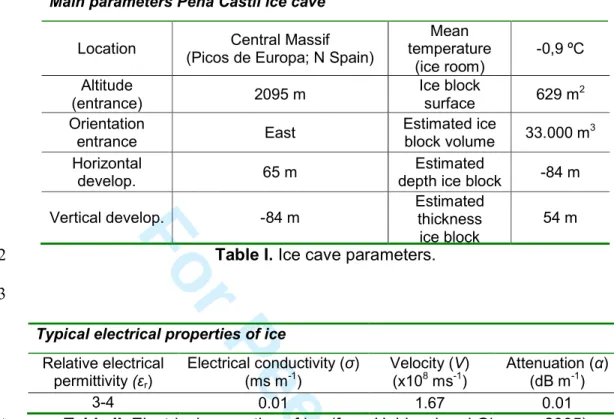
75
For Peer Review
(Kern and Perşoiu, 2013), which makes greater knowledge of ice caves
76
necessary and urgent from several perspectives and using all instruments
77
available in order to better understand them and to be able to obtain their
78
maximum paleoclimatic potential before many of them disappear. One such
79
instrument is the Ground Penetrating Radar (GPR).
80
81
GPR studies in ice caves
82
Due to its relative ease of use on site -it covers relatively large areas in a
83
reasonably short time, its non-invasive nature and the fact that modern
84
equipment can collect and process a lot of data relatively easily-, we find many
85
radar studies of glaciers and permafrost, and its usefulness as a technique for
86
surveying thicknesses and anomalies is widely agreed (Navarro et al., 2009;
87
Arcone, 1996; Travassos and Simoes, 2004; Fukui et al., 2007). The
88
morphology of permafrost and glacial ice differs considerably from that of ice
89
caves, and even taking into account on the analysis of these media, the ice
90
caves research has been centered exclusively on the application of the
91
georadar to the type of ice.
92
The usefulness of GPR as a tool in the study of ice blocks within ice caves has
93
been demonstrated in previous studies (e.g. Hausmann and Behm, 2011). It
94
facilitates the measurement of different parameters fundamental to the internal
95
structure, which is why it has been used in the present study. It indicates the
96
degree of melting and the weakness of an ice block, offering details, often not
97
visible, of its compaction, and with it attempt to predict its evolution in the near
98
future. It also permits us to know the degree of stratification and then interpret
99
the polygenetic nature of the ice block, as well as the greater or lesser quantity
100
For Peer Review
of clasts within it. This, together with the lie of the strata, helps us to determine
101
internal flows and deformities to which the block is subjected, and therefore to
102
interpret the origin, behavior and future evolution of the ice. Determining the
103
geometry of the cavity and the volumes and thickness of the ice block is also
104
possible through the application of GPR. And all of this can serve to select the
105
best place in the ice block to carry out later research in order to go deeper into
106
its paleoclimatic potential (e.g. drilling).
107
Nowadays geophysical techniques for the study of ice blocks in ice caves have
108
seldom been used. In the majority of cases the aim has been the quantification
109
of volumes (Geczy and Kucharovi, 1995; Novotný and Tulis, 1995; Behm and
110
Hausmann, 2007; Podsuhin and Stepanov, 2008; Colucci et al., 2012; Rojšek,
111
2012; Stepanov et al., 2014; Garašić, 2014), whereas in others they have been
112
of use in finding the largest ice thicknesses prior to drilling cores (Kern et al.,
113
2011; Colucci et al., 2014). On just a few occasions they have been used for the
114
analysis of the internal structure of the block or to determine cave geometries
115
(Behm and Hausmann, 2008; Behm et al., 2010; Hausmann and Behm, 2011).
116
Also, GPR data have been acquired on ice blocks inside caves with the aim of
117
checking the applicability of this technique in searching for underground water
118
or ice on Mars (Ciarletti et al, 2013a, 2013b).
119
In the Iberian Peninsula, ice cave studies are very recent. The only ice caves
120
that have been studied scientifically are in the Pyrenees (Belmonte and Sancho,
121
2010; Belmonte et al., 2011, 2012, 2014, Sancho et al., 2014; Leunda et al.,
122
2015); and Picos de Europa (Gómez-Lende et al., 2011, 2014; Berenguer et al.,
123
2014; Gómez-Lende 2015; Gómez-Lende and Serrano, 2012a, 2012b, 2012c,
124
2013, 2014), however none of these studies involved the application of GPR.
125
For Peer Review
Difficulty of access acts as a deterrent to scientific fieldwork applying electric or
126
electromagnetic geophysical techniques in caves which have, nevertheless,
127
been successfully applied in other periglacial studies on the surface in Picos de
128
Europa, for example (Del Río et al., 2009; Serrano et al., 2010, 2011; Paniagua
129
et al., 2004; Serrano et al., 2012)
130
With the aim of improving knowledge of the internal structure and thickness of
131
the ice block, which permits the interpretation of the current state of the ice, its
132
organization and its evolution in the near future as well as determining possible
133
places suitable for carrying out future research, in the present study we applied
134
GPR to the ice block of the Peña Castil ice cave (Picos de Europa).
135
136
Study Area and Cave Setting
137
The Peña Castil ice cave is located in the high periglacial mountain environment
138
of the Picos de Europa, an Atlantic glaciokarst high mountain in the north of the
139
Cantabrian Range (northern Spain) with a maximum altitude of 2648 m.a.s.l.
140
(Torrecerredo) (Figure 1). Actually, this high mountain environment is a
141
marginal periglacial and totally deglaciated landscape in which perennial ice
142
bodies remain at the surface (perennial snow and ice patches from the glaciers
143
of the Little Ice Age) and below it (ice caves).
144
The cave studied is located in the Central Massif of the Picos de Europa
145
(43º1’21”N/4º47’48”W), under the Peña Castil summit (2444 m.a.s.l.) and
146
hanging over the Duje valley (Figure 1). The lower and main entrance is located
147
at 2095 m.a.s.l. with an eastern orientation without other entrances worth
148
consideration. Speleological surveys have not revealed any other lower
149
entrances, although the cave morphology suggests minor upper entrances
150
For Peer Review
(Figure 2). The horizontal development is around 65 m and the vertical is still
151
unknown (currently -84 m). The entrance comprises an “Entrance ramp” (snowy
152
entrance slope; sector 1) leading to two main “Ice rooms” (“Lower room” and
153
“Upper room”; sectors 2 and 3) in which the ice body is located, and a small
154
“Terminal room” (sector 5) after passing through a narrow “Corridor” (sector 4).
155
Neither the “Corridor” and “Terminal room” have perennial ice. There is a small
156
“Filling shaft” that can be accessed from the “Lower room” by descending a
157
narrow ramp.
158
The perennial ice deposit at the surface is about 629 m2 and its thickness, as
159
far as is known to date, is at least 54 m (the basal bedrock interface is
160
unknown). It involves an estimated ice filling of at least 33.300 m3 (Gómez
161
Lende, 2015). The air temperature inside is constant throughout the summer
162
period and irregular during the winter period; however the annual average is
163
below 0ºC (Gómez-Lende et al., 2014) (Table I). According to
164
glacioclimatological criteria (Luetscher and Jeannin, 2004) it is a static ice cave
165
with firn and congelation ice (Gómez-Lende, 2015).
166
167
Method
168
This study is based on speleological explorations made in 2011 (Sánchez et al.,
169
2011) and GPR surveys carried out in August 2014. Data acquisition was
170
achieved with a shielded ground-coupled antenna manufactured by IDS
171
(Ingenieria dei Sistemi) with a nominal frequency of 400 MHz (Figure 3). The
172
transmitter (Tx) and receiver (Rx) elements are embedded in a common casing
173
allowing data to be gathered by the common-offset method. The software used
174
For Peer Review
to acquire the data was IDS-K2. To process raw signals GRESWINv1 (IDS-Spa,
175
2005) was used.
176
During fieldwork, different time window lengths (data time windows in which
177
underground reflections are collected) were used: 120 ns, 160 ns, 320 ns and
178
1280 ns with a variable number of samples between 512 and 4096. It is worth
179
pointing out that 1 ns (10-9 s) is the time needed by light to travel 30
180
centimetres (in a vacuum), thus the precision of measurements is very high. A
181
window length of 120 ns with 512 samples was selected for the majority of the
182
profiles shown in this work.
183
The GPR survey was carried out using a 400 MHz antenna, commonly used in
184
alpine ice caves (Hausmann and Behm, 2011). This makes a good compromise
185
between resolution and depth of penetration, given that in general the lower
186
frequency antennas are those that reach greater depth with lower resolution. On
187
the other hand, the higher frequency radar antennas (in the range of 800 MHz –
188
2 GHz) penetrate less but with better definition. The antennas of 200 to 600
189
MHz are those most commonly used in mixed studies of similar characteristics
190
to the present one. Such is the case of glaciers in which, among other things,
191
snow cover and basal bedrock thicknesses are measured, although there are
192
references to antennas of lower resolution and greater penetration, such as 50
193
MHz (Travassos and Simoes, 2004) or 20MHz - 200MHz (Navarro et al., 2009).
194
Data were acquired along eleven profiles on the surface of the ice block
195
(profiles 1-11), but three profiles were rejected due to a lack of resolution
196
(profiles 7, 8 and 11): profiles 1 to 6 in “lower room” and profiles 9 and 10 in
197
“upper room”. Figure 4 shows the results of applying radar time windows
198
For Peer Review
between 120 ns and 320 ns, and using standard physical parameters of ice
199
proposed by previous authors (Hubbard and Glasser, 2005) (Table II).
200
201
Results
202
Pattern analysis of GPR profiles
203
All the radargrams show different layering patterns and reflection intensities, on
204
a marked and repetitive banding that can be seen in all the profiles and at all
205
depths.
206
In most of the radargrams two large reflection patterns can be generically
207
distinguished with very distinctive sharpness (Figure 4):
208
- “Pattern A” presents a sub-horizontal or slightly concave layering, continuous
209
along a good part of profiles (pattern A in Figure 4). It is characterized by its
210
relative homogeneity in the return signals, weak in its reflection, sporadically
211
sharp and differently orientated. Reflection hyperbolae are also common,
212
forming high amplitude features spaced randomly across the radargrams with a
213
more intense reflection than the surrounding signals (a.1 in Figure 4).
214
- “Pattern B” is defined by intense reflectivity characterized by very closely
215
spaced hyperbolae (pattern B in Figure 4), in which the sub-horizontal banding
216
is not clearly visible. Abrupt changes in electromagnetic properties explain the
217
presence of hyperbolae and are characteristic of this pattern. They also show
218
up randomly spread and as very highly energetic hyperbolae, though only in
219
some profiles (e.g, profile 2 in Figure 4).
220
Pattern A shows reflection signals of lesser intensity and greater homogeneity
221
with respect to the reflections of pattern B, in which the reflections are more
222
chaotic and irregular, but sharper.
223
For Peer Review
Pronounced reflection signatures are observed in all the radargrams. These
224
signatures reveal particularly intense diffractions down to one metre depth from
225
the surface (although in some profiles they appear at greater depths and with
226
lesser wave intensities; see profiles 1, 2, 3 and 9), or reflections that are
227
prolonged at greater depths (see profiles 1, 2, 3, 4 and 9).
228
In addition to these reflection hyperbolae, in all the “Lower room” radargrams,
229
parallel straight-line signals at different depths are seen with good intensity
230
(yellow arrows in the profiles from 1 to 6, Figure 4). As they do not present
231
diffraction hyperbolae they correspond to continuous, homogeneous reflectors.
232
They form a continuity in the reflected trace with an appreciable slope towards
233
the centre of the profiles (the centre of the “Lower room”). In some of the
234
profiles these signals form a broad arch that crosses the entire surveyed
235
surface (profile 2). In most cases the signal is blurred at depth due to the
236
profusion of the previously mentioned hyperbolae. The abovementioned signals
237
are not reflected, however, in the “Upper room” (profiles 9 and 10).
238
In the upper part (the first nanoseconds of GPR reflections) all radargrams
239
exhibit reflections down to depths of around 10-20 cm. These features have not
240
been completely eliminated by filtering. A more careful inspection reveals areas
241
with parallel and perfectly horizontal reflection bands down to a depth of one
242
metre, which introduces a strong interference between the shallow waves and
243
the rest of the ice body surveyed (green boxes in Figure 4).
244
Other reflections with different characteristics were found. On one hand, there
245
are low amplitude hyperbolae, similar to those described earlier but located in
246
the central parts of the room and of lesser amplitude, and on the other hand
247
For Peer Review
there are intense hyperbolic reflections, located deeper (Figures 6 and 7
248
respectively).
249
Interpretation
250
Thickness and volume of ice mass
251
The bedrock at the bottom of the cave cannot be observed sharply in the
252
radargrams and thus, neither could a thickness of the ice block be determined.
253
All the profiles show a continuity of the ice block to at least 7 m depth, without
254
noteworthy differences in thickness. Changes were not found in the reflection
255
signatures as a result of the ice-basal bedrock interface in any of the cases,
256
which indicates the vertical continuity of both the ice block and the cave.
257
Cave geometry
258
In the GPR profiles clear changes are observed in the reflections at the margins
259
of the “Ice room”, corresponding to the sharp hyperbolae aligned in a vertical
260
trace (B in Figure 4). According to the sections where they are found in each
261
radargram and depending on the geometry of the cavity, we interpret them as
262
the back reflections produced by the contact of the ice block with the end of the
263
snow ramp entrance (profiles 1 to 4, Figure 5). The accumulation of clasts in the
264
first strata (appreciated on the ground by visual inspections) could lead to many
265
sharp reflection hyperbolae. Underneath, there are reflective signatures at the
266
ends of nearly all profiles that do not correspond to the ice block (profiles 1, 2,
267
3, 4 and 5 in Figure 5 for the “Lower room” and profile 9 in Figure 5 for the
268
“Upper room”). These reflections can be interpreted as the basal bedrock of the
269
cave. This correspondence with the ice-bedrock interface extends deeper
270
revealing the possible vertical geometry of the cave. In this case, the ice block
271
could fill a vertical shaft, which is coherent with the prevailing endokarstic
272
For Peer Review
morphologies in the Picos de Europa and with the ice filling in other ice caves in
273
these mountains (Gómez-Lende, 2015).
274
Internal structure
275
The reflection signatures with very acute angles and of smaller amplitudes
276
located in the central areas of the “Lower room” may be caused by boulders
277
embedded within the ice block both in the surface layers and in the lower strata
278
(where the signals are fainter), as described in other cave ice GPR studies
279
(Hausmann and Behm, 2011; Colucci et al., 2014).
280
The origin of strong individual hyperbolae at greater depth is more difficult to
281
determine. Their abundance from 2-3 m depth in almost all the profiles and the
282
sharpness of their reflection signal has two possible origins:
283
- The presence of internal tunnels in the ice block like those observed
284
descending to 15 m below the surface of the block (Gómez-Lende et al., 2014).
285
These tunnels may or not be filled with congelation ice. These individual and
286
broad hyperbolae have previously been interpreted as the reflection of
287
intraglacial tunnels in glaciers (e.g. Moorman and Michel, 2000).
288
- The existence of numerous interbedded boulders. This hypothesis seems the
289
most likely given that, in the former case, if the tunnels were filled with
290
congelation ice or if they were air-filled cavities (Figure 7) a significant change in
291
the reflected waves below the hyperbolae would be expected.
292
Banded layering is reflected in the first metres of the radargrams. These
293
reflections occur at depth along a parallel-subparallel plane. One of these
294
reflections shows slight undulations with different amplitudes within the ice block
295
(profile 2 in Figure 9). We attribute the different sharpness in its reflection to the
296
different sedimentary content of the strata. Those strata with greater content in
297
For Peer Review
cryogenic calcite produce a sharper signal return. These are fine sediments,
298
since clasts may generate a more irregular signal with more acute reflection
299
hyperbolae. This consideration is coherent with the observation during the
300
speleological exploration of different cryogenic calcite contents in adjacent
301
strata (Figure 8).
302
Ciarletti et al. (2013b) attributed similar reflection signatures to internal fractures
303
in the ice block. In this case, however, these prominent reflection waves in the
304
upper part of the radargrams are not interpreted as internal fractures of the ice
305
block due to their parallel orientation with respect to the stratification of the
306
upper part of the radargrams. Although they sometimes appear oblique to the
307
rest of the strata, this is not in contradiction with the proposed origin, as in this
308
case they correspond to marked sedimentation hiatuses in the cave ice
309
stratigraphy (black circle in Figure 8), as in the case of alpine ice caves (Colucci
310
et al., 2014) and other ice caves in Picos de Europa currently under study
311
(Altáiz and Verónica ice caves, Sánchez et al., 2011; Gómez-Lende et al.,
312
2011).
313
The remaining continuous and less energetic reflections, parallel or sub-parallel
314
to the previous ones, characterize the first metres of all radargrams, and at
315
some specific sections they reach greater depths. We observe how these lines
316
and the previous ones draw successive broad arches, curved in the central
317
parts of the “Lower room” (profile 2 in Figure 9). These structures could be
318
reflected by cave ice stratification and its deformation towards the central areas
319
due to the shaft-shaped configuration previously mentioned and to the
320
gravitational displacement of the ice mass accompanied by the potential melting
321
or weakening of the ice block at its base.
322
For Peer Review
In the upper parts (first centimetres from the surface) congelation ice layers are
323
identified in agreement with field observations. All radargrams show that from
324
20 cm depth the reflection pattern is homogenous throughout the ice block,
325
except where there are surface clasts, and in the possible contact between the
326
ice block and the “entrance ramp” (bedrock interface). At some sections parallel
327
bands with reversed polarity appear (green squares in Figure 10). These
328
features can be interpreted as melting morphologies (melting channels, shallow
329
melting ponds, etc.) on the surface of the ice block, later filled with congelation
330
ice, which can reach over a metre in depth, as both radargrams and
331
photographs reveal (Figure 10).
332
Ice mass compaction
333
If the broad reflection hyperbolae correspond to large embedded clasts, and not
334
to internal tunnels or cryokarst cavities, the ice block can be considered, at least
335
to the depths surveyed, to be a compact ice mass (no ablation morphologies
336
are appreciated). The superficial fissures visible in some seasons of the year
337
(melting periods in summer and autumn months) are not reflected in the
338
interpreted profiles. In this way, considering that in the first 5-6 m depth of
339
certain parts of the ice block hyperbolae that reflect the presence of clasts are
340
absent suggests that the ice block forms a single-unit homogeneous mass in
341
the first 7 m of its thickness (Figure 11).
342
343
Discussion
344
Behm and Hausmann (2007) applied different GPR frequencies (200, 400, 600
345
and 1200 MHz) using shielded antennae and with recording time windows
346
ranging between 100 and 400 ns, obtaining high quality results. Following their
347
For Peer Review
methodology and in view of the results they obtained, we directly used 400 MHz
348
antennae, given that they provide a good compromise between resolution and
349
depth, with signal acquisition time windows of 120 ns. The results are very
350
promising, as determined by the quality of the data gathered for the study of the
351
ice block in the ice cave.
352
Behm and Hausmann (2007) attributed the intense reflection bands at the base
353
of the ice block to the abundance of thin sediments or liquid water content in the
354
ice-bedrock interface, and the banding of its radargrams to the alternation of
355
thin sediments (Behm and Hausmann, 2007; Hausmann and Behm, 2011). We
356
cannot conclude that the different strata distinguished in the cave radargrams
357
are produced by differences in the sedimentary content or to the different
358
compositions of air bubbles due to the impossibility of making a direct
359
observation of the strata. Nevertheless, its origin can be inferred as being a
360
consequence of the different thin sediment content (cryogenic calcite)
361
extrapolating the observations made of the ice block during speleological
362
fieldwork. The reflection bands, therefore, may correspond to ice block
363
stratification, ice layers alternating with thin sediments and cryogenic calcite
364
layers. This is consistent with our visual observations during speleological
365
fieldwork and studies in other ice caves (Hausmann and Behm, 2011).
366
The GPR survey did not enable us to determine the depth of the ice block, nor
367
to establish the ice-basal bedrock interface, which would suggest the real
368
thickness of the ice mass. Speleological explorations reveal that the ice block
369
might have a mean thickness of as much as 54 m (GELL, 1995), which would
370
yield a volume of at least 33,000 m3. What has been established, however, is
371
the underneath morphology of the cavity as a shaft of large dimensions and with
372
For Peer Review
a high degree of verticality (ice-lateral bedrock interface in some radargram
373
sections) down to a depth of 7 m. The main shaft would be found behind the
374
entrance ramp, occupying entirely the “Ice room”, where the ice block is located.
375
The thickness interpretation estimated, 7 metres depth of radargram signal, is
376
coherent with the 54 m minimum ice block thickness suggested in explorations
377
and topo-speleological studies (GELL, 1995; Sánchez et al., 2011,
Gómez-378
Lende et al., 2012).
379
This is an ice block with a possible compact mass and sub-horizontal concave
380
stratification, in which ice strata and strata with greater cryogenic calcite
381
contents may alternate, as well as scattered and interbedded clasts. The curved
382
signal of the strata, their disposition throughout the profiles and their continuity
383
at depth suggest a deformation of the ice mass deriving from possible vertical
384
gravitational displacement depending on the configuration of the shaft, with a
385
potential basal melting of the ice block in the ice-basal bedrock interface
386
(causing the downward movement of the ice block). This is the current situation
387
of the blocks of nearby ice caves such as Altáiz, where intense basal melting
388
has left the ice block completely suspended around 30 m over the base of the
389
chasm, held up only by the shaft walls (Sánchez et al., 2011; Gómez-Lende et
390
al., 2011; Gómez-Lende, 2015). Deformation by basal melting has been
391
observed in many other ice caves (e.g. Citterio et al., 2003), with acceleration
392
processes of basal melting due to the presence of air dynamics that circulate
393
between the ice and rock (e.g. Kern et al., 2008).
394
In case of the two main types of reflection hyperbolae distinguished, we can
395
interpret in two ways. On the one hand, in the case of the hyperbolae with
396
arches of broad curvature, they are the scattered back reflections produced by
397
For Peer Review
internal clasts, ruling out possible tunnels or internal cryocaves. On the other
398
hand, the reflection hyperbolae are interpreted as features produced by
399
superficial embedded clasts in the ice block, which may be seen in the first
50-400
100 cm of the congelation ice strata. It is consistent with the quantity of
401
gravitational debris observed both in certain sub-surface sectors of the
402
congelation ice in the ice block, as in the rooms immediate to the “Ice room”
403
(“Corridor” or “Terminal Room”). Despite the fact that no boulders or clasts have
404
been observed at the surface we can consider that the existence of internal
405
boulders or clasts in the Peña Castil ice block is very probable due to the
406
presence of these noticeable broad angle hyperbolae. The presence of
407
embedded clasts in the ice block has been confirmed in field observations made
408
in other ice caves in Picos de Europa (e.g. Verónica ice cave, Sánchez et al.,
409
2011; Gómez-Lende et al., 2011). Similar reflection hyperbolae have been
410
interpreted as clasts buried in ice bodies (e.g. Hausmann and Behm, 2011;
411
Colucci et al., 2014), and in geo-cryological near cases such as the Jou Negro
412
ice patch (in Picos de Europa surface, Del Río et al., 2009).
413
In the superficial strata there are reversed-polarity reflection bands compared to
414
reflections from adjacent strata. They are interpreted as congelation ice layers
415
with a greater water or air bubble content associated with melting morphologies
416
(melting channels, ponds,Z). During the fieldwork no clasts or fine sediment
417
strata were found that could explain these reversed polarity bands. Behm et al.
418
(2007) described similar reflection waves in the Dachstein ice cave, attributed to
419
the existence of melt waters under the superficial frozen layers and beneath the
420
first congelation ice layers. In Peña Castil ice block the recorded reflections may
421
For Peer Review
correspond to similar morphologies (ice-filled melting morphologies)(see photos
422
in Figure 10).
423
Upper congelation ice layers or pure ice layers (Behm et al., 2007) are imaged
424
in the first centimetres of all radargrams and have been interpreted from the
425
direct waves present in the GPR data. Highly homogeneous wave signals are
426
recorded with hardly any irregularities to depths from 0,5 to 1 m (and even up to
427
1,5 m in some places). These signals have been interpreted as congelation ice
428
layers that remain from the last ice accumulation period (last spring).
429
430
Conclusions
431
The application of GPR to the study of the Peña Castil ice block has been
432
shown to be a useful technique for the description of its ice mass, helping us to
433
interpret the internal structure, stratification and compaction of the topmost 7
434
metres using 400 MHz shielded antenna. Although basal interfaces of ice-basal
435
bedrock contact have not been distinguished, interfaces with the bedrock walls
436
have been observed, and the configuration of the vertical shaft-shaped cave
437
has been determined. The ice block thickness shown in the GPR survey is
438
consistent with estimated depth and volume of the ice block (54 m and 33,000
439
m3) as has been observed in previous studies.
440
Several embedded clasts were detected within the ice block as well as in its
441
surface. Although it was not possible to determine the ice block thickness to its
442
basal bedrock, the analysis of its structure and the disposition of its strata
443
suggest a deformation of the ice body caused by possible basal melting that
444
could generate its vertical displacement and the strata curvature.
445
For Peer Review
GPR measurements are a very useful tool with great potential in the particular
446
case of this ice cave. The results derived will be confirmed in the future if the
447
evolution of its ice mass provides a suitable scenario for more complete and
448
direct visual examinations, and these outcomes offer us the possibility of
449
determining which parts of the ice block are suitable for future research, e.g.
450
drilling cores, necessary to making any paleoclimatological interpretation.
451
Acknowledgements
452
This research has been funded by projects I+D+I project CGL2015-68144-R
453
(Ministerio de Economía y Competitividad) and OAPN-053/2010 (MAGRAMA)
454
of Spanish government. We thank the “Facultad de Ingeniería en Ciencias de la
455
Tierra de la ESPOL” for making available their georadar data processing
456
facilities, and “Proyecto Prometeo” of “Secretaría de Educación Superior,
457
Ciencia, Tecnología e Innovación de la República del Ecuador” for the financial
458
support. We wish to be grateful for CES-Alpha speleological group, the
459
assistance provided during the speleological exploration, specially to Emilio
460
Herrera and Javier Sánchez. We are in debt with Manuel Díez and Vicente
461
Gómez for his useful help during the field work. We are grateful to the
462
anonymous reviewers for their helpful and suggestions. Petty Giles has helped
463
the paper translation.
464
465
References
466
Achleitner A. 1995. Zum Alter des Höleneises in der Eisgruben-Eishöhle im
467
Sarstein (Oberösterreich). Die Höhle 46 (1): 1-5.
468
For Peer Review
Arcone SA. 1996. High resolution of glacial ice stratigraphy: A ground
469
penetrating radar study of Pegasus Runway, McMurdo Station, Antartica.
470
Geophysics61(6): 1653-1663.
471
Behm M, Hausmann H. 2007. Eisdickenmessungen in alpinen Höhlen mit
472
Georadar (Determination of ice thickness in alpine caves with ground
473
penetrating radar). Die Höhle, Zeitschrift für Karst-und Höhlenkunde58: 3-11.
474
Behm M, Hausmann H. 2008. Determination of ice thicknesses in alpine cave
475
using georadar. In 3rd International Workshop on Ice Caves. Proceedings.
476
Kadebskaya O, Mavlyudov BR, Pyatunin M (eds). Kungur, Russia; 70-74.
477
Behm M, Hausmann H, Weghofer C. 2010. Thickness and internal structure of
478
underground ice in a low-elevation cave in the Eastern Alps (Beilstein-Eishöhle,
479
Hochschwab, Austria). In 4th International Workshop on Ice Caves Abstracts
480
Volume. Spötl C, Luetscher M, Rittig P (eds). Obertraun, Austria; 6.
481
Belmonte A, Sancho C. 2010. First data from a Pyrenean ice cave (A294,
482
Cotiella massif, Spain). In 4th International Workshop on Ice Caves. Abstracts
483
Volume. Spötl C, Luetscher M, Rittig P (eds). Obertraun, Austria; 7.
484
Belmonte A, Sancho C, Moreno A 2011. Chronology of a Pyrenean subsurface
485
ice deposit (A294 cave, Cotiella massif, Spain). In 8th EGU General Assembly,
486
Geophysical Research Abstracts. Vienna (Austria); 13.
487
Belmonte A, Bartolomé M, Sancho C, Moreno A, López-Martínez J. 2012.
488
Assessing the palaeoclimate potential of the A294 ice cave (Central Pyrenees,
489
Northern Spain). In 5th International Workshop on Ice Cave. Abstracts Volume.
490
Turri S, Strini A and Tomasi F. (eds) Barzio, Valssasina, Italy; 47.
491
For Peer Review
Belmonte A, Sancho C, Moreno A, López-Martínez J, Bartolomé M. 2014.
492
Present-day environmental dynamics in ice cave A294, Central Pyrenees,
493
Spain. Geografia Fisica e Dinamica Quaternaria37: 131-140.
494
Berenguer Sempere F, Gómez-Lende M, Serrano, Sanjosé Blasco J.J. 2014.
495
Orthothermographies and 3D modeling as potential tools in ice caves studies:
496
the Peña Castil Ice Cave (Picos de Europa, Northern Spain). International
497
Journal of Speleology43 (1): 35-43.
498
Ciarletti V, Clifford S, Plettermeier D, Dorizon S, Statz Ch, Lustrementm B,
499
Humeau O, Hassen-Khodja R, Galic A, Cais P. 2013a. Investigation of an
500
alpine ice cave in Austria with EXOMARS WISDOM GPR. Geophysical
501
Research Abstracts. EGU General Assembly 2013. Vienna, Austria.
502
Ciarletti V. Clifford S, Plettermeier D, Dorizon S, Statz Ch, Lustrementm B,
503
Humeau O, Hassen-Khodja R, Galic A. 2013b. WISDOM GPR investigations of
504
ice thickness, stratigraphy, structure and basal topography in an alpine ice cave
505
in Dachstein, Austria. In 44th Lunar and Planetary Science Conference,
2365-506
2366.
507
Citterio M, Turri S, Bini A, Maggi V. 2003. Some observations on the structure
508
and morphology of an ice deposit in the “Abisso sul Margine dell’Alto Bregai”
509
cave (Grigna Settentrionales, Italian Alps). In 6th International Symposiun
510
Glacier Caves and Karst in Polar Regions, Eraso A, Dominguez C (eds).
511
Svalbard, Norway; 13-19.
512
Citterio M, Turri S, Bini A, Maggi, V, Stenni B, Udisti R. 2005. Chemical and
513
stable isotopes profiles from the snow deposit in the Lo Lc 1607 ice cave
514
(Grigna Settentrionale, Italian Alps). In 14th International Congress of
515
Speleology, Athens, 21-28 August 2005.
516
For Peer Review
Clausen H, Vrana K, Bo hansen S, Berg Larsen L, Baker J, Siggaard-Andersen
517
ML, Sjolte J, Lundholm SC. 2006. Continental ice body in Dobšiná ice cave
518
(Slovakia). Part II. Results of chemical and isotopic study. In 2nd International
519
Workshop on Ice Cave. Turri S, Zelinka J (eds.) Demänovská Dolina, Slovak
520
Republic, 9.
521
Colucci R, Forte E, Guglielmin M. 2012. Underground cryosphere in the Monte
522
Canin massif, Alpi Giulie (Itlay). In 5th International Workshop on Ice Cave
523
Volume Abstracts, Turri S, Strini A, Tomasi F (eds). Barzio, Italy; 17-18.
524
Colucci R, Fontana D, Forte E. 2014. Characterization of two permanent ice
525
cave deposits in the southeastern Alps (Italy) by means of ground penetrating
526
radar (GPR). In Land L, Kern Z, Maggi V, Turri S (eds). 6th International
527
Workshop on Ice CaveProceedings. Idaho Falls, Idaho, USA; 33-39.
528
Del Río LM, Tejado JJ, De San José JJ, Atkinson A, Serrano E, González
529
Trueba JJ, Fernández A. 2009. Ice match structure and depth using GPR
530
techniques: a first approach to the Jou Negro ice patch (Picos de Europa,
531
Spain). In Proceeding 5th International Workshop on Advanced Ground
532
Penetrating Radar (IWAGPR 2009), Granada; 122-126.
533
Dickfoss P. 1996. Stratified ice accumulations as a source of climate proxy
534
data. Ohio State University.
535
Feurdean A, Perşoiu A, Pazdur A, Onac BP. 2011. Evaluating the
536
palaeoecological potential of pollen recovered from ice in caves: a case study
537
from Scărişoara Ice Cave, Romania. Review of Palaeobotany and Palynology
538
165 (1-2): 1-10.
539
Filipov AG. 2005. The age of the relict firn plug in the Kremeshetskaya cave,
540
Eastern Siberia. In Glacier Caves and Glacial Karst in High Mountains and
541
For Peer Review
Polar Regions, 7th GLACKIPR symposium Mavlyudov BR. (ed.). Institute of
542
geography of the Russian Academy of Sciences, Moscow, 98-100.
543
Fórizs I, Kern Z, Nagy B, Szántó Zs, Palcsu L, Molnár M. 2004. Environmental
544
isotope study on perennial ice in the Focul Viu Ice Cave, Bihor Mts., Romania.
545
Theoretical and Applied Karstology17: 61-69.
546
Fórizs I, Perşoiu A, Kern Z, Nagy B. 2006. Stable isotope study of different
547
water sources in Bortig ice cave, Apuseni Mts, Romania. In 2nd International
548
Workshop on Ice Cave. Turri S, Zelinka J. (eds.). Demänovská Dolina, Slovak
549
Republic, May 8 - 12, 2006, 9.
550
Fukui K, Sone T, Strelin J, Torielli C, Mori J. 2007. Ground penetrating radar
551
sounding on an active rock glacier on James Ross Island, Antartic Peninsula
552
region, Polish Polar Research28 (1): 13-22
553
Garašić M. 2014. New research in cave Ledenica in Bukovi Vrh on Velebit Mt in
554
Croatian Dinaric Karst. In Land L, Kern Z, Maggi V, Turri S (eds). 6th
555
International Workshop on Ice Cave Proceedings. Idaho Falls, Idaho, USA;
31-556
32.
557
Geczy J, Kucharovic L. 1995. Determination of the ice filling thickness at the
558
selected sites of the Dobsinska ice cave. Ochrana ladovych jaskyn Zilina;
17-559
23.
560
GELL. 1995. http://www.zapespeleo.com
561
Gómez-Lende M, Serrano E, Sempere F. 2011. Cuevas heladas en Picos de
562
Europa. Primeros estudios en Verónica, Altáiz y Peña Castil. Karaitza 19:
56-563
61.
564
Gómez-Lende M, Serrano E. 2012a. Elementos del patrimonio geomorfológico
565
subterráneo: las cuevas heladas de Picos de Europa (Cordillera Cantábrica). In
566
For Peer Review
XII Reunión Nacional de Geomorfología. González A et al. (eds). Santander,
567
Cantabria, España; 47-50.
568
Gómez-Lende M, Serrano E. 2012b. Morfologías, tipos de hielo y regímenes
569
térmicos. Primeros estudios en la cueva helada de Peña Castil (Picos de
570
Europa, Cordillera Cantábrica). In Avances de la Geomorfología en España
571
2010-2012. Actas de la XII Reunión Nacional de Geomorfología. González A, et
572
al. (eds.) Santander, 17-20 September 2012: 613-616.
573
Gómez-Lende M, Serrano E. 2012c. First thermal, morphological and ice types
574
studies in the Peña Castil ice cave (Picos de Europa, Cantabrian Mountains,
575
Northern Spain In 5th International Workshop on Ice Cave. Abstracts Volume.
576
Turri S, Strini A and Tomasi F. (eds) Barzio, Valssasina, Italy; 52-53.
577
Gómez-Lende M, Berenguer F, Serrano E, Sanjosé Blasco J.J. 2013. Los
578
ortotermogramas en los estudios de hielo de las cuevas heladas. El caso de la
579
cueva helada de Peña Castil (Picos de Europa). In IV Congreso Ibérico de la
580
International Permafrost Association. Gómez Ortiz A, et al. (eds). Núria (Vall de
581
Ribes, España; 263-276.
582
Gómez-Lende M, Berenguer F, Serrrano E. 2014. Morphology, ice types and
583
termal regime in a high mountain ice cave. First studies applying terrestrial laser
584
scanner in the Peña Castil Ice Cave (Picos de Europa, Northern Spain).
585
Geografia Fisica e Dinamica Quaternaria37: 141-150.
586
Gómez-Lende M. 2015. Las cuevas heladas en Picos de Europa: clima,
587
morfologías y dinámicas. Tesis doctoral, Universidad de Valladolid, Valladolid;
588
Hausmann H, Behm M. 2011. Imaging the structure of cave ice by ground
589
penetrating radar. The Cryosphere5: 329-340.
590
For Peer Review
Holmlund P, Onac BP, Hanson M, Holmgren K, Mörth M, Nyman M. Perşoiu A.
591
2005. Assessing the palaeoclimate potential of cave glaciers: the example of
592
the Scarisoara ice cave (Romania). Geografiska Annaler, 87 (A): 193-201.
593
Hubbard B, Glasser N. 2005. Field techniques in glaciology and glacial
594
geomorphology. John Wiley & Sons Ltd: England.
595
IDS-Spa (2005) Greswin software user Manual. Ingeneria dei sistema, Pisa,
596
Italy
597
Kern Z, Fórizs I, Kázmér M, Nagy B, Szántó Zs, Gál A, Palcsu L, Molnár M.
598
2004. Late Holocene environmental changes recorded at Gheţarul de la Focul
599
Viu, Bihor Mts, Romania. Theoretical and Applied Karstology, 17: 51-60.
600
Kern Z, Nagy B, Surányi G, Fórizs I, Balogh D. 2006. Investigation of natural
601
perennial ice deposits of Durmitor Mts, Montenegro. In 2nd International
602
Workshop on Ice Cave. Turri S, Zelinka J (eds.) Demänovská Dolina, Slovak
603
Republic, 70-73.
604
Kern Z, Fórizs I, Horvatinčić N, Széles É, Bočić N, Nagy B, László P. 2006.
605
Palaeoenvironmental record from ice caves of Velebit mountains – Ledena Pit
606
and Vukušić Ice Cave, Croatia. In 3rd International Workshop on Ice Caves.
607
Abstracts. Kadebskaya O, Mavlyudov BR, Pyatunin M. (eds). Kungur, Rusia;
608
108-113.
609
Kern Z, Fórizs I, Pavuza R, Molnár M, Nagy B. 2011. Isotope hydrological
610
studies of the perennial ice deposit of Saarhalle, Mammuthöhle, Dachstein Mts,
611
Austria. The Cryosphere5: 291-298.
612
Kern Z, Széles E, Horvatincic N, Fórizs I, Bocic N, Nagy B. 2011b.
613
Glaciochemical investigations of the ice deposit of Vukušic Ice Cave, Velebit
614
Mountain, Croatia. The Cryosphere5: 485-494.
615
For Peer Review
Kern Z, Perşoiu A. 2013. Cave ice-the inminent loss of untapped mid-latitude
616
cryospheric palaeoenvironmental archives. Quaternary Science Reviews 67:
1-617
7.
618
Lacell D. 2007. Environmental setting, (mircro) morpohologies and stable C-O
619
isotope composition of cold climate carbonate precipitates-a review and
620
evaluation of their potential as paleoclimatic proxies. Quaternary Sciences
621
Review26 (11-12): 1170-1189.
622
Lacelle D, Lauriol B, Clark ID. 2009. Formation of sesonal ice bodies and
623
associated cryogenic carbonates in cavern de L’Ours, Québec: kinetic isotope
624
effects and pseudo-biogenetic crystal estructures. Journal of caves and karst
625
studies71 (1): 48-62.
626
Lauriol B, Clark ID. 1993. An approach to determine the origin and age of
627
massive ice blockages in two artic caves. Permafrost and Periglacial Processes
628
4 (1): 77-85.
629
Luetscher M, Jeannin PY. 2004. A process-based classification of alpine ice
630
caves. Theoretical and Applied Karstology 17: 5-10.
631
Luetscher M. 2005. Processes in ice caves and their significance for
632
paleoenvironmental reconstructions. Swiss Institute for Speleology and Karst
633
Studies (SISKA), La Chaux-de-Fonds. Swiss.
634
Luetscher M, Borreguero M, Moseley GE, Spötl C, Edwards RL. 2013. Alpine
635
permafrost thawing during the Medieval Warm Period identified from cryogenic
636
carbonates. The Cryosphere7: 1073-1081.
637
Leunda M, Bartolomé M, Sancho C, Moreno A, Oliva-Urcia B,
González-638
Sampériz P, Gil-Romera G, Gomollón A. 2015. La cueva helada de Casteret
639
(PNOMP, Huesca): primeras aportaciones del registro de hielo. In XIV Reunión
640
For Peer Review
Nacional de Cuaternario. Galve J.P, Azañón J.M, Pérez Peña J.V, and Ruano,
641
P (eds.) Granada (España); 78-81.
642
Maggi V, Turri S, Bini A, Perşoiu A, Onac B, Stenni B, Udisti R. 2012. Two
643
millenia of natural to antropogenic effects in Transilvana from Focul Viu ice
644
core. In 5th International Workshop on Ice Cave. Turri S, Strini A, Tomasi F.
645
(eds.). Barzio, Valssasina, Italy. Sept. 16-23, 2012, Abstracts Volume, 38.
646
May B, Spötl C, Wagenbach D, Dublyansky Y, Liebl J. 2011. First investigations
647
of an ice core from Eisriesenwelt cave (Austria). The Cryosphere5: 81-93.
648
Moorman BJ, Michel FA 2000. Glacial hydrological system characterization
649
using ground-penetrating radar. Hydrological Processes14: 2645–2667.
650
Novotný L, Tulis J. 1995. Ice filling in the Dobsina ice cave. Kras a jaskyne
651
(Liptovsky Nikulas); 16-17.
652
Navarro FJ, Otero J, Macheret YY, Vasilenko EV, Lapazaran JJ, Ahlstrom AP,
653
Machio F. 2009.Radioglaciological studies on Hurd Peninsula glaciers,
654
Livingston Island, Antartica. Annals of Glaciology50 (51): 17-24
655
Paniagua J, Del Río M, Rufo M. 2004. Test site for the analysis to subsoil GPR
656
signal propagation. In Tenth International Conference on Ground Penetrating
657
Radar Proceedings, Slob E, Yarovoy A, Rhebergen J. (eds). Delf, Netherlands;
658
751-754.
659
Perşoiu A. 2011. Palaeoclimatic significance of perennial ice accumulations in
660
caves: an example from Scărişoara Ice Cave, Romania. Graduate School
661
Theses and Dissertations. University of South of Florida, USA.
662
Perşoiu A, Onac BP, Wynn JG, Bojar AV, Holmgren K. 2011. Stable isotope
663
behavior during cave ice formation by water freezing in Scărişoara Ice Cave,
664
Romania. Journal of Geophysical Research116: 1-8.
665
For Peer Review
Podsuhin G, Stepanov Y. 2008. Measuring of the thickness of perennial ice in
666
Kungur Ice Cave by georadar. In 3rd International Workshop on Ice Caves.
667
Proceedings. Kadebskaya O, Mavlyudov BR, Pyatunin M. (eds.) Kungur, Rusia;
668
52-55.
669
Richter DK, Riechelmann DF. 2008. Late Pleistocene cryogenic calcite
670
spherolites from the Malachitdom Cave (NE Rhenish Slate Mountains,
671
Germany): origin, unusual internal structure and stable C-O isotope
672
composition. International Journal of Speleology 37 (2): 119-129.
673
Richter DK, Meissner P, Immenhauser A, Schulte U, Dorsten I. 2010. Cryogenic
674
and non-cryogenic pool calcites indicating permafrost and non-permafrost
675
periods: a case study from the Hersbtlabyrinth-Advent Cave system (Germany).
676
The Cryosphere4: 501-509.
677
Rojšek D. 2012. Cave ice in Velika Leden Jama V Paradani, Slovenija. In 5th
678
International Workshop on Ice Cave Volume Abstracts, Turri S, Strini A, Tomasi
679
F (eds). Barzio, Italy; 19.
680
Sánchez J, Jordá L, Serrano E, Gómez-Lende M, Hivert B. 2011. Memoria de
681
las exploraciones subterráneas. Macizo central de Picos de Europa,
Camaleño-682
Cantabria. CES Alfa-AS Charentaise: Madrid.
683
Sancho C, Belmonte A, López-Martínez J, Moreno A, Bartolomé M, Calle M,
684
Santolaria P. 2012. Potencial paleoclimático de la cueva helada A294 (Macizo
685
de Cotiella, Pirineos, Huesca). Geogaceta 52: 101-104.
686
Serrano E, Del Río M, Sanjosé JJ, González-Trueba JJ, Atkinson A,
687
Fernández, A, Martín R. 2010. Evolución reciente y dinámica actual del helero
688
del Jou Negro (Picos de Europa). Primera aproximación. In Ambientes
689
For Peer Review
periglaciares, permafrost y variabilidad climática. Blanco JJ, de Pablo MA,
690
Ramos M. (eds). Universidad de Alcalá; 39-46
691
Serrano E, González-Trueba JJ, Sanjosé JJ, Del Río M. 2011. Ice patch origin,
692
evolution and dynamics in a temperate high mountain environment: the Jou
693
Negro, Picos de Europa (NW Spain). Geografiska Annaler 93 (2): 57-70.
694
Serrano E, González-Trueba JJ, González-García M. 2012. Mountain
695
glaciations and paleoclimate reconstruction in the Picos de Europa (Iberian
696
Peninsula, SW Europe). Quaternary Research78: 303-314.
697
Spötl C, Cheng H. 2014. Holocene climate change, permafrost and cryogenic
698
carbonate formation: insights from a recently deglaciated, high-elevation cave in
699
the Austrian Alps. Climate of the Past10: 1349-1362.
700
Stepanov Y, Tainitskiy A, Kichigin A, Kadebskaya O, Mavlyudov BR. 2014.
701
Study of multiyear ice in Medeo cave (North Ural). In Land L, Kern Z, Maggi V,
702
Turri S (eds). 6th International Workshop on Ice Cave Proceedings. Idaho Falls,
703
Idaho, USA; 25-30.
704
Stoffel M, Luetscher M, Bollschweiler M, Schlatter F. 2009. Evidence of NAO
705
control on subsurface ice accumulation in a 1200 yr old cave-ice sequence, St.
706
Livres ice cave, Switzerland. Quaternary Research72: 16-26.
707
Travassos JM, Simoes JC. 2004. High-resolution radar mapping of internal
708
layers of a subpolar ice cap, Kings George Island, Antartica. Pesquisa Antartica
709
Brasileira(4): 57-65
710
Viehmann I, Silvestru E, Onac BP. 2004. Scarisoara (Romania), Eisriesenwelt,
711
and Dachstein (Austria) ice caves: a preliminary comparative study. In 1st
712
International Workshop on Ice Cave. Citterio M, Turri S. (eds.). Căpuş and
713
Scărişoara, Romania. Feb. 29 – March 3, 2004, Abstracts Volume, 31.
714
For Peer Review
Vrana K, Baker J, Clusen HB, Hansen S, Zelinka J., Rufli H, Ockaik L, Janocko
715
J. 2006. Continental ice body in Dobšiná ice cave (Slovakia)- Part I.- Project
716
and sampling phase of isotopoic and chemical study. In 2nd International
717
Workshop on Ice Cave. Turri S, Zelinka J. (eds.). Demänovská Dolina, Slovak
718
Republic, May 8 - 12, 2006, 24-28.
719
Žák K, Urban J, Cilek V, Hercman H. 2004. Cryogenic cave calcite from several
720
Central European caves: age, carbon, and oxygen isotopes and a genetic
721
model. Chemical Geology206 (1-2): 119-136.
722
Žák K, Onac BP, Perşoiu A. 2008. Cryogenic carbonate in cave environments:
723
a review. Quaternary International187 (1): 84-96.
724
For Peer Review
Supporting Information
1
Main parameters Peña Castil ice cave
Location Central Massif (Picos de Europa; N Spain)
Mean temperature
(ice room)
-0,9 ºC
Altitude
(entrance) 2095 m
Ice block
surface 629 m
2
Orientation
entrance East
Estimated ice
block volume 33.000 m
3
Horizontal
develop. 65 m
Estimated
depth ice block -84 m
Vertical develop. -84 m
Estimated thickness ice block
54 m
Table I. Ice cave parameters.
2
3
Typical electrical properties of ice
Relative electrical permittivity (εr)
Electrical conductivity (σ) (ms m-1)
Velocity (V) (x108 ms-1)
Attenuation (α) (dB m-1) 3-4
3-4
0.01 1.67 0.01
Table II. Electrical properties of ice (from Hubbard and Glasser, 2005)
4
For Peer Review
5º0’O 4º45’O
4º45’O 5º0’O
43º16’N
4º50’O
4º50’O 4º40’O
4º55’O 4º50’O 4º40’O
43º14’N
43º12’N
43º08’N 43º16’N
43º14’N
43º12’N
43º10’N
43º08’N
43º10’N
Torrecerredo 2.648
río
río
Cares
Arenal
río
Duje
Peña Santa 2.596
Morra Lechugales 2.444
río
Deva
Cornión (Western massif)
Urrielles (Central massif)
Andara (Eastern massif)
Áliva 1.466 Enol Lake
1.063
Peña Castil 2.444 Peña Castil IC
Pte. Poncebos 218
2.648 0 altitude (m)
0 50 km
Cantabrian sea
0 320 km
3.478
0 m
Altitude PICOS DE EUROPA
0 2,25 5,5km
2.648
200
altitude (m)
Level contour 100 m
1400 1000
1200
1600 1800 2000
800
1200
1600
2000
2200
1000 1400
2000
1500
1200 1600
1000 1200
1000
1400
1600
1800
2000
600
1000
1600
2000 1100
900
900 1400 1600
1200
1400 1800
2200
1000
1200
1400
1600
1800