Validation of the Spanish Version
of the Index of Spouse Abuse
Juncal Plazaola-Castan˜o, Ph.D.,1,2 Isabel Ruiz-Pe´rez, M.D., Ph.D.,1,2 Vicenta Escriba`-Agu¨ir, M.D., Ph.D.,2,3 Juan Manuel Jime´nez-Martı´n, B.Sc.,1and Elisa Herna´ndez-Torres, Ph.D.4
Abstract
Background:Partner violence against women is a major public health problem. Although there are currently a number of validated screening and diagnostic tools that can be used to evaluate this type of violence, such tools are not available in Spain. The aim of this study is to analyze the validity and reliability of the Spanish version of the Index of Spouse Abuse (ISA).
Methods:A cross-sectional study was carried out in 2005 in two health centers in Granada, Spain, in 390 women between 18 and 70 years old. Analyses of the factorial structure, internal consistency, test-retest reliability, and construct validity were conducted. Cutoff points for each subscale were also defined. For the construct validity analysis, the SF-36 perceived general health dimension, the Rosenberg Self-Esteem Scale and the Goldberg 12-item General Health Questionnaire were included.
Results:The psychometric analysis shows that the instrument has good internal consistency, reproducibility, and construct validity.
Conclusions:The scale is useful for the analysis of partner violence against women in both a research setting and a healthcare setting.
Introduction
P
artner violence against womenis a recognized public health problem. Its prevalence is high,1,2incidence and mortality rates are increasingly reported,3and it has serious consequences for both the mental and physical health of women.4–6Health repercussions range from immediate visi-ble provisi-blems, such as physical injuries, to chronic health conditions, such as headaches, sexually transmitted diseases (STDs), and psychiatric problems.7,8In recent years, many studies have tried to determine the magnitude of the problem in Spain in the population as a whole9–11and in healthcare settings.12–14Because there is no consensus regarding the definition of the problem and the use of different methodologies and tools to study it, however, it is difficult to compare the different sets of data obtained with the results of other international research work. The healthcare setting is considered to be one of the most suitable contexts in which to address partner violence against women, both in terms of helping the women involved and for the purpose of
research. This observation is based on the fact that abused women use healthcare services more often than do those who are not abused.15
There are a number of validated tools that have been used to screen for and evaluate partner violence against women in cross-sectional16 and longitudinal studies.17 However, this trend has not extended to Spain, where the lack of screening and diagnostic tools for partner violence is a major obstacle to increasing knowledge of the problem. One of the most widely used diagnostic tools in the United States is the Index of Spouse Abuse (ISA), which was designed in 1981 for use in a clinical environment18in order to evaluate progress made in interventions with abused women.
The ISA measures the severity of partner violence against women over the past year. In addition to measuring physical, sexual, and emotional violence, it also measures behavior that aims to control and isolate women. It includes 30 items, which make up two independent scales: one relating to nonphysical violence (19 items) and another relating to physical violence (11 items). Items receive different weights, given that some of
1Andalusian School of Public Health, Granada, Spain.
2
Ciber Epidemiologı´a y Salud Pu´blica (CIBERESP), Spain.
3General Directorate of Public Health, Valencia, Spain.
4Hospital Virgen de las Nieves, Granada, Spain.
ªMary Ann Liebert, Inc. DOI: 10.1089=jwh.2008.0944
them represent very severe acts of violence, whereas others represent less severe violent acts. This scale has been vali-dated in the United States using samples of university stu-dents, female victims of abuse,18 and African American women,19,20showing a need to adapt this instrument to spe-cific groups. Although the ISA has proved to be a reliable, valid tool for studying and addressing partner violence against women in different population groups in the United States, its psychometric features must be evaluated in a Spanish context. The aim of this study is to analyze the va-lidity and reliability of the Spanish version of the ISA.
Materials and Methods Spanish version of the ISA
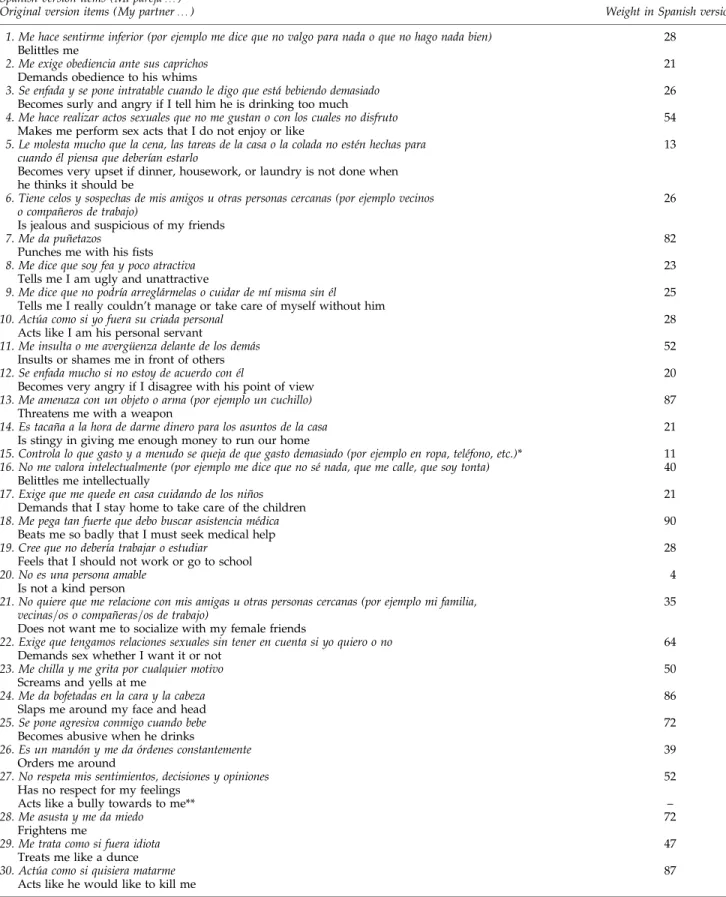
The ISA was first adapted for Spain’s cultural context in 2005.21The original instrument was semantically (not literal-ly) translated to Castilian Spanish, independently, by two bilingual translators of Spanish origin, and this version was then back-translated to English by a North American trans-lator residing in Spain to test the equivalence between the original and Spanish versions. Conflicts in translation and back-translation were resolved by all translators together with the research team. The Spanish version of the instrument was then revised by eight experts on gender violence to de-termine the suitability of the scale in our context (content validity analysis). As a result of this analysis, one item was removed from the original version, and a new one was added to the Spanish version. The wording of some other items was modified to make them better adjusted to our cultural context. We then pretested the instrument in a primary healthcare center, asking 10 women to complete the questionnaire fol-lowing the same procedure that is later described. Questions were rapidly answered, well accepted, and understood. Fi-nally, we obtained the weights of each item using the same methodology used by the authors of the original instrument, adapted from the Thurstone Law of Comparative Judg-ment.22To obtain the score of each subscale, the formula is the same as the one proposed by the authors of the original in-strument.18The final version of the ISA in Spanish (with the equivalent original item and with each item weight) is shown in Table 1.
Design
A cross-sectional study was carried out in two health cen-ters in Granada, Spain, in August 2005, with women between 18 and 70 years of age who attended these health centers. Given that the ISA is designed to be answered by the partic-ipants themselves, the following groups of women were ex-cluded from the study: illiterate women, those who did not understand Spanish, those with serious cognitive deteriora-tion, and following the Ethical and Safety Recommendations for Research on Domestic Violence Against Women,23those who were accompanied by their partners. Given the time limit set by the ISA, women who had not been in a relationship during the year prior to the study were also excluded.
For a confidence level of 95%, an expected violence prev-alence over the last year of 20% and a sampling error of4%, a group of 384 women was deemed appropriate. Recruitment was carried out by three researchers in each of the two centers that participated in the study until the required number of
women was obtained. Women were approached while they were in the waiting room or when they were leaving the consulting room.
After confirming that the women met the criteria for in-clusion in the study, researchers asked if they would like to participate in a study to improve women’s health. If the pa-tient agreed to participate and gave her informed consent, she was told she could complete the questionnaire (included in an envelope) in a room set aside for this study to ensure she was comfortable and her privacy was respected. All the women were made aware that their participation was voluntary and that the confidentiality and anonymity of their responses would be respected, as they could not be identified in any way by anyone. When they finished completing the questionnaire, they were asked to close=seal the envelope. Moreover, within the envelope, women were given information on available community resources for battered women in the area.
Analysis of factorial structure
An exploratory analysis of the unweighted items was car-ried out, using a two-step process to analyze the principal components through varimax rotation. First, all the principal components with self-values of>1 were extracted. Second, the SCREE self-values test24 was used to determine the number of factors present in the scale and the percent of total variance explained for these variables. Finally, the saturations of each factor were analyzed to determine which items should be used as a measurement for each one.
To determine the acceptance and response rates for each item, the response percentage for each alternative and the percentage of lost values were calculated. The mean, median, typical deviation, and weighted point range for each of the ISA subscales were then calculated.
Internal consistency analysis
The internal consistency of each item was analyzed by correlating each item with the global scores for the subscale that it hypothetically represented and with those of scores that it hypothetically did not represent. The first correlation was estimated by extracting the item from the subscale’s global scores. In this way, the so-called corrected item-scale corre-lation coefficient was obtained. The value of this coefficient ranges from 1 to þ1 and values of >0.4025 are re-commended. The internal consistency of the subscales was calculated in all the women by calculating the Cronbach alpha coefficient. The value of this coefficient ranges from 0 to 1, and values of>0.7022are recommended.
Test-retest reliability
Table1. Summary of Items and Final Spanish Version of ISA
Spanish version items (Mi pareja…)
Original version items (My partner…) Weight in Spanish version
1. Me hace sentirme inferior (por ejemplo me dice que no valgo para nada o que no hago nada bien) 28
Belittles me
2. Me exige obediencia ante sus caprichos 21
Demands obedience to his whims
3. Se enfada y se pone intratable cuando le digo que esta´ bebiendo demasiado 26
Becomes surly and angry if I tell him he is drinking too much
4. Me hace realizar actos sexuales que no me gustan o con los cuales no disfruto 54
Makes me perform sex acts that I do not enjoy or like
5. Le molesta mucho que la cena, las tareas de la casa o la colada no este´n hechas para cuando e´l piensa que deberı´an estarlo
13
Becomes very upset if dinner, housework, or laundry is not done when he thinks it should be
6. Tiene celos y sospechas de mis amigos u otras personas cercanas (por ejemplo vecinos o compan˜eros de trabajo)
26
Is jealous and suspicious of my friends
7. Me da pun˜etazos 82
Punches me with his fists
8. Me dice que soy fea y poco atractiva 23
Tells me I am ugly and unattractive
9. Me dice que no podrı´a arregla´rmelas o cuidar de mı´ misma sin e´l 25
Tells me I really couldn’t manage or take care of myself without him
10. Actu´a como si yo fuera su criada personal 28
Acts like I am his personal servant
11. Me insulta o me avergu¨enza delante de los dema´s 52
Insults or shames me in front of others
12. Se enfada mucho si no estoy de acuerdo con e´l 20
Becomes very angry if I disagree with his point of view
13. Me amenaza con un objeto o arma (por ejemplo un cuchillo) 87
Threatens me with a weapon
14. Es tacan˜a a la hora de darme dinero para los asuntos de la casa 21
Is stingy in giving me enough money to run our home
15. Controla lo que gasto y a menudo se queja de que gasto demasiado (por ejemplo en ropa, tele´fono, etc.)* 11
16. No me valora intelectualmente (por ejemplo me dice que no se´ nada, que me calle, que soy tonta) 40
Belittles me intellectually
17. Exige que me quede en casa cuidando de los nin˜os 21
Demands that I stay home to take care of the children
18. Me pega tan fuerte que debo buscar asistencia me´dica 90
Beats me so badly that I must seek medical help
19. Cree que no deberı´a trabajar o estudiar 28
Feels that I should not work or go to school
20. No es una persona amable 4
Is not a kind person
21. No quiere que me relacione con mis amigas u otras personas cercanas (por ejemplo mi familia, vecinas=os o compan˜eras=os de trabajo)
35
Does not want me to socialize with my female friends
22. Exige que tengamos relaciones sexuales sin tener en cuenta si yo quiero o no 64
Demands sex whether I want it or not
23. Me chilla y me grita por cualquier motivo 50
Screams and yells at me
24. Me da bofetadas en la cara y la cabeza 86
Slaps me around my face and head
25. Se pone agresiva conmigo cuando bebe 72
Becomes abusive when he drinks
26. Es un mando´n y me da o´rdenes constantemente 39
Orders me around
27. No respeta mis sentimientos, decisiones y opiniones 52
Has no respect for my feelings
Acts like a bully towards to me** –
28. Me asusta y me da miedo 72
Frightens me
29. Me trata como si fuera idiota 47
Treats me like a dunce
30. Actu´a como si quisiera matarme 87
Acts like he would like to kill me
*New item added in the Spanish version, not included in the original scale (‘‘controls my expenses and often complains that I spend too much (ie, clothing, telephone, etc.)’’).
Construct validity
To evaluate the construct validity, the following instru-ments, in addition to the ISA, were included in this study: the SF-36 perceived general health dimension,26 the Rosenberg Self-Esteem Scale,27and the Goldberg 12-item General Health Questionnaire (GHQ-12).28These instruments were included because the literature has consistently demonstrated that partner abuse against women is strongly associated with impaired self-perceived health, low self-esteem, and psycho-logical distress (as well as social support) and also because these instruments have shown adequate psychometric prop-erties and are widely used in the literature.3The SF-36 per-ceived general health dimension is a single question that has five response options that are used categorically (excel-lent, very good, good, regular, and bad). The Rosenberg Self-Esteem Scale (also used in the validation of the original ISA) contains 10 items with four response options each and provides a final continuous score between 10 and 40. Scores
25 represent low self-esteem, scores between 26 and 29 represent median self-esteem, and scores30 represent high self-esteem. The GHQ-12 measures psychological distress and contains 12 items with four response options each. It provides a final continuous score between 0 and 12. Scores
3 mean presence of psychological distress. The different scales were applied in the same order as they appear in this paper. The ISA was applied after the self-esteem scale and before the GHQ-12. Social support was also measured by asking the following question: Do you have a person or persons whom you can trust and confide in when you have any kind of problem or difficulty in life? The possible an-swers were yes and no.
In addition, data were gathered about sociodemographic characteristics: age, number of children, marital status, em-ployment status, level of education, monthly household in-come, and country of origin, with the aim of characterizing the group studied.
To determine the construct validity, the scores for the two subscales of the ISA were correlated with scores obtained in the same women for the SF-36 perceived general health di-mension, the Rosenberg Self-Esteem Scale didi-mension, the GHQ-12 dimension, and the social support dimension, re-spectively. In order to evaluate the correlation between the ISA and the different measurements, Student’sttest or AN-OVA was used when the variance met the normality and homogeneity criteria, and the Kruskal-Wallis nonparametric test was used when these criteria were not met.
Defining cutoff points
Finally, given that the ISA’s two subscales give continuous scores within a range between 0 and 100, a cutoff point nee-ded to be defined for each of the subscales. Any woman above that cutoff point would be categorized as abused, and any woman below that cutoff point would be categorized as nonabused. In order to do this, a K-means cluster analysis was carried out. Given the nature of the variables (abnormal distribution and low dispersion), both the scores for the physical violence subscale and those for the nonphysical vi-olence subscale were recalculated using a logarithmic trans-formation of the scores for each item. All these analyses were carried out using version 12.0 of the statistics program SPSS (Chicago, IL).
Results
Five hundred twenty-eight eligible women were identified who met all of the inclusion criteria for the study. Of these, 138 declined to participate in the study (response rate of 74%). As a result, the final group included 390 women.
Over 78% of the women were married or lived with their partner, and almost 56% were in paid employment; 32.4% had completed primary education, 23.8% had a university qualification, and 44.2% stated they had a monthly house-hold income>1200 euros. The majority of the women sur-veyed (87.7%) stated that they had a person or persons in whom they could trust and confide when they had any type of problem or difficulty in life. The average age of the par-ticipants was 36.27, years and the average number of chil-dren was 1.37. Of the women, 5.9% were not Spanish; however, they met the criteria for inclusion in the study, and it was decided to include them in the analysis because they reflect primary care patients in Spain. Almost half of the women stated they were in good health, 24% said that they were in excellent or very good health, and 26.3% stated they were in an average or poor state of health; 17.6% percent of the women had average esteem, 8.3% had low self-esteem, and 31.8% showed signs of psychological distress (Table 2).
Analysis of factorial structure
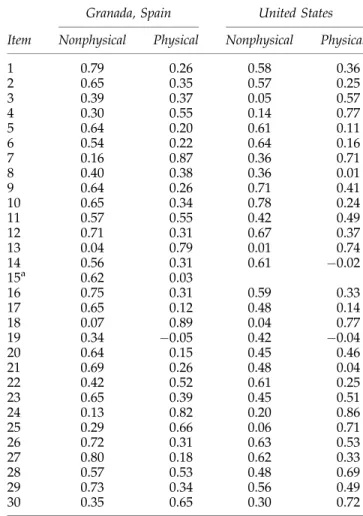
The factorial analysis showed that there were two di-mensions in the scale that explain 52.4% variability of the data. As in the original scale, the first dimension was referred to as ‘‘nonphysical violence’’ and the second as ‘‘physical violence.’’ The items with saturations of >0.50 in the first dimension and those of<0.50 in the second were assigned to the first dimension. Likewise, the items with saturations of >0.50 in the second dimension and those of<0.50 in the first were assigned to the second dimension. Items 3, 8, and 19 of the Spanish version had saturations of <0.50 in both di-mensions. However, these three items had slightly higher saturations in the first dimension. In addition, the content of these items suggests that they should be considered as measurements of nonphysical violence. Items 11 and 28 had saturations of>0.50 in both dimensions. As in the previous case, these two items had slightly higher saturations in the first dimension. In addition, the content of these items sug-gests that they should be considered as measurements of nonphysical violence (Table 3). Although, as in the original scale, factor analysis revealed the existence of two dimen-sions of violence, the assignment of the items to one or an-other subscale differed between the original and the Spanish versions. Items 3, 23, and 28 of the Spanish version were included as measures of physical violence in the original scale and are included as measures of nonphysical violence in the Spanish version. In contrast, item 22 was included as a non-physical item in the original scale and is included as a physical item in the Spanish version. Finally, the nonphysical violence subscale contains 22 items (1–3, 5, 6, 8–12, 14–17, 19–21, 23, 26–29) and physical violence subscale contains 8 ı´tems (4, 7, 13, 18, 22, 24, 25, 30).
Internal consistency analysis
With regard to the correlation each item had with the subscale it hypothetically represented, in all cases, this cor-relation was higher than that with the scale it hypotheti-cally did not represent. In addition, with the exception of item 19, the correlation coefficient for all items and the sub-scale they represented was>0.40. With regard to the inter-nal consistency of the two subscales, the Cronbach alpha was 0.85 for the physical violence subscale and 0.94 for the non-physical violence subscale. It was not necessary to extract any items to improve the internal consistency of the subscales (Table 4).
Test-retest reliability
The scores obtained when the ISA was first applied and those obtained when it was applied for a second time are not statistically different. The intraclass correlation coefficient was 0.97 for the physical violence subscale and 0.90 for the nonphysical violence sub-scale.
Construct validity
The women who stated they were in an average or poor state of health had higher scores on both subscales of violence than those who stated they had a good, very good, or excellent state of health. These differences were only statistically sig-nificant in the case of nonphysical violence (p¼0.049). With regard to self-esteem, a clear dose-response gradient was noted, where self-esteem decreased as violence increased (p<0.001). Similarly, women who showed signs of psycho-logical distress had significantly higher scores in both sub-scales of violence compared with women who showed no signs of morbidity. In addition, the women who stated they had no social support had average scores for physical and nonphysical violence that were higher than the scores for Table2. Sociodemographic and Clinical Features
of Sample(n¼390)
Variable n %
Nationality
Spanish 366 94.1
Ecuadorian 5 1.3
Colombian 5 1.3
Other 13 3.3
Civil status
Married=live with partner 305 78.4
Single 70 18.0
Separated=divorced 13 3.3
Widow 1 0.3
Labor situation
Housewife 104 26.7
Employee 217 55.8
Student 36 9.3
Unemployed 32 8.2
Academics
No studies 19 4.9
Primary education 125 32.4
Secondary education 95 24.6
Intermediate 55 14.2
University 92 23.8
Income level
<600 euros 27 7.5
600–900 euros 81 22.4
900–1200 euros 94 26.0
>1200 euros 160 44.2
Social support
Yes 341 87.7
No 48 12.3
Self-perceived health
Excellent=very good 93 24.0
Good 193 49.7
Regular=bad 102 26.3
Self-esteem
High 277 74.1
Median 66 17.6
Low 31 8.3
Psychological distress
No 266 68.2
Yes 124 31.8
Minimum Maximum Average SD
Age 18 65 36.27 11.27
Number of children 0 8 1.37 1.36
Table3. Factorial Analysis of Index of Spouse Abuse in This Study (Granada,n¼390) and in Study of Authors of Original Version (United States,n¼398)
Granada, Spain United States
Item Nonphysical Physical Nonphysical Physical
1 0.79 0.26 0.58 0.36
2 0.65 0.35 0.57 0.25
3 0.39 0.37 0.05 0.57
4 0.30 0.55 0.14 0.77
5 0.64 0.20 0.61 0.11
6 0.54 0.22 0.64 0.16
7 0.16 0.87 0.36 0.71
8 0.40 0.38 0.36 0.01
9 0.64 0.26 0.71 0.41
10 0.65 0.34 0.78 0.24
11 0.57 0.55 0.42 0.49
12 0.71 0.31 0.67 0.37
13 0.04 0.79 0.01 0.74
14 0.56 0.31 0.61 0.02
15a 0.62 0.03
16 0.75 0.31 0.59 0.33
17 0.65 0.12 0.48 0.14
18 0.07 0.89 0.04 0.77
19 0.34 0.05 0.42 0.04
20 0.64 0.15 0.45 0.46
21 0.69 0.26 0.48 0.04
22 0.42 0.52 0.61 0.25
23 0.65 0.39 0.45 0.51
24 0.13 0.82 0.20 0.86
25 0.29 0.66 0.06 0.71
26 0.72 0.31 0.63 0.53
27 0.80 0.18 0.62 0.33
28 0.57 0.53 0.48 0.69
29 0.73 0.34 0.56 0.49
30 0.35 0.65 0.30 0.72
a
women who said they had social support. This difference was statistically significant (Table 5).
Defining cutoff points
The K-means cluster analysis of the scores for the non-physical violence subscale showed there were two clearly distinct groups. The first group had scores of<14, and the second group had scores14. Similarly, analysis of the scores for the physical violence subscale showed three distinct groups. The first group had scores of <6, the second had scores between 6 and 20, and the last group had scores>20. When the responses of the participants for the subscale items were examined, the second group could be defined as mod-erately abused and the third group as severely abused. As a result, the second and third groups were joined to form a single group. The women with scores of<6, therefore, formed the first group, whereas those with scores of>6 formed the second group. Thus, the cutoff points for the nonphysical and physical subscales were 14 and 6, respectively. Using these cutoff points, 5.9% of the women who took part in the study (n¼23) were classified as victims of physical abuse, and 13.6% (n¼53) were classified as victims of nonphysical abuse.
Discussion
This study analyzes the psychometric properties of the Spanish version of the ISA for evaluation of partner violence against women in a healthcare setting.
A number of limitations should be taken into account when interpreting the results of this analysis. First, the small num-ber of women who agreed to complete the questionnaire a second time for the retest to evaluate reproducibility should be considered. Although the questionnaire was initially in-tended to be completed by a random subsample of 30 women, in the end only 10 women completed it for a second time. As a result, although the instrument has proven itself to have an acceptably high level of reproducibility, the data obtained here should be interpreted with caution. The cross-sectional design selected for this study represents another limitation. Validation of the scales could be carried out using a case-control design or a cross-sectional design. The first would have involved thea prioriselection of abused women (cases) and nonabused women (controls) by recruiting the cases from shelters or care centers for victims of abuse. This would have meant that the criterion validity of the instrument could have been evaluated. However, it would have also caused a sig-nificant selection bias because the cases would only include women who had undergone the most severe forms of violence and had decided to break away from that situation.18Thus, a cross-sectional design was selected that could provide a scale that was sensitive enough to identify women as abused if they suffered violence at the hands of their partner even if they had not yet asked for outside help as a result of the situation. This choice, however, does not allow evaluation of the scale’s cri-terion validity. It also makes it more difficult to define the cutoff points because of a lack of external criteria.
Table4. Internal Consistency Analysis of Each Item on Each Subscale(n¼390)
Nonphysical violence Physical violence
Item ra Alpha r Alpha
1 0.80 0.94 0.49
2 0.70 0.94 0.53
3 0.47 0.94 0.45
4 0.47 0.60 0.83
5 0.62 0.94 0.42
6 0.54 0.94 0.39
7 0.50 0.79 0.82
8 0.49 0.94 0.45
9 0.66 0.94 0.42
10 0.70 0.94 0.53
11 0.72 0.94 0.66
12 0.75 0.94 0.50
13 0.36 0.69 0.84
14 0.58 0.94 0.50
15 0.53 0.94 0.28
16 0.78 0.94 0.50
17 0.60 0.94 0.35
18 0.42 0.78 0.83
19 0.25 0.95 0.12
20 0.61 0.94 0.36
21 0.70 0.94 0.49
22 0.56 0.58 0.85
23 0.72 0.94 0.55
24 0.45 0.68 0.82
25 0.53 0.54 0.85
26 0.75 0.94 0.51
27 0.77 0.94 0.45
28 0.69 0.94 0.67
29 0.76 0.94 0.55
30 0.56 0.67 0.83
Globalb - 0.94 - 0.85
a
r, correlation coefficient item-scale (corrected in the case of correlations between items and the scale they represent); Alpha, alpha of Cronbach of scale without the item.
bAlpha of Cronbach of subscales with all items.
Table5. Association between Two ISA Subscales and Self-Perceived Health, Self-Esteem, Psychological
Distress and Social Support(n¼390)
n
Nonphysical (average)
Physical (average)
Self-perceived health (SF-36)a
Excellent=very good 93 4.22 1.19
Good 193 6.21 1.70
Regular=bad 102 8.28 1.87
pvalue 0.049 0.097
Self-esteem
Low 31 17.86 5.68
Median 66 13.71 4.50
High 277 3.37 0.52
Fratio 39.47 18.01
pvalue <0.001 <0.001
Psychological distress
No 266 3.05 0.54
Yes 124 13.59 3.93
Fratio 72.19 25.23
pvalue <0.001 <0.001
Social support
Yes 341 4.97 1.25
No 48 16.39 4.25
Fratio 39.15 9.45
pvalue <0.001 0.002
With regard to the results, the Spanish version of the ISA is different from the original American version in several ways. Although the scale, like the original version, is made up of a subscale of physical violence and a subscale of nonphysical violence, the method of ascribing the items to one subscale or the other is not the same for both versions (e.g., item 22, He demands that we have sexual relations without considering whether I want to or not, is included in the nonphysical lence subscale in the Spanish version but in the physical vio-lence subscale of the original version). This fact reinforces the need to adapt the ISA to specific groups, as stated in other validation studies.19,20
The psychometric analysis shows that the instrument has good internal consistency, reproducibility, and construct va-lidity, confirming that women with higher ISA scores are in poorer states of physical and psychological health. However, a number of subtleties should be pointed out. First, the wide range of theoretical and conceptual models on which instru-ments to diagnose violence are based is reflected in the questions used. This could lead to a failure to adhere to one of the basic criteria of research through surveys: that the ques-tions have the same meaning for all the people who are an-swering them.29,30The use of some ISA questions to design and validate alternative instruments has given mixed results depending on the different population groups studied. Dif-ferent dimensions of gender-based violence have been iden-tified according to the sample used,31and this is of particular relevance for the items that concern emotional or psycholog-ical violence.
As a result of their content or phrasing, some items pro-posed in these questionnaires may simply describe forms of relationship for a certain partner model and may not neces-sarily reflect violence based on male supremacy.29 More specifically, item 19 (My partner thinks that I should not work or study) had a low internal consistency. This may be because it could easily be interpreted by women as an act of care and protection rather than one of control. In addition, item 5 (My partner gets very annoyed if the dinner, the housework, or the washing are not done when he thinks that they should be), item 14 (My partner is stingy in giving me money to run our home), and item 17 (My partner demands that I stay at home to take care of the children) may not apply to all women, perhaps because they do not live with their partner, they do not depend on their partner for money, or they do not have children, respectively. Despite the low response rate for these items and their good internal consistency, it would be advis-able to include a brief instruction at the beginning of the questionnaire stating that the women should leave blank the items that do not apply to their personal situation.
Conclusion
The good internal consistency and construct validity of the Spanish version of the ISA, as well as the fact that it is easy to understand, confirm that the scale is useful for analysis of partner violence against women both in a research setting and in a healthcare setting. However, given the limited time available in individual consultations in the health setting and given also that partner abuse is only one among several issues addressed by health professionals, shorter instruments could be more appropriate, although shorter instruments are usu-ally screening and not diagnostic instruments. Consequently,
we recommend the ISA to be used by health professionals when time is available, especially in order to confirm results of screening obtained with shorter instruments.
The Spanish version of the ISA is an important starting place to address the problem in a healthcare setting in Spain. Its use in research studies means that knowledge of the problem can be increased and that it can be easily compared with other studies. In addition, its use in a healthcare setting will make it easier to identify women who suffer violence at the hands of their partners.
Acknowledgments
This study was an initiative of the Observatory of Women’s Health, Ministry of Health and Consumers Affairs of Spain, which funded the project.
Disclosure Statement
No competing financial interests exist.
References
1. Ruiz-Pe´rez I, Plazaola-Castan˜o J, Blanco-Prieto P, Gonza´lez-Barranco JM, Ayuso-Martı´n P, Montero-Pin˜ar MI. [Intimate partner violence. A survey conducted in the primary healthcare setting.] Gac Sanit 2006;20:202–208.
2. Heise L, Ellsberg M, Gottemoeller M. Ending violence against women. Population reports. Series L, No. 11. Balti-more: Johns Hopkins University School of Public Health, Population Information Program, 1999.
3. World Health Organization. World report on violence and health. Geneva: World Health Organization, 2002.
4. Coker AL, Smith PH, Fadden MK. Intimate partner violence and disabilities among women attending family practice clinics. J Womens Health 2005;14:829–838.
5. Plazaola-Castan˜o J, Ruiz-Pe´rez I. [Intimate partner violence against women and physical and mental health conse-quences.] Med Clı´n (Barc) 2004;122:461–467.
6. Pico-Alfonso MA, Garcia-Linares MI, Celda-Navarro N, Blasco-Ros C, Echeburu´a E, Martinez M. The impact of physical, psychological, and sexual intimate male partner violence on women’s mental health: Depressive symptoms, posttraumatic stress disorder, state anxiety, and suicide. J Womens Health 2006;15:599–611.
7. Garcı´a-Moreno C. Violence against women. Gender and health equity. Harvard: Harvard Center for Population and Development Studies, OPS=OMS, 2000.
8. Krug EG. The world report on violence and health. Lancet 2002;360:1083–1088.
9. Fontanil Y, Ezama E, Ferna´ndez R, Gil P, Herrero FJ, Paz D. [Prevalence of intimate partner violence against women.] Psicothema 2005;17:90–95.
10. Medina J, Barberet R. Intimate partner violence in Spain: Findings from a national survey. Violence against Women 2003;9:302–322.
11. Women’s Institute. Violence against women. Results from the macro-survey [in Spanish]. Available at www.mtas.es=
mujer=mujeres=cifras=violencia=macroencuesta_violencia.htm Accessed May 9, 2007.
12. Polo C. [Intimate partner violence against women. Related factors implied.] Madrid: University of Alcala´, 2001. 13. Ruiz-Pe´rez I, Plazaola-Castan˜o J, Del Rı´o-Lozano M.
14. Matud P. [The impact of domestic violence on the health of abused women.] Psicothema 2004;16:397–401.
15. Koss MP, Koss PG, Woodruff WJ. Deleterious effects of criminal victimization on women’s health and medical uti-lization. Arch Intern Med 1991;151:342–347.
16. Ruiz-Perez I, Jime´nez Rodrigo ML, Bermu´dez Tamayo C, Plazaola Castan˜o J. Catalogue of screening and diagnostic instruments for physical, psychological and sexual intimate partner violence. Available at www.msc.es=organizacion=
sns=planCalidadSNS=pdf=equidad=genero_vg_01.pdf Accessed May 9, 2007.
17. Coker AL, Flerx VC, Smith PH, et al. Intimate partner vio-lence and continuation in a primary care screening program. Am J Epidemiol 2007;165:821–827.
18. Hudson WW, McIntosh SR. The assessment of spouse abuse: Two quantifiable dimensions. J Marriage Fam 1981;873–888. 19. Campbell DW, Campbell J, King C, Parker B, Ryan J. The reliability and factor structure of the index of spouse abuse with African-American women. Violence Vict 1994;9:259–274. 20. Cook SL, Conrad L, Bender M, Kaslow NJ. The internal validity of the index of spouse abuse in African American women. Violence Vict 2003;18:641–657.
21. lazaola Castan˜o J, Ruiz Pe´rez I, Escriba` Agu¨ir V, Jime´nez Martı´n JM. Spanish adaptation of one diagnostic and one screening scale to detect intimate partner violence in the healthcare setting. Available at www.msc.es=organizacion=
sns=planCalidadSNS=pdf=equidad=genero_vg_02.pdf Accessed May 9, 2007.
22. Nunnally JC, Bernstein IJ. Psychometric theory. New York: McGraw-Hill, 1995.
23. World Health Organization. Putting women’s safety first: Ethical and safety recommendations for research on do-mestic violence against women: Global program on evidence for health policy. Geneva: World Health Organization, 1999. 24. Cattell RB. The SCREE test for the number of factors.
Mul-tivariate Behav Res 1966;1:245–276.
25. Stewart AI, Ware JE. Measuring functioning and well-being: The medical outcomes study approach. Durham, NC: Duke University Press, 1992.
26. Alonso J, Prieto L, Anto´ JM. [The Spanish version of the SF-36 Health Survey (the SF-SF-36 health questionnaire): An in-strument for measuring clinical results.] Med Clı´n (Barc) 1995;104:771–776.
27. Morejo´n AJ, Jime´nez Garcı´a-Bo´veda R, Va´zquez-Morejo´n Jime´nez R. [Rosenberg Self-Esteem Scale: Reliability and validity in a clinical Spanish sample.] Apuntes Psicolo-gı´a 2004;22:247–255.
28. Mun˜oz PE, Tejerina-Allen M, Can˜as F. [Predictive validation study of the General Health Questionnaire (GHQ) in urban population.] Madrid: Fondo de Investigacio´n Sanitaria (ex-pediente 93=0905), 1993.
29. Ruiz-Pe´rez I, Plazaola-Castan˜o J, Vives-Cases C. Methodo-logical issues in the study of violence against women. J Epidemiol Community Health 2007;61:26–31.
30. Ruiz-Pe´rez I, Jime´nez JM. [Intimate partner violence against women. Methodological reflections from the sociology field.] Bilbao: Inguruak 2007;44:309–320.
31. Delgado A, Aguar M, Castellano M, Luna del Castillo Jde D. [Validation of a scale to measure ill-treatment of women.] Aten Primaria 2006;38:82–89.
Address reprint requests to: Isabel Ruiz-Pe´rez Andalusian School of Public Health Campus Universitario de Cartuja Cuesta del Observatorio 4 18080 Granada Spain