
Didactic proposal based on the lexical approach to improve the vocabulary skill among English ii Etudents of the Faculty of Administration Universidad Privada del Norte 2017
118
0
0
Texto completo
(2) “DIDACTIC PROPOSAL BASED ON THE LEXICAL APPROACH TO IMPROVE THE VOCABULARY SKILL AMONG ENGLISH II STUDENTS OF THE FACULTY OF ADMINISTRATION DE LA UNIVERSIDAD PRIVADA DEL NORTE, 2017”. _______________________________. ____________________________. ROXANA GENOVEVA ACUÑA ALCANTARA. M.Sc. MILAGROS CABEZAS MARTINEZ Scientific Consultant’s name. Researcher’s name. Presented to the Postgraduate Unit of Historical Social Sciences of the National University Pedro Ruiz Gallo. To obtain the Mastery degree in Education Science with mention in didactic of English.. RESEARCH PAPER APPROVED BY: _________________________________. Dra. Doris Nancy Díaz Vallejos CHAIRMAN. ___________________________________. M. Sc. María del Pilar Fernández Celis SECRETARY. ________________________________. M. Sc. Elmer Llanos Díaz SPOKESPERSON. March 2019 ii.
(3) DEDICATION. I would like to dedicate my thesis to the almighty GOD who gave me the strength and patience to complete this study.. I also dedicate this thesis to my dear husband and my two children for their patience and love too.. The author. iii.
(4) ACKNOWLEDGEMENTS. Sincere thanks go to those people and institutions that helped me and contributed in the accomplishment of this research. First of all, I am very grateful to my thesis adviser M.Sc. Milagros Cabezas Martinez, for her valuable suggestions and support during the thesis period. I would also like to thank Universidad Privada del Norte - Cajamarca for offering me the place and all the students of English II for their participation in the research during the experimental period. Special acknowledgement goes to my beloved family, who gave me loving encouragement and for their patience. Above all, I wish to thank The Almighty GOD, who heard me when I called on him.. The author. iv.
(5) INDEX DEDICATION…………………………………………………………………………. ii ACKNOWLEDGEMENT……………………………………………………………... iii INDEX…………………………………………………………………………………. iv RESUMEN……………………………………………………………….….…..…….. ix ABSTRACT…………………………………………………………………………… x INTRODUCTION……………………………………………………………………... xi CHAPTER I 1.1. Location and historical background about UPN………..…………………………….. 1 1.2. How the problem arises………………………………………………..................... 7 1.2.1. International context…………………………………………….……………… 7 1.2.2. Latin american context…………………………………………………………. 8 1.2.3. Peruvian context………………………………………………………………... 9 1.2.4. The local context………………………………………………………………..10 1.3. How the problem states and its characteristics ……………………………………12 1.4. Methodology……………………………………………………………………… 14 CHAPTER II 2.1. Theoretical conceptual framework……………………………………………….. 17 2.1.1. Background information…………………………………………………………17 2.1.2. Effects of instructional games on facilitating of students' vocabulary learning…17 2.1.3. The Essentials of Vocabulary Teaching: From Theory to Practice …………….18 2.2. Theoretical basis…………………………………………………………………...18 2.2.1. The lexical approach (Michael Lewis)………………………………………….. 18 2.2.1.1. Types of Lexical Units………………………………………………………... 21 2.2.1.2. Lexis in Language Teaching and Learning…………………………………… 22 2.2.1.3. Pedagogical Sequences………………………………………………………... 23 2.2.1.4. From Input to Output………………………………………………………….. 23 2.2.1.5. From Vocabulary Lists to Words in Context………………………………….. 23 2.2.2. Theory of language by Antony Peters 1983…………………………………………...... 23 2.2.3. Learning vocabulary is an ongoing process that takes time and practice ……….. 23. 2.2.4. What does the research say about vocabulary? …………………………………. 26 v.
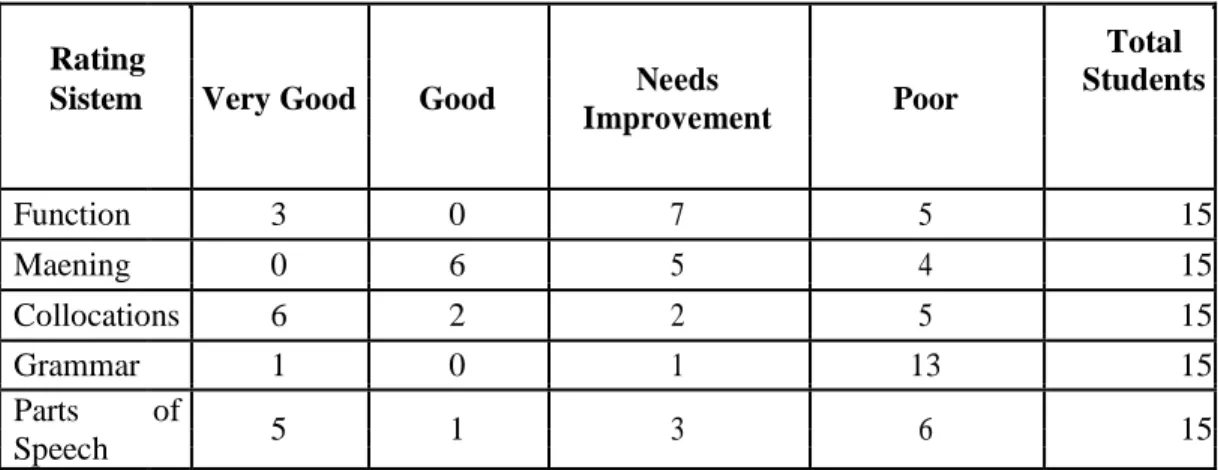
(6) 2.2.5. The Background on Background Knowledge…………………………………… 26. 2.2.6. Poverty, the Brain, and Vocabulary……………………………………………... 30 2.2.6.1. How Are the Brains of Poor Kids Different?………………………………… 30 2.2.6.2. Improving the Systems.. ……………………………………………………... 31 2.2.7. The Three Tiers….……………………………………………………………..... 32. 2.2.8. The “How” of Teaching Vocabulary….……………………………………….... 33 2.2.9. Vocabulary….………………………………………............................................ 34. 2.2.9.1. Language Corpora….………………………………………............................ 34 2.2.9.2. Word meaning….………………………………………................................... 35 2.2.9.3. Extending Word use….……………………………………….......................... 36 2.2.9.4. Word combination….………………………………………............................. 37 2.2.9.5. The grammar of words….………………………………………...................... 37 2.2.10. Learning Strategies….………………………………………............................ 38 2.2.10.1. Consolidation….……………………………………...................................... 38 2.2.10.1.1. Social Strategies….……………………………………….......................... 38 2.2.10.1.2. Memory Strategies….………………………………………...................... 39 2.2.10.1.3. Pictures/imagery….……………………………………….......................... 39 2.2.10.1.4. Related words….……………………………………….............................. 40 2.2.10.1.5. Unrelated words….……………………………………….......................... 40 2.2.10.1.6. Grouping….………………………………………..................................... 40 2.2.10.1.7. Word’s orthographical or phonological form….…..................................... 41 2.2.10.1.8. Other memory strategies………………………………………………….. 42 2.2.10.1.9. Cognitive Strategies……………………………………………………… 43 2.2.10.1.10. Metacognitive Strategies………………………………………………... 44 2.2.10.1.11. Which Strategies do learners use and believe to be helpful?.................... 45 2.3. Glossary………………………………………………………………………....... 45 2.4. Theoretical model………………………………………………………………… 48 CHAPTER II 3.1. Analysis of data………………………………………………………………….,, 49 3.1.1. Quantitative results…………………………………………………………………….,, 49 3.1.1.1. Analysis of the pre-test (vocabulary diagnostic test) applied to diagnose what the students’ vocabulary level was…………………………………………………….... 49. vi.
(7) 3.1.1.2. Analysis of the post-test (vocabulary diagnostic test) applied to diagnose what the students’ vocabulary level was………………………………….... 56 3.1.1.3. Comparative analysis of the pre - test and the post – test………………….. 61 3.2. Problematic situation……………………………………………………………. 61 3.3. Description of the didactical proposal…………………………………………... 62 3.4. Proposal objectives……………………………………………………………… 62 3.5. Didactical proposal structure……………………………………………………. 63 CONCLUSIONS…………………..……………………………………………..….. 64 RECOMMENDATIONS……………………………………………………….…… 66 BIBLIOGRAPPHY………………………………………………………………….. 67 ANNEXES…………………………………………………………………………... 69. vii.
(8) LIST OF TABLES Table 1 Example 3 incorrect form……………………………………………………………………. 13. Table 2 Example 3 correct form…………………………………………………………………….... 13. Table 3 Population of English II students of Faculty of Administration UPN University….. 15 Table 4 Taxonomy of Lexical Items…………………………………………………………………. 22. Table 5 Table of elements of vocabulary…………………………………………………………….. 50. Table 6 Evaluation matrix of vocabulary…………………………………………………………….. 51. Table 7 Pre – test result table………………………………………………………………………… 52. Table 8 Didactical proposal structure…………………………………………………………………… 63. viii.
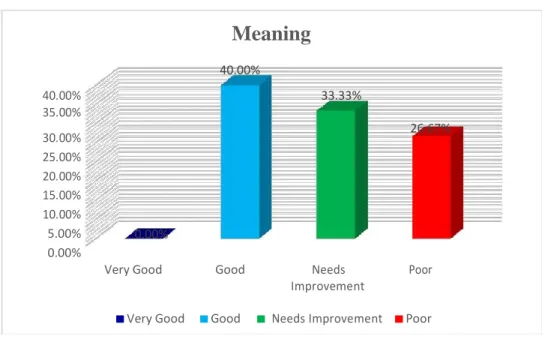
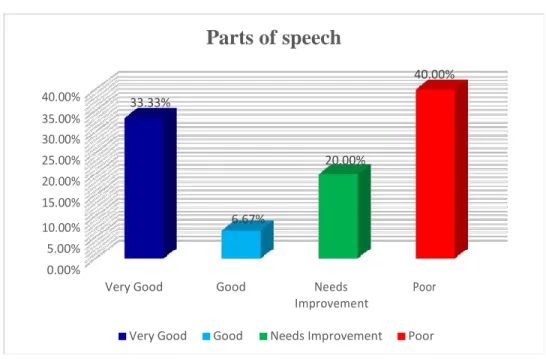
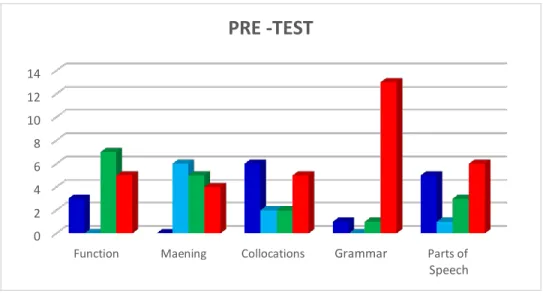
(9) LIST OF FIGURES Figura 1 Morphological Change………………………………………………………………. 38 Figura 2 Function frequency and percentage………………………………………………….. 52 Figura 3 Meaning frequency and percentage………………………………………………….. 53 Figura 4 Collocations frequency and percentage……………………………………………… 54 Figura 5 Grammar frequency and percentage………………………………………………… 54 Figura 6 Parts of speech frequency and percentage……………………………………………55 Figura 7 Pre test results……………………………………………………………………….. 56 Figura 8 Function post-test frequency and percentage……………………………………….. 57 Figura 9 Meaning post-test frequency and percentage……………………………………….. 57 Figura 10 Collocations post-test frequency and percentage…………………………………… 58 Figura 11 Grammar post-test frequency and percentage………………………………………. 59 Figura 12 Parts of speech post-test frequency and percentage………………………………… 59 Figura 13 Post-test summary…………………………………………………………………... 60 Figura 14 Comparative analysis of the pre - test and the post – test…………………………... 61. ix.
(10) RESUMEN. El problema de investigación denominado Propuesta didáctica basada en estrategias para mejorar la habilidad de vocabulario en los estudiantes de Inglés II de la Facultad de Administración de la Universidad Privada del Norte 2017 responde a la situación problemática sobre la carencia de vocabulario, en los estudiantes universitarios, habilidad que juega un papel importante en la adquisición de un segundo idioma. Plantea el objetivo de aplicar la propuesta didáctica basada en estrategias, con la finalidad de mejorar e incrementar el vocabulario de los estudiantes, considerando el uso del enfoque lexical para optimizar el mismo. Presenta una investigación con diseño pre experimental y por su nivel de profundidad es de corte aplicativo. Con respecto a la muestra estuvo conformada por 15 estudiantes, que corresponde a un solo grupo. Se aplicó una pre-test y un post-test para medir el vocabulario de los estudiantes, los cuales fueron evaluados en las dimensiones de Function, Meaning, Collocations, Grammar, Parts of Speech. Después, se prepararon actividades basadas en el enfoque lexical para contrastar si este proceso ayudaría a los estudiantes a incrementar y mejorar su vocabulario. Para ello, se entregó a los estudiantes una hoja de trabajo con actividades adecuadas para lograr el propósito de la investigación. En conclusión, la aplicación de las actividades y estrategias fueron eficaces, logrando mejorar e incrementar el nivel de vocabulario de los estudiantes, comprobando la hipótesis planteada.. Palabras Clave: vocabulario, hoja de trabajo, estrategias de aprendizaje, enfoque lexical. x.
(11) ABSTRACT The research problem called didactic proposal based on strategies to improve vocabulary skills in English II students of the Faculty of Administration of the Universidad Privada del Norte 2017 responds to the problematic situation about the lack of vocabulary, in university students, skill that plays an important role in the acquisition of a second language. Pose the goal to apply the didactic proposal based on strategies, in order to improve and increase the vocabulary of students, considering the use of the lexical approach to optimize it. Which presents a research with pre experimental design and its level of depth is of application. With respect to the sample, it consisted of 15 students, who correspond to a single group. A pre-test and a post-test were applied to measure the vocabulary of the students, who were evaluated in the dimensions of Function, Meaning, Collocations, Grammar, Parts of Speech. Then, activities based on the lexical approach were prepared to test whether this process would help students increase and improve their vocabulary. For this, students were given a worksheet with appropriate activities to achieve the purpose of the research. In conclusion, the application of the activities and strategies were effective, managing to improve and increase the level of vocabulary of the students, verifying the proposed hypothesis.. Keywords: vocabulary, worksheet, learning strategies, lexical approach. xi.
(12) INTRODUCTION One of the most challenging tasks constantly facing language teachers is how to capture the interest and to stimulate the imagination of their students so that they will be more motivated to learn. All languages have words. Language emerges first as words, both historically, and in terms of the way each of us learned our first and any subsequent languages. The coining of new words never stops. Nor does the acquisition of words. Even in our first language we are continually learning new words, and learning new meanings for old words. The number of vocabulary words a beginner student has to learn in the first few months of studying is vast. In order to be able to communicate basic ideas, it is of outmost importance that the EFL beginner student learns the relevant vocabulary necessary to express greetings, give and ask for personal information, ask for directions, in addition to learning colors, numbers, and adjectives to describe people. It goes without saying that students arrive with expectations and doubts about their abilities and possibilities, it is teachers that can help to make this transition easier if they approach this vocabulary learning task in a friendly and easy manner.. In recent years the interest in vocabulary teaching has improved. This is partly due to the recent availability of computerized data bases of words and partly due to the development of new approaches to language teaching which are much more “wordcentred”, such as the lexical approach. The term Lexis is a noun synonym of the word Vocabulary, which refers to “all the words in a particular language”. Therefore, it could be said that when educators instruct 12xii.
(13) vocabulary or lexis, they are teaching how words are used in context (grammar), when it is proper to use them (its function), etc. You can be understood if you make grammatical errors when you speak a language, but you cannot express your ideas if you lack vocabulary.. However, the core vocabulary that will serve in most situations is about 2,000. Therefore, in order to be able to communicate effectively in this language EFL learners must constantly work hard to increment their vocabulary. However, very often vocabulary does not receive enough attention in language classrooms because teachers focus more on teaching and explaining grammar, leaving behind the practice of new lexical items, expecting the students to practice them on their own, not being aware that students generally lack the knowledge of strategies necessary to build up the needed vocabulary.. The motivation behind this study was the difficulty that the researcher observed in the English II students of the Faculty of Administration Universidad Privada del Norte had to learn and remember such an array of new vocabulary words in the English language, and their lack of appropriate learning strategies. Therefore, she decided to carry out the investigation called Didactic Proposal based on the Lexical Approach to improve the vocabulary skill among English II students of the faculty of Administration Universidad Privada del Norte 2017.. The researcher chose to use strategies based on the lexical approach in the EFL classroom because she believes to work with them because it is a highly motivational device to improve students’ vocabulary. When they developed the programmed activities in different worksheets,. 13xiii.
(14) it helped them to understand the words or sentences better. It was a highly motivational resource in improving the vocabulary, and that students enjoy working with them.. Consequently, the present study is proposed to provide students strategies to improve their English language skills in order to get lexical structures easily. By doing this, they will be empowered to select the strategies that best fit their specific learning styles, not only within the frame of the class, but also throughout the rest of their English language studies.. The present work is focused on achieving the following general objective: Determine the Lexical efficiency of vocabulary among English II students of Faculty of Administration UPN – 2017. It also achieves the next specific objectives: -. To diagnose the level of vocabulary of the students through a pre-test.. -. To design and implement a didactic proposal based on The Lexical Approach to improve the vocabulary skill of the students.. -. To evaluate the level of vocabulary after the proposal to validate the improvement.. Furthermore, this work pretends to demonstrate the following hypothesis: If I apply the correct strategies based on lexical approach then the English II students of Faculty of Administration probably will improve their vocabulary at UPN. The present research is divided into three chapters: On chapter 1, Analysis of the object of study, the author writes down the problematic aspect of the object of study, the location where the research was carried out, how the 14. xiv.
(15) problem arises out, its characteristics and a description of the methodology that was used to carry out this research. On chapter 2, the theoretical framework of this work, is based on relevant sources of background literature like approaches, theories and studies that support the use of the lexical approach. On chapter 3, Results and discussion, it is the practical part of the research and it is based on the findings of a pre-test and a post-test that the writers applied to the students during this research. It also includes the Theoretical Proposal to solve the problem boarded.. Finally, the writer presents the conclusions and the recommendations after applying and finishing the research.. xv15.
(16) CHAPTER I ANALYSIS OF THE PROBLEMATIC EDUCATIONAL REALITY OF PRIVADA DEL NORTE UNIVERSITY. 16.
(17) Chapter I In this chapter, the writer presents a general, national and regional view of the problematic educational reality, to arrive at Privada del Norte University, focusing on improving the vocabulary skill among English II students. To end up with the methodology that will be used in this research. 1.1. Location and historical background about Privada del Norte University Peru is located on South America's central Pacific coast. The world's twentiethlargest nation, it borders Bolivia, Brazil, and Chile to the east and south, and Colombia and Ecuador to the north. Lima, the capital, is located on the central coast. Peru's 1,326,074 square kilometers (512,000 square miles) make it roughly the size of Alaska. Lima is approximately the size of Rhode Island. Cajamarca (Spanish pronunciation: [kaxaˈmaɾka]) is the capital and largest city of the Cajamarca Region as well as an important cultural and commercial center in the northern Andes. It is located in the northern highlands of Peru at approximately 2,750 m (8,900 ft) above sea level in the valley of the Mashcon river. Cajamarca had an estimated population of about 226,031 inhabitants in 2015, making it the 13th largest city in Peru. Cajamarca has a mild highland climate, and the area has a very fertile soil. The city is well known for its dairy products and mining activity in the surroundings. Among its tourist attractions, Cajamarca has numerous examples of Spanish colonial religious architecture, beautiful landscapes, pre-Hispanic archeological sites and hot springs at the nearby town of Baños del Inca (Baths of the Inca). The history of the city is. 17.
(18) highlighted by the Battle of Cajamarca, which marked the defeat of the Inca Empire by Spanish invaders as the Incan emperor Atahualpawas captured and murdered here. Geography Cajamarca is situated at 2750 m (8900 ft) above sea level on an inter-Andean valley irrigated by three main rivers: Mashcon, San Lucas and Chonta; the former two join together in this area to form the Cajamarca river. Climate Cajamarca has a subtropical highland climate, which is characteristic of high elevations at tropical latitudes. This city presents a semi-dry, temperate, semi-cold climate with resence of rainfall mostly on spring and summer (from October to March) with little or no rainfall the rest of the year. Daily average temperatures have a great variation, being pleasant during the day but cold during the night and dawn. January is the warmest month, with an average maximum temperature of 72 °F (22 °C) and an average minimum of 45 °F (7 °C). The coldest months are June and July, both with an average maximum of 71 °F (21 °C) but with an average minimum of 38 °F (3 °C). Frosts may occur but are less frequent and less intense than in the southern Peruvian Andes. Economy Cajamarca is surrounded by a fertile valley, which makes this city an important center of trade of agricultural goods. Its most renowned industry is that of dairy products. Yanacocha is an active gold mining site 45 km north of Cajamarca, which has boosted the economy of the city since the 1990s. 18 2.
(19) Transportation The only airport in Cajamarca is Armando Revoredo Airport located 3.26 km. northeast of the main square. Cajamarca is connected to other northern Peruvian cities by bus transport companies. The construction of a railway has been proposed to connect mining areas in the region to a harbor in the Pacific Ocean. Culture Cajamarca is home to the annual celebration of Carnaval, a time when the locals celebrate Carnival before the beginning of Lent. Carnival celebrations are full of parades, autochthonous dances and other cultural activities. A local Carnival custom is to spill water and/or some paint among friends or bypassers. During late January and early February this turns into an all-out water war between men and women (mostly between the ages of 6 and. 25) who use buckets of water and water balloons to douse members of the opposite sex. Stores everywhere carry packs of water balloons during this time, and it is common to see wet spots on the pavement and groups of young people on the streets looking for “targets”. Education Cajamarca is home of one of the oldest high schools in Peru: San Ramon School, founded in 1831. Some of the largest, most important schools in the city include Marcelino Champagnat School, Cristo Rey School, Santa Teresita School, and Juan XXIII School. Cajamarca is also a centre of higher education in the northern Peruvian Andes.. 193.
(20) The city hosts two local universities: Universidad Nacional de Cajamarca (National University of Cajamarca), a public university, while Universidad Antonio Guillermo Urrelo is a private one. Five other universities have branches in Cajamarca: Universidad Antenor Orrego, Universidad San Pedro, Universidad Alas Peruanas, Universidad Los Angeles de Chimbote and Universidad Privada del Norte. Privada del Norte University is located in the city of Cajamarca belongs to the district and province of Cajamarca, in Cajamarca Region. CAJAMARCA REGION Privada del Norte University Cajamarca R.D. Nº 220-2005-CONAFU. Privada del Norte University was founded in Lima in 1993. This University has many branches in different cities like: Lima,Trujillo y Cajamarca. In Cajamarca, Privada del Norte University has an amount of 6000 students, The Mistress of the university is Arq. José Álvarez Barrantes, there are 315 professors. This university has 6 faculties: -. Engineering. -. Sciences of the health 20 4.
(21) -. Communication. -. Arquitecture and Design. -. Bussines. -. Law and Politic Sciences. The Rector of Privada del Norte University, Ing. Andrés Velarde Talleri. He lives and works. in Lima, from this place, he monitors all the branches around Peru. VISION OF PRIVADA DEL NORTE UNIVERSITY. “To be recognized as a university of excellent academic and accessible quality, which trains professional owners of their destiny who perform successfully in a global environment”. MISION OF PRIVADA DEL NORTE UNIVERSITY. “Transform the lives of our students through innovative educational processes that privilege learning, critical thinking and entrepreneurial spirit, allowing them to contribute to the sustainable development of our society and the achievement of their life goals”.. Principles and institutional strategic values Transcendence:. We focus our efforts and processes on positively transforming the lives of our students, collaborators and their environment, seeking to train outstanding and successful graduates for our society.. Integrity: 215.
(22) The coherence that exists between what we say and do and respect for others in any circumstance are the basis of trust on all our levels.. Innovation:. We constantly seek new and practical solutions to contribute to the success of our institution.. Teamwork:. We build high performance teams because we know that listening, valuing opinions, adding talent and commitment will achieve extraordinary results.. Commitment:. We put passion in everything we do, living our values day by day and focusing our efforts towards the achievement of our mission.. Orientation to results:. Our results are based on establishing challenging objectives, overcoming obstacles and motivating the achievement of these. FACULTY OF ADMINISTRATION. We train you to be a leader capable of efficiently managing the human, technological, economic and financial resources to achieve business objectives.. 226.
(23) International work and mirror classes with other universities, debates and discussions, role plays, project development. Use of business simulators to train you in decision making.. Support in innovation and entrepreneurship to develop business ideas and investment projects. Academic trips and technical visits to companies. Business talk shows and entrepreneurship fairs. We are the only university that offers you a speed reading program within the curriculum, so you can strengthen your reading and text comprehension skills in this way.. 1.2. How the Problem Arises 1.2.1. International context At present, English Language has been considered as the key of success for the great majority of people worldwide. A bilingual person has insured an economically stable future in a more and more competitive society.. The English language has developed and is still developing many new varieties in different parts of the world because the language is now being used in communities where other languages already exist and these other languages are leaving traces on nativespeaker English.. English is a West Germanic language that was first spoken in early medieval England and is now a global lingua franca. It is an official language of almost 60 sovereign states, the most commonly spoken language in the United Kingdom, the United States, Canada, Australia, Ireland, and New Zealand, and a widely spoken language in countries in the Caribbean, Africa, and South Asia. It is the third most common native language in the world, after Mandarin and Spanish. It is widely learned as a second 23. 7.
(24) language and is an official language of the United Nations, of the European Union, and of many other world and regional international organizations.. English, besides forming new words from existing words and their roots, also borrows words from other languages. This process of adding words from other languages is common place in many world languages, but English is characterized as being especially open to borrowing of foreign words throughout the last 1,000 years. The most commonly used words in English are West Germanic. The vocabulary of English is vast, and counting exactly how many words English (or any language) has is impossible.. English speakers from around the world can communicate with one another effectively. Different accents are distinguished only by phonological and phonetic differences among speakers, whereas dialects also display grammatical and lexical differences.. 1.2.2. Latin american context In Latin America, nowadays English is one of the most important languages that people want to learn, not only for communication but also if they want to get a degree or a good job. We have to take into account how important is that we improve this second language as well as our mother tongue, not only in learning grammar, phonetics, etc. but also in vocabulary, because we know that vocabulary development place a key role in language learning.. Latino parents know that language is a key to cultural identity and losing it would reduce the chances to preserve their native culture. But language also opens possibilities to. 24 8.
(25) enrich their own culture and to spread it to others as well. And this is what the goal should be.. Learning English as a second language is similar to receiving a key to a second culture. This second key comes with a number of benefits; first, and perhaps most important, we have the chance to communicate with people from other cultures. We can use this ability to interact to spread our own culture and educate others.. In general, the level of English in Latin America is low and there are a lot of places that need to be better in it. Almost all the countries in the region have programmes to improve the education in the English language, but we have to select from all strategies and approaches the best to apply.. 1.2.3. Peruvian context. In Peru, the majority of students have a lot of weakness in vocabulary skills. This is because teachers have not found yet the appropriate way to teach “vocabulary”.. 1.2.3.1. Poor training from teachers and less time dedicated for English classes have influenced the results Peru dropped 10 ranking points in the English Proficiency Index, an index put together by Education First (EF) that evaluated people's English proficiency from 72 countries that do not have it as an official language. Peru was ranked 45 out of 72 countries, while in Latin America it was in 8th. The overall performance of Peruvians for English as a second language was 49.83 points, which this ranking labels as a “low level”. 25 9.
(26) Peru dropped 10 places from the ranking published last year, where it placed 35 out of 70 countries. In this regard, EF’s academic director, Giorgio Lemmolo, explained that the training of English teachers and fewer hours of teaching influence the results. “Peruvians do not have a lot of exposure to the language, they do not use English media.. They do not see a movie in English with English subtitles,” he added.. According to Lemmolo, approximately nine thousand Peruvians took an online English proficiency exam to obtain this result. Around one million people in the world also participated in the evaluation. Lemmolo said that despite these results, “young people speak better English than older people, and there is slowly a trend of improvement.” She also explained that “overall” women performed better than men on this test.. 1.2.4. The local context Universidad Privada del Norte, English II students do not have enough vocabulary. It causes a big problem such as they express their ideas in oral and written form using their mother tongue. At the same time, they cannot develop reading comprehension because they have a lack of vocabulary to understand the context of readers and they cannot develop the listening skill either. This is the reason they cannot communicate each other using a second language (English). The main objective is that these students learn “vocabulary learning strategies” to improve their vocabulary and they can communicate with others. English is more and. 26 10.
(27) more necessary for success in adult life, it is more and more important that the students are successful in it.. As well as we know, vocabulary is a big problem into the Teaching and Learning process and teachers have to be able to find some solutions. Teachers need to accept that the learning of new words involve a period of “initial fuzziness”, teaching should direct attention to the sound of new words, particularly the way they are stressed.. Students need to wean themselves off a reliance on direct translation from their mother tongue. Learners need to use the appropriate strategies to organize their mental lexicon taking into account the words that they have to know.. The amount of vocabulary EFL students have to learn throughout their studies is enormous. Having to learn and remember so many new vocabulary words in a foreign language is a difficult challenge for young adult individuals who register in an English course for the first time. The students come with many expectations but they are also totally dependent on the teacher to guide them in this learning process: to pronounce a new word, to explain its grammatical position, its usage. On the teacher’s side there are two major challenges the EFL teacher has to consider: 1. Finding ways to present new vocabulary 2. Try to cover students’ needs and expectations in a large class. For these reasons, the teacher has to take into consideration the students’ needs, it is imperative to search for “vocabulary learning strategies” to help students to improve their vocabulary learning. Similarly, it is also necessary to find “vocabulary teaching strategies”. 2711.
(28) to assist the teacher in performing his or her duties in different and motivating ways while, at the same time, helping students to become autonomous and independent learners.. The challenge of a basic EFL student is to cover a range of 1000 words to communicate effectively.. 1.3. How the Problem States and Its Characteristics We have observed that English II students of Faculty of Administration UPN do not use “vocabulary learning strategies”. 1. They have trouble in communicating with others and speaking fluently. In this way, students feel afraid and nervous when they have to make dialogues this is because they do not feel confident about the language.. Example 1 When the students make a dialogue, their answers are only Yes or No, this is because they do not have enough vocabulary. A: Do you have any brothers or sisters? B: Yes/No (this is wrong answer, because according to the question the student has to specify if he/she has only brothers or sisters or both). 2. Another thing is that the first language is their support but can also be a potential block to the development of a second language lexicon.. In consequence, many times they have to communicate using their mother tongue, they feel frustrated and find really hard to express; because they do not know the appropriate words to express their own ideas or opinions. 1228.
(29) Example 2 A: Where do you go? B: I go to the parquet 3. Students have problems when they classify the words into categories.. Example3 Put the words from the box in the correct column.. Table 1. Example 3 incorret form. everyday house. nouns Always. normally. happy. eatbeautiful. study. every week. verbs. adjectives. normally. eat. always lawyer. adverbs house. time expressions beautiful. The correct form is: Table 2. Example 3 correct form. nouns House. verbs. adjectives. eat. beautiful. 13 29. adverbs normally. time expressions always.
(30) Acquiring new lexical structures from a target language is one of the most important factors in learning a language, firstly because you can be understood if you make grammatical errors when you speak a language, but you cannot express your ideas if you lack vocabulary. Secondly, because it is said that an educated native speaker will probably have a vocabulary of around 20,000 words or word families. Therefore, in order to be able to communicate effectively in this language an EFL learner must constantly work hard to increment his or her vocabulary. However, very often vocabulary does not receive enough attention in language classrooms because teachers focus more on teaching and explaining grammar, leaving behind the practice of new lexical items, expecting the students to practice them on their own, not being aware that students generally lack the knowledge of strategies necessary to build up the needed vocabulary.. 1.4. Methodology This type of research is pre-experimental, because it was applied to only one group. During the investigation, the observation technique with worksheets was used. This is based. On the quantitative positivist approach, because it assumes a deductive perspective; In addition to analyzing, measuring, quantifying and statistically testing tha data obtained, Using scientific objectivity in relation to the improvement of the level of vocabulary in English II students of administration UPN. According to Hernández (2014), the quantitative approach is sequential and probative, since it uses data collection to test hypotheses in relation to statistical analysis in order to test theories. He also states that the quantitative approach uses experiments and causeeffect analysis, which leads to a sequential and deductive process, to achieve a generalization of results, predictions, control of phenomena and the possibility of developing replicas with said research. 30. 14.
(31) The design is as follows:. G. 01 -X-. 02. Key: G: Group 01: Pre-test. 02: Post –test X: Treatment. Population and sampling -. Table 3 Population: There is a population of 15 English II students of Faculty of Administration UPN University.. English Level English II. Male students 12. Female students 3. Total students 15. Source: The chart above was provided by the Coordinator (taken from the Evaluation Assistant Register- 2016-I English II) at Universidad Privada del Norte.. -. Sampling: It will be composed by the same number of students of Universidad Privada del Norte. In order to carry out this project, it was necessary to apply the following methodology. The bibliographic method was used in order to collect scientific information regarding to the use of the Lexical approach to improve vocabulary skill.. 1531.
(32) Also, the quantitative method was taken in order to collect data from students through and tests.. The first step was the collection of bibliographic information related to the use of the Lexical approach in order to improve the vocabulary. The sources used to collect this information included books, web sites, and articles.. The next step was to create a pre-test in order to sound out and find out the level of development of vocabulary as well as to know what vocabulary dimensions, they would be able to reinforce with the develop of different activities.. This pre-test was applied to 15 students chosen at random. It included written tasks in order to be worked individually and it was carried out on July 26, 2017. (see appendix 1). The following stage was the creation of ten lesson plans. (see appendix 2) including designed activities based on the Lexical approach especially for elementary students to improve their vocabulary during the month of July, August and September.. After two months of the application of the PROPOSAL, a post-test was applied to find out if the use of the Lexical approach as a good mean to accomplish the purpose of this research. The post-test was applied on October 20,2017.. 32 16.
(33) CHAPTER II THEORETICAL – CONCEPTUAL FRAMEWORK. 33.
(34) 2.1. Theoretical conceptual framework. 2.1.1. Background Information The term Lexis is a noun synonym of the word Vocabulary, which refers to “all the words in a particular language”. Therefore, it could be said that when educators instruct vocabulary or lexis, they are teaching how words are used in context (grammar), when it is proper to use them (its function), how they sound and how they should be pronounced. It is important to note that the lexicon belongs to the registry of an entire geographic community, which implies the knowledge of that registry by each of its inhabitants, which gives it a virtuality plane, since it exists only in the mind of the speaker. However, the vocabulary implies rather the knowledge and use of a series of terms, but by a single person, that is, it is determined when it makes use of terms at the time of the communicative act (Moliner, 2000).. 2.1.2. Effects of instructional games on facilitating of students' vocabulary learning This quantitative research was situated in Urmia, Iran. Its aim was to identify how games may facilitate the teaching process and help students to learn vocabulary. Also, it tried to find out whether games can improve ESL learners' vocabulary learning as well as identify the potentiality of using games for literary training. The participants for this case study were 70 students in two classes of Noor primary school in Urmia, Iran. The samples of the study were 12- 13-years old female students of the low intermediate level and mostly came from the same socio-economic background. These students were divided equally into control and experimental group. Dolati and Mikaili (2011) collected data by utilizing a pre-test and a post-test in the beginning and at the end of the study and a game called “The charade”. 17 34.
(35) The pre-test and post-test method allowed them a chance to empirically evaluate the effectiveness of their instruction and assess the vocabulary acquisition of their students through formative assessment. However, tests only could show, by before and after tests, what changes have occurred. Tests could not reveal in fine detail just how changes occurred in day-to-day activities, negotiations and decisions.. In my point of view games are a good way to motivate the students to learn vocabulary and avoid they feel boring in the class.. 2.1.3. The Essentials of Vocabulary Teaching:. From Theory to Practice (Aleidine J.. Moeller, OlhaKetsman, LeylaMasmaliyeva – University of Nebraska – Lincoln) Aleidine J. Moeller, Olha Ketsman, Leyla Masmaliyeva point out when teachers are equipped with the knowledge of what, why, and how students best acquire vocabulary and language in the foreign language classroom, they can clearly articulate and illustrate to students, parents, and other constituents why they employ pedagogical practices which are designed to increase language proficiency efficiently and effectively. According with them through the integration of multimedia, language acquisition and learning theory, authentic texts and visuals, and alignment with standards, language learners will feel more success and competence and grow more confident in their ability to communicate in their second language resulting in increased learning and self-motivation.. I think, nowadays the learning of vocabulary is easier with the integration of different aids and people around you.. 18 35.
(36) 2.2. Theoretical basis 2.2.1. The lexical approach (Michael Lewis) Proposes that fluency is the result of the acquisition of a large store of fixed and semi-fixed prefabricated items which are available as the foundation for any linguistic novelty or creativity.. A lexical approach reflects a movement away from a purely structural view of language, a movement where Lexis, rather than grammar, plays a primary role in the acquisition of language. Language, is that in The Lexical Approach, vocabulary is considered not only as single words but as chunks of language. “Language consists not of traditional grammar and vocabulary but often of multiword prefabricated chunks.”. What is more, individual language learners have large stores of these prefabricated chunks of language in their memories, which they draw on when creating output, either written or spoken.. It is important to note that these chunks are fixed or semi-fixed. Fixed are set expressions such as: How do you do? While semi-fixed expressions allow variations within the phrase: According to the authors/ writers/publicists, the main advantage is…. These multi-word items are divided in four different categories: 1.. (a) Words e.g. push; fruit; exit. They are not frequent but they have high information content. (b) Polywords e.g. by the way, on the other hand. They are frequent but they have low information content. They are used to generate patterns 19 36.
(37) 2.. Collocations e.g. an initial reaction, to assess the situation; do a job. They consist of two word combinations that can and must go together.. 3.. Fixed expressions or institutionalized utterances e.g. I’ll see what I can do; It’s not the sort of thing you think it will ever happen to you; Certainly not! These are expressions with a strong pragmatic meaning, they have a clear function.. 4.. Sentence frames or heads e.g. Considerable research has been done in recent years on the question of…; At present, however, expert opinion remains divided; some experts believe that…; That’s all very well but… Suggesting that language should be taught in such a Lexical approach is not without. problem. However, In the first place no one has yet explain how the learning of fixed and semi-fixed phrases come be incorporated into the understanding of a language system. Indeed it come be argued that learning the system is a vital prerequisite of the ability to string phrases together into to coherent whole. Otherwise we are left with the danger of having to learn an endless succession of phrase-book utterances,’all chunks but no pineapple’.. Another problem is the way in which we might order such phrases for teaching a learning purposes or, if we believe that exposure enough suitable input is the key, what kind of input that should be.. Finally, we need to ask in what way the Lexica approach differs from other accounts of language teaching since there are as yet no sets of procedure to exemplify, an approach to language learning.. Despite these reservations, however, the Lexical approach has certainly drawn our attention to facts about the composition of language; what it has not yet done is make the leap 20 37.
(38) from that stage to a set pedagogic principles or syllabus specifications which could be incorporated into a method.. The developers decided to move away from the traditional grammatical syllabus and adopt. features of the Lexical Approach instead. Lewis suggests the following: -. Lexis is the basis of language.. -. Grammatical mastery is not a requirement for effective communication.. -. Any meaning-centered syllabus should be organized around lexis rather than grammar.. 2.2.1.1. Types of Lexical Units Lewis also suggests that Native speakers have a large inventory of lexical chunks that are vital for fluent production. Chunks include collocations and fixed and semi-fixed expressions and idioms. Fluency does not depend on a set of generative grammar rules and a separate store of isolated words, but on the ability to rapidly access this inventory of chunks. These chunks occupy a crucial role in facilitating language production and are the key to fluency. Two points to remember about lexical chunks: learners are able to…. -. Comprehend lexical phrases as unanalyzed wholes or chunks.. -. Use whole phrases without understanding their constituent parts.. 21 38.
(39) Table 4 Taxonomy of Lexical Items. Lexical Item. Examples. Words. book, pen. Polywords. by the way, upside down. Collocations. Prices fell, rancid butter. Institutionalized utterances. I'll get it; That'll do. Sentence frames and heads. That is not as [adjective] as you think; The danger was.... Text frames. In this paper we will explore...; Firstly... Fuente: Lewis. (1997).. 2.2.1.2. Lexis in Language Teaching and Learning The language activities consistent with the lexical approach must be directed toward naturally occurring language and toward raising learners' awareness of the lexical nature of language. Activites of this nature include the following: -. intensive and extensive listening and reading in the target language. -. first and second language comparisons and translation. -. repetition and recycling of activities to keep words and expressions that have been learned active. -. guessing the meaning of vocabulary items from context. -. noticing and recording language patterns and collocations. -. working with dictionaries and other reference tools. -. working with language corpuses to research word partnerships, preposition usage, style, and so on. 3922.
(40) 2.2.1.3. Pedagogical Sequences A typical pedagogical sequence for vocabulary learning often contains multiple progressions. For example, there is often a progression from receptive skills to productive skills combined with a progression from decontextualized to contextualized vocabulary. 2.2.1.4. From Input to Output Lee and Van Patten state to advocate the principles of Processing Instruction, an inputoriented approach to grammar instruction, to the teaching of vocabulary. Within processing instruction, learners must understand the meaning of the words in order to perform a given task. Early input-based activities that emphasize receptive skills slowly give way to outputbased activities that require production.. 2.2.1.5. From Vocabulary Lists to Words in Context The second kind of vocabulary progression focuses on the level of contextualization of a vocabulary word. Learners first encounter vocabulary words in minimal contexts such as vocabulary lists. As the sequence progresses, learners encounter the same vocabulary items in more richly contextualized speech and written texts. 2.2.2. Theory of language by Antony Peters 1983 He consider three theoretical views of language: the first and the most traditional, is the structural view, the view that language is a system of structurally related elements for the coding of meaning. The target of language learning is seem to be the mastery of elements of this system, which are generally defined in terms of phonological units (eg. Phonemes), grammatical units (eg. Clauses, Phrases,sentences), grammatical operations (eg. Adding, shifting, joining or transforming elements).. 23 40.
(41) And lexical items (eg. Function words and structure words,the Audiolingual Method embodies this particular view of language, as do such methods as Total Physical Response and the Silent Way. The second view of language is the Functional view, the view that language is a vehicle for the expression of Functional meaning. The communicative movement. This theory emphasizes the semantic and communicative dimension rather than merely the grammatical characteristics of language, and leads to a specification and organization of language teaching content by categories of meaning and function rather than by elements of structure and grammar. The third view of language can be called the Interactional view. It sees language as a vehicle for the realization of interpersonal relations an3d for the performance of social transaction between individuals. Language is seen as a tool for the creation and maintenance of social relations. Areas of inquiry being drawn on in the development of interactional approaches to language teaching include Interaction analysis, conversation analysis and ethnomethodology.. 2.2.3. Learning vocabulary is an ongoing process that takes time and practice Nakata (2006) acknowledged that vocabulary acquisition requires continual repetition in order for effective vocabulary learning. Vocabulary acquisition is not something a student can spend time learning or memorizing, like grammar, and be successful. Acquisition requires the learner to be disciplined, spending time each day working on words he/she does not know in order for learners to remember high frequency words and put them into their long term memory.. Others like Nation and Waring pointed out that learners need to encounter the word multiple times in authentic speaking, reading, and writing context at the student’s appropriate level. Developing lessons which allow the student to encounter new words multiple times, allowing them to put the new words into his/her long term memory can be time consuming.. 24 41.
(42) Developing word lists from the context of the lesson can reduce the work load, enabling the student to encounter the word multiple times through reading, listening, and speaking.. Learning new vocabulary through context also helps the student understand the word’s correct usage and prevents students from making sentences from dictionary definition such as, there is a large cleavage between the rich and poor in America. Learning new words from a word list is much different from learning them in the context of a sentence or story. Yongqi Gu (s/f) stated that learning new words through context is only one step students may use, and that students should think meta- cognitively and learn new words within the context of where they appear. To help the student learn the important words from the context of a lesson a teacher needs to focus on low context words, which necessitates a second distinction: high frequency and low frequency words. Nation defined high frequency words as words that occur quite frequently in the language, such as the, a, man, and woman. High frequency words occur so regularly in daily conversation that if students understand these words, they are able to write and speak in comprehensible English.. Low frequency words, as described by Nation, are words that deal more with academic studies, words that appear throughout all academic texts and courses, but not very often in day to day speech, such as formulate, index, and modify. This helps ease the burden a teacher has when trying to understand what words students understand; however, low frequency words are the more difficult aspect for teachers to teach and learners to understand. Creating vocabulary lists from the students’ textbooks and presenting these words through context in the lesson should help them to retain and use the new vocabulary. It will also carry through that students learn vocabulary better when they find the items to be useful and are able to put the new words into use more often while they study. 2542.
(43) Vocabulary, like other aspects of language learning, can be facilitated when done through cooperative learning. Yongqi Gu (s/f) pointed out that vocabulary acquisition is a very learner-centered activity with the effectiveness of the learner’s strategies depending on his/her attitude and motivation towards new vocabulary acquisition. This is true because the main motivational learning factor must come from the student, but when learning vocabulary in a cooperative learning environment it allows students to learn from peers closest to them.. Murphey and Arao pointed out that students felt more relaxed and learned more from peers since they saw that making mistakes is acceptable, having goals is good, and learning English can be fun. So, even though vocabulary acquisition is a learner-centered activity in regards to studying and being disciplined to set goals, when done in collaboration with peers students may enjoy the activity more, learning more vocabulary in the end. Understanding that vocabulary learning is an ongoing process, that learning new vocabulary through context, and learning new vocabulary can be done cooperatively are what guided the classroom practices below. 2.2.4. What does the research say about vocabulary? According to Marzano and Pickering one of the key indicators of students’ success in school, on standardized tests, and indeed, in life, is their vocabulary. The reason for this is simply that the knowledge anyone has about a topic is based on the vocabulary of that information.. There are a variety of factors that affect student achievement, including the effectiveness of the teacher, the student’s own personal interest in the content matter, and the amount of information students already possess about the content. “Prior knowledge” is a term with. 4326.
(44) which most educators are familiar. In neuroscience terms, we are talking about long-term memory. And, yes, prior knowledge, also known as background knowledge, consists of networks in the brain that have been placed in permanent memory. 2.2.5. The Background on Background Knowledge According to Marzano, background knowledge is acquired through the interaction of two factors: the ability of the student to process and store information and the regularity with which a student has academically oriented experiences. Professional educators know that the amount of background knowledge our students have may rely a great deal on their cultural differences and their economic status.. Not only does background knowledge grow in the brains of our students through their experiences, but the vocabulary words that are stored as a result of such experiences provide avenues to comprehend the curriculum from the text, as well as lecture and discussion. We can look at the work of Piaget, who concluded that we organize information in our brains in the form of a schema, a representation of concepts, ideas, and actions that are related.. Schemata (the plural of schema) are formed in our brains through repeated and varied experiences related to a topic. As a neuro educator, one who teaches students and teachers based on current brain research, I like to refer to schemata as those networks in the brain that we form, store, re-form, and restore through our interactions in the world through both experience and environment. It is the brain’s ability to change known as neuroplasticity that allows us to learn and form lasting memories… Yet, as new evidence presents itself, the brain can change to accommodate the new information.. 4427.
(45) Often long-term memory is compared to files in our brains. Just as you store files on your computer or tablet, the brain stores information in ways that allow it to retrieve concepts, ideas, and actions in an orderly and expeditious manner. Consider, if you will, the file you have stored for “school.” As an educator, you may have stored in that file what you liked or loved about school that brought you to the classroom and perhaps beyond. In that file you may also have memories of your own school days, beginning with preschool and going through the university degrees you may have. Certain teachers who are role models for you are stored in this file, as are teachers you would not want to emulate. If you have been in education for a while, there are many “buzzwords” that have been used throughout the years that were considered best practices in teaching. Today you have probably added terms like differentiation, Response-to-Intervention, and Common Core State Standards. All of this, and much more, refers to your background knowledge of “school.”. All of our students have a school file (or schema) in their brains as well. Their files are likely very unique to their experiences with schools and teachers, their cultures, their parents views of education, and their personal success in school.. It is no easy task to build background knowledge in students who enter our classrooms with few academic experiences from other classrooms or from real-world involvement. Background knowledge is a reflection of who they are; it is the lens through which they see the world. Those students from low-income families see school in a different light. School may be a place to be safe when home is not. School may be inconsequential to those who believe their “street smarts” will get them farther in life than school smarts. School may feel dangerous to some students whose parents identify school as a place where they felt stupid or unappreciated. Many students from impoverished backgrounds enter school with little 28 45.
(46) knowledge of a world outside the streets where they live. If their poverty was pervasive throughout their short lives, factors such as lack of nutrition or exposure to toxins may have stunted the growth of their brains, which affects their cognitive abilities.. According to educational research by Hart and Risley, children enter school with “meaningful differences.” The differences that did not appear to be meaningful were things like race, ethnicity, birth order, or gender. What made a big difference among students was economics. Hart and Risley state, “by age 3 the children in professional families would have heard more than 30 million words, the children in working class families 20 million, and the children in welfare families 10 million”. Interestingly, although the number of words spoken was different, the topics and the style of speech were similar. The parents who spoke to their children more began to ask questions, vary their vocabulary, and in general offered the kids a rich language experience. In addition to counting the number of words that were spoken to the children, Hart and Risley also examined the types of reinforcement the children received.. The number of affirmative statements as opposed to prohibitory statements was tallied for each socioeconomic group. The professional parents offered affirmative feedback much more often (every other minute) than the other groups. The welfare parents gave their children more than twice as many prohibitions as the professional parents. Some children in professional families heard 450 different words and 210 questions in the three hours the parent spoke most. Another child from a low-income family heard fewer than 200 different words and 38 questions in that same amount of time. The results of the study lead all to believe that the. 29 46.
(47) single-most important component of child care is the amount of talking occurring between child and caregiver. Consider these facts: -. Vocabulary is a strong indicator of student success. -. The number of words students learn varies greatly: 2 vs. 8 words per day 750 vs. 3,000 per year. -. Printed school English, as represented by materials in grades 3 to 9, contains 88,533 distinct word families.. -. 88,533 word families result in total volumes of nearly 500,000 graphically distinct word types, including proper names. Roughly half of 500,000 words occur once or less in a billion words of text.. -. In grades 3 through 12, an average student is likely to learn approximately 3,000 new vocabulary words each year, if he or she reads between 500,000 and a million running words of text a school year.. -. Between grades 1 and 3, it is expected that economically disadvantaged students’ vocabularies increase by about 3,000 words per year, while middle-class students’ vocabularies increase by about 5,000 words per year.. -. Children’s vocabulary size approximately doubles between grades 3 and 7.. 2.2.6. Poverty, the Brain, and Vocabulary Students from low-income families are part of the at-risk population who have heard fewer words and may have brains that are not as cognitively efficient for some of the work ahead of them in school and in life. Research supports the need for these students to have some extra resources. The remarkable ability of the brain to change has been seen in students with many different kinds of deficits. Poverty can cause physical differences in the brain as well as behavioral differences. According to Harris, three areas drive school behavior: 3047.
(48) 1. A desire for reliable relationships. Much research looks at the teacher- student relationship as a driving force for motivation, socialization, and academic performance. 2. A desire for social acceptance by peers. In order for students to seek academic achievement, it must be socially acceptable to achieve it. Your school must create a culture that supports and encourages good academic behavior. 3. A desire for social status. Students want to feel special. The emotional brain contains an affective filter that will allow information to go to higher levels of thinking under the right conditions. Negative feelings, lack of social status, and low peer acceptance will keep the brain focused on these and prevent cognitive function.. 2.2.6.1. How Are the Brains of Poor Kids Different? Several areas of the brain are different in low-income and middle-income students. Using the work of Farah, Noble, and Hurt, we can examine five systems that are responsible for overall school functioning: -. The executive system, which engages the prefrontal cortex of the brain. This structure is crucial to working memory, future planning, delaying gratification, and decision making.. -. The language system, which involves the temporal and frontal lobes of the left hemisphere. This system is our reading system and contains the structures that allow students to decode, pronounce, and comprehend.. -. The memory system, which allows students to process semantic learning (text, lecture, pictures, etc.) and then store it. This system is responsible for one-trial learning and the ability to retain a representation of a stimulus after a single exposure to it. Our emotional center and our memory center are next to each other, which explains why emotions influence our memories.. 31 48.
Figure


+7


Documento similar
Government policy varies between nations and this guidance sets out the need for balanced decision-making about ways of working, and the ongoing safety considerations
In the “big picture” perspective of the recent years that we have described in Brazil, Spain, Portugal and Puerto Rico there are some similarities and important differences,
Keywords: iPSCs; induced pluripotent stem cells; clinics; clinical trial; drug screening; personalized medicine; regenerative medicine.. The Evolution of
Astrometric and photometric star cata- logues derived from the ESA HIPPARCOS Space Astrometry Mission.
The photometry of the 236 238 objects detected in the reference images was grouped into the reference catalog (Table 3) 5 , which contains the object identifier, the right
Díaz Soto has raised the point about banning religious garb in the ―public space.‖ He states, ―for example, in most Spanish public Universities, there is a Catholic chapel
teriza por dos factores, que vienen a determinar la especial responsabilidad que incumbe al Tribunal de Justicia en esta materia: de un lado, la inexistencia, en el
What is perhaps most striking from a historical point of view is the university’s lengthy history as an exclusively male community.. The question of gender obviously has a major role
