THE EFFECT OF ABILITY-GROUPING TECHINIQUES ON STUDENTS’ PERCEPTIONS OF SPEAKING TASKS
Tesis de Pregrado para optar al título de Profesor de Inglés para la Enseñanza Básica y Media
Autores: Catalina Guerra Díaz, Alejandra Martin Riveros, Catalina Pulido Quintana, Gonzalo Salas Rivas, Felipe Soto Quiñones
Profesor Guía: Carol Gómez Merino
ii
ACKNOWLEDGMENTS
First, after this long process we would like to thank our alma mater Universidad Andrés Bello. The Faculty of Education has given us the opportunity to learn under an outstanding English program. Teachers have provided us with the proper tools to get where we are now, and have prepared us to successfully face this thesis process. Furthermore, the course that was most helpful to get through this process was Educational Research, conducted by Carol Gómez, in which we learned all the terminology and concepts that were necessary to write ideas properly.
In spite of the fact Carol Gómez taught Educational Research I and II, we were fortunate to have her as our teacher guide for our thesis as well. She guided our writing and provided us with knowledge and ideas to carry on through the semester. She was always there for us, including weekends and after class hours, and she was always willing to answer any question.
iii
Table of Contents
Abstract... vi
1. Introduction ... 9
1.1 The Chilean EFL Context ... 9
1.2 Theoretical Motivation ... 11
1.3 Pedagogical Motivation ... 13
1.4 The Current Study ... 15
2. Literature Review ... 16
2.1 Ability Grouping ... 16
2.1.1 Homogeneous grouping. ... 17
2.1.2 Heterogeneous grouping. ... 19
2.1.3 Learners‟ levels of ability. ... 22
2.1.3.1 High-ability learners.... 22
2.1.3.2 Middle-ability learners. ... 22
2.1.3.3 Low-ability learners. ... 23
2.2 Speaking as a Linguistic Skill... 23
2.2.1 The importance of promoting speaking skills. ... 24
2.2.2 Principles for teaching speaking skills. ... 25
2.2.3 Types of classroom-speaking performance. ... 27
2.2.3.1 Imitative speaking. ... 27
2.2.3.2 Intensive speaking. ... 27
2.2.3.3 Responsive speaking. ... 27
2.2.3.4 Transactional speaking. ... 28
2.2.3.5 Interpersonal speaking. ... 28
2.2.3.6 Extensive speaking. ... 28
2.2.4 Learners‟ perceptions of speaking tasks. ... 29
2.3 The Current Study ... 29
3. Methodology ... 31
iv
3.2 Context and Participants ... 32
3.3 Instruments ... 32
3.4 Procedures ... 33
3.5 Data Analysis ... 35
4. Results ... 36
4.1 Learners‟ Perceptions of Ability Grouping: Mode Measures ... 36
4.2 Learners‟ Perceptions of Ability Grouping: Percentage Measures ... 38
4.2.1 Learners‟ perceptions of interpersonal speaking tasks. ... 39
4.2.2 Learners‟ perceptions of transactional speaking tasks. ... 40
4.2.3 Learners perceptions of extensive speaking tasks. ... 42
4.3 Learners‟ Perceptions of Ability Grouping: Questionnaire Comments ... 45
4.3.1 Participants comments on interpersonal tasks. ... 46
4.3.2 Participants‟ comments on transactional tasks. ... 48
4.3.3 Participants comments on extensive tasks. ... 49
5. Discussion ... 51
5.1 The effect of grouping on learners` perceptions of Interpersonal speaking tasks... ... 51
5.2 The effect of grouping on learners` perceptions of transactional speaking tasks ... 54
5.3 The effect of grouping on learners` perceptions of extensive speaking tasks... ... 58
5.4 The effect of grouping on learners‟ overall perceptions on speaking tasks ... 62
6. Conclusions ... 65
6.1 Implications ... 65
6.2 Limitations... 66
v
List of Tables, Graphs and Appendices
Table 1. Procedures to enhance students speaking skills (Brown, 2007) ... 25
Table 2. Learners' perceptions of ability grouping: mode measures ... 37
Table 3. Learners' perceptions of ability grouping: percentage of total agreement and agreement ... 39
Table 4. Percentages of groups comments arranged by themes ... 46
Graph 1. Average results of positive perceptions...44
Appendix 1. Original questionnaire ... 71
Appendix 2. Original Consent ... 72
vi
ABSTRACT
vii
RESUMEN
9
1. INTRODUCTION 1.1 The Chilean EFL Context
Over the last decade, the Chilean educational system has undergone a series of updates regarding the focus of English teaching. The English Language Learning Strengthening Program (Programa de Fortalecimiento del Aprendizaje del Idioma Inglés) and the English Opens Doors Program (Programa Inglés Abre Puertas) were first implemented in 2004 and helped to raise awareness on the importance of English in Chile. However, it was in 2009 through the curricular adjustment - which proposed a change of approach moving from Grammar-based instruction to Communicative Language Teaching; and the General Education Law (Ley General de la Educación, or LGE) - that nationwide principles for schools to follow were first established and included.
Together with the change of approach, according to Bases Curriculares Idioma Extranjero Inglés (2013), other aspects of English teaching and learning were emphasized by incorporating to the Chilean curriculum the principles of communication and other language learning theories, such as the following:
i) Students should learn cooperatively through interaction with peers (Cooperative Language Learning),
ii) Other subjects should be integrated into the English as a Foreign Language (EFL) class (Content-based Instruction),
iii) Teachers should provide students with comprehensible and meaningful input to make learning possible (Natural Approach), and
10 Despite the above initiatives, and according to our practicum experiences as pre-service teachers, communication-based EFL instruction is yet far from being successfully achieved in Chilean classrooms due to the old-fashioned methodologies that still take place in many settings. The context for EFL teaching seems to be pessimistic since its characteristics do not facilitate learning, and many times hinder the possibilities to apply what the curricular bases suggest. For example, the fact that many schools have a large class size, meaning 40 to 45 students per classroom, makes it hard to monitor each students´ performance, especially if the lesson needs to be based on communication. As discussed by Chen and Goh (2011); “large classes have a direct impact on the amount of time individual students have to get involved in the activities and lower the effectiveness of these activities. They also hinder communication between students and teachers” (p.339). For instance, several schools in Chile deal with this reality of having classes up to 40 students, which makes the process of involving every student in the activity significantly complex. Moreover, teachers might face setbacks when trying to overcome this problem because many schools count with little classroom space, therefore, it is difficult to create activities that elicit speaking and collaboration.
11
Accordingly, it seems critical then to look for classroom practices, which could promote communication not only to some, but to all learners. Therefore, if teachers are to achieve participation of a whole class, then careful attention should be paid to learners individually. For instance, as pre-service teachers we are aware that all learners have different ability levels when it comes to learning a new subject. Hence, it appears to be that teachers should find an instruction method that engages low-ability learners, encourages the middle ones, and challenges high-ability learners every class. Then, there is a need to look for practicalities to overcome the obstacles that prevent teachers from fostering and improving communication in classrooms. Literature suggests a series of ability-grouping techniques that could have a meaningful impact in EFL classrooms and benefit the application of communicative tasks. Consequently, different articles will be cited and revised as means to organize the background of our study.
1.2 Theoretical Motivation
The theoretical motivation for conducting a study regarding grouping techniques for the development of communicative skills lies on the premise that learning a language is best achieved through social interaction. Vygotsky (1978, in Boblet, 2012) states that: “every stage in a child‟s cultural development made two appearances, first between people on the social level (inter-psychologically), and then inside the child on an internal level (intra-psychologically) (p. 5).
12 development as determined through problem solving under adult guidance, or in collaboration with more capable peers" (Vygotsky, 1978, in Boblet, 2012, p. 3). Consequently, learning in a communicative environment, such as in a group of learners, may increase opportunities for comprehension due to its explicit cooperative nature. The latter could be achieved by considering Bruner´s Scaffolding theory. “Scaffolding refers to the steps taken to reduce the degrees of freedom in carrying out some task so that the child can concentrate on the difficult skill she is in the process of acquiring” (Bruner, 1978, in Michell & Sharpe, 2005, p. 32). Hence, guidance is likely to be a decisive factor when it comes to setting an objective for a communicative environment. However, the fact that scaffolding seems ideal in theory does not mean that it will be the same in practice. Teachers must be aware that some learners simply do not know how to be effectively cooperative when working in groups. Beebe and Masterson (2003, in Burke, 2011) describe that “there may be pressure from a group to conform to the majority opinion” and that “an individual may dominate the discussion” (p.88). Furthermore, some members of the group may rely too heavily on others to do the work (Beebe & Masterson, 2003, in Burke, 2011) by not pitching in to help and not adequately contributing to the group (Freeman & Greenacre, 2011, in Burke, 2011). Consequently, it is critical to practically investigate how learners feel and learn in different cooperative activities.
13 current study focuses on developing and testing the mentioned skill in a communicative environment.
Finally, since we want to explain the reasons behind our interest in the application of communicative tasks, it is necessary to relate this theoretical framework with the perceived practices inside Chilean classrooms.
1.3 Pedagogical Motivation
Even when the Chilean Curriculum establishes that English should be taught meaningfully and communicatively, the reality is that classes are mainly focused on grammar-based activities. Therefore, learners do not have as many opportunities as they should to produce the language effectively. In concordance with what we have seen, large classes are a common reality in our context, thus it is even more difficult to group learners properly to have them work efficiently. When the teacher gives learners the opportunity to choose the groups to work with, hence randomly, they do not know how to group themselves in a way that will fulfill the aim of the task. They prefer to work with their acquaintances rather than with a peer that is equally or more knowledgeable for the task. Therefore, a great number of learners does not work and mostly speak in Spanish instead of using the target language. In addition to this issue, strong learners unconsciously tend to take control of the task while other learners do not contribute, wasting the cooperative benefits of group work.
14 make them (students) actively participate. Nonetheless, there is no practical consensus as to how the speaking skill could be best developed.
As future teachers, we are concerned about learners‟ perceptions towards the learning of English. Most of the time, teachers tend to focus only on academic performance leaving perceptions aside. Learners‟ perceptions are related to the Wash-back Effect proposed by Brown (2007) which is the impact of our teaching practices on learners; how they perceive what teachers do regarding teaching and evaluation. This effect can be either positive or negative. Hence, perceptions are imperative to improve the quality of our teaching practices. By doing so, learners can face classes that are more suitable in respect to their personal characteristics and needs.
This study will benefit teachers who are seeking for improvements in their fields, and once they know about their learners‟ perceptions, they can adapt their teaching methodologies to have meaningful classes. Consequently, we believe that one of the most important aspects of the target language is to learn how to produce it for real-life communicational settings and not only for schooling purposes.
15
1.4 The Current Study
This study aims to determine the effects of ability-grouping techniques on EFL learners‟ perceptions of communicative tasks by applying two techniques: a) grouping students by similar ability levels, hence, homogeneously, and b) grouping students with different abilities, forming heterogeneous groups. From this moment on, and for the purposes of this study, we will define the two techniques as:
i) Homogeneous ability grouping, and ii) Heterogeneous ability grouping.
As for the specific objectives, we have the following three:
1) To determine the effects of ability grouping on learners‟ perceptions of interpersonal activities
2) To determine the effects of ability grouping on learners‟ perceptions of transactional activities
16
2. LITERATURE REVIEW 2.1 Ability Grouping
Ability grouping has increasingly been practiced by teachers around the world. In a brief definition, ability grouping can be described as “the practice of dividing students for instruction on the basis of their perceived capacities for learning” (Adodo & Agbayewa, 2011, p. 48). Therefore, for this research, the concept of ability grouping is going to be considered as grouping students per their perceived ability level as language learners.
There are two technique groups considered for ability grouping: homogeneous grouping and heterogeneous grouping. The first technique consists on arranging students from one class into groups with similar ability level, while the second technique consists on arranging the same students into groups with different levels of. Many authors support ability grouping by arguing that “moderate gains occur in students‟ academic achievement when educators adopt practices used in gifted education such as ability grouping” (Kulik & Kulik, 1990; Slavin, 1987, in Tieso 2005, p.61), which means that using grouping techniques in the classroom can be beneficial for the learners‟ academic achievement.
Grouping by learners‟ abilities has become a much-known technique in teaching nowadays, used by different institutions around the globe and in our context, as well. Thereby, several authors along history have taken their side to support ability grouping and its effects on teaching. Kerckhoff (1986, in Aydin & Tugal, 2005), for instance, supports this with „‟The traditional hypothesis‟‟, which claims that ability grouping yields positive gains by all learners regardless of the group they are placed in (p.2).
17 benefits for the learners; however, there is a debate on which of these grouping techniques is the best to help learners feel more comfortable in the classroom. This question has not been answered yet, and it has opened an interesting gap in research that we are now seeking to resolve.
2.1.1 Homogeneous grouping.
Homogeneous grouping is a technique that consists of arranging students in the classroom in groups with similar ability levels. This means that by arranging students homogeneously, students with a perceived high-ability level will be together in a group, while students with a perceived low ability level will be together in another group, both groups being in the same classroom. This can be significantly beneficial for learners because, as Kerckhoff (1986, in Aydin & Tugal, 2005) pointed out,
High-ability students can move faster without having to slow down for their less competent friends on the one hand, and on the other, low-ability, students can benefit from this segregation in that the teachers can provide them with an appropriate curriculum and pace of instruction. (p.2)
This means that teachers can plan their classes per specific needs of their learners, while they can benefit from their peers working at their own pace of instruction. “One of the arguments supporting the practice of grouping students homogeneously is that it simplifies teachers‟ instruction of students varying ability levels” (Oakes, 1985, in Wright-Castro et al., 2003, p. 39), providing the learners a more adequate and personalized education.
18 to the various abilities of students, often making them feel more comfortable to receive instruction with students who are at their same level (Oakes, 1985, in Wright-Castro et al., 2003, p. 39). This way, students in the low-ability group do not feel the pressure of reaching up to their classmates in the high-ability group, and the latter group has the freedom to move forward without stopping for their slower peers.
Adodo and Agbayewa (2011), another advocate for homogeneous grouping, stated that “the high-ability students maintain interest and incentive in homogeneous group but they languished when grouped with the slow learners” (pp. 48-49). This means when high-ability students are grouped with peers whose ability level is similar; they can be interested and motivated. On the contrary, while high ability students are grouped with low-ability students, this mixture only affected students‟ interest in the task. To support this premise, Lou et al. (1996, in Adodo & Agbayewa, 2011) opined that “it is unethical to retard the achievement of high-ability students by assigning them to heterogeneous group class settings where they might spend their time instructing other group members rather than learning information they did not already know” (p. 49). Moreover, the results from Adodo and Agbayewa‟s study (2011) showed that homogeneous ability level grouping was superior for promoting students learning outcome. Furthermore, Kulik & Kulik (1985, in Allan, 1991) also states teaching homogeneous groups can be beneficial for low-ability students‟ self-esteem, as well as for high-ability students; “Limited studies of remedial programs provide evidence that instruction in homogeneous groups has positive effects on the self-esteem of slow learners. Programs designed for gifted students have trivial effects on self-esteem” (p. 64).
19 complementing and working as a team, without having to rely on stronger students.
“In a homogeneous scheme, active students are grouped together to fight it out, allowing reticent learners to interact more casually. If you have designed a task that has a defined outcome and learners understand that there is a job to be accomplished, then grouping the reticent learners together forces them to take the initiative to complete the task even though there may be a minimal use of English” (Rance-Roney, 2010, p. 23).
Hence, students should execute the task by working as a team, and because they belong to a similar ability level, they would all have to make a leveled contribution. Rance-Roney (2010) stated “When the objective is for learners to work with a problem and achieve consensus on a solution, this homogeneous grouping scheme will maximize chances for all group members to engage in conversation” (p.23).
As homogeneous grouping brings up many benefits for students, so does heterogeneous grouping. This controversy puts the two techniques in a debate on which one is considered best for teaching practices.
2.1.2 Heterogeneous grouping.
20 concentrate upon and complete only those elements that are within his range of competence” (p.90).
From this vantage, it is important to clarify that when arranged heterogeneously, high-level students are likely to behave as experienced adults since their knowledge in the subject is superior. Notwithstanding the fact that higher-ability students tend to finish tasks earlier, the remaining time of a class can be used to collaborate with peers that are still working, becoming “second teachers” in the classroom. We agree on the fact that it is important to create an environment where students can feel comfortable while learning the language; hence, distributing students properly could be considered of critical importance. Supporters of heterogeneous grouping believe this type of arrangement can increase students‟ achievements as well as their social attributes.
Heterogeneous groups in consideration of their diverse academic and social attributes would foster more and deeper collaboration with members helping each other construct knowledge and understanding. For instance, less knowledgeable students gain from seeing how their peers approach problems, and more knowledgeable students gain a deeper understanding of the subject by teaching it to others. (Felder & Brent, 1994, in Jahng & Bullen, 2012, p.2)
By having different ability levels in a group, students can learn more from their peers where higher students can teach lower students, gaining more on how their classmates solve problems. Apart from that, high-ability students tend to boost confidence by working as models for their low-ability peers, a behavior that can motivate not only specific students, but also the overall group.
Brabham and Villaume (2001, in Bikarian, 2009) commented:
21 who will benefit from a particular strategy focus; and sometimes we group students heterogeneously to provide extended opportunities for sharing similar interests, collaborating, and peer modeling (p.263).
Thus, learners would feel that when grouped heterogeneously, they could have more opportunities to complement ideas and to collaborate with each other. By having different ability levels, they can lean on they peers for support and benefit from their different ways of working.
Bikarian (2009) also stated that:
Students have told me that they both enjoy and produce better results when grouped heterogeneously because students with different abilities are in their group and can help them if they start to struggle with a concept or skill (p. 1).
When one of the group members gets frustrated carrying out a task, other members of the group with different skills and ideas could help solving that problem and continue working side by side. Furthermore, learners may get better results by being arranged heterogeneously as they could fill their knowledge gaps with other members‟ expertise. The latter might be reflected in their academic performance and self- confidence.
In addition, Hallam (2002, in Bikarian, 2009) stated that:
22 Although there are many positive aspects of heterogeneous grouping, it is important to mention that neither homogeneous nor heterogeneous ability grouping is proven better than the other. As Emily et al. (2003, in Adodo & Agbayewa, 2011) proposed, both ability-grouping techniques had a differential effect on students‟ learning and neither homogeneous nor heterogeneous ability-grouping classes was uniformly superior for promoting achievements of students. Because of this gap, we have taken interest in comparing these two techniques of homogeneous and heterogeneous grouping to see which of the two is perceived as better by learners at the time of working with oral activities in the English class.
2.1.3 Learners’ levels of ability.
In terms of grouping learners per ability level, there are generally three main groups in which students are divided per their perceived level of ability; high, middle and low (Slavin, 1987; Hallinan & Sorensen, 1983, in Aydin & Tugal, 2005), which will be defined in the next sections.
2.1.3.1 High-ability learners.
Learners who are perceived to perform at an outstanding level and show great potential in performance are labelled as high-ability learners. These learners operate at a higher level of speed and can easily keep up with individual and/or group activities, and according to Kerckhoff (1986, in Aydin & Tugal, 2005) high-ability learners can move faster without having to slow down for their so-called less competent friends.
2.1.3.2 Middle-ability learners.
23 be faster at working to belong to the low-ability group, and at the same time, not competent enough to belong to the high-ability group.
2.1.3.3 Low-ability learners.
When learners work, and perform at a low level in comparison to their classmates, and take more time to carry out an activity, they are considered to belong to the group of low-ability learners. It is important to understand that this does not mean that learners are less intelligent, but rather less competent to perform and keep up with some activities. Low-ability learners need to move at their own pace for learning to be achieved. Mamary and Rowe (1985, in Aydin & Tugal, 2005) propose that low-ability learners do not get frustrated by the progress of high-ability learners, hence they can learn at their own pace.
Grouping students by ability may be useful in many contexts, but for this research, we are using this technique to see how the learners feel working in groups arranged either heterogeneously or homogeneously while they work and perform speaking activities. In the next section, the characteristics and importance of the speaking skill are pointed out.
2.2 Speaking as a Linguistic Skill As stated in Bases Curriculares,
24 Taking into consideration what speaking skill entails, it is imperative to promote an adequate environment for its development. Since speaking is a productive skill, learners need to interact among themselves to fulfill the purpose of communication; therefore, it is not a passive skill that can be acquired by just simply listening to information.
Moreover, Bases Curriculares (Mineduc, 2012) addresses the fact that through oral expression and real-life communicative situations, learners can incorporate significant functions of the language. At the same time, communicative contexts provide learners with strategies and tools, which can reduce their anxiety when speaking in another language.
2.2.1 The importance of promoting speaking skills.
Nowadays the world is interdependent; the fact that people can communicate in a worldwide common language is one major impulse for EFL Chilean classes. Yet, it seems that not many Chilean students are able to start a basic conversation in the target language. Therefore, it is essential to help students overcome the fear of making mistakes to start producing oral language.
25 This extract shows the importance of the English language to the Chilean context and the benefits that come when learning it. Although this sounds easy, it is important to remember that there are principles to follow to teach the speaking skill in the classroom in a way that will be beneficial for all students.
2.2.2 Principles for teaching speaking skills.
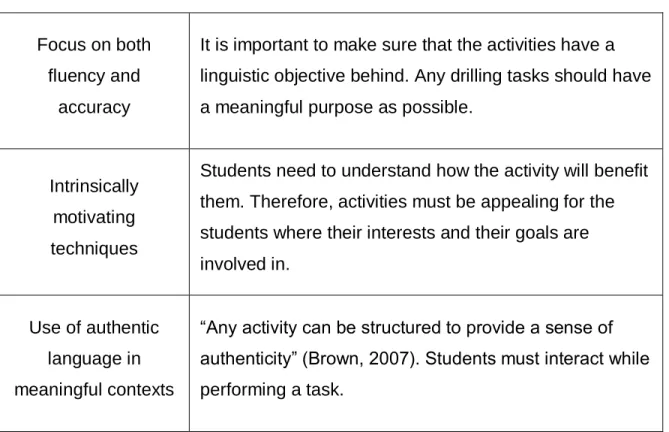
For every goal achieved, there should be a wise planning behind. Having a clear idea on how to teach speaking skills is decisive when setting objectives. Therefore, teachers should tackle different facets of oral communication to prepare learners output. Table 1 presents seven procedures which are likely to enhance learners speaking skills:
Table 1. Procedures to enhance students speaking skills (Brown, 2007)
Focus on both fluency and
accuracy
It is important to make sure that the activities have a linguistic objective behind. Any drilling tasks should have a meaningful purpose as possible.
Intrinsically motivating techniques
Students need to understand how the activity will benefit them. Therefore, activities must be appealing for the students where their interests and their goals are involved in.
Use of authentic language in meaningful contexts
26 Appropriate
feedback and correction
“It is important that you take advantage of your knowledge of English to inject the kinds of corrective feedback that are appropriate for the moment” (Brown, 2007)
The natural link between speaking
and listening
Many interactive activities will mix listening with
speaking; however, even though you might be focusing on reinforce speaking; listening skill can be integrated to the students‟ benefits. The only way that students can dominate the production skill is by comprehension.
Opportunities to initiate oral communication
It is important to let students initiate the language. Normally teachers focus their time by asking questions, giving directions or providing information. Students need to learn how to control a conversation and how to
change the subject of it.
Encourage the development of speaking strategies.
Students need to develop their own personal strategies for accomplish speaking production. The teacher here has the job to create awareness of this objective.
27
2.2.3 Types of classroom-speaking performance.
According to Brown (2007), there are six types of speaking production for learners to apply in the classroom: imitative, intensive, responsive, transactional, interpersonal and extensive.
2.2.3.1 Imitative speaking.
As Brown (2007) states in his book, imitative activities are mainly focused on some elements of language form. Therefore, learners are not expected to interact with their classmates but to spend time practicing intonation or the pronunciation of a vowel sound. One significant method for teachers to use is drilling, as “Drills offer students an opportunity to listen and to orally repeat certain strings of language that may pose some linguistic difficulty” (Brown, 2007, p. 328). Hence, drilling can be successful if teachers follow the proper steps. Drills must be simple and short for students to understand why they are doing the drill. Moreover, teachers should not overuse drills and activities should lead to communicative goals.
2.2.3.2 Intensive speaking.
Intensive activities are the next step of the imitative activities. As Brown (2007) notes, “intensive speaking includes any speaking performance that is designed to practice phonological or grammatical aspects of language” (p. 329). Therefore, this kind of activities can be self-initiated or be involved in some pair work where students need to reinforce certain language forms.
2.2.3.3 Responsive speaking.
28 learners, what the main idea of the paragraph is, the answer is meaningful and authentic (Brown, 2007).
2.2.3.4 Transactional speaking.
As different as the other activities previously mentioned, transactional activities focus on conveying or exchanging specific information. To mention one difference with responsive activities, transactional performances include more negotiation from the learners in their speech. Conversations are an example of this type of activities which can be in groups or teacher-student oriented (Brown, 2007).
2.2.3.5 Interpersonal speaking.
Interpersonal speaking is another example of a conversational method used in the classroom, nevertheless, this kind of activity carries out more for maintaining social relationships rather than the exchange of facts or information. Therefore, learners need to pay attention to some factors that can help them with their speech such as: slang, sarcasm, ellipsis, colloquial language and emotional charged language (Brown, 2007).
2.2.3.6 Extensive speaking.
The kinds of activities that belong to this type of classroom speaking performance are mainly monologues in the form of oral reports, summaries, or short speeches. They are extensive activities because learners need to be more formal and deliberative while speaking. These speeches can be planned or improvised depending of the type of student (Brown, 2007).
29 to their pace of learning. The learners‟ perceptions are what is going to support the use of these different types of activities for their benefit.
2.2.4 Learners’ perceptions of speaking tasks.
After reviewing different types of speaking tasks, the main concern is how learners perceive each of them in relation to their abilities. Learners‟ oral proficiency on different speaking tasks has been reviewed sporadically. Nevertheless, this study intends to explore learners‟ perceptions rather than their performances as means to understand learners‟ comfortability when speaking. The latter might help learners‟ academic success, but the importance of providing a good environment with engaging speaking activities is to help them realize that they can communicate using the target language. The literature about learners‟ perceptions on speaking activities is scarce, which is one of the reasons why we have taken interest in this area.
2.3 The Current Study
After reviewing the literature mentioned above, this study aims to determine the effects of ability-grouping techniques on EFL learners‟ perceptions of a range of speaking tasks.
Therefore, from this moment on, and for the purposes of this study, we will define the two independent variables as: a) Homogeneous ability grouping, and b) Heterogeneous ability grouping. On the other hand, the dependent variable of the study will be learners‟ perceptions of the speaking tasks, which will be implemented in two secondary classes.
30 transactional activities to elicit conversation, and extensive activities for learners to be more deliberate when speaking.
Based on the identified variables, this study will proceed to state the following Research Questions, which are sought to be answered by the end of the investigation:
i) Do learners‟ perceptions of interpersonal speaking tasks differ depending on how they are grouped? If so, how?
ii) Do learners‟ perceptions of transactional speaking tasks differ depending on how they are grouped? If so, how?
iii) Do learners‟ perceptions of extensive speaking tasks differ depending on how they are grouped? If so, how?
31
3. METHODOLOGY
After all the ideas reviewed in the literature, the current chapter explains in detail the main methodological procedures followed in this study, such as the research design, the context in which the study was held, and the participants who took part throughout its application. Consequently, we established the methods and instruments to be used, to finally conclude with the data analysis.
3.1 Research Design
This study follows a quantitative approach through an experimental comparison group design. As it is claimed by Denscombe, (2007) “experiments involve the manipulation of circumstances. The researcher needs to identify factors which are significant and then introduce them or exclude them from the situation so that their effect can be observed” (p.61). Hence, to conduct this experiment, the variables defined were Learners‟ Perceptions and Grouping Techniques, the former being the dependent variable and the latter being the independent variable. It was expected to know the learners‟ perceptions per way they were grouped.
32
3.2 Context and Participants
The study was carried out at a subsidized school located in El Bosque, Santiago. This school follows the curriculum proposed by the Ministry of Education. (MINEDUC). In addition to this, the class for our research is accustomed to working with a course book, which has a communicative approach. The school is characterized by a good teaching organization, technical resources, such as an English lab and data projectors.
In this study, two out of four tenth grades were selected to participate. We addressed the groups as “A” and “B”, and their ages ranged from 15 to 16 years old. The original number of students in both classes was 81; however, due to uncontrollable factors such as absenteeism (38) and initial withdrawal (8), the final number of participants was 35 (18 for group “A” and 17 for group “B”). As suggested by the literature, in which former ability-grouping studies have detected three proficiency groups in which students can be categorized, we decided to place learners into three different proficiency levels in the target language: Low, Intermediate and High. We did this through a “Placement Test” that will be explained later in the procedures section. Finally, after identifying participants‟ proficiency level, group “A” was defined as the homogeneous class and group “B” as heterogeneous.
3.3 Instruments
The instrument consists of a four-point Likert Scale questionnaire containing seven closed questions related to learners‟ perceptions on the group arrangement. The statements were:
1) I felt comfortable working in my group.
33 4) I felt that when I needed help, I had the support of my group mates. 5) I felt that I could work at my own pace, and I didn‟t feel pressure to
finish.
6) I felt that we worked well as a group and we complemented each other.
7) I felt that I found new ways of doing the activities, thanks to group work.
Participants completed the questionnaire after each session. Both groups - heterogeneous and homogeneous - received the same questionnaire and were exposed to the same activities.
Below the Likert Scale is presented ranging from Totally Disagree to Totally Agree.
It is worth mentioning that the entire questionnaire was in Spanish for learners‟ better understanding of the task. See original instrument in Appendix 1.
3.4 Procedures
The first step in this study was the placement test. This procedure consisted of three sections:
a) An Interpersonal speaking activity in which participants needed to answer questions about themselves,
b) A Transactional speaking activity where participants were shown a map in which they had to give directions from one point to another two times, and
Totally Disagree
34 c) An Extensive speaking activity in which participants were shown two pictures in which they needed to describe what they could see in them.
This placement test helped researchers to place students into three proficiency levels: low, medium and high. Later, we arranged homogeneous groups in one class (A) and heterogeneous groups in the other (B). Nonetheless, before its application the placement test was piloted in three classes of three different schools to measure its validity. The classes that were piloted shared similar characteristics to the one in which the study was carried out; they were all students from 10th grade, they had a similar number of students and they were mixed-ability classes.
After piloting the placement test, we analyzed the results to organize the groups. Participants received a score in respect to a scale. On the one hand, Group A takes part of the homogeneous group; therefore, participants were placed in groups that shared the same proficiency level. On the other hand, participants from group B were arranged heterogeneously, meaning that every group member had different proficiency levels.
35
3.5 Data Analysis
This is a quantitative study in which one of the measurements of central tendency was used. The questionnaires represent the learners‟ perceptions in verbal statements, which is why the most suitable measurement of central tendency is the mode (Jamieson, 2004). The mode allows narrowing down the perceptions to determine whether they are positive or negative.
For this type of analysis, the mean and the standard deviation are inappropriate for ordinal data. “Likert scales are commonly used to measure attitude, providing „a range of responses to a given question or statement‟” (Jamieson, 2004, p.1217). This study is concerned about the perceptions of the learners regarding speaking activities and the amount of positive or negative responses to them, and using the mode as a measurement of central tendency will provide us with that information.
Once all the data was collected, the two groups – homogeneous and heterogeneous – were compared to appreciate the difference between them (if there was any). The analysis addressed the following comparison between both groups:
- Statement analysis (seven statements) - Activity analysis (six activities)
- Type of activity analysis (three types)
36
4. RESULTS
After reviewing the reasons for conducting the study, the current section aims to show the statistical data obtained from the applied questionnaires. First, learners‟ perceptions will be measured by the mode. Second, learners‟ perceptions will be addressed considering percentages of interpersonal, transactional and extensive speaking tasks. Finally, learners‟ comments in the questionnaire will be shown in accordance with interpersonal, transactional and extensive speaking tasks.
4.1 Learners’ Perceptions of Ability Grouping: Mode Measures
As outlined in Table 2, statements from one to seven ranged participants‟ perceptions of the six activities performed from one to four – Totally disagree and totally agree respectively- regarding the Likert scale. Consequently, it is pivotal to mention that participants‟ perceptions are measured by the mode of the Likert scale numbers of the latter.
37 Table 2. Learners' perceptions of ability grouping: mode measures
Statements
1 I felt comfortable working in
my group 4 4 4 4 4 4 4 4 3 3 3.5 4
The study commenced the sessions with the Interpersonal activity called “Role Play”. As presented in Table 2, the mode in groups A and B was 4.0, meaning that both groups had the highest positive responses from the participants‟ perceptions. The same mode can be appreciated in the second interpersonal activity called “Interview”.
38 Group A with a mode of 4.0, while group B concluded with a mode of 3.0 - since Group B perceived Transactional tasks less positively than Group A. Even though there is a difference of one point, both modes, 3.0 and 4.0 are still positive. Consequently, learners perceived Transactional tasks less positively than Interpersonal tasks with a difference of one point in the Likert scale.
Finally, for the extensive activities, “Story Telling” presented a mode of 3.0 for both groups A and B. Thus, we can observe that “Story Telling” alongside “Who am I” are both considered less positive than “Role Play” and “Interview” when considering perceptions of Group A and Group B. Dissimilarly, for the “Poster Presentation” the mode, which is still positive, differed between both groups – group A with a mode of 4.0, while group B presented a mode of 3.25.
Therefore, the overall mode ranged from three to four in the Likert scale, meaning there were no significant differences between homogeneous and heterogeneous groups because both perceived all six lessons positively.
4.2 Learners’ Perceptions of Ability Grouping: Percentage Measures
39 Table 3. Learners' perceptions of ability grouping: percentage of total agreement and
agreement
Statement
Interpersonal Transactional Extensive Role Play Interview Who am I Debate Story Telling Poster
A B A B A B A B A B A B
1 94% 100% 100% 100% 94% 100% 89% 100% 83% 94% 100% 94%
2 94% 88% 94% 94% 83% 82% 89% 94% 78% 82% 89% 88%
3 94% 94% 83% 88% 67% 94% 89% 100% 78% 82% 89% 94%
4 100% 94% 94% 94% 89% 94% 89% 100% 83% 100% 83% 94%
5 67% 82% 78% 76% 83% 94% 78% 88% 78% 76% 72% 88%
6 89% 94% 94% 100% 83% 94% 78% 100% 78% 88% 94% 94%
7 100% 76% 89% 82% 83% 94% 67% 76% 72% 73% 67% 82%
TOTAL 91% 90% 90% 91% 83% 93% 83% 94% 79% 85% 85% 91%
4.2.1 Learners’ perceptions of interpersonal speaking tasks.
As we can see in Table 3, in both Interpersonal activities “Role Play” and “Interview”, learners‟ perceptions averaged 91% and 90% for groups A and B. However, in the “Role Play” activity there are some important differences in percentages among the statements, being appreciated with a difference of 15% in statement five.
A percentage of learners from group A (Homogeneous) perceived that they could not work at their own pace and felt more pressured as compared with group B (Heterogeneous) in the “Role Play” activity.
40 Moreover, in statement seven we can observe that group A shows 100% of learners‟ positive response, whereas group B shows 76%, meaning a difference of 24%. From here, we can infer that in contrast to Group A, which completely agreed on the benefits that group work brought them to complete the activity, in Group B, 24% of the participants disagreed on the helpfulness of group work for this activity.
7 I felt that I found new ways of doing the activities, thanks to group work.
As for the “Interview” activity, in statement six, group A shows 94% of positive responses in comparison with the 100% that group B presented, meaning a difference of 6% between them. Even though, there is a slight difference, it is worth mentioning that 6% of the participants in Group A felt that group work did not take place to complement each other.
6 I felt that we worked well as a group and we complemented each other
4.2.2 Learners’ perceptions of transactional speaking tasks.
As for the Transactional activity “Who am I”, there is a more noticeable difference to consider when comparing both groups‟ perceptions. With a difference of 10%, in Group A, 83% of the participants perceived the activity positively in general terms while in Group B, 93% of the participants did. If we go into a deeper analysis, in “Who am I” a similar difference can be observed in statement three.
41 regarding the fact of being able to help their group mates. Dissimilarly, Group B (Homogeneous) majorly perceived that they could help their group mates.
3 I felt that I was able to help my group mates
In the case of “Debate” activity, there are five differences to consider between both groups. Firstly, the total averages in the percentages between the groups are the following: Group A 83% and group B 94%, meaning that 11% more of learners perceived the activity positively in Group A.
If we go deeper into each difference, we can begin by describing statement one. In this statement, there was a difference of 11% between both groups, Group A averaged 89% whereas group B averaged 100%. That is to say, Group A felt less comfortable working in groups than Group B, in which all participants felt comfortable within their groups.
1
I felt comfortable working in my group
Likewise, following with the analysis of statement three, the difference in average is also 11%. Therefore, Group A averaged 89% of positive perceived perceptions, while in Group B 100% perceived statement three positively:
This means that Group A felt that they were less able to help their group mates in comparison with Group B.
As for statement number four, both Groups, A and B averaged the same as in the above statement with 89% and 100% respectively. The latter explains
3
42 that in Group A, 11% of the participants felt that when they needed help, they did not have support from their group mates as participants in Group B.
As for statement number six, on the one hand, 78% of the participants in Group A felt that they worked well as a group and that they complemented each other. On the other hand, the remaining percentage (22%) felt that they did not. Contrasting this, 100% of the participants in Group B agreed that they did work well and complemented each other.
In the group comparison in statement number seven, there was an average difference of 9% between both groups‟ perceptions. While 67% of the participants in Group A agreed on the fact that they felt that group work provided new ways of doing the activities, in Group B, 76% agreed on the same perception. It is worth mentioning that, even though both percentages were above 50% of agreement, they were the lowest set of scores of all the statements for all the activities.
4.2.3 Learners’ perceptions of extensive speaking tasks.
The last speaking activities to be compared belong to the “Extensive” type of task. It is worth mentioning that the overall average of participants‟ positive perceptions on the “Extensive” task was 79% for Group A, and 85% for Group B. First, we considered groups‟ perceptions of the fourth “Story Telling” statement.
4
I felt that when I needed help, I had the support of my group mates
6
I felt that we worked well as a group and we complemented each other
7
43 Hereby, there was a substantial averaged difference of 17% in participants‟ positive perceptions of both groups. Although 100% of participants in Group B felt that when they needed help they had the support of their group mates, 83% of participants in Group A felt the same.
As for the sixth statement, there was an averaged difference of 10% between both groups‟ positive perceptions when we considered statement number six. While 78% of participants in Group A thought that they worked well as a group and that they complemented each other, in Group B 88% of the participants felt the same.
6
I felt that we worked well as a group and we complemented each other
Moving on to the last activity to be compared – Poster Presentation - we considered to analyze statements five and six. In statement five, with an average difference of 16% between both groups, 72% of participants in Group A felt that they could work at their own pace and did not feel pressured to finish. In contrast, 88% of participants in Group B felt the same when considering statement number five.
5 I felt that I could work at my own pace, and I didn‟t feel pressure to finish.
Lastly, when comparing statement number seven, there was an average difference of 15% between both groups. On the one hand, 67% of participants in Group A felt that they found new ways of doing the activities thanks to group work. On the other hand, 82% of participants in Group B felt the same in statement seven.
4
44
Finally, after contrasting the average results for both groups and the differences between statements, we realized that there was a trend in the average results.
Graph 1. Average results of positive perceptions
As Table 4 portrays, Group B showed a tendency in having more positive perceptions in five of the six activities. Group A had slightly more positive perceptions only in activity one (Role Play) with a difference of just 1%. Subsequently, all percentages in Group B were above 90% throughout the
7
45 activities, whereas Group A had percentages below 90% from activity three to six. Notwithstanding the fact that perceptions on homogeneous grouping are still considered positive (because they are above 50%), the comparison reflects that heterogeneous grouping had a greater effect on students‟ perceptions.
4.3 Learners’ Perceptions of Ability Grouping: Questionnaire Comments In addition to the Likert Scale, the questionnaire applied in the study had a section in which participants could freely express their opinions about the activities performed. Consequently, these comments could be either positive or negative depending on each participant‟s perception. After analyzing participants‟ comments, these were categorized into five themes.
The first theme is “Comfort”, which shows the level of contentment learners had within the group. In the questionnaire, there were only three comments referring to “Comfort”, which is not a significant number. Nonetheless, they can help our study to complement data from the results. The same happens with the second theme “Learning took Place”, with two comments referring to it. This theme was included because it measures if learners could learn, thus helpful for discussion. “Team Work” is the third theme, which deals with learners‟ collaborative work for the same purpose. The fourth theme is “Lack of Time”; as some learners stated they needed more time to finish the activities. Finally, the last theme is “New Ways of Learning”, where learners would comment whether the activity was innovative and appropriate for learning. Interestingly, the latter was the most referred theme by participants with a number of eighteen comments overall.
46 Table 4. Percentages of groups’ comments arranged by themes
4.3.1 Participants comments on interpersonal tasks.
First, in the Interpersonal task “Role Play”, there were some differences to contrast between groups. When considering “Comfort”, Group A did not have comments while two comments in Group B considered that theme in their questionnaire‟s comments. As one of the participants claimed:
“I felt comfortable in the class and it was one of the few classes I wanted to participate”
As for “Learning took place”, two participants‟ comments in Group A wrote that they could learn. For instance, the comments say:
“It was a good class and dynamic to learn new words”
“I enjoyed working in group; I think you can learn better”
Theme
Interpersonal Transactional Extensive
Total Role play Interview Who am I Debate Story
Telling
Poster Presentation
A B A B A B A B A B A B
Comfort 0 2 0 0 0 1 0 0 0 0 0 0 3
Learning took place 2 0 0 0 0 0 0 0 0 0 0 0 2
Team work 4 1 0 0 0 0 2 0 0 0 0 0 7
Lack of Time 1 1 0 0 0 0 0 0 0 3 0 4 9
New ways of learning 3 7 0 2 0 1 1 1 1 1 0 1 18
47 Interestingly, in Group B there were no comments referring to new ways of learning.
Moving on to the theme “Team work”, four comments in Group A claimed that they worked collaboratively. For example, one student commented:
“I think that these activities are very helpful because they allow us to help each other within the group”
As for Group B, only one participant commented:
“It was a creative way of working, since each of us had to contribute for the group to complement”
Following with the theme “Lack of Time”, one comment from Group A referred to the fact that participants needed more time to complete the task by saying:
“Maybe if we would have had more time, we could have done the activity at ease and less pressured”.
This means that those learners felt that they could have done much better in the activity, but time was an impediment to do so. Evenly, there was also one comment in Group B referring to the latter:
“Good class, fun, but too fast”
Lastly, for the theme “New Ways of Learning”, Group A wrote three comments against the seven written in Group B. As for Group A, one participant opined:
48 Equally, one of the comments in Group B stated:
“I liked the activity and sharing with peers I did not used to work with”
The fact that in the theme “New Ways of Learning” there are similar comments from both groups should not surprise us. Overall, in the “Role Play” activity, both groups have comments for all five themes and referred to equal facts.
In the second Interpersonal activity “Interview”, Group A had no comments, while Group B had two comments regarding the theme “New Ways of Learning”. One comment is:
“I liked the different ways the teacher taught the class”.
4.3.2 Participants’ Comments on Transactional Tasks.
In the second type of speaking activity, Group A presented no comments in the activity “Who am I”, while Group B presented two. The first comment deals with the theme “Comfort” and the learner stated:
“I felt that it was nice to work with different people”.
As for the second comment, which belongs to the theme “New Ways of Learning”, the learner stated:
“The activity was very creative and good”
49 satisfactorily, and ideas were shared. Additionally, in Group B there were only two comments regarding “New Ways of Learning”. One of those comments stated that activities like a debate were encouraging for learning. For instance:
“Today there was more communication as a group and we exchanged knowledge”
“I like to have different activities, like Debate”
4.3.3 Participants Comments on Extensive Tasks.
Regarding Extensive tasks, the last two activities “Story Telling” and “Poster Presentation” only presented the themes “Lack of Time” and “New Ways of Learning”. Firstly, in the “Story Telling” activity, there were no comments regarding “Lack of Time” in Group A, whereas in Group B there were three comments:
“Fun but too fast”
“The class was too short and we had to rush to finish with the activity”
“Classes should be slower”
Regarding the theme “New Ways of Learning”, in Group A only one learner commented:
“Very good class, dynamic and fun”
50 “Wow, best class ever”
Finally, in the “Poster Presentation” activity, Group A did not comment on the activity, while in Group B five participants commented on the matter. Three comments addressed the theme “Lack of Time”, and for the theme “New Ways of Learning”, two comments were addressed. One of the learners stated:
“We needed more time” while another said
“The classes were very different”
51
5. DISCUSSION
The current chapter will explain the results obtained in the study, which will answer the research questions. The chapter is divided into four sections in accordance to the research questions, which are the following:
i) Do learners‟ perceptions of interpersonal speaking tasks differ depending on how they are grouped? If so, how?
ii) Do learners‟ perceptions of transactional speaking tasks differ depending on how they are grouped? If so, how?
iii) Do learners‟ perceptions of extensive speaking tasks differ depending on how they are grouped? If so, how?
iv) Does one type of grouping affect learners‟ perceptions of speaking tasks more positively overall? If so, which and how?
5.1 The Effect of Grouping on Learners` Perceptions of Interpersonal Speaking Tasks
52 group had 100% of positive response. The fact that heterogeneous grouping had a more positive impact in students‟ perceptions is supported by Hallam (2002, in Bikarian, 2009) who claims that “Heterogeneous grouping provides equity of opportunity, encourages cooperative behavior and social integration […]” (p.30).
As for the second Interpersonal activity “Interview”, both homogeneous and heterogeneous groups scored 100% in the same statement mentioned before. Consequently, both results support the idea of social relationships being prioritized, as proposed by Brown (2007).
Nonetheless, when considering the statement “I felt that I could work at my own pace, I didn’t feel pressure to finish”, many learners felt that they were rushed to complete the task, which caused this statement to be the least positively perceived. This perception does not support Kerckhoff‟s idea of learners working at their own pace when grouped homogeneously (Kerckhoff, 1986, in Aydin & Tugal, 2005), but they rather felt pressured. The latter could have happened due to the lack of familiarity learners had with the activities. As one of the learners commented:
“Maybe if we would have had more time, we would have done the activity at ease and less pressured”
As a consequence, in this case learners perceived they could have done a better work if they had more time available to finish.
In contrast to the above, Hallam (2002, in Bikarian, 2009) argues that it is heterogeneous grouping the one that allows pupils to work at their own pace; idea that is reflected in the 82% of positive perceptions the heterogeneous groups presented in the “Role Play” activity.
53 statement “I felt that I learned a little bit more working in my group”. Thus, even though groups were arranged differently, learners‟ perceptions were the same when it came to learning. As Felder and Brent proposed, “Heterogeneous groups in consideration of their diverse academic and social attributes would foster more and deeper collaboration with members helping each other construct knowledge and understanding” (1994, in Jahng & Bullen, 2012, p.2).
In addition, when considering statement six:
“I felt that we worked well as a group and we complemented each other”
learners in homogeneous groups presented 94% of positive perceptions in the activity “Interview”. Therefore, we can say that since learners shared the same ability level in their groups, they could not rely on others to finish and had to work collaboratively similarly to what Rance-Roney (2010) defended:
If you have designed a task that has a defined outcome and learners understand that there is a job to be accomplished, then grouping the reticent learners together forces them to take initiative to complete the task even though there may be a minimal use of English (p.23).
Considering the above, now we can answer our first research question. Do learners’ perceptions of interpersonal speaking tasks differ depending on how they are grouped? If so, how?
54
5.2 The Effect of Grouping on Learners` Perceptions of Transactional Speaking Tasks
First, according to Brown (2007) the purpose of transactional activities is to convey or exchange specific information. Moreover, it can include more negotiation from the learners in their speech. In our study, we chose two transactional activities, “Who am I” and “Debate”.
In the first activity, “Who am I”, the highest positively perceived perception belongs to the first statement
“I felt comfortable working in my group”
55 The latter can also support statement three:
“I felt that I was able to help my group mates”,
which was the least positively perceived in the activity “Who am I”. In contrast, we believe that homogeneous grouping is not as effective as heterogeneous grouping when peers seek for help within the group. In the current study, 67% of learners‟ perceptions in homogeneous grouping felt they could help their group mates, while 94% of learners‟ perceptions in heterogeneous grouping felt the same. Furthermore, supporting the previous idea, Felder and Brent (1994 in Jahng & Bullen, 2012) stated that “heterogeneous groups in consideration of their diverse academic and social attributes would foster more and deeper collaboration with members helping each other construct knowledge and understanding” (p.2).
Another important finding in statement two
“I felt that I learn a little bit more working in my group”
Was that both homogeneous and heterogeneous groups‟ percentages scored similarly, 83% and 82% respectively. Therefore, we can infer that as the activity “Who am I” belongs to the Interpersonal speaking type of task, which means that there is only exchange of personal information, both grouping techniques are suitable for this activity.
Interestingly, in the second Transactional activity “Debate”, statement six:
56 shows a significant difference between homogeneous (78%) and heterogeneous grouping (100%). Thus, all participants in heterogeneous groups felt that they could work well as a group and that they complemented each other. We can complement the participants‟ comment of statement six in Bikarian (2009):
Students have told me that they both enjoy and produce better results when grouped heterogeneously because students with different abilities are in their group and can help them if they start to struggle with a concept or skill (p. 1).
Notwithstanding the fact that a minor amount of 78% agreed with statement six in the homogeneous groups, such amount is enough to say that most participants perceived the activity positively. This can be supported by a participant‟s comment which stated:
“Today there was more communication as a group and we exchanged knowledge”
Literature supports this comment with Rance-Roney‟s quote “When the objective is for learners to work with a problem and achieve consensus on a solution, this homogeneous grouping scheme will maximize chances for all group members to engage in conversation” (p.23).
Moving on to statement seven:
“I felt that I found new ways of doing the activities, thanks to group work”
57 the activity. Here, it is worth mentioning that learners were seldom exposed to a “Debate” activity performed in English. Nevertheless, both groups scored low percentages for statement seven even when a debate in English was supposed to be new. Thus, group work did not help learners to find new ways of doing the activity as it was expected.
After reviewing the results, we can answer the second research question: “Do learners’ perceptions of transactional speaking tasks differ depending on how they are grouped? If so, how?”
We can say that it does differ on how learners are arranged. 11% of difference confirms that for this type of task, heterogeneous grouping had a more positive effect on how learners perceived the activities than homogeneous grouping. As both “Who am I” and “Debate” activities belong to the Transactional speaking task, specific information was asked to be exchanged among learners. Hence, this could mean that low-ability learners in homogeneous group might feel less confident to do the activity due to the unfamiliarity with the content. Furthermore, Vygotsky‟s idea of Zone Proximal Development (ZPD) explains that problem solving is determined under adult guidance, or in collaboration with more capable peers. For this reason, learners who share the same ability level may not reach a consensus when performing a task because they cannot leave their zone of proximal development, as they are not challenged by high-ability peers.