A Radical Mechanism in the Vanadium-Catalyzed
Deoxydehydration of Glycols
Luis Carlos de Vicente Pout´
as,
†Marta Casti˜
neira Reis,
†Roberto Sanz,
‡Carlos
Silva L´
opez,
†and Olalla Nieto Faza
∗,¶†Departamento de Qu´ımica Org´anica. Facultad de Qu´ımica. Universidade de Vigo.
Campus Lagoas-Marcosende, 36310, Vigo, Spain
‡Departamento de Qu´ımica. Facultad de Ciencias, Universidad de Burgos, Pza. Misael
Ba˜nuelos s/n, 09001 Burgos, Spain
¶Departamento de Qu´ımica Org´anica. Facultade de Ciencias. Universidade de Vigo.
Campus As Lagoas 32004, Ourense, Spain
E-mail: [email protected]
Abstract
We propose a novel mechanism for the deoxydehydration (DODH) reaction of gly-cols catalyzed by a [Bu4N][VO2(dipic)] complex (dipic= pyridine-2,6-dicarboxylate)
using triphenylphosphine as a reducing agent. Using density functional theory (DFT) we have confirmed that the preferred sequence of reaction steps involves reduction of the V(V) complex by phosphine, followed by condensation of the glycol into a [VO(dipic)(-O-CH2CH2-O-)] V(III) complex (6), which then evolves to the alkene product and the
Introduction
Biomass can become a viable and renewable alternative to the use of fossil oil as fuel or
as a source of raw materials for the chemical industry. For this to happen however the
products obtained from its processing, mainly polyalcohols, need to be transformed in other
compounds that can be incorporated into the existing industrial processes. The most
com-mon approach involves deoxygenation or dehydration processes that reduce their content
in oxygen, transforming them into more suitable industrial feedstocks. In this context,
deoxydehydration (DODH) reactions have become appealing transformations because they
preserve functionalization: a glycol yields an alkene, compared with hydrodeoxygenation
(HDO) processes in which alkanes are obtained from alcohols. The first chemical approaches
(as in opposed to biological alternatives to biomass valorization involving fermentations) rely
on the use of heterogeneous catalysts that effect the hydrogenolysis of polyols. The most
efficient among them use noble metals to activate hydrogen and tungsten or rhenium as
additives,1 but other systems such as Ni-Cu/Al
2O3 have also been used.2 Homogeneous
re-actions using rhenium catalysts, for which detailed mechanistic information (computational
and experimental) is available,3–15 are showing great potential in processes ranging from
the deoxydehydration of glycols to the deoxygenation of epoxides, alcohols and carbonyl
compounds, as does the derivatization of biomass polyols catalyzed by rhodium or iridium
complexes.16The discovery of the activity of Mo(VI) and V(V) complexes, based on cheaper and more abundant metals, in the DODH of glycols17–24 led us to focus on the study of the mechanism of these transformations. These complexes are versatile in terms of manipulation
and derivatization, hence the goal is designing more efficient catalytic systems. In this work,
we have studied the mechanism of the deoxydehydration of glycols to alkenes catalyzed by
a [Bu4N][VO2(dipic)] complex (dipic= pyridine-2,6-dicarboxylate) using triphenylphosphine
as a reducing agent described by Nicholas and Chapman in 2013.20 The authors propose two
alternative paths for this transformation, depending on the ordering of the steps involving
metal center (see Figure 1).
Figure 1: Mechanism of the deoxydehydration of glycols proposed by Nicholas and Chap-man20 and Galindo.25 In path A (red), the glycol is first condensed with the V(V) complex
1, from which an oxygen atom is then transferred to a phosphine, affording V(III) complex 6. In path B (blue) the sequence of these steps is reversed. Both mechanisms converge in6, which leads to the alkene product through a concerted [3+2] retrocycloaddition.
We decided to organize our analysis of this mechanism using these two generic paths as
a scaffold, although this scheme proved to be greatly oversimplified. While preparing this
report, a very recent DFT study of this same reaction by Galindo came to our attention.25
A number of his conclusions are similar to ours, however we find relevant differences in
fundamental parts of the mechanism. Galindo uses single point CPCM energies in benzene
on gas phase B3LYP/6-311+G* geometries and frequencies to describe two reaction paths,
parallel to paths A and B in Figure 1. For both paths he characterizes triplet minima
and transition states when they are lower in energy than their singlet counterparts. In
his discussion, path A involves bidentate coordination of ethylene glycol to 1 through the
sequential formation of a V–O bond and loss of hydrogen to an oxo group that becomes
reduced through oxygen transfer to a phosphine molecule, leading to V(III) complex6. This
path visits the triplet potential energy surface only between the intermediate [V]–O–PPh3
species that precedes the formation of 6and6itself. In path B, the oxygen transfer between
1 and phosphine is the first step, leading to V(III) complex 2. Glycol addition then leads
to 6. This path proceeds on the triplet potential energy surface between the [V]–O–PPh3
species preceding the formation of 2 and 6. The evolution of 6 to the alkene product and
regeneration of the catalyst, common to both paths, is considered to proceed through an
asynchronous concerted [3+2] retrocycloaddition. Galindo has found in his study that path
B is globally lower in energy than path A, with the highest energy barrier in the mechanism
corresponding to the alkene extrusion (6 → 1) with an energy of 40.2 kcal/mol relative to
the reactants.26
In our analysis of this reaction we find that the mechanism shows significant differences
when taking into account solution-phase optimized structures. Moreover, our exploration
indicates that the singlet and triplet regions are not as clear cut, with a greater deal of
sur-face hopping, and that the consideration of (di)radical species is key in the formation of the
alkene and oxygen transfer processes. The characterization of the minimum energy crossing
points (MECPs) between the singlet and triplet surfaces provides interesting information on
the spin-crossing events, not addressed in the previous work. In studying these diradical
pro-cesses, we discover a mechanism in which the formation of a vanadium metallacycle is a key
step for the formation of the alkene product from the V(III) complex, which contrasts heavily
with the conventionally accepted concerted retrocycloaddition step. With the description
of this alternative, the activation barrier of this reaction is significantly lowered, and new
Computational Methods
We have used Density Functional Theory in the Kohn-Sham formulation to optimize the
stationary points depicted in Figures 2 and 6. The unrestricted form of the B3PW91
func-tional (UB3PW91)27,28 has been used together with the Def2-TZVPP basis set.29,30 The effect of solvation has been included in all calculations using an implicit model for benzene
(PCM with the integral equation formalism variant, IEFPCM31–33 with UAKS radii). All stationary points have been characterized as minima or transition states through harmonic
analysis, and IRC calculations34 have been used to unambiguously connect transition states
to the corresponding reactants and products when needed. All this calculations have been
carried out with the Gaussian09 suite of programs.35 Bond orders and atomic charges were
calculated with the Natural Bond Orbital (NBO) method, with the NBO3.1 program.36,37
One of the main problems that we have had to deal with during this research is the
dirradical character of a significant number of species in the singlet spin potential energy
surface. This led to problems with the stability of wavefunctions, due to the mixing with
the triplet state, and prompted us to analyze the reaction in both the singlet and triplet
potential energy surfaces. This is not an uncommon problem when dealing with structures
with diradical character. The Cope reaction is a good example of this phenomenon, where
the contribution of diradical components is large at the transition state.38–40Another recent
example of the importance of taking into account the dirradical character of relevant
tran-sition structures along a mechanism is provided by the study of the isomerization of vinyl
allene oxides.41,42 The need to check the stability of wavefunctions so that we make sure that
it is a real minimum in the function space is as relevant as the more widely recognized need
to calculate the hessian with respect to the coordinates to characterize stationary points as
minima or transition states.43Thus, for all stationary points the stability of the wavefunction
has been computed44 to guarantee that the wavefunctions are minima in the configuration
space of the basis used.
triplet surfaces, we have used the method described by Harvey,45 as implemented in the
Orca program,46 using tight convergence criteria and numerical frequencies to ensure that
the crossing point found is indeed a minimum. The functional and basis set are the same used
all along this work, but we have used COSMO47 for the simulation of the effect of solvent.
These MECPs, as the minima in the seams between surfaces, provide just an estimation of
the region where the surface-hopping takes place and the energy needed to reach it, and
thus, of the accesibility of the crossing and the feasibility of the mechanism. Evaluation
of the probability of the surface hopping using spin-orbit coupling calculations should be
made if more accurate kinetic information were needed about these steps in the mechanism.
The high computational cost of these calculations for a system with such a large number of
electrons involved in the key bond formation/breaking processes, precludes their use in this
problem.
In order to save computational resources and simplify the potential energy surfaces,
thus facilitating geometry optimizations, we have introduced some truncations in the model
system. The first is using trimethylphosphine instead of triphenylphosphine as a reductant.
The second is to use ethyleneglycol instead of glycerol, both reducing the number of electrons
in the system and the potential complexity of the mechanism in terms of conformations and
alternative paths that could lead to regioselectivity. The last aproximation is to use just one
water molecule in mediating proton relays when such mechanisms have been considered.
Results and Discussion
As originally proposed by Chapman and Nicholas20 and confirmed by Galindo,25 two are
the main paths that can be proposed for this transformation, depending on the sequence in
which the reduction, glycol coordination and formation of the alkene steps take place (see
Figure 1). In order to facilitate the presentation and discussion of results, we will follow the
description of path B.
Path B
In this path a reduction from V(V) complex1to V(III) complex2through an oxygen transfer
to a phosphine is generally proposed. This is a step common to other redox catalytic cycles
involving transition metals in high oxidation states, such as rhenium or molybdenum,48–50
but we found that this description is oversimplified and the mechanism is much more complex
than what is often assumed and cannot be described as in Figure 1. The main difficulty arises
from the fact that 1 is clearly a singlet (the triplet lies 73.6 kcal/mol higher in energy) and
2 a triplet (the singlet lies 6.2 kcal/mol higher in energy). Actually not only there is a
crossing between the singlet and triplet surfaces between these two points, but also that the
two surfaces become quite close in the whole area, leading to a very strong multirreference
character of the transition states and intermediates found for this reaction. We propose two
different paths for this step, which are depicted in Figure 2.
The lowest energy alternative, which corresponds to the mechanism described by Galindo
(with a barrier of 34.7 kcal/mol) is a stepwise process that generates intermediate4 through
ts1-4associated to an activation barrier of 30.5 kcal/mol. We were not able to optimize this
transition state as a stationary point on the triplet PES, but at this geometry the triplet is
4.1 kcal/mol higher in electronic energy than the singlet. Intermediate4, however is already
more stable in the triplet state, although the difference between singlet and triplet is just
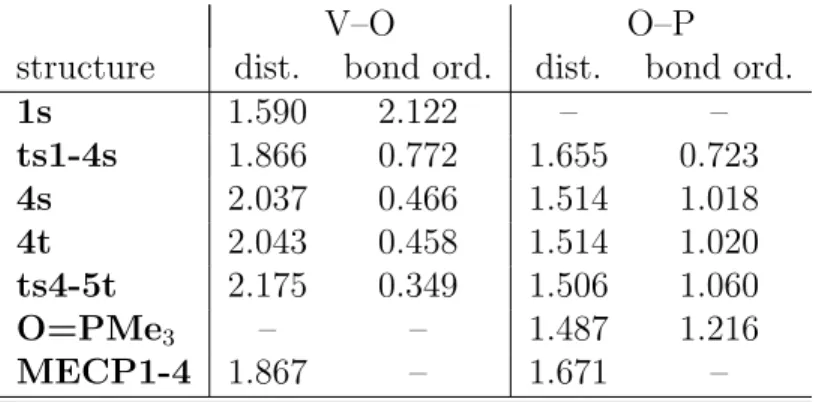
1.3 kcal/mol. Once at this point, it is worth comparing the geometries of structures ts1-4,
4 and the MECP, whose key features (bond distances and NBO bond orders) have been
summarized in Table 1.
We find that in going from 1 to ts1-4, the vanadium-oxygen distance is significantly
elongated by 0.276 ˚A, associated with a dramatic decrease in the bond order, from 2.1 to
0.77. At the same time a new phosphorous-oxygen bond is being formed, at a P–O distance
Table 1: NBO bond orders and bond distances (in ˚A) of key structures in the oxygen transfer reaction in path B. A “t” on the name of the structure indicates the stationary point optimized on the triplet surface, while a “s” denotes the corresponding singlet.
V–O O–P
structure dist. bond ord. dist. bond ord.
1s 1.590 2.122 – –
ts1-4s 1.866 0.772 1.655 0.723
4s 2.037 0.466 1.514 1.018
4t 2.043 0.458 1.514 1.020
ts4-5t 2.175 0.349 1.506 1.060
O=PMe3 – – 1.487 1.216
MECP1-4 1.867 – 1.671 –
than that found by Galindo, with a V–O distance of 1.78 ˚A and a P–O distance of 1.76
˚
A.51 At the end of this step (structure 4), the V–O bond is further debilitated at 2.04 ˚A
and a bond order of just 0.47, while there is already a strong P–O bond in place, at 1.51
˚
A and 1.02 bond order. These values indicate that the structure of 4 is close to that of a
phosphine oxide coordinated to vanadium, since the P–O bond is only slightly shorter in the
free O=PMe3, at 1.49 ˚A and a bond order of 1.22. There is a strong dirradical character in
this structure, both as a singlet and as a triplet. One unpaired electron is localized on the
vanadium center, while the second is mainly delocalized over the pyridine ring and on the
oxo oxygen (see Figure 3). Thus, this step can be described as the attack of the lone pair
on the phosphine to the π∗V−O, so that in 4 the phosphorous atom displays positive charge
(0.63 a.u. vs. 0.07 in free PMe3), the V–O double bond disappears and the bonding between
V and N is enhanced with respect to the values found in 1 (the V–N distance and bond
order go from 2.14 to 1.94 ˚A and 0.45 to 0.72, respectively). With the data in Table 1 we
also confirm that the triplet and singlet surfaces are very close in the region of 4, since not
only the difference in energy between 4s and 4t is very small, but also the geometries and
bonding patterns of these two stationary points are very close.
Although there are no experimental geometries available for these structures, we have
to the metal-phosphine oxide bond in 4 is 2.04 ˚A, similar to the 2.00 ˚A in VCl3(OPEt3)3
or the 2.08 ˚A in VCl3(THF)3, both V(III) complexes.52 If we want to compare those with
the distance in a vanadium oxo complex, the closest structure we found is a V(IV) complex,
[VO(acac)2OPPh3], where the V–O distance is considerably larger at 2.26 ˚A.53In both cases,
the P–O bond is slightly shorter than the 1.51 ˚A in 4, at 1.46/1.48 ˚A (VCl3(OPEt3)3 ) or
1.49 ˚A (V(C5H7O2)2O(C18H15OP)). The 0.47 bond order and short V–O distances found
in 4 anticipate that the departure of the phosphine oxide ligand is not trivial in this case,
and all attempts to locate a transition state corresponding to this process failed. A set of
constrained optimizations at different values of the V–OP bond (see SI), showed that the
energy rises steadily upon the ligand departure. These results suggest that a dissociative
pathway from 4 to 2 is unfavourable. Thus, an associated mechanism was explored where
the the attack of a new ligand onto the vanadium center assists to expell the phosphine oxide
from the coordination sphere of the metal center (ts4-5 in Figure 2).54
In the second pathway, if phosphine acts as a nucleophile on the vanadium center instead
of attacking the πV∗−O, we can find a route connecting 1 and 2. The coordination of a
phosphine to vanadium on 1 through ts1-3 displaces one of the carboxylate ligands of
the picolinate in an SN2 mechanism on the metal center. The activation barrier, of 28.8
kcal/mol is slightly lower than those corresponding to the other mechanism. Intermediate
3, still clearly on the singlet surface (the triplet is 52.3 kcal/mol more energetic), proceeds
then to 2 through a high energy transition state ts3-2 (40.4 kcal/mol, corresponding to
an activation barrier of 14.2 kcal/mol) that combines a reductive elimination of phosphine
oxide with the coordination to vanadium of the previously detached carboxylate ligand.55 Although interesting from a mechanistic point of view, this path is not competitive with the
outer-sphere oxygen transfer path that avoids the formation of the V(III) complex 2
The crossing between the singlet and the triplet energy surfaces would take place just
before 2 in the inner-sphere (ts1-3–3–ts3-2) path, and in the vicinity of 4in the preferred
latter path (MECP1-4), finding, as expected, a structure very close in energy (1.7 kcal/mol
higher) and geometry to ts1-4, as can be seen from the data in Table 1.
Irrespective of whether the oxygen transfer mechanism leads to 2 or4, the coordination
of the first oxygen of the glycol proceeds, as described by Galindo, on the triplet surface,
anti to the nitrogen, with the concerted transfer of the alcohol proton to the oxo group. We
proposed a proton relay mechanism mediated by one water molecule, which can serve as a
proxy of water in the reactive mixture (the alcohols obtained by processing of biomass are
often mixed with some water) or another glycol molecule. We found that this relay leads
to a lowering of the reaction barrier by 3.4 kcal/mol in the case of ts2-5 and a raising of
it by 0.9 kcal/mol in ts4-5. In ts4-5, it is the increase in coordination of vanadium upon
complexation of the alcohol that leads to the expulsion of the phosphine oxide.
All pathways in the generic Path Bthus converge in5, which evolves through a second
concerted V–O coordination and proton jump, now made slightly easier (7.0 vs. 8.6 kcal/mol
barrier in the non-water-mediated mechanism or 3.3 vs. 5.2 kcal/mol in the water-mediated
one) thanks to a longer V–O distance in the former oxo group (2.07 ˚A in ts5-6tvs. 1.72 ˚A
ints2-5t) that allows an earlier transition state (V–Oglycol distance of 2.18 vs. 2.10 ˚A).
In ts5-6 the departure of the newly created water ligand is concerted with the proton
jump and the formation of the new V–O bond, leading to V(III) complex 6, which is more
stable on the triplet surface than on the singlet, by 10.4 kcal/mol. A proton relay mechanism
involving one water molecule reduces the barrier for this step by 3.7 kcal/mol.
Here is the point where our mechanistic proposal drastically differs from that of Galindo.
While he proposes a concerted [3+2] retrocycloaddition singlet transition state for the
forma-tion of the alkene from 6, with a barrier of 45.1 kcal/mol (40.2 kcal/mol over the reference
of energies) we find that the reaction proceeds through a radical mechanism instead. In
Figure 4 we show three dimensional structures of the main stationary points discussed in
this section, including key geometric parameters.
either the singlet or the triplet potential energy surfaces. In the first case, we find ts6-1,
a concerted transition state that directly leads to the ethylene and recovery of the V(V)
catalyst 1. The barrier associated to this path is 46.1 kcal/mol (with a free energy 24.6
kcal/mol over the reference), similar to that found by Galindo. As ts6-1has been found as
a stationary point only on the singlet potential energy surface, we have looked for the MECP
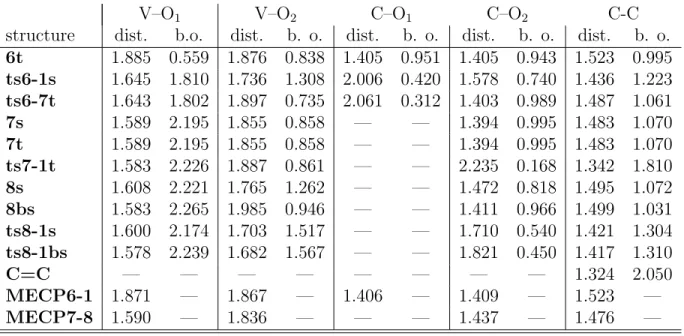
between the singlet and triplet surfaces in the region between 6 and ts6-1. We have found
that the structure of MECP6-1is very close to that of 6, with V–O bonds sligthly shorter
and C–O bonds slightly larger (see Table 1). The high activation energy of this transition
state (ts6-1), and the associated antiaromatic character, as determined by a NICS(0) value
of 9.1 ppm, (see Figure 7) made us to look for an alternative path.
This alternative path involves transition state ts6-7, still on the triplet surface, where
only one of the C–O bonds is being broken, leading to the dirradical structure7. Although
the barrier corresponding to this reaction is quite high, at 34.1 kcal/mol, ts6-7 is only 12.5
kcal/mol more energetic than the reference, making it quite accesible. The difference of 12
kcal/mol and the avoidance of a spin-crossing event, clearly marks this as the preferred path.
The crossing between the triplet and singlet surfaces is expected to be in the region
around7, since the singlet and triplet dirradicals are very close in energy (the singlet is only
0.3 kcal/mol more energetic than the triplet). In fact, MECP7-8displays a geometry very
close to that of 7, with just a slight shortening of the remaining V–O bond (by less than
0.02 ˚A) and a lengthening of the remaining C–O bond (by 0.04 ˚A). The energy of this point
is just 0.7 kcal/mol higher than that of 7.
A second transition state, still on the triplet surface (ts7-1), directly transforms 7 into
ethylene and1 by breaking the remaining C–O bond through a barrier of 32.7 kcal/mol. As
a result, we could consider that the asynchronicity of the concerted transition state found
on the singlet PES (ts6-1) becomes a stepwise path on the triplet PES: first breaking the
longer C–O bond and afterwards breaking the remaining C–O bond after the formation of
found on the triplet PES coalesce into just one (the asynchronicity would be a reflection of
this hidden second TS) when on the singlet PES.
In this context the difference in energy between the two mechanisms is not significant,
withts7-1being just 2.1 kcal/mol higher in energy thants6-1, although the concerted path
would be slightly preferred. However, we propose a third mechanism that results in a much
lower barrier for the formation of the product (15.6 kcal/mol lower than ts7-1).
Once intermediate 7 has been formed (ts6-7 is 12.1 kcal/mol more stable than the
alternative ts6-1), a rotation of the remaining O–C bond, makes this dirradical collapse
to the metallacycle 8 in the singlet surface (the closed structure does not correspond to
a minimum in the triplet surface). There are two isomers of this structure, depending on
whether the carbon (8-b) or the oxygen (8) are trans to the nitrogen in this octahedral
complex. The former is more stable than the latter by 6.7 kcal/mol, as expected from
the trans series, an effect that is also reflected in the difference in the barriers for the
alkene formation from these two metallacycles through a [2+2] retrocycloaddition reaction.
Oxo groups, as strong σ and π donors have one of the strongest structural trans effects in
octahedral complexes,56 and an R− ligand, as a better σ donor usually displays a stronger
trans effect than aOH−. Thus,8-b, with the V–C bond avoiding the coordination site trans
to the oxo group, is more stable than its isomer8. The labilization of the sitetrans to the oxo
group, makes ts8-1, in which the breaking V–C bond occupies this position, more favorable
than ts8-1-b, in which a new oxo group is being generated at this site (the geometry at the
latter transition state is quite distorted to avoid two oxo groupstrans to each other). Thus,
we propose that the reaction proceeds from 7 to 8 and then through a very low barrier of
2.7 kcal/molts8-1to the final product and the original V(V) catalyst. The formation of the
more stable intermediate 8-b, although faster than the formation of its isomer, would be a
dead end, reverting to 7 instead of crossing the 16.2 kcal/mol barrier to the final product.
Looking at the free energy profile of this mechanism (See Figure 5), we identify the oxygen
Table 2: NBO bond orders and bond distances (in ˚A) of key structures in the alkene formation steps in path B. A “t” on the name of the structure indicates the stationary point optimized on the triplet surface, while a “s” denotes the corresponding singlet.
V–O1 V–O2 C–O1 C–O2 C-C
structure dist. b.o. dist. b. o. dist. b. o. dist. b. o. dist. b. o.
6t 1.885 0.559 1.876 0.838 1.405 0.951 1.405 0.943 1.523 0.995
ts6-1s 1.645 1.810 1.736 1.308 2.006 0.420 1.578 0.740 1.436 1.223
ts6-7t 1.643 1.802 1.897 0.735 2.061 0.312 1.403 0.989 1.487 1.061
7s 1.589 2.195 1.855 0.858 — — 1.394 0.995 1.483 1.070
7t 1.589 2.195 1.855 0.858 — — 1.394 0.995 1.483 1.070
ts7-1t 1.583 2.226 1.887 0.861 — — 2.235 0.168 1.342 1.810
8s 1.608 2.221 1.765 1.262 — — 1.472 0.818 1.495 1.072
8bs 1.583 2.265 1.985 0.946 — — 1.411 0.966 1.499 1.031
ts8-1s 1.600 2.174 1.703 1.517 — — 1.710 0.540 1.421 1.304
ts8-1bs 1.578 2.239 1.682 1.567 — — 1.821 0.450 1.417 1.310
C=C — — — — — — — — 1.324 2.050
MECP6-1 1.871 — 1.867 — 1.406 — 1.409 — 1.523 —
MECP7-8 1.590 — 1.836 — — — 1.437 — 1.476 —
over the separated reactants in energy as a potential rate-limiting step. In contrast, the
strength of the P–O bond in phosphine oxide, makes ts6-7t and ts8-1 at 12.5 and 11.1
kcal/mol, respectively lower in energy than the reactants, although the activation barrier
for the first C–O bond breaking is larger than for the oxygen transfer, at 34.1 kcal/mol. To
elucidate which barrier is going to affect the kinetics of the reaction the most, something
needed to devise ways to improve the catalyst, we have applied the energetic span model57,58 to the radical mechanism we propose as preferred for this transformation: 1–4t–5t–6t–7t–
8–1 We have neglected any assumption about the probability of the surface hops, and used
the lowest energy structure (be it either in the triplet or the singlet potential energy surface)
for every minimum or transition state along the path. As a result, all spin-crossings along
the mechanism are considered to proceed without any kind of energy penalty or delay. In
this framework, the TOF-determining transition state is found to be ts6-7, with 6 as the
TOF-determining intermediate. Transition statets8-1has a non-negligeable influence on the
concept of turn-over determining step in this mechanism could be applied to the homolytic
breaking of the C–O bond in 6. Using 160◦C as the working temperature (the experimental
work by Chapman et al.20 report a 150-170◦C interval), the TOF for this reaction is found
to be 3.8·10−5s−1 and the energetic span of the reaction 34.1 kcal/mol. Application of this
kinetic model to the alternative going through a concerted transition state for the formation
of the alkene: 1–4t–5t–6t–1, which agrees with the proposal by Galindo,25 leds to a much lower TOF ( 3.7·10−12s−1) and higher energetic span (46.2 kcal/mol), making the radical mechanism the preferred reaction path. The stepwise mechanism not involving the formation
of the metallacycle (going through ts7-1) is even less favourable than the concerted path,
with a TOF of 3.3· 10−12s−1 and a energetic span of 48.3 kcal/mol. In all three cases,
the potential well associated to the stability of the pair 6 + phosphine oxide with respect
to 1, phosphine and the free glycol, makes the oxygen transfer between the V(V) catalyst
and the phosphine reductant not kinetically relevant, and ts6-7,ts6-1orts7-1become the
turn-over frequency dermining steps of the considered mechanisms.
As a proof of concept of the possibilities that such a mechanistic analysis can open for
the design of improved catalysts, we explore two simple ways of lowering the considerably
high activation barriers of the reaction. First, we propose one structural modification of
the glycol that would stabilize the dirradical in 7, thus facilitating the breaking of the first
C–O bond in this step of the mechanism. Adding two methyl substituents on the carbon
supporting the radical, lowers the barrier of this step by 3.7 kcal/mol (the barrier is 30.4
kcal/mol), and further differentiates this TS from the concerted alternative (ts6-1) lying
15.3 kcal/mol higher in energy. As a result, it is expected that this reaction will be more
favorable with longer diol chains, more interesting substrates, from an industrial point of
view, than the simple model used in this paper.
This success prompted us to propose a modification of the catalyst that would stabilize the
radical on the metal center, which would be a first step in the design of a better catalyst for
ligand by sulfur atoms, known to stabilize radicals on transition metal complexes59 led to a
barrier of just 23.0 kcal/mol for triplet ts6-7, the rate determining step in the mechanism.
The concerted alternative on the singlet surface (ts6-1) is no longer a transition state in
this system, and becomes a second order saddle point 14.6 kcal/mol higher in energy than
ts6-7. Calculation of ts1-4, which can take over as the rate-determining step for this
sulfur-substituted system if the barrier associated to ts6-7 is lowered, led us to a barrier of 27.1
kcal/mol for the most costly step in the oxygen transfer between vanadium and phosphine,
also reduced with respect to the barrier corresponding to the parent system (30.5 kcal/mol).
Thus, replacing the oxygen atoms on the vanadium catalyst by sulfurs could be a good
way of experimentally testing the soundness of our mechanistic proposal. Other alternatives
could involve the use of radical scavengers that would hinder the formation or evolution of
N
28.8 (28.8) 26.2 40.4 (14.2) -5.3
Figure 3: Spin density for 4 in the singlet state (isosurface at 0.005 au).
Path A
This path starts with the condensation of the glycol on the V(V) catalyst 1 (see Figure 6).
The mechanism for this condensation is analogous to that described by Galindo: a first
concerted transition state where the V–O bond is formed at the same time the proton
jumps from the alcohol to one of the oxo groups on the metal center. Two trajectories have
been analyzed for the attack of the alcohol, both resulting in the formation of an octahedral
complex: 1) perpendicular to the chelate ligand plane, andtrans to an oxo group, so that the
oxo group receiving the proton istrans to the nitrogen (ts1-9), and 2)trans to the nitrogen,
so that the oxo receiving the proton is perpendicular to the plane of the chelate (ts1-9-b).
In this second case, some conformations can generate a hydrogen bond between the
non-reacting hydroxyl group of the glycol and the second oxo ligand on vanadium, but the extra
stabilization provided by this hydrogen bond does not compensate the penalty of attacking
trans to the nitrogen, and the lowest barrier found is still 8.9 kcal/mol larger than the 26.9
kcal/mol corresponding to ts1-9. This step leads to hexacoordinated complex 9, lying 24.0
kcal/mol higher in energy than the separated reactants (See Supporting Information for the
structures).
The coordination of the second hydroxy group to the vanadium proceeds via a similar
transition state where the V–O bond formation, proton transfer and departure of the newly
formed water molecule happen in concert. We were not able to locate a minimum in the
potential energy surface where water is coordinated to 10, the product of this step.
Sur-prisingly, the invocation of a proton relay mechanism involving one water molecule does not
lower the barrier of this step, but makes it larger instead (18.7 kcal/mol). In parallel to
what we observed in Path B, the barrier for this V–O bond formation is lower than the
first (12.3 vs. 26.9 kcal/mol, although this is attribuable to the instability of intermediate9,
24.0 kcal/mol higher in energy than the separate reactants). Intermediate 10is more stable
than 9, at 12.6 kcal/mol, probably due to a chelate effect.
N
Figure 6: Proposed mechanisms for path A. Most structures depicted have been calculated in both the triplet (energies in red) and singlet (in black) potential energy surfaces. Gibbs free energies (all values are in kcal/mol) are provided with respect to singlet 1, ethyleneglycol, water and phosphine. Activation free energies (in parentheses) are calculated with respect to the previous lowest energy minima, irrespective of their spin state. The structures colored in red are those for which the most stable spin state is the triplet.
center needs to be reduced to V(III). The proposed mechanism is an oxygen transfer reaction,
similar to that found for1inPath B(see Figures 2 and 6). Thus, we can find two alternative
paths for the reduction of V(V) to V(III).
The first, involves a nucleophilic attack of the phosphine to the vanadium center,
dis-placing a carboxylate from the metal and leading to hexacoordinated complex 15 through
transition state ts10-15. The activation barrier associated to this process is rather high, at
23.6 kcal/mol, and the resultant intermediate is only 1.3 kcal/mol more stable than this TS.
The evolution of this intermediate15 through a reductive elimination and re-attachment of
the dangling carboxylate to 6, where the mechanism would converge to that shown inPath
B, involves another high energy step (a barrier of 16.8 kcal/mol and a TS 51.8 kcal/mol over
center is not the most favored way of effecting a oxygen transfer between an oxovanadium
complex and a phosphine.
The second path, involves an attack of the phosphine to the oxo group on the vanadium
center. Triplet and singlet are close in this region, but the transition state (ts10-11) is lower
in energy on the triplet surface, with a barrier of 36.2 kcal/mol, corresponding to a free energy
of 48.9 kcal/mol relative to the reactants. As did Galindo, we find that this first step in the
oxygen transfer between vanadium and phosphine is the rate limiting step inPath A, making
Path B the preferred alternative for the studied vanadium-catalyzed deoxydehydration of
glycols. This transition state would lead to hexacoordinated intermediate 11 on the triplet
surface, with a relative free energy of -20.2 kcal/mol.
Despite not being competitive, this path is worth studying, since it provides interesting
information on the effect of the coordination number and oxidation state of the metal on
the reactions involved in the oxygen transfer between vanadium and phosphorous and on
the alkene extrussion. Again on complex 11, as we did on 4, we find that the cleavage of
phosphine oxide from vanadium is not trivial (we were not able to locate a transition state
for this reaction, and the energy continuously rises as the V–O distance increases. As a
result, although the mechanism for the alkene extrussion is similar in paths A and B, these
two paths don’t converge in structure 6, as proposed by Galindo.
After 11, one of the C–O bonds is cleaved through ts11-12, to provide diradical triplet
12. In this step O=PPMe3 is still coordinated to the vanadium center. We have found that
the cleavage of the C–O bondanti to the nitrogen is slightly preferred (0.2 kcal/mol) to the
cleavage of the C–O bond anti to the phosphine oxide, but the two branches of the path
thus opened readily converge as the resultant diradical collapses to metallacycle 13 through
a transition state (ts12-13) with an activation barrier of 10.8 kcal/mol.60 Intermediate 13
evolves then through ts13-14 to the alkene and the V(V) compound 14. And it is only on
the last step of the reaction (ts14-1), after the alkene has been formed, that the nucleophilic
center.
Interestingly, the NICS on points along a line perpendicular to the center of the C–C–O–V
ring, show the strong aromatic character of ts13-14, which compares well to that found for
ts8-1-bin path B(see Figure 7). Thus, we can describe these two steps in the mechanism
as a [2+2] retrocycloadditions. These reactions, only allowed in an antara/supra approach
in organic systems, can proceed through a non-twisted transition state in organometallic
metallacycles, since an allowed, 4-π electron, M¨obius system is achieved through the extra
node in the d orbital of the metal center that is forming the new V–O double bond in the
product.61
-3 -2 -1 0 1 2 3
Distance along the z axis (Å)
-10 0 10 20 30 40 50
Isotropic shielding (ppm)
ts6-1 ts8-1 ts8-1-b ts13-14
Figure 7: Isotropic shielding (ppm) vs. distance (˚A) along a straight line perpendicular to the ring plane crossing its center in selected transition states along the two mechanisms.
The main difference between these two transition structures and ts8-1 in path B, which
does not display aromatic character (see Figure 7), is the permanence in the latter of the
two V–O bonds to the carboxylate group of the dipicolinate ligand, instead of just one. As a
result of this, there is a marked difference in the charge on vanadium, which becomes more
positive, going from 0.60 and 0.65 a.u. in ts13-14 and ts8-1-bto 0.39 in ts8-1 and in the
charge on the carbon attached to the metal center, wich increases from -0.32 and -0.30 in
ts13-14 andts8-1-b to -0.53 ints8-1. This is also reflected in the breaking C–V and C–O
Conclusions
In this work, we find that, as already proposed by Galindo,25 the DODH of glycols
cat-alyzed by a [VO2(dipic)]− complex using a phosphine as a reducing agent proceeds through
a mechanism involving the initial reduction of the V(V) catalyst to V(III) by the phosphine,
followed by condensation of the glycol and further formation of the alkene product (path
B). A reaction path where the order of the condensation and reduction steps is reversed
(path A), has been found to be non-competitive.
In contrast with previous reports, however, we have found a stepwise alternative to the
antiaromatic [3+2] concerted retrocycloaddition commonly thought to connect the
V(III)-glycol complex 6into the alkene product. This path is considerably lower in energy (by 12.1
kcal/mol) than the concerted alternative and involves the formation of diradical 7 and its
collapse to a metallacycle with a direct C–V bond, which then evolves through an aromatic
[2+2] retrocycloaddition, allowed by the intervention of the d orbitals on the metal center.
We have found that the TOF-determining step of the mechanism is the cleavage of the O–C
bond in 6 to form dirradical 7 and we propose as a result the use of sulfur ligands on the
vanadium center as a potential improvement of the catalytic system.
We describe the mechanism of this transformation as an example of two-state reactivity,
where the system travels along the singlet and triplet potential energy surfaces and have
characterized the MECPs in the seams between where the two surfaces cross along the
mechanism.
Together with that, we have explored alternative mechanisms to the reduction of the
V(V) complex by phosphines (both before, in path B, and after, in path A, condensation of
the glycol has taken place) that share interesting features that provide a better understanding
of V(III)/V(V) cycles, which could be potentially exploited in the design of other oxygen
transfer processes (see Figure 2).
The main results of this study are summarized in the reaction profile in Figure 5, where we
for path B.
Acknowledgement
We thank the Centro de Supercomputaci´on de Galicia (CESGA) for the allocation of
compu-tational resources and the Xunta de Galicia and Ministerio de Econom´ıa y Competitividad
for funding through projects EM2014/040 and C2-1-P and
CTQ2013-48937-C2-2-P, respectively. MCR thanks the Ministerio de Educaci´on Cultura y Deporte for a FPU
fellowship.
Supporting Information Available
The scan starting from 4and the 3-D structures of 9, 9-b, ts1-9and ts1-9-b are available
in the Supporting Information. DFT energies and cartesian coordinates for each stationary
point are available in a xyz file for each structure.
This material is available free of charge via the Internet at http://pubs.acs.org/.
References
(1) Nakagawa, Y.; Tamura, M.; Tomishige, K. Catalytic Materials for the Hydrogenolysis
of Glycerol to 1,3-Propanediol. J. Mater. Chem. A 2014,2, 6688–6702.
(2) Gandarias, I.; Arias, P. L.; Fern´andez, S. G.; Requies, J.; Doukkali, M. E.;
G¨uemez, M. B. Hydrogenolysis Through Catalytic Transfer Hydrogenation: Glycerol
Conversion to 1,2-Propanediol. Catal. Today 2012,195, 22–31.
(3) Nakagiri, T.; Murai, M.; Takai, K. Stereospecific Deoxygenation of Aliphatic Epoxides
(4) McClain II, J. M.; Nicholas, K. M. Elemental Reductants for the Deoxydehydration of
Glycols. ACS Catal. 2014,4, 2109–2112.
(5) Fernandes, T. A.; Bernardo, J. R.; Fernandes, A. C. Direct Reductive Deoxygenation of
Aryl Ketones Catalyzed by Oxo-Rhenium Complexes. ChemCatChem 2015, 7, 1177–
1183.
(6) Dethlefsen, J. R.; Fristrup, P. In Situ Spectroscopic Investigation of the
Rhenium-Catalyzed Deoxydehydration of Vicinal Diols. ChemCatChem 2015, 7, 1184–1196.
(7) Dethlefsen, J. R.; Fristrup, P. Rhenium-Catalyzed Deoxydehydration of Diols and
Poly-ols. ChemSusChem 2014, 8, 767–775.
(8) Raju, S.; Moret, M.-E.; Gebbink, R. J. M. K. Rhenium-Catalyzed Dehydration and
Deoxydehydration of Alcohols and Polyols: Opportunities for the Formation of Olefins
from Biomass. ACS Catal. 2015, 5, 281–300.
(9) Boucher-Jacobs, C.; Nicholas, K. M. Oxo-Rhenium-Catalyzed Deoxydehydration of
Polyols With Hydroaromatic Reductants. Organometallics 2015, 34, 1985–1990.
(10) Kasner, G. R.; Boucher-Jacobs, C.; McClain II, J. M.; Nicholas, K. M. Oxo-Rhenium
Catalyzed Reductive Coupling and Deoxygenation of Alcohols.Chem. Commun.2016,
52, 7257–7260.
(11) Bernardo, J. R.; Fernandes, A. C. Deoxygenation of Carbonyl Compounds Using an
Alcohol as an Efficient Reducing Agent Catalyzed by Oxo-Rhenium Complexes. Green
Chem. 2016,18, 2675–2681.
(12) Wu, D.; Zhang, Y.; Su, H. Mechanistic Study on Oxorhenium-Catalyzed
(13) Shiramizu, M.; Toste, F. D. Expanding the Scope of Biomass-Derived
Chemi-cals through Tandem Reactions Based on Oxorhenium-Catalyzed Deoxydehydration.
Angew. Chem. Int. Ed. 2013, 52, 12905–12909.
(14) Liu, S.; Senocak, A.; Smeltz, J. L.; Yang, L.; Wegenhart, B.; Yi, J.; Kentt¨amaa, H. I.;
Ison, E. A.; Abu-Omar, M. M. Mechanism of MTO-Catalyzed Deoxydehydration of
Diols to Alkenes Using Sacrificial Alcohols. Organometallics 2013, 32, 3210–3219.
(15) Li, X.; Wu, D.; Lu, T.; Yi, G.; Su, H.; Zhang, Y. Highly Efficient Chemical Process
To Convert Mucic Acid into Adipic Acid and DFT Studies of the Mechanism of the
Rhenium-Catalyzed Deoxydehydration. Angew. Chem. Int. Ed. 2014, 53, 4200–4204.
(16) Coskun, T.; Conifer, C. M.; Stevenson, L. C.; Britovsek, G. J. P. Carbodeoxygenation of
Biomass: The Carbonylation of Glycerol and Higher Polyols to Monocarboxylic Acids.
Chem. Eur. J.2013,19, 6840–6844.
(17) Hills, L.; Moyano, R.; Montilla, F.; Pastor, A.; Galindo, A.; ´Alvarez, E.; Marchetti, F.;
Pettinari, C. Dioxomolybdenum(VI) Complexes with Acylpyrazolonate Ligands:
Syn-thesis, Structures, and Catalytic Properties.European Journal of Inorganic Chemistry
2013, 2013, 3352–3361.
(18) Garcia, N.; Garc´ıa-Garc´ıa, P.; Fern´andez-Rodr´ıguez, M. A.; Garc´ıa, D.; Pedrosa, M. R.;
Arn´aiz, F. J.; Sanz, R. An Unprecedented Use for Glycerol: Chemoselective Reducing
Agent for Sulfoxides. Green Chem. 2013, 15, 999–1005.
(19) Garc´ıa, N.; Garc´ıa-Garc´ıa, P.; Fern´andez-Rodr´ıguez, M. A.; Rubio, R.; Pedrosa, M. R.;
Arn´aiz, F. J.; Sanz, R. Pinacol as a New Green Reducing Agent: Molybdenum-
Cat-alyzed Chemoselective Reduction of Sulfoxides and Nitroaromatics. Adv. Synth. Catal.
2012, 354, 321–327.
(20) Chapman Jr., G.; Nicholas, K. M. Vanadium-Catalyzed Deoxydehydration of Glycols.
(21) Dethlefsen, J. R. and Lupp, D. and Oh, B-C. and Fristrup, P., Molybdenum-Catalyzed
Deoxydehydration of Vicinal Diols. ChemSusChem 2014, 7, 425–428.
(22) Dethlefsen, J. R.; Lupp, D.; Teshome, A.; Nielsen, L. B.; Fristrup, P.
Molybdenum-Catalyzed Conversion of Diols and Biomass-Derived Polyols to Alkenes Using Isopropyl
Alcohol as Reductant and Solvent. ACS Catal. 2015,5, 3638–3647.
(23) Lupp, D.; Christensen, N. J.; Dethlefsen, J. R.; Fristrup, P. DFT Study of the
Molybdenum-Catalyzed Deoxydehydration of Vicinal Diols. Chem. Eur. J. 2015, 21,
3435–3442.
(24) Sousa, S. C.; Fernandes, A. C. Efficient Deoxygenation Methodologies Catalyzed by
Oxo-Molybdenum and Oxo-Rhenium Complexes. Coord. Chem. Rev. 2015, 284, 67–
92.
(25) Galindo, A. Dft Studies on the Mechanism of the Vanadium-Catalyzed
Deoxydehydra-tion of Diols. Inorg. Chem. 2016, 55, 2284–2289.
(26) The activation barrier corresponding to this step would be 45.1 kcal/mol or 21.4
kcal/mol, depending on whether the previous minimum is considered to be 6 on the
triplet or on the singlet surface. With PMe3 the relative free energy of this TS is 35.2
kcal/mol in benzene.
(27) Becke, A. D. Density functional thermochemistry. III. The role of exact exchange. J.
Chem. Phys.1993,98, 5648–5652.
(28) Perdew, J. P.; Chevary, J. A.; Vosko, S. H.; Jackson, K. A.; Pederson, M. R.;
Singh, D. J.; Fiolhais, C. Atoms, Molecules, Solids, and Surfaces: Applications of
the Generalized Gradient Approximation for Exchange and Correlation. Phys. Rev. B
(29) Weigend, F.; Ahlrichs, R. Balanced Basis Sets of Split Valence, Triple Zeta Valence
and Quadruple Zeta Valence Quality for H to Rn: Design and Assessment of Accuracy.
Phys. Chem. Chem. Phys. 2005,7, 3297–3305.
(30) Sch¨afer, A.; Horn, H.; Ahlrichs, R. Fully Optimized Contracted Gaussian Basis Sets for
Atoms Li to Kr. J. Chem. Phys. 1992,97, 2571–2577.
(31) Tomasi, J.; Persico, M. Molecular Interactions in Solution: An Overview of Methods
Based on Continuous Distributions of the Solvent. Chem. Rev. 1994, 94, 2027–2094.
(32) Tomasi, J.; Mennucci, B.; Cammi, R. Quantum Mechanical Continuum Solvation
Mod-els. Chem. Rev. 2005,105, 2999–3094.
(33) Canc´es, E.; Mennucci, B. The Escaped Charge Problem in Solvation Continuum
Mod-els. J. Chem. Phys. 2001, 115, 6130–6135.
(34) Gonz´alez, C.; Schlegel, H. B. Reaction Path Following in Mass-Weighted Internal
Co-ordinates. J. Chem. Phys. 1990,94, 5523–5527.
(35) Frisch, M. J. et al. Gaussian09 Revision E.01. Gaussian Inc. Wallingford CT 2009.
(36) Reed, A. E.; Curtiss, L. A.; Weinhold, F. Intermolecular Interactions from a Natural
Bond Orbital, Donor-Acceptor Viewpoint. Chem. Rev. 1988, 88, 899–926.
(37) Glendening, E. D.; Reed, A. E.; Carpenter, J. E.; Weinhold, F. NBO Version 3.1.
(38) Blavins, J. J.; Cooper, D. L.; Karadakov, P. B. Aromatic vs Diradical Character in
the Transition States of the Cope Rearrangements of 1,5-Hexadiene and Its Cyano
Derivatives. J. Phys. Chem. A. 2004, 108, 194–202.
(39) Salvatella, L. Theoretical Design of Tetra(Arenediyl)Bis(Allyl) Derivatives as Model
Compounds for Cope Rearrangement Transition States. RSC Adv. 2015, 5, 11494–
(40) McGuire, M. J.; Piecuch, P. Balancing Dynamic and Nondynamic Correlation for
Di-radical and Aromatic Transition States: A Renormalized Coupled-Cluster Study of the
Cope Rearrangement of 1,5-Hexadiene. J. Am. Chem. Soc. 2005,127, 2608–2614.
(41) L´opez, R. V.; Faza, O. N.; L´opez, C. S. Accounting for Diradical Character through
DFT. The Case of Vinyl Allene Oxide Rearrangement.J. Org. Chem.2015,80, 11206–
11211.
(42) Hebert, S. P.; Cha, J. K.; Brash, A. R.; Schlegel, H. B. Investigation into
9(s)-HPODE-Derived Allene Oxide to Cyclopentenone Cyclization Mechanism Via Diradical Oxyallyl
Intermediates. Org. Biomol. Chem. 2016,14, 3544–3557.
(43) Hoffmann, R.; Schleyer, P.; Schaefer, H. Predicting Molecules-More Realism, Please!
Angew. Chem. Int. Ed. 2008, 47, 7164–7167.
(44) Bauernschmitt, R.; Ahlrichs, R. Stability Analysis for Solutions of the Closed Shell
Kohn-Sham Equation. J. Chem. Phys. 1996, 104, 9047–9052.
(45) Poli, R.; Harvey, J. N. Spin Forbidden Chemical Reactions of Transition Metal
Com-pounds. New Ideas and New Computational Challenges. Chem. Soc. Rev. 2003, 32,
1–8.
(46) Neese, F. The Orca Program System.Wiley Interdiscip. Rev. Comput. Mol. Sci. 2012,
2, 73–78.
(47) Klamt, A.; Sch¨u¨urmann, G. COSMO: A new approach to dielectric screening in solvents
with explicit expressions for the screening energy and its gradient.J. Chem. Soc. Perkin
Trans. 1993, 2, 799–805.
(48) Wang, Y.; ; Espenson, J. H. Efficient Catalytic Conversion of Pyridine N-Oxides to
(49) Sanz, R.; Escribano, J.; Fern´andez, Y.; Aguado, R.; Pedrosa, M. R.; Arn´aiz, F. J.
De-oxygenation of N-Oxides with Triphenylphosphine Catalyzed by
Dichlorodioxomolyb-denum(VI). Synlett 2005, 9, 1389–1392.
(50) Sanz, R.; Escribano, J.; Pedrosa, M.; Aguado, R.; Arn´aiz, F.
Dioxomolybdenum(VI)-Catalyzed Reductive Cyclization of Nitroaromatics. Synthesis of Carbazoles and
In-doles. Adv. Synth. & Catal. 2007, 349, 713–718.
(51) Any stationary point we optimized with distances around these values was found to
have a unstable wavefunction.
(52) Cotton, F.; Lu, J.; Ren, T. Phosphine and Phosphine Oxide Adducts of Vanadium(Iv)
Chloride: Synthesis and Structural Studies. Inorg. Chim. Acta 1994, 215, 47–54.
(53) Chen, H.; Si, Y.; Chen, C.; Liu, Q. Bis(acetylacetonato)oxido(triphenylphosphine
ox-ide)Vanadium(IV). Acta Crystallogr. Sect. E 2008, 64, m159.
(54) The V–OP and O–P distances in ts4-5 are 2.17 ˚A and 1.51 ˚A, respectively. We were
able to follow the IRC corresponding to this TS up until they became 2.21 and 1.50 ˚A,
respectively.
(55) ts3-2 does not seem to be a stationary point in the triplet potential energy surface,
so we calculated the energy of the triplet wavefunction corresponding to the optimized
singlet geometry, obtaining a 0.9 kcal/mol singlet-triplet gap.
(56) Coe, B. J.; Glenwright, S. J. Trans-Effects in Octahedral Transition Metal Complexes.
Coord. Chem. Rev. 2000, 203, 5–80.
(57) Kozuch, S.; Shaik, S. How to Conceptualize Catalytic Cycles? The Energetic Span
Model. Acc. Chem. Res. 2011, 44, 101–110.
Assessment of Catalytic Cycles. Wiley Interdiscip. Rev. Comput. Mol. Sci. 2012, 2,
795–815.
(59) Morsing, T. J.; MacMillan, S. N.; Uebler, J. W. H.; Brock-Nannestad, T.; Bendix, J.;
Lancaster, K. M. Stabilizing Coordinated Radicals via MetalLigand Covalency: A
Structural, Spectroscopic, and Theoretical Investigation of Group 9 Tris(dithiolene)
Complexes. Inorg. Chem. 2015,54, 3660–3669.
(60) This barrier has been calculated with structures optimized in acetonitrile, since we
could not characterize ts12-13 in benzene.
(61) Upton, T. H.; Rappe, A. K. A Theoretical Basis for Low Barriers in Transition-Metal
Complex 2π+ 2πReactions: the Isomerization of the Dicyclopentadienyltitanium
Graphical TOC Entry
N
V O
O
O O
O O HO
OH
PMe3
O=PMe3
The mechanism of the [VO2(dipic)]−catalyzed DODH of glycols using
PMe3as a reductant has been shown to proceed through a radical
mechanism after the initial V(V)/V(III) reduction and glycol condensation, with an energetic span 12 kcal/mol lower than that of the