
Literacy rich environments : a tool to foster reading comprehension in EFL
84
0
0
Texto completo
(2) 2. LITERACY RICH ENVIRONMENTS: A TOOL TO FOSTER READING COMPREHENSION IN EFL. JESÚS ALBERTO CASTAÑO Research Mentor: FRANCISCO PEREZ. UNIVERSIDAD PEDAGÓGICA NACIONAL FACULTAD DE HUMANIDADES DEPARTAMENTO DE LENGUAS BOGOTÁ, COLOMBIA 2016.
(3) 3. NOTE OF ACCEPTANCE. __________________________ Accepted Date. Note _______________________________________ _______________________________________ _______________________________________ _______________________________________. Signatures _______________________________________ Committee Member. _______________________________________ Committee Member. _______________________________________ Committee Member. BOGOTA - 2016.
(4) i. ABSTRACT. Lite racy Rich Environments: A Tool To Foster Reading Comprehension In EFL. This research aimed to investigate the influence of a given literacy environment as a tool to enhance students‟ reading comprehension skills in English as a Foreign language. To reach the aim of this study, the qualitative research paradigm was used to collect the required data. This way, the group 104 from DFS School in Bogota, Colombia; was selected for the diagnostic activities and the interviews. The implementation of literacy rich environments enabled the students to engage closely with reading dynamics in English, besides providing them with the aids to develop further social and academic skills. Key words: Reading comprehension, learning environment, literacy, EFL. ________________________________________________________________________ RESUMEN. Ambientes Ricos en literacidad: Una herramienta para promover la compre nsión lectora en Inglés como Lengua extranje ra Esta investigación busca obtener un mayor entendimiento sobre los procesos de comprensión de lectura en Inglés como segunda lengua.Para alcanzar estos objetivos, los datos se recolectaron bajo el paradigma de la investigación cualitativa. Las respuestas de los participantes fueron analizadas bajo el método cualitativo de la triangulación. De esta forma el grupo 104 del colegio distrital Domingo Faustino Sarmiento, en Bogotá, fue escogido para ser intervenido. La implementación de un ambiente de literacidad permirió que los estudiantes tuvieran un contacto más cercano con los procesos de lectura en inglés, proveiendolos además con un desarrollo en sus capacidades académicas y sociales. Palabras claves: Comprensión lectora, ambiente de aprendizaje, literacidad, Inglés como lengua extranjera..
(5) ii RESUMEN ANALÍTICO EN EDUCACIÓN - RAE. Tipo de documento. 1. Información General Trabajo de grado. Acceso al docume nto. Universidad Pedagógica Nacional. Biblioteca Central Literacy Rich Environments: A tool to Foster Reading comprehension in EFL (Ambientes ricos en literacidad: Una. Titulo del docume nto herramienta para promover la comprensión lectora en Inglés como Lengua extranjera) Autor(es). Castaño Vargas, Jesús Alberto.. Director. Pérez, Francisco.. Publicación. Bogotá. Universidad Pedagógica Nacional, 2017. 87p.. Unidad Patrocinante. Universidad Pedagógica Nacional. COMPRENSIÓN. Palabras Claves. LECTORA,. AMBIENTE. DE. APRENDIZAJE, LITERACIDAD, INGLÉS COMO LENGUA EXTRANJERA.. 2. Descripción Tesis de grado donde el autor propone el diseño y uso de un ambiente rico en literacidad como herramienta para desarrollar y potenciar las habilidades de comprensión lectora en inglés en estudiantes del Colegio Técnico Domingo Faustino Sarmiento, en Bogotá, con un nivel A0 (MCER). Este tipo de ambiente fue diseñado partiendo de las necesidades y gustos de los estudiantes. Las actividades e intervenciones fueron realizadas usando como principal herramienta los cuentos cortos en inglés apoyados en imágenes, audios y vocabulario. Además, las clases.
(6) iii fueron desarrolladas en español e inglés haciendo uso del codeswitching.. 3. Fuentes Church, S. (1996). The future of whole language: reconstruction or self-destruction? Portsmouth, NH: Heinemann. Clarke, T. & Ouellette, M. (2001) Developing and Supporting Literacy-Rich Environments for Children. National Governors Association Center for Best Practices Issue Brief written by Jerlean, D. Criado, R. (2013). A critical review of the Presentation-Practice-Production Model (PPP) in Foreign Language Teaching. In R. Monroy (Ed.), Murcia. 97-115 Denzin, N., & Lincoln, Y. (Eds.). (2005). Handbook of qualitative research (3rd ed.). Thousand Oaks, CA: Sage. Dlugosz, D. W. (2000). Rethinking the role of reading in teaching a foreign language to young learners. ELT Journal, 54, 284–291. Edelsky, C. ( 1992). A Talk with Carole Edelsky about politics and literacy. Language Arts, 69, 324-329. Fraser, B. J. 1994. Research on classroom and school climate. In D. Gabel (ed.), Handbook of research on science teaching and learning. New York: Macmillan, 493–541. Fraser, B. J. 1998. Classroom environment instruments: Development, validity and applications. Learning Environments Research 1, 7–33. Govea Piña, Lidia; Agüero, Eimel; (2008). Las Preguntas Previas Como Estrategia De Pre-Lectura En La Comprensión De Textos Descriptivos En Inglés. Laurus, Septiembre-Noviembre, 315-338.
(7) iv Hammerberg, D. (2004). Comprehension instruction for socioculturally diverse classrooms: A review of what we know. Reading Teacher, 57, 648–658. Hoover, W. A., & Gough, P. B. (1990). # e simple view of reading. Reading and writing: An interdisciplinary journal, 2, 127–160. Johnson. J, Dunbar. C, & Roach. S. (2003) Improving Reading Achievement through the Use of a Balanced Literacy Program. Saint Xavier University & Pearson Skylight. Chicago. IL. Kalmbach Phillips, D., & Carr, K. (2010). Becoming a Teacher through Action Research: Process, Context, and Self-Study. Krajcik and Blumfeld. (2006) In: The Cambridge Handbook of the Learning Sciences. (2006). R. Keith Sawyer (ed). Cambridge University Press Loughlin, C, & Martin, M. (1987). Supporting literacy: Developing effec tive learning environments. NY: Teachers College Press. McNiff, J. (1988). Action research: Principles and practice. Basingstoke: Macmillan. Merriam, S. (2009). Qualitative research: A guide to design and implementation. San Francisco, CA: Jossey-Bass. Meyer, J. (2000) „Using qualitative methods in health related action research‟, British Medical Journal, 320: 178–181. Michalowitz, R. (1992) Emergent literacy in Early childhood education. UNESCO Haifa, Israel. Moos, R.H. 1974. The Social Climate Scales: an overview. Palo Alto, CA: Consulting Psychologists Press. Patton, MQ. (1999)."Enhancing the quality and credibility of qualitative analysis." HSR: Health Services Research. 34 (5) Part II. pp. 1189-1208. Praveen S & Premalatha R (2013) Using Graphic Organizers to Improve Reading Comprehension.
(8) v Skills for the Middle School ESL Students. English Language Teaching; Vol. 6, No. 2. pp 155-170 Reutzel R. D. & Wolfersberger M. (1996) An Environmental Impact Statement: Designing Supportive Literacy Classrooms for Young Children. Reading Horizons. Volume 36. Shin, J. K., & Crandall, J. A. (2014). Teaching Young Learners English: From Theory to Practice. Boston: National Geographic Learning/Cengage Learning. Shin, J. K. (2015). Literacy instruction for young EFL learners: A balanced approach. Boston: National Geographic Learning/Cengage Learning. Smagorinsky, P. (2001). If meaning is constructed, what is it made from? Toward a cultural theory of reading. Review of Educational Research, 71(1), 133–169. Snow, C. (2002). Reading for understanding: Toward and R & D program in reading comprehension. Santa Monica, CA: RAND. Vygotsky, L. S. (1978). Mind in society. Cambridge, MA: MIT Press. 4. Contenidos El presente trabajo se compone de seis capítulos. El primer capítulo desarrolla una descripción de los contextos externos e internos de la población con la que se desarrolló, gracias a esta descripción fue posible identificar el problema de aprendizaje a partir del diagnóstico de aspectos socio-afectivos, culturales y cognitivos que sirvieron como sustento para la formulación tanto de la pregunta de investigación como del objetivo general y los específicos. En el capítulo número dos se hace una revisión de los fundamentos teóricos necesarios para dar soporte a la investigación. Allí se definen conceptos en torno a: comprensión de lectura, como un proceso que involucra tanto la decodificación de signos como la relación dialógica entre.
(9) vi el lector y el texto; la lectura en lengua extranjera y la implicación que esta tiene en los procesos de aprendizaje de lengua materna y lengua extranjera; los ambientes de aprendizaje definidos como los espacios en donde el aprendizaje es concebido de manera significativa; los ambientes ricos en literacidad, llenos de recursos y oportunidades que favorecen la interacción de los estudiantes con las lenguas y la instrucción del Whole Language, el cual propone que las lenguas deben ser aprendidas como un todo y no por los segmentos que las componen. El tercer capítulo desarrolla la revisión de la metodología de investigación acción y su naturaleza reflexiva y cíclica. Además, los instrumentos d e recolección de datos son también presentados y justifican la veracidad de las evidencias que se obtuvieron en la implementación de este proyecto. Finalmente este capítulo presenta las categorías que posteriormente servirán para el diseño y la implementación de las intervenciones. El capítulo cuatro hace una introducción a los enfoques constructivistas como métodos de enseñanza para esta investigación y, una vez más, el Whole Language como método de instrucción de segunda lengua, apoyados en la técnica del Codeswitching como herramienta para promover la comunicación en el salón de clases. De igual forma desarrolla los cronogramas de intervenciones realizadas y el método presentación-práctica-producción (PPP) como guía para la planeación de estas. Igualmente, cada una de las fases y etapas de esta planeación presenta su nombre, duración, descripción de la misma y los objetivos que la orientan. En el quinto capítulo se realiza una revisión exhaustiva de los resultados encontrados analizándolos por medio de la triangulación de los diferentes instrumentos de recolección de datos. Estos análisis son guiados por los objetivos trazados en el capítulo uno, y las categorías propuestas en el capítulo tres. Para dar mayor sustento y veracidad a este capítulo, una serie de evidencias fotográficas y vínculos a evidencias audiovisuales son adjuntados..
(10) vii Finalmente, en el sexto capítulo se presentan las conclusiones y los hallazgos encontrados en el desarrollo de este trabajo. Se hace una revisión del impacto del ambiente rico en literacidad y las dinámicas que este propone en la población, las limitaciones encontradas a través del desarrollo de la investigación y las posibles recomendaciones para futuros proyectos que realicen un acercamiento a una problemática similar.. 5. Metodología La metodología usada para el desarrollo de este trabajo fue la investigación acción y se desarrolló en el Colegio Técnico Domingo Faustino Sarmiento, con un grupo de 34 estudiantes de primer grado (104) entre los 6 y 8 años en la jornada de la tarde. Los parámetros de la investigación acción establecen un proceso cíclico que comprende el diagnóstico, el plan de acción, la implementación y la evaluación enfocados a lograr un aprendizaje específico. Los instrumentos usados para recolectar los datos fueron diarios de campos, encuestas, grabaciones de audio y vídeo, y trabajos de los participantes (artefactos).. 6. Conclusiones Esta investigación reveló que los ambientes de aprendizaje influencian de manera directa los procesos de enseñanza y aprendizaje en la escuela. De igual forma, se encontró que los procesos de literacidad y comprensión de lectura deben ser apoyados en una gran cantidad tanto de recursos como de oportunidades para que los estudiantes interactúen con la segunda lengua. Otra de las conclusiones encontradas en esta investigación fue la gran influencia de la lengua materna en los procesos de aprendizaje de una lengua extranjera; esto debido a que gran parte de los resultados obtenidos por el grupo de estudiantes fueron alcanzados gracias a la transferencia de.
(11) viii habilidades de lengua materna al aprendizaje de la lengua extranjera. Los procesos de aprendizaje de segunda lengua y de comprensión de lectura deben ser diseñados de manera que respondan a las necesidades y a los gustos de los estudiantes.. Elaborado por: Revisado por:. Jesús Alberto Castaño Francisco Pérez Gómez. Fecha de elaboración del Resumen:. 19. 02. 2017.
(12) ix Tabla de contenido Chapter 1: Introduction ............................................................................................................... 1 1.1. Introduction to the study ......................................................................................... 1. 1.2. Characterization ...................................................................................................... 2. 1.2.1 Context .................................................................................................................... 2 1.3. Diagnosis................................................................................................................. 5. 1.4. Rationale of the Study............................................................................................. 8. 1.5. Problem Statement ................................................................................................ 10. 1.5.1 Description of the problem.................................................................................... 10 1.5.2 Justification ........................................................................................................... 11 1.5.3 Research question(s) and objective(s) ................................................................... 11 1.6. Conclusion ............................................................................................................ 12. Chapter 2: Theoretical Frame work& State of the Art............................................................ 13 2.1. Introduction ........................................................................................................... 13. 2.2. Theoretical framework .......................................................................................... 13. 2.2.1 Reading comprehension ........................................................................................ 13 2.2.2 Foreign language reading ...................................................................................... 14 2.2.3 Learning environments.......................................................................................... 15 2.2.4 Literacy rich environments.................................................................................... 15 2.2.5 Whole Language Instruction ................................................................................. 16 2.3. Literature review ................................................................................................... 16. 2.4. Conclusion ............................................................................................................ 18. Chapter 3: Research Design....................................................................................................... 18 3.1. Introduction ........................................................................................................... 18.
(13) x 3.2. Type of study ........................................................................................................ 19. 3.2.1 Qualitative research ............................................................................................... 19 3.2.2 Action research...................................................................................................... 19 3.3. Data management procedures ............................................................................... 20. 3.3.1 Data analysis methodology ................................................................................... 20 3.4. Categories.............................................................................................................. 20. 3.4.1 Overall category mapping ..................................................................................... 20 Table 1 Overall Category Mapping. ................................................................................. 21 3.4.2 Artifacts‟ descriptions ........................................................................................... 21 3.4.3 Criteria description and justification ..................................................................... 22 3.5. Conclusion ............................................................................................................ 23. Chapter 4: Pedagogical Intervention and Imple mentation .................................................... 23 4.1. Introduction ........................................................................................................... 23. 4.2. Visions of language and learning.......................................................................... 24. 4.2.1 Vigotsky‟s constructivism..................................................................................... 24 4.2.3 Codeswitching ....................................................................................................... 25 4.3. Instructional design ............................................................................................... 26. 4.3.1 Lesson planning..................................................................................................... 26 4.4. Implementation ..................................................................................................... 26. 4.5. Timetable: ............................................................................................................. 30.
(14) xi.
(15) LITERACY RICH ENVIRONMENTS AND READING COMPREHENSION IN EFL. 1. Chapter 1: Introduction. 1.1. Introduction to the study Literacy is one of the most important skills in life. Learning how to read and write may. determine whether a subject becomes successful or not in a variety of areas in life. Most of literacy processes focus their aims on both writing and decoding texts. In Domingo Faustino Sarmiento School in Bogota, Colombia, a group of 34 students from 1 st grade were chosen to evaluate the influene of a literacy rich environment in their processes of acquiring reading comprehension skills in L2. The chosen population were developing their literacy skills in L1 and this research argued that, with the proper environment, tools and stimuli, some of those literacy skills in L1 might be transferred to L2 enhancing the reading comprehension skills in L2. The group of students that went through the dynamics, activities and lessons implemented through an 11.week program showed great achievements in terms of reading comprehension, picture reading, writing in English and they also improved their interaction with the environment and their peers. This sort of rich environment may be used to support the learning and teaching processes in any subject, language and population. Most importantly is the way the teache rs and tutors take ownership of such ambiances and properly scaffold the dynamics to achieve their goals..
(16) LITERACY RICH ENVIRONMENTS AND READING COMPREHENSION IN EFL 1.2. 2. Characterization Through this section the aim is to provide both the researcher and the reader a clear idea. of the population and the context the researcher was working with. In this case the research took place in an official school in Bogotá, Colombia. It was important, then, to contextualize the institution itself including educational paradigms and the socio cultural surroundings. 1.2.1 1.2.1.1. Context Local Context. Domingo Faustino Sarmiento is an official school founded in 1972 in Rionegro neighborhood. It offers the community of this area the services of elementary and high school as well as technical formation for 11th graders on financial operation and assistance as well as logistics of sports in two shifts; morning and afternoon. Rionegro neighborhood is situated between Av. S uba and Calle 100 in Bogotá. It belongs to the Barrios Unidos locality. The main economic activities in this neighborhood are small shops and plenty of mechanical garages; most of these places owned and ran by the inhabitants. 1.2.1.2. Institutional Context. Domingo Faustino Sarmiento focuses its job on human and social development. Throughout its PEI; “Calidad educativa para la formación integral y laboral”, the school aims to the education of citizens able to transform and modify the Colombian society based on human rights respect, love and pacific coexistence. Its mission aims for the formation of students through pedagogic processes for their human development. Knowledge, motivation, principles and values would lead students to create and perform a proper life project qualified on autonomy, creativity and diversity..
(17) LITERACY RICH ENVIRONMENTS AND READING COMPREHENSION IN EFL. 3. In regards to their alumni, the school expects to promote people that communicate, be active actors of the society and that interact in several contexts with critical thought. The student who graduates from Domingo Faustino Sarmiento School should be able to transform the context around him towards the benefit of the whole Colombian society. It becomes relevant, then, to revise the participants which are the basis of the research project. 1.2.1.3. Participants. The grade 104 was composed by 34 boys and girls between the ages of 6 and 8 years old. Most of the kids lived nearby the school but 47% of them came from several neighborhoods such as Bilbao, Aures and Tibabuyes; located in Suba locality. All of the students stated they loved the school they went to and, according to the survey 1º (See Appendix A: Survey Nº1) only one of them said he was forced to go to school. In regards to their learning strategies, most of them said they did homework at home helped by any adult using resources such as the notes they take and the text books they had. These last two were full of notes and had information that the students could use both at school and at home. Reading was one of their biggest interests. The group showed a great initiative when interpreting and getting involved with written input in Spanish. This did not necessarily mean that they did not enjoy English. Based on the field notes and several diagnostic activities, the kids showed an impressive response to English. They certainly had no fear of participating, mumbling or just getting along with activities in English. Inside the classroom there was only a few of visual and written resources. To be fair, the only resources the students had were their text books and the guides –designed and- given by the.
(18) LITERACY RICH ENVIRONMENTS AND READING COMPREHENSION IN EFL. 4. teacher.In class, the students participated a lot and most of the time the knowledge was built up by cooperative work between the students and the teacher. The students also respected and followed social rules;they were respectful to each other and the teacher. Inside the group there were common and individual interests. Pretty much every kid liked a different T.V show, or a musical artist, but the whole group wanted to learn how to read in Spanish following a comprehensive and interpretative process. This preference diversity did not affect the communication or the bonds inside the class group. Most of the time kids enjoyed working in groups and helping each other. They were able to distinguish the moment they were allowed to talk and also followed speaking turns. Questions were not only formulated by the kids but also by the teacher. Some of them were in order to give the kids clues about the topic they were learning or to promote communication among the group. When the questions were done by the kids, most of them were intendend to ask for a repetition, or to ask for permission. Students often went in front of the class to show the group the way they solved a problem or did the homework. There was a “Cuaderno viajero” which gave the kids the opportunity to bring home some of the school dynamics and share with their families and so on with the class group. To sum up, it is possible to affirm that students from 104 were active and participative learners. They did enjoy talking to each other and the bonds that exist among the students and the teacher were remarkable. The class group featured a respectful and participative environment in which the kids were constantly learning through their experiences and the interchange of ideas..
(19) LITERACY RICH ENVIRONMENTS AND READING COMPREHENSION IN EFL 1.3. 5. Diagnosis To properly set the goal of this research it was necessary to find out the proficiency the. students from course 104 had in the main 4 language skills (Reading, Writing, Speaking and Listening). Thus, a diagnose exercise was created (See Appendix A and B: Guía Nº1 & Nº2) along with an evaluation criteria (See Appendix C: Evaluation Criteria) in order to obtain and properly state their strengths and weaknesses in English. These interventions were designed and performed based on both “Estándares básicos en Inglés y Lengua Castellana”. Even thought the diagnostic was in L2, the excercises were conducted using written and spoken Spanish. This is based on the field notes (See Appendix E: Field notes Nº 1) that establish that most of the participants did not catch along when English was taught. That is when Spanish came to place, to be used as a link, instructions were written and given in Spanish, and the dynamics themselves-audios, prints and vocabulary- were given in English. The first diagnostic activity (See Appendix B: Guía Nº 1) aimed for the evaluation of the four skills; speaking and listening skills were measured by listening to songs, charades and asking them basic greetings in English, and for the written part, the participants were asked to circle up the words they recognized out of a list provided. Now, the first conclusion dragged out of the diagnose #1, and an extract of field notes, was that the whole group lacked a proper literacy process in English due to several reasons such as the little input they received, the lack of preparation from the assigned teacher, among others. On the bright side though, when it came to relating pictures, or retelling a given short stories during other interventions, most of the participants showed an average score even though their response was in Spanish (See Appendix G: Field notes Nº 3) . The participants showed a 60% of accuracy when relating graphics to texts, and they also had a 40% of accuracy when.
(20) LITERACY RICH ENVIRONMENTS AND READING COMPREHENSION IN EFL. 6. organizing images in a chronological way, which showed the researcher that they needed to work on their image reading skills. Now, this brought up one very important conclusion: The 104 group seemed to have certain strenghts to interpret texts by looking at pictures and relating these to texts. The group in general had a high competence when summarizing texts and identifying the main idea of these. To measure this it was necessary to perform a focus group in which the students participated by commenting and adding ideas, in a cooperative way, in order to recreate the plot and arguments of the story “Hansel and Gretel”. It was necessary then to design a second diagnose exercise to confirm that assumption; the activity this time was focused on Spanish reading co mprehension (See Appendix B: Guía Nº 1) The second diagnose showed that the participants had an above average level of reading comprehension in Spanish (See Appendix C: Guía Nº 2); this means, that they were not a 100% proficient but they were still working on that and improving day after day. Out of the 34 students, 61% showed a high proficiency when it came to making conclusions before reading a text only by looking at images and titles. It is quite interesting that most of the groups had a 40% of accuracy when giving an order to the images and the story the students told in Spanish was concrete, coherent and clear. The conclusions brought out of the English diagnose are the following: 55% of the group had a low competence when recognizing words and sentences in English and 90% of the group got low as well when matching illustrations and simple sentences. So it is possible to infer from these results that the kids have low vocabulary in English and as a consequence, they do not know how to read in English..
(21) LITERACY RICH ENVIRONMENTS AND READING COMPREHENSION IN EFL The results during the comprehension focus in English were good. The students got to organize the story sequence and tell the story using Spanish. Once again, they certainly had great prediction and comprehension skills in Spanish but they did not have enough English input to speak this language properly. When it came to the oral and non-verbal part they showed great results. 100% of the group participated actively during songs, charades and games when supported by modeling and body language which, according to the Estándares de Calidad, was adequate. In regards to the response to oral questions 50% of the participants got a medium proficiency, this was measured by asking easy and quotidian questions such as “how are you” and “What is your name” which they were supposed to know. . The group 104 from Domingo Faustino Sarmiento school afternoon shift had, in general, a good reading comprehension in Spanish. They supported this process by relating illustrations and texts, making suppositions and guessing what the texts were about.. . They also showed good competence when organizing images chronologically and creating stories out of these.. . In English language, the group had severe difficulties when it came to reading written texts and expressing their ideas speaking in English. Their oral production was limited to repetition and their use of non- verbal language depended on the visual stimulithey received from the teacher.. . On the other hand, they had great response to English. Even though they did not produce either oral or written texts, they took risks and participated with no fear of feeling ashamed. Their affective filter, during English activities, was really low which allowed them to feel comfortable and active during the several English dynamics.. 7.
(22) LITERACY RICH ENVIRONMENTS AND READING COMPREHENSION IN EFL 1.4. 8. Rationale of the Study Literacy skills in a foreign language can begin as early as the foreign language instruction. begins. Some foreign language programs propose a delay to those literacyprocesses and focus more on the oral development. Studies have shown though, that this delay is not even necessary or recommended.(Shin and Crandall, 2014) The transfer of skills happens on a daily basis. Students not only learn mathematics for the sake of figuring out somebody‟s age that is half the age of his father. They learn and apply those skills when going shopping, investing in real state and creating a savings plan (Perkins, 1988). Now this theory might support the fact that participants from grade 104 may transfer their literacy skills in Spanish to be applied in English. More concretely, their reading comprehension skills from L1 to L2. Adding to this statement, Dlugosz (2000) states that initial literacy does not necessarily need to be in L1. Taking into account that most EFL teachers have a limited time in class, in Colombia for instance according to the “Estándares Básicos de Competencias en lenguas extranjeras” some elementary schools have got 1 hour in English class and some others have not been assigned class hours yet (P. 31) literacy skills might as well be incorporated to the syllabus leaving behind a focus merely on oral development, especially because learning to read is also proven to help in oral language development. In Dlugosz‟s (2000) words “…including the teaching of reading in language programs will benefit all young beginners, including preschoolers. Depending on the country, this group will include children below the ages of five, six, or seven. If reading is emphasized in their curriculum from the very beginning of their language education, these young children will progress faster not only in learning to read, but also in understanding and speaking the language” (P. 285).
(23) LITERACY RICH ENVIRONMENTS AND READING COMPREHENSION IN EFL. 9. Reading then, becomes an essential skill that might define the succes s or failure of students. It has been proved that 74% of students in grade 3 were poor readers in grade 9 (Foorman, 1998, p. 37). Once the students reach fourth grade, most of the information they need is given to them in written formats, from then on they have to switch from learning to read, to reading to learn. This research implemented a literacy-rich environment in which students would learn how to read in English as a foreign language. The importance of a specific learning environment is supported by the idea that the physical atmosphere of the classroom can be a dominant instrument in support of the literacy skills (Loughling and Martin, 1987). Ray Reutzel and Mary Wolfersberger (1996) present a study named: An environmental Impact Statement: Designing supportive literacy classroom for Young Children. Here, they propose four concepts that support the implementation of a literacy environment in this research. . Children‟s literacy development and learning is highly influenced by the presence or not of literacy tools.. . Children‟s development is affected by the physical arrangement of the space and the placing of the tools within the space. . Children‟s literacy is affected by social interaction using literacy tools.. . Children‟s learning is affected by the authenticity of the context in which the tools are proposed. Reutzel and Wolfersberger (1996) state that among the several advantages of using these. environments, literacy ones can be used to enrich any area of the c urriculum due to the joy that children feel when interacting, and learning, with literacy props..
(24) LITERACY RICH ENVIRONMENTS AND READING COMPREHENSION IN EFL. 10. When properly designed, these literacy environments are aesthetically pleasing to children and also stimulate a further growth of their language and literacy skills (P 279). 1.5. Proble m State ment 1.5.1. Description of the proble m. Taking into account the diagnosis and the several interventions made by the researcher, it is possible to state that the students of first grade (104) at Domingo Faustino Sarmiento School had quite impressive reading comprehension skills in Spanish that might be transferred to L2 as a medium of developing reading comprehension in English. In this specific case the so on called “problem” was not something to be fixed but something to be worked and strengthen. The “problem” was technically the basis to this research. According to the “Estándares Básicos de Competencias en lenguas extranjeras” kids from first to third grade should be placed on a A1 level (CEFR) having proper abilities on the following criteria: . Recognizing words and short sentences in books, commercials, and places at school.. . Relating imagery with simple sentences. . Reacting to oral stimuli supported on imagery and modeling. . Responding to greetings and easy questions about oneself.. . Usingnon verbal language to express thoughts. . Participating actively during games and charades. The criteria presented previously are just a sample that compiles, somehow, what is. important to be taken into account for this research. The complete document presents much more guidelines taking into account as well the students‟ communicative competences such as linguistic, pragmatic and socio- linguistic..
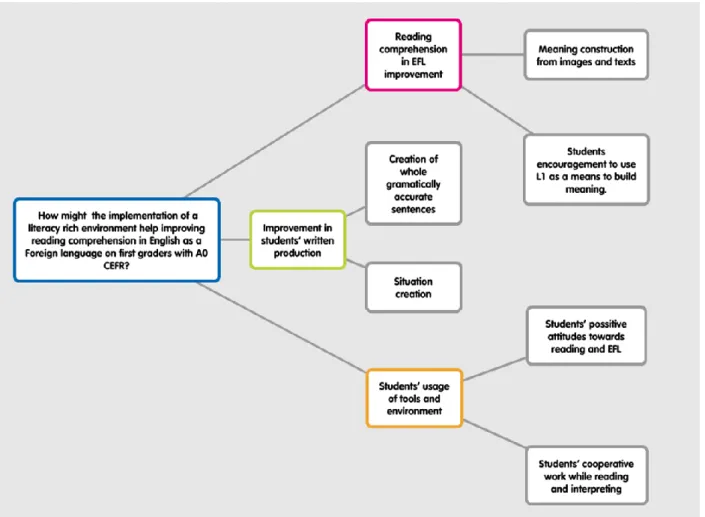
(25) LITERACY RICH ENVIRONMENTS AND READING COMPREHENSION IN EFL. 11. The age of the group was a determinant factor as well, it helped identifying the students‟ likes and dislikes along with their motivations in regards to their approach to English activities such as songs, charades, use of visual materials and the reading of short stories in English. Here it is important to establish the relevance of reading comprehension as a key process not only for literacy but also for several cognitive and socio-cultural skills and abilities. This research seeks to develop reading comprehension skills as the main ability to reinforce in beginners levels and this would help supporting the process of literacy in general. To wrap things up, this research sought to enhance and potenciate the reading comprehension skills the group 104 through the transferring of skills from L1 to L2 supported by a literacy rich environment. 1.5.2. Justification. This research aimed to develop an analytic process in which it would be possible to recognize the suitability of the application of a specific environment, designed and developed based on concrete needs and resources; and its influence on the development of reading comprehension in L2 carried on using skills transferred from L1. This analysis might as well set certain basis in terms of the strategies used to foster processes literacy both in L1 and L2. 1.5.3. Research question(s) and objective(s). How might the implementation of a literacy rich environment help improve reading comprehension in English as a Foreign language on first graders with A0 CEFR? To properly answer this question, it was necessary to formulate certain objectives that would lead the research process in an organized and precise way: . Main objective: To establish how effective is the implementation of a literacy-rich environment as a tool to improve reading comprehension in EFL for first graders..
(26) LITERACY RICH ENVIRONMENTS AND READING COMPREHENSION IN EFL . 12. Specific objectives: 1. To describe the way that reading comprehension is fostered by the implementation of a literacy rich environment. 2. To evaluate the influence of a literacy rich environment in the reading comprehension and literacy development. 3. To evaluate the pertinence of the proposed strategies to improve reading comprehension of the grade 104.. 1.6. Conclusion In general terms, the participants from grade 104 showed some impressive skills in terms. of reading comprehension in Spanish. These skills were transferred to L2 in order to foster a process that might develop their reading comprehension skills in English. The main tool used to support such process was a literacy rich environment that provided the group 104 with the resources and ambiance they needed to enhance such skills..
(27) LITERACY RICH ENVIRONMENTS AND READING COMPREHENSION IN EFL. 13. Chapter 2: Theoretical Frame work& State of the Art 2.1. Introduction Recasting some general aspects from chapter one, it was necessary to bring to mind the. main problem in students from grade 104 which was the lack of reading comprehension skills in EFL. It was precise to perform a review on the theoretical approaches that scientifically supported the pertinence of this research. Now, the main concepts to understand and develop the research were : reading comprehension, foreign language reading, learning environments and skills transfer. 2.2. Theoretical frame work 2.2.1. Reading comprehension. It was once believed that reading comprehension was the process in which readers decoded written texts and oral stimulus (Hoover & Gough, 1990) that means, if readers got to decode the words on a page and understood what was being read to them, they were reading. However, the construction of meaning goes beyond text decoding. This is a process that involves the reader‟s prior cultural, linguistic and litearay experience. Accoding to Smagorinsk (2001) each reading is placed and relates to other readings. Understanding readings as experiences and, in general, the reader‟s background. Snow (2002) on the other hand, proposes that comprehension is the process in which readers extract the meaning from a text. Meaning, then, resides within the text a priori so the readers must be able enough to efficiently extract it. Snow‟s proposal conceives texts as a message container that goes from the writer to the reader. The text is then encoded by the writer and decoded by the reader..
(28) LITERACY RICH ENVIRONMENTS AND READING COMPREHENSION IN EFL. 14. One may conclude then, that reading comprehension involves the reader‟s experiences and prior knowledge with the physical and cognitive process of encoding and decoding information. 2.2.2. Foreign language reading. The speech is undoubtedly the primary mode of communication in natural language; following the previous statement, teachers have underrated the role of reading in the process of foreign language learning in young children. According to Dlugosz (2000) the teaching of reading in language programmes would help young learners, including pre-scholars, to progress faster not only in learning to read but also in understanding and speaking the language. This previous statement is one of the main reasons why this research was focused on reading comprehension in EFL with non- literate students. Moving on a bit further in reading approaches, there are two main methods to introduce kids to reading. One is the phonic method in which students are taught to transform letters to sounds.This method goes along with writing so the kids identify the form of the word and what letters compose this one before they understand the actual meaning. On the other hand there is the look-and-say method in which kids are given images and words altogether. With this one, the teachers and the environment are responsible of providing the kids with enough experiences of seeing, hearing and reading the target language. As established before, the population chosen for this research were not English literate but they showed good proficency when reading images and relating these to texts in Spanish. This was the major reason why the look and say method was impleme nted through a literacy rich environment..
(29) LITERACY RICH ENVIRONMENTS AND READING COMPREHENSION IN EFL 2.2.3. 15. Learning environments. During the 1990s the growth of constructivism and its spread on education and psychology represented a paradigm shift for educator and curriculum designers to a view of learning as a more social and conversational process than just as formal instruction. The theoretical statement behind learning environmentsmainly proposes anambiance in which learning is a whole process that allows the learners to acquire knowledge in real life based contexts. These context are adapted to the learners‟ needs and interests. There have been several researches that reveal that students perceive learning environments as a determinant feature in learning outcomes. Fraser (1998) states that the quality of learning environments at school directly affects the students‟ learning and their positive perception of those environments would pave the way through meaningful learning (7-33). This is the reason why the execution of this environments might help fostering a better learning process not only for this research project but to any other academic program. As stated previously, reading comprehesion involves interaction of the students with their experiences,culture and knowledge and then the environment promotes this sort of dynamics. 2.2.4. Lite racy rich environments. In a literacy rich environment, parents and teachers make sure that children engage with a given language about everyday life or events the children may find interesting(Clarke, T. & Ouellette, M. 2001). These environments include a regular process of reading, talking, writing, discussing and experimentation with books, prints and else. These spaces provide the kids with a chance to witness how printed language works and the several ways it may be used..
(30) LITERACY RICH ENVIRONMENTS AND READING COMPREHENSION IN EFL. 16. These environments have three core characteristics: . Kids are exposed to numerous stimuli such as books, prints and oral language.. . Reading and writing are encouraged along with the sharing of the students‟ and teacher‟s ideas.. 2.2.5. Reading is conceived as a pleasant activity and group learning is also encouraged. Whole Language Instruction. Church (1996) conceives language as a whole, as something that can not be put apart. This theory states that languages are acquired implicitly when, in a content and literacy rich environment, reading is taught in a contextualized setting with real life communication. Reading focuses then, on a regular exposure to real, vocabulary rich literature. To complement the previous statement, Edelsky (1992) proposes five theoretical principles that support the whole language: (a) Language is a whole. It is not something t hat can simply be put apart in small pieces; (b) written language is language indeed; (c) knowledge is a social phenomena; (d) it is most advantageous and beneficial to look at people‟s language strengths rather than their lacks, and (e) reading and writing are transactional processes. 2.3. Lite rature review It is important then to have a second review, this time, on what other studies have tried to. address problems related to reading comprehension in EFL and learning environments, in this case literacy rich environments. To begin with, “Rethinking the role of reading in teaching a foreign language” by Dlugosz (2000) shows the importance of reading as a strategy to foster literacy processes in a foreign language with early students of English including those who have not yet learnt how to read in their native language..
(31) LITERACY RICH ENVIRONMENTS AND READING COMPREHENSION IN EFL. 17. Dlugosz (2000) establishes that the contact with reading during the first steps of teaching a foreign language will help the learners improve their understanding and speaking skills in a second language. Out of the study conducted, the author proposes several factors that explain the beneficial role of learning to read in the process of acquiring a foreign language; some of them are: . Using both the phonemic and the look-and-say method gives the kids two channels of perception speeding up learning and improving the functioning of their short-term memory.. . The graphic representation of a text helps children to isolate basic sentence meaning components, and helps them creating linguistic patterns. Moreover, these patterns help them speed up the development of their listening comprehension and language production skills.. . When kids get to read a short book they show great signs of accomplishment and success pumping up their motivation which is a determinant factor in learning success in general. Moving on, Shin, J. (2015) presents “Literacy instruction for Young EFL learners: A. balanced approach” based on the supposition that EFL teachers should integrate the four language skills in a language rich environment that provides the students with lots of opportunities of reading and writing meaningfully in English. Shin (2015) is quite clear when bringing back the importance of using the students‟ previous knowledge and giving children the chance to experiment with language in realistic contexts. The author proposes five building blocks for an effective EFL meaning- focused literacy program: . Students should be immersed in print and literature having the opportunity to go through several reading experiences using all sorts of books..
(32) LITERACY RICH ENVIRONMENTS AND READING COMPREHENSION IN EFL . 18. Use the students‟ prior knowledge as a way to transfer their learning and reading strategies from L1 to L2 so they can build academic and cultural language to be effective readers and writers of English. . Build and reinforce students‟ high frequency vocabulary following the idea that children must know at least 95% of the words in a text to fully understand it.. . Creating phonemic awareness and giving explicit instruction on phonic decoding and word spelling.. 2.4. Conclusion Improving the reading comprehension processes in the students from 104 would provide. them with cognitive and formal skills so they can succeed both in the academic and social contexts. Working as well with a specific learning environment would give the students the necessary scaffolding to improve their learning process. Chapter 3: Research Design 3.1. Introduction This research implemented two ways of directing its aims and goals. The theoretical. framework and the literature review are the conceptual basis of this research, but when it comes to “shaping” the project, establishing how it will be done, it is necessary to bring two components that help the reader and the researcher constructing a coherent process. The first component is the type of study; in this case it is qualitative research and the second one is the approach which is action research..
(33) LITERACY RICH ENVIRONMENTS AND READING COMPREHENSION IN EFL 3.2. 19. Type of study 3.2.1. Qualitative research. Qualitative research focuses its procedures on what people do and how they react and relate to their environment. This means that, according to Denzin & Lincoln (2005), qualitative researchers study happenings in their natural settings attempting to interpret phenomena in terms of what meanings people bring to them. Merriam (2009) on the other hand proposes that qualitative researchers are interested in understanding the meaning people have constructed, this means, how people make sense of the world and the experiences these have with it. Following these constructs, the reader and the researcher might as well find an answer to the question why qualitative research? Qualitative research provides the researcher with non-ordinal values and data, compared to other research paradigms, which avoid for most of the parts, ge neralizing and allows the use of various data analysis methods and theoretical frameworks. 3.2.2. Action research. Action Research, which is also known as participative action research, is an approach that involves a specific range of skills to achieve certain research goals; these skills include planning, observation and listening, evaluation and critical reflection. Meyer (2000) establishes that the basis of action research lies in its focus on generating solutions to practical problems and its ability to involve both the research and the researcher on the development and design of changing activities..
(34) LITERACY RICH ENVIRONMENTS AND READING COMPREHENSION IN EFL. 20. Following the previous explanation on what action research is, the researcher finds this approach appropriate to study and develop the reading comprehension issues that students from grade 104 present. 3.3. Data manage ment procedures 3.3.1. Data analysis methodology. Once collected the necessary data, the analysis method chosen by the researcher is Triangulation due to the validity this method gives to the investigation. Ac cording to Patton (1999) triangulation provides a research with a rich, robust and comprehensive analysis of the collected data. This is achievable by using multiple observers and analysts, in this case the researcher, the tutor-teacher and the students whom the researcher has shared the analysis with. Using different methods, approaches and points of view certainly enriched this research. 3.4. Categories 3.4.1. Overall category mapping. Category Reading comprehension in EFL. Sub-categories . Imagery reading. . Students‟ interactions. . Word decoding Phonemic awareness Meaning construction Picture reading Prediction making Relating imagery and texts Interactions SSSS/SSEnvironment. Instrument. Description. . Field notes Surveys Handouts. Examines the way students interact with different types of texts.. . Handouts Field notes Videotaping.. Revises how students relate to pictures and how they get to construct meaning out of these.. . Videotaping Handouts Field notes.. Considers the ability students have to interact with their peers and the environment specifically designed for them..
(35) LITERACY RICH ENVIRONMENTS AND READING COMPREHENSION IN EFL. 21. Table 1 Overall Category Mapping. 3.4.2. Artifacts’ descriptions. 3.4.2.1. Observations. Following Kalmbach (2006), observing is to watch as a participant in the classroom in a critical way. This statement recognizes that “live action” is a powerful information provider for the researchers. In this category one can place the video recordings and the field notes previously proposed. These observation were carried out during the whole research and split up unto three stages; the diagnosis process in which observation was key to identify the characteristics of the population, the implementation in which data was collected to examine the goals and achievements set up previously. Finally during the las stage of the research observations contributed to the data gathering process and helped in drawing conclusions and in analyzing the results. 3.4.2.2. Interviews. Kalmbach (2006) refers to interviews as the process of inquiring, asking questions and listening to different people so the researcher may have different perspectives of the research that is being conducted. In this case, surveys are taken into account as well. These artifacts were used during the first stage to help drawing the characteristics of the population and during the final stage in order to know the perception of the participants towards the whole process. These two were key fot the research due to the opportunity nterviews provide for the participants to have their own voice..
(36) LITERACY RICH ENVIRONMENTS AND READING COMPREHENSION IN EFL 3.4.2.3. 22. Artifacts. Artifacts are defined any kind of physical documentation hat sheds additional light on a given research question and topic (Kalmback, 2016. P 78).. The main artifacts used during this research were the interviews, previously explained, and quite a few hand outs and work shops used mainly during the second and third stage of the research in which the students were constantly working towards the achievement of the goals and, at the same time, providing the researcher with heaps of information and evidence in regards to these dynamics. 3.4.3 3.4.3.1. Crite ria description and justification Reading comprehension in EFL:. This category comprehends the way the participants constructed meaning from the several types of input they engaged with and the way they related their previous knowledge and cultural background during this interaction. To measure and support the conclusions on this category several videos were recorded and handouts were given to the students and collected after they worked on them. 3.4.3.2. Imagery reading:. Taking into account that most of the texts the students worked with were in the outline of a picture book, in which images and visual stimuli primed over texts and words, it was necessary to work on the way both images and texts relay on each other and how either of them provide meaning to the lectures. That is why skills such as prediction making and imagery reading in general were promoted..
(37) LITERACY RICH ENVIRONMENTS AND READING COMPREHENSION IN EFL 3.4.3.3. 23. Students’ interactions:. The literacy rich environment departs from the constructivist paradigm in which knowledge is built upon the interactions amongst the learners and the environment, set on a real life context. The main tool implemented during this research was the literacy rich environment, this is why studying the interactions and the effects produced on the students by the environment became essential. 3.5. Conclusion As a conclusion, the previous categories of data analysis provided the research with a rich. source of information regarding the way students built knowledge surrounded by the given environment and the tools and resources they used to do so. Those categories weredesigned taking into account both the population needs and their cognitive strategies, furthermore, these categoriesprovided the researcher with a more specific and coherent path to follow all over the investigative process. Through the categories, the researchsees a clearer course to proceed with the implementation of the project as well as the data gathering and analysis. Chapter 4: Pedagogical Intervention and Implementation 4.1. Introduction Following the previous statements on the formal structure of this project, a pedagogical. review must be done as it is the basis of this research; this becomes the part of the project in which both the reader and the researcher find the pedagogical theory that supports the project as a changing dynamic in regards to the reading comprehension in EFL from grade 104..
(38) LITERACY RICH ENVIRONMENTS AND READING COMPREHENSION IN EFL. 24. There are two main pedagogical theories here, both the vision of la nguage teaching and the vision of learning have been chosen taking into account the learning needs of group 104 and their cognitive skills and strategies. 4.2. Visions of language and learning 4.2.1. Vigotsky’s constructivis m. Social constructivism provides an explanation for how learning can be achieved by pedagogical practices based on interaction. This theory makes emphasis on how learning takes place in a socio-cultural environment and places learners as “active constructors of their own learning environment. Vygotsky (1978) claimed that learning occurs through dialogue; this dialogue occurs between students, students and the teacher and even between the readers and the texts. Thus, learning occurs when the student interacts with himself, and with the individuals around it. These types of dialogue were the ones that supported the suitability of this learning theory to work as a support to the dynamics carried out in the literacy rich environment. 4.2.2Whole Language Instruction. The Whole language instruction claims that words should not be put apart in segments of letters and sounds to be decoded (Stahl and Miller, 1989), but they should be taught as a whole system full of meaning in which words are related one and other on a given context (Moats, 2007). Adding to this previous statement, Froese (1991, p.2) defines whole language as: “child centered, literature-based approach to language teaching that immerses students in real communication situations whenever possible” It is clear to state now, that the whole language approach, on a real comminucation setting, may have provided the students from grade 104 with a chance to enhance their.
(39) LITERACY RICH ENVIRONMENTS AND READING COMPREHENSION IN EFL. 25. reading comprehension skills in L2 by reading entire concepts instead of decoding letters and sounds separately. 4.2.3. Codeswitching. There have always been discussions on whether or not teachers and students should use their L1 when learning a given L2 or target language. Macaro (2009) reviews two theories that support the use of L1 in the L2 classroom. The first theory shows that, from a psycholinguistic point of view, language is perceived, stored and kept in the same way as other type of information. Then both L1 and L2 in bilingual and non bilingual speakers are contained in the same conceptual store for the speaker to use them when needed. This being said, L1 lexicon and resources are far much stronger and reachable than L2 ones, mostly in non-advanced bilingual speakers. Ignoring or suppressing this would be restraining the speaker/learner from a great learning tool (Ellis, 2005). The second theory shows that codeswitching in the classroom may be used by the teacher to foster interactions in the classroom and to put across message-oriented information to the students. These two theoretical approaches supported the implementation of codeswitching with the participants of this research due to the fact that these theories may have helped the participants to both use their lexicum in L1 to understand information in L2 and to promote the interaction as they would normally do in a real based context (Turnbull, M., & Dailey-O'Cain, J. 2009).
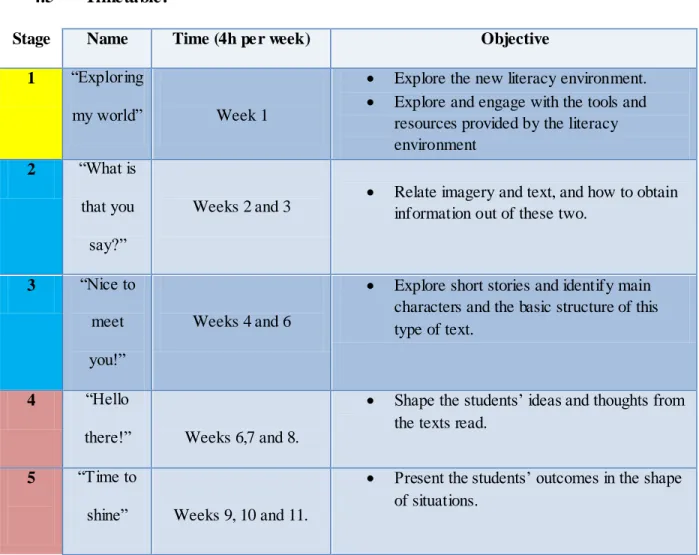
(40) LITERACY RICH ENVIRONMENTS AND READING COMPREHENSION IN EFL 4.3. 26. Instructional design 4.3.1. Lesson planning. Lessons have been planned following the Presentation-Practice-Production (PPP) model. Criado (2013) presents the main features of such approach on three stages. Through the first stage the information is presented either in a deductive or inductive way, here the goals and the targets of the unit are presented. During the second stage, practice, the contents and information presented previously are to be practiced by the students.The goal of this phase is for the students to achieve a certain level of expertise that would be mastered later on during the production stage. The third stage of this model aims at increasing the expertise of the skills previously presented and practiced. Here, the students work through more autonomous and creative activities that may imply discussions, roleplays debates and such (97-115). 4.4. Implementation The research was planned and implemented through a 11 week program divided into 5. stages (See Table 2: Timetable) within 3 different phases (Yellow, blue and pink). Every one of the stages and phases was designed so the participants got to develop, little by little, some skills needed to improve their reading comprehension in EFL. Since the very beginning the lessons were carried through in three stages following the Presentation-Practice-Production (PPP) model. Subjects and goals were presented and students had the chance to experiment, inquire, question and examine both the goals and the material used for the session. Then, they had the opportunity to practice and, literally, play with the information and materials they had around. The third step was focused on production in which students were free to produce what ever they felt like as long as they were using what they had learned..
(41) LITERACY RICH ENVIRONMENTS AND READING COMPREHENSION IN EFL. 27. This last stage was key because most of students produced different outcomes. It did not matter if they drew, painted, wrote or spoke. It was all about producing and getting them to realize that they can actually do something with the English language besides translating or repeating isolated terms with unclear aims. This freedom must not be misunderstood. Every session had a different outcome, some sessions involved purely reading, some others drawing and writing and some others a short theatre play. It mostly depended on the aims of the research and whether or not it was necessary to collect evidences of those processes. Following the previous introduction here are the three phases in which the lessons were developed. 4.4.1 Yellow Phase: 1 Week – 4 Hours.Students contributed with ideas to build their new environment in terms of the distribution of spaces, the places where the materials would be situated and such. They also created a vocabulary wall (See appendix K) and they nourished it every week according to the subject that was being worked in the program.The main goal of the research was presented to the participants, along with the dynamics of the environment. This last one was constantly built throughout the development of the lessons but at this stage some stimuli were already available for the students. The outcomes during this stage were merely spoken and by groups because most of the dynamics were lead for the whole class.During this stage the students helped building the vocabulary wall; a designated area inside the classroom in which every week both the researcher and the participants added new words, images and concepts that might have been useful throughout the project. Most of the practice and production activities were carried on focusing on the importance of the images and the relations these had with the texts. Risk taking was encouraged and mistakes were not penalized but those set the grounds to.
(42) LITERACY RICH ENVIRONMENTS AND READING COMPREHENSION IN EFL. 28. deep reflections on the reasons why those approximations were correct or not. Images that recall known concepts such as “boy, love, teacher and student”. The images were presented on a flat secquence and the interpretation of these was carried on using guide questions such as: “What may this mean?” referring to single images and then to the secquence as a whole unit of meaning.The students participated guessing what the secquence of pictures might mean and explaining why. This stage was quite interesting and very meaningful to the students because, as stated in the characterization, they had barely explored English and now they had the chance to do so, in a student centered dynamic, feeling to make mistakes and try new things. This stage was the hook up for them to feel interested on the rest of dynamics. 4.4.2 Blue Phase: 4 Weeks – 16 hours. During this phase the students got to explore a considerable amount of resources and dynamics moving from reading and interacting with picture books, worksheets, storylines and scavenger hunts. The goal to this phase was giving the participants a closer approach to the materials and tools they would be using throughout the research. The researcher, the guide teacher and the literacy rich environment itself were all along the process to facilitate the scaffolding for the students. The main focus of this phase was discovering the way texts and, mainly, picture books were presented; the amount of text and the relation it has got with the pictures. The series of books used throughout the research had a common structure composed by a big image illustrating what was happening, e.g. “little red ridding hood walking in the woods”, some support images with precise and punctual vocabulary such as “Scared, basket, wolf, forest” and so on, and a small piece of text narrating what was happening..
(43) LITERACY RICH ENVIRONMENTS AND READING COMPREHENSION IN EFL. 29. This structure was the one used the most for the visual and written production of the students. Most of the reading sessions during this phase were made by groups alternating the book and the participants of each group. After they had read the books, or at least a part of it, they were asked to retell, act or draw a segment of the story, the one that caught their attention the most. They had to include as well any support images they felt were important to construct meaning and a bit of text too. 4.4.3 Pink Phase: 6 Weeks – 24 hours.. At this point the participants had the. opportunity to create in many ways. They got to design and create the situation diagram, explained in the time table, and they were free to choose what their situation would include, how many support images would this one have, the words accompanying these and so on. Every student was free to interpret the story and to present an explanation, in both English and Spanish, to the rest of the classmates. Regarding their oral and written outcomes, they were allowed to use Spanish but they were highly encouraged to include English in their productions. Throughout these two last phases (Blue & Pink) , comprehension was checked in terms of story prediction, picture reading and the links they made between the text and images.This situation making phase was very meaningful because it helped giving account of the cognitive processes the students went through to in order to design their situations and present them stating the reasons why they did it..
(44) LITERACY RICH ENVIRONMENTS AND READING COMPREHENSION IN EFL 4.5. Timetable:. Stage. Name. 1. “Exploring my world”. 2. 30. Time (4h per week). Week 1. Objective . Explore the new literacy environment. Explore and engage with the tools and resources provided by the literacy environment. . Relate imagery and text, and how to obtain information out of these two.. . Explore short stories and identify main characters and the basic structure of this type of text.. . Shape the students‟ ideas and thoughts from the texts read.. . Present the students‟ outcomes in the shape of situations.. “What is that you. Weeks 2 and 3. say?” 3. “Nice to meet. Weeks 4 and 6. you!” 4. “Hello there!”. 5. Weeks 6,7 and 8.. “Time to shine”. Weeks 9, 10 and 11.. Table 2. Time table.. Chapter 5: Organization and analysis of the information 5.1 Introduction Right after the implementation of the 11 week program, data was collected, classified and analysed according to the goals set for this research. Establishing certain categories and subcategories to organize and analyse these data was a key step before drawing conclusions. 5.2 Organization of the data The process of triangulation was used to analyse the data and to provide precise and concrete conclusions of this process, that is the reason why several instruments were used to.
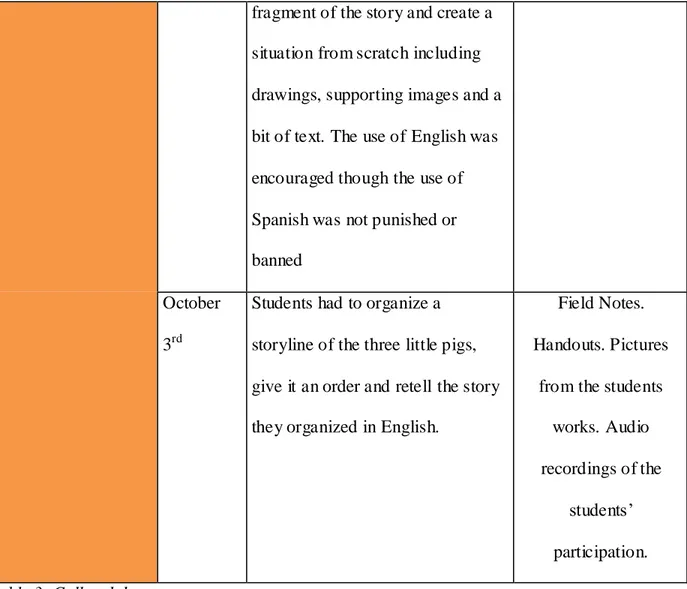
(45) LITERACY RICH ENVIRONMENTS AND READING COMPREHENSION IN EFL. 31. collect data throughout the research process. As stated in chapter three, observation, interviews and artifacts were the means used to collect this data. This type of data colletion allows the triangulation process to draw rich, clear and founded conclusions of the processes giving the research a more trustworthy image. The data collected during the process was then organized by sets, each one of them corresponding to the categories set previously in chapter 3 (See table 1). Both physical and digital evidences were named after the three categories previously mentioned. For organizational purposes, data sets were organized in a chart that includes punctual information regarding the date of collection and the instrument used. 5.3 Colleted data Data set (Phase). Date. Actions Imple mented. May 16th Groupal imagery reading. Students looked at the board full of isolated Exploring my. images and they established. world. (Yellow. relationships and patterns to. Phase). Data Collected Audio recordings with the students participation.. construct meaning. May 20th Groupal imagery reading. Students looked at the board full of isolated images and they established. Audio recordings with the students participation.. relationships and patterns to construct meaning August 8th Groupal reading of picture books. Students went to the playground. Audio recordings with the students speech..
(46) LITERACY RICH ENVIRONMENTS AND READING COMPREHENSION IN EFL and in groups of 6 students read What is that you. Field notes.. and identified the main. say?. characteristics of the books. After. &. that they performed any of the. Nice to meet you!. situations present in the book. Both English and Spanish were used. August 19th. Decoration of the classroom.. Video recordings,. Addition of new vocabulary to the. pictures from the. “Vocabulary wall”. classroom.. Groupal reading of picture books. This time the students identified and presented to the classroom August. three elements of the situations or. 26th. happenings present in the books; the setting as a physical space, the characters and their actions and the support images that surrounded these situations and the function they had. Groupal reading of Little red ridding hood. Imagery and text relating to construct meaning. Students had to select any. Field notes. 32.
(47) LITERACY RICH ENVIRONMENTS AND READING COMPREHENSION IN EFL Hello there! &. September fragment of the story and create a. Field Notes.. Time to shine.. 6th. situation from scratch including. Handouts. Pictures. drawings, supporting images and a. from the students. bit of text. The use of English was. works.. encouraged though the use of Spanish was not punished or banned.. Groupal reading of Goldilocks and the three Bears. Imagery and text relating to construct meaning. September Students had to select any. Field Notes.. 16th. fragment of the story and create a. Handouts. Pictures. situation from scratch including. from the students. drawings, supporting images and a. works.. bit of text. The use of English was encouraged though the use of Spanish was not punished or banned. September Groupal reading of The Three. Field Notes.. 26th. Little Pigs. Imagery and text. Handouts. Pictures. relating to construct meaning.. from the students. Students had to select any. works.. 33.
(48) LITERACY RICH ENVIRONMENTS AND READING COMPREHENSION IN EFL fragment of the story and create a situation from scratch including drawings, supporting images and a bit of text. The use of English was encouraged though the use of Spanish was not punished or banned October. Students had to organize a. 3rd. storyline of the three little pigs, give it an order and retell the story they organized in English.. Field Notes. Handouts. Pictures from the students works. Audio recordings of the students‟ participation.. Table 3: Colleted data. 5.4 Analysis of the data The results obtained throughout the implementation and development of this research provided key information in regards the dynamics that can be used to enhance the reading comprehension processes in a foreign language in an official school with quite similar characteristics to Domingo Faustino Sarmiento School in Bogotá. The results expected oscillated from basic spoken and written outcomes to the construction of more complex structures in L2. On the bright side though, more meaningful. 34.
Figure
Documento similar
There are common and divergent patterns in the answers to a questionnaire that delves into motivational and teaching aspects linked to reading education: leisure reading habits,
The present study, aiming to evaluate the effects of a 15-week program of water activities adapted in aquatic skills for students with autism spectrum disorder, found that,
In addition, as some authors point out, we can assume that the comprehension ability in itself is developed at an early age (Kendeou, van den Broek, White, & Lynch, 2007). That
The aim of this paper is to demonstrate that reading authentic literary material in the English as a Foreign Language (EFL) classroom can improve students’ language learning skills as
The objective of the research is to foster a clearer comprehension of how functional physiological adaptations (including stomatal response and photosynthetic quantum yield
The development of the Programme based on the Intercultural Approach to improve reading comprehension in 3rd grade students of Simón Bolívar High school from
ABSTRACT: This study examined the effect of classifying vocabulary into parts of speech using Google Drive sheets in order to improve reading comprehension.. Participants were 20
The Dwellers in the Garden of Allah 109... The Dwellers in the Garden of Allah
