
Implementing reading comprehension strategies by using Jim Scrivener's reading route map
65
0
0
Texto completo
(2) IMPLEMENTING READING COMPREHENSION STRATEGIES BY USING JIM SCRIVENER'S READING ROUTE MAP. JHON HARLY ROMERO RÚA MARCELO ANDRÉS TORRES MARÍN. Trabajo de Grado presentado como requisito para obtener el título de Licenciado en Lengua Inglesa. Asesor: Ronald Alan Perry. UNIVERSIDAD TECNOLÓGICA DE PEREIRA FACULTAD DE BELLAS ARTES Y HUMANIDADES LICENCIATURA EN LENGUA INGLESA PEREIRA 2017.
(3) i. ACKNOWLEDGMENTS. First, we would like to thank our God who provided us support and willingness to develop this project. Second, we would like to express our gratitude to our families, especially our parents who have supported us. Third, we would like to thank our advisors Humberto Uchíma Tasamá and Ronald Alan Perry whose hard work and guidance contributed greatly to the accomplishment of this project. We would like to thank our teachers Javier Vanegas, Dolly Ramos, Clara Inés González, and Frank Giraldo who provided us valuable information. They deserve great credit because they contributed their time and expertise during some stages of this Classroom Project. Finally, we would like to thank our dear classmates and friends Jhon James Galvez, Luisa Duque, and Marcelo Rojas, who shared their experience with us..
(4) ii. ABSTRACT. We conducted this classroom project during our practicum in a public institution in Pereira. A group of tenth graders was selected as participants of this project. The main objective was to design and implement reading comprehension tasks that foster the use of reading comprehension strategies.to implement the use of reading comprehension strategies by using a Top-down reading model proposed by Jim Scrivener (2005). This project was carried out considering some procedures and sections like a research study, having a conceptual framework where we considered important terms which supported our results. The results were reported considering the reflections we made. The use of reading comprehension strategies provided our participants advantages like make students more confident when they come into contact with texts in a systematic and orderly manner. The students showed understanding better the instructions and were able to use reading strategies properly. It was a fact that such strategies were important in our student’s learning process when the goal was continue growing in the field of teaching English..
(5) iii. RESUMEN. Realizamos este proyecto de aula durante nuestra práctica en una institución pública en Pereira. Un grupo de alumnos de décimo grado fueron seleccionados como participantes de este proyecto. El objetivo principal fue diseñar e implementar tareas de comprensión lectora que fomentaran el uso de las mismas por medio de un modelo de lectura propuesto por Jim Scrivener (2005). El proyecto se llevó a cabo de una manera similar a un estudio de investigación, teniendo un marco conceptual para considerar conceptos importantes y a la vez analizar y apoyar ideas extraídas de diferentes investigaciones relacionadas con el mismo campo, tales como las estrategias de comprensión lectora y la cultura. Después de la aplicación de la metodología, los resultados extraídos de la experiencia y las reflexiones realizadas por el profesor, se encontró que el uso de las estrategias de comprensión de lectura proporcionaba ventajas con el fin de hacer que los estudiantes fuesen más seguros de sí mismos cuando se enfrentan a textos escritos, en una forma sistemática y ordenada. Los estudiantes mostraron una mayor comprensión de las instrucciones, y fueron capaces de utilizar estrategias de lectura correctamente. Es un hecho, que tales estrategias son importantes en el proceso de aprendizaje de los alumnos, si el objetivo es continuar creciendo en el campo de la enseñanza de la lengua inglesa..
(6) iv. TABLE OF CONTENTS. Page INTRODUCTION. vii. 1. JUSTIFICATION. 1. 1.1 Teaching Objectives. 3. 1.2 Learning Objectives. 3. 2, CONCEPTUAL FRAMEWORK. 4. 2.1 Reading. 4. 2.2 Comprehension. 5. 2.3 Reading Comprehension Strategies. 6. 2.3.1 Prediction. 7. 2.3.2 Skimming. 8. 2.3.4 Scanning. 8. 2.3.5 Reading for detailed Information. 9. 2.4 Reading Comprehension Models. 9. 2.4.1 Bottom-Up Model. 9. 2.4.2 Top-Down Model. 10. 2.4.3 Interactive Model. 10. 2.5 Scrivener´s Route Map. 11. 3. METHODOLOGY. 13. 3.1 Description of the Project. 13. 3.2 Context and Setting. 14. 3.3 Participants. 14.
(7) v. Page 3.4 Pre-service teachers´ role. 14. 3.5 Data Collection Techniques. 15. 3.5.1 Teachers’ logs. 15. 3.5.2 Observation formats. 16. 3.5.3 Document Analysis. 16. 4. INSTRUCTIONAL DESIGN. 17. 5. RESULTS. 18. 5,1 Professional Development. 18. 5.1.1 Challenges. 18. 5.1.2 Material design and implementation. 22. 5.1.3 Lesson planning and implementation. 22. 5.1.4 Academic and Personal Growth. 24. 5.2 Students´ responses 5.2.1 Students´ reactions towards the implementation of reading strategies.. 25 25. 5.3 Linguistic Outcomes. 31. 5.3.1 Language development. 31. 6. CONCLUSIONS. 35. 6.1 Social, academic, personal, professional and institutional impact. 35. 6.2 Professional development. 36. 6.3 Linguistic responses. 37. 6.4 Students´ responses. 38. REFERENCES. 39. Appendix 01 - Teaching log format. 43.
(8) vi. Page Appendix 02 - Observation Report format. 44. Appendix 03 - Document Analysis format. 45. Appendix 04 - Survey from students´ preferences and needs. 46. Appendix 05 - Survey from students´ preferences and needs tabulated. 48. Appendix 06 - Worksheets designed. 50. Appendix 07 - Scrivener´s Reading Route Map. 55.
(9) vii. INTRODUCTION. The effective Reading Comprehension strategies teaching such as Prediction, Skimming and Scanning requires the development of certain skills such as perceptive, cognitive and linguistic skills. The skills could be integrated into reading comprehension teaching for reading comprehension ability building. For this reason, we designed and implemented reading comprehension tasks that fostered the use of reading comprehension strategies by using a reading route map proposed by Jim Scrivener (2005).. We introduced secondary school students to some reading comprehension strategies implementation. We considered their preferences and needs in to attract them to read. Our participants followed instructions included in the top-down model proposed by Scrivener. The model included some effective strategies in the search of improving their reading comprehension ability.. We were focused on designing and implementing some reading comprehension tasks. These tasks allowed us to analyse how explicit teaching of certain strategies such as Prediction, Skimming, and Scanning seemed to improve our participants´ comprehension ability. Thus, we intended to raise awareness of the use of reading comprehension strategies for participants and report their reactions.. During the implementation, we reflected on reading comprehension as a highly interactive process which took place in the participants’ engagement in designed texts. Participants in this Classroom project gave us valuable information based on their reactions and experiences. This information allowed to provide the results of our project..
(10) viii. This Classroom Project included a selected primary language skill, in this case: Reading Comprehension supported by language skills, cognitive resources, knowledge of the world and previous knowledge. It was a fact that their previous experiences and expectations helped them with the goal of carrying meaning, encouraging and motivating them to see themselves as readers.. This classroom project included some reading topics selected by the participants after filling a survey provided by us. The intention with this survey was explore our participants’ preferences and needs to plan our classes, activities and tasks. We concluded in our results that considering their preferences and needs was valuable to motivate them and increase their view as readers besides their text reading purpose realisation.. Finally, as we mentioned before the purpose of this project was to raise awareness of the importance of recognising and reading comprehension strategies usage in the classroom. We think the development of this strategies helped them to improve their reading comprehension ability, and should be a subject that should be considered as a way to encourage the development of communication skills by improving levels of literacy.
(11) 1. 1.. JUSTIFICATION. Reading in English is one of the four main skills to master the English language. However, understanding a text while you read involves more than the ability to recognise words, phrases, and sentences. According to Grellet (1999) and Snow (2002), reading comprehension is the process of extracting and constructing meaning as efficiently from a text as possible. Grellet (1999) also says that we use different reading strategies depending on the purpose of the activity of reading. In Colombia, for English teachers, reading comprehension during English classes is an aspect that needs to be improved. It is important to encourage our students to be "active" readers able to interact with text.. Due to the importance that reading comprehension has in the context of teaching in Colombia, the Ministerio de Educación has published the results of some reports related to this issue. According to ICFES (Instituto Colombiano para el Fomento de la Educación Superior) in its exam “Saber 11” (Mandatory requirement for entry to higher education - Ley 1324 of 2009 Article 7) that consisted of eight areas (English, Math, Language (Spanish), Social Sciences, Biology, Chemistry, Physics and Philosophy), from 2011 to 2013, Colombian eleventh graders who presented it, obtained low scores in the English area. Reports showed that in 2011, students had an average of 42,69, then in 2012 reduced to 41.25, finally in 2013, the average rose slightly to 42.12 of 100 possible. According to the World PISA report for 2012, in Colombia, only three out of every thousand fifteen-year-olds reached the highest reading comprehension level: critical reading. The results obtained by our students in national tests show an alarming situation. Between the graduates of secondary education in 2014, less than one percent comes at a high level in argument and language, and less than two percent reached that level in interpretative skills..
(12) 2. It can be appreciated that the reading comprehension competence in Colombia is very low. In the educational system of Colombia, it is not common to implement and foster the use of reading strategies for English classes; also, there is a lack of studies related to the implementation of reading strategies and their results in schools, local policies, and curriculums.. The facts about low reading comprehension levels encouraged us to make our proposal on raising awareness on the importance of reading strategies implementation (Prediction, Skimming, and Scanning). The purpose of our project is to implement three different reading comprehension strategies considering the topics included in the reading materials, the presentation of the activities and the instructions included in the route map proposed by Jim Scrivener (2005). As it can be observed, our project got some outcomes and conclusions that may contribute to improving the low reading comprehension results mentioned before in the English classes and the local context. The current classroom project was implemented with a group of 10th grade students from the city of Pereira and contributed to improve the learner's reading comprehension ability in English with the help of reading comprehension strategies.. The observations and results shown in this the project will be the report about what happened in our sessions during the implementation of reading strategies. We also reported what happened when participants were introduced to the strategies in each class session. If it is possible, we would like to contribute with the Educational institution where the project was carried out by sharing the results and observations to the professors in charge at the end of the project. And of course, we expected positive results related with the performance of the students involved in this classroom project..
(13) 3. 1.1. Teaching Objectives. General Objective To design and implement reading comprehension tasks that foster the use of reading comprehension strategies by using a reading route map proposed by Jim Scrivener. Specific Objectives ● To raise awareness of the use of reading comprehension strategies. ● To observe learners’ reactions towards the implementation of reading comprehension tasks that include topics of their interest and promote the use of reading comprehension strategies ● To identify benefits and challenges of using reading comprehension strategies with tenth grade students. 1.2. Learning Objectives ● To recognise the importance of reading comprehension strategies such as Prediction, Skimming and Scanning and effectively employ them..
(14) 4. 2.. CONCEPTUAL FRAMEWORK. Once shown the justification of our project, we share the concepts that were needed for the implementation. In order to begin exploring our conceptual framework, we presented our first concept which is reading with definitions drawn from different authors.. 2.1. Reading Reading involves decoding meaning from a written text. For Pang et, al. (2003 p 6) It. involves perception and thought. It consists of word recognition (the process of recognising symbols) and comprehension (the procedure for understanding words, sentences and texts) Snow (2002) complements Pang's ideas when he states that learning reading is a developmental process which involves three elements: the reader, the text, and the activity. The reader is the agent who has to carry out the understanding of the text. It is the reader who uses different skills, abilities, knowledge and experience necessary to perform the act of reading. The text is the element that must be understood by the reader. It can have different characteristics (print media, electronic media, a source in which it is written, internal structure, surface structure, etc.) and provides two types of information (implicit and explicit information). The activity consists of a series of objectives, methodologies and assessments related to the reading. In addition, every activity has a direct impact in the readers by increasing their reading experiences and their understanding of the text. Pang et al (2003 p 6) complements Snow ideas showing reading as an important educational tool, valuable in the learning process no matter if it is a challenging skill. According to Goodman (1967), all readings involve a risk. It is a guessing game where readers go through a.
(15) 5. puzzle-solving process. They infer meanings, decide what to retain, and move on. As has already been mentioned, reading is closely related to the second concept that is part of this project which is comprehension. Bearing in mind that a good reader requires a high level of comprehension, it is necessary to define this term. 2.2. Comprehension Comprehension is the conscious construction of the representation of the overall meaning. of a text which results from the integration of textual information with reader’s prior knowledge. Pardo (2004) states that comprehension is the transaction that occurs when the reader interacts with the text. In this process, readers explore the text and combine their previous knowledge and experience to engage with it. Readers make inferences and search for coherence during the process. This leads them to the understanding of the text. Klingner (2007) described comprehension as a highly complex process where the interaction between the reader and the text is important. Readers need to activate their previous knowledge and use strategies that help them promote their interest and understanding. The comprehension process begins before readers start to read the text. According to Pardo (2004) reading instruction should be divided into pre-reading, during reading and post reading activities. Pressley & Wharton-McDonald (1997) indicated in their research that in those stages, readers set their goals, check and activate their previous knowledge, make connections and provide conclusions. Brown (2002) highlights the importance of these strategies that offer a starting place for teachers who teach reading comprehension through modelling and guided practice, in the search of promoting effective readers, who understand what they read and overcome difficulties using strategies. Since the main purpose of this project is to increase students level of reading comprehension, it is paramount to implement some reading strategies to accomplish this objective..
(16) 6. 2.3. Reading Comprehension Strategies Reading strategies are skills involved in decision-making during the process of reading. (in the planning, implementation, monitoring and evaluation) to construct meaning through the interrelationship between the reader and the text in each context. These strategies can be applied during three stages: Pre-reading, during reading and post reading. Those strategies can be classified into two main categories: cognitive and metacognitive strategies. Cognitive strategies are mental activities (not always conscious) that readers execute to process the information with the intention of making it more significant. These strategies are operations and procedures that readers use to acquire and retain different types of knowledge. When readers are introduced to cognitive strategies they acquire procedures that facilitate them to learn. According to Gellatly (1997) cited in Maturano et al. (2002) cognition involves expressing, gathering, organising and using knowledge. The result of cognitive processes is the construction of a structure that integrates decoding of text elements and prior knowledge. Thus, the reader combines new knowledge with prior knowledge. Metacognitive strategies allow the reader to select, use, monitor, and evaluate the use of reading strategies. They involve active monitoring and subsequent regulation of the activities of information processing. (Palincsar and Brown (1997) cited in Maturano et al. (2002)) They are divided into three parts of metacognition: planning, monitoring, and evaluating strategies. (Israel, (2007); Pressley & Afflerbach, (1995) cited in Iwai (2011)). Planning strategies occur in the pre-reading stage. They help to activate learners´ background and prepare them for reading. (Almasi, 2003; Israel, 2007 cited in Iwai (2011)). Readers preview the general information in the text and the structure. Readers get involved with predictions and elicitations about the text to be prepared to read. Monitoring strategies occur during reading. These strategies involve the reader in exploring new vocabulary, self-questioning, summarising, and inferring main ideas on each.
(17) 7. paragraph (Israel (2007); Pressley (2002) cited in Iwai (2011)). Readers identify key information and keywords that allow them to know what information is relevant or not for their purpose of reading (Hudson (2007) cited in Iwai (2011)). Evaluating strategies are employed after reading. Readers know how to apply what they read in other contexts, and appropriate knowledge and the message of the text. Baker (1994) cited in Reza (2013) affirms that these strategies are the most important factors that facilitate reading. comprehension.. Students. are. ready. to. determine. the. veracity. of. their. findings/conclusions. At this point of the activity, students are often eager to know "the right answers". They compare the text with the assumptions they have made. Thus, they perform a critical reading of the text using keywords found to create meanings. Baker (1994) cited in Maturano et al. (2002) divides the reading process into two important activities: The evaluation which is the process where the reader is aware of understanding the text, and the regulation that are the steps the readers take to solve their challenges. For that reason, readers employ reading strategies to make sense of text. In the following section, we will define the reading comprehension strategies we intended to implement in our project which are included in the Top-down route map proposed by Scrivener (2005).. 2.3.1 Prediction Prediction is the ability to develop hypotheses about the information found in a text. It is performed before reading and is based on data provided in titles, illustrations, headings, etc. Readers use their linguistic and cultural knowledge to anticipate what will happen. Duke and Pearson (2002) states in their research article “Effective Practices for Developing Reading Comprehension” that "it is the first strategy", where readers interact with three main activities that involve activating prior knowledge, previewing and overviewing. Those activities encourage readers to understand new ideas. Then, using their existing previous knowledge they anticipate what could be the possible aim of the proposed reading..
(18) 8. 2.3.2 Skimming After students made their predictions and activated their previous knowledge, they get ready to look for general information or main ideas in the text. In this way, they start to skim. Skimming involves looking over the text to get a general idea of the topic. Readers activate their prior knowledge on a given topic that provide the connections between their inferences and new information provided by the text. The reader moves his eyes quickly over sentences to understand main ideas through pictures, titles, subtitles, headings, subheadings, etc. Harmer (2007) highlights the importance of skimming as a strategy when states that it builds reader’s confidence and understanding without reading every word in the text.. 2.3.3 Scanning After learners extract general information from the text, they are ready to look for specific information or scan the text. Scanning is a reading strategy that helps the search for specific information (dates, names, cities, specific concepts, etc.). In this strategy, there is no need to read the text completely to find such information (Brown, 1994). This strategy involves searching for specific information by moving the eyes quickly in each paragraph in search of that specific information..
(19) 9. 2.3.4 Reading for detailed information When our students extracted specific information from a specific context, they start to read carefully for extra information in the text. Careful reading is the way readers select examples of language use. In this skill, they read every word, and work to learn from the text. It starts at the beginning of the passage and proceeds to the end. Once the concept of reading strategies is understood, it is important to explore another of the elements involved in this process such as reading comprehension models. 2.4. Reading Comprehension Models For Paris, Wasik, & Turner, (1991) cited in Reza (2013) reading is a complex process. that is developed with conscious and unconscious strategies to solve their problem of constructing meaning from texts. It is important to consider the study of the three important models of reading (Bottom-up, Top-down, and interactive model). They facilitate reading comprehension and help readers to face difficulties while reading (Eskey (2005) cited in Reza et al. (2013)). We will describe each model as follows:. 2.4.1 Bottom-Up Model This model is based on the linear way that learners use to construct meaning from context (letters - words - sentences). Each learner decodes letters, then words, and finally sentences to understand the meaning. However, this model has been criticised for being mechanical and.
(20) 10. makes readers translate piece-by-piece mental information (Grabe & Stoller, (2002, p. 32) cited in Reza et al. (2013)). Decoding word-by-word, makes the process slow and takes a lot of time and effort in the reading comprehension process. Readers tend to forget what they read because they often use the memory in their scheme of comprehension.. 2.4.2 Top-Down Route map This model is mainly supported by learners´ background knowledge, prior experience and expectations. In this model, it is not necessary to read all the vocabulary and sentences to read the context. The reader only uses certain words (keywords) and sentences to construct meaning quickly (Smith (2004) cited in Reza et al. (2013)).. 2.4.3 The Interactive Model The interactive model is the combination of Bottom-up and Top-down model. It emphasises the interrelationship between the reader and the text. Ahmadi & Pourhossein, (2012) cited in Reza (2013) suggest that the combination of Bottom-up and Top-down processes is necessary to describe the whole reading process. This model considers word identification and text interpretation, making reading comprehension the result of the interaction between the reader and the text instead of only the transmission of graphic information to the reader's´ mind. (Grabe (1991) cited in Reza (2013)) Finally, as one of our key objectives is to implement reading strategies using a top-down reading model, it is important to understand the proposal made by.
(21) 11. Scrivener, and how this proposal was valuable in the implementation of our project.. 2.5. Scrivener´s Route Map For the implementation of this project, we decided to expose our participants to the top-. down model proposed by Jim Scrivener (2005). He proposes a model where lessons move from overview to details. Scrivener identified some difficulties found in second language readers: limited vocabulary, the need of a dictionary and the slow process to understand a few sentences. He proposed that it was not necessary to understand every word to understand the context. For this, he highlighted the importance of using Prediction, Skimming, and Scanning to make selective readers that move their eyes looking for general or specific information. We intend to explain the three stages contained in his model as follows: The first stage is called Pre-text. This stage is divided in two activities (Introduction and lead-in, and First task). The first activity is Introduction and Lead in, where participants get interested in the topic, discuss about specific information elicited by the teacher, and connect the topics to their lives and personal experiences. Finally, participants are introduced to a specific new vocabulary relevant for the text. The second activity is First task, where readers predicts information from images, titles, subtitles, and read only the questions about the text. The second stage is called Text. This stage is divided in four activities (Skimming,.
(22) 12. Scanning, meaning focused tasks and tasks of individual language item) The first activity is Skimming where readers contrast their predicted previous information against what they found after skimmed the text. The second activity is Scanning that allows readers to find specific information after searching keywords or key phrases relevant to solve their doubts. The third activity is Meaning focused tasks which is divided into two (General and Specific). In here, readers find general or specific pieces of information that allow them to solve their questions. The fourth activity is tasks of individual language item, where readers extract meaning from the text and can show why they select their responses after highlighting or underlining specific information. The third stage is called Post-text. This stage is divided into two activities, (Follow on task and closing) The first activity is follow on task where readers solve the questions, appropriate what they have learned and contrast to their lives. Readers can produce orally or in a written way in their first or their foreign language (depends on their foreign language proficiency.) The second activity is closing. In this activity readers review and express their conclusions.
(23) 13. 3.. METHODOLOGY After we selected and prepared the theory which provided us the guide to prepare the. implementation of the project, we considered a plan to be carried out in the project. We selected and described the context and the setting. We described the role of the participants involved in the process, and prepared the material used to gather information that provided us with the results reported in this project. In the following sections, we will describe every component related to the planning of the project.. 3.1. Description of the project This project was carried out with tenth-grade students of an official high school in. Pereira. Participants were introduced to reading strategies using a top-down reading route map that allowed us to observe their reactions while facing reading tasks. The selected readings were extracted from Anglophone cultural topics that were adjusted to their preferences in an effort to increase their participation and interest to read. We reported their reactions when our participants were introduced to reading comprehension strategies when they performed their reading tasks, through the implementation of Scrivener´s route map (2005). The information gathered in our project allowed us to analyse how to accomplish our main objective which was our participants used and understood reading strategies. The following section reflects the classroom project implementation. In order to conduct and evaluate any observation in our classroom project, a reflective process was implemented through observation reports, teaching logs and document analysis. In the last section of this document the context, setting, participants and the data collection methods implemented in our project are described..
(24) 14. 3.2. Context and Setting This project was carried out in an official high school, located in the urban area of. Pereira, Risaralda. This school had approximately 1006 students. In the morning and in the afternoon, this institution ran from kindergarten to eleventh grade, where twenty-five teachers worked and taught the different subjects in there. The school had three teachers in English as a foreign language, which oversaw teaching from sixth to eleventh grade. Teachers have completed their degree as Licenciature English teachers. Students at the secondary level attended a regular English Language course that lasted three hours per week. One teacher was directly in charge of the curriculum design with the school Principal’s approval.. 3.3. Participants The participants in this classroom project were a group of 37 tenth grade students of high. school from an official institution in Pereira. According to “Formar en lenguas extranjeras el reto” (2006), which are the basic standards of competences in foreign language learning in Colombia, tenth grade students are classified in B1 level. These learners are able to identify keywords in a text, and comprehend and analyse general ideas, descriptive, narrative and argumentative texts from different sources and use different reading comprehension strategies according to purpose and type of text. This group of students were aged between 15 and 17-yearold, of whom the majority lived in Pereira.. 3.4. Pre-service teachers’ role At the time we implemented the project, we were called “Preservice teachers”. We were. two students from last semester of English Language Licenciature. Our intended role in the project was being observers. We selected and adapted readings taken from internet, which helped us to guide our lessons. We also guided, modelled, observed, and reported our participants’.
(25) 15. reactions. For this, we developed written reports. Those reports were our research instruments where we gathered information. We got support on Stuhlman et al. (2008) who describes the importance of using those instruments in research projects, and described observational methodology in four key areas: a. Why and how to observe classroom process b. Choosing observation tools c. Best practices in conducting observations d. Using data from observations to systemically improve classroom quality. In the following section, we explain in detail our selected data collection techniques.. 3.5. Data Collection Techniques We used collection techniques as a way of gathering information which allowed us to. reflect on their reactions. In the following section, we will describe each instrument we used in our implementation.. 3.5.1 Teacher’s logs Teacher´s logs are instruments that we selected to record events in the classroom. After every session, we wrote about our thoughts, questions, and concerns related to a lesson or a specific issue. We made logs as a way of reporting each session. This allowed us to sequence our process and reflect in our teaching.. Teacher´s logs were an excellent tool for improving our methodologies. We got support on Scale (2008 p.15) who states that reflection is both a ‘process and activity’ and should lead to a product such as a diary, log or reflective journal. He defined the reflective journal as ‘a written record of our experiences, and our feelings about planning, preparing and delivering teaching and learning’..
(26) 16. Logs were a tool, which encouraged us to reflect on our teaching and stimulated to enquiry into pedagogical practice. They allowed us to report our challenges that helped us in our academic and personal growth. Considering what Scales proposed, we recorded our reflections during and after each lesson. From there we extracted relevant questions as a guide to analyse the development of the class taught (See Appendix 01).. 3.5.2 Observation formats After evaluating the importance of including teaching logs in our project, we selected Observation format as an overall approach to inquiry data-gathering. It was an essential element of our classroom project. Observation formats allowed us to collect data about our participant’s activities when they performed their tasks. We follow Glessne suggestions (1999) who states that observation formats can be used to get new information. These instruments helped us to analyse the role and relationship between participants, the material and the activities proposed (See Appendix 02).. 3.5.3 Document analysis After reflecting on our teaching and writing our participants reactions, we selected document analysis as an important social data collection tool. We found support in Bryman (2001) who states that this instrument is invaluable because it allows to triangulate the information gathered in data collection techniques. In the case of our project, we used logs and observation formats. As Bryman proposed, we analysed not only what we reflected and observed but also the different written documents produced by our participants such as worksheets and homework activities. That information provided us with a comprehensive measure of how the participants achieved their activities. (See Appendix 03).
(27) 17. 4.. INSTRUCTIONAL DESIGN. We designed our reading tasks according to a Top-down reading model. The idea in this model was to move from “general” to “specific”, from overview to details. This model was based on the route map for the reading lessons proposed by Jim Scrivener (2005). In his design, Scrivener proposes three main stages called: Pre-text, Text, and Post-text. In the first stage, which is called pretext, we focused on activating our learner's previous knowledge through the use of elicitation. We explored their experiences that helped them to predict what they would be reading about. During the prediction stage, we taught our learners how to make predictions about a text just by using images, titles, headings, subheadings, etc. In the second stage called text, we taught and modelled for our learners on how to use effective reading comprehension strategies. In this stage, they were ready to focus on fast reading for gist or for general details which involved strategies like skimming. In this stage, our learners were asked to skim the text. Then, we asked them to read the topic sentences and the conclusion of every paragraph of the text for them to get a general idea of what the text was about. In the last stage called post-text, learners were asked to produce linguistic outcomes either orally or in written form. They showed understanding by taking part in debates, forums and written reflections. Due to their lack of English knowledge, the participants wrote in Spanish in some cases, a few of them did it in English. Finally, at the end of the sessions, students provided a written review where they summarised what had been studied and what had been learned..
(28) 18. 5.. RESULTS After collecting and analysing the information gathered, the results of this project were. presented, reported and classified into three main categories: Professional Development, Students´ Responses, and Linguistic Outcomes.. 5.1. Professional Development In the following section, we report on the challenges we found during the implementation. of the project. These challenges refer to linguistic demands and students’ misunderstanding of strategies. The learners were always waiting for our help to solve the tasks in the text. Also, we noticed the students’ difficulties understanding and applying reading strategies. This led us to study the theory proposed in our Conceptual Framework to clarify their misunderstandings.. 5.1.1 Challenges The first class was based on the directives in Guía 22 (Established by the Ministry of Education of Colombia) which states: “Tenth graders are categorised as B.1.2 learners. They are able to use a range of reading comprehension strategies depending on the purpose and the type of text.” In the first session, we designed a worksheet for pre-intermediate students based on Bob Marley´s biography. During the class, our students asked us many times to translate English words into Spanish from the worksheet. They expressed difficulty in comprehending the questions in the worksheet due to their lack of English vocabulary. Even though the students showed interest when trying to solve the task, they did not recognise some vocabulary required to solve it. As a result, the task was not solved as expected. They would complain about their lack of comprehension uttering expressions like: “No entiendo nada de lo que dice aquí profe”. “¿Profe me podría decir como se dice esto en español?”.
(29) 19. We resolved the issue after considering Cameron’s Teaching English to Young Learners (2001) about the necessity of considering cognitive and linguistic demands for the design of the tasks. Although we followed each step included in the route map proposed by Scrivener (2005), the students needed constant monitoring. Therefore, we decided to redesign the material for A.2 learners (elementary students) instead of B.1.2 students as proposed by Guía 22. Another challenge was found in the first two sessions. The participants showed difficulties in recognising the reading comprehension strategies. They did not recognise the real purpose of each strategy. The example below illustrates two of the participant's points of view: (See figure 01). SM “Me gusta usar Skimming porque con esto yo puedo entender información específica”. MR “Generalmente uso Scanning para obtener la idea general del texto”. Figure 01 - Students´ misunderstanding of the reading comprehension strategies.. Based on the above, the students misunderstood the use of both strategies skimming and scanning since they were confused in the terminology. They translated “información específica”, as if it were skimming and “idea general del texto” as if it were scanning. For this reason, when we asked them about the reading strategy that they were using, they did not answer appropriately. We gave them feedback on the terms and explained the strategies with examples. Evidence of this can be found in our teaching log number 2 (See figure 02).
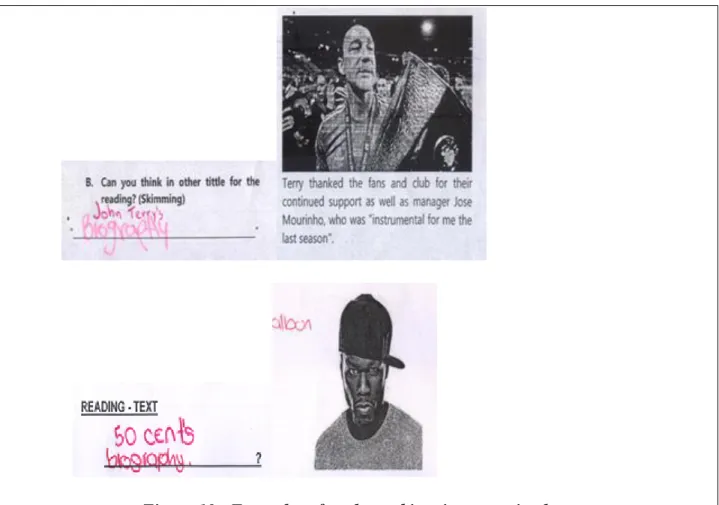
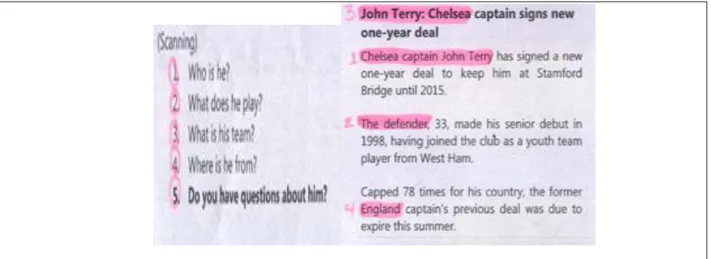
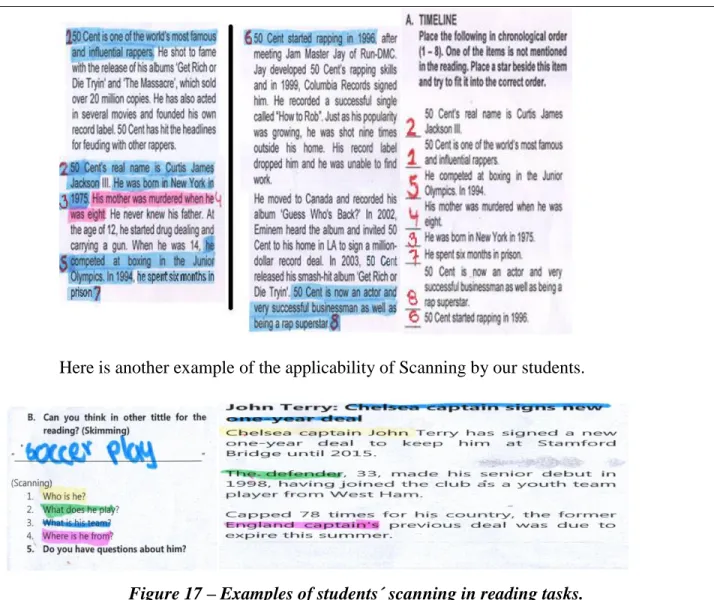
(30) 20. “... We need to provide feedback and explain the strategies with examples. We must prepare PowerPoint presentations, and model the instructions. It is important for us, they have a good idea of how to proceed when they perform the strategies ...” Figure 02 - Excerpt from teaching log N° 2. From the comments given by some students and the time spent to solve the tasks, we may infer that the concepts and what the concepts involve were this time clear to learners. This corroborated the concept that effective instruction provides the key to create effective readers using modelling and guided practice (Brown, 2002). When our students were asked about the use of the reading strategies implemented, they showed us that they understood their use. (See figure 03). EM “Skimming lo uso para entender la idea general de un texto y Scanning para sacar la idea específica” MR “Las estrategias me sirven mucho con Skimming si yo quiero entender más general y Scanning si quiero algo más específico”. Figure 03 - Students´ understanding of the reading comprehension strategies.. Learners performed the activities in the worksheets by following the instructions on their own. They solved the tasks in less time than in previous sessions. Moreover, they expressed their confidence in a written composition after reflecting on the benefits of reading strategies. (See figure 04).
(31) 21. BS “Al aprender las estrategias de lectura puedo entender más rápido y también responder bien las preguntas”. JH “He aprendido que si uso las estrategias de lectura puedo entender más lo que leo y más rápido”. Figure 04 - Students´ reflections on the reading comprehension strategies.. In conclusion, based on the challenges we faced at the beginning we had to revise both the concepts on cognitive and linguistic demands (Cameron, 2001) and effective instruction (Brown, 2002) to re teach the lessons in a more effective way. The challenges also led us to think of solutions for the difficulties the students were experiencing on the use of Scrivener’s route map. At the end of this stage of reading comprehension strategies, the learners were able to recognise the strategies and use them to solve the tasks by themselves.. 5.1.2 Material design and implementation First, we did a survey to know more about our learners' preferences. Based on the results, we selected the subjects that our participants marked as their favourites. We found our learners’ favourite topics were Reggae music, junk food, football, social networks, and Rap music (See Appendix 05) As it is proposed by McIntyre et al (2001) reading is closely connected to person’s motivation for reading. Second, we designed the worksheets based on the stages proposed by Scrivener in his top-down model. Each worksheet contained three columns (See appendix 06) inspired in the column layout of newspapers where the paragraphs have one or two sentences. Using three columns made the sentences more compact, created nice blocks of paragraphs and more information could be inserted in a page. In addition, more visual information could be given since several pictures were inserted on one single page. It seemed that our students were pleased.
(32) 22. to read these types of reading formats. These are some examples of our students’ comments on the design of our worksheets:. SM “Leer en columnas es más bacano, no cansa tanto, se lee más rápido y entiendo más” MP “Leer así es más chimba, así me rinde un resto” LT “Me gustó mucho cómo diseñó las hojas de trabajo. Tiene varias imágenes que le ayudan a uno a entender mejor la lectura.” Figure 05 - Students´ comments on the design of the worksheets.. For the introduction of each lesson, we designed PowerPoint presentations on the topics selected for each class. Those presentations were shown to our students following the order of Scrivener’s route map to introduce the purpose of the class and explain the use of prediction, skimming and scanning through reading samples.. 5.1.3 Lesson planning and implementation The stages and sequences of each lesson were according to the reading route map proposed by Scrivener (See Appendix 07). The route map was thought of as a tool to help our learners to follow instructions, among other skills, when they had to solve a reading task. The Scrivener´s route map also helped us to improve our time management for each lesson. As an example of this, the very first sessions took longer than usual (they were expected to solve the reading task in 30 minutes) for the students to solve their task. In other words, the tasks given to students were not totally finished. After the route map was explained and learners were given examples and tasks to solve, the time to solve the tasks was used as planned..
(33) 23. Taking into account the learners´ interests and needs before planning each lesson gave us important information for the design of the tasks. We observed how our participants enjoyed each class and participated in the activities. As evidenced in our teaching log, students reported that they enjoyed the activities Participants have enjoyed the worksheets, some of them expressed the worksheets facilitated them working on each task. Some of them said the format helped them to understand the text easily. The format of the text of three columns and the use of pictures allowed them to use reading strategies. Thus, they inferred what could be the reading about. There are some pieces of data from students which support our project with their opinions and comments”. Figure 06 - Excerpt from teaching log N° 2 - Design of the worksheets.. Now, we will explain how Scrivener’s model stages were introduced to the learners: In the Pretext stage, we asked our learners some questions to activate their previous knowledge and to predict the possible topic of the class. After this, students did a warm up activity, which was designed with the purpose of exploring students´ previous knowledge or preferences about the topic. Finally, we presented the unknown vocabulary using a matching activity, students sometimes used some synonyms to solve the activity, (e.g. “Reggae” which was related to “music”, or “Third world” with “nation”, “Rastafarian” with “sect”, disband “with stop playing”, or “hamburger”, which they related to “junk food”, “Facebook” with “social networks”, etc.) In the second stage called Text, we introduced the reading strategies of Skimming and scanning. For instance, students wrote the possible title of the reading according to what the images suggested in the text. After that, they filled a chronological timeline with relevant information by scanning the text to identify keywords (from questions given by the pre-service teacher) which would be used to pinpoint relevant information of the text. To do this, students would organise the facts chronologically using numbers 1 to 8..
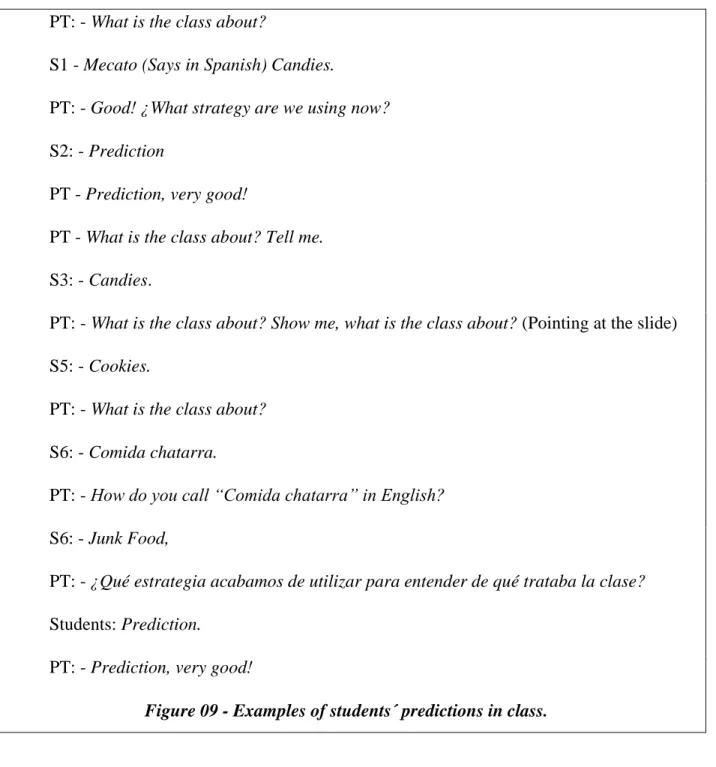
(34) 24. Finally, for the third stage called Post-text, we gave students some questions for reflection on the reading comprehension process based on the model proposed (Scrivener’s). We asked them to write their reflections about their reading comprehension process. The learners expressed their opinion about the benefits they found when using strategies. They told us what was going well and what they needed to improve. (See figure 12). 5.1.4 Academic and Personal Growth The implementation of this project was rewarding for us as future teachers. The use of the reading strategies in the classroom through the use of the Scrivener´s route map seemed to improve our students’ reading ability. We learned how helpful it was to provide our students with a route in each lesson. Our goal in this project was that our students recognise and use the reading strategies. Therefore, the theory studied led us to reflect on the importance of planning and give all our attention to them. Another important aspect that we considered was that knowing how to read is not only being able to decode a set of graphs and pronounce them correctly, but basically it is to understand what reading is, and to be able to reconstruct the overall meaning of a text; this involves identifying the main idea that the author wants to communicate, the purpose that leads him to develop the text or the structure used, etc. This implies an intellectual action of a high degree of complexity, in which the one who reads the text is looking for the meaning from the context. We also learned about the importance of considering our students’ preferences before planning. This facilitated the planning and the development of each lesson, and increased the participation of our participants in the activities. This experience helped us to grow as individuals too. We understood the importance of reflecting. This permitted us to find other alternatives when things did not go so well. When we gathered information about what happened in the class on our teaching logs, we learned how to.
(35) 25. deal with those situations. Thus, we had the possibility to experience and come up with innovative ideas to put them into practice while also rethinking the dynamics of educational practice.. 5.2. Students´ Responses In this section, we reported our participants´ reactions towards the reading material. We. described the activities that helped us in our reflection. We analysed our participants’ reactions while they performed their reading tasks. The information we gathered guided us to analyse their outcomes and discover new insights.. 5.2.1 Students reactions towards to the implementation of reading strategies. In the first sessions, our students needed to pay special attention to the instructions in order to be familiar with each stage in the route map. Our learners seemed confused about the correct use of each one (prediction, skimming and scanning). After asking our students to think about the use of reading strategies, they shared with us the following thoughts:. EG: “Skimming me sirve para predecir algo que puede suceder, pero no siempre porque puede cambiar la predicción de uno.” SM: “Prediction me ha servido para sacar ideas generales o propuestas más importantes acerca de los textos o párrafos o imágenes para entender más” AB: “Scanning es una idea más general de algo” Figure 07 - Students´ thoughts of the reading comprehension strategies..
(36) 26. For this reason, we encouraged our learners to participate actively in each lesson. As a result, they started raising their hands to participate after being elicited by us. Our first step was exploring their previous knowledge looking for preparing them to read following the instructions included in the route map. Our students usually answered our questions no matter if they were in English. We used basic language to form easy questions. We used body language as a tool to make ourselves understood. Eliciting information from our students allowed to boost their engagement toward the class. They provided us information after answering our questions. Our students became active learners, rather than just listening to us giving information. When we found out what students knew, we considered that they were prepared to learn new things. This part of the route map helped us to plan future lessons. Here are some examples of elicitation that happened in our class sessions. PT - Hey, tell me. Who is that guy? Who is that guy? Who is he? S1 - Bob Marley. PT - Very good! (PT claps) PT - What do you know about him? Is he a writer or is he a doctor? PT - What is he? Is he a singer? Students - Yes, a singer. PT - A singer, very good! PT - What type of music is Bob Marley known for? S5: - Reggae. Figure 08 - Examples of students´ elicitation in class..
(37) 27. Students made predictions as a useful strategy. Our learners used pictures, titles, headings and text to make those predictions. They anticipated information and events in the text, and suppose what might happen. Through this strategy, we observed that they were engaged and connected to the text by asking them what they thought what the class would be about. PT: - What is the class about? S1 - Mecato (Says in Spanish) Candies. PT: - Good! ¿What strategy are we using now? S2: - Prediction PT - Prediction, very good! PT - What is the class about? Tell me. S3: - Candies. PT: - What is the class about? Show me, what is the class about? (Pointing at the slide) S5: - Cookies. PT: - What is the class about? S6: - Comida chatarra. PT: - How do you call “Comida chatarra” in English? S6: - Junk Food, PT: - ¿Qué estrategia acabamos de utilizar para entender de qué trataba la clase? Students: Prediction. PT: - Prediction, very good! Figure 09 - Examples of students´ predictions in class..
(38) 28. The learners skimmed the texts to get an overview. They inferred information from pictures, titles, subtitles, headings, etc. This way they understood main ideas of the text. They told us that this strategy helped them to understand what could be the reading text about. Here are some examples of our students skimming a text after observing pictures and subheadings.. Figure 10 - Examples of students skimming a text in class.. When our learners were asked to scan their texts, they looked for specific information. They worked on matching and timeline exercises. They selected keywords that they found in the text. They selected keywords in the worksheet questionnaire which they found, highlighted and numbered in the text. After this, they solved the exercises. They told us that those kinds of.
(39) 29. exercises were better than others they did before the implementation. Here is an example of one student scanning his worksheet.. Figure 11 - Examples of students scanning a text in class. In the fourth-class session, the learners reflected that their performance seemed to improve when solving their reading tasks. We included four questions related to their reading process in the third stage (Post-reading) in their worksheets See figure 12) 32 of the 37 participants resolved the questions expressing their pleasure after being introduced to reading strategies. In the first question: “1. De 1 a 10, siendo 1 lo más bajo y 10 lo más alto. ¿Qué tanto entendiste la lectura? 16 participants graded their understanding of the reading with an eight (8). 10 of them with a ten (10), and 6 of them with a (9). In the second question: “2. ¿Te han servido las estrategias de comprensión lectora?” All the students answered it in an affirmative way. They even expressed their understanding seemed to improve after being introduced to the strategies. In the third question: “3. ¿Piensas que tu proceso de lectura en inglés ha mejorado? All of them answered positively expressing their difficulties before the implementation. Finally, in the last question: “4. ¿Crees que es necesario conocer cada palabra en inglés para entender un texto?” All of the learners answered negatively showing that through the use of strategies, they could infer the information without translating all the words corroborating what Smith (2004) cited in Reza.
(40) 30. et al. (2013) that it was not necessary to read all the vocabulary and sentences to read the context. The learners only used certain words (keywords) and sentences to construct meaning.. Figure 12 - Students´ reflections on their reading comprehension process.. CG: “Que uno sabiendo que es Skimming y Scanning pues hace la lectura más fácil” CH: “Las estrategias me ayudaron porque viendo y analizando el texto y las imágenes pude contestar las questions” EG: “Gracias a Skimming y Scanning leí más ligero el texto y respondí más rápido” Figure 13 - Other examples of students´ reflection on their reading comprehension strategies.. From the third session on, learners applied the reading comprehension strategies we showed them in a way that indicated they understood the use of each one of them. Here are some examples of their reactions they made in a written composition in their native language. (See figure 14).
(41) 31. AM: “Prediction es una suposición - Skimming es una idea general - Scanning es una idea detallada” JV: “Prediction me ha funcionado bien podemos predecir algo que va a suceder, pero no siempre sabremos porque puede cambiar - Skimming me ha funcionado porque la verdad me ha ayudado a sacar una idea general de un texto por medio de imágenes - Con Scanning escaneo un texto a fondo para saber de qué habla y comprenderlo mejor” VA: “Prediction es predecir el tema del texto basándose en una característica que resalte a simple vista - Skimming es sacar una idea principal a partir de una lectura sumamente breve y superficial del texto - Scanning es trabajar y analizar el texto con detalle, sacando conclusiones claras y concretas” LR: “Prediction es predecir algo que nos va a suceder - Skimming es una idea general del texto - Scanning es una idea específica” Figure 14 - Students´ reactions on the reading comprehension strategies.. 5.3. Linguistic Outcomes In this section, we report how we observed their ongoing process development, and how. their reading ability was increasing each session. These outcomes guided us in the data collection process and to achieve the main objective of designing reading tasks.. 5.3.1 Language Development. Before the implementation of the project, our participants were not confident enough while reading. When they faced a reading text, they only understood some isolated vocabulary related to true cognates. They expressed their difficulty in solving this kind of tasks during the first reading class implementation. They told us “Esto está muy duro”, “Yo no entiendo nada de.
(42) 32. Inglés”, “Ja! Yo voy a subrayar todo, yo no entiendo”.. Some of the students did not seem comfortable when they were introduced to the reading tasks in the first sessions. They asked for help many times to solve their reading tasks. After the third session, our participants solved their reading tasks using reading strategies, they seemed to improve their confidence while reading. In the last sessions, we asked them to reflect on how their processes had improved. They provided us with the following information. (See figure 15). JH - “Me sirvió mucho para comprender mucho más las lecturas. Y para saber nuevas palabras de inglés.” EG - “Aprendí algunas palabras que no conocía…” CH - “Sacamos el vocabulario que no conocíamos subrayados.” Figure 15 - Students´ reflections on their reading comprehension processes.. Students learned new vocabulary during the sessions. Our observations confirmed Pressley & Wharton-McDonald (1997) who describe comprehension as an active process involving the construction of meaning, word knowledge (vocabulary) and thinking and reasoning. In each session, we introduced some vocabulary they needed before reading. We used images instead of translation to introduce the vocabulary and then had our learners do warm up activities where they matched their new vocabulary with their corresponding definitions.. After introducing the vocabulary, we looked for engaging our participants with the text. We looked for they constructed meaning using reading strategies. For this, we followed the route map instructions where strategies were shown before, during, and after reading. Our learners.
(43) 33. solved reading tasks in each stage. In this way, we elicited information from them using their native and foreign language. (See figure 16). PT: - “What are we doing? ¿Qué estamos haciendo?” S1: - Skimming! P: - “¿Para qué usamos Skimming?” S2- Para encontrar la idea general”. PT: - Show me. (pointing at the text) S1: - Pille profe, ¿Si ve esa hamburguesa de ahí? ¿Y esa viejita? Uno al ver las dos cosas sabe que esa viejita le gusta la hamburguesa. PT: - Great! Well done! Figure 16 - Examples of students´ recognising on the reading comprehension strategies.. When the learners were looking for specific information, they learned that using reading strategies that it was not necessary to know the translation of each word in the text to solve their tasks. As can be seen in the following example, the learners extracted specific information without reading the whole text by using keywords. They filled a timeline task according to the information given in the text. We observed how our learners underlined or highlighted keywords that helped them to solve the task. (See figure 17).
(44) 34. Here is another example of the applicability of Scanning by our students.. Figure 17 – Examples of students´ scanning in reading tasks.. In conclusion, when our participants recognised the purpose of each reading strategy, they solved their tasks by themselves. They changed their view when solving reading tasks. They correctly resolved the exercises proposed in the worksheets. They told us about the importance of using reading comprehension strategies when solving the activities. They solved their tasks by themselves in less time without the use of translations of every word. As it is observed, reinforce reading comprehension strategies using Scrivener's’ route map stages seemed to led them to positive results,.
(45) 35. 6.. CONCLUSIONS. The primary reason for conducting this project was to design and implement reading comprehension tasks that foster the use of reading comprehension strategies by using a reading route map proposed by Jim Scrivener (2005). By means of this project we observed the learners’ reactions towards to the reading strategies presented. We have reported the challenges and benefits of using reading comprehension strategies with tenth grade students from a public high school in Pereira. This classroom project had great social, academic, personal, professional, and institutional significance. The use of reading strategies seemed to improve our participants´ language learning process. The implementation of this project helped to raise awareness in our participants of the use of reading comprehension strategies. They identified the benefits when using strategies and learned how to solve challenges while reading. In this section, we reported the results from our own professional development and learners’ linguistic responses.. 6.1. Social, academic, personal, professional and institutional impact:. We observed that the use of Reading Comprehension Strategies seemed to improve our learners’ performance. They were important in the development of their reading comprehension ability. Although they experienced some challenges when solving their tasks at the beginning of the project, the introduction to reading comprehension tasks using reading strategies through the model of reading proposed by Scrivener helped them overcome those difficulties.. This project involved us in human experiences which were significant for our academic and personal growth. After observing our participants’ responses to reading strategies, and the.
(46) 36. challenges we encountered in presenting them, we were convinced that reading comprehension is a skill that needs to be further explored.. We concluded that reading strategies were essential not only to successful comprehension, but to overcome reading problems and to become better readers.. 6.2. Professional development During the first lessons, our participants were poor readers with a limited vocabulary but. during subsequent lessons they seemed to infer meaning and they demonstrated interest and appreciation for the texts. The activation of their previous knowledge helped them to learn new things. They shared opinions and comments during the post reading stages of each lesson. The challenges we faced provides us with ideas to write about, with respect to our planning, in our teaching logs.. Among the aspects explored that helped us to broaden our academic and personal point of view was the importance of considering our students’ interests, preferences, and needs. The support from the authors mentioned in our Conceptual Framework provided us with ideas about how to resolve the challenges we faced.. In selecting our reading material and designing our worksheets, it was vital to take into consideration our students’ language demands and also explore their interests and needs. It helped us make these materials more appropriate. It was also essential to follow the stages included in the route map. The use of this model of reading in their tasks helped to achieve the purpose of those reading strategies..
(47) 37. This project introduced students to reading strategies, and a route map that guided our students´ reading comprehension. It is clear that working in reading comprehension skills are very important in our country and all efforts to contribute to the goal of producing capable readers are welcome.. 6.3. Linguistic responses Our students made predictions from texts. They activated their background knowledge. through this strategy. We observed that students figured things out even when they had difficulties in reading and comprehension in English. Students made connections between their own prior knowledge and the ideas in the texts. Predicting while reading also helped students. This supported “rereading,” an important component of comprehension, especially for struggling readers.. Additionally, the students skimmed and scanned texts and learned new vocabulary. We observed that they completed the tasks by giving titles to the readings (skimming). They also matched words (keywords), and looked for specific information (Scanning). Trough modelling instructions included in the route map, the students became aware of the importance of the reading strategies. The use of the Scrivener´s route map helped them to accomplish their tasks.. Learners were made aware of the importance of reading comprehension strategies. They talked about the benefits they acquired after being introduced to these strategies and how the use of these strategies seemed to improve their performance. They used contexts to infer meaning. They commented that after being introduced to reading strategies, they solved their tasks in less time..
(48) 38. 6.4. Students responses When the classroom project implementation began, we observed that our learners. experienced some challenges related to their limited vocabulary and misunderstanding of reading comprehension strategies. After we taught them the reading comprehension strategies and provided feedback about use of those strategies, the learners made predictions about what could be the reading about, skimmed information through pictures, titles, subtitles, headings, etc., and scanned information after using keywords they found in the questions. Our students were always willing to participate. They raised their hands, spoke louder and provided the answers that allowed us to gather information analysed in our results section. They also reacted in positive ways to the different stages proposed in the class. They shared their reflections using their native language or their foreign language if they felt they could do it. At the end of the implementation of this project, the learners were able to successfully apply reading strategies and independently resolve related tasks. The use of these strategies enabled them to resolve these tasks more rapidly. The use of a reading route map proposed by Jim Scrivener raised awareness in the learners on the use of reading comprehension strategies. This classroom project allowed us to observe their reactions towards the implementation of reading comprehension tasks that included topics of their interest and promoted the use of reading comprehension strategies. Our learners recognised the importance of reading comprehension strategies such as Prediction, Skimming and Scanning. They told us how these strategies seemed to improve their performance when solving their reading tasks..
(49) 39. REFERENCES. SCRIVENER, J. (2005). Learning teaching a guidebook for English language teachers. Second Edition. Oxford, UK. Macmillan Books. Retrieved from: http://www.tesol.brawnblog.com/HUFS-TESOL/Methods/learning_teaching.pdf. GRELLET, F. (1999). Developing Reading Skills. Cambridge University Press.. SNOW, C. (2002). Reading for understanding: Toward an R&D program in reading comprehension. Santa Monica, CA: RAND Corporation.. PANG, E. (2003). Teaching Reading. Geneva: International Bureau of Education PARDO, L. (2004). “What Every Teacher Needs to Know About Comprehension” in The Reading Teacher. pages 272-281. Retrieved from: https://www.google.com/url?q=https://ftp.learner.org/workshops/teachreading35/pdf/teachers_kn ow_comprehension.pdf&sa=D&ust=1485538312668000&usg=AFQjCNE19Z7xcrNbdPtIqg_T6t hZHOco9Q. MATURANO, C. MAZZITELI, C. ASCENSIÓN, M. (2002). Las Estrategias Meta cognitivas y su relación con el contexto educativo. Retrieved from: https://www.google.com/url?q=http://www.feeye.uncu.edu.ar/web/posjornadasinve/area2/Apren dizaje%2520-%2520eleccion%2520de%2520carrera/009%2520%2520Mazzitelli%2520y%2520Maturano%2520%2520UN%2520San%2520Juan.pdf&sa=D&ust=1485538312674000&usg=AFQjCNF4WxJN7.
(50) 40. xXaXThwfv8bFWHit29IsA. KLINGNER, J. VAUGHN, S. & BOARDMAN, A. (2007). Teaching Reading Comprehension to Students with learning difficulties. New York, USA. Harris & Graham Editors. Retrieved from: https://drive.google.com/file/d/0B6x39Trk9QxMdlZMMzI2YnZDQWs/view. IWAI, Y. (2011). The Effects of Metacognitive Reading Strategies; Pedagogical Implications for EFL/ESL Teachers. Retrieve from: https://www.google.com/url?q=http://www.readingmatrix.com/articles/april_2011/iwai.pdf&sa= D&ust=1485538312672000&usg=AFQjCNFED29aTddYwSR_Tm499Rjqsfaung. PEARSON, D. AND DUKE, N. (2002). From What Research Has to Say about Reading Instruction. Third Edition. Retrieved from: https://www.google.com/url?q=https://www.learner.org/workshops/teachreading35/pdf/Dev_Rea ding_Comprehension.pdf&sa=D&ust=1485538312669000&usg=AFQjCNEL48O2mIhv_LqrtKp xr7DUMYVeHA. HARMER, J. (2007) How to teach English. Second Edition. Essex, UK. Pearson Education Limited.. BROWN, D. (1994). Principles of Language Learning and Teaching, 3rd edition. Longman, Inc., White Plains, NY..
(51) 41. REZA, M. NIZAM, H. AND KAMARUL, H. (2013). The Importance of Metacognitive Reading Strategy Awareness in Reading Comprehension Retrieved from: https://www.google.com/url?q=http://files.eric.ed.gov/fulltext/EJ1077125.pdf&sa=D&ust=1485 538312670000&usg=AFQjCNFJu40M1el7mUGIO7QNzioNtzJj6w. GLESNE, C. (1999). Becoming qualitative researchers: An introduction (2nd ed.). Don Mills, Ontario, Canada: Longman.. BRYMAN, A. (2001). Social Research Methods. Oxford, UK. Oxford University Press.. CAMERON, L. (2001). Teaching English to young learners. Cambridge, UK. Cambridge University Press.. BROWN, L & BRABHAM, E. G. (2002). Effects of teachers' reading-aloud styles on vocabulary acquisition and comprehension of students in the early elementary grades. Journal of Educational Psychology, 94(3), 465-473. Retrieved from: https://www.google.com/url?q=http://www.ibe.unesco.org/fileadmin/user_upload/archive/Public ations/educationalpracticesseriespdf/prac12e.pdf&sa=D&ust=1485538312675000&usg=AFQjC NFxrVYkwJoU2aVPyoqUOe3vll9X-Q. MACINTYRE, P. D., BAKER, S. C., CLEMENT, R., & CONROD, S. (2001). Willingness to communicate, social support, and language-learning orientations of immersion students. Studies on Second Language Acquisition, 23, 369-388. PRESSLEY, M., & WHARTON-McDONALD, R. (1997). Skilled comprehension instruction and its development through instruction. School Psychology Review, 26, 448–466..
(52) 42. GOODMAN, K. S. (1967). Reading: A Psycholinguistic Guessing Game. Journal of the Reading Specialist 6:126-35. MINISTERIO DE EDUCACIÓN NACIONAL (MEN) Series Guías Nº 22 – Formar en lenguas extranjeras – el reto. Santafé de Bogotá. 2006.
(53) 43.
(54) 44.
(55) 45.
(56) 46. APPENDIX 04 SURVEY FROM STUDENTS´PREFERENCES AND NEEDS. JHON HARLY ROMERO RÚA y MARCELO ANDRÉS TORRES MARÍN estudiantes de la Universidad Tecnológica de Pereira, integrantes de la Licenciatura en Lengua Inglesa, estamos realizando una encuesta para conocer los gustos y preferencias de los jóvenes de grado 10 B de la Institución Educativa Complejo Educativo La Julita. De antemano agradecemos su colaboración. Pueden marcarse más de una opción (Marca con una X la opción o las opciones de su preferencia): 1. ¿Qué tipo de programas de televisión le gustan? Comedias Drama Novelas Farándula. Noticias. ¿Ves algún programa de TV en inglés? ¿Cuál? 2. ¿Qué es lo que más te gusta hacer cuando navegas en Internet? Chatear Redes Sociales Ver videos. Investigar. ¿Visitas alguna página web en inglés? ¿Cuál?. Dib. Animados ¿Cuál (es)?. Jugar Dib. Animados ¿Cuál (es)?. 3. ¿Qué tipo de música escuchas? Reggae. Metal. Pop. Rock. Salsa. Merengue. Popular. Bachata. Clásica. Boleros. Góspel. Hip Hop. Rancheras. Carrilera. Rap. Vallenatos. Reggaetón. ¿Acostumbras escuchar canciones en inglés? ¿Cuáles?. Otra (¿Cuál?) ¿Cuál (es)?. 4. ¿Qué deporte practicas? Football. Rugby. Volleyball. Basketball. Baseball. Tennis. Ajedrez. Atletismo. Balón mano. Artes Marciales. Billar. Natación. Boxeo. Ciclismo. Esgrima. Equitación. Hockey. ¿Acostumbras ver en TV deportes en inglés? ¿Cuál (es)?. Otro (¿Cuál?) ¿Cuál (es)?. 5. ¿Qué tipo de lectura disfrutas? Artículos en línea. Artículos de revistas. Reseñas. Lectura informativa. Lectura recreativa. Lectura de estudio. Lectura literaria. Lectura reflexiva. Otra (¿Cuál?). 6. ¿Qué tipo de comida prefieres? Rápida. Gourmet. Típica. Internacional. Vegetariana. Otra (¿Cuál?).
(57) 47 7. ¿Qué actividades disfrutas en tu tiempo libre? Cine Camping. Danza. Música (práctica). Fiestas. Actuación. Cocina. Jardinería. Otra (¿Cuál?).
Figure

+2
Documento similar
the euro is expected to depreciate by around 1 percentage point against the basket of currencies of our main reading partners; short-term interest rates are expected to decline by
The objective of the research is to foster a clearer comprehension of how functional physiological adaptations (including stomatal response and photosynthetic quantum yield
SOLOMON (1989): The influence of prior reading instruction on fourth grade students 1 attitudes toward reading according to select national assessment of educa- tional
That is why our purpose is to analyze the reading frequency, reading formats, and reading preferences of high school students from Poland, Chile, and Portugal to learn how much
The reading of Fanon’s main concepts becomes here the object of a certain cultural-political interpretation, in which strategies of adaptation or even appropriation make it possible
There are common and divergent patterns in the answers to a questionnaire that delves into motivational and teaching aspects linked to reading education: leisure reading habits,
REMOTE WORK No.. Complete the reading activities about “The Prom” reading. Solve exercise about the Simple Present Tense. Write 20 sentences using the simple present tense. Make
In addition, as some authors point out, we can assume that the comprehension ability in itself is developed at an early age (Kendeou, van den Broek, White, & Lynch, 2007). That
