
The Economic Analysis of Medical Tourism in Thailand: opportunities, challenges and impacts
146
0
0
Texto completo
(2) DOCTORAL THESIS 2017 Doctoral Programme of Tourism and Environmental Economics THE ECONOMIC ANALYSIS OF MEDICAL TOURISM IN THAILAND: OPPORTUNITIES, CHALLENGES AND IMPACTS Kansinee Guntawongwan Thesis Supervisor: Vicente Ramos Thesis Supervisor: Javier Rey-Maquierira Thesis Supervisor: Mingsarn Kaosa-ard Doctor by the Universitat de les Illes Balears. 2.
(3) ABSTRACT Medical tourism experienced a rapid growth in Thailand, particularly after the 1997’s Asian financial crisis. Both, public authorities and private companies soon became aware of this segment’s potential, which explains why it received considerable attention in destination’s strategic plans, and attracted private investment. However, more destinations became interested in attracting medical tourism, as it shifted from a minor niche, to a segment with huge capacity to generate value. Hence, there has been a remarkable increase in international competition in recent years. The development of medical tourism was followed by academic interest. However, the analyses are usually constrained due to two common problems: unclear conceptual definition and limited data availability. The first challenge of this PhD was to face this common limitation. Hence, the initial research focus was centered in clarifying the conceptual definition of medical tourism. After proving that available data in Thailand was not appropriate to perform a detail study, the second research task was to generate primary data that can be used throughout the analyses. Two sets of data were generated by the researcher: First, a series of in-depth interviews with the administrators of private providers in Thailand were planned and executed. Second, a questionnaire to medical tourists was designed, tested, and implemented. Once the data was generated, this dissertation proposes a holistic study of the medical tourism phenomenon in Thailand using diverse analytical methods to investigate demand, supply and competitiveness. The study is initiated by extending the comprehension of Thailand medical tourism demand. The questionnaire showed that reasonable price of treatments, and cost of living, were the main reasons to choose Thailand. The average length of stay, and expenditure were two times higher than for general tourists. Respondents felt that overall medical services in Thailand were worthwhile in terms of money and time; and the level of satisfaction and loyalty was high. A grey model was selected to forecast. 3.
(4) future demand, as it is the appropriate technique when there is a limited number of observations. A structural equation model (SEM) is applied to investigate the causal relationship between motivation, experiences, and future behavior intention of medical tourists. The results revealed that satisfaction had the highest total effect on behavior intention, while service experience was the main factor affecting overall satisfaction. The country motivation was the key factor affecting visitors’ perceived value. Whereas hospital motivation was the major factor that affected medical service experience. Finally, the study of supply and competitiveness analysis estimated that medical tourists were approximately ten percent of all foreign patients. The long experience in attending foreign patients, and appropriate medical and tourism endowments are the determinants that enhance Thailand’s competitiveness. The significant strengths of Thailand are hospital standards, tourism resources and local hospitality, and cost of treatments. However, its weaknesses are the absence of a clear image of treatments’ specialization, language limitations of medical personnel, and the lack of cooperation between related agencies. The benchmarking with major competitors in Asia showed that Thailand has an advantage in tourism endowment while other competitors have advantages in different aspects. Asian medical tourism has been presented as comprised by niche markets, where destinations position themselves differently. Hence, private providers focus more on domestic competition than on international competition. The policy recommendations to accommodate the potential future development of Thailand’s medical tourism are to increase the domestic production of medical personnel, and to coordinate the activities of the relevant public agencies in medical tourism. In addition, a comprehensive and precise database on medical tourism should be created to be able to extend the analyses presented in this research, and monitor the future evolution of this segment.. 4.
(5) RESUMEN El turismo médico ha experimentado un rápido crecimiento en Tailandia, particularmente después de la crisis financiera asiática de 1997. Las autoridades públicas y las empresas privadas se dieron cuenta pronto del potencial de este segmento. Esto se tradujo en su integración en los planes estratégicos del destino y en la atracción de inversión privada. Cuando el turismo médico pasó de ser un nicho menor, a un segmento con enorme capacidad de generar valor más destinos internacionales se interesaron por él. En consecuencia, en los últimos años ha habido un notable aumento de la competencia internacional. El desarrollo del turismo médico fue seguido por el interés académico. Sin embargo, estos análisis suelen estar limitados por dos problemas comunes: una definición conceptual poco clara y escasa disponibilidad de datos. El primer desafío de este doctorado fue afrontar estas limitaciones comunes. Por lo tanto, el enfoque inicial de la investigación se centró en aclarar la definición conceptual de turismo médico. Después de comprobar que los datos disponibles en Tailandia no eran apropiados para realizar un estudio detallado, la segunda tarea de investigación fue generar datos primarios que se pudieran utilizar en un análisis riguroso. El candidato generó dos conjuntos de datos: En primer lugar, se planificaron y realizaron una serie de entrevistas en profundidad con los administradores de los proveedores privados en Tailandia. En segundo lugar, se diseñó, testó e implementó un cuestionario a turistas médicos. Una vez generados los datos, esta tesis propone un estudio holístico del fenómeno del turismo médico en Tailandia utilizando diversos métodos analíticos para investigar la demanda, la oferta y la competitividad. El estudio se inicia ampliando la comprensión de la demanda de turismo médico de Tailandia. El cuestionario mostró que el precio razonable de los tratamientos y el coste de vida fueron las principales razones para elegir Tailandia. La duración media de la estancia y el gasto fueron dos veces superiores al conjunto de turistas. Los. 5.
(6) encuestados consideraban que los servicios médicos en general en Tailandia valían la pena en términos de dinero y tiempo; Y el nivel de satisfacción y lealtad era alto. Se seleccionó un Grey Model para predecir la demanda futura, ya que es la técnica apropiada cuando hay un número limitado de observaciones. Se aplica un modelo de ecuaciones estructural (SEM) para investigar la relación causal entre la motivación, las experiencias y el comportamiento futuro de los turistas. Los resultados revelaron que la satisfacción tuvo el mayor efecto total sobre el comportamiento futuro, mientras que la experiencia de servicio fue el principal determinante de la satisfacción. La motivación-país fue el factor clave para el valor percibido. Por último, la motivación-hospital fue factor clave para la experiencia de servicio. Finalmente, el estudio oferta y competitividad estimó que los turistas médicos eran aproximadamente el diez por ciento del total de pacientes extranjeros. La larga experiencia en la asistencia a pacientes extranjeros, y los adecuados recursos médicos y turísticos son los determinantes que mejoran la competitividad de Tailandia. Los puntos fuertes de Tailandia son la acreditación de sus hospitales, los recursos turísticos, la hospitalidad local, y el coste de los tratamientos. Sus debilidades son la ausencia de una imagen clara de la especialización en algunos tratamientos, las limitaciones lingüísticas del personal médico y la falta de cooperación entre las agencias relacionadas. La comparación entre los principales competidores en Asia mostró que Tailandia tiene una ventaja en la dotación turística, mientras que otros competidores tienen ventajas en diferentes aspectos. El turismo médico asiático se ha presentado como segmentado por nichos de mercado en los que los destinos se posicionan de manera diferente. Por lo tanto, los proveedores privados se centran más en la competencia interna que en la competencia internacional. Las recomendaciones de política para el desarrollo futuro del turismo médico en Tailandia son aumentar la producción doméstica de personal médico, y coordinar las actividades de las agencias públicas relevantes en este segmento. Además, debe crearse una base de datos completa sobre turismo médico para poder ampliar los análisis presentados en esta investigación, y evaluar la evolución de este segmento.. 6.
(7) RESUMEN El turisme mèdic ha experimentat un ràpid creixement a Tailàndia, particularment després de la crisi financera asiàtica de 1997. Les autoritats públiques i les empreses privades es van adonar aviat del potencial d'aquest segment. Això es va traduir en la seva integració en els plans estratègics de la destinació i en l'atracció d'inversió privada. Quan el turisme mèdic va passar de ser un nínxol menor, a un segment amb enorme capacitat de generar valor, més destinacions internacionals es van interessar per ell. En conseqüència, en els últims anys hi ha hagut un notable augment de la competència internacional. El desenvolupament del turisme mèdic va ser seguit per l'interès acadèmic. No obstant això, aquestes anàlisis solen estar limitats per dos problemes comuns: una definició conceptual poc clara, i escassa disponibilitat de dades. El primer repte d'aquest doctorat va ser afrontar aquestes limitacions comuns. Per tant, l'enfocament inicial de la investigació es va centrar en aclarir la definició conceptual de turisme mèdic. Després de comprovar que les dades disponibles a Tailàndia no eren apropiats per a realitzar un estudi detallat, la segona tasca d'investigació va ser generar dades primàries que es poguessin utilitzar en una anàlisi rigorosa. El candidat va generar dos conjunts de dades: En primer lloc, es van planificar i van realitzar una sèrie d'entrevistes en profunditat amb els administradors dels proveïdors privats a Tailàndia. En segon lloc, es va dissenyar, testar i implementar un qüestionari a turistes mèdics. Un cop generades les dades, aquesta tesi proposa un estudi holístic del fenomen del turisme mèdic a Tailàndia utilitzant diversos mètodes analítics per investigar la demanda, l'oferta i la competitivitat. L'estudi s'inicia ampliant la comprensió de la demanda de turisme mèdic de Tailàndia. El qüestionari va mostrar que el preu raonable dels tractaments, i el cost de vida van ser les principals raons per triar Tailàndia. La durada mitjana de l'estada i la despesa van ser dues vegades superiors al conjunt de turistes. Els enquestats. 7.
(8) consideraven que els serveis mèdics a Tailàndia valien la pena en termes de diners i temps; I el nivell de satisfacció i lleialtat era alt. Es va seleccionar un Grey Model per predir la demanda futura, ja que és la tècnica apropiada quan hi ha un nombre limitat d'observacions. S'aplica un model d'equacions estructural (SEM) per investigar la relació causal entre la motivació, les experiències i el comportament futur dels turistes. Els resultats van revelar que la satisfacció va tenir el major efecte total sobre el comportament futur, mentre que l'experiència de servei va ser el principal determinant de la satisfacció. La motivació-país va ser el factor clau per al valor percebut. Finalment, la motivacióhospital va ser factor clau per a l'experiència de servei. Per últim, l'estudi d’oferta i competitivitat estimar que els turistes mèdic eren aproximadament el deu per cent del total de pacients estrangers. La llarga experiència en l'assistència a pacients estrangers, i els adequats recursos mèdics i turístics són els determinants que milloren la competitivitat de Tailàndia. Els punts forts de Tailàndia són l'acreditació dels seus hospitals, els recursos turístics, l'hospitalitat local, i el cost dels tractaments. Les seves debilitats són l'absència d'una imatge clara de l'especialització en alguns tractaments, les limitacions lingüístiques del personal mèdic i la manca de cooperació entre les agències relacionades. La comparació entre els principals competidors a Àsia va mostrar que Tailàndia té un avantatge en la dotació turística, mentre que altres competidors tenen avantatges en diferents aspectes. El turisme mèdic asiàtic s'ha presentat com segmentat per nínxols de mercat en els que les destinacions es posicionen de manera diferent. Per tant, els proveïdors privats se centren més en la competència interna que en la competència internacional. Les recomanacions de política per al desenvolupament futur del turisme mèdic a Tailàndia són augmentar la producció domèstica de personal mèdic, i coordinar les activitats de les agències públiques rellevants en aquest segment. A més, s'ha de crear una base de dades completa sobre turisme mèdic per poder ampliar les anàlisis presentades en aquesta investigació, i avaluar l'evolució d'aquest segment.. 8.
(9) ACKONWLEDGMENTS Firstly, I would like to express my sincere thanks to my thesis advisor, Prof. Vicente Ramos Mir, Prof. Javier Rey-Maquieira, and Prof. Mingsarn Kaosa-ard for the continuous support of my PhD study and related research, for their patience, motivation, and immense knowledge. Their guidance helped me in all the time of research and writing of this thesis. I would like to gratefully acknowledge the National Research Council of Thailand (NRCT) and the Thailand Research Fund (TRF) for the financial support as well as the Public Policies Studies Institute (PPSI) that give me an opportunity to participate in the research project. I am also grateful to Chiang Mai University for funding the PhD Scholarship. I would like to thank my friend, Mr. Akarapong Untong for the assistance and support. Last but not the least, I would like to thank my parents and my colleagues for all their support throughout the period of this research.. Kansinee Guntawongwan. 9.
(10) CONTENTS Chapter I. Introduction. 15. 1.1. Introduction. 15. 1.2. The General Situation of Medical Tourism. 17. 1.3. Data Used in This Study. 19. 1.3.1 Qualitative data: in-depth interviews with private companies administrators. 20. 1.3.2 Quantitative data: medical tourists’ questionnaire. 21. 1.3.3 Secondary data sources. 23. 1.4. Structure of the Dissertation. 23. 1.5. References. 25. Chapter II. Demand Analysis of Medical Tourism in Thailand. 29. 2.1. Introduction. 29. 2.2. Characteristic and Behavior of Medical Tourists in Thailand. 33. 2.2.1 Characteristics of the medical tourists. 34. 2.2.2 Behavior of medical tourists. 36. Medical Tourism Trend in Thailand. 48. 2.3.1 The forecasting methods. 50. 2.3.2 Result of the forecasting. 54. 2.4. Conclusions. 56. 2.5. References. 58. 2.3. Chapter III. Motivation, Experiences and Future Behavior Intention of Medical Tourists in Thailand. 63. 3.1. Introduction. 63. 3.2. Literature Review. 66. 3.2.1 Motivation. 67. 3.2.2 Service quality. 68. 3.2.3 Perceived value. 69. 3.2.4 Overall satisfaction. 69. 3.2.5 Future behavior intention. 70. 10.
(11) CONTENTS 3.3. Research Methodology. 71. 3.3.1 Two conceptual frameworks. 71. 3.3.2 Data used in the study. 74. 3.3.3 Variables used in the study. 75. Data Analysis and Results. 76. 3.4.1 Data analysis. 77. 3.4.2 Results from structural equations estimation. 80. 3.5. Conclusions. 89. 3.6. References. 91. 3.4. Chapter IV. Supply Analysis and the Competitiveness of Medical Tourism in Thailand. 97. 4.1. Introduction. 97. 4.2. Medical Tourism in Thailand. 98. 4.2.1 The structure of foreign patients in Thailand. 99. 4.2.2 Factors influencing the decision-making of medical tourists. 103. 4.2.3 Medical tourists’ sources of information for decision-marking. 108. Competitiveness Analysis of Medical Tourism in Thailand. 110. 4.3.1 The determinants of competitive advantage, ‘Porter diamond’ model. 111. 4.3.2 SWOT analysis. 117. 4.4. Asian Countries’ Medical Tourism Competitiveness Index. 121. 4.5. Conclusions. 127. 4.6. References. 129. 4.3. Chapter V. Conclusions. 135. 5.1. Research Motivation. 135. 5.2. Main Results and Contributions. 138. 5.3. References. 141. Appendix Appendix A: Structured of the interview. 142. Appendix B: Questionnaire. 144. 11.
(12) LIST OF TABLES Table 2.1 Demographic characteristics. 35. Table 2.2 Use of medical services abroad. 36. Table 2.3 Main trip purpose and decision-marking horizon. 37. Table 2.4 Type of medical tourists. 38. Table 2.5 The decision-marking to receive medical services in Thailand. 39. Table 2.6 Importance of country attributes on the decision to choose medical services in Thailand. 41. Table 2.7 The importance giving to each item of medical services in Thailand. 42. Table 2.8 Behavior during received medical services in Thailand. 43. Table 2.9 Medical tourists group and trip arrangement. 45. Table 2.10 The satisfaction received from medical services in Thailand. 46. Table 2.11 Perceived value and overall satisfaction received from medical services in Thailand. 47. Table 2.12 Future behavior intention after using medical services in Thailand. 48. Table 2.13 Type of medical services would like to receive in the future. 48. Table 2.14 The estimated revenue and number of medical tourists in Thailand, 2009-2015. 49. Table 2.15 Accuracy test of number foreign patients forecasting. 54. Table 2.16 The estimated number of medical tourists in Thailand, 2017-2020. 55. Table 3.1 Main studies on the causal relationship of medical tourists’ behavior. 65. Table 3.2 Latent and observable variables in the study. 76. Table 3.3 Descriptive statistics and normality testing. 77. Table 3.4 Reliability and validity test of measurement model. 80. Table 3.5 Goodness of fit statistics of partial model. 81. Table 3.6 The causal relationship in partial model. 84. Table 3.7 Goodness of fit statistics of compete model. 85. Table 3.8 Standardized factor loading of the latent variables. 87. Table 3.9 The causal relationship in the complete model. 88. Table 4.1 Push and pull factors for medical tourism in Asia. 105. Table 4.2 Main studies on ‘Porter’s diamond’ model and SWOT analysis in the case of medical tourism in Thailand. 12. 110.
(13) LIST OF TABLES Table 4.3 The result of SWOT analysis of Thailand’s medical tourism. 118. Table 4.4 The component of medical tourism competitiveness of Thailand and major competitors in Asia. 123. Table 4.5 Medical tourism competitiveness index of Thailand and major competitors in Asia. 125. 13.
(14) LIST OF FIGURES Figure 2.1 Trend of the number of medical tourists, 2017-2020. 56. Figure 3.1 Conceptual model of the causal relationship between experiences and future behavior intention of medical tourists in Thailand. 72. Figure 3.2 Conceptual model of the causal relationship between motivation, experience, and future behavior intention of medical tourists in Thailand. 74. Figure 3.3 Standardized coefficients of the experiences and future behavior intention of medical tourists in Thailand. 82. Figure 3.4 Standardized coefficients of the motivation, experience, and future behavior intention of medical tourists in Thailand. 86. Figure 4.1 Structure and source of information of foreign patients in Thailand. 100. Figure 4.2 Determinant of Thailand’s medical tourism competitiveness. 112. Figure 4.3 The conceptual framework of medical tourism competitiveness evaluation. 122. Figure 4.4 Benchmarking of medical tourism competitiveness between Thailand and major competitors. 126. 14.
(15) Chapter I Introduction. 1.1. Introduction Medical tourism is an emerging niche tourism product which has grown rapidly. over the past decade (Veerasoontorn, Beise-Zee and Sivayathorn, 2011; Connell, 2011; 2013; Han and Hyun, 2015; John and Larke, 2016). Even if it is very difficult to identify precisely the value of medical tourism in the global market, some recent research (Patients Beyond Borders, 2017) estimated that medical tourism accounted for an overall world value of US$ 46-72 billion with more than 14 million medical tourists in 2015. Moreover, it is expected to increase by up to 25 percent every year for the next decade. Medical tourism involves people traveling across the border to other countries for receiving medical services, whether it is medical treatments, cosmetics, or health check-up. Medical tourism is not new, in fact, people traveled abroad for health benefits since ancient times. There are studies discussing such movements particularly since 19th century when middle-class Europeans traveled to spa towns, thermal spring, and coastal locations (Gray and Poland, 2008; Hall, 2013), and rich people from developing countries traveled to developed countries to access better facilities and medical technology (Goodrich and Goodrich, 1987; Tucki and Cleave, 2014). However, it developed rapidly since late 1990s with an increase in patients from richer and more developed nations, traveling to less-developed countries of Asia such as India, Thailand, and Malaysia, in search of medical care generally deemed too expensive, inadequate, or unavailable at home (Connell, 2006; 2013; Manaf et al., 2015). These tourism destination countries usually combine reasonable infrastructure, hotel facilities, and attractive tourist destinations. Nevertheless, there still have the elites travel to the United States, Germany, Switzerland, and the United Kingdom for expansive but trusted medical care, especially for the complex operations which need very advanced (special) medical technology. There is no single definition of medical tourism. Connell (2006) defined this tourism product as occurring when traveling involves a specific medical treatment, 15.
(16) which is substantial and usually has long-term effects. While, Hunter (2007) described medical tourism as an integration of features of the medical industry and the tourism industry at a travel destination. From the above examples, it can be seen that even if there is not a unanimous definition, it is generally accepted that medical tourism refers to a travel activity that involves a medical procedure. In other words, medical tourism is the practice of traveling across the borders to obtain health care services in other countries, which are equivalent to or better than those available in one’s own country (Heung, Kucukusta and Song, 2010; Thailand Medical Tourism Cluster, 2011; Connell, 2013). In general, the statistical reports of medical tourism in many countries always include all foreigners that received a medical treatment in a host country. Then, the extent of medical tourism tends to be overstated. That is because immigrants and other long term foreign residents in the country should not be considered as tourist following the definition of United Nations, Department of Economic and Social Affairs, Statistics Division (2010). Among those that are usually reported as medical tourists using the conventional definition, Cohen (2008) developed a five groups’ classification based on the extent to which medical treatment plays a role in tourists’ incentive and conducts on relative to vacationing: 1) Mere tourist is an individual who does not make any use of medical services while vacationing in the host country. 2) Medicated tourist is one who receives medical treatment for health problems incidentally occurring while traveling in the host country. 3) Medical tourist proper is an individual whose visit to the host country includes both tourism and medical treatment (for matters unrelated to the trip). This group includes tourists traveling to the host country with the purpose of receiving a treatment, as well as those deciding on such treatment once in the country. 4) Vacationing patient is an individual who visits the host country mainly to receive medical treatment, but makes incidental use of vacationing opportunities, especially during the recuperation period that follows an operation or some specific treatments. 16.
(17) 5) Mere patient is an individual who visits the host country solely to receive medical treatment, and does not make use of any vacationing opportunities. From the influencing work of Cohen (2008), subsequent studies attempted to provide a more precise description of what should be included or excluded in the analyses of medical tourism. Those studies emphasized that medical tourists are those who travel across an international border for medical care through their own volition, then it should exclude: those who fall ill on holidays, were resident expatriates, or those who were effectively sent abroad by health agencies due to lack of available specialists in their home country (Lunt and Carrera, 2010; Pollard, 2010). This PhD thesis defines medical tourist as those foreign tourist who decide to receive medical services in Thailand. They may decide to undergo medical treatments in Thailand before departing from their home country or after arriving. The main reason to travel to Thailand might be completely for receiving a medical treatment or to combine it with a holiday. Hence, medical tourists in this study exclude foreign tourists who received medical services because of health problems incidentally occurring during their travel in Thailand.. 1.2. The General Situation of Medical Tourism During the past three decades, medical tourism has been growing steadily in. many regions, especially Asia-Pacific. Some countries in the latter region have deliberately linked medical care to tourism by the promotion of a complementary use of health care and attractive tourism resources. Specifically, India, Singapore and Thailand have done a remarkable effort in the last decades, and they are now estimated to account for 90 percent of all medical tourism within Asia (Tucki and Cleave, 2014). The academic literature emphasizes some key factors to explain the increasing importance of medical tourism: 1) Change in demographic structure: The rapid increase of aging population, especially in developed countries as United States, Japan, and many countries in Europe cause a demand increase for health care services, while. 17.
(18) the supply of medical services in those countries is limited (VISA, 2014; United Nations, Department of Economic and Social Affairs, Population Division, 2015). This excess demand for medical treatment, when compare with its supply, causes long waiting lists, and pushes people in these developed countries to seek medical services abroad (Connell, 2006; 2013; John and Larke, 2016; Uçak, 2016). 2) The increase of health care cost in developed countries: These cause people from developed countries to travel abroad to receive medical treatments, which have similar standards as those in their own countries but at a lower cost (Connell, 2006; 2013; Turner, 2007; Gray and Poland, 2008). 3) Impossibility of undertaking various procedures at home: In some cases, there are medical treatments that patients cannot undergo in their home country due to legal or availability constrains, such as abortion, some forms of organ transplantation, or stem cell therapy. Then, these patients decide to take these medical treatments in other countries where the procedures are offered (Crooks et al., 2010; Manaf et al., 2015; John and Larke, 2016). 4) The expansion of low-cost airlines: This makes international travel more convenient as the travel cost is lower. Then, traveling abroad to receive medical services is more accessible (Connell, 2006). 5) The rise of high quality medical care in developing countries: There are many hospitals in developing countries, especially in Asia, that have acquired international quality accreditation of their medical services. For instance, JCI (Joint Commission International) is a United States organization with well-known international reputation regarding its standard quality of hospitals’ inspection. These international certifications give developed countries’ users confidence about medical service quality. Those factors explain the steady growth of traveling abroad to receive medical services. Especially, from developed countries as United States, Australia, Russia, and other countries in Europe.. 18.
(19) Thailand is one of the centers for medical tourism in the world (Connell, 2013; Alberti et al., 2014; Mary, 2014; Wong, Velasamy and Arshad, 2014; Ganguli and Ebrahim, 2017; Patients Beyond Border, 2017). In Asia, Thailand is among the top three major medical tourism destinations while Singapore, Malaysia, and India are its main competitors in this region (Alberti et al., 2014; Bhaidkar, 2014; Wong, Velasamy and Arshad, 2014; Ganguli and Ebrahim, 2017). The academic literature on medical tourism in Thailand is still limited because of the two same problems which affect the analysis of this segment at the international level: 1) Unclear definition of what is medical tourism, which has already been discussed. 2) Limited data availability. Most data in Thailand refer to foreign patients, which are non-Thai citizens receiving medical services in the country, including residential expatriates, general tourists, and medical tourists. Then, this conceptual misspecification may cause an overestimation of the real importance of medical tourism. Another related problem is the difficulty to access to the patients. Even if there was a unanimous definition of medical tourists, most of them are receiving treatments in private hospitals, which are not willing to reveal the data of their patients due to the business reason. Moreover, accessing to medical tourists is difficult because they require privacy. In fact, most private hospital provides special privacy care such as an exclusive lounge separated from other patients, etc.. 1.3. Data Used in This Study The difficulties in accessing good quality data mentioned in previous section. were one of the initial challenges of this dissertation. To overcome this problem, a major contribution of this research was the construction of primary data that can be used to provide an analytical discussion of medical tourism in Thailand. Hence, this dissertation combines primary and secondary data. The former is obtained from qualitative and quantitative surveys, which are explained in the following paragraphs. Secondary data were obtained from various sources, which will be summarized in section 1.3.3.. 19.
(20) It should also be mentioned that the current dissertation is part of the research project ‘Promoting the Potential of Hi-Value Tourism Industry and Hi-Value Destination’ coordinated by the Public Policies Studies Institute (PPSI) and funded by the National Research Council of Thailand (NRCT) and the Thailand Research Fund (TRF). One of the areas of analysis of the project was the competitiveness of Thailand’s health tourism industry.. 1.3.1. Qualitative. data:. in-depth. interviews. with. private. companies. administrators Medical tourism in Thailand is mainly operated by private hospitals, especially Bumrungrad Hospital1 and those within the Thailand’s largest private healthcare group: Bangkok Dusit Medical Services (BDMS)2. The relevance of these private operators explains why the information about this activity (type of medical tourists, their number, the revenue obtained through these services) is usually not public due to business reasons. To overcome this limitation, this study planned and executed in-depth interviews with the people who are involved in medical tourism management and provision. As previous research indicates, in a data limitation situation, a case approach which combines the evidence collected from direct observation of the events and interviews with the people involved in them is regarded as appropriate (Yin, 2003; Wong, Mistilis and Dwyer, 2011). The structure of the interview is presented in appendix A, while the description of the process is as follows: 1) The researcher sent a letter to ask for the interviews with the administrators of private hospitals and other companies related with medical tourism located in the major Thailand’s cities: Bangkok, Chiang Mai, Pattaya, and Phuket. These companies were selected as they are the 1. Bumrungrad Hospital is located in Bangkok, Thailand. It is one of the largest private hospitals in Southeast Asia,. with 580 beds and over 30 specialty centers. They have 1.1 million patients annually, including over 520,000 international patients (Bumrungrad International Hospital, 2016). 2. Bangkok Dusit Medical Services (BDMS) owns and manages six major hospital brands: Bangkok Hospital,. Samitivej Hospital, BNH Hospital, Phyathai Hospital, Paolo Hospital and the Royal Hospital (Bangkok Dusit Medical Services, 2016).. 20.
(21) medical tourism providers indicated in the promotional web page of the Tourism Authority of Thailand (TAT). 2) After sending those letters, there were twelve private hospitals, one medical assistance company, and one healthcare industry consulting company that allowed the researcher to interview with their administrators. Six of these hospitals were located in Bangkok, two in Pattaya, two in Phuket, and two in Chiang Mai3. 3) The researcher sent the interview agenda and made an appointment with the administrators of each private hospital and related company. 4) The interviews were done at their workplaces and took about one to two hours. Sadly, the interviewees did not allow us to record the interview. 5) Finally, the researcher sent the report of these interviews to the interviewees to verify the statements before using them in this study.. 1.3.2. Quantitative data: medical tourists’ questionnaire This study used a questionnaire to collect data from the medical tourists in. Thailand. The study focused solely on medical tourists who undergone treatments at five registered private hospitals4, which allow us to access to their patients. Medical tourists who received treatments at medical and dental clinics5 are excluded from this study. The reasons for restricting data collection only to private hospitals were: 1) The number of medical tourists who received medical services from private hospitals are more than those attending medical or dental clinics (the information was obtained from the in-depth interviews). Most of the foreign patients using treatments in clinics are residential expatriates or medicated tourists. 3. After the interviews, we found that these two private hospitals in Chiang Mai were not medical tourism providers.. 4. Registered private hospitals are private sanatoriums that offer specialized treatments and can admit patients for. overnight stays and are registered by the Ministry of Public Health. 5. Clinics provide medical treatments but patients cannot stay overnight.. 21.
(22) 2) Private hospitals provide a diversity of treatments to medical tourists. Then, we can get information about the behavior of medical tourists who undergone different treatments. 3) These hospitals agree to cooperate in this research and help us to identify the medical tourists. Out of the ten hospitals treating medical tourist (exclude the two from Chiang Mai) that let us interview their managers as explain in previous section, there were only five that allowed us to access to their patients. As it has already been said, privacy in a demand for many of their patients. Regarding these five hospitals, two of them were located in Pattaya, Chonburi Province and two in Phuket Province while the other was located in Bangkok. Pattaya and Phuket are famous Thailand’s tourist destinations (Cohen, 2008; Connell, 2011; Wongkit and McKercher, 2013) and have been renowned in cosmetic surgery. Bangkok is the capital of Thailand and a center of medical treatments which require advanced medical technology (Wongkit and McKercher, 2013). The design of the questionnaire was based both, on previous literature and on the objectives of the research6. The draft questionnaire was then vetted by the administrators of the private hospitals that participated in the in-depth interviews to test the wording and objective of the questions. Minor revisions were made according to their suggestions. A pilot test involving 30 medical tourists was conducted in March, 2013. Cronbach’s alpha coefficient is usually employed in the context of structural equations to investigate the reliability of the questionnaires7 (Mile and Banyard, 2007; Wongkit and McKercher, 2013). We performed such tests, and its overall value was above 0.70, which suggests a high level of reliability (Hair et al., 20108). The questionnaire (which is provided in appendix B) has two parts.. 6. Particularly in regard to the use of structural equation model, which is the methodological approach used to study the behavior. of medical tourists. The research questions and methodology will be explained in detail in Chapter III of the PhD thesis. 7. Further discussion is provided in Chapter III.. 8. Hair et al. (2010) proposed that the Cronbach’s alpha should have a value above 0.70.. 22.
(23) -. The first part consists of five questions. . Prospective respondents were asked two filtering questions to qualify them for inclusion in the final study. The first question sought to determine if they can be classified as tourist (length of stay above 12 months), while the second question asked if they sought treatment as a result of sickness, illness, or injury during their holiday. A positive response to either question invalidated the candidate.. . The other three questions are gender, nationality, and type of treatments they undergo in the trip.. -. The second part of the questionnaire consists of 26 questions, which ask socio-demographic information of the respondents, their behavior while using medical services and, finally, an assessment of the satisfaction they received and their intended future behavior.. The fieldwork data collection was done by hospitals’ staffs during April to August, 2013. Before that, the researcher organized training for the collectors of the questionnaire to explain the procedures and intention of the questionnaire. Moreover, a data collection manual was prepared and distributed.. 1.3.3. Secondary data sources The secondary data gathers various sources of evidence, whether official. documents as research journals and government reports, or non-official publications as articles in the website.. 1.4. Structure of the Dissertation This dissertation proposes a holistic study of the medical tourism phenomenon in. Thailand, which includes demand, supply and competitiveness analysis. This PhD candidate believes that the generation of such knowledge should contribute to the understanding and management of the medical tourism product in Thailand. It can be. 23.
(24) used by private hospitals in order to improve their services through a better understanding of the demand. Adapting the product to the client should lead to higher satisfaction and positive future behavior intention (willingness to revisit or favorable word of mouth). The results from this study could also be applied by government agencies with responsibilities at the destination level, so that they can design appropriate policies to enhance medical tourism competitiveness and promote Thailand as the Asian medical hub. The thesis is organized in three self-contained pieces of research with the structure of an academic paper. The first research topic aims to extend the comprehension of Thailand medical tourism demand. The chapter begins presenting the results from the analysis of the primary data that was obtained from 383 medical tourists. These findings show the characteristics and behaviors of the medical tourists in Thailand in the stage of decision-making, on-site experience, and future behavior intention. The second part of the chapter presents the estimation and forecast of medical tourists demand in Thailand considering the constraints of historical data limitation. In this sense, the discussion of the challenges related with short series and the methodological proposal is a contribution in the field of medical tourism analysis. The third chapter attempts to illustrate the behavior of medical tourists in Thailand through the analysis of the causal relationship between motivation, experience in using medical services, and future behavior intention. Two conceptual models are used in the chapter: The first model is a partial approach which analyzes the causal relationship between experiences and future behavior intention. This model replicates previous studies on the behavior of tourists (Lee, Yoon and Lee, 2007; Chen and Chen, 2010; Han and Hyun, 2015). The second model is a complete model that analyzes the magnitude of the influence of country motivation and hospital motivation on experiences and future behavior intention of medical tourists. These two conceptual models are presented and tested using data collected from the sample described in section 1.3.2. Structural equation modeling (SEM) methodology is selected for the empirical analysis. The supply and competitiveness analysis is presented in Chapter IV. This piece of research uses a holistic approach for analyzing and synthesizing information from 24.
(25) multiple sources. A case study approach disentangling the in-depth interviews described in section 1.3.1 is provided to illustrate the medical tourism market from the perspective of the private providers’ administrators. It includes their views on issues such as: the share of medical tourists from total foreign patients, the reason why medical tourists choose Thailand as the medical tourism destination, which sources of information are used for decision-making, etc. The second part of the chapter discusses Thailand’s medical tourism competitiveness applying both, the determinants of competitive advantage (the ‘Porter’s diamond’ model) and a SWOT analysis. Moreover, this chapter also proposes a medical tourism competitiveness index (MTCI) based on available secondary data. This index measures the endowment and price advantage of the elements of medical tourism (medical and tourism service), and uses this index for benchmarking the medical tourism competitiveness between Thailand and its major competitors in Asia as Singapore, Malaysia, and India. Finally, the conclusions of the dissertation are summarized in the last chapter. It presents the findings of each of the topics, and highlights the most important contributions and results.. 1.5. References. Alberti, F.G., Giusti, J.D., Papa, F. and Pizzurno, E. (2014). Competitiveness policies for medical tourism clusters: Government initiatives in Thailand. International Journal of Economic Policy in Emerging Economies, 7(3), 281-309. Bangkok Dusit Medical Services. (2016). Annual Report 2016. Bangkok: Bangkok Dusit Medical Services Public Company Limited. Bhaidkar, A. (2014). A comparative analysis of the medical tourism industry in India and Thailand. NMIS Management Review, XXIV(April-May), 105-117. Bumrungrad International Hospital (2016). Annual Report 2016. Bangkok: Bumrungrad Hospital Public Company Limited. Chen, C.-F. and Chen, F.-S. (2010). Experience quality, perceived value, satisfaction and behavioral intentions for heritage tourists. Tourism Management, 31(1), 29-35. Cohen, E. (2008). Medical tourism in Thailand. AU-GSB e-Journal, 1(1), 24-37.. 25.
(26) Connell, J. (2006). Medical tourism: Sea, sun, sand and surgery. Tourism Management, 27(6), 1093-1100. Connell, J. (2011). Medical Tourism. Wallingford: CABI. Connell, J. (2013). Contemporary medical tourism: Conceptualization, culture and commodification. Tourism Management, 34(February), 1-13. Crooks, V.A., Kingsbury P., Snyder J. and Johnston, R. (2010). What is known about the patient’s experience of medical tourism? A scoping review. BMC Health Services Research, 10, 266. Ganguli, S. and Ebrahim, A.H. (2017). A qualitative analysis of Singapore’s medical tourism competitiveness. Tourism Management Perspectives, 21(January), 74-84. Goodrich, J.N. and Goodrich, G.E. (1987). Health-care tourism – An exploratory study. Tourism Management, 8(3), 217-222. Gray, H.H. and Poland, S.C. (2008). Medical tourism: Crossing border to access health care. Kennedy Institute of Ethics Journal, 18(2), 193-201. Hair, J.F., Black, W.C., Babin, B.J. and Anderson, R.E. (2010) Multivariate Data Analysis. 7th ed. New Jersey: Prentice-Hall International. Hall, C.M. (2013). Medical Tourism: The Ethics, Regulation, and Marketing of Health Mobility. New York: Routledge. Han, H. and Hyun, S.S. (2015). Customer retention in the medical tourism industry: Impact of quality satisfaction, trust, and price reasonableness. Tourism Management, 46(February), 20-29. Heung, V.C.S., Kucukusta, D. and Song, H. (2010). A conceptual model of medical tourism: Implication for future research. Journal of Travel and Tourism Marketing, 27(3), 236-251. Hunter, W.C. (2007). Medical Tourism: A new global niche. International Journal of Tourism Science, 7(1), 129-140. John, S. and Larke, R. (2016). An analysis of push and pull motivations investigated in medical tourism research published from 2000 to 2016. Tourism Review International, 20(2-3), 73-90. Lee, C.-K., Yoon, Y.-S. and Lee, S.-K. (2007). Investigating the relationships among perceive value, satisfaction and recommendations: The case of the Korean DMZ. Tourism Management, 28(1), 204-214. Lunt, N. and Carrera, P. (2010), Medical tourism: Assessing the evidence on treatment abroad. Maturitas, 66(1), 27-32. 26.
(27) Manaf, N.H.A., Hussin, H., Kassim, P.N.J., Alavi, R. and Dahari, Z. (2015). Medical tourism service quality: Finally some empirical findings. Total Quality Management, 26(9), 1017-1028. Mary, S.S.R. (2014). Medical tourism in Asia – An overview.. Scholars World –. International Refereed Multidisciplinary Journal of Contemporary Research, 2(2), 131-136. Miles, J. and Banyard, P. (2007). Understanding and Using Statistics in Psychology: A Practical Introduction. London: Sage Publications. Patients Beyond Borders (2017). Medical Tourism Statistics & Facts. https://www. patientsbeyondborders.com/medical-tourism-statistics-facts. (June 3, 2017) Pollard, K. (2010). Medical Tourism Statistics: Comparing Apples with Apples. http://treatmentabroad.blogspot.com/2010/03/medical-tourism-statisticscomaaring.html. (June 6, 2011) Thailand Medical Tourism Cluster (2011). Medical Tourism in Thailand. http://thai. thailandmedicaltourismcluster.org/AboutMedicalTourism/MedicalTourisminThailan d/WhatisMedicalTourism.aspx. (June 6, 2011) Tucki, A. and Cleave, P. (2014). Medical tourism – New growing industry on a concealed market. European Journal of Medical Technologies, 4(5), 1-7. Turner, L. (2007). ‘First world health care at third world prices’: Globalization, bioethics and medical tourism. Biosocieties, 2(3), 303-325. Uçak, H. (2016). The relationship between the growth in the health sector and inbound health tourism: The case of Turkey. SpringerPlus, 5(1), 1685-1695. United Nations, Department of Economic and Social Affairs, Population Division (2015). World Population Ageing 2015. (ST/ESA/SER.A/390). New York: United Nations. United Nations, Department of Economic and Social Affairs, Statistics Division. (2010). International Recommendations for Tourism Statistics 2008. Series M No.83/Rev.1. New York: United Nations Publication. Veerasoontorn, R, Beise-Zee, R. and Sivayathorn, A. (2011). Service quality as a key driver of medical tourism: The case of Bumrungrad International Hospital in Thailand. International Journal of Leisure and Tourism Marketing, 2(2), 140-158. VISA (2014). Mapping the Future of Global Travel and Tourism.. 27.
(28) Wong, E.P.Y., Mistilis, N. and Dwyer, L. (2011). A framework for analyzing intergovernmental collaboration – The case of ASEAN tourism. Tourism Management, 32(2), 367-376. Wong, K.M., Velasamy, P. and Arshad, T.N.T. (2014). Medical tourism destination SWOT analysis: A case study of Malaysia, Thailand, Singapore and India. SHS Web of Conference 12, 01037, 1-8. Wongkit, M. and McKercher, B. (2013). Toward a typology of medical tourists: A case study of Thailand. Tourism Management, 38(October), 4-12. Yin, R.K. (2003). Case Study Research: Design and Methods. 3rd ed. Thousand Oaks: Sage Publications.. 28.
(29) Chapter II Demand Analysis of Medical Tourism in Thailand. 2.1. Introduction As it has been described in previous chapter, medical tourism has grown. remarkably during past decades. Moreover, some Asia countries, such as Korea, Singapore, Malaysia, India and also Thailand, have included this tourism product into their development priorities (Lee, Han and Lockyer, 2012; Musa, Thirumoorthi and Doshi, 2012; Shahijan et al., 2015; Ganguli and Ebrahim, 2017; Miyashita et al., 2017). As with any other type of tourism activity, the understanding and forecasting of demand are crucial given the intangibility and non-storability that characterize the industry (Smith, 1994; Vanhove, 2011; Candela and Figini, 2012). For this reason, the second chapter of this PhD dissertation is devoted to the study of medical tourism demand in Thailand. The academic literature on medical tourism demand is still limited (Lin, Lee and Huang, 2009; Peng et al., 2015). Most previous studies focused mainly on two topics, defining who should be considered as medical tourists (Wongkit and McKercher, 2013; Noree, Hanefeld and Smith, 2016), and analyzing the size of this segment (Lin, Lee and Huang, 2009; Huang, 2012; Rai, Chakrabarty and Sarkar, 2014). There are also some papers focusing on the factors that influence the travel decision to receive medical services (Ricafort, 2011; Kanittinsuttitong, 2015; John and Larke, 2016). Finally, there are a small number of academic publications that focused on the behavior of medical tourists (Johnston et al., 2010; Croooks et al., 2013; Zain et al., 2016). Based on the type of data and the scope of the analysis, the literature can be further classifying into two levels. The first is the micro-level, which investigates tourists’ characteristics and behavior at destinations such as: Thailand (Wongkit and McKercher, 2013; Noree, Hanefeld and Smith, 2014; 2016; Kanittinsuttitong, 2015), Malaysia (Musa, Thirumoorthi and Doshi, 2012; Manaf et al., 2015; Rahman and Zailani, 2016), Korea (Yu and Ko, 2012; An, 2014; Han and Hyun, 2015), India (Sultana et al., 2014), Iran (Shahijan et al., 2015), etc. The second is the macro-level, which. 29.
(30) focuses on forecasting, trend analysis, and the estimation of the market size of medical tourism (Lin, Lee and Huang, 2009; Huang, 2012; Noree, Hanefeld and Smith, 2016). The following paragraphs will review the most influential papers that analyzed medical tourism in Thailand. Most micro-level studies in Thailand focused on the characteristics and classification of medical tourists. The study of Wongkit and McKercher (2013) divided medical tourists in four groups based on trip purpose and decision horizon: 1) Dedicated medical tourists are those whose visited to Thailand completely (or equally) for medical treatments and pre-planned to undergo treatments before departing from home country. 2) Hesitant medical tourists are those who had the main purpose to go to Thailand absolutely (or equally) for medical treatment but did not make the final decision to participate until arriving in Thailand. This may be because they obtained an information about medical services in Thailand and interested to take, but had some doubts about these procedures. Then they did not decide until arrive in Thailand. 3) Holidaying medical tourists are those who intended to go to Thailand completely (or mostly) for tourism but planned to undergo medical services such as health check-up or dentistry before departing from home country. 4) Opportunistic medical tourists are those who came to Thailand completely (or mostly) for tourism purpose but decided to receive medical services in Thailand after arriving. This may be because they got the information about the medical treatments of private hospitals from several sources as in-flight magazines, information counter at the airport, or free advertising brochures during travel in Thailand.. 30.
(31) Wongkit and McKercher (2013) estimated that 60 percent of all medical tourists, correspond to dedicated and holidaying medical tourists. Hence, those who decide to receive medical services in Thailand before departing from their home country (which corresponds with the traditional categorization of medical tourists).. Wongkit and McKercher (2013) also found statistical significant different across these four groups in aspects such as: profile, type of intended treatments, motivation, decision-making process, and travel behavior. The results from this study were distinctive from previous studies, which believe that medical tourism was both a core trip purpose, and a pre-planned activity (Bookman and Bookman, 2007; Keckley, 2008). Other interesting finding from this study was that medical tourists who require invasive procedures preferred to receive their treatments in the destinations which were well-known as a center of medical treatment as Bangkok, but those who sought plastic or cosmetic surgery preferred to receive the medical services at holiday destinations as Pattaya and Phuket. The study of Kanittinsuttitong (2015) found that medical tourists in Thailand can be divided into two main groups. The first group considered mainly tourism factors such as country’s attractiveness and travel convenience. The second group focused on medical or healthcare factors (medical treatment was the main purpose) and had the limitations of health services in their home country as the main motivation factors to receive medical services in Thailand. Noree, Hanefeld and Smith (2016) interviewed five private hospitals’ medical tourists in 2012 and found that 34 percent visited Thailand solely for medical services, while 18 percent decided to undergo treatments after arriving to Thailand. Regarding tourism demand macro-level studies in Thailand, most previous studies attempted to forecast medical tourism market size. Lin, Lee and Huang (2009) applied grey model [GM (1,1)] to forecast the revenue and number of foreign patients in Thailand, which have limited historical data. While, Huang (2012) applied GM (1,1) and GM (1,1)-Alpha to forecast the foreign patients in Thailand and other countries in Asia as Singapore and India. The above studies showed that based on the limited historical data, grey model is an appropriate methodological approach in these forecasting studies. 31.
(32) The study of Noree, Hanefeld and Smith (2016) tried to estimate the market size of medical tourists in Thailand by checking the attendance records of all foreign patients who received medical services in five major private hospitals. According to an unpublished survey of 55 hospitals conducted by the Thai Ministry of Commerce in 2007, these five private hospitals together took 63 percent of all foreign patients visiting Thailand while the remaining 37 percent distributed across the other 50 hospitals surveyed (Department of International Trade Promotion, Thai Ministry of Commerce, unpublished observations, 2007). The results from this study found that in 2010, approximately 10 percent of all foreign patients that reported by Thai government agency were medical tourists. Due to the fact that there are few academic publications about medical tourism demand in Thailand, this chapter aims to comprehend Thailand medical tourism demand with two main objectives: . The first objective is to understand medical tourists’ characteristics and behavior through all the stages: decision-making, on-site experience, and future behavior intention. The information obtained from this study will be beneficial for medical tourism providers in Thailand to formulate the strategies to improve the quality of medical services, which meet the needs of medical tourists and lead to an increase of satisfaction and positive future behavior intention. Moreover, a better understanding of medical tourists’ behavior could be beneficial for the Thai government and other relevant agencies as Tourism Authority of Thailand (TAT), the Department of Tourism (DOT), the Department of Export Promotion (DEP), and the Department of Health Service Support (HSS) to set the policy to achieve the goal to be the medical hub of Asia.. . The second objective aims at estimating the number of medical tourists in Thailand under the constraints of historical data limitation by applying the appropriate forecasting techniques to obtain accurate results. The information obtained from this study will be useful for the investment plan and allocation of resources in both public and private sectors to prepare the supply to accommodate to the expansion of medical tourism market. 32.
(33) 2.2. Characteristic and Behavior of Medical Tourists in Thailand This study defines medical tourists as foreign patients who received medical. services in Thailand. Following the official definition of tourist (United Nations, Department of Economic and Social Affairs, Statistics Division, 2010), the length of stay in Thailand has to be less than twelve months. The decision to receive medical services may occur before they depart from their home country or after arriving to Thailand. These patients may travel to Thailand only for medical reasons, or they may combine a holiday with medical treatment. Nevertheless, medical tourists in this study exclude the foreign tourists who received medical services due to unexpected health problems occurring during their travel (Cohen, 2008). Following the above definition of medical tourist, the population of this study is medical tourists receiving medical services in private hospitals, medical or dental clinics in Thailand9. However, there is no published information of the number of medical tourists from any agencies, so non-probability sampling technique is used to select the sample size (Saunders, Lewis and Thornhill, 2009). As it has been explained in Chapter I, data were collected using a questionnaire to interview medical tourists in five private hospitals that permit researcher access to their patients. Survey participation depends on the acceptance of these medical tourists (convenience sampling)10. Two of these hospitals were located in Pattaya, Chonburi Province and two in Phuket Province while the other was located in Bangkok. Pattaya and Phuket are famous tourist destinations. Previous studies found that most medical tourists receiving medical services in these destinations undergone plastic or cosmetic surgery (Connell, 2006; Cohen, 2008; Wongkit and McKercher, 2013). Bangkok is Thailand’s capital, and a center of medical treatments. Private hospitals in this destination provide a variety of medical services such as health check-up, cosmetic surgery, or invasive procedures. Wongkit and McKercher (2013) showed that medical tourists who require invasive treatments preferred to receive their treatments in Bangkok. It should be noted that four out of the five hospitals in our study were located in tourist destinations as Pattaya and Phuket. Hence, the sample of this study will. 9. Cohen (2008) quoted that medical tourism in Thailand is predominantly concentrated in the private medical sector. which is consistent with the information obtained from the interviews with the administrators of private providers. The foreigners receiving medical services from public hospital in Thailand are usually residential expatriates. 10. Sampling method and data collection process are described in Chapter I.. 33.
(34) represent the specific market of beauty medical tourism. Further data should be analyzed to obtain the recommendation about broader medical tourism market in Thailand. This study did not fixed the sample size in each hospital. That is because we do not know the number of population and the interviews with medical tourists are quite difficult. Most private hospitals provided exclusive services for medical tourists such as a unique lounge isolate from typical patients or particular staffs to take care them. Nevertheless, the survey which was conducted during April-August, 2013 collected a sample of 383 observations. This number is enough to apply the structural equation model (SEM) for investigate the causal relationship of medical tourism experiences and future behavior intention in Chapter III. The remaining of the section will be separated into two parts: The first part presents the medical tourists’ characteristics. The second part shows their behavior by dividing it into three stages: decision-making process, behavior during medical services (on-site experience), and future behavior intention.. 2.2.1. Characteristics of the medical tourists The objective of this part is to present the general characteristics of the. medical tourists, including the information about their experience in using medical services abroad. Table 2.1 presents the demographic characteristics of respondents in this study. The results showed that the sample included more women (87.2 percent) than men, and their average age was 32 years old. The majority of respondents were company employees (32.3 percent), followed by the self-employed people (14.5 percent), and independent professional (e.g. lawyer, doctor, etc.). The average yearly personal income (before pay tax) was US$ 64,618. The majority of respondents were Australian (69.6 percent) followed by Russian and New Zealand respectively. In other words, the highest proportion (74.9 percent) was tourists form Oceania (Australia and New Zealand). This distribution is similar to Wongkit and McKercher (2013) where the majority of sample was Australians. Note that the above study also collected the data from the medical tourists receiving services in private hospitals located in Phuket.. 34.
(35) Table 2.1: Demographic Characteristics Demographic variables. Frequency. Percentage. Gender. 368. 100.0. - Female. 321. 87.2. 47. 12.8. Age (average age is 32 years old). 359. 100.0. - Under 25 years old. 128. 35.6. - 25-34 years old. 122. 34.0. - 35-44 years old. 53. 14.8. - 45-54 years old. 31. 8.6. - 55 years and above. 25. 7.0. Main occupation. 378. 100.0. - Company employee. 122. 32.3. - Self-employed person. 55. 14.5. - Independent professional (lawyer/doctor/etc.). 45. 11.9. - Housewife. 40. 10.6. - Public servant. 28. 7.4. - Student. 27. 7.1. - Retired. 9. 2.4. - Other (e.g. hairdresser, child care, laborer). 52. 13.8. 4.. Average personal income (before pay tax). US$ 64,618 per year. 5.. Nationality. 381. 100.0. - Australian. 265. 69.6. - Russian. 32. 8.4. - New Zealand. 20. 5.3. - Omani. 19. 5.0. - European (e.g. British, Spanish, Swedish, German). 18. 4.7. - Emirian. 8. 2.1. - American. 5. 1.3. - Japanese. 2. 0.5. 12. 3.1. 1.. - Male 2.. 3.. - Other (e.g. South Africa, Bahraini, Chinese) Source: Survey in April-August, 2013.. We found that for 88 percent of the sample, this was their first medical treatments outside their country. From those who had experienced in using medical services abroad, 20 percent have had their medical treatments in Thailand. 60 percent of respondents with previous medical abroad used beauty services as cosmetic surgery (Table 2.2).. 35.
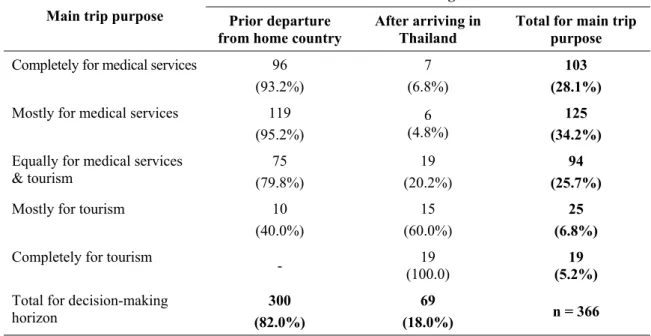
(36) Table 2.2: Use of Medical Services Abroad Use of medical services abroad 1.. Frequency. Repetition in using medical services abroad. 45. 12.0*. 9. 20.0. Type of medical services received in the last trip. 45. 100.0. - Beauty. 27. 60.0. - Dentistry. 13. 28.9. 5. 11.1. - Reuse medical services in Thailand 2.. Percentage. - Specialized treatment/serious disease Note: * 12.0 percent of total number of respondents (n = 376). Source: Survey in April-August, 2013.. 2.2.2. Behavior of medical tourists The behavior of medical tourists in Thailand can be divided into three stages:. a) Decision-making process This part displays the decision making process to receive medical services in Thailand. For example, issues such as if they make the decision before departing from their countries or after arriving to Thailand, the sources of information used, or the main reason to choose Thailand, etc. Table 2.3 presents the relationship between medical tourists’ main trip purpose and decision-making horizon. We found that the majority of respondents (82 percent) decided to receive medical services in Thailand before departing from their home country. More than 60 percent of the sample traveled solely (or mostly) for medical treatments, while 12 percent stated that tourism was the only or core reason for visiting Thailand. This findings are consistent with some previous studies (Bookman and Bookman, 2007; Keckley, 2008) in which medical treatment was the main trip purpose, and it was already planned at the home country. However, this differ from Wongkit and McKercher (2013) which found that the majority of respondents went to Thailand with completely (or mainly) purpose for a holiday. This difference may explained as Wongkit and McKercher (2013) included patients who received treatments at medical and dental clinics in which the decision is taken after arriving to Thailand. While our study focuses only medical tourists who received treatments at registered private hospitals as it was already mentioned in Chapter I. 36.
(37) Table 2.3: Main Trip Purpose and Decision-making Horizon Unit: persons. Decision-making horizon Main trip purpose. Prior departure from home country. After arriving in Thailand. Total for main trip purpose. Completely for medical services. 96 (93.2%). 7 (6.8%). 103 (28.1%). Mostly for medical services. 119 (95.2%). 6 (4.8%). 125 (34.2%). Equally for medical services & tourism. 75 (79.8%). 19 (20.2%). 94 (25.7%). Mostly for tourism. 10 (40.0%). 15 (60.0%). 25 (6.8%). -. 19 (100.0). 19 (5.2%). 300 (82.0%). 69 (18.0%). n = 366. Completely for tourism Total for decision-making horizon. Pearson Chi-square = 140.1 (d.f. = 4; p-value = 0.00) Source: Author calculation.. The Chi-square analysis was used to test the relationship between main trip purpose and decision-making horizon11. The null hypothesis of this test is that the main objective to go to Thailand is related with the decision-making horizon. The results of the hypothesis testing, shown in the last row of Table 2.3, revealed that medical tourists with distinct trip purpose also had a different decision-making horizon at a 5 percent statistical significance level (2 = 140.1, p-value < 0.05). Those who identified medical treatments as the main purpose of their trip tended to make the decision to receive treatments before departing from their home country, whereas those who traveled mostly (or completely) for holiday reasons were likely to decide to get medical services after arriving Thailand. If we classify medical tourists based on main trip purpose according to 12. Cohen (2008) , the majority of the respondents (34.2 percent) were ‘vacationing patient’ 11. In the case that the cross-tabulation contains more than four categories, the Chi-square statistic would not be. accurate if more than 20 percent of the cells have an expected value below 5 (Yates, Moore and McCabe, 1999; Royse, Thyer and Padgett, 2010). In table 2.3, this condition is fulfilled, so the use of Chi-square statistic is appropriate. 12. Explained in Chapter I.. 37.
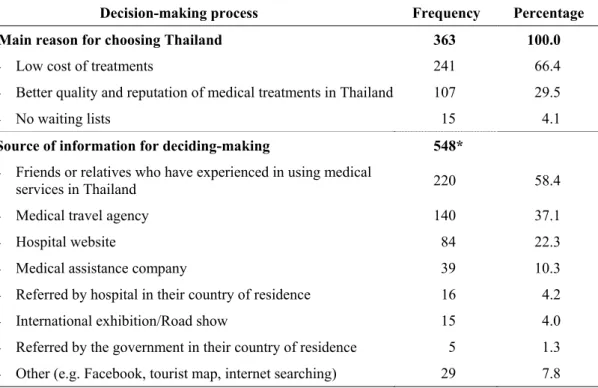
(38) who had medical treatments as main trip purpose, but did some tourism activities as shopping or city tour in the rehabilitation period. Nevertheless, the study of Cohen (2008) considered only one dimension (main trip purpose) to identify type of medical tourists. However, this PhD follows Wongkit and McKercher (2013) to classify medical tourists based on both, main trip purpose and decision-making horizon.. Table 2.4: Type of Medical Tourists Decision-making horizon Main trip purpose. Prior departure from home country. After arriving in Thailand. Medical (equally to completely for medical treatment). Dedicated medical tourists (96.7%). Hesitant medical tourists (48.5%). Tourism (mostly to completely for tourism). Holidaying medical tourists (3.3%). Opportunistic medical tourists (51.5%). Note: The type was classified follow Wongkit and McKercher (2013).. When considering the type of the medical tourists as shown in Table 2.4, the majority of participants (96.7 percent) were ‘dedicated medical tourists’ who go to Thailand mainly or totally for medical reasons and pre-planned this trip in their country. ‘Opportunistic medical tourists’ and ‘hesitant medical tourists’ shared a similar proportion (51.5 and 48.5 percent respectively). Hesitant medical tourists were interested in medical services in Thailand and probably searched for the information before departing from their home country. However, they make the final decision on the details in Thailand. Whereas ‘opportunistic medical tourists’ visit Thailand mostly (or completely) for tourism, but decide to receive medical services once in Thailand (probably influenced by some marketing channel as private hospitals advertising, in-flight magazines, freely distributed tourist publications or other media). Finally, only 3.3 percent were ‘holidaying medical tourists’ who go to Thailand mostly (or completely) for tourism but planned to get medical services as health check-up before departing from home country. Table 2.5 presents several information regarding the decision-making of medical tourists in Thailand. The main reason for choosing Thailand was the low cost of treatments (66.4 percent) followed by their perceived better quality and reputation. This result is consistent with previous studies in which lower cost of treatments was an. 38.
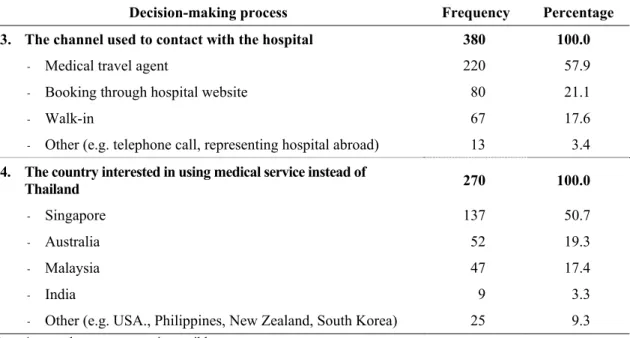
(39) important motivation for medical tourism (Bookman and Bookman, 2007; Horowitz and Rosensweig, 2007; Cabrera, 2010; Voigt et al., 2010). The main source of information (58.4 percent) of the majority of respondents was friends or relatives who experienced medical services in Thailand; 37.1 obtained information from medical travel agencies, and 22.3 percent used hospitals’ websites. After the decision to receive medical services in Thailand was made, 57.9 percent of respondents contacted a private hospital through a medical travel agency, while 21.1 percent reserved the medical services via the hospital website, and 17.6 percent were walk-in medical tourists. Finally, the questionnaire asked which country would have the respondents chosen if they would not come to Thailand, 50.7 percent of respondents answered Singapore, although it is not renowned for cosmetic surgery. 19.3 percent of respondents were willing to receive medical services in their home country (Australia) and 17.4 percent were interested in going to Malaysia. This result is consistent with the information from the in depth interviews with private companies administrators, as all of them agreed that Singapore was the major Thailand’s competitors in medical tourism while only 3 and 2 of them (total interviewees are 12 persons) stated that Malaysia and India were also relevant competitors.. Table 2.5: The Decision-making to Receive Medical Services in Thailand Decision-making process 1.. Frequency. Percentage. Main reason for choosing Thailand. 363. 100.0. - Low cost of treatments. 241. 66.4. - Better quality and reputation of medical treatments in Thailand. 107. 29.5. 15. 4.1. - No waiting lists 2. Source of information for deciding-making. 548*. - Friends or relatives who have experienced in using medical services in Thailand. 220. 58.4. - Medical travel agency. 140. 37.1. - Hospital website. 84. 22.3. - Medical assistance company. 39. 10.3. - Referred by hospital in their country of residence. 16. 4.2. - International exhibition/Road show. 15. 4.0. 5. 1.3. 29. 7.8. - Referred by the government in their country of residence - Other (e.g. Facebook, tourist map, internet searching). 39.
(40) Table 2.5: The Decision-making to Receive Medical Services in Thailand (cont.) Decision-making process. Frequency. 3. The channel used to contact with the hospital. Percentage. 380. 100.0. 220. 57.9. - Booking through hospital website. 80. 21.1. - Walk-in. 67. 17.6. - Other (e.g. telephone call, representing hospital abroad). 13. 3.4. 270. 100.0. - Singapore. 137. 50.7. - Australia. 52. 19.3. - Malaysia. 47. 17.4. 9. 3.3. 25. 9.3. - Medical travel agent. 4. The country interested in using medical service instead of Thailand. - India - Other (e.g. USA., Philippines, New Zealand, South Korea) Note: * more than one answer is possible. Source: Survey in April-August, 2013.. This study applied Chi-square test to analyze the relationship between the type of medical tourists and their decision-making processes (e.g. type of medical services received, channel to contact with the hospital, etc.). The results showed that decision-making processes were not related with type of medical tourists at a 5 percent statistical significance level. Another section of the questionnaire tries to evaluate which is the importance of both, country attributes and medical service attributes in the decision process. Hence, respondents were asked to use a seven-point rating scale (1 = lowest and 7 = highest) to rank the importance of different country and medical service attributes. The corresponding results are presented in the following tables. Table 2.6 presents the importance of country attributes on the decision to choose Thailand as the medical tourism destination. The findings showed that three factors share a top position in the ranking: reasonable price of treatments, reasonable cost of stay in Thailand, and the possibility to combine tourism with medical treatment.. 40.
Figure

+7




Documento similar
In the second half of the nineteenth century, physicians in the Czech Lands and elsewhere 19 strove to fully professionalize medical practice, dominate the medical market,
The expansionary monetary policy measures have had a negative impact on net interest margins both via the reduction in interest rates and –less powerfully- the flattening of the
Canada Medical Journal and Monthly Record of Medical and Surgical Science, nº 5, 1868, p.. An Essay on the Contagion, Infection, Portability and Communicability of the Asiatic
In addition, the main initiatives to support the tourism and hospitality sector that have been undertaken at the global, European and national levels are highlighted and, finally,
The tourist profile of dark tourism participants in Córdoba is young, has a university education, seeks new experiences, is aware of dark tourism places through the Internet,
Researchers and academics (Dann, 1996) described eight properties of the language of tourism that are often present in tourism materials in order to create a more effective
The technical dimension of Medical Imaging addresses the problems arising in real time implementation of medical image enhancement and segmenta- tion. Faced with this challenge,
We can define the capabilities as the activities that the organization does better than its competitors and depend on its own resources. In the case of SEUR, the main advantage
