LIBRARY OF CATALONIA
(BIBLIOTECA DE CATALUNYA) CIP INFORMATION
Foreign investment in the Barcelona area and Catalonia I. Carranza, Isabel, ed. II. Rodríguez, Imma (Rodríguez López), ed. III. Diamante, Giulia, ed. IV. ACC1Ó V. Barce-lona. Sector de Promoció Econòmica 1. Inversions estrangeres – Barcelona 2. Inversions es-trangeres – Catalunya
339.727.22(467)
FOREIGN
INVESTMENT IN
THE BARCELONA
AREA AND
CATALONIA
Disclaimers:This work is licensed under the Attri-bution-Noncommercial-Share-Alike 3.0 Creative Commons. It allows the re-production, distribution and broadcast provided that they cite the author and do not be a commercial use. The creation of deriva-tive works is permitted provided that they are spread with the same license. The full license is available at http://creativecom-mons.org/licenses/by-nc-sa/3.0/es/deed.en
EDITION
Barcelona City Council Economic Promotion sector
Llacuna 162, 1st floor 08018 - Barcelona - Spain T. +34 93 256 39 29 [email protected]
Government of Catalonia ACC1Ó Invest in Catalonia
Passeig de Gràcia, 129 08008 - Barcelona T. + 34 93 476 72 00 [email protected]
PricewaterhouseCoopers
Pablo López Romero Elena Casas Martínez
COORDINATION
Isabel Carranza - Barcelona City Council Imma Rodríguez - Invest in Catalonia - ACC1Ó Giulia Diamante - Planning and analysis - ACC1Ó
DESIGN Index
PRINTING Cevagraf, S.C.C.L.
D.L.:
Dynamic and open, enterprising and cosmopoli-tan, Barcelona has always been a city that welco-mes foreign investment. The city has a dense metropolitan area full of vitality, and Barcelona’s economy is characterized by the diversification of activity with a strong industrial base and a predo-minant services sector. The city’s objectives in-clude actively maintaining this economic diversification, adapting to new demands and meeting new challenges to stay attractive and competitive in a globalized world.
Over the centuries, the city has continually rein-vented itself to adjust to the needs of each period and open itself to the world. With its long indus-trial tradition, Barcelona is now focusing strongly on the knowledge economy and sustainability, based on the solid advantage of its unbeatable lo-cation as the southern gateway to Europe and the Mediterranean. It is an attractive city due to its bu-siness development, entrepreneurial initiatives, in-ternational talent, leading research, boundless creativity and quality of life, which has earned the admiration of the entire world.
The Barcelona metropolitan area has a popula-tion of 4.9 million and an area of 3,236 km2. Its considerably diversified business community has a long industrial tradition and provides a very attractive location for foreign investment. Barcelona was recently named the headquarters of the Secretariat of the Union for the Mediterra-nean, a fact that will strengthen the city’s leadership in this area even more and attract leading companies interested in benefiting from new business opportunities.
More than 2,700 foreign companies are currently operating in the Barcelona area. These companies have shown their loyalty to the area by staying here and consolidating their presence through re-newed investments. More and more companies with a vision of the future are choosing Barcelona as the location of their business, as shown by the high rate of satisfaction of the foreign companies operating here. The companies established in the city frequently make new investments to focus on strategic growth in activities of increased added value.
Attracting foreign investment to the Barcelona area, as presented in this fifth edition of the study, is a key aim of the public administration to create loyalty and increase inflows of foreign investment. Today Barcelona’s objective is to focus firmly and decisively on a model of economic growth based on innovation, creativity and the knowledge eco-nomy. Barcelona wants to continue to be known for its proactive support of talent and creativity, its openness to new economic activities, and its drive to increase the quality of life of its inhabitants.
Jordi Hereu Mayor of Barcelona
I am pleased to present the 5th edition of the study "Foreign investment in the area of Barce-lona and Catalonia”, which is jointly developed, biannually, by Invest in Catalonia - ACC1Ó and the Economic Development Area of the Barcelona City Council. Certainly, foreign investment in our country, and the opinion of businessmen about it, are key aspects that contribute to improve the competitiveness of Catalan companies and, ulti-mately, of Catalonia.
The strategic location of our country in southern Europe, the quality of life we enjoy and our entre-preneurial spirit, are factors that make Catalonia one of Europe's most attractive areas for foreign investment. The fact that more than 3,000 foreign companies are established and generate a total flow of foreign direct investment of 3,458 million Euros, in 2008, confirms the ability of Catalonia and Barcelona to attract high value-added foreign investment and international talent.
Despite the current situation, where the world economy has experienced a setback due to the financial crisis and, in turn, the competition is increasing globally, Catalonia has to make an effort to remain an attractive destination for foreign investment, maximizing the advantages of having a diversified business network and competitive service providers, along with human resources with high technical skills.
In addition to maintaining the traditional foreign investment, Catalonia has to carry on with its productive model transformation process and lead the foreign investment attraction of emerging
sectors and countries. Knowledge-intensive and high value-added activities take a special impor-tance in business growth strategies for compa-nies and represent, at the same time, a factor of competitiveness to attract and retain foreign in-vestment. The availability and investment in scientific and technological infrastructures, toge-ther with policies and government incentives for research and development, become some of the most valued aspects by businesses when ma-king the final decision to establish in our territory.
I am confident that Catalonia is prepared to face the challenges of globalization and technological change and, at the same time, it is able to make the most of the opportunities created by the cu-rrent situation. The Catalan government, aimed at encouraging the development of new business projects, will develop further cooperation with the private sector to support the growth of our terri-tory, thereby ensuring the welfare of all citizens.
Josep Huguet i Biosca Minister of Innovation, Universities
03
02
04
06
INDEX
FDI IN EMERGING INDUSTRIES IN
CATALONIA: ATTRACTING TALENT
AND REACHING CRITICAL MASS
5.1The dynamics of the business community in emerging industries: a note on local-global alliances
5.2The role of clusters as generators of the economic activities
5.3The competitive advantage of Catalonia and the Barcelona area in terms of FDI in emerging industries
5.4Human capital
5.5Access to financing: venture capital and public incentives
5.6Other contextual factors
GEOGRAPHIC ANALISYS OF FDI IN
CATALONIA
6.1Europe and the United States 6.2Asia
6.3Mediterranean countries 6.4Geographic comparison: critical points, challenges and opportunities
APPENDICES
7.1Methodology of the study 7.2List of figures, tables and graphs 7.3Sources7.4Glossary of terms
51
52
56
60 61
64
71 73 76 78
84 88 89 91
MAIN CONCLUSIONS OF
THE STUDY
INTRODUCTION TO THE STUDY
AND THE ECONOMIC CONTEXT
2.1Introduction to the study2.2Methodological approach and
conceptual framework of the study 2.3Opportunities of FDI for Catalonia in the context of world economic change
CURRENT SITUATION OF FDI IN
CATALONIA AND THE REST OF THE
WORLD
3.1Current situation of FDI in the world 3.2Increased competition to attract FDI 3.3Current situation of FDI in Catalonia and the Barcelona area
TRADITIONAL FDI IN CATALONIA:
CONCENTRATED AT KEY POINTS
ALONG THE VALUE CHAIN
4.1The situation of the business community in mature industries: the focus on activities with high added value and knowledge intensive activities 4.2The business model of companies in mature industries: the R&D&i opportunity 4.3The competitive advantage of Catalonia and the Barcelona area in terms of traditional FDI 4.4Human capital 4.5Other contextual factors06
12 13
15
20 22
23
31
34
36
41 42
01
01
MAIN CONCLUSIONS
OF THE STUDY
01
Catalonia and the Barcelona area lead the rankings of the most attractive places to do business. However, the reduction in the volume of FDI at the global level in the last year has resulted in greater competition between regions interested in attracting, consolidating and maintaining investments.
02
Strategies to promote the competitive-ness of Catalonia and the Barcelona area are being implemented in a context of growing competitiveness at the world level and within a framework of change in production models at the local level. In this regard, different lines of action are emerging:
•Maintaining traditional FDI in mature in-dustries while focusing on added-value and knowledge-intensive activities. •Attracting and consolidating FDI in New Economy industries and entrepreneurship.
Catalonia and the Barcelona area have a bu-siness community of mature industries where the focus is on R&D&i, technology and logistics. These industries should repre-sent the seed for attracting and consolidating FDI in emerging industries such as biotech-nology, renewable energies and ICTs.
To favour this approach, public administra-tions can impact competitiveness factors at the local level, particularly with regard to in-frastructure, human capital, access to fi-nancing, the regulatory framework and quality of life.
10
03
More than 3100 foreign companies are operating in Catalonia, with a total flow of FDI of €3.45 billion in 2008.
The Barcelona area accounts for about 75% of the FDI projects in Catalonia on average and accounted for 87% in 2008.
In the last 5 years, projects connected to ICTs have represented more than 20% of the total and, together with services for companies and consumer products, they represent 50% of the FDI projects imple-mented.
04
In mature industries, R&D&i constitutes a strategy for increasing business, as well as a competitive factor for attracting and maintaining FDI in the Barcelona area and Catalonia. In 2008 industrial investment in-creased by 2.2% and 38% of all FDI received by Catalonia was earmarked for industry. The-refore, Catalonia’s aim of maintaining pro-duction should also help increase R&D&i activities in mature industries.
05
The competitive advantage of Catalonia and the Barcelona area regarding traditio-nal FDI stems from:
•The technical training of human capital.
75% of foreign companies in mature indus-tries consider the level of technical personnel and university graduates to be high or very high.
•Policies and incentives related to R&D&i together with investment in scientific in-frastructures.
•Access to high-capacity transport and lo-gistics infrastructure. 63% of foreign com-panies in mature industries that participated in the study said that the level of infrastruc-ture and accessibility was acceptable.
•Public-private sector cooperation.
06
FDI in emerging industries in Catalonia and the Barcelona area is consolidating New Economy industries such as biotech-nology, renewable energies and ICTs in clusters designed to attract a critical mass of investment and entrepreneurial talent.
In biotechnology, the Barcelona area is beco-ming an international benchmark for the cre-ation of new companies, with a growth rate of 30%, which is higher than the European average.
07
The competitive advantage of Catalonia and the Barcelona area regarding FDI in emerging industries stems from:
•The availability of technological infras-tructure59% of the foreign companies in emerging industries consulted said the tech-nological infrastructure in Catalonia was ac-ceptable.
•The existence of a network of related companies at the local and global levels and service providers.
•An attractive lifestyle for qualified pro-fessionals and international entrepre-neurs.90% of the companies in emerging industries that participated in the study said they were satisfied with the cultural, sports and leisure activities available in the Barce-lona area and Catalonia.
•The public administration helps develop new business projects.
08
The human capital available in the Barce-lona area and Catalonia constitutes a com-petitiveness factor in its own right. 87% of the companies consulted said they were satisfied with the level of university quali-fications and technical training. This is also an area in which the public administration can have an impact by creating synergies between the business community and academia.
09
European and North American companies emphasized a set of opportunities for the Barcelona area and Catalonia that can help increase the attractiveness of the region:
•Support from the public sector for the development of the New Economy through initiatives aimed at the most rele-vant factors for companies from these regions that invest in industries such as biotechnology, nanotechnology, etc.
•Focusing on the values of entrepreneurship and international exchange as a differentia-ting and positioning factor in Europe.
•Providing and spreading information on available services and incentives to foreign companies in the process of setting up in Catalonia.
10
Asian companies highlighted the compe-titive advantage of Catalonia that plays a part in the investment decisions of Asian companies in this area:
•The existence of a competitive business community that offers support and provides the services these companies need for their activities is a highly important factor for then. More than 80% of the Asian companies par-ticipating said they were satisfied or very sa-tisfied with the level of concentration of companies in related industries.
•The availability of information on the things that make Catalonia and Barcelona stand out in terms of work culture, values, the involvement of the public administration in the business climate, etc., due to their perception of Europe as a homogeneous unit.
•The dissemination of successful cases of businesses launched with Asian capital to provide references for new investors.
09 08
02
13 FOREIGN INVESTMENT IN THE BARCELONA AREA AND CATALONIA •INTRODUCTION TO THE STUDY AND THE ECONOMIC CONTEXT
13
02
12
Barcelona City Council’s Area of International Economic Promotion and Invest in Catalonia (Ca-talan Government - ACC1Ó) have prepared the fifth edition of the study “Foreign Investment in the Barcelona Area and Catalonia”with the co-llaboration of PricewaterhouseCoopers.
Unlike the previous edition, which came out in June 2007, this one has been issued in a climate of uncertainty for foreign direct investment (FDI) and for the economies of Catalonia and the world. With this in mind, the study focuses on the featu-res of the Catalan economy that have made Cata-lonia and the city of Barcelona a model for the entire world when it comes to attracting business projects and flows of FDI from all over the world.
Despite the current economic situation, the trends that have been prevalent in recent years are still valid regarding industrial production, the shift of the most advanced economies towards the New Economy and the organization of the economy in complex networks.
With all these factors in play, positioning the eco-nomy of the Barcelona area (and, by extension, that of Catalonia as a whole) as an attractive place for FDI represents a real challenge for the future, as well as a wealth of opportunities. As discussed in different sections of the study, in the immediate future Catalonia has to make its capacity to maintain the level of inflows of FDI in so-called traditional industries compatible with the strong push it must give to the emerging in-dustries that are expected to drive the world eco-nomy in coming years.
With regard to the study, ACC1Ó and Barcelona City Council’s Area of International Economic Pro-motion decided to make a drastic change in their methodological approach and structure. The main part of the study has the following sections:
•An initial section that presents the main con-clusions of the study, with a breakdown of the Catalan economy’s strengths and potential for growth and as an attractive destination for FDI.
•A statistics section with the main macro-econo-mic figures of the current and recent context of FDI in Catalonia and the world,as well as the defining features.
•A section dedicated to traditional FDI in Cata-lonia,which is understood to mean FDI targeted at companies in mature, consolidated industries and FDI from countries with a long-term presence in Catalonia. In this section, the emphasis is on the main challenges of consolidating investment and the points on the value chain that will be the most important in coming years: research and development and innovation (R&D&i), logistics and distribution.
•A section dedicated to FDI in emerging indus-tries in Catalonia,especially in New Economy in-dustries that are expected to play a key role in the future of Catalonia and the rest of the world, especially biotechnology, renewable energies and information and communication technologies (ICTs). Special attention is paid in this section to the concept of international entrepreneurship.
•The last section, which is on the geographic analysis of FDI in the Barcelona area and Cata-lonia,discusses the investments made by coun-tries with an historic, consolidated presence in Catalonia and those that have a growing impor-tance in the Catalan economy, especially Asian and Mediterranean countries. Finally, the defining features and different opportunities of these regions are compared.
2.1
Introduction to the Study
2.2
Methodological Approach and
Conceptual Framework of the Study
According to the register of foreign companies in Catalonia, there are more than 3,100 foreign com-panies operating in Catalonia that represent approximately one third of the foreign companies in Spain1. In terms of geographic concentration in
Catalonia, approximately 90% of foreign compa-nies are located in the Barcelona area. For the pur-poses of this study, the Barcelona area is understood to bethe Barcelona metropolitan area, which covers the administrative limits of the city, plus the 7 counties that surround it: Barcelo-nès, Maresme, Garraf, Baix Llobregat, Vallès Oriental, Vallès Occidental and Alt Penedès.
The study on FDI in Catalonia is based on an
uni-que conceptual frameworkdeveloped for this
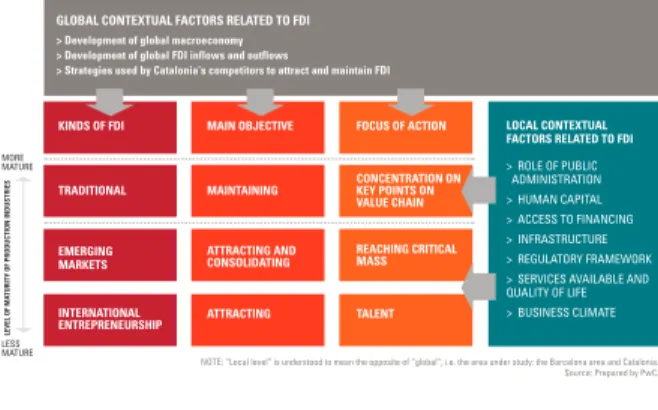
edition that adapts to the structure of sections presented in the past. This conceptual framework is based on the hypothesis (see Figure 1) that different kinds of FDI can be defined based on the level of maturity of the production industries and the companies operating in the region. Each kind of FDI can be associated with a main objective, as well as a specific focus of action. These different associated strategiesbasically seek to increase the amount of FDI projects and flows throughout the region.
1 By July 2009, a total of 3124 companies had been surveyed. Invest in Catalonia.
FIGURE 1.FDI CONCEPTUAL FRAMEWORK
NOTE: “Local level” is understood to mean the opposite of “global”, i.e. the area under study: the Barcelona area and Catalonia. Source: Prepared by PwC. GLOBAL CONTEXTUAL FACTORS RELATED TO FDI
> Development of global macroeconomy > Development of global FDI inflows and outflows
> Strategies used by Catalonia’s competitors to attract and maintain FDI
LOCAL CONTEXTUAL FACTORS RELATED TO FDI > ROLE OF PUBLIC
ADMINISTRATION > HUMAN CAPITAL > ACCESS TO FINANCING > INFRASTRUCTURE > REGULATORY FRAMEWORK > SERVICES AVAILABLE AND QUALITY OF LIFE > BUSINESS CLIMATE KINDS OF FDI
TRADITIONAL EMERGING MARKETS INTERNATIONAL ENTREPRENEURSHIP MAIN OBJECTIVE MAINTAINING ATTRACTING AND CONSOLIDATING ATTRACTING
FOCUS OF ACTION
15 FOREIGN INVESTMENT IN THE BARCELONA AREA AND CATALONIA •INTRODUCTION TO THE STUDY AND THE ECONOMIC CONTEXT
15
02
14
•In-depth interviews with 8 facilitating agents, including chambers of commerce, foreign con-sulates and other reference institutions in the area of FDI.
These agents were included to provide a contrast with the working approach and to highlight the factors that make FDI in Catalonia different.
•The organization of discussion groups in the form of industry and geographic workshops, which involved arranging them in two large groups, depending on whether they represented FDI in traditional or emerging industries and markets. A total of 6 workshops were organized with the presence of 45 companies:
FDI IN TRADITIONAL INDUSTRIES
1.Point on the R&D&i value chain: future trends and challenges
2.Point on the logistics and distribution value chain: future trends and challenges
3.Specific features of FDI from the United States and Canada
FDI IN EMERGING INDUSTRIES
4.Specific features of FDI from Asian companies
5.Specific features of FDI in emerging industries
6.International entrepreneurs
These discussion groups were structured as follows:
PART 1
Differences in the industries and geographic areas involved, such as: •The dynamic nature of the business community
•The key factors for competitiveness of the economy in Catalonia and the Barcelona area •The focus on added-value activities
•The role of clusters
•Experiences in the area of public-private cooperation BOX 1.ABBREVIATED METHODOLOGY OF THE STUDY
PART 2
Gathering primary data through questionnairesfrom participating companies, divided into the following 8 contextual areas and a total of 32 variables, rated according to the level of impor-tance and the current level of satisfaction:
•Investment context •Investment costs •Human capital •Work culture •Infrastructure •Available services •Legal and tax framework •Financing
•Personal interviews at companiesto complement the discussion groups and carry out case studies.
Finally, the analysis of secondary datawas maintained from previous editions that provided a relevant contextual perspective in terms of
industry and geographic trends on the evolution of FDI over time.
2 OCDE: Benchmark Definition of Foreign Direct Investment, 4th Edition, April 2008.
The context in which companies make decisions on FDI in Catalonia has two parts. On the one hand, it is made up of factors that can be consi-dered local. The role played at the local level has direct implications on decisive aspects such as the availability of a wide range of infrastructure, the excellent level of human capital in the region and the existence of a certain business climate. Fur-thermore, at the global level there are also factors that can have a decisive effect on companies’ stra-tegic decision making regarding future FDI, such as the more or less aggressive and innovative stra-tegies that other regions can implement to attract new FDI.
As mentioned above, one point that was different about this year’s study compared to previous edi-tions was the innovative focus on the work me-thodology. Rather than have a representative sample of companies fill out a questionnaire, tech-niques were used to acquire a more accurate rea-ding of the more qualitative aspects of the current situation, challenges and opportunities faced by major foreign companies in Catalonia. The main parts of this new methodology are as follows:
2.3
Opportunities of FDI for Catalonia in a Context
of World Economic Change
FDI constitutes a key part of the rapid economic integration witnessed in recent years at the world level. FDI represents a way to create stable, di-rect, long-lasting ties between economies. At the same time, FDI has become an important tool for the development of the local business community and can help improve the competitive position of the receiving economy and the investor beyond its own borders.
In particular, FDI facilitates the transfer of tech-nology and know-how between economies.It also provides opportunities for the economy of the country making the investment because its pro-ducts are promoted more extensively on interna-tional markets.
The significant growth in the volume of FDI in re-cent decades and the way in which FDI has spread throughout the world reflect both an in-crease in the size and number of FDI transactions and projects, and an increase in the diversification of the companies in different economies and in-dustries. Large companies, corporations and mul-tinational holding companies traditionally played a dominant role in these global transactions. Howe-ver, in recent years, there has been a consensus that small and medium-sized companies have pla-yed a role of growing importance in FDI2
17 FOREIGN INVESTMENT IN THE BARCELONA AREA AND CATALONIA •INTRODUCTION TO THE STUDY AND THE ECONOMIC CONTEXT
17
02
16
In 2007, world outflows and inflows of FDI
in-creased by more than 50% compared to 20063.
Likewise, the number of FDI projects throughout Europe increased by 5% compared to 2006, and
by 95% compared to 20024. It should be borne
in mind at the present time that the evolution over time of global FDI figures is closely lin-ked to the evolution of the economic and fi-nancial situation. Therefore, once the necessary adjustments have been made in the world macroeconomic panorama, some kind of recovery by 2010 of the different indicators, as forecast by the main institutions5, should
result in increases in FDI flows and projects throughout the world.
This context of global economic adjustment coincides with another process, which is neither new nor recent, and involves the accelerated evolution of advanced economies in the New Economy. As an advanced economy, Catalonia is no exception, and its own production industries are going through their own development.
Over the last three decades, the Catalan eco-nomy, with its strong industrial character, has become an economy every time more based primarily on knowledge, and Catalan society now depends more directly on the production, dissemination and widespread use of knowledge and information. In this regard,
3 www.oecd.org
4 European Investment Monitor 2008 Report.
5 The International Monetary Fund has forecast global growth of 2.5% of GDP by 2010 compared to a drop of 1.4% in 2009. http://www.imf.org/external/pubs/ft/weo/2009/update/02/pdf/0709.pdf
general movements are taking place in terms of the tertiarization of industrial activities and the “industrialization” of service activities.
In this context, the strategies of attracting, main-taining and consolidating FDI have to be adap-ted to new consumer needs, production methods, and especially to contextual, energy and environmental factors.
Catalonia and the Barcelona area in particular face the double challenge of increasing their competitiveness in attracting FDI and maintai-ning and improving the level of satisfaction of the businesspeople operating in the region.
03
After experiencing a major increase in the first years of the 21st century, the aggregate figure of FDI flows generated or received by different world regions reached its high point in 2007. The latest
data published by UNCTAD show an aggregate fi-gure for FDI flows of $1.6 trillion, which represents a 10% reduction compared to the previous year.
03
20 21
FOREIGN INVESTMENT IN THE BARCELONA AREA AND CATALONIA •CURRENT SITUATION OF FDI IN CATALONIA AND THE REST OF THE WORLD
The evolution of FDI over time is not markedly different from the
progress of economic activity; it is, in fact, a consequence of
economic activity. This section provides a brief and basically
quantitative overview of the most recent data on individual and
aggregate FDI flows received by different regions in the world. This
analysis is followed by a brief reflection on the trends described
recently in the different strategies being used throughout the world
to attract FDI, regardless of whether or not they are linked to
macroeconomic development. Finally, the in-depth analysis of the
situation in Catalonia provides the main conclusions and outlines
the different characteristics of the investment made in Catalonia by
foreign companies.
3.1
Current Situation of FDI in the World
The drop in FDI has been more pronounced in de-veloped countries and has been much smaller in developing and transition countries.
There is considerable consensus among the main reference institutions that in financial year 2010 the macroeconomic situation is expected to start improving again, which will affect the recovery of FDI flows around the world.
An analysis of inflows and outflows of investment in different regions shows the dominance of Eu-rope, which accounts for nearly half of inflows and outflows of FDI. Strictly with regard to inflows of FDI, the region of Asia and Oceania receives about 5%, which is nearly twice what it produces.
(1) Europe: Austria, Belgium, Bulgaria, Cyprus, Czech Republic, Denmark, Estonia, Finland, France, Germany, Greece, Hungary, Ireland, Italy, Latvia, Luxembourg, Lithuania, Malta, Ne-therlands, Poland, Portugal, Romania, Slovakia, Slovenia, Spain, Sweden, United Kingdom, Gi-braltar, Iceland, Norway and Switzerland. (2) Other developed countries: Australia, Israel, Japan, New Zealand. (3) Commonwealth of Independent States (CIS): Armenia, Azerbaijan, Belarus, Georgia, Ka-zakhstan, Kyrgyzstan, Moldova, Russia, Tajikis-tan, TurkmenisTajikis-tan, Ukraine and Uzbekistan. GRAPH 01.WORLD FDI BY REGION (2008)
Source:UNCTAD FDI/TNC database
OUTFLOWS INFLOWS
Africa Latin America Asia and Oceania Southeastern Europe and CIS (3) Other developed countries (2) North America Europe (1) 100%
75%
50%
25%
0%
2.9% 6.9%
17.5% 4.7% 9.1%
13%
46%
2.6% 0.3%
2.6% 9.8%
8.1% 16%
61%
GRAPH 02.DISTRIBUTION OF FDI ATTRACTION AT THE WORLD LEVEL (2003-2008)
Source: OCO Monitor database. China United
States India Kingdom United France Russia Germany Spain Poland Romania 10,000
8,000
6,000
4,000
2,000
0
03
23 Within the context of Spain and Europe, Catalonia
plays a leading role when it comes to attracting global FDI. This has been corroborated by several studies, such as the 2008 European Investment Monitor, which positioned Catalonia as the fourth most attractive location for setting up a businessin a ranking topped by the region of Greater London. In another a recent study by Cushman & Wakefield,9the Barcelona area was
ranked fourth out of 34 leading European cities
as a place to do business, bearing in mind a wide range of contextual factors.
Catalonia has historically been a high-priority des-tination for foreign companies seeking new loca-tions to do business. FDI projects are implemented in Catalonia in a wide range of tra-ditional and highly innovative industries, which demonstrates the region’s ability to welcome a wide spectrum of foreign business initiatives. By country, more than one fourth of the FDI
pro-jects in the entire world originate in the United States, whereas Germany generates one tenth of the total. In the cumulative total for 2003-2008, Spain produced 2.5% of the world total.
China, the United States and India occupy the top three positions in terms of the number of projects
received, a fact that explains the importance of new emerging countries on the world economic pano-rama. In this classification, Spain is ranked eighth.
However, in reference to the volume of FDI, Spain is in the seventh position worldwide, and the fourth in Europe, with a market share of 3.9%.
22
FOREIGN INVESTMENT IN THE BARCELONA AREA AND CATALONIA •CURRENT SITUATION OF FDI IN CATALONIA AND THE REST OF THE WORLD
Not all FDI is the same. Different kinds of com-panies have different reasons for investing be-yond the borders of the country where they have their main operations. Likewise, these same companies assess the decision to invest in different ways and have different priorities when choosing where to invest. In fact, these reasons and priorities have changed a great deal in recent years.
Many governments consider FDI in terms of the number of jobs created. However, FDI can have a considerable direct and indirect impact that may vary depending on the kind of FDI attracted, the region’s level of economic development, the ties between FDI and the domestic economy and the degree to which the promotion of FDI is included in the economic strategy of the region receiving the investment.6
The fact that there has been a reduction in the amount of FDI around the world has automatically led to an increase in competition for a smaller number of projects. In this context, it will be more crucial than ever for governments (and their pro-motional organizations) to impact investment de-cisions by providing timely information on the region and production industries, and to provide additional services, such as accompanying com-panies as they explore their investment options.7
All this is relevant for attracting new investments and maintaining the FDI being received in the re-gion, because improving service and monitoring by the local government can ensure jobs are maintained.
Finally, new, more efficient approaches towards traditional promotional services, providing infor-mation and other services such as accompanying potential investors can ensure the success of FDI promotional offices at a time when many public administrations are facing major budget cuts.
Other considerations that are the result of diffe-rent studies8indicate that, regardless of trends in
global economic activity, where FDI plays a key role, companies around the world are looking into new markets and exploring the competitive advantages they have to offer. In other words, without bearing in mind the dollar value of these flows, the number of countries in different parts of the world receiving FDI flows is increasing, as are the creation of wealth and new opportunities in parts of the world that, until recently, received little investment.
3.2
Increased Competition to
Attract FDI
3.3
Current Situation of FDI in Catalonia
and the Barcelona Area
6 Foreign Investment Promotion Center – World Bank
7 Global Investment Promotion Benchmarking 2009: Summary Report. World Bank Group
8 IBM Plant Location International
9 Cushman & Wakefield: European Cities Monitor 2009
03
25 Catalonia’s ability to attract FDI is supported by
a labour force with ahigh level of professional skills and a sophisticated level of consumer de-mand with considerable purchasing power. More-over, Catalonia has positioned itself as a privileged platform for access to other markets in Latin America, continental Europe and the Middle East, not only for cultural and geographic reasons, but because of the strategic opportuni-ties offered by the Catalan and Spanish compa-nies in these regions.
More than 3,100 foreign companies were opera-ting in Catalonia in 2008. As shown in the table and graph below, the countries with the most pre-sence in Catalonia in terms of the number of com-panies were France, Germany, the United States and Italy.
24
FOREIGN INVESTMENT IN THE BARCELONA AREA AND CATALONIA •CURRENT SITUATION OF FDI IN CATALONIA AND THE REST OF THE WORLD
GRAPH 04.EVOLUTION OF GROSS FDI IN CATALONIA (2003-2008)
Source: Invest in Catalonia. COUNTRY OF ORIGIN
Germany France United States Italy Netherlands Japan United Kingdom Switzerland Belgium - Luxembourg Denmark Sweden Portugal Austria Canada Finland Norway Other
Total
2006 705 519 399 356 198 148 140 111 87 67 62 46 44 28 20 15 55
3,000 2008
537 671 392 360 224 153 147 107 90 73 58 53 58 25 19 18 139
3,124 TABLE 01.
NUMBER OF FOREIGN COMPANIES OPERATING IN CATALONIA
In line with total world development and that of the main developed economies, the Catalan eco-nomy has behaved similarly in relation to the FDI
flows received in the last ten years. Total flows of FDI received in Catalonia in 2008 amounted to € 3,45 billion10.
GRAPH 03.EVOLUTION OF WORLD FDI AND FDI GROWTH IN CATALONIA IN THE LAST TEN YEARS
Source: UNCTAD FDI/TNC database and Ministry of Industry, Tourism and Trade. 0.0%
5.0%
0.0%
5.0%
0.0%
FDI in Catalonia World FDI 1998 1999 2000 2001 2002 2003 2004 2005 2006 2007
10 Ministry of Industry, Tourism and Trade.
Source:Ministry of Industry, Tourism and Trade Note: FDI includes ETVEs and NO ETVEs operations. ETVEs are the FDI operations carried out in Spanish holding companies. 4,500
4,000
3,500
3,000
2,500
2,000
1,500
1,000
500
0
(In millions of euros)
2003 2004 2005 2006 2007 2008
90% of the foreign investment received in Ca-talonia comes from the EU-27, 4.4% from other OECD countries and 5.6% from the rest of the world. According to the investment criteria of ulti-mate origin,France, with 627 million Euros and an increase of 219.8%heads the list of investors with more than a quarter (29.5%) of the volume reached in 2008. The Netherlands is in the second position (19.1%), followed by the USA (9.8%) and
the United Kingdom, Germany and Italy, each one contributing about 6%.
27 FOREIGN INVESTMENT IN THE BARCELONA AREA AND CATALONIA •CURRENT SITUATION OF FDI IN CATALONIA AND THE REST OF THE WORLD
26
In line with the growing importance of emer-ging industries, the advantages offered by the Barcelona area and Catalonia for FDI have evolved. There are currentlyactivities and niche markets in keeping with this advanced level of
develop-ment. These activities involvehigh added value
and a considerable technological level, with an emphasis on quality, differentiation, R&D&i and design.
Moreover, when the number of FDI projects star-ted up in Catalonia in the last 5 years is broken down by sector, we can see that software and
ICTsaccounted for more than 20% of these
pro-jects and that, along with business services and consumer products, they represented half of the FDI projects carried out.
Finally, based on the kind of FDI, and distinguis-hing between FDI generated by holding compa-nies and firms that are not holding compacompa-nies, i.e. production FDI, the analysis shows that there was a considerable increase in 2008 in the proportion of investment through holding com-panies, which constituted more than one third of all the FDI received.
GRAPH 07.INDUSTRIES ATTRACTING THE MOST FDI IN CATALONIA (2003-2008)
Source: OCO Monitor database. 60
40
20
0
(Numbers of projects)
Business Services ConsumerProducts Software
and ICTs TobaccoFood & ceuticalsPharma- Chemicals Textiles Transport FinancialServices Automotive
GRAPH 08.INVESTMENT BY HOLDING COMPANIES AND NON-HOLDING COMPANIES IN CATALONIA
Source: Ministry of Industry, Tourism and Trade. 100
75
50
25
0
2006 2007 2008
Volume of investment
Holding Companies (millions of euros) Non-Holding Companies (millions of euros)
(%)
15%
85% 94%
6%
63% 37%
0,5 0,2 1,2
03
A comparison between 2006 and 2008 reflectsthe stability of the total number of companies. Indeed, 40% of these companies have been operating in Catalonia for more than 10 years, which indicates the level of loyalty of the investments in the region and its sustained competitiveness.
With regard to the Barcelona area, the analysis of the number of FDI projects attracted over the years indicates that these projects represent at least 75% of the total number of projects in Ca-talonia and, in 2008, these projects accounted for 87% of all projects.
.
When the number of projects attracted is broken down based on the field of activity, it can be seen that 57% of the projects implemented from 2003
to 2008 focused on the activities of manufactu-ring, marketing, retail trade and logistics. GRAPH 05.DISTRIBUTION OF FDI PROJECTS IN THE BARCELONA AREA AND CATALONIA (2003-2008)
Source: OCO Monitor database. 100
75
50
25
0
2003 2004 2005 2006 2007 2008
(*) Barcelonès, Maresme, Garraf, Baix Llobregat, Vallès Oriental, Vallès Occidental, Alt Penedès Counties
Rest of Catalonia Barcelona Area (*)
(Numbers of projects)
GRAPH 06.FDI IN CATALONIA BY FIELD OF ACTIVITY (2003-2008)
Source: OCO Monitor database (2003-2008). 120
80
40
0
(Numbers of projects)
Sales and Marketing RetailTrade
04
TRADITIONAL FDI IN
31 The following subsections show the relationship
between the evolution of the different production industries in the Catalan economy and the chan-ges taking place in traditional FDI in terms of the
redefinition of company strategies and new needs. Also addressed are the actions taken by other economic actors in the region to success-fully ensure and retain traditional investment. FOREIGN INVESTMENT IN THE BARCELONA AREA AND CATALONIA •TRADITIONAL FDI IN CATALONIA
04
30
Traditionally, foreign investment in Catalonia has come from
com-panies in consolidated businesses and industries, and basically from
advanced economies. Traditional FDI is also characterized by the fact
that the companies that set up in the host country, in this case, the
Barcelona area and Catalonia, generally fit the traditional model of
parent company-affiliate company, which means the
decision-ma-king centre is far from the place where the FDI is invested. Another
characteristic of traditional FDI is related to the fact that the required
know-how is also consolidated and readily available in a wide range
of places.
In the case of Catalonia, the main competitive factor for attracting
FDI has historically been cost. Although this scenario was fully valid
for most of the second half of the 20th century, increased
competi-tion in the European Union and competicompeti-tion from regions where
costs are lower has largely changed the current situation.
31 Therefore, in the case of traditional FDI in
Catalo-nia, emphasis is now being placed on the points on the value chain, such as R&D&i and logistics, that make it possible to maintain or increase the
competitiveness of the region as an attractive place to invest. For this reason, two workshops were held with companies to focus on these points.
FIGURE 3.KEY FACTORS AND ACTORS IN TRADITIONAL FDI
The Barcelona area and Catalonia in general have evolved from an industrial economy into one based on knowledge. This process, which began decades ago, has sped up considerably in recent years, thanks to major technical advances and
other basic trends, i.e. chiefly the progressive structural change towards a service-based economy, with an increase in tangible capital and, in particular, the increased and growing importance of processes linked to innovation.
4.1
The situation of the business community
in mature industries: The focus on activities
with high added value and
knowledge-intensive activities
Source: Prepared by PwC INITIAL FACTORS
> Acceleration of the tertiarization process of industry > Commitment to competitiveness based on knowledge and added value
MATURE INDUSTRIES MAIN OBJECTIVE: MAINTAINING
FOCUS OF ACTION: CONCENTRATION ON KEY POINTS ON VALUE CHAIN
PRIORITY AREAS FOR COMPANIES THAT GENERATE TRADITIONAL FDI
> SKILLED HUMAN CAPITAL > R&D&i INCENTIVES > INFRASTRUCTURE > SPEED AND EFFICIENCY WHEN DEALING WITH PUBLIC ADMINISTRATION > PARTNERSHIP FORMULAS
ADVANTAGES OFFERED BY THE BARCELONA AREA AND CATALONIA
> TRANSPORT INFRASTRUCTURE
> PROFESSIONAL TRAINING > e-ADMINISTRATION > INCENTIVES AND AID > PUBLIC-PRIVATE PARTNERSHIPS > TECHNOLOGICAL INFRASTRUCTURE R&D&i
LOGISTICS
FIGURE 2. THE VALUE CHAIN AND TRADITIONAL FDI
Source: Prepared by PwC R&D
PURCHASING
33 FOREIGN INVESTMENT IN THE BARCELONA AREA AND CATALONIA •TRADITIONAL FDI IN CATALONIA
33
04
32
Although traditional industry continues to play a key role in the creation of wealth, the fact that it has lost relative weight, especially in terms of job
creation, should be understood in the context of the generation of new synergies between ma-nufacturing and services functions.
The “integrated” sector – manufacturing and services for production – represented 55.7% of total employment in Catalonia in 2005, which was 8.5% higher than the Spanish average.
The successful convergence between
know-ledge-intensive activities in the industrial and services sectors and new technologieshas had effects on advanced Western economies such as the Catalan economy. Following are the main be-nefits for the business community11:
GRAPH 12. FDI IN CATALONIA IN TRADITIONAL SECTORS (2003-2008) This fact is important, bearing in mind the weight of industry in traditional FDI. 38% of all
FDI received in Catalonia is earmarked for the industrial sector.
Agriculture and Fishing Construction Consumer Services Production Services Manufacturing Industries
Services Agriculture Industry Construction 100
75%
50%
25%
0%
PERCENTAGE DISTRIBUTION
ANNUAL VARIATION RATES (%)
GRAPH 10. EVOLUTION OF EMPLOYMENT IN MAJOR ECONOMIC SECTORS: CATALONIA AND SPAIN
GRAPH 11. INDUSTRIAL INVESTMENT IN CATALONIA
Source: Secretariat of Industry and Enterprise.
Source: INE, Contabilidad Regional de España. 1995 2005 1995 2005
CATALONIA SPAIN
2001 2002 2003 2004 2005 2006 2007 2008 6.5%
1.5%
-3.5%
The rate of industrial investment in Catalonia remained positive in 2008
One of the highlights of 2008 was the evolution of industrial investment, which continued to increase for the sixth consecutive year and finished at 2.2%. This demonstrates the industry’s drive to renew its equipment, production systems and technology as a key way to stay competitive.
2.2% 2.9% 6.7% 5.3% 3.5% 1.7%
-0.9%
•The internationalization of production proces-ses and the effects on how companies are or-ganized.
•Major changes in the nature and dynamics of
markets and company strategies.
•The growing interrelationship between manu-facturing and service activities in companies and along the value chain, and also in terms of tech-nological and economic interdependence.
By restructuring logistics and distribution pro-cesses in companies in mature industries, the trend in recent years has been to focus on in-creased technological development at key points along the value chain.Therefore, for different mature industries in which logistics constitutes a relevant part of the financial re-sults, all the investment in distribution and information-systems infrastructure can result in considerable benefits for the affiliate company and, ultimately, for the parent company.
11 “La nova indústria: el sector central de l’economia catalana”. Papers d’economia industrial no. 26. Catalan government. Ministry of Labour and Industry. Secretariat of Industry and Energy.
Source: Ministry of Industry, Tourism and Trade and PwC analysis (does not include holding companies). 41.8%
37.9% 12.0%
8.3% Services
Construction Industry and Energy Agriculture 100
75%
50%
25%
0%
PERCENTAGE DISTRIBUTION
GRAPH 9. TRADITIONAL DISTRIBUTION OF GDP IN CATALONIA BY INDUSTRY
Source: IDESCAT
2000 2005 2008
AS A PERCENTAGE OF TOTAL FDI
15%
10%
5%
0%
35 FOREIGN INVESTMENT IN THE BARCELONA AREA AND CATALONIA •TRADITIONAL FDI IN CATALONIA
35
04
34
As a result of the different interviews and dis-cussion groups with foreign companies in mature industries, it was found that these companies
spend a considerable amount on R&D&i, moder-nizing their production structures and integrating with suppliers and clients all along the value chain.
FIGURE 4.STRONG POINTS OF R&D&i IN CATALONIA
4.2
The business model of companies
in mature industries:
The R&D&i opportunity.
As a result, Catalonia is becoming even more at-tractive as a place for FDI for mature industries positioning themselves to offer competitive ad-vantages at the points along the value chain that are expected to show the best prospects for companies in coming years.
The number of innovative companies between 2005 and 2007 was 10,470, a figure that repre-sents 27.4% of all companies12. In terms of the
kind of innovation, the greatest trend is in process innovation, followed by product innovation.
The Barcelona area has a solid base in the area of research and innovationand the drive of public and private investment in this area is setting the in-ternational benchmark.
Catalonia is the origin of nearly 1% of world scientific production (on a par with that of Finland and Scotland), 2.5% of that of EU-15 and more than 25% of that of Spain13.
The fact that the foreign companies operating in the Barcelona area focus on R&D is becoming one of the ways to maintain FDI flows. Because R&D is closely linked to production in traditional industries (electronics, automotive industry, phar-maceutics, etc.), Catalonia’s focus on maintai-ning and attracting production should also bring R&D activity along with it.
AS A PERCENTAGE OF TOTAL FDI
GRAPH 13.FDI IN CATALONIA BY INDUSTRY (2003-2008)
Source: Ministry of Industry, Tourism and Trade and PwC analysis (does not include holding companies).
Source: Prepared by PwC
Chemical
Real Est ate /
Const ruction
Who lesale
Trad e and
Distr ibutio
n FinanceAgro-food
Metallur gy
Business A ctivit
ies
Water and Ener
gy
Retail T rade
Transpor t
Hospit ality
Machiner y
Cultur al and S
ports A ctivit
ies TextilesPlast
ics
Graphic A rts / PublishingAut
omot ive
Comput er Activit
ies Paper
Elect rical /
Elect ronics
R&D&i
LEGALPROTECTION SKILLED HUMAN
CAPITAL AVAILABILITY OF INFRASTRUCTURE
CONSOLIDATED
KNOW-HOW
Moreover, in terms of the human capital working on R&D, though Catalonia has traditionally con-centrated more on development activities than research, it holds a competitive position compa-red to other regions. Therefore, the number of specialized personnel, along with aspects such as improved protection of intellectual property, makes the Barcelona area competitive when it comes to possible offshoring in this specific con-text. As a result, Catalonia is more competitive than regions such as Asia because of the pro-tection provided by the legal framework, good professional practice and the rigour of the standards and proceduresto be followed, which is particularly true in sectors such as the pharmaceutical industry.
Finally, in the area of public-private cooperation, the strategy of encouraging companies to par-ticipate in the operations of research and tech-nology centres could involve providing incentives for communication and the participa-tion of the private sector in decision making on major investments in R&D&i. This could involve formulas for public-private partnerships and in-cluding leading companies in the industry, which would strengthen the commitment and involve-ment of the business community in the results of these partnerships.
12 Idescat.
37 SUPPORT FOR THE TECNIO NETWORK IN CATALONIA
TECNIO15is a network that connects the main technology-transfer centres and agents in Catalonia
with the aim of creating contact between companies and favouring the competitiveness and in-ternational projection of the Catalan business community. The advanced tehcnology centres of the Tecnio network currently include: Ascamm, Leitat, CTM, Cetemmsa and CIBM.
They have been entrusted with the following two missions:
•Consolidating and promoting the technology-transfer model to generate a Catalan technology market that makes companies more competitive. The new network has more than 100 agents spe-cializing in the technology-transfer system in Catalonia. It is currently made up of technology cen-tres, advanced technology centres and university groups. New agents such as hospital research foundations and research centres are expected to join the network in the near future.
•Equipping companies with technology to provide added value to their projects and become a springboard for their projection abroad.With the aim of increasing the competitiveness of compa-nies, TECNIO detects the needs of Catalan companies and informs them of the technological capa-city of the agents in the network. Companies can find a technology ally to implement R&D&i projects, solve their technology needs and receive support in the management of incentives and projects. FOREIGN INVESTMENT IN THE BARCELONA AREA AND CATALONIA •TRADITIONAL FDI IN CATALONIA
37
04
36
Year after year, the governments of all advanced and emerging economies try to increase their in-flows of FDI by improving their business climate, developing different guarantees for investors and offering several kinds of incentives.
According to the Organization for Economic Coo-peration and Development (OECD), the most important factors considered by investors when deciding on setting up in a specific location in-clude:
•A predictable, non-discriminatory regulatory framework and a lack of unjustified administra-tive red tape for business.
•A stable macroeconomic context, including
fa-cilities for international trade.
•Sufficient accessible resources, including the presence of relevant infrastructure and human capital14.
As a result of the discussion groups and inter-views carried out with the group of companies that generate traditional FDI, the aspects they are most interested in were identified in relation to company needs and the competitive advan-tage of the Barcelona area and Cataloniain these areas:
•The existence of policies, incentives and investment in infrastructure in relation to R&D&i
•High-capacity transport infrastructurefor
carrying out logistics activities
•A fluid, expeditious relationship with institutions for administrative procedures
•The promotion of new forms of public-private cooperation
•Skilled human capitalat reasonable costs (see Section 4.4)
R&D&i: the focus on networks and public aid
One of the main things being concentrated on in the Barcelona area to make it more attractive for potential FDI is related to technological infras-tructure. Companies have acknowledged the effort made by the different public administra-tions to create technology centres and increase incentives and programmes. As a result, 81% of polled companies in mature industries consi-der the level of technological infrastructure in Catalonia to be acceptable,and 13% said they were very satisfied.
Catalonia has many technological research parks operating in a competitive context in the region. This action is producing good results and giving these centres a reputation for being benchmarks in their fields. One of the ways to expand on this strategy is through cooperation between centres (in Catalonia, Spain and the rest of the world) to offer increased specializa-tion and the availability of infrastructure to make this cooperation more attractive to major companies, as well as those with international capital.
Therefore, technology parks can help attract new FDI flows in the area of R&Dbecause they are equipped with virtual networks and latest-ge-neration technologies. They also have guidelines on the different lines of research to be carried out, incentives for efficiency and productivity, and a long-term strategic approach, which makes them one of the region’s outstanding assets.
Moreover, one of the basic conditions for R&D&i activities to be carried out by foreign compa-nies in Catalonia is a network of excellent small companiesin very specific fields (consul-ting, the manufacture of components and pro-totypes, design, etc.).
At the institutional level, the National Agree-ment on Research and Innovation (PNRI)has entered into effect. It provides a roadmap on re-search and innovation for the next 15 years. The main aims of this agreement are to position re-search and innovation as a leading priority on the political, social and economic agenda, improve the mechanisms for collaboration between uni-versities and companies, and establish the steps
to be taken to ensure research and innovation policies are efficient and effective.
Along similar lines, the Strategic Agreement to Promote the Internationalization, Job Quality and Competitiveness of the Catalan Eco-nomy, 2008-2011puts forth different measures to increase economic productivity. The agree-ment is structured in 8 major areas: infrastruc-ture, employment and training policies, R&D&i, social policies, labour relations, financing econo-mic activity, creating an environment that fa-vours business activity and internationalization.
4.3
The competitive advantage
of Catalonia and the Barcelona
area in terms of traditional FDI
39 FOREIGN INVESTMENT IN THE BARCELONA AREA AND CATALONIA •TRADITIONAL FDI IN CATALONIA
39
04
38
THE STRENGTH OF R&D&i INCENTIVES
The companies currently operating in the Barcelona area and Catalonia have access to a wide range of financial grants and incentives aimed at promoting innovation16. In general, this financial
aid can be differentiated as follows:
•Financial aid
Aid to finance projects to improve technology, support programmes for innovation in SMEs and to create incentives for industrial research and experimental development projects, among others.
•Soft loan lines
These loans are granted with terms and conditions that are more advantageous than market condi-tions. The focus on soft loans as a way to support different business initiatives is becoming more consolidated. For example, loans are available for business projects at innovation centres and for
R&D&i and industrial modernization. THE PORTS OF BARCELONA AND TARRAGONA AS KEY PORTS OF ENTRY
FOR GOODS IN WESTERN EUROPE
One of the strong points of Catalonia’s infrastructure is its ports, especially the facilities at the Port of Barcelona, which is considered the main logistics port in Southern Europe. It handles 24% of foreign trade in Spain and 78% in Catalonia18.
In order to handle increases in traffic and become a benchmark port on the Mediterranean, new port areas are being created to double the port’s capacity and improve market accessibility. The expansion of the Port of Barcelona, with an investment of €3.59 billion, will give it an area of 1,300 hectares.
The lease on the first terminal in the expansion was awarded to Terminal Catalonia, a company in which the group Hutchison Port Holdings holds a stake. Hutchison Port Holdings is the leading terminal operator in the world. The terminal will be positioned as a key platform for the flow of goods between Asia, Europe and the Americas. The Port Authority of Barcelona is working to attract the growing maritime traffic between Europe and Asia, especially traffic with China.
The Port of Tarragona, with a land area of 613 hectares19and 36.3 million tonnes of goods traffic
in 2007, is located one hour from Barcelona and is a key infrastructure for the area, which inclu-des a petrochemical cluster that is the largest of its category in Southern Europe. More than half the traffic handled by this port is chemical in nature.
Foreign companies confirm that both facilities are able to handle an enormous volume of goods and also highlight the extensive list of daily routes to a great many countries.
After the expansion carried out at both facilities, one of the main challenges they face concerns transport intermodality, i.e. the integration of different modes of transport (air, rail, sea and road) to ensure the system is used profitably and effectively. Around 3% of the goods currently moved through the Port of Barcelona connect with the rail network and this figure is increasing by 25% per year and is expected to reach 30%.
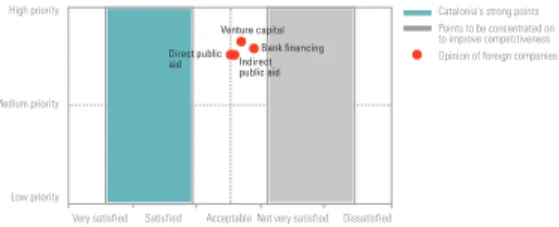
GRAPH 14.INFRASTRUCTURE IN CATALONIA AND TRADITIONAL FDI
High priority
Medium priority
Low priority
Very satisfied Satisfied Acceptable Not very satisfied Dissatisfied
Catalonia's strong points Points to be concentrated on to improve competitiveness Opinion of foreign companies
Availability and quality of telecommunications
Accessibility of main roads Technological infrastructure Availability and quality of office space
17 www.aena.es 18 Port Authority of Barcelona.
19 Port Authority of Tarragona.
16 www.acc10.cat
Infrastructure
For companies that generate traditional FDI, a high priority is having access to good connections, es-pecially through airports and ports, so that goods can be moved on short notice. Moreover, because logistics is important in these companies, advan-ces in terms of goods transport, arrival and distri-bution points, and an increase in the capacity of different communication routes are key to making a region more attractive.
When companies that generate traditional FDI were asked about infrastructure in the broadest sense (communication, technological, telecommu-nications and physical capital infrastructure), it was found that 75% consider this infrastructure in ge-neral to be acceptable or satisfactory.
It is worth noting that 87% of the companies are satisfied or very satisfied with the availability and quality of telecommunications infrastructure, and 56% have the same opinion about the availability of office space and business centres, especially in the Barcelona area.
In terms of infrastructure that is important for attracting traditional FDI,airports occupy a pro-minent position. Thanks to the recent inaugura-tion of the T-1 terminal at Barcelona airport, connectivity with major cities all over the world has improved and Barcelona has positioned itself on the same level as other European airport hubs.
In 2008, Barcelona airport handled more than 30 million passengers and more than 320,000 ope-rations were carried out. In terms of cargo trans-port, more than 100 million tonnes of goods passed through the airport facilities17. Besides