Accepted Manuscript
Title: Treatment with corn oil improves neurogenesis and cognitive performance in the Ts65Dn mouse model of Down syndrome
Authors: Andrea Giacomini, Fiorenza Stagni, Marco Emili, Sandra Guidi, Maria Elisa Salvalai, Mariagrazia Grilli, Veronica Vidal-Sanchez, Carmen Martinez-Cu´e, Renata Bartesaghi
PII: S0361-9230(18)30330-7
DOI: https://doi.org/10.1016/j.brainresbull.2018.06.009
Reference: BRB 9453
To appear in: Brain Research Bulletin Received date: 2-5-2018
Revised date: 7-6-2018 Accepted date: 18-6-2018
Please cite this article as: Giacomini A, Stagni F, Emili M, Guidi S, Salvalai ME, Grilli M, Vidal-Sanchez V, Martinez-Cu´e C, Bartesaghi R, Treatment with corn oil improves neurogenesis and cognitive performance in the Ts65Dn mouse model of Down syndrome, Brain Research Bulletin (2018), https://doi.org/10.1016/j.brainresbull.2018.06.009
This is a PDF file of an unedited manuscript that has been accepted for publication. As a service to our customers we are providing this early version of the manuscript. The manuscript will undergo copyediting, typesetting, and review of the resulting proof before it is published in its final form. Please note that during the production process errors may be discovered which could affect the content, and all legal disclaimers that apply to the journal pertain.
© 2018. This manuscript version is made available under the
CC-BY-NC-ND 4.0 license http://creativecommons.org/licenses/by-nc-nd/4.0/
1
Title: Treatment with corn oil improves neurogenesis and cognitive performance in the Ts65Dn mouse model of Down syndrome
Abbreviated title: Effects of corn oil in the trisomic brain
Authors: Andrea Giacomini a*, Fiorenza Stagni a*, Marco Emili a, Sandra Guidi a, Maria Elisa Salvalai b, Mariagrazia Grilli b, Veronica Vidal-Sanchez c, Carmen Martinez-Cué c, Renata Bartesaghi a.
Address:
a) Department of Biomedical and Neuromotor Sciences, University of Bologna, Bologna, Italy b) Department of Pharmaceutical Sciences, University of Piemonte Orientale, Novara, Italy c) Department of Physiology and Pharmacology, School of Medicine, University of Cantabria,
Santander, Spain
Authorship note: The Authors indicated with an asterisk contributed equally to the work.
Corresponding author: Prof. RENATA BARTESAGHI
Department of Biomedical and Neuromotor Sciences Physiology Building
Piazza di Porta San Donato 2 I-40126 BOLOGNA BO, Italy Tel +39 051 2091727 Fax +39 051 2091737
E-mail [email protected]
Highlights
Reduced neurogenesis and intellectual disability characterize Down syndrome Fatty acids have been shown to be critical factors for proper neural development We found that corn oil restores neurogenesis in the Ts65Dn model of Down syndrome Corn oil improves hippocampus-dependent memory in the Ts65Dn model
Supplementation with corn oil may represent a useful therapy for Down syndrome
ABSTRACT
Individuals with Down syndrome (DS), a genetic condition due to triplication of Chromosome 21, are
2
characterized by intellectual disability that worsens with age. Since impairment of neurogenesis and
dendritic maturation are very likely key determinants of intellectual disability in DS, interventions targeted to these defects may translate into a behavioral benefit. While most of the neurogenesis enhancers tested so far in DS mouse models may pose some caveats due to possible side effects, substances naturally present in the human diet may be regarded as therapeutic tools with a high translational impact. Linoleic acid and oleic acid are major constituents of corn oil that positively affect neurogenesis and neuron maturation. Based on these premises, the goal of the current study was to establish whether treatment with corn oil improves hippocampal neurogenesis and hippocampus-dependent memory in the Ts65Dn model of DS. Four-month-old Ts65Dn and euploid mice were treated with saline or corn oil for 30 days. Evaluation of behavior at the end of treatment showed that Ts65Dn mice treated with corn oil underwent a large improvement in
hippocampus-dependent learning and memory. Evaluation of neurogenesis and dendritogenesis showed that in treated Ts65Dn mice the number of new granule cells of the hippocampal dentate gyrus and their dendritic pattern became similar to those of euploid mice. In addition, treated Ts65Dn mice underwent an increase in body and brain weight. This study shows for the first time that fatty acids have a positive impact on the brain of the Ts65Dn mouse model of DS. These results suggest that a diet that is rich in fatty acids may exert beneficial effects on cognitive performance in individuals with DS without causing adverse effects.
Key Words: Down syndrome; intellectual disability; Ts65Dn model; hippocampus; neurogenesis; dendrites; memory
1. INTRODUCTION
Triplication of Chromosome 21 causes Down syndrome (DS), a pathology characterized by brain hypotrophy and disability in several cognitive domains, including explicit memory. Since individuals with DS above 40 years of age are at high risk for the onset of Alzheimer’s disease, intellectual disability may transform into dementia (Hartley et al., 2015). Widespread impairment of neural precursor proliferation starting from fetal life stages is a key hallmark of DS (Haydar and Reeves, 2012; Stagni et al., 2017a). Moreover, the DS brain is characterized by severe impairment in dendritic maturation (Bartesaghi et al.,
3
2011; Benavides-Piccione et al., 2004). Both these defects are thought to be key determinants of cognitive impairment in DS. No effective pharmacotherapies currently exist for intellectual disability in individuals with DS. Ideally, therapies to improve brain development should be performed at early life stages. Yet, since neurons of the hippocampal dentate gyrus are continuously generated throughout life, interventions that are able to improve hippocampal neurogenesis may also have a positive impact on hippocampus-dependent learning and memory at adult life stages and could possibly delay the onset of Alzheimer’s disease.
Among the various pharmacotherapies attempted in DS mouse models some of them proved to be effective in improving hippocampus-dependent learning and memory (Bartesaghi et al., 2011; Costa and Scott-McKean, 2013; Gardiner, 2015; Stagni et al., 2015). It should be noted, however, that some of the drugs used may also cause side effects, which diminishes their translational impact. For instance, lithium may impair renal function and inhibitors of GABAA receptors may have pro-convulsant effects. Ideally, the treatment of choice should be effective, safe and well tolerated. In this context, substances that are naturally present in the human diet should be regarded as therapeutic tools with a potentially strong translational impact.
There is evidence that in addition to their role in metabolism, fatty acids can serve as signaling molecules by affecting intra- and extracellular receptor systems, either directly or after conversion to specific fatty acid derivatives (Georgiadi and Kersten, 2012). Poly- and/or mono-unsaturated fatty acids (PUFAs and MUFAs, respectively) have been implicated as critical nutritional factors for proper neural development and function (Gordon, 1997) and fatty acids appear to favor brain development and ameliorate cognitive
functions in normal and diseased conditions (Hussain et al., 2013). Long chain poly-unsaturated fatty acids (LC-PUFAs), which make up 20% of the dry weight of the brain, are critical for healthy brain development and contribute to membrane structure and cytokine regulation. According to the position of the first double bond from the methyl end of the fatty acid chain, the most important PUFAs for humans can be divided into two families: n-6 (omega-6) and n-3 (omega-3) PUFAs. Linoleic acid (LA, 18:2n-6) is the parent fatty acid of omega-6 PUFAs, and produces principally arachidonic acid (AA, 20:4n-6), whereas α-linolenic acid (ALA, 18:3n-3) is the parent fatty acid of omega-3 PUFAs, and gives rise mainly to eicosapentaenoic acid (20:5n-3). LA and ALA must be supplied by food because they cannot be synthesized by the human body and for this reason they are called essential fatty acids. Essential fatty acids and their metabolites, especially
4
n-6 PUFA-derived mediators, have been shown to have profound effects on the proliferation of different stem cell types (Kang et al., 2014), including neural stem cells (Beltz et al., 2007; Maekawa et al., 2009; Sakayori et al., 2011; Tokuda et al., 2014). The observation that their deficiency alters neurogenesis (Coti Bertrand et al., 2006; Tang et al., 2016) highlights a possibly relevant role of n-6 PUFAs in the regulation of neurogenesis. The MUFA oleic acid (OA, C18:1n-9), which is the primary fatty acid in the white matter of the mammalian brain (O'Brien and Sampson, 1965), has been shown to promote axonogenesis in the striatum during brain development (Polo-Hernandez et al., 2010) and to favor dendritic differentiation (Rodriguez-Rodriguez et al., 2004), suggesting a role of OA in neuron maturation.
Corn oil, which is extracted from the germ of corn, contains a high percentage of both LA and OA. In view of the positive effects exerted by these fatty acids on neurogenesis and neuron maturation, the goal of the current study was to establish whether treatment with corn oil improves neurogenesis and neuron maturation in the hippocampal dentate gyrus of the Ts65Dn mouse model of DS and whether these effects are associated with a behavioral improvement.
2. MATERIALS AND METHODS
2.1. Colony
In order to obtain Ts65Dn mice, B6EiC3Sn a/ATs(17<16>)65Dn females were mated with C57BL/6JEiJ x C3H/HeSnJ (B6EiC3Sn) F1 hybrid males provided by Jackson Laboratories (Bar Harbor, ME, USA). We used the first generation of this breeding. The genotyping of the animals was carried out as previously described (Reinholdt et al., 2011). The day of birth was designated postnatal day zero. The mice were kept in a room with a 12:12 h light/dark cycle and had free access to water and food. All efforts were made to minimize animal suffering and to keep the number of animals used to a minimum.
2.2. Experimental protocol
A total of 47 male mice aged 4 months were used. Mice were i.p. injected every other day for one month with i) saline (0.9% NaCl; n=17 euploid and n=8 Ts65Dn mice) or ii) corn oil (Sigma: C8267; 10 µl/g; n=12 euploid and n=10 Ts65Dn mice). At the end of treatment, mice were behaviorally tested with the Morris Water Maze and Contextual Fear Conditioning tests. Because C3H/HeSnJ mice carry a recessive mutation
5
that leads to retinal degeneration (Rd), animals were genotyped by standard PCR to screen out mice carrying this gene. Mice that did not carry a recessive mutation that leads to retinal degeneration entered the
behavioral study. At the end of behavioral testing mice were killed, the brain was removed, fixed by immersion in PFA 4% and frozen. Mice injected with saline will be called hereafter control mice and mice injected with corn oil will be called treated mice.
2.3. Histological procedures
The frozen hemispheres were cut with a freezing microtome into 30-m-thick coronal sections that were serially collected in anti-freezing solution (30% glycerol; 30% ethylen-glycol; 0.02% sodium azide; PBS1X to volume).
2.4. Immunohistochemistry
For doublecortin (DCX) immunohistochemistry, one out of six free-floating sections from the hippocampal formation (n=10 sections) were permealized with 0.4% Triton X-100 in KPBS and blocked for 2 h in 10% donkey serum in 0.4% Triton X-100 and KPBS. Sections were then incubated overnight at 4°C with a goat polyclonal anti-DCX antibody (Santa Cruz Biotechnology Cat# sc-8066, RRID: AB_2088494) diluted 1:100. Detection was performed with FITC-conjugated anti-goat secondary antibody (Abcam Cat# ab6881, RRID: AB_955236) diluted 1:200.
2.5. Measurements
2.5.1. Number of DCX-positive cells. Quantification of DCX-positive cells in the dentate gyrus was conducted in every 6th section using a fluorescence microscope (Nikon Eclipse TE 2000-S inverted
microscope; Nikon Corp., Kawasaki, Japan; objective: x 20, 0.50 NA; final magnification: x 200), equipped with a Nikon digital camera DS 2MBWc. DCX-positive cells were counted along the whole length of the granule cell layer and their number was expressed as number of cells for 100 µm of linear length.
2.5.2. Neuron sampling. Series of sections (n=10) across the dentate gyrus were used for reconstruction of the dendritic tree of DCX-positive neurons. DCX-positive neurons were sampled in the upper blade. Only neurons with branches extending beyond the outer one half of the molecular layer were selected. The total number of sampled neurons was 4-7 per animal.
2.5.3. Measurement of the dendritic tree. The dendritic tree of DCX-positive cells was traced as previously described (Guidi et al., 2013). The operator starts with branches emerging from the cell soma and after
6
having drawn the first parent branch goes on with all daughter branches of the next order in a centrifugal direction. For each neuron, we evaluated total dendritic length, total number of branches, number of branches of each order and mean branch length.
2.6 Behavioral testing
2.6.1. Morris Water Maze (MWM). The MWM test was used in order to examine hippocampus-dependent learning and memory. Mice were maintained in a room with reverse light/dark cycle. Animals were tested starting at 08.30-09.00am and before being tested were put in the behavior room for 1 h of habituation. Mice were trained in the MWM task to locate a hidden escape platform in a circular pool. The apparatus consisted of a large circular water tank (1.00 m diameter, 50 cm height) with a transparent round escape platform (10 cm2). The pool was virtually divided into four equal quadrants identified as Northeast, Northwest, Southeast, and Southwest. The pool was filled with tap water at a temperature of 20-22ºC up to 0.5 cm above the top of the platform and the water was made opaque with milk. The platform was placed in the pool in a fixed position (in the middle of the Southwest quadrant). The pool was placed in a large room with intra- (squares, triangles, circles and stars) and extra-maze visual cues. A video camera was placed above the center of the pool and connected to a videotracking system (ANY-maze Behavioral tracking software 5.0, Wheat Lane Wood Dale, IL, U.S.A.). The MWM test was organized as follows. Days 1-8: learning sessions; day 9: probe test. During the learning phase mice were subjected to 4 trials on day one and to two blocks of 4 trials separated by an interval of 45 minutes on days 2-8. Mice were released facing the wall of the pool randomly from the North, East, South, or West starting point and allowed to search for up to 60 s for the platform. If they reached the platform within this time they were left on the platform for 15 s, then they were returned to the home cage and tested again after 10 s. If mice did not reach the platform they were gently put on the platform, left there for 15 s and then returned to the home cage and tested again after 10 s. For the learning phase, we evaluated the latency to find the hidden platform, time in the periphery of the water tank
(thigmotactic behavior), percentage of time in the periphery, path length, proximity to the platform, and swimming speed. Retention was assessed with one trial (probe trial), on the ninth day, 24 h after the last acquisition trial, using the same starting point for all mice. During this trial, the platform was removed from the tank. Mice were allowed to search for up to 60 s for the platform. For the probe trial, the latency of the first entrance in the trained platform zone, the frequency of entrances in the trained quadrant, the proximity
7
to the trained platform position (Gallagher’s test), the percentage of time spent at the periphery
(thigmotaxis), the swimming speed and the percentage of time spent in each quadrant were evaluated. All experimental sessions were carried out between 8.30am and 5.00pm.
2.6.2. Contextual Fear Conditioning (CFC). CFC was performed the day after the MWM. The test occurred in 30 x 24 x 21 cm operant chambers (Ugo Basile, Comerio VA, Italy). Each chamber was equipped with a stainless-steel rod floor through which a footshock could be administered, two stimulus lights, one house light, and a solenoid, all controlled by ANY-maze computer software (Behavioral tracking software 5.0, Wheat Lane Wood Dale, IL, U.S.A.). The chambers were located in a sound-isolated enclosure in the presence of red light. Mice were trained and tested on 2 consecutive days (Comery et al., 2005). The training procedure consisted of placing a subject in a chamber and allowing exploration for 2 min. An auditory cue [74 dB, 2000 Hz clicking via the solenoid; conditioned stimulus (CS)] was presented for 15 s. A 2 s
footshock [0.6 mAmp; unconditioned stimulus (US)] was administered for the final 2 s of the CS. The entire procedure was repeated three times and mice were removed from the chamber 30 s later. Twenty hours after training, mice were returned to the same chamber in which training occurred (context), and freezing behavior was recorded by the experimenter using time sampling (10 s intervals). Freezing was defined as lack of movement except that required for respiration. At the end of the 5 min context test, mice were returned to their home cage. Approximately 1 h later, freezing was recorded in a novel environment and in response to the cue. The novel environment consisted of modifications including an opaque Plexiglas divider diagonally bisecting thechamber, a Plexiglas floor, and decreased illumination. Mice were placed in the novel
environment, and time sampling was used to score freezing for 3 min. The auditory cue (CS) was then presented for 3 min, and freezing was again scored. All phases of the test were recorded and immobility was detected by using the video tracking and analysis software ANY-maze (Behavioral tracking software 5.0, Wheat Lane Wood Dale, IL, U.S.A.). Freezing scores for each subject were expressed as a percentage for each portion of the test. Memory for the context (contextual memory) for each subject was obtained by subtracting the freezing percentage in the novel environment from that in the context.
2.7 Cultures of subventricular zone neural progenitor cells (NPCs)
Cells were isolated from the subventricular zone (SVZ) of newborn (age: 1-2 days) euploid and Ts65Dn mice. Briefly, brains were removed, SVZ regions were isolated and individually collected in ice-cold PIPES
8
buffer pH 7.4. After centrifugation, tissue was digested for 10 min at 37°C using Trypsin/EDTA 0.25% (Life Technologies) aided by gentle mechanical dissociation. Cell suspension from each individual mouse was plated onto 25 cm2 cell-culture flask (Thermo Fisher Scientific) and cultured as floating neurospheres in medium containing basic fibroblast growth factor (bFGF, 10 ng/ml; Peprotech) and epidermal growth factor (EGF, 20 ng/ml; Peprotech) using an established protocol (Meneghini et al., 2014). Primary (Passage 1, P1) neurospheres were dissociated using StemproAccutase (Life Technologies) after 7 days in vitro (DIV), thereafter neurospheres were passaged every 5 DIV. For proliferation studies, neurospheres (P3-P12) were dissociated in a single cell suspension and plated onto NunclonTM Delta Surface 96-well plate (Thermo Fisher Scientific) at a density of 4×10³ cells per well in DMEM/F-12 medium supplemented with B27, GlutamaxTM, heparin sodium salt (4 μg/ml; ACROS Organics), bFGF (10 ng/ml), and 100 U/100 μg/ml Penicillin/Streptomycin (Life Technologies). NPC cultures were treated for 96 h with LA-BSA complex (0.1-100 µM, Sigma-Aldrich), OA-BSA complex (0.1-100 µM, Sigma-Aldrich) and corresponding vehicle (BSA 3.3 mg/ml, Sigma-Aldrich). For antagonistic experiments, cells were treated with LA-BSA complex (100 M) in presence of either GSK0660, a PPAR/ antagonist (0.1-10 µM, MCE), GW9662, a PPAR antagonist (0.01-30 µM, MCE) and corresponding vehicle (DMSO 0.05 %- BSA 3.3 mg/ml). Lithium chloride (LiCl, 2mM, Sigma-Aldrich) was used as positive control (Trazzi et al., 2014). Cell proliferation was quantified as relative luminescence units (RLU) values using CellTiter-Glo viability assay reagent (Promega) on a Victor3-V plate reader (PerkinElmer).
2.8 Statistical analysis
Results are presented as mean ± standard error of the mean (SE). Data were analyzed with IBM SPSS 22.0 software. Before running statistical analyses, we checked data distribution and homogeneity of variances for each variable using the Shapiro-Wilk test and Levene’s test respectively. Since the in vitro data were not normally distributed, statistical analysis was carried out using Kruskal-Wallis test followed by Mann– Whitney U test for comparisons between different doses of either LA or OA and vehicle, between LiCl and vehicle and different concentrations of the PPAR/ or the PPAR antagonist and vehicle. A comparison between LA, OA, and LiCl was also carried out. Statistical analysis of the in vivo data was carried out using a two-way ANOVA with genotype (euploid, Ts65Dn) and treatment (saline, corn oil) as factors. Post hoc multiple comparisons were carried out using the Fisher Least Significant Difference (LSD) test. For the
9
learning phase of MWM, statistical testing was performed using a three-way mixed ANOVA, with genotype and treatment as grouping factors and days as a repeated measure. For the probe test, save for the percentage of time spent in quadrants, we used a two-way ANOVA with genotype and treatment as factors followed by the Fisher LSD post hoc test. For the time spent in quadrants, we compared the percentage of time spent in the Northwest, Southeast, and Northeast quadrants with the percentage of time spent in the trained platform quadrant (Southwest) using a paired-sample t-test. Based on the “Box plot” tool available in SPSS
Descriptive Statistics we excluded from each analysis the extremes, i.e. values that were larger than 3 times the IQ range [x ≥ Q3 + 3 * (IQ); x ≤ Q1 – 3 * (IQ)]. A probability level of p ≤ 0.05 was considered to be statistically significant.
3. RESULTS
3.1. Effect of corn oil on body and brain weight
A two-way ANOVA on body weight before treatment showed no genotype x treatment interaction, a significant main effects of genotype [F(1,43) = 12.25, p = 0.001] but no main effect of treatment. Before treatment, there was no body weight difference between Ts65Dn mice destined to be treated with vehicle and those destined to be treated with corn oil (Fig. 1A). Both groups had a reduced body weight in comparison with euploid mice destined to be treated with vehicle (Fig. 1A). A two-way ANOVA on body weight after treatment showed a genotype x treatment interaction [F(1,43) = 4.21, p = 0.046], a main effects of genotype [F(1,43) = 12.59, p = 0.001] and a main effect of treatment [F(1,43) = 4.27, p = 0.045]. At the end of treatment, treated Ts65Dn mice had a body weight larger than control Ts65Dn mice and similar to that of control euploid mice (Fig. 1B). In euploid mice, treatment had no effect on body weight (Fig. 1B).
A two-way ANOVA on brain weight showed no genotype x treatment interaction and no main effect of genotype or treatment. Treatment with corn oil had no effect on the brain weight of either Ts65Dn or euploid mice in comparison with their control counterparts (Fig. 1C). Treated Ts65Dn mice, however,
ACCEPTED MANUSCRIPT
10
exhibited a significant increase in brain weight in comparison with treated euploid mice (Fig. 1C).
3.2. Effect of corn oil on learning and memory in Ts65Dn and euploid mice
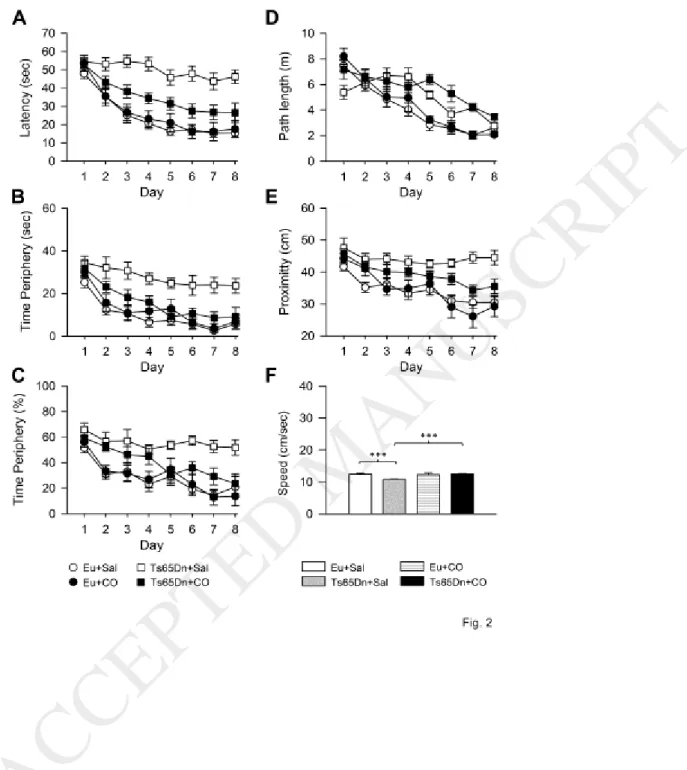
MWM test is classically used in mouse models of DS to assess hippocampus-dependent learning and memory. For the learning phase, the following variables were evaluated: escape latency, time in periphery, percentage of time in periphery, path length, proximity. We additionally evaluated the swimming speed. We carried out a three-way mixed ANOVA for all variables followed by the post hoc Fisher LSD test. Results of ANOVA are reported hereafter and results of the post hoc test are summarized in Table 1.
A three-way mixed ANOVA on escape latency, with genotype and treatment as grouping factors and day as a repeated measure revealed no effect of genotype x treatment x day. We found a genotype x day interaction [F(7,301) = 5.64, p < 0.001], a genotype x treatment interaction [F(1,43) = 10.30, p = 0.003], no treatment x day interaction, a main effect of genotype [F(1,43) = 40.65, p < 0.001], a main effect of treatment [F(1,43) = 5.49, p = 0.024], and a main effect of day [F(7,301) = 45.62, p < 0.001]. While control euploid mice exhibited a fast learning improvement with time, in control Ts65Dn mice the latency to reach the platform did not decrease as the test progressed, indicating poor learning capacity (Fig. 2A, Table 1). In contrast, Ts65Dn mice treated with corn oil showed a large learning improvement in comparison with their control counterparts, although their escape latency did not attain the values of control euploid mice (Fig. 2A, Table 1). In euploid mice treated with corn oil the latency was similar to that of control euploid mice (Fig. 2A; Table 1).
A three-way mixed ANOVA on the absolute time spent in the periphery zone (thigmotaxis), with genotype and treatment as grouping factors and day as a repeated measure revealed no effect of genotype x treatment x day. We found a genotype x day interaction [F(7,301) = 4.27, p < 0.001], a genotype x treatment interaction [F(1,43) = 10.01, p = 0.003], but no treatment x day interaction; a main effect of genotype
[F(1,43) = 21.35, p < 0.001] was also found, as was a main effect of day [F(7,301) = 60.27, p < 0.001], while there was no main effect of treatment. A post hoc Fisher LSD test showed that, while control Ts65Dn mice spent more time in the periphery zone than control euploid mice, Ts65Dn mice treated with corn oil spent a similar time there as control euploid mice, save for days 4 and 7 (Fig. 2B, Table 1), suggesting an
11
improvement in searching strategy. Euploid mice treated with corn oil showed no changes in thigmotaxis. A three-way mixed ANOVA on the percentage of time spent in the periphery zone, with genotype and treatment as grouping factors and day as a repeated measure, revealed no effect of genotype x treatment x day. We found a genotype x day interaction [F(7,301) = 2.17, p = 0.037], while neither a treatment x day interaction nor a genotype x treatment interaction were present. There was a main effect of genotype [F(1,43) = 19.93, p < 0.001], no main effect of treatment; but a main effect of day [F(7,301) = 17.84, p < 0.001]. A post hoc Fisher LSD test showed that the time that control Ts65Dn mice spent in the periphery zone,
expressed as a percentage of the total latency, was larger than that of control euploid mice (Fig. 2C, Table 1). In treated Ts65Dn mice the percentage of time in thigmotaxis underwent a reduction and on days 5-8 it was significantly reduced in comparison with their control counterparts (Fig. 2C, Table 1), suggesting an improvement in spatial learning.
A three-way mixed ANOVA on path length, with genotype and treatment as grouping factors and day as a repeated measure revealed no effect of genotype x treatment x day. We found a genotype x day interaction [F(7,301) = 8.90, p < 0.001], while there was no treatment x day interaction, or genotype x treatment interaction. A main effect of genotype [F(1,43) = 14.59, p < 0.001] was observed, while no main effect of treatment emerged. A main effect of day [F(7,301) = 47.16, p < 0.001] was present. In all groups, the path length decreased from day 4 to day 8 (Fig. 2D). A post hoc Fisher LSD test showed no differences in the path length between control and treated Ts65Dn mice or between control and treated euploid mice (Table 1).
A three-way mixed ANOVA on proximity to the trained platform position (Gallagher’s test; proximity), with genotype and treatment as grouping factors and day as a repeated measure revealed no effect of genotype x treatment x day. We found a genotype x day interaction [F(7,301) = 3.78, p = 0.001], a treatment x day interaction [F(7,301) = 4.27, p < 0.001], no genotype x treatment, a main effect of genotype [F(1,43) = 18.85, p < 0.001], no main effect of treatment, but a main effect of day [F(7,301) = 23.58, p < 0.001]. Fig. 2E shows that, while in control euploid mice the distance from the platform position decreased from day 1 to day 8, control Ts65Dn mice underwent no improvement. In contrast, treated Ts65Dn mice underwent an improvement and on days 7-8 their distance from the platform was significantly reduced in comparison with their control counterparts; on days 5-8 their distance was similar to that of control euploid
12 mice (Fig. 2E, Table 1).
A two-way ANOVA on the mean swimming speed during the 8 days of the learning phase, with genotype and treatment as grouping factors showed a genotype x treatment interaction [F(1,43) = 9.43, p = 0.004], a main effect of genotype [F(1,43) = 4.96, p = 0.031], and a main effect of treatment [F(1,43) = 6.22, p = 0.017]. A post hoc Fisher LSD test showed that in control Ts65Dn mice the swimming speed was reduced in comparison with control euploid mice. This difference disappeared in treated Ts65Dn mice (Fig. 2F).
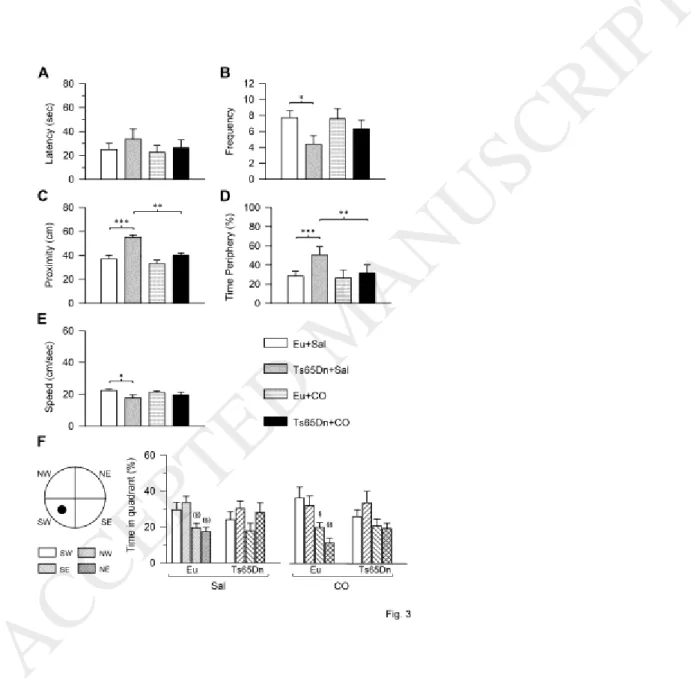
In the probe test, we considered the following parameters as an index of spatial memory: i) latency to enter the trained platform zone (latency); ii) frequency of entrances into the trained quadrant (frequency); iii) proximity to the trained platform position (Gallagher’s test; proximity); iv) percentage of time spent in the periphery zone (thigmotaxis); v) percentage of time spent in each quadrant. We additionally evaluated the swimming speed. A two-way ANOVA on the latency showed no genotype x treatment interaction, no main effect of genotype, and no main effect of treatment. A post hoc Fisher LSD test showed no significant differences between groups, although treated Ts65Dn mice underwent a latency reduction in comparison with their control counterparts (Fig. 3A). A two-way ANOVA on the frequency showed no genotype x treatment interaction, a main effect of genotype [F(1,43) = 4.55, p = 0.039] but no main effect of treatment. A post hoc Fisher LSD test showed that control Ts65Dn mice exhibited a reduced frequency of entrances in comparison with control euploid mice. In treated Ts65Dn mice there was an increase in the frequency that became similar to that of control euploid mice (Fig. 3B). A two-way ANOVA on the proximity showed no genotype x treatment interaction, while there was a main effect of genotype [F(1,43) = 18.37, p < 0.001] and a main effect of treatment [F(1,43) = 11.45, p = 0.002]. A post hoc Fisher LSD test showed that control Ts65Dn mice swam at a greater distance from the trained platform zone in comparison with control euploid mice (Fig. 3C). Treated Ts65Dn mice swam closer to the trained platform zone and their performance became similar to that of control euploid mice (Fig. 3C).
A two-way ANOVA on the percentage of time spent in the periphery zone showed no genotype x treatment interaction, no main effect of genotype, and no main effect of treatment. A post hoc Fisher LSD test showed that in control Ts65Dn mice the percentage of time spent in the periphery zone was greater than that of control euploid mice (Fig. 3D). In treated Ts65Dn mice the percentage of time spent in the periphery
13
zone was reduced in comparison with their control counterparts (Fig. 3D), suggesting restoration of the searching strategy.
A two-way ANOVA on the swimming speed showed no genotype x treatment interaction. A main effect of genotype [F(1,43) = 6.34, p = 0.016] was found, but there was no main effect of treatment. A post hoc Fisher LSD test showed that in control Ts65Dn mice swimming speed was reduced in comparison with control euploid mice. This difference disappeared in treated Ts65Dn mice (Fig. 3E).
A paired samples t-test showed that control Ts65Dn mice exhibited no differences in the time spent in the trained platform quadrant (SW) in comparison with the other quadrants (Fig. 3F). Treated Ts65Dn mice spent more time in the trained platform quadrant and in the Northwest (NW) quadrant, although these differences were not statistically significant. Control euploid mice spent marginally more time in the trained platform quadrant in comparison with the Northeast (NE) quadrant [t(16) = 2.07, p = 0.054] and the
Southeast (SE) quadrant [t(16) = 2.06, p = 0.056] (Fig. 3F). Treated euploid mice spent significantly more time in the trained platform quadrant in comparison with the SE [t(11) = 2.33, p = 0.040] and NE [t(11) = 3.38, p = 0.006] quadrants (Fig. 3F).
The CFC paradigm is a test that allows for estimation of both hippocampus-independent (cued) and hippocampus-dependent (contextual) memory (McHugh et al., 2007). A two-way ANOVA with genotype and treatment as grouping factors on the performance in the old context showed an interaction between genotype and treatment [F(1,41) = 5.42, p = 0.025] and no main effect of either genotype or treatment. A post hoc Fisher LSD test showed that control Ts56Dn mice showed a lower freezing behavior in the trained environment (old context) compared to euploid control mice (Fig. 4A), although the difference was not significant (p = 0.075). In treated Ts65Dn mice the freezing behavior significantly increased in comparison with their control counterparts (Fig. 4A),indicating improvement of memory for the context. No effect of treatment was found in euploid mice (Fig. 4A). A two-way ANOVA with genotype and treatment as factors on the performance in the cued session showed no interaction between genotype and treatment, no main effect of treatment but a main effect of genotype [F(1,43) = 5.57, p = 0.023]. A post hoc Fisher LSD test showed no difference between groups save for treated Ts65Dn mice that had a reduced freezing in comparison with control euploid mice (Fig. 4B). Freezing in the cued session is expressed as difference between the percentage of freezing during the sound (cue) delivery and the spontaneous freezing in the new
14
context. We considered of interest to establish possible differences between groups in the amount of freezing in the new context and during sound delivery, respectively. Fig. 4C shows that in the new context both treated euploid and Ts65Dn mice exhibited a higher freezing in comparison with their control counterparts, although the difference was not statistically significant. During sound delivery, while control Ts65Dn mice exhibited a lower freezing in comparison with euploid mice, this difference disappeared in treated Ts65Dn mice (Fig. 4D).
3.3. Effect of corn oil on hippocampal neurogenesis in Ts65Dn and euploid mice
Doublecortin (DCX) is a microtubule-associated phosphoprotein selectively located in the periphery of the soma with a pattern that overlaps microtubule distribution (Couillard-Despres et al., 2005). DCX is expressed in the cytoplasm of immature granule neurons during the period of neurite elongation (from one to four weeks after neuron birth), which allows evaluation of total number of new granule cells. In order to establish whether treatment with corn oil enhances neurogenesis in the hippocampal dentate gyrus, brain sections were subjected to immunohistochemistry for DCX. In agreement with the morphogenesis of the granule cell layer, DCX-positive cells were located in the innermost portion of the layer, close to the hilus (Fig. 5A). A two-way ANOVA on the number of DCX-positive cells showed no genotype x treatment interaction but a main effect of genotype [F(1,14) = 29.39, p < 0.001] and treatment [F(1,14) = 10.30, p = 0.006]. In agreement with previous evidence, control Ts65Dn mice had a reduced number of new granule cells in comparison with their euploid counterparts (Fig. 5A,B). In Ts65Dn mice treated with corn oil there was an increase in the number of new neurons in comparison with control Ts65Dn mice (Fig. 5A,B) that became similar to that of control euploid mice (Fig. 5A,B). In euploid mice treatment with corn oil did not affect the number of new granule cells (Fig. 5A,B). These results suggest that treatment with corn oil exerts a beneficial effect on hippocampal neurogenesis specifically in Ts65Dn mice.
3.4. Effect of corn oil on dendritic development in Ts65Dn and euploid mice
Dendritic morphology of newborn granule cells was analyzed in sections subjected to
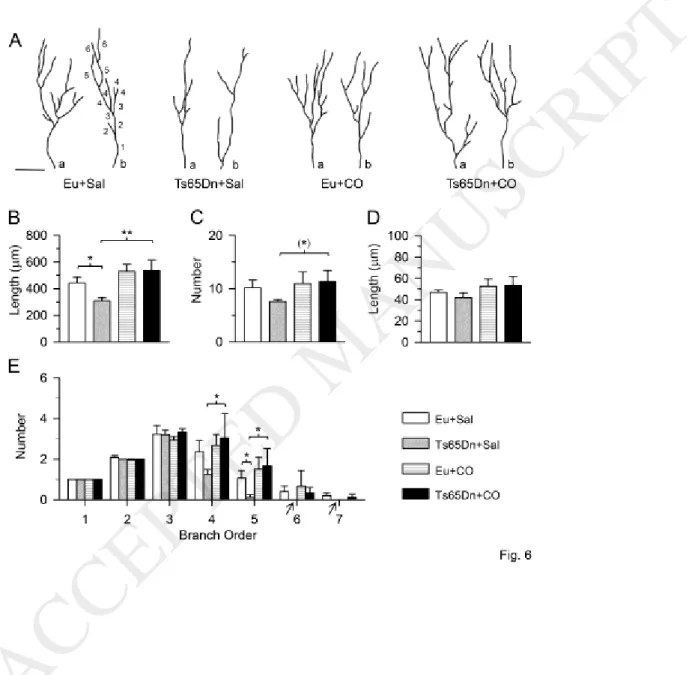
immunohistochemistry for DCX. Fig 6A shows examples of the dendritic pattern in each experimental group. It can be readily appreciated that the granule cells of control Ts65Dn mice had a poorly-branched
15
dendritic tree and that treatment with corn oil increased its complexity.
A two-way ANOVA on the total length of the dendritic tree showed no genotype x treatment interaction, no main effect of genotype, but a main effect of treatment [F(1,14) = 12.54, p = 0.003]. A post hoc Fisher LSD test showed that in control Ts65Dn mice the dendritic length was reduced in comparison with control euploid mice and that treatment with corn oil fully restored total dendritic length (Fig. 6B). A two-way ANOVA on the total number of dendritic branches showed no genotype x treatment interaction and no main effect of genotype and treatment. A post hoc Fisher LSD test showed no differences between groups, although in treated Ts65Dn mice the total number of branches was marginally larger (p = 0.06) in comparison with their control counterparts (Fig. 6C). The analysis of the number of branches of each order showed no interaction between genotype x treatment and no main effect of genotype and treatment for all orders, save for order 5 that showed a main effect of treatment [F(1,14) = 4.89, p = 0.044]. A post hoc Fisher LSD test showed no differences between groups for orders 1-3 and 6-7 (Fig. 6E). However, control Ts65Dn mice had a reduced number of branches of order 5 in comparison with control euploid mice and treated Ts65Dn mice had a larger number of branches of order 4 and 5 in comparison with control Ts65Dn mice (Fig. 6E). Importantly, while control Ts65Dn mice lacked branches of orders 6 and 7, in treated Ts65Dn mice branches of orders 6 and 7 were also present (Fig. 6E). A two-way ANOVA on the mean branch length showed no genotype x treatment interaction no main effect of genotype and no main effect of treatment. A post hoc Fisher LSD test showed no differences between groups (Fig. 6D).
3.5. Effect of linoleic acid and oleic acid on the proliferation rate of neural progenitor cells from Ts65Dn
and euploid mice
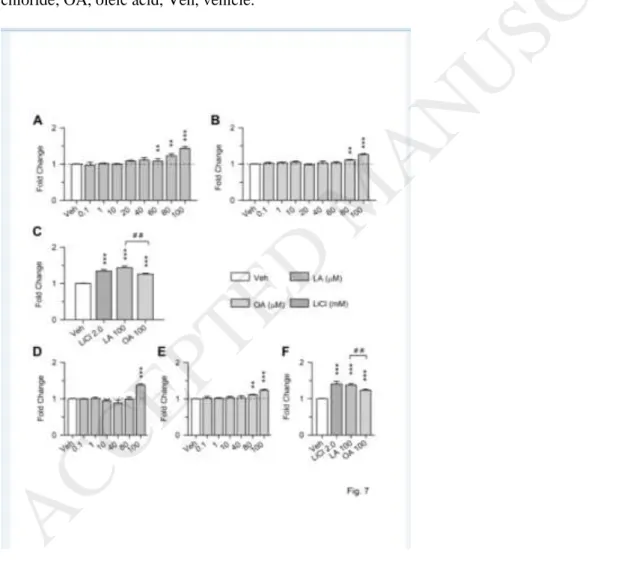
Corn oil contains a high percentage (~54%) of PUFAs, mainly represented by LA (omega-6), and a high percentage (~28%) of the MUFA OA (omega-9). In order to investigate whether the most abundant PUFA and MUFA in corn oil could directly affect neurogenesis, we used cultures of neural progenitor cells (NPCs) from the subventricular zone of Ts65Dn mice. Cultures were exposed to different concentrations of LA or OA (from 0.1 to 100.0 µM). The Kruskal-Wallis test showed a significant effect of LA on
proliferation rate [χ2
(8) = 44.43, p < 0.001]. The Mann-Whitney test showed that in cultures exposed to LA there was a proliferation increase in comparison with cultures exposed to vehicle at concentrations of 60.0
16
µM (U = 0.001, p = 0.007), 80 µM (U = 0.001, p = 0.007), and 100 µM (U = 0.001, p < 0.001) (Fig. 6A). The Kruskal-Wallis test showed a significant effect of OA on proliferation rate [χ2 (8) = 48.84, p < 0.001]. The Mann-Whitney test showed that in cultures exposed to OA there was a proliferation increase in
comparison with cultures exposed to vehicle at concentrations of 80 µM (U = 0.001, p = 0.006), and 100 µM (U = 0.001, p < 0.001) (Fig. 6B).
A comparison of the pro-proliferative effect of different concentrations of LA showed that the effect of the concentration of 60 µM was lower in comparison with the concentration of 80 µM (U = 0.000, p = 0.050) and 100 µM (U = 6.000, p = 0.044), and that there were no differences between the concentrations of 80 µM and 100 µM (Fig. 7A). A comparison of the pro-proliferative effect of different concentrations of OA showed that the concentration of 80 µM had an effect that was lower in comparison with the concentration of 100 µM (U = 2.000, p = 0.011) (Fig. 7B). A comparison of the effects of LA and OA showed that the
proliferation increase caused by LA was larger than that caused OA (U = 68.000; p = 0.003) (Fig. 7C). While LA at a concentration of 100 µM caused a 45% increase in proliferation rate in comparison with cultures exposed to vehicle, OA at a concentration of 100 µM caused a 26 % increase only. This evidence indicates that LA is a more powerful neurogenesis enhancer in comparison with OA.
Since lithium has been shown to restore proliferation of NPCs of Ts65Dn mice in vivo (Bianchi et al., 2010; Contestabile et al., 2013) and in vitro (Trazzi et al., 2014), it seemed of interest to compare the pro-proliferative effect of lithium and those of LA/OA. We used a 2.0 mM concentration of LiCl based on previous evidence showing that this concentration restores neurogenesis in trisomic NPCs (Trazzi et al., 2014). As expected, LiCl increased the proliferation of trisomic cells (+ 34 %) compared to vehicle (Fig. 7C). Since LA and OA were effective at 100 µM, they appear to be more potent enhancers of NPCs proliferation than LiCl.
We exposed euploid cultures of NPCs from the subventricular zone of euploid mice to LA and OA in order to establish their effects on euploid cells. The Kruskal-Wallis test showed a significant effect of LA on proliferation rate [χ2
(8) = 43.07, p < 0.001]. The Mann-Whitney test showed that in cultures exposed to LA there was a proliferation increase in comparison with cultures exposed to vehicle at the concentration of 100 µM (U = 0.000, p < 0.001) (Fig. 7D). The Kruskal-Wallis test showed a significant effect of OA on
proliferation rate [χ2
(8) = 40.71, p < 0.001]. The Mann-Whitney test showed that in cultures exposed to OA
17
there was a proliferation increase in comparison with cultures exposed to vehicle at concentrations of 80 µM (U = 0.000, p = 0.001), and 100 µM (U = 8.000, p < 0.001) (Fig. 7E). In euploid cultures exposed to LiCl there was an increase in proliferation (+ 41 %) compared to vehicle (Fig. 7F).
3.6. The pro-proliferative effect of linoleic acid are blocked by PPAR and PPAR antagonists
The mechanisms of action of PUFAs on neurogenesis remain elusive (Dyall, 2015), although there are suggestions of a possible role of peroxisome-proliferator activated receptors (PPARs) (Bernal et al., 2015). PPARs are a group of transcription factors that represent the best recognized nuclear sensor system for fatty acids (Fidaleo et al., 2014; Georgiadi and Kersten, 2012). There are three isotypes of PPARs, named PPARα, PPARβ/δ and PPAR (Fidaleo et al., 2014). Mouse NPCs express isotypes PPARβ/δ and PPAR only (Bernal et al., 2015). In order to investigate whether the pro-proliferative effect exerted by the most abundant corn oil PUFA, LA, could be mediated by PPARs, trisomic cells were exposed to LA 100 µM in presence of either a PPAR / antagonist (GSK0660, 0.1-30 M) or a PPAR antagonist (GW9662, 0.01-10 M). The Kruskal-Wallis test showed a significant effect of the PPAR / antagonist [χ2 (5) = 19.86, p = 0.001] and the PPAR antagonist [χ2
(4) = 33.57, p < 0.001] on proliferation. We found that both antagonists counteracted the LA-induced proliferative effects on trisomic NPCs (Fig. 8A,B). Exposure to the PPARβ/δ receptor antagonist GSK0660 caused a moderate reduction in the pro-proliferative effect of LA at all tested concentrations (0.1-30 µm), but did not completely abrogate its effect, even at the highest concentration (Fig. 8A). Exposure to the PPAR receptor antagonist GW9662 at low concentrations (0.01 µm) did not reduce the pro-proliferative effect of LA (Fig. 8B). However, exposure to higher concentrations (1, 3, and 10 µm) reduced and even abrogated the effect of LA (Fig. 8B). Taken together, these results suggested that, at least in vitro, PPAR/and PPAR contribute to the proliferative effects of LA on trisomic NPC.
4. DISCUSSION
4.1. Corn oil positively impacts on hippocampal neurogenesis in Ts65Dn mice
While neurogenesis is a process that is largely accomplished before birth, in the hippocampal dentate
18
gyrus neurogenesis persists throughout life in all examined mammals, including humans (Bayer, 1980; Eriksson et al., 1998; Guidi et al., 2011; Guidi et al., 2004; Kempermann and Gage, 2002; Ninkovic et al., 2007; Spalding et al., 2013). Hippocampal neurogenesis has been shown to be severely impaired in fetuses with DS and in mouse models of DS at early life stages (Stagni et al., 2017a) and in adulthood (Belichenko and Kleschevnikov, 2011; Clark et al., 2006; Lorenzi and Reeves, 2006; Rueda et al., 2005). A number of studies has explored the effects of different drugs on hippocampal neurogenesis and hippocampus-dependent learning and memory in mouse models of DS (Gardiner, 2015; Stagni et al., 2015). In the current study, we found that treatment with a natural substance, corn oil, leads to restoration of neurogenesis in the
hippocampus of adult Ts65Dn mice, which demonstrates for the first time that corn oil can enhance neurogenesis in DS.
While it is known that LA and OA increase cognitive performance (Jenkins et al., 2016; Moazedi et al., 2007), little evidence is available regarding the pro-neurogenic role of these fatty acids. By exploiting cultures of NPCs, we found that both LA and OA are able to increase the proliferation rate of NPCs, which suggests that both fatty acids of corn oil may potentially contribute to the neurogenesis increase observed in Ts65Dn mice treated with corn oil. The effects of LA, however, were larger than those of OA and had a magnitude that was comparable to that exerted by lithium, indicating that LA may act as a potent neurogenesis enhancer in the trisomic brain. Our in vitro results indicate that PPARand PPAR are involved in the direct effects of LA on NPCs suggesting that these receptors may contribute to the beneficial effects elicited by corn oil in trisomic mice. There is evidence that the triplicated gene Down syndrome critical region 2 (DSCR2) physically interacts with PPARβ in mammalian HEK293 cells and inhibits its ligand-induced transcriptional activity (Song et al., 2008). This suggests that this inhibition may contribute to impair neurogenesis in the DS brain and strengthens the conclusion that the positive effect of corn oil in Ts65Dn mice may be mediated by PPARs. Of course, other mechanisms and contributors cannot be ruled out.
4.2. Corn oil positively impacts on dendritic development in Ts65Dn mice
In Ts65Dn mice, newborn granule cells had a reduced total dendritic length. This confirms previous evidence that dendritic hypotrophy starts at the initial stages of granule cells development (Guidi et al., 2013)
19
and is in agreement with evidence of severe dendritic pathology in the Ts65Dn model of DS as well as in individuals with DS (Benavides-Piccione et al., 2004; Dang et al., 2014; Guidi et al., 2013). The reduction in total dendritic length was due to a reduction in the number of branches of intermediate order and a lack of high order branches, and not to a reduction in the mean branch length. In Ts65Dn mice treated with corn oil there was an increase in the number of branches of intermediate order and the de novo appearance of high order branches, with consequent restoration of total dendritic length. Neuron generation and dendritic maturation are severely compromised in DS. Thus, therapies to improve brain development should be aimed at restoring both of these processes. Current results show that corn oil restores the dendritic length of trisomic granule cells, indicating that the same treatment is able to restore not only the number of new granule neurons but also their "quality", in terms of correct maturation.
4.3. Corn oil positively impacts on hippocampus-dependent learning and memory in Ts65Dn mice
The deficits in hippocampus-dependent learning and memory in DS are attributable to reduced neurogenesis and synaptic alterations in the hippocampal formation, a region that is fundamental for declarative memory. We found that the restoration of neurogenesis and dendritic pattern of new granule neurons induced by treatment with corn oil in Ts65Dn mice was accompanied by a large improvement in hippocampus-dependent learning and memory as assessed with the MWM test. During the learning phase, the reduction in the latency to reach the platform and in the time spent in the periphery showed that a large improvement had taken place; the proximity to the trained platform quadrant was similar to that of control euploid mice, indicating restoration of this parameter. In the probe test, the frequency of entrances in the trained platform quadrant, the proximity and the time spent in the periphery, became similar to that of control euploid mice, indicating restoration of these aspects of memory. It must be noted that control Ts65Dn mice had a slightly lower swimming speed in comparison with control euploid mice (-13%). It may be argued that the longer latency to reach the platform exhibited by control Ts65Dn mice in comparison with euploid mice during the learning phase of the MWM was due to their reduced speed, and that the latency reduction in treated Ts65Dn mice was due to the treatment-induced improvement in swimming speed and not to a learning improvement. However, on day 5 of the learning phase control Ts65Dn mice had a latency that was 3 times that of euploid mice, while their speed was only reduced by 13%, suggesting that the longer latency
20
of Ts65Dn mice mainly reflects impairment of learning rather than a motor deficit. On day 5, the latency of treated Ts65Dn mice decreased by 40% in comparison with their control counterparts while swimming speed only increased by 15%, suggesting that the latency reduction was mainly due to an improvement in spatial learning and not in swimming speed. Moreover, the finding that treated Ts65Dn mice spent less time in the periphery and swam closer to the platform quadrant during the learning phase, and crossed the trained platform quadrant with increased frequency in the probe test, indicates an improvement in the searching strategy and, thus, in spatial learning.
Conflicting results are available regarding the swimming speed of Ts65Dn mice. While some reports show no swimming speed differences in comparison with euploid mice (Catuara-Solarz et al., 2015; Costa et al., 2010; Escorihuela et al., 1995; Faizi et al., 2011; Netzer et al., 2010; Stagni et al., 2017b), other studies show that Ts65Dn mice have a reduced speed (Catuara-Solarz et al., 2016; Costa et al., 1999; Heinen et al., 2012). These discrepancies may be accounted for by differences in the sex and/or age of mice and/or by the notably higher degree of variability in swimming speed that characterizes Ts65Dn mice (Costa et al., 1999).
The CFC test showed that in treated Ts65Dn mice freezing in the old context increased in
comparison with their control counterparts, suggesting improvement of context memory. During the cued session, however, treated Ts65Dn mice showed reduced freezing in comparison with control mice, which may suggest a poor association between the sound (cue) and the adverse stimulus (foot shock). Observation of Fig. 4D, however, shows that treated Ts65Dn mice demonstrated similar freezing to control euploid mice during sound delivery, suggesting no impairment in the retention of the association between sound and shock. On the other hand, treated Ts65Dn mice exhibited a higher (although not significant) level of freezing in the new context in comparison with control mice (Fig. 4C). Since freezing in the cued session is expressed as the difference between freezing during sound delivery and freezing in the new context, the reduced freezing of treated Ts65Dn in comparison with control mice during the cued session (Fig. 4B) may be due to a higher level of freezing in the new context rather than to an impairment in cue association learning.
Taken together, the current results are in agreement with a number of studies showing that Ts65Dn mice are impaired in learning and memory. In treated Ts65Dn mice, the parameters of the learning phase and probe test ameliorated in comparison with their control counterparts and some of the examined parameters became similar to those of control euploid mice. Moreover, the CFC test showed that treated Ts65Dn mice
21
remembered the context to a similar extent as did control euploid mice. The finding that treatment with corn oil largely improved or even restored hippocampus-dependent learning and memory is consistent with our finding that treatment restored hippocampal neurogenesis and dendritogenesis. The fact that treatment did not fully restore behavior may be related to the relatively low rate of neurogenesis at the examined age and, thus, to the relatively low number of new granule neurons added to the hippocampal circuits in comparison with pre-existing neurons.
4.4. Corn oil restores body weight in Ts65Dn mice
We found that after treatment with corn oil the body weight of Ts65Dn mice became similar to that of euploid mice. This effect is in agreement with evidence that in pre-term infants treated with PUFAs there is an improvement in growth and developmental scores (Fleith and Clandinin, 2005). To our knowledge, this is the first demonstration that it is possible to restore the reduced body weight of Ts65Dn mice through administration of corn oil. The effect of corn oil may be related to an improvement in metabolic processes exerted by fatty acids as well as to an increase in caloric intake. The finding that treatment increased the swimming speed of Ts65Dn mice suggests that corn oil may exert beneficial effects on the trophism of muscle cells.
We found no differences in the brain weight of five-month-old Ts65Dn mice compared to euploid mice, in contrast with our findings in younger mice (Stagni et al., 2017b). While treatment with corn oil had no effect in euploid mice, Ts65Dn mice underwent a small but significant brain weight increase. Since most of the brain neurons are born prenatally, the increase in brain weight may be related to an improvement in the composition of the neuronal membranes and/or growth of the neuronal processes.
4.5 Treatment with corn oil does not affect neurogenesis and cognitive performance in euploid mice
Unlike in Ts65Dn mice, treatment with corn oil did not increase proliferation and dendritic maturation of granule cells in the hippocampal dentate gyrus of euploid mice and did not enhance hippocampus-dependent learning and memory. Yet, exposure to LA or OA was able to increase the proliferation rate of euploid NPCs in vitro, indicating that euploid NPCs are responsive to LA and OA similarly to trisomic NPCs. Taken together these results suggest that the lack of effects of corn oil in vivo in
22
euploid mice may be due to a ceiling effect that prevents further enhancement of hippocampal development. This is consistent with previous observations that treatments that are effective in Ts65Dn mice may not have a similar efficacy in euploid mice (Corrales et al., 2014; Dang et al., 2014; Stagni et al., 2017b).
4.6. Conclusions
Nourishment with PUFAs and MUFAs has been shown to have a positive effect in various types of neurological disorders (Hussain et al., 2013). LA is the major PUFA, and OA is the major MUFA, of corn oil. Unlike OA, LA cannot be synthesized by the human body, so it must be exogenously supplied (Hussain et al., 2013). Arachidonic acid, which is a derivative of LA, has been shown to increase neurogenesis at postnatal stages when administered prenatally (Maekawa et al., 2009). Decreased levels of OA have been observed in the brain of Alzheimer’s disease patients (Martin et al., 2010) and OA supplementation has been shown to inhibit the production of Aβ peptide and amyloid plaques (Amtul et al., 2011).
We found here that corn oil restores neurogenesis and improves hippocampus-dependent memory in adult Ts65Dn mice. Treatments that ameliorate hippocampal neurogenesis in adulthood may increase the "cognitive reserve" and postpone the onset of Alzheimer’s-due dementia (Whalley et al., 2004). Although we administered corn oil intraperitoneally, our data may suggest that a diet based on an appropriate fatty acid intake may exert a benefit on cognitive performance in individuals with DS. It is conceivable that treatment with fatty acids during the critical windows of neurogenesis (prenatal and early postnatal period) may have larger effects than those observed here and may possibly lead to a full behavioral rescue.
Various studies have explored the effects of a variety of pharmacological agents on hippocampus-dependent learning and memory in adult Ts65Dn mice (see (Gardiner, 2015)). Treatments i) targeted to transmitter/receptor systems, ii) employing neuroprotective agents, antioxidants, and free radical scavengers, iii) targeted to perturbed signaling pathways, iv) aimed at normalizing the expression of proteins coded by triplicated genes and v) that have used proneurogenic molecules demonstrated that it is possible to
pharmacologically rescue or partially rescue behavioral deficits. While most of these studies show that it is possible to improve cognitive performance in a model of DS, some of the used therapies pose some caveats for human application in view of the nature of the used molecules that may potentially cause side effects. Corn oil, which is extracted from the germ of corn, contains a high percentage of fatty acids which are
23
substances that are naturally present in the human diet. The current study shows that adult treatment with corn oil restores neurogenesis, dendritic development, and learning and memory in the Ts65Dn model of DS. Thus, supplementation of fatty acids may represent a promising and safe therapy for DS with a good
translational potential in adulthood as well as at early life stages.
ACKNOWLEDGMENT
This work was supported by grants to R. B. from “Fondazione Generali e Assicurazioni Generali”, Italy and “Fondazione del Monte”, Italy. The assistance of Melissa Stott in the revision of the language and the technical assistance of Mr. Francesco Campisi and Mr. Massimo Verdosci are gratefully acknowledged.
CONFLICT OF INTEREST
The authors declare that they have no conflict of interest.
REFERENCES
Amtul, Z., Westaway, D., Cechetto, D.F., Rozmahel, R.F., 2011. Oleic acid ameliorates amyloidosis in cellular and mouse models of Alzheimer's disease. Brain Pathol 21, 321-329.
Bartesaghi, R., Guidi, S., Ciani, E., 2011. Is it possible to improve neurodevelopmental abnormalities in Down syndrome? Rev Neurosci 22, 419-455.
Bayer, S.A., 1980. Development of the hippocampal region in the rat. I. Neurogenesis examined with 3H-thymidine autoradiography. J.Comp.Neurol. 190, 87-114.
Belichenko, P.V., Kleschevnikov, A.M., 2011. Deficiency of Adult Neurogenesis in the Ts65Dn Mouse Model of Down Syndrome, in: Dey, S. (Ed.), Genetics and Etiology of Down Syndrome. InTech, Rijeka, p. Ch. 09.
Beltz, B.S., Tlusty, M.F., Benton, J.L., Sandeman, D.C., 2007. Omega-3 fatty acids upregulate adult neurogenesis. Neurosci Lett 415, 154-158.
Benavides-Piccione, R., Ballesteros-Yanez, I., de Lagran, M.M., Elston, G., Estivill, X., Fillat, C., Defelipe, J., Dierssen, M., 2004. On dendrites in Down syndrome and DS murine models: a spiny way to learn. Prog Neurobiol 74, 111-126.
Bernal, C., Araya, C., Palma, V., Bronfman, M., 2015. PPARbeta/delta and PPARgamma maintain
undifferentiated phenotypes of mouse adult neural precursor cells from the subventricular zone. Front Cell Neurosci 9, 78.
Bianchi, P., Ciani, E., Contestabile, A., Guidi, S., Bartesaghi, R., 2010. Lithium Restores Neurogenesis in the
24
Subventricular Zone of the Ts65Dn Mouse, a Model for Down Syndrome. Brain Pathol 20, 106-118. Catuara-Solarz, S., Espinosa-Carrasco, J., Erb, I., Langohr, K., Gonzalez, J.R., Notredame, C., Dierssen, M.,
2016. Combined Treatment With Environmental Enrichment and (-)-Epigallocatechin-3-Gallate Ameliorates Learning Deficits and Hippocampal Alterations in a Mouse Model of Down Syndrome. eNeuro 3.
Catuara-Solarz, S., Espinosa-Carrasco, J., Erb, I., Langohr, K., Notredame, C., Gonzalez, J.R., Dierssen, M., 2015. Principal Component Analysis of the Effects of Environmental Enrichment and (-)-epigallocatechin-3-gallate on Age-Associated Learning Deficits in a Mouse Model of Down Syndrome. Front Behav Neurosci 9, 330.
Clark, S., Schwalbe, J., Stasko, M.R., Yarowsky, P.J., Costa, A.C., 2006. Fluoxetine rescues deficient
neurogenesis in hippocampus of the Ts65Dn mouse model for Down syndrome. Exp Neurol 200, 256-261. Comery, T.A., Martone, R.L., Aschmies, S., Atchison, K.P., Diamantidis, G., Gong, X., Zhou, H., Kreft, A.F.,
Pangalos, M.N., Sonnenberg-Reines, J., Jacobsen, J.S., Marquis, K.L., 2005. Acute gamma-secretase inhibition improves contextual fear conditioning in the Tg2576 mouse model of Alzheimer's disease. J Neurosci 25, 8898-8902.
Contestabile, A., Greco, B., Ghezzi, D., Tucci, V., Benfenati, F., Gasparini, L., 2013. Lithium rescues synaptic plasticity and memory in Down syndrome mice. J Clin Invest 123, 348-361.
Corrales, A., Vidal, R., Garcia, S., Vidal, V., Martinez, P., Garcia, E., Florez, J., Sanchez-Barcelo, E.J., Martinez-Cue, C., Rueda, N., 2014. Chronic melatonin treatment rescues electrophysiological and neuromorphological deficits in a mouse model of Down syndrome. J Pineal Res 56, 51-61.
Costa, A.C., Scott-McKean, J.J., 2013. Prospects for improving brain function in individuals with down syndrome. CNS Drugs 27, 679-702.
Costa, A.C., Stasko, M.R., Schmidt, C., Davisson, M.T., 2010. Behavioral validation of the Ts65Dn mouse model for Down syndrome of a genetic background free of the retinal degeneration mutation Pde6b(rd1). Behav Brain Res 206, 52-62.
Costa, A.C., Walsh, K., Davisson, M.T., 1999. Motor dysfunction in a mouse model for Down syndrome. Physiol Behav 68, 211-220.
Coti Bertrand, P., O'Kusky, J.R., Innis, S.M., 2006. Maternal dietary (n-3) fatty acid deficiency alters neurogenesis in the embryonic rat brain. J Nutr 136, 1570-1575.
Couillard-Despres, S., Winner, B., Schaubeck, S., Aigner, R., Vroemen, M., Weidner, N., Bogdahn, U., Winkler, J., Kuhn, H.G., Aigner, L., 2005. Doublecortin expression levels in adult brain reflect neurogenesis. Eur J Neurosci 21, 1-14.
Dang, V., Medina, B., Das, D., Moghadam, S., Martin, K.J., Lin, B., Naik, P., Patel, D., Nosheny, R., Wesson Ashford, J., Salehi, A., 2014. Formoterol, a long-acting beta2 adrenergic agonist, improves cognitive function and promotes dendritic complexity in a mouse model of Down syndrome. Biol Psychiatry 75, 179-188.
Dyall, S.C., 2015. Long-chain omega-3 fatty acids and the brain: a review of the independent and shared
25 effects of EPA, DPA and DHA. Front Aging Neurosci 7, 52.
Eriksson, P.S., Perfilieva, E., Bjork-Eriksson, T., Alborn, A.M., Nordborg, C., Peterson, D.A., Gage, F.H., 1998. Neurogenesis in the adult human hippocampus. Nat Med 4, 1313-1317.
Escorihuela, R.M., Fernandez-Teruel, A., Vallina, I.F., Baamonde, C., Lumbreras, M.A., Dierssen, M., Tobena, A., Florez, J., 1995. A behavioral assessment of Ts65Dn mice: a putative Down syndrome model. Neurosci Lett 199, 143-146.
Faizi, M., Bader, P.L., Tun, C., Encarnacion, A., Kleschevnikov, A., Belichenko, P., Saw, N., Priestley, M., Tsien, R.W., Mobley, W.C., Shamloo, M., 2011. Comprehensive behavioral phenotyping of Ts65Dn mouse model of Down syndrome: activation of beta1-adrenergic receptor by xamoterol as a potential cognitive enhancer. Neurobiol Dis 43, 397-413.
Fidaleo, M., Fanelli, F., Ceru, M.P., Moreno, S., 2014. Neuroprotective properties of peroxisome proliferator-activated receptor alpha (PPARalpha) and its lipid ligands. Curr Med Chem 21, 2803-2821.
Fleith, M., Clandinin, M.T., 2005. Dietary PUFA for preterm and term infants: review of clinical studies. Crit Rev Food Sci Nutr 45, 205-229.
Gardiner, K.J., 2015. Pharmacological approaches to improving cognitive function in Down syndrome: current status and considerations. Drug Des Devel Ther 9, 103-125.
Georgiadi, A., Kersten, S., 2012. Mechanisms of gene regulation by fatty acids. Adv Nutr 3, 127-134. Gordon, N., 1997. Nutrition and cognitive function. Brain Dev 19, 165-170.
Guidi, S., Bianchi, P., Alstrup, A.K., Henningsen, K., Smith, D.F., Bartesaghi, R., 2011. Postnatal
neurogenesis in the hippocampal dentate gyrus and subventricular zone of the Gottingen minipig. Brain Res Bull 85, 169-179.
Guidi, S., Ciani, E., Severi, S., Contestabile, A., Bartesaghi, R., 2004. Postnatal neurogenesis in the dentate gyrus of the guinea pig. Hippocampus.
Guidi, S., Stagni, F., Bianchi, P., Ciani, E., Ragazzi, E., Trazzi, S., Grossi, G., Mangano, C., Calza, L., Bartesaghi, R., 2013. Early pharmacotherapy with fluoxetine rescues dendritic pathology in the Ts65Dn mouse model of Down syndrome. Brain Pathol 23, 129-143.
Hartley, D., Blumenthal, T., Carrillo, M., DiPaolo, G., Esralew, L., Gardiner, K., Granholm, A.-C., Iqbal, K., Krams, M., Lemere, C., Lott, I., Mobley, W., Ness, S., Nixon, R., Potter, H., Reeves, R., Sabbagh, M., Silverman, W., Tycko, B., Whitten, M., Wisniewski, T., 2015. Down syndrome and Alzheimer's disease: Common pathways, common goals. Alzheimers Dement 11, 700-709.
Haydar, T.F., Reeves, R.H., 2012. Trisomy 21 and early brain development. Trends Neurosci 35, 81-91. Heinen, M., Hettich, M.M., Ryan, D.P., Schnell, S., Paesler, K., Ehninger, D., 2012. Adult-onset fluoxetine
treatment does not improve behavioral impairments and may have adverse effects on the Ts65Dn mouse model of Down syndrome. Neural Plast 2012, 467251.
Hussain, G., Schmitt, F., Loeffler, J.P., Gonzalez de Aguilar, J.L., 2013. Fatting the brain: a brief of recent research. Front Cell Neurosci 7, 144.
Jenkins, N.D., Housh, T.J., Miramonti, A.A., McKay, B.D., Yeo, N.M., Smith, C.M., Hill, E.C., Cochrane,
26
K.C., Cramer, J.T., 2016. Effects of rumenic acid rich conjugated linoleic acid supplementation on cognitive function and handgrip performance in older men and women. Exp Gerontol.
Kang, J.X., Wan, J.-B., He, C., 2014. Concise review: Regulation of stem cell proliferation and differentiation by essential fatty acids and their metabolites. Stem cells (Dayton, Ohio) 32, 1092-1098.
Kempermann, G., Gage, F.H., 2002. Genetic influence on phenotypic differentiation in adult hippocampal neurogenesis. Brain Res Dev Brain Res 134, 1-12.
Lorenzi, H.A., Reeves, R.H., 2006. Hippocampal hypocellularity in the Ts65Dn mouse originates early in development. Brain Res 1104, 153-159.
Maekawa, M., Takashima, N., Matsumata, M., Ikegami, S., Kontani, M., Hara, Y., Kawashima, H., Owada, Y., Kiso, Y., Yoshikawa, T., Inokuchi, K., Osumi, N., 2009. Arachidonic acid drives postnatal
neurogenesis and elicits a beneficial effect on prepulse inhibition, a biological trait of psychiatric illnesses. PLoS One 4, e5085.
Martin, V., Fabelo, N., Santpere, G., Puig, B., Marin, R., Ferrer, I., Diaz, M., 2010. Lipid alterations in lipid rafts from Alzheimer's disease human brain cortex. J Alzheimers Dis 19, 489-502.
McHugh, T.J., Jones, M.W., Quinn, J.J., Balthasar, N., Coppari, R., Elmquist, J.K., Lowell, B.B., Fanselow, M.S., Wilson, M.A., Tonegawa, S., 2007. Dentate gyrus NMDA receptors mediate rapid pattern
separation in the hippocampal network. Science 317, 94-99.
Meneghini, V., Cuccurazzu, B., Bortolotto, V., Ramazzotti, V., Ubezio, F., Tzschentke, T.M., Canonico, P.L., Grilli, M., 2014. The noradrenergic component in tapentadol action counteracts mu-opioid receptor-mediated adverse effects on adult neurogenesis. Mol Pharmacol 85, 658-670.
Moazedi, A.A., Hossienzadeh, Z., Chinpardaz, R., 2007. The effects of coadministration palmitic acid and oleic acid (omega 9) on spatial learning and motor activity in adult male rat. Pak J Biol Sci 10, 3650-3655. Netzer, W.J., Powell, C., Nong, Y., Blundell, J., Wong, L., Duff, K., Flajolet, M., Greengard, P., 2010.
Lowering beta-amyloid levels rescues learning and memory in a Down syndrome mouse model. PLoS One 5, e10943.
Ninkovic, J., Mori, T., Gotz, M., 2007. Distinct modes of neuron addition in adult mouse neurogenesis. J Neurosci 27, 10906-10911.
O'Brien, J.S., Sampson, E.L., 1965. Fatty acid and fatty aldehyde composition of the major brain lipids in normal human gray matter, white matter, and myelin. Journal of Lipid Research 6, 545-551.
Polo-Hernandez, E., De Castro, F., Garcia-Garcia, A.G., Tabernero, A., Medina, J.M., 2010. Oleic acid synthesized in the periventricular zone promotes axonogenesis in the striatum during brain development. J Neurochem 114, 1756-1766.
Reinholdt, L.G., Ding, Y., Gilbert, G.J., Czechanski, A., Solzak, J.P., Roper, R.J., Johnson, M.T., Donahue, L.R., Lutz, C., Davisson, M.T., 2011. Molecular characterization of the translocation breakpoints in the Down syndrome mouse model Ts65Dn. Mamm Genome 22, 685-691.
Rodriguez-Rodriguez, R.A., Tabernero, A., Velasco, A., Lavado, E.M., Medina, J.M., 2004. The neurotrophic effect of oleic acid includes dendritic differentiation and the expression of the neuronal basic
27
helix transcription factor NeuroD2. J Neurochem 88, 1041-1051.
Rueda, N., Mostany, R., Pazos, A., Florez, J., Martinez-Cue, C., 2005. Cell proliferation is reduced in the dentate gyrus of aged but not young Ts65Dn mice, a model of Down syndrome. Neurosci Lett 380, 197-201.
Sakayori, N., Maekawa, M., Numayama-Tsuruta, K., Katura, T., Moriya, T., Osumi, N., 2011. Distinctive effects of arachidonic acid and docosahexaenoic acid on neural stem /progenitor cells. Genes Cells 16, 778-790.
Song, H.J., Park, J., Seo, S.R., Kim, J., Paik, S.R., Chung, K.C., 2008. Down syndrome critical region 2 protein inhibits the transcriptional activity of peroxisome proliferator-activated receptor beta in HEK293 cells. Biochem Biophys Res Commun 376, 478-482.
Spalding, K.L., Bergmann, O., Alkass, K., Bernard, S., Salehpour, M., Huttner, H.B., Bostrom, E.,
Westerlund, I., Vial, C., Buchholz, B.A., Possnert, G., Mash, D.C., Druid, H., Frisen, J., 2013. Dynamics of hippocampal neurogenesis in adult humans. Cell 153, 1219-1227.
Stagni, F., Giacomini, A., Emili, M., Guidi, S., Bartesaghi, R., 2017a. Neurogenesis impairment: An early developmental defect in Down syndrome. Free Radic Biol Med.
Stagni, F., Giacomini, A., Guidi, S., Ciani, E., Bartesaghi, R., 2015. Timing of therapies for Down syndrome: the sooner, the better. Front Behav Neurosci 9, 265.
Stagni, F., Giacomini, A., Guidi, S., Emili, M., Uguagliati, B., Salvalai, M.E., Bortolotto, V., Grilli, M., Rimondini, R., Bartesaghi, R., 2017b. A flavonoid agonist of the TrkB receptor for BDNF improves hippocampal neurogenesis and hippocampus-dependent memory in the Ts65Dn mouse model of DS. Exp Neurol 298, 79-96.
Tang, M., Zhang, M., Cai, H., Li, H., Jiang, P., Dang, R., Liu, Y., He, X., Xue, Y., Cao, L., Wu, Y., 2016. Maternal diet of polyunsaturated fatty acid altered the cell proliferation in the dentate gyrus of
hippocampus and influenced glutamatergic and serotoninergic systems of neonatal female rats. Lipids Health Dis 15, 71.
Tokuda, H., Kontani, M., Kawashima, H., Kiso, Y., Shibata, H., Osumi, N., 2014. Differential effect of arachidonic acid and docosahexaenoic acid on age-related decreases in hippocampal neurogenesis. Neurosci Res 88, 58-66.
Trazzi, S., Fuchs, C., De Franceschi, M., Mitrugno, V., Bartesaghi, R., Ciani, E., 2014. APP-dependent alteration of GSK3ß activity impairs neurogenesis in the Ts65Dn mouse model of Down syndrome. Neurobiol Dis doi: 10.1016/j.nbd.2014.03.003. [Epub ahead of print].
28 cognitive aging. Ageing Res Rev 3, 369-382.
FIGURE LEGENDS
Fig. 1. Effect of treatment with corn oil on the body and brain weight.
A-C: Body weight before treatment (A) and body (B) and brain (C) weight after treatment (mean SE) in grams of control euploid mice (n=17), control Ts65Dn mice (n=8), treated euploid mice (n=12) and treated Ts65Dn mice (n=10). * p < 0.05; ** p < 0.01; *** p < 0.001 (Fisher LSD test after two-way ANOVA).
29 Abbreviation: CO, corn oil; Eu, euploid; Sal, saline.