
Germination of Tabebuia heterophylla seeds (Bignoniaceae) from a wet and dry forest of Puerto Rico
8
0
0
Texto completo
(2) REVISTA DE BIOLOGIA TROPICAL. 80. Britton. site during Juiy 199 1. The length and width of. (Bignoniac.eae) is no exception (Longwood 197 1, Gentry 1990). In Puerto Rico, vegetative variations of T. heterophy//a seem. glcm2), fruit length, number of developed. Tabebuia. to. be. (De).. heterophylla. correlated. with. the. amount. the largest leaflet, specific leaf weight (SLW, seeds per fruit, and seed and seed plus wing. of. width were measured. Data on fruit length,. precipitation, which defines a strong north-. number of seed per fruit, and seed weight. south gradient across the island the seed germination of two T.. taken from collected fruits of at least. We studied. heterophy/la. populations when subjected to a gradient of water potentials. morphological. (calculated from the weight of. 25 seeds) were 18 trees. during late May 1992.. We also present some. traits. two. Germination experiment: A pooled sample. contrasting subtropical forests where this tree. related. to. the. of seeds was obtained from available dry fruits. species occurs. T.. arbitrarily collected in June. heterophy/la is a shrub or 20 m in height. It flowers. secondary tree up to mainly. in. early. spring. and. sporadically. through the year (Little and Wadsworth The natural range of T. Hispaniola,. Puerto. 1989).. heterophylla includes. Rico,. Virgin. Islands. through the Lesser Antilles to Grenada and Barbados.. In Puerto Rico, it grows from sea. level to approximately. 1000 m (Longwood. were eliminated from the samples. Seeds were treated with solutions of polyethylene-glycol (pEG, molar mass. 6000, Sigma Co.), with -0.3, -0.5, -0.7, -0.9, -1.2 and -1.5 MPa, at 23 C, following the. osmotic potential of -0.1, procedures. and. conditions. put on Petri dishes with. MATERIAL AND METHODS. Guánica.. El. Verde. in. the. 10-15 mI of PEG. solutions or distilled water (e.g. control), and. Seeds were collected from El Verde and Luquillo. maintained on atable under laboratory conditions (25 C ambient temperature and a Treatments were. 50% relative humidity).. Puerto. replicated four times. Seed germination was. 65°49'W, 18°20'N) has a mean annual 3920 mm. The forest is in the. solutions were renewed every eight days, as. Experimental. Forest. (northeastem. precipitation of. subtropical wet forest life zone (Ewel and Whitmore. 1973), and the soil water content is. maintained during most of the year. Guánica Commonwealth Forest and Biosphere Reserve in the southwestem part of Puerto Rico. (65°52'W, 17°52'N) presents a subtropical dry forest life zone (Ewel and Whitmore 1973). Soil moisture deficits can occur 10 months a year, and a strong dry season commonly exists from January to May (Lugo et al. 1978). Rainfall varies among 600 to 1100 mm annually (Ewel and Whitmore 1973), but there are two well-defined rainfall peaks in April and September (Lugo, term. previously. considered (Cordero and Di Stéfano 1991, and references there in). Twenty-five seeds were. 1971).. Rico,. 1991 from 16. trees at each forest. Small and damaged seeds. precipitation. el al. 1978).. patterns. show. Long strong. unpredictability in annual precipitation and its. recorded every. day. during. 28 days. PEG. well as the control. Number of days for initial germination. was recorded,. germination. percentages. and. were. the. final. calculated.. Viability of seeds (tetrazolium test) collected during May. 1995 was not different to the seed. germination in destilled water under the same conditions as aboye, but a little higher than the. 1991 seeds.. Statistical analyses:. Morphological traits. were compared using the non parametric Rank Sum Test of the Statistix Program, due to non homogeneity of variances in some of the compared. characters.. The. regression. coefficients between fruit length and seed number. were. compared. for. the. two. distribution in Guánica (Medina and Cuevas. popuiations using a modified Student "t" test.. 1990). Morphological measurements: The plant. Final. material was collected from ten trees at each. the statistical analysis.. germination. percentages. were. normalized with the arcsine transformation for Two ways ANOVA.
(3) R.A. Cordero & B. Molano-Flores: Gerrnination of Tabebuia heterophylla seeds (Bignoniaceae). with seed souree (populations) and treatments (osmotie solutions) as factors was performed as suggested by Scott � al. (1984). Baektransformed values are reported. The same analysis was performed for the days to initial germination, eliminating those treatments where no germination occurred. Mean differences between treatments were eompared by using the Tukey test. Statistical differences were considered significant at P<O.05. RESULTS. Morphological traits: Leaf morphology showed strong differences among populations (Table 1). Leaflet dimensions were larger and specifie leaf weights were lower at El Verde population, indicating bigger and thinner leaves in the wet foresto A.tendency to reduce the number of leaflets (such as producing simple leaves) is remarkable in the Guánica TABLE. 81. trees. Strong differences in fruit and seed variables were obtained among populations. El Verde fruits were larger than Guánica fruits. Seed size at El Verde was twice larger than Guánica. Also, significant differenees were found on seed width and seed plus wing's width (Table 1). Guánica seeds were four times lighter than El Verde seeds (Rank Sum test, P<O.OOI). In general, seed traits were less variable in the fruits from the dry forest trees. On the fruits collected in 1991, mean number of seeds per fruit from Guánica population was slight1y greater than ones in the El Verde population. This tendency ehanged for 1992 fruits, but differences among populations were not significant in any of the two years. . The relationship and its regression slope between fruit length and number of seeds per fruit (Fig.l) were different among populations (p<O.OOI).. 1. Mean and standar error (SE) o[ some morphological traits measured on adult T. hc:terophylla treesfrom a wet [orest (El Verde) and a dry [orest (Guánica) in PuertoRico.. Wetforest Mean. SE. Dryforest ,r. Mean. SE. ,r. pi. 30. 3.45. 0.15. 38. **. Leaflet lenglh (an). 14.14 0.58. Leaflet width (an). 5.69. 0.192. 30. 1.51. 0.075. 38. **. Leaflet area (an2 ). 55.52. 4.56. 30. 5.51. 0.45. 26. **. Specific leafweigbt <EJan2). 95.11. 1.86. 30. 104.6. 2.24. 26. *. Froit lenglh 1991 (an). 19.17. 0.79. 27. 9.26. 0.38. 30. .**. Froit lenglh 1992 (an). 15.35. 0.67. 32. 9.33. 0.3 i. 30. **. Seeds per hit 1991. 68.2. 9.29. 10. 74.53. 3.56. 30. NS2. Seeds pec ftuit 1992. 79.4. 5.9. 32. 71.6. 2.63. 30. NS2. Seed + wingl (an). 2.73. 0.05. 40. 1.85. 0.04. 40. **. Seed width (an). 1.21. 0.02. 40. 0.633. 0.07. 40. **. Seed weigbt 1992 (g). 0.0174. 3.7E-4. 36. 4.0E-3. 4.3E-4. 30. *-. pl: indicates significant difference between means using SumRank Test �: no significant. P > 0.05. (*) P < 0.01. and (**) P< 0.001. nJ: sample size..
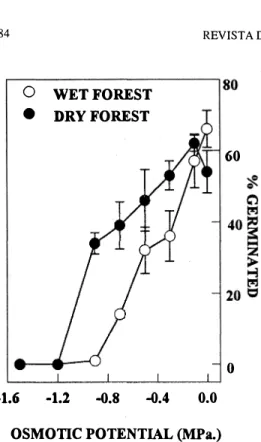
(4) REVISTA DE BIOLOGIA TROPICAL. 82. TABLE. 2. Number of days for initiation of germination of T. heterophylla seeds under several osmotic water potentials treatments. Seeds came from a wet forest (El Verde) and a the dry forest (Guánica) ofPuerto Rico. Four replications per treatment. Statistical analysis explained in the texto No germination occurs in sorne treatments. Wetforest. Dryforest. Treatment. Mean. s.E... Mean. s.E... Control. 5.50a. 0.86. 2.25a. 0.25. -0.1 MPa. 5.50ab. 0.96. 3.75ab. 0.63. -0.3. 4.50ab. 0.75. 4.75bc. 0.48. -0.5. 7.00ab. 0.91. 5.00bc. 0.41. -0.7. 11.0b. 1.22. 7.00c. 0.41. -0.9. 15. 6.00bc. 0.71. -1.2. 15. -1.5 *SE, mean standard error. Different letter indicates significant differences between rneans of the Tukey test at 0.05 leve/... Germination experiment: A two-way ANOVA for the days to germination showed significant differences due to the osmotic potential treatments(p<O.OOl, Table 2). A marginal population effect (p<O.059), and a non significant interaction (P<O.201) were obtained. Due to tbis, a separate one way ANOVA was done for each population, wbich reveled a, strong treatment effect on seeds from both El' Verde (P<O.OOI) and Guánica (p<O.OOO l). In general, adelay in the time for initiation,of germination on El Verde seeds was observed. In addition, lower variation in this parameter in the Gmínica seeds indicates an even germination in every treatment (Table 2). Seeds froro El Verde were less able to germinate under low water potentials, producing a delayed germination with an increased variance among treatments (Fig. 2). At the end of the 28 days' germination period, seeds from the dry forest showed fewer differences in the total germination percentage among osmotic treatments tban those from the wet forest (Fig. 2). The osmotic stress on T. heterophy/la seeds (see Fig. 2) produced a significant reduction in final germination. percentage as osmotic potential decreased (two way ANOVA, treatment effect, p<O.OOO1). This response occurred in both seed provenances (population effect, p<O.OOOI).. 150 o. S 125. WETFOREST. •. �. �100 = � � ¡¡¡.. 75. � =. 50. >;J z. 25. I'-l. O �. �. O. o O. 5. 10 15 20 25. FRUIT LENGTH (cm) Flg. 1. Fruit length versus seed number linear regression analysis of T. heterophylla fruits from Guánica dry forest (filled circles) and from tbe El Verde wet forest (open. circles) from Puerto Rico..
(5) R.A. Cordero & B. Molano-Flores: Gennination of Tabebuia heterophylla seeds (Bignoniaceae). WETFOREST. "'"'. '#. '-'. DRYFOREST. 75. �..... I. MPa. 75. -0.1. 45. 60 45. 30. -0.3 -0.5. JO. j. 15. -0.7. 15. t;;¡. O. 4). O. �. �. MPa -0.1 0.0 -0.3 -0.5 -0.7 -0.9. 0.0. 60. �. 83. fi-;. � U. O. 10. 20. JO. 10. O. 30. 20. DAYS AFTER SOWING Flg. 2. Cumulative gennination curves for two populations of Tabebuia heterophylla seeds under a gradient of osmotic solutions ofPEG. Error bars indicates tIte greater standard error offour replications. Treatments at -1.2 and -1.5 MPa completely inhibited gennination.. An interaction effecf (P<O.OOO) indicated. that plastic response to treatments. by seed. origins occurs in a different degree for each. population (Hg. 3). Osmotic potentials aboye. -0.1. MPa. produces. similar. germination. percentage in El Verde and Guánica seed popuiations.. Osmotic potentials below. -0.9. MPa completely inhibited seed germination in both populations (Fig. 3).. species.. 1t has been postulated that. seed. Tbis is supported. by the fact that in many. species, seed variation is lower than other. plant traits. (Harper 1977). However, we found seed dimensions and weight. differences in. among populations of T.. heterophylla, as. it. has been reported in other species (Melzack. and. Watts. paniculatum,. In. 1982).. Desmodium. within plant variability in seed. size is reduced under limited nutrients. DISCUSSION. size. is a trait normally under strong selection.. 1986).. (Wulff. In addition, maternal environment. Morphological traits: There was a significant. influenced seed size. reproductive) morphological variables among. no differences in the number of seeds per fruit. presented smaller values in a11 size traits, and. more and small seeds per fruit when small. difference in eight out of nine (leaf and. wet and. dry forest trees.. Dry forest trees. a greater specific leaf weight.. Tbis response. was expected due to the strong effect on cell. enlargement and division. during plant growth. of water. stress. (Bradford and Hsiao. 1982). AIso, phosphorus limitation and other dry forest (Lugo and Murphy 1986), could be interacting with low soil moisture availability (Lugo el al. 1978; Medina el al. 1990) for determining soíl characteristics at Guánica. foliar sclerophylly and reduced sizes on this. WulfI. (Gutterman 1980-81, 1986). On the other hand, there were. among populations, but. dry forest fruits bave. fruits are compared (Fig. 1).. These results. suggest a compromise among seed quality. (size, seed resources) and seed number.. We. think tbat in a very unpredictable environment. (like tbis dry forest) (Medina and Cuevas 1990), where environmental stresses could restrict seed quality (size) and its variation,. selection. might. dispersa} chance. favors. for. augmenting. by increasing the number of. less expensive propagules..
(6) 84. REVISTA DE BIOLOGIA TROPICAL. ,------, 80 O WETFOREST •. DRYFOREST 60. o -1.6. -1.2. -0.8. -0.4. 0.0. OSMOTIC POTENTIAL (MPa.) Fig.. 3. Relationship bttwem osmotic potential of germination treatment and tbe final germination p=tage of T. heterophylla seros. Two populations were studied: Guánica dry forest (filled circ\es) and El Verde wet forest (open circ\es).. Seed Germination: The arrested germination produced as the osmotic potential decreases is well k:nown from cultivated plants (Bodsworth and Bewley 1981), and in tropical tree species (Cordero and Di Stéfano 1991). This kind of response might be selected in areas with sporadic rains and great variation of quantity of rain (Gutterman 1980/81). Our results could also be due to the physics of water imbibition as affected by seed size, but the general appearance of seeds indicated that they were well imbibed, which suggested that radicle growth was the arrested process, and not the seed imbibition. The most relevant result from this study líes on the differences in response among dry and wet forest Tabebuia tree seeds . This confers an ecological irnportance to the ability of seeds to germinate under moisture stresses, as the one adduced to the habitat distribution oftwo Quercus species (Vuillernin 1982), and to sorne populations of Pinus (Falusi et al. 1983).. Several factors probably reduce soil water potentials at Guánica. This dry forest presents shallow soils with (requent limestone outcropping, where rain water rapidly percolates, runs off. or evaporates (Lugo et al. 1978). Then, biophysical properties of soil, high temperature and rapid use of available soil water by plants could favor the rnaintenance of reduced low soil water potentials, especially during dry to wet season transition, when deciduous species are resprouting and increasing the water absorption again. We consider that the higher germination rate of srnall seeds may confer advantages in both greater imbibition and seedling survival under low water potentials, helping to maintain the population under reduced moisture availability. In sorne species, seedling survival is also greater for plants from small seeds under short-term drought (Wulff 1986, Hendrix and Trapp 1992). Under that situation, we hypothesize that the irregular and unpredictable rainfall pattern during the dry to wet season transition in the dry forest of Guánica (Medina and Cuevas 1990), produce a preconditioning effect of the germination response of seeds. Enhanced and faster germination after preconditioning treatrnents has been obtained for a tropical tree (Cordero and Di Stéfano 1991) and others cultivated plants (Bodsworth and Bewley 1981). Also, this preconditioning effect could explain the absence of differences in germination and seedling survival to watering regimes found in other studies (Blain and Kellman 1991). This rnechanism would be irrelevant in wet forests where less if any soil rnoisture deficít occurs. In ecological terms, it is predicted that preconditioned seeds will have a more homogeneous germination and emergence through the dry to wet season transltlon. Thus, the differences in physiological phenotypic plasticity of both seed populations and their environmental1y correlated morphological traits in the natural populations are in concordance with the ability of T. heterophylla to survive and rnaintain viable populations in these two contrasting subtropical forests. Plant.
(7) R.A. Cordero & B. Molano-Flores: Gennination of Tabebuia heterophylla seeds (Bignoniaceae). demography, seed size variation among populations and its maternal effects and the extent to which these variations will affect seedling traits in longer periods would produce different results (Hendrix and Trapp 1992). RESUMEN. El efecto de la tensión hídrica sobre la germinación de las semillas de Tabebuia heterophy/la (Bignoniaceae), procedentes de un bosque seco y otro muy húmedo en Puerto Rico, se estudió utilizando un gradiente de potenciales osmóticos (O a -1.5 Mpa). Algunas comparaciones moñológicas fueron hechas de individuos adultos de ambas poblaciones. Los árboles del bosque seco presentaron hojas, frutos. y semillas más pequeñas y el peso foliar específico fue mayor. Los frutos del bosque seco contenían mayor cantidad de semillas más pequeñas que los frutos de tamaño similar de árboles del bosque muy húmedo. El porcentaje de germinación se redujo drásticamente conforme el . potencial osmótico fue más negativo en ambas poblaciones, aunque fue más acentuado en las semillas del bosque húmedo. El número de días para el inicio de la germinación. presentó la misma respuesta, pero ésta fue menos marcada en las semillas de árboles del bosque seco La germinación fue inhIbida completamente a potenciales osmóticos menores que -0.9 MPa, Y no fue diferente entre los potenciales osmóticos. más altos, en ambas poblacionesrespetivamente. Estos efectos sobre la germinación junto con las modificaciones moñológico-ambientales parecen capacitar a esta especie a mantener poblaciones viables en estos ambientes tan contrastantes. .. .. ACKNOWLEDGMENTS. Criticisms and English corrections on :final manuscripts by the faculty and friends at UPR are great1y appreciated, especially A Montana and S. Ward This study was partially supported by RIMI NSF grant RII-8903827, a summer stipent to RAe from the Terrestrial. 8S. Ecology Division, UPR and tbe facilities of tbe Dept. ofBiology. UPR. REFERENCES Abrams, M.O., B.O. KIoeppel & M.E. Kubiske. 1992. Ecopbysiological and morphological responses to shade and drought in two contrasting ecotypes of Prunus serotina. Treé Physio!. 10:343-355. Ang:¡purger, C. K 1979. Irregular rain cues and the germination and survival of a Panamanian shrub (Hybanthus pruniifolius). Oecologiá 44:53-59. Blain, D. & M Kellman. 1991. Tbe effelt of water supply on tree seed germination and seedling survival in a tropical seasonal f orest. in Veraauz, Méxioo. J. Trql. Eoo!. 7:69-83 Bodsworth, S. & J.D. Bewley. 1981. Osmotic priming of. seeds of aop species with polydhylcne glyool as a mesn. of enhancing early and syndJronous germination at 0001. temperatures. Can. J. Bot. 59:672-676.. Bradford, KJ. & T. C. Hsiao. 1982. Physiological. responses to mocIa-ate water stress. p:227-265. In: Lange, 0.1... � !l. (eds.) Physiologicsl Plant Eoology n Water relations and carbon assimilation. Encyclopedia of Plant Physiology, New Series, Vol 12B. Springer-Verlag.. Berlin.. Cordero; R.A. & J.F. Di Stéfano. 1991. Efec:to del estrés osmótioo sobre la germinaciÓll de las semillas de Tecoma stans (1...) H.B. K (Bignoniacese). Rev. Biol. Trql. 39:107-110.. Ewel, J. J. & J.1... Whitmore. 1973. Tbe eoologicsl life zones of Puerto Rioo and the Virgin Islands. U.S. For. Secv. Res. Papo ITF-18. Institute of Trqlical Forestry, Rio Piedras, Puerto Rioo. 72 p. Falusi, M, R. Calamasi & A Tocci. 1983. Sensitivity of seed germination on seedling root growth to moisture stress in f our provcnances of Pinus halapensis Mill. Silvae Genetica 32:4-9. _. GarwOOd, N. C. 1986.. Cónstraints on the timing of seed germination in a tropical f orest. pp:347-355. IN: Estrada, A & T. H. Fleming. (eds.) Frugivores and seed dispersa!. Dr. W. Junk Publisbers. Dordrecht.. Gartty, AH. 1990. Evolutionary pattems in Neotropical Bignoniacese. Me.m. New York Bot. Garden 55:118129.. Guttennan, Y. 1980\81. Intlucnces on seed germinability: phcnotypic maternal effeás during seed maturation. Israel J. Bot. 29:105-117. Harper, J. L. 1977. Population biology of plants. Academic, New York. 892 p. Hcndrix, S.D. & E. J. Trapp. 1992. Population demography of Pastinaca sativa (Apiacese): Effeás of seed size QP.
(8) 86. REVISTA DE BIOLOGIA TROPICAL. emergence. survival. and recruitment. Amer. J. Bot. 79:365-375. Little. E.L. lr. & F.H. Wadsworth. 1989. Common trees of Puerto Rico and the Virgin Islands. 2nd. ed. Agric. Handbook No. 249. U.S. Dept. Agric., Forest Service. Washington D.C . 556p.. Longwood, F.R. 1971. Present and potwtial commercial. timbers ofthe Caribbean. Agric. 2nd ed. Handbook No. 207. US Dept. Agric., For. Servo Washington D . C. 167p. Lugo, AE., lA González, B. CintrÓll & K Dugger. 1978. Structure, productivity, and transpiration of a subtropical dry forest in Puerto Rico. Biotropica 10:278-291.. Lugo, AE. & P.O. Murphy. 1986. Nutrient dynamics of a Puerto Rican subtropical dry foresto J. Trop. Eco\. 2:5572. Medina, E.V. 1983. Adaptations oftropical trees to moisture stress. p. X-X IN: F.B. Golley (ed.) Ecosystems ofthe world: tropical rain fores!., struc.ture, and fimction. Elsevier, Amsterdam, Holland.. Medina, E.V. & E. Cuevas. 1990. Propiedades fotosintéticas y eficiencia de uso de agua de plantas leñosas del bosque deciduo de Guánica: Consideraciones generales y resuhados preliminares. Acta Científica 4(1-3):2536. Medina, E., V. Garcia & E. Cuevas. 1990. Sclerophylly and oligotrophyc environments: relationship báween leaf. structure, nineral nutrient content, and drought resistance in tropical rain forests ofthe Upper Río Negro Region. Biotropica 22:51-64 Melzack, R.N. & D. Watts . 1982. Variation in seed weight, gerrnination and seedling vigor in the yew (Taxus baccata L) in England. l. ofBiogeogr. 9:55 Schlichting, C D. 1986. The evolution of phenotypic plasticity in plants. Ann. Rev. Eco\. & Syst. 17:667693. .. Scott, S. J., RA Jones & WA WiIliams. 1984. Review of data analysis mt'thods for seed gerrnination. Crop Sci. 24:1192- 1199. Sobrado, MA & O. Cuenca. 1979. Aspectos del uso del agua de especies deciduas y siempreverdes en 1m bosque seco tropical de Venezuela. Acta Científica. Ven. 30:302-308. Stemmermann, L. 1983. EcologicaI studies of Hawaiian Metrosideros in a successional context. Pacific Science. 37:361-373.. Vuillemin, J. 1982. Ecophysiologie compareé du développment initial de Quercuspubescens WilI. á º' ilex L. JI. Oerrnination á croissance radiculaire en condition de stress hidrique. Ecología Mediterranea 8: 147-151. Wulff, R.D. 1986. Seed size variation in Desmodium paniculatum, l. Factor affecting seed sire. l. Eco!. 74:87-97.. PAPER REPRODUCED FROM A CAMERA-READY ORIGINAL PREPARED BY AUTHORS..
(9)
Figure
Documento similar
Impedance measurements were performed with dry and wet samples of both RC/4 and RC/4+dendrimer membranes; wet sam- ples mean immersed for 24 h in a 1 mM solution of the
torquata seeds contained in the faeces of native (mara and guanaco) and exotic mammals (donkey and hare); and (2) to determine mortality, germination percentage and germination speed
In addition to two learning modes that are articulated in the literature (learning through incident handling practices, and post-incident reflection), the chapter
The main aim of the present study was to evaluate the effect of kale seeds germination under periodical application of low UV-B doses in the main phytochemicals content (GLs,
No obstante, como esta enfermedad afecta a cada persona de manera diferente, no todas las opciones de cuidado y tratamiento pueden ser apropiadas para cada individuo.. La forma
1) finding the optimal herbicide medium composition that distinguishes resistant from susceptible populations on agar medium (percentage of germination, root length
The draft amendments do not operate any more a distinction between different states of emergency; they repeal articles 120, 121and 122 and make it possible for the President to
H I is the incident wave height, T z is the mean wave period, Ir is the Iribarren number or surf similarity parameter, h is the water depth at the toe of the structure, Ru is the
