UNIVERSIDAD LAICA VICENTE ROCAFUERTE
DE GUAYAQUIL
FACULTAD DE EDUCACIÓN
CARRERA DE INGLÉS
PROYECTO DE INVESTIGACIÓN
PREVIO A LA OBTENCIÓN DEL TÍTULO DE
LICENCIADO EN CIENCIAS DE LA EDUCACIÓN MENCIÓN
INGLÉS Y ADMINISTRACIÓN EN SISTEMAS EDUCATIVOS
TEMA
COLLABORATIVE
STRATEGIC
READING
AND
ITS
INFLUENCE ON TEACHING READING COMPREHENSION TO
SEVENTH GRADE STUDENTS AT U.E. CUCALÓN LASSO,
SCHOOL YEAR 2019-2020
TUTOR
Msc. Mélida Rocío Campoverde Méndez
AUTHOR
Dickson Dionisio Figueroa Roldán
ii REPOSITORIO NACIONAL EN CIENCIA Y TECNOLOGÍA
FICHA DE REGISTRO DE TESIS
TÍTULO Y SUBTÍTULO:
Collaborative Strategic Reading And Its Influence On Teaching Reading Comprehension To
Seventh Grade Students At U.E. Cucalón Lasso, School Year 2019-2020
AUTOR/ES:
Licenciado en Lengua Inglesa, mención en Enseñanza y Administración de Sistemas
iii to develop a didactic guide with reinforcement activities for reading comprehension. The purpose of this proposal is to provide the educational community with didactic resources for the academic improvement of students and improve reading comprehension in them. It also aims to work on aspects such as participation and interaction within a group. Due to its flexibility, it can be done at any time in a Teaching Unit or in a reading session. It is important to emphasize that the activity not only serves to work out loud reading, oral comprehension and oral expression. This basic cooperative activity can be extended to other formats such as presentations, movie scenes, paintings, drawings, mathematical problems, etc.
N. DE REGISTRO: N. DE CLASIFICACIÓN:
DIRECCIÓN URL:
ADJUNTO PDF: SI NO
CONTACTO CON AUTOR/ES:
Figueroa Roldán Dickson Dionisio
Teléfono:
0994374085
E-mail:
CONTACTO EN LA INSTITUCIÓN: MSc. Georgina Hinojosa Dazza, DECANA Teléfono: 2596500 EXT. 221 DECANATO E-mail: [email protected]
MTEFL Janeth Leticia Mora Zapater Teléfono: 2596500 EXT. 292
iv
Urkund Analysis Result
Analysed Document: tesis dickson por corregir cap 1 al 4 (3).docx (D58031522)
Submitted: 11/1/2019 3:17:00 AM
Submitted By: [email protected]
Significance: 4 %
Sources included in the report:
Thesis final Norma Sanchez.docx (D57189249)
CARLOS AND JHONNY TESIS SEPTIEMBRE.docx (D41536149) EDUARDO ALVARADO ZAMBRANO - GLADIS BUELE ZHAPZN SOLO CAPITULOS.docx (D40811923)
https://www.espeeglobal.com/media/contentpage_99_30_10.pdf https://www.ereadingworksheets.com/reading-comprehension-worksheets/nonfiction-reading- test-black-friday.pdf
https://wellingtonchurch.co.uk/2017/03/14/the-legend-of-father-almeida/ https://docplayer.es/amp/151368919-Educative-project-previous-to-obtain-the-bachelor-s- degree-in-english-language-topic-influence-of-daily-routine-vocabulary-in-speaking-skills.html
https://teachingstrategies662.weebly.com/collaborative-strategic-reading.html
Instances where selected sources appear:
vii ACKNOWLEDGEMENT
I thank to my teachers who helped me during my academic formation because they
taught me the importance to support people in need with the main aim to share the
knowledge that I have been acquired at the university which it makes me feel an useful
person in the society.
DEDICATION
I dedicate this project to the most important people that I have by my side: they are my
parents who made me a good person and gave me the strength to continue with my
goals. Moreover, they were my inspiration, motivation, and my unconditional support in
viii
List of Content
REPOSITORIO NACIONAL EN CIENCIA Y TECNOLOGÍA ... ii
ACKNOWLEDGEMENT ... vii
1.2. Statement of the Problem ... 2
1.3. Problem Formulation ... 5
1.4. Problem Systematization ... 5
1.5. Objectives of the Investigation ... 6
1.5.1. Broad Objective ... 6
1.5.2. Specific Objectives ... 6
1.7. Research Justification ... 6
1.8. Scope and Delimitation of the Study ... 8
1.9. Idea to Defend ... 8
2.2.2. The Transformation in the Classroom through the CL. ... 12
2.2.3. Importance of the Group in Collaborative Learning ... 13
2.2.4. Characteristics of a Collaborative Learning ... 13
2.2.5. The Role of the Teacher in Collaborative Learning ... 14
2.2.6. Brief Concept of Term Reading ... 16
ix
2.2.8. Benefits of Reading in the Classroom ... 18
2.2.9. Types of Reading ... 19
2.2.9.1. Literal Comprehensive Reading ... 19
2.2.9.2. Inferential Comprehensive Reading ... 20
2.2.9.3. Critical Reading ... 20
2.2.9.4. Intensive Reading ... 20
2.2.9.7. Fast Reading (Skimming and Scanning) ... 21
2.2.9.7.1. Skimming ... 21
2.2.12. Collaborative Strategic Reading and its Concepts ... 24
2.2.13. The Effectiveness Use of CSR ... 25
2.2.14. What can Teachers Do to Improve the ReadingCcomprehension in their Students? ... 26
2.2.15. Strategies to Avoid Clunks while developing Reading Comprehension ... 27
2.2.16. Get the Gist Strategy... 28
2.2.17. Wrap Up Strategies ... 29
2.2.17.1. To Generate And Answer Questions From The Text: ... 29
2.2.17.2. Review What Was Learned: ... 29
2.2.18. Collaborative Learning in Reading Comprehension ... 29
2.2.19. Treat Classroom Management ... 31
3.2. Type of Research Description ... 39
3.2.1. Field Research ... 39
x
3.2.3. Applied Research ... 40
3.3. Methods and Techniques ... 40
3.3.1. Qualitative Method ... 40
3.3.2. Quantitative Method ... 40
3.4. Research Instruments ... 41
3.4.1. Surveys ... 41
3.4.2 Interview ... 41
3.4.3. Pretest and Post-test ... 41
3.5. Population ... 42
3.6. Samples ... 42
3.7. Students’ Survey ... 43
3.8. Teachers’ Survey ... 53
3.9. Pretest and Post-test Results ... 64
3.10. Preliminary Conclusions ... 66
CHAPTER IV ... 68
PROPOSED PROJECT PLAN ... 68
4.1. Title ... 68
4.3. Objectives (Broad and Specific) ... 68
4.4. Content Framework of the Proposal Project Plan ... 69
4.5.Collaborative Strategic Reading (CSR): An Essential Teaching Strategy for English Reading Skills ... 73
4.6.Social Impact and Beneficiaries ... 115
4.7. Conclusions and Recommendations ... 116
4.7.1. Conclusions ... 116
4.7.2 Recommendations ... 118
xi
List of tables
Table 1. Faculty Line Research ... 8
Table 2. Cognitive and Affective Aspect ... 18
Table 3. Reading Strategies ... 26
Table 4. Problems and Solutions in the Classroom ... 31
Table 5. Population and Sample ... 42
Table 6. Reading Comprehension ... 43
Table 7. How to Summarize ... 44
Table 8. Time for Reading Comprehension Activities ... 45
Table 9. Inferring Meaning from the Text ... 46
Table 10. Encouraging a Taste for Reading ... 47
Table 11. Frequency of Reading ... 48
Table 12. Learning New Words ... 49
Table 13. Idea Recognition ... 50
Table 14. Activities to Improve Reading Comprehension ... 51
Table 15. Collaborative Strategic Reading Activities ... 52
Table 16. Reading Comprehension ... 53
Table 17. How to Make a Summary ... 54
Table 18. Reading Comprehension Activities ... 55
Table 19. Finding Word Meaning ... 56
Table 20. Motivating Students to Reading ... 57
Table 21. Understanding Assessment ... 58
Table 22. Word Comprehension... 59
Table 23. Distinction of Ideas ... 60
Table 24. Improving Learning Process ... 61
Table 25. Reading Comprehension Activities ... 62
Table 26. Pretest Results ... 64
Graph 8. Time for Reading Comprehension Activities………..45
Graph 9. Inferring Meaning from the text………..46
xii
Graph 11. Frequency of Reading...48
Graph 12. Learning New Words………..………...49
Graph 13. Idea Recognition………..………...50
Graph 14. Activities to Improve Reading Comprehension………..………...51
Graph 15. Reading Comprehension Activities………52
Graph 16. Reading Comprehension……….53
Graph 17. How to Make a Summary………...54
Graph 18. Reading Comprehension Activities………55
Graph 19. Finding Word Meaning………..56
Graph 20. Motivating Students to Reading……….57
Graph 21. Understanding Assessment……….58
Graph 22. Word Comprehension……….59
Graph 23. Distinction of Ideas……….60
Graph 24. Improving Learning Process………...61
Graph 25. Reading Comprehension Activities………62
Graph 26. Results of Pre-test………...64
Graph 27. Post-test Results………..65
Graph 28. Pretest and Post-test Comparative Graph………...66
List of Annexes
Annex 1. Survey to Students ... 126Annex 2. Survey to Teachers ... 127
Annex 3. Validation of the Proposed Project Plan ... 128
Annex 4. Pretest Worksheet ... 131
Annex 5. Posttest Worksheet. ... 134
1 INTRODUCTION
Nowadays it is very common to hear, in many educational institutions, that present
problems in the learning of the students associated with the reading comprehension; a
large part of the teaching staff continues to lament the low rate of understanding in their
students, some think that addressing this problem is only one more burden for their
work. However, it is important to attend since, if the student did not develop a good
reading comprehension, it can be seen affected in school career, understanding is the
fundamental basis of any subject, but especially in learning.
The purpose of this project is to recognize the problems that were in the classroom and
observe how students at an early age have weaknesses in reading comprehension, so I
consider implementing innovative strategies to develop significant learning to improve
this problem. The intervention project that emerges from the observation I made during
the six-month period in which I joined as an adjunct teacher at Educacion Primaria
Cucalón Lasso, in the 7th grade group" A "at the time, identified a series of academic
problems.
To collaborate is to work with other people, therefore, in a very simple definition;
collaborative learning refers to learning through group work instead of doing it alone.
The background of collaborative learning refers to the history of humanity itself, since it
is evident that cooperation between men has been the key to evolution. Exchange,
independence, process socialization, and results, among others, are decisive factors of
the formation of man as a human being.
In one way or another, over time there have been pronouncements and actions that have
emphasized the need for interaction and cooperation between partners to learn, since
learning, although it is an individual phenomenon, occurs in a social framework of
relationships and interrelationships. .Thus, the notion of cooperative learning is not
new; its idea has been present throughout the history of education. What is new is the
experimental research that demonstrates its effectiveness in comparison with other
2
CHAPTER I
1. STUDY APPROACH
1.1. Theme
Collaborative Strategic Reading and Its Influence on Teaching Reading
Comprehension to Seventh Grade Students at U.E. Cucalón Lasso, School Year
2019-2020
1.2. Statement of the Problem
English as a second language is the most important subject-matter given in the
Educational System in Ecuador. Although, teachers do not know how to teach English
in an efficient way, so they feel obligated to find a good strategy to use as a complement
in the second language, also educators do not have the necessary tools to instruct the
students and make easy the understanding.
The little motivation, resource, and fear during the learning process cause that students
lose the desire to learn. Thus, they show a restricted knowledge of English vocabulary
which students face problems when they have to participate in reading skill because of
their low level in English classes.
Escuela de Educación Básica “Cucalon Lasso” is a public school located at Juan
Montalvo and Bolivar in Naranjal. The Institution works in two schedules, during the
morning and in the afternoon. Cucalón Lasso Institution does not have an English
department where students can learn properly the second language and it has not the
needed materials to give a class.
Education cannot be carried out correctly due to many factors that affect the dynamics
and entertained classes such as teacher’s reduction, traditional methods, the bad use of
multimedia resources, the lack of technology department to encourage students to still
3 comprehending the given activities for the teacher taking them have a poor performance
in the classroom.
Additionally, pupils do not have confidence in themselves creating doubt in their
capacity to understand the text or passages that have been learned during the reading
comprehension activities. According the factors, it is important to stablish new methods
and strategies to increase the reading comprehension and the critical thinking in order to
develop the student’s reading skill.
Reading is a multifaceted process and it is developed with constant practice; it is the
best way to improve English vocabulary. The context of articles, stories, and
conversations helps you figure out and understand the meaning of English words in the
text that are new to students. Reading also provides a repetition of vocabulary words
you have already learned to help you remember them. Learning English as a second
language through reading strategy is the most important way of teaching due to a
complete process it has in order to acquire the English language.
In spite of teaching reading in EFL students as learning process, teachers do not know
how to apply pedagogical resources to improve the ability of reading, so it is observed
the low academic performance in students in the English subject due to the lack of
knowledge and pedagogical tools in order to identify the reading content and to know
what the author wants to say or express in each article.
The English language has become the first-order language for verbal and written
expression in various fields, this language is spoken by one in four people around the
world; that is, a quarter of the world's population. Education in Ecuador is in a constant
process and in an academic transition. This implies overcoming a series of challenges,
such as the need to be more prepared as to be part in a globalized world, where the
English language plays an important role to develop oral production in order to be able
to communicate with English speakers. (El Comercio, 2017).
Learners feel obliged to find a good method to use as a complement in the second
language, as well as educators do not have the necessary instruments and facilities to
instruct the students and make understanding easier and faster. The little motivation,
4 desire to pay attention to the class, facing problems to have an active participation and
develop the reading skill because of their low level in English classes.
There are some factors that cause conflicts when using and understanding the English
language correctly in students from seventh grade at Unidad Educativa Cucalón Lasso;
these are the unavailable didactic resources, the non-interesting repetitive activities
applied in the classroom provided by the teachers and the lack of students’ active
participation. Students also show a low academic performance in the English subject
due to the knowledge shortcoming to solve problems and applying reading strategies
correctly.
Students often experience constant challenges at school. They experience frustration
with increasing complexity of school work and constant demands of reading throughout
all of their subject matter. Consequently, they may fall farther behind the desired level
at the English language at school. There are many different areas that can cause them to
struggle while reading. Learners who are poor readers often have difficulty in fluency,
decoding, and comprehension.
Due to the highest impact reading skill has in the whole curriculum area, it’s important
to provide teachers adequate collaborative strategic reading training in order to promote
the habit of reading in students. Different learning difficulties affect in reading fluency;
in fact, most of the students lose their attention and get bored with reading. This turns
around reading in a nonsense and tedious activity which students must do in order to
fulfil a teacher’s requirement.
Collaborative Strategic Reading (CSR) is a method of teaching reading comprehension
strategies originally designed for teacher-led small groups of students in special
education whose first language is not English. It was later adapted to cooperative
learning and peer-led small group instruction in general education classes that include
students with special needs.
Dealing with the importance of reading comprehension, Collaborative Strategic
Reading (CSR) is a strategy that could help the reader understand a text and teaches
students to use comprehension strategies while working cooperatively. The goal of CSR
is to improve reading comprehension and increase conceptual learning in ways that
5 The elaboration of a set of (CSR) activities will be useful to reinforce the main ideas
and the vocabulary words students have learned from reading. There are some activities
such as Verbal and Visual-Word Association, where Students write clunks on a Post-it
note and adhere it to the page in which the chunks were found, graphic Organizers that
consists on organizing the information they have learned from reading in charts,
diagrams, or maps, etc.
This strategy has been developed to enhance reading comprehension skills for students
with learning disabilities and students at risk for reading difficulties. This research
proposal has the aim to promote the ability to read in class and the habit for reading by
using a didactic manual with sorts of collaborative strategic reading activities. In
addition, it will also contribute in improving students’ academic performance.
1.3. Problem Formulation
What is the influence of collaborative strategic reading on teaching reading
comprehension to seventh grade students at Unidad Educativa “Cucalon Lasso”, school
year 2019-2020?
1.4. Problem Systematization
How does collaborative strategic reading develop students’ reading skills and
promote the habit of reading?
What are the level of acceptance and agreement in using teaching strategies to improve collaborative strategic reading to improve teaching reading
comprehension?
How does the use of didactic manual with collaborative strategic reading
activities enhance teaching reading skills in English language teaching and
6 1.5. Objectives of the Investigation
1.5.1. Broad Objective
To analyze the influence of collaborative strategic reading in the development of
reading comprehension at Unidad Educativa “Cucalon Lasso” through field study in
order to get feasible theoretical foundations.
1.5.2. Specific Objectives
To diagnose the effects of collaborative strategic reading in students’ academic
improvement through pretest and posttest
To describe the level of acceptance and agreement in using collaborative
strategic reading to improve teaching reading comprehension through statistical
data, surveys and interview.
To select the most important aspects in this research as to develop teaching
reading comprehension through a didactic manual with collaborative strategic
reading activities addressed to teachers and students
1.7. Research Justification
This project will start with the observation of the students at Unidad Educativa Cucalón
Lasso, who show a lack of interest as to work over reading activities in the English
language, as they consider it a difficult and incomprehensible language. This
generalized feeling toward this important and basic part of the language decreases the
opportunity to improve students’ reading receptive skills and avoids them to reach the
desired English level.
The beneficiaries are directly the teachers and children. Applying collaborative strategic
7 solving pedagogical problem and have a better school environment between teachers
and students. It offers a deep analysis of the collaborative strategic reading in teaching
reading comprehension to seventh graders. It also provides new techniques to engage
the students to keep on learning and understanding English texts from the basis. If
students can read and understand what they read from the context, they would have
better opportunities to transmit their knowledge and have a fluent communication.
The pertinence of this research is aimed to solve an educational problem, making
learning more practical to improve the reading skill of students. Collaborative Strategic
Reading is aimed to teach students to use comprehension strategies while working
equality and social inclusion and the indispensable condition for the good way of living.
People, families and society have the right and responsibility to participate in education
as to help and support students to face and overcome problems that may arise from the
misunderstanding and confusion they feel when reading any kind of texts.
Collaborative Strategic Reading has a great impact in order to strengthen the reading
skill and help students to improve their English language. Although Collaborative
Strategic Reading was first designed to be used with expository texts, it can also be used
with narrative texts. It is highly compatible with a range of reading programs, including
literature-based instruction, or other approaches. Its goals are to improve reading
comprehension and increase conceptual learning in ways that maximize students'
involvement. It is developed to enhance reading comprehension skills for students with
learning disabilities and students at risk for reading difficulties, it also yields positive
8 1.8. Scope and Delimitation of the Study
Field research has been chosen with the purpose to find the best way to improve reading
skill by using collaborative strategic reading at Unidad Educativa Cucalón Lasso, It is
located in Juan Montalvo and Bolivar Street, in canton Naranjal, province of Guayas. It
has a population of 532 students form initial education to third baccalaureate. For the
sample, 50 students have been taken at randomly from seventh grade students in section
A and B. The investigation was conducted, in the period between January 2019 to June
2019
1.9. Idea to Defend
Collaborative strategic reading influence teaching reading comprehension in seventh
grade students at Unidad Educativa “Cucalon Lasso”, school year 2019-2020?
1.10. Line of Research
The line of this research is Teacher performance and professionalization and the sub
line is centered in Communicative skills in teachers and students.
Table 1. Faculty Line Research
Universidad Laica Vicente Rocafuerte Institutional Line
Educational Faculty Line Faculty Sub-lines
9
CHAPTER II
2. THEORETICAL FRAMEWORK
2.1. Literature Review
(Boardman, Vaughn, & Buckley, 2016), published an article based on collaborative
strategic reading for students with learning disabilities in upper elementary classrooms.
The authors mention the importance of providing students CSR classrooms where they
are able to develop reading comprehension through feedback and making collaborative
grouping structures.
Motivational reading teaching techniques are the main guideline to stimulate the anxiety
to read in the classroom and provide strategies to solve problems, find main ideas,
discover, analyze, use skimming, scanning and among others. The authors mentioned
above states that students are able to strengthen the development of reading
comprehension using collaborative strategic reading to awake the interest of reading by
applying a didactic guidance with playful activities.
Reviewing the repository from Universidad Laica Vicente Rocafuerte there is a variety
of information related to reading skills; however, there is not any information who
supports the fundamental theory of collaborative strategic reading in the development of
reading skills. Some research projects have been taken into consideration in order to
find different kinds of theoretical foundation useful to strengthen this present project.
(Yanez , 2018) has done a thesis titled as “The influence of the mother tongue on the
learning of lexicon for reading skill in a 4th grade EFL class at Balmara Unidad
Educativa Bilingue in Guayaquil school year 2016-2017”. The author considers the use
of study techniques as to enhance educative problems as main process to generate the
acquisition of new knowledge; this will be used during whole student life and becoming
at the same time individuals who are able to struggle some personal and professional
10 On the other hand, (Saavedra & Pabon, 2017), in their thesis named as “The use of
hands on activities in the development of English reading skills through pedagogical
interactive guidance in fourth grade at Unidad Educativa Bautista Israel primary school”
mention some pedagogical tools to foster reading skill, however, this project lacks of
information based on collaborative strategic reading. The mentioned authors contribute
considerably to the current project since they refer to the fact that teaching resources are
effective to facilitate and promote the knowledge corresponding to English language
learning, because they are used to strengthen the development of knowledge acquired
by students, so they will have support for the formative action in order to foster reading
skill development.
A thesis titled as “Effectiveness of reading comprehension activities for developing communicative skills in 8th basic year students at Unidad Educativa Lemas”, by
(Alcívar & Ramírez, 2016), mention some didactic resources to achieve students’
achievements in order to enhance reading comprehension. This thesis also states the
importance of teacher’s participation as mentors in the student’s teaching and learning
process in the English language acquisition. Teachers must choose careful the kind of
material or resource that is going to be used to socialize the subject and make the class
significant.
It is alarming to observe the scarce interest students have to read a text or book, and it is
even more worrisome the lack of comprehension to answer the question and solve
problem at the moment of reading. Teachers are also considered as an obstacle who do
not encourage the pleasure for reading in students, therefore, it becomes a real problem
when reading a book without knowing the study techniques and it does not allow them
to assimilate and internalize the read contents. It is relevant that students must read
constantly and teacher must apply CSR in daily practice.
The present work makes reference on the application of Collaborative strategic reading
and its influence in teaching reading comprehension in seventh grade students at Unidad
Educativa Cucalón Lasso, with the purpose of improving academic performance,
reading skills and achieve significant learning as a fundamental basis in the life of the
school. The research project focuses on reading techniques that stimulate the cognitive
11 journals, magazines in the English language and promote optimal teaching and learning
process.
2.2. Theoretical Foundation
2.2.1. Understanding Collaborative Learning
Collaborative learning is a concept that defines a theoretical area and research of great
relevance and strong identity. Although the theme of intellectual cooperation has a long
tradition in the field of research in psychology and education (Melero Zabal, &
Fernández Berrocal, 2013), It is often associated with the idea of group or team work,
only in the 80s, and especially in the 90s, the question gained a new impulse, giving rise
to the recognized epistemic field as collaborative learning.
In its basic sense, collaborative learning (CL) refers to the activity of small groups
developed in the classroom. Although CL is more than just working in team by the
students, the idea that sustains it is simple: the students form "small teams" after
receiving instructions from the teacher. Within each team the students exchange
information and work on a task until all their members have understood and finished it,
learning through collaboration. Comparing the results of this way of working, with
learning models traditionally, it has been found that students learn more when they use
CL, remember the content longer, develop superior reasoning skills and critical thinking
and feel more confident and accepted by themselves and by the others (Noh & Yusuf,
2018).
Collaboration corresponds to a process in which people negotiate and share meanings,
in a coordinated and synchronic activity that takes place in a work aimed at solving
problems, building together and maintaining a shared conception of the problem
(Roschelle & Teasley, 1995), cited by (Van Gasse, Vanlommel, Vanhoof, & Van
Petegem, 2017, p. 118). Collaborative learning occurs in group work spaces; it is
important to emphasize that learning which seeks to generate this method does not
necessarily occur naturally when giving an instruction or task to a group of students,
12 The result of this group experience generates an individual learning; however, the
construction of knowledge through this form of interaction generates better and greater
results than working individually, allowing teachers and students to have a more
heterogeneous learning for the members of the working group. Collaborative learning is
based on the fact that knowledge is generated socially, through the consensus of the
knowledge of group members, so students dialogue with each other, reaching an
agreement on the subject.
Social interaction turns out to be the medium which is at the base for the knowledge
construction, focusing mainly on the students’ learning who must conceptualize,
organize and test ideas in a continuous process of evaluation, under the assistance of the
teacher who facilitates the request for the process of learning (Vuopala, Hyvönen, &
Järvelä, 2016, p. 30).
2.2.2. The Transformation in the Classroom through the CL.
What it was a class in the past, now it becomes an open forum to dialogue between
students and teachers, passive students now actively participate in interesting and
demanding situations. In CL classrooms, activities are structured so that students
explain to each other what they learn. Sometimes a student is assigned a specific role
within the team. In this way they can learn from their points of view, give and receive
help from their classmates and help each other to investigate more deeply about what
they are learning.
Terms such as: passive, memorization, individual and competitive, are elements that are
not associated with CL (Slavin, 2015). On the contrary, the elements that are always
present in this type of learning are:
1. Cooperation. Students support each other to fulfill a double objective: to become
experts in the knowledge of content, in addition to developing teamwork skills, students
share goals, resources, achievements and understanding of each other's role. A student
cannot succeed unless everyone on the team succeeds.
2. Responsibility. Students are individually responsible for the part of the task that
corresponds to each one of them. At the same time, everyone on the team must
13 3. Communication. The team members exchange important information and materials,
help each other efficiently and effectively, offer feedback to improve their performance
in the future and analyze the conclusions and reflections of each one to achieve higher
quality thoughts and results.
4. Teamwork Students learn to solve problems together, developing leadership skills,
communication, confidence, decision making and conflict resolution.
5. Self-evaluation Teams should evaluate which actions have been useful and which
have not. Team members set goals, periodically evaluate their activities and identify
changes that need to be made to improve their work in the future.
2.2.3. Importance of the Group in Collaborative Learning
Before addressing the concept collaborative learning, it is important to make a brief
explanation about how students learn. People perform some activities, reading,
construction, prediction that stimulate some learning mechanism: induction, deduction,
compilation. Similarly, couples do not learn because they are in pairs, but because they
perform some activities that stimulate some specific learning mechanisms. Individual
cognition is not suppressed in the couple interaction, but it is observed the interaction
between subjects generates extra activities, explanations, disagreements, mutual
regulation, that awaken additional cognitive mechanisms, internalization, extraction,
and knowledge.
2.2.4. Characteristics of a Collaborative Learning
(Retnowati, Ayres, & Sweller, 2017), pose four typical characteristics of the
collaboration:
Sharing knowledge among professors and students: Sharing knowledge is in many
forms, the characteristic of the traditional class, where the teacher is the one who
delivers information, but also incorporates input from students, where the student shares
14 Shared authority between teachers and students: The objectives in relation to the
subject are established jointly between the teacher and the students, in this way, the
Students can choose the way to achieve these objectives.
Teachers as mediators: Teachers encourage students to "learn how to learn” being as
one of the most important aspects of collaborative learning.
Heterogeneous group of students: This characteristic teaches all students to respect
and appreciate the contribution made by all the classmates regardless of the content.
Although these characteristics were established by the authors mentioned in the context
of primary and secondary education, (Gaunt & Westerlund, Collaborative learning in
higher music education, 2016) point out that “it is possible apply them to the university
context, where the traditional model of the teacher is also presented giving information
to their students, who are expected to process and understand the matter, which does not
always happen” (p. 236). The process of transmitting knowledge changes from the
teacher as an expert with a unidirectional transfer of information to a scenario with a
guide between peers, where the teacher, as mentioned above, is a facilitator for the
student to build their own knowledge.
2.2.5. The Role of the Teacher in Collaborative Learning
The role of the teacher and its relationship with students is one of the most important
aspects in any exchange of knowledge. In the same way, collaborative learning
environments have been a good table of experimentation, questioning and research to
transgress a traditionalist vision.
Collaborative learning, because of its idiosyncrasies, positioning and commitment, puts
into question not only the role played by each one, but also the environment in which
they are related. A too directive approach can bring the learning dynamic to a high level
of negative reactions such as demotivation and little commitment causing a strong
setback in the processes and dynamics that are put in place. The teacher in the
collaborative learning process plays a role of mediator, as well as accompaniment to
15 constructivist point of view that allows the development of the potentialities of the
student and seeks to correct the deficient cognitive functions that could have.
Deepening the role of the teacher, for (Kaendler, Wiedmann, Rummel, & Spada, 2015),
“collaborative learning is a process of cultural change, where teachers are agents of change in space academic by facilitating students to learn in this way” (545).
Collaborative learning prevents students from depending on the teacher as an authority
figure in group processes. It is also not their responsibility to supervise the group's
learning, but their role is to be a member of the group, being at the same level as the
students, in the process of knowledge construction.
When the teachers is accustomed to another teaching method and decides to apply the
collaborative learning methodology, they must take special care not to fall into a
situation of pedagogical "spontaneity", where, due to lack of preparation, structure or
familiarity with the methodology, it results in neither the teacher teaching nor the
students learning. This can be enhanced when students come from a traditional
pedagogy where they are passive and depend on the teacher's action.
(Gaunt & Westerlund, 2016), states “the role of the teacher must be active; in terms of
creating spaces or moments of reflection, discussion and debate among group members,
clarifying the doubts, giving opinion and generating an environment of interaction to
build knowledge and achievement.” This role should be mediator or facilitator in order
to build reasoning routes, provide indicated and necessary scaffolding for students to
recognize the need to exchange ideas, experiences and prior knowledge.
It is not the duty of the teacher to ensure that students work in order, but they must
encourage them to make interventions within the group in order to form arguments,
counterarguments or simply explanations. Teachers must be sure students take
advantage of their communicative skills (arguing, interpreting and proposing, etc.) and
interpersonal skills that benefit teamwork (respect for plurality and opinion diversity). It
is important that students must not forget debate and discussion are about ideas and
arguments and not about people; that is without confusing, for example,
16 2.2.6. Brief Concept of Term Reading
Reading is a process through which the meaning is constructed. Reading is also called a
set of phases of meaning construction, there is an interaction between thought and
language. It is a search for meanings and it works as an instrument to comprehend text
and restate new previous experiences and internalize new concept that are unknown at
the moment of reading. (Rosenshine, Skill hierarchies in reading comprehension. In
Theoretical issues in reading comprehension , 2017), states "At present we live in a
rapidly changing world, and for this reason reading competition is forced to evolve at
the pace of these changes, both social and cultural." (p.95).
Reading is indispensable for the action of learning and knowledge function; it is
considered as the highest part of educational methodology. On the other hand
(McGeown, Duncan, & Griffiths, 2015), affirm: "Each reader has its own objectives
that guide its reading, and the strategies will vary according to these objectives, since
these will determine how the text is read "(p.25). The idea of the previous cite leads to
deduce that practice reading has a double purpose which are aesthetic and functional. Its
aim is to offer primarily a quality education with a ludic and aesthetic component as to
learn the English language through reading skills.
Reading is important because it is a mean of communication. However, few students
develop this skills and are capable to reflect, understand and capture the intended
meaning transmitted by the author of the book which it is read, and in some cases
people transmit their own interpretation about what they understand; changing at the
same time the meaning of the text and violating the original meaning written by authors.
Reading a text as literature implies putting into practice implicit knowledge and a series
of strategies that make certain aspects of that text intelligible, otherwise, they may seem
disconcerting, strange or indecipherable. Teacher must recognize that there are
remarkable tools and skills to encourage students to read. Books are always the main
elements and the center of students’ interest; nevertheless, technology, internet and
television have been the worst distracted elements for the society during this last
decades; giving as a result a sedentary life, and the lack of interest to read in or out of
17 Reading has an important and irreplaceable role in educational ambit and modern
society. Therefore, competitive readers do not read blindly, they read with a purpose,
make plan and set a goal or objective. When students achieve the goal to understand the
central ideas which the author of the book wants to transmit, they are able to think the
system as a whole, that is, the sooner they get involved in the author's idea, they begin
to think inside a system and become the fastest protagonist. They start to acquire skills
to comprehend the books and initiates a positive reading habit.
2.2.7. Ambit of Reading Comprehension
In the XXI century, behaviorist classroom is still observed; teachers in spite of their
professional backgrounds and profiles, still prepare their classes without any innovative
teaching resources; as a result, there is a lack of understanding, analytical, critical and
reflective in the EFL students. (van Viersen, Kroesbergen, & Slot, 2016), states: "As
readers, we need become adept at evaluating the quality of the author's reasoning and
this is achieved only after we can express precisely and in our own words, what the
author means "(p.190).
One of the main problem students face in all years of education is the ability to read
correctly as to make conclusion and find the main ideas or plot. Reading, activity which
is characterized by the translation of symbols or letters in words and phrases with
meaning, once the symbol is deciphered it is played, the first phase of learning to read is
linked to writing, the ultimate goal of reading is to make possible the comprehension of
written materials, evaluate and use them.
Reading is a transcendental medium for the English language development and oral
expression. It provides many benefits and it is one of the main informative, social and
historical process a humanity has generated from the Language development; as a
product of evolution and the invention of writing, in its configuration as a civilized
social organization (Rosenshine, 2017). Reading increases the ability to decode and
understand what that is read, allowing to make value judgments; it is an activity that it
consists of interpreting and deciphering, by sight, the phonic value of a series of written
18 Reading is an intellectual and very significant process in the society, through it; Young
learners develop diverse skills and at the same time, they contribute to learning new
words that in one way or another help students to increase their cognitive level and are
able to comprehend short or long texts either in the classroom or in the environment
where they are surrounded.
2.2.8. Benefits of Reading in the Classroom
Reading is undoubtedly an intellectual activity that has positive results in both cognitive
and affective aspects when it is developed with frequently. The practice of this
understanding process contributes to the improvement of written expression, as well as
the acquisition of various skills that in turn facilitate future learning, as it is detailed in
the table below:
Table 2. Cognitive and Affective Aspect
Cognitive Aspect Affective Aspect
Students increase the ability to
comprehend and describe what they read.
When a person read with frequency, they
have the ability to express what they think
and feel Students find main ideas in any texts
Students have the capacity to recognize
and analyze parts of the reading
Students will not feel the library as a
punishment but a pleasure moment
Students are able to elaborate their own
criteria
Note: Descriptive Chart for the explanation of cognitive and affective aspect in reading comprehension.
Source: (Conrad & Deacon, 2016) Elaborated by: Figueroa, D (2019)
According to (Conrad & Deacon, 2016), reading offers young learners a set of benefits
“Reading is an essential mean for the English language development, stimulate the
19 emotion and affectivity, Develop critical feeling and determine the academic
development; however, it is not an easy task since it is generally seen as somehow
boring or monotony. Therefore, teachers in company to the parents must find ways and
strategies, so students will be able to create the habit of reading by themselves; It is all
clear the best way to teach is showing their values form their houses
2.2.9. Types of Reading
(Richardson & Tidwell, 2013), “Reading, besides being considered one of the
fundamentals pillars of education, is considered a human ability that allows students to
think, reason, argue and even learn to solve situations that are in their social
environment.” Reading scramble the ideas in written text and helps student improve the
ability to create and organize ideas. The types of reading undoubtedly contribute to
improving the processes of understanding and decoding. There are different texts and
types of reading for each of them; these types are used according to the experience
which is intended to get the knowledge students want to acquire.
The reading can be classified as follows: Literal comprehensive reading, Inferential
reading, Critical reading
2.2.9.1. Literal Comprehensive Reading
It is the one that predominates in the educational environment because it focuses on the
basic level of reading. It consists on identifying and remembering the explicit or
superficial information of the text; that is, locating written information that appears in
the text, such as details (time, place, names of characters and incidents), main ideas
(information implicit in the text), sequences (the order of the proposed actions clearly) ,
cause and effect relationships and character traits of the characters (Aghababian &
Nazir, 2012).
According to what was mentioned by the author, literal comprehensive reading
concentrates specifically on selecting data included in the text without adding value
judgments. For this type of reading, the various fundamental processes such as
20 2.2.9.2. Inferential Comprehensive Reading
An inferential reading consists on deduction which is built when the author dos not
mention the idea in the text or document. The purpose of inferential reading is to
elaborate conclusions and it is known to infer additional details, main ideas which are
not included in the text, sequences of actions in the text, cause and effect relationships
(based on hypotheses) and predict events about reading (Flynn, 2013). In this type of
consideration the content of the text to formulate value judgments. “They should focus
on accuracy, acceptability and probability; can be: adequacy and validity, appropriation
and rejection or acceptance” (Valeri, 2019, p. 236). When critical reading is applied,
basically the reader analyzes what the writers say in a specific text as to verify the way
they express their information; therefore, besides take into account the author's
evaluations, it is necessary to look for other research sources to accept or reject such
criteria or information; Critical reading is a great tool for the correct elaboration of
summaries.
2.2.9.4. Intensive Reading
English language is interesting, creative and versatile. Words do not only have and
objective and literal meaning, but a variety of meaning because of the context in which
people use to transmit their experiences and knowledge. Intensive reading aims to
capture a large number of data and relate them in large units of meaning, which is
intended to appropriate knowledge, is the reading that is done when studying. This type
of reading is done with the purpose of developing the abilities linked to reading
21 Intensive reading allows the reader to learn how to control their own learning. The
student learns to analyze the words, phrases and sentences to achieve a maximum
understanding, to pay attention to both the meaning and the form of the language and to
solve their doubts through the textbook, a dictionary or questions to the teacher or
classmates.
2.2.9.7. Fast Reading (Skimming and Scanning)
2.2.9.7.1. Skimming
Skimming is used to search the main ideas of a text; it consists on reading the first and
last paragraphs. This type of reading allows the reader to streamline the reading speed in
three or four times; it is effective to read study materials but no other genres such as
fiction content. The purpose is to identify the main concepts, data and key dates, so it is
not necessary to read every word of the text. It can be read as it is mentioned before the
first and last paragraphs of a text with the first sentence of each paragraph; which will
give a general idea (and not deeply) of what the text is about.
2.2.9.7.1. Scanning
An example of scanning a text is when you look for a number in the phone book. The
reader does not read all the names but look for a specific one, or also when someone
looks for a word in the dictionary. It is clear that it is not necessary to read everything to
find the definition. Scanning a text is very useful to find a specific information that
somebody already knows in advance and do not have time to read everything. This type
of reading is used when the reader has the previous knowledge about the word and what
is looking for.
To scan a text what should do is to move the eyes quickly on the page in order to find
that particular data. It is mostly a "location help" to find figures, dates or key phrases.
Scanning is used when the reader already has a question in mind or know what data is
going to be looking for in a text, ignoring the rest of the information (Ness, 2016, p. 5).
22 the answer can be found. For example, if the students are looking for a date and they
quickly see there are no numbers in a paragraph, then clearly it will not be there. They
must also look at what the headlines say: the first sentences will give you an idea of
what is being talked about, and it is likely that if skimming is applied, students can
determine whether the information they are looking for will be there or not.
2.2.9.8. Oral Reading
The oral reading is given when a person reads out loud. Some people do this activity
because the sound helps the ideas to be "recorded" in the brain, although there is a noisy
environment which is difficult to concentrate, students read loudly as to listen their own
voice in order. Doing oral reading dispel somewhat distraction. In addition, oral reading
has a social function because the reader can share this type of experience with other
people at the moment of reading. It is also a good way to help people with visual
disabilities.
2.2.9.9. Silent Reading
By practicing this reading, people carry information directly to the brain through what
their eyes observe without the need to use their auditory sense. This type of reading is
practiced when you need to know the contents of a writing individually, it contributes to
the acquisition of experiences and is considered an effective means of self-education. it
is also a very easy way to teach students to become independent.
2.2.10. Collaborative Strategic Reading
Although some students find difficult to understand written text, reading comprehension
is rarely taught by many English teachers. It is important to teach reading
comprehension strategies to students who have not yet mastered this skill. When
students understand the written text and combine their understanding with prior
knowledge, they can carry out the reading comprehension skills listed in the table
23 Reading comprehension skills
(Carrell & Carson, 2012), states three main purpose to develop reading comprehension:
• To Identify simple facts that are presented in the written text (literal comprehension)
• To Judge the content of the written text (evaluative comprehension)
• To Connect the text with other passages and written situations (inferential
comprehension) (p.57)
These three reading comprehension skills are necessary for students to take advantage
of the textbook and, ultimately, be successful in their class. Reading comprehension is
critical to the student’s skill development. This is especially feasible where the
curriculum requires students to understand informational texts. Consequently, teachers
expect that once the students finish third grade, they will be able to read and understand
the textbooks of all subjects. “Although it is important to ask students questions about
what they read, it is not the same as teaching them how to understand what they have
read” (Klingner, Vaughn, & Schumm, 2013, p. 21).
Unfortunately, many students have not learned effective strategies to understand
informational text and navigate this type of information. Additionally, a lack of
sufficient prior knowledge and specific content vocabulary also impedes the students'
ability to understand the subject. Although reading comprehension is complex, student
text comprehension can be influenced by several important factors: The reader which
includes the cognitive capacity, motivation, knowledge and experiences of the reader.
The text; which includes the text formulation and manner in which the information is
selected, described or presented; the instructional activity which includes the purpose of
the activity, the nature, the operations which are carried out to process the text and the
result of the activity and the environment or context which consists on the classroom
environment, especially the maternal language, the culture and the ethnicity of the
24 2.2.11. Improving Reading Comprehension
Good readers automatically use comprehension strategies, but bad readers do not. These
comprehension strategies can be taught by using the four elements.
Prior knowledge - Students are taught to think about what they already know about a
particular topic. Then, they are asked to try making a connection between their prior
knowledge and the text they are reading.
Vocabulary development - Students are taught to use graphical diagrams or organizers
to help them learn and remember the meanings of new words.
Questioning Techniques - Students are taught to generate questions before, during and
after reading. Students are asked to predict what they are going to read, if it makes sense
what they have read, and generate questions about the text after reading.
Opportunities to practice new skills - Students are given enough time in the day for
independent reading and are encouraged to share what they have read.
Good readers use several strategies to help them organize, evaluate and remember the
information they find in informational texts. More specifically, before, during or after
reading, they may clarify the purpose for reading, make a plan to learn how to read the
text, connect information with their prior knowledge and monitor their understanding.
In contrast, bad readers lack the knowledge of such strategies. They usually understand
little because they do not know how to make sense of the information they find in
informational texts. Poor readers often focus on decoding words, they do not see
connections between parts of the text, or do not realize they do not understand what
they have read. They do not understand the concept of reading to get the meaning either.
2.2.12. Collaborative Strategic Reading and its Concepts
According to (Reutebuch, El Zein, Kim, & Weinber, 2015, p. 109), “Collaborative and
strategic reading (CSR) incorporates the four elements described in the previous page
that are prior knowledge, vocabulary development, questioning techniques and
25 and developed to help students improve their reading comprehension. Its purpose is to
improve reading comprehension in a way that maximizes student participation. Students
with a variety of reading levels can use CSR to apply comprehension strategies while
reading informational texts in small and cooperative learning groups.
CSR, named as "Collaborative Strategic Reading", was developed as a way to
accomplish several goals. First, to provide students at risk and with learning and reading
disabilities access to content area instruction. Second, to provide opportunities to
students to access the general education curriculum. And third, to develop a feasible and
procedural practice that classroom teachers could implement and would include in
students with learning disabilities. What CSR has really done is take advantage of
researching reading comprehension and cooperative groups and put them together in a
feasible way in order to implement in the classroom by the teachers.
2.2.13. The Effectiveness Use of CSR
There are several sources of information that allow teachers to have confidence in the
effectiveness use of CSR. It is likely that most important data would be studies in which
CSR is compared with comparative or control interventions. CSR is a moderate to
highly effective practice with subgroups of students, particularly low-performing
students, those with learning disabilities or those who study English as a second
language. CSR is considered as a fun practice to encourage students to perform their
reading skills and participate in class. They have the opportunity to learn from their
classmates, and apply the strategies they learn; in terms of acquiring the English
language and also develop the ability to read.
CSR is originally developed to improve students ‘reading comprehension with learning
disabilities, and has been shown to be equally effective with students of medium to high
performance, those with reading difficulties and those who study English as a second
language. For this reason, CSR is an ideal strategy to use in the classroom where the
26 2.2.14. What can Teachers Do to Improve the Reading Comprehension in their Students?
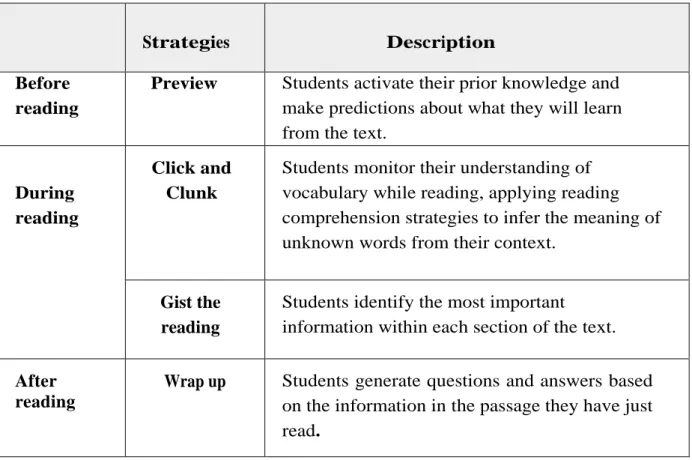
CSR consists of four reading strategies that students apply before, during and after
reading a passage in a peer-mediated learning environment. Researchers such as
(Klingner, Vaughn, & Boardman, 2015), classify this strategies: Preview, the Click and
Clunk, get the Gist and Wrap up; these are effective models for improving reading
comprehension. The table below includes a brief description of each one.
Table 3. Reading Strategies
Strategies Description
Before reading
Preview Students activate their prior knowledge and make predictions about what they will learn from the text. comprehension strategies to infer the meaning of unknown words from their context.
Gist the reading
Students identify the most important
information within each section of the text.
After reading
Wrap up Students generate questions and answers based on the information in the passage they have just read.
Note: Descriptive Chart for the explanation of the theory of collaborative strategic reading
Source: (Klingner, J. K., Vaughn, S., & Boardman, A, 2015). Elaborated by: Figueroa, D (2019)
When teachers apply CSR, they need to consider several things:
27 Support for Students - Once students have mastered the strategies, the teacher should
introduce longer sections of the text (for example, first paragraphs, then sections, then
chapters). Teachers should also help students make connections between content and
their prior knowledge.
Student Progress - By using the CSR approach students will apply each strategy in
turn. It is beneficial for students to keep record their thinking over each strategy in their
learning journals.
Students use the learning journals to write students’ predictions ("clunks"), the
essentials ("gists") and final review questions ("wrap-up review questions"), create a
permanent record so teachers can examine their progress, study for future exams, tests
and create a base for other activities and keep a track of their learning and create
follow-up activities.
Preview Reading Strategy
The purpose of this pre-reading strategy is to allow students to learn as much as they can about the text in a short time, think about what they already know about the text, predict what it says about the subject using the elements such as titles, subtitles, graphics and illustrations, terms in bold
Click and Clunk Strategy
After completing the Preview strategy, students apply Click and Clunk strategy. The
purpose of this strategy is to allow students to monitor your understanding of the
meanings of words while reading, identify unknown vocabulary and use reading
comprehension strategies to understand the text.
The words that students understand instantly are called clicks, while the ones that do not
make sense to them and interfere with students’ understanding are called Clunks. The
clunks are analogous to street bumps that impede the progress of reading
comprehension.
2.2.15. Strategies to Avoid Clunks while developing Reading Comprehension
The teacher demonstrates the difference between a click and a clunk. The teacher
reinforces this distinction by reading or asking the class to read a short section of text
28 & Vaughn, 2012), states students who find a clunk must apply one or more of the four
reading comprehension strategies:
1. Reread the sentence as if the clunks were a blank space and try to guess another
word that could be appropriate instead of it. It is very possible that clunk is a
synonym.
2. Reread the sentence with the clunk and the sentences before or after it to look
for clues (for example, other words or phrases that can indicate the meaning of a
clunk partially).
3. Find a prefix or suffix in the clunk that might help define its meaning.
4. If possible, divide the clunk into smaller, familiar words that could indicate the
meaning of it (p.342).
To figure out the meanings of these clunks, students can use a group of strategies to
identify words (for example, reading comprehension strategies). Teachers must decide
how much text students should read before stopping to click and hit. For example, the
text may consist of a paragraph, a section of multiple paragraphs, a page. Each of these
has its advantages and disadvantages: Generally, reading shorter texts leads to greater
comprehension but may require more class time, while longer ones shorten the total
activity time but may not encourage the same depth of understanding of the text.
2.2.16. Get the Gist Strategy
During their reading, students apply the Gist reading Strategy. The purpose of this
strategy is to help students identify central ideas as they read, increase comprehension
of the text and reformulate the main idea in ten words or less. The teacher explains the
students how to reformulate the most important idea of a text section using their own
words. The teacher assigns a passage to read.
Students identify the most important idea of a text section by using the following steps:
1. Identify if the paragraph is primarily about a person, a place or a thing.