UNIVERSIDAD DE CUENCA
FACULTAD DE FILOSOFÍA, LETRAS Y CIENCIAS DE LA EDUCACIÓN
CARRERA DE LENGUA Y LITERATURA INGLESA
"Teachers’ Perceptions on Inclusive Education for High School Students with Special -
Education Needs Associated with Disabilities in the EFL Classrooms of District Two of the Ministry of Education – Cuenca, Ecuador."
Trabajo de Titulación previo a la obtención del Títulode Licenciada en Ciencias de laEducación en Lengua y Literatura Inglesa.
AUTORA:
Andrea Abigail Robayo Nugra C.I.: 0925367823
DIRECTOR:
Dr. Fabián Darío Rodas Pacheco C.I.: 0101867703
CUENCA – ECUADOR
RESUMEN
La enseñanza de un lenguaje extranjero requiere de un aprendizaje constante, práctica y esfuerzo hacia el perfeccionamiento del idioma meta, que en este caso es el inglés. Sin embargo, como facilitadores del proceso de enseñanza-aprendizaje de un nuevo idioma, los docentes deben aumentar sus conocimientos y experiencias en el ámbito de la educación inclusiva. Este estudio examina la comprensión general y las percepciones de una muestra de diecisiete profesores de inglés de la parroquia Sucre de la ciudad de Cuenca sobre la
educación inclusiva, las necesidades educativas especiales (NEE) y las discapacidades. En consecuencia, esta información se recopiló a través de encuestas y entrevistas aplicadas a docentes de establecimientos tanto públicos como privados. Los hallazgos muestran que, a pesar de la predisposición de los participantes, la falta de preparación y conocimiento sobre el tema produce una perspectiva algo negativa hacia la inclusión de estudiantes con NEE
asociadas a discapacidades en los contextos educativos regulares.
ABSTRACT
Teaching a foreign language requires constant learning, practice and effort with the purpose of perfecting the target language, which in this case is English. Notwithstanding, as facilitators of the teaching-learning process of a new language, teachers should also increase their knowledge and experiences in the scope of inclusive education. This study examines the general understanding and perceptions of a sample of seventeen high school English teachers from the Sucre parish of the city of Cuenca towards inclusive education, special-education needs (SEN), and disabilities. Accordingly, this information was gathered from surveys and interviews applied to teachers from both private and public institutions. The findings show that despite the participants’ predisposition, the lack of preparation and knowledge in the field produces a somehow negative perspective related to the placement of students with SEN associated with disabilities in mainstream contexts.
TABLE OF CONTENTS
2.1. A brief historical background of inclusion……….16
2.1.1. The emergence and failure of the “integration” stage...……….18
2.2. Inclusion today………20
2.3. Disability and SEN……….23
2.3.1. International view about disability………..23
2.3.2. National view about disability……….25
2.3.3. SEN……….27
2.4. Ecuadorian laws regarding SEN associated with disabilities………30
CHAPTER III: METHODOLOGY………33
3.2. Participants and Context………..34
3.3. Data Collection Techniques……….36
3.4. Procedure……….39
CHAPTER IV: DATA ANALYSIS AND RESULTS………...40
4.1. Survey Results……….40
4.2. Interviews Interpretation……….63
CONCLUSIONS………67
RECOMMENDATIONS………...69
REFERENCES………...70
APPENDICES………75
Appendix A. Survey Template………76
Appendix B. Interview Template………79
DEDICATION
I dedicate this work to my family who have supported me in all my academic and professional development.
I especially dedicate this work to my lovely sister for her kind and thoughtful words
ACKNOWLEDGEMENTS
I wish to express my gratitude to the University of Cuenca and its teachers for
generously guiding my passion for education and a special thanks to Dr. Fabián Rodas for his help and guidance through this academic process.
INTRODUCTION
Disabilities and special-education needs have been extremely related to inclusive education, sometimes narrowing this broad and diverse topic down into a specific group of people. The misunderstanding and lack of knowledge towards inclusion, special-education needs or disabilities leads to a major struggle when trying to implement an inclusive environment. Therefore, this study focuses on the inclusion of students with special-education needs associated with disabilities.
In this context, inclusion is a process which should not be merely reduced to practice since it has to first be understood as a mind transformation which will, eventually produce effective practices. Accordingly, many challenges may appear on the way to achieving an effective inclusive class, for instance, teachers realizing their lack of preparation, the class size, time constraints, etc.
This terminology has been frequently used in educational fields, and EFL teachers are not the exception. Inclusive practices have appeared in Ecuadorian contexts in the last years. Thus, this study aims at exposing the basic definitions and terminology currently used in Ecuador as well as presenting international views. Moreover, this research examines in-service English teachers’ ideas on what inclusive education is; teachers’ perceptions towards the placement of students in mainstream context are analyzed as well.
CHAPTER I THE STUDY 1.1 Delimitation of the problem
The United Nations (1948), within the Universal Declaration of Human Rights in article 26, state that "Everyone has the right to education." Everyone may imply that each and every person should have access to education no matter his/her physical or mental abilities,
religion, gender, and sexual orientation. In Ecuador, over the years and together with a series of circumstances, this right has promoted the so-called inclusive education that nowadays is closely related with students with special-education needs [SEN] associated with disabilities. However, this relationship between inclusion and disabilities is not enough. As Ainscow & Miles (2009) explain, defining inclusive education is still a difficult and confusing field.
An English as a Foreign Language [EFL] classroom should not be an exception to inclusion in any aspect. Teaching English as a foreign language, as any other subject, has the potential to implement inclusive practices since they allow teachers and students to feel comfortable with diversity rather than seeing it as a problem (The United Nations
Educational, Scientific and Cultural Organization [UNESCO], 2005). An inclusive classroom for students with SEN associated with disabilities, in order to be successful, needs positive teachers’ attitudes towards it (Niemeyer & Proctor, 2002). Understanding inclusion or SEN and implementing an inclusive classroom for students with SEN associated with disabilities has become a challenge due to teachers’ lack of knowledge towards inclusion or disabilities.
process. The goal of doing this research is to determine those teachers’ perceptions and knowledge in order to provide a perspective of the current reality of Cuenca’s public and private high schools as regards the extent to which EFL education is immersed in inclusion for students with SEN associated with disabilities.
1.2. Justification and Background
Inclusion is nowadays a paradigm which aims at functional and organizational changes within both private and state educational institutions as well as specialized and mainstream ones. Inclusive education is a challenge for everyone: authorities, parents, teachers, and students. Taking into consideration that each student learns in a different way, teachers should not forget those students who may have SEN whether associated with disabilities or not.
It should be stated that the term inclusion, in a general manner, is a broad topic. As stated by the UNESCO (1999), in a revision of the Salamanca Statement:
Inclusion is to be seen as part of the wider struggle to overcome exclusive discourse and practices, and against the ideology that each individual is completely separate and independent. Inclusion is about the improvement of schooling. Rather than being a marginal theme concerned with how a relatively small group of pupils might be attached to mainstream schools, it lays the foundations for an approach that could lead to the transformation of the system itself (p.9).
Consequently, the attitudes or beliefs teachers may have towards inclusion or disabilities will define their actions or decisions at the moment of teaching. Thus, a teacher should be a guide who is responsible for creating inclusive practices. As Arnaiz (2012) mentions, it is crucial for a teacher to have knowledge on the content of the subject as it is to facilitate inclusive learning among students.
In spite of the fact that inclusion is a wide topic, it is necessary to narrow this research down to the inclusion of students with SEN associated with disabilities (physical, intellectual, auditory and visual). In Ecuador, policies have been implemented concerning inclusive education and SEN associated with disabilities. To name one, the Ley Orgánica de Discapacidades (The Organic Disabilities Act) [LOD] in its 27th Article states that:
The state will ensure that people with disabilities can have access to, remain and finish, within the National Education System and Superior Education System, their studies, in order to obtain education and/or training, attending classes in a specialized institution or an institution of mainstream school education, as appropriate”
(Presidencia de la República del Ecuador, 2012, p.11).
Therefore, with some of the insights provided, it is relevant to find out teachers’ views towards the topic to give the English teaching community a current reality about inclusive education and increase teachers’ desire to broaden their interest, reflection, and active participation in the field.
1.3. Research question
1.4. Aim
1.4.1. General Objective
To analyze in-service English teachers' perceptions and knowledge towards the inclusion of students with SEN associated with disabilities.
1.4.2. Specific Objectives
• To analyze the pertinent literature which deals with basic concepts about inclusion and SEN associated with disabilities.
• To find out Ecuadorian legal background procedures in terms of inclusive classrooms for students with SEN associated with disabilities.
CHAPTER II
THEORETICAL FRAMEWORK 2.1 A brief historical background of inclusion
In order to conceptualize the different ideas for inclusion as well as its current implications, it is necessary to start from a historical review of the term, its background and the previous concepts which made possible the arrival of inclusive education to daily conversations in classrooms as well as in Teaching English as a Foreign Language [TEFL] settings.
Inclusion symbolizes a transformation within the education system. For this reason, the defining of “Inclusive Education” results have been both extensive and diverse.
According to Thomas and Loxley (2007), this term first appeared in 1988 when a group of educators, writers, and parents concerned about the exclusion faced, at that time, in Frontier College, Toronto, came up with the new idea of “inclusive education” to reject exclusion and encourage participation. This new perspective of inclusion is the main attribute of the
Salamanca Statement and Framework for Action on Special Needs Education agreed by representatives of ninety-two governments and twenty-five international organizations. This statement considered requirements to promote inclusive education so that schools may guarantee education for all children, especially those with SEN (UNESCO, 1994).
Laws (1935) which gradually decreased truancy in all states. These laws established a penalty for those who did not obey the law; nevertheless, even when children were supported by laws to attend schools, those who had disabilities were clearly left behind. Deffenbaugh and Keesecker (1935) in The Compulsory School Attendance Law stated “...or that his bodily or mental condition has been such as to prevent his attendance at school or application to study for the period required, the penalty previously mentioned shall not be incurred” (p.7). This assertion made possible the deduction that those children were not considered able to obtain education. Moreover, one of the exemptions that the state of Oklahoma enacted was “if prevented by mental or physical disability” (Deffenbaugh & Keesecker, 1935).
Consequently, as Stainback & Smith (2005) expressed, not all changes were positive, and less so for students with disabilities. In addition, the “separate but equal” mandate
conceived in 1850 formally established segregation throughout the country. The same authors mentioned that it was not until 1817 that Thomas Gallaudet settled the first educational program for children with disabilities at the American Asylum for the Education and Instruction of the Deaf and Dumb in Connecticut. However, children who became part of such institutions or those who stayed at home were isolated, called mentally retarded and not properly treated (Stainback & Smith, 2005).
Religious or philanthropic organizations used to sponsor places for those pupils who might need special attention. These separate, special schools became part of the national education arrangements as well. In later years, however, it had been questioned and
In the late 1900s in the United States, the separate and special-education schools were no longer as popular as they used to be. According to Stainback, as cited by Stainback and Smith (2005), the case of Brown vs. The Board of Education in 1954, in which the Supreme Court abolished the racial segregation of black students within schools, encouraged different groups to rethink the isolated education that children with disabilities were having in the special schools. Treppa (1988) marks two groups which strove to show the needs of children with disabilities to lawmakers: The National Association for Retarded Citizens [NARC] and The Council for Exceptional Children [CEC]. In 1975, Congress enacted Public Law 94-142, known as the Education for All Handicapped Children Act. It was later amended in 1997 and is currently known as the Individuals with Disabilities Education Act [IDEA]. This act was created to assure children with disabilities free appropriate public schooling and the
emergence of Individualized Educational Programs [IEP] (Treppa, 1988). Additionally, as Stainback and Smith (2005) point out, in 1958, NARC efforts led Congress to provide funds for preparing leaders in special education, who also started to support the rights of students with disabilities to be educated within mainstream settings alongside their same age and nondisabled peers.
2.1.1 The emergence and failure of the “integration” stage
As a result of these series of events, the integration of children with disabilities began to be part of most mainstream public schools. It meant that integration rose due to the
‘normal’ life. In that sense integration presupposes some kind of segregation” (p.27). Another reason why the integration stage failed was due to the misuse of the terms and categorization. Ainscow (1999) expresses that a problem for industrialized countries, regardless of the integration policies for students with disabilities, was that they started being categorized, so their institutions could earn resources. Therefore, a term such as ¨the integration pupils” was used to describe students with disabilities. The disapproval of labeling phrases for students with disabilities demanded a wider and more progressive adjustment. To define the term integration, Elshabrawy and Hassenein (2014) in accordance to Barton, mention “Integration follows a ‘deficit’ medical and/ or psychological explanation of disability, where
“deficit” diagnosis, categorization, and individual treatments are stressed and usually disguised under the traditional special educational provisions” (p.35). In other words, children with disabilities were accepted in mainstream schools, but they had to adapt in the school. How did it differ from inclusion? Elshabrawy and Hassanein (2014) state that
“Inclusion, where the school accepts the child and all those in the school (adults, pupils, and the institution as a whole) will adapt as best as they can in order to meet the child’s needs” (p.36). This adaptation from the school goes from rethinking attitudes to physical environment. Besides, it will positively affect, not strictly the pupil with a disability but the whole group of students as well.
Ainscow (1999) illustrates another failure of the integration stage. Different ways of segregation derived from integration since this new pattern followed several practices of special education, such as the support for the child with disabilities. He asseverates:
For example, in England we have seen the proliferation of largely untrained
individualized education plans has encouraged colleagues in some schools to feel that even more children will require such responses, thus creating massive budget
problems in many parts of the country (p.5).
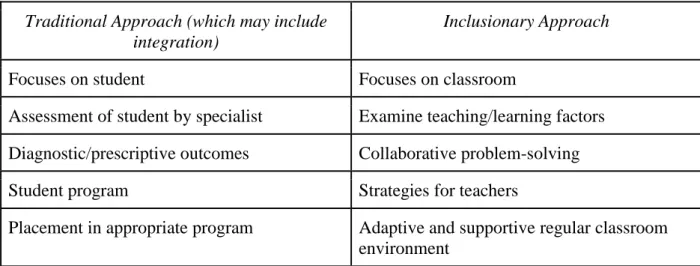
In conclusion, Ainscow (1999) points out the need to personalize the lesson rather than individualize it since the idea is to involve the whole class. In an attempt to settle certain differences between integration and inclusion, Porter (1997) creates a list of what is called the traditional approach (includes integration) and the inclusive approach.
Traditional Approach (which may include integration)
Inclusionary Approach
Focuses on student Focuses on classroom
Assessment of student by specialist Examine teaching/learning factors Diagnostic/prescriptive outcomes Collaborative problem-solving
Student program Strategies for teachers
Placement in appropriate program Adaptive and supportive regular classroom environment
Table 1. Traditional approach vs. Inclusionary approach. (Porter, 1997). 2.2 Inclusion today
After a brief historical background of the term inclusion, different perspectives and conceptualizations will be approached to establish the wide and dynamic idea of inclusive education.
To start with, the UNESCO (2005) defines inclusive education as “a dynamic
In order for inclusion to be implemented effectively, countries need to define a set of inclusive principles together with practical ideas to guide the transition towards policies addressing inclusion in education. The principles of inclusion that are set out in various international declarations can be used as a foundation. These can then be interpreted and adapted to the context of individual countries (p.6).
Additionally, a definition for inclusion provided by Sharma & Mahapatra (2007) in their book Emerging Trends in Inclusive Education states that:
Inclusion is a term which expresses commitment to educate each child, to the
maximum extent appropriate, in the school and classroom he or she would otherwise attend. It involves bringing the support services to the child (rather than moving the child to the services) and requires only that the child will benefit from being in the class (rather than having to keep up with the other students) (p.17).
Furthermore, inclusion, as a general term might be related to a person’s life in a diverse manner. Escribano and Martinez (2013) define inclusion as “…a process of equal participation of all members of a society in their different areas: economic, legal, political, cultural, educative, etc.” (p.6). When taking into account the educative area, Ainscow (1999) encourages to consider that the background, culture and experiences of different schools will always be idiosyncratic but useful to build inclusive practices. He has provided some ideas that will help with the development of inclusive education. They are as follows:
● using existing practices and knowledge as starting points for development; ● seeing difference as opportunities for learning rather than problems to be
fixed;
● scrutinizing barriers to pupil participation;
● developing a language of practice; and
● creating conditions that encourage a degree of risk-taking (p.14). There are several perspectives and definitions for the term inclusion. Index for Inclusion is a book written by Booth and Ainscow (2011), which encourages the inclusive development of schools, originally in England. They consider that “Inclusion is about increasing participation for all children and adults. It is about supporting schools to become more responsive to the diversity of children’s backgrounds, interests, experience, knowledge, and skills” (p.9). Also, these authors mention what inclusion in education involves as follows:
● Putting inclusive values into action.
● Viewing every life and every death as of equal worth. ● Supporting everyone to feel that they belong.
● Increasing participation for children and adults in learning and teaching activities, relationships and communities of local schools.
● Reducing exclusion, discrimination, barriers to learning and participation. ● Restructuring cultures, policies and practices to respond to diversity in ways
that value everyone equally.
● Linking education to local and global realities.
● Learning from the reduction of barriers for some children to benefit children more widely.
● Viewing differences between children and between adults as resources for learning.
● Acknowledging the right of children to an education of high quality in their locality.
● Emphasizing the development of school communities and values, as well as achievements.
● Fostering mutually sustaining relationships between schools and surrounding communities.
● Recognizing that inclusion in education is one aspect of inclusion in society (p.11).
2.3 Disability and SEN
First of all, a difference in terminology should be addressed. Inclusive education does not refer to students with disabilities specifically. Ainscow, Dyson, and Weiner (2013) state that “In some countries, inclusive education is still largely thought of as an approach to serving children with disabilities within general education settings” (p.4). However, since inclusion is a response to all students’ diversity, students with SEN, whether these are related with disabilities or not, are only a group to be considered when implementing an inclusive classroom. To further expand this concept, Thomas and Loxley (2007) state: “Inclusion is more than the integration of children from specialized institutes to mainstream ones. Inclusion embraces more than “special educational needs” which might be derived of learning difficulties or disabilities” (p.182).
Thus, inclusive education is a synonym for neither SEN nor disabilities, but a benefit for all students. It is necessary to define these two concepts since this research focuses on this group of students only.
2.3.1 International view about disability
medical and a social issue; nevertheless, a balanced approach is needed (WHO, 2011). The International Classification of Functioning, Disability and Health [ICF-CY] created by the WHO (2007) views the medical paradigm of disability “as a problem of the person, directly caused by disease, trauma or other health condition, which requires medical care provided in the form of individual treatment by professionals” (p.47). On the other hand, WHO (2007) through the ICF- CY expresses that the social paradigm is “…mainly a socially created problem, and basically as a matter of the full integration of individuals into society” (p.47). Moreover, to support the idea of disability seen as both a social and a medical model, the United Nations (2006) created the Convention on the Rights of Persons with Disabilities [CRPD] which clearly defines and recognizes that “disability is an evolving concept and that disability results from the interaction between persons with impairments and attitudinal and environmental barriers that hinders their full and effective participation in society on an equal basis with others” (p.1). In accordance with the above statement, it is worth emphasizing that disability be seen as an interaction encompassing the idea that a disability is not an attribute of the person. Similarly, Luque & Luque (2015) assert that a disability goes beyond an individual or social characteristic and does not look to homogenize or categorize people; rather, it pretends to remark upon their particular characteristics, need for comprehension and support without affecting them as individuals.
contextual factors. The WHO (2011) in the World Report on Disability summarizes the first three terms as follows:
• Impairments are problems in body function or alterations in body structure – for example, paralysis or blindness;
• Activity limitations are difficulties in executing activities – for example, walking or eating;
• Participation restrictions are problems with involvement in any area of life – for example, facing discrimination in employment or transportation (p.27).
In addition, there are two contextual factors: environmental and personal. On one hand, the environmental factor refers to the extrinsic world which surrounds a person; for instance, the physical world itself, their relationships among other people, attitudes, laws, rules, etc. On the other hand, the personal factors are those contextual factors related to age, gender, social statues, life experiences, etc. (WHO, 2007).
2.3.2 National view about disability
To begin with, as said by Consejo Nacional de Igualdad de Discapacidades [CONADIS] (The National Council on Equality of the Disabled) (2013), Ecuador has adopted the international concepts on disability proposed by the WHO. Equally, the term ‘disability’ is viewed as a complex and developing concept which has faced both a medical and social model. First, a medical model where the person with a disability is seen as a patient; thus, a passive receiver in need for support. Then, this view is followed by the social model which, rather than focusing on the condition, values the human being and does not consider disability a familial, individual or minority issue but a social one. Therefore, Ecuador aims at seeing disability under an interaction of both concepts (CONADIS, 2013).
essential activities of daily life, which can be caused or aggravated by the economic and social environment” (CONADIS, 2013, p.24). Furthermore, the same organization recognizes six types of disabilities in Ecuador. They are the following:
• Physical Disability
• Visual Disability
• Auditory Disability
• Disability related to Language
• Intellectual Disability
• Psychological Disability (p.24)
2.3.3 SEN
In order to define SEN, the Vice-presidency of Ecuador along with the Ministry of Education have established some terminology. First of all, Warnock and Breman (as cited in the Ministry of Education, 2011), feel that:
A student has special-education needs when he/she presents greater difficulties than the rest of the students to access the regular curriculum, the common learning at his/her age, (either for internal causes or due to an inadequate educational approach), and in order to compensate these difficulties, the student needs learning conditions especially adapted in different elements of the regular curriculum; additionally, the supply of specific resources different of those offered to the majority of students in the school (p.9).
The Ministry of Education (2011), expresses that SEN can be permanent or transitory. On the one hand, the permanent SEN are the ones present during the student’s whole life as a result of “intellectual, sensorial, or physical disabilities, multiple disabilities or pervasive developmental disorders and learning disorders, behavioral disorders or intellectual giftedness” (p.9). Any of these SEN aforementioned requires specialized support, such as didactic, pedagogical, technological, personal (professional, familiar, and community) and/or accessibility (Ministry of Education, 2011).
As was mentioned before, the SEN classification varies around the world; however, the Ecuadorian Ministry of Education (2011) has adopted two terms which guide the
classification of the SEN. These are: SEN not associated with disabilities and SEN associated with disabilities. Both classifications will be addressed with examples of each in the
following charts:
Special-education needs not associated with disabilities
TYPE CLASSIFICATION
LEARNING DISORDERS » Dyslexia
» Dysorthography » Dysgraphia » Dyscalculia
INTELLECTUAL GIFTEDNESS » Intellectual giftedness » High giftedness » Gifts
BEHAVIORAL DISORDERS » Attention Deficit Hyperactivity
Disorder (ADHD) or Attention Deficit Disorder (ADD)
» Dissocial Personality Disorder » Oppositional defiant disorder
» Other behavioral disorders related to infancy, childhood, or adolescence.
OTHERS » Catastrophic diseases
» Human mobility » Adolescent offenders » Migration and/or refuge
Special-education needs
» This classification is given in accordance with:
» Dimension IV: Health (physical health, mental health, etiology)
» Dimension V: Context (environment and culture)
MENTAL Mental and psychotic illnesses
Personality disorders
PHYSICAL Central nervous system injuries
Peripheral nervous system injuries Musculoskeletal
Due to specific characteristics, the following disabilities are also considered: PERVASIVE DEVELOPMENTAL
DISORDERS
Autism spectrum disorders Asperger’s syndrome
Childhood disintegrative disorder Pervasive developmental disorder not
otherwise specified (PDD-NOS)
DOWN’S SYNDROME
MULTIPLE DISABILITIES The presence of two or more disabilities
Table 3. Classification of SEN associated with disabilities. (Ministry of Education, 2011). As seen above, Ecuador has a wide classification for both SEN associated with disabilities and SEN not associated with disabilities. However, currently, there are not articles, manuals or guides which may broaden this field.
2.4 Ecuadorian laws regarding SEN associated with disabilities
The Ley Orgánica de Educación Intercultural [LOEI] establishes in Article 47:
Both the non-formal and formal education shall take into account people with SEN in the affective cognitive and psychomotor aspects. The national education authority will ensure that these SEN will not become an impediment to access education. The Ecuadorian State shall guarantee the inclusion and integration of these people in educational institutions, eradicating barriers to their learning (Presidencia de la República del Ecuador, 2011, p.24).
Together with this,theLOD (2012) establishes the responsibility of the national educational authority in its Article 28:
support, such as specialized personnel, either temporary or permanent, and/or curriculum adaptations and physical accessibility, communicational, and learning spaces, in an institution of mainstream education (Presidencia de la República del Ecuador, 2012, p.11).
Therefore, the Ministry of Education, through ministerial agreement 0295-13 (2013), has established the following three main objectives for Inclusive Education in Ecuador:
a) To promote in our culture, respect for the difference, tolerance, solidarity,
harmonious coexistence and practice of dialogue, and conflict resolution;
b) To eradicate learning barriers associated with infrastructure, institutional
performance, communication systems, didactic resources, curriculum, educators, geographical and cultural context; and,
c) To educate autonomous citizens, independent, able to act jointly and actively in the
social and occupational scope (p.6).
General definitions as well as objectives for inclusion have been legally settled in institutions of mainstream public school education. Likewise, it is important to mention one of their obligations; according to the ministerial agreement 0295-13 (2013) “…these
institutions must adopt necessary measurements in order to allow the admission of those who are students with SEN associated with disabilities or not” (p.6). Supported by this
CHAPTER III METHOLODOGY
3.1. Research Approach
To begin with, there are two types of research widely used in the area of social science. They are the qualitative and quantitative approaches. Creswell (2014) defines quantitative research as an approach where the researcher aims at confirming or proving a theory by usually determining hypotheses. Furthermore, Patten (2009) explains that quantitative research is characterized by a deductive approach; a researcher usually infers from theories or literature. Additionally, in a quantitative approach, statistical and numerical results are provided by the data collection instruments, which can be generalized to a
population where a random sample is chosen. On the other hand, Creswell (2014) claims that qualitative research is an approach “for exploring and understanding the meaning individuals or groups ascribe to a social or human problem” (p.32). Moreover, the same author states that the data analysis goes from specific to general themes to conclude with the interpretation of the data by the researcher. The process of this research differs from the quantitative one since the researcher uses an inductive approach to plan the study or research. In addition, the sample is usually smaller due to the amount of time required (Patten, 2009). According to Creswell (2014), one of the biggest differences between quantitative and qualitative research is often narrowed down to the use of words or open-ended questions (qualitative) rather than numbers or close-ended questions (quantitative).
essential importance of this mixed method research is that it provides a reliable understanding of the research problem. Furthermore, assuming that the collection of data from the
quantitative and qualitative researches has both limitations and assets, it is worth considering that the dual consolidation develops a stronger perspective of the research (Creswell, 2014).
Correspondingly, since the objectives of the current research required both a
qualitative and quantitative collection of data, a mixed methods approach was employed. The type of mixed methods approach selected by the researcher is the one of explanatory
sequential mixed methods. This approach requires a two-phase study, where the researcher first collects the quantitative data and analyzes them; later, based on the findings, a
qualitative instrument appears. The aim of the qualitative data is to complement the quantitative results in a deeper manner (Creswell, 2014).
This research benefited from qualitative data collection tools, such as bibliographical research and a semi-structured interview; at the same time it also used a survey as the
quantitative tool. Consequently, due to the characteristics of an explanatory research method, the survey was carried out followed by the semi-structured interview to the sample.
3.2. Participants and Context
The Ministry of Education (n.d.) in its webpage, explains that Ecuador has adopted two terms to refer to educational institutions. These are: the inclusive (mainstream) and special-education schools. In reference to the latter term, “Special education is a form of attention of the educational system of a transversal and interdisciplinary kind and addresses students with SEN associated with disabilities, not subject to inclusion” (Ministry of
Education, n.d.). In order to be part of these schools, students with SEN must take an
is not a special-education school. An agent from the inclusive department of the Ministry of Education, UDAI, from District two of the city of Cuenca, expressed that each and every mainstream school has the parameters and obligation to be an inclusive school; hence, all public and private institutions of the city of Cuenca should implement inclusive policies and be labeled as inclusive classrooms, where students with and without SEN associated with disabilities or not enter, remain and finish their studies (personal communication, October 15th, 2016).
Once the main difference between inclusive classrooms and special-education
classrooms was explained, this research considered as its participants high school mainstream English teachers from district two of the Ministry of Education. Nevertheless, in order to explain the sample of participants of this research, it is important to delimitate some concepts. Firsy, Ecuador has twenty-four provinces according to the INEC (2010) divided into nine educational zones. The city of Cuenca, which belongs to the province of Azuay, is placed in the sixth educational zone. Furthermore, Cuenca has two educational districts (Ministry of Education, 2013). These educational districts are composed of thirty-seven rural and urban parishes made up of twenty-two and fifteen parishes respectively (INEC, 2010). This research focused its attention on district two of the Ministry of Education. This district has, between rural and urban, sixteen parishes. They are as follows: Baños, Cumbe, Chaucha, Molleturo, Turi, Valle, Victoria del Portete, Tarqui, Quingeo, Santa Ana, San Sebastián, El Batán, Yanuncay, Sucre, Huayna Capac, and Monay (INEC, 2010). In light of the above, within district two there are approximately three hundred fifty-three (353) institutions, which may be mainstream or special-education schools, public or private. These may offer: initial
elementary, middle or high school education.
fiscally controlled. Additionally, these institutions can be classified due to their educational purpose as follows: five schools that offer initial education, six which have elementary and middle school, four institutions with initial and elementary education, six schools with elementary, middle and high school education, one that offers all, initial, elementary, middle, and high school education and lastly, one institution labeled as “a non-school”. Therefore, the institutions that participated for this research are those which offer high school education, narrowing the sample down to seven institutions. They are as follows: (A) Unidad Educativa Remigio Romero y Cordero, (B) Unidad Educativa Bilingue Nuestra Familia, (C) Bilingüe Interamericano, (D) Antonio Avila Maldonado, (E) Benigno Malo, (F) Colegio Nacional Mixto Miguel Merchán Ochoa, and (G) Promoción Social Integral del Austro.
The participants of this research were seventeen (fourteen females and three males) high school mainstream English teachers from the seven previously mentioned institutions of the Sucre parish, who belong to district two of the Ministry of Education. They completed the survey questionnaire, leading the researcher to create the questions for the semi structured interview.
3.3. Data Collection Techniques
The data collection techniques applied in this research included bibliographic research, survey, and an interview.
Subsequently, a survey questionnaire was designed and carried out. A survey is one of the instruments for the quantitative approach. As explained by The European Association of Methodology (2008), “a survey can be seen as a research strategy in which quantitative information is systematically collected from a relatively large sample taken from a population” (p.2). Applying a survey has advantages, such as standardization of the
minimal, adequate, and high. Lastly, a Liker Scale was used to assess the degree of agreement or disagreement of the participants towards ten statements. Participants had to select among four options, strongly agree, agree, disagree, and strongly disagree.
Finally, the instrument employed for the qualitative data was an interview. Interviews are widely used in qualitative approaches. In the words of Edwards and Holland (2013), an interview consists of “one person asking another person questions on a particular topic or issue, and the other responding” (p.1). Besides, qualitative interviews can be classified into two types: semi-structured and unstructured. Usually a semi-structured interview consists of a list of questions to be covered with flexibility from both parts, the interviewee and the
interviewer (Edwards and Holland, 2013).
associated with disabilities, and the last question asked teachers for any experience they had had with students with SEN associated with disabilities.
3.4. Procedure
CHAPTER IV
DATA ANALYSIS AND RESULTS 4.1. Survey results
This section shows the results of the survey completed by seventeen teachers from the seven high schools previously mentioned in chapter three. It presents the results of each question in numbers and percentages together with a pie chart for better visualization. In addition, tables are used to show a subdivision in the responses among English teachers from public and private institutions.
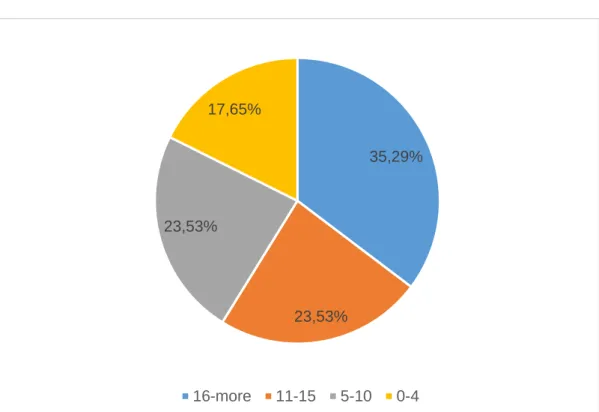
PART I: PERSONAL INFORMATION-QUESTION 1: Years of teaching experience
Figure 1. Teaching experience of the participants expressed in years. 35,29%
23,53% 23,53%
17,65%
Table 4
Participants’ teaching experience from public and private institutions.
Option Response Percentage (%)
Public Private
From 0 to 4 years 0 3 17.65
From 5 to 10 years 0 4 23.53
From 11 to 15 years 3 1 23.53
From 16 or more 6 0 35.29
As already mentioned, the survey consisted of two sections. The first section was related to personal information, in which question number one intended to show the years of teaching experience each participant has had. The results show that most of the participants (35.29%) have sixteen or more years of experience in the field of teaching English as a Foreign Language (see figure 1). In addition, these participants belong to public institutions (see table 4).
PART I: PERSONAL INFORMATION-QUESTION 3: Level(s) you currently teach
Figure 2. Current levels taught by participants in their institutions. Table 5
Participants’ current teaching level from public and private institutions.
Option Response Percentage (%)
Public Private
10th level 2 0 11.76
11th level 1 0 5.88
12th level 0 1 5.88
10th and 12th levels 1 0 5.88
11th and 12th levels 4 1 29.41
10th, 11th, and 12th levels 1 6 41.18
The following question asked participants for the level(s) they were currently teaching at the moment of the survey. The results show that participants had from one to three levels in the high school area; however, the majority of the participants specified that they teach all the
41,18%
29,41% 11,76%
5,88% 5,88%
5,88%
three levels in their institutions (see figure 2). From this majority of participants, six out the seven belong to private institutions (see table 5).
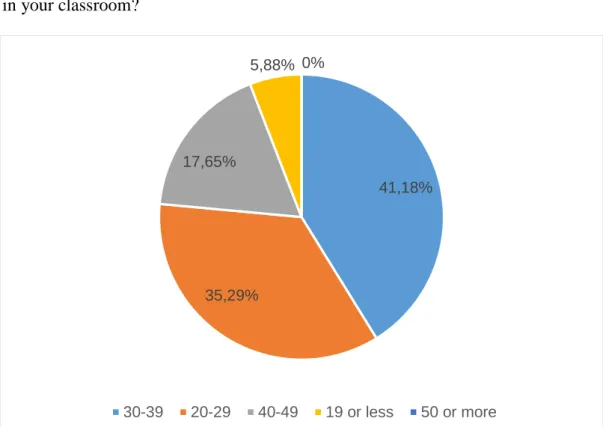
PART I: PERSONAL INFORMATION-QUESTION 4: How many students do you usually have in your classroom?
Figure 3. Approximate number of students whom participants have in their classrooms. Table 6
Approximately class size teachers have in public and private institutions.
Option Response Percentage (%)
Public Private
19 or less students 0 1 5.88
20-29 students 1 5 35.29
30-39 students 5 2 41.18
40-49 students 3 0 17.65
50 or more 0 0 0.00
In the final question of the first section, most of the participants (41.18%) claim to 41,18%
35,29% 17,65%
5,88% 0%
component in education. As mentioned in Harmer’s work (2003), overcrowded classrooms will not benefit from new and more dynamic techniques leaving no time for the teachers to deal with other aspects, such as relationships with students, identifying the strengths and weaknesses each student may have, etc. Evidently, class size is an important component at the moment of implementing an inclusive environment in any aspect, especially for students with SEN associated with disabilities.
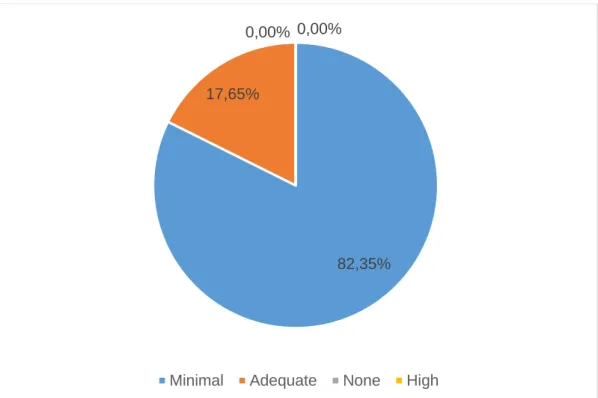
PART II: KNOWLEDGE AND ATTITUDES TOWARDS INCLUSIVE EDUCATION-QUESTION 1: My experience teaching students with special-education needs associated with disabilities
Figure 4. Teachers’ experience with students with SEN associated with disabilities. 82,35%
17,65%
0,00% 0,00%
Table 7
Participants’ teaching experience from public and private institutions.
Option Response Percentage (%)
Public Private
None 0 0 0.00
Minimal 8 6 82.35
Adequate 1 2 17.65
High 0 0 0.00
In the following section of the survey questionnaire, questions related to knowledge and attitudes were measured. The first question asked teachers about their experience
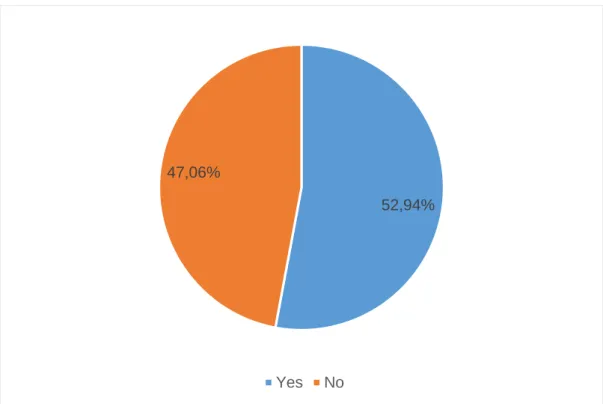
PART II: KNOWLEDGE AND ATTITUDES TOWARDS INCLUSIVE EDUCATION-QUESTION 2: Do you have students with special-education needs associated with disabilities in the classroom(s) that you are currently teaching?
Figure 5. Teachers who have students with SEN associated with disabilities in their current classrooms.
Figure 6. Students with SEN associated with disabilities according to their disability. 52,94%
47,06%
Yes No
68,00% 24,00%
8,00% 0,00%
Table 8
Participants’ responses about students with SEN associated with disabilities.
Option Response Percentage (%)
Public Private
Intellectual 14 3 68
Visual 2 4 24
Physical 1 1 8
Auditory 0 0 0
PART II: KNOWLEDGE AND ATTITUDES TOWARDS INCLUSIVE EDUCATION-QUESTION 3: What is your knowledge about methods or techniques for the different disabilities?
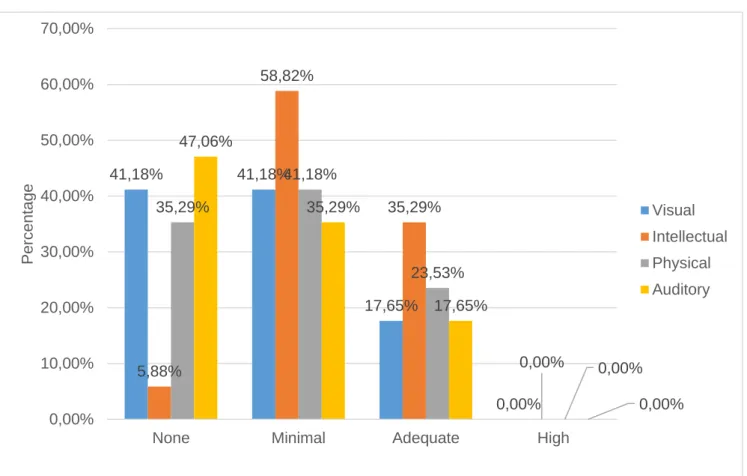
Figure 7. Teachers’ answers on knowledge about methods or techniques for each disability.
In addition, in general terms and from the participants’ personal perspectives, the knowledge about techniques or methods towards each type of disability was requested. Most of the participants asserted to have a high percentage of students with intellectual disabilities (see figure 6). Likewise the highest percentage (58.82%) about knowledge on the methods or techniques was given for intellectual disabilities (see figure 7). Besides, the highest
percentages related to the four disabilities are minimal followed by none, and unfortunately, none of the participants reported to have a high knowledge. Additionally, the auditory
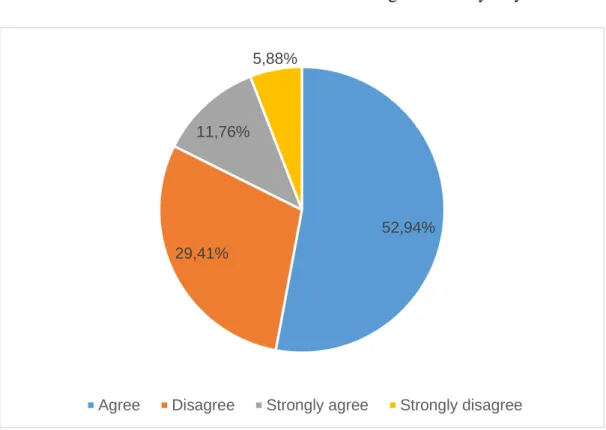
PART II: KNOWLEDGE AND ATTITUDES TOWARDS INCLUSIVE EDUCATION-QUESTION 4.1. I consider the terms “inclusion” and “integration” as synonymous.
Figure 8. The terms inclusion and integration viewed as synonymous. Table 9
Integration and inclusion viewed as synonymous by participants’ perspective from the public and private institutions.
Option Response Percentage (%)
Public Private
Strongly agree 0 2 11.76
Agree 7 2 52.94
Disagree 2 3 29.41
Strongly disagree 0 1 5.88
The last question of this second section of the survey questionnaire, was subdivided into ten statements where participants had to choose from strongly agree, agree, disagree, and strongly disagree options. The first statement aimed at showing if participants considered the terms of integration and inclusion as synonymous. The results show that more than half of the
52,94%
29,41% 11,76%
5,88%
percentage of participants, seven out of nine were from public institutions (see table 9). Nevertheless, these concepts show a process in the history of inclusion. Integration supposes a stage where mostly all the focus is on the student, the diagnosis of his ‘problem’ and further adaptation to the school; while inclusion being followed by integration, focuses on the
classroom, examines strategies, teaching-learning factors and aims at adapting the curriculum, school, environment, etc., to the student (Ainscow 1999; Söder, 1997).
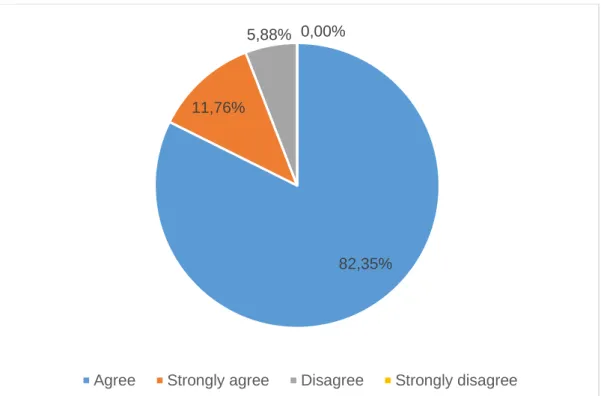
PART II: KNOWLEDGE AND ATTITUDES TOWARDS INCLUSIVE EDUCATION-QUESTION 4.2. I understand the difference between special-education needs associated with disabilities and special education needs not associated with disabilities.
Figure 9. Participants’ understanding of the difference among SEN associated with
disabilities and SEN not associated with disabilities.
82,35% 11,76%
5,88% 0,00%
Table 10
Participants’ understanding, from public and private institutions, about the difference among SEN associated with disabilities and SEN not associated with disabilities.
Option Response Percentage (%)
Public Private
Strongly agree 1 1 11.76
Agree 7 7 82.35
Disagree 1 0 5.88
Strongly disagree 0 0 0
The second statement inquired participants about their knowledge on the
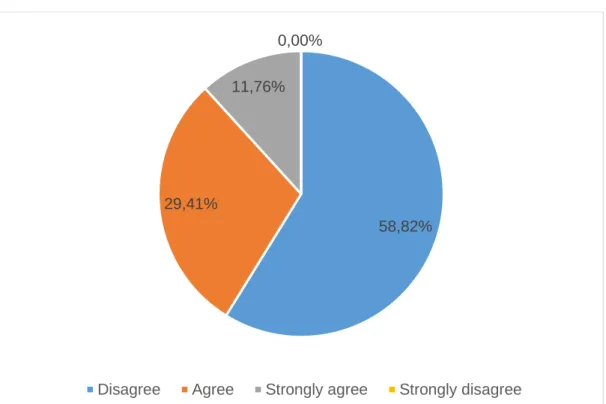
PART II: KNOWLEDGE AND ATTITUDES TOWARDS INCLUSIVE EDUCATION-QUESTION 4.3. All students with special-education needs associated with disabilities should be included in mainstream classrooms no matter the disability.
Figure 10. Participants’ opinion about the inclusion of all students with SEN regardless of
their disability in mainstream classrooms. Table 11
Opinion of participants from public and private institutions about the inclusion of all students with SEN regardless of their disability in mainstream classrooms.
Option Response Percentage (%)
Public Private
Strongly agree 0 2 11.76
Agree 4 1 29.41
Disagree 5 5 58.82
Strongly disagree 0 0 0
Regarding the third statement, the majority of participants disagreed to the idea of placing all students with SEN associated with disabilities in mainstream contexts without considering the type of disability first. On the other hand, the rest of the participants agreed to
58,82% 29,41%
11,76% 0,00%
associated with disabilities must be evaluated first in order to be placed in a mainstream school. This evaluation is done by a team of professionals of medicine, psychology, and social work (CONADIS, 2013), who in the educational field are called UDAI. As mentioned in chapter two, a student may stay in a specialized school where he/she will be considered a potential student to be placed in a mainstream school if the circumstances enable him/her (CONADIS, 2013). Besides, the results show that participants from private institutions are more willing to accept students with SEN associated with disabilities into their classrooms (see table 11).
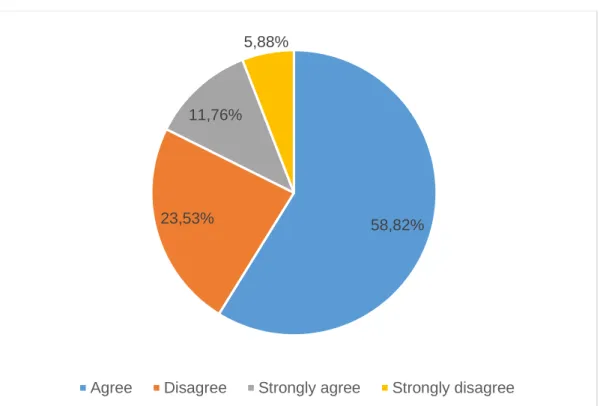
PART II: KNOWLEDGE AND ATTITUDES TOWARDS INCLUSIVE EDUCATION-QUESTION 4.4. I have knowledge of current Ecuadorian policies about students with special-education needs associated with disabilities.
Figure 11. Participants’ knowledge about current Ecuadorian policies
58,82% 23,53%
11,76% 5,88%
Table 12
Knowledge of participants from public and private institutions about current Ecuadorian policies.
Option Response Percentage (%)
Public Private
Strongly agree 0 2 11.76
Agree 5 5 58.82
Disagree 4 0 23.53
Strongly disagree 0 1 5.88
PART II: KNOWLEDGE AND ATTITUDES TOWARDS INCLUSIVE EDUCATION-QUESTION 4.5. The inclusion of students with special-education needs associated with disabilities may promote social relationships and the acceptance of differences among my students.
Figure 12. Participants’ answers about the social acceptance among students in inclusive classrooms.
Table 13
Participants’ answers from public and private institutions about the social acceptance among students in inclusive classrooms.
Option Response Percentage (%)
Public Private
Strongly agree 1 3 23.53
Agree 7 5 70.59
Disagree 1 0 5.88
Strongly disagree 0 0 0
Subsequently, the following statement asked participants if they considered that placing students with SEN in mainstream classrooms would produce social acceptance in the
70,59% 23,53%
5,88% 0,00%
PART II: KNOWLEDGE AND ATTITUDES TOWARDS INCLUSIVE EDUCATION-QUESTION 4.6. The inclusion of students with special-education needs associated with disabilities may have a negative impact in my classroom.
Figure 13. Participants considered a negative impact may arise from including students with SEN associated with disabilities.
Table 14
Participants from public and private institutions considered a negative impact may arise from including students with SEN associated with disabilities.
Option Response Percentage (%)
Public Private
Strongly agree 0 1 5.88
Agree 5 1 35.29
Disagree 4 5 52.94
Strongly disagree 0 1 5.88
In order to contrast the above mentioned information, the next statement inquired participants about their opinion towards any negative impact which may arise from having students with SEN associated with disabilities in their classrooms. On the one hand, once
52,94% 35,29%
5,88%
5,88%
again, more than half of participants disagreed to the before mentioned option (see figure 13). On the other hand, results show that more participants from public institutions considered that negative impacts may result from the placement of students with SEN associated with
disabilities (see table 14). As reported by Ainscow and Miles (2009), barriers, such as a lack of expertise, inappropriate methods or even attitudes, may limit the participation, presence, and achievement of some students; however, depending on the circumstances, these students who face these kind of barriers could motivate the improvement of the school itself, resulting in benefits for all the learners. The authors have labeled these students as the “hidden voices” (p.4).
PART II: KNOWLEDGE AND ATTITUDES TOWARDS INCLUSIVE EDUCATION-QUESTION 4.7. After finishing my EFL/ESL studies, I was competent to manage classrooms with students with special-education needs associated to disabilities.
Figure 14. Participants’ perception on their preparation after finishing their EFL studies.
41,18%
35,29% 23,53%
0,00%
Table 15
Participants’ perceptions from public and private institutions on their preparation after finishing their EFL studies.
Option Response Percentage (%)
Public Private
Strongly agree 0 0 0
Agree 4 3 41.18
Disagree 2 4 35.29
Strongly disagree 3 1 23.53
PART II: KNOWLEDGE AND ATTITUDES TOWARDS INCLUSIVE EDUCATION-QUESTION 4.8. I can identify and conceptualize the different disabilities a student may experience.
Figure 15. Participants believe they can identify and conceptualize the disabilities students may present.
Table 16
Participants from public and private institutions believe they can identify and conceptualize the disabilities students may present.
Option Response Percentage (%)
Public Private
Strongly agree 0 0 0
Agree 3 4 41.18
Disagree 5 4 52.94
Strongly disagree 1 0 5.88
Additionally, participants were requested to express their agreement at the moment of identifying and conceptualizing the disabilities students may present. A high percentage of participants disagreed to this statement (see figure 15). On the one hand, the results show that
52,94% 41,18%
5,88% 0,00%
identifying and conceptualizing disabilities. On the other hand, participants from public institutions are more likely to disagree to this option (see table 16).
PART II: KNOWLEDGE AND ATTITUDES TOWARDS INCLUSIVE EDUCATION-QUESTION 4.9. There are special-education needs associated with disabilities inappropriate for mainstream classrooms.
Figure 16. Some disabilities are inappropriate for mainstream schools. Table 17
Participants from public and private institutions consider the existence of some disabilities inappropriate for mainstream schools.
Option Response Percentage (%)
Public Private
Strongly agree 0 1 5.88
Agree 7 5 70.59
Disagree 2 2 23.53
Strongly disagree 0 0 0
70,59% 23,53%
5,88% 0,00%
Once again, the next statement shows the agreement of participants who consider that there are some inappropriate disabilities for the mainstream context. As has been previously mentioned, Ecuadorian policies specified that the entrance of students with SEN associated with disabilities is a task determined by medical and educational professionals. Regarding this assertion, a total of 76.47% of participants expressed their agreement (see figure 16, table 17).
PART II: KNOWLEDGE AND ATTITUDES TOWARDS INCLUSIVE EDUCATION-QUESTION 4.10. Inclusive education refers only to the inclusion of those students with special-education needs associated or not with disabilities.
Figure 17. Inclusive education refers only to the inclusion of those students with SEN associated with disabilities.
64,71% 29,41%
5,88% 0,00%
Table 18
Participants from public and private institutions consider inclusive education as the inclusion of those students with SEN associated with disabilities only.
Option Response Percentage (%)
Public Private
Strongly agree 0 0 0
Agree 6 5 29.41
Disagree 3 2 64.71
Strongly disagree 1 0 5.88
Finally, the last statement inquired of participants their ideas on relating inclusive education exclusively to the inclusion of those students with SEN associated with disabilities. The findings show a decidedly large percentage of participants who considered inclusive education is solely related to students with SEN associated with disabilities (see figure 17). In addition, participants from both public and private institutions show a higher number of participants who agree to this claim (see table 18).
4.2. Interview Interpretations
After the quantitative data were analyzed, the researcher interviewed the seventeen participants in order to obtain more reliable data which complemented the above mentioned results. The responses must be interpreted according to the objectives of this research; a report of the most relevant answers will be given in the following paragraphs.
other hand, nine participants provided an answer somehow related with disabilities. Inclusive education was addressed as a plan or program specifically for students with special needs or disabilities.
When referring to SEN associated with disabilities and those not associated with disabilities, the answers varied. For instance, some participants considered both terms as being the same, others expressed their lack of knowledge about the terms. Lastly, a group of teachers attempted to mention differences among them. The SEN associated with disabilities were exemplified as the physically or mentally impaired, students using crutches or wheel chairs, those with health problems, diseases or illnesses; some of the participants explained that SEN associated with disabilities are skills which some students are not able to do, or are not as equal as those in regular classes. The SEN not associated with disabilities caused confusion among some participants since they viewed both terms as synonymous.
Nevertheless, examples for this group of SEN were pregnancy, house problems, emotional fields, or everything not related with the physical aspect. In general terms, participants struggled to recognize, define, or exemplify both SEN. In addition, participants mentioned the types of disabilities according to their opinions. Most of them listed or exemplified physical, visual, hearing or auditory, and intellectual disabilities; however, examples which are not considered as disabilities were reported, such as social issues, behavioral (i.e. attention deficit disorder), and learning disorders (i.e. dyslexia). As it was stated in the
Participants were also asked about a general perspective on placing students with SEN associated with disabilities in mainstream contexts. In order to obtain accurate responses, the interviewer made sure both SEN associated with disabilities and mainstream terms were well understood by all participants. Participants who currently have students with SEN associated with disabilities, or as a matter of fact had worked with them, explained their unconformity as to having them in their classes. One of the common reasons was the management of the teaching process in a short period of time, owing to the double performance the teacher has to do with both groups of students. Participants also expressed their emphasis on the idea that teachers are not prepared to have students with SEN with disabilities. Additionally, some participants agreed to the fact that some disabilities (i.e. transitory physical) are more accessible than others; hence, depending on the disability, students should be placed into special-education schools. So far, most of the participants’ answers had expressed how difficult having students with SEN associated with disabilities could be for a teacher. Nevertheless, one participant focused on the positive experience students may face. This participant explained that despite the fact that difficulties may arise, providing a mainstream experience for both students with and without disabilities is important in creating a sensitive environment in a classroom.
disabilities feel comfortable in a regular classroom without distinction or a different treatment than his classmates.
Finally, due to the challenges and restrictions above mentioned, participants expressed their lack of preparation to manage a class with students with SEN associated with
CONCLUSIONS
Nowadays, inclusive education has become a controversial aspect in Ecuadorian classrooms. Subsequently, Ecuador has established guidelines and regulations in order to apply this widespread system. After analyzing the results and the collected information along this research paper, it can be concluded that inclusive education is still linked to the
differentiated plan for students with disabilities rather than a global method which can benefit all students.
Hence, the experiences and explanations provided by the sample showed that Ecuador is living an integration stage where the focus remains on the student. Thus, creating different planning for a single student where the content is modified according to his needs or
providing extra time in the regular hour class so that the teacher can focus on helping the student with the disability, are clear examples of the stage of integration students with SEN associated with disabilities may face in mainstream contexts.
Despite the fact that the findings of this study should not be generalized, this study should be considered as a preliminary investigation that analyzes a sample of English
RECOMMENDATIONS
Teaching English as a foreign language to students with special-education needs (SEN) can be a hard task for teachers due to the multiple challenges and limitations described along this study. Therefore, this research paper together with the research findings and
conclusions, recommends the following:
1. Creating dialogues among EFL teachers should be an implemented strategy in order to reflect on the difference between integration and inclusion stages.
2. Considering the fact that before planning or requiring practical strategies for teaching students with SEN associated with disabilities, reflection and investigation should be the first steps to produce a mentality change.
3. Analyzing the pertinent documents, ministerial agreements, trades, etc., freely offered in the Ministry of Education webpage, is necessary in order to grasp a better and general understanding about the change on inclusive education Ecuador is engaged in. The most relevant documents, although just a few, have been mentioned in this research paper and can be contrasted with the international views.
REFERENCES
Ainscow, M. (1999). Understanding the development of inclusive schools. http://dx.doi.org/10.4324/9780203016619
Ainscow, M., Dyson, A., & Weiner, S. (2013). From inclusion to exclusion: Ways of responding in schools to students with special educational needs. Retrieved from http://files.eric.ed.gov/fulltext/ED546818.pdf
Ainscow, M., & Miles, S. (2009). Developing inclusive education systems: how can we move politics forward? Retrieved from
https://pdfs.semanticscholar.org/e849/cf5de98a03304867093fff0a5d8265a6e20e.pdf Arnaiz, P. (1996). Las escuelas son para todos. Siglo Cero, vol. 27. Retrieved from
http://www4.congreso.gob.pe/comisiones/2006/discapacidad/tematico/educacion/Las-Escuelas-para-todos.htm
Arnaiz, P. (2012). Effective and inclusive schools: How to promote their development. Educatio siglo XXI, vol. 30. Retrieved from
http://revistas.um.es/educatio/article/view/149121
Booth, T., & Ainscow, M. (2011). Index for inclusion: Developing learning and participation In schools. Frenchay, BS: Centre for Studies on Inclusive Education (CSIE).
CONADIS. (2013). Agenda nacional para la igualdad en discapacidades. Retrieved from
http://www.consejodiscapacidades.gob.ec/wp-content/uploads/downloads/2014/03/agenda_nacional_discapacidades.pdf
Creswell, J. (2014) RESEARCH DESIGN: Qualitative, Quantitative, and Mixed Methods Approaches. Los Angeles: Sage publications, Inc.
Edwards, R., & Holland, J. (2013). What is qualitative interviewing? Retrieved from http://eprints.ncrm.ac.uk/3276/1/complete_proofs.pdf
Elshabrawy, E., & Hassanein, A. (2014). Inclusion, disability, and culture.
http://dx.doi.org/10.1007/978-94-6209-923-4
Escribano, A., & Martínez, A. (2013). Inclusión educativa y profesorado inclusivo: Aprender juntos para aprender a vivir juntos. Madrid: NARCEA, S.A. DE EDICIONES. Graham, L., & Scott, W. (2016). Teacher preparation for inclusive education: Initial teacher
education and in-service professional development. Retrieved from http://library.unimelb.edu.au/
Harmer, J. (2003). How to Teach English? Malaysia: Person Education Limited INEC. (2010). Base de Datos-Censo de Población y Vivienda. Población y
Demografía. Retrieved from http://www.ecuadorencifras.gob.ec/base-de-datos-censo-de-poblacion-y-vivienda-2010-a-nivel-de-manzana/
Luque, D., & Luque, M. (2015). Students with special needs of educational support;
psychoeducational aspects in an inclusive frame. Perspectiva Educacional. Formación de profesores, vol. 54 (2). Retrieved form
http://www.redalyc.org/pdf/3333/333339872005.pdf
Ministerio de Educación. (2011). Respuestas a las necesidades educativas especiales.
Retrieved from
https://drive.google.com/file/d/0Bxl4LLo2QyyJWEZTN2lvWXJVUGs/view Ministerio de Educación. (2013). Acuerdo N° 0295-13. Retrieved from
http://educacion.gob.ec/wp-content/uploads/downloads/2013/08/ACUERDO_29513.pdf