
Influence of online shopping e service quality on consumers' perceptions and behavior
144
0
0
Texto completo
(2) Acknowledgments ........................................................................................................................... 4 Chapter 1 ......................................................................................................................................... 6 1.1 Introduction ............................................................................................................................. 6 1.2 Significance of the study ...................................................................................................... 11 1.3 Research problem ................................................................................................................. 13 1.4 Thesis Organization .............................................................................................................. 13 Chapter 2 ....................................................................................................................................... 15 Study objectives .......................................................................................................................... 15 2.1 General objective .................................................................................................................. 15 2.2 Specific objectives ................................................................................................................ 15 2.3 Justification and theoretical motivation ................................................................................ 16 2.4 Principal research questions ................................................................................................. 17 2.5 Contribution to existing literature ......................................................................................... 17 Chapter 3 ....................................................................................................................................... 19 Literature review and hypotheses ............................................................................................... 19 3.1 Service .................................................................................................................................. 19 3.1.1 Service Features ............................................................................................................. 20 3.1.2 Services' classification ................................................................................................... 22 3.1.3 Service Provision Stages ................................................................................................ 24 3.1.4 Applicability ofService Features ................................................................................... 24 3.2 Quality .................................................................................................................................. 25 3.3 Service quality ...................................................................................................................... 26 3.3.1 Expected service quality ................................................................................................ 28 3.3.2 Perceived service quality ............................................................................................... 32 3.3.3 Assessing service quality ............................................................................................... 33 3.4 e-service ................................................................................................................................ 35 3.4.1 E-service delivery process ............................................................................................. 37 3 .5 e-service quality .................................................................................................................... 37 3.5.1 Dimensions of electronic service quality (e-sq) ............................................................. 38 3.5.2 e-service quality models ................................................................................................. 42 3.6 Consumer satisfaction ........................................................................................................... 48 3. 7 Consumer behavior ............................................................................................................... 51 3.8 Purchase intentions ............................................................................................................... 52 3.9 Brand loyalty ........................................................................................................................ 53 3.10 Corporate image .................................................................................................................. 55 3.11 Communication ................................................................................................................... 56 3.12 E-commerce in Mexico ....................................................................................................... 57 3.13 Hypotheses .......................................................................................................................... 58 3.13.1 Hypothesis framework ................................................................................................. 59 2.
(3) Chapter 4 ....................................................................................................................................... 61 Study design ................................................................................................................................ 61 4.1 Sampling ............................................................................................................................... 61 4.2 Instrument Design ................................................................................................................. 61 4.3 Pilot test ................................................................................................................................ 62 4.4 Data collection ...................................................................................................................... 64 4.5 Construct of measurements and non-parametric tests .......................................................... 66 Chapter 5 ....................................................................................................................................... 67 Data analysis and findings .......................................................................................................... 67 5.1 Instrument analysis ............................................................................................................... 67 5.2 Variables ............................................................................................................................... 68 5.3 Cluster analysis and Descriptive statistics ............................................................................ 81 5.4 Hypotheses tests .................................................................................................................... 85 5.5 Discussion ............................................................................................................................. 91 Chapter 6 ....................................................................................................................................... 95 Conclusions ................................................................................................................................. 95 6.1. Managerial implications ...................................................................................................... 95 6.2 Conclusions ........................................................................................................................... 98 6.3 Study limitations and directions for future research ........................................................... 103 Reíeren ces ................................................................................................................................... 104 Appendices .................................................................................................................................. 131 A.1. Instrument ......................................................................................................................... 131 A.2 Pilot test survey descriptive statistics n=l 15 ..................................................................... 134 A.3 Pilot test survey variable histograms n=l 15 ...................................................................... 135 A.4 Pilot test survey regression and correlation analysis first group n=5 l .............................. 138 A.5 Pilot test survey regression and correlation analysis second group n=64 .......................... 140 A.6 Variable frequencies .......................................................................................................... 142 A. 7. Regression analysis for satisfied and unsatisfied consumers ............................................ 145. 3.
(4) Chapter 1 1.1 Introduction World development indicators report that in 2010 the world economy increased 4.2 percent, a quick rebound from 2.3 percent in 2009 and well above the annual average of 2.9 percent since 2000. Indicators reveal that a proficient service sector plays a fundamental role in the economic growth. Furthermore, services represent more than two thirds of the World Gross Domestic Product (GDP) (World Bank, 2012). Reports indicate that during 2010, lower middle-income economies increased 6.9 percent and low-income economies 5.9 percent; meanwhile, highincome economies, which account for 68 percent of the world's GDP, increased 3.1 percent. Thus, this has been identified that developing economies grew faster over the last decade than in the previous two years and faster than high-income economies. According to the World Bank research, Mexico is amongst the economies catalogued as low and middle-income (World Bank, 2012). Mexico presented a GDP increment of 5.4 percent during 2010, which indicated an important progress since its average annual growth was 2.1 percent from 2000 to 201 O. Regarding the service sector in Mexico, the average annual growth was 2.5 percent from 2000 to 2010. Moreover, the service sector in Mexico accounted for 62 percent of the GDP during 2010 (World Bank, 2012). There is a fast growing activity in commerce and service investment. The unique and specific service features such as intangibility, inseparability, variability, and perishability clearly differentiate services from goods (Regan, 1963; Zeithaml, 1981). Based on those natural service features, services are enclosed in a classification of search, experience, and credence services (Nelson, 1970; Darby and Kami, 1973). Service features are significant when they are used under the appropriate circumstances, conditions and stages in which they apply (Edvardsson, Gustafsson, and Roos, 2005). Those conditions arise during the development of the stages of the service provision proposed by Moeller (201 O) in which, he recognized the three stages of the service provision, including, facilities, transformation, and usage, based on the integration of consumers' resources into the company's service process. High quality services impact production costs and, therefore, company competitiveness and the degree of integration into global markets. Quality is described as "the single most important force.
(5) leading to the economic growth of companies in international markets" (Feigenbaum, 1982). Therefore, the most highly researched area of the service marketing field is service quality (SQ) (Fisk, Brown and Bitner, 1993), which has been the dominant focus of scholars and practitioners. Ekinci, Riley, and Fife-Schaw ( 1998) defined SQ as the gap amongst consumer expectations and perceptions. Thus, the two variables to ascertain service quality are expected service quality and perceived service quality. Expectations are attributed to the service itself, the context, and characteristics of the consumer (Oliver, 1980); what consumers expect from a service, is as varied as their education, culture, values, and experience, amongst others (Davidow and Uttal, 1988). Services are heterogeneous, thus, consumer expectations and perceptions may be swayed by the ultimate lack of homogeneity. Desired service is separated from adequate service by a zone of tolerance, and it represents the extent to which a consumer identifies and is prepared to accept heterogeneity during the service provision process. The tolerance zone expands and contracts, denoting the difference between desired service and adequate service (Zeithaml, Berry, and Parasuraman, 1993), and also consumers' tolerance zones may vary (i.e. bigger or smaller) depending on the related dimension (Walker, and Baker, 2000). Previous studies indicate that perceived performance, in fact, does impact perceived SQ (Haistead, Hartman, and Schmidt, 1994). Service consumers have distinct perceptions regarding what SQ represents for them, and those perceptions are influenced by factors such as: culture, environment, context, situational factors, personality traits, socioeconomic leve!, service attributes, and social responsibility (McCallum and Harrison, 1985). The importance of explaining the consumers' perceptions on the quality of a service provided the need of framing models that measure service quality emerging around the North American and the Nordic European school of thought. Services, nowadays, are offered in a different way, that is, in the virtual realm. The virtual world is ruling commerce worldwide and more services are now being distributed online. Internet has changed the way commerce is performed between vendors and buyers. Electronic commerce (e-commerce) is transforming companies' business dynamics and driving them toward reframing consumer service supply (Voss, 2003). Throughout Internet use, companies develop web services to cut costs and generate value-added services for their consumers (Santos, 2003; Walsh and Godfrey, 2000), who not only make use of cyberspace to obtain quality in information, but also look for quality in transactions (Parasuraman 7.
(6) and Zinkhan, 2002). During 2012, e-commerce in Mexico generated US$6.4 billion and US$9.2 billion in 2013, accounting for a 42 percent increase (AMIPCI, 2014 ). Thus, e-commerce has shown a fundamental role in the growing economy in Mexico (Palacios, 2001). The e-commerce market place embraces companies that are only operating on the Web and those operating traditionally that are exploiting the Web as a supplementary channel. Electronic services (e-services) are outlined as services provided via communication technology (Fassnacht and Koese, 2006) where online consumers, normally interact with companies throughout a suitable user interface that allows consumers, for themselves, to originate the required operation in arder to get the desired benefits (Semeijn, van Riel, van Birgelen, and Streukens, 2005). Most e-services that initiate online are by sorne mean concluded physically offline. Research studies prove that offline quality is as significant in defining total consumer satisfaction as online quality (Semeijn et al., 2005). However, those studies lack a holistic examination of the complete purchase experience without taking into consideration what is happening in each stage of the eservice delivery process and its resulting outcomes. Such holistic approach of research in eservices offered in Mexico would contribute more to describe what is happening with virtuallyoperating Mexican companies that are not successful enough in the e-commerce market. Electronic service quality (e-SQ) is defined as the degree with which an electronic service is able to effectively and efficiently fulfill relevant consumer needs (Fassnacht and Koese, 2006). Perceived service quality in an e-commerce scenario is described as the global judgment that a consumer exposes of the excellence and quality of a service used electronically, in which face-toface interactions are practically null (Kassim and Asiah Abdullah, 2010). Consumers use different criteria when evaluate quality in services, generating multi dimensions implicated in the assessment of e-sq. Further, Mexican e-consumer behavior has not been explored enough to robustly support the most important attributes that Mexican e-consumers assess in offered electronic services. E-service quality models are elemental to the measurement of e-service quality and, therefore, consumer behavior. Severa! attempts to model service quality are proposed in the literature; however, the elaboration of any instrument to measure e-service quality requires the consideration of the specific type of service, which is assessed (Tan, Xie, and Li, 2003; Francis, 2007). The latter implies that it is not possible to find generalizations through the limited research 8.
(7) that has been conducted in Latín America, especially in Mexico. Therefore, research in the Mexican electronic market must be promoted in multiple kinds of services offered through the Internet, which would help companies to clearly understand the quality attributes that they must tend to when offering online services in Mexico. E-satisfaction reflects the extent to which expectations are reached by an online service and reveals a transaction-specific feeling of a consumer, accompanied of a short-term affective response to the experience with the company and its website (Palvia, 2009). Satisfaction is associated with important consumer attitudes and post purchase behaviors, amongst them are frequency of service usage, positive word-of-mouth communication, re-purchasing intentions, service company provider recognition, recommendation, and consumer loyalty (Yang et al., 2004; Vazquez-Carrasco and Foxall, 2006). Meanwhile, dissatisfaction is considered as the antecedent of a complaining behavior and negative word-of-mouth communication (Tax, Brown, and Chandrashekaran, 1998). Within the e-commerce context, there is a lack of full understanding of online consumer behavior (Yang et al., 2003), which is imperative to understand because of its consequential impact on market success (Straub and Watson, 2001). Companies offering e-services without knowing consumer satisfiers could cause frustrated and unsatisfied consumers which, in turn, barely return to purchase an inefficient e-service. Research on Mexican consumer behavior in the field of e-services will contribute to give and actual picture of what are the most important satisfiers for consumers, what they are mainly looking for when acquiring services, how they express their satisfaction and dissatisfaction and how this impacts their future behavior. Knowing the antecedents for e-consumer satisfaction is imperative for the success of companies in the electronic Mexican market. Online transactions carry sorne degree of uncertainty and risk because service providers are less trustworthy than traditional service suppliers (Gefen, Karahanna, and Straub, 2003). Perceptions of uncertainty bring about risk perceptions which denote the consumer's own subjective chance of experiencing a loss (Chiles and McMackin, 1996). Pavlou (2003) indicates that risk perceptions influence consumers in a negative way for the adoption of e-commerce. However, perceived uncertainty and risk of making electronic transactions can be reduced throughout trust (Gefen, 2000). Many Mexican consumers are still not adopting Internet as a way of purchasing services; therefore, studies that contribute to understanding what factors represent risks for consumers when purchasing online, will help companies develop features that promote trust and 9.
(8) comfort, and assure e-consumers when purchasing their services. As a result, this will encourage the adoption of online service consumption. Overall consumer satisfaction has a high positive impact on loyalty (Semeijn et al., 2005); however, there are more antecedents to drive consumer loyalty, such as, switching barriers, corporate image, switching price, price perception, and consumer value (Gan, Cohen, Ciernes, and Chong, 2006). Additionally, the service value to achieve social integration and the service value to get a peaceful life are related with loyalty (Lages and Femandes, 2005). Consumer loyalty in an electronic environment is considered a crucial asset for online companies due to the elevated cost to bring in new consumers and the difficulty in retaining them (Gefen, 2002). E-Joya! consumers increase online companies' profits through long-time consumer commitment and diminished costs of gaining new consumers; moreover, they refer new consumers to the online company, which represents a source of profit for e-companies (Reichheld and Schefter, 2000). E-Joya! consumers can often be tended to with less operating costs, even though they also tend to buy more than a recently acquired purchaser (van Riel et al., 2001). E-satisfaction andetrust exert positive influence on e-loyalty (Kim, Jin, and Swinney, 2009). Thus, there is a path to uncover e-satisfaction and e-trust antecedents of the Mexican market, to know how they impact in the creation of e-loyal consumers and which are considered barriers to companies positioning in the e-commerce. Therefore, if electronic Mexican companies find the dimensions that their offered services must have in order to create trust and satisfied consumers, they will probably build, with every potential consumer visit, a new potential loyal consumer. A firrn's reputation impacts the expectations of a consumer regarding the offered quality (Shapiro and Moriarty, 1982), and also in how consumers perceive a company's product and/or service in comparison to those offered by direct competitors (Fombrun and Shanley, 1990), which in tum leads to a certain consumer behavior. Corporate reputation is constructed throughout the interplay of numerous messages arising from official and unofficial sources (Gotsi and Wilson, 2001), and is highly affected by how consumers perceive and react to companies' actions and words. There is a high positive relationship between the perception of service quality and consumers' disposition to recommend the firrn (Parasuraman et al., 1994). Consumers with higher perceived risk tend to participate in conversations about the service in question and are involved in word-ofmouth discussions in order to minimize uncertainty in the purchase (Midgley, 1983). A reason 10.
(9) why consumers rely in higher degree of word-of-mouth is because they perceive it to be more reliable and less biased (Zeithaml, 1981 ). Therefore, word-of-mouth communication influences in the formation of service expectations. The upsurge of e-commerce in the world has brought radical changes in the Mexican economy leading business owners to restate the way they perfonn businesses in a new globalized economy driven by innovation and technology. Company owners in Mexico establish their business strategies considering the implementation of new technologies into their companies such as the establishment of a website (Jones and Tullous, 2000). They are aware that this represents to the company the opportunity to achieve potential business expansion, as companies that set up a website contribute to e-commerce growth (Palacios, 2001 ).. 1.2 Significance of the study The application of novel technologies and their effect across the stages of service consumption is a significant area for research. Services are gradually spreading throughout the virtual world, goveming it. Most of the traditional services are extending their operations into the electronic market, others, are bom with the Web; many others are completely migrating toward it disappearing from the brick and mortar businesses. This innovative system of e-commerce is projected to grow rapidly. Mexico, cataloged as an emerging market, is not the exception and ecommerce is increasing; however, few studies have been performed in this country regarding consumers' adoption and perceptions of e-commerce. The Internet has triggered diverse changes in consumers' expectations; in the past, the personal aspects in service encounters were extremely important when acquiring a service, nowadays, true interactivity is almost null as the virtual world has been displacing this interaction through the use of a user interface, which tries to standardize the service delivery for consumers. The growth of novel technologies raises certain questions about their acceptance. Internet also changed consumers' role from being merely service receptors to becoming dynamically implicated during the production and delivery of a service (Xue and Harker 2002). Consequently, e-consumers are required to deal with a different system of customer service where there is no chance for real-time corrections to the offered service and where replies may be slow (Goetzinger, Kun Park, and Widdows, 2006). Electronic consumers also face problems related to payment altematives, delivery issues, distinct return policies, security issues, privacy 11.
(10) concerns, and website information quality and technical performance (Holloway and Beatty, 2003); hence, such modem consumers' roles in electronic services require investigation. Consumers purchase and consume a service first and, afterwards, they tend to assess and leam from their experience (Y oung, 1981 ). In this way, consumers become more and more demanding, and less willing to tolerate a poor service performance. If service fails, negative effects impact the firm including lowered reputation amongst consumers, loss of time and money, the decline of consumer trust, and a negative word-of-mouth that may influence purchase decision-making. Consumers' assessments of e-services vary from those of traditional offline services, hence, it is mandatory to better understand how e-consumers assess e-services in arder to develop and test new models, and how their assessments impact their perceptions of the overall service quality offered by electronic firms. Price does not rule the Web (Reichheld and Schefter, 2000) but better quality, which represents an important source of competitive advantage for electronic services' suppliers (Fassnacht and Koese, 2006), does have a significant impact. Service companies are aware that quality superiority offers important strategic advantages such as brand loyalty which represents a positive impact on the firm. A superior leve) of e-SQ contributes to reach the principal goals of a company, which is why e-service quality is recognized as one of the fundamental factors to determine firms' success. Therefore, consumer focused theories of e-SQ need to be developed and refined. There is scarce research of the antecedents and consequences of e-SQ, few studies consider directly how consumers value e-service quality, and limited research offer in-depth, systematic research into online shopping convenience dimensions and the specific components of each dimension (Beauchamp and Ponder, 201 O). Most of the existent scales proposed for e-SQ have been developed within a specific geographical context (predominantly the United States of America). According to Barrutia and Gilsanz (2009), theories constructed in a particular geographical context should require verification and validation in others' research performed in distinctive contexts and cultures. Because scales for measuring e-SQ vary in different contexts, just as the benefits demanded from an e-service also depend on the context. As such, it is important to explore Mexican traits in the perception and adoption of e-services.. 12.
(11) 1.3 Research problem In 1995, researchers (Mahmood, Gemoets, and Gosler) informed that Mexico was part of the twenty countries with the highest index of computer usage, besides being the second country in Latin America with the largest the IT market (Tigre, 1991). Electronic commerce (e-commerce) has changed the way organizations do business (Fernández, 2012). Companies in Mexico are rethinking their business strategy in this new environment, the e-commerce. According to the AMIPCI (Asociación Mexicana de Internet) (2014), from 2012 to 2013 the number of users with Internet access increased in 13 percent, being the greatest historical increment in Mexico. The outmost concentration of Internet use and e-commerce activity occurs in Mexico City metropolitan region constituted by the Federal District and Mexico State (Cruz González, 2000). Moreover, during 2012 e-commerce in Mexico generated US$6.4 billion and US$9.2 billion in 2013, accounting for a 42 percent increase (AMIPCI, 2014). Thus, e-commerce has shown a fundamental role in the growing economy in Mexico (Palacios, 2001 ). Although it has been predicted that e-commerce would develop at a fast pace, research shows that consumers are reluctant to buy on Internet (Lee and Turban, 2001 ), mainly due to privacy and security issues (Hoffinan, Novak, and Peralta, 1999). Elements such as lack of privacy and security directly influence consumer trust. Trust towards a firm is essential to the creation of brand loyalty; that is, if consumers do not trust a firm, the probability of them acquiring products and/or services from such firm decreases. The latter, consequently, has a negative impact on the firm's growth. For ali intents and purposes, consumers in emerging markets are more hesitant towards online purchasing. When discussing eservices (i.e. services provided online), consumers' trust and credibility towards the firm are fundamental, especially when referring to emerging markets. Consumers in Mexico tend to distrust firms; Jones and Tullous (2000) state that Mexican consumers show a degree of anxiety when it comes to the use of online platforms to purchase products and/or services. Therefore, how do consumers' instill trust and credibility towards a firm virtually, leading to brand loyalty?. 1.4 Thesis Organization Chapter 1 includes an introduction which gives an overview of the concepts that are discussed throughout the present study, that is, services, quality and e-commerce. Further, a brief discussion on the implications of Mexican e-consumers is also addressed. The Chapter also includes the. 13.
(12) significance of the study, why the study was held, and the research problem tackled in this research. Chapter 2 consists of the objectives ofthe study, the theoretical motivation that brought the research to life, and the justification of the study. The principal research questions, as well as the contributions to the existing literature are also found in Chapter 2. An extensive review of previous literature on the subject matter is incorporated in Chapter 3. There were many concepts that had to be reviewed to fully comprehend the extent of the implications of business dynamics operating online. As such, various concepts related to services, quality, consumer behavior, satisfaction, and brand loyalty were addressed. The working hypotheses, established in accordance with the literature reviewed and a framework, developed to illustrate the relationship between the hypotheses and variables, are also included. Chapter 4 comprises the study's design; it includes the methodology, sampling, the instrument's design, validation of the pilot test, data collection, the construct of measurements, as well as the nonparametric tests implemented throughout the study. Chapter 5 incorporates the analysis of the findings of this research. Each variable is analyzed along with their descriptive statistics, and the instrument is analyzed in detail. Further, the testing of each of the working hypotheses and results is presented and a general discussion on findings is included based on statistical data obtained from the analysis. And, Chapter 6 encompasses the managerial implications and conclusions associated with the study's findings; moreover, the results of the statistical analysis implemented throughout the study are consolidated to offer a clear panorama of the implications of this research. The Chapter also includes the limitations of the study as well as the directions for future research.. 14.
(13) Chapter 2 This dissertation aims to explore the various factors associated with the dynamics of e-services leading to the impact on e-consumers' behavior. Furthermore, expectations and perceptions of econsumers are analyzed in order to define the criteria and identify the dimensions used by consumers when assessing e-SQ. This study incorporates results post e-SQ perceptions such as, e-consumer intensions (repurchasing or at least revisiting the website) and behavior (word-ofmouth) (Zeithaml, Parasuraman, and Malhotra, 2002).. Study objectives 2.1 General objective The general objective of the study is to evaluate the influence of e-services' quality provided by a firrn on consumers' perceptions. Meaning that, the actual quality that consumers perceived from a service provided online may, in fact, shape their perceptions and, thus, their preferences. However, four specific objectives ofthe study were developed as follows.. 2.2 Specific objectives The first specific objective is to analyze the influence of consumers' perceptions of e-service quality on purchase decision-making and, the latter's impact on corporate image (0 1). That is, the extent to which e-consumers' perception of e-service quality may sway their purchase decisionmaking; further, the effect of a positive or negative perception of e-service quality on the firm 's reputation. The second is to determine the effect of e-service quality dimensions on e-consumer behavior leading to e-consumer satisfaction and e-loyalty (02 ). That said the effect of the dimensions such as, information, security, ease of use, usefulness, interface, might have a positive or negative influence on e-consumers' behavior. lt is maintained that distinct aspects of e-service quality have a differing impact on enhancing consumer word-of-mouth and esatisfaction, which, in tum, lead to consumer e-loyalty. Therefore, the third objective is to evaluate the influence of e-consumers' perceptions of e-service quality on word-of-mouth (03), and the fourth, to evaluate the influence ofword-of-mouth regarding e-consumers' perceptions of e-service quality on e-consumers' behavior (04).. 15.
(14) 2.3 Justification and theoretical motivation The way services are offered has changed; the virtual world is ruling commerce worldwide and more services are now being distributed via Internet. Reichheld and Schefter affirmed, in 2000, that mainly for those companies whose operations are performed in an e-commerce context, Joya! consumers are fundamental for their survival. E-loyalty is being explored, for a better comprehension, for knowing its antecedents and consequences. In 2002, Srinivasan, Anderson, and Ponnavolu studied the consequences that e-service quality has on the e-consumers' Joyalty and stated that e-Joyalty includes the commitment and positive attitude that an e-consumer takes towards the online vendor that results in a recurrent purchasing behavior. Reichheld, Markey, and Hopton (2000), established that e-Joya! consumers increase companies' profits dueto: (i) the cost reduction of gaining new e-consumers; (ii) the long term e-consumers' commitment; (iii) the consumers' willingness to pay premium prices; (iv) new e-consumers referred to the company; (v) the consumers' consumption compared to recently acquired econsumers; and, (vi) the consumers' satisfaction with Jess operating costs. The mentioned authors also assured that despite the fact that the cost to generate loyalty in electronic commerce is higher than that of establishing Joyalty in traditional services, once the bond is formed, the companies' profit growth increases at a faster pace in the electronic context. Furthermore, Reichheld, Markey, and Hopton (2000) found that e-consumers consider trust as the principal factor when they decide to purchase from an online vendor; additionally, they proved that trust has a great impact on the formation of e-loyalty, which, in tum, has a positive impact on the companies' profit. Theoretical motivation for the research also stems from the need to explore and test the concepts of e-service quality perception, consumer behavior, e-satisfaction, e-loyalty, and word-of-mouth, to find the relationships amongst them. In regards to consumers in emerging markets, there is paucity in previous literature in the context of e-shopping (Geyskens, Steenkamp, and Kumar, 1998), which has been mostly focused in the United States (Ba and Pavlou, 2002). Barrutia and Gilsanz observed in 2009 that the consequences of the e-SQ perceptions on consumer satisfaction, perceived value, trust, and loyalty are not explored enough. Therefore, there is lack of empirical research in the electronic service and e-service quality in Mexico. Furthermore, the entire process of e-service dynamics has yet to be evaluated from the consumer's perspective as well as the latter impacts on business growth. 16.
(15) 2.4 Principal research questions The emergence of e-commerce has certainly created controversy in the discussion of the creation of quality in services provided online. This has brought an overwhelming amount of definitions for the expected service quality and perceived service quality as well as the satisfaction, trust and loyalty derived from service quality. Understanding the antecedents for e-consumer satisfaction is imperative for the success of companies in the electronic Mexican market. Thus, the first research question was frarned to understand what are Mexican consumers mainly looking for when acquiring services online? That is, are they seeking satisfaction from high quality services or are they merely seeking for quality in service delivery. There are many differences between traditional services and e-services, the main difference being the lack of human contact. The interaction that exists between the service supplier and consumer when a service is provided is a significant part of consumer perception of service quality. Therefore, the second research question was what are the effects of consumers' e-shopping experiences? In other words is it possible to stimulate e-trust and e-loyalty in consumers that purchase services electronically? lt is important for finns to understand consumer purchase decision making in order to provide satisfying outcomes for both consumers and businesses. As such, a third question arose, what role does consumer perception of service quality play in their satisfaction and, therefore, their behavior? Finally, the fourth research question was how do consumers establish brand loyalty? That is, since the service is provided online, is the loyalty based on convincement of the brand's business dynamics or solely based on convenience? Thus, there is a need to uncover e-satisfaction and e-trust antecedents and attributes of the Mexican market to know how they impact the creation of e-Ioyal consumers and which are considered barriers to companies positioning in the e-commerce.. 2.5 Contribution to existing literature The vast majority of previous studies have been developed in The United States and in Europe, as is clear by the principal schools of thought on the subject matter (i.e. North American and the Nordic European school of thought). Thus, developing this study in an important emerging market as Mexico, will certainly contribute to the understanding of consumer behavior in an electronic context. Figure 2.1 illustrates the contribution of this research to existing literature. Previous literature has, in general, either focused on the creation e-service quality (i.e. from the. 17.
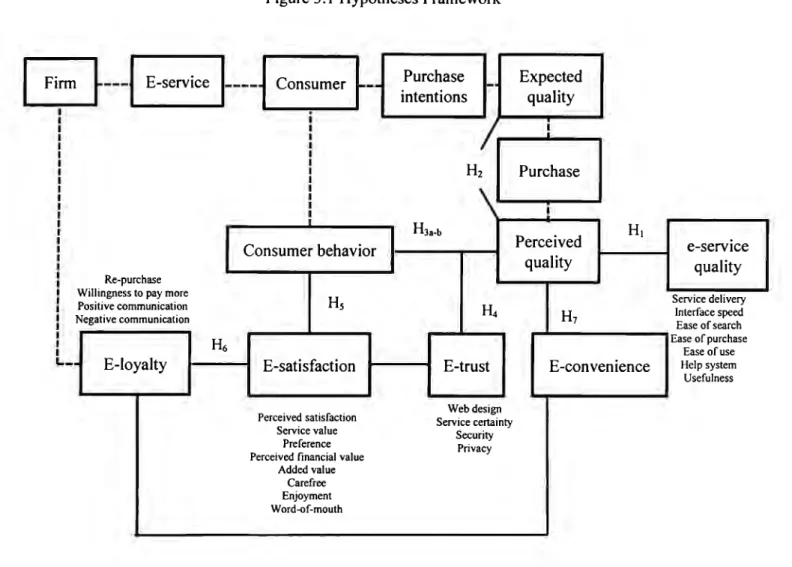
(16) firms' perspective) or the creation of satisfaction, trust, and loyalty (i.e. from the consumers' perspective). The present study seeks to understand both perspectives, that is, what dimensions of firms' dynamics provide quality in the services they offer, and what are the effects of consumers' perceptions of such quality on their purchase decision making, their behavior. Furthennore, this study contributes to existing literature by including an element that has not been addressed in the field of e-service quality, that is, the creation of e-loyalty based on consumers' preference for convenience rather than convincement ofthe brand's dynamics. That is, the consumers' tolerance for a low perception of service quality for the sake of obtaining a service conveniently. The latter ultimately has an impact on both consumer behavior and the finn. Figure 2.1 Contributions to existing literature. -. Finn 1. e-service quality 11) 1-,. :::, ~ 1-,. K. Supplier attributes. 11). ,-.. Supplier attention. 1-,. H1. .....:::,c,:s. H2. -. 1-,. 11). 11). .-::::. Hia-b. tll. .-:::: tll. :::,. o. ·;; 11) 1-,. :::,. o.. o. ·;; 11) 1-,. Cl.... Consumer Behavior. ~. Consumer. .....o e: o. ·.;:::. Hs. Loyalty. 1. -. H.. Satisfaction. Perception vs reality Trust. -. H6. :::, .D. ·e ..... e: o. u. H1. Convenience. I. 18.
(17) Chapter 3 Literature review and hypotheses 3.1 Service In 2002, services accounted far almost sixty seven percent of the world's total output (World Bank, 2002). Business in services is developing faster than other areas and accounts far approximately twenty percent of world trade (Stauss and Mang, 1999). In 1990, fifty percent of the total fareign direct investment stock was delegated to the service sector (Trade and Development Center, 2003). Evidently, the movement towards a service economy has been taking place in several countries (Reeves and Bednar, 1994). The service sector is becoming an increasingly critical factor in the economy's development in many countries in the world (Regan, 1963; Thuy and Hau, 201 O), particularly in developing countries, generating unique opportunities far ali categories of service-related companies (Malhotra, Ulgado, Agarwal, Shainesh, and Wu, 2005), recent studies show that services represent more than two thirds of the World Gross Domestic Product (GDP) (World Bank, 2012). Developing countries profit not only from increasing their exports of services, but also from acquiring access to services that are domestically not obtainable (Braga, 1996). Therefare, as the marginal attraction of services grows faster than goods, business investments and management has been addressing the service market's evolution more (Regan, 1963). Although results indicate that there is a fast growing activity of commerce and investment in services, it is well admitted that the area is practically new regarding research and literature (Clark, Rajaratnam, and Smith, 1996; Knight, 1999). Therefare, the service revolution has led to emphasize the relevance of researching in this field (Ostrom, Bitner, Brown, Burkhard, Goul, Smith-Daniels, Demirkan and Rabinovich, 201 O). Three periods have been established in reference to the evolution of services: Crawling out, Scurrying About, and Walking Erect stage. The early history of the service discipline initiated with the Crawling out stage in 1953, in which many ofthe noticeable services' marketing authors started producing their work. That was the starting period of services marketing literature, which started centering on personal services (Bowen, 1986). In 1963, Regan wrote the first servicemarketing article, describing a U.S. notable progress into a service revolution that, in tum, would lead to change consumer behavior; he also posited that market potentials pointed services as an 19.
(18) important sector for business development. Later, Judd (1964) suggested redefining services and designed a service typology. In the same manner, Rathmell (1966) offered a definition of service and stated the need to dedicate more effort for the research of the service sector. Another contribution was made by Blois (1974) who noted the significance of a service economy in the United Kingdom and, also, stressed the insufficiency of service literature. Meanwhile, Donnelly ( 1976) contributed with a research of distribution channels for services, in which he proved that marketing channels far services are considerably distinctive from physical goods channels. Thus, in the l 970s, service marketing was bom as a separated field, by divorcing itself from goods (Fisk, Brown, and Bitner, 1993; Shostack 1977). A service is a deed, a perfonnance, and an effort (Berry, 1980), essentially immaterial and can be depicted as a simultaneous action where production and consumption take place (Gronroos, 1984). Service is defined as a social action that is carried out in direct contact amongst the consumer and the service finn representatives (Nonnann, 1984); also, services are described as activities, fulfillments, and/or benefits that are offered far sale, although, at times, a service can be delivered in conjunction with the goods' sale (Regan, 1963). When a service is purchased, the consumer incurs in an expense; conversely, when a good is acquired, the consumer obtains an asset (Rathmell, 1966). The most important contribution to the service marketing literature during the Crawling Out stage was, clearly, the outlining of services features (Fisk, Brown and Bitner, 1993), intangibility, inseparability, variability and perishability, which distinguish services from products. These service features cause a tough full comprehension of services (Regan, 1963; Zeithaml, 1981 ), which could become the cause of sorne complications far scholars and practitioners regarding the detennination of quality in a service (Espinoza, 1999). 3.1.1 Service Features. Intangibility is the most defining feature of a service, which primarily differentiates it from a product. Physical products in a store are widely displayed far consumers to see, taste, touch, weigh, or sniff at befare deciding whether or not to buy. Services are immaterial (Say, 1936) and do not have a physical existence, that is, they cannot be seen, smelled or touched (Zeithaml, 1981; Mitra, Reiss, and Capella, 1999) befare choosing, although, clearly, a previous assessment based on past experience, word-of-mouth or reputation can exist. This characteristic poses a 20.
(19) unique challenge for marketers, as they need to attach tangible attributes to an otherwise intangible offering. Furthennore, intangibility is more complex for suppliers to demonstrate the attributes that a service possesses to the buyer (Judd, 1964; Milis and Margulies, 1980; Regan, 1963; Sasser, Olsen and Wyckoff, 1978; Shostack, 1977; Wilson, 1972), making it difficult for the consumer to make an assessment prior to the purchase. Say ( 1936), who first mentioned inseparability, indicated that serv1ce production and consumption happen simultaneously, as such, the latter are perceived as inseparable (Berry, 1980). Other authors state that services are expected to be sold, then, subsequently produced and consumed within the same time frame (Regan, 1963; Berry, 1980; Sasser et al, 1978; Shostack, 1977), while goods are first produced, then sold and, afterwards, consumed. The abovementioned simultaneity implies that as a request for a service is put forth, the service must be fulfilled (Bowen and Schneider, 1988). One of services' key features is that the service resource and supplier are inseparable from its consumption and consumer; this indicates that the buyer frequently contributes in the service's production, thus, affecting the quality of the service (Zeithaml, 1981 ). Therefore, inseparability highlights the indispensable interaction amongst providers and consumers (Moeller, 201 O). Variability or heterogeneity refers to the difficulty in standardizing services (Edgett and Parkinson, 1993). Heterogeneity indicates that a service varies, it depends on each supplier, consumer and, even, the day the service is provided (Gronroos, 1983; Shostack, 1977; Zeithaml, Parasuraman, and Berry, 1985); meaning that, since the same employee will not always provide the service, employees' skills and moods may diverge (Zeithaml, 1981 ), and/or consumers' perceptions may differ from one occasion to another, the service itself varies. Companies that produce physical products, in contrast, increasingly pay special attention to ensuring consistency in quality, features, packaging and so on. As mentioned earlier, services are unique and, as such, may not be precisely repeated in spite of the defined standards (Mitra, Reiss, and Capella, 1999); however, heterogeneity has been ascribed to consumers' heterogeneous participation in a process service (Palmer and Cole, 1995); thus, it has been criticized in service literature (Lovelock and Gummesson, 2004) as not being a service feature due to numerous options of standardization (e.g. a program developed for online shopping is a standardized service). Therefore, certain aspects of services can be recognized potentially offering the opportunity for standardization, while other aspects might impede it; such aspects are, thus, heterogeneous by nature (Moeller, 21.
(20) 2010). According to Vargo and Lusch (2004), heterogeneity is well associated with human's performance as opposed to that of machines. In regards to quality, it is difficult to monitor, control, and guarantee consistency in standards, as consumers frequently participate in the service's production process whilst they consume it (Palmer and Cole, 1995). Perishability has usually been related with the unavailable possibility of storing services (Beaven and Scotti, 1990; Edgett and Parkinson, 1993; Kotler, 1994; Vargo and Lusch, 2004). The term was first noted by Adam Smith ( 1776) who stated that the result of the transformation process appears to immediately perish because what remains is the perceived utility of such process. Services, unlike physical products, are considered to be perishable; therefore, firms cannot handle inventaries to manage fluctuations in demand. Unlike most physical products, perishability makes it impossible to either stock or save a service and sell it on another day (Regan, 1963; Sasser et al., 1978), neither retum or resell a service once it has been used. After a service has been rendered to a requester, it is completely consumed and cannot be delivered to another consumer. Consequently, a service is considered to be a process rather than an item (Gronroos, 1983; Shostack, 1977). The most perishable component of services' capacity is time (Rust, Zahorik, and Keiningham, 1996), as if a service is not consumed in a determined period of time, it disappears; moreover, since time is a constraint, service firms frequently contemplate reducing costs or increasing flexibility (Mitra, Reiss, and Capella, 1999) to counterbalance perishability. 3.1.2 Services' classification. Based on the natural service features above mentioned (intangibility, inseparability, variability, and perishability) services have been enclosed in a classification that has been fundamental in prior theory of search that was developed by Stigler (1961). This theory states that through search, a consumer obtains information regarding vendors, prices, and quality; the identification ofvendors and the detection oftheir prices is a fundamental activity in the search for information, unlike the search for knowledge on the quality which is, indeed, analytically more complicated. Nelson (1970) and Darby and Kami ( 1973) followed this search theory to distinguish three types of characteristics: search, experience and credence, and, later, according to service marketing researchers (Guiltinan, 1987; Ostrom and Iacobucci, 1995; Zeithaml, 1981), said characteristics have been adopted by practitioners and scholars, and customized to be used in the service sector to classify services as: search, experience, and credence services.. 22.
(21) Search services encompass attributes that can be evaluated prior to purchase (Nelson, 1970). Those mentioned attributes include color, style, and price, amongst others; although services have few search qualities (Zeithaml, 1981) because they cannot be physically exhibited or displayed, therefore, those that involve high search qualities can be practically specified and assessed prior purchase (Nelson, 1974). Experience services encompass attributes that can be perceived either after purchase or sometimes during consumption (Nelson, 1970). Those mentioned attributes include taste, consumer satisfaction, and versatility, amongst others. Those services that are high in experience qualities can be evaluated after they have been consumed (Ford, Smith, and Swasy, 1990). Once a consumer has acquired a service from a certain brand, its cost and quality are merged to provide the consumer with information to further evaluate the purchase's utility (Nelson, 1974). Credence services encompass attributes that imply that a service can roughly be evaluated; meaning, that the consumer requires highly specialized knowledge of the service to be acquired in order to evaluate its performance (Darby and Kami, 1973). For this reason a consumer of credence services has several options to choose from, but with minimal perceptible differences among them because of the high customization and the limited information conceming available altematives (Mitra, Reiss, and Capella, 1999). That is, credence services specifically demand the service supplier's personal involvement with a particular service personalization (Guiltinan, 1987; Zeithaml, 1981 ). For Zeithaml (1981), therefore, the abovementioned service features (intangibility, inseparability, variability, and perishability) lead consumers to be more perceptive of those services classified as experience and credence services than those categorized as search services. However, later, throughout research of the service features contrasting points of view have emerged from service marketing researchers (Lovelock and Wright, 2001; Gummesson, 2000; Vargo and Lusch, 2004) regarding the generalization of service features as a single entity. They argue that each service feature must be considered independently (Lovelock and Gummesson, 2004); further, they should be used when they are significant and under the appropriate circumstances for which it is necessary to comprehend the conditions and identify the stages in which they apply (Edvardsson, Gustafsson, and Roos, 2005). Those conditions arise during the development of the stages of the service provision (Moeller, 201 O).. 23.
(22) 3.1.3 Service Provision Stages. Moeller (2008) recognized the three stages of the service provision, including, facilities, transfonnation, and usage, based on the integration of consumers' resources into the company's service process. Those resources can be the consumers themselves, their belongings, their assets, and/or personal infonnation (FlieB and Kleinaltenkamp 2004). Facilities are the first stage and are considered to be the basis to generate value. They encompass each resource of the company such as know-how, technology, personnel, and machinery; researchers as FlieB and Kleinaltenkamp (2004), Mayer, Bowen, and Moulton (2003), and Shostack ( 1992) state that resources must be available befare any service provision is possible. Therefore, facilities are the primary requirement for a company befare making any offering. Transfonnation constitutes the second stage in which the company plays the role of the main resource integrator (Lusch, Varga, and O'Brien, 2007), combining company resources with consumer resources (consumer integration) to provide a service. Such combination involves knowledge application to achieve the transformation of consumer resources (Moeller, 2008). Usage, the third stage, takes place when consumer resources leave the sphere of the company; that is, the consumers, and/or their properties are no longer part of the transfonnation process, as the transfonnation is accomplished and the stage of usage and utility perception begins (Moeller, 2008). This stage, also called outcome of the service provision, is the consumer's ultimate purpose when acquiring a service, to make use ofthe resulted transfonnation ofthe resources and generate value (Moeller, 201 O). 3.1.4 Applicability of Service Features. A service provision process includes facilities that are generally tangible in nature, even company and consumer resources sometimes include tangible elements (Lovelock, 1983). Thus, the intangibility feature of services <loes not refer to the facilities or the company and consumer's resources; rather, intangibility refers to the resources' process transformation itself (Moeller, 201 O), which is the core of services (Hill, 1986). Furthermore, this is supported by Lovelock ( 1992) who states that in spite the fact that services frequently involve tangible actions, the intangibility belongs to the service performance itself. Researchers posit that providers face complications when attempting to obtain uniform service outcomes (Moeller, 201 O; Rust, 1996), highlighting, that although human beings and machines 24.
(23) contribute to consumer resources' transformation, only human performance is strongly associated to heterogeneity (Vargo and Lusch, 2004). One reason is that consumer resources, during the transfonnation stage, inherently vary from consumer to consumer and the input's variability disturbs the service provision. Hence, heterogeneity can be associated to consumer resources, and not to the transfonnation itself (Moeller, 201 O). The inseparability feature of services applies to consumer resources instead of the consumer itself. The fact is that consumer resources are specifically those that are intrinsically linked to their transfonnation (Moeller, 2010). Meaning that, the consumer is not necessarily required to be present throughout the whole transfonnation process, however, the consumer's resources, in fact, need to be present. As soon as the process of transfonnation is completed, the expected outcome seems to perish instantaneously; further, the only element remaining is the consumer's perceived utility (Smith, 1776). Thus, the perishability of the outcome is not an appropriate reference to describe services (Edvardsson et al., 2005; Lovelock, 1992). However, service literature also associates perishability with the capacity of the service provider including, required facilities, equipment, and workforce, which must be ready to generate a service, although it denotes productive capacity and not the outcome itself (Lovelock and Wright, 2001). Indeed, the facilities initiate operation once the consumer resources are integrated, and to handle capacity, the provider relies on consumers' demand (Ng, Wirtz, and Sheang Lee, 1999), thus, while there are no consumer resources available, the capacity portrayed in the facilities to achieve a transfonnation of them, is the one that perishes (Lovelock, 1983). Consequently, the utmost perishable element of services capacity is, definitely, time (Rust, Zahorik, and Keiningham, 1996). 3.2 Quality Previous literature indicates that there is no universal definition on quality or a definite quality model (Reeves and Bednar, 1994). In 1987, The Intemational Organization for Standardization (ISO) issued intemational standards for quality systems, which later were adopted by the American National Standards Institute (ANSI) and the American Society for Quality (ASQ), in which a definition of quality has been standardized as: "The totality of features and characteristics of a product or service that impact its ability to satisfy given needs" (ISO 8402:. 25.
(24) 1986, 3.1 ); clearly this definition suggests that quality in a product and/or service must meet consumer expectations and requirements (Parasuraman, Zeithaml and Berry 1985). Scholars have strived to relate the concept of quality to a wide variety of factors; accordingly, quality has been detennined as (i) a value (Feigenbaum, 1951; Abbott, 1955; Reeves and Bednar, 1994), (ii) the accordance with product and/or service's requirements (Crosby, 1979), (iii) the achievement of the product and/or service's purpose (i.e. fitness for use) (Juran, Gryna and Bingham Jr, 1974), (iv) the compliance with the product and/or service's specifications (Levitt, 1972; Gilmore, 1974; Reeves and Bednar, 1994), (v) consumers' perspective of a product and/or service meeting or exceeding their expectations (Gronroos, 1983; Parasuraman, Zeithaml and Berry 1985; Ekinci, 2008). In spite of quality's different approaches and definitions, quality has been described as "the single most important force leading to the economic growth of companies in international markets" (Feigenbaum, 1982). According to Zeithaml (1988), perceived quality is the judgment of consumers regarding overall excellence of a product and/or service. He argues that perceived quality involves a total evaluation that resembles attitude which whereby, it differs from real quality. Therefore, researchers have stressed distinction between perceived and objective quality (Dodds and Monroe 1985; Holbrook and Corfinan 1985; Jacoby and Olson 1985), for sorne ofthem, objective quality defines the real technical excellence of the services and/or products, and refers to quantifiable and verifiable superiority on defined standards (Hjorth-Anderson 1984; Monroe and Krishnan 1985).. 3.3 Service quality The most highly researched area of service marketing field is service quality (SQ) (Fisk, Brown and Bitner, 1993), which has been the dominant focus of scholars and practitioners. The origins of the service quality research lays in studies of consumer satisfaction theory developed by Oliver in 1980, and in conceptual work from Europe with the contribution ofthe researchers Gronroos in 1983, Lehtinen and Lehtinen in 1991. Feigenbaum (1983) clearly detected the high significance of services, and proposed to add them to the quality definition as follows: "product and service quality can be defined as the total composite product and service characteristics of marketing, engineering, manufacturing and maintenance through which the product and service in use will meet the expectations ofthe consumer" (Feigenbaum, 1983).. 26.
(25) Researchers, then, changed the focus defining SQ, taking consumers' perspective into consideration (Chiu, 2002). At that time, Gronroos (1984) proposed SQ as the result of the evaluation process, through which a consumer compares expectations against the service received; this definition was later supported by Ladhari (2009). Then, Parasuraman, Zeithaml, and Berry (1988) explained service quality as "the difference between perceived and objective quality". Ekinci, Riley, and Fife-Schaw (1998) defined SQ as the gap amongst consumers' expectations and consumers' perceptions. In the same line, Duffy and Ketchand (1998) proposed SQ as meeting consumers' expectations. Meanwhile, Dabholkar, Shepherd, and Thorpe (2000) posited that SQ is the subjective evaluation of service performance made by the consumers, and also, it was defined as a type of attitude which involves a general judgment associated with the excellence ofthe service (Stewart, Hope, and Muhlemann, 1998; Jun, Yang and Kim, 2004). The most widely used definition of SQ, nevertheless, is to meet consumers' expectations, defined by Parasuraman, Zeithaml, and Berry in 1985 (Chiu, 2002). These researchers concluded that it is not possible to evaluate SQ across the existent methods meant to measure quality within goods, just because of the uniqueness of service features (intangibility, heterogeneity, inseparability, and perishability) that distinguish SQ from product quality, making it a distinctive, more abstract, and elusive construct (Parasuraman, Zeithaml and Berry, 1988). As a result, these authors theorized SQ as a form of attitude. SQ, hence, is explained as a form of attitude by Parasuraman, Zeithaml, and Berry (1985). The definition of attitude is "a mental and neural state of readiness, organized through experience, exerting a directive or dynamic influence upon the individual's response to ali objects and situations with which it is related" (Allport, 1935). This attitudinal approach involves cognitive, affective, and behavioral components (Edwards, 1990; Zanna and Rempel, 1988). Toe cognitive component refers to having knowledge on the subject, and includes beliefs and judgments. The affective component denotes the feelings regarding the subject, including emotions (Edwards, 1990). And the behavioral component explains the probable reaction to the subject according to the acquired knowledge and feelings (Weiner, 1998). However, after performing research, Bagozzi and Bumkrant ( 1979) assert that attitudes are formed by cognition and affect elements and, that both, must be used as simultaneous predictors of behavior criteria.. 27.
(26) There is a trend, furthermore, in SQ research, toward delimiting the affective and cognitive component of service quality (Parasuraman, Zeithaml, and Berry, 1994), since they are seen as different components that have their own influence during the consumption process (Chiu, 2002). Thus, this attitudinal approach has received much attention in service marketing literature and has been supported empirically (Erevelles, 1998). Accordingly, in Lutz' proposal (1986) two forms of quality dominate, affective quality and cognitive quality. Affective quality is defined as the faculty to produce a change in primary emotions: mood and feelings. While a primary emotion exists inside the consumer, affective quality exists in the stimulus (Russell, 2003). For Lutz (1986), affective quality is predominantly concerned with services where attributes can be evaluated simply during consumption (experience attributes). Cognitive quality requires the conscious information processing (Oliver, 1980). Further, as consumers debate the reasons of their preferences, a cognitive attitude element becomes clear (Millar and Tesser, 1986). Complementarily, Lutz (1986) noted that cognitive quality predominantly is performed in situations where attributes can be assessed before consumption (search attributes), which enables the consumer to be cognitively aware of the components of the offering to be obtained before acquisition. In light of the above approaches, researchers (Gronroos, 1984; Lewis, Orledge, and Mitchell, 1994) denoted two variables to ascertain service quality: expected service quality and perceived service quality. 3.3.1 Expected service quality. Consumers constantly fluctuate during the process of buying a service; frequently they know their expectations, especially with uncommonly used services (Cameron and Whetten, 1983). Researchers argue that understanding, determining and measuring consumer expectations is a challenge (Cronin and Taylor, 1992; Lawrence and Reeves, 1993). Because of its variability, it is a complex task to predict either if a service will meet or fall short of consumers' expectations (McCallum and Harrison, 1985). Expectations vary from person to person, and, are shaped by different factors (Davidow and Uttal, 1988), including but not limited to: externa! company communication (traditional marketing) (Calonius, 1989; Gronroos, 1984; Parasuraman, Zeithaml, and Berry 1985), previous experience with a service (Garfein, 1988; Smith, and Swinyard, 1983), the information they have heard and/or read about a service (Bitner, 1992), and culture (idiosyncratic responses to different situations, beliefs, values, among others) (McCallum and. 28.
(27) Harrison, 1985; Pantouvakis, 2013). Therefore, expectations are attributed to the service itself, the context, and characteristics of the consumer (Oliver, 1980). Rigorously, in Davidow and Uttal 's ( 1988) words, what consumers expect from a service, is as varied as their education, culture, values, and experience, amongst others. Olson and Dover (1979) defined consumer expectation as prior beliefs regarding a service, which is used as reference against which service performance is judged. Shortly before, Miller (1977) termed the expected standard, outlining it, as an objective estimation of probability of performance. Also Oliver (1981) described expectations as the probabilities defined by consumers, that either a positive or negative episode might occur, which depend on their behavior.. Classification ofservices' expectations. Researchers. (Tse. and. Wilton,. 1988). conclude. that. during. the. consumer. satisfaction/dissatisfaction (CS/D) formation process more than one expectation standard exists (Walker, and Baker, 2000). Later on, Prakash (1984) confirmed three kinds of expectations: (i) predictive, which are explained as approximations of estimated performance leve), (ii) normative, that is the way a company should perform to fully satisfy to consumer, and (iii) comparative, which are the expectations formed by the consumer from other comparable brands. Similarly, the determinants of consumers' expectations regarding services were well described through a conceptual model proposed by Zeithaml, Berry, and Parasuraman (1993), where they identified three service expectations as follows: (z) desired service, (ii) adequate service, and, (iii) predicted service. Researchers highlighted that consumer service expectations must be considered into five general dimensions: reliability, tangibles, responsiveness, assurance, and empathy (Parasuraman, Zeithaml, and Berry, 1988). Desired service is the performance leve) that a consumer expects to obtain (Miller, 1977; Swan and Trawick, 1980), and it is affected by six antecedents. Such antecedents are: Enduring. service intensifiers that are factors that increase the consumer's sensitivity regarding the service; such factors are (i) derived service expectations, where the consumers' expectations are motivated by third parties, and (ii) personal service philosophy that is the consumers' belief in reference to the service's meaning and the latter's providers' correct behavior. Personal needs. 29.
(28) are those basic conditions required for the consumers' welfare including physical and psychological aspects. Explicit service promises are all the declarations that organizations make about the service offered, among them is advertising, which influences the way consumers understand objective and vague evidence regarding quality (Deighton, 1984; Hoch and Ha, 1986, Ha and Hoch, 1989). lmplicit service promises are hints related with the service that enable consumers to make suppositions of the way a service is; amongst such hints are the tangibles of the service and price. Consumers sometimes use tangibles and price as altematives to identify quality (Zeithaml, 1988). Word-of-mouth communication includes personal and non-personal testimonies from third parties that transmit to potential consumers how the service is likely to be (Davis, Guiltinan, and Janes, 1979; George and Berry, 1981; Donnelly 1980). And, Past. experience refers to the consumers' earlier experience with a service that is important to form future desires (Garfein, 1988; Scott and Yalch, 1980; Smith and Swinyard, 1983). Adequate service is the minimum perfonnance service level that a consumer agrees to accept (Miller, 1977; Cadotte, Woodruff, and Jenkins, 1987), after pondering diverse factors (Parasuraman, Berry, and Zeithaml, 1991 ), such as: Transitory service intensifiers which are momentary individual factors that make the consumer intensify sensitivity towards the service, such as personal emergencies where the consumer urgently requires the service; the latter, in tum, impacts the expected standard of an adequate service, increasing the view of what is considered acceptable. Perceived service alternatives refer to consumers' perceptions of the possibility to acquire the same or better service across a distinct provider. Consumers' perceptions of an adequate service increase, when numerous service providers exist ancl/or the same consumer can provide the service for itself; the level of adequate service might be lower for those consumers who don't perceive the same options (Parasuraman, Berry, and Zeithaml, 1991). Consumers'. awareness of their role in service is the level perceived by the consumer to which they can impact the degree of service they obtain. When the consumer's contribution is crucial during the provision of a service, consumer's expectations are partially affected by the perceived perfonnance degree of its developed role (Bowen, 1989). Situational factors are incidents presented during the provision of a service. Consumers are able to perceive that such incidents are outside the jurisdiction of the company and consent certain diminution on the degree of adequate service (Parasuraman, Berry, and Zeithaml, 1991). And, Predicted service is the. 30.
(29) service leve! that consumers suppose they are probably to receive (Oliver, 1980; Olson and Dover, 1979). Predicted service, above defined, is influenced by four of the six antecedents that impact desired service as well. These antecedents consist in explicit service promises, implicit service promises, word-of-mouth communications, and past experience (Beales, Mazis, Salop, and Staelin, 1981 ). Research indicates that predicted service performs a direct role affecting satisfaction; conversely, it only indirectly influences service quality evaluation by affecting adequate service. That in mind, Parasuraman Berry, and Zeithaml after developing an empirical research in 1991, conjectured two levels for consumers' expectations: desired service and adequate service. Services, as mentioned earlier, are not, by nature, homogeneous; as such, consumers' expectations and perceptions may be swayed by the ultimate lack of homogeneity. Desired service is separated from adequate service by a zone of tolerance, and it represents the extent to which a consumer identifies and is prepared to accept heterogeneity during the service provision process. The tolerance zone expands and contracts, denoting the difference between desired service and adequate service (Zeithaml, Berry, and Parasuraman, 1993), and also consumers' tolerance zones may vary (i.e. bigger or smaller) depending on the related dimension (reliability, responsiveness, assurance, empathy and tangibles) (Walker, and Baker, 2000). Although, occasionally when desired service and adequate service have the same significance, the tolerance zone can be zero. The variation in this zone is due to variability of adequate service leve) which changes because of the circumstances, contrary to the desired service leve), that increases as the experience grows. SQ evaluation, as mentioned above, derives from comparing desired service and perceived service. However, Parasuraman, Zeithaml, and Berry ( 1985) also call that difference a gap between consumers' expectations and perceptions, which indeed, is theorized as the difference of desired and adequate service. Furthermore, expectations can also influence perceived performance as perceptions may be clouded by prior expectations (Niedrich, Kiryanova and Black, 2005).. 31.
Figure

+7
Documento similar
We argue that primary elections are most needed in safe constituencies, where the advantaged party’s candidate can usually win the general election – even if she is “low quality.”
If the concept of the first digital divide was particularly linked to access to Internet, and the second digital divide to the operational capacity of the ICT‟s, the
The potential displacement of reduction process at less negative values in the voltammograms and the changes in cathodic charge when iridium is present in the solution at
16 It is especially noteworthy that there were guilds of journeymen (though not from the maritime cargo-handling guilds). The relevance of this fact is the
Impacts of soil management practices on crop productivity, on indicators for climate change mitigation, and on the chemical, physical and biological quality of
The mission of the company is to offer an innovative product and service with quality, therefore it dedicates much of its efforts to the research and development of new
17,18 Contrary to graphene, the band gap in ML-MDS separating the valence and conduction bands is naturally large and due to the absence of inversion symmetry in ML-MDS the
The proposed positive effects of legal, ethical, economic, philanthropic and environmental dimensions of CSR on consumers’ support for corporate reputation, the selection of
